Numbers 14:23

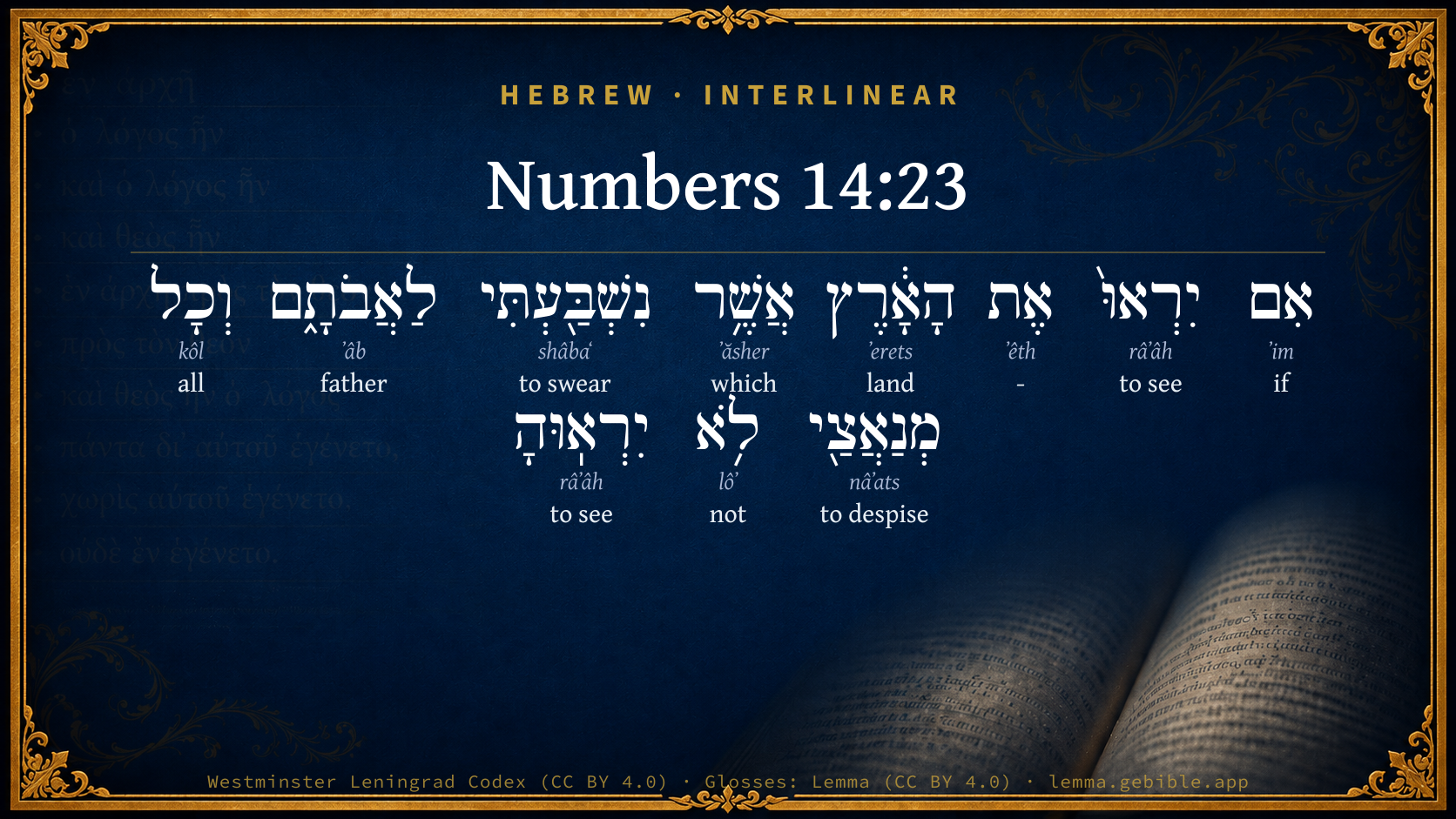
Hebrew (Westminster Leningrad Codex) Numbers 14:23 appears in the Hebrew Old Testament. The text above is from the Westminster Leningrad Codex. Each word links to its Strong’s number, a concise gloss, and parsing drawn from the Open Scriptures Hebrew Bible morphology. Click any word for its full Brown-Driver-Briggs (BDB) entry.
Download image
Cite this verse

Numbers 14:23 (World English Bible). Public Domain. Lemma interlinear Bible study tool, https://lemma.gebible.app/v/numbers/14/23.

Show BibTeX & RIS
BibTeX
RIS
English Translation
surely they shall not see the land which I swore to their fathers, neither shall any of those who despised me see it:
World English Bible · Public Domain
Download a study sheet

One document with this verse’s original text, its word-by-word gloss line, the meaning frame, cross-references with their text, attributed commentary, and full source and license credits — printable, and it pastes into notes with its structure intact.

This verse Autodidact and up

Study sheet (.html) Plain text (.txt)

A passage Seminary Student

Up to 50 verses in one chapter. A passage sheet keeps up to 6 commentary sources and 12 cross-references per verse, in the order this page ranks them, and says so on the sheet whenever that leaves anything out. Ask for a single verse and you get the Autodidact verse sheet above.

Everything on this page stays free to read, with no account — the sheet is a download of what is already on screen, not access to it.

Want to remove ads? Support Godless Engineer
Compare translations 3

The same verse in 3 English versions, stacked beneath the original-language interlinear above. Click any original word for its lexicon entry.

Each is an independent rendering of the whole verse — the interlinear is not word-aligned to these translations.

Highlighted words mark where these versions differ — a whole-verse word diff, not a word-by-word alignment.

  • World English Bible Public Domain
    surely they shall not see the land which I swore to their fathers, neither shall any of those who despised me see it:
  • King James Version Public Domain
    Surely they shall not see the land which I sware unto their fathers, neither shall any of them that provoked me see it:
  • unfoldingWord Literal Text CC BY-SA 4.0
    if they see the land that I swore to their fathers. And all the ones spurning me will not see it.

unfoldingWord Literal Text — © unfoldingWord, licensed CC BY-SA 4.0. Word-aligned USFM3 via Door43 (git.door43.org/unfoldingWord/en_ult).

Versions to compare (up to 4)

3 of 4 selected

Show all 18 translations

Every available English version of this verse, each an independent rendering of the whole verse.

  • World English Bible Public Domain
    surely they shall not see the land which I swore to their fathers, neither shall any of those who despised me see it:
  • Berean Standard Bible Public Domain
    not one will ever see the land that I swore to give their fathers. None of those who have treated Me with contempt will see it.
  • Majority Standard Bible Public Domain
    not one will ever see the land that I swore to give their fathers. None of those who have treated Me with contempt will see it.
  • King James Version Public Domain
    Surely they shall not see the land which I sware unto their fathers, neither shall any of them that provoked me see it:
  • American Standard Version (1901) Public Domain
    surely they shall not see the land which I sware unto their fathers, neither shall any of them that despised me see it:
  • Revised Version (1885) Public Domain
    surely they shall not see the land which I sware unto their fathers, neither shall any of them that despised me see it:
  • Geneva Bible (1599) Public Domain
    Certainely they shall not see the lande, whereof I sware vnto their fathers: neither shall any that prouoke me, see it.
  • Douay-Rheims (1899) Public Domain
    Shall not see the land for which I aware to their fathers, neither shall any one of them that hath detracted me behold it.
  • Young's Literal Translation Public Domain
    they see not the land which I have sworn to their fathers, yea, none of those despising Me see it;
  • Literal Standard Version CC BY-SA 4.0
    they do not see the land which I have sworn to their fathers, indeed, none of those despising Me see it;
  • Unlocked Literal Bible CC BY-SA 4.0
    So I say that they will certainly not see the land about which I made an oath to their ancestors. Not one of them who despised me will see it,
  • unfoldingWord Literal Text CC BY-SA 4.0
    if they see the land that I swore to their fathers. And all the ones spurning me will not see it.
  • Darby Bible Public Domain
    shall in no wise see the land which I did swear unto their fathers: none of them that despised me shall see it.
  • World Messianic Bible Public Domain
    surely they shall not see the land which I swore to their fathers, neither shall any of those who despised me see it.
  • Webster's Bible Public Domain
    Surely they shall not see the land which I swore to their fathers, neither shall any of them that provoked me see it:
  • Free Bible Version CC BY-SA 4.0
    not a single one of them is ever going to see the country I promised to give their forefathers. None of those who rejected me will see it.
  • Bible in Basic English Public Domain
    They will not see the land about which I made an oath to their fathers; not one of these by whom I have not been honoured will see it.
  • JPS Tanakh (1917) Public Domain
    surely they shall not see the land which I swore unto their fathers, neither shall any of them that despised Me see it.

Literal Standard Version (2020), Covenant Press — licensed CC BY-SA 4.0. Text via the HelloAO Bible API (eBible.org). Unlocked Literal Bible (unfoldingWord) — licensed CC BY-SA 4.0. Text via the HelloAO Bible API (eBible.org). unfoldingWord Literal Text — © unfoldingWord, licensed CC BY-SA 4.0. Word-aligned USFM3 via Door43 (git.door43.org/unfoldingWord/en_ult). Free Bible Version, Dr. Jonathan Gallagher — licensed CC BY-SA 4.0. Text via the HelloAO Bible API (eBible.org).

Word by word

More ways to search: Search by grammar → Find every occurrence → Compare this word →

Practice this passage: Drill this verse → Learn its vocabulary →

מְנַאֲצַ֖י
nâʼats
H5006
“despising · me”
Verb, Piel, Participle Active, Masculine, Plural, Construct + Suffix, Personal, 1st Person, Common, Singular
Part of Speech
Verb
Stem
Piel
Form
Participle Active
Gender
Masculine
Number
Plural
State
Construct
Full BDB Definition

Origin: a primitive root

TWOT: 1274

to spurn, contemn, despise, abhor - (Qal) to spurn, contemn - (Piel) - to spurn - to cause to contemn - (Hiphil) to spurn - (Hithpolel) to be contemned
  1. אִם ʼim H518 “if” Conjunction
  2. יִרְאוּ֙ râʼâh H7200 “to see” Verb, Qal, Imperfect, 3rd Person, Masculine, Plural
  3. אֶת ʼêth H853 “-” Particle, Direct Object
  4. הָאָ֔רֶץ ʼerets H776 “the · land” Particle, Definite Article + Noun, Common, Both, Singular, Absolute
  5. אֲשֶׁ֥ר ʼăsher H834 “which” Particle, Relative
  6. נִשְׁבַּ֖עְתִּי shâbaʻ H7650 “to swear” Verb, Niphal, Perfect, 1st Person, Common, Singular
  7. לַאֲבֹתָ֑ם ʼâb H1 “to/for · fathers · their” Preposition + Noun, Common, Masculine, Plural, Construct + Suffix, Personal, 3rd Person, Masculine, Plural
  8. וְכָל kôl H3605 “and · all of” Conjunction + Noun, Common, Masculine, Singular, Construct
  9. לֹ֥א lôʼ H3808 “not” Particle, Negative
  10. יִרְאֽוּהָ râʼâh H7200 “to see · her” Verb, Qal, Imperfect, 3rd Person, Masculine, Plural + Suffix, Personal, 3rd Person, Feminine, Singular

About this verse

These counts appear in no published source. They are computed here, from the morphology-tagged text and Lemma’s own curated glosses. What Lemma adds →

11
words
10
distinct lemmas
Pentateuch
section

Notable vocabulary

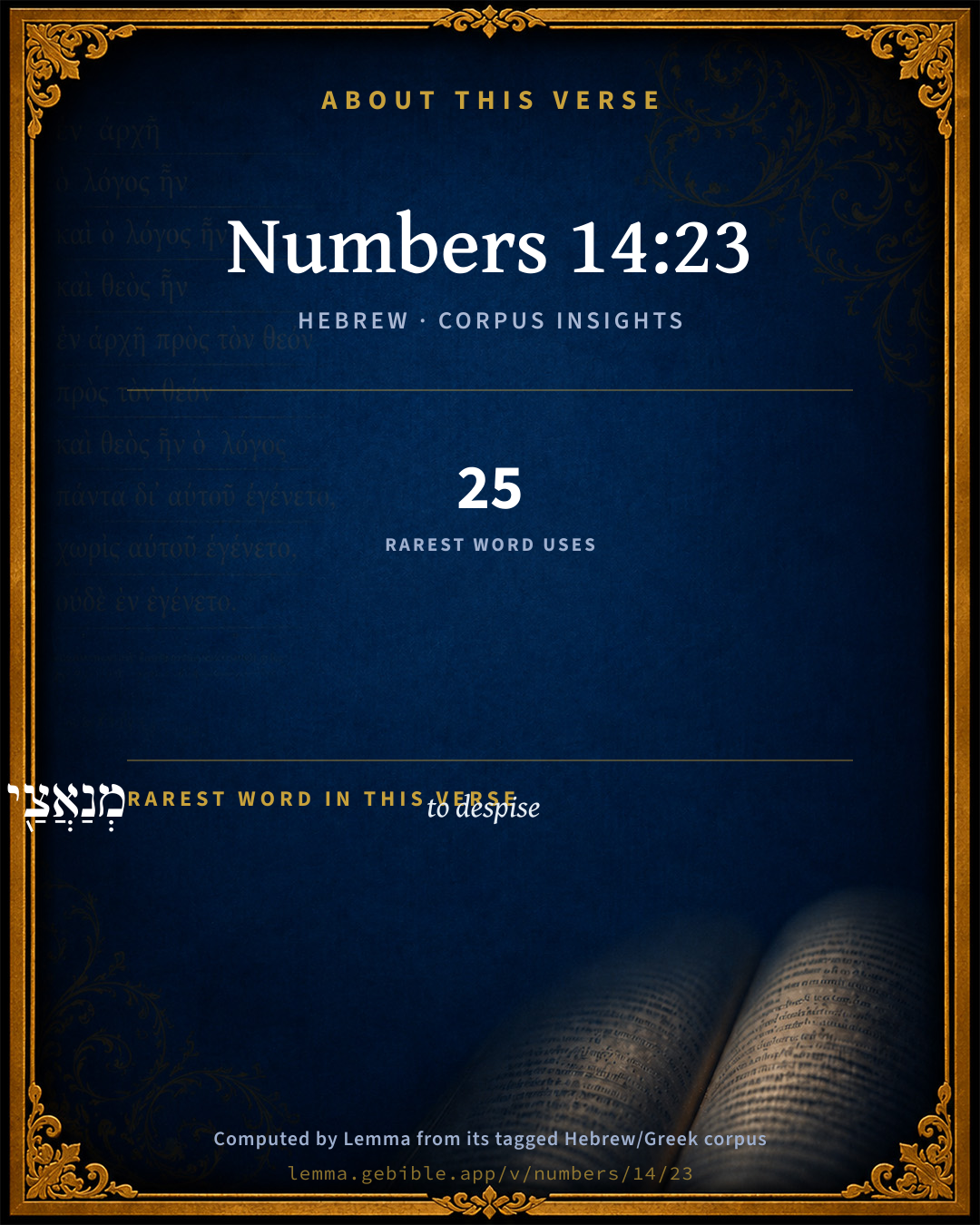
The rarest word here is מְנַאֲצַ֖י to despise H5006 — appearing just 25 times in the whole Hebrew Bible.

Shared distinctive vocabulary

מְנַאֲצַ֖י to despise H5006 occurs in 24 verses of the Hebrew Bible. Also found in:

Grammatical profile

  • 4 verbs
  • 3 nouns
  • 1 conjunction
  • 3 particles

Verb forms

  • יִרְאוּ֙ Qal · Imperfect
  • נִשְׁבַּ֖עְתִּי Niphal · Perfect
  • מְנַאֲצַ֖י Piel · Participle Active
  • יִרְאֽוּהָ Qal · Imperfect

Repetition

A word recurs within this verse — often emphatic in Hebrew:

  • יִרְאוּ֙ to see H7200 ×2

Hebrew & Septuagint length

In English translation the verse runs 23 words from the Hebrew and 48 from the Septuagint (LXX English) — the Septuagint runs noticeably longer here. See the side-by-side →

A rough comparison of the two English renderings, which tokenize alike — not a word-level alignment.

Word counts can differ between the Hebrew and the Greek without any difference in meaning — e.g. the Hebrew direct-object marker אֵת has no separate Greek word, and Greek often adds the article ὁ.

Cross-references

9

Topical passages linked to Numbers 14:23 in the Treasury of Scripture Knowledge — connected by theme and wording, ordered by reader-vote popularity; previews shown in the World English Bible.

  • Numbers 32:11 Surely none of the men who came up out of Egypt, from twenty years old and upward, shall see the land which I swore to Abraham, to Isaac, and to Jacob; because they have not wholly followed me:
  • Numbers 26:64 But among these there was not a man of them who were numbered by Moses and Aaron the priest, who numbered the children of Israel in the wilderness of Sinai.
  • Ezekiel 20:15 Moreover also I swore to them in the wilderness, that I would not bring them into the land which I had given them, flowing with milk and honey, which is the glory of all lands;
  • Deuteronomy 1:35–45 Surely there shall not one of these men of this evil generation see the good land, which I swore to give to your fathers,
  • Hebrews 3:17–18 With whom was he displeased forty years? Wasn't it with those who sinned, whose bodies fell in the wilderness?
  • Nehemiah 9:23 Their children also multiplied you as the stars of the sky, and brought them into the land concerning which you did say to their fathers, that they should go in to possess it.
  • Psalms 95:11 Therefore I swore in my wrath, "They won't enter into my rest."
  • Psalms 106:26 Therefore he swore to them That he would overthrow them in the wilderness,
  • Hebrews 4:3 For we who have believed do enter into that rest, even as he has said, "As I swore in my wrath, they will not enter into my rest;" although the works were finished from the foundation of the world.

Cross-references courtesy of OpenBible.info (CC BY 4.0).

Hebrew and Greek witnesses Masoretic Hebrew ↔ Greek Septuagint

The same verse in the two great witnesses to the Old Testament, shown verse-for-verse.

Here the Septuagint runs noticeably longer than the Hebrew — LXX2012 (modern English Septuagint) 48 words vs World English Bible 23. A rough length comparison of the two English translations, not a word-level alignment — read both below.

These are two independent witnesses, not word-aligned to each other, and the Septuagint is shown in lemma (dictionary) form.

Hebrew Numbers 14:23 Masoretic · Westminster Leningrad Codex

אִם יִרְאוּ֙ אֶת הָאָ֔רֶץ אֲשֶׁ֥ר נִשְׁבַּ֖עְתִּי לַאֲבֹתָ֑ם וְכָל מְנַאֲצַ֖י לֹ֥א יִרְאֽוּהָ

surely they shall not see the land which I swore to their fathers, neither shall any of those who despised me see it:

World English Bible · Public Domain

Greek LXX Numbers 14:23 Septuagint · lemma form

ἤ μήν οὐ ὁράω ὁ γῆ ὅς ὄμνυμι ὁ πατήρ αὐτός ἀλλά ἤ ὁ τέκνον αὐτός ὅς εἰμί μετά ἐγώ ὧδε ὅσος οὐ οἶδα ἀγαθός οὐδέ κακός πᾶς νέος ἄπειρος οὗτος δίδωμι ὁ γῆ πᾶς δέ ὁ παραὀξύνω ἐγώ οὐ ὁράω αὐτός

surely they shall not see the land, which I swore to their fathers; but their children which are with me here, as many as know not good or evil, every inexperienced youth, to them will I give the land; but none who have provoked me shall see it.

LXX2012 (modern English Septuagint) · Public Domain

On this verse, The Pulpit Commentary discusses the Septuagint’s reading. Read the note in Commentary ↓

Hebrew: Westminster Leningrad Codex (CC BY 4.0). Greek: Septuagint (public domain); English from LXX2012 (modern English Septuagint) (Public Domain). How the Septuagint differs from the Hebrew →

Targum (Aramaic paraphrase)

2

The Targum is the ancient Jewish Aramaic paraphrase of the Hebrew Scriptures — an interpretive translation, not the Hebrew text itself. Onkelos (literal) and Pseudo-Jonathan (expansive) render the Torah, and Jonathan the Prophets. Coverage is partial: where no permissively-licensed English translation exists for a verse, only the Aramaic is shown. This is verse-level text, not a word-by-word alignment to the Hebrew.

  1. Targum Onkelos Torah (Genesis–Deuteronomy)
    אִם יֶחֶזוּן יָת אַרְעָא דִי קַיֵמִית לַאֲבָהַתְהוֹן וְכָל דְאַרְגִיזוּ קֳדָמַי לָא יֶחֱזִנַהּ

    (no public-domain English translation for this verse)

    Targum Onkelos — Aramaic: “Onkelos Genesis” (public domain); “Onkelos Exodus” (public domain); “Onkelos Leviticus” (public domain); “Onkelos Numbers” (public domain); “Onkelos Deuteronomy” (public domain). English: “Sefaria Community Translation” (CC0 1.0 (public-domain dedication)); “J.W. Etheridge. The Targums of Onkelos and Jonathan Ben Uzziel on the Pentateuch. London: Longmans, Green, 1862” (public domain). Text via Sefaria.

  2. Targum Pseudo-Jonathan Torah (Genesis–Deuteronomy)
    בִּשְׁבוּעָא אֲמִירָא דָא דְלָא יֶחֱמוּן יַת אַרְעָא דְקַיֵימִית לְאַבְהַתְהוֹן וְלָא דָרָא דְאַרְגִיזוּ קֳדָמַי לָא יֶחְמוּנָהּ

    by oath have I said this, That they shall not see the land which I covenanted to their fathers; and the generation which have been provokeful before me shall not behold it.

    Targum Pseudo-Jonathan — Aramaic: “Targum Jonathan on Genesis” (public domain); “Targum Jonathan on Exodus” (public domain); “Targum Jonathan on Leviticus” (public domain); “Targum Jonathan on Numbers” (public domain); “Targum Jonathan on Deuteronomy” (public domain). English: “The Targum of Jonathan ben Uzziel, trans. J. W. Etheridge, London, 1862” (public domain). Text via Sefaria.

Commentary

Notes on Numbers 14:23 from classic Christian and Jewish commentators (each source and its license shown beneath its notes). The classic Christian expositions comment on the surrounding passage and are grouped to its opening verse, so a note may address several verses; the Jewish commentaries on the Tanakh (Rashi and others) are per-verse, so they appear only where the commentator wrote on this verse.

Lemma curates 59 commentaries, every one of them public domain or Creative Commons licensed, each selected and text-cleaned for this edition rather than reprinted as found. About our sources →

Tyndale Open Study Notes

Tyndale Open Resources

14:23-25 Having turned their backs on the Promised Land, the Israelites were now ordered to march the other way. • The Red Sea could refer to bodies of water on either side of the Sinai Peninsula (the Gulf of Aqaba or the Gulf of Suez).

Tyndale Open Study Notes — © Tyndale Open Resources, licensed CC BY-SA 4.0. Text via the HelloAO Bible API.

John Gill's Exposition

But my servant Caleb,.... Who was one of the spies, and brought a good and true report of the land; and so in that, as well as in other things, approved himself to be a faithful servant of the Lord, and who had stilled the people at the beginning of their murmur, and with Joshua had attempted to quiet them afterwards; and though Joshua is not here mentioned, because, as some say, he had no children, and therefore it could not be said of him that his seed should possess the land, as is said of Caleb; or rather, because he was to be the general and commander of the people, who was to introduce them into the land of Canaan, and therefore there was no necessity of expressing him by name, yet he is afterwards mentioned, Num 14:30,

because he had another spirit with him; different from that of the rest of the spies, excepting Joshua; a spirit of faith, and of the fear of the Lord, of might and courage, of truth and faithfulness; believing in the promise of God, which the spies distrusted, being persuaded the land might easily be conquered, which they feared; and bringing a true report of the land, the reverse of the ill and false one they brought. For this is to be understood not of the Holy Spirit of God, nor of his work upon the hearts of good men, which is different from the spirit of the world, though Caleb was possessed of that also:

and hath followed me fully; with full purpose of heart whithersoever he led him, or directed him, in every path of duty, and in the exercise of every grace; or "hath fulfilled after me" (y); obeyed his word of command, fulfilled his mind and will, by going after him, and acting according to the rules and directions he gave him:

him will I bring into the land whereinto he went; the land of Canaan he went into to spy and search:

and his seed shall possess it; not the whole land, but Hebron, and the parts about it, where he particularly went, and which he and his posterity afterwards enjoyed, see Num 13:22. The Targum of Onkelos is, "shall expel it"; the inhabitants of it; for the word signifies both to inherit and disinherit; and so Jarchi interprets it, shall disinherit the Anakim, and the people that are in it, that is, drive them out of it, as Caleb did, Jos 15:13.

(y) "et implevit post me", Montanus, Tigurine version, Fagius, Drusius.

John Gill's Exposition of the Whole Bible (1746–1763) — public domain (CC PDM 1.0). Text via the HelloAO Bible API.

Haydock's Catholic Bible Commentary

It. None of those who murmured ever entered the land of promise. Origen (hom. 27,) believes that the Levites behaved with fidelity, and were not comprised in the punishment. In effect, Eleazar certainly entered Chanaan, Josue xiv. 1. Salmon also, who espoused Rahab, had seen the wonders of God, but had not joined with the rest; so that, when it is said (ver. 2,) that all murmured, we must explain it by St. Jerome’s rule, of the greatest part; as, no doubt, many would abhor the conduct of the seditious. (Calmet) --- Omnia non ad totum referenda esse sed ad partem maximam. (St. Jerome, ep. 146. ad Dam.)

George Leo Haydock (1774–1849), Haydock's Catholic Family Bible and Commentary, 1859 edition — public domain. Excludes Psalms (Douay-Rheims chapter numbering differs from Protestant) and Deuterocanonical books (Catholic canon only).

The Pulpit Commentary

Surely they shall not see. WarYA "if they shall see," according to the usual Hebrew idiom. Cf. Psa_107:11 (Septuagint), Heb_4:3, wv wmosa ... ei eiseleusontai .

The Pulpit Commentary (1880–1919), ed. H.D.M. Spence-Jones & Joseph S. Exell — public domain. Text from a community e-Sword module.

Scofield Reference Notes

C. I. Scofield

Surely

Kadesh-barnea is, by the unbelief of Israel there, and the divine comment on that unbelief Num 14:22-38; Deu 1:19-40; 1Co 10:1-5; Heb 3:12-19 invested with immense spiritual significance. The people had faith to sprinkle the blood of atonement Exo 12:28 and to come out of Egypt (the world), but had not faith to enter their Canaan rest. Therefore, though redeemed, they were a forty years’ grief to Jehovah. The spiritual application is made in Heb 6:3-11:

(See Scofield "Heb 6:4").

The Scofield Reference Bible (1917 edition), notes by C. I. Scofield — public domain. Text from a community e-Sword module.

unfoldingWord translationNotes

Door43 World Missions Community

Connecting Statement:

Yahweh continues speaking to Moses.

because he had another spirit

Here "spirit" represents his attitude. Caleb was willing to obey God. What his attitude was can be stated clearly. AT: "because he had a different attitude" or "because he was willing to obey God" (See: Metonymy and Assumed Knowledge and Implicit Information)

translationWords

oath

servant

Caleb

spirit

possess

Amalek

Canaan

turn

desert

Sea of Reeds

unfoldingWord translationNotes — © Distant Shores Media and the Door43 World Missions Community, licensed CC BY-SA 4.0. Source: git.door43.org/Door43/en_tn.

Rashi

Rabbi Shlomo Yitzchaki (Rashi)

אם יראו means THAT THEY SHALL NOT SEE.

לא יראוה THEY SHALL NOT SEE IT — i. e. they shall not see the land.

Rashi on the Tanakh — English translations: “The Judaica Press complete Tanach with Rashi, translated by A. J. Rosenberg” (CC BY 4.0); “Pentateuch with Rashi's commentary by M. Rosenbaum and A.M. Silbermann, 1929-1934” (public domain); “The Metsudah Tanach series, Lakewood, N.J” (CC BY 4.0); and “The Book of Joshua, Metsudah Publications, 1997” (CC BY 4.0). Text via Sefaria.

Ramban (Nachmanides)

Rabbi Moshe ben Nachman (Ramban / Nachmanides)

NEITHER SHALL ANY OF THEM THAT PROVOKED ME SEE IT. This means “for none of them that provoked Me shall see it.” etc., the question arises why the same fact is repeated at the end of the same verse? Ramban answers that the second half is an explanation of the first half. And Rabbi Abraham ibn Ezra commented: “any that provoked Me of their children,” but this [explanation] makes no sense. Perhaps this expression [neither shall any of them that provoked Me see it] alludes to the generations who were to be exiled from the Land [at the time of the destruction of the First Temple], as our Rabbis have said, and it is here that He fixed that night [of the ninth of Ab] as one of weeping throughout their generations, for [on that night] He will remember their first punishment.

Ramban (Nachmanides) on the Tanakh — English translation: “Commentary on the Torah by Ramban (Nachmanides). Translated and annotated by Charles B. Chavel. New York, Shilo Pub. House, 1971-1976” (CC BY 4.0). Text via Sefaria.

Lesson kit

Teaching starters — assembled from the data on this page, not authored interpretation. Every prompt links to the verse data it draws on. Edit before teaching.

Numbers, in the Pentateuch, opens this verse with 11 words (10 distinct Hebrew lemmas). Its most distinctive word is nâʼats (“to despise”). The Greek Septuagint runs longer here. A historical commentator’s framing appears above. Read the whole chapter for the surrounding context.

Discussion questions

  1. What does “to despise” (nâʼats) contribute to the verse as a whole?
  2. Numbers 14:11 shares the word «to despise» with this verse. How do the two illuminate each other?
  3. “to see” occurs 2× in this one verse. What is the effect of the repetition?
  4. Compared with the Hebrew, the Septuagint runs longer here. What questions does that raise?
  5. These translations render this verse differently. What is at stake in choosing one wording over another?
  6. The verb «יִרְאוּ֙» is Qal Imperfect. How does its form color the action?
  7. Reading how Tyndale Open Study Notes and John Gill's Exposition read this verse, where do the two commentators agree and where do they part?

Things to notice

Reading settings

Reading text

Shown beneath each verse's original-language words.

Old Testament
Old Testament edition

Read the OT as the Masoretic Hebrew (MT) or the Greek Septuagint (LXX).

English shown for the Greek Septuagint (in the Hebrew ↔ Greek comparison).

Comparing translations? Open the Compare panel on any verse page to stack up to four side by side.