
Exodus 23:26

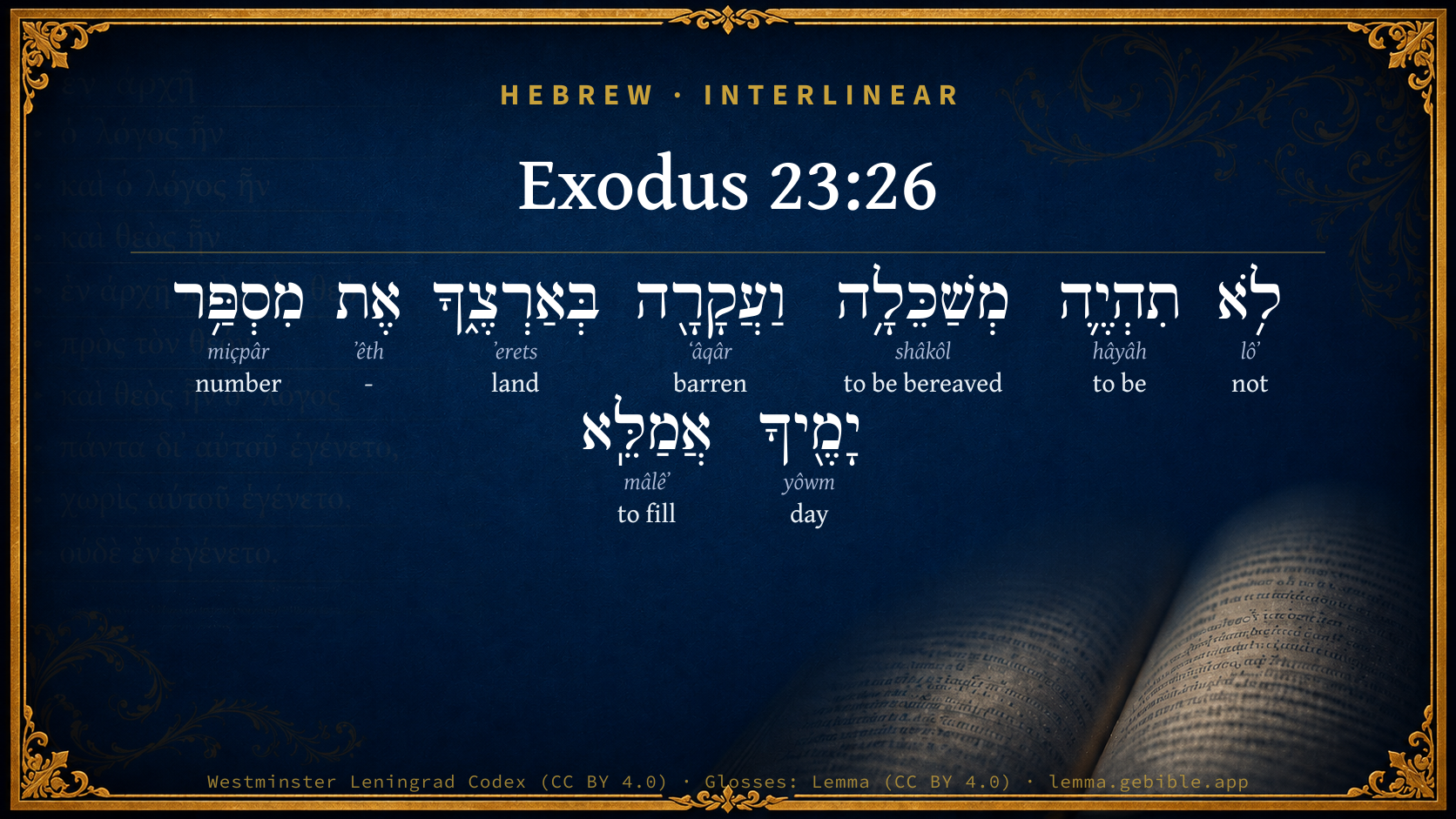
Hebrew (Westminster Leningrad Codex) Exodus 23:26 appears in the Hebrew Old Testament. The text above is from the Westminster Leningrad Codex. Each word links to its Strong’s number, a concise gloss, and parsing drawn from the Open Scriptures Hebrew Bible morphology. Click any word for its full Brown-Driver-Briggs (BDB) entry.
Download image
Cite this verse

Exodus 23:26 (World English Bible). Public Domain. Lemma interlinear Bible study tool, https://lemma.gebible.app/v/exodus/23/26.

Show BibTeX & RIS
BibTeX
RIS
English Translation
No one will miscarry or be barren in your land. I will fulfill the number of your days.
World English Bible · Public Domain
Download a study sheet

One document with this verse’s original text, its word-by-word gloss line, the meaning frame, cross-references with their text, attributed commentary, and full source and license credits — printable, and it pastes into notes with its structure intact.

This verse Autodidact and up

Study sheet (.html) Plain text (.txt)

A passage Seminary Student

Up to 50 verses in one chapter. A passage sheet keeps up to 6 commentary sources and 12 cross-references per verse, in the order this page ranks them, and says so on the sheet whenever that leaves anything out. Ask for a single verse and you get the Autodidact verse sheet above.

Everything on this page stays free to read, with no account — the sheet is a download of what is already on screen, not access to it.

Want to remove ads? Support Godless Engineer
Compare translations 3

The same verse in 3 English versions, stacked beneath the original-language interlinear above. Click any original word for its lexicon entry.

Each is an independent rendering of the whole verse — the interlinear is not word-aligned to these translations.

Highlighted words mark where these versions differ — a whole-verse word diff, not a word-by-word alignment.

  • World English Bible Public Domain
    No one will miscarry or be barren in your land. I will fulfill the number of your days.
  • King James Version Public Domain
    There shall nothing cast their young, nor be barren, in thy land: the number of thy days I will fulfil.
  • unfoldingWord Literal Text CC BY-SA 4.0
    There will not be a miscarriage or a barren woman in your land. I will fulfill the number of your days.

unfoldingWord Literal Text — © unfoldingWord, licensed CC BY-SA 4.0. Word-aligned USFM3 via Door43 (git.door43.org/unfoldingWord/en_ult).

Versions to compare (up to 4)

3 of 4 selected

Show all 18 translations

Every available English version of this verse, each an independent rendering of the whole verse.

  • World English Bible Public Domain
    No one will miscarry or be barren in your land. I will fulfill the number of your days.
  • Berean Standard Bible Public Domain
    No woman in your land will miscarry or be barren; I will fulfill the number of your days.
  • Majority Standard Bible Public Domain
    No woman in your land will miscarry or be barren; I will fulfill the number of your days.
  • King James Version Public Domain
    There shall nothing cast their young, nor be barren, in thy land: the number of thy days I will fulfil.
  • American Standard Version (1901) Public Domain
    There shall none cast her young, nor be barren, in thy land: the number of thy days I will fulfil.
  • Revised Version (1885) Public Domain
    There shall none cast her young, nor be barren, in thy land: the number of thy days I will fulfill.
  • Geneva Bible (1599) Public Domain
    There shall none cast their fruite nor be baren in thy lande: the number of thy dayes will I fulfill.
  • Douay-Rheims (1899) Public Domain
    There shall not be one fruitless nor barren in thy land: I will fill the number of thy days.
  • Young's Literal Translation Public Domain
    there is not a miscarrying and barren one in thy land; the number of thy days I fulfil:
  • Literal Standard Version CC BY-SA 4.0
    there is not a miscarrying and barren one in your land; I fulfill the number of your days.
  • Unlocked Literal Bible CC BY-SA 4.0
    No woman will be barren or will miscarry her young in your land. I will give you long lives.
  • unfoldingWord Literal Text CC BY-SA 4.0
    There will not be a miscarriage or a barren woman in your land. I will fulfill the number of your days.
  • Darby Bible Public Domain
    There shall nothing cast their young, nor be barren, in thy land; the number of thy days will I fulfil.
  • World Messianic Bible Public Domain
    No one will miscarry or be barren in your land. I will fulfill the number of your days.
  • Webster's Bible Public Domain
    There shall nothing cast their young, nor be barren, in thy land: I will complete the number of thy days.
  • Free Bible Version CC BY-SA 4.0
    No woman will have a miscarriage or be without children. I will make sure you live long lives.
  • Bible in Basic English Public Domain
    All your animals will give birth without loss, not one will be without young in all your land; I will give you a full measure of life.
  • JPS Tanakh (1917) Public Domain
    None shall miscarry, nor be barren, in thy land; the number of thy days I will fulfil.

Literal Standard Version (2020), Covenant Press — licensed CC BY-SA 4.0. Text via the HelloAO Bible API (eBible.org). Unlocked Literal Bible (unfoldingWord) — licensed CC BY-SA 4.0. Text via the HelloAO Bible API (eBible.org). unfoldingWord Literal Text — © unfoldingWord, licensed CC BY-SA 4.0. Word-aligned USFM3 via Door43 (git.door43.org/unfoldingWord/en_ult). Free Bible Version, Dr. Jonathan Gallagher — licensed CC BY-SA 4.0. Text via the HelloAO Bible API (eBible.org).

Word by word

More ways to search: Search by grammar → Find every occurrence → Compare this word →

Practice this passage: Drill this verse → Learn its vocabulary →

וַעֲקָרָ֖ה
ʻâqâr
H6135
“and · barren”
Conjunction + Adjective, Adjective, Feminine, Singular, Absolute
Part of Speech
Conjunction + Adjective
Type
Adjective
Gender
Feminine
Number
Singular
State
Absolute
Full BDB Definition

Origin: from H6131

TWOT: 1682a

barren, sterile
  1. לֹ֥א lôʼ H3808 “not” Particle, Negative
  2. תִהְיֶ֛ה hâyâh H1961 “to be” Verb, Qal, Imperfect, 3rd Person, Feminine, Singular
  3. מְשַׁכֵּלָ֥ה shâkôl H7921 “being bereaved” Verb, Piel, Participle Active, Feminine, Singular, Absolute
  4. בְּאַרְצֶ֑ךָ ʼerets H776 “in/at · land · your” Preposition + Noun, Common, Both, Singular, Construct + Suffix, Personal, 2nd Person, Masculine, Singular
  5. אֶת ʼêth H853 “-” Particle, Direct Object
  6. מִסְפַּ֥ר miçpâr H4557 “number of” Noun, Common, Masculine, Singular, Construct
  7. יָמֶ֖יךָ yôwm H3117 “days · your” Noun, Common, Masculine, Plural, Construct + Suffix, Personal, 2nd Person, Masculine, Singular
  8. אֲמַלֵּֽא mâlêʼ H4390 “to fill” Verb, Piel, Imperfect, 1st Person, Common, Singular

About this verse

These counts appear in no published source. They are computed here, from the morphology-tagged text and Lemma’s own curated glosses. What Lemma adds →

9
words
9
distinct lemmas
Pentateuch
section

Notable vocabulary

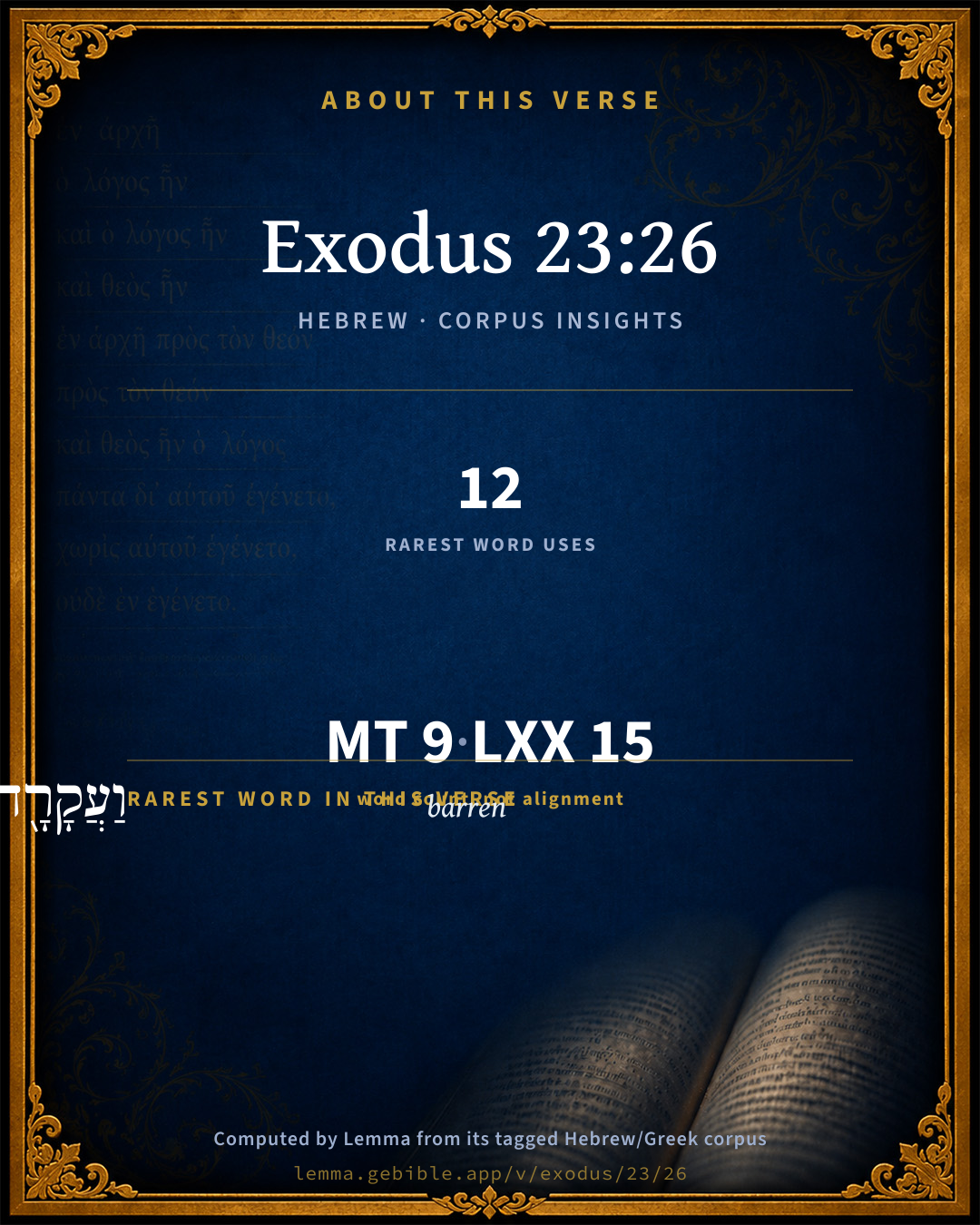
The rarest word here is וַעֲקָרָ֖ה barren H6135 — appearing just 12 times in the whole Hebrew Bible.

Shared distinctive vocabulary

וַעֲקָרָ֖ה barren H6135 occurs in 11 verses of the Hebrew Bible. Also found in:

Grammatical profile

  • 3 verbs
  • 3 nouns
  • 1 adjective
  • 2 particles

Verb forms

  • תִהְיֶ֛ה Qal · Imperfect
  • מְשַׁכֵּלָ֥ה Piel · Participle Active
  • אֲמַלֵּֽא Piel · Imperfect

Hebrew & Septuagint length

In English translation the verse runs 18 words from the Hebrew and 22 from the Septuagint (LXX English) — closely comparable.

A rough comparison of the two English renderings, which tokenize alike — not a word-level alignment.

Word counts can differ between the Hebrew and the Greek without any difference in meaning — e.g. the Hebrew direct-object marker אֵת has no separate Greek word, and Greek often adds the article ὁ.

In the original languages it is 9 Hebrew tokens and 15 Greek tokens — but the two are counted differently (Hebrew bundles its prefixes and suffixes into one token; the Greek is in lemma form), so that isn’t a like-for-like length.

Cross-references

14

Topical passages linked to Exodus 23:26 in the Treasury of Scripture Knowledge — connected by theme and wording, ordered by reader-vote popularity; previews shown in the World English Bible.

  • Deuteronomy 7:14 You shall be blessed above all peoples: there shall not be male or female barren among you, or among your cattle.
  • Deuteronomy 28:4 Blessed shall be the fruit of your body, and the fruit of your ground, and the fruit of your animals, the increase of your cattle, and the young of your flock.
  • Job 5:26 You shall come to your grave in a full age, Like a shock of grain comes in its season.
  • Job 21:10 Their bulls breed without fail. Their cows calve, and don't miscarry.
  • Isaiah 65:20 There shall be no more there an infant of days, nor an old man who has not filled his days; for the child shall die one hundred years old, and the sinner being one hundred years old shall be accursed.
  • Psalms 107:38 He blesses them also, so that they are multiplied greatly. He doesn't allow their cattle to decrease.
  • Psalms 144:13 Our barns are full, filled with all kinds of provision. Our sheep bring forth thousands and ten thousands in our fields.
  • Genesis 35:29 Isaac gave up the spirit, and died, and was gathered to his people, old and full of days. Esau and Jacob, his sons, buried him.
  • 1 Chronicles 23:1 Now David was old and full of days; and he made Solomon his son king over Israel.
  • Malachi 3:10–11 Bring the whole tithe into the store-house, that there may be food in my house, and test me now in this," says Yahweh of hosts, "if I will not open you the windows of heaven, and pour you out a blessing, that there shall not be room enough for.
  • Genesis 25:8 Abraham gave up the spirit, and died in a good old age, an old man, and full of years, and was gathered to his people.
  • Job 42:17 So Job died, being old and full of days.
  • Psalms 55:23 But you, God, will bring them down into the pit of destruction. Bloodthirsty and deceitful men shall not live out half their days, But I will trust in you.
  • Psalms 90:10 The days of our years are seventy, Or even by reason of strength eighty years; Yet their pride is but labor and sorrow, For it passes quickly, and we fly away.

Cross-references courtesy of OpenBible.info (CC BY 4.0).

Hebrew and Greek witnesses Masoretic Hebrew ↔ Greek Septuagint

The same verse in the two great witnesses to the Old Testament, shown verse-for-verse.

These are two independent witnesses, not word-aligned to each other, and the Septuagint is shown in lemma (dictionary) form.

Hebrew Exodus 23:26 Masoretic · Westminster Leningrad Codex

לֹ֥א תִהְיֶ֛ה מְשַׁכֵּלָ֥ה וַעֲקָרָ֖ה בְּאַרְצֶ֑ךָ אֶת מִסְפַּ֥ר יָמֶ֖יךָ אֲמַלֵּֽא

No one will miscarry or be barren in your land. I will fulfill the number of your days.

World English Bible · Public Domain

Greek LXX Exodus 23:26 Septuagint · lemma form

οὐ εἰμί ἄγονος οὐδέ στεῖρα ἐπί ὁ γῆ σύ ὁ ἀριθμός ὁ ἡμέρα σύ ἀναπληρόω

There shall not be on your land one that is impotent or barren. I will surely fulfil the number of your days.

LXX2012 (modern English Septuagint) · Public Domain

Hebrew: Westminster Leningrad Codex (CC BY 4.0). Greek: Septuagint (public domain); English from LXX2012 (modern English Septuagint) (Public Domain). How the Septuagint differs from the Hebrew →

Targum (Aramaic paraphrase)

2

The Targum is the ancient Jewish Aramaic paraphrase of the Hebrew Scriptures — an interpretive translation, not the Hebrew text itself. Onkelos (literal) and Pseudo-Jonathan (expansive) render the Torah, and Jonathan the Prophets. Coverage is partial: where no permissively-licensed English translation exists for a verse, only the Aramaic is shown. This is verse-level text, not a word-by-word alignment to the Hebrew.

  1. Targum Onkelos Torah (Genesis–Deuteronomy)
    לָא תְהֵי מְתַכְּלָא וְעַקְרָא בְּאַרְעָךְ יָת מִנְיַן יוֹמָיךְ אַשְׁלִים:

    (no public-domain English translation for this verse)

    Targum Onkelos — Aramaic: “Onkelos Genesis” (public domain); “Onkelos Exodus” (public domain); “Onkelos Leviticus” (public domain); “Onkelos Numbers” (public domain); “Onkelos Deuteronomy” (public domain). English: “Sefaria Community Translation” (CC0 1.0 (public-domain dedication)); “J.W. Etheridge. The Targums of Onkelos and Jonathan Ben Uzziel on the Pentateuch. London: Longmans, Green, 1862” (public domain). Text via Sefaria.

  2. Targum Pseudo-Jonathan Torah (Genesis–Deuteronomy)
    לָא תְהֵי תַּכְלָא וְעַקְרָא בְּאַרְעָךְ יַת מִנְיַין יוֹמֵי חַיָּיךְ אֲשַׁלֵּם מִיּוֹמָא לְיוֹמָא

    None shall be abortive or barren in thy land; the number of the days of thy life I will fulfil from day to day.

    Targum Pseudo-Jonathan — Aramaic: “Targum Jonathan on Genesis” (public domain); “Targum Jonathan on Exodus” (public domain); “Targum Jonathan on Leviticus” (public domain); “Targum Jonathan on Numbers” (public domain); “Targum Jonathan on Deuteronomy” (public domain). English: “The Targum of Jonathan ben Uzziel, trans. J. W. Etheridge, London, 1862” (public domain). Text via Sefaria.

Commentary

Notes on Exodus 23:26 from classic Christian and Jewish commentators (each source and its license shown beneath its notes). The classic Christian expositions comment on the surrounding passage and are grouped to its opening verse, so a note may address several verses; the Jewish commentaries on the Tanakh (Rashi and others) are per-verse, so they appear only where the commentator wrote on this verse.

Lemma curates 59 commentaries, every one of them public domain or Creative Commons licensed, each selected and text-cleaned for this edition rather than reprinted as found. About our sources →

Trapp's Complete Commentary

John Trapp

Exo 23:26 There shall nothing cast their young, nor be barren, in thy land: the number of thy days I will fulfil.

Ver. 26. The number of thy days.] Thou shalt die, as Abraham did, with a good hoary head; be satur dierum, as Job; fall as a full ripe apple into the hands of God, the gatherer.

John Trapp, A Commentary or Exposition upon All the Books of the Old and New Testament (1647–1656) — public domain. Text from a community e-Sword module.

Tyndale Open Study Notes

Tyndale Open Resources

23:26 Pagan rites were carried out in an attempt to manipulate the forces of fertility and reproduction. God promised to give these gifts freely if the people would faithfully carry out the terms of their covenant with him.

Tyndale Open Study Notes — © Tyndale Open Resources, licensed CC BY-SA 4.0. Text via the HelloAO Bible API.

Adam Clarke's Commentary

Verse 26. There shall nothing cast their young, nor be barren] Hence there must be a very great increase both of men and cattle.

The number of thy days I will fulfil.] Ye shall all live to a good old age, and none die before his time. This is the blessing of the righteous, for wicked men live not out half their days; Ps 55:23.

Adam Clarke's Commentary on the Bible (1810–1826) — public domain. Text from a community e-Sword/MySword module.

Ellicott's Commentary for English Readers

(26) There shall nothing cast their young, nor be barren.—Abortions, untimely births, and barrenness, when they exceeded a certain average amount, were always reckoned in the ancient world among the signs of God’s disfavour, and special expiatory rites were devised for checking them. Conversely, when such misfortunes fell short of the ordinary average, God’s favour was presumed. The promises here made confirm man’s instinctive feeling.

The number of thy days I will fulfil.—Comp. Exo_20:12. Long life is always regarded in Scripture as a blessing. (Comp. Psa_55:23; Psa_90:10; Job_5:26; Job_42:16-17; 1Ki_3:11; Isa_65:20; Eph_6:3, &c.)

A Bible Commentary for English Readers, edited by Charles John Ellicott (1878–1897) — public domain. Text from a community e-Sword module.

John Gill's Exposition

And I will send hornets before thee,.... Which may be interpreted either figuratively, and so may signify the same as fear before which should fall on the Canaanites upon hearing the Israelites were coming; the stings of their consciences for their sins, terrors of mind, dreading the wrath of the God of Israel, of whom they had heard, and terrible apprehensions of ruin and destruction from the Israelites: Aben Ezra interprets it of some disease of the body, which weakens it, as the leprosy, from the signification of the word, which has some affinity with that used for the leprosy; and so the Arabic version understands it of a disease: or rather, the words are to be taken literally, for hornets, which are a sort of wasps, whose stings are very penetrating and venomous; nor is it any strange or unheard of thing for people to be drove out of their countries by small animals, as mice, flies, bees, &c. and particularly Aelianus (q) relates, that the Phaselites were drove out of their country by wasps: and Bochart (r) has shown that those people were of a Phoenician original, and inhabited the mountains of Solymi; and that this happened to them about the times of Joshua, and so may probably be the very Canaanites here mentioned, as follow: the wasps, in Aristophanes's comedy which bears that name, are introduced speaking of themselves, and say, no creature when provoked is more angry and troublesome than we are (s):

which shall drive out the Hivite, the Canaanite, and the Hittite, from before thee; which three are mentioned instead of the rest, or because they were more especially infested and distressed with the hornets, and drove out of their land by means of them.

(q) Hist. Animal. l. 11. c. 28. (r) Hierozoic. par. 2. l. 4. c. 13. col. 541. (s) Aristoph. Vespae, p. 510.

John Gill's Exposition of the Whole Bible (1746–1763) — public domain (CC PDM 1.0). Text via the HelloAO Bible API.

Haydock's Catholic Bible Commentary

Fruitless. Hebrew may also be, "miscarrying." --- Days. An untimely death was a judgment of God on the wicked, though sometimes he chooses to draw his elect quickly out of this dangerous world, Wisdom iv. 11.

George Leo Haydock (1774–1849), Haydock's Catholic Family Bible and Commentary, 1859 edition — public domain. Excludes Psalms (Douay-Rheims chapter numbering differs from Protestant) and Deuterocanonical books (Catholic canon only).

Matthew Poole's English Annotations

Here was a double mercy. God gave them strength both to conceive, and to retain the conception till the natural and proper time of bringing forth came.

The number of thy days I will fulfil; I will preserve thee so as thou shalt live as long as the course of nature and temper of thy body will permit, when evil men shall not live out half their days, Psa 55:23.

Matthew Poole's English Annotations on the Holy Bible (1683–1685) — public domain. Text from a community e-Sword/MySword module.

The Pulpit Commentary

There shall nothing out their young, nor be barren in thy land. This blessing could not have followed upon godly living in the way of natural sequence, but only by Divine favor and providential care. It would have rendered them rich in flocks and herds beyond any other nation. The number of thy days I will fulfil. There shall be no premature deaths. All, both men and women, shall reach the term allotted to man, and die in a good old age, having fulfilled their time. Godly living, persisted in for several generations, might, perhaps, produce this result.

The Pulpit Commentary (1880–1919), ed. H.D.M. Spence-Jones & Joseph S. Exell — public domain. Text from a community e-Sword module.

John Wesley's Explanatory Notes

The number of thy days I will fulfill - And they shall not be cut off in the midst by untimely deaths. Thus hath godliness the promise of the life that now is.

John Wesley, Explanatory Notes Upon the Whole Bible (1754–1765) — public domain. Text via the GEBible commentary corpus.

unfoldingWord translationNotes

Door43 World Missions Community

General Information:

Yahweh continues telling Moses his laws for the people of Israel.

No woman will be barren or will miscarry her young in your land

This can be stated in positive form. AT: "Every woman will be able to become pregnant and give birth to healthy babies" (See: Double Negatives)

miscarry

to have a pregnancy end early and unexpectedly

hornets

a flying insect that can sting people and cause pain

or the land would become abandoned

"because no one would be living in the land"

translationWords

barren

fear

people group

Hivite

Canaan

Hittite

unfoldingWord translationNotes — © Distant Shores Media and the Door43 World Missions Community, licensed CC BY-SA 4.0. Source: git.door43.org/Door43/en_tn.

Rashi

Rabbi Shlomo Yitzchaki (Rashi)

לא תהיה משכלה THERE SHALL NOTHING BE BEREAVED OF YOUNG, if you will act according to My will.

משכלה BEREAVED OF YOUNG — A woman who miscarries or who buries her children at a very early age is called משכלה.

Rashi on the Tanakh — English translations: “The Judaica Press complete Tanach with Rashi, translated by A. J. Rosenberg” (CC BY 4.0); “Pentateuch with Rashi's commentary by M. Rosenbaum and A.M. Silbermann, 1929-1934” (public domain); “The Metsudah Tanach series, Lakewood, N.J” (CC BY 4.0); and “The Book of Joshua, Metsudah Publications, 1997” (CC BY 4.0). Text via Sefaria.

Lesson kit

Teaching starters — assembled from the data on this page, not authored interpretation. Every prompt links to the verse data it draws on. Edit before teaching.

Exodus, in the Pentateuch, opens this verse with 9 words (9 distinct Hebrew lemmas). Its most distinctive word is ʻâqâr (“barren”). A historical commentator’s framing appears above. Read the whole chapter for the surrounding context.

Discussion questions

  1. How does “barren” (ʻâqâr) shape what this verse is saying?
  2. How does Genesis 11:30, which shares the word «barren», read alongside this verse?
  3. These translations render this verse differently; the difference is in the English rendering, not the original. What questions does that raise?
  4. «תִהְיֶ֛ה» is a Qal Imperfect verb. How does that grammatical form shape the action described?
  5. Compare how Trapp's Complete Commentary and Tyndale Open Study Notes read this verse. Where do they agree or differ?

Things to notice

Reading settings

Reading text

Shown beneath each verse's original-language words.

Old Testament
Old Testament edition

Read the OT as the Masoretic Hebrew (MT) or the Greek Septuagint (LXX).

English shown for the Greek Septuagint (in the Hebrew ↔ Greek comparison).

Comparing translations? Open the Compare panel on any verse page to stack up to four side by side.