Exodus 23:13

Hebrew (Westminster Leningrad Codex) Exodus 23:13 appears in the Hebrew Old Testament. The text above is from the Westminster Leningrad Codex. Each word links to its Strong’s number, a concise gloss, and parsing drawn from the Open Scriptures Hebrew Bible morphology. Click any word for its full Brown-Driver-Briggs (BDB) entry.
Download image
Cite this verse

Exodus 23:13 (World English Bible). Public Domain. Lemma interlinear Bible study tool, https://lemma.gebible.app/v/exodus/23/13.

Show BibTeX & RIS
BibTeX
RIS
English Translation
"Be careful to do all things that I have said to you; and don't invoke the name of other gods, neither let them be heard out of your mouth.
World English Bible · Public Domain
Download a study sheet

One document with this verse’s original text, its word-by-word gloss line, the meaning frame, cross-references with their text, attributed commentary, and full source and license credits — printable, and it pastes into notes with its structure intact.

This verse Autodidact and up

Study sheet (.html) Plain text (.txt)

A passage Seminary Student

Up to 50 verses in one chapter. A passage sheet keeps up to 6 commentary sources and 12 cross-references per verse, in the order this page ranks them, and says so on the sheet whenever that leaves anything out. Ask for a single verse and you get the Autodidact verse sheet above.

Everything on this page stays free to read, with no account — the sheet is a download of what is already on screen, not access to it.

Want to remove ads? Support Godless Engineer
Compare translations 3

The same verse in 3 English versions, stacked beneath the original-language interlinear above. Click any original word for its lexicon entry.

Each is an independent rendering of the whole verse — the interlinear is not word-aligned to these translations.

Highlighted words mark where these versions differ — a whole-verse word diff, not a word-by-word alignment.

  • World English Bible Public Domain
    "Be careful to do all things that I have said to you; and don't invoke the name of other gods, neither let them be heard out of your mouth.
  • King James Version Public Domain
    And in all things that I have said unto you be circumspect: and make no mention of the name of other gods, neither let it be heard out of thy mouth.
  • unfoldingWord Literal Text CC BY-SA 4.0
    You shall take heed to everything that I have said to you. You shall not mention the names of other gods, nor let them be heard on your mouth.

unfoldingWord Literal Text — © unfoldingWord, licensed CC BY-SA 4.0. Word-aligned USFM3 via Door43 (git.door43.org/unfoldingWord/en_ult).

Versions to compare (up to 4)

3 of 4 selected

Show all 18 translations

Every available English version of this verse, each an independent rendering of the whole verse.

  • World English Bible Public Domain
    "Be careful to do all things that I have said to you; and don't invoke the name of other gods, neither let them be heard out of your mouth.
  • Berean Standard Bible Public Domain
    Pay close attention to everything I have said to you. You must not invoke the names of other gods; they must not be heard on your lips.
  • Majority Standard Bible Public Domain
    Pay close attention to everything I have said to you. You must not invoke the names of other gods; they must not be heard on your lips.
  • King James Version Public Domain
    And in all things that I have said unto you be circumspect: and make no mention of the name of other gods, neither let it be heard out of thy mouth.
  • American Standard Version (1901) Public Domain
    And in all things that I have said unto you take ye heed: and make no mention of the name of other gods, neither let it be heard out of thy mouth.
  • Revised Version (1885) Public Domain
    And in all things that I have said unto you take ye heed: and make no mention of the name of other gods, neither let it be heard out of thy mouth.
  • Geneva Bible (1599) Public Domain
    And ye shall take heede to all things that I haue sayde vnto you: and ye shall make no mention of the name of other gods, neither shall it be heard out of thy mouth.
  • Douay-Rheims (1899) Public Domain
    Keep all things that I have said to you. And by the name of strange gods you shall not swear, neither shall it be heard out of your mouth.
  • Young's Literal Translation Public Domain
    and in all that which I have said unto you ye do take heed; and the name of other gods ye do not mention; it is not heard on thy mouth.
  • Literal Standard Version CC BY-SA 4.0
    and in all that which I have said to you—take heed; and you do not mention the name of other gods; it is not heard on your mouth.
  • Unlocked Literal Bible CC BY-SA 4.0
    Pay attention to everything that I have said to you. Do not mention the names of other gods, nor let their names be heard from your mouth.
  • unfoldingWord Literal Text CC BY-SA 4.0
    You shall take heed to everything that I have said to you. You shall not mention the names of other gods, nor let them be heard on your mouth.
  • Darby Bible Public Domain
    And ye shall be on your guard as to everything that I have said unto you; and shall make no mention of the name of other gods -- it shall not be heard in thy mouth.
  • World Messianic Bible Public Domain
    “Be careful to do all things that I have said to you; and don’t invoke the name of other gods or even let them be heard out of your mouth.
  • Webster's Bible Public Domain
    And in all things that I have said to you be circumspect: and make no mention of the names of other gods, neither let it be heard from thy mouth.
  • Free Bible Version CC BY-SA 4.0
    Make sure to pay attention to everything I've told you. Don't think to call on the names of other gods—you must not even mention them.
  • Bible in Basic English Public Domain
    Take note of all these things which I have said to you, and let not the names of other gods come into your minds or from your lips.
  • JPS Tanakh (1917) Public Domain
    And in all things that I have said unto you take ye heed; and make no mention of the name of other gods, neither let it be heard out of thy mouth.

Literal Standard Version (2020), Covenant Press — licensed CC BY-SA 4.0. Text via the HelloAO Bible API (eBible.org). Unlocked Literal Bible (unfoldingWord) — licensed CC BY-SA 4.0. Text via the HelloAO Bible API (eBible.org). unfoldingWord Literal Text — © unfoldingWord, licensed CC BY-SA 4.0. Word-aligned USFM3 via Door43 (git.door43.org/unfoldingWord/en_ult). Free Bible Version, Dr. Jonathan Gallagher — licensed CC BY-SA 4.0. Text via the HelloAO Bible API (eBible.org).

Word by word

More ways to search: Search by grammar → Find every occurrence → Compare this word →

Practice this passage: Drill this verse → Learn its vocabulary →

אֲחֵרִים֙
ʼachêr
H312
“other”
Adjective, Adjective, Masculine, Plural, Absolute
Part of Speech
Adjective
Type
Adjective
Gender
Masculine
Number
Plural
State
Absolute
Full BDB Definition

Origin: from H309

TWOT: 68a

another, other, following - following, further - other, different
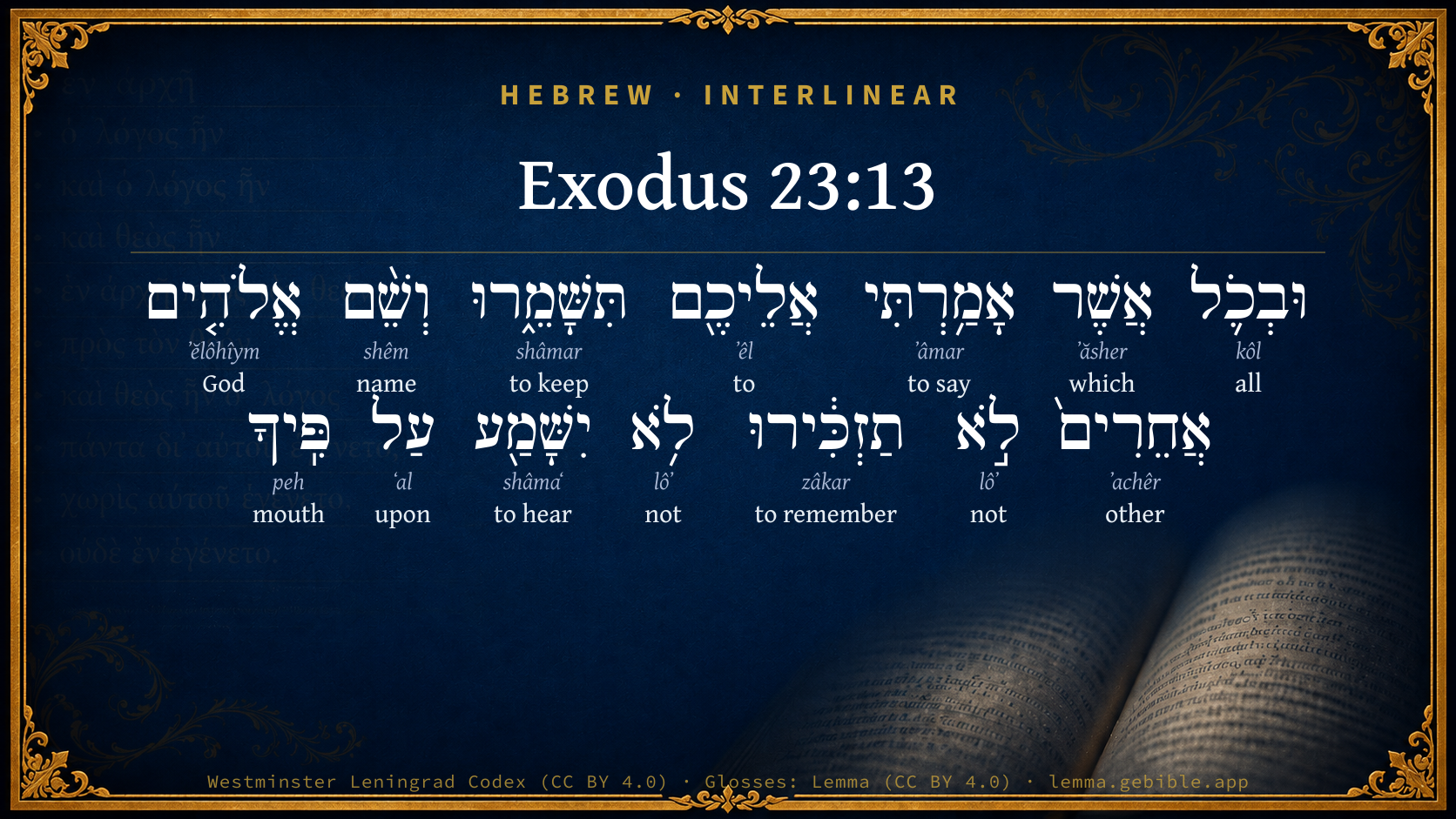
  1. וּבְכֹ֛ל kôl H3605 “and · in/at · all” Conjunction + Preposition + Noun, Common, Masculine, Singular, Absolute
  2. אֲשֶׁר ʼăsher H834 “which” Particle, Relative
  3. אָמַ֥רְתִּי ʼâmar H559 “to say” Verb, Qal, Perfect, 1st Person, Common, Singular
  4. אֲלֵיכֶ֖ם ʼêl H413 “to · you” Preposition + Suffix, Personal, 2nd Person, Masculine, Plural
  5. תִּשָּׁמֵ֑רוּ shâmar H8104 “to keep” Verb, Niphal, Imperfect, 2nd Person, Masculine, Plural
  6. וְשֵׁ֨ם shêm H8034 “and · name of” Conjunction + Noun, Common, Masculine, Singular, Construct
  7. אֱלֹהִ֤ים ʼĕlôhîym H430 “God(s)” Noun, Common, Masculine, Plural, Absolute
  8. לֹ֣א lôʼ H3808 “not” Particle, Negative
  9. תַזְכִּ֔ירוּ zâkar H2142 “to remember” Verb, Hiphil, Imperfect, 2nd Person, Masculine, Plural
  10. לֹ֥א lôʼ H3808 “not” Particle, Negative
  11. יִשָּׁמַ֖ע shâmaʻ H8085 “to hear” Verb, Niphal, Imperfect, 3rd Person, Masculine, Singular
  12. עַל ʻal H5921 “upon” Preposition
  13. פִּֽיךָ peh H6310 “mouth · your” Noun, Common, Masculine, Singular, Construct + Suffix, Personal, 2nd Person, Masculine, Singular

About this verse

These counts appear in no published source. They are computed here, from the morphology-tagged text and Lemma’s own curated glosses. What Lemma adds →

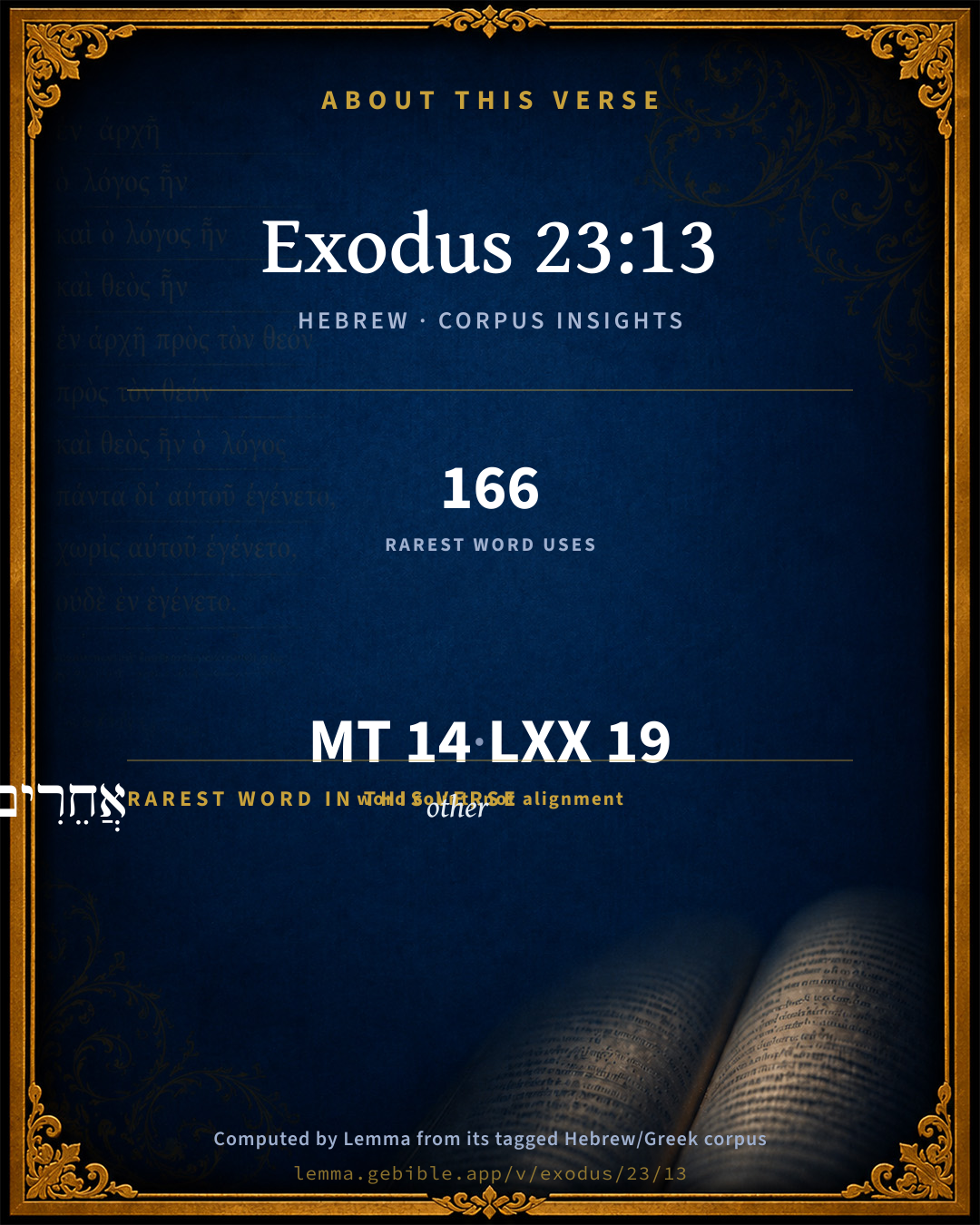
14
words
13
distinct lemmas
Pentateuch
section

Grammatical profile

  • 4 verbs
  • 4 nouns
  • 1 adjective
  • 2 prepositions
  • 3 particles

Verb forms

  • אָמַ֥רְתִּי Qal · Perfect
  • תִּשָּׁמֵ֑רוּ Niphal · Imperfect
  • תַזְכִּ֔ירוּ Hiphil · Imperfect
  • יִשָּׁמַ֖ע Niphal · Imperfect

Repetition

A word recurs within this verse — often emphatic in Hebrew:

Hebrew & Septuagint length

In English translation the verse runs 29 words from the Hebrew and 29 from the Septuagint (LXX English) — the same length.

A rough comparison of the two English renderings, which tokenize alike — not a word-level alignment.

Word counts can differ between the Hebrew and the Greek without any difference in meaning — e.g. the Hebrew direct-object marker אֵת has no separate Greek word, and Greek often adds the article ὁ.

In the original languages it is 14 Hebrew tokens and 19 Greek tokens — but the two are counted differently (Hebrew bundles its prefixes and suffixes into one token; the Greek is in lemma form), so that isn’t a like-for-like length.

Cross-references

17

Topical passages linked to Exodus 23:13 in the Treasury of Scripture Knowledge — connected by theme and wording, ordered by reader-vote popularity; previews shown in the World English Bible.

  • Joshua 23:7 that you not come among these nations, these that remain among you; neither make mention of the name of their gods, nor cause to swear [by them], neither serve them, nor bow down yourselves to them;
  • Zechariah 13:2 It will come to pass in that day, says Yahweh of Hosts, that I will cut off the names of the idols out of the land, and they will no more be remembered; and also I will cause the prophets and the spirit of impurity to pass out of the land.
  • Deuteronomy 4:9 Only take heed to yourself, and keep your soul diligently, lest you forget the things which your eyes saw, and lest they depart from your heart all the days of your life; but make them known to your children and your children's children;
  • Hosea 2:17 For I will take away the names of the Baals out of her mouth, And they will no more be mentioned by their name.
  • 1 Timothy 4:16 Pay attention to yourself, and to your teaching. Continue in these things, for in doing this you will save both yourself and those who hear you.
  • Deuteronomy 12:3 and you shall break down their altars, and dash in pieces their pillars, and burn their Asherim with fire; and you shall cut down the engraved images of their gods; and you shall destroy their name out of that place.
  • Joshua 22:5 Only take diligent heed to do the commandment and the law which Moses the servant of Yahweh commanded you, to love Yahweh your God, and to walk in all his ways, and to keep his commandments, and to cleave to him, and to serve him with all your heart and with all your soul.
  • Joshua 23:11 Take good heed therefore to yourselves, that you love Yahweh your God.
  • Psalms 16:4 Their sorrows shall be multiplied who give gifts to another god. Their drink-offerings of blood I will not offer, Nor take their names on my lips.
  • Jeremiah 10:11 Thus shall you say to them, The gods that have not made the heavens and the earth, these shall perish from the earth, and from under the heavens.
  • Deuteronomy 4:15 Take therefore good heed to yourselves; for you saw no manner of form on the day that Yahweh spoke to you in Horeb out of the midst of the fire.
  • Psalms 39:1 I said, "I will watch my ways, so that I don't sin with my tongue. I will keep my mouth with a bridle while the wicked is before me."
  • Ephesians 5:15 Therefore watch carefully how you walk, not as unwise, but as wise;
  • Hebrews 12:15 looking carefully lest there be any man who falls short of the grace of God; lest any root of bitterness springing up trouble you, and thereby the many be defiled;
  • 1 Chronicles 28:7–9 I will establish his kingdom forever, if he be constant to do my commandments and my ordinances, as at this day.
  • Ephesians 5:12 For the things which are done by them in secret, it is a shame even to speak of.
  • Numbers 32:38 and Nebo, and Baal Meon, (their names being changed), and Sibmah: and they gave other names to the cities which they built.

Cross-references courtesy of OpenBible.info (CC BY 4.0).

Hebrew and Greek witnesses Masoretic Hebrew ↔ Greek Septuagint

The same verse in the two great witnesses to the Old Testament, shown verse-for-verse.

These are two independent witnesses, not word-aligned to each other, and the Septuagint is shown in lemma (dictionary) form.

Hebrew Exodus 23:13 Masoretic · Westminster Leningrad Codex

וּבְכֹ֛ל אֲשֶׁר אָמַ֥רְתִּי אֲלֵיכֶ֖ם תִּשָּׁמֵ֑רוּ וְשֵׁ֨ם אֱלֹהִ֤ים אֲחֵרִים֙ לֹ֣א תַזְכִּ֔ירוּ לֹ֥א יִשָּׁמַ֖ע עַל פִּֽיךָ

"Be careful to do all things that I have said to you; and don't invoke the name of other gods, neither let them be heard out of your mouth.

World English Bible · Public Domain

Greek LXX Exodus 23:13 Septuagint · lemma form

πᾶς ὅσος εἶπον πρός σύ φυλάσσω καί ὄνομα θεός ἕτερος οὐ ἀναμιμνήσκω οὐδέ μή ἀκούω ἐκ ὁ στόμα σύ

Observe all things whatever I have commanded you; and you⌃ shall make no mention of the name of other gods, neither shall they be heard out of your mouth.

LXX2012 (modern English Septuagint) · Public Domain

Hebrew: Westminster Leningrad Codex (CC BY 4.0). Greek: Septuagint (public domain); English from LXX2012 (modern English Septuagint) (Public Domain). How the Septuagint differs from the Hebrew →

Targum (Aramaic paraphrase)

2

The Targum is the ancient Jewish Aramaic paraphrase of the Hebrew Scriptures — an interpretive translation, not the Hebrew text itself. Onkelos (literal) and Pseudo-Jonathan (expansive) render the Torah, and Jonathan the Prophets. Coverage is partial: where no permissively-licensed English translation exists for a verse, only the Aramaic is shown. This is verse-level text, not a word-by-word alignment to the Hebrew.

  1. Targum Onkelos Torah (Genesis–Deuteronomy)
    וּבְכֹל דִי אֲמָרִית לְכוֹן תִּסְתַּמְרוּן וְשׁוּם טַעֲוַת עַמְמַיָא לָא תִדְכְּרוּן לָא יִשְׁתְּמַע עַל פּוּמְכוֹן:

    (no public-domain English translation for this verse)

    Targum Onkelos — Aramaic: “Onkelos Genesis” (public domain); “Onkelos Exodus” (public domain); “Onkelos Leviticus” (public domain); “Onkelos Numbers” (public domain); “Onkelos Deuteronomy” (public domain). English: “Sefaria Community Translation” (CC0 1.0 (public-domain dedication)); “J.W. Etheridge. The Targums of Onkelos and Jonathan Ben Uzziel on the Pentateuch. London: Longmans, Green, 1862” (public domain). Text via Sefaria.

  2. Targum Pseudo-Jonathan Torah (Genesis–Deuteronomy)
    וּבְכָל פִּקּוּדַיָא דְאָמְרִית לְכוֹן תִּסְתַּמְּרוּן וְשׁוּם טַעֲוַות עַמְמַיָא לָא תִדְכְּרוּן לָא יִשְׁתְּמַע עַל פּוּמְכוֹן

    And of all the precepts that I have spoken to you, be carefull; and the names of the idols of the Gentiles remember not, nor let them be heard upon your lips.

    Targum Pseudo-Jonathan — Aramaic: “Targum Jonathan on Genesis” (public domain); “Targum Jonathan on Exodus” (public domain); “Targum Jonathan on Leviticus” (public domain); “Targum Jonathan on Numbers” (public domain); “Targum Jonathan on Deuteronomy” (public domain). English: “The Targum of Jonathan ben Uzziel, trans. J. W. Etheridge, London, 1862” (public domain). Text via Sefaria.

Commentary

Notes on Exodus 23:13 from classic Christian and Jewish commentators (each source and its license shown beneath its notes). The classic Christian expositions comment on the surrounding passage and are grouped to its opening verse, so a note may address several verses; the Jewish commentaries on the Tanakh (Rashi and others) are per-verse, so they appear only where the commentator wrote on this verse.

Lemma curates 59 commentaries, every one of them public domain or Creative Commons licensed, each selected and text-cleaned for this edition rather than reprinted as found. About our sources →

Trapp's Complete Commentary

John Trapp

Exo 23:13 And in all [things] that I have said unto you be circumspect: and make no mention of the name of other gods, neither let it be heard out of thy mouth.

Ver. 13. Be circumspect.] Or wary; keep you close to the rule, and up to your principles. {See Trapp on "Eph 5:15"}

Of the name of other gods,] sc., Without dislike. The primitive Christians would not call their days of the week, Dies Martis, Mercurii, &c., as Mercurius Trismegistus had named them; but the first, second, third, &c., day of the week, Deastrorum nomina ne nota quidem esse voluerunt inter Christi cultores, saith one. They desired that Christians should spit out of their mouths those dunghill deities with utmost contempt; as David did. {Psa 16:4}

John Trapp, A Commentary or Exposition upon All the Books of the Old and New Testament (1647–1656) — public domain. Text from a community e-Sword module.

The Biblical Illustrator

Joseph S. Exell

Exo_23:13

Be circumspect.

Circumspection

I. In general. In all things. Moses is drawing to the close of these precepts, and looking back upon them, he says--Be circumspect. The original suggests--

1. That we should be fully awake to the importance of the Divine commands.

(1) Give them intelligent and reverent examination.

(2) Store them up in the memory.

(3) Study them in their beneficent operation.

2. That we should be on our guard against temptations to break the Divine commands. Temptations are

(1) sudden;

(2) insidious;

(3) deceiving.

3. That we should be careful to remember His commandments to do them.

(1) There is a danger lest an exaggerated estimate of human weakness should lead to despair on the one hand, and recklessness on the other.

(2) God would not command the impossible.

(3) There is grace to help in time of need.

II. In particular, make no mention, etc. Because--

1. That would be uncircumspect in the first and greatest commandment.

2. That would be to forfeit the help promised to the circumspect.

3. That would be to yield to a tendency to be uncircumspect in everything. Christians--

1. Watch and pray, lest ye enter rote, temptation.

2. Live so as to adorn the doctrine of God your Saviour m all things. (J. W. Burn.)

Circumspection needed

The mysterious perturbation of a ships compass is reported in a scientific journal. It appears that the compass of the ship Penguin, recently anchored off Australia, was deflected fifty-five degrees, and had a dip of eighty-three degrees. After the ship left the anchorage and proceeded on her voyage the disturbance ceased. At two miles from the point the variation was quite normal. The captain spent a day in investigating the phenomenon. He passed two or three times over the point where he had anchored, and found that whenever the ship crossed it, the compass was disturbed as before, and recovered when at a distance of two miles in any direction. This satisfied him that the centre of the submarine disturbance was limited to a circle of less than two miles magnetic minerals at the sea bottom. The journal reporting his observation says: Great as is the gain to the navigator to be thus warned of a formidable danger in certain places, it lays upon him the imperative duty of being always on his guard against such sources of disaster elsewhere, and of promptly reporting any new magnetic disturbance, as he would a rock or shoal.! Similar vigilance is necessary on the part of every voyager through life.

The Biblical Illustrator, edited by Joseph S. Exell (c. 1880s–1900s) — public domain. Text from a community e-Sword module.

Joseph Benson's Commentary

Exo 23:13. In all things be circumspect — We are in danger of missing our way on the right hand and on the left, and it is at our peril if we do, therefore we have need to look about us. A man may ruin himself through mere carelessness, but he cannot save himself without great care and circumspection. Particularly since idolatry was a sin they were much addicted to, and would be greatly tempted to, they must endeavour to blot out the remembrance of the gods of the heathen, and must disuse all their superstitious forms of speech, and never mention them but with detestation. In Christian schools and academies, (for it is in vain to think of reforming the play-houses,) it were to be wished that the names and stories of the heathen deities, or demons rather, were not so commonly and familiarly used.

Joseph Benson's Commentary on the Old and New Testaments (1811–1818) — public domain. Text from a community e-Sword module.

The Preacher's Complete Homiletical Commentary

Joseph S. Exell (gen. ed.)

MAIN HOMILETICS OF THE PARAGRAPH.—Exo_23:13

THE NEED OF CIRCUMSPECTION

The man who makes a wise use of his eyes is in so far circumspect. Words that primarily set forth bodily actions are secondarily applied to the description of mental states and actions. Circumspection is descriptive of a mental condition, and denotes intensity and watchfulness of spirit. The man who takes heed to himself and his ways is circumspect. “In all things that I have said unto you be circumspect.” There never was greater need for circumspection. This exhortation is for all time.

I. Circumspection is difficult. It is difficult, from the fact that we are blind, and are unconscious of our sad state. The blind man moves with caution because he feels his defect. Carelessness, which may be taken as the opposite of circumspection, is characteristic of a childish state. It is difficult for the child to command its attention. There is a deal of childishness in full-grown men. It is difficult for the photographer to get a happy expression fixed upon the prepared glass. The sitter cannot bear the necessary fixity of gaze, and the countenance assumes an unnatural aspect. This is typical. It is difficult to keep the mind fixed upon the great problems of life, and the ears ever open to the reception, and the understanding ever on the stretch to the true perception of the voice of God. Circumspection is not a mere listless gaze. It is a looking round about, but it is a looking with an earnest purpose in order to see what dangers are to be avoided, what voice is to be obeyed, and what course is to be pursued. All mental efforts in the initial stages are difficult, and circumspection is a mental effort. It must sometimes be a prolonged mental strain.

II. Circumspection is wise. It is not by ease, but by difficulties, that the world’s great heroes have been created. The smooth pathway is the most attractive, but it is not the one selected by wisdom. “See that ye walk circumspectly; not as fools, but as wise redeeming the time.” The man is unwise who does not constantly employ his powers of mental vision. Circumspection we consider wise in the merchant, the soldier, the sailor, and the statesman. Circumspection is wise on the part of moral beings, or those who have great duties to discharge. There is a right spirit in which feast days and days of rest must be kept, and it is wise to be circumspect.

III. Circumspection is wise, for it is helpful. Helpful to the individual. The exercise of circumspection increases our power of being circumspect. It will become a habit. All difficulty will vanish. And then all his nature will be enlarged. He will march through this world thoroughly alive to its great movements, and its solemn realities. He will not be easily surprised by any foe. He cannot be taken unawares, for He is always on the watch-tower. Every power and faculty of His nature will be brought into play. Helpful to the community. The careless horse in the team hinders all the rest. A great many overlookers would have to be discharged if all workers were circumspect. What a blessed revolution would circumspection produce in civil and ecclesiastical communities! What holy rejoicings on feast days if all feasters were circumspect! What undisturbed and delightful repose on rest days if all were truly circumspect!

IV. This circumspection is required—

1. By reason of the condition of our nature. We are materialised. The spiritual essence has been eliminated. Idolatry is alluring and compatible. This was the danger of the Jews. This is still our danger. One of our great literary men lately said he was only interested in what he could “see and touch.” Is not this the idolater’s temper?

2. By reason of the condition of our surroundings. The Jews were the only theocratic nation. They were surrounded by idolaters. It was needful for them to be circumspect There is a revivification of materialistic philosophy. Matter is deified. Idols are being projected from the ingenious minds of scientists. We may not be in danger of bowing down to misshapen idols of the hand; but we are in danger of worshipping misshapen idols of the mind. We must be circumspect.

3. Increased circumspection is required with reference to those evils to which we are specially liable. The Jews were not even to mention the name of heathen gods; for this was their special danger. We know how easy a thing it was for them to lapse into idolatry; therefore the need of increased circumspection. “Let us lay aside every weight, and the sin which doth so easily beset.” Where danger threatens let the forces gather. Let us consider the circumstances of our times, the peculiar dangers to which we are liable; let us be increasingly circumspect.

4. Increased circumspection is required in those things that may seem of little importance. It is a strict charge not to let the name of other gods be heard out of the mouth. The Jew might be disposed to resist this as unreasonable. Words are little things, but in them are great powers. The utterance of our thoughts increases their vitality and their potency. The more we speak about the evil thing, the less is our repugnance to it. Let abhorrence of idolatry be so great that we shall not deign to mention the name of other gods. O God, keep the door of my lips, as well as guide the motions of my heart!—W. Burrows, B.A.

SUGGESTIVE COMMENTS ON THE VERSES

CIRCUMSPECTION.—Exo_23:13

I. In general. “In all things.” Moses is drawing to the close of these precepts, and looking back upon them, he says—“Be circumspect.” The original (שָמַד) suggests—

1. That we should be fully awake to the importance of the Divine commands.

(1.) Give them intelligent and reverent examination.

(2.) Store them up in the memory.

(3.) Study them in their beneficent operation.

2. That we should be on our guard against temptations to break the Divine commands. Temptations are

(1.) sudden;

(2.) insidious;

(3.) deceiving.

3. That we should be careful “to remember His commandments to do them.”

(1.) There is a danger lest an exaggerated estimate of human weakness should lead to despair on the one hand, and recklessness on the other.

(2.) God would not command the impossible.

(3.) There is “grace to help in time of need.”

II. In particular, “make no mention,” &c. Because—

1. That would be uncircumspect in the first and greatest commandment.

2. That would be to forfeit the help promised to the circumspect.

3. That would be to yield to a tendency to be uncircumspect in everything.

Christians—i. “Watch and pray, lest ye enter into temptation.” ii. Live so as “to adorn the doctrine of God your Saviour in all things.”

—J. W. Burn.

ILLUSTRATIONS

BY

REV. WILLIAM ADAMSON

Mosaic Morals! Exo_23:1-19. A modern jurist, Hennequin, says: “Good right had Moses to challenge the Israelites, what nation hath statutes like yours? a worship so exalted—laws so equitable—a code so complex?” A Frenchman and an infidel, he observes that, compared with all the legislations of antiquity, none so thoroughly embodies the principles of everlasting righteousness. Lycurgus wrote, not for a people, but for an army: It was a barrack which he erected, not a commonwealth. Solon, on the other hand, could not resist the surrounding effeminate influences of Athens. It is in Moses alone that we find a regard for the right, austere and incorruptible; a morality distinct from policy, and rising above regard for times and peoples.

“But what could Moses’ law have done

Had it not been divinely sent?

The power was from the Lord alone,

And Moses but the instrument.”

—Newton.

Circumspection! Exo_23:13.

(1) Circumspection is nothing else but the soul running up and down, to and fro, busy everywhere. It is the heart busied and employed with diligent observation of what comes from within us, and of what comes from without us and into us. Ah! souls, says Brookes, you are no longer safe and secure than when you are upon your watch. While Antipater kept the watch, Alexander was safe. A watchful soul is a soul upon the wing, a soul out of gunshot, a soul upon a rock, a soul in a castle, a soul above the cloud, a soul held fast in the Everlasting Arms.

(2) Be circumspect, writes Dyke, over thine heart. It is like a wild horse; if a man once let go the bridle as he is walking on his journey, when it is gone, it is not so easily secured again; and much time may be spent in trying to recover the runaway. Keep thine heart with all diligence, for out of it are the issues of life.

(3) Be circumspect, counsels Reynolds, for thou hast many foes. When enemies are around, generals and subalterns and sentinels are all on the alert. The Christian’s foes are more relentless and numerous. They have no desire that thou shouldst reach the object of thy pursuit. And though they cannot shut thee out from the Land of Promise, the stronghold of eternity, yet may they do much to hinder thy march thitherward.

“Oh watch and pray! for thou hast foes to fight,

Foes which alone thou canst not overcome;

Watching and prayer will keep thine armour bright;

Soon will thy toils be o’er—thy victory won.”

—Mant.

The Preacher's Complete Homiletical Commentary (gen. ed. Joseph S. Exell; Funk & Wagnalls, c. 1892) — public domain (pre-1929). A full-Bible homiletical/sermon-outline anthology covering 65 of 66 books (2 John is absent from the source module). Text from a community e-Sword module.

Geneva Bible (1599)

Geneva Bible translators

Neither by swearing by them nor speaking of them, Ps. 16:4; Eph. 5:3.

Geneva Bible (1599) marginal notes — public domain. Text via Bolls.life.

Jamieson, Fausset & Brown

Robert Jamieson, A. R. Fausset & David Brown

make no mention of the name of other gods, &c.--that is, in common conversation, for a familiar use of them would tend to lessen horror of idolatry.

Jamieson, Fausset & Brown — Commentary Critical and Explanatory on the Whole Bible (1871) — public domain (CC PDM 1.0). Text via the HelloAO Bible API.

Ellicott's Commentary for English Readers

(13) Be circumspect.—Rather, take heed. The verb used is a very common one.

Make no mention of the name of other gods.—The Jewish commentators understand swearing by the name of other gods to be the thing here forbidden, and so the Vulg., “per nomen exterorum deorum non jurabitis.” But the words used reach far beyond this. Contempt for the “gods of the nations” was to be shown by ignoring their very names. They were not to be spoken of, unless by preachers in the way of warning, or by historians when the facts of history could not be otherwise set forth. Moses himself mentions Baal (Num_22:41), Baal-peor (Num_25:3; Num_25:5), Chemosh (Num_21:29), and Moloch (Lev_20:2-5; Lev_23:21).

A Bible Commentary for English Readers, edited by Charles John Ellicott (1878–1897) — public domain. Text from a community e-Sword module.

The Cambridge Bible for Schools and Colleges

gen. ed. J. J. S. Perowne

13. God’s commands to be honoured; and ‘other gods’ not even to be mentioned, still less invoked in worship. The verse can hardly be in place in the midst of laws relating to sacred seasons. It reads like the conclusion, perhaps added by a compiler, either to the Book of the Covenant itself, or to one of the smaller collections of laws, out of which (cf. p. 203) the Book of the Covenant seems to have been formed. Probably it has found its present place as a result of successive expansions or transpositions of the text. It is impossible to determine its original position: but it would follow suitably v. 19.

make] Heb. make ye; Sam. make thou.

other gods] See on Exo_20:3. With the clause itself comp. Jos_23:7 (D2[193]).

[193] Deuteronomic passages in Josh., Jud., Kings.

upon (Psa_50:16 Heb.) thy mouth] Cf. Hos_2:17 [Heb. 19], Zec_13:2, Psa_16:4.

The Cambridge Bible for Schools and Colleges (gen. ed. J. J. S. Perowne; Cambridge University Press, 1878–1918) — public domain. Text from a community e-Sword module.

John Gill's Exposition

Three times thou shall keep a feast unto me in the year. The feast of the passover, on the fourteenth of the month Nisan or March; and the feast of weeks or pentecost fifty days after that; and the feast of tabernacles on the fifteenth day of Tisri or September.

Three times thou shall keep a feast unto me in the year. The feast of the passover, on the fourteenth of the month Nisan or March; and the feast of weeks or pentecost fifty days after that; and the feast of tabernacles on the fifteenth day of Tisri or September.

Exodus 23:15

exo 23:15

exo 23:15

exo 23:15Thou shalt keep the feast of unleavened bread,.... Which began on the fourteenth of the month Abib or Nisan, and lasted seven days, during which time no leavened bread was to be eaten by the Israelites, or to be in their houses, of which see the notes on:See Gill on Exo 12:15, Exo 12:18, Exo 12:19, Exo 12:10, Exo 13:6, Exo 13:7.

thou shall eat unleavened bread, seven days, as I commanded thee, in the time appointed of the month Abib; from the fourteenth of the month to the twenty first:

for in it thou camest out of Egypt; in such haste that there was no time to leaven the dough in the troughs; in commemoration of which this law was given, and this feast was kept:

and none shall appear before me empty; at this feast and the two following ones; for, besides the offerings and sacrifices appointed, at the feast of passover was brought a sheaf of the first fruits of the barley harvest; and at the feast of pentecost the two wave loaves or cakes of the first fruits of the wheat harvest; and at the feast of tabernacles they appeared with palm tree branches, and boughs of goodly trees, and poured out water fetched from Siloam, before the Lord: but to this appearance the Jewish doctors (b) say,"there was no measure fixed; for everyone, if he would, might go up and appear, and go away: according to another interpretation, for the burnt offering of appearance, and the peace offerings of the Chagigah, which a man is bound to bring, as it is written, "ye shall not appear empty"; there is no measure from the law, as it is written, "a man according to the gift of his hand", Deu 16:17, but the wise men fix a measure; to the burnt offering a meah of silver, to the Chagigah two pieces of silver:''some understand this, not of their bringing anything with them to appear before the Lord with, but of what they should be blessed with there; even with the presence of God, and communion with him, and with the blessings of his grace and goodness; so that however they came, they should not remain, nor go away empty, and so have no cause to repent their appearance before him; but the former sense seems best.

(b) Bartenora in Misn. Peah, c. 1. sect. 1.

John Gill's Exposition of the Whole Bible (1746–1763) — public domain (CC PDM 1.0). Text via the HelloAO Bible API.

Albert Barnes' Notes on the Bible

Compare Deu 4:9; Jos 22:5; Eph 5:15.

Albert Barnes' Notes on the Bible (1834–1885) — public domain. Text from a community e-Sword/MySword module.

Haydock's Catholic Bible Commentary

Name. Hence it is supposed, the Jews had given abusive titles to the idols; as they call Beelzebub the god-fly, &c. No respect was to be shewn to them. (Calmet)

George Leo Haydock (1774–1849), Haydock's Catholic Family Bible and Commentary, 1859 edition — public domain. Excludes Psalms (Douay-Rheims chapter numbering differs from Protestant) and Deuterocanonical books (Catholic canon only).

Matthew Poole's English Annotations

Make no mention, to wit, with honour or delight, or without detestation; as fornication is not to be named among saints, Eph 5:3. Or, not mention them in your worship, or in oaths, or in common discourse, and without special occasion, lest the frequent mention of them might keep up their memory, or introduce their worship. Hence the names of idols and idolatrous places were ofttimes changed by the Israelites. See Num 32:38; Jos 23:7 Compare Psa 16:4; Hos 2:17; Zec 13:2.

Matthew Poole's English Annotations on the Holy Bible (1683–1685) — public domain. Text from a community e-Sword/MySword module.

Whedon's Commentary on the Bible

Daniel D. Whedon

13. No mention of the name of other gods — “In order to eradicate idolatry, with all its far-spreading roots, the idols shall not only be banished from the hearts, but also from the lips; they should not even be alluded to or mentioned, much less worshipped. And as it was forbidden to use the name of God falsely or disrespectfully, (Exo_20:7; Exo_22:28,) thus the heathen deities should entirely disappear from the language.” — Kalisch.

Daniel D. Whedon (gen. ed.), Commentary on the Old and New Testaments (1874–1909) — public domain. Text from a community e-Sword module.

The Pulpit Commentary

Verse 13 contains two injunctions one general, one special:

1. "Be circumspect" (or cautious, careful) "in respect of all that I command you.

2. "Do not so much as utter the name of any false god." Not even to mention their names, was to show them the greatest contempt possible; and, if followed out universally, would soon have produced an absolute oblivion of them. Moses, it may be observed, scarcely ever does mention their names. Later historians and prophets had to do so, either to deliver the true history of the Israelites, or to denounce idolatries to which they were given. There are many words one would wish never to utter; but while wicked men do the things of which they are the names, preachers are obliged to use the words in their sermons and other warnings.

The Pulpit Commentary (1880–1919), ed. H.D.M. Spence-Jones & Joseph S. Exell — public domain. Text from a community e-Sword module.

John Wesley's Explanatory Notes

In all things that I have said unto you be circumspect - We are in danger of missing our way on the right hand and on the left, and it is at our peril if we do, therefore we have need to look about us. A man may ruin himself through mere carelessness, but he cannot save himself without great care and circumspection; particularly since idolatry was a sin they were much addicted to, and would be greatly tempted to, they must endeavour to blot out the remembrance of the gods of the heathen, and must disuse all their superstitious forms of speech, and never mention them but with detestation. In Christian schools and academies (for it is in vain to think of re-forming the play-houses) it were to be wished that the names and stories of the heathen deities or demons rather were not so commonly and familiarly used.

John Wesley, Explanatory Notes Upon the Whole Bible (1754–1765) — public domain. Text via the GEBible commentary corpus.

Rashi

Rabbi Shlomo Yitzchaki (Rashi)

ובכל אשר אמרתי אליכם תשמרו AND IN ALL THAT I HAVE SAID TO YOU TAKE HEED — This statement is intended to bring every positive command (מצות עשה) also under the category of a prohibition (לאו); for wherever the term שמר, “take heed”, is used in the Torah it is an admonition in the place of (having the force of) a prohibition (cf. Yalkut Shimoni on Torah 355).

לא תזכירו MAKE NO MENTION [OF THE NAME OF OTHER GODS] — This means that one must not say to another: “Wait for me near such-and-such an idol”, or, “Stay with me on the festival of such-an-such an idol’” (mentioning its name) (cf. Mekhilta; Sanhedrin 63b). Another explanation of verse 13 is: the juxtaposition of “Be heedful in respect of everything that I have spoken to you” with “and the names of other gods ye shall not mention” is intended to teach you that the practise of idol-worship is of equal heinousness as though one had infringed every command (cf. Horayot 8a); and that one who avoids it may be regarded as though he had observed every one of them (cf. Chullin 5a).

לא ישמע IT SHALL NOT BE HEARD from a heathen, THROUGH THINE AGENCY — i. e. you shall make no business partnership with a heathen through which it might happen that he will take an oath by the name of his god, for consequently you will have brought it about that it has been mentioned through your agency (cf. Sanhedrin 63b).

Rashi on the Tanakh — English translations: “The Judaica Press complete Tanach with Rashi, translated by A. J. Rosenberg” (CC BY 4.0); “Pentateuch with Rashi's commentary by M. Rosenbaum and A.M. Silbermann, 1929-1934” (public domain); “The Metsudah Tanach series, Lakewood, N.J” (CC BY 4.0); and “The Book of Joshua, Metsudah Publications, 1997” (CC BY 4.0). Text via Sefaria.

Ramban (Nachmanides)

Rabbi Moshe ben Nachman (Ramban / Nachmanides)

AND IN ALL THINGS THAT I HAVE SAID UNTO YOU TAKE YE HEED. Rashi explained: “This verse is intended to bring every positive commandment also under the term of a prohibition, on the festival of Succoth] he has also violated thereby a negative commandment as expressed in the verse before us. for wherever the term shmirah (taking heed) or shvithah ” is not found in our Rashi. And correctly so, for the term shvithah can indicate a positive commandment, such as: and on the seventh day ‘tishboth’ (thou shalt rest) — Verse 12. is used in the Torah, it signifies an admonition in the place of an express prohibition.”Now according to his explanation, Rashi will have to say that this verse is a lav sh’bichlaluth [a negative admonition expressed in general terms, so that violation of any or all of the prohibitions included under it does not render one liable to punishment]. For if that were not so, the court would have to administer whipping to anyone who fails to fulfill any of the positive commandments of the Torah; but in such a prohibition which includes many matters without mentioning specifically any particular transgression, everyone would agree that no whipping is incurred on account of its breach. But [if so, there is the following difficulty with Rashi’s explanation]: the Rabbis have already said that the term hishamer (take heed) used in connection with a positive commandment, carries the force of an additional positive commandment; in that case, He has added here [not a negative commandment as Rashi has it], but a mere positive one [since the statement, and in all things that I have said unto you ‘tishameru’ (take ye heed), refers to the positive commandments mentioned in the preceding Verses 10-12]! In the Mechilta the Sages differed as to the explanation of this verse and interpreted it in many ways.In accordance with the plain meaning of Scripture, the explanation of the verse is: “and in all things that I have said unto you concerning other gods take ye heed,” for the verse is to be connected with its continuation, [which states: and make no mention of the name of other gods, neither let it be heard out of thy mouth]. Thus He is stating: Of all the many admonitions that I have said to you concerning other gods, take great heed; do not worship them, nor bow down to them, condemn to death anyone who sacrifices to them, and make no graven image, nor any manner of likeness. Moreover, take heed not to mention the name of their gods, such as Chemosh the god of Moab, and Milkom the god of the children of Ammon, and Ashima the god of Hamath. Neither let there be heard out of thy mouth their name, even without the epithet of deity, such as merely mentioning Milkom or Ashima; instead you are to mention them in a manner of condemnation: “the abhorrent thing of Moab,” “the abomination of the children of Ammon.” Or, the expression lo yishama (neither let there be heard), means: let it not be heard from its worshipper through your dealings with him, similarly to that which our Rabbis have said, that one should not make a business—partnership with an idolator, for it might lead to him swearing by his deity.It is possible that lo tazkiru (make no mention) is transitive, meaning: do not mention the name of other gods to their worshippers, such as saying, “By your god! deal kindly with me.” Neither let there be heard out of thy mouth the mention of his name at all. It is this which is said in the Book of Joshua, Neither make mention of the name of their gods, nor cause to swear by them, nor serve them. He added prohibitions in that verse, in order to explain that the admonition here covers not mentioning or causing anyone whomsoever to swear by the foreign gods.

Ramban (Nachmanides) on the Tanakh — English translation: “Commentary on the Torah by Ramban (Nachmanides). Translated and annotated by Charles B. Chavel. New York, Shilo Pub. House, 1971-1976” (CC BY 4.0). Text via Sefaria.

Lesson kit

Teaching starters — assembled from the data on this page, not authored interpretation. Every prompt links to the verse data it draws on. Edit before teaching.

Exodus, in the Pentateuch, opens this verse with 14 words (13 distinct Hebrew lemmas). Its most distinctive word is ʼachêr (“other”). A historical commentator’s framing appears above. Read the whole chapter for the surrounding context.

Discussion questions

  1. How does “other” (ʼachêr) shape what this verse is saying?
  2. How does Joshua 23:7, which shares this passage’s theme, read alongside this verse?
  3. What does the repetition of “not” (2× in this one verse) do in this verse?
  4. These translations render this verse differently; the difference is in the English rendering, not the original. What questions does that raise?
  5. «אָמַ֥רְתִּי» is a Qal Perfect verb. How does that grammatical form shape the action described?
  6. Compare how Trapp's Complete Commentary and The Biblical Illustrator read this verse. Where do they agree or differ?

Things to notice

Reading settings

Reading text

Shown beneath each verse's original-language words.

Old Testament
Old Testament edition

Read the OT as the Masoretic Hebrew (MT) or the Greek Septuagint (LXX).

English shown for the Greek Septuagint (in the Hebrew ↔ Greek comparison).

Comparing translations? Open the Compare panel on any verse page to stack up to four side by side.