

Hebrews 13:5
Greek (Tischendorf 8th ed.) Hebrews 13:5 appears in the Greek New Testament. The text above is from the Tischendorf 8th edition. Each word links to its Strong’s number and a concise gloss. Click any word for its full Thayer’s Greek Lexicon entry.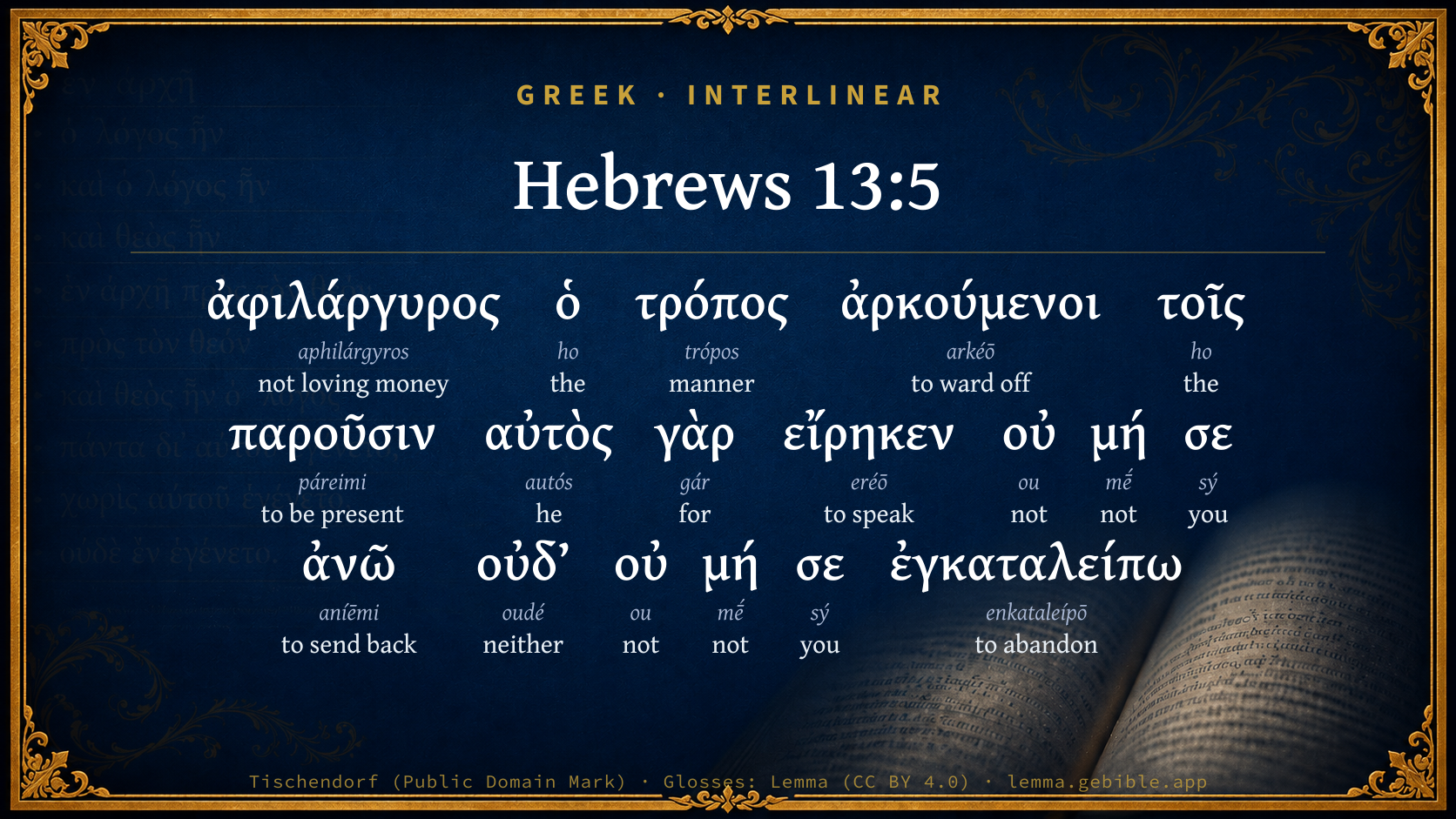
Be free from the love of money, content with such things as you have, for he has said, "I will in no way leave you, neither will I in any way forsake you."
Download a study sheet
One document with this verse’s original text, its word-by-word gloss line, the meaning frame, cross-references with their text, attributed commentary, and full source and license credits — printable, and it pastes into notes with its structure intact.
This verse Autodidact and up
A passage Seminary Student
Up to 50 verses in one chapter. A passage sheet keeps up to 6 commentary sources and 12 cross-references per verse, in the order this page ranks them, and says so on the sheet whenever that leaves anything out. Ask for a single verse and you get the Autodidact verse sheet above.
Everything on this page stays free to read, with no account — the sheet is a download of what is already on screen, not access to it.
Compare translations 3
The same verse in 3 English versions, stacked beneath the original-language interlinear above. Click any original word for its lexicon entry.
Each is an independent rendering of the whole verse — the interlinear is not word-aligned to these translations.
Highlighted words mark where these versions differ — a whole-verse word diff, not a word-by-word alignment.
-
World English Bible Public Domain
Be free from the love of money, content with such things as you have, for he has said, "I will in no way leave you, neither will I in any way forsake you."
-
King James Version Public Domain
Let your conversation be without covetousness; and be content with such things as ye have: for he hath said, I will never leave thee, nor forsake thee.
-
unfoldingWord Literal Text CC BY-SA 4.0
Your manner of life free from the love of money, being content the things being present, for he himself has said, “I will never leave you, nor never will I forsake you,”
unfoldingWord Literal Text — © unfoldingWord, licensed CC BY-SA 4.0. Word-aligned USFM3 via Door43 (git.door43.org/unfoldingWord/en_ult).
Show all 19 translations
Every available English version of this verse, each an independent rendering of the whole verse.
-
World English Bible Public Domain
Be free from the love of money, content with such things as you have, for he has said, "I will in no way leave you, neither will I in any way forsake you."
-
Berean Standard Bible Public Domain
Keep your lives free from the love of money and be content with what you have, for God has said: “Never will I leave you, never will I forsake you.”
-
Majority Standard Bible Public Domain
Keep your lives free from the love of money and be content with what you have, for God has said: “Never will I leave you, never will I forsake you.”
-
King James Version Public Domain
Let your conversation be without covetousness; and be content with such things as ye have: for he hath said, I will never leave thee, nor forsake thee.
-
American Standard Version (1901) Public Domain
Be ye free from the love of money; content with such things as ye have: for himself hath said, I will in no wise fail thee, neither will I in any wise forsake thee.
-
Revised Version (1885) Public Domain
Be ye free from the love of money; content with such things as ye have: for himself hath said, I will in no wise fail thee, neither will I in any wise forsake thee.
-
Geneva Bible (1599) Public Domain
Let your conuersation be without couetousnesse, and be content with those things that ye haue, for he hath said,
-
Douay-Rheims (1899) Public Domain
Let your manners be without covetousness, contented with such things as you have; for he hath said: I will not leave thee, neither will I forsake thee.
-
Young's Literal Translation Public Domain
Without covetousness the behaviour, being content with the things present, for He hath said, `No, I will not leave, no, nor forsake thee,'
-
Literal Standard Version CC BY-SA 4.0
[Be] without covetous behavior, being content with the things present, for He has said, “No, I will not leave, no, nor forsake you,”
-
Unlocked Literal Bible CC BY-SA 4.0
Let your conduct be free from the love of money. Be content with the things you have, for God himself has said, “I will never leave you, nor will I forsake you.”
-
unfoldingWord Literal Text CC BY-SA 4.0
Your manner of life free from the love of money, being content the things being present, for he himself has said, “I will never leave you, nor never will I forsake you,”
-
Darby Bible Public Domain
[Let your] conversation [be] without love of money, satisfied with [your] present circumstances; for *he* has said, I will not leave thee, neither will I forsake thee.
-
World Messianic Bible Public Domain
Be free from the love of money, content with such things as you have, for he has said, “I will in no way leave you, neither will I in any way forsake you.”
-
Webster's Bible Public Domain
Let your manner of life be without covetousness; and be content with such things as ye have: for he hath said, I will never leave thee, nor forsake thee.
-
Free Bible Version CC BY-SA 4.0
Don't love money; be content with what you have. God himself has said, “I'll never let you down; I'll never give up on you.”
-
Bible in Basic English Public Domain
Be free from the love of money and pleased with the things which you have; for he himself has said, I will be with you at all times.
-
Text-Critical English NT CC BY 4.0
Keep your lives free from the love of money, and be content with what you have, for God has said, “I will never leave yoʋ or forsake yoʋ.”
-
Tyndale New Testament (1534) Public Domain
Let youre conversacion be with out coveteousnes and be content with that ye have all redy. For he verely sayd: I will not fayle the nether forsake the:
Literal Standard Version (2020), Covenant Press — licensed CC BY-SA 4.0. Text via the HelloAO Bible API (eBible.org). Unlocked Literal Bible (unfoldingWord) — licensed CC BY-SA 4.0. Text via the HelloAO Bible API (eBible.org). unfoldingWord Literal Text — © unfoldingWord, licensed CC BY-SA 4.0. Word-aligned USFM3 via Door43 (git.door43.org/unfoldingWord/en_ult). Free Bible Version, Dr. Jonathan Gallagher — licensed CC BY-SA 4.0. Text via the HelloAO Bible API (eBible.org).
Word by word
More ways to search: Search by grammar → Find every occurrence → Compare this word →
Practice this passage: Drill this verse → Learn its vocabulary →
- Appears 2× in the Greek New Testament
- First appears at 1 Timothy 3:3
- Part of Speech
- Adjective
- Case
- Nominative
- Number
- Singular
- Gender
- Masculine
Full Thayer's Definition
- ἀφιλάργυρος aphilárgyros G866 “not loving money” Adjective, Nominative, Singular, Masculine
- ὁ ho G3588 “the” Article, Nominative, Singular, Masculine
- τρόπος trópos G5158 “manner” Noun, Nominative, Singular, Masculine
- ἀρκούμενοι arkéō G714 “to ward off” Verb, Present, Passive, Participle, Nominative, Plural, Masculine
- τοῖς ho G3588 “the” Article, Dative, Plural, Neuter
- παροῦσιν páreimi G3918 “to be present” Verb, Present, Active, Participle, Dative, Plural, Neuter
- αὐτὸς autós G846 “he” Personal pronoun, Nominative, Singular, Masculine
- γὰρ gár G1063 “for” Conjunction
- εἴρηκεν eréō G2046 “to speak” Verb, Perfect, Active, Indicative, 3rd person, Singular, Attic form
- οὐ ou G3756 “not” Particle, Negative
- μή mḗ G3361 “not” Particle, Negative
- σε sý G4771 “you” Personal pronoun, 2nd person, Accusative, Singular
- ἀνῶ aníēmi G447 “to send back” Verb, Aorist, Active, Subjunctive, 1st person, Singular
- οὐδ’ oudé G3761 “neither” Conjunction, Negative
- οὐ ou G3756 “not” Particle, Negative
- μή mḗ G3361 “not” Particle, Negative
- σε sý G4771 “you” Personal pronoun, 2nd person, Accusative, Singular
- ἐγκαταλείπω enkataleípō G1459 “to abandon” Verb, Present, Active, Indicative, 1st person, Singular
About this verse
These counts appear in no published source. They are computed here, from the morphology-tagged text and Lemma’s own curated glosses. What Lemma adds →
- 18
- words
- 14
- distinct lemmas
- General Epistles
- section
Cross-references
35Topical passages linked to Hebrews 13:5 in the Treasury of Scripture Knowledge — connected by theme and wording, ordered by reader-vote popularity; previews shown in the World English Bible.
- Deuteronomy 31:8 Yahweh, he it is who does go before you; he will be with you, he will not fail you, neither forsake you: don't be afraid, neither be dismayed.
- Joshua 1:5 There shall not any man be able to stand before you all the days of your life. As I was with Moses, so I will be with you; I will not fail you, nor forsake you.
- Deuteronomy 31:6 Be strong and of good courage, don't be afraid, nor be scared of them: for Yahweh your God, he it is who does go with you; he will not fail you, nor forsake you.
- 1 Samuel 12:22 For Yahweh will not forsake his people for his great name's sake, because it has pleased Yahweh to make you a people to himself.
- Isaiah 41:17 The poor and needy seek water, and there is none, and their tongue fails for thirst; I, Yahweh, will answer them, I, the God of Israel, will not forsake them.
- Psalms 37:25 I have been young, and now am old, Yet I have not seen the righteous forsaken, Nor his children begging for bread.
- Isaiah 41:10 Don't you be afraid, for I am with you; don't be dismayed, for I am your God; I will strengthen you; yes, I will help you; yes, I will uphold you with the right hand of my righteousness.
- 1 Chronicles 28:20 David said to Solomon his son, Be strong and of good courage, and do it: don't be afraid, nor be dismayed; for Yahweh God, even my God, is with you; he will not fail you, nor forsake you, until all the work for the service of the house of Yahweh is finished.
- Matthew 6:25 Therefore, I tell you, don't be anxious for your life: what you will eat, or what you will drink; nor yet for your body, what you will wear. Isn't life more than food, and the body more than clothing?
- Genesis 28:15 Behold, I am with you, and will keep you, wherever you go, and will bring you again into this land. For I will not leave you, until I have done that which I have spoken of to you."
- Matthew 6:34 Therefore don't be anxious for tomorrow, for tomorrow will be anxious for itself. Each day's own evil is sufficient.
- Psalms 37:28 For Yahweh loves justice, And doesn't forsake his saints. They are preserved forever, But the children of the wicked shall be cut off.
- Philippians 4:11–12 Not that I speak in respect to lack, for I have learned in whatever state I am, to be content in it.
- 1 Timothy 6:6–10 But godliness with contentment is great gain.
- Luke 16:13–14 No servant can serve two masters, for either he will hate the one, and love the other; or else he will hold to one, and despise the other. You aren't able to serve God and mammon."
- Luke 12:15–21 He said to them, "Beware! Keep yourselves from covetousness, for a man's life doesn't consist of the abundance of the things which he possesses."
- Colossians 3:5 Put to death therefore your members which are on the earth: sexual immorality, uncleanness, depraved passion, evil desire, and covetousness, which is idolatry;
- Ezekiel 33:31 They come to you as the people comes, and they sit before you as my people, and they hear your words, but don't do them; for with their mouth they show much love, but their heart goes after their gain.
- Luke 3:14 Soldiers also asked him, saying, "What about us? What must we do?" He said to them, "Extort from no one by violence, neither accuse anyone wrongfully. Be content with your wages."
- Psalms 119:36 Turn my heart toward your statutes, Not toward selfish gain.
- Psalms 10:3 For the wicked boasts of his heart's cravings, He blesses the greedy, and condemns Yahweh.
- 2 Peter 2:14 having eyes full of adultery, and who can't cease from sin; enticing unsettled souls; having a heart trained in greed; children of cursing;
- Jeremiah 6:13 For from the least of them even to the greatest of them everyone is given to covetousness; and from the prophet even to the priest everyone deals falsely.
- Romans 1:29 being filled with all unrighteousness, sexual immorality, wickedness, covetousness, maliciousness; full of envy, murder, strife, deceit, evil habits, secret slanderers,
- 1 Timothy 3:3 not a drinker, not violent, not greedy for money, but gentle, not quarrelsome, not covetous;
- 2 Peter 2:3 In covetousness they will exploit you with deceptive words: whose sentence now from of old doesn't linger, and their destruction will not slumber.
- Luke 8:14 That which fell among the thorns, these are those who have heard, and as they go on their way they are choked with cares, riches, and pleasures of life, and bring no fruit to maturity.
- Ephesians 5:5 Know this for sure, that no sexually immoral person, nor unclean person, nor covetous man, who is an idolater, has any inheritance in the Kingdom of Christ and God.
- Ephesians 5:3 But sexual immorality, and all uncleanness, or covetousness, let it not even be mentioned among you, as becomes saints;
- Exodus 2:21 Moses was content to dwell with the man. He gave Moses Zipporah, his daughter.
- Mark 7:22 covetings, wickedness, deceit, lustful desires, an evil eye, blasphemy, pride, and foolishness.
- 1 Corinthians 5:11 But as it is, I wrote to you not to associate with anyone who is called a brother who is a sexual sinner, or covetous, or an idolater, or a slanderer, or a drunkard, or an extortioner. Don't even eat with such a person.
- 1 Corinthians 6:10 nor thieves, nor covetous, nor drunkards, nor slanderers, nor extortioners, will inherit the Kingdom of God.
- Exodus 20:17 "You shall not covet your neighbor's house. You shall not covet your neighbor's wife, nor his man-servant, nor his maid-servant, nor his ox, nor his donkey, nor anything that is your neighbor's."
- Jude 1:11 Woe to them! For they went in the way of Cain, and ran riotously in the error of Balaam for hire, and perished in Korah's rebellion.
Cross-references courtesy of OpenBible.info (CC BY 4.0).
Lesson kit
Teaching starters — assembled from the data on this page, not authored interpretation. Every prompt links to the verse data it draws on. Edit before teaching.
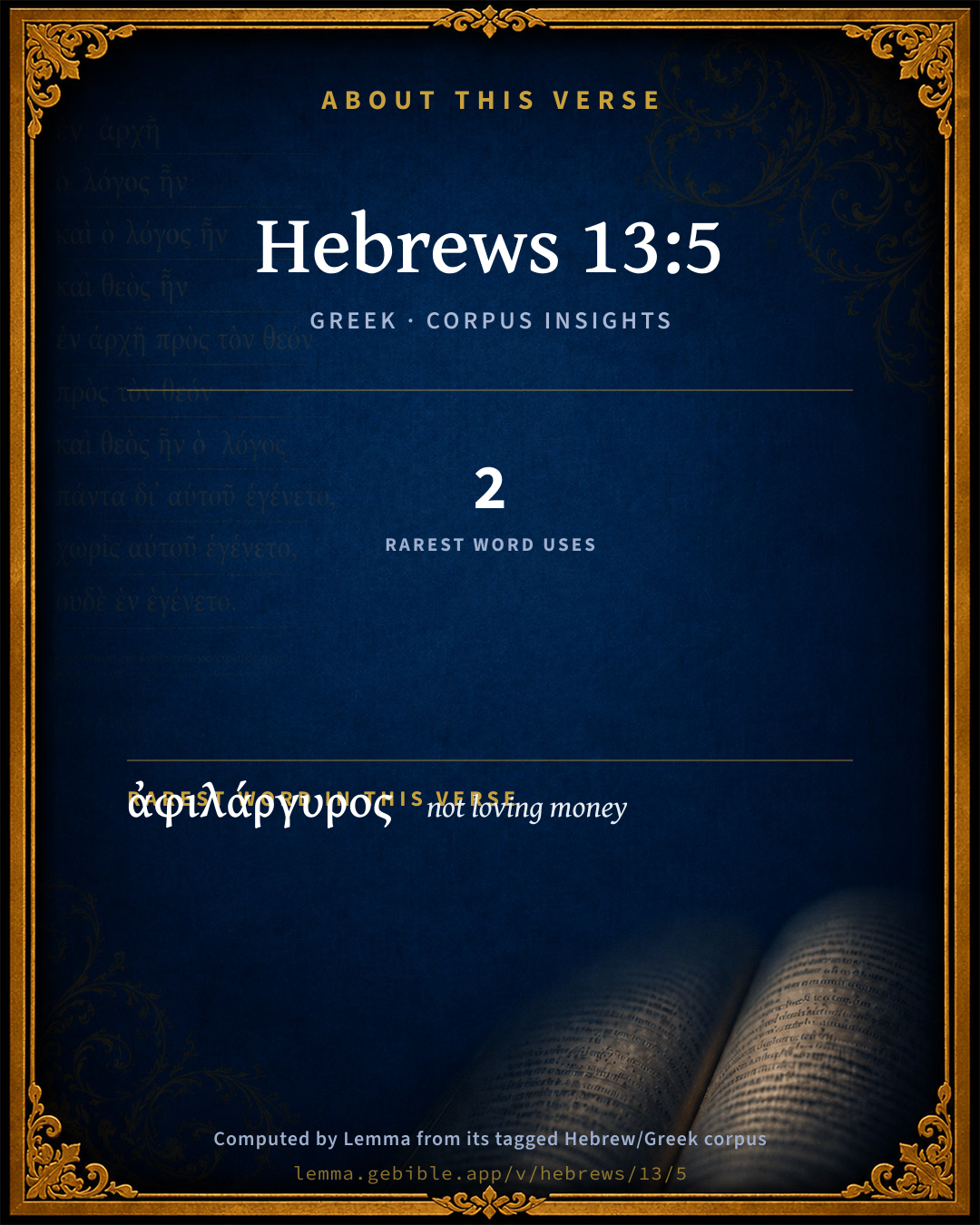
Hebrews, in the General Epistles, opens this verse with 18 words (14 distinct Greek lemmas). Its most distinctive word is aphilárgyros (“not loving money”). A historical commentator’s framing appears above. Read the whole chapter for the surrounding context.
Discussion questions
- What does “not loving money” (aphilárgyros) contribute to the verse as a whole?
- How does 1 Timothy 3:3, which shares the word «not loving money», read alongside this verse?
- What does the repetition of “the” (2× in this one verse) do in this verse?
- The translations on this page render this verse differently — a whole-verse word diff, not a word-by-word alignment. What might account for the different wordings?
- Compare how Ellicott's Commentary for English Readers and The Biblical Illustrator read this verse. Where do they agree or differ?
Things to notice
- These translations choose different wording for 20 words in this verse.
- “the” occurs 2× in this single verse.
- 14 distinct Greek lemmas span 18 words in this verse.
Commentary
Notes on Hebrews 13:5 from classic Christian and Jewish commentators (each source and its license shown beneath its notes). The classic Christian expositions comment on the surrounding passage and are grouped to its opening verse, so a note may address several verses; the Jewish commentaries on the Tanakh (Rashi and others) are per-verse, so they appear only where the commentator wrote on this verse.
Lemma curates 59 commentaries, every one of them public domain or Creative Commons licensed, each selected and text-cleaned for this edition rather than reprinted as found. About our sources →
Ellicott's Commentary for English Readers
A Bible Commentary for English Readers, edited by Charles John Ellicott (1878–1897) — public domain. Text from a community e-Sword module.
The Biblical Illustrator
Joseph S. Exell
The Biblical Illustrator, edited by Joseph S. Exell (c. 1880s–1900s) — public domain. Text from a community e-Sword module.
Joseph Benson's Commentary
Joseph Benson's Commentary on the Old and New Testaments (1811–1818) — public domain. Text from a community e-Sword module.
MacLaren's Expositions of Holy Scripture
Alexander MacLaren
Alexander MacLaren, Expositions of Holy Scripture (1904–1910) — public domain. Text from a community e-Sword module.
Tyndale Open Study Notes
Tyndale Open Resources
Tyndale Open Study Notes — © Tyndale Open Resources, licensed CC BY-SA 4.0. Text via the HelloAO Bible API.
Bengel's Gnomon
Johann Albrecht Bengel
Bengel's Gnomon of the New Testament — English translation (T&T Clark, Edinburgh, 1860) — public domain. Text from a community e-Sword module.
Meyer's Critical & Exegetical Commentary
Heinrich August Wilhelm Meyer
Meyer — Critical and Exegetical Commentary on the New Testament — English translation by Peter Christie, edited by Frederick Crombie (T&T Clark, 1880) — public domain. Text from a community e-Sword module.
Expositor's Greek Testament
ed. W. Robertson Nicoll
The Expositor's Greek Testament, edited by W. Robertson Nicoll (1897–1910) — public domain. Text from a community e-Sword module.
Geneva Bible (1599)
Geneva Bible translators
Geneva Bible (1599) marginal notes — public domain. Text via Bolls.life.
Jamieson, Fausset & Brown
Robert Jamieson, A. R. Fausset & David Brown
Jamieson, Fausset & Brown — Commentary Critical and Explanatory on the Whole Bible (1871) — public domain (CC PDM 1.0). Text via the HelloAO Bible API.
Adam Clarke's Commentary
Adam Clarke's Commentary on the Bible (1810–1826) — public domain. Text from a community e-Sword/MySword module.
John Calvin's Commentaries
John Calvin's Commentaries (1540-1563) — public domain. Text from the Calvin Translation Society English edition (1840s-50s) via the Christian Classics Ethereal Library (ccel.org). Calvin's coverage is partial (roughly two-thirds of the Bible); uncommented books and verses are honest gaps, never fabricated. The 19th-century editor's footnotes and remarks are omitted so the notes are faithfully Calvin's own voice.
The Cambridge Bible for Schools and Colleges
gen. ed. J. J. S. Perowne
The Cambridge Bible for Schools and Colleges (gen. ed. J. J. S. Perowne; Cambridge University Press, 1878–1918) — public domain. Text from a community e-Sword module.
John Gill's Exposition
John Gill's Exposition of the Whole Bible (1746–1763) — public domain (CC PDM 1.0). Text via the HelloAO Bible API.
Trapp's Complete Commentary
John Trapp
John Trapp, A Commentary or Exposition upon All the Books of the Old and New Testament (1647–1656) — public domain. Text from a community e-Sword module.
Albert Barnes' Notes on the Bible
Albert Barnes' Notes on the Bible (1834–1885) — public domain. Text from a community e-Sword/MySword module.
Haydock's Catholic Bible Commentary
George Leo Haydock (1774–1849), Haydock's Catholic Family Bible and Commentary, 1859 edition — public domain. Excludes Psalms (Douay-Rheims chapter numbering differs from Protestant) and Deuterocanonical books (Catholic canon only).
Matthew Poole's English Annotations
Matthew Poole's English Annotations on the Holy Bible (1683–1685) — public domain. Text from a community e-Sword/MySword module.
Whedon's Commentary on the Bible
Daniel D. Whedon
Daniel D. Whedon (gen. ed.), Commentary on the Old and New Testaments (1874–1909) — public domain. Text from a community e-Sword module.
The Pulpit Commentary
The Pulpit Commentary (1880–1919), ed. H.D.M. Spence-Jones & Joseph S. Exell — public domain. Text from a community e-Sword module.
John Wesley's Explanatory Notes
John Wesley, Explanatory Notes Upon the Whole Bible (1754–1765) — public domain. Text via the GEBible commentary corpus.
Burkitt's Expository Notes on the New Testament
William Burkitt
William Burkitt's Expository Notes on the New Testament (1700–1703) — public domain. Text from a community e-Sword module.
The People's New Testament
B. W. Johnson
B. W. Johnson's The People's New Testament with Notes (1889–1891) — public domain. Electronic text from the Christian Classics Ethereal Library (CCEL) ThML edition.
unfoldingWord translationNotes
Door43 World Missions Community
unfoldingWord translationNotes — © Distant Shores Media and the Door43 World Missions Community, licensed CC BY-SA 4.0. Source: git.door43.org/Door43/en_tn.
Cambridge Greek Testament for Schools and Colleges
Cambridge Greek Testament for Schools and Colleges (Cambridge University Press, 1896; 21 vols, various authors incl. Carr, Maclear, Plummer, Farrar, Lumby, Moule, M. R. James, Simcox) — public domain. Text from a community e-Sword module.
Alford’s Greek Testament
Henry Alford
Henry Alford, The Greek Testament (1849–1861) — public domain. Text from a community e-Sword module.
Westcott on Hebrews & the Epistles of John
Brooke Foss Westcott
Brooke Foss Westcott (1825–1901), The Epistle to the Hebrews (1889) and The Epistles of St John (1883) — public domain (pre-1929). Text recovered from Internet Archive / Google Books OCR scans. Westcott’s Gospel of John commentary is not included (its OCR lost the chapter running-heads required for reliable verse-keying). Some Greek quoted in the Hebrews volume is imperfectly rendered by the OCR.