
Galatians 2:5

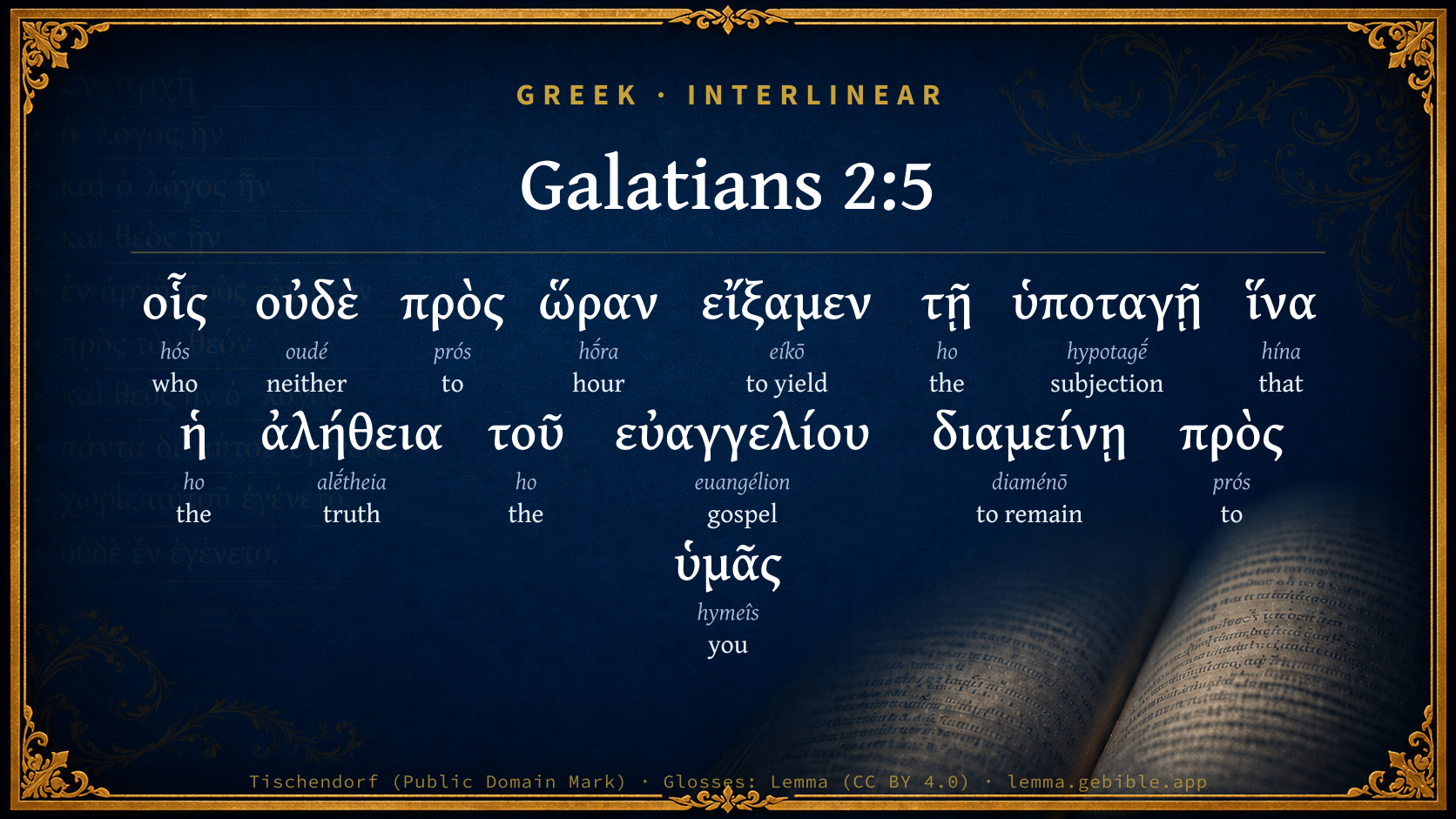
Greek (Tischendorf 8th ed.) Galatians 2:5 appears in the Greek New Testament. The text above is from the Tischendorf 8th edition. Each word links to its Strong’s number and a concise gloss. Click any word for its full Thayer’s Greek Lexicon entry.
Download image
Cite this verse

Galatians 2:5 (World English Bible). Public Domain. Lemma interlinear Bible study tool, https://lemma.gebible.app/v/galatians/2/5.

Show BibTeX & RIS
BibTeX
RIS
English Translation
to whom we gave no place in the way of subjection, not for an hour, that the truth of the Gospel might continue with you.
World English Bible · Public Domain
Highlights
  • 1 first appearance in the Greek New Testament
Full analysis ↓
Download a study sheet

One document with this verse’s original text, its word-by-word gloss line, the meaning frame, cross-references with their text, attributed commentary, and full source and license credits — printable, and it pastes into notes with its structure intact.

This verse Autodidact and up

Study sheet (.html) Plain text (.txt)

A passage Seminary Student

Up to 50 verses in one chapter. A passage sheet keeps up to 6 commentary sources and 12 cross-references per verse, in the order this page ranks them, and says so on the sheet whenever that leaves anything out. Ask for a single verse and you get the Autodidact verse sheet above.

Everything on this page stays free to read, with no account — the sheet is a download of what is already on screen, not access to it.

Want to remove ads? Support Godless Engineer
Compare translations 3

The same verse in 3 English versions, stacked beneath the original-language interlinear above. Click any original word for its lexicon entry.

Each is an independent rendering of the whole verse — the interlinear is not word-aligned to these translations.

Highlighted words mark where these versions differ — a whole-verse word diff, not a word-by-word alignment.

  • World English Bible Public Domain
    to whom we gave no place in the way of subjection, not for an hour, that the truth of the Gospel might continue with you.
  • King James Version Public Domain
    To whom we gave place by subjection, no, not for an hour; that the truth of the gospel might continue with you.
  • unfoldingWord Literal Text CC BY-SA 4.0
    we did not even yield in submission to them for an hour, so that the truth of the gospel might remain with you.

unfoldingWord Literal Text — © unfoldingWord, licensed CC BY-SA 4.0. Word-aligned USFM3 via Door43 (git.door43.org/unfoldingWord/en_ult).

Versions to compare (up to 4)

3 of 4 selected

Show all 19 translations

Every available English version of this verse, each an independent rendering of the whole verse.

  • World English Bible Public Domain
    to whom we gave no place in the way of subjection, not for an hour, that the truth of the Gospel might continue with you.
  • Berean Standard Bible Public Domain
    We did not give in to them for a moment, so that the truth of the gospel would remain with you.
  • Majority Standard Bible Public Domain
    We did not give in to them for a moment, so that the truth of the gospel would remain with you.
  • King James Version Public Domain
    To whom we gave place by subjection, no, not for an hour; that the truth of the gospel might continue with you.
  • American Standard Version (1901) Public Domain
    to whom we gave place in the way of subjection, no, not for an hour; that the truth of the gospel might continue with you.
  • Revised Version (1885) Public Domain
    to whom we gave place in the way of subjection, no, not for an hour; that the truth of the gospel might continue with you.
  • Geneva Bible (1599) Public Domain
    To whom we gaue not place by subiection for an houre, that the trueth of the Gospel might continue with you.
  • Douay-Rheims (1899) Public Domain
    To whom we yielded not by subjection, no not for an hour, that the truth of the gospel might continue with you.
  • Young's Literal Translation Public Domain
    to whom not even for an hour we gave place by subjection, that the truth of the good news might remain to you.
  • Literal Standard Version CC BY-SA 4.0
    to whom not even for an hour we gave place by subjection, that the truth of the good news might remain to you.
  • Unlocked Literal Bible CC BY-SA 4.0
    but we did not yield in submission to them for a moment, so that the truth of the gospel would remain with you.
  • unfoldingWord Literal Text CC BY-SA 4.0
    we did not even yield in submission to them for an hour, so that the truth of the gospel might remain with you.
  • Darby Bible Public Domain
    to whom we yielded in subjection not even for an hour, that the truth of the glad tidings might remain with you.
  • World Messianic Bible Public Domain
    to whom we gave no place in the way of subjection, not for an hour, that the truth of the Good News might continue with you.
  • Webster's Bible Public Domain
    To whom we gave place by subjection, no, not for an hour; that the truth of the gospel might continue with you.
  • Free Bible Version CC BY-SA 4.0
    We never gave in to them, not even for a moment. We wanted to make sure to keep the truth of the good news unchanged for you.)
  • Bible in Basic English Public Domain
    To whom we gave way not even for an hour; so that the true words of the good news might still be with you.
  • Text-Critical English NT CC BY 4.0
    But we did not yield to them in submission for even an hour, so that the truth of the gospel might be preserved for you.
  • Tyndale New Testament (1534) Public Domain
    To whom we gave no roume no not for the space of an houre as concerninge to be brought into subieccion: and that because that the trueth of the gospell myght continue with you.

Literal Standard Version (2020), Covenant Press — licensed CC BY-SA 4.0. Text via the HelloAO Bible API (eBible.org). Unlocked Literal Bible (unfoldingWord) — licensed CC BY-SA 4.0. Text via the HelloAO Bible API (eBible.org). unfoldingWord Literal Text — © unfoldingWord, licensed CC BY-SA 4.0. Word-aligned USFM3 via Door43 (git.door43.org/unfoldingWord/en_ult). Free Bible Version, Dr. Jonathan Gallagher — licensed CC BY-SA 4.0. Text via the HelloAO Bible API (eBible.org).

Word by word

More ways to search: Search by grammar → Find every occurrence → Compare this word →

Practice this passage: Drill this verse → Learn its vocabulary →

εἴξαμεν
eíkō
G1502
“to yield”
Verb, Aorist, Active, Indicative, 1st person, Plural
Part of Speech
Verb
Tense
Aorist
Voice
Active
Mood
Indicative
Person
1st person
Number
Plural
Full Thayer's Definition

Origin: apparently a root word

TDNT: None

1. to yield
  1. οἷς hós G3739 “who” Relative pronoun, Dative, Plural, Masculine
  2. οὐδὲ oudé G3761 “neither” Conjunction, Negative
  3. πρὸς prós G4314 “to” Preposition
  4. ὥραν hṓra G5610 “hour” Noun, Accusative, Singular, Feminine
  5. τῇ ho G3588 “the” Article, Dative, Singular, Feminine
  6. ὑποταγῇ hypotagḗ G5292 “subjection” Noun, Dative, Singular, Feminine
  7. ἵνα hína G2443 “that” Conjunction
  8. ἡ ho G3588 “the” Article, Nominative, Singular, Feminine
  9. ἀλήθεια alḗtheia G225 “truth” Noun, Nominative, Singular, Feminine
  10. τοῦ ho G3588 “the” Article, Genitive, Singular, Neuter
  11. εὐαγγελίου euangélion G2098 “gospel” Noun, Genitive, Singular, Neuter
  12. διαμείνῃ diaménō G1265 “to remain” Verb, Aorist, Active, Subjunctive, 3rd person, Singular
  13. πρὸς prós G4314 “to” Preposition
  14. ὑμᾶς hymeîs G5210 “you” Personal pronoun, 2nd person, Accusative, Plural

About this verse

These counts appear in no published source. They are computed here, from the morphology-tagged text and Lemma’s own curated glosses. What Lemma adds →

15
words
12
distinct lemmas
Pauline Epistles
section

Notable vocabulary

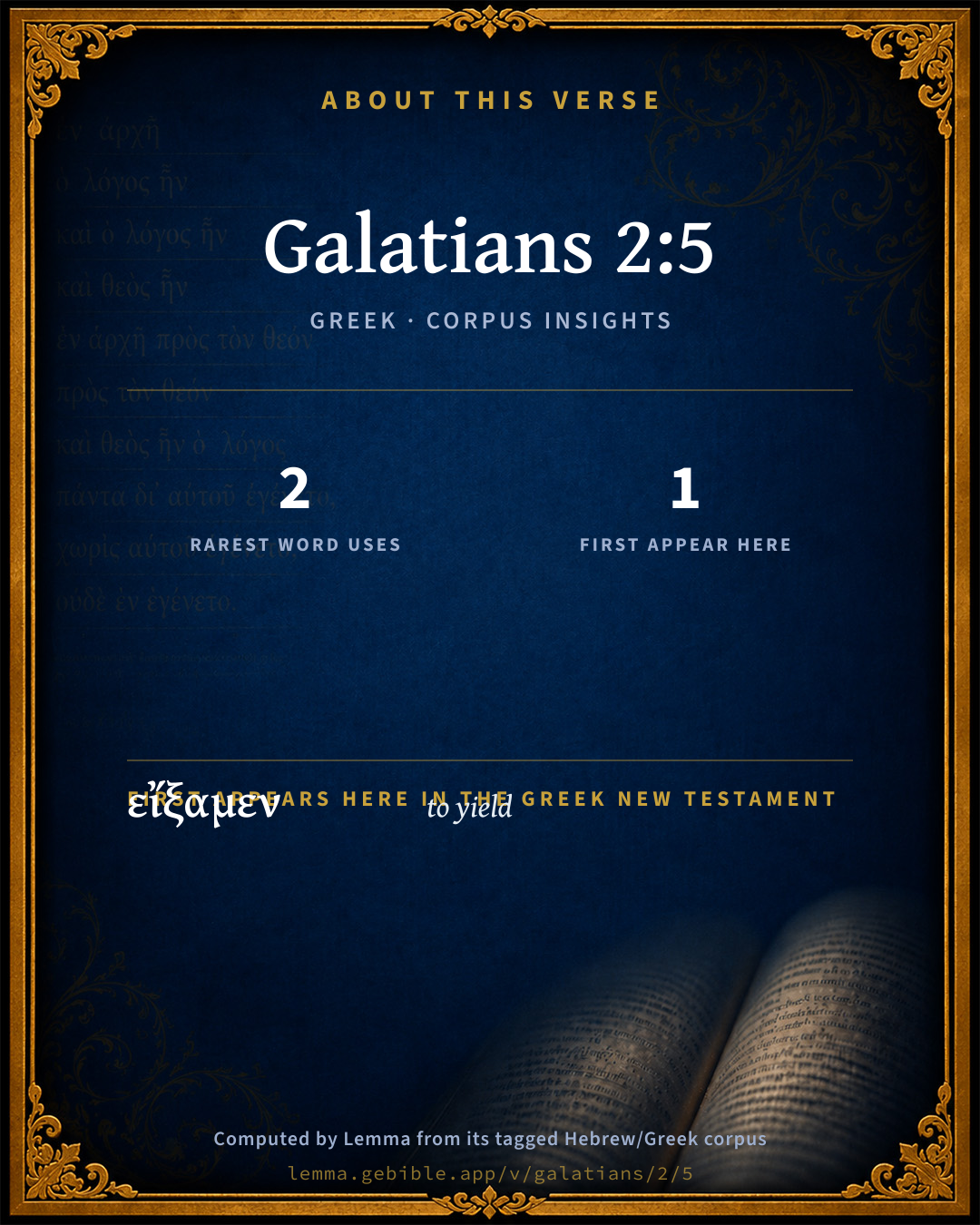
The rarest word here is εἴξαμεν to yield G1502 — appearing just 2 times in the whole Greek New Testament.

First appearance in Scripture

This word makes its first canonical appearance in the Greek New Testament here:

  • εἴξαμεν to yield G1502

Shared distinctive vocabulary

εἴξαμεν to yield G1502 occurs in 2 verses of the Greek New Testament. Also found in:
Repetition

Words recur within this verse:

Cross-references

9

Topical passages linked to Galatians 2:5 in the Treasury of Scripture Knowledge — connected by theme and wording, ordered by reader-vote popularity; previews shown in the World English Bible.

  • Galatians 2:14 But when I saw that they didn't walk uprightly according to the truth of the Gospel, I said to Peter before them all, "If you, being a Jew, live as the Gentiles do, and not as the Jews do, why do you compel the Gentiles to live as the Jews do?
  • Galatians 4:16 So then, have I become your enemy by telling you the truth?
  • Galatians 3:1–2 Foolish Galatians, who has bewitched you not to obey the truth, before whose eyes Jesus Christ was openly set forth among you as crucified?
  • Ephesians 1:13 in whom you also, having heard the word of the truth, the Gospel of your salvation,--in whom, having also believed, you were sealed with the Holy Spirit of promise,
  • Colossians 1:5 because of the hope which is laid up for you in the heavens, of which you heard before in the word of the truth of the Gospel,
  • Colossians 2:4–8 Now this I say that no one may delude you with persuasiveness of speech.
  • Jude 1:3 Beloved, while I was very eager to write to you about our common salvation, I was constrained to write to you exhorting you to contend earnestly for the faith which was once for all delivered to the saints.
  • Acts 15:2 Therefore when Paul and Barnabas had no small discord and discussion with them, they appointed Paul and Barnabas, and some others of them, to go up to Jerusalem to the apostles and elders about this question.
  • 1 Thessalonians 2:13 For this cause we also thank God without ceasing, that, when you received from us the word of the message of God, you accepted it not as the word of men, but, as it is in truth, the word of God, which also works in you who believe.

Cross-references courtesy of OpenBible.info (CC BY 4.0).

Commentary

Notes on Galatians 2:5 from classic Christian and Jewish commentators (each source and its license shown beneath its notes). The classic Christian expositions comment on the surrounding passage and are grouped to its opening verse, so a note may address several verses; the Jewish commentaries on the Tanakh (Rashi and others) are per-verse, so they appear only where the commentator wrote on this verse.

Lemma curates 59 commentaries, every one of them public domain or Creative Commons licensed, each selected and text-cleaned for this edition rather than reprinted as found. About our sources →

The Biblical Illustrator

Joseph S. Exell

Gal_2:5

To whom we gave place by subjection, no, not for an hour.

The truth in the Church

I. The truth of the gospel is essentially embodied in the doctrinal articles, and the devotional services, of the Church of England. Her basis is the Word of God. There is no one truth contained in the Bible which does not appear interwoven in her services; and, what is of vast importance, those truths are every one of them brought forward throughout her ecclesiastical year with a distinctness, and yet with a beautiful consistency and harmony, according to the analogy of the faith.

II. The reformers, both in their lives and by their deaths, evinced a deep anxiety that the truth of the gospel, by means of a scriptural Church, might continue with us.

III. It becomes us their children, blessed with such privileges, to be alive to the importance of maintaining the truth of the gospel, and handing it down unimpaired to posterity. Gratitude demands this at our hands; the mercy of God in the bestowment of these blessings, and the salvation of souls which is so closely bound up in them, enforce this duty upon us. If religion be anything, it is everything. And surely, if men be anxious and persevering and brave in securing temporal freedom and national liberty, oh! shall the Christian, actuated by the love of Christ, the most constraining principle, be afraid, or unwilling, or indifferent, to perpetuate the truth which sets free the immortal spirit, and obtain, so far as human instrumentality can, the blessings of salvation to children yet unborn?

1. If we would effectually promote the interests of Divine truth, we must take care, first of all, that we ourselves embrace it.

2. And then, having embraced the truth, I would say, Contend earnestly for the truth--not in the spirit of party, not in the pride of reason, not with any secular motives, but because of its vitality and importance to the present and eternal well-being of man. And as the truth itself is but a modification of love, let your contention be in the spirit of love, seeking to reclaim those who are in error, in meekness and affection.

3. And see to it, that it is the truth you are contending for. In essentials let not false charity or a spurious liberality lead you astray; there ought to be, there can be, no compromise of the one saving truth.

IV. The education of the young in the principles of Divine truth, as embodied and taught in the formularies of the Church, must commend itself as a means at once simple and efficient. (Joseph Haslegrave, M. A.)

Pauls fearless independence

No characteristic of the apostle is more marked than this. He went on his way unmoved alike by prejudiced and narrow-minded bigotry within the Church, or by armed and persecuting hostility without. Whether he is confronted with the worse than heathen libertinism that threatened to corrupt the Churches of Greece, or by the half-converted Pharisees who would have offered up the universality of the gospel to the prejudices of a sect; whether he stands before a Roman officer or before an infuriated mob; whether he is exposed to the sneers of a scoffer like Agrippa, or the sordid venality of an unjust judge like Felix--in all circumstances and under every temptation to make concessions to the prejudice or passions of those around him, Paul maintained an undaunted fearlessness of bearing, and stands forth with vigorous self-reliance, refusing to submit to the control of others his conviction of duty, refusing to swerve a hairsbreadth from the path his conscience marks out for him. (Prof. Robertson Smith.)

The reasons and consequences of Pauls resistance

There are some who may see in this resolute attitude the inevitable egotism of a strong will and a clear purpose; but it is more reasonable to discover in such a temper an unshaken conviction in the reality of his mission, and a distinct persuasion that this mission was to be fulfilled in one way on!y, and by those specific means which he had been already adopting. And to us, who can understand the effect of this uncompromising temper upon the history of Christianity, it is manifest that the apostles persistency is the reason why Christianity did not become a mere Jewish School, which might have had a faint existence in the Ana of some Talmud or Cabbala; or would, more probably, have been completely lost in the general havoc of the Jewish war. As it is, the teaching of the Pharisee of Tarsus has given method to modern civilization, has erected Christianity into a social system, and has constituted a standard by which the Christian system has been measured and reformed. (Paul of Tarsus.)

Prompt opposition to error

Some years ago I was amused with the sentiment of a witty fellow who said, A lie will travel from Maine to Georgia while truth is putting on his boots. In that case, he added, truth should not stop to put on his boots. The difficulty lies in allowing the lie to run so far ahead; let them start abreast, and truth will gain the field. It may be distanced at the first heat, but on the long run it is sure to secure the prize. (Cangray.)

Strict faithfulness

The other day I received a communication from a lawyer, who says that a very large owner has discovered that a very small piece of property belongs to him, and not to the small proprietor in whose possession it has for a very long time remained. The matter seemed a trifling one. We had a conference, and there came the steward with the lawyers, and he was furnished with maps, and putting on his spectacles, examined them with great care. Why? It was a small matter to him, but because he was a steward he was expected to be faithful. And when he found that this small piece of ground belonged to his lord he was determined to have it. So let me say--as stewards of the gospel of God--never give up one verse, one doctrine, one word of the truth of God. Let us be faithful to that committed to us, it is not ours to alter. We have but to declare that which we have received. (S. Cook, D. D.)

No terms with error

During the Spartan war against Xerxes, the Athenians were entreated not to abandon their natural allies, and leave Greece to be enslaved. Pointing to the sun, Aristides replied, While that sun holds his course, we will come to no terms with Xerxes. For you, Spartans, our character might have raised us above your fears. The earth contains not the gold, nor does the sun shine upon the land that could move our purpose. Even with such unshaken courage and faithfulness must Christians fight against the enemies of the gospel of Christ. (R. Brewin.)

No surrender

To authorize generals, or other officers, to lay down their arms in virtue of a capitulation … affords a dangerous latitude (except when they compose the garrison of a fortress). It is destructive of all military character in a nation to open such a door to the cowardly, the weak, or even the misdirected brave. Great extremities require extraordinary resolution. The more obstinate the resistance of an army, the greater the chances of assistance or success. How many seeming impossibilities have been accomplished by men whose only resource was death! (Maxim LXVII.)

In the campaign of 1759 Frederick directed General Pink, with 18,000 men, upon Maxen, for the purpose of cutting off the Austrian army from the defiles of Bohemia. Surrounded by twice his numbers, Pink capitulated after a sharp action, and 14,000 men laid down their arms. This conduct was the more disgraceful, because General Winch, who commanded the cavalry, cut his way through the enemy. The whole blame of the surrender fell, therefore, upon Pink, who was afterwards tried by a court-martial, and sentenced to be cashiered and imprisoned for two years.

The Biblical Illustrator, edited by Joseph S. Exell (c. 1880s–1900s) — public domain. Text from a community e-Sword module.

Tyndale Open Study Notes

Tyndale Open Resources

2:5 we refused to give in to them for a single moment: Titus was not circumcised (2:3), and Paul did not require circumcision of Gentile Christians. • to preserve the truth: The false teaching would destroy the gospel message by adding other requirements and impeaching the effectiveness of Christ’s death and God’s grace (cp. 2:11-21).

Tyndale Open Study Notes — © Tyndale Open Resources, licensed CC BY-SA 4.0. Text via the HelloAO Bible API.

Bengel's Gnomon

Johann Albrecht Bengel

Gal 2:5. Τῇ ὑποταγῇ, by subjection) There is here a limitation. We would willingly have yielded for love [but not in the way of subjection].—ἡ ἀλήθεια) the truth of the Gospel, the pure Gospel, not another, ch. Gal 1:6: which false brethren attempt to substitute. The same mode of speaking is found, Gal 2:14; Col 1:5. Truth, precise, unaccommodating, abandons nothing, that belongs to itself, admits nothing, that is inconsistent with it.—ὑμᾶς, you) Greeks. We defended for your sakes, what you now reject.

Bengel's Gnomon of the New Testament — English translation (T&T Clark, Edinburgh, 1860) — public domain. Text from a community e-Sword module.

Meyer's Critical & Exegetical Commentary

Heinrich August Wilhelm Meyer

Gal_2:5. Connection:On account of the false brethren, however, Titus was not compelled to be circumcised; to these we did not yield even for an hour. Had we consented to the suggestion, which was made to us by Christians at Jerusalem (see on Gal_2:3), at least to circumcise Titus, we should have thereby yielded to the false brethren standing in the background, who declared the circumcision of Gentile Christians to be necessary; but this did not at all take place.[70]

οἷς] in the sense of τούτοις γάρ. See Stallbaum, ad Phil. p. 195 f.; Kühner, ad Xen. Mem. i. 1. 64; Ellendt, Lex. Soph. II. p. 371.

πρὸς ὥραν] not even for an hour, indicating a very short duration of time. Comp. 2Co_7:8; Phm_1:15; Joh_5:35; 1Th_2:17; also πρὸς μίαν ῥοπήν, Wis_18:12; πρὸς ὀλίγον, πρὸς βραχύ, and the like.

εἴξαμεν] namely, I and Barnabas and Titus.

τῇ ὑποταγῇ] belongs not to διαμείνῃ (Matthias), an inverted arrangement which would be without motive, but to εἴξαμεν, beside which it stands: through the obedience claimed by the false brethren, that is, by rendering to them the obedience which they desired. On the matter itself, see Act_15:1; Act_15:5. Matthies regards τῇ ὑποταγῇ as an appositional explanation of οἷς (as to this usage, see Fritzsche, Diss. in 2 Cor. II. p. 135 f.). But the yielding takes place not to the obedience, but to the demand (τῇ ἐντολῇ). Fritzsche correctly takes it in an ablative sense, but explains, eo obsequio praestito, quod apostoli postularent. But in combination with οἷς … εἴξαμεν, and with ἵνα ἡμᾶς καταδουλ. preceding, it would not occur to the reader to think of anything else than the obedience claimed by the ψευδάδελφοι. Besides, it was not the apostles at all who demanded the circumcision of Titus, but (see on Gal_2:3) Christians at Jerusalem, acting on the instigation of the ψευδάδελφοι, so that these latter would have been obeyed by the circumcision in question. Comp. the state of matters at Act_21:21. Holsten, without any indication of support in the context, interprets: by the subordination to the δοκοῦντες, which had been demanded by the false brethren. Lastly, Hermann (who is followed by Bretschneider), entirely in opposition to the context, explains it, quibus ne horae quidem spatium Jesu obsequio segnior fui.

ἵνα ἡ ἀλήθεια κ.τ.λ.] Object of this non-compliance at that time, which, although in the nature of the case it concerned Pauline Christians generally, is represented concretely as referring to the Galatians: in order that the truth of the gospel may abide with you; in order that by our conduct the principle of Christian freedom should not be shaken, and ye should not be induced to deviate from the truth, which forms the subject-matter of the gospel (Gal_2:14; Col_1:5), by mixing it up with Mosaism (comp. ἕτερον εὐαγγέλιον, Gal_1:6). A purpose, thereforeand this the readers were intended to feelto which their present apostasy entirely ran counter!

πρὸς ὑμᾶς] as πρὸς αὐτόν, Gal_1:18, comp. 1Co_16:7; here also it is not the with of simple rest, but expresses the relation of an active bearing on life; Bernhardy, p. 265. Besides, Paul might justly say πρὸς ὑμᾶς, as the Galatians were for the most part Gentile Christians, and in that opposition to the false brethren it was the freedom of the Gentile Christians which he sought to maintain. The ὑμᾶς individualizes the readers of the letter (Gal_3:26, Gal_4:6; Col_1:25; Eph_3:2, and frequently). The reference to the yet unconverted Gentiles, whom the truth of the gospel had still to reach (πρὸς ὑμᾶς), as suggested by Hofmann,[71] is in complete opposition to the text.

διαμείνη] permaneret; denoting the abiding continuance. The truth which they have received was not again to be lost. Heb_1:11; 2Pe_3:4; Luk_22:8; and frequently in Greek authors.

[70] Paul was therefore by no means nearly compelled to have Titus circumcised (Hilgenfeld in his Zeitschr. 1860, p. 121).

[71] Comp. Windischmann.

Note.

As by the ψευδάδελφοι (Gal_2:4-5) cannot be meant the Judaizers at work among the Galatians (which is assumed by Fritzsche entirely in opposition to the connection), but only the same persons mentioned in Act_15:1; Act_15:5; they cannot be described as false brethren in relation to any one particular church (e.g. to the church of Antioch, into which they had crept from Jerusalem, as Baur and Reiche think). On the contrary, the general form of their antagonism, Gal_2:4-5, as well as the further account in Gal_2:7-10, and the whole argument of the epistle, admit only of one point of view,that the apostle, out of the certainty of the ἀλήθεια τοῦ εὐαγγελίου, styles them false brethren in relation to Christianity generally, of which they had, as regards their Judaizing character and action looked at from a Pauline standpoint, falsely pretended to be professors. This does not in itself exclude the fact that they had come from Jerusalem to Antioch (Act_15:1). The inflexible opposition offered to them by the apostle in Jerusalem doubtless contributed much to the bringing about of the apostolic decree. Comp. Märcker, l.c. p. 539.

Meyer — Critical and Exegetical Commentary on the New Testament — English translation by Peter Christie, edited by Frederick Crombie (T&T Clark, 1880) — public domain. Text from a community e-Sword module.

Expositor's Greek Testament

ed. W. Robertson Nicoll

Gal 2:5 . εἴξαμεν . Paul here couples Barnabas with himself in recording the determined resistance offered by both to the demand for the circumcision of all Christians preferred at Antioch. Barnabas was at that time a staunch supporter of Greek freedom. The verse obviously refers to their attitude at Antioch before going to Jerusalem. τῇ ὑποταγῇ : by our submission . Here, as in 2Co 9:13 , ὑποταγή denotes a voluntary act, not one imposed upon a subject. The same rendering appears more appropriate for expressing the due attitude of wife and children in 1Ti 2:11 ; 1Ti 3:4 . The middle voice ὑποτάσσεσθαι is five times rendered submit in the Authorised Version, and the force of the original is impaired by its exclusion from the text of the Revised Version. ἵνα … The motive for firmness was the maintenance of the truth of the Gospel, i.e. , of the freedom to which the uncircumcised were entitled in Christ. πρὸς ὑμᾶς : for you, i.e. , with a view to your welfare. The rendering of our versions, with you , would be properly expressed by ἐν ὑμῖν .

The Expositor's Greek Testament, edited by W. Robertson Nicoll (1897–1910) — public domain. Text from a community e-Sword module.

International Critical Commentary

5. οἷς οὐδὲ πρὸς ὥραν εἲξαμεν τῇ ὑποταγῇ, “to whom not for an hour did we yield by way of the subjection (demanded).” Though the request that Paul and those with him should yield was made not by, but because of, the false brethren, he clearly saw that to grant the request would be in effect to surrender to the latter. Hence the dative here instead of διὰ οὕς, corresponding to διὰ τοὺς ψευδαδέλφους. The article before ὑποταγῇ is restrictive, showing that the word is used not simply with qualitative force, but refers to the particular obedience which was demanded. The phrase is therefore epexegetic of εἴξαμεν, indicating wherein the yielding would have consisted if it had taken place, and the negative denies the yielding, not simply a certain kind of yielding. This fact excludes any interpretation which supposes that Paul meant simply to deny that he yielded obediently, i. e., to a recognised authority, while tacitly admitting a conciliatory yielding (as is maintained by those who hold that he really circumcised Titus). For this thought he must have used the dative without the article. Cf. Php 1:15-18, 1Th 4:4, 1Th 4:5.

On πρὸς ὥραν, meaning “for a short time,” see 2Co 7:8, 1Th 2:17, Phm 1:15, where, as in the present passage, ὥρα is not a definite measure of time, a twelfth of a day, but merely a (relatively) short time; in the cases cited, some days or weeks; in the present passage rather, as we should say in English, “a moment,” “an instant.” Cf., not as exactly similar instances, but as illustrating the flexibility of the word, Mat 10:19, Mat 10:26:40, 45, 55.

Οἷς οὐδὲ πρὸς ὥραν. The reading at this point has been the subject of extended discussion, especially by Klostermann, Probleme im Aposteltexte, pp. 36 ff., Sief. Com. ad loc., and Zahn Com. ad loc. and Excurs. I. The principal evidence may be summarised as follows:

πρὸς ὥραν (without οἷς οὐδέ): D* d e plur codd. lat. et gr. ap. Victorin. codd. lat. ap. Hier. al. Irenint. Tert. Victorin. Ambrst. Pelag.

οὐδὲ πρὸς ὥραν: codd. gr. et lat. ap. Ambrst., quidam (codd.?) ap. Victorin. Mcion, Syr. (psh.), and (accg. to Sief.) one ms. of Vg.

οἶς πρὸς ὥραν: Jerome quotes certain persons as asserting: et hoc esse quod in codicibus legatur Latinis, “quibus ad horam cessimus.” Primasius (XI 209, quoted by Klostermann, p. 83; cf. Plummer, Com. on 2 Corinthians, p. lv) says: Latinus habet: “quibus ad horam cessimus.” Sedulius: Male in Latinis codicibus legitur: “quibus ad horam cessimus.”

οἶς οὐδὲ πρὸς ὥραν: אABCDcorr FGKLP, 33, and Grk. mss. generally, f g Vg. Syr. (psh. harcl.) Boh. Arm. Aeth. codd. gr. ap. Hieron.; also Bas. Epiph. Euthal. Thdrt. Damas. Aug. Ambr. Hier.

Klostermann and Zahn adopt the first reading. Tdf. Treg. WH. Ws. RV. and modern interpreters generally, the fourth. The evidence shows clearly that the difficulty of the latter reading was early felt, and that, for whatever reason, a syntactically easier text was current among the Latins. The evidence against οἶς οὐδέ, however, is not sufficient to overcome the strong preponderance in its favour, or the improbability that any one would have introduced the anacoluthic οἷς. But since the reading οἷς without οὐδέ is very weakly attested it remains to accept the reading which has both οἷς and οὐδέ.

ἵνα ἡ ἀλήθεια τοῦ εὐαγγελίου διαμείνῃ πρὸς ὑμᾶς. “that the truth of the gospel might continue with you.” The clause states the purpose of his refusing to yield. To make it a statement of the purpose of the yielding as Zahn does, omitting οἷς οὐδέ is, especially in view of the τῇ before ὑποταγῇ, to represent Paul as making the absurd statement that, in order that the truth of the gospel that men are free from law might abide with the Gentiles, he yielded to the demand of the legalists and did as they required. It is also to convert a paragraph which is put forth as an evidence that he had always maintained his independence of men into a weak apology for having conceded the authority of the Twelve. The term εὐαγγέλιον evidently has here the same sense as in v. 2 and in 1:7 (cf. the notes on those vv., and note word ἀλήθεια here). The genitive is a possessive genitive, the truth is the truth contained in, and so belonging to, the gospel. Cf. ἡ τῶν νόμων ἀλήθει[α], Papyri in Brit. Mus. II p. 280, cited by M. and M. Voc. The effect of the triumph of the view of Paul’s opponents would have been to rob the Gentiles of the truth of the gospel, leaving them a perverted, false gospel. See 1:7. The verb διαμείνῃ implies that at the time referred to the truth of the gospel, i. e., the gospel in its true form as he preached it, not in the perverted form preached by the judaisers, had already been given to those to whom he refers under ὑμᾶς.

Πρός meaning properly “towards” and then “with,” usually of persons in company and communication with others (1Th 3:4, 2Th 2:5, 2Th 3:10, Gal 1:18, Gal 1:4:18, Gal 1:20) is here used like μετά in Php 4:9, of the presence of an impersonal thing with men. The idea of possession is not in the preposition, but is suggested by the context and the nature of the thing spoken of. ὑμᾶς may refer specifically to the Galatians, to whom he is writing, in which case it is implied that they had already received the gospel at the time of this Jerusalem conference. But the more general interpretation of ὑμᾶς as meaning simply “you Gentiles” is so easy, and the inclusion of the Galatians with the Gentiles in the class on behalf of whom Paul then took his stand is so natural, even though historically the Galatians only later participated in the benefit of his action, that it would be hazardous to lay any great weight on this word in the determination of chronological questions. The most that can safely be said is that διαμείνῃ πρὸς ὑμᾶς receives its most obvious interpretation if the Galatians are supposed to have been already in possession of the gospel at the time here referred to. See Introduction, p. xlii.

5. Paul presented the matter in Jerusalem both publicly, and privately before the eminent men of the church, James and Peter and John. Cf. on v. 2.

International Critical Commentary — older volumes (1896–1929), various authors — public domain. Text from a community e-Sword module.

Geneva Bible (1599)

Geneva Bible translators

Under the Galatians’ name, he understandeth all nations.

The true and sincere doctrine of the Gospel, which remained safe from being corrupt with any of these men’s false doctrines.

By submitting ourselves to them, and betraying our own liberty.

Geneva Bible (1599) marginal notes — public domain. Text via Bolls.life.

Jamieson, Fausset & Brown

Robert Jamieson, A. R. Fausset & David Brown

Greek, "To whom not even for an hour did we yield by subjection." ALFORD renders the Greek article, "with THE subjection required of us." The sense rather is, We would willingly have yielded for love [BENGEL] (if no principle was at issue), but not in the way of subjection, where "the truth of the Gospel" (Gal 2:14; Col 1:5) was at stake (namely, the fundamental truth of justification by faith only, without the works of the law, contrasted with another Gospel, Gal 1:6). Truth precise, unaccommodating, abandons nothing that belongs to itself, admits nothing that is inconsistent with it [BENGEL].

might continue with you--Gentiles. We defended for your sakes your true faith and liberties, which you are now renouncing.

Jamieson, Fausset & Brown — Commentary Critical and Explanatory on the Whole Bible (1871) — public domain (CC PDM 1.0). Text via the HelloAO Bible API.

Adam Clarke's Commentary

Verse 5. To whom we gave place by subjection] So fully satisfied was he with his Divine call, and that he had in preaching among the Gentiles acted in strict conformity to it, that he did not submit in the least to the opinion of those Judaizing teachers; and therefore he continued to insist on the exemption of the Gentiles from the necessity of submitting to Jewish rites; that the truth of the Gospel-this grand doctrine, that the Gentiles are admitted by the Gospel of Christ to be fellow-heirs with the Jews, might continue; and thus the same doctrine is continued with you Gentiles.

Adam Clarke's Commentary on the Bible (1810–1826) — public domain. Text from a community e-Sword/MySword module.

John Calvin's Commentaries

5. To whom we gave place by subjection, no, not for an hour. This steadiness was the seal of Paul’s doctrine. For when false brethren, who wished nothing more than a ground of accusation against him, exerted themselves to the utmost, and he stood firm, there could no longer be any room for doubt. It cannot now be insinuated that he deceived the apostles. He asserts that he did not for a moment give place to them by subjection, that is, by such a mode of yielding as would have implied that his liberty had been crushed. In every other respect, he was prepared, to the very close of his life, to exercise mildness and forbearance toward all men.

That the truth of the gospel. There was no danger that Paul would be deprived of his liberty even by yielding to them; but the example would have done harm to others, and therefore he prudently inquired what was expedient. This shows us how far offenses must be avoided, and points us to edification as the object which ought to be kept in view in all matters of indifference. The amount, is this: “We are the servants of the brethren, but still keeping in view that we all serve the Lord, and that the liberty of our conscience shall remain unimpaired.” When false brethren wished to bring the saints in to bondage, it was their duty not to yield to them.

The truth of the gospel denotes its genuine purity, or, which means the same thing, its pure and entire doctrine. For the false apostles did not altogether set aside the gospel, but mixed up with it their own notions, so as to give it a false and disguised aspect, which it always has when we make the smallest departure “from the simplicity that is in Christ.” (2 Corinthians 11:3.)

With what effrontery then will the Papists boast that they possess the gospel, which is not only corrupted by many inventions, but more than adulterated by many wicked doctrines? Let us remember that it is not enough to retain the name of the gospel, and some kind of summary of its doctrines, if its solid purity do not remain untouched. Where are the men who, by pretended moderation, endeavor to bring about a reconciliation between us and the Papists? as if the doctrine of religion, like a matter affecting money or property, could be compromised. With what abhorrence would such a transaction have been regarded by Paul, who affirms that it is not the true gospel, if it is not pure!

John Calvin's Commentaries (1540-1563) — public domain. Text from the Calvin Translation Society English edition (1840s-50s) via the Christian Classics Ethereal Library (ccel.org). Calvin's coverage is partial (roughly two-thirds of the Bible); uncommented books and verses are honest gaps, never fabricated. The 19th-century editor's footnotes and remarks are omitted so the notes are faithfully Calvin's own voice.

Ellicott's Commentary for English Readers

(5) To whom—i.e., to the Jewish agitators, though probably not so much in their own persons as through the Apostles who advocated concession to their views.

We gave place.—St. Paul himself, with Barnabas and Titus.

By subjection.—By yielding to them the submission which they claimed of us.

No, not for an hour.—It is strange that the negative here and the relative at the beginning of the verse are wanting in some Latin authorities, including Irenæus and (partially, at least) Tertullian. This, however, is only interesting as pointing to a very early corruption of the text, and not for any bearing that it has on the exegesis of the passage.

The truth of the gospel.—The gospel in its true form, with all the liberty which its essential doctrine of justification by faith involves, not mutilated or restricted by any false conditions.

Might continue with you.—The words used in the Greek are expressive of undiminished continuance: “Might reach to you and persist among you in its full extent.”

A Bible Commentary for English Readers, edited by Charles John Ellicott (1878–1897) — public domain. Text from a community e-Sword module.

The Cambridge Bible for Schools and Colleges

gen. ed. J. J. S. Perowne

5. To whom … an hour] In some early copies the negative seems to have been omitted. “We yielded by a temporary concession”. This would of course imply that Titus was circumcised. But the received reading is not to be disturbed.

the truth of the Gospel] The truth which is indeed good tidings—that man is justified for the merit’s sake of Jesus Christ by faith, and not for his own works or deservings.

with you] Galatians, and with all other Gentile converts.

The Cambridge Bible for Schools and Colleges (gen. ed. J. J. S. Perowne; Cambridge University Press, 1878–1918) — public domain. Text from a community e-Sword module.

John Gill's Exposition

To whom we gave place by subjection,.... Meaning not the apostles, elders, and brethren at Jerusalem, who did not insist upon the observance of the rituals of the law as necessary, but were one and all of opinion that the Gentiles should be free from them; but the false teachers with whom they combated, and would not yield in the least unto, so as to be brought into subjection to their impositions, nor suffer others to yield unto them:

no, not for an hour; for the least space of time, knowing what advantages and improvements would be made of it, should they allow of the use of these things as necessary for any short time, though it should be agreed then to drop them. This is a way of speaking used by the Jews, when they would express their steady adherence to any principle or practice; of which take the following instance from Gamaliel (c):

"it happened to Rabban Gamaliel, that he read the first night he was married; his disciples said to him, master, hast thou not taught us, that the bridegroom is free from reading the Shema, i.e. "hear, O Israel", &c. the first night? he replied to them, I will not hearken to you to cause to cease from me the yoke of the kingdom of heaven, , "even one hour".''

The reason why the apostle, and others with him, were so resolute and pertinacious in this matter was,

that the truth of the Gospel might continue with you; with the Galatians in particular, and with all the Gentiles in general, which otherwise would have been in danger of being entirely removed from them, at least of being adulterated and mixed with the Mosaic rites, and the inventions of men; whereas the apostle's desire was, that, the Gospel might be continued with them genuine, sincere, and unmixed, in opposition to the shadows of the law, and the false doctrines of men.

(c) Misn. Beracot, c. 2. sect. 5.

John Gill's Exposition of the Whole Bible (1746–1763) — public domain (CC PDM 1.0). Text via the HelloAO Bible API.

Trapp's Complete Commentary

John Trapp

5 To whom we gave place by subjection, no, not for an hour; that the truth of the gospel might continue with you.

Ver. 5. To whom we gave place] We must stick close to the truth, and stickle hard for it, accounting each parcel thereof precious, and not to be parted with for any good. How religious were the apostles and ancients this way! They would not yield for an hour, or exchange one letter or syllable of that holy faith, wherewith Christ had betrusted them.

John Trapp, A Commentary or Exposition upon All the Books of the Old and New Testament (1647–1656) — public domain. Text from a community e-Sword module.

Albert Barnes' Notes on the Bible

To whom we gave place by subjection, no, not for an hour - We did not submit to this at all. We did not yield even for the shortest time. We did not waver in our opposition to their demands, or in the slightest degree become subject to their wishes. We steadily opposed their claims, in order that the great principle might be forever settled, that the laws of Moses were not to be imposed as obligatory on the Gentile converts. This I take to be the clear and obvious sense of this passage, though there has been a great variety of opinions on it. A considerable number of manuscripts omit the words οἵς οὐδὲ hois oude), “to whom neither” (see Mill, Koppe, and Griesbach), and then the sense would be reversed, that Paul did yield to them for or after a short time, in order that he might in this way better consult the permanent interests of the gospel. This opinion has been gaining ground for the last century, that the passage here has been corrupted; but it is by no means confirmed. The ancient versions (the Syriac, the Vulgate, and the Arabic) accord with the usual reading of the text. So also do by far the largest portion of mss., and such, it seems to me, is the sense demanded by the connection. Paul means, in the whole passage, to say, that a great principle was settled. That the question came up fairly whether the Mosaic rites were to be imposed upon Gentile converts. That false brethren were introduced who demanded it; and that he steadily maintained his ground. He did not yield a moment. He felt that a great principle was involved; and though on all proper occasions he was willing to yield and to become all things to all men, yet here he did not court them, or temporize with them in the least. The phrase “by subjection” here means, that he did not suffer himself to be compelled to yield. The phrase “for an hour” is equivalent to the shortest period of time. He did not waver, or yield at all.

That the truth of the gospel might continue with you - That the great principle of the Christian religion which had been taught you might continue, and that you might enjoy the full benefit of the pure gospel, without its being intermingled with any false views. Paul had defended these same views among the Galatians, and he now sought that the same views might be confirmed by the clear decision of the college of apostles at Jerusalem.

Albert Barnes' Notes on the Bible (1834–1885) — public domain. Text from a community e-Sword/MySword module.

Haydock's Catholic Bible Commentary

To whom we yielded not. St. Jerome takes notice that in some Latin copies read, to whom we yielded; but this is not the true reading by the Greek and Syriac. (Witham)

George Leo Haydock (1774–1849), Haydock's Catholic Family Bible and Commentary, 1859 edition — public domain. Excludes Psalms (Douay-Rheims chapter numbering differs from Protestant) and Deuterocanonical books (Catholic canon only).

Matthew Poole's English Annotations

To these Judaizing Christians the apostle did not think fit to yield one jot, not for the least time, nor in so much as one precedent; having a desire that these Gentile churches might not be perverted. Or, (as others think), to which men of reputation we yielded not in the least. It is very probable, that Peter and James, upon their first arguing the case, to avoid the scandal and offence of the Jews, would have had Titus circumcised: St. Paul would not yield to it, that he might preserve the doctrine of the gospel, which he had planted amongst the Galatians, and other Gentiles, pure, and not encumber those churches with the Mosaical rites. But the most and best interpreters rather judge the persons here mentioned, to whom Paul would not yield, to be some Judaizing Christians, rather than the persons of reputation, mentioned Gal 2:2.

Matthew Poole's English Annotations on the Holy Bible (1683–1685) — public domain. Text from a community e-Sword/MySword module.

Whedon's Commentary on the Bible

Daniel D. Whedon

5. We—The delegation from Antioch. To the apostles and the orthodox Church there was a deference; but these factionists demanded subjection, which was not yielded an hour. The very truth of the gospel was at stake.

You—Galatians and all other Gentile Christians.

Daniel D. Whedon (gen. ed.), Commentary on the Old and New Testaments (1874–1909) — public domain. Text from a community e-Sword module.

The Pulpit Commentary

To whom we gave place by subjection, no, not for an hour (oiv oujde prov wran eixamen) To whom; i.e. to the false brethren; not the persons immediately referred to in ver. 3 as seeking to compel Titus to be circumcised. These last used advice and persuasion; the false brethren demanded with clamour. (dei, Act_15:5) The phrase rendered for an hour occurs also Joh_5:35; 2Co_7:8; Phm_1:15. There seems to be an underlying allusion to those occasions on which the apostle did, as he says, "to the Jews become as a Jew, to the weak, weak"; (1Co_9:20, 1Co_9:22) but this he would not do when dealing with false brethren, whose aim was in effect to turn gospel freedom into legal slavery. We; I, Barnabas, Titus. The words oiv oujde most certainly belong to the original text. Not merely does only one uncial manuscript omit them, but their omission would leave behind a sentence self-convicted of absurdity. For it would run thus: "But because of the false brethren without warrant brought in, a set of men who without warrant came in to spy out our liberty, that they might degrade us into slavery, we yielded for a season with subjection, that the truth of the gospel might lastingly abide with you; yielded, i.e. by circumcising Titus; for this is what this reading most probably supposes St. Paul to have done. In this sentence the vituperative description of the false brethren, so extended and so intensely emphatic, instead of being an implied argument in favour of the course of action which the apostle states he adopted, namely, concession to those men, both lacks all motive for its introduction here, and works wholly in favour of the opposite course, of resistance to their wishes. The only suitable and logical description of those for whose sake the concession would have been made would have been that they were brethren meaning well, but weak in the faith, who should, by concession for a season, be won over to more perfect accord with the gospel. (On this reading, see Alford, and the fuller discussion of it in Bishop Lightfoot, pp. 121-123.) By subjection (th uJpotagh): in the way of subjection. As uJpotagh In the other passages in which it occurs means the habit or spirit of subjection, and never an act of submission, (cf. 2Co_9:13 1Ti_2:11 1Ti_3:4) it probably denotes here subjection of spirit to those who were so authoritatively laying upon us their injunctions, tie might give way in a point of this kind in a spirit of brotherly concession; but he would bow to no man"s imperative injunction. The article before uJpotagh is the article before an abstract noun, as in thv ajgaphv; (Gal_5:13) th ejlafria. (2Co_1:17) That the truth of the gospel (ina hJ ajlhqeia tou eujaggeliou). The truth, the sure unadulterated doctrine, which is embodied in the gospel, and is its very hinge and substance. The same phrase is found in Col_1:5. The "truth" is that enunciated in ver. 16, and that it is the very essence of the gospel is declarednh Rom_1:17. The refusal of Church fellowship to a believer of this gospel except he were circumcised, by just inference vitiated and, indeed, nullified the truth that faith in Christ is the sole and sufficient ground of justification. Might continue with you (diamei prov uJmav). Might never cease to have its home with you, to be believingly entertained by you. Diamenw is an intensified form of menw. The preposition prov is used as in Gal_1:18, where see note. It is possible that, as Alford observes, the Galatians may not specially have been in St. Paul"s mind at that time, but only the Gentile Churches in general; and that for greater impressiveness he applies to the particular what was only shared by it in the general. It is, however, supposable that the eases of the several Churches which he had then lately founded with Barnabas were much in his thoughts at that time; for, as is shown by his numerous references to his specific intercessory prayer, his spirit was incessantly conversant with "all the Churches"; (2Co_11:28) and he was anxiously cognizant of efforts made from the very first by legalizing Christians to pervert their faith. It is not certain that Act_16:6 records the first occasion of his visiting the "Galatic country;" he may have been there and founded "the Churches of Galatia" before the occurrences described in Acts 15.; and the opinion is even held by many that Iconium and Derbe, belonging to the Roman province of Galatia, were two of "the Churches of Galatia" (see Introduction, p. 2).

The Pulpit Commentary (1880–1919), ed. H.D.M. Spence-Jones & Joseph S. Exell — public domain. Text from a community e-Sword module.

John Wesley's Explanatory Notes

To whom we did not yield by submission - Although in love he would have yielded to any. With such wonderful prudence did the apostle use his Christian liberty! circumcising Timothy, Acts xvi, 3, because of weak brethren, but not Titus, because of false brethren. That the truth of the gospel - That is, the true genuine gospel. Might continue with you - With you gentiles. So we defend, for your sakes, the privilege which you would give up.

John Wesley, Explanatory Notes Upon the Whole Bible (1754–1765) — public domain. Text via the GEBible commentary corpus.

Luther on Galatians

Martin Luther

see notes on vs 4

Martin Luther — Commentary on the Epistle to the Galatians (1535), English translation by Theodore Graebner (Zondervan, 1939) — public domain (U.S. copyright not renewed). Text from a community e-Sword module.

McGarvey & Pendleton's Commentaries

J. W. McGarvey

to whom we gave place in the way of subjection, no, not for an hour; that the truth of the gospel might continue with you. [But the sequel showed that I did not run in vain, for my voice and my authority were recognized in that council in the matter of Titus; and though certain Jews, who were members of the church and yet not Christians at all, but had entered the church to further Jewish interests, and who were ever then present in the council as spies of the Jews to spy out our liberty which we have in Christ, that they might bring the church of Christ back into the bondage of the law--though these I say were present, demanding the circumcision of Titus, I did not yield to them at all, but saved the liberty of Titus, that the true liberty of the gospel might be preserved for you Gentiles. Paul after this circumcised Timothy, who was by birth entitled to circumcision. He did this because by so doing he would give Timothy larger influence in preaching to the Jews, and because the church at Jerusalem, having, after a full hearing, accepted one uncircumcised Christian, had once for all admitted that circumcision was not essential to Christianity. Had Paul yielded in the case of Titus, the precedent would have established the contrary rule.]

J. W. McGarvey (with Philip Y. Pendleton), Commentaries on the New Testament (The Fourfold Gospel, 1914; Acts; and the epistles) — public domain. Text from a community e-Sword/MySword module.

The People's New Testament

B. W. Johnson

5. To whom we gave place, no, not for an hour. We refused to yield to any of their demands. See Acts 15:5. Paul sternly opposed their demands in order to preserve the truth of the gospel among the Gentiles. The motive of his firmness was to make the future safe. Had he yielded a jot, advantage would have been taken of it.

B. W. Johnson's The People's New Testament with Notes (1889–1891) — public domain. Electronic text from the Christian Classics Ethereal Library (CCEL) ThML edition.

Cambridge Greek Testament for Schools and Colleges

5. οἷς οὐδὲ. Omitted by D* Irenlat (“et iterum ait Ad horam cessimus subjectioni”). Tert., Jerome and “Ambrosiaster” also mention the omission as a Latin reading, but prefer the evidence of the Greek manuscripts.

5. οἷς οὐδὲ πρὸς ὥραν. The words exclude any such temporary (Joh 5:35) concession for peace’ sake as the circumcision of Titus would have been, even though St Paul had affirmed at the time that by this he did not grant the principle that Gentiles should be circumcised. The omission of οἷς οὐδὲ in some “Western” authorities (see the Notes on Textual Criticism) presupposes the erroneous interpretation of ἠναγκάσθη, Gal 2:3. It should be noted that Jerome would then explain the statement as referring to his going up to Jerusalem, i.e. St Paul submitted to go up for the good of the Church generally; so also B. W. Bacon, perhaps independently, who adopts the “Western” text.

εἴξαμεν[71]. I and those with me, in particular Barnabas.

[71] Is affixed to a word it means that all the passages are mentioned where that word occurs in the New Testament.

τῇ ὑποταγῇ[72]. In 1Ti 2:11; 1Ti 3:4 of those who are in a subordinate position, wives to husbands, children to parents; cf. Col 3:18. It thus apparently connotes here that to yield would have been to recognize some authority in his opponents. The false brethren demanded obedience. This he refused to give. For the dative of mode see Rom 4:20 (τῇ ἀπιστίᾳ). The article probably indicates “which they required.”

[72] Is affixed to a word it means that all the passages are mentioned where that word occurs in the New Testament.

ἵνα … ὑμᾶς not ἡμᾶς (Gal 2:4): he cannot think that he himself will ever doubt the Gospel.

ἡ ἀλήθεια τοῦ εὐαγγελίου, Gal 2:14; Col 1:5[73]. The Gospel in its integrity as compared with Judaistic perversions of it.

[73] Is affixed to a word it means that all the passages are mentioned where that word occurs in the New Testament.

διαμείνῃ. 2Pe 3:4. “The idea of firm possession is enforced by the compound verb, by the past tense, and by the preposition” (Lightfoot).

πρὸς ὑμᾶς, Gal 1:18. You Galatians are a specific instance of the Gentile converts whom I wished to protect. On the false deduction drawn from this phrase, see Introd. pp. xxiv. sq.

Cambridge Greek Testament for Schools and Colleges (Cambridge University Press, 1896; 21 vols, various authors incl. Carr, Maclear, Plummer, Farrar, Lumby, Moule, M. R. James, Simcox) — public domain. Text from a community e-Sword module.

Vincent's Word Studies in the New Testament

Marvin R. Vincent

We gave place by subjection [ειξαμεν τη υποταγη] . We, Paul and Barnabas. Gave place or yielded, N. T. o By the subjection which was demanded of us. The noun only in Paul and the Pastorals, and always in the sense of self - subjection. Comp. 2Co 9:13; 1Ti 2:11; 1Ti 3:4.

Marvin R. Vincent, Word Studies in the New Testament (1887–1900) — public domain. Text from a community e-Sword/MySword module.

Lesson kit

Teaching starters — assembled from the data on this page, not authored interpretation. Every prompt links to the verse data it draws on. Edit before teaching.

Galatians, in the Pauline Epistles, opens this verse with 15 words (12 distinct Greek lemmas). Its most distinctive word is eíkō (“to yield”). A historical commentator’s framing appears above. Read the whole chapter for the surrounding context.

Discussion questions

  1. How does “to yield” (eíkō) shape what this verse is saying?
  2. This is the first place “to yield” appears in Scripture (first appears here). What does its debut here establish?
  3. How does 2 John 1:5, which shares the word «to yield», read alongside this verse?
  4. What does the repetition of “the” (3× in this one verse) do in this verse?
  5. The translations on this page render this verse differently — a whole-verse word diff, not a word-by-word alignment. What might account for the different wordings?
  6. Compare how The Biblical Illustrator and Tyndale Open Study Notes read this verse. Where do they agree or differ?

Things to notice

  • 1 word makes its first canonical appearance in Scripture here.
  • These translations choose different wording for 11 words in this verse.
  • “the” occurs 3× in this single verse.
  • 12 distinct Greek lemmas span 15 words in this verse.

Reading settings

Reading text

Shown beneath each verse's original-language words.

Old Testament
Old Testament edition

Read the OT as the Masoretic Hebrew (MT) or the Greek Septuagint (LXX).

English shown for the Greek Septuagint (in the Hebrew ↔ Greek comparison).

Comparing translations? Open the Compare panel on any verse page to stack up to four side by side.