John 1:13

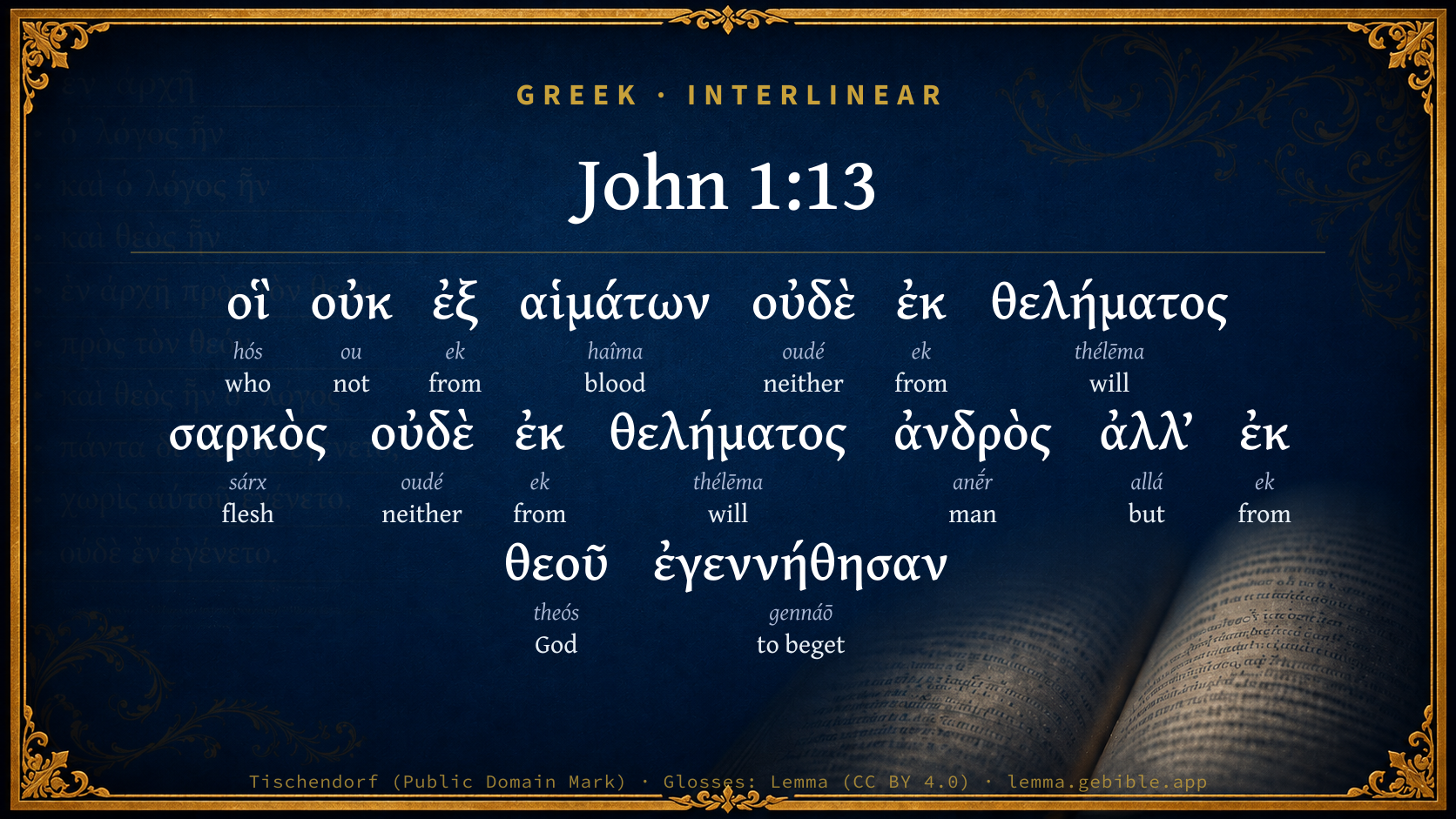
Greek (Tischendorf 8th ed.) John 1:13 appears in the Greek New Testament. The text above is from the Tischendorf 8th edition. Each word links to its Strong’s number and a concise gloss. Click any word for its full Thayer’s Greek Lexicon entry.
Download image
Cite this verse

John 1:13 (World English Bible). Public Domain. Lemma interlinear Bible study tool, https://lemma.gebible.app/v/john/1/13.

Show BibTeX & RIS
BibTeX
RIS
English Translation
who were born not of blood, nor of the will of the flesh, nor of the will of man, but of God.
World English Bible · Public Domain
Download a study sheet

One document with this verse’s original text, its word-by-word gloss line, the meaning frame, cross-references with their text, attributed commentary, and full source and license credits — printable, and it pastes into notes with its structure intact.

This verse Autodidact and up

Study sheet (.html) Plain text (.txt)

A passage Seminary Student

Up to 50 verses in one chapter. A passage sheet keeps up to 6 commentary sources and 12 cross-references per verse, in the order this page ranks them, and says so on the sheet whenever that leaves anything out. Ask for a single verse and you get the Autodidact verse sheet above.

Everything on this page stays free to read, with no account — the sheet is a download of what is already on screen, not access to it.

Want to remove ads? Support Godless Engineer
Compare translations 3

The same verse in 3 English versions, stacked beneath the original-language interlinear above. Click any original word for its lexicon entry.

Each is an independent rendering of the whole verse — the interlinear is not word-aligned to these translations.

Highlighted words mark where these versions differ — a whole-verse word diff, not a word-by-word alignment.

  • World English Bible Public Domain
    who were born not of blood, nor of the will of the flesh, nor of the will of man, but of God.
  • King James Version Public Domain
    Which were born, not of blood, nor of the will of the flesh, nor of the will of man, but of God.
  • unfoldingWord Literal Text CC BY-SA 4.0
    the ones not born from bloods, nor from the will of the flesh, nor from the will of a man, but from God.

unfoldingWord Literal Text — © unfoldingWord, licensed CC BY-SA 4.0. Word-aligned USFM3 via Door43 (git.door43.org/unfoldingWord/en_ult).

Versions to compare (up to 4)

3 of 4 selected

Show all 19 translations

Every available English version of this verse, each an independent rendering of the whole verse.

  • World English Bible Public Domain
    who were born not of blood, nor of the will of the flesh, nor of the will of man, but of God.
  • Berean Standard Bible Public Domain
    children born not of blood, nor of the desire or will of man, but born of God.
  • Majority Standard Bible Public Domain
    children born not of blood, nor of the desire or will of man, but born of God.
  • King James Version Public Domain
    Which were born, not of blood, nor of the will of the flesh, nor of the will of man, but of God.
  • American Standard Version (1901) Public Domain
    who were born, not of blood, nor of the will of the flesh, nor of the will of man, but of God.
  • Revised Version (1885) Public Domain
    which were born, not of blood, nor of the will of the flesh, nor of the will of man, but of God.
  • Geneva Bible (1599) Public Domain
    Which are borne not of blood, nor of the will of the flesh, nor of ye wil of man, but of God.
  • Douay-Rheims (1899) Public Domain
    Who are born, not of blood, nor of the will of the flesh, nor of the will of man, but of God.
  • Young's Literal Translation Public Domain
    who -- not of blood nor of a will of flesh, nor of a will of man but -- of God were begotten.
  • Literal Standard Version CC BY-SA 4.0
    who were begotten, not of blood, nor of will of flesh, nor of will of man, but of God.
  • Unlocked Literal Bible CC BY-SA 4.0
    These were not born of blood, nor of the will of the flesh, nor of the will of man, but of God.
  • unfoldingWord Literal Text CC BY-SA 4.0
    the ones not born from bloods, nor from the will of the flesh, nor from the will of a man, but from God.
  • Darby Bible Public Domain
    who have been born, not of blood, nor of flesh's will, nor of man's will, but of God.
  • World Messianic Bible Public Domain
    who were born, not of blood, nor of the will of the flesh, nor of the will of man, but of God.
  • Webster's Bible Public Domain
    Who were born, not of blood, nor of the will of the flesh, nor of the will of man, but of God.
  • Free Bible Version CC BY-SA 4.0
    These are the children born not in the usual way, not as the result of human desire or a father's decision, but born of God.
  • Bible in Basic English Public Domain
    Whose birth was from God and not from blood, or from an impulse of the flesh and man's desire.
  • Text-Critical English NT CC BY 4.0
    who were born not of blood, nor of the will of the flesh, nor of the will of man, but of God.
  • Tyndale New Testament (1534) Public Domain
    which were borne not of bloude nor of the will of the flesshe nor yet of the will of man: but of God.

Literal Standard Version (2020), Covenant Press — licensed CC BY-SA 4.0. Text via the HelloAO Bible API (eBible.org). Unlocked Literal Bible (unfoldingWord) — licensed CC BY-SA 4.0. Text via the HelloAO Bible API (eBible.org). unfoldingWord Literal Text — © unfoldingWord, licensed CC BY-SA 4.0. Word-aligned USFM3 via Door43 (git.door43.org/unfoldingWord/en_ult). Free Bible Version, Dr. Jonathan Gallagher — licensed CC BY-SA 4.0. Text via the HelloAO Bible API (eBible.org).

Word by word

More ways to search: Search by grammar → Find every occurrence → Compare this word →

Practice this passage: Drill this verse → Learn its vocabulary →

θελήματος
thélēma
G2307
“will”
Noun, Genitive, Singular, Neuter
Part of Speech
Noun
Case
Genitive
Number
Singular
Gender
Neuter
Full Thayer's Definition

Origin: from the prolonged form of G2309

TDNT: 03:52,3

1. what one wishes or has determined shall be done a. of the purpose of God to bless mankind through Christ b. of what God wishes to be done by us 1. commands, precepts 2. will, choice, inclination, desire, pleasure
  1. οἳ hós G3739 “who” Relative pronoun, Nominative, Plural, Masculine
  2. οὐκ ou G3756 “not” Particle, Negative
  3. ἐξ ek G1537 “from” Preposition
  4. αἱμάτων haîma G129 “blood” Noun, Genitive, Plural, Neuter
  5. οὐδὲ oudé G3761 “neither” Conjunction, Negative
  6. ἐκ ek G1537 “from” Preposition
  7. σαρκὸς sárx G4561 “flesh” Noun, Genitive, Singular, Feminine
  8. οὐδὲ oudé G3761 “neither” Conjunction, Negative
  9. ἐκ ek G1537 “from” Preposition
  10. θελήματος thélēma G2307 “will” Noun, Genitive, Singular, Neuter
  11. ἀνδρὸς anḗr G435 “man” Noun, Genitive, Singular, Masculine
  12. ἀλλ’ allá G235 “but” Conjunction
  13. ἐκ ek G1537 “from” Preposition
  14. θεοῦ theós G2316 “God” Noun, Genitive, Singular, Masculine
  15. ἐγεννήθησαν gennáō G1080 “to beget” Verb, Aorist, Passive, Indicative, 3rd person, Plural

About this verse

These counts appear in no published source. They are computed here, from the morphology-tagged text and Lemma’s own curated glosses. What Lemma adds →

16
words
11
distinct lemmas
Gospels
section

Repetition

Words recur within this verse:

  • οὐδὲ neither G3761 ×2
  • θελήματος will G2307 ×2
  • ἐξ from G1537 ×4

Cross-references

24

Topical passages linked to John 1:13 in the Treasury of Scripture Knowledge — connected by theme and wording, ordered by reader-vote popularity; previews shown in the World English Bible.

  • James 1:18 Of his own will he brought us forth by the word of truth, that we should be a kind of first fruits of his creatures.
  • 1 John 3:9 Whoever is born of God doesn't commit sin, because his seed remains in him; and he can't sin, because he is born of God.
  • 1 Peter 1:23 having been born again, not of corruptible seed, but of incorruptible, through the word of God, which lives and remains forever.
  • 1 Peter 1:3 Blessed be the God and Father of our Lord Jesus Christ, who according to his great mercy became our father again to a living hope through the resurrection of Jesus Christ from the dead,
  • John 3:5–8 Jesus answered, "Most assuredly I tell you, unless one is born of water and spirit, he can't enter into the Kingdom of God!
  • 1 John 5:4 For whatever is born of God overcomes the world. This is the victory that has overcome the world: your faith.
  • 1 John 2:28–29 Now, little children, remain in him, that when he appears, we may have boldness, and not be ashamed before him at his coming.
  • Titus 3:5 not by works of righteousness, which we did ourselves, but according to his mercy, he saved us, through the washing of regeneration and renewing by the Holy Spirit,
  • 1 John 4:7 Beloved, let us love one another, for love is of God; and everyone who loves is born of God, and knows God.
  • Philippians 2:13 For it is God who works in you both to will and to work, for his good pleasure.
  • 1 Corinthians 3:6 I planted. Apollos watered. But God gave the increase.
  • 1 John 5:1 Whoever believes that Jesus is the Christ is born of God. Whoever loves the father also loves the child who is born of him.
  • 1 John 5:18 We know that whoever is born of God doesn't sin, but he who was born of God keeps himself, and the evil one doesn't touch him.
  • John 3:3 Jesus answered him, "Most assuredly, I tell you, unless one is born anew, he can't see the Kingdom of God."
  • Romans 9:7–16 Neither, because they are Abraham's seed, are they all children. But, "In Isaac will your seed be called."
  • Romans 10:1–3 Brothers, my heart's desire and my prayer to God is for Israel, that they may be saved.
  • Psalms 110:3 Your people offer themselves willingly in the day of your power, in holy array. Out of the womb of the morning, you have the dew of your youth.
  • Matthew 3:9 Don't think to yourselves, 'We have Abraham for our father,' for I tell you that God is able to raise up children to Abraham from these stones.
  • Genesis 25:22 The children struggled together within her. She said, "If it be so, why do I live?" She went to inquire of Yahweh.
  • John 8:33–41 They answered him, "We are Abraham's seed, and have never been in bondage to anyone. How do you say, 'You will be made free?'"
  • Romans 9:1–5 I tell the truth in Christ. I am not lying, my conscience testifying with me in the Holy Spirit,
  • 1 Peter 2:2 as newborn babes, long for the pure milk of the Word, that you may grow thereby,
  • Genesis 27:33 Isaac trembled violently, and said, "Who, then, is he who has taken venison, and brought it me, and I have eaten of all before you came, and have blessed him? Yes, he will be blessed."
  • Genesis 25:28 Now Isaac loved Esau, because he ate his venison. Rebekah loved Jacob.

Cross-references courtesy of OpenBible.info (CC BY 4.0).

Commentary

Notes on John 1:13 from classic Christian and Jewish commentators (each source and its license shown beneath its notes). The classic Christian expositions comment on the surrounding passage and are grouped to its opening verse, so a note may address several verses; the Jewish commentaries on the Tanakh (Rashi and others) are per-verse, so they appear only where the commentator wrote on this verse.

Lemma curates 59 commentaries, every one of them public domain or Creative Commons licensed, each selected and text-cleaned for this edition rather than reprinted as found. About our sources →

Tyndale Open Study Notes

Tyndale Open Resources

1:13 a birth that comes from God: People can escape the darkness only by God’s grace (8:12; 12:35-36, 44-46).

Tyndale Open Study Notes — © Tyndale Open Resources, licensed CC BY-SA 4.0. Text via the HelloAO Bible API.

Bengel's Gnomon

Johann Albrecht Bengel

Joh 1:13. Οἱ, who) This is to be referred to τέκνα, children. For as the words [ἐλαβον] received and to them that believe [τοῖς πιστεύουσιν] correspond to one another, and denote the cause: so the effect is denoted in that expression to become children, and it is further explained in this verse.—οὐκ ἐξ αἱμάτων, not of bloods) דמים αἵματα, the Hebrew idiom often has bloods in the Plural number, even when only one man is spoken of: but when the subject treated of is generation, it does not call it the blood or bloods of the parents. But for the commendation of a noble lineage, the term blood is frequent among the ancient writers, as it is in the usage of the present day: and thence it is that bloods denote variety of origins, in consequence of which various prerogatives [privileges] are either sought after, or even enjoyed, in the world.—οὐδε ἐκ θελήματος σαρκός, nor of the will of the flesh) Husband and wife are Flesh, and that one flesh: and the will of the wedded pair, חפץ, gives birth to the children, who being born of the flesh are flesh, and sons of the flesh. Joh 3:6, “That which is born of the flesh is flesh;” Rom 9:8, “They which are the children of the flesh, these are not the children of God.” With propriety the term, the will, is used as moving midway between holy [pure] love, and grovelling lust, ὄρεξιν. Nor does John use the softer word, of which the flesh considered in itself is unworthy: nor the harsher, lest those born of holy [pure] parents should except themselves [i.e. Had John said, The children of God were born not of lust, then those men who are born of a pure marriage union might think themselves excepted from the children of the flesh].—οὐδὲ ἐκ θελήματος ἀνδρός, nor of the will of man) The will of man is contained in the will of the flesh: and yet it is mentioned separately, as if it were the greater, and in some measure, the more guilty part of it. For Christ had a mother, but one who knew not man. Luk 1:34, “How shall this be, seeing I know not a man.” [Mary to the angel].

These three things, bloods, the will of the flesh, the will of man, bring to the sons of men ἐξουσίαν, power and rank, which are noble, but natural and human. For, indeed, it was on these three the Jews used to lean, being wont to boast either of their ancestors, Abraham, Isaac, Israel, Juda, Benjamin, Levi, Aaron, David, etc., or of both parents, but more especially of their fathers, and fancied that owing to these they could not but be pleasing to God; but John declares that these very things have no weight [with Him].—ἀλλʼ ἐκ Θεοῦ, but of God) To the natural generation of men is opposed generation of God. And although the former, as the latter, is in reality single, yet the former being expressed in a threefold manner [“infert,” causes] carries with it a threefold mode of viewing the latter. We are therefore taught, that they become Sons of God, who are born, not as the sons of men, such as themselves also were by original descent, after the manner of men, but of God: that is, 1) not of bloods, but of the heavenly and supreme Father, from whom the whole of the blessed and holy family is named: 2) not of the will of the flesh, but of that love, of which the Son is Himself the first-begotten of every creature; Col 1:13; Col 1:15, “His dear Son, Who is the image of the invisible God, the first-born of every creature:” and of that will which hath begotten us as a “[a kind of] first fruits of His creatures;” Jas 1:18, אב father, and אבה he willed, he loved, are kindred words. 3) Not of the will of man, but of the Holy Spirit. A similar antithesis occurs, Luk 1:34-35, Mary, “I know not a man.” The angel, “The Holy Ghost shall come upon thee, etc., therefore that holy thing which shall be born of thee shall be called the Son of God.” These indeed are the sons of God, and of such sons Adam was a type, since he was begotten not of bloods, nor of the will of the flesh, nor of the will of man, and in consequence he stood in a peculiar relation to God; Luk 3:38, “Adam, which was the son of God;” and Isaac, Gal 4:23; Gal 4:29, “He who was of the bond-woman was born after the flesh, but He of the free-woman was by promise;—He, that was born after the flesh, persecuted Him that was born after the Spirit:” but John uses this phraseology, of the sons of God, in a higher sense.—ἐγεννήθησαν, were born) This as to regeneration is not merely a mode of speaking peculiar to this evangelist; but a doctrine frequently and emphatically dwelt upon in the writings of the Prophets and Apostles. Believers are sons of God by a generation peculiarly so called, deriving their life from Himself, reproducing [referentes, exhibiting in themselves traits of] His character, shining in His image: how much more so the Only-begotten One, ὁ μονογενής? They are sons through Him by adoption. In all ways God claims as to Himself.

Bengel's Gnomon of the New Testament — English translation (T&T Clark, Edinburgh, 1860) — public domain. Text from a community e-Sword module.

Meyer's Critical & Exegetical Commentary

Heinrich August Wilhelm Meyer

Joh_1:13. Οἵ] refers to τέκνα θεοῦ (the masculine in the well-known constructio κατὰ σύνεσιν, 2Jn_1:1, Phm_1:10, Gal_4:19; comp. Eurip. Suppl. 12, Androm. 571), not to τοῖς πιστεύουσιν, because the latter, according to Joh_1:12, are said to become Gods children, so that ἐγεννήθησαν would not be appropriate. The conception children of God is more precisely defined as denoting those who came into existence not after the manner of natural human generation, but who were begotten of God. The negative statement exhibits them as those in whose coming into existence human generation (and consequently also Abrahamic descent) has no part whatever. This latter brings about no divine sonship, Joh_3:6.

οὐκ ἐξ αἱμάτων] not of blood, the blood being regarded as the seat and basis of the physical life (comp. on Act_15:20), which is transmitted by generation.[88] Comp. Act_17:26; Hom. Il. vi. 211, xx. 241; Soph. Aj. 1284, El. 1114; Plato, Soph. p. 268 D; Liv. 38, 28. Kypke and Loesner on the passage, Interpp. ad Virg. Aen. vi. 836; Horace, Od. ii. 20. 6; Tib. i. 6. 66. The plural is not to be explained of the commingling of the two sexes (ex sanguinibus enim homines nascuntur maris et feminae, Augustine; comp. Ewald), because what follows (ἀνδρός and the corresponding ἘΚ ΘΕΟῦ) points simply to generation on the mans side; nor even of the multiplicity of the children of God (B. Crusius), to which there is no reference in what follows; quite as little does it refer to the continuos propagationum ordines from Adam, and afterwards from Abraham downwards (Hoelemann, p. 70), which must necessarily have been more distinctly indicated. Rather is the plural used in a sense not really different from the singular, and founded only on this, that the material blood is represented as the sum-total of all its parts (Kühner, II. p. 28). Comp. Eur. Ion. 705, ἄλλων τραφεὶς ἀφʼ αἱμάτων; Soph. Ant. 121, and many places in the Tragedians where αἵματα is used in the sense of murder (Aesch. Eum. 163, 248; Eur. El. 137; Or. 1547, al.); Monk, ad Eur. Alc. 512; Blomf. Gloss. Choeph. 60. Comp. Sir_22:22; Sir_31:21; 2Ma_14:18; also Plato, Legg. x. p. 887 D, ἔτι ἐν γάλαξι τρεφόμενοι.

The negation of human origination is so important to John (comp. Joh_3:6), that he adds two further parallel definitions of it by οὐδέ

οὐδέ (which he arranges co-ordinately); nor evennor even, where σαρκός designates the flesh as the substratum of the generative impulse, not the woman (Augustine, Theophylact, Rupertus, Zeger, Schott, Olshausen),an interpretation which is most inappropriately supported by a reference to Gen_2:22, Eph_5:28-29, Jud_1:7, while it is excluded by the context (ἀνδρός, and indeed by what follows). The mans generative will is meant, and this is more exactly, i.e. personally, defined by ἐκ θελ. ἀνδρός, to which the contrasted etc ἘΚ ΘΕΟῦ is correlative; and hence ἈΝΉΡ must not be generalized and taken as equivalent to ἌΝΘΡΩΠΟς (Lücke), which never occurseven in the Homeric ΠΑΤῊΡ ἈΝΔΡῶΝ ΤΕ ΘΕῶΝ ΤΕ only apparentlybut here least of all, because the act of generation is the very thing spoken of. The following are merely arbitrary glosses upon the points which are here only rhetorically accumulated to produce an ever increasing distinctness of description; e.g. Baumgarten Crusius: There is an advance here from the most sensual to the most noble (nature, inclination, willin spite of the twice repeated θελήματος!); Lange (L. J. III. p. 558): There is an onward progress from natural generation to that which is caused by the will, and then to that consummated in theocratic faith; Hoelemann: σάρξ, meant of both sexes, stands midway between the universalis humani generis propagatio (ΑἽΜΑΤΑ) and the proprius singularis propagationis auctor (ἈΝΉΡ). Even Delitzsch refines upon the words, finding in ΘΕΛΉΜ. ΣΑΡΚΌς the unholy side of generation, though John has only in view the antithesis between the human and the divine viewed in and by themselves.

ἐκ θεοῦ ἐγεννήθ.] were begotten of God, containing the real relation of sonship to God, and thus explaining the former τέκνα θεοῦ, in so far as these were begotten by no human being, but by God, who through the Holy Spirit has restored their moral being and life, Joh_3:5. Hence ἘΚ ΘΕΟῦ ἘΓΕΝΝ. is not tautological. ἘΚ indicates the issuing forth from God as cause, where the relation of immediateness (in the first and last points) and of mediateness (in the second and third) lies in the very thing, and is self-evident without being distinctively indicated in the simple representation of John.

[88] ὡς τοῦ σπέρματος ὑλὴν τοῦ ἔχοντος, Eustath. ad Hom. Il vi. 211. Comp. Delitzsoh, Psychol. p. 246 [E. T. p. 290, and note].

Meyer — Critical and Exegetical Commentary on the New Testament — English translation by Peter Christie, edited by Frederick Crombie (T&T Clark, 1880) — public domain. Text from a community e-Sword module.

Expositor's Greek Testament

ed. W. Robertson Nicoll

Joh 1:13 . οἳ οὐκ ἐξ αἱμάτων … ἐγεννήθησαν . This first mention of τέκνα θεοῦ suggests the need of further defining how these children of God are produced. The ἐκ denotes the source of the relationship. First he negatives certain ordinary causes of birth, not so much because they could be supposed in connection with children of God (although thoughts of hereditary rights might arise in Jewish minds) as for the sake of emphasising by contrast the true source. οὐκ ἐξ αἱμάτων ; that is, not by ordinary physical generation. αἵμα was commonly used to denote descent; Act 17:26 , Odys. iv. 611, αἵματος εἰς ἀγάθοιο . This is rather a Greek than a Hebrew expression. The plural αἱμάτων has given rise to many conjectural explanations; and the idea currently received is that it suggests the constituent parts of which the blood is composed (Godet, Meyer). Westcott says: “The use of the plural appears to emphasise the idea of the element out of which in various measures the body is formed”. Both explanations are doubtful. The plural is used very commonly in the Sept [27] , 2Sa 16:8 , ἀνὴρ αἱμάτων σύ ; Psa 25:9 , μετὰ ἀνδρῶν αἱμάτων ; 2Ch 24:25 , etc.; and especially where much slaughter or grievous murder is spoken of. Cf. Eurip., Iph. in Taur. , 73. It occurs in connection with descent in Eurip., Ion. , 693, ἄλλων τραφεὶς ἐξ αἱμάτων (Lücke). The reason of John’s preference for the plural in this place is not obvious; he may perhaps have wished to indicate that all family histories and pedigrees were here of no account, no matter how many illustrious ancestors a man could reckon, no matter what bloods united to produce him. οὐδὲ … ἄνδρος . The combination of these clauses by οὐδὲ … οὐδὲ and not by οὔτε … οὔτε excludes all interpretations which understand these two clauses as subdivisions of the foregoing. οὐδέ adds negation to negation: οὔτε divides a single negation into parts (see Winer, p. 612). “Nor of the will of the flesh,” i.e. , not as the result of sexual instinct; “nor of the will of a man.” i.e. , not the product of human purpose (“Fortschritt von Stoff zum Naturtrieb und zum persönlichen Thun,” Holtzmann). Cf. Delitzsch, Bibl. Psych. , p. 290, note E. Tr. ἀλλʼ ἐκ θεοῦ ἐγεννήθησαν . The source of regeneration positively stated. Human will is repudiated as the source of the new birth, but as in physical birth the life of the child is at once manifested, so in spiritual birth the human will first manifests regeneration. In spiritual as in physical birth the origination is from without, not from ourselves; but just because our spiritual birth is spiritual the will must take its part in it. Nothing is spiritual into which the will does not enter.

[27] Septuagint.

The Expositor's Greek Testament, edited by W. Robertson Nicoll (1897–1910) — public domain. Text from a community e-Sword module.

Godet's Commentaries

Frédéric Louis Godet

[See also the "General Considerations on the Prologue" in the comments of Joh 1:18.]

Ver. 13. “Who were born, not of blood, nor of the will of the flesh, nor of the will of man, but of God.”

It seems, at the first glance—because of the past verb: who were born —that the apostle places regeneration before faith, which is, of course, impossible. But, as Meyer rightly observes, the relative οἵ (who), does not refer to the words τοῖς πιστεύουσιν (those who believe), but, by a constructio ad sensum, to the neuter substantive τέκνα θεοῦ (children of God). Joh 1:13 unfolds this term: children of God, first in a negative relation, by means of three cumulative phrases which have a somewhat disdainful and even contemptuous character. Does John mean thereby to stigmatize the false confidence of the Jews in their character as children of Abraham? This does not seem to me probable. Three expressions to set forth the idea of the theocratic birth would be useless. Besides, the Prologue has too lofty a flight, too universal a bearing, to admit of so paltry a polemic. John means rather to set forth with emphasis the superiority of the second creation which the Logos comes to accomplish on the foundation of the first. There are two humanities, one which propagates itself in the way of natural filiation; the other, in which the higher life is communicated immediately by God Himself to every believer. It is, therefore, ordinary birth, as the basis of natural humanity, which John characterizes in the first three expressions. The first phrase: not of blood, denotes procreation from the purely physical point of view; the blood is mentioned as the seat of natural life (Lev 17:1).

The plural αἱμάτων has been applied either to the duality of the sexes, or to the series of human generations. It should rather be interpreted as the plural γάλαξι, in the words of Plato (Legg. x., p. 887, D): ἔτι ἐν γάλαξι τρεφόμενοι —the plural suggesting the multiplicity of the elements which form the blood (see Meyer). The two following phrases are not subordinate to the first, as St. Augustine thought, who, after having referred the latter to the two sexes, referred the two others, the one to the woman and the other to the man. The disjunctive negative, neither...nor (οὔτε...οὔτε), would be necessary in that case. The last two expressions designate, like the first, the natural birth; but this, while introducing, in the one phrase, the factor of the will governed by the sensual imagination (the will of the flesh), in the other, that of a will more independent of nature, more personal and more manlike, the will of man. There is a gradation in dignity from one of these terms to the other. But, to whatever height the transmission of natural life may rise, this communication of life- power cannot pass beyond the circle traced out at the first creation—that of the physico-psychical life. That which is born of the flesh, even in the best conditions, is, and remains flesh.The higher, spiritual, eternal life is the immediate gift of God. To obtain it, that divine begetting is needed by which God communicates His own nature. The limiting phrase, ἐκ θεοῦ (of God), contains, in itself alone, the antithesis to the three preceding phrases. By its very conciseness it expresses the beauty of that spiritual birth which is altogether free from material elements, from natural attraction, from human will, and in which the only cooperating forces are God acting through His Spirit on the one side, and man’s faith on the other.

But how are we to explain the virtue of this faith which fits the man to be begotten of God? Does it have in itself, in its own nature, the secret of its power? No, for it is only a simple receptivity, a λαμβάνειν, receive: its virtue comes from its object. The apostle had already intimated this by the words: “who believe on His name;” and he now expressly declares it:

Frédéric Louis Godet — Commentaries on Luke, John, Romans, and 1 Corinthians — English translation (T&T Clark, Edinburgh, 1870s–1890s) — public domain. Text from a community e-Sword module.

Geneva Bible (1599)

Geneva Bible translators

Of that gross and corrupt nature of man, which is throughout the Scriptures set as enemy to the Spirit.

Geneva Bible (1599) marginal notes — public domain. Text via Bolls.life.

Jamieson, Fausset & Brown

Robert Jamieson, A. R. Fausset & David Brown

Which were born--a sonship therefore not of mere title and privilege, but of nature, the soul being made conscious of the vital capacities, perceptions, and emotions of a child of God, before unknown.

not of blood, &c.--not of superior human descent, not of human generation at all, not of man in any manner of way. By this elaborate threefold denial of the human source of this sonship, immense force is given to what follows,

but of God--Right royal gift, and He who confers must be absolutely divine. For who would not worship Him who can bring him into the family, and evoke within him the very life, of the sons of God?

Jamieson, Fausset & Brown — Commentary Critical and Explanatory on the Whole Bible (1871) — public domain (CC PDM 1.0). Text via the HelloAO Bible API.

Adam Clarke's Commentary

Verse 13. Which were born, not of blood] Who were regenerated, ουκ εξ αιματων, not of bloods-the union of father and mother, or of a distinguished or illustrious ancestry; for the Hebrew language makes use of the plural to point out the dignity or excellence of a thing: and probably by this the evangelist intended to show his countrymen, that having Abraham and Sarah for their parents would not entitle them to the blessings of the new covenant; as no man could lay claim to them, but in consequence of being born of God; therefore, neither the will of the flesh-any thing that the corrupt heart of man could purpose or determine in its own behalf; nor the will of man-any thing that another may be disposed to do in our behalf, can avail here; this new birth must come through the will of God-through; his own unlimited power and boundless mercy, prescribing salvation by Christ Jesus alone. It has been already observed that the Jews required circumcision, baptism, and sacrifice, in order to make a proselyte. They allow that the Israelites had in Egypt cast off circumcision, and were consequently out of the covenant; but at length they were circumcised, and they mingled the blood of circumcision with the blood of the paschal lamb, and from this union of bloods they were again made the children of God. See Lightfoot. This was the only way by which the Jews could be made the sons of God; but the evangelist shows them that, under the Gospel dispensation, no person could become a child of God, but by being spiritually regenerated.

Adam Clarke's Commentary on the Bible (1810–1826) — public domain. Text from a community e-Sword/MySword module.

Ellicott's Commentary for English Readers

(13) Which were born.—The result of receiving Him remains to be explained. How could they become “sons of God?” The word which has been used (Joh_1:12) excludes the idea of adoption, and asserts the natural relation of child to father. The nation claimed this through its descent from Abraham. But they are Abraham’s children who are of Abraham’s faith. There is a higher generation, which is spiritual, while they thought only of the lower, which is physical. The condition is the submissive receptivity of the human spirit. The origin of life is “not of blood, nor of the will of the flesh, nor of the will of man, but of God.”

A Bible Commentary for English Readers, edited by Charles John Ellicott (1878–1897) — public domain. Text from a community e-Sword module.

The Cambridge Bible for Schools and Colleges

gen. ed. J. J. S. Perowne

13. S. John denies thrice most emphatically that human generation has anything to do with Divine regeneration. Man cannot become a child of God in right of human parentage: descent from Abraham confers no such ‘power.’ A bitter word to Jewish exclusiveness.

were born] Literally, were begotten. Comp. 1Jn_5:1; 1Jn_5:4; 1Jn_5:18.

not of blood] The blood was regarded as the seat of physical life. Gen_9:4; Lev_17:11; Lev_17:14, &c.

nor of the will of the flesh] Better, nor yet from will of flesh, i.e. from any fleshly impulse. A second denial of any physical process.

nor of the will of man] Better, nor yet from will of man, i.e. from the volition of any earthly father: it is the Heavenly Father who wills it. A third denial of any physical process.

There is an interesting false reading here. Tertullian (c. a.d. 200) had ‘was born’ for ‘were born,’ making it refer to Christ; and he accused the Valentinians of corrupting the text in reading ‘were born,’ which is undoubtedly right. This shews that as early as a.d. 200 there were corruptions in the text, the origin of which was already lost. Such things take some time to grow: by comparing them and tracing their roots and branches we arrive at a sure conclusion that this Gospel cannot have been written later than a.d. 85–100. See on Joh_1:18 and Joh_9:35.

The Cambridge Bible for Schools and Colleges (gen. ed. J. J. S. Perowne; Cambridge University Press, 1878–1918) — public domain. Text from a community e-Sword module.

John Gill's Exposition

Which were born not of blood,.... Or bloods, in the plural number. The birth, here spoken of, is regeneration, expressed by a being born again, or from above; by a being quickened by the Spirit and grace of God; by Christ being formed in men; and by a partaking of the divine nature; and by being made new creatures, as all that believe in the name of Christ are; and which is the evidence of their being the sons of God: and now this is owing not to blood, or bloods; not to the blood of circumcision; or of the passover, which the Jews had an high opinion of, and ascribe life and salvation to, and to which notion this may be opposed: so their commentators (f) on Eze 16:6 where the word "live" is twice used, observe on the first "live", by the blood of the passover, on the second "live", by the blood of circumcision; but, alas! these contribute nothing to the life of the new creature: nor is regeneration owing to the blood of ancestors, to natural descent, as from Abraham, which the Jews valued themselves upon; for sin, and not grace, is conveyed by natural generation: all men are of one blood, and that is tainted with sin, and therefore can never have any influence on regeneration; no blood is to be valued, or any one upon it, but the blood of Christ, which cleanses from all sin,

Nor of the will of the flesh; man's free will, which is carnal and corrupt, is enmity to God, and impotent to every thing that is spiritually good: regeneration is ascribed to another will and power, even to the will and power of God, and denied of this:

nor of the will of man: of the best of men, as Abraham, David, and others; who, though ever so willing and desirous, that their children, relations, friends, and servants, should be born again, be partakers of the grace of God, and live in his sight, yet cannot effect any thing of this kind: all that they can do is to pray for them, give advice, and bring them under the means of grace; but all is ineffectual without a divine energy. So with the Jews, "a man", signifies a great man, in opposition to "Adam", or "Enosh", which signify a mean, weak, frail man; and our translators have observed this distinction, in Isa 2:9 and the mean man (Adam) boweth down, and the great man (Ish) "humbleth himself": on which Jarchi has this note, "Adam boweth down", i.e. little men; "and a man humbleth himself", i.e. princes, and mighty men, men of power: and so Kimchi on Psa 4:2. "O ye sons of men", observes, that the Psalmist calls them the sons of men, with respect to the great men of Israel; for there were with Absalom the sons of great men. Though sometimes the Jews say (g), Adam is greater than any of the names of men, as Geber, Enosh, Ish. But now our evangelist observes, let a man be ever so great, or good, or eminent, for gifts and grace, he cannot communicate grace to another, or to whom he will; none are born again of any such will:

but of God; of God, the Father of Christ, who begets to a lively hope; and of the Son, who quickens whom he will; and of the grace of the Spirit, to whom regeneration is generally ascribed,

(f) Jarchi & Kimchi in loc. Shemot Rabba, sect. 19. fol. 103. 2. & 104. 4. & Mattanot Cehuna in Vajikra Rabba, sect. 23. fol. 164. 2. Zohar in Lev. fol. 39. 2. (g) Zohar in Lev. fol. 20. 2.

John Gill's Exposition of the Whole Bible (1746–1763) — public domain (CC PDM 1.0). Text via the HelloAO Bible API.

Trapp's Complete Commentary

John Trapp

13 Which were born, not of blood, nor of the will of the flesh, nor of the will of man, but of God.

Ver. 13. But of God] Whose sons therefore they are, and so "higher than the kings of the earth," Psa 89:27, as those that prolong the days of Christ upon earth, being begotten by the travail of his soul, Isa 53:10-11. Hence faith is said to adopt us, Joh 1:12, in like sort as it justifies us, viz. by virtue of its object, Christ. {a} Hence, Psa 72:17, there is said to be a succession of Christ’s name; it is begotten, as one generation is begotten of another. This is true nobility, where God is the top of the kin, religion the root. Beatus Ludovicus would be called Ludovicus de Pissiaco, rather than take greater titles, because there he became a Christian. He thought no birth equal to a new birth in Christ, no parentage to that of God to his Father.

{a} Γεγενημενον εκ Διος ερνος. Homer. Filiabitur nomine eius. Trem.

John Trapp, A Commentary or Exposition upon All the Books of the Old and New Testament (1647–1656) — public domain. Text from a community e-Sword module.

Albert Barnes' Notes on the Bible

Which were born - This doubtless refers to the “new birth,” or to the great change in the sinner’s mind called regeneration or conversion. It means that they did not become the children of God in virtue of their natural birth, or because they were the children of “Jews,” or because they were descended from pious parents. The term “to be born” is often used to denote this change. Compare Joh 3:3-8; 1Jo 2:29. It illustrates clearly and beautifully this great change. The natural birth introduces us to life. The new birth is the beginning of spiritual life. Before, the sinner is “dead” in sins Eph 2:1; now he begins truly to live. And as the natural birth is the beginning of life, so to be born of God is to be introduced to real life, to light, to happiness, and to the favor of God. The term expresses at once the “greatness” and the “nature” of the change.

Not of blood - The Greek word is plural; not of “bloods” - that is, not of “man.” Compare Mat 27:4. The Jews prided themselves on being the descendants of Abraham, Mat 3:9. They supposed that it was proof of the favor of God to be descended from such an illustrious ancestry. In this passage this notion is corrected. It is not because men are descended from an illustrious or pious parentage that they are entitled to the favor of God; or perhaps the meaning may be, not because there is a union of illustrious lines of ancestry or “bloods” in them. The law of Christ’s kingdom is different from what the Jews supposed. Compare 1Pe 1:23. It was necessary to be “born of God” by regeneration. Possibly, however, it may mean that they did not become children of God by the bloody rite of “circumcision,” as many of the Jews supposed they did. This is agreeable to the declaration of Paul in Rom 2:28-29.Nor of the will of the flesh - Not by natural generation.

Nor of the will of man - This may refer, perhaps, to the will of man in adopting a child, as the former phrases do to the natural birth; and the design of using these three phrases may have been to say that they became the children of God neither in virtue of their descent from illustrious parents like Abraham, nor by their natural birth, nor by being “adopted” by a pious man. None of the ways by which we become entitled to the privileges of “children” among people can give us a title to be called the sons of God. It is not by human power or agency that men become children of the Most High.

But of God - That is, God produces the change, and confers the privilege of being cawed his children. The heart is changed by his power. No unaided effort of man, no works of ours, can produce this change. At the same time, it is true that no man is renewed who does not himself “desire” and “will” to be a believer; for the effect of the change is on his “will” Psa 110:3, and no one is changed who does not strive to enter in at the strait gate, Phi 2:12. This important verse, therefore, teaches us:

1.That if men are saved they must be born again.

2.That their salvation is not the result of their birth, or of any honorable or pious parentage.

3.That the children of the rich and the noble, as well as of the poor, must be born of God if they will be saved.

4.That the children of pious parents must be born again; or they cannot be saved. None will go to heaven simply because their “parents” are Christians.

5.That this work is the work of God, and “no man” can do it for us.

6.That we should forsake all human dependence, east off all confidence in the flesh, and go at once to the throne of grace, and beseech of God to adopt us into his family and save our souls from death.

Albert Barnes' Notes on the Bible (1834–1885) — public domain. Text from a community e-Sword/MySword module.

Matthew Poole's English Annotations

Which were born, not of blood; not of the blood of men and women; or, not of the blood of Abraham (which was the boast of the Jews, We have Abraham to our Father).

Nor of the will of the flesh; nor from the lusts of the flesh.

Nor of the will of man; nor from a power in man’s will, or men’s free act in adopting other men’s children. To be born, signifieth to receive our principle of life: those who are the children of God hard not the principle of their life, as they are such, from the motions of nature, nor from the will of men.

But of God: whatever be the sense of the former words, these words plainly affirm God to be the principal efficient, and procreant cause, of all those who are the sons of God; for faith, by which we are the children of God, Gal 3:26, is the work of God, Joh 6:29, his gift, Phi 1:29; and men are born again, not of corruptible seed, but of that which is incorruptible, 1Pe 1:23; they are sanctified and cleansed with the washing of water by the word, Eph 5:26; the washing of regeneration, and renewing of the Holy Ghost, Tit 3:5.

Matthew Poole's English Annotations on the Holy Bible (1683–1685) — public domain. Text from a community e-Sword/MySword module.

Whedon's Commentary on the Bible

Daniel D. Whedon

13. Which were born—Though the term regeneration but seldom appears in Scripture, yet the terms which variously express it are abundant.

Not of blood—As the blood of the parent flows into the veins of the offspring.

Nor of the will of the flesh—Nor from the carnal impulse of sensual nature.

Nor of the will of man—Though the will of man be a previous condition upon which God regenerates, the will of man does not regenerate either another man or himself. Self-regeneration is an impossibility in fact and an absurdity in thought. Man consents, and God regenerates. Man repents, and God forgives. Man turns, and God converts. Man believes, and God justifies. But antecedent to either or all of these operations the divine Logos ENLIGHTENS every man, (Joh_1:9,) both by his own truth and power and by his Holy Spirit sent into the heart.

Daniel D. Whedon (gen. ed.), Commentary on the Old and New Testaments (1874–1909) — public domain. Text from a community e-Sword module.

John Wesley's Explanatory Notes

Who were born - Who became the sons of God, not of blood - Not by descent from Abraham, nor by the will of the flesh - By natural generation, nor by the will of man - Adopting them, but of God - By his Spirit.

John Wesley, Explanatory Notes Upon the Whole Bible (1754–1765) — public domain. Text via the GEBible commentary corpus.

Burkitt's Expository Notes on the New Testament

William Burkitt

Because the bragging Jews did much boast of their natural birth and descent from Abraham, as being his blood and offspring, therefore it is here asserted, that men become not the children of God by natural propagation, but by spiritual regeneration: They are not born of blood. Grace runs not in the blood, piety is not hereditary. Religious parents propagate corruption, not regeneration. Were the conveyances of grace natural, good parents would not be so ill-suited with children as sometimes they are. No person then whatsoever has the gracious privilege of adoption by the first birth. They are not born of blood, nor of the will of the flesh, nor of the will of man; that is, no man by the utmost improvement of nature can raise himself up to this privilege of adoption, and be the author and efficient cause of his own regeneration.

Learn hence, That man in all his capacities is too weak to produce the work of regeneration in himself. They, says Dr. Hammond, who by the influence of the highest rational principles, live most exactly according to the rule of rational nature, that is, of unregenerated morality, are the persons here described.

Learn, 2. That God alone is the prime efficient Cause of regeneration. He works upon the understanding by illumination, and upon the will by sanctification; Which were born, not of blood, nor of the will of the flesh, nor of the will of man, but of God.

William Burkitt's Expository Notes on the New Testament (1700–1703) — public domain. Text from a community e-Sword module.

The People's New Testament

B. W. Johnson

13. Who were born, not of blood, nor of the will of the flesh. The Jews prided themselves on being Abraham's children, and trusted in their blood for salvation. To be a son of God is not a fleshly birth at all, but the spirit of the subject is born of God. In John 3:1–8, the Savior explains this birth more particularly.

B. W. Johnson's The People's New Testament with Notes (1889–1891) — public domain. Electronic text from the Christian Classics Ethereal Library (CCEL) ThML edition.

Cambridge Greek Testament for Schools and Colleges

13. S. John denies thrice most emphatically that human generation has anything to do with Divine regeneration. Man cannot become a child of God in right of human parentage: the new Creation is far more excellent than the first Creation; its forces and products are spiritual not physical.

αἱμάτων. The blood was regarded as the seat of physical life. Gen 9:4; Lev 17:11; Lev 17:14. The plural is idiomatic (cf. τὰ ὕδατα, ‘the waters,’ τὰ γάλακτα), and does not refer to the two sexes. In Eur. Ion, 693 we have ἄλλων τραφεὶς ἀφ’ αἱμάτων. Winer, p. 220.

οὐδὲ ἐκ θ. σαρκός. Nor yet from will of flesh, i.e. from any fleshly impulse. A second denial of any natural process.

οὐδὲ ἐκ θ. ἀνδρός. Nor yet from will of man, i.e. from the volition of any human father. Ἀνήρ is not here put for ἄνθρωπος, the human race generally; it means the male sex, human fathers in contrast to the Heavenly Father. A third denial of any natural process.

ἐγεννήθησαν. Were begotten. There is an interesting false reading here. Tertullian (circ. A.D. 200) read the singular, ἐγεννήθη, which he referred to Christ; and he accused the Valentinians of falsifying the text in reading ἐγεννήθησαν, which is undoubtedly right. These differences are most important: they shew that as early as A.D. 200 there were corruptions in the text, the origin of which had been lost. Such corruptions take some time to grow: by comparing them and tracing their ramifications we arrive with certainty at the conclusion that this Gospel cannot have been written later than towards the end of the first century, A.D. 85–100. See on Joh 1:18, Joh 3:6; Joh 3:13, Joh 9:35.

Cambridge Greek Testament for Schools and Colleges (Cambridge University Press, 1896; 21 vols, various authors incl. Carr, Maclear, Plummer, Farrar, Lumby, Moule, M. R. James, Simcox) — public domain. Text from a community e-Sword module.

Alford’s Greek Testament

Henry Alford

13.] The Jews grounded their claim to be children of God on their descent from Abraham. John here negatives any such claim, and asserts the exclusive divine birth of all who become children of God by faith. It is to be noticed that the conjunctions here are not the merely disjunctive ones οὔτε … οὔτε, which would necessitate the ranging the clauses as co-ordinate and parallel, but οὐδὲ … οὐδέ, which rise in climax from one clause to another,—‘not ἐξ αἱμάτων, nor yet ἐκ θελ. σαρκ. nor yet ἐκ θελ. ἀνδ., but ἐκ θεοῦ’ (see examples of οὔτε, Mat 12:32: of οὐδέ, Mat 6:26). Many interpreters have seen in θέλημα ἀνδρός the male, and in θέλημα σαρκός the female side of human concupiscence (so Augustine, Theophylact, &c.); or in the former the higher and more conscious, in the latter the lower and animal side (Bleek, Luthardt). Besides the above, other objections lie against both these interpretations,—(1) that σάρξ is never so used (Eph 5:29 is no instance in point); (2) that θέλημα is ascribed to both. Euthymius seems to give the right interpretation: εἰπὼν δὲ ὅτι οὐκ ἐξ αἱμάτων, ἐπήγαγε φανερώτερον ὅτι οὐδὲ ἐκ θελήματος σαρκός· εἶτα καὶ τοῦτο τελεώτερον ἐφηρμήνευσε, προσθεὶς ὅτι οὐκ ἐκ θελήματος ἀνδρός· αἷμα γὰρ καὶ σάρξ, ὁ ἀνήρ· θέλημα δὲ νῦν νοεῖ τὴν ἐπιθυμίαν, τὴν συνουσίαν: in loc. ii. 421. Or perhaps this may be earned somewhat further, and we may better satisfy the climax by regarding the ἐξ αἱμάτων as indicating the mere phenomena of physical generation wherever found: then rising to ἐκ θελήματος σαρκός, the instigation of that capacity by sexual desire: then rising still higher to the most exalted instance of that desire, ἐκ θελήματος ἀνδρός.

The plural usage of αἱμάτων is only found in one other place in this signification,—Eurip. Ion 693 Dind., 705 Herm., ἔχει δόλον τύχαν θʼ ὁ παῖς | ἄλλων τραφεὶς ἀφʼ αἱμάτων. The other usage of the plural, for murder, is frequent in the LXX and the classics.

ἀνήρ, in the sense of man generally, is not uncommon; we have in plur. πατὴρ ἀνδρῶν τε θεῶν τε, in Hom. passim; and in sing. Il. ν. 321; σ. 432, 433.

ἐκ, remarks De Wette, denotes, the first time, the material—the second and third time, the mediate cause,—the fourth time, the immediate cause, of the generation.

Henry Alford, The Greek Testament (1849–1861) — public domain. Text from a community e-Sword module.

International Critical Commentary

13. For οἳ … ἐγεννήθησαν, the O.L. version in b gives qui natus est, the verse being thus a reference to the Virgin Birth of Christ. Irenæus (adv. Haer. iii. xvii. 1 and xx. 2), and possibly Justin (Tryph. 61; cf. Apol. i. 32, 63 and ii. 6), bear witness to the existence of this (Western) reading. Tertullian (de carne Christi, 19) adopts it formally, adducing arguments against the common text “who were born,” which he says is an invention of the Valentinians. In recent years the reference of the verse to Christ, and the reading qui natus est, have been approved by Resch (Aussercanonische Paralleltexte, iv. 57) and by Blass (Philology of the Gospels, p. 234).3 But the MS. evidence is overwhelming for ἐγεννήθησαν, which moreover, as we shall see, is in accordance with the characteristic teaching of Jn.

The children of God are “begotten” by Him by spiritual generation, as contrasted with the ordinary process of physical generation.

οὐκ ἐξ αἱμάτων κτλ. It was a current doctrine in Greek physiology that the human embryo is made from the seed of the father, and the blood of the mother. Thus Wisd. 7:2, “In the womb of a mother was I moulded into flesh in the time of ten months, being compacted in blood (παγεὶς ἐν αἵματι) of the seed of man and pleasure that came with sleep.” Cf. 4 Macc. 13:20 and Philo (de opif. mundi 45). 1

The plural αἱμάτων is unexpected, but Bräckner quoted the parallel ἄλλων τραφεὶς ἀφʼ αἱμάτων (Eurip. Ion, 693). Augustine (Serm. cxxi. 4) explains αἱμάτων, “mixtis sanguinibus, masculi et feminae, commixtione carnis masculi et feminae,” which may be right; but more probably the plural is used to indicate drops of blood.

οὐδὲ ἐκ θελήματος σαρκός, “nor yet of the will of the flesh,” i.e. of sexual desire. θέλημα is used once or twice in the LXX in the sense of delectatio, e.g. Isa 62:4 and Ecc 12:1. Hippolytus (Ref. vi. 9) has the phrase ἐξ αἱμάτων καὶ ἐπιθυμίας σαρκικῆς, καθάπερ καὶ οἱ λοιποὶ, γεγεννημένος, which is apparently a reminiscence of this verse, of which at any rate it gives the meaning, identifying θέλημα with ἐπιθυμία (cf. 1Jn 2:16).

The passage is also recalled by Justin (Tryph. 63), ὡς τοῦ αἵματος αὐτοῦ οὐκ ἐξ ἀνθρωπείου σπέρματος γεγεννημένου ἀλλʼ ἐκ θελήματος θεοῦ.

οὐδὲ ἐκ θελήματος ἀνδρός, “nor yet of the will of a man,” i.e. a male, for so ἀνήρ is always used in Jn., as distinct from ἄνθρωπος.

The threefold negation emphasises the point that the “begetting” of the children of God has nothing to do with the normal begetting of children.

ἀλλʼ ἐκ θεοῦ (God being the immediate cause of the new spiritual life which begins in the believer). The metaphor of God as “begetting” children is strange to a modern ear, but it is frequent in Jn. Cf. also 1Pe 1:3, ὁ … ἀναγεννήσας ἡμᾶς εἰς ἐλπίδα ζῶσαν, and see J. B. Mayor on Jas 1:18.

The verb γεννᾶν in the active voice generally means “to beget,” and is used of the father, e.g. Ἀβραὰμ ἐγέννησε τὸν Ἰσαάκ (Mat 1:2). Sometimes this is followed by ἐκ and the mother’s name, e.g. ἐγέννησα ἐξ αὐτῆς Τωβίαν (Tobit 1:9).

γεννᾶν is also, but rarely, used of the “bearing” of children by a woman, e.g. μία μήτηρ ἐγέννησεν ἡμᾶς διδύμους (Acta Philippi, 115).

In Jn. the verb (with one exception, 1Jn 5:1) is only found in the passive γεννᾶσθαι Sometimes this means “to be born,” e.g. 9:2f., 16:21, 18:37; cf. Μαρίας, ἐξ ἧς ἐγεννήθη Ἰησοῦς (Mat 1:16).

But usually in Jn. γεννᾶσθαι means “to be begotten,” and the phrase “to be begotten by God” is thoroughly Johannine. Jn. does not shrink from drawing out the metaphor, e.g. πᾶς ὁ γεγεννημένος ἐκ τοῦ θεοῦ ἁμαρτιαν οὐ ποιεῖ, ὅτι σπέρμα οὐτοῦ ἐν αὐτῷ μένει (1Jn 3:9). Gods σπέρμα is in the man, who is thus (the phrase occurs in the next verse, 1Jn 3:10) τέκνον θεοῦ. An even closer parallel to vv. 12, 13, is πᾶς ὁ πιστεύων ὅτι Ἰησοῦς ἐστὶν ὁ Χριστὸς ἐκ τοῦ θεοῦ γεγέννηται (1Jn 5:1, 1Jn 5:4), where it is again said that those who believe in Christ are “begotten of God.” Cf. also 1Jn 2:29, 1Jn 4:7, 1Jn 5:18. This mystical language goes back to Psa 2:7, where Yahweh says of the king of His favour, ἐγὼ σήμερον γεγέννηκά σε. Indeed, to say that believers are “begotten of God” is only to stretch a little farther the metaphor involved in the words, “Our Father which art in heaven.” See on v. 12.

The rendering of ἐγεννήθησαν here by nati sunt in the Latin versions cannot be taken to exclude the translation “were begotten”; for in the several passages in 1 Jn. where we have the phrase γεγεννημένος ἐκ τοῦ θεοῦ (2:29, 3:9, 4:7, 5:1, 18), and where it must bear the meaning “begotten by God” (see especially 1Jn 3:9), the Latin versions similarly have natus.

The Incarnation (V. 14)

International Critical Commentary — older volumes (1896–1929), various authors — public domain. Text from a community e-Sword module.

Lesson kit

Teaching starters — assembled from the data on this page, not authored interpretation. Every prompt links to the verse data it draws on. Edit before teaching.

John, in the Gospels, opens this verse with 16 words (11 distinct Greek lemmas). Its most distinctive word is thélēma (“will”). A historical commentator’s framing appears above. Read the whole chapter for the surrounding context.

Discussion questions

  1. The word thélēma carries the sense “will.” How does it shape the verse?
  2. James 1:18 shares this passage’s theme. How do the two illuminate each other?
  3. “neither” occurs 2× in this one verse. What is the effect of the repetition?
  4. These translations render this verse differently. What is at stake in choosing one wording over another?
  5. Reading how Tyndale Open Study Notes and Bengel's Gnomon read this verse, where do the two commentators agree and where do they part?

Things to notice

  • These translations choose different wording for 5 words in this verse.
  • “neither” occurs 2× in this single verse.
  • 11 distinct Greek lemmas span 16 words in this verse.

Reading settings

Reading text

Shown beneath each verse's original-language words.

Old Testament
Old Testament edition

Read the OT as the Masoretic Hebrew (MT) or the Greek Septuagint (LXX).

English shown for the Greek Septuagint (in the Hebrew ↔ Greek comparison).

Comparing translations? Open the Compare panel on any verse page to stack up to four side by side.