Luke 17:21

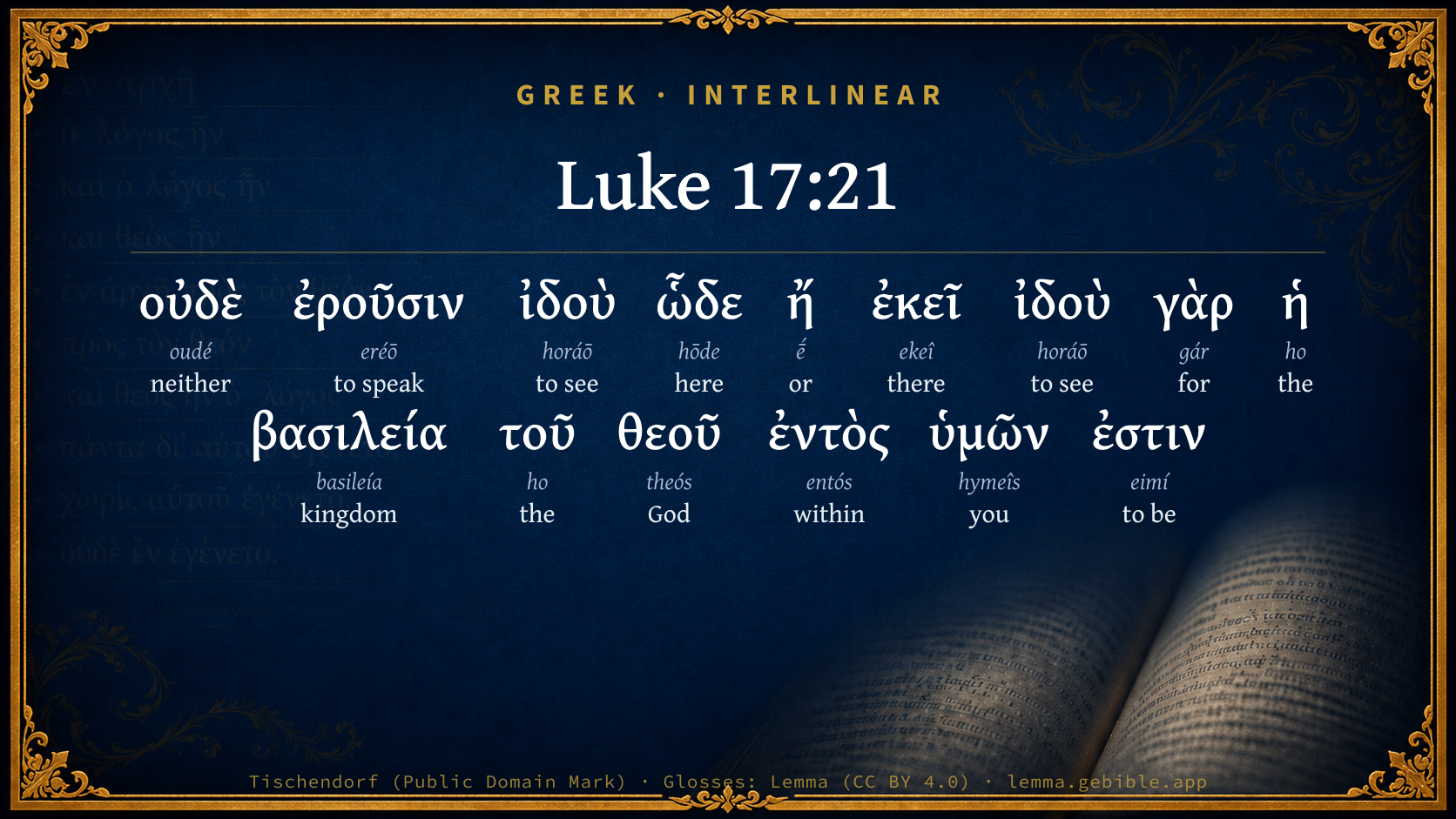
Greek (Tischendorf 8th ed.) Luke 17:21 appears in the Greek New Testament. The text above is from the Tischendorf 8th edition. Each word links to its Strong’s number and a concise gloss. Click any word for its full Thayer’s Greek Lexicon entry.
Download image
Cite this verse

Luke 17:21 (World English Bible). Public Domain. Lemma interlinear Bible study tool, https://lemma.gebible.app/v/luke/17/21.

Show BibTeX & RIS
BibTeX
RIS
English Translation
neither will they say, 'Look, here!' or, 'Look, there!' for behold, the Kingdom of God is within you."
World English Bible · Public Domain
Download a study sheet

One document with this verse’s original text, its word-by-word gloss line, the meaning frame, cross-references with their text, attributed commentary, and full source and license credits — printable, and it pastes into notes with its structure intact.

This verse Autodidact and up

Study sheet (.html) Plain text (.txt)

A passage Seminary Student

Up to 50 verses in one chapter. A passage sheet keeps up to 6 commentary sources and 12 cross-references per verse, in the order this page ranks them, and says so on the sheet whenever that leaves anything out. Ask for a single verse and you get the Autodidact verse sheet above.

Everything on this page stays free to read, with no account — the sheet is a download of what is already on screen, not access to it.

Want to remove ads? Support Godless Engineer
Compare translations 3

The same verse in 3 English versions, stacked beneath the original-language interlinear above. Click any original word for its lexicon entry.

Each is an independent rendering of the whole verse — the interlinear is not word-aligned to these translations.

Highlighted words mark where these versions differ — a whole-verse word diff, not a word-by-word alignment.

  • World English Bible Public Domain
    neither will they say, 'Look, here!' or, 'Look, there!' for behold, the Kingdom of God is within you."
  • King James Version Public Domain
    Neither shall they say, Lo here! or, lo there! for, behold, the kingdom of God is within you.
  • unfoldingWord Literal Text CC BY-SA 4.0
    Neither will they say, ‘Behold, here!’ or ‘There!’ For behold, the kingdom of God is within you.”

unfoldingWord Literal Text — © unfoldingWord, licensed CC BY-SA 4.0. Word-aligned USFM3 via Door43 (git.door43.org/unfoldingWord/en_ult).

Versions to compare (up to 4)

3 of 4 selected

Show all 19 translations

Every available English version of this verse, each an independent rendering of the whole verse.

  • World English Bible Public Domain
    neither will they say, 'Look, here!' or, 'Look, there!' for behold, the Kingdom of God is within you."
  • Berean Standard Bible Public Domain
    Nor will people say, ‘Look, here it is,’ or ‘There it is.’ For you see, the kingdom of God is in your midst.”
  • Majority Standard Bible Public Domain
    Nor will people say, ‘Look, here it is,’ or ‘There it is.’ For you see, the kingdom of God is in your midst.”
  • King James Version Public Domain
    Neither shall they say, Lo here! or, lo there! for, behold, the kingdom of God is within you.
  • American Standard Version (1901) Public Domain
    neither shall they say, Lo, here! or, There! for lo, the kingdom of God is within you.
  • Revised Version (1885) Public Domain
    neither shall they say, Lo, here! or, There! for lo, the kingdom of God is within you.
  • Geneva Bible (1599) Public Domain
    Neither shall men say, Loe here, or lo there: for behold, the kingdome of God is within you.
  • Douay-Rheims (1899) Public Domain
    Neither shall they say: Behold here, or behold there. For lo, the kingdom of God is within you.
  • Young's Literal Translation Public Domain
    nor shall they say, Lo, here; or lo, there; for lo, the reign of God is within you.'
  • Literal Standard Version CC BY-SA 4.0
    nor will they say, Behold, here; or, Behold, there; for behold, the Kingdom of God is within you.”
  • Unlocked Literal Bible CC BY-SA 4.0
    Neither will they say, 'Look, here it is!' or, 'There it is!' For look, the kingdom of God is within you.”
  • unfoldingWord Literal Text CC BY-SA 4.0
    Neither will they say, ‘Behold, here!’ or ‘There!’ For behold, the kingdom of God is within you.”
  • Darby Bible Public Domain
    nor shall they say, Lo here, or, Lo there; for behold, the kingdom of God is in the midst of you.
  • World Messianic Bible Public Domain
    neither will they say, ‘Look, here!’ or, ‘Look, there!’ for behold, God’s Kingdom is within you.”
  • Webster's Bible Public Domain
    Neither will they say, Lo here! or lo there! for behold, the kingdom of God is within you.
  • Free Bible Version CC BY-SA 4.0
    People won't be saying, ‘Look, it's here’ or ‘Look, it's there,’ for God's kingdom is among you.”
  • Bible in Basic English Public Domain
    And men will not say, See, it is here! or, There! for the kingdom of God is among you.
  • Text-Critical English NT CC BY 4.0
    nor will people say, ‘Behold, here it is!’ or, ‘ Behold, there it is!’ For behold, the kingdom of God is within you.”
  • Tyndale New Testament (1534) Public Domain
    Nether shall men saye: Loo here loo there. For beholde the kyngdome of God is with in you.

Literal Standard Version (2020), Covenant Press — licensed CC BY-SA 4.0. Text via the HelloAO Bible API (eBible.org). Unlocked Literal Bible (unfoldingWord) — licensed CC BY-SA 4.0. Text via the HelloAO Bible API (eBible.org). unfoldingWord Literal Text — © unfoldingWord, licensed CC BY-SA 4.0. Word-aligned USFM3 via Door43 (git.door43.org/unfoldingWord/en_ult). Free Bible Version, Dr. Jonathan Gallagher — licensed CC BY-SA 4.0. Text via the HelloAO Bible API (eBible.org).

Word by word

More ways to search: Search by grammar → Find every occurrence → Compare this word →

Practice this passage: Drill this verse → Learn its vocabulary →

About this verse

These counts appear in no published source. They are computed here, from the morphology-tagged text and Lemma’s own curated glosses. What Lemma adds →

15
words
13
distinct lemmas
Gospels
section

Notable vocabulary

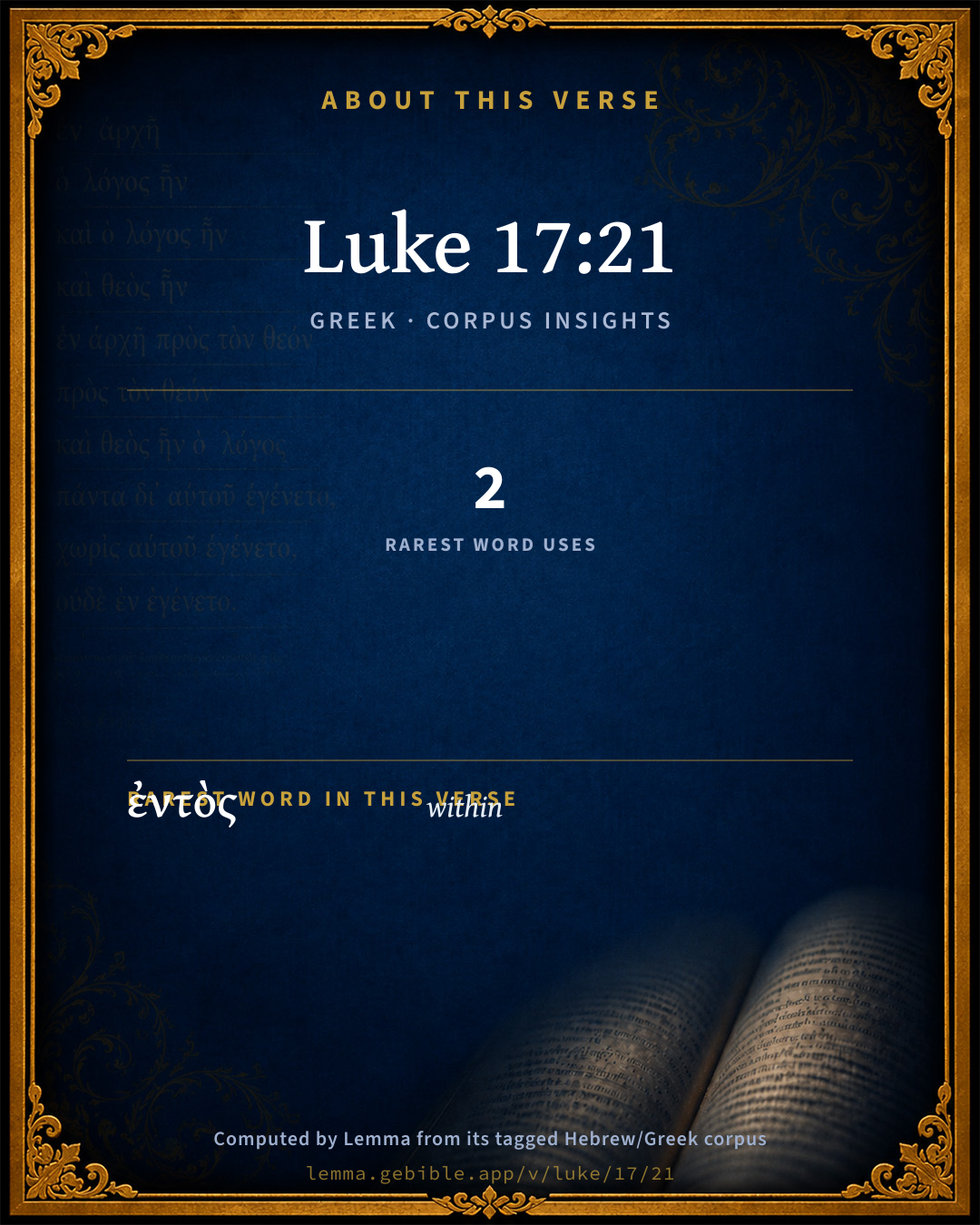
The rarest word here is ἐντὸς within G1787 — appearing just 2 times in the whole Greek New Testament.

Shared distinctive vocabulary

ἐντὸς within G1787 occurs in 2 verses of the Greek New Testament. Also found in:

Repetition

Words recur within this verse:

Cross-references

9

Topical passages linked to Luke 17:21 in the Treasury of Scripture Knowledge — connected by theme and wording, ordered by reader-vote popularity; previews shown in the World English Bible.

  • Matthew 12:28 But if I by the Spirit of God cast out demons, then the Kingdom of God has come upon you.
  • Romans 14:17 for the Kingdom of God is not eating and drinking, but righteousness, peace, and joy in the Holy Spirit.
  • Mark 13:21 Then if anyone tells you, 'Look, here is the Christ!' or, 'Look, there!' don't believe it.
  • Colossians 1:27 to whom God was pleased to make known what are the riches of the glory of this mystery among the Gentiles, which is Christ in you, the hope of glory;
  • Luke 10:9–11 Heal the sick who are therein, and tell them, 'The Kingdom of God has come near to you.'
  • Matthew 24:23–28 "Then if any man tells you, 'Behold, here is the Christ,' or, 'There,' don't believe it.
  • Luke 17:23 They will tell you, 'Look, here!' or 'Look, there!' Don't go away, nor follow after them,
  • Luke 21:8 He said, "Watch out that you don't get led astray, for many will come in my name, saying, 'I AM,' and, 'The time is at hand.' Therefore don't follow them.
  • John 1:26 John answered them, "I baptize in water, but among you stands one whom you don't know.

Cross-references courtesy of OpenBible.info (CC BY 4.0).

Commentary

Notes on Luke 17:21 from classic Christian and Jewish commentators (each source and its license shown beneath its notes). The classic Christian expositions comment on the surrounding passage and are grouped to its opening verse, so a note may address several verses; the Jewish commentaries on the Tanakh (Rashi and others) are per-verse, so they appear only where the commentator wrote on this verse.

Lemma curates 59 commentaries, every one of them public domain or Creative Commons licensed, each selected and text-cleaned for this edition rather than reprinted as found. About our sources →

Bengel's Gnomon

Johann Albrecht Bengel

Luk 17:21. Οὐδὲ ἐροῦσιν, neither shall they say) viz. they who point out the kingdom. The verb put without the noun is consonant with this view. For the world does not recognise the messengers of the kingdom.—[ὧδε—ἐκεῖ, here—there) Here includes under it the notion of the present time; there, that of the future.—V. g.[187]]—ἰδοὺ γὰρ, for behold) Ye ought to turn your earnest attention to the fact: Then you will see that the kingdom of God is already within your reach. This true (well-grounded) Behold, is put in antithesis to the Behold [“Lo, here or there”] which is looked for without good ground.[188] For behold (ἰδοὺ γὰρ) does not belong to (stand under) ἘΡΟῦΣΙΝ, they shall say.—ἐντὸς, within) Ye ought not to look to times that are future, or places that are remote: for the kingdom of God is within you; even as the King Messiah is in the midst of you: Joh 1:26 [“There standeth one among you (μέσος ὑμῶν) whom ye know not”], Luk 12:35. Within is here used, not in respect of the heart of individual Pharisees (although in very deed Christ dwells in the heart of His people: Eph 3:17), but in respect to the whole Jewish people. The King, Messiah, and therefore the kingdom, is present: ye see and ye hear [Him]. The LXX. use ἐντὸς answering to קרב of those things which are in a man; but in this passage He is speaking of more than one. So the LXX. ed Hervag.,[189] Deu 5:14, ὁ ἐντὸς τῶν πυλῶν σου. Raphelius compares the words found in Xenophon, ὅσα ἐντὸς αὐτῶν καὶ χρήματα καὶ ἄνθρωποι ἐγένοντο, “whatever both property and men were inside (within), with them, in the camp.”—ἔστιν, is) The Present, appositely, and with emphasis. It cannot be said, the kingdom cometh, but it is now present: see Joh 3:8.

[187] The note of the Gnomon on Luk 17:20, and the reference to Luk 17:37, implies that place, not time, is the leading idea of the answer as to the here and the there. Time is only a subordinate notion in it.—E. and T.

[188] ADabc Orig. 1,238c, 4,294c, Hil. Vulg. have ἢ ἰδοὺ ἐκεῖ, as Rec. Text and Lachm. read. But BL omit ἰδοὺ; and so Tisch.—E. and T.

[189] This edition was brought out at Basle, Τῆς Θείας γραφῆς, παλαίας δηλάδη καὶ νέας ἅπαντα, by John Hervagius, 1545. The preface was by Melancthon. The text of Lonicerus is chiefly followed: there are in it some valuable various readings.—E. and T.

Bengel's Gnomon of the New Testament — English translation (T&T Clark, Edinburgh, 1860) — public domain. Text from a community e-Sword module.

Expositor's Greek Testament

ed. W. Robertson Nicoll

Luk 17:21 . οὐδὲ ἐροῦσι , nor will they say; there will be nothing to give occasion for saying: non erit quod dicatur , Grotius. ὧδε , ἐκεῖ , here, there, implying a visible object that can be located. ἐντὸς ὑμῶν , within you, in your spirit. This rendering best corresponds with the non-visibility of the kingdom. The thought would be a very appropriate one in discourse to disciples . Not so in discourse to Pharisees. To them it would be most natural to say “ among you” = look around and see my works: devils cast out (Luk 11:20 ), and learn that the kingdom is already here ( ἔφθασεν ἐφʼ ὑμᾶς ). Kindred to this rendering is that of Tertullian ( c. Marcionem , L. iv., 35): in your power, accessible to you: in manu, in potestate vestra . The idea “among you” would be more clearly expressed by ἤδη ἐν μέσῳ ὑμῶν . Cf. Joh 1:6 . μέσος ὑ . στήκει , etc., one stands among you whom ye know not cited by Euthy. to illustrate the meaning of our passage. Field ( Ot. Nor. ) contends that there is no clear instance of ἐντὸς in the sense of “among,” and cites as an example of its use in the sense of “within” Psa 103:1 , πάντα τὰ ἐντός μου .

The Expositor's Greek Testament, edited by W. Robertson Nicoll (1897–1910) — public domain. Text from a community e-Sword module.

Geneva Bible (1599)

Geneva Bible translators

You look about for Messiah as though he were absent, but he is amongst you in the midst of you.

Geneva Bible (1599) marginal notes — public domain. Text via Bolls.life.

Jamieson, Fausset & Brown

Robert Jamieson, A. R. Fausset & David Brown

Lo here! . . . lo there!--shut up within this or that sharply defined and visible geographical or ecclesiastical limit.

within you--is of an internal and spiritual character (as contrasted with their outside views of it). But it has its external side too.

Jamieson, Fausset & Brown — Commentary Critical and Explanatory on the Whole Bible (1871) — public domain (CC PDM 1.0). Text via the HelloAO Bible API.

Adam Clarke's Commentary

Verse 21. Lo here! or, lo there!] Perhaps those Pharisees thought that the Messiah was kept secret, in some private place, known only to some of their rulers; and that by and by he should be proclaimed in a similar way to that in which Joash was by Jehoiada the priest. See the account, 2Ch 23:1-11.

Adam Clarke's Commentary on the Bible (1810–1826) — public domain. Text from a community e-Sword/MySword module.

Ellicott's Commentary for English Readers

(21) The kingdom of God is within you.—The marginal reading, “among you.” has been adopted, somewhat hastily, by most commentators. So taken. the words emphatically assert the actual presence of the Kingdom. It was already in the midst of them at the very time when they were asking when it would appear. The use of the Greek preposition is, however, all but decisive against this interpretation. It is employed for that which is “within,” as contrasted with that which is “without,” as in Mat_23:26, and in the LXX. version for the “inward parts,” or spiritual nature of man, as contrasted with the outward, as in Psa_103:1; Psa_109:22; Isa_16:11. It was in that region, in the life which must be born again (Joh_3:3), that men were to look for the kingdom; and there, whether they accepted it or rejected it, they would find sufficient tokens of its power.

A Bible Commentary for English Readers, edited by Charles John Ellicott (1878–1897) — public domain. Text from a community e-Sword module.

The Cambridge Bible for Schools and Colleges

gen. ed. J. J. S. Perowne

21. for behold, the kingdom of God is within you] intra vos est, Vulg. As far as the Greek is concerned, this rendering of entos is defensible (comp. Mat_23:26), and the spiritual truth expressed by such a rendering— which implies that “the Kingdom of God is...righteousness and peace,

and joy in the Holy Ghost” (Rom_14:17)—is most important. See Deu_30:14. So that Meyer is hardly justified in saying that the conception of the Kingdom of God as an ethical condition of the soul is modem not historico-biblical. But entos humon may also undoubtedly mean among you (marg.), ‘in the midst of your ranks,’ as in Xen. Anab. i. 10, §3; and this rendering is more in accordance (i) with the context—as to the sudden coming of the Son of Man; and (ii) with the fact,—for it certainly could not be said that the Kingdom of God was in the hearts of the Pharisees. The meaning then is the same as in Joh_1:26; Mat_12:28. But in either case our Lord implied that His Kingdom had already come while they were straining their eyes forward in curious observation, Luk_7:16, Luk_11:20.

The Cambridge Bible for Schools and Colleges (gen. ed. J. J. S. Perowne; Cambridge University Press, 1878–1918) — public domain. Text from a community e-Sword module.

John Gill's Exposition

And he said unto his disciples,.... Who also were expecting a worldly kingdom, and external honours, and temporal emoluments, and riches; and therefore to take off their minds from these things, and that they might not have their expectations raised this way, but, on the other hand, look for afflictions and persecutions, he observes to them,

the days will come when ye shall desire to see one of the days of the son of man; , "the days of the Messiah", a phrase frequently used in Jewish writings; that is, when they should be glad to enjoy one such a day in the personal presence of Christ, as they now did; and instead of looking forward for happy days, in a temporal sense, they would look back upon the days they have enjoyed with Christ, when he was in person among them, and wish they had one of those days again; when besides his corporeal presence, and spiritual communion with him, and the advantage of his ministry and miracles, they bad much outward peace and comfort: whereas in those days nothing but afflictions and persecutions abode them, wherever they went; so that by these words Christ would have them to understand, that they were not to expect better times, but worse, and that they would be glad of one of the days they now had, and in vain wish for it:

and ye shall not see it, or enjoy it. Moreover, days and opportunities of public worship, of praying to the Lord, of singing his praise, of hearing his word, and of attending on his ordinances, may be called days of the son of man, or Lord's days; see Rev 1:10 even the first days of weeks, on which days the apostles, and primitive churches, met together for religious worship: and these may very well be called days of the son of man, since, on those days, he first appeared to his disciples, after his resurrection, Joh 20:19 and on the same days his disciples and followers met together to preach in his name, to hear his Gospel, and to commemorate his sufferings and death, Act 20:7 and still continue to do so; and seeing he often meets with his people at such seasons and opportunities, fills them with his Spirit, communicates his grace, and indulges them with fellowship with himself, which make those days desirable ones: but sometimes so violent has been the persecution of the saints, that they have not been able, for a long time, to enjoy one of those days openly, and with freedom, though greatly desired by them; which may be considered as a fulfilment, at least in part, of this prediction of our Lord's: and therefore, whenever this is the case, it should not be thought strange; it is no other than what Christ has foretold should be: and it may teach us to prize, make use of, and improve such days and opportunities, whilst we have them, we know not how soon our teachers may be removed into corners, when we shall wish in vain for them; and seasons of hearing them, as is here suggested: sad it is to know the worth of Gospel opportunities, by the want of them!

John Gill's Exposition of the Whole Bible (1746–1763) — public domain (CC PDM 1.0). Text via the HelloAO Bible API.

Trapp's Complete Commentary

John Trapp

21 Neither shall they say, Lo here! or, lo there! for, behold, the kingdom of God is within you.

Ver. 21. The kingdom of God is within you] It is spiritual, Rom 14:17. Or, it is among you, but that you cannot see wood for trees. You seek me as absent, whom you reject present.

John Trapp, A Commentary or Exposition upon All the Books of the Old and New Testament (1647–1656) — public domain. Text from a community e-Sword module.

Albert Barnes' Notes on the Bible

“Lo here! or, Lo there!” When an earthly prince visits different parts of his territories, he does it with pomp. His movements attract observation, and become the common topic of conversation. The inquiry is, Where is he? which way will he go? and it is a matter of important “news” to be able to say where he is. Jesus says that the Messiah would not come in that manner. It would not be with such pomp and public attention. It would be silent, obscure, and attracting comparatively little notice. Or the passage may have reference to the custom of the “pretended” Messiahs, who appeared in this manner. They said that in this place or in that, in this mountain or that desert, they would show signs that would convince the people that they were the Messiah. Compare the notes at Act 5:36-37.

Is within you - This is capable of two interpretations.

1. The reign of God is “in the heart.” It does not come with pomp and splendor, like the reign of temporal kings, merely to control the external “actions” and strike the senses of people with awe, but it reigns in the heart by the law of God; it sets up its dominion over the passions, and brings every thought into captivity to the obedience of Christ.

2. It may mean the new dispensation is “even now among you.” The Messiah has come. John has ushered in the kingdom of God, and you are not to expect the appearance of the Messiah with great pomp and splendor, for he is now among you. Most critics at present incline to this latter interpretation. The ancient versions chiefly follow the former.

Albert Barnes' Notes on the Bible (1834–1885) — public domain. Text from a community e-Sword/MySword module.

Haydock's Catholic Bible Commentary

Is within you. It is with you; your Messias is already come. --- He standeth in the midst of you, as John the Baptist told you. (John i. 26.) (Witham)

George Leo Haydock (1774–1849), Haydock's Catholic Family Bible and Commentary, 1859 edition — public domain. Excludes Psalms (Douay-Rheims chapter numbering differs from Protestant) and Deuterocanonical books (Catholic canon only).

Matthew Poole's English Annotations

The latter words of this verse seem fairly to admit of a double interpretation, as you here may signify the disciples of Christ, who had received Christ as their Lord, over whom he exercised a spiritual dominion and jurisdiction, or as it may respect the whole Jewish nation, amongst whom the kingdom of God was now exercised, by the preaching of the gospel, and the power of Christ put forth in the casting out devils, and other miraculous operations. I incline to the latter, as differing from those that think these words were spoken with a peculiar respect to the disciples; I rather think them a reply to the Pharisees, as corrective of their false notion and apprehension of the Messiah, as if he were yet to come, and to set up a temporal principality; for it is said, Luk 17:22, And he said unto the disciples, as if he did but then specially apply his discourse to them; εν ημιν thus signifieth, Luk 7:16; Joh 1:14. You (saith our Saviour) are much mistaken as to the nature of my kingdom, and indeed of the kingdom of the Messiah, in the expectation of which you live. It is not a kingdom of the same nature with the kingdoms of the world, it cometh not with pomp: and splendour, for men and women to observe; they shall not say, Lo here he cometh! Or, Lo there he goeth! The kingdom of God is now in the midst among you, though you observe it not.

Matthew Poole's English Annotations on the Holy Bible (1683–1685) — public domain. Text from a community e-Sword/MySword module.

Whedon's Commentary on the Bible

Daniel D. Whedon

21. Lo, here—As it would not show itself to the observation of watchers in the sky, so it would not break out in spots on the earth. The rumour that the Messiah was marching with the blood-red banner from Edom, or that he had already descended upon Mount Olivet, or that he was in secret council chambers with the sages of the Sanhedrim, would all prove falsehoods.

Is within you—Is not an external and political one, but is a power and a realm within the soul. By using the second person plural, Jesus did not mean to concede that that kingdom was now actually within their hearts. He spoke to them generally as men. Some render the passage, the kingdom of God is among you. The Greek preposition well admits that meaning, but the context scarcely does. What our Lord appears to assert is, that his kingdom is not external but internal; that is, it is not a thing of observation and localities, but of consciousness, and within.

Daniel D. Whedon (gen. ed.), Commentary on the Old and New Testaments (1874–1909) — public domain. Text from a community e-Sword module.

The Pulpit Commentary

Neither shall they say, Lo here: or, lo there! for, behold, the kingdom of God is within you. That kingdom will be marked out on no map, for, lo, it is even now in your midst. It may be asked How "in your midst"? Scarcely not as Godet and Olshausen, following Chrysostom, think, in your hearts. The kingdom of God could not be said to be in the hearts of those Pharisees to whom the Master was especially directing his words of reply here. It should be rather understood in the midst of your ranks; so Meyer and Farrar and others interpret it.

The Pulpit Commentary (1880–1919), ed. H.D.M. Spence-Jones & Joseph S. Exell — public domain. Text from a community e-Sword module.

John Wesley's Explanatory Notes

Neither shall they say, Lo here, or lo there - This shall not be the language of those who are, or shall be sent by me, to declare the coming of my kingdom. For behold the kingdom of God is within or among you - Look not for it in distant times or remote places: it is now in the midst of you: it is come: it is present in the soul of every true believer: it is a spiritual kingdom, an internal principle. Wherever it exists, it exists in the heart.

John Wesley, Explanatory Notes Upon the Whole Bible (1754–1765) — public domain. Text via the GEBible commentary corpus.

Scofield Reference Notes

C. I. Scofield

(Greek - ἐντός = "in the midst)." It could not be said of a self-righteous, Christ rejecting pharisee, that the kingdom of God, as to its spiritual content, was within him. Our Lord’s whole answer, designedly enigmatic to the Pharisees (cf) Mat 13:10-13 had a dispensational meaning. The kingdom in its outward form, as covenanted to David 2Sa 7:8-17 and described by the prophets (See Scofield "Zec 12:8") had been rejected by the Jews; so that, during this present age, it would not "come with observation" (lit. "outward show") but in the hearts of men (cf); Luk 19:11; Luk 19:12; Act 1:6-8.

(See Scofield "Act 1:6"). See Scofield "Rom 14:17.

Meantime, the kingdom was actually "in the midst" of the Pharisees in the persons of the King and His disciples.

within you in the midst of.

The Scofield Reference Bible (1917 edition), notes by C. I. Scofield — public domain. Text from a community e-Sword module.

Cambridge Greek Testament for Schools and Colleges

21. ἐντὸς ὑμῶν. Intra vos est, Vulg[309], i.e. in animis vestris. As far as the Greek is concerned, this rendering of ἐντὸς is defensible (comp. Mat 23:26), and the spiritual truth expressed by such a rendering—which implies that “the Kingdom of God is … righteousness and peace, and joy in the Holy Ghost” (Rom 14:17)—is most important. See Deu 30:14. So that Meyer is hardly justified in saying that the conception of the Kingdom of God as an ethical condition of the soul is modern not historico-biblical. But ἐντὸς ὑμῶν may also undoubtedly mean among you (marg.), ‘in the midst of your ranks,’ as in Xen. Anab. I. 10, § 3; and this rendering is more in accordance (i) with the context—as to the sudden coming of the Son of Man; and (ii) with the fact,—for it certainly could not be said that the Kingdom of God was in the hearts of the Pharisees. The meaning then is the same as in Joh 1:26; Mat 12:28. But in either case our Lord implied that His Kingdom had already come while they were straining their eyes forward in curious observation, Luk 7:16, Luk 11:20 (ἔφθασεν ἐφ’ ὑμᾶς).

[309] Vulg. Vulgate.

Cambridge Greek Testament for Schools and Colleges (Cambridge University Press, 1896; 21 vols, various authors incl. Carr, Maclear, Plummer, Farrar, Lumby, Moule, M. R. James, Simcox) — public domain. Text from a community e-Sword module.

Alford’s Greek Testament

Henry Alford

21. οὐδὲ ἐρ.…] Its coming shall be so gradual and unobserved, that none during its waxing onward shall be able to point here or there for a proof of its coming.

ἰδοὺ γάρ] for behold the kingdom of God is (already) among you. The misunderstanding which rendered these words ‘within you,’ meaning this in a spiritual sense, ‘in your hearts,’ should have been prevented by reflecting that they are addressed to the Pharisees, in whose hearts it certainly was not. Nor could the expression in this connexion well bear this spiritual meaning potentially—i.e. is in its nature, within your hearts. The words are too express and emphatic for this. We have the very expression, Xen. Anab. i. 10. 3,—ἀλλὰ καὶ ταύτην ἔσωσαν (οἱ Ἕλληνες) καὶ ἄλλα ὁπόσα ἐντὸς αὐτῶν καὶ χρήματα καὶ ἄνθρωποι ἐγένοντο πάντα ἔσωσαν:—see also Joh 1:26; Joh 12:35, both of which are analogous expressions. See the two renderings compared in Bleek’s note.

The kingdom of God was begun among them, and continues thus making its way in the world, without observation of men; so that whenever men can say ‘lo here or lo there,’—whenever great ‘revivals’ or ‘triumphs of the faith’ can be pointed to, they stand self-condemned as not belonging to that kingdom. Thus we see that every such marked event in the history of the Church is by God’s own hand as it were blotted and marred, so as not to deceive us into thinking that the kingdom has come. So it was at the Pentecostal era:—so at that of Constantine;—so at the Reformation.

The meaning ‘among you,’ includes of course the deeper and personal one ‘within each of you,’ but the two are not convertible.

Henry Alford, The Greek Testament (1849–1861) — public domain. Text from a community e-Sword module.

International Critical Commentary

21. οὐδὲ ἐροῦσιν . “Neither will they say” (with any reason): non erit quod dicatur (Grot.). In ver. 23 they do say this; but it is a groundless statement. The ἰδοὐ before ἐκεῖ (A D, Vulg.) is an insertion from ver. 23.

ἰδοὺ γάρ . See on 1:44. This ἰδού introduces the true statement in contrast to the previous ἰδού, which introduced a false one. The γάρ marks the reason why “Lo here” or “There” cannot be accepted. Note the solemn repetition of ἡ βασιλεία τοῦ Θεοῦ.

ἐντὸς ὑμῶν ἐστίν. Usage sanctions either translation: “within you, in your hearts” (Psa 38:4, 108:22, 103:1; Isa 16:11; Dan 10:16 (Theod.); Ecclus. 19:23[26]: comp. Mat 23:26); or, “among you, in your midst” (Xen. Anab. 1:10, 3; Hellen. 2:3, 19; Plat. Leg. 7:789 A). The latter seems to suit the context better; for the Kingdom of God was not in the hearts of the Pharisees, who are the persons addressed. The meaning will then be, “so far from coming with external signs which will attract attention, the Kingdom is already in the midst of you (in the person of Christ and of His disciples), and you do not perceive it.” Note the contrast between ἐροῦσιν, the supposition that the Kingdom is still in the future, and ἐστίν, the fact that it is really present. But this rendering of ἐντός lacks confirmation in Scripture, and the context is not decisive against the other. If “within you” be adopted, the meaning will be, “Instead of being something externally visible, the Kingdom is essentially spiritual: it is in your hearts, if you possess it at all.”

All Latin texts have intra vos est. But the interpretation of “within you” varies considerably. Gregory Nyssen explains it of the image of God bestowed upon all men at their birth (De Virg. 12.; comp. De Beat. 1.), Which cannot be right. Cyril of Alexandria makes it mean, “lies in your power to appropriate it,” ἐν ἐξουσίᾳ κεῖται τὸ λαβεῖν αὐτήν (Migne 72:841). Similarly Maldonatus, quia poterant, si vellent Christum recipere. But this is translating ἐντὸς ὑμῶν “within you,” and interpreting “within you” as much the same as “among you.” If they had not received Christ or the Kingdom, it was not yet within them. Against “in your hearts” Maldonatus points that not only does Lk. tell us that the words were addressed to the Pharisees, in whose hearts, the Kingdom was not; but that he emphasizes this by stating that the next saying was addressed to the disciples. Among moderns, Godet arguesably for “within you” (see also McClellan): Weiss and Hahn for “among you.” Syr-Sin. has “among.” Comp. 10:9, 11:20.

International Critical Commentary — older volumes (1896–1929), various authors — public domain. Text from a community e-Sword module.

Vincent's Word Studies in the New Testament

Marvin R. Vincent

Within. Better, in the midst of. Meyer acutely remarks that "you refers to the Pharisees, in whose hearts nothing certainly found a place less than did the ethical kingdom of God." Moreover, Jesus is not speaking of the inwardness of the kingdom, but of its presence. "The whole language of the kingdom of heaven being within men, rather than men being within the kingdom, is modern" (Trench, after Meyer).

Marvin R. Vincent, Word Studies in the New Testament (1887–1900) — public domain. Text from a community e-Sword/MySword module.

Lesson kit

Teaching starters — assembled from the data on this page, not authored interpretation. Every prompt links to the verse data it draws on. Edit before teaching.

Luke, in the Gospels, opens this verse with 15 words (13 distinct Greek lemmas). Its most distinctive word is entós (“within”). A historical commentator’s framing appears above. Read the whole chapter for the surrounding context.

Discussion questions

  1. What does “within” (entós) contribute to the verse as a whole?
  2. Matthew 23:26 shares the word «within» with this verse. How do the two illuminate each other?
  3. “to see” occurs 2× in this one verse. What is the effect of the repetition?
  4. The translations on this page render this verse differently — a whole-verse word diff, not a word-by-word alignment. What might account for the different wordings?
  5. Reading how Bengel's Gnomon and Expositor's Greek Testament read this verse, where do the two commentators agree and where do they part?

Things to notice

  • These translations choose different wording for 4 words in this verse.
  • “to see” occurs 2× in this single verse.
  • 13 distinct Greek lemmas span 15 words in this verse.

Reading settings

Reading text

Shown beneath each verse's original-language words.

Old Testament
Old Testament edition

Read the OT as the Masoretic Hebrew (MT) or the Greek Septuagint (LXX).

English shown for the Greek Septuagint (in the Hebrew ↔ Greek comparison).

Comparing translations? Open the Compare panel on any verse page to stack up to four side by side.