Galatians 2:3

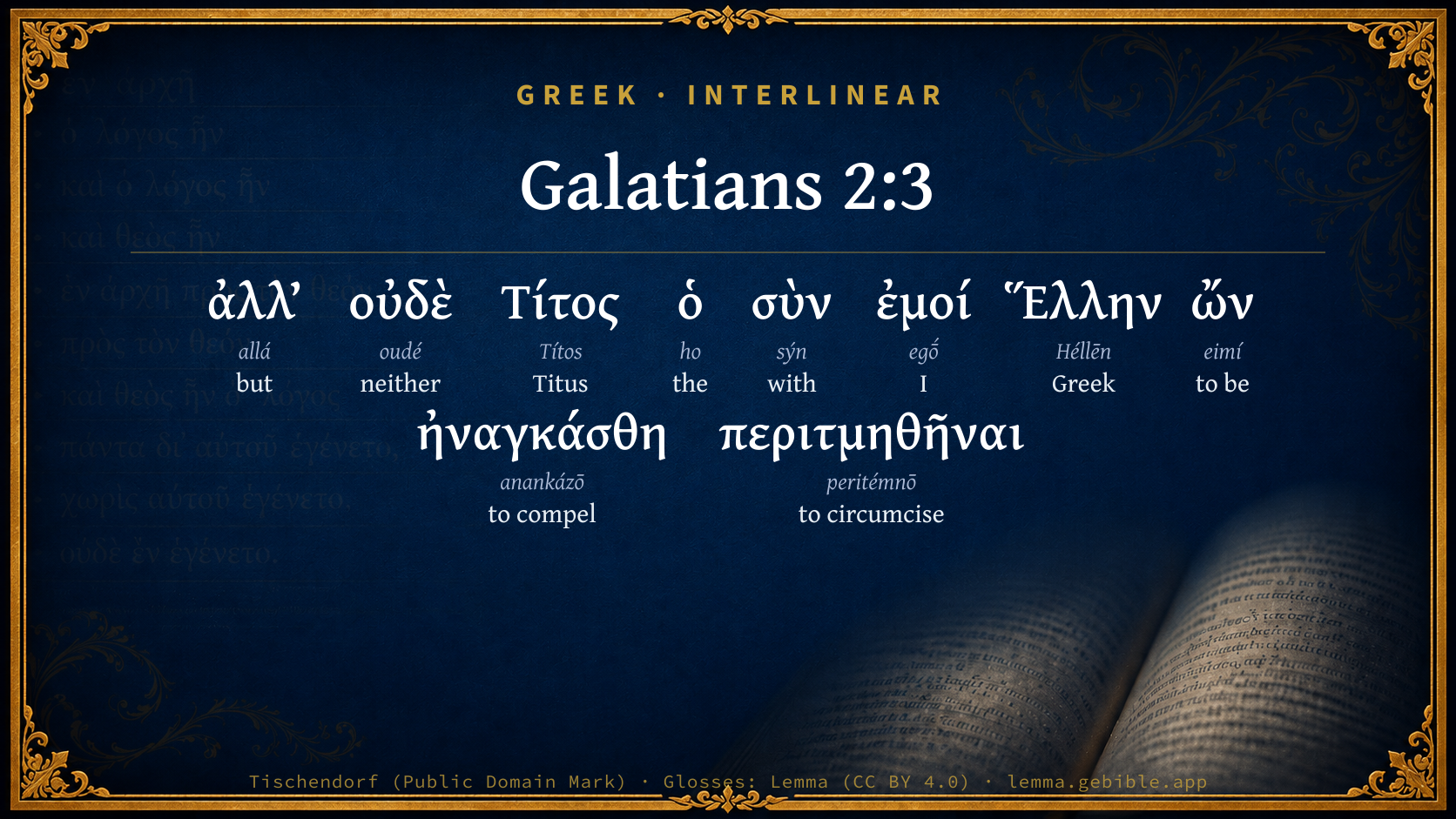
Greek (Tischendorf 8th ed.) Galatians 2:3 appears in the Greek New Testament. The text above is from the Tischendorf 8th edition. Each word links to its Strong’s number and a concise gloss. Click any word for its full Thayer’s Greek Lexicon entry.
Download image
Cite this verse

Galatians 2:3 (World English Bible). Public Domain. Lemma interlinear Bible study tool, https://lemma.gebible.app/v/galatians/2/3.

Show BibTeX & RIS
BibTeX
RIS
English Translation
But not even Titus, who was with me, being a Greek, was compelled to be circumcised.
World English Bible · Public Domain
Download a study sheet

One document with this verse’s original text, its word-by-word gloss line, the meaning frame, cross-references with their text, attributed commentary, and full source and license credits — printable, and it pastes into notes with its structure intact.

This verse Autodidact and up

Study sheet (.html) Plain text (.txt)

A passage Seminary Student

Up to 50 verses in one chapter. A passage sheet keeps up to 6 commentary sources and 12 cross-references per verse, in the order this page ranks them, and says so on the sheet whenever that leaves anything out. Ask for a single verse and you get the Autodidact verse sheet above.

Everything on this page stays free to read, with no account — the sheet is a download of what is already on screen, not access to it.

Want to remove ads? Support Godless Engineer
Compare translations 3

The same verse in 3 English versions, stacked beneath the original-language interlinear above. Click any original word for its lexicon entry.

Each is an independent rendering of the whole verse — the interlinear is not word-aligned to these translations.

Highlighted words mark where these versions differ — a whole-verse word diff, not a word-by-word alignment.

  • World English Bible Public Domain
    But not even Titus, who was with me, being a Greek, was compelled to be circumcised.
  • King James Version Public Domain
    But neither Titus, who was with me, being a Greek, was compelled to be circumcised:
  • unfoldingWord Literal Text CC BY-SA 4.0
    But not even Titus, the one with me, being a Greek, was forced to be circumcised.

unfoldingWord Literal Text — © unfoldingWord, licensed CC BY-SA 4.0. Word-aligned USFM3 via Door43 (git.door43.org/unfoldingWord/en_ult).

Versions to compare (up to 4)

3 of 4 selected

Show all 19 translations

Every available English version of this verse, each an independent rendering of the whole verse.

  • World English Bible Public Domain
    But not even Titus, who was with me, being a Greek, was compelled to be circumcised.
  • Berean Standard Bible Public Domain
    Yet not even Titus, who was with me, was compelled to be circumcised, even though he was a Greek.
  • Majority Standard Bible Public Domain
    Yet not even Titus, who was with me, was compelled to be circumcised, even though he was a Greek.
  • King James Version Public Domain
    But neither Titus, who was with me, being a Greek, was compelled to be circumcised:
  • American Standard Version (1901) Public Domain
    But not even Titus who was with me, being a Greek, was compelled to be circumcised:
  • Revised Version (1885) Public Domain
    But not even Titus who was with me, being a Greek, was compelled to be circumcised:
  • Geneva Bible (1599) Public Domain
    But neither yet Titus which was with me, though he were a Grecian, was compelled to be circumcised,
  • Douay-Rheims (1899) Public Domain
    But neither Titus, who was with me, being a Gentile, was compelled to be circumcised.
  • Young's Literal Translation Public Domain
    but not even Titus, who `is' with me, being a Greek, was compelled to be circumcised --
  • Literal Standard Version CC BY-SA 4.0
    but not even Titus, who [is] with me, being a Greek, was compelled to be circumcised—
  • Unlocked Literal Bible CC BY-SA 4.0
    But not even Titus, who was with me and who was a Greek, was forced to be circumcised.
  • unfoldingWord Literal Text CC BY-SA 4.0
    But not even Titus, the one with me, being a Greek, was forced to be circumcised.
  • Darby Bible Public Domain
    (but neither was Titus, who was with me, being a Greek, compelled to be circumcised;)
  • World Messianic Bible Public Domain
    But not even Titus, who was with me, being a Greek, was compelled to be circumcised.
  • Webster's Bible Public Domain
    But neither Titus, who was with me, being a Greek, was compelled to be circumcised:
  • Free Bible Version CC BY-SA 4.0
    But as it turned out, nobody even insisted that Titus who was with me should be circumcised, though he was Greek.
  • Bible in Basic English Public Domain
    But not even Titus who was with me, being a Greek, was made to undergo circumcision:
  • Text-Critical English NT CC BY 4.0
    But not even Titus, who was with me, was compelled to be circumcised, even though he is a Greek.
  • Tyndale New Testament (1534) Public Domain
    Also Titus which was with me though he were a Greke yet was not compelled to be circumcised

Literal Standard Version (2020), Covenant Press — licensed CC BY-SA 4.0. Text via the HelloAO Bible API (eBible.org). Unlocked Literal Bible (unfoldingWord) — licensed CC BY-SA 4.0. Text via the HelloAO Bible API (eBible.org). unfoldingWord Literal Text — © unfoldingWord, licensed CC BY-SA 4.0. Word-aligned USFM3 via Door43 (git.door43.org/unfoldingWord/en_ult). Free Bible Version, Dr. Jonathan Gallagher — licensed CC BY-SA 4.0. Text via the HelloAO Bible API (eBible.org).

Word by word

More ways to search: Search by grammar → Find every occurrence → Compare this word →

Practice this passage: Drill this verse → Learn its vocabulary →

About this verse

These counts appear in no published source. They are computed here, from the morphology-tagged text and Lemma’s own curated glosses. What Lemma adds →

10
words
10
distinct lemmas
Pauline Epistles
section

Notable vocabulary

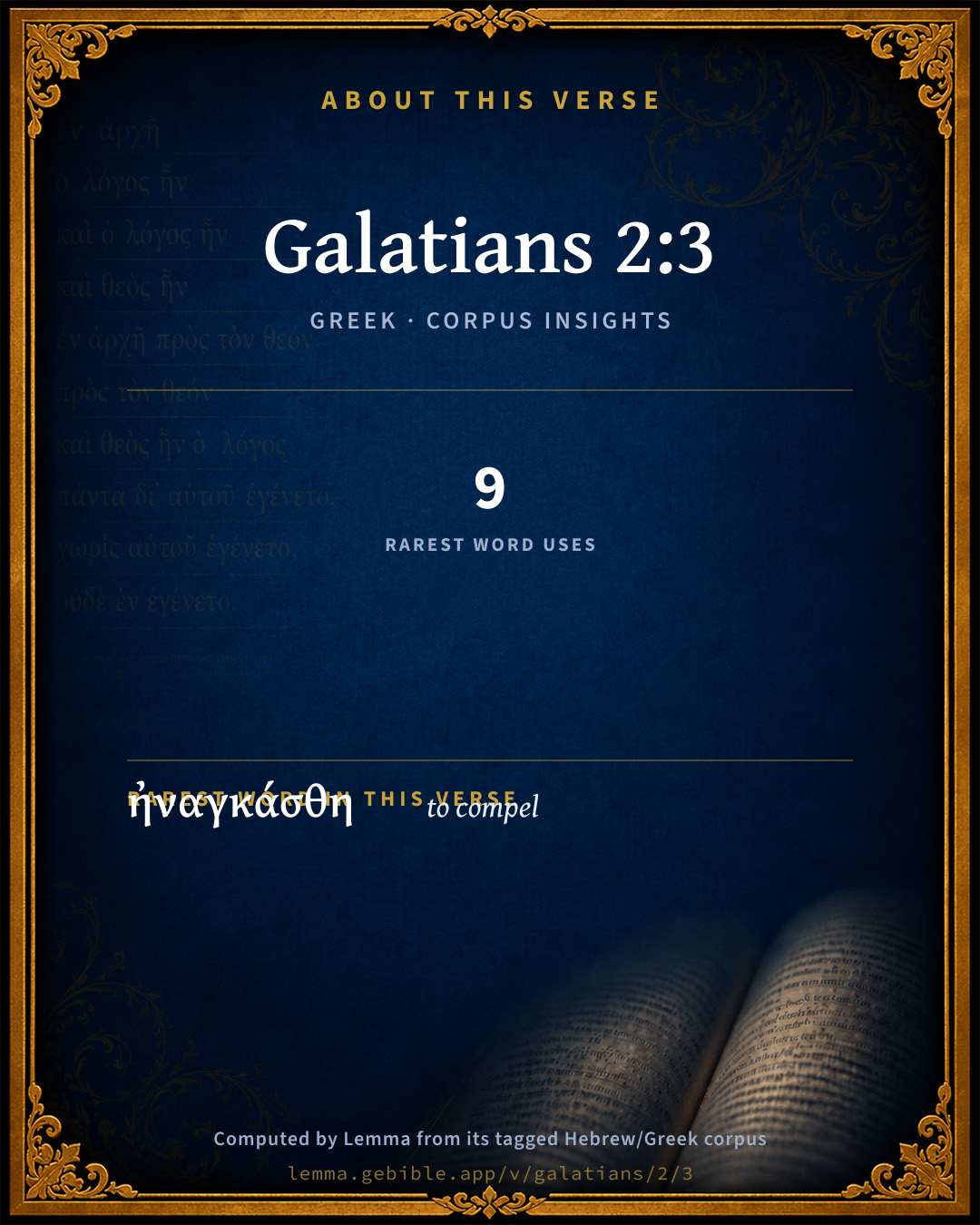
The rarest word here is ἠναγκάσθη to compel G315 — appearing just 9 times in the whole Greek New Testament.

Shared distinctive vocabulary

ἠναγκάσθη to compel G315 occurs in 9 verses of the Greek New Testament. Also found in:

Cross-references

5

Topical passages linked to Galatians 2:3 in the Treasury of Scripture Knowledge — connected by theme and wording, ordered by reader-vote popularity; previews shown in the World English Bible.

  • Acts 16:3 Paul wanted to have him go out with him, and he took and circumcised him because of the Jews who were in those parts; for they all knew that his father was a Greek.
  • Galatians 5:2–6 Behold, I, Paul, tell you that if you receive circumcision, Christ will profit you nothing.
  • 1 Corinthians 9:20–21 To the Jews I became as a Jew, that I might gain Jews; to those who are under the law, as under the law, that I might gain those who are under the law;
  • 2 Corinthians 2:13 I had no relief for my spirit, because I didn't find Titus, my brother, but taking my leave of them, I went out into Macedonia.
  • Acts 15:24 Because we have heard that some who went out from us have troubled you with words, unsettling your souls, saying, 'You must be circumcised and keep the law,' to whom we gave no commandment;

Cross-references courtesy of OpenBible.info (CC BY 4.0).

Commentary

Notes on Galatians 2:3 from classic Christian and Jewish commentators (each source and its license shown beneath its notes). The classic Christian expositions comment on the surrounding passage and are grouped to its opening verse, so a note may address several verses; the Jewish commentaries on the Tanakh (Rashi and others) are per-verse, so they appear only where the commentator wrote on this verse.

Lemma curates 59 commentaries, every one of them public domain or Creative Commons licensed, each selected and text-cleaned for this edition rather than reprinted as found. About our sources →

The Biblical Illustrator

Joseph S. Exell

Gal_2:3

But neither Titus, who was with me.

But neither Titus

1. This incident is introduced by way of evidence, not by way of apology.

2. The circumcision of Titus is inconsistent with individual expressions in the passage.

3. For such a concession, both the time and the person were most inopportune. St. Paul is here indirectly meeting a charge brought against him on the ground of his circumcision of Timothy.

I. Not even Titus, who as my fellow-labourer would be constantly brought in contact with the Jews, and therefore might well have adopted a conciliatory attitude.

II. Not even Titus, although the pressure exerted in his case was great.

III. Why? because he was a Greek; Timothy was a Jew. (Bishop Lightfoot.)

Soul liberty

Paul circumcised Timothy, but would not allow Titus to be, to show that Christianity

(1) is independent of ceremonies,

(2) can exist without them. Soul liberty is--

I. Essentially identified with christ.

II. Is opposed to a ritualistic ministry.

III. Is to be defended with uncompromising determination. (D. Thomas, D. D.)

The gravity of the crisis

Judaism was the cradle of Christianity, and very nearly became its grave. (Paul of Tarsus.)

Narrowness and breadth

In our own country people very often attempt to coerce the minority by calumniating its objects, and one of the commonest words used for this purpose is the term un-English. Now, the nationalist party among the Jews might have called the converts un-Jewish. Heated by a narrow patriotism, they were ready to join the cry of the depraved rabble in the heathen cities, and stigmatise the Christian as the enemy of the human race, because his sympathies were comprehensive. (Paul of Tarsus.)

The Biblical Illustrator, edited by Joseph S. Exell (c. 1880s–1900s) — public domain. Text from a community e-Sword module.

Joseph Benson's Commentary

Gal 2:3. But neither Titus, &c. — As if he had said, That the apostles, to whom I communicated the doctrine which I preach, acknowledged it to be the true gospel of Christ, is evident from this, that not even Titus, who was with, me, though a Greek, or converted Gentile, was compelled to be circumcised — In order to his being received as a true member of the Christian Church; a clear proof that none of the apostles insisted on circumcising the Gentile believers. The sense seems to be, It is true, some of those false brethren would gladly have compelled Titus to be circumcised, but I utterly refused it. And that because of false brethren — That is, I was averse to, and opposed the circumcision of Titus, because the Jews, who professed the Christian religion, yet urged the observation of the ceremonial law as necessary to salvation, (Act 15:1,) and so were real enemies to the gospel. Or, the sense may be, that Titus was not compelled, by the apostles and elders of Jerusalem, to be circumcised, on account even of the false brethren, who, when they found that Titus was not circumcised, complained of Paul to his brethren apostles on that account. Unawares brought in — Made members of the church at Jerusalem upon their great pretences to piety, without due consideration and trial; who came in privily — To our meetings at Jerusalem; to spy, &c. — To find out and condemn our freedom from the law of Moses, which we Gentiles have obtained by Christ Jesus’s gospel. Or, as some explain the clause, these false brethren had got themselves introduced secretly, that is, by persons that did not know their real character, into the meetings which Paul had with the apostles, to observe whether he would stand to the defence of that liberty from the ceremonial law before the apostles, which he preached among the Gentiles. That they might bring us into bondage — That in case I had not maintained our liberty, they might thence take occasion to bring back the Christian Gentiles, and whole church, under the yoke of the ceremonial law. To whom we gave place, no, not for an hour — Yielded to them in allowing the ceremonies, in no degree. With such wonderful prudence did the apostle use his Christian liberty; circumcising Timothy, (Act 16:3,) because of weak brethren, but not Titus, because of false brethren; that the truth of the gospel — The true genuine gospel, or the purity of gospel doctrine; might continue with you — And other churches of the Gentiles. So that, as if he had said, we defend for your sakes the privileges which you would give up.

Joseph Benson's Commentary on the Old and New Testaments (1811–1818) — public domain. Text from a community e-Sword module.

Tyndale Open Study Notes

Tyndale Open Resources

2:3 The Jerusalem apostles affirmed Paul’s message without qualification. They stood together on the same Good News—that God’s grace comes through faith in Christ, not through keeping the law. Clearly the Jerusalem apostles did not think that circumcision was necessary for a Gentile like Titus.

Tyndale Open Study Notes — © Tyndale Open Resources, licensed CC BY-SA 4.0. Text via the HelloAO Bible API.

Bengel's Gnomon

Johann Albrecht Bengel

Gal 2:3. Οὐδὲ, not even) We did not even allow the necessity of circumcising Titus, who was with me, to be laid upon us.

Bengel's Gnomon of the New Testament — English translation (T&T Clark, Edinburgh, 1860) — public domain. Text from a community e-Sword module.

Meyer's Critical & Exegetical Commentary

Heinrich August Wilhelm Meyer

Gal_2:3. Observe, that Paul does not pass on to the result of his discussions with the δοκοῦσι until Gal_2:6, and consequently it is Gal_2:6 ff. which corresponds to the κατʼ ἰδίαν δὲ δοκοῦσι in Gal_2:2; so that Gal_2:3-5 have reference to the result of the laying his gospel to the Gentiles before the Christians in Jerusalem generally, and correspond with the first part of Gal_2:2 (ἀνεθέμην αὐτοῖς τὸ εὐαγγ. ὃ κηρ. ἐν τ. ἔθν.).

But so little had that exposition of my gospel to the church at Jerusalem a result counteracting it and implying the εἰς κενὸν τρέχω ἢ ἔδραμον, that, on the contrary, not even Titus, etc. Thus ἀλλʼ οὐδέ (comp. Luk_23:15; Act_19:2) introduces a fact whichin contrast to the idea of running in vain, which had just been brought forward as the point for inquiry in that exposition of his gospelserves as the surest palpable proof how triumphantly the Gentile gospel of the apostle (which rejected the necessity of circumcision for the Hellenes) maintained its ground then before the church of Jerusalem, and how very far people were from ascribing to the apostle a running, or having run, in vain. For otherwise it would have been absurd, if the church had not pleaded for, and carried out, the circumcision at least of Titus.[61] But not even this was done, to say nothing of its being a duty of the church to reject my gospel which was altogether opposed to the circumcision of Gentiles, and to decide that I εἰς κενὸν τρέχω ἢ ἔδραμον! This line of argument involves a syllogism, of which ἀλλʼ οὐδὲ … περιτμηθῆναι is the minor.

Ἕλλην ὤν] Although a Hellene, a Gentile.[62] We have no further details as to his descent.

ἠναγκάσθη] From Gal_2:4-5 it follows that, on the part of certain Christians at Jerusalem (not of the apostles also, who are not referred to until Gal_2:6, where the κατʼ ἰδίαν δὲ τοῖς δοκ. is resumed), the circumcision of Titus had been urged, but had not been complied with on the part of Paul, Barnabas, and Titus, and this resistance was respected by the church;[63] hence the οὐκ ἠναγκάσθη περιτμηθῆναι, there was not imposed on him the necessity of submitting to be circumcised. Most expositors, however, adopt the common opinion that οὐδὲ … ἠναγκάσθη περιτ. implies that the circumcision of Titus had not been demanded, which is adduced by Paul as a proof of his agreement with the apostles. See Chrysostom, Theodoret, Theophylact, Oecumenius, and many others, including Winer, Usteri, Matthies, Schott, de Wette, Hofmann. This view is decisively set aside by the sequel (see on Gal_2:4), apart from the fact that here the relation to the apostles is not yet under discussion. Moreover, if the circumcision of Titus had not been demanded, there would have been no occasion for the expression ἠναγκάσθη. Certain individuals in the church, no doubt instigated by the false brethren (Gal_2:4), had really come forward with the demand that Titus must submit to be circumcised. Comp. the subsequent case of Timothy, who under different circumstances was circumcised by Paul himself (Act_16:3). To look upon the false brethren themselves as those who demanded the circumcision of Titus (Bleek, Wieseler, and others) does not suit Gal_2:4, in which they appear only as the more remote cause of the demand; they kept in the background.[64]

[61] The latter, as associated with the apostle in teaching, must, in his uncircumcised Gentile condition, have been specially offensive to those who had Judaistic views.

[62] This although a Hellene refers to ὁ σὺν ἐμοί. Paul is conscious of the boldness, nay, of the defiance (comp. Jerome on ver. 1, ausus sit), which was involved in bringing the Hellene with him to the council at Jerusalem, the seat of Judaism. In the sense of my official colleague (Reiche, Wieseler), the simple ὁ σὺν ἐμοί is not in harmony with the context.

[63] For the ἠναγκάσθη περιτμηθῆναι, if it had occurred, could only have occurred through the churchand indeed possibly even the apostolic college (as the Tübingen criticism asserts)joining in the demand made on Titus, and adopting it as their own.

[64] Holsten wrongly reverses the relation, when he holds that behind the false brethren Paul saw the Christians of Jerusalem and the δοκοῦντες.

Note.

An inconsistency with Acts 15, in which the argument and decision are against the necessity of circumcision, would only emerge in Gal_2:3, if the matter in question here had been the principal transactions of the council itself, and if those who required the circumcision of Titus had been the apostles (or had at least included the apostles), as Fritzsche, Baur, Hilgenfeld, Holsten, and others assume. But as neither of these is the case, and as, indeed, it does not even follow from our passage that the apostles had so much as merely advised the circumcision of Titus (Wieselers earlier opinion, which he has now rightly abandoned), this passage cannot furnish arguments either against the identity of the journey Galatians 2 with that of Acts 15 (Fritzsche, p. 224), or against the historical character of Acts 15 (Baur and his followers).

Meyer — Critical and Exegetical Commentary on the New Testament — English translation by Peter Christie, edited by Frederick Crombie (T&T Clark, 1880) — public domain. Text from a community e-Sword module.

Expositor's Greek Testament

ed. W. Robertson Nicoll

Gal 2:3 . Howbeit even Titus, who was with me, being a Greek, had not been compelled to be circumcised . The last verse related the steps taken by Paul to disarm opposition. He was, however, no less resolute in his resistance to any encroachment on Christian freedom. The presence of Titus with him attested his determination; for the circumcision of Titus had been demanded, and resisted evidently by Paul himself. It is a strange misconception of critics to argue as if this struggle over Titus took place at Jerusalem. The demand for the circumcision of all converts was made at Antioch and pressed against the authority of Paul and Barnabas (Act 20:2 ): the express object of the deputation was to protest against this demand, which they did with entire success. The Greek aorist ἠναγκάσθη answers here to the English pluperfect, as often elsewhere ( cf. Winer, xl., 5).

The Expositor's Greek Testament, edited by W. Robertson Nicoll (1897–1910) — public domain. Text from a community e-Sword module.

Cambridge Greek Testament for Schools and Colleges

3–5. A parenthesis, which however illustrates the main subject, referring to an incident which marked an important stage in the history of his stay at Jerusalem. (Gal 2:3) Strong representations were made, by a small but energetic section of Jewish Christians, in favour of circumcision. But not even Titus—my companion, brought therefore into close contact with the Jewish Christians—a Gentile, was circumcised in spite of all their compulsion, (Gal 2:4) But because of the nature of that attempt at compulsion, or rather, I say, because of the activity of the false-brethren who had been brought in secretly—deserving the title for they came in secretly to act the spy on our liberty in Christ Jesus, that they might enslave us to the law—(Gal 2:5) I say, to these we yielded, as though recognizing their authority—no, not for a moment; in order that the Gospel in its integrity might continue with Gentile Christians, including you yourselves.

3–5. The success of my independent attitude is shown by the case of Titus. Strong representations were made that he should be circumcised. But in vain

3. ἀλλʼ. So far from any hindrance to my work resulting from the interview.

οὐδὲ. Not even though Titus was both my companion and a Greek.

Τ. ὁ σὺν ἐμοὶ. Actually with me in Jerusalem, exposed to all the opposition. This would be increased by the inconvenience of having a Gentile fellow-believer with whom many Jewish Christians would not even eat.

Ἕλλην ὤν. Ἕ.: Greek, not merely Gentile. It would hardly be applied to any non-Jew, e.g. Roman or Egyptian, but only to any Greek-speaking non-Jew, who was, therefore, presumably, of Greek origin. But because Aryan culture and religion had, since the days of Antiochus, come to Judaea by way of Greek-speaking persons, “Greek” came to mean very nearly “non-Jew.”

ἠναγκάσθη περιτμηθῆναι. Some have strangely laid such stress on ἠναγκάσθη as to argue that Titus was circumcised, not compulsorily indeed, but by way of kindly feeling on St Paul’s part (see Gal 2:5 note). If so he had better have said nothing about it to the Galatians, for he could not well allow him to be circumcised and blame them when they seriously thought of circumcision for themselves, ἠναγκάσθη in reality only suggests the greatness of the pressure brought to bear on St Paul. The form of the sentence suggests that neither the Church at Jerusalem generally nor οἱ δοκοῦντες brought pressure to bear on the circumcision of so well-known a Gentile as Titus. The attempt of others to secure this failed (see Zahn).

Cambridge Greek Testament for Schools and Colleges (Cambridge University Press, 1896; 21 vols, various authors incl. Carr, Maclear, Plummer, Farrar, Lumby, Moule, M. R. James, Simcox) — public domain. Text from a community e-Sword module.

Jamieson, Fausset & Brown

Robert Jamieson, A. R. Fausset & David Brown

But--So far were they from regarding me as running in vain, that "not even Titus who was with me, who was a Greek (and therefore uncircumcised), was compelled to be circumcised." So the Greek should be translated. The "false brethren," Gal 2:4 ("certain of the sect of the Pharisees which believed," Act 15:5), demanded his circumcision. The apostles, however, constrained by the firmness of Paul and Barnabas (Gal 2:5), did not compel or insist on his being circumcised. Thus they virtually sanctioned Paul's course among the Gentiles and admitted his independence as an apostle: the point he desires to set forth to the Galatians. Timothy, on the other hand, as being a proselyte of the gate, and son of a Jewess (Act 16:1), he circumcised (Act 16:3). Christianity did not interfere with Jewish usages, regarded merely as social ordinances, though no longer having their religious significance, in the case of Jews and proselytes, while the Jewish polity and temple still stood; after the overthrow of the latter, those usages naturally ceased. To have insisted on Jewish usages for Gentile converts, would have been to make them essential parts of Christianity. To have rudely violated them at first in the case of Jews, would have been inconsistent with that charity which (in matters indifferent) is made all things to all men, that by all means it may win some (Co1 9:22; compare Rom 14:1-7, Rom 14:13-23). Paul brought Titus about with him as a living example of the power of the Gospel upon the uncircumcised heathen.

Jamieson, Fausset & Brown — Commentary Critical and Explanatory on the Whole Bible (1871) — public domain (CC PDM 1.0). Text via the HelloAO Bible API.

Adam Clarke's Commentary

Verse 3. But neither Titus, who was with me] The apostle proceeds to state that his account was so satisfactory to the apostles, that they not only did not require him to insist on the necessity of circumcision among the Gentiles, but did not even require him to have Titus, who was a Greek, circumcised; though that might have appeared expedient, especially at Jerusalem, to have prevented false brethren from making a handle of his uncircumcision, and turning it to the prejudice of the Gospel in Judea.

To spy out our liberty] The Judaizing brethren got introduced into the assembly of the apostles, in order to find out what was implied in the liberty of the Gospel, that they might know the better how to oppose St. Paul and his fellows in their preaching Christ to the Gentiles, and admitting them into the Church without obliging them to observe circumcision and keep the law. The apostle saw that while such men were in the assembly it was better not to mention his mission among the Gentiles, lest, by means of those false brethren, occasion should be given to altercations and disputes; therefore he took the opportunity, by private conferences, to set the whole matter, relative to his work among the Gentiles, before the chief of the apostles.

Adam Clarke's Commentary on the Bible (1810–1826) — public domain. Text from a community e-Sword/MySword module.

John Calvin's Commentaries

3. But neither Titus. This is an additional argument to prove that the Apostles held the same views with himself; for he had brought to them an uncircumcised man, whom they did not hesitate to acknowledge as a brother. The reason is assigned why he was not circumcised; for circumcision, being a matter of indifference, might be neglected or practiced as edification required. Our invariable rule of action is, that, if “all things are lawful for us,” (1 Corinthians 10:23) we ought to inquire what is expedient. He circumcises Timothy, (Acts 16:3,) in order to take away a ground of offense from weak minds; for he was at that time dealing with weak minds, which it was his duty to treat with tenderness. And he would gladly have done the same thing with Titus, for he was unwearied in his endeavors to “support (Acts 20:35) the weak;” but the case was different. For some false brethren were watching for an opportunity of slandering his doctrine, and would immediately have spread the report: “See how the valiant champion of liberty, when he comes into the presence of the apostles, lays aside the bold and fierce aspect which he is wont to assume among the ignorant!” Now, as it is our duty to “bear the infirmities of the weak,” (Romans 15:1,) so concealed foes, who purposely watch for our liberty, must, be vigorously resisted. The duties of love to our neighbor ought never to be injurious to faith; and therefore, in matters of indifference, the love of our neighbour will be our best guide, provided that faith shall always receive our first regard.

John Calvin's Commentaries (1540-1563) — public domain. Text from the Calvin Translation Society English edition (1840s-50s) via the Christian Classics Ethereal Library (ccel.org). Calvin's coverage is partial (roughly two-thirds of the Bible); uncommented books and verses are honest gaps, never fabricated. The 19th-century editor's footnotes and remarks are omitted so the notes are faithfully Calvin's own voice.

Ellicott's Commentary for English Readers

(3) But neither Titus . . .—This and the two following verses are parenthetical. The result of the private conference with the Judaic Apostles is not given till Gal_2:7; but without waiting for this, the Apostle turns aside to give one emphatic piece of evidence that his practice in regard to the Gentile converts was not interfered with. The question of principle was raised in the case of Titus, and there he stood his ground, in spite of the pressure that was put upon him.

In addition to its bearing upon the main argument, there is probably a special reason for this mention of the case of Titus. At the beginning of his second missionary journey, on taking with him his youthful convert Timothy, St. Paul made so much of a concession to Jewish prejudices as to have him circumcised (Act_16:3). We shall see later that this gave rise to a charge of inconsistency, which the Judaising party in Galatia were not slow to make use of. (See Gal_5:11, and Notes there.) There was indeed some real inconsistency, but not more than any one who is engaged in the struggles of active life will constantly find himself drawn into. The meeting at Jerusalem was a crisis in the history of the Church. The question of principle was at stake. Concession herein would have been ruinous and fatal, and the Apostle stood firm. On the other hand, the circumcision of Timothy was merely a practical compromise to smooth the way for the preaching of the gospel in new regions. The Apostle was too wise to incur needless opposition, which would bar the way to essential truths on a point which, though in some of its aspects involving principle, was yet in others of quite minor importance. Besides, there is this to be noticed, that whereas Titus was by descent wholly a Gentile, Timothy was, on his mother’s side, a Jew.

Turning to the phraseology of the passage, we may observe that the opening clause would be better translated, But not even was Titus . . . compelled to be circumcised. “Not even” refers to the prominence which Titus assumed as being associated with St. Paul in his ministry. This was a special reason for insisting upon his circumcision; and yet he was not circumcised.

Being a Greek.—Rather, a Gentile. It is observed that the Peshito version translated the word here rendered “Greek” by “Aramæan” or “Syrian.” All idea of pure Hellenic descent has dropped out of it.

A Bible Commentary for English Readers, edited by Charles John Ellicott (1878–1897) — public domain. Text from a community e-Sword module.

The Cambridge Bible for Schools and Colleges

gen. ed. J. J. S. Perowne

3. neither Titus] Better, not even Titus, who, as Paul’s colleague, might have thus had more ready access to the Jews.

being a Greek] unlike Timothy, Act_16:1-3.

was compelled] Scholefield renders, “was under any necessity to be circumcised, but only because, &c.” i.e. there was no necessity for his being circumcised, except that pretended necessity which was set up by these false brethren. (Hints for an improved Translation of the N. T.)

“Paul might have suffered Titus to be circumcised; but because he saw they would compel him thereunto, he would not. For if they had prevailed therein, by-and-by they would have gathered that it had been necessary to justification, and so through this sufferance would have triumphed against Paul.” Luther.

3–5. The construction of this passage is irregular and uncertain, and the meaning of several words and phrases obscure. But the general argument would seem to be as follows:—‘I conferred indeed with the Apostles at Jerusalem, but though I was quite ready to treat them with courtesy and respect, I was not prepared to make to them any concession of principle. That would have been to allow their authority as superior to my own, and would also have been a betrayal of the Gospel. An attempt was made to assert the necessity of obedience to the ceremonial law, as a condition of justification. This attempt took a practical shape, when certain false brethren with sinister motives demanded that Titus, a Gentile, should submit to circumcision. The Apostles were for temporising, in the hope of conciliating these intruders, who were really spies, feigning themselves to be true men and zealous for the law. The question in itself might seem indifferent. [St Paul had himself taken Timothy “and circumcised him on account of the Jews”, Act_16:3. But then Timothy was the son of a Jewish mother.] But when they tried compulsion, I at once made a stand and refused compliance. What I might perhaps have conceded to love, was resisted when it involved subjection to these false brethren: that the Gospel in its purity and fulness might be preserved for you Gentiles. Of that Gospel the observance of the ceremonial law is no condition. To insist upon it, is to pervert the truth of the Gospel, and send men back for salvation to the “weak and beggarly elements” from which Christ by His death hath for ever set us free’.

The Cambridge Bible for Schools and Colleges (gen. ed. J. J. S. Perowne; Cambridge University Press, 1878–1918) — public domain. Text from a community e-Sword module.

John Gill's Exposition

But neither Titus, who was with me, being a Greek,.... There was such an agreement between the apostle, and his fellow apostles at Jerusalem, even about this article of the necessity of circumcision, and other rituals of the law of Moses, to salvation; that Titus, whom he brought along with him, an intimate companion of his in his travels, a fellow labourer with him in the ministry, and now upon the spot, though he was a Gentile, an uncircumcised person, yet even not he

was compelled to be circumcised: the elders did not urge it, or insist upon it, as proper and necessary; they looked upon it as a thing indifferent, left him to his liberty, and made use of no forcible methods to oblige him to it; yea, were of opinion, as Peter and James in the synod declared, that such a yoke ought not to be put upon the necks of the disciples, and that those who turned to God from among the Gentiles, should not be troubled with these things.

John Gill's Exposition of the Whole Bible (1746–1763) — public domain (CC PDM 1.0). Text via the HelloAO Bible API.

Trapp's Complete Commentary

John Trapp

3 But neither Titus, who was with me, being a Greek, was compelled to be circumcised:

Ver. 3. Was compelled to be circumcised] i.e. I would not yield he should be; lest I should seem to countenance them that held circumcision necessary to salvation. In the year of grace 1549, the ministers of Magdeburg did stoutly oppose them of Wittenberg and Leipsic, and set forth many books against them, because they dealt deceitfully, and by their Adiaphora, or things indifferent, as they called them, they paved a way to Popery. (Alsted. Chron.) And this was our case till this late blessed Reformation. It was not without cause that Peter Martyr commended it to the care of Queen Elizabeth, that church governors endeavour not to carry the ark of the gospel into England upon the cart of needless ceremonies.

John Trapp, A Commentary or Exposition upon All the Books of the Old and New Testament (1647–1656) — public domain. Text from a community e-Sword module.

Albert Barnes' Notes on the Bible

But neither Titus, who was with me - Paul introduces this case of Titus undoubtedly to show that circumcision was not necessary for salvation. It was a case just in point. He had gone up to Jerusalem with the express reference to this question. Here was a man whom he had admitted to the Christian church without circumcising him. He claimed that he had a right to do so; and that circumcision was not necessary in order for salvation. If it were necessary, it would have been proper that Titus should have been compelled to submit to it. But Paul that says this was not demanded; or if demanded by anyone, the point was yielded, and he was not compelled to be circumcised. It is to be remembered that this was at Jerusalem; that it was a case submitted to the apostles there; and that consequently the determination of this case settled the whole controversy about the obligation of the Mosaic laws on the Gentile converts.

It is quite evident from the whole statement here that Paul did not intend that Titus should be circumcised; that he maintained that it was not necessary; and that he resisted it when it was demanded; Gal 2:4-5. Yet on another occasion he himself performed the act of circumcision upon Timothy; Act 16:3. But there is no inconsistency in Paul’s conduct. In the case of Titus, it was demanded as a matter of right and as obligatory upon him, and Paul resisted the principle as dangerous. In the case of Timothy, it was a voluntary compliance on his part with the usual customs of the Jews, where it was not pressed as a matter of obligation, and where it would not be understood as indispensable to salvation. No danger would follow from compliance with the custom, and it might do much to conciliate the favor of the Jews, and he therefore submitted to it. Paul would not have hesitated to have circumcised Titus in the same circumstances in which it was done to Timothy; but the circumstances were different; and when it was insisted upon as a matter of principle and of obligation, it became a matter of principle and of obligation with him to oppose it.

Being a Greek - Born of Gentile parents, of course he had not been circumcised. Probably both his parents were Greeks. The case with Timothy was somewhat different. His mother was a Jewess, but his father was a Greek Act 16:3.

Was compelled to be circumcised - I think it is implied here that this was demanded and insisted on by some that he should be circumcised. It is also implied that Paul resisted it, and the point was yielded, thus settling the great and important principle that it was not necessary in order for salvation; see Gal 2:5.

Albert Barnes' Notes on the Bible (1834–1885) — public domain. Text from a community e-Sword/MySword module.

Haydock's Catholic Bible Commentary

Neither Titus....circumcised, who had been a Gentile. A convincing proof, says St. John Chrysostom, that even according to the other apostles, the Gentiles converted, were not subject to the Jewish laws. (Witham)

George Leo Haydock (1774–1849), Haydock's Catholic Family Bible and Commentary, 1859 edition — public domain. Excludes Psalms (Douay-Rheims chapter numbering differs from Protestant) and Deuterocanonical books (Catholic canon only).

Matthew Poole's English Annotations

The apostle brings this as an instance of the apostles at Jerusalem agreeing with him in his doctrine, as to the non-necessity of circumcision; for though Titus was with him, who was a native Gentile, being a Greek, and a minister of the gospel, (and possibly Paul carried him with him for an instance), yet the apostles at Jerusalem did not think fit to impose upon him circumcision; no, not upon a solemn debate of that question. If any shall object that Paul himself circumcised Timothy, who was a Greek, Act 16:1,3; the answer is easy, the same text letting us know that his mother was a Jewess, and that he did it because of the Jews in those quarters. As to the Jews, it was matter of liberty at this time, they might or might not be circumcised. Now in matters of this nature, where men have a liberty, they ought to have regard to circumstances, and to do that which they, from a view of circumstances, judge will be most for the glory of God, the good of others, and give least offence, 1Co 10:28-31.

Matthew Poole's English Annotations on the Holy Bible (1683–1685) — public domain. Text from a community e-Sword/MySword module.

Whedon's Commentary on the Bible

Daniel D. Whedon

3. Neither Titus… circumcised—Titus is here put forth as a living fact in proof of what the pillars did not require. He was placed by St. Paul among them as an uncircumcised Gentile Christian, and they yield the point of circumcision. Paul, according to his ground, could circumcise his Gentile converts, as he did Timothy, if expedient, without any surrender of the principle. But they could not accept one uncircumcised Christian without admitting that there could be Christianity without circumcision. We can, therefore, clearly see why Paul could circumcise Timothy and insist that Titus should not be circumcised. And Paul, doubtless, puts this case to the Galatians as an answer to the argument drawn from his circumcising Timothy.

Daniel D. Whedon (gen. ed.), Commentary on the Old and New Testaments (1874–1909) — public domain. Text from a community e-Sword module.

The Pulpit Commentary

But (ajll); and yet. "Though I explicitly stated to the leading men in the Church of Jerusalem what I taught respecting the relation of Gentile converts to circumcision and the Mosaic Law, yet in the end they, by their support, enabled us to withstand the pressure which was for a while applied for getting Titus circumcised." Neither Titus, who was with me, being a Greek, was compelled to be circumcised (oujdetov oJ su Ellhn w) hjnagkasqh peritmhqhnai); not even was Titus who was with me, being a Greek, compelled to be circumcised. This, St. Paul intimates, was a crucial case. Titus was a Gentile pure; not (like Timothy) having one parent of Jewish extraction and therefore capable of being identified with the Jewish people, but Gentile-born of both parents. The clause, was with me," after ver. 1, was quite unnecessary for mere definition; in fact, it is not added for definition, but to mark the close association with an uncircumcised Gentile which the apostle openly displayed at Jerusalem. He took him with him, we may suppose, when he came before the Church at its public assemblies; when he appeared before the select meeting of the apostles and elders; when he joined the brethren in the agapae and the Lord"s Supper occasions of fraternal communion, in which the presence of a "dog," "an uncircumcised Greek," would be tenfold obnoxious. We cannot, by the way, but marvel at St. Paul"s great courage in thus acting. Not only was this paraded fellowship with Titus sure to give deep offence to the vast majority of his Christian brethren, but it might also well expose him to serious personal risks among the highly inflammable populace of the city. At Jerusalem his "soul was among lions." The two clauses, "who was with me, being a Greek," illustrate the "not even." Openly displayed as was Titus"s companionship with St. Paul before the eyes of all the Jews, both believers and unbelievers,and Gentile as he was known to be, yet not even in his case was circumcision persistently insisted upon. The aorist tense of hjnagkasqh is significant of the ultimate result; it implies that an attempt was made to get Titus to submit to the rite, but failed. We must observe that St. Paul does not write,"I was not compelled to circumcise Titus," but "Titus was not compelled to be circumcised." This appears to make a material difference. By putting it as he has done, the apostle intimates that it was to Titus himself that the pressure was applied. Titus was plied, we may suppose, with theological argument, with appeals to his brotherly sympathies, with appeals to his prudent care for public peace, with threats of social and religious excommunication, and with stern, indignant remonstrance. But sustained, as he all through knew himself to be, by at least St, Paul, if not also by his fellow-deputies, he through it all maintained his firm stand upon his liberty. The "we" of the eicamen in ver. 5, no doubt, includes at least Titus. The question, however, arises Who were they that for a while endeavoured to force circumcision upon Titus? The converts from the sect of the Pharisees, mentioned by St. Luke, (Act_15:5) are naturally the first to occur to our minds. But the moulding of the sentence in the next verse discountenances this solution. We cannot help identifying the "false brethren" there spoken of with just those very Pharisean converts men who had simply thrown the cloak of professed Christian discipleship over the old Pharisean legalism still wholly clung to. But if we suppose this, we cannot imagine that the writer would have said that Titus was not compelled to be circumcised by reason of those false brethren," if these had been the very persons alluded to as having tried to compel him. It is more probable that the persons alluded to were certain influential members of the Jewish Church, with a strong body, perhaps, of the elders of that Church, having possibly the concurrence even of James and of Cephas. James and the elders, on a later occasion, (Act_21:18-26) urged Paul himself to undertake the performance of certain Mosaical observances, with the view of conciliating the believers of Jerusalem. It is, therefore, quite supposable, at this earlier and as yet immature stage in the development of the practical application of the evangelical doctrine, that Titus was now being dealt with in a somewhat similar manner. But whoever they were that were doing it, it is plain that, in effect, they were working towards the same practical result as the most eager of the Mosaist legalists, only by a different mode of approach. Titus in particular was fastened upon for this assault, apparently because St. Paul had brought him with him as a crucial instance whereupon to try the general question.

The Pulpit Commentary (1880–1919), ed. H.D.M. Spence-Jones & Joseph S. Exell — public domain. Text from a community e-Sword module.

John Wesley's Explanatory Notes

But neither was Titus who was with me - When I conversed with them. Compelled to be circumcised - A clear proof that none of the apostles insisted on the circumcising gentile believers. The sense is, And it is true, some of those false brethren would fain have compelled Titus to be circumcised; but I utterly refused it.

John Wesley, Explanatory Notes Upon the Whole Bible (1754–1765) — public domain. Text via the GEBible commentary corpus.

Luther on Galatians

Martin Luther

VERSE 3. But neither Titus, who was with me, being a Greek, was compelled to be circumcised.

The word "compelled" acquaints us with the outcome of the conference. It was resolved that the Gentiles should not be compelled to be circumcised.

Paul did not condemn circumcision in itself. Neither by word nor deed did he ever inveigh against circumcision. But he did protest against circumcision being made a condition for salvation. He cited the case of the Fathers. "The fathers were not justified by circumcision. It was to them a sign and seal of righteousness. They looked upon circumcision as a confession of their faith."

The believing Jews, however, could not get it through their heads that circumcision was not necessary for salvation. They were encouraged in their wrong attitude by the false apostles. The result was that the people were up in arms against Paul and his doctrine.

Paul did not condemn circumcision as if it were a sin to receive it. But he insisted, and the conference upheld him, that circumcision had no bearing upon salvation and was therefore not to be forced upon the Gentiles. The conference agreed that the Jews should be permitted to keep their ancient customs for the time being, so long as they did not regard those customs as conveying God’s justification of the sinner.

The false apostles were dissatisfied with the verdict of the conference. They did not want to rest circumcision and the practice of the Law in Christian liberty. They insisted that circumcision was obligatory unto salvation.

As the opponents of Paul, so our own adversaries [Luther’s, the enemies of the Reformation] contend that the traditions of the Fathers dare not be neglected without loss of salvation. Our opponents will not agree with us on anything. They defend their blasphemies. They go as far to enforce them with the sword.

Paul’s victory was complete. Titus, who was with Paul, was not compelled to be circumcised, although he stood in the midst of the apostles when this question of circumcision was debated. This was a blow to the false apostles. With the living fact that Titus was not compelled to be circumcised Paul was able to squelch his adversaries.

Martin Luther — Commentary on the Epistle to the Galatians (1535), English translation by Theodore Graebner (Zondervan, 1939) — public domain (U.S. copyright not renewed). Text from a community e-Sword module.

Burkitt's Expository Notes on the New Testament

William Burkitt

Observe here, 1. The instance and evidence which St. Paul brings of the apostles at Jerusalem, agreeing with him, both in their doctrine and in their practice; and that was Titus, who being a Gentile, born a Greek, and now a preacher of the gospel, and never circumcised, the apostles at Jerusalem would no more compel him to be circumcised than St. Paul had done, but received him into fellowship with them, though he was an uncircumcised Greek. This was a plain evidence, that they did not judge circumcision, at that time, to be a part of God’s commanded worship; for then they would have compelled Titus to it; that is, constrained him, by the force of ecclesiastical censures, to become circumcised, had they thought circumcision necessary to the Gentiles.

Observe, 2. The reason assigned, why the apostle would not circumcise Titus, though he had before circumcised Timothy, namely, because some false brethren crept in, would have taken advantage from it, to bring persons into bondage to the law of ceremonies, and plead conformity to circumcision as an obliged duty.

Learn hence, that although the cermonial law was certainly abolished by the death of Christ; yet, Almighty God, partly with respect to it as his own ordinance, and partly in condescension to the weakness of the Jews, was pleased to tolerate the observation of some part of it, and particularly circumcision, as an indifferent action, though not as a part of religion, for some time; the cermonial rites being dead, they were to be decently, nor over hastily buried.

Observe, 3. The apostle’s undaunted courage, and heroic resolution in this matter; he would, notwithstanding the false apostles importunity, never yield subjection, or submission to, or compliance with, their commands, in the least measure, by consenting to circumcise Titus; that so the truth and liberty of the gospel might continue sincere and unshaken.

Learn hence, that an outward act of compliance must not be consented to, which, in some cases, might be complied with, when, by making it necessary, we turn Christian liberty into servitude and bondage, when things in their own nature indifferent, are urged and enforced as necessary; in that case, the practice of a thing indifferent, is to be abstained from. Thus here, when false brethren urged the circumcision of Titus, as an evidence of St. Paul’s receding from the doctrine of Christian liberty, he would not obey them, nor consent unto them: To whom we gave place, no not for an hour; that is, we refused to use circumcision, though but that once, because we would not give the adversaries the least advantage against us, or against the truth delivered and defended by us.

William Burkitt's Expository Notes on the New Testament (1700–1703) — public domain. Text from a community e-Sword module.

McGarvey & Pendleton's Commentaries

J. W. McGarvey

But not even Titus who was with me, being a Greek, was compelled to be circumcised

J. W. McGarvey (with Philip Y. Pendleton), Commentaries on the New Testament (The Fourfold Gospel, 1914; Acts; and the epistles) — public domain. Text from a community e-Sword/MySword module.

The People's New Testament

B. W. Johnson

3. But neither Titus, etc. Though Titus, a Gentile Christian and a minister, was with him, he was not compelled to be circumcised.

B. W. Johnson's The People's New Testament with Notes (1889–1891) — public domain. Electronic text from the Christian Classics Ethereal Library (CCEL) ThML edition.

unfoldingWord translationNotes

Door43 World Missions Community

to be circumcised

This can be stated in active form. AT: "to have someone circumcise him" (See: Active or Passive)

The false brothers came in secretly

"People who pretended to be Christians came into the church," or "People who pretended to be Christians came among us"

spy on the liberty

secretly watch people to see how they live in liberty

liberty

freedom

They desired

"These spies desired" or "These false brothers wanted"

to make us slaves

"to make us slaves to the law." Paul is speaking about being forced to follow the Jewish rituals that the law commanded. He is speaking about this as if it were slavery. The most important ritual was circumcision. AT: "to force us to obey the law" (See: Assumed Knowledge and Implicit Information and Metaphor)

yield in submission

"submit" or "listen"

translationWords

Titus

Greek

circumcise

in Christ

servant

unfoldingWord translationNotes — © Distant Shores Media and the Door43 World Missions Community, licensed CC BY-SA 4.0. Source: git.door43.org/Door43/en_tn.

Alford’s Greek Testament

Henry Alford

3.] But (so far were they from regarding my course to have been in vain, that) neither (ἀλλʼ οὐδέ introduces a climax, see reff.) was Titus, who was with me, being a Greek (i.e. though he was a Gentile, and therefore liable to the demand that he should be circumcised), compelled to be circumcised (i.e. we did not allow him to be thus compelled: the facts being, as here implied, that the church at Jerusalem (and the Apostles? apparently not, from Act 15:5) demanded his circumcision, but on account of the reason following, the demand was not complied with, but resisted by Paul and Barnabas. So Meyer, with Piscator and Bengel, and I am persuaded, rightly, from what follows. But usually it is understood, that the circumcision of Titus was not even demanded, and that Paul alleged this as shewing his agreement with the other Apostles. So Chrys.: ἀκρόβυστον ὄντα οὐκ ἠνάγκασαν περιτμηθῆναι οἱ ἀπόστολοι, ὅπερ ἀπόδειξις ἦν μεγίστη τοῦ μὴ καταγινώσκειν τῶν ὑπὸ τοῦ Παύλου λεγομένων ἢ πραττομένων: so also Thdrt., Thl., Œc., &c., and Winer and De W. Had this been so, besides that the following could not have stood as it does, not the strong word ἠναγκάσθη, but the weakest possible word would have been used—‘the circumcision of Titus was not even mentioned’):

Henry Alford, The Greek Testament (1849–1861) — public domain. Text from a community e-Sword module.

International Critical Commentary

3. ἀλλʼ οὐδὲ Τίτος ὁ σὺν ἐμοί, Ἕλλην ὤν, ἠναγκάσθη περιτμηθῆναι· “But not even Titus, who was with me, and was a Greek, was compelled to be circumcised.” In antithesis to the possibility of his work proving fruitless (by reason of the opposition of the Jerusalem church and apostles) Paul here sets forth the fact that on this very occasion and in a test-case his view prevailed. For ἀλλά introducing the evidence disproving a previously suggested hypothesis, see Rom 4:2, 1Co 2:9. The fact of the presence of Titus with the apostle had already been mentioned in the preceding sentence. Its repetition here in ὁ σὺν ἐμοί is evidently, therefore, for an argumentative purpose, and doubtless as emphasising the significance of the fact that he was not circumcised. It is upon this element of the sentence especially that οὐδέ “not even” throws its emphasis. The opponents of Paul, the “false brethren” desired, of course, the circumcision of all Gentile Christians. But so far were they from carrying through their demand that not even Titus, who was there on the ground at the time, and to whom the demand would first of all apply, was circumcised. The non-circumcision of Titus, therefore, was in reality a decision of the principle. The phrase ὁ σὺν ἐμοί is thus concessive in effect. See BMT 428. The participial phrase, Ἕλλην ὤν, adds a fact, probably like ὁ σὺν ἐμοί, known to the readers, but necessary to be borne in mind in order to appreciate the significance of the fact about to be stated. Like the preceding phrase it also is concessive (BMT 437), “though he was a Greek” (and hence uncircumcised; not of course, “although a Greek and hence under preeminent obligation to be circumcised,” which neither Paul nor his opponents would have claimed). Though the Greek construction is different in the two phrases, the thought is best expressed in English by joining them as in the translation given above. Segond also renders “qui était avec moi et qui était Grec.” The term Ἓλλην is doubtless to be taken in its broad sense of “Gentile,” as in Rom 1:16, Rom 1:2:9, Rom 1:10 et freq., a usage which occurs also in Jos. Ant. 20:262 (11:2), and in the Christian Fathers (Th.). This is the first mention of circumcision in the epistle. The fact so well known to Paul and his readers as to require no explicit mention, but clearly brought out later in the letter, that the legalistic party insisted most strenuously upon circumcision, is here incidentally implied. ἠναγκάσθη is undoubtedly to be taken as a resultative aorist (BMT 42), and οὐδὲ ἠναγκάσθη denies not the attempt to compel but the success of the attempt. That the attempt was (unsuccessfully) made is clearly implied in the context.

The argument of Sief. for his interpretation, making οὐδὲ ἠναγκάσθη a denial that pressure was brought to bear on Paul, i. e., by the apostles, confuses the distinction between the meaning of the word and the force of its tense. ἀναγκάζω is used consistently throughout N. T. in the present and imperfect with conative force (Act 26:12, Gal 2:14, Gal 6:12), signifying “to apply pressure,” “to (seek to) compel”; in the aorist, on the other hand, consistently with a resultative sense, in the active “to compel,” in the passive, “to be forced” (Mat 14:22, Mar 6:45, Luk 14:23, Act 28:19, 2Co 12:11). What, therefore, the aorist with οὐκ denies is simply the result. Whether that result did not ensue because no pressure was applied, or because the pressure was successfully resisted, can be determined only by the connection. The fact, however, that the imperfect with οὐκ would have clearly expressed the thought that no effort was made, and the clear implication in the context that effort was made are practically decisive for the present case. Sief.’s contention that the context excludes effort on the part of the apostles to have Titus circumcised is unsupported by the context, and involves a misapprehension of Paul’s contention throughout the passage; this is not that the apostles did not disagree with him, and always approved his position, but that he was independent of them; in this particular matter, that they yielded to him. See esp. v. 7 with its clear implication of a change of front on the part of the apostles. For other interpretations of οὐκ … περιτμηθῆναι, see below on the various constructions ascribed to διὰ… ψευδαδέλφους.

3. Those which make διὰ … ψευδαδ. limit something supplied from the preceding. (a) οὐκ ἠναγκάσθη περιτμηθῆναι (Ell.) or οὐκ περιετμήθη (Frit. cited by Ltft.). This is not materially different from making it limit οὐδέ … περιτμηθῆναι already expressed, as is done by Mey., and is open to the same objections. (b) περιετμήθη, Rück. et al.; advocated by Hort. (WH. II app. p. 121). According to this interpretation οὐ throws its whole force on ἠναγκάσθη, only the compulsion, not the circumcision, being denied; δέ is adversative, and introduces the statement of the reason why Titus, though not compelled, was nevertheless circumcised, viz., because of the false brethren. This is perhaps the most improbable of all the proposed interpretations. If the circumcision of Titus was carried through without Paul’s consent, then how could he have said that it was not compelled? If with his consent and, as he says, because of the false brethren, how could he say that he had not yielded to them for so much as an hour? What was such consent but precisely ἡ ὑποταγή, the surrender which they demanded (cf. on τῇ ὑποταγῇ, v. 5)? And with what honesty could he have maintained that he had pursued this course at Jerusalem, “that the truth of the gospel might continue with you,” when in fact he had on that occasion surrendered the very thing which was to him the key to the whole situation so far as concerned the relation of the Gentile to the law and to Christ? Cf. 5:1-4. In fact, any view which assumes that Titus was circumcised involves the conclusion that Paul surrendered his case under compulsion or through wavering, and that in his present argument he made a disingenuous and unsuccessful attempt to prove that he did not surrender it. (c) The thought of (unsuccessful) pressure implied in οὐδὲ … ἠναγκάσθη. This view (set forth in the larger print above), and well advocated by Ltft. pp. 105, 106, yields a clear and consistent account of what took place, showing the Jerusalem apostles standing between the extremists on both sides, advising Paul to consent to the circumcision of Titus for the sake of peace, while Paul, seeing in such a yielding a surrender of vital principle to the false representatives of Christianity, persistently refused; it accounts at the same time for the insertion of the phrase, and for the characterisation of the men referred to as false brethren, etc., showing at the same time the extent to which the Jerusalem apostles could, from Paul’s point of view, be led astray, so as even to advocate a course dictated by regard for those who were in reality only false brethren, and suggesting a contributory reason for his resistance, that the demand for the circumcision of Titus originated with spies from without, men who had no proper place in the church at all. This view alone brings this portion of the paragraph into line with the apostle’s general argument by which he aims to show his entire independence, even of the other apostles.

If it be judged too harsh and difficult to supply from the preceding language the thought, “this was urged,” the most reasonable alternative view is that of Wies. et al. (1 (b) above). From a purely linguistic point of view this interpretation is perhaps the easiest of all that have been proposed, and if it could be supposed, with Weizs., that Paul would refer in this unqualified way to a reason which was, after all, only contributory, it would be the most probable interpretation of the passage.

οἵτινες παρεισῆλθον κατασκοπῆσαι τὴν ἐλευθερίαν ἡμῶν “who sneaked in to spy out our freedom.” The liberty of which the apostle here speaks is, of course, the freedom of the Christian from bondage to the law, which would have been surrendered in principle if the Gentile Christians had been compelled to be circumcised. Cf. 4:8, 9, 11-31, and esp. 5:1-3, 13. That he calls it “our freedom” (cf. ὑμᾶς at the end of v.5) shows that although the obligation of the Gentile to be circumcised was the particular question at issue, this was in the apostle’s mind only a part of a larger question, which concerned both Jewish and Gentile Christians, or else that Paul is for the moment associating himself with the Gentile Christians as those whose case he represents. The Antioch incident (vv. 11-21) shows how closely the question of the freedom of the Jews was connected with that of the liberty of the Gentile Christians, both in fact and in the apostle’s mind. Yet there is nothing in his narrative to indicate that in the discussion at Jerusalem the freedom of the Gentile was explicitly considered in relation to anything except circumcision. Still less is it to be assumed that the question of the obligation of the Jewish Christians in respect to foods or defilement by association with Gentile Christians was at this time brought up. Rather does the expression “that the truth of the gospel might continue with you” suggest that at this time the only question raised pertained to the Gentiles, and this is further confirmed by the situation which afterwards arose at Antioch, in which the question of foods and particularly the obligation of the Jews in respect to them appears as one on which an agreement had not been previously reached.

Παρεισέρχομαι is a verb not uncommon in later Greek, meaning literally “to come in alongside,” but usually (not, however, in Rom 5:20) implying stealth. See exx., cited by Th.; and esp. Luc. Asin. 15, εἰ λύκος παρεισέλθοι (Sief.). κατασκοπέω, “to spy out,” with the associated idea of hostile intent, purpose to destroy (Grk. writers from Xenophon down, Lxx, here only in N. T.) is here nearly equivalent to “stealthily to destroy.”

ἥν ἔχομεν ἐν Χριστῷ Ἰησοῦ, “which we have in Christ Jesus.” The preposition ἐν is probably used here to mark its object as the causal ground or basis of the freedom which we possess, the person by reason of whom and on the basis of whose work we have this freedom. See Th. ἐν, I 6c, and Act 13:39, Rom 3:24, Rom 5:9 and note on v.17 below. Others (see Ell., e. g., h. l. and v. 17) take ἐν in the sense “in mystical union with,” a meaning which the word sometimes has in Paul. But in view of the clear instances of the causal sense both before names of Christ and other words, it is certainly to be preferred here where the so-called mystical sense itself becomes intelligible only by adding to it a causal sense, making it mean “by virtue of our union with.”

ἵνα ἡμᾶς καταδουλώσουσιν, “that they might bring us into bondage,” i. e., to the law, implying an already possessed freedom. Observe the active voice of the verb, excluding the sense to bring into bondage to themselves, and cf. 4:9, 10, 4:21-5:1. Undue stress must not be laid on ἡμᾶς as meaning or including Jewish Christians (cf. on ἐλευθερίαν ἡμῶν above), yet its obvious reference is to Christians in general, not to Gentile Christians exclusively. The whole phraseology descriptive of these “false brethren” implies, as Weizs. has well pointed out (Ap. Zeit. pp. 216-222, E. T., I 257-263) that they were distinct and different from the original constituents of the church, a foreign element, introduced at a relatively late date, distinguished not only from the apostles but from the primitive church in general, and this not only personally but in their spirit and aims. By κατασκοπῆσαι and ἵνα καταδουλώσουσιν Paul definitely charges that these men entered the church for a propagandist purpose, that they joined the Christian community in order to make it legalistic, and implies that previous to their coming non-legalistic views were, if not generally held, at least tolerated. Cf. also on 1:24. As concerns the apostle’s reflection upon the character of these men and the unworthiness of their motive, some allowance must necessarily be made for the heat of controversy; but that fact does not seem to affect the legitimacy of the inferences from his statement as to the state of opinion in the Jewish church and of practice among Gentile Christians. These facts have an important bearing on the question of the relation of Paul’s narrative in this chapter to that of Acts, chaps. 6, 7, 10, 11. The recent entrance of these men into the church and the implication as to the condition of things before they came suggest that the representation of Acts that the Jerusalem church was in the early days of its history tolerant of non-legalistic views, and not unwilling to look with favour on the acceptance of Gentiles as Christians, is not in itself improbable. It is at least not in conflict with the testimony of this letter.

On the use of a future in a pure final clause, see BMT 198 and cf. Luk 14:10, Luk 20:10, Act 21:24, Act 28:27, Rom 3:4.

3. The subject for the discussion of which Paul went to Jerusalem on the occasion recorded in 2:1 was specifically the necessity of circumcising Gentiles who believed in Christ and wished to join the Christian community. Cf. on vv. 2, 3, pp. 69, 75

3. In quotations from O. T. in a soteriological sense: “to escape death,” the penalty of sin, “to attain the divine approval,” “to be justified”: chap. 3:11, Rom 1:17 (in quotation from Hab 2:4); chap. 3:12, Rom 10:5 (quotation from Lev 18:5).

International Critical Commentary — older volumes (1896–1929), various authors — public domain. Text from a community e-Sword module.

Vincent's Word Studies in the New Testament

Marvin R. Vincent

Neither [ουδε] . More correctly, not even. So far were they from pronouncing my labor in vain, that not even Titus was compelled to be circumcised, although he was a Greek. Though approving Paul 's preaching, the apostles might, for the sake of conciliation, have insisted on the circumcision of his Gentile companion.

Being a Greek (%Ellhn wn). Or, although he was a Greek. Const.

closely with sun ejmoi, with me. It was a bold proceeding for Paul to take an uncircumcised Gentile with him to the conference at Jerusalem.

Was compelled to be circumcised [ηναγκασθη περιτμηθηναι] . That is. no constraint was applied by the Jerusalem church and its authorities for the circumcision of Titus. The statement is not that such an attempt was pressed but successfully resisted, but that circumcision was not insisted on by the church. The pressure in that direction came from "the false brethren" described in the next verse.

Marvin R. Vincent, Word Studies in the New Testament (1887–1900) — public domain. Text from a community e-Sword/MySword module.

Lesson kit

Teaching starters — assembled from the data on this page, not authored interpretation. Every prompt links to the verse data it draws on. Edit before teaching.

Galatians, in the Pauline Epistles, opens this verse with 10 words (10 distinct Greek lemmas). Its most distinctive word is anankázō (“to compel”). A historical commentator’s framing appears above. Read the whole chapter for the surrounding context.

Discussion questions

  1. What does “to compel” (anankázō) contribute to the verse as a whole?
  2. How does Matthew 14:22, which shares the word «to compel», read alongside this verse?
  3. These translations render this verse differently; the difference is in the English rendering, not the original. What questions does that raise?
  4. Compare how The Biblical Illustrator and Joseph Benson's Commentary read this verse. Where do they agree or differ?

Things to notice

Reading settings

Reading text

Shown beneath each verse's original-language words.

Old Testament
Old Testament edition

Read the OT as the Masoretic Hebrew (MT) or the Greek Septuagint (LXX).

English shown for the Greek Septuagint (in the Hebrew ↔ Greek comparison).

Comparing translations? Open the Compare panel on any verse page to stack up to four side by side.