Galatians 1:17

Greek (Tischendorf 8th ed.) Galatians 1:17 appears in the Greek New Testament. The text above is from the Tischendorf 8th edition. Each word links to its Strong’s number and a concise gloss. Click any word for its full Thayer’s Greek Lexicon entry.
Download image
Cite this verse

Galatians 1:17 (World English Bible). Public Domain. Lemma interlinear Bible study tool, https://lemma.gebible.app/v/galatians/1/17.

Show BibTeX & RIS
BibTeX
RIS
English Translation
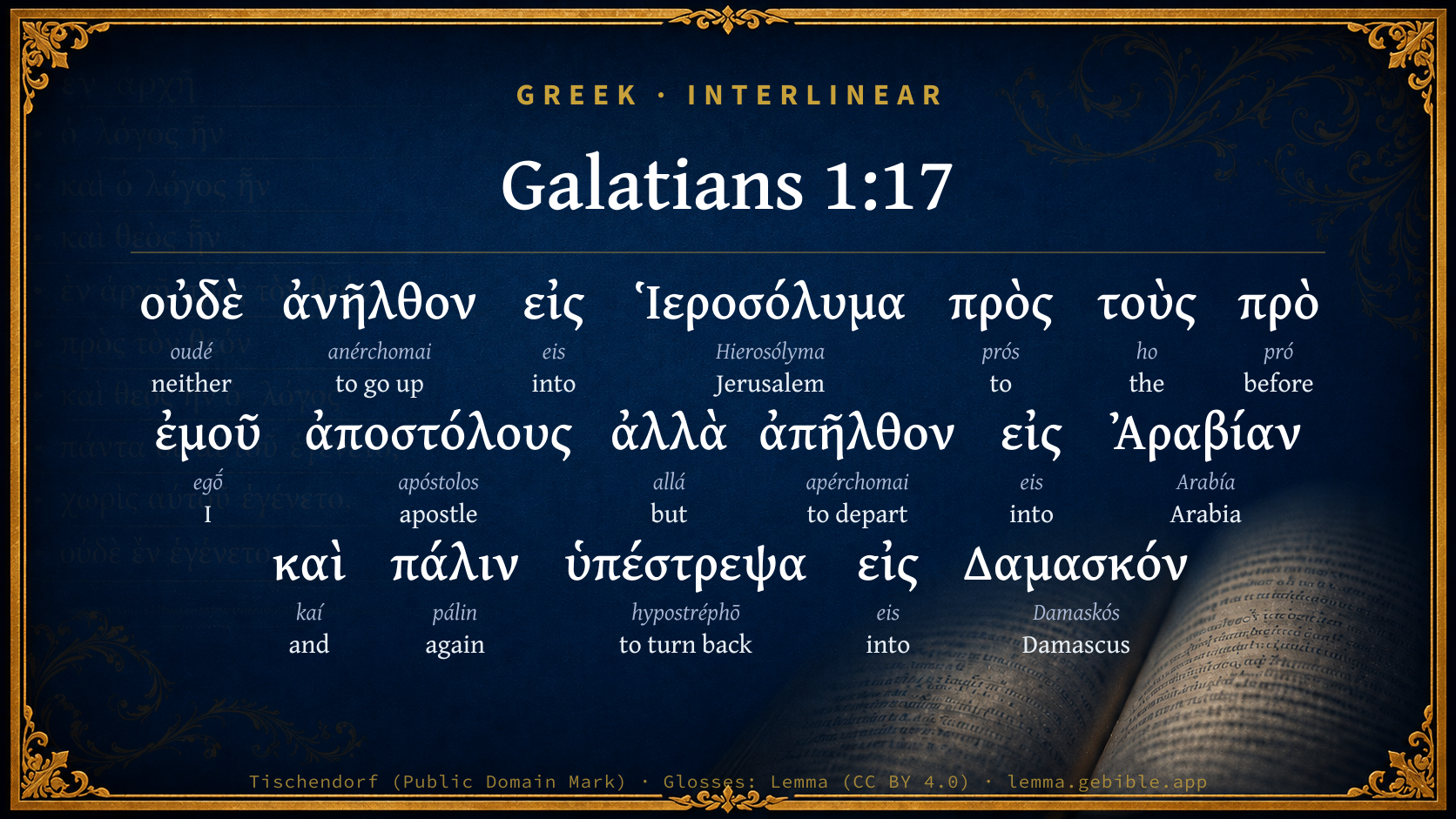
nor did I go up to Jerusalem to those who were apostles before me, but I went away into Arabia. Then I returned to Damascus.
World English Bible · Public Domain
Highlights
  • 1 first appearance in the Greek New Testament
Full analysis ↓
Download a study sheet

One document with this verse’s original text, its word-by-word gloss line, the meaning frame, cross-references with their text, attributed commentary, and full source and license credits — printable, and it pastes into notes with its structure intact.

This verse Autodidact and up

Study sheet (.html) Plain text (.txt)

A passage Seminary Student

Up to 50 verses in one chapter. A passage sheet keeps up to 6 commentary sources and 12 cross-references per verse, in the order this page ranks them, and says so on the sheet whenever that leaves anything out. Ask for a single verse and you get the Autodidact verse sheet above.

Everything on this page stays free to read, with no account — the sheet is a download of what is already on screen, not access to it.

Want to remove ads? Support Godless Engineer
Compare translations 3

The same verse in 3 English versions, stacked beneath the original-language interlinear above. Click any original word for its lexicon entry.

Each is an independent rendering of the whole verse — the interlinear is not word-aligned to these translations.

Highlighted words mark where these versions differ — a whole-verse word diff, not a word-by-word alignment.

  • World English Bible Public Domain
    nor did I go up to Jerusalem to those who were apostles before me, but I went away into Arabia. Then I returned to Damascus.
  • King James Version Public Domain
    Neither went I up to Jerusalem to them which were apostles before me; but I went into Arabia, and returned again unto Damascus.
  • unfoldingWord Literal Text CC BY-SA 4.0
    nor did I go up to Jerusalem to the ones apostles before me. Instead, I went to Arabia and again returned to Damascus.

unfoldingWord Literal Text — © unfoldingWord, licensed CC BY-SA 4.0. Word-aligned USFM3 via Door43 (git.door43.org/unfoldingWord/en_ult).

Versions to compare (up to 4)

3 of 4 selected

Show all 19 translations

Every available English version of this verse, each an independent rendering of the whole verse.

  • World English Bible Public Domain
    nor did I go up to Jerusalem to those who were apostles before me, but I went away into Arabia. Then I returned to Damascus.
  • Berean Standard Bible Public Domain
    nor did I go up to Jerusalem to the apostles who came before me, but I went into Arabia and later returned to Damascus.
  • Majority Standard Bible Public Domain
    nor did I go up to Jerusalem to the apostles who came before me, but I went into Arabia and later returned to Damascus.
  • King James Version Public Domain
    Neither went I up to Jerusalem to them which were apostles before me; but I went into Arabia, and returned again unto Damascus.
  • American Standard Version (1901) Public Domain
    neither went I up to Jerusalem to them that were apostles before me: but I went away into Arabia; and again I returned unto Damascus.
  • Revised Version (1885) Public Domain
    neither went I up to Jerusalem to them which were apostles before me: but I went away into Arabia; and again I returned unto Damascus.
  • Geneva Bible (1599) Public Domain
    Neither came I againe to Hierusalem to them which were Apostles before me, but I went into Arabia, and turned againe vnto Damascus.
  • Douay-Rheims (1899) Public Domain
    Neither went I to Jerusalem, to the apostles who were before me: but I went into Arabia, and again I returned to Damascus.
  • Young's Literal Translation Public Domain
    nor did I go up to Jerusalem unto those who were apostles before me, but I went away to Arabia, and again returned to Damascus,
  • Literal Standard Version CC BY-SA 4.0
    nor did I go up to Jerusalem to those who were apostles before me, but I went away to Arabia, and again returned to Damascus;
  • Unlocked Literal Bible CC BY-SA 4.0
    I did not go up to Jerusalem to those who had become apostles before me. Instead, I went to Arabia and then returned to Damascus.
  • unfoldingWord Literal Text CC BY-SA 4.0
    nor did I go up to Jerusalem to the ones apostles before me. Instead, I went to Arabia and again returned to Damascus.
  • Darby Bible Public Domain
    nor went I up to Jerusalem to those [who were] apostles before me; but I went to Arabia, and again returned to Damascus.
  • World Messianic Bible Public Domain
    nor did I go up to Jerusalem to those who were emissaries before me, but I went away into Arabia. Then I returned to Damascus.
  • Webster's Bible Public Domain
    Neither did I go to Jerusalem to them who were apostles before me: but I went into Arabia, and returned again to Damascus.
  • Free Bible Version CC BY-SA 4.0
    I didn't go to Jerusalem to talk to those who preceded me as apostles; instead I left for Arabia, and then later returned to Damascus.
  • Bible in Basic English Public Domain
    And I went not up to Jerusalem to those who were Apostles before me; but I went away into Arabia, and again I came back to Damascus.
  • Text-Critical English NT CC BY 4.0
    nor did I go up to Jerusalem to those who were apostles before me, but I went away to Arabia and returned again to Damascus.
  • Tyndale New Testament (1534) Public Domain
    nether returned to Ierusalem to them which were Apostles before me: but wet my wayes into Arabia and came agayne vnto Damasco.

Literal Standard Version (2020), Covenant Press — licensed CC BY-SA 4.0. Text via the HelloAO Bible API (eBible.org). Unlocked Literal Bible (unfoldingWord) — licensed CC BY-SA 4.0. Text via the HelloAO Bible API (eBible.org). unfoldingWord Literal Text — © unfoldingWord, licensed CC BY-SA 4.0. Word-aligned USFM3 via Door43 (git.door43.org/unfoldingWord/en_ult). Free Bible Version, Dr. Jonathan Gallagher — licensed CC BY-SA 4.0. Text via the HelloAO Bible API (eBible.org).

Word by word

More ways to search: Search by grammar → Find every occurrence → Compare this word →

Practice this passage: Drill this verse → Learn its vocabulary →

Ἀραβίαν
Arabía
G688
“Arabia”
Noun, Accusative, Singular, Feminine
Part of Speech
Noun
Case
Accusative
Number
Singular
Gender
Feminine
Full Thayer's Definition

Origin: of hebrew origin H6152

TDNT: None

Arabia = "desert or barren" 1. a well known peninsula of Asia lying towards Africa, and bounded by Egypt, Palestine, Syria, Mesopotamia, Babylonia, the Gulf of Arabia, the Persian Gulf, the Red Sea and the Indian Ocean
  1. οὐδὲ oudé G3761 “neither” Conjunction, Negative
  2. ἀνῆλθον anérchomai G424 “to go up” Verb, Aorist, Active, Indicative, 1st person, Singular
  3. εἰς eis G1519 “into” Preposition
  4. Ἱεροσόλυμα Hierosólyma G2414 “Jerusalem” Noun, Accusative, Singular, Feminine
  5. πρὸς prós G4314 “to” Preposition
  6. τοὺς ho G3588 “the” Article, Accusative, Plural, Masculine
  7. πρὸ pró G4253 “before” Preposition
  8. ἐμοῦ egṓ G1473 “I” Personal pronoun, 1st person, Genitive, Singular
  9. ἀποστόλους apóstolos G652 “apostle” Noun, Accusative, Plural, Masculine
  10. ἀλλὰ allá G235 “but” Conjunction
  11. ἀπῆλθον apérchomai G565 “to depart” Verb, Aorist, Active, Indicative, 1st person, Singular
  12. εἰς eis G1519 “into” Preposition
  13. καὶ kaí G2532 “and” Conjunction
  14. πάλιν pálin G3825 “again” Adverb
  15. ὑπέστρεψα hypostréphō G5290 “to turn back” Verb, Aorist, Active, Indicative, 1st person, Singular
  16. εἰς eis G1519 “into” Preposition
  17. Δαμασκόν Damaskós G1154 “Damascus” Noun, Accusative, Singular, Feminine

About this verse

These counts appear in no published source. They are computed here, from the morphology-tagged text and Lemma’s own curated glosses. What Lemma adds →

18
words
16
distinct lemmas
Pauline Epistles
section

Notable vocabulary

The rarest word here is Ἀραβίαν Arabia G688 — appearing just 2 times in the whole Greek New Testament.

First appearance in Scripture

This word makes its first canonical appearance in the Greek New Testament here:

  • Ἀραβίαν Arabia G688

Shared distinctive vocabulary

Ἀραβίαν Arabia G688 occurs in 2 verses of the Greek New Testament. Also found in:

Repetition

A word recurs within this verse:

Cross-references

3

Topical passages linked to Galatians 1:17 in the Treasury of Scripture Knowledge — connected by theme and wording, ordered by reader-vote popularity; previews shown in the World English Bible.

  • Acts 9:20–25 Immediately in the synagogues he proclaimed the Christ, that he is the Son of God.
  • 2 Corinthians 11:32–33 In Damascus the governor under Aretas the king guarded the city of the Damascenes desiring to arrest me.
  • Galatians 1:18 Then after three years I went up to Jerusalem to visit Peter, and stayed with him fifteen days.

Cross-references courtesy of OpenBible.info (CC BY 4.0).

Commentary

Notes on Galatians 1:17 from classic Christian and Jewish commentators (each source and its license shown beneath its notes). The classic Christian expositions comment on the surrounding passage and are grouped to its opening verse, so a note may address several verses; the Jewish commentaries on the Tanakh (Rashi and others) are per-verse, so they appear only where the commentator wrote on this verse.

Lemma curates 59 commentaries, every one of them public domain or Creative Commons licensed, each selected and text-cleaned for this edition rather than reprinted as found. About our sources →

The Cambridge Bible for Schools and Colleges

gen. ed. J. J. S. Perowne

17. neither went I up to Jerusalem] The situation of Jerusalem was on a hill, and it was also the Jewish metropolis, the political centre formerly, and still the religious centre of the nation. “Thither the tribes went up, the tribes of Jehovah,” Psa_122:4. We speak of ‘going up’ to London.

to them which were apostles before me] He admits the fact of their priority in point of time, while repudiating the inference that they had any claim to greater authority than himself. In like manner the antiquity of the Roman Church is no argument for Papal supremacy, much less for Papal infallibility. For the thought, we may compare Rom_16:7, “My fellow-prisoners, who are of note among the Apostles, who also have been in Christ before me.”

into Arabia … Damascus] “A thick veil”, says Bp Lightfoot, “hangs over St Paul’s visit to Arabia.” It is not mentioned in the narrative in the Acts. The locality, the object, and the time of this visit are alike uncertain. A full discussion of them must be reserved for an Appendix (I. p. 83). In the interval between his conversion a.d. 37 and his visit to Jerusalem a.d. 40, St Paul would seem to have sought retirement in the desert of Sinai, and there by prayer and meditation and undistracted communion with God, to have equipped himself for the warfare which only terminated with his life. How much of the three years was thus spent, we are not told. At its expiration St Paul returned to Damascus, and when at length the Jews conspired to take away his life, he made his escape and fled to Jerusalem (Act_9:23-26). He refers to this incident, 2Co_11:32.

Damascus] One of the oldest cities in the world, first mentioned in the history of Abraham (Gen_14:15; Gen_15:2). It was conquered by David (2Sa_8:5-6), but subsequently recovered by the Syrians. After various vicissitudes it succumbed to the Assyrian arms. The city was destroyed, and the people carried away captives to Assyria (2Ki_16:9). It subsequently fell under the Macedonian and the Roman power, and in the time of St Paul it was included in the territory of Aretas, an Arabian prince (2Co_11:32) who was father-in-law of Herod Antipas, and who held his kingdom under the Romans. It is pleasantly situated at the foot of the Anti-Libanus range of mountains, distant 133 miles north of Jerusalem and 60 miles from the Mediterranean Sea, in a fertile district watered by the historic streams, Abana and Pharpar.

St Paul’s Visit to Arabia

It may be well to consider this incident under the three heads indicated in the note to ch. Gal_1:17. The notices are slight, and though insufficient to enable us to construct a narrative of the events with definiteness or with certainty, supply material for a probable and consistent account of them.

(1) The locality. The term Arabia has been taken by some commentators in its widest signification, as extending from the Sinaitic peninsula on the south to the neighbourhood of Damascus on the north; and expressions in Justin Martyr (Dial. c. Tryph. p. 305, A.) and Tertullian (Adv. Jud. c. 9; Adv. Marc. iii. 13) are adduced in support of this view. It is argued from the silence of St Luke (Act_9:19-25) that St Paul did not withdraw to any great distance from the city, so that though he actually went into Arabia for a time—how long, is not stated—he is regarded by the narrator as still at Damascus. The objections to this view are concisely stated by Bp Lightfoot. “It gives to ‘Arabia’ an extension, which at all events seems not to have been common, and which even the passage of Justin shews to have required some sort of justification. It separates the Arabia of the first chapters from the Arabia of the fourth. And lastly, it deprives this visit of a significance which, on a more probable hypothesis, it possesses in relation to this crisis of St Paul’s life.” By ‘Arabia’ then we understand (as in ch. Gal_4:25) the Sinaitic peninsula.

(2) The object. Of this two accounts are given. Patristic commentators suppose that St Paul went into Arabia, as the Apostle of the Gentiles, to commence his great missionary work. No doubt ‘Arabians’ were among those who were present at the great Pentecostal miracle (Act_2:11), and it may have been for the purpose of expounding unto them the way of God more perfectly that this journey was undertaken. But it is not likely that so marked a commencement of his labours as a missionary to the Gentiles would have been unrecorded by St Luke, especially as he is careful to tell us that St Paul “preached Christ in the synagogues”, and “how at Damascus he had preached boldly in the name of Jesus” (Act_9:20; Act_9:27).

If however we adopt the other explanation, and regard the object of St Paul’s visit as of a private and personal nature—that he might in solitude commune with his own heart and listen to the “still small voice” of God—then we can understand why, like Elijah of old, he should have journeyed ‘unto Horeb, the mount of God’. There, on the very spot where the Law was given, he was taught the use of the Law—that “by the deeds of the Law no flesh shall be justified”; that while “the Law made nothing perfect”, there was brought in “a better hope”; that “though the Law worketh wrath”, “Christ hath redeemed us from the Curse of the Law, being made a Curse for us.”

(3) The time. We do not know at what period of the ‘three years’ the journey was made, nor how long St Paul’s sojourn in Arabia continued. St Luke’s language is somewhat vague, but not at all inconsistent with the view here adopted. It is possible that after essaying to preach to the Jews in Damascus ‘the faith which once he destroyed’, St Paul found it needful to seek fresh supplies of grace and strength for a work so difficult and so discouraging. He may have heard his Master’s call, bidding him ‘come apart into a desert place, and rest awhile’. His stay in Horeb may have lasted, like that of Moses, for forty days and forty nights—the period of time spent by Elijah in his journey from Beer-sheba to Horeb, and by the great Antitype in the wilderness. These are, it is true, only conjectures. But while they are not inconsistent with the narrative of the Acts, they are in full accord with what we know of the nature and the needs of man, and with the dealings of God with the objects of His love and the instruments of His purposes. We may long for certainty. But where Scripture is silent, we are sure that more accurate knowledge is not needed, because it is not vouchsafed.

The Cambridge Bible for Schools and Colleges (gen. ed. J. J. S. Perowne; Cambridge University Press, 1878–1918) — public domain. Text from a community e-Sword module.

The Biblical Illustrator

Joseph S. Exell

Gal_1:17

Neither went I up to Jerusalem to them which were apostles before me.

Aspects of the new life

I. Negative. He did not report himself.

1. The apostles were stiffly conservative, and

(1) might have suspected his conversion;

(2) would probably have questioned his Divine commission;

(3) would certainly have repudiated his apostleship.

2. Paul wanted nothing of them, and they could give him nothing.

3. He wished his life rather than his lips to speak. Let others see the reality of your conversion;they will then need no verbal proof of it.

II. Passive. In Arabia Paul--

1. Lived a life of quiet meditation.

2. Equipped himself for his great work.

3. Calmly waited for indications from God. After conversion

(1) dont rush into office, but

(2) think, read, pray, weigh the responsibility of Christian work, fit yourself by Divine grace, wait till God says, Go.

III. Active. To Damascus (see Act_9:22).

1. The hour had struck, and the man was ready for it.

(1) Paul now knew not only what to say, but how to say it and defend it.

(2) The seed sown at conversion had produced a body of experience.

2. Once at it he grew strong in the work.

3. He was rewarded with striking success.

IV. Suffering (Act_9:23-24).

1. Persecution tests depth of conviction and reality of work.

2. Look for it, but dont fear it.

V. Independence. Living movements do not come of committees, they come of individuals. (J. H. Newman, D. D.)

Quiet places

Just as an eagle, which has been drenched and battered by some fierce storm, will alight to plume its ruffled wings, so, when a great soul has passed through fire and through water, it needs some safe and quiet place in which to rest … Like almost every great soul in ancient or modern times, to whom has been entrusted the task of swaying the destinies by moulding the convictions of mankind--like Sakya Mouni, like Mahomet in the cave of Hira, like St. Francis of Assisi in his sickness, like Luther in the monastery of Erfurt, Paul would need a quiet period in which to elevate his thoughts, to still the tumult of his emotions, to commune in secrecy and in silence with his own soul. (F. W. Farrar.)

The significance of this episode for us

In the busy mart, amid lifes dusky lanes and accumulating cares, we lose and forget our God. Our books are too much with us; friends and social life make the hours busy with what is human; and the claims of business are of increasing urgency. We must find for ourselves a desert place, where, occasionally for prolonged seasons, and daily for a short season, we may receive the Lords anointing. (S. Pearson, M. A.)

Meditation is the life of the soul; action is the outcome of meditation, honour is the reward of action. So meditate that thou mayest do; so do that thou mayest be honoured; so accept honour as to give God the glory.

The inner life of St. Paul

The world and the Church have ever shown a curiosity as to the inner life of great men, as to what they were, not when the eye of man was upon them, but when they were alone--what they were in the secret recesses of their hearts; and this curiosity has made biographies and autobiographies, and private journals and letters, very popular. It has led, moreover, to the publication of documents which were never meant for the public eye, and which had better have remained unperused. But God has seen fit in the ease of St. Paul to gratify, not indeed a mere morbid curiosity, but the devout desire on the part of His Church to know something of the great apostles secret feelings and sternest conflicts for its own edification and for His own glory. (Canon Miller.)

St. Pauls solitude

His main object we may assume to have been to seclude himself for a while from the outer world, to commune with God and his own soul in stillness, and to seek for grace for his future labours. It was a pause in his career, which he might legitimately crave after; a moment of calm between the stormy passions of his past life, and the tumultuous scenes which lay before him; a half-hour of heavenly silence in which, alone with God, he might learn more perfectly his Masters will, and gather strength to do his Masters work. We may follow the apostle into Arabia, and safely infer that his retirement was made use of for the following purposes.

1. Thought. On reviewing his past life--his former antagonism to Christ, his ignorance and self-will, his unbelief and active enmity; and the forbearance, love, and mercy of God--what food for reflection had St. Paul! Thought concerning God, the gospel of Christ, the soul, sin, death, salvation, life, heaven, is essential to salvation; there can be no real, intelligent living unto God without it.

2. Selfabasement. Bitter mourning for sin. The manifestation of Gods love deepens the sense of ingratitude and unworthiness in the truly penitent.

3. Prayer. He who is most fully conscious of his own utter helplessness, will cling with tightest grasp to the only Giver of all good.

4. Self-dedication. The life given to God. (Emilius Bayley, B. D.)

St. Pauls sojourn in Arabia

1. Obscurity of the incident. A veil of thick darkness hangs over St. Pauls visit to Arabia. Of the scenes among which he moved, of the thoughts and occupations which engaged him while there, of all the circumstances of a crisis which must have shaped the whole tenour of his after life, absolutely nothing is known. Immediately, says St. Paul, I went away into Arabia. The historian passes over the incident without a mention. It is a mysterious pause, a moment of suspense in the apostles history, a breathless calm which ushers in the tumultuous storm of his active missionary life.

2. The place. If we suppose that the apostle at this critical moment betook himself to the Sinaitic peninsula, the scene of the giving of the law, then his visit to Arabia becomes full of meaning. He was attracted thither by a spirit akin to that which formerly had driven Elijah to the same region (1Ki_19:8-18). Standing on the threshold of the new covenant, he was anxious to look upon the birth-place of the old: that dwelling for a while in seclusion in the presence of the mount that burned with fire, he might ponder over the transient glories of the ministration of death, and apprehend its real purpose in relation to the more glorious covenant which was now to supplant it. Here, surrounded by the children of the desert, the descendants of Hagar the bondwoman, he read the true meaning and power of the law. In the rugged and barren region whence it issued, he saw a fit type of that bleak desolation, which it created, and was intended to create, in the soul of man. In the midst of such scenes and associations, his spirit was attuned to harmony with his Divine mission, and fitted to receive fresh visions and revelations.

3. Its duration. What was the length of this sojourn we can only conjecture. The interval between his conversion and his first visit to Jerusalem, St. Paul here states to have been three years. The notices of time in the narrative of the Acts are vague, but not contradictory to this statement. From Damascus, St. Paul tells us, he went away into Arabia, whence he returned to Damascus. St. Luke represents him as preaching actively in this city after his conversion, not mentioning, and apparently not aware of any interruption, though his narrative is not inconsistent with such. It seems probable, then, that St. Pauls visit to Arabia took place early in this period, before he commenced his active labours. Immediately, he says, instead of conferring with flesh and blood, I went into Arabia. The silence of the historian is best accounted for on the supposition that the sojourn there was short; but as St. Lukes companionship with the apostle commenced at a much later date, no great stress must be laid on the omission. Yet, on the other hand, there is no reason for supposing it of long duration. It was probably brief--brief enough not to occupy any considerable space in the apostles history, and yet not too brief to serve the purpose it was intended to serve.

4. Its purpose. Can we doubt that by this journey he sought seclusion from the outer world, that his desire was to commune with God and his own soul amid these hallowed scenes, and thus to gather strength in solitude for his active labours? His own language implies this--I conferred not with flesh and blood, but departed into Arabia. The fathers for the most part take a different view of this incident. They imagine the apostle hurrying forth into the wilds of Arabia, burning to impart to others the glad tidings which had so suddenly burst upon himself. See how fervent was his soul, exclaims Chrysostom; he was eager to occupy lands yet untilled; he forthwith attacked a barbarous and savage people, choosing a life of conflict and much toil. This comment strikes a false note. Far different at such a crisis must have been the spirit of him, whose life henceforth was at least as conspicuous for patient wisdom and large sympathies as for intense self-devotion. He retired for a while, we may suppose, that, separate from the world, his heart might deeply take, and strongly keep, the print of heaven. And what place more fit for this retirement than that holy ground, where all around, On mountains, sand, and sky, Gods chariot wheels have left distinctest trace. (Bishop Lightfoot.)

St Pauls seclusion

After a great change of conviction, nature, as well as something higher than nature, tells us that a long period of retirement and silence is fitting, if not necessary. The three days in the house of Judas were not enough in which to sound the heights and depths of newly recognized truth, or the strength and weakness of the soul which was to own and to proclaim it. They were to be followed by three years passed in the desert of Arabia. It is, indeed, thought that this retirement was dictated by a wish to preach the gospel to the wandering Bedouin tribes, or to the settled Arabs at Petrea. And there is no doubt that Arabia among the ancients was a very wide and inclusive geographical term. It might have included Damascus itself; it might have even taken in regions far to the north, extending to the very borders of Cilicia. But these are less usual uses of the word; nor can it be supposed that emphasis would have been laid on this retirement if all that had been meant was a journey of a few miles into the desert beyond the walls of Damascus. Something may be said for a retreat to Petra, the ancient capital of Edom, which had its own synagogue in Jerusalem; but the probabilities are that, under the profound and awful inspirations of the hour, Paul sought to tread in the very footsteps of Moses and Elijah at the base of Sinai. The spiritual attractions of such a course must have been, to a man of his character and antecedents, not less than overwhelming. There, where the Jewish law had been given, he wag led to ask what it really meant--what were its sanctions, what its obligations, what the limit of its moral capacity, what the criterion of its weakness. There he must have felt the inspiration of a life like Elijahs, the great representative of a persecuted religious minority, the preacher of an unpopular truth against vulgar but intolerant error. Would not the still small voice which had there spoken to the prophet--or rather, did it not--again and again speak to him? They were precious years, depend upon it, for a man whose later life was to be passed, wholly passed, in action. (Canon Liddon.)

Value of seclusion

The value of such retirement, if circumstances admit of it or suggest it, before entering on the decisive work of life, can hardly be exaggerated. Many a young man, whose education is complete (as the phrase goes), and who knows, or thinks that he knows, what to do for himself or his fellow-creatures, is often painfully disappointed when his plans for immediate action suddenly break down, and he has to remain for a while in comparative obscurity and inaction. It seems to him to be a loss of time, with little or nothing to redeem the disadvantage. He is wasting, he thinks, his best years in idleness. He may, of course, so act as to make that phrase justifiable. It need not be so. A prudent, no less than a religious man, will thankfully, if he can, avail himself of such an opportunity for consolidating his acquirements, for reviewing the bearing of his governing convictions, for estimating more accurately the resources at his disposal for extending or contracting his plans, at least for reconsidering them. A religious man will, above all, seize such an opportunity for testing and strengthening his motives, and for cultivating an increased intimacy with those means and sources of effective strength which he will need so much hereafter. (Canon Liddon.)

Observe--

I. God sometimes raises up and qualifies His agents without human intervention.

II. Such agents are duly qualified and may be tested by their fruits.

III. As a rule, they have assigned them some new department of labour. (J. Lyth.)

Residence in Arabia

The point thus suggested is the interval between the choice of a profession or calling in life and the entrance on the public duties of that profession or calling.

I. The first point relates to the professions or callings which may be properly regarded as presenting themselves to one who is about to embark on life.

1. The first thing which strikes us on this point is the great variety of things to be done in the world, during any one generation; or the variety of the fields for exertion and employment.

2. The next point, under this head, relates to the variety of endowments among men, as adapted to these various occupations--endowments such that these various ends are in fact secured, and such that at the same time they are secured voluntarily, or so that men enter on their different pursuits not by force or compulsion, but of preference and choice.

3. A third remark under this head; the ends of life may be secured, the purposes of society advanced, and God may be honoured, in any one of these occupations and employments.

II. In the next place, we have to inquire on what principles should such a profession or calling be chosen?

1. The first is, that the profession or calling should be selected in which the most can be made of life for its proper purposes; or, in which life can be turned to the best account. Life, though transitory, short, uncertain, has its purpose.

2. The second principle which I mention is, that, consequently, when there is a fitness for either of two or more courses of life, that should be chosen which under the circumstances will be most adapted to secure the ends of life.

3. A third rule would be that the profession or calling should be chosen which will be best adapted to develop the peculiar endowments of the mind, or which will be in the line of those endowments.

4. A fourth thing which is vital to any just views of life, to a proper choice of a profession, is, that that only should be chosen which is just and honourable; which is itself right, and is consistent with the highest standard of morality; and which can be pursued in all its ramifications, and always, and in all respects, on the principles of honesty, truth, justice, and fairness.

5. A fifth principle is that that course should be chosen in which there are the fewest temptations to evil.

6. A sixth principle is, that a young man should choose that which while it will conduce to his own individual interest and to the purpose of his life, will, at the same time, promote the general good of society, and contribute to the advancement of the race.

7. A seventh principle may be added. It is, that that calling should be selected which will not interfere with, but which will best aid the preparation for another world.

III. These remarks and suggestions will enable us, in the third place, to answer the main inquiry with which we started--in what way shall the interval between the choosing of a profession and the entrance on its active duties be employed?

1. The first is, that time enough should be taken to prepare for the profession or calling which has been selected.

2. Secondly, the studies should obviously have reference to the future calling.

3. One thought only remains: It is, that the preparation for that profession should be--as the choice of the profession, and the profession itself should be--subordinate to the life to come--to the preparation for eternity. (A. Barnes.)

The Biblical Illustrator, edited by Joseph S. Exell (c. 1880s–1900s) — public domain. Text from a community e-Sword module.

Tyndale Open Study Notes

Tyndale Open Resources

1:17 those who were apostles before I was: Paul put his own apostleship in the same category as the original disciples (see 1 Cor 9:1; 15:5-9; cp. Acts 1:22; 10:41). • Paul’s trip to Arabia is not mentioned elsewhere; his understanding of the Good News was apparently formed during that time. Paul knew the Scriptures (see Acts 22:3), the claims of the first Christians (see Acts 8:1), and what others had told him since his conversion.

Tyndale Open Study Notes — © Tyndale Open Resources, licensed CC BY-SA 4.0. Text via the HelloAO Bible API.

Bengel's Gnomon

Johann Albrecht Bengel

Gal 1:17. Οὐδὲ ἀνῆλθον) Neither went I up; so ἀνῆλθε, Joh 6:3.—Ἱεροσόλυμα, to Jerusalem) the seat of the apostles.—Ἀραβίαν, Arabia) a country of the Gentiles.—πάλιν ὑπέστρεψα, again I returned) Paul here takes for granted that his journey to Damascus, on which he had been converted, was previously known.—Δαμασκὸν, Damascus) of Syria. There is no other Damascus than that of Syria, but I have added the mention of Syria, because he had been formerly speaking of Arabia, etc.

Bengel's Gnomon of the New Testament — English translation (T&T Clark, Edinburgh, 1860) — public domain. Text from a community e-Sword module.

Meyer's Critical & Exegetical Commentary

Heinrich August Wilhelm Meyer

Gal_1:17. Neither went I away (from Damascus) to Jerusalem, unto those who were apostles before me; but I went away into Arabia. So according to Lachmanns reading; see the critical notes. Τοὺς πρὸ ἐμοῦ ἀποστ. is written by Paul in the consciousness of his full equality of apostolic rank (beginning from Damascus), in which nothing but greater seniority pertained to the older apostles. On the twice-employed emphatic ἀπῆλθον, comp. Rom_8:15; Heb_12:18 ff.; Fritzsche, ad Rom. II. p. 137.

εἰς Ἀραβίαν] It is possible that some special personal reason, unknown to us, induced him to choose this particular country. The region was heathen, containing, however, many Jews of the Diaspora (Act_2:11). This journey, which is to be looked upon not as having for its object a quiet preparation (Schrader, Köhler, Rückert, Schott), but (comp. Rom. Introd. § 1) as a first, certainly fervent experiment of extraneous ministry,[34] and which was of short duration,[35] is not mentioned in Acts. Perhaps not known to Luke at all, it is most probably to be placed in the period of the ἱκαναὶ ἡμέραι, Act_9:23,an inexact statement of the interval between the conversion and the journey to Jerusalem, which betrays, on the part of Luke, only a vague and inadequate knowledge of the chronology of this period. See on Act_9:19 ff. Paul mentions the journey here, because he had to showfollowing the continuous thread of the historythat, in the first period after his conversion, he had not been anywhere where he could have received instruction from the apostles.

ΠΆΛΙΝ ὙΠΈΣΤΡΕΨΑ] ΠΆΛΙΝ, used on the hypothesis that the locality of the calling and revelation mentioned was well known to his readers, refers to the notion of coming conveyed in ὑπέστρ. Comp. Act_18:21; Hom. Od. viii. 301, αὖτις ὑποστρέψας, et al.; Eur. Alc. 1022; Bornemann, ad Cyrop. iii. 3. 60; Kühner, ad Xen. Mem. ii. 2. 4.

[34] Our passage bears testimony in favour of this view by εὐθέως … ἀπῆλθον following immediately on ἵνα εὐαγγ. αὐτὸν ἐν τοῖς ἔθνεσιν. Hence Holstens view (die Bedeutung des Wortes σάρξ im N.T. p. 25; ueber Inh. u. Gedankeng. d. Gal. Br. p. 17 f.; also zum Evang. d. Paul. u. Petr. p. 269 f.), that Paul, purposely tearing himself away for three years from the atmosphere of the national spirit at Jerusalem, had gone to Arabia, in order to reconcile the new revelation with the old by meditating on the religious records of his people, is quite opposed to the context. Certainly the system of the apostles gospel, as it is exhibited in the Epistles to the Galatians and Romans, must have taken its shape gradually, and by means of a long process of thought amidst the widening of experience; but even in the absence of such a developed system he might make a commencement of his ministry, and might preach the Son of God as the latter had been directly revealed in him by divine agency. Thiersch arbitrarily considers (Kirche in apostol. Zeitalt. p. 116) that he desired to find protection with Aretas. It is the view also of Acts, that Paul immediately after his conversion followed the divine guidance, and did not postpone his beginning to preach till the expiration of three years. According to Acts, he preached immediately, even in Damascus, Act_9:20; comp. Act_26:19 f. See, besides, on Rom. Introd. § 1.

[35] L. Cappellus, Benson, Witsius, Eichhorn, Hemsen, and others, also Anger, Rat. temp. p. 122, and Laurent, hold the opinion that Paul spent almost the whole three years (ver. 18) in Arabia, because the Jews at Damascus would not have tolerated his remaining there so long. But in our ignorance of the precise state of things in Damascus, this argument is of too uncertain a character, especially as Act_9:22, comp. with ver. 23, ὡς δὲ ἐπληρ. ἡμέραι ἱκαναί, points to a relatively longer working in Damascus. And if Paul had laboured almost three years, or, according to Ewald, about two years, in Arabia, and that at the very beginning of his apostleship, we could hardly imagine that Luke should not have known of this ministry in Arabia, or, if he knew of it, that he should not have mentioned it, for Paul never stayed so long anywhere else, except perhaps at Ephesus. It may indeed be alleged that Luke purposely kept silence as to the journey to Arabia, because it would have proved the independent action of the apostle to the Gentiles (Hilgenfeld, Zeller); but this view sets out from the premiss that the book of Acts is a partisan treatise, wanting in historical honesty; and it moreover assumeswhat without that premiss is not to be assumedthat the author was acquainted with our epistle. If he was acquainted with it, the intentional distortion of portions of his history, which it is alleged he allowed himself to make, would be the more shameless, and indeed foolish.

Meyer — Critical and Exegetical Commentary on the New Testament — English translation by Peter Christie, edited by Frederick Crombie (T&T Clark, 1880) — public domain. Text from a community e-Sword module.

Expositor's Greek Testament

ed. W. Robertson Nicoll

Gal 1:17 . ἀνῆλθον . The religious position of Jerusalem as seat of the Temple and mother-city of the Church, its political importance, and its geographical position on the central heights of Palestine, combined to suggest the application of the terms up and down to journeys to and from Jerusalem. ἀποστόλους . In the third Gospel and early chapters of the Acts this title is habitually applied to the Twelve. It was extended to Paul and Barnabas on the occasion of their mission. In 1Co 9:2 Paul and Barnabas are distinctly enumerated amidst the recognised Apostles. Rom 16:7 suggests a further extension of the title, probably to all founders of churches. But with the possible exception of James, no addition is recorded to the number of the Twelve at Jerusalem after Matthias. Ἀραβίαν . No mention is made elsewhere of this journey; its object is clearly indicated by the context; for it is placed in strong contrast with human intercourse, and was, therefore, undertaken for the sake of solitary communion with God. The Arabian deserts were within easy reach of Damascus. Lightfoot suggests, indeed, that Paul perhaps repaired to Mount Sinai; but if the Apostle had been granted communion with God on Mount Sinai, the name would have constituted too effective an argument in favour of his Divine commission to be suppressed here. The Sinaitic peninsula was, in fact, remote from Damascus; the journey was at all times dangerous for travellers without escort, and in the year 37 (the most probable date of Saul’s conversion) was hardly possible on account of war between King Aretas and the Romans.

The Expositor's Greek Testament, edited by W. Robertson Nicoll (1897–1910) — public domain. Text from a community e-Sword module.

Cambridge Greek Testament for Schools and Colleges

17. οὐδὲ, “nor even.” For if I did not choose to consult others it might have seemed reasonable that I should confer with the Twelve.

ἀνῆλθον, Gal 1:18; Joh 6:3[56]. Cf. ἀναβαίνω Gal 2:1-2 and often in Gospels and Acts. ἀνά. See Gal 2:1, note.

[56] Is affixed to a word it means that all the passages are mentioned where that word occurs in the New Testament.

εἰς Ἰεροσόλυμα. The Aramaic and Greek form; Gal 1:18, Gal 2:1 Paul[57]; while Ἰερουσαλήμ Gal 4:25-26 is the Hebrew form. On the occurrence of the two forms elsewhere see W.H. Appendix, p. 160.

[57] Is affixed to a word it means that all the passages are mentioned where that word occurs in the New Testament.

πρὸς τοὺς πρὸ ἐμοῦ ἀποστόλους. The priority of their apostleship formed the only reason why it was likely that he should go.

ἀλλὰ ἀπῆλθον. In the Pauline Epp. Rom 15:28[58]. I went quite away from Jerusalem and any other place where I was likely to meet with Christians. Not, of course, in order that he might preach to the heathen (in spite of the mention of this in Gal 1:16) but that he might be alone. This would not exclude some evangelistic activity if the opportunity presented itself, but it cannot have been the primary object of his withdrawing from Christian counsellors.

[58] Is affixed to a word it means that all the passages are mentioned where that word occurs in the New Testament.

εἰς Ἀραβίαν. Perhaps he wandered through various parts of the large kingdom of the Nabathaeans, extending at that time from Damascus to the Sinaitic peninsula. It is hardly probable that he went to Mt Sinai itself. See Appendix, Note A.

καὶ πάλιν ὑπέστρεψα εἰς Δαμασκόν. Why does he mention this fact? Because as he did go there it was the simplest way of calling attention to the fact that he did not go to Jerusalem even now. Observe that he has not stated that his conversion was near Damascus; the πάλιν is an undesigned coincidence with Act 9:3.

NOTE A

Arabia in Gal 1:17 and Gal 4:25

THE terms Arabia and Arabians, as used during the first century A.D., referred not only to the peninsula proper including the Sinaitic peninsula (Gal 4:25), but also especially to the kingdom of the Nabathaeans. So Josephus expressly in Antt. I. 12. 4 § 221. He also speaks of Arabia being on the east of Peraea (B.J. III. 3. 3 [§ 47]), of its being visible from the Temple towers (B. J. v. 4. 3 [§ 160]), and of its limit in the country of Gamalitis (Antt. XVIII. 5. 1§ 113). The Nabathaeans, who presumably came from a more southern part, were settled in Petra B.C. 312 (if not even earlier, in the first half of the 5th cent. B.C. see Mal 1:3), and from that time came into frequent touch with the Seleucid, Egyptian, Jewish, and Roman rulers, holding their own with some ease, on account of the natural difficulties of their country. The limits of their kingdom changed, but in the first century A.D. extended as far north as the neighbourhood of Damascus. Damascus itself was under the suzerainty of Rome, but the cessation of Roman coinage there after 33–34 until 62 A.D. makes it probable that during those years it was in the hands of the Arabians, probably ceded to Aretas IV. by Caligula. Thus St Paul’s notice, 2Co 11:32, is so far confirmed. See further Schürer, English Translation, I. ii., pp. 345 sqq., C. H. Turner in Hastings, D.B. I. 416, and Nöldeke in Hastings-Selbie, D.B. s.v. Arabia.

It is then clear, if the language of Josephus is sufficient guide, that when St Paul speaks of spending two years in Arabia he may mean anywhere in the kingdom of the Nabathaeans, from near Damascus down to the Sinaitic peninsula. As he does not give any closer definition he probably wandered from place to place. He may even have gone as far south as Mt Sinai, but we know too little of the possibilities of travelling at that time in Petra and the districts bordering upon it to be able to say that he could do so. It may be doubted whether the sentimental reason of visiting the scene of the giving of the Law would have appealed to him just after his conversion. The case of Elijah was wholly different: to him the revelation to Moses was the highest conceivable; not so to St Paul.

Cambridge Greek Testament for Schools and Colleges (Cambridge University Press, 1896; 21 vols, various authors incl. Carr, Maclear, Plummer, Farrar, Lumby, Moule, M. R. James, Simcox) — public domain. Text from a community e-Sword module.

Jamieson, Fausset & Brown

Robert Jamieson, A. R. Fausset & David Brown

went I up--Some of the oldest manuscripts read, "went away."

to Jerusalem--the seat of the apostles.

into Arabia--This journey (not recorded in Acts) was during the whole period of his stay at Damascus, called by Luke (Act 9:23), "many [Greek, a considerable number of] days." It is curiously confirmatory of the legitimacy of taking "many days" to stand for "three years," that the same phrase exactly occurs in the same sense in Kg1 2:38-39. This was a country of the Gentiles; here doubtless he preached as he did before and after (Act 9:20, Act 9:22) at Damascus: thus he shows the independence of his apostolic commission. He also here had that comparative retirement needed, after the first fervor of his conversion, to prepare him for the great work before him. Compare Moses (Act 7:29-30). His familiarity with the scene of the giving of the law, and the meditations and revelations which he had there, appear in Gal 4:24-25; Heb 12:18. See on Gal 1:12. The Lord from heaven communed with him, as He on earth in the days of His flesh communed with the other apostles.

returned--Greek "returned back again."

Jamieson, Fausset & Brown — Commentary Critical and Explanatory on the Whole Bible (1871) — public domain (CC PDM 1.0). Text via the HelloAO Bible API.

Adam Clarke's Commentary

Verse 17. Neither went I up to Jerusalem] The aim of the apostle is to show that he had his call so immediately and pointedly from God himself, that he had no need of the concurrence even of the apostles, being appointed by the same authority, and fitted to the work by the same grace and Spirit, as they were.

But I went into Arabia.] That part of Arabia which was contiguous to Damascus, over which Aretas was then king. Of this journey into Arabia we have no other account. As St. Luke was not then with him, it is not inserted in the Acts of the Apostles. See introduction to this epistle. Jerusalem was the stated residence of the apostles; and, when all the other believers were scattered throughout the regions of Judea and Samaria, we find the apostles still remaining, unmolested, at Jerusalem! Ac 8:1.

Adam Clarke's Commentary on the Bible (1810–1826) — public domain. Text from a community e-Sword/MySword module.

John Calvin's Commentaries

17. Neither did I return to Jerusalem. What he had just written is now explained, and more fully stated. As if he had said, “I did not ask the authority of any man,” not even of the apostles themselves. It is a mistake to suppose, that, because the apostles are now separately mentioned, they are not included in the words, flesh and blood. Nothing new or different is here added, but merely a clearer explanation of what had been already said. And no disrespect to the apostles is implied in that expression. For the purpose of shewing that he did not owe his commission to man, the false boasting of unprincipled men laid him under the necessity of contrasting. the authority of the apostles themselves with the authority of God. When a creature is brought into comparison with God, however contemptuous or humiliating may be the language employed, he has no reason to complain.

But I went into Arabia. In the Acts of the Apostles, Luke has omitted these three years. In like manner, there are other passages of the history which he does not touch; and hence the slander of those who seek to build on this a charge of inconsistency in the narratives is ridiculous. Let godly readers consider the severe temptation with which Paul was called to struggle at the very commencement of his course. He who but yesterday, for the sake of doing him honor, had been sent to Damascus with a magnificent retinue, is now compelled to wander as an exile in a foreign land: but he does not lose his courage.

John Calvin's Commentaries (1540-1563) — public domain. Text from the Calvin Translation Society English edition (1840s-50s) via the Christian Classics Ethereal Library (ccel.org). Calvin's coverage is partial (roughly two-thirds of the Bible); uncommented books and verses are honest gaps, never fabricated. The 19th-century editor's footnotes and remarks are omitted so the notes are faithfully Calvin's own voice.

Ellicott's Commentary for English Readers

(17) Went I up.—The usual phrase is to go up to “Jerusalem,” from the fact that Jerusalem stood upon high ground, and was approached from all sides by an ascent. Here, however, the reading is doubtful between “went up” and “went away,” each of which is supported by nearly equally good authority. In so close a balance of the authorities the less common phrase is, perhaps, more likely to have been the original reading, though there is an almost equal probability that it may have slipped in from the second “went” (really the same word, “went away”), a little further on in the verse.

Unto Arabia.—The question, what part of Arabia St. Paul retired into can only be one of speculation. There is nothing in the context to show at all decisively. The boundary of Arabia at this period was not exactly defined. By some writers it was made to include Damascus itself. It is therefore possible that by “Arabia” may have been meant the desert in the neighbourhood of the city. This would be the most obvious supposition. But, on the other hand, there would be a certain appropriateness if we could imagine, as we are certainly permitted to do, that the scene of his sojourn may have been the region of Mount Sinai itself. The place where the Law was first given may have seen its renewal in his mind—not destroyed, but fulfilled in the new law of love. Like Moses, and like Elijah, the great minister of the new dispensation may have here received strength for his work. And if this was the case, we can the more readily understand the typical allusion to Mount Sinai later in the Epistle. Such arguments may have some slight weight, but the real locality must remain uncertain.

As to the time of the Apostle’s withdrawal, and its duration, little can be said beyond the fact that it must have come within the three years that intervened between his conversion and the first visit to Jerusalem. When we compare this account with the narrative of the Acts, it is not clear how they are to be reconciled. St. Paul says, that after his conversion, “immediately (eutheôs) he conferred not with flesh and blood . . . but went unto Arabia.” St. Luke says, after recording the same event, “Then was Saul certain days with the disciples which were at Damascus. And straightway (eutheos) he preached Christ (or, according to a more correct reading, Jesus) in the synagogues, that He is the Son of God” (Act_9:19-20). There does not seem room here to insert the retreat into Arabia. It would indeed come in more naturally among the “many days,” mentioned in a later verse, which were terminated by the plot of the Jews against the life of the Apostle and his final escape from Damascus. There would still, however, be some apparent collision between “conferring not with flesh and blood” and “spending certain days with the disciples” at Damascus. The discrepancy is only such as we might expect to find between two perfectly independent narratives, one of which was compiled from secondary sources, and is, besides, very brief and summary in its form. We are obliged, by the Apostle’s own words, to believe that his withdrawal into Arabia took place “immediately” after his conversion; and as it would not take a very long time to attract the attention or excite the animosity of the Jews at Damascus, it seems natural to suppose that this period of silent seclusion occupied the larger half of the whole period of three years.

The patristic commentators seem to have held, for the most part, to the belief that the object of his visit to Arabia was to preach to the heathen there; but the whole context of the Epistle shows that it was rather for solitary meditation and communion with God.

Damascus.—We gather from 2Co_11:32 that Damascus was at this time in the possession, or in some manner, at least, under the rule, of Aretas, the Arabian king. How this can have been is an obscure and difficult question. (See Note on that passage.) It may have been seized by him, and held for a time, during his war with Herod Antipas and the Romans at the end of the reign of Tiberius, in A.D. 36-37; or it may possibly have been placed in his hands by Caligula on the disgrace of his rival, Antipas; or “the ethnarch under Aretas the king” may have been an officer subordinate to the Romans, and charged with a sort of consulship over the Arabians in Damascus. The first theory does not seem quite probable in the face of a power so strong as that of Rome; the second is a pure hypothesis, with no support from any contemporary writer; and the third hardly seems to satisfy the conditions of the problem. In any case, the most probable date of these events would be soon after the death of Tiberius in A.D. 37.

A Bible Commentary for English Readers, edited by Charles John Ellicott (1878–1897) — public domain. Text from a community e-Sword module.

John Gill's Exposition

Neither went I up to Jerusalem,.... That is, immediately, as soon as he was converted, not till three years after, as follows; though by the account which Luke gives of him, Act 9:23 and by that which the apostle gives of himself, Act 22:17 it looks as if he went to Jerusalem some little time after his conversion, and before the date here given: and therefore some have thought that he did go up to Jerusalem pretty quickly, when, praying in the temple, he fell into a trance, and was ordered to make haste from thence, and go far hence unto the Gentiles and accordingly he made no stay, did not go to any of the apostles, and neither saw nor conversed with any of them, which is what he here says,

to them which were apostles before me. The twelve, who were called, ordained, and sent forth as apostles before he was; for last of all Christ appeared to him, and was seen by him as one born out of due time: his meaning is, not that he was a successor of the apostle's, but that they were instated in the office of apostleship before him; and this he mentions to show that he did not receive the Gospel from men, no not from the apostles themselves; since, upon his conversion, he did not go up to Jerusalem to see any of them, and talk with them; nor did he stand in need of any instructions from them, being immediately furnished sufficiently by Christ himself; nor did his work lie at Jerusalem, nor so much among the Jews as among the Gentiles, and therefore to them he went:

but I went into Arabia. This journey of the apostle is wholly omitted by Luke, nor should we have known anything of it, had it not been for this account: how long he stayed there, what he did, and what success he met with among the Arabs are no where related; no doubt but he preached the Gospel to them, and as his ministry everywhere was owned and blessed by God, it may be very reasonably thought it was here at his first setting out in it. The Arabic version reads it, "I went to Balcam", which was a city in Syria; but without any foundation for it; for it was not Syria, but Arabia to which he went. There are three countries which bear the name of Arabia, and which are called to distinguish them from one another, Arabia Petraea, Arabia Deserta, and Arabia Felix; of which See Gill on Act 2:11. It is very likely it was the former of these which the apostle went to, as being nearest to Syria, since from Damascus, the metropolis of Syria, he went thither; and Damascus itself was at this time under the government of an Arabian king, see Co2 11:32. So Pliny frequently speaks of Arabia as near to Syria, Palestine, and Judea: in one place he says (l), Arabia divides Judea from Egypt; and elsewhere (m) observes, that Syria is distinguished by many names; for it is called Palestina, where it touches the Arabians, and Judea, and Coele, and Phenice; and Peraea, or the country beyond Jordan, he says, is next to Arabia and Egypt; and on the east of the lake of Asphaltites he places Arabia, that belongs to the Nomades; so likewise Josephus (n) places Arabia at the east of Peraea, or the country beyond Jordan; and says (o) in another place, that Arabia borders on Judea, the metropolis of which was Petra, where Aretas the king had his royal palace: Jerom (p) likewise observes, that the river Jordan divides Judea and Arabia; so that this country into which the apostle went was not a great way off of Syria and Judea, whither he returned again after some time; which seems to be about the space of three years, by what follows in the next verse, and when he had done the work and will of God in those parts; where doubtless he was the instrument of converting souls, and planting churches, and here it is certain were churches in ages following: in the "third" century were churches in Arabia, mentioned along with the churches in Syria, by Eusebius (q); in which age lived two famous Arabian bishops, Beryllus and Maximus; and the same historian (r) reports, that in the times of Dioclesian there were some wonderful martyrs in Arabia, who suffered the most cruel tortures and death, for the sake of Christ: and in the "fourth" century there were Arabian bishops in the Nicene council, and in other synods, as at Jerusalem and Sardica; and in the same century there were bishops of Arabia Petraea, at the synod in Antioch, whose names were Nicomachus and Cyrion: and also in the "fifth" century there were churches and bishops in the same country (s), not to trace them any further:

and returned again unto Damascus; and then it was, that being increased in spiritual strength and knowledge, he proved that Jesus of Nazareth was the true Messiah, to the confusion of the Jews there; which drew upon him their resentment and indignation, so that they took counsel and lay in wait to kill him; but the disciples let him down through a window, by the wall of the city in a basket, and so he escaped them.

(l) Nat. Hist. l. 12. c. 21. (m) lb. l. 5. c. 12, 14, 16. (n) De Bello Jud. l. 3. c. 3. sect. 3. (o) Antiqu. l. 14. c. 1. sect. 4. & l. 4. c. 4. sect. 7. (p) De locis Hebraicis, fol. 92. G. (q) Eccl. Hist. l. 7. c. 5. (r) lb. l. 8. c. 12. (s) Hist. Eccl. Magdeburgh. cent. 4. c. 9. p. 350, 390, 405, 425. cent. 5. c. 2. p. 2. c. 10. p. 552.

John Gill's Exposition of the Whole Bible (1746–1763) — public domain (CC PDM 1.0). Text via the HelloAO Bible API.

Trapp's Complete Commentary

John Trapp

17 Neither went I up to Jerusalem to them which were apostles before me; but I went into Arabia, and returned again unto Damascus.

Ver. 17. But I went into Arabia] Of this journey Luke maketh no mention in the Acts. Into these tents of Kedar came St Paul, and made them, by his preaching, comely as the curtains of Solomon, Son 1:5. Rude they were, but rich; black, but comely, when they had this precious man among them especially, who became a blessing to all places wheresoever he came. Contrary to that which is said of the Great Turk, that wherever he sets his foot he leaves desolation behind him. Arabia was Felix indeed when St Paul was there.

John Trapp, A Commentary or Exposition upon All the Books of the Old and New Testament (1647–1656) — public domain. Text from a community e-Sword module.

Albert Barnes' Notes on the Bible

Neither went I up to Jerusalem - That is, I did not go there at once. I did not go to consult with the apostles there, or to be instructed by them in regard to the nature of the Christian religion. The design of this statement is to show that, in no sense, did he derive his commission from man.

To them which were apostles before me - This implies that Paul then regarded himself to be an apostle. They were, he admits, apostles before he was; but he felt also that he had original authority with them, and he did not go to them to receive instruction, or to derive his commission from them. Several of the apostles remained in Jerusalem for a considerable time after the ascension of the Lord Jesus, and it was regarded as the principal place of authority; see Acts 15.

But I went into Arabia - Arabia was south of Damascus, and at no great distance. The line indeed between Arabia Deserta and Syria is not very definitely marked, but it is generally agreed that Arabia extends to a considerable distance into the Great Syrian Desert. To what part of Arabia and for what purpose that Paul went is wholly unknown. Nothing is known of the circumstances of this journey; nor is the time which he spent there known. It is known indeed Gal 1:18 that he did not go to Jerusalem until three years after his conversion, but how large a part of this time was spent in Damascus, we have no means of ascertaining. It is probable that Paul was engaged during these three years in preaching the gospel in Damascus and the adjacent regions, and in Arabia; compare Act 9:20, Act 9:22, Act 9:27. The account of this journey into Arabia is wholly omitted by Luke in the Acts of the Apostles, and this fact, as has been remarked by Paley (Horae Paulinae, chapter v. No. 2), demonstrates that the Acts and this Epistle were not written by the same author, or that the one is independent of the other; because, “if the Acts of the Apostles had been a forged history made up from the Epistle, it is impossible that this journey should have been passed over in silence; if the Epistle had been composed out of what the author had read of Paul’s history in the Acts , it is unaccountable that it should have been inserted.”

As to the reason why Luke omitted to mention the journey into Arabia nothing is known. Various conjectures have been entertained, but they are mere conjectures. It is sufficient to say, that Luke has by no means recorded all that Paul or the other apostles did, nor has he pretended to do it. He has given the leading events in the public labors of Paul; and it is not at all improbable that he has omitted not a few short excursions made by him for the purpose of preaching the gospel. The journey into Arabia, probably, did not furnish any incidents in regard to the success of the gospel there which required particular record by the sacred historian, nor has Paul himself referred to it for any such reason, or intimated that it furnished any incidents, or any facts, that required particularly the notice of the historian. He has mentioned it for a different purpose altogether, to show that he did not receive his commission from the apostles, and that he did not go at once to consult them. He went directly the other way. Since Luke, in the Book of Acts , had no occasion to illustrate this; since he had no occasion to refer to this argument, it did not fall in with the design to mention the fact. Nor is it known why Paul went into Arabia. Bloomfield supposes that it was in order to recover his health after the calamity which he suffered on the way to Damascus. But everything in regard to this is mere conjecture. I should rather think it was more in accordance with the general character of Paul that he made this short excursion for the purpose of preaching the gospel.

And returned again unto Damascus - He did not go to Jerusalem to consult with the apostles after his visit to Arabia, but returned again to the place where he was converted and preached there, showing that he had not derived his commission from the other apostles.

Albert Barnes' Notes on the Bible (1834–1885) — public domain. Text from a community e-Sword/MySword module.

Haydock's Catholic Bible Commentary

So far from receiving his apostleship from the other apostles, he saw none of them, till he had spent three years in announcing the word of God. (Calmet) --- In this epistle to the Galatians, St. Paul treats the same matter as in his epistle to the Romans; to the former he writes less exactly and more briefly, as very rude and uncivilized; to the latter, with more precision, and with greater copiousness, as replenished with all knowledge: repleti omni scientia. (Romans xv. 14.)

George Leo Haydock (1774–1849), Haydock's Catholic Family Bible and Commentary, 1859 edition — public domain. Excludes Psalms (Douay-Rheims chapter numbering differs from Protestant) and Deuterocanonical books (Catholic canon only).

Matthew Poole's English Annotations

As Jerusalem was the place for the oracle of the law, under the Old Testament; so it also was for the gospel upon the first publication of it. There the disciples were; they returned thither after they had seen Christ ascend to heaven, Luk 24:52; from thence they were not to depart, but to wait there for the promise of the Father, Act 1:4. There the Holy Ghost came down upon them, Act 2:1-47 there they continued till the persecution scattered them; there was the college of the apostles. Paul saith, that, upon his conversion, he did not go up thither, nor till three years after (as he tells us in the next verse); but he went into Arabia, amongst the heathens, and the most wild and barbarous heathens, for such were the Arabians. Luke, in the Acts, tells us nothing of this. From hence it was easy to conclude, that Paul had not his commission from the other apostles that were before him, for he saw none of them till he had been a preacher of the gospel to the wild Arabians three years. And then he

returned to Damascus: the word is υπεστρεψα, which is by some observed to signify his being compelled to return, (as they judge), by some persecution raised amongst the heathens; but of this the Scripture saith nothing.

Matthew Poole's English Annotations on the Holy Bible (1683–1685) — public domain. Text from a community e-Sword/MySword module.

Whedon's Commentary on the Bible

Daniel D. Whedon

17. Neither—Paul has thus far shown how incapable a mind like his was, from its intense Judaism, of originating the gospel. He now shows that he had no intercourse with apostles or with Jerusalem to derive it thence.

Up—See note, Act_11:2.

Arabia—Strictly, the ancient land lying between the Persian Gulf and the Red Sea, including the Peninsula of Sinai. At different periods, however, it stretched into very different extensions, even to a bordering eastward upon Damascus itself, and including it. Prof. Lightfoot suggests, without fully avowing, a theory that Paul prosecuted a pilgrimage to Mount Sinai itself. There, where Moses gave the law, and where Elijah’s soul was strengthened to restore it. Paul receives from Christ the sublime apocalypse of his gospel. Arabia, then, will be here, as it should be, identical with Arabia in Gal_4:25. We thereby see how the conception of that allegory arose to his mind. That meditation, the process of the forming of the true conception of the gospel, and not, as the early Christian writers assumed, preaching, was his business in the desert we may readily believe.

Returned again—His stay in Arabia appears to have been brief.

Daniel D. Whedon (gen. ed.), Commentary on the Old and New Testaments (1874–1909) — public domain. Text from a community e-Sword module.

The Pulpit Commentary

Neither went I up to Jerusalem (oujdeluma) neither went I up (or, away). This "neither" negatives one particular instance of the general notion of "consulting flesh and blood," in reference to which an exception might else have not unnaturally been supposed likely. It forms a sort of climax to the negative. So Rom_9:16, "Not of him that willeth, neither of him that ranneth." It is uncertain whether "went up" or "went away" is the true reading of the Greek text. If the latter, the verb is repeated after the following "but" (ajlla), as Rom_8:15, "Ye have received;". Heb_12:18, Heb_12:22, "Ye are come." To them which were apostles before me (prov touv prolouv) For this "before me," comp. Rom_16:7. Every reader must feel the consciousness of official parity with the twelve which transpires in this expression of St. Paul"s. The like consciousness is apparent in 1Co_15:5-11, strongly as the writer there expresses his sense of comparative personal unworthiness. Why, it may be asked, does the apostle thus particularly refer to the "apostles before him"? The probable answer seems to be, for the purpose of more forcibly illustrating the assured conviction, which from the very first he entertained, of the sufficiency and Divine authority of the gospel which he had already received. But I went into Arabia (ajll ajphlqon eijv jArabi) but I went away into Arabia. It is impossible to determine what was the precise locality to which St. Paul then went. "Arabia" was in those days a geographical term of very wide significance. Damascus itself appertained to Arabia; so Justin Martyr writes ("Dial. c. Tryph.," 305, A) "that Damascus was of the Arabian country (thv-jArabikhv ghv), and is, even though now probably, Bishop Lightfoot suggests, by Hadrian"s arrangement of those provinces it has been assigned to what is called the Syrophoenician country, none even of you are able to deny." So Tertullian, "Adv. Mare," 3:13; "Adv. Judaeos," 9. At the time of St. Paul"s abode at Damascus the city was subject to an "ethnarch of Aretas"; (2Co_11:32) and "Aretas," the King of Petra, is in the case of several successive princes, styled "the King of the Arabians" (RAPC 2Ma 5:8; Josephus, "Ant.," 14:1, 4; "Bell. Jud:," 1:6, 2; "Ant.," 16:10, 8, 9). The apostle"s words may, therefore, describe a withdrawal into some district, whether inhabited or uninhabited, not far distant from Damascus. On the other hand, in Gal_4:25, the apostle refers to "Arabia" in connection with Mount Sinai; so that Arabia Petraea may possibly have been the country visited. And here the imagination is tempted by recollections of Moses and the giving of the Law, and of Elijah, to indulge in speculations with reference to the especial appropriateness of that vicinity for being Saul"s place of sojourn at this crisis of spiritual illumination and call to apostleship. But all this is conjectural: there is no solid ground whatever for our believing that it was thither flint his steps were at this season directed, And we cannot but recollect, with reference to the Lord Jesus, that when, after his baptism, "the Spirit drove him forth into the wilderness," with a view, as we may in all reverence believe, to his preparing himself for his high ministry as the Christ, no one imagines that it was into the wilderness of Sinai that he was led. And this suggests the remark that, at this particular juncture in especial, Saul"s movements were directed by heavenly guidance. This we seem warranted to infer from our Lord"s words to him, "Rise, and enter into the city, and it shall be told thee what thou must do". (Act_9:6) At such a season, indeed, the unceasing cry of his whole soul a cry at, rely not unresponded to must have been, "Lord, what wilt thou have me to do?" For further description of the geographical question,see Conybeare and Howson, ch. 3.; "Dictionary of the Bible" articles "Arabia" and "Aretus;" Lightfoot"s "Galatians: Excursus," pp. 87-92, 6th edit. And returned again unto Damascus (kailin uJpestreya eijv Damaskon). That is, "without going elsewhere or to any place where I could meet with men who could be my instructors in the gospel." This must be supposed to be implied; otherwise the narrative would be illusive. As above stated, the "immediately" appears intended to qualify this clause as well as the preceding. The evidential value of this reference to Damascus, by implication indicated as the scene of his previously mentioned conversion, is strikingly illustrated by Paley in his "Heros Paulinae (Galatians), cited by Dean Howson, in loc. "A casual expression at the end, and an expression brought in for a different purpose, alone fixes it to have been at Damascus. Nothing can be more like simplicity and undesignedness than this." At the risk of repeating some remarks already made, I venture to propose the following as a just paraphase of the whole passage, beginning with ver. 12. "My gospel which ye are swerving from I did not in any degree receive from men, but solely through the revelation of Jesus Christ which God himself made to me. It is evident that before I knew Christ, during the time that I was persecuting God"s own Church with fanatical fury, my whole heart and soul devoted to the strictest Judaism of the Pharisees, I was removed poles asunder from all possible sympathetic contact with this doctrine. That God"s love was ready to embrace every believer in Christ, whether obeying Moses" Law or not obeying it, this was a truth that in those days could not possibly have gained access to my mind. And after this, when God graciously illuminated my soul with the sight of his Son, in order that I might become the joyful herald of his grace to the Gentiles, to no mortal man, whether at Damascus or elsewhere, did I apply for further light; neither did I even repair to Jerusalem to seek instruction from Christ"s own former apostles: I at once departed in a direction which took me where I was still far away or, perhaps, "which took me farther and farther away" from Jerusalem, into Arabia: and who should teach me this doctrine in Arabia? And then, forthwith, I came hack straight to Damascus, Damascus being my first appointed sphere of labour.

The purpose of St. Paul"s journey into Arabia. The paraphrase given above in the Exposition explains why it is that the apostle mentions his going into Arabia. It is because, at that juncture, he left Damascus to go nowhere else, and because this was a country where there was no man to teach him the gospel. It explains, I say, why St. Paul mentions the journey into Arabia; the journey itself it does not explain. But thin is a point which now claims consideration.

1. By ancient commentators it was generally supposed that the apostlehastened into Arabia in order at once to begin "preaching the Son of God among Gentiles," in conformity with the Divine purpose in calling him to be an apostle, stated in ver. 16. To this view there are three objections.

(1) If this had been his object in taking that journey, the apostle might have been expected to have added to the statement," I went away into Arabia," some hint of such evangelizing work, e.g. "preaching the Lord Jesus," or the like. Such an addition would have told most forcibly for his argument, as showing, by his proceeding at once to preach the gospel which he had received from God, that he had considered himself as already then equipped with the requisite knowledge.

(2) The apostle had no occasion to hasten away into Arabia to find Gentiles to evangelize. Damascus itself was a Gentile city, in which Jews, though forming so numerous a settlement there as to have more than one synagogue, (Act_9:2) were, however, only alien dwellers.

(3) It appears doubtful whether it was the Divine will that St. Paul should exercise his ministry among Gentiles immediately and in the first instance. In narrations of his ministerial work, especially in its earlier stages, whether as related by St. Luke or as sketched by St. Paul himself, (see Act_9:20-22 Act_26:20) the apostle is exhibited as addressing himself in the first instance to Jews and to those Gentiles who were found attaching themselves to the Jewish worship, and only subsequently turning to the uncircumcision.

2. A different view has found acceptance with most recent expositors,namely, that he went away into Arabia with the view of withdrawing himself from all human society; alike breaking himself off from his old Pharisean associates among the non-believing Jews, and detaching himself even from those Christian Jews who had been constrained to own him as "brother"; (Act_9:17) in order that, by uninterrupted devotion to prayer, by meditation and study of the Holy Scriptures unbiassed by any extraneous human influences, and, above all, by laying himself open to supernatural communications from the Lord Jesus, and to the informing operation upon his soul of the Holy Spirit, he might win his way into more perfect at-oneness with the facts, principles, and schemes of life, all hitherto so strange to him, which had been just now presented to his soul. It will readily occur to the reader"s mind how analogous such a feature in St. Paul"s history would appear to that six weeks" retirement of the Lord Jesus himself which intervened between his baptism and his entrance upon his public ministry, to which reference was made above. If, in the case of the guiltless and holy One, such a period of devout seclusion was deemed meet, how much more was it meet, and even above all things necessary, in the case of one both in nature weak and sinful, and with habits of thought and feeling up to that hour so alien to the work to which he was now being summoned! The apostle"s statement would doubtless have been more clearly suggestive of this view if he had written, "I went away into the wildernesses of Arabia." But if the paraphrase above offered interprets his tenor of thought justly, it did not lie within his present scope that he should indicate the purpose of his journey at all; it sufficed that he should specify the locality as being one which withdrew him away from all who might have been supposed his possible instructors in the gospel. Moreover, this view furnishes the most satisfactory explanation of any that has been offered, of the omission of this particular in St. Luke"s history. Such a retreat from the world needs not to be supposed to have been long protracted. The wonderful vivacity and quick versatility which characterized both the intellect and the feelings of the apostle rendered him capable under the Divine grace of a spiritual transformation vastly more rapid than with most men would have been possible. A period of (say) forty days, such as that during which Moses, Elijah, and the Lord Jesus were severally withdrawn from human association, in order to be brought into closer communication with the spiritual world, may perhaps have sufficed in this case also. And as the word immediately" shows that the departure into Arabia was the first course of proceeding adopted by the apostle after his illumination, it is a highly probable supposition that it took place directly after his baptism, mentioned Act_9:19. Upon returning to Damascus, he would naturally at once attach himself, in the way that St. Luke in the verse just cited makes mention of, to the society of the "disciples" among the Jews, and proceed without delay in the synagogues to proclaim Jesus, that he is the Son of God". (Act_9:20) Such being the conditions of the case, it is quite supposable that St. Luke, though perhaps aware of this journey into Arabia, might not have felt that there was any occasion for referring to it; not only because it occupied so brief a space of time, but also because it formed no part of that public life of St. Paul which was the historian"s proper concern. He was not likely to have never known of it, seeing that it had been stated in this Epistle.

Vers. 17-24.

Proofs of his entirely independent course after conversion.

The apostle adduces three or four separate facts to prove his independence of the apostles and of Judaic influence.

I HIS FIRST JOURNEY AFTER HIS CONVERSION WAS NOT TO JERUSALEM. "Neither went I up to Jerusalem to them which were apostles before me." It was very necessary for him to show that he received no instructions from the apostles at the commencement of his ministry, for the Judaists were saying to the Galatians," Ye are the disciples of the apostles; so is Paul; therefore he has no superiority over us." But he did not go to Jerusalem to rehearse his experience or to receive either instruction or authority from them. When he did go, it was not by command of the apostles, but entirely of his own accord, in his reference to them he sets himself strictly by their side, conceding to them no superiority except upon this one point of priority of calling they were "apostles before me.

II HIS FIRST ACT AFTER CONVERSION WAS HIS WITHDRAWAL INTO ARABIA. "But I went into Arabia.

1. This fact showed that he had at once placed himself completely beyond the reach of human influence. It was a proof of his statement that he did not confer with flesh and blood.

2. His retirement to Arabia that is, to the Sinaitic peninsula was evidently for the purpose of solitary communion with God. There would be a natural yearning, after such a scene as broke his life into two widely sundered parts, to be for a time alone with God, that he might receive in his heart the healing of those wounds which the hand of Divine mercy had inflicted, as well as to learn by revelation the glories of the gospel which was entrusted to him for promulgation among the Gentiles.

3. This mysterious pause at the beginning of his career lasted a considerable time. It is not possible to say whether it was the whole of three years; for the text merely asserts it was three years from the date of his conversion till his first visit to Jerusalem, and we know that after his conversion he stayed a few days (hJmerav tinav) with the disciples at Damascus, and returned again from Arabia to Damascus. Yet it is probable that he was the most part of three years in Arabia, as a sort of substitute, we may suppose, for the three years" personal training of the other apostles under Christ, This period of lonely thought and meditation was as prolific of mighty results as the year"s solitude of Luther in the Wartburg, or as the imprisonment of Huss in the castle on the Rhine.

III HIS FIRST APPEARANCE IN PUBLIC LIFE AFTER THE ARABIAN SECLUSION WAS NOT AT JERUSALEM, BUT AT DAMASCUS. "I went into Arabia, and returned again unto Damascus." It was natural that his career as an apostle should begin at the scene of his gracious call, and nowhere else. That ancient city, with its unbroken history of four thousand years, standing on the great road of communication between Eastern and Western Asia, was a fitting starting-point for the career of one who was to embrace both East and West in the amplitude of his apostolic labours.

IV HIS FIRST VISIT TO JERUSALEM AFTER HIS CONVERSION. "Then after three years I went up to Jerusalem to see Peter, and abode with him fifteen days." For three years, at least, his course was perfectly independent; but his stay was so exceedingly short that there were few opportunities for his receiving instruction from the apostles. He did not see the twelve apostles, only Peter, and James the Lord"s brother. The other apostles were probably absent at the time. He naturally sought the acquaintance of Peter, because he was the oldest and most distinguished of the apostles one, in fact, of "the pillars"; (Gal_2:9) but the language of Paul does not imply that he went to consult him or to receive instruction or authority in regard to his work, but rather, we may suppose, that the two apostles might come to an understanding with regard to the future spheres of their apostolic labour. Peter could influence him but slightly in the matter of Gentile liberty, for he was not himself very clear or decided on the subject. In fact, Peter was not at this time very (Act_9:29) clear about a commission to the Gentiles at all. The apostle"s interview with James, who was supposed to represent a strongly Judaic tendency, could not be supposed to bias him in favour of Gentile liberty. The fortnight"s sojourn in Jerusalem was long enough to enable Peter to know Paul and to ascertain the true character of his gospel. But the visit was abruptly ended by a plot against the apostle"s life (Act_9:29) and by a vision from heaven. (Act_22:17-21)

V HIS NEXT MOVEMENT CARRIED HIM FAR FROM JERUSALEM. "Afterwards I came into the regions of Syria and Cilicia." This shows how he left Palestine altogether and passed beyond the reach of Judaean influence. There were Churches in these Cilieian and Syrian regions at a subsequent period; probably founded by the apostle at this very. (Act_15:23, Act_15:41)

VI HE WAS PERSONALLY UNKNOWN TO THE JUDAEAN CHURCHES, AND ONLY KNOWN BY FAME AS A CONVERTED PERSECUTOR. "And was unknown by face unto the Churches of Judaea which were in Christ. But they had heard only, That he which persecuted us in times past now preacheth the faith which he was once destroying. And they glorified God in me.

1. He was a stranger to the Judaean Churches; for, in travelling from Damascus to Jerusalem, after his Arabian seclusion, he visited none of the Churches by the way, but went straight to the metropolis. Then he was so suddenly hurried away from the city that he had no time to become known to the Judaean Churches, while, in any case, he may have thought that, as the destined apostle of the Gentiles, his way did not lie through the Churches of the Jews. He must have become well known to them if he had stood in very intimate relations with the apostles.

2. Yet he was not a stranger by character and repute; for the Judaean Churches had already heard of his conversion with joy.

(1) The conversion of Saul the persecutor was a widely known event. "They kept hearing." Christian love made it impossible that they should be indifferent to anything that concerned so remarkable a man.

(2) It is the duty of Christians, not only to receive a converted persecutor, but to glorify God "in him;

(a) because his talents were no longer perverted to evil;

(b) because they were now employed to build up the faith be was once trying to extinguish in blood;

(c) because nothing but God"s grace could change the career of one who was pre-eminently a blasphemer, and persecutor, and injurious.

(3) The conversion of Paul what an event to the world, to the Church, to theology!

(4) The grateful joy of the Judaean Churches over such a conversion was a rebuke to Judaists who aimed to destroy his influence and undermine his authority.

VII MARK THE SOLEMN ASSEVERATION OF THE APOSTLE AS TO THESE FACTS. "But as to what I write unto you, behold, before God, I lie not.

1. The necessity for such a strong declaration shows how unscrupulous were the calumnies of his Judaist enemies. As there could be no witness to most of the facts hereinbefore recited, he can only appeal direct to God.

2. The passage shows that swearing is not forbidden in (Mat_5:34, (James) (5:12.)

3. As there are exigencies in life to justify a direct appeal to God, it is well that we should be able truthfully to call God to witness upon our conduct. T.C.

The Pulpit Commentary (1880–1919), ed. H.D.M. Spence-Jones & Joseph S. Exell — public domain. Text from a community e-Sword module.

John Wesley's Explanatory Notes

Neither did I go up to Jerusalem - The residence of the apostles. But I immediately went again into Arabia, and returned again to Damascus - He presupposes the journey to Damascus, in which he was converted, as being known to them all.

John Wesley, Explanatory Notes Upon the Whole Bible (1754–1765) — public domain. Text via the GEBible commentary corpus.

Luther on Galatians

Martin Luther

VERSE 17. Neither went I up to Jerusalem to them which were apostles before me; but I went into Arabia, and returned again unto Damascus.

"I went to Arabia before I saw any of the apostles. I took it upon myself to preach the Gospel to the Gentiles without delay, because Christ had called me for that purpose." This statement refutes the assertion of the false apostles that Paul had been a pupil of the apostles, from which the false apostles inferred that Paul had been instructed in the obedience of the Law, that therefore the Gentiles also ought to keep the Law and submit to circumcision.

Martin Luther — Commentary on the Epistle to the Galatians (1535), English translation by Theodore Graebner (Zondervan, 1939) — public domain (U.S. copyright not renewed). Text from a community e-Sword module.

McGarvey & Pendleton's Commentaries

J. W. McGarvey

neither went I up to Jerusalem to them that were apostles before me: but I went away into Arabia; and again I returned unto Damascus . [Paul's conversion, being too well known to the Galatians to require restatement, is simply referred to in the phrases "called me," "returned to Damascus," etc. He appeals to that conversion to show that he was neither man's apostle nor even an apostle's apostle, but a true apostle of God. Moreover, even he himself had no part in the call, for he could in no way have fitted or qualified himself to be such, since God had called him to the place from birth, as he had done Moses, John the Baptist, Isaiah ( Isa_49:1 ), and Jeremiah ( Jer_1:5 ). His call to be an apostle was, therefore, due to the free grace of God and not because of anything which Paul was as a man, or held as derived from man. Moreover, in purpose the call was purely apostolic, for he was called to receive illumination, that, having received a revelation of Christ, he might be sent forth to enlighten the Gentiles with it. And this illumination was absolutely independent of any person or persons at Jerusalem, for he had received it in another land, and it was made wholly sufficient without any recourse to Jerusalem, as was clear from the fact that he had not turned to that city for more light, but had gone into Arabia, and, returning to Damascus, had entered upon his ministry ( Act_9:19 ; Act_9:22 ; Act_26:20 ). The sojourn in Arabia must have been brief. Paul's predestination to the office of an apostle is an entirely different thing from predestination to salvation, for he nowhere claims the latter-- 1Co_9:27 ]

J. W. McGarvey (with Philip Y. Pendleton), Commentaries on the New Testament (The Fourfold Gospel, 1914; Acts; and the epistles) — public domain. Text from a community e-Sword/MySword module.

The People's New Testament

B. W. Johnson

17. Neither went I … to them which were apostles. He did not seek those who were apostles before him at Jerusalem to be taught. I went into Arabia. This is the only place where this fact is mentioned. Like Moses and Elijah, he spent a season, perhaps for reflection, communion with God, and preparation, amid the Arabian solitudes. He then returned to Damascus. Here he probably did his first preaching (Acts 9:20–22). Arabia lay south and east of Palestine, extending to the vicinity of Damascus.

B. W. Johnson's The People's New Testament with Notes (1889–1891) — public domain. Electronic text from the Christian Classics Ethereal Library (CCEL) ThML edition.

Alford’s Greek Testament

Henry Alford

17.] ἀπῆλθον both times refers to his departure from Damascus: q.d. ‘when I left Damascus, I did not go … but when I left Damascus, I went.’ The repetition of ἀπῆλθον is quite in the Apostle’s manner; Meyer adduces as examples Rom 8:15 (Heb 12:18, Heb 12:22. We may add Heb 2:16).

εἰς Ἀραβ.] On the place which this journey holds in the narrative of Act_9, see notes on vv. 19, 22 there. Its object does not seem to have been (as Chrys., al., Meyer, al.) the preaching of the gospel,—nor are the words ἵνα εὐαγγελ. κ.τ.λ. necessarily to be connected with it,—but preparation for the apostolic work; though of course we cannot say, that he did not preach during the time, as before and after it (Act 9:20, Act 9:22) in the synagogues at Damascus. Into what part of Arabia he went, we have no means of determining. The name was a very vague one, sometimes including Damascus (‘Damascus Arabiæ retro deputabatur, antequam transcripta erat in Syrophœnicem ex distinctione Syriarum.’ Tert. adv. Marcion., iii. 13, vol. ii. p. 339: so also (verbatim) adv. Judæos 9, p. 619. ὅτι δὲ Δάμασκος τῆς Ἀραβικῆς γῆς ἦ κ. ἔστιν, εἰ καὶ νῦν προσνενέμηται τῇ Συροφοινίκῃ λεγομένῃ, οὐδ ̓ ὑμῶν τινες ἀρνήσασθαι δὐνανται, Justin Mart. c. Trypho, 78, p. 176),—sometimes extending even to Lebanon and the borders of Cilicia (Pliny, Hist. Nat. vi. 32). It was however more usually restricted to that peninsula now thus called, between the Red Sea and the Persian Gulf. Here we must apparently take it in the wider sense, and understand that part of the Arabian desert which nearly bordered on Damascus. (From C. and H. edn. 2, i. p. 117, f.) How long he remained there we are equally at a loss to say. Hardly for any considerable portion of the three years: Act 9:23 will scarcely admit of this: for those ἡμέραι ἱκαναί were manifestly passed at Damascus. The journey is mentioned here, to account for the time, and to shew that he did not spend it in conferring with men, or with the other Apostles.

καὶ πάλ. ὑπέστρ.] cf. Act 9:22, Act 9:25.

Henry Alford, The Greek Testament (1849–1861) — public domain. Text from a community e-Sword module.

International Critical Commentary

17. οὐδὲ ἀνῆλθον εἰς Ἰεροσόλυμα πρὸς τοὺς πρὸ ἐμοῦ ἀποστόλους, “nor did I go up to Jerusalem to those that were apostles before me.” The reference is, of course, particularly to the Twelve, yet would include any, such as James, who had been recognised as apostles before Paul himself received the apostolic office. The preposition πρό is evidently used in its temporal sense. The reference to Jerusalem indicates that at this time Jerusalem was the headquarters of the Christian movement as conducted by the Twelve, and that they or the leaders among them still resided there. The use of the phrase τοὺς πρὸ ἐμοῦ ἀποστόλους involves the recognition of the apostleship of the Twelve, and implies that Paul regarded his apostleship and that of the Twelve as of essentially the same character. Cf. detached note on Ἀπόστολος, p. 363. It possibly suggests that he regarded himself as already at the time referred to, an apostle, but does not necessarily involve this.

οὐδὲ ἀνῆλθον: אAKLp al. pler. It. Vg. Syr. (harcl-txt.) Arm. Aeth. Boh. Chr. Euthal. Cyr. Thrdt. Dam. Victorin. Ambrst. Aug. Hier.; οὐδὲ ἀπῆλθον: BDFG 103, 181, 429, 462, Syr. (psh. harcl-mg.) Bas. Thphl. The attestation of ἀπ seems to be Western, that of ἀν- Alexandrian and Syrian. Either reading might arise by assimilation, ἀνῆλθον under the influence of v. 18, ἀπῆλθον under that of 17b, but the former more easily because of the εἰς Ἰεροσόλυμα. Because it was common usage to speak of going up to Jerusalem (as in v. 18; cf. M. and M. Voc. s. v.) ἀπῆλθον would be more likely to be changed to ἀνῆλθον than the reverse, but for the same reason intrinsic probability is on the side of ἀνῆλθον, and the latter is in this case perhaps of greater weight. The preponderance of evidence is but slightly in favour of ἀνῆλθον. So Tdf. WH. Ltft. Sief. Sd. et al. Contra Zahn.

ἀλλὰ ἀπῆλθον εἰς Ἀραβίαν, “but I went away into Arabia.” The purpose of this visit to Arabia, though not specifically stated, is clearly implied in οὐ προσανεθέμην σαρκὶ καὶ αἵματι above. By that phrase the apostle denies not only that he sought instruction from the Twelve in particular, but that he put himself in communication with men at all, excluding not only the receiving of instruction, but the imparting of it. The only natural, almost the only possible, implication is that he sought communion with God, a thought sufficiently indicated on the one side by the antithesis of “flesh and blood” and on the other by the mention of the relatively desert land to which he went. The view of some of the early fathers (adopted substantially by Bous.) that he sought no instruction from men, but having received his message hastened to Arabia to preach the gospel to the “barbarous and savage people” of this foreign land (for fuller statement of the early views see Ltft., p. 90) is not sustained by the language. He must in that case have written not προσανεθέμην, but some such expression as οὐκ ἐζήτησε διδασκαλίαν. Nor is it in accordance with psychological probability. The revelation of Jesus as the Son of God must at once have undermined that structure of Pharisaic thought which he had hitherto accepted, and, no doubt, furnished also the premises of an entirely new system of thought. But the replacement of the ruined structure with a new one built on the new premises and as complete as the materials and his power of thought enabled him to make it, however urgent the necessity for it, could not have been the work of an hour or a day. The process would have been simpler had the acceptance of Jesus as the Christ been, as it was to some of his fellow Jews, the mere addition to Judaism of the belief that Jesus was the long-expected Messiah; it would have been simpler if the acceptance of Jesus had been to him what it doubtless was to many of his Gentile converts, the acceptance of a new religion with an almost total displacement of former religious views and practices. To Paul the revelation of Jesus as the Son of God meant neither of these, but a revolutionary revision of his former beliefs, which issued in a conception of religion which differed from the primitive Christian faith as commonly held by Jewish Christians perhaps even more than the latter differed from current Judaism. Only prolonged thought could enable him to see just how much of the old was to be abandoned, how much revised, how much retained unchanged. Many days would be needed to construct out of the material new and old even so much of a new system as would enable him to begin his work as a preacher of the new faith. A period of retirement in which he should in some measure accomplish this necessary task is both more consistent with his language and in itself more probable than an impetuous plunging into evangelism. Particularly improbable is the selection of Arabia (see below on the meaning of the word) as a place of preaching. Aside from the question whether there were Jews in Arabia, and whether Paul at this early period recognised with sufficient clearness his mission to the Gentiles to lead him to seek at once a Gentile field of effort, it is clear alike from his letters and from the narrative of Acts that Paul had a strong preference for work in the centres of population and of civilised life. A withdrawal to a region like that of Arabia, sparsely inhabited and comparatively untouched by either Jewish or Roman civilisation is almost certainly, unless Paul’s disposition in this respect underwent a radical change, not a missionary enterprise but a withdrawal from contact with men.

The term Ἀραβία (Heb. ערב, originally simply “desert”) is applied by Greek writers from Herodotus down to the whole or various portions of that vast peninsula that lies between the Red Sea on the southwest and the Persian Gulf and the Euphrates River on the northeast, and extends to the ocean on the southeast. See Hdt. 2:11 3:107-113 4:39 (Encyc. Bib.). Its northwestern boundary was somewhat vague, but the term generally included the Sinaitic peninsula, and excluded Palestine and Phœnicia. Within this great territory, inhabited doubtless by many nomad tribes, the kingdom of the Nabateans established itself some time previous to 312 b.c. (see Encyc. Bib. art. “Nabateans”). In Jos. Ant. 14. 15 ff. (1:4), which refers to the time of Hyrcanus II and Antipater, father of Herod, Aretas, known from other sources to be king of the Nabateans, is spoken of as king of the Arabians (cf. also 2 Mac. 5:8); his country is said to border upon Judea and its capital to be Petra. 2Co 11:32 has been interpreted as showing that at the time to which our present passage refers the Nabatean dominion included Damascus. See Schürer, Gesch. des jüd. Volkes,3 vol. I, pp. 726 ff. In that case Paul would seem to say that he went from a city of Arabia into Arabia, which would be like saying that one went from London into England. But it is known that Pompey gave Damascus to Syria, and the coins of Damascus show that down to 34 A. D. (between 34 and 62 A. D. evidence is lacking) it was under Rome; while a passage which Josephus (Ant. 14. 117 [7:2]) quotes from Strabo refers to an ethnarch of the Jews in Alexandria, and thus indicates that the title ethnarch might be applied to one who acted as governor of the people of a given nationality residing in a foreign city. It is probable, therefore, that at the time of which Paul is speaking, though there was an ethnarch of the Nabateans in the city, Damascus was not under Nabatean rule, hence not in Arabia. This both removes all difficulty from this sentence, and makes it practically certain that by Ἀραβία Paul means the Nabatean kingdom. See Clemen, Paulus, 183; Lake, Earlier Epistles of St. Paul, pp. 321 ff.*

Into what portion of the kingdom Paul went the sentence does not, of course, indicate. That the Sinaitic peninsula was sometimes included in Arabia is shown in 4:25, which, if the clause is a genuine part of the epistle, shows also that Paul so included it. But this does not prove that it was to this peninsula that Paul went. If it is necessary to suppose that he went to a city, Petra in the south and Bostra in the north are among the possibilities. There is nothing to necessitate the supposition that he went far from Damascus, nor anything to exclude a far-distant journey except that if he had gone far to the south a return to Damascus would perhaps have been improbable.

καὶ πάλιν ὑπέστρεψα εἰς Δαμασκόν. “and again I returned to Damascus.” An indirect assertion that the experience described above (ἀποκαλύψαι τὸν υἱὸν αὐτοῦ ἐν ἐμοί) occurred at Damascus (cf. Act 9:1-22 and parallels); from which, however, it neither follows that the ἀποκάλυψις here spoken of must because of Act 9:3, Act 9:4 be interpreted as an external appearance of Jesus, nor that the narrative in Acts is to be interpreted as referring to an experience wholly subjective. The identity of place, Damascus, and the evident fact that both passages refer to the experience by which Paul was led to abandon his opposition to Jesus and accept him as the Christ, require us to refer both statements to the same general occasion; but not (nor are we permitted), to govern the interpretation of one expression by the other. As shown above our present passage deals only with the subjective element of the experience. For the apostle’s own interpretation of the character of the event viewed objectively, cf. 1Co 9:1, 1Co 15:1-8.

(c) Evidence of his independent apostleship drawn from a visit to Jerusalem three years after his conversion (1:18-20)

The apostle now takes up the circumstances of his first visit to Jerusalem after his Damascus experience, finding in it evidence that he was conscious of a source of truth independent of men.

18Then after three years I went up to Jerusalem to visit Cephas, and I remained with him fifteen days, 19and no other of the apostles did I see except James the brother of the Lord. 20Now as respects the things which I write to you, behold, before God, I am not lying.

International Critical Commentary — older volumes (1896–1929), various authors — public domain. Text from a community e-Sword module.

Vincent's Word Studies in the New Testament

Marvin R. Vincent

Went I up [ανηλθον] . Comp. verse 18. Only in this chapter, and Joh 6:3. More commonly ajnabainein, often of the journey to Jerusalem, probably in the conventional sense in which Englishmen speak of going up to London, no matter from what point. See Mt 20:17; Mr 10:32; Joh 2:13; Act 11:2. In Act 18:22 the verb is used absolutely of going to Jerusalem. The reading ajphlqon I went away had strong support, and is adopted by Weiss. In that case the meaning would be went away to Jerusalem from where I then was.

Apostles before me. In point of seniority. Comp. Rom 16:7.

Arabia. It is entirely impossible to decide what Paul means by this term, since the word was so loosely used and so variously applied. Many think the Sinaitic peninsula is meant (Stanley, Farrar, Matheson, Lightfoot). Others, the district of Auranitis near Damascus (Lipsius, Conybeare and Howson, Lewin, McGiffert). Others again the district of Arabia Petraea.

Marvin R. Vincent, Word Studies in the New Testament (1887–1900) — public domain. Text from a community e-Sword/MySword module.

Lesson kit

Teaching starters — assembled from the data on this page, not authored interpretation. Every prompt links to the verse data it draws on. Edit before teaching.

Galatians, in the Pauline Epistles, opens this verse with 18 words (16 distinct Greek lemmas). Its most distinctive word is Arabía (“Arabia”). A historical commentator’s framing appears above. Read the whole chapter for the surrounding context.

Discussion questions

  1. How does “Arabia” (Arabía) shape what this verse is saying?
  2. This is the first place “Arabia” appears in Scripture (first appears here). What does its debut here establish?
  3. How does Galatians 4:25, which shares the word «Arabia», read alongside this verse?
  4. What does the repetition of “into” (3× in this one verse) do in this verse?
  5. The translations on this page render this verse differently — a whole-verse word diff, not a word-by-word alignment. What might account for the different wordings?
  6. Compare how The Cambridge Bible for Schools and Colleges and The Biblical Illustrator read this verse. Where do they agree or differ?

Things to notice

  • 1 word makes its first canonical appearance in Scripture here.
  • These translations choose different wording for 10 words in this verse.
  • “into” occurs 3× in this single verse.
  • 16 distinct Greek lemmas span 18 words in this verse.

Reading settings

Reading text

Shown beneath each verse's original-language words.

Old Testament
Old Testament edition

Read the OT as the Masoretic Hebrew (MT) or the Greek Septuagint (LXX).

English shown for the Greek Septuagint (in the Hebrew ↔ Greek comparison).

Comparing translations? Open the Compare panel on any verse page to stack up to four side by side.