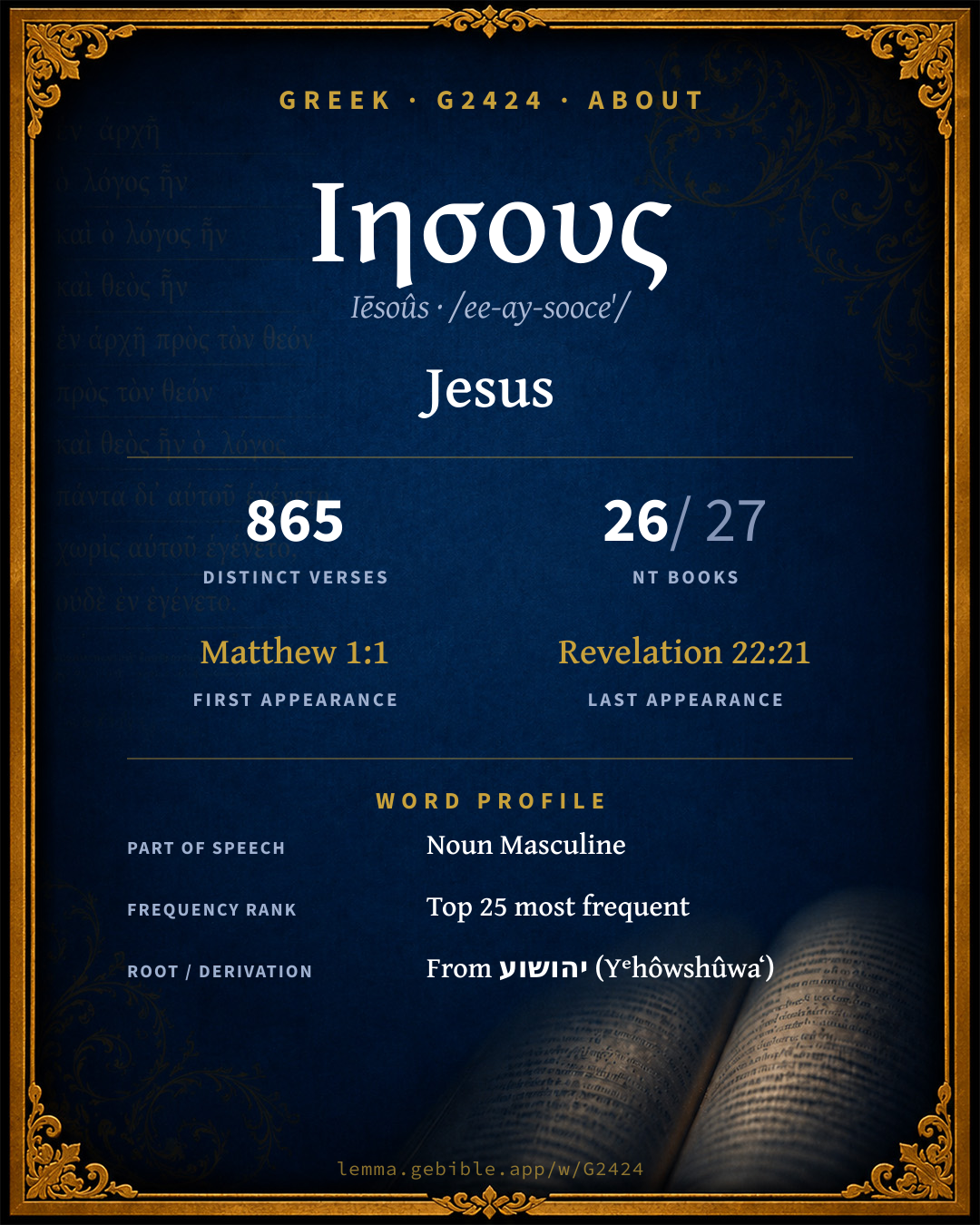
Ἰησοῦς
Jesus
Thayer's lists 6 entries for ‘Jesus’ fuller range ↓
Full lexicon entry — Thayer's Greek Lexicon
From Thayer's Greek Lexicon
Where this word appears
See every Nominative-case word in the Greek New Testament →
Grammar key — what these labels mean
Part of speech
- Noun
- A naming word — a person, place, thing, or idea.
Case
- Nominative
- The case of the subject (and the predicate nominative).
- Genitive
- The case of source, possession, or “of” — answers “whose / from what.”
- Accusative
- The case of the direct object and of extent.
- Dative
- The case of the indirect object, means, or location — “to / for / with / in.”
- Vocative
- The case of direct address (“O Lord”).
Gender
- Masculine
- Grammatically masculine.
Number
- Singular
- One.
Grammatical forms
- Noun, Nominative, Singular, Masculine 453 times (50%)
- Noun, Genitive, Singular, Masculine 225 times (25%)
- Noun, Accusative, Singular, Masculine 126 times (14%)
- Noun, Dative, Singular, Masculine 92 times (10%)
- Noun, Vocative, Singular, Masculine 9 times (1%)
Parsed forms decoded from the imported morphology (Robinson–Tischendorf, public domain), counted across 905 parsed occurrences — not distinct verses.
Page 1 of 5 — showing verses 1–200 of 865 distinct verses where G2424 appears, across 26 books. Click any verse to open its interlinear word-by-word view. Verse text shown in the World English Bible for context — . Each verse’s Greek form is shown with its reference; the English is not keyword-highlighted, since the data carries no word-level English alignment. Use “Compare translations” on any verse to read it across multiple English versions. This concordance covers the Greek New Testament; Septuagint (Greek Old Testament) occurrences of this word are not indexed here.
Matthew 145 verses
- Matthew 1:1 Ἰησοῦ n gen sg masc The book of the generation of Jesus Christ, the son of David, the son of Abraham.
- Matthew 1:16 Ἰησοῦς n nom sg masc Jacob became the father of Joseph, the husband of Mary, from whom was born Jesus, who is called Christ.
- Matthew 1:18 Ἰησοῦ n gen sg masc Now the birth of Jesus Christ was like this; for after his mother, Mary, was engaged to Joseph, before they came together, she was found pregnant by the Holy Spirit.
- Matthew 1:21 Ἰησοῦν n acc sg masc She shall bring forth a son. You shall call his name Jesus, for it is he who shall save his people from their sins."
- Matthew 1:25 Ἰησοῦν n acc sg masc and didn't know her sexually until she had brought forth her firstborn son. He named him Jesus.
- Matthew 2:1 Ἰησοῦ n gen sg masc Now when Jesus was born in Bethlehem of Judea in the days of Herod the king, behold, wise men from the east came to Jerusalem, saying,
- Matthew 3:13 Ἰησοῦς n nom sg masc Then Jesus came from Galilee to the Jordan to John, to be baptized by him.
- Matthew 3:15 Ἰησοῦς n nom sg masc But Jesus, answering, said to him, "Allow it now, for this is the fitting way for us to fulfill all righteousness." Then he allowed him.
- Matthew 3:16 Ἰησοῦς n nom sg masc Jesus, when he was baptized, went up directly from the water: and behold, the heavens were opened to him. He saw the Spirit of God descending as a dove, and coming on him.
- Matthew 4:1 Ἰησοῦς n nom sg masc Then Jesus was led up by the Spirit into the wilderness to be tempted by the devil.
- Matthew 4:7 Ἰησοῦς n nom sg masc Jesus said to him, "Again, it is written, 'You shall not test the Lord, your God.'"
- Matthew 4:10 Ἰησοῦς n nom sg masc Then Jesus said to him, "Get behind me, Satan! For it is written, 'You shall worship the Lord your God, and him only shall you serve.'"
- Matthew 4:17 Ἰησοῦς n nom sg masc From that time, Jesus began to preach, and to say, "Repent! For the Kingdom of Heaven is at hand."
- Matthew 7:28 Ἰησοῦς n nom sg masc It happened, when Jesus had finished saying these things, that the multitudes were astonished at his teaching,
- Matthew 8:4 Ἰησοῦς n nom sg masc Jesus said to him, "See that you tell nobody, but go, show yourself to the priest, and offer the gift that Moses commanded, as a testimony to them."
- Matthew 8:10 Ἰησοῦς n nom sg masc When Jesus heard it, he marveled, and said to those who followed, "Most assuredly I tell you, I haven't found so great a faith, not even in Israel.
- Matthew 8:13 Ἰησοῦς n nom sg masc Jesus said to the centurion, "Go your way. Let it be done for you as you have believed." His servant was healed in that hour.
- Matthew 8:14 Ἰησοῦς n nom sg masc When Jesus came into Peter's house, he saw his wife's mother lying sick with a fever.
- Matthew 8:18 Ἰησοῦς n nom sg masc Now when Jesus saw great multitudes around him, he gave the order to depart to the other side.
- Matthew 8:20 Ἰησοῦς n nom sg masc Jesus said to him, "The foxes have holes, and the birds of the sky have nests, but the Son of Man has nowhere to lay his head."
- Matthew 8:34 Ἰησοῦ n gen sg masc Behold, all the city came out to meet Jesus. When they saw him, they begged that he would depart from their borders.
- Matthew 9:2 Ἰησοῦς n nom sg masc Behold, they brought to him a man who was paralyzed, lying on a bed. Jesus, seeing their faith, said to the paralytic, "Son, cheer up! Your sins are forgiven you."
- Matthew 9:4 Ἰησοῦς n nom sg masc Jesus, knowing their thoughts, said, "Why do you think evil in your hearts?
- Matthew 9:9 Ἰησοῦς n nom sg masc As Jesus passed by from there, he saw a man called Matthew sitting at the tax collection office. He said to him, "Follow me." He got up and followed him.
- Matthew 9:10 Ἰησοῦ n dat sg masc It happened as he sat in the house, behold, many tax collectors and sinners came and sat down with Jesus and his disciples.
- Matthew 9:15 Ἰησοῦς n nom sg masc Jesus said to them, "Can the friends of the bridegroom mourn, as long as the bridegroom is with them? But the days will come when the bridegroom will be taken away from them, and then they will fast.
- Matthew 9:19 Ἰησοῦς n nom sg masc Jesus got up and followed him, as did his disciples.
- Matthew 9:23 Ἰησοῦς n nom sg masc When Jesus came into the ruler's house, and saw the flute players, and the crowd in noisy disorder,
- Matthew 9:27 Ἰησοῦ n dat sg masc As Jesus passed by from there, two blind men followed him, calling out and saying, "Have mercy on us, son of David!"
- Matthew 9:28 Ἰησοῦς n nom sg masc When he had come into the house, the blind men came to him. Jesus said to them, "Do you believe that I am able to do this?" They told him, "Yes, Lord."
- Matthew 9:30 Ἰησοῦς n nom sg masc Their eyes were opened. Jesus strictly charged them, saying, "See that no one knows about this."
- Matthew 9:35 Ἰησοῦς n nom sg masc Jesus went about all the cities and the villages, teaching in their synagogues, and preaching the Gospel of the Kingdom, and healing every disease and every sickness among the people.
- Matthew 10:5 Ἰησοῦς n nom sg masc Jesus sent these twelve out, and charged them, saying, "Don't go among the Gentiles, and don't enter into any city of the Samaritans.
- Matthew 11:1 Ἰησοῦς n nom sg masc It happened that when Jesus had finished directing his twelve disciples, he departed from there to teach and preach in their cities.
- Matthew 11:4 Ἰησοῦς n nom sg masc Jesus answered them, "Go and tell John the things which you hear and see:
- Matthew 11:7 Ἰησοῦς n nom sg masc As these went their way, Jesus began to say to the multitudes concerning John, "What did you go out into the wilderness to see? A reed shaken by the wind?
- Matthew 11:25 Ἰησοῦς n nom sg masc At that time, Jesus answered, "I thank you, Father, Lord of heaven and earth, that you hid these things from the wise and understanding, and revealed them to infants.
- Matthew 12:1 Ἰησοῦς n nom sg masc At that time, Jesus went on the Sabbath day through the grain fields. His disciples were hungry and began to pluck heads of grain and to eat.
- Matthew 12:15 Ἰησοῦς n nom sg masc Jesus, perceiving that, withdrew from there. Great multitudes followed him; and he healed them all,
- Matthew 13:1 Ἰησοῦς n nom sg masc On that day Jesus went out of the house, and sat by the seaside.
- Matthew 13:34 Ἰησοῦς n nom sg masc Jesus spoke all these things in parables to the multitudes; and without a parable, he didn't speak to them,
- Matthew 13:53 Ἰησοῦς n nom sg masc It happened that when Jesus had finished these parables, he departed from there.
- Matthew 13:57 Ἰησοῦς n nom sg masc They were offended by him. But Jesus said to them, "A prophet is not without honor, except in his own country, and in his own house."
- Matthew 14:1 Ἰησοῦ n gen sg masc At that time, Herod the tetrarch heard the report concerning Jesus,
- Matthew 14:12 Ἰησοῦ n dat sg masc His disciples came, and took the body, and buried it; and they went and told Jesus.
- Matthew 14:13 Ἰησοῦς n nom sg masc Now when Jesus heard this, he withdrew from there in a boat, to a deserted place apart. When the multitudes heard it, they followed him on foot from the cities.
- Matthew 14:29 Ἰησοῦν n acc sg masc He said, "Come!" Peter stepped down from the boat, and walked on the waters to come to Jesus.
- Matthew 14:31 Ἰησοῦς n nom sg masc Immediately Jesus stretched out his hand, took hold of him, and said to him, "You of little faith, why did you doubt?"
- Matthew 15:1 Ἰησοῦ n dat sg masc Then Pharisees and scribes came to Jesus from Jerusalem, saying,
- Matthew 15:21 Ἰησοῦς n nom sg masc Jesus went out from there, and withdrew into the region of Tyre and Sidon.
- Matthew 15:28 Ἰησοῦς n nom sg masc Then Jesus answered her, "Woman, great is your faith! Be it done to you even as you desire." And her daughter was healed from that hour.
- Matthew 15:29 Ἰησοῦς n nom sg masc Jesus departed there, and came near to the sea of Galilee; and he went up into the mountain, and sat there.
- Matthew 15:32 Ἰησοῦς n nom sg masc Jesus summoned his disciples and said, "I have compassion on the multitude, because they continue with me now three days and have nothing to eat. I don't want to send them away fasting, or they might faint on the way."
- Matthew 15:34 Ἰησοῦς n nom sg masc Jesus said to them, "How many loaves do you have?" They said, "Seven, and a few small fish."
- Matthew 16:6 Ἰησοῦς n nom sg masc Jesus said to them, "Take heed and beware of the yeast of the Pharisees and Sadducees."
- Matthew 16:8 Ἰησοῦς n nom sg masc Jesus, perceiving it, said, "Why do you reason among yourselves, you of little faith, 'because you have brought no bread?'
- Matthew 16:13 Ἰησοῦς n nom sg masc Now when Jesus came into the parts of Caesarea Philippi, he asked his disciples, saying, "Who do men say that I, the Son of Man, am?"
- Matthew 16:17 Ἰησοῦς n nom sg masc Jesus answered him, "Blessed are you, Simon Bar Jonah, for flesh and blood has not revealed this to you, but my Father who is in heaven.
- Matthew 16:21 Ἰησοῦς n nom sg masc From that time, Jesus began to show his disciples that he must go to Jerusalem and suffer many things from the elders, chief priests, and scribes, and be killed, and the third day be raised up.
- Matthew 16:24 Ἰησοῦς n nom sg masc Then Jesus said to his disciples, "If anyone desires to come after me, let him deny himself, and take up his cross, and follow me.
- Matthew 17:1 Ἰησοῦς n nom sg masc After six days, Jesus took with him Peter, James, and John his brother, and brought them up into a high mountain by themselves.
- Matthew 17:4 Ἰησοῦ n dat sg masc Peter answered, and said to Jesus, "Lord, it is good for us to be here. If you want, let's make three tents here: one for you, one for Moses, and one for Elijah."
- Matthew 17:7 Ἰησοῦς n nom sg masc Jesus came and touched them and said, "Get up, and don't be afraid."
- Matthew 17:8 Ἰησοῦν n acc sg masc Lifting up their eyes, they saw no one, except Jesus alone.
- Matthew 17:9 Ἰησοῦς n nom sg masc As they were coming down from the mountain, Jesus commanded them, saying, "Don't tell anyone what you saw, until the Son of Man has risen from the dead."
- Matthew 17:17 Ἰησοῦς n nom sg masc Jesus answered, "Faithless and perverse generation! How long will I be with you? How long will I bear with you? Bring him here to me."
- Matthew 17:18 Ἰησοῦς n nom sg masc Jesus rebuked him, the demon went out of him, and the boy was cured from that hour.
- Matthew 17:19 Ἰησοῦ n dat sg masc Then the disciples came to Jesus privately, and said, "Why weren't we able to cast it out?"
- Matthew 17:22 Ἰησοῦς n nom sg masc While they were staying in Galilee, Jesus said to them, "The Son of Man is about to be delivered up into the hands of men,
- Matthew 17:25 Ἰησοῦς n nom sg masc He said, "Yes." When he came into the house, Jesus anticipated him, saying, "What do you think, Simon? From whom do the kings of the earth receive toll or tribute? From their children, or from strangers?"
- Matthew 17:26 Ἰησοῦς n nom sg masc Peter said to him, "From strangers." Jesus said to him, "Therefore the children are exempt.
- Matthew 18:1 Ἰησοῦ n dat sg masc In that hour the disciples came to Jesus, saying, "Who then is greatest in the Kingdom of Heaven?"
- Matthew 18:22 Ἰησοῦς n nom sg masc Jesus said to him, "I don't tell you until seven times, but, until seventy times seven.
- Matthew 19:1 Ἰησοῦς n nom sg masc It happened when Jesus had finished these words, he departed from Galilee, and came into the borders of Judea beyond the Jordan.
- Matthew 19:14 Ἰησοῦς n nom sg masc But Jesus said, "Allow the little children, and don't forbid them to come to me; for to such belongs the Kingdom of Heaven."
- Matthew 19:18 Ἰησοῦς n nom sg masc He said to him, "Which ones?" Jesus said, "'You shall not murder.' 'You shall not commit adultery.' 'You shall not steal.' 'You shall not offer false testimony.'
- Matthew 19:21 Ἰησοῦς n nom sg masc Jesus said to him, "If you want to be perfect, go, sell what you have, and give to the poor, and you will have treasure in heaven; and come, follow me."
- Matthew 19:23 Ἰησοῦς n nom sg masc Jesus said to his disciples, "Most assuredly I say to you, a rich man will enter into the Kingdom of Heaven with difficulty.
- Matthew 19:26 Ἰησοῦς n nom sg masc Looking at them, Jesus said, "With men this is impossible, but with God all things are possible."
- Matthew 19:28 Ἰησοῦς n nom sg masc Jesus said to them, "Most assuredly I tell you that you who have followed me, in the regeneration when the Son of Man will sit on the throne of his glory, you also will sit on twelve thrones, judging the twelve tribes of Israel.
- Matthew 20:17 Ἰησοῦς n nom sg masc As Jesus was going up to Jerusalem, he took the twelve disciples aside, and on the way he said to them,
- Matthew 20:22 Ἰησοῦς n nom sg masc But Jesus answered, "You don't know what you are asking. Are you able to drink the cup that I am about to drink, and be baptized with the baptism that I am baptized with?" They said to him, "We are able."
- Matthew 20:25 Ἰησοῦς n nom sg masc But Jesus summoned them, and said, "You know that the rulers of the Gentiles lord it over them, and their great ones exercise authority over them.
- Matthew 20:30 Ἰησοῦς n nom sg masc Behold, two blind men sitting by the road, when they heard that Jesus was passing by, cried out, "Lord, have mercy on us, you son of David!"
- Matthew 20:32 Ἰησοῦς n nom sg masc Jesus stood still, and called them, and asked, "What do you want me to do for you?"
- Matthew 20:34 Ἰησοῦς n nom sg masc Jesus, being moved with compassion, touched their eyes; and immediately their eyes received their sight, and they followed him.
- Matthew 21:1 Ἰησοῦς n nom sg masc When they drew near to Jerusalem, and came to Bethsphage, to the Mount of Olives, then Jesus sent two disciples,
- Matthew 21:6 Ἰησοῦς n nom sg masc The disciples went, and did just as Jesus commanded them,
- Matthew 21:11 Ἰησοῦς n nom sg masc The multitudes said, "This is the prophet, Jesus, from Nazareth of Galilee."
- Matthew 21:12 Ἰησοῦς n nom sg masc Jesus entered into the temple of God, and drove out all of those who sold and bought in the temple, and overthrew the money-changers' tables and the seats of those who sold the doves.
- Matthew 21:16 Ἰησοῦς n nom sg masc and said to him, "Do you hear what these are saying?" Jesus said to them, "Yes. Did you never read, 'Out of the mouth of babes and nursing babies you have perfected praise?'"
- Matthew 21:21 Ἰησοῦς n nom sg masc Jesus answered them, "Most assuredly I tell you, if you have faith, and don't doubt, you will not only do what is done to the fig tree, but even if you told this mountain, 'Be taken up and cast into the sea,' it would be done.
- Matthew 21:24 Ἰησοῦς n nom sg masc Jesus answered them, "I also will ask you one question, which if you tell me, I likewise will tell you by what authority I do these things.
- Matthew 21:27 Ἰησοῦ n dat sg masc They answered Jesus, and said, "We don't know." He also said to them, "Neither will I tell you by what authority I do these things.
- Matthew 21:31 Ἰησοῦς n nom sg masc Which of the two did the will of his father?" They said to him, "The first." Jesus said to them, "Most assuredly I tell you that the tax collectors and the prostitutes are entering into the Kingdom of God before you.
- Matthew 21:42 Ἰησοῦς n nom sg masc Jesus said to them, "Did you never read in the Scriptures, 'The stone which the builders rejected, The same was made the head of the corner. This was from the Lord. It is marvelous in our eyes?'
- Matthew 22:1 Ἰησοῦς n nom sg masc Jesus answered and spoke again in parables to them, saying,
- Matthew 22:18 Ἰησοῦς n nom sg masc But Jesus perceived their wickedness, and said, "Why do you test me, you hypocrites?
- Matthew 22:20 Ἰησοῦς n nom sg masc He asked them, "Whose is this image and inscription?"
- Matthew 22:29 Ἰησοῦς n nom sg masc But Jesus answered them, "You are mistaken, not knowing the Scriptures, nor the power of God.
- Matthew 22:41 Ἰησοῦς n nom sg masc Now while the Pharisees were gathered together, Jesus asked them a question,
- Matthew 23:1 Ἰησοῦς n nom sg masc Then Jesus spoke to the multitudes and to his disciples,
- Matthew 24:1 Ἰησοῦς n nom sg masc Jesus went out from the temple, and was going on his way. His disciples came to him to show him the buildings of the temple.
- Matthew 24:4 Ἰησοῦς n nom sg masc Jesus answered them, "Be careful that no one leads you astray.
- Matthew 26:1 Ἰησοῦς n nom sg masc It happened, when Jesus had finished all these words, that he said to his disciples,
- Matthew 26:4 Ἰησοῦν n acc sg masc They took counsel together that they might take Jesus by deceit, and kill him.
- Matthew 26:6 Ἰησοῦ n gen sg masc Now when Jesus was in Bethany, in the house of Simon the leper,
- Matthew 26:10 Ἰησοῦς n nom sg masc But Jesus, knowing this, said to them, "Why do you trouble the woman? Because she has done a good work for me.
- Matthew 26:17 Ἰησοῦ n dat sg masc Now on the first day of unleavened bread, the disciples came to Jesus, saying to him, "Where do you want us to prepare for you to eat the Passover?"
- Matthew 26:19 Ἰησοῦς n nom sg masc The disciples did as Jesus commanded them, and they prepared the Passover.
- Matthew 26:26 Ἰησοῦς n nom sg masc As they were eating, Jesus took bread, gave thanks for it, and broke it. He gave to the disciples, and said, "Take, eat; this is my body."
- Matthew 26:31 Ἰησοῦς n nom sg masc Then Jesus said to them, "All of you will be made to stumble because of me tonight, for it is written, 'I will strike the shepherd, and the sheep of the flock will be scattered.'
- Matthew 26:34 Ἰησοῦς n nom sg masc Jesus said to him, "Most assuredly I tell you that tonight, before the rooster crows, you will deny me three times."
- Matthew 26:36 Ἰησοῦς n nom sg masc Then Jesus came with them to a place called Gethsemane, and said to his disciples, "Sit here, while I go there and pray."
- Matthew 26:49 Ἰησοῦ n dat sg masc Immediately he came to Jesus, and said, "Hail, Rabbi!" and kissed him.
- Matthew 26:50 Ἰησοῦς Ἰησοῦν n nom sg masc n acc sg masc Jesus said to him, "Friend, why are you here?" Then they came and laid hands on Jesus, and took him.
- Matthew 26:51 Ἰησοῦ n gen sg masc Behold, one of those who were with Jesus stretched out his hand, and drew his sword, and struck the servant of the high priest, and struck off his ear.
- Matthew 26:52 Ἰησοῦς n nom sg masc Then Jesus said to him, "Put your sword back into its place, for all those who take the sword will die by the sword.
- Matthew 26:55 Ἰησοῦς n nom sg masc In that hour Jesus said to the multitudes, "Have you come out as against a robber with swords and clubs to seize me? I sat daily in the temple teaching, and you didn't arrest me.
- Matthew 26:57 Ἰησοῦν n acc sg masc Those who had taken Jesus led him away to Caiaphas the high priest, where the scribes and the elders were gathered together.
- Matthew 26:59 Ἰησοῦ n gen sg masc Now the chief priests, the elders, and the whole council sought false testimony against Jesus, that they might put him to death;
- Matthew 26:63 Ἰησοῦς n nom sg masc But Jesus held his peace. The high priest answered him, "I adjure you by the living God, that you tell us whether you are the Christ, the Son of God."
- Matthew 26:64 Ἰησοῦς n nom sg masc Jesus said to him, "You have said it. Nevertheless, I tell you, henceforth you will see the Son of Man sitting at the right hand of Power, and coming on the clouds of the sky."
- Matthew 26:69 Ἰησοῦ n gen sg masc Now Peter was sitting outside in the court, and a maid came to him, saying, "You were also with Jesus, the Galilean!"
- Matthew 26:71 Ἰησοῦ n gen sg masc When he had gone out onto the porch, someone else saw him, and said to those who were there, "This man also was with Jesus of Nazareth."
- Matthew 26:75 Ἰησοῦ n gen sg masc Peter remembered the word which Jesus had said to him, "Before the rooster crows, you will deny me three times." He went out and wept bitterly.
- Matthew 27:1 Ἰησοῦ n gen sg masc Now when morning had come, all the chief priests and the elders of the people took counsel against Jesus to put him to death:
- Matthew 27:11 Ἰησοῦς Ἰησοῦς n nom sg masc n nom sg masc Now Jesus stood before the governor: and the governor asked him, saying, "Are you the King of the Jews?" Jesus said to him, "So you say."
- Matthew 27:17 Ἰησοῦν n acc sg masc When therefore they were gathered together, Pilate said to them, "Whom do you want me to release to you? Barabbas, or Jesus, who is called Christ?"
- Matthew 27:20 Ἰησοῦν n acc sg masc Now the chief priests and the elders persuaded the multitudes to ask for Barabbas, and destroy Jesus.
- Matthew 27:22 Ἰησοῦν n acc sg masc Pilate said to them, "What then shall I do to Jesus, who is called Christ?" They all said to him, "Let him be crucified!"
- Matthew 27:26 Ἰησοῦν n acc sg masc Then he released to them Barabbas, but Jesus he flogged and delivered to be crucified.
- Matthew 27:27 Ἰησοῦν n acc sg masc Then the governor's soldiers took Jesus into the Praetorium, and gathered the whole garrison together against him.
- Matthew 27:37 Ἰησοῦς n nom sg masc They set up over his head the accusation against him written, "THIS IS JESUS, THE KING OF THE JEWS."
- Matthew 27:46 Ἰησοῦς n nom sg masc About the ninth hour Jesus cried with a loud voice, saying, "Eli, Eli, lima sabachthani?" That is, "My God, my God, why have you forsaken me?"
- Matthew 27:50 Ἰησοῦς n nom sg masc Jesus cried again with a loud voice, and yielded up his spirit.
- Matthew 27:54 Ἰησοῦν n acc sg masc Now the centurion, and those who were with him watching Jesus, when they saw the earthquake, and the things that were done, feared exceedingly, saying, "Truly this was the Son of God."
- Matthew 27:55 Ἰησοῦ n dat sg masc Many women were there watching from afar, who had followed Jesus from Galilee, serving him.
- Matthew 27:57 Ἰησοῦ n dat sg masc When evening had come, a rich man from Arimathaea, named Joseph, who himself was also Jesus' disciple came.
- Matthew 27:58 Ἰησοῦ n gen sg masc This man went to Pilate, and asked for Jesus' body. Then Pilate commanded the body to be given up.
- Matthew 28:5 Ἰησοῦν n acc sg masc The angel answered the women, "Don't be afraid, for I know that you seek Jesus, who has been crucified.
- Matthew 28:9 Ἰησοῦς n nom sg masc As they went to tell his disciples, behold, Jesus met them, saying, "Rejoice!" They came and took hold of his feet, and worshiped him.
- Matthew 28:10 Ἰησοῦς n nom sg masc Then Jesus said to them, "Don't be afraid. Go tell my brothers that they should go into Galilee, and there they will see me."
- Matthew 28:16 Ἰησοῦς n nom sg masc But the eleven disciples went into Galilee, to the mountain where Jesus had sent them.
- Matthew 28:18 Ἰησοῦς n nom sg masc Jesus came to them and spoke to them, saying, "All authority has been given to me in heaven and on earth.
Mark 78 verses
- Mark 1:1 Ἰησοῦ n gen sg masc The beginning of the Gospel of Jesus Christ, the Son of God.
- Mark 1:9 Ἰησοῦς n nom sg masc It happened in those days, that Jesus came from Nazareth of Galilee, and was baptized by John in the Jordan.
- Mark 1:14 Ἰησοῦς n nom sg masc Now after John was taken into custody, Jesus came into Galilee, preaching the Gospel of the Kingdom of God,
- Mark 1:17 Ἰησοῦς n nom sg masc Jesus said to them, "Come after me, and I will make you into fishers for men."
- Mark 1:24 Ἰησοῦ n voc sg masc saying, "Ha! What do we have to do with you, Jesus, you Nazarene? Have you come to destroy us? I know you who you are: the Holy One of God!"
- Mark 1:25 Ἰησοῦς n nom sg masc Jesus rebuked him, saying, "Be quiet, and come out of him!"
- Mark 2:5 Ἰησοῦς n nom sg masc Jesus, seeing their faith, said to the paralytic, "Son, your sins are forgiven you."
- Mark 2:8 Ἰησοῦς n nom sg masc Immediately Jesus, perceiving in his spirit that they so reasoned within themselves, said to them, "Why do you reason these things in your hearts?
- Mark 2:15 Ἰησοῦ n dat sg masc It happened, that he was reclining at the table in his house, and many tax collectors and sinners sat down with Jesus and his disciples, for there were many, and they followed him.
- Mark 2:17 Ἰησοῦς n nom sg masc When Jesus heard it, he said to them, "Those who are healthy have no need for a physician, but those who are sick. I came not to call the righteous, but sinners to repentance."
- Mark 2:19 Ἰησοῦς n nom sg masc Jesus said to them, "Can the groomsmen fast while the bridegroom is with them? As long as they have the bridegroom with them, they can't fast.
- Mark 3:7 Ἰησοῦς n nom sg masc Jesus withdrew to the sea with his disciples, and a great multitude followed him from Galilee, from Judea,
- Mark 5:6 Ἰησοῦν n acc sg masc When he saw Jesus from afar, he ran and bowed down to him,
- Mark 5:7 Ἰησοῦ n voc sg masc and crying out with a loud voice, he said, "What have I to do with you, Jesus, you Son of the Most High God? I adjure you by God, don't torment me."
- Mark 5:15 Ἰησοῦν n acc sg masc They came to Jesus, and saw him who had been possessed by demons sitting, clothed, and in his right mind, even him who had the legion; and they were afraid.
- Mark 5:20 Ἰησοῦς n nom sg masc He went his way, and began to proclaim in Decapolis how Jesus had done great things for him, and everyone marveled.
- Mark 5:21 Ἰησοῦ n gen sg masc When Jesus had crossed back over in the boat to the other side, a great multitude was gathered to him; and he was by the sea.
- Mark 5:27 Ἰησοῦ n gen sg masc having heard the things concerning Jesus, came up behind him in the crowd, and touched his clothes.
- Mark 5:30 Ἰησοῦς n nom sg masc Immediately Jesus, perceiving in himself that the power had gone out from him, turned around in the crowd, and asked, "Who touched my clothes?"
- Mark 5:36 Ἰησοῦς n nom sg masc But Jesus, when he heard the message spoken, immediately said to the ruler of the synagogue, "Don't be afraid, only believe."
- Mark 6:4 Ἰησοῦς n nom sg masc Jesus said to them, "A prophet is not without honor, except in his own country, and among his own relatives, and in his own house."
- Mark 6:30 Ἰησοῦν n acc sg masc The apostles gathered themselves together to Jesus, and they told him all things, whatever they had done, and whatever they had taught.
- Mark 8:27 Ἰησοῦς n nom sg masc Jesus went out, with his disciples, into the villages of Caesarea Philippi. On the way he asked his disciples, "Who do men say that I am?"
- Mark 9:2 Ἰησοῦς n nom sg masc After six days Jesus took with him Peter, James, and John, and brought them up onto a high mountain privately by themselves, and he was changed into another form in front of them.
- Mark 9:4 Ἰησοῦ n dat sg masc Elijah and Moses appeared to them, and they were talking with Jesus.
- Mark 9:5 Ἰησοῦ n dat sg masc Peter answered Jesus, "Rabbi, it is good for us to be here. Let's make three tents: one for you, one for Moses, and one for Elijah."
- Mark 9:8 Ἰησοῦν n acc sg masc Suddenly looking around, they saw no one with them any more, except Jesus only.
- Mark 9:23 Ἰησοῦς n nom sg masc Jesus said to him, "If you can believe, all things are possible to him who believes."
- Mark 9:25 Ἰησοῦς n nom sg masc When Jesus saw that a multitude came running together, he rebuked the unclean spirit, saying to him, "You mute and deaf spirit, I command you, come out of him, and never enter him again!"
- Mark 9:27 Ἰησοῦς n nom sg masc But Jesus took him by the hand, and raised him up; and he arose.
- Mark 9:39 Ἰησοῦς n nom sg masc But Jesus said, "Don't forbid him, for there is no one who will do a mighty work in my name, and be able quickly to speak evil of me.
- Mark 10:5 Ἰησοῦς n nom sg masc But Jesus said to them, "For your hardness of heart, he wrote you this commandment.
- Mark 10:14 Ἰησοῦς n nom sg masc But when Jesus saw it, he was moved with indignation, and said to them, "Allow the little children to come to me! Don't forbid them, for the Kingdom of God belongs to such as these.
- Mark 10:18 Ἰησοῦς n nom sg masc Jesus said to him, "Why do you call me good? No one is good except one-- God.
- Mark 10:21 Ἰησοῦς n nom sg masc Jesus looking at him loved him, and said to him, "One thing you lack. Go, sell whatever you have, and give to the poor, and you will have treasure in heaven; and come, follow me, taking up the cross."
- Mark 10:23 Ἰησοῦς n nom sg masc Jesus looked around, and said to his disciples, "How difficult it is for those who have riches to enter into the Kingdom of God!"
- Mark 10:24 Ἰησοῦς n nom sg masc The disciples were amazed at his words. But Jesus answered again, "Children, how hard is it for those who trust in riches to enter into the Kingdom of God!
- Mark 10:27 Ἰησοῦς n nom sg masc Jesus, looking at them, said, "With men it is impossible, but not with God, for all things are possible with God."
- Mark 10:29 Ἰησοῦς n nom sg masc Jesus said, "Most assuredly I tell you, there is no one who has left house, or brothers, or sisters, or father, or mother, or wife, or children, or land, for my sake, and for the Gospel's sake,
- Mark 10:32 Ἰησοῦς n nom sg masc They were on the way, going up to Jerusalem; and Jesus was going in front of them, and they were amazed; and those who followed were afraid. He again took the twelve, and began to tell them the things that were going to happen to him.
- Mark 10:38 Ἰησοῦς n nom sg masc But Jesus said to them, "You don't know what you are asking. Are you able to drink the cup that I drink, and to be baptized with the baptism that I am baptized with?"
- Mark 10:39 Ἰησοῦς n nom sg masc They said to him, "We are able." Jesus said to them, "You shall indeed drink the cup that I drink, and you shall be baptized with the baptism that I am baptized with;
- Mark 10:42 Ἰησοῦς n nom sg masc Jesus summoned them, and said to them, "You know that they who are recognized as rulers over the Gentiles lord it over them, and their great ones exercise authority over them.
- Mark 10:47 Ἰησοῦς Ἰησοῦ n nom sg masc n voc sg masc When he heard that it was Jesus the Nazarene, he began to cry out, and say, "Jesus, you son of David, have mercy on me!"
- Mark 10:49 Ἰησοῦς n nom sg masc Jesus stood still, and said, "Call him." They called the blind man, saying to him, "Cheer up! Get up. He is calling you!"
- Mark 10:50 Ἰησοῦν n acc sg masc He, casting away his cloak, sprang up, and came to Jesus.
- Mark 10:51 Ἰησοῦς n nom sg masc Jesus asked him, "What do you want me to do for you?" The blind man said to him, "Rhabboni, that I may see again."
- Mark 10:52 Ἰησοῦς n nom sg masc Jesus said to him, "Go your way. Your faith has made you well." Immediately he received his sight, and followed Jesus in the way.
- Mark 11:6 Ἰησοῦς n nom sg masc They said to them just as Jesus had said, and they let them go.
- Mark 11:7 Ἰησοῦν n acc sg masc They brought the young donkey to Jesus, and threw their garments on it, and Jesus sat on it.
- Mark 11:22 Ἰησοῦς n nom sg masc Jesus answered them, "Have faith in God.
- Mark 11:29 Ἰησοῦς n nom sg masc Jesus said to them, "I will ask you one question. Answer me, and I will tell you by what authority I do these things.
- Mark 11:33 Ἰησοῦ Ἰησοῦς n dat sg masc n nom sg masc They answered Jesus, "We don't know." Jesus said to them, "Neither do I tell you by what authority I do these things."
- Mark 12:17 Ἰησοῦς n nom sg masc Jesus answered them, "Render to Caesar the things that are Caesar's, and to God the things that are God's." They marveled greatly at him.
- Mark 12:24 Ἰησοῦς n nom sg masc Jesus answered them, "Isn't this because you are mistaken, not knowing the Scriptures, nor the power of God?
About this entry
At a glance — auto-summarized from this page’s data, not written by a person. Every figure links to its source below. This summary describes the numbers; it doesn’t interpret them.
The Greek name Ιησους centers on the idea of “Jesus.” Its earliest occurrence is Matthew 1:1. It appears 865 verses across 26 books of the Greek New Testament, among its most common vocabulary. The word gravitates to John (26%), then Matthew and Luke. Dig into 865-verse concordance and the renderings breakdown below.
Gloss history
Strong's 1890 vs modern scholarship
About this word
Strong's G2424 catalogs a Greek word from the Greek New Testament.
These counts are not copied from any lexicon or concordance. They are computed here, from the morphology-tagged Greek New Testament. What Lemma adds →
- 865
- distinct verses
- The word appears in 865 distinct verses.
- 26 / 27
- NT books
- The word appears in 26 of 27 New Testament books.
- #21
- by frequency
- Top 25 most frequent Greek words (rank 21 of 5,347 Greek words by occurrence).
View all 865 occurrences in the concordance →
By section of the New Testament
By traditional corpus
Conventional, traditional groupings — biblical authorship is debated, so this is a traditional corpus grouping, not an authorship claim. Some books belong to more than one corpus (Luke is in both the Gospels and the Lukan corpus, and so on), so these shares overlap and need not total 100%. Each figure is a share of the word’s 865 distinct verses.
- Gospels 536 verses · 62%
- Johannine 254 verses · 29%
- Pauline corpus 198 verses · 23%
- Lukan (Luke–Acts) 153 verses · 18%
- General (Catholic) Epistles 37 verses · 4%
- Hebrews 14 verses · 2%
- Revelation 12 verses · 1%
How translations render this word
Counts come from each version’s own published word-to-Strong’s tagging or interlinear alignment — an approximate guide to how each version renders this word, not a word-level alignment the data otherwise carries. Because each total is that version’s own tagged count, the per-version totals vary from one another and need not match the appearance or distinct-verse counts above. These counts may also differ from a printed concordance because Lemma counts each distinctly tagged rendering and does not collapse phrase taggings into a single head-word total. This is a fixed set of word-tagged versions (KJV, ASV, BSB, ULT) and does not change with the reading translation you choose elsewhere. Each version’s license is shown beside its name below (and on Sources).
- King James Version: Jesus 960×, Jesus' 10×, Thou jesus 3×
- American Standard Version: Jesus 867×, He 40×, Him 3×
- Berean Standard Bible: Jesus 866×, Jesus’ 9×, Joshua 3×
- unfoldingWord Literal Text: Jesus 910×, Joshua 3×
King James Version Public Domain
Renders G2424 across 975 tagged occurrences — most commonly:
Plus 2 renderings that appear only once — usually multi-word phrases or single function words the recovered tagging swept in, not distinct renderings.
American Standard Version Public Domain
Renders G2424 across 937 tagged occurrences — most commonly:
Plus 22 renderings that appear only once — usually multi-word phrases or single function words the recovered tagging swept in, not distinct renderings. Not rendered by a distinct English word in 3 further occurrences.
Berean Standard Bible Public Domain
Renders G2424 across 886 tagged occurrences — most commonly:
Plus 6 renderings that appear only once — usually multi-word phrases or single function words the recovered tagging swept in, not distinct renderings. Not rendered by a distinct English word in 30 further occurrences.
unfoldingWord Literal Text CC BY-SA 4.0
Renders G2424 across 918 tagged occurrences — most commonly:
Plus 5 renderings that appear only once — usually multi-word phrases or single function words the recovered tagging swept in, not distinct renderings.
Senses in Thayer's
The 6 senses Thayer's distinguishes for this word, in lexicon order (not ranked by frequency or importance). The full entry — with sub-senses — is in the Lexicon Entry tab.
- Jesus = "Jehovah is salvation"
- Jesus, the Son of God, the Saviour of mankind, God incarnate
- Jesus Barabbas was the captive robber whom the Jews begged Pilate to release instead of Christ
- Joshua was the famous captain of the Israelites, Moses' successor ( Ac. 7:45 , Heb. 4:8 )
- Jesus, son of Eliezer, one of the ancestors of Christ ( Luk. 3:29 )
- Jesus, surnamed Justus, a Jewish Christian, an associate with Paul in the preaching of the gospel ( Col. 4:11 )
Word origin
Derived from יהושוע (Yᵉhôwshûwaʻ) (H3091) — Joshua.
Of hebrew origin [ H3091 ]; Jesus (that is Jehoshua ) the name of our Lord and two (three) other Israelites : - Jesus.
— Strong’s Exhaustive Concordance (1890), public domain.
Forms in the corpus
The 3 distinct written forms G2424 takes in the Greek New Testament, most frequent first — each parse links to that case’s occurrences in the concordance.
| Form | Parsing | Example | Uses |
|---|---|---|---|
| Ἰησοῦς Iēsoûs | Noun, Nominative, Singular, Masculine | Matthew 1:16 | 453 |
| Ἰησοῦ Iēsoû | Noun, Genitive, Singular, Masculine | Matthew 1:1 | 326 |
| Ἰησοῦν Iēsoûn | Noun, Accusative, Singular, Masculine | Matthew 1:21 | 126 |
Same root — word family
Other Thayer's entries built from the same root as G2424, grouped by Strong’s listed origin. These share a root / origin per the lexicon — not necessarily a shared meaning. Each links to that word’s own entry.
Derives from
Proper names from this root
People and places named from this root — a name, not an additional meaning of the word.
Compare all same-root words → 2 of the same-root words are proper names (people or places). They share a root, not necessarily a meaning.
Bible dictionary
Public-domain dictionary articles matched to this entry by name (Jesus). A biblical name can be shared by more than one person or place, so an article may treat several.
Easton's Bible Dictionary · M. G. Easton, 1897
(1.) Joshua, the son of Nun (Acts 7:45; Heb. 4:8; R.V., "Joshua").
(2.) A Jewish Christian surnamed Justus (Col. 4:11).
Je'sus, the proper, as Christ is the official, name of our Lord. To distinguish him from others so called, he is spoken of as "Jesus of Nazareth" (John 18:7), and "Jesus the son of Joseph" (John 6:42).
This is the Greek form of the Hebrew name Joshua, which was originally Hoshea (Num. 13:8, 16), but changed by Moses into Jehoshua (Num. 13:16; 1 Chr. 7:27), or Joshua. After the Exile it assumed the form Jeshua, whence the Greek form Jesus. It was given to our Lord to denote the object of his mission, to save (Matt. 1:21).
The life of Jesus on earth may be divided into two great periods, (1) that of his private life, till he was about thirty years of age; and (2) that of his public life, which lasted about three years.
In the "fulness of time" he was born at Bethlehem, in the reign of the emperor Augustus, of Mary, who was betrothed to Joseph, a carpenter (Matt. 1:1; Luke 3:23; comp. John 7:42). His birth was announced to the shepherds (Luke 2:8-20). Wise men from the east came to Bethlehem to see him who was born "King of the Jews," bringing gifts with them (Matt. 2:1-12). Herod's cruel jealousy led to Joseph's flight into Egypt with Mary and the infant Jesus, where they tarried till the death of this king (Matt. 2:13-23), when they returned and settled in Nazareth, in Lower Galilee (2:23; comp. Luke 4:16; John 1:46, etc.). At the age of twelve years he went up to Jerusalem to the Passover with his parents. There, in the temple, "in the midst of the doctors," all that heard him were "astonished at his understanding and answers" (Luke 2:41, etc.).
Eighteen years pass, of which we have no record beyond this, that he returned to Nazareth and "increased in wisdom and stature, and in favour with God and man" (Luke 2:52).
He entered on his public ministry when he was about thirty years of age. It is generally reckoned to have extended to about three years. "Each of these years had peculiar features of its own. (1.) The first year may be called the year of obscurity, both because the records of it which we possess are very scanty, and because he seems during it to have been only slowly emerging into public notice. It was spent for the most part in Judea. (2.) The second year was the year of public favour, during which the country had become thoroughly aware of him; his activity was incessant, and his frame rang through the length and breadth of the land. It was almost wholly passed in Galilee. (3.) The third was the year of opposition, when the public favour ebbed away. His enemies multiplied and assailed him with more and more pertinacity, and at last he fell a victim to their hatred. The first six months of this final year were passed in Galilee, and the last six in other parts of the land.", Stalker's Life of Jesus Christ, p. 45.
The only reliable sources of information regarding the life of Christ on earth are the Gospels, which present in historical detail the words and the work of Christ in so many different aspects. (See CHIRST.)
Smith's Bible Dictionary · William Smith, 1863
called Jestus, a Christian who was with St. Paul at Rome. (Colossians 4:11) (A.D. 57.)
(saviour).
+ The Greek form of the name Joshua or Jeshua, a contraction of Jehoshua, that is, "help of Jehovah" or "saviour." (Numbers 13:16) + Joshua the son of Nun. (Numbers 27:18; Hebrews 4:8) [Jehoshua]
Hitchcock's Bible Names Dictionary · Roswell D. Hitchcock, 1869
savior; deliverer
Classic public-domain reference works; full attribution on Sources.
Septuagint usage
The same Greek word Ιησους appears 246 times in the Greek Old Testament (Septuagint), across 218 verses in 11 books.
- 246
- LXX occurrences
- Tagged occurrences of this Greek word in the Septuagint.
- 218
- verses
- Distinct Septuagint verses containing this word.
- 11 / 39
- OT books
- The word appears in 11 of the 39 Old Testament books.
Sample Septuagint occurrences
- Exodus 17:9 ἰησοῦς
- Numbers 11:28 ἰησοῦς
- Deuteronomy 1:38 ἰησοῦς
- Joshua 1:1 ἰησοῦς
- Judges 1:1 ἰησοῦς
- 2 Kings 23:8 ιησους
- 1 Chronicles 24:11 ἰησοῦς
- 2 Chronicles 31:15 ἰησοῦς
- Ezra 2:2 ἰησοῦς
- Haggai 1:1 ἰησοῦς
- Zechariah 3:1 ἰησοῦς
Septuagint occurrences (same lexeme)
Every verse where the same Strong’s number (G2424) appears in the Greek Septuagint — showing the first 50 of 218. Verse text shown in the World English Bible for context; the Greek form is the matched word — the English is not keyword-highlighted.
- Exodus 17:9 ἰησοῦς Moses said to Joshua, "Choose men for us, and go out, fight with Amalek. Tomorrow I will stand on the top of the hill with God's rod in my hand."
- Exodus 17:10 ἰησοῦς So Joshua did as Moses had told him, and fought with Amalek; and Moses, Aaron, and Hur went up to the top of the hill.
- Exodus 17:13 ἰησοῦς Joshua defeated Amalek and his people with the edge of the sword.
- Exodus 17:14 ἰησοῦς Yahweh said to Moses, "Write this for a memorial in a book, and rehearse it in the ears of Joshua: that I will utterly blot out the memory of Amalek from under the sky."
- Exodus 24:13 ἰησοῦς Moses rose up with Joshua, his servant, and Moses went up onto God's Mountain.
- Exodus 24:15 ἰησοῦς Moses went up on the mountain, and the cloud covered the mountain.
- Exodus 32:17 ἰησοῦς When Joshua heard the noise of the people as they shouted, he said to Moses, "There is the noise of war in the camp."
- Exodus 33:11 ἰησοῦς Yahweh spoke to Moses face to face, as a man speaks to his friend. He turned again into the camp, but his servant Joshua, the son of Nun, a young man, didn't depart out of the Tent.
- Numbers 11:28 ἰησοῦς Joshua the son of Nun, the minister of Moses, one of his chosen men, answered, My lord Moses, forbid them.
- Numbers 13:16 ἰησοῦς These are the names of the men who Moses sent to spy out the land. Moses called Hoshea the son of Nun Joshua.
- Numbers 14:6 ἰησοῦς Joshua the son of Nun and Caleb the son of Jephunneh, who were of those who spied out the land, tore their clothes:
- Numbers 14:30 ἰησοῦς surely you shall not come into the land, concerning which I swore that I would make you dwell therein, save Caleb the son of Jephunneh, and Joshua the son of Nun.
- Numbers 14:38 ἰησοῦς But Joshua the son of Nun, and Caleb the son of Jephunneh, remained alive of those men who went to spy out the land.
- Numbers 26:65 ἰησοῦς For Yahweh had said of them, They shall surely die in the wilderness. There was not left a man of them, save Caleb the son of Jephunneh, and Joshua the son of Nun.
- Numbers 27:18 ἰησοῦς Yahweh said to Moses, Take Joshua the son of Nun, a man in whom is the Spirit, and lay your hand on him;
- Numbers 27:22 ἰησοῦς Moses did as Yahweh commanded him; and he took Joshua, and set him before Eleazar the priest, and before all the congregation:
- Numbers 32:12 ἰησοῦς save Caleb the son of Jephunneh the Kenizzite, and Joshua the son of Nun; because they have wholly followed Yahweh.
- Numbers 32:28 ἰησοῦς So Moses gave charge concerning them to Eleazar the priest, and to Joshua the son of Nun, and to the heads of the fathers' [houses] of the tribes of the children of Israel.
- Numbers 34:17 ἰησοῦς These are the names of the men who shall divide the land to you for inheritance: Eleazar the priest, and Joshua the son of Nun.
- Deuteronomy 1:38 ἰησοῦς Joshua the son of Nun, who stands before you, he shall go in there: encourage you him; for he shall cause Israel to inherit it.
- Deuteronomy 3:21 ἰησοῦς I commanded Joshua at that time, saying, Your eyes have seen all that Yahweh your God has done to these two kings: so shall Yahweh do to all the kingdoms where you go over.
- Deuteronomy 3:28 ἰησοῦς But charge Joshua, and encourage him, and strengthen him; for he shall go over before this people, and he shall cause them to inherit the land which you shall see.
- Deuteronomy 31:3 ἰησοῦς Yahweh your God, he will go over before you; he will destroy these nations from before you, and you shall dispossess them: [and] Joshua, he shall go over before you, as Yahweh has spoken.
- Deuteronomy 31:7 ἰησοῦς Moses called to Joshua, and said to him in the sight of all Israel, Be strong and of good courage: for you shall go with this people into the land which Yahweh has sworn to their fathers to give them; and you shall cause them to inherit it.
- Deuteronomy 31:14 ἰησοῦς Yahweh said to Moses, Behold, your days approach that you must die: call Joshua, and present yourselves in the tent of meeting, that I may give him a charge. Moses and Joshua went, and presented themselves in the tent of meeting.
- Deuteronomy 31:23 ἰησοῦς He gave Joshua the son of Nun a charge, and said, Be strong and of good courage; for you shall bring the children of Israel into the land which I swore to them: and I will be with you.
- Deuteronomy 32:44 ἰησοῦς Moses came and spoke all the words of this song in the ears of the people, he and Joshua the son of Nun.
- Deuteronomy 34:9 ἰησοῦς Joshua the son of Nun was full of the spirit of wisdom; for Moses had laid his hands on him: and the children of Israel listened to him, and did as Yahweh commanded Moses.
- Joshua 1:1 ἰησοῦς Now it happened after the death of Moses the servant of Yahweh, that Yahweh spoke to Joshua the son of Nun, Moses' minister, saying,
- Joshua 1:10 ἰησοῦς Then Joshua commanded the officers of the people, saying,
- Joshua 1:12 ἰησοῦς To the Reubenites, and to the Gadites, and to the half-tribe of Manasseh, spoke Joshua, saying,
- Joshua 1:16 ἰησοῦς They answered Joshua, saying, All that you have commanded us we will do, and wherever you send us we will go.
- Joshua 2:1 ἰησοῦς Joshua the son of Nun sent out of Shittim two men as spies secretly, saying, Go, view the land, and Jericho. They went and came into the house of a prostitute whose name was Rahab, and lay there.
- Joshua 2:23 ἰησοῦς Then the two men returned, and descended from the mountain, and passed over, and came to Joshua the son of Nun; and they told him all that had happened to them.
- Joshua 2:24 ἰησοῦς They said to Joshua, Truly Yahweh has delivered into our hands all the land; and moreover all the inhabitants of the land do melt away before us.
- Joshua 3:1 ἰησοῦς Joshua rose up early in the morning; and they removed from Shittim, and came to the Jordan, he and all the children of Israel; and they lodged there before they passed over.
- Joshua 3:5 ἰησοῦς Joshua said to the people, Sanctify yourselves; for tomorrow Yahweh will do wonders among you.
- Joshua 3:6 ἰησοῦς Joshua spoke to the priests, saying, Take up the ark of the covenant, and pass over before the people. They took up the ark of the covenant, and went before the people.
- Joshua 3:7 ἰησοῦς Yahweh said to Joshua, This day will I begin to magnify you in the sight of all Israel, that they may know that, as I was with Moses, so I will be with you.
- Joshua 3:9 ἰησοῦς Joshua said to the children of Israel, Come here, and hear the words of Yahweh your God.
- Joshua 4:1 ἰησοῦς It happened, when all the nation were clean passed over the Jordan, that Yahweh spoke to Joshua, saying,
- Joshua 4:4 ἰησοῦς Then Joshua called the twelve men, whom he had prepared of the children of Israel, out of every tribe a man:
- Joshua 4:8 ἰησοῦς The children of Israel did so as Joshua commanded, and took up twelve stones out of the midst of the Jordan, as Yahweh spoke to Joshua, according to the number of the tribes of the children of Israel; and they carried them over with them to the place where they lodged, and laid them down there.
- Joshua 4:9 ἰησοῦς Joshua set up twelve stones in the midst of the Jordan, in the place where the feet of the priests who bore the ark of the covenant stood: and they are there to this day.
- Joshua 4:10 ἰησοῦς For the priests who bore the ark stood in the midst of the Jordan, until everything was finished that Yahweh commanded Joshua to speak to the people, according to all that Moses commanded Joshua: and the people hurried and passed over.
- Joshua 4:14 ἰησοῦς On that day Yahweh magnified Joshua in the sight of all Israel; and they feared him, as they feared Moses, all the days of his life.
- Joshua 4:15 ἰησοῦς Yahweh spoke to Joshua, saying,
- Joshua 4:17 ἰησοῦς Joshua therefore commanded the priests, saying, Come up out of the Jordan.
- Joshua 4:20 ἰησοῦς Those twelve stones, which they took out of the Jordan, did Joshua set up in Gilgal.
- Joshua 5:2 ἰησοῦς At that time Yahweh said to Joshua, Make you flint knives, and circumcise again the children of Israel the second time.
These are occurrences of the same Greek lexeme (G2424) in the Septuagint — not a translation of any one Hebrew word. The store carries no word-level Hebrew↔Greek alignment, so no Hebrew original is asserted here. Counts come from the recovered LXX Strong's tagging — high-frequency vocabulary is well covered, while rare or late forms may be untagged — so they reflect tagged occurrences and may slightly undercount.