
Joshua 4:15

Hebrew (Westminster Leningrad Codex) Joshua 4:15 appears in the Hebrew Old Testament. The text above is from the Westminster Leningrad Codex. Each word links to its Strong’s number, a concise gloss, and parsing drawn from the Open Scriptures Hebrew Bible morphology. Click any word for its full Brown-Driver-Briggs (BDB) entry.
Download image
Cite this verse

Joshua 4:15 (World English Bible). Public Domain. Lemma interlinear Bible study tool, https://lemma.gebible.app/v/joshua/4/15.

Show BibTeX & RIS
BibTeX
RIS
English Translation
Yahweh spoke to Joshua, saying,
World English Bible · Public Domain
Download a study sheet

One document with this verse’s original text, its word-by-word gloss line, the meaning frame, cross-references with their text, attributed commentary, and full source and license credits — printable, and it pastes into notes with its structure intact.

This verse Autodidact and up

Study sheet (.html) Plain text (.txt)

A passage Seminary Student

Up to 50 verses in one chapter. A passage sheet keeps up to 6 commentary sources and 12 cross-references per verse, in the order this page ranks them, and says so on the sheet whenever that leaves anything out. Ask for a single verse and you get the Autodidact verse sheet above.

Everything on this page stays free to read, with no account — the sheet is a download of what is already on screen, not access to it.

Want to remove ads? Support Godless Engineer
Compare translations 3

The same verse in 3 English versions, stacked beneath the original-language interlinear above. Click any original word for its lexicon entry.

Each is an independent rendering of the whole verse — the interlinear is not word-aligned to these translations.

Highlighted words mark where these versions differ — a whole-verse word diff, not a word-by-word alignment.

  • World English Bible Public Domain
    Yahweh spoke to Joshua, saying,
  • King James Version Public Domain
    And the LORD spake unto Joshua, saying,
  • unfoldingWord Literal Text CC BY-SA 4.0
    And Yahweh spoke to Joshua, saying,

unfoldingWord Literal Text — © unfoldingWord, licensed CC BY-SA 4.0. Word-aligned USFM3 via Door43 (git.door43.org/unfoldingWord/en_ult).

Versions to compare (up to 4)

3 of 4 selected

Show all 18 translations

Every available English version of this verse, each an independent rendering of the whole verse.

  • World English Bible Public Domain
    Yahweh spoke to Joshua, saying,
  • Berean Standard Bible Public Domain
    Then the LORD said to Joshua,
  • Majority Standard Bible Public Domain
    Then the LORD said to Joshua,
  • King James Version Public Domain
    And the LORD spake unto Joshua, saying,
  • American Standard Version (1901) Public Domain
    And Jehovah spake unto Joshua, saying,
  • Revised Version (1885) Public Domain
    And the LORD spake unto Joshua, saying,
  • Geneva Bible (1599) Public Domain
    And the Lord spake vnto Ioshua, saying,
  • Douay-Rheims (1899) Public Domain
    And he said to him:
  • Young's Literal Translation Public Domain
    And Jehovah speaketh unto Joshua, saying,
  • Literal Standard Version CC BY-SA 4.0
    And YHWH speaks to Joshua, saying,
  • Unlocked Literal Bible CC BY-SA 4.0
    Then Yahweh spoke to Joshua,
  • unfoldingWord Literal Text CC BY-SA 4.0
    And Yahweh spoke to Joshua, saying,
  • Darby Bible Public Domain
    And Jehovah spoke to Joshua, saying,
  • World Messianic Bible Public Domain
    The LORD spoke to Joshua, saying,
  • Webster's Bible Public Domain
    And the LORD spoke to Joshua, saying,
  • Free Bible Version CC BY-SA 4.0
    The Lord had told Joshua,
  • Bible in Basic English Public Domain
    Then the Lord said to Joshua,
  • JPS Tanakh (1917) Public Domain
    And the LORD spoke unto Joshua, saying:

Literal Standard Version (2020), Covenant Press — licensed CC BY-SA 4.0. Text via the HelloAO Bible API (eBible.org). Unlocked Literal Bible (unfoldingWord) — licensed CC BY-SA 4.0. Text via the HelloAO Bible API (eBible.org). unfoldingWord Literal Text — © unfoldingWord, licensed CC BY-SA 4.0. Word-aligned USFM3 via Door43 (git.door43.org/unfoldingWord/en_ult). Free Bible Version, Dr. Jonathan Gallagher — licensed CC BY-SA 4.0. Text via the HelloAO Bible API (eBible.org).

Word by word

More ways to search: Search by grammar → Find every occurrence → Compare this word →

Practice this passage: Drill this verse → Learn its vocabulary →

יְהוֹשֻׁ֖עַ
Yᵉhôwshûwaʻ
H3091
“Joshua”
Noun, Proper
Part of Speech
Noun
Type
Proper
Full BDB Definition

Origin: from H3068 and H3467

TWOT: None

Joshua or Jehoshua = "Jehovah is salvation" - son of Nun of the tribe of Ephraim and successor to Moses as the leader of the children of Israel; led the conquest of Canaan - a resident of Beth-shemesh on whose land the Ark of the Covenant came to a stop after the Philistines returned it - son of Jehozadak and high priest after the restoration - governor of Jerusalem under king Josiah who gave his name to a gate of the city of Jerusalem
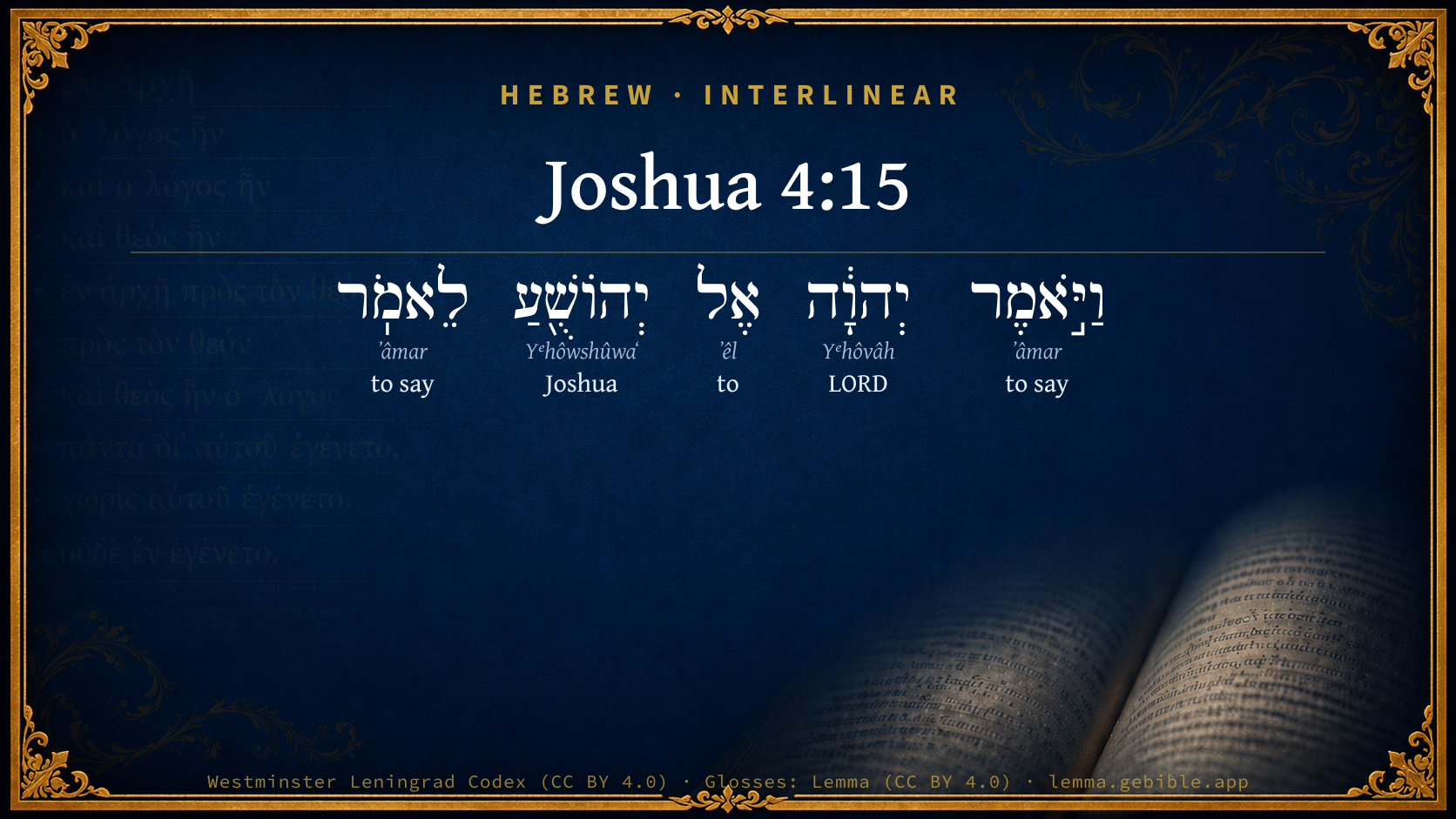
  1. וַיֹּ֣אמֶר ʼâmar H559 “and · to say” Conjunction + Verb, Qal, Sequential Imperfect, 3rd Person, Masculine, Singular
  2. יְהוָ֔ה Yᵉhôvâh H3068 “LORD” Noun, Proper
  3. אֶל ʼêl H413 “to” Preposition
  4. לֵאמֹֽר ʼâmar H559 “to say” Preposition + Verb, Qal, Infinitive Construct

About this verse

These counts appear in no published source. They are computed here, from the morphology-tagged text and Lemma’s own curated glosses. What Lemma adds →

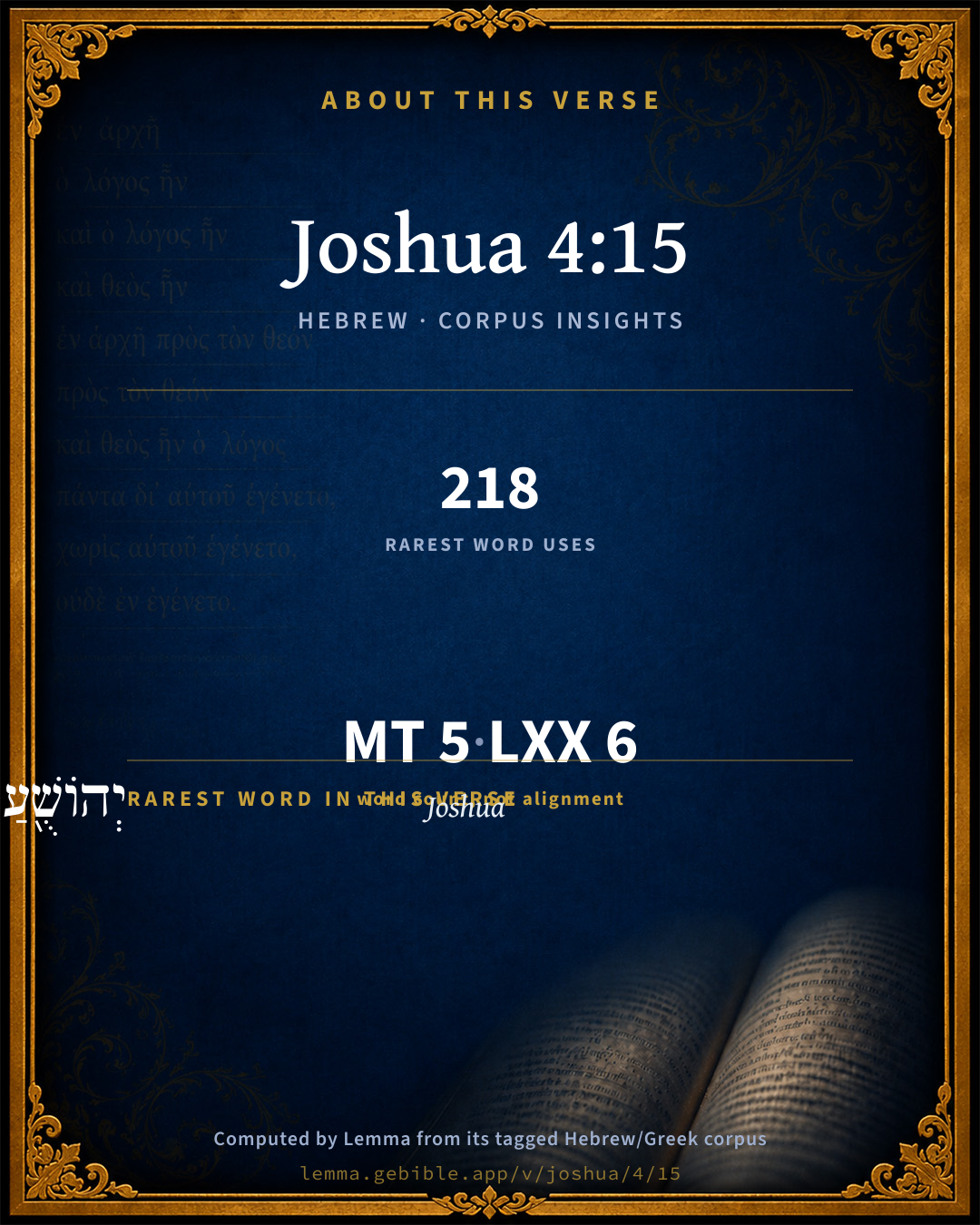
5
words
4
distinct lemmas
Historical
section

Grammatical profile

  • 2 verbs
  • 2 nouns
  • 1 preposition

Verb forms

  • וַיֹּ֣אמֶר Qal · Sequential Imperfect
  • לֵאמֹֽר Qal · Infinitive Construct

Repetition

A word recurs within this verse — often emphatic in Hebrew:

  • וַיֹּ֣אמֶר to say H559 ×2

Hebrew & Septuagint length

In English translation the verse runs 5 words from the Hebrew and 7 from the Septuagint (LXX English) — closely comparable.

A rough comparison of the two English renderings, which tokenize alike — not a word-level alignment.

Word counts can differ between the Hebrew and the Greek without any difference in meaning — e.g. the Hebrew direct-object marker אֵת has no separate Greek word, and Greek often adds the article ὁ.

In the original languages it is 5 Hebrew tokens and 6 Greek tokens — but the two are counted differently (Hebrew bundles its prefixes and suffixes into one token; the Greek is in lemma form), so that isn’t a like-for-like length.

Hebrew and Greek witnesses Masoretic Hebrew ↔ Greek Septuagint

The same verse in the two great witnesses to the Old Testament, shown verse-for-verse.

These are two independent witnesses, not word-aligned to each other, and the Septuagint is shown in lemma (dictionary) form.

Hebrew Joshua 4:15 Masoretic · Westminster Leningrad Codex

וַיֹּ֣אמֶר יְהוָ֔ה אֶל יְהוֹשֻׁ֖עַ לֵאמֹֽר

Yahweh spoke to Joshua, saying,

World English Bible · Public Domain

Greek LXX Joshua 4:15 Septuagint · lemma form

καί εἶπον κύριος ὁ ἰησοῦς λέγω

And the Lord spoke to Joshua, saying,

LXX2012 (modern English Septuagint) · Public Domain

Hebrew: Westminster Leningrad Codex (CC BY 4.0). Greek: Septuagint (public domain); English from LXX2012 (modern English Septuagint) (Public Domain). How the Septuagint differs from the Hebrew →

Targum (Aramaic paraphrase)

1

The Targum is the ancient Jewish Aramaic paraphrase of the Hebrew Scriptures — an interpretive translation, not the Hebrew text itself. Onkelos (literal) and Pseudo-Jonathan (expansive) render the Torah, and Jonathan the Prophets. Coverage is partial: where no permissively-licensed English translation exists for a verse, only the Aramaic is shown. This is verse-level text, not a word-by-word alignment to the Hebrew.

  1. Targum Jonathan Prophets (Joshua–Malachi)
    וַאֲמַר יְיָ לִיהוֹשֻׁעַ לְמֵימָר:

    (no public-domain English translation for this verse)

    Targum Jonathan — Aramaic: “Mikraot Gedolot” (public domain). English: “Sefaria Community Translation” (CC0 1.0 (public-domain dedication)); “London "Chaldee Paraphrase," 1871” (public domain). Text via Sefaria.

Commentary

Notes on Joshua 4:15 from classic Christian and Jewish commentators (each source and its license shown beneath its notes). The classic Christian expositions comment on the surrounding passage and are grouped to its opening verse, so a note may address several verses; the Jewish commentaries on the Tanakh (Rashi and others) are per-verse, so they appear only where the commentator wrote on this verse.

Lemma curates 59 commentaries, every one of them public domain or Creative Commons licensed, each selected and text-cleaned for this edition rather than reprinted as found. About our sources →

Trapp's Complete Commentary

John Trapp

Jos 4:15 And the LORD spake unto Joshua, saying,

Ver. 15. And the Lord spake unto Joshua.] See Jos 1:1.

John Trapp, A Commentary or Exposition upon All the Books of the Old and New Testament (1647–1656) — public domain. Text from a community e-Sword module.

John Gill's Exposition

And the Lord spake unto Joshua,.... When all the people had passed over jordan:

saying; as follows.

John Gill's Exposition of the Whole Bible (1746–1763) — public domain (CC PDM 1.0). Text via the HelloAO Bible API.

Albert Barnes' Notes on the Bible

The passage of the priests to the further bank had been already referred to, Jos 4:11; but the writer, in observance of his general plan (compare introductory remarks to Josh. 3), re-introduces it here as the leading feature in the concluding section of his account, and (as before) with mention of God’s special direction about it. The statement that on the removal of the ark the waters of Jordan at once returned to their former level Jos 4:18, heightens the impression which is especially inculcated throughout - that the whole transaction was extraordinary and miraculous. The details and incidents of the passage are no doubt open to manifold discussion: but all such discussion will be futile unless it proceed throughout on the admission that we have here before us the record of a distinctly supernatural interposition: compare the introduction to the Book of Joshua.

Albert Barnes' Notes on the Bible (1834–1885) — public domain. Text from a community e-Sword/MySword module.

Whedon's Commentary on the Bible

Daniel D. Whedon

15. The Lord spake unto Joshua — The Hebrew having no pluperfect, this may be rendered had spoken. This repetition of what has been previously described is for the purpose of showing how Joshua was magnified, by connecting his agency with the miracle. “The priests did not quit their station till Joshua, who had ordered them thither, ordered them thence; nor did he thus order them until the Lord commanded him: so obedient were all parties to the word of God.” — Scott.

Daniel D. Whedon (gen. ed.), Commentary on the Old and New Testaments (1874–1909) — public domain. Text from a community e-Sword module.

The Pulpit Commentary

And the Lord spake unto Joshua, saying. Meyer and others, according to the method of a certain school, regard this as an extract from another document, which is equivalent to saying that the Book of Joshua is a compilation of the most unintelligent kind, a conclusion which is refuted by every line of the Book. A vivid and picturesque narrative, such as we have before us, could hardly have Been brought together by the liberal use of scissors and paste, with utter disregard of the coherence of the extracts. It is not denied that the writer Of the Book of Joshua may have compiled his history from contemporary documents (see Introduction). All that is affirmed is that in so doing he used his materials with ordinary common sense. As has been before remarked, a marked feature of early Hebrew composition was repetition; repetition with additional details to add to the completeness of the narrative, but designed principally to emphasise the principal facts. Thus we are now told that it was at the command of Joshua, on God"s express intimation, that the priests left their post. And to mark more clearly the historian"s sense of the importance of the miracle, it is added that, as soon as the priests" feet had left the channel in which the waters had flowed up to the moment that they entered the waters of Jordan on the other side, the waters which had been cut off returned, and flowed exactly where they had done before. This additional fact, supplementing as it does the briefer detail in Jos_3:17 and Jos_4:11, must be therefore regarded as a record of the solemn conviction of the historian that in the events he is narrating he recognised a special interposition of the hand of God (see vers. 23, 24), in which in like manner we find a repetition in fuller detail of the command concerning the stones, designed to mark more clearly the sense the historian wishes his readers to have of the direct interference of God in what he has recorded.

Vers. 15-17. Prophets and priests the order of precedence.

Here a layman commands a priest. It was not a case of royal supremacy exactly, nor did he govern them by virtue of his being the civil head of the community; but because, though layman (he was of the tribe of Ephraim), he was a prophet. "The Lord spake to Joshua," and therefore Joshua could command even the priests of God. We have here not a question of arehaeological interest merely. It is a live question of today. Rome goes in for having an order of priests; Protestantism for an order of prophetsi.e. , speakers forth of God"s messages to man. They want a prescriptive class, elevated above their fellows, "ordained to offer gifts and sacrifices to God;" we want, not men ordained, but men inspired, who, fresh from the vision of God and converse with Him, will be able to tell us what He is, and feels, and wants. Are they or we following the more excellent way? Let the subordination of the priest to the prophet here help us to the answer. It may do so, for observe

I THE PRECEDENCE HERE IS the constant precedence. Aaron was older brother and high priest. Moses was the prophet who "spake with God face to face." The order of the names invariably is "Moses and Aaron:" prophet first, priest second. In all the subsequent centuries you find prophets foremost, priests subservient. The greatest men of Israel those who sustained their patriotism, kindled their devotion, fed the flame of hope, those who led them in the path of duty, and were the reformers of religion were prophets, Elijah and Elisha, Isaiah, Daniel. Ezra was the only priest who, without being a prophet, can be classed with them. Jeremiah and Ezekiel were priests and prophets, but it is in the latter character they rendered their grandest service. We must not depreciate the services of the priesthood. Perhaps the tone of Dean Stanley"s lecture on the Jewish Priesthood ("Jewish Church," vol. 2:356) is too disparaging. They tended to keep alive devotion, to familiarise men with the great idea of access to God, they guided men in the ways of gratitude and trust. Still the teachers, inspirers, leaders of souls were the prophets; and throughout all Old Testament history down to the time of the Maccabees, it is the prophetic order that keeps alive piety in all its grand activities. And if we had applied the same terms on the Christian dispensation it might be shown that the greater of the two services has been that rendered by men of the prophetic, rather than that rendered by men of the priestly, stamp. Athanasius, Augustine, Tertullian, St. Bernard, Luther, Calvin, Knox, Wesley those that can speak out the heart and the will of God have, according to a law of moral gravitation, found a higher level than the most devoted and self forgetful of ecclesiastics. Anyhow, here the prophet commands, and the priest obeys. Observe secondly

II THIS ORDER OF PRECEDENCE IS THE NATURAL ORDER. The rank of priest is high an ambassador of man in the court of heaven. But the rank of prophet is higher an ambassador of God. The priest"s grandest work is supplication; the prophet"s is to mediate the promises, commands, requirements of God. For the former office the requirements were low a certain lineage, freedom from physical defect, familiarity with ritual, rubric, and law. For the office of the prophet far higher requirements were made purity of heart, to see God; the open ear, that could hear His voice; the heart of love, that could enter into His purposes; the courage which could confront men with the Divine behest. The priest could be made by man the prophet only by God. The former had outward and visible ordination; the latter was ordained by the laying on of the unseen hands of the great God Himself. One reason why communities that have degenerated in faith are so emphatic in their doctrines of holy orders is that the priest is easily made, his work easily done, his claims easily asserted and enforced. But to make men prophets, or catch the inspiration of heaven, is not at all so easy. It takes a happy concurrence of grace and nature, a "bridal of the earth and sky," to make him. Naturally, therefore, because the prophet"s is a higher taste demanding higher powers, the prophet ranks before the priest. Lastly, observe as the conclusion of the above

III PROPHETS ARE THE GREAT WANT OF THIS AND EVERY AGE. True priests are invaluable: such as by their pity and their love are spontaneous, fervent intercessors for their fellow men. We should covet to be such: whether in or out of "orders," we may belong to "the Royal Priesthood," whose mark is not an official garb, but a compassionate heart. But the great want is prophets not prophets of the almanack sort, dealing with the curious questions of the future; but prophets of the Bible sort pre-eminently engaged with "present truth" and present duty. The great want of the age is not priests at the altar, but inspired men in all the pulpits of the land men who, walking with God, can bring to us the truth, the consolations, the requirements of God, with the authority of those who have learned from His lips what they address to our ears. Such men would speak "with authority" which all would recognise without needing demonstration of it. Their lips would feed many. Their utterances would find or make a way into all hearts. And reason approving, the heart accepting, the conscience endorsing, all their words, the people of our land would become "obedient to the heavenly vision" and "walk in the light of the Lord." Not after formal authority of the priest, but after the living inspiration of the prophet, let us all aspire. G.

The Pulpit Commentary (1880–1919), ed. H.D.M. Spence-Jones & Joseph S. Exell — public domain. Text from a community e-Sword module.

Keil & Delitzsch

C. F. Keil & F. Delitzsch

Termination of the miraculous Passage through the Jordan. - As soon as the priests left their standing-place in the river with the ark of the covenant, according to the command of God made known to them by Joshua, and the soles of their feet "tore themselves loose upon the dry ground" (נתּקוּ אל החרבה, constructio praegnans, for they tore themselves loose from the soft soil of the river, and trode upon the dry or firm ground), the waters of the Jordan returned again to their place, and went over all its banks as before (vid., Jos 3:15). This affirms as clearly as possible that it was the ark which kept back the stream.

Keil & Delitzsch — Biblical Commentary on the Old Testament (1861–1891) — public domain (CC PDM 1.0). Text via the HelloAO Bible API. (Old Testament only.)

unfoldingWord translationNotes

Door43 World Missions Community

General Information:

Yahweh tells Joshua to have the priests exit the Jordan River.

translationWords

Yahweh

Joshua

command

priest

ark of the covenant

unfoldingWord translationNotes — © Distant Shores Media and the Door43 World Missions Community, licensed CC BY-SA 4.0. Source: git.door43.org/Door43/en_tn.

Lesson kit

Teaching starters — assembled from the data on this page, not authored interpretation. Every prompt links to the verse data it draws on. Edit before teaching.

Joshua, in the Historical, opens this verse with 5 words (4 distinct Hebrew lemmas). Its most distinctive word is Yᵉhôwshûwaʻ (“Joshua”). A historical commentator’s framing appears above. Read the whole chapter for the surrounding context.

Discussion questions

  1. How does “Joshua” (Yᵉhôwshûwaʻ) shape what this verse is saying?
  2. “to say” occurs 2× in this one verse. What is the effect of the repetition?
  3. The translations on this page render this verse differently — a whole-verse word diff, not a word-by-word alignment. What might account for the different wordings?
  4. The verb «וַיֹּ֣אמֶר» is Qal Sequential Imperfect. How does its form color the action?
  5. Reading how Trapp's Complete Commentary and John Gill's Exposition read this verse, where do the two commentators agree and where do they part?

Things to notice

Reading settings

Reading text

Shown beneath each verse's original-language words.

Old Testament
Old Testament edition

Read the OT as the Masoretic Hebrew (MT) or the Greek Septuagint (LXX).

English shown for the Greek Septuagint (in the Hebrew ↔ Greek comparison).

Comparing translations? Open the Compare panel on any verse page to stack up to four side by side.