
Mark 12:17

Greek (Tischendorf 8th ed.) Mark 12:17 appears in the Greek New Testament. The text above is from the Tischendorf 8th edition. Each word links to its Strong’s number and a concise gloss. Click any word for its full Thayer’s Greek Lexicon entry.
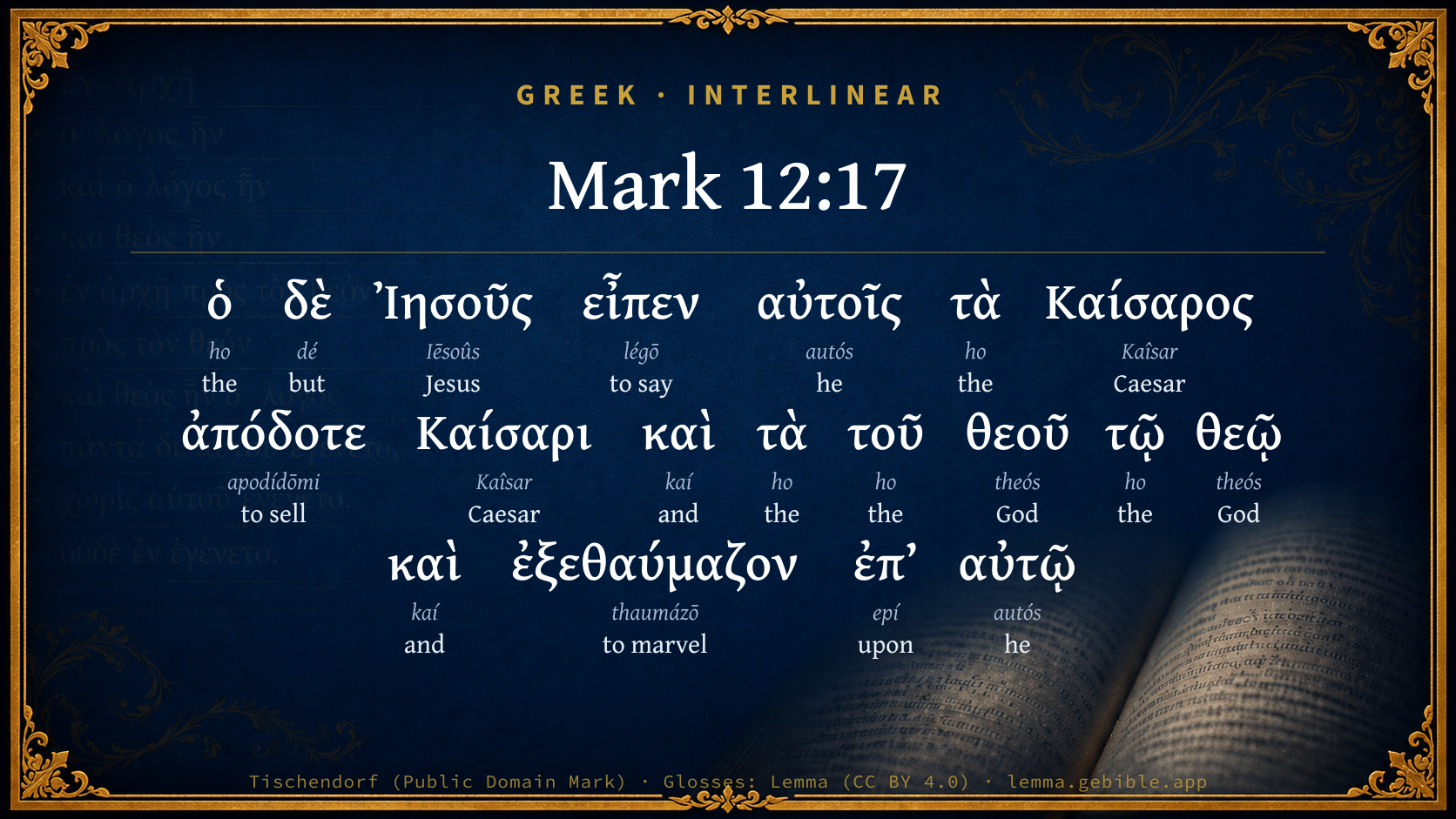
Download image
Cite this verse

Mark 12:17 (World English Bible). Public Domain. Lemma interlinear Bible study tool, https://lemma.gebible.app/v/mark/12/17.

Show BibTeX & RIS
BibTeX
RIS
English Translation
Jesus answered them, "Render to Caesar the things that are Caesar's, and to God the things that are God's." They marveled greatly at him.
World English Bible · Public Domain
Download a study sheet

One document with this verse’s original text, its word-by-word gloss line, the meaning frame, cross-references with their text, attributed commentary, and full source and license credits — printable, and it pastes into notes with its structure intact.

This verse Autodidact and up

Study sheet (.html) Plain text (.txt)

A passage Seminary Student

Up to 50 verses in one chapter. A passage sheet keeps up to 6 commentary sources and 12 cross-references per verse, in the order this page ranks them, and says so on the sheet whenever that leaves anything out. Ask for a single verse and you get the Autodidact verse sheet above.

Everything on this page stays free to read, with no account — the sheet is a download of what is already on screen, not access to it.

Want to remove ads? Support Godless Engineer
Compare translations 3

The same verse in 3 English versions, stacked beneath the original-language interlinear above. Click any original word for its lexicon entry.

Each is an independent rendering of the whole verse — the interlinear is not word-aligned to these translations.

Highlighted words mark where these versions differ — a whole-verse word diff, not a word-by-word alignment.

  • World English Bible Public Domain
    Jesus answered them, "Render to Caesar the things that are Caesar's, and to God the things that are God's." They marveled greatly at him.
  • King James Version Public Domain
    And Jesus answering said unto them, Render to Caesar the things that are Caesar's, and to God the things that are God's. And they marvelled at him.
  • unfoldingWord Literal Text CC BY-SA 4.0
    And Jesus said to them, “The things of Caesar, give back to Caesar, and the things of God, to God.” And they were marveling at him.

unfoldingWord Literal Text — © unfoldingWord, licensed CC BY-SA 4.0. Word-aligned USFM3 via Door43 (git.door43.org/unfoldingWord/en_ult).

Versions to compare (up to 4)

3 of 4 selected

Show all 19 translations

Every available English version of this verse, each an independent rendering of the whole verse.

  • World English Bible Public Domain
    Jesus answered them, "Render to Caesar the things that are Caesar's, and to God the things that are God's." They marveled greatly at him.
  • Berean Standard Bible Public Domain
    Then Jesus told them, “Give to Caesar what is Caesar’s, and to God what is God’s.” And they marveled at Him.
  • Majority Standard Bible Public Domain
    In response Jesus told them, “Give to Caesar what is Caesar’s, and to God what is God’s.” And they marveled at Him.
  • King James Version Public Domain
    And Jesus answering said unto them, Render to Caesar the things that are Caesar's, and to God the things that are God's. And they marvelled at him.
  • American Standard Version (1901) Public Domain
    And Jesus said unto them, Render unto Caesar the things that are Caesar's, and unto God the things that are God's. And they marvelled greatly at him.
  • Revised Version (1885) Public Domain
    And Jesus said unto them, Render unto Caesar the things that are Caesar’s, and unto God the things that are God’s. And they marveled greatly at him.
  • Geneva Bible (1599) Public Domain
    Then Iesus answered, and saide vnto them, Giue to Cesar the things that are Cesars, and to God, those that are Gods: and they marueiled at him.
  • Douay-Rheims (1899) Public Domain
    And Jesus answering, said to them: Render therefore to Caesar the things that are Caesar's, and to God the things that are God's. And they marvelled at him.
  • Young's Literal Translation Public Domain
    and Jesus answering said to them, `Give back the things of Caesar to Caesar, and the things of God to God;' and they did wonder at him.
  • Literal Standard Version CC BY-SA 4.0
    and Jesus answering said to them, “Give back the things of Caesar to Caesar, and the things of God to God”; and they wondered at Him.
  • Unlocked Literal Bible CC BY-SA 4.0
    Jesus said, “Give to Caesar the things that are Caesar's, and to God the things that are God's.” They marveled at him.
  • unfoldingWord Literal Text CC BY-SA 4.0
    And Jesus said to them, “The things of Caesar, give back to Caesar, and the things of God, to God.” And they were marveling at him.
  • Darby Bible Public Domain
    And Jesus answering said to them, Pay what is Caesar's to Caesar, and what is God's to God. And they wondered at him.
  • World Messianic Bible Public Domain
    Yeshua answered them, “Give to Caesar the things that are Caesar’s, and to God the things that are God’s.” They marveled greatly at him.
  • Webster's Bible Public Domain
    And Jesus answering, said to them, Render to Cesar the things that are Cesar's, and to God the things that are God's. And they wondered at him.
  • Free Bible Version CC BY-SA 4.0
    “Then give back to Caesar what belongs to him, and give back to God what belongs to him,” Jesus told them. They were amazed at his reply.
  • Bible in Basic English Public Domain
    And Jesus said to them, Give to Caesar the things which are Caesar's, and to God the things which are God's. And they were full of wonder at him.
  • Text-Critical English NT CC BY 4.0
    In response Jesus said to them, “Render to Caesar the things that are Caesar's, and to God the things that are God's.” And they were amazed at him.
  • Tyndale New Testament (1534) Public Domain
    And Iesus answered and saide vnto the: Then geve to Cesar that which belongeth to Cesar: and to God that which perteyneth to God. And they mervelled at him.

Literal Standard Version (2020), Covenant Press — licensed CC BY-SA 4.0. Text via the HelloAO Bible API (eBible.org). Unlocked Literal Bible (unfoldingWord) — licensed CC BY-SA 4.0. Text via the HelloAO Bible API (eBible.org). unfoldingWord Literal Text — © unfoldingWord, licensed CC BY-SA 4.0. Word-aligned USFM3 via Door43 (git.door43.org/unfoldingWord/en_ult). Free Bible Version, Dr. Jonathan Gallagher — licensed CC BY-SA 4.0. Text via the HelloAO Bible API (eBible.org).

Word by word

More ways to search: Search by grammar → Find every occurrence → Compare this word →

Practice this passage: Drill this verse → Learn its vocabulary →

Καίσαρος
Kaîsar
G2541
“Caesar”
Noun, Genitive, Singular, Masculine
Part of Speech
Noun
Case
Genitive
Number
Singular
Gender
Masculine
Full Thayer's Definition

Origin: of Latin origin

TDNT: None

Caesar = "severed" 1. the surname of Julius Caesar, which adopted by Octavius Augustus and his successors afterwards became a title, and was appropriated by the Roman emperors as part of their title
  1. ὁ ho G3588 “the” Article, Nominative, Singular, Masculine
  2. δὲ dé G1161 “but” Conjunction
  3. Ἰησοῦς Iēsoûs G2424 “Jesus” Noun, Nominative, Singular, Masculine
  4. εἶπεν légō G3004 “to say” Verb, Aorist, Active, Indicative, 3rd person, Singular
  5. αὐτοῖς autós G846 “he” Personal pronoun, Dative, Plural, Masculine
  6. τὰ ho G3588 “the” Article, Accusative, Plural, Neuter
  7. ἀπόδοτε apodídōmi G591 “to sell” Verb, Aorist, Active, Imperative, 2nd person, Plural
  8. Καίσαρι Kaîsar G2541 “Caesar” Noun, Dative, Singular, Masculine
  9. καὶ kaí G2532 “and” Conjunction
  10. τὰ ho G3588 “the” Article, Accusative, Plural, Neuter
  11. τοῦ ho G3588 “the” Article, Genitive, Singular, Masculine
  12. θεοῦ theós G2316 “God” Noun, Genitive, Singular, Masculine
  13. τῷ ho G3588 “the” Article, Dative, Singular, Masculine
  14. θεῷ theós G2316 “God” Noun, Dative, Singular, Masculine
  15. καὶ kaí G2532 “and” Conjunction
  16. ἐξεθαύμαζον thaumázō G2296 “to marvel” Verb, Imperfect, Active, Indicative, 3rd person, Plural
  17. ἐπ’ epí G1909 “upon” Preposition
  18. αὐτῷ autós G846 “he” Personal pronoun, Dative, Singular, Masculine

About this verse

These counts appear in no published source. They are computed here, from the morphology-tagged text and Lemma’s own curated glosses. What Lemma adds →

19
words
11
distinct lemmas
Gospels
section

Shared distinctive vocabulary

Καίσαρος Caesar G2541 occurs in 23 verses of the Greek New Testament. Also found in:
Repetition

Words recur within this verse:

  • Καίσαρος Caesar G2541 ×2
  • θεοῦ God G2316 ×2
  • ὁ the G3588 ×5
  • αὐτοῖς he G846 ×2
  • καὶ and G2532 ×2

Cross-references

18

Topical passages linked to Mark 12:17 in the Treasury of Scripture Knowledge — connected by theme and wording, ordered by reader-vote popularity; previews shown in the World English Bible.

  • Romans 13:7 Give therefore to everyone what you owe: taxes to whom taxes are due; customs to whom customs; respect to whom respect; honor to whom honor.
  • 1 Corinthians 14:24–25 But if all prophesy, and someone unbelieving or unlearned comes in, he is reproved by all, and he is judged by all.
  • 2 Corinthians 5:14–15 For the love of Christ constrains us; because we judge thus, that one died for all, therefore all died.
  • 1 Peter 2:17 Honor all men. Love the brotherhood. Fear God. Honor the king.
  • Job 5:12–13 He frustrates the devices of the crafty, So that their hands can't perform their enterprise.
  • Proverbs 24:21 My son, fear Yahweh and the king. Don't join those who are rebellious:
  • Matthew 22:22 When they heard it, they marveled, and left him, and went away.
  • Matthew 22:46 No one was able to answer him a word, neither dared any man from that day forth ask him any more questions.
  • Acts 4:19–20 But Peter and John answered them, "Whether it is right in the sight of God to listen to you rather than to God, judge for yourselves,
  • Ecclesiastes 5:4–5 When you vow a vow to God, don't defer to pay it; for he has no pleasure in fools. Pay that which you vow.
  • Malachi 1:6 "A son honors his father, and a servant his master. If I am a father, then where is my honor? And if I am a master, where is the respect due me? Says Yahweh of Hosts to you, priests, who despise my name. You say, 'How have we despised your name?'
  • Matthew 17:25–27 He said, "Yes." When he came into the house, Jesus anticipated him, saying, "What do you think, Simon? From whom do the kings of the earth receive toll or tribute? From their children, or from strangers?"
  • Romans 6:13 Neither present your members to sin as instruments of unrighteousness, but present yourselves to God, as alive from the dead, and your members as instruments of righteousness to God.
  • Romans 12:1 Therefore I urge you, brothers, by the mercies of God, to present your bodies a living sacrifice, holy, acceptable to God, which is your spiritual service.
  • Proverbs 23:26 My son, give me your heart; And let your eyes keep in my ways.
  • Matthew 22:33 When the multitudes heard it, they were astonished at his teaching.
  • Mark 12:30 you shall love the Lord your God with all your heart, and with all your soul, and with all your mind, and with all your strength.' This is the first commandment.
  • 1 Corinthians 6:19–20 Or don't you know that your body is a temple of the Holy Spirit which is in you, which you have from God? You are not your own,

Cross-references courtesy of OpenBible.info (CC BY 4.0).

Commentary

Notes on Mark 12:17 from classic Christian and Jewish commentators (each source and its license shown beneath its notes). The classic Christian expositions comment on the surrounding passage and are grouped to its opening verse, so a note may address several verses; the Jewish commentaries on the Tanakh (Rashi and others) are per-verse, so they appear only where the commentator wrote on this verse.

Lemma curates 59 commentaries, every one of them public domain or Creative Commons licensed, each selected and text-cleaned for this edition rather than reprinted as found. About our sources →

The Biblical Illustrator

Joseph S. Exell

Mar_12:17

Render to Caesar the things that are Caesars, and to God the things that are Gods.

Our obligations to God and man

The spirit of the passage requires us to regard the rights of all beings as sacred, and to give to them all that is theirs.

I. What is due to God? Or what are the things, the property of God, which our Saviour here requires us to render to Him? The earth is the Lords, etc. Of course we, and all that we possess, are Gods property. More particularly-

1. Our souls with all their faculties.

2. Our bodies.

3. Our time.

4. All our knowledge and literary acquisitions.

5. Our temporal possessions.

6. Our influence.

He, then, who withholds from God any of these things, or any part of them, does not comply with the precept in the text.

II. What things are due from us to men?

1. All men have a right to our love.

2. To all whom God has made our superiors we owe obedience, submission and respect.

3. To our inferiors we owe kindness, gentleness and condescension.

4. Those of us who are members of Christs visible church, owe to each other the performance of all the duties which result from our connection.

5. There are some things which we owe our families and connexions. As husbands and wives.

Improvement:

1. How great, how inconceivable is the debt which we have contracted both to God and to men!

2. Our need of an interest in the Saviour, and the impossibility of being saved without Him. We evidently cannot discharge our past debts. In Christ is there help. He becomes surety for all who believe in Him. And do not reason, conscience, and a regard to our own happiness, combine with Scripture in urging us to accept the offers of this Divine benefactor, and, constrained by His love, to live henceforth to Him, and not to ourselves? (Dr. Payson.)

God before Caesar

Frederic, the Elector of Saxony, who, being prisoner to Charles V, was promised enlargement and restitution of dignity, if he would come to mass. Summum in terris dominum, agnosco Caesarem, in caelis Deum.-In all civil accommodations I am ready to yield unto Caesar, but for heavenly things I have but one Master, and therefore I dare not serve two: Christ is more welcome to me in bonds, than the honours of Caesar without Christ. (Dictionary of Illustrations.)

An offence against Caesar

A boy about nine years of age, who attended a Sabbath school at Sunderland, requested his mother not to allow his brother to bring home anything that was smuggled when he went to sea. Why do you wish that, my child? said the mother. He answered, Because my catechism says it is wrong. The mother replied) But that is only the word of a man. He said, Mother, is it the word of a man which said, Render unto Caesar the things that are Caesars? This reply entirely silenced the mother; but his father, still attempting to defend the practice of smuggling, the boy said to him, Father, whether is it worse to rob one or to rob many? By these questions and answers, the boy silenced both his parents on the subject of smuggling. (Biblical Museum.)

The Biblical Illustrator, edited by Joseph S. Exell (c. 1880s–1900s) — public domain. Text from a community e-Sword module.

Tyndale Open Study Notes

Tyndale Open Resources

12:17 give to Caesar what belongs to Caesar: Jesus’ words cannot be taken as those of an anti-Roman zealot opposing Jewish taxation by Caesar. Jesus clearly indicates elsewhere that he was opposed to the zealot cause (see Matt 5:9, 39, 41; 26:52). However, Jesus’ statement cannot be understood as pro-Roman, either, because service to God is fundamental, and God is ultimately over Caesar. Like the evil farmers in the previous parable, the religious leaders had not given God what belonged to him.

Tyndale Open Study Notes — © Tyndale Open Resources, licensed CC BY-SA 4.0. Text via the HelloAO Bible API.

Expositor's Greek Testament

ed. W. Robertson Nicoll

Mar 12:17 . Christ’s reply is given here very tersely = the things of Caesar render to Caesar, and those of God to God. ἐξεθαύμαζον : the compound, in place of Mt.’s simple verb, suggests the idea of excessive astonishment, though we must always allow for the tendency in late Greek to use compounds. Here only in N. T., occasionally in Sept [111] [111] Septuagint.

The Expositor's Greek Testament, edited by W. Robertson Nicoll (1897–1910) — public domain. Text from a community e-Sword module.

The Cambridge Bible for Schools and Colleges

gen. ed. J. J. S. Perowne

17. Render] Literally, Give back, pay as being due. “therefore yelde ye to Cæsar,” Wyclif. It was not a question of a voluntary gift, but of a legal due. The head of the Emperor on the coin, the legend round it, and its circulation in the country, were undeniable proofs of the right of the actually existing government to levy the tax. “Ubicunque numisma alicujus regis obtinet, illic incolæ regem istum pro domino agnoscunt;” Maimonides. Remembrance of this precept “would have spared the Jewish war, the destruction of Jerusalem, and the downfall of their nation.” Lange.

and to God] He would remind them that besides the claims of the ruling powers, they had also the claim upon them of their Spiritual King, and obedience to Cæsar must ever be conditioned by obedience to God. “Render unto Cæsar all that he can lawfully demand, but render also to God, what He requires of you as His spiritual subjects.” “Give to God that which has the image and superscription of God, the soul.” Erasmus.

they marvelled at him] Neither the orthodox Pharisee nor the aristocratic royalist had expected such an answer from the Galilæan Teacher.

The Cambridge Bible for Schools and Colleges (gen. ed. J. J. S. Perowne; Cambridge University Press, 1878–1918) — public domain. Text from a community e-Sword module.

John Gill's Exposition

Master, Moses wrote unto us,.... Has left in writing for us the following precept to observe; for they acknowledged the writings of Moses, and indeed all the Scriptures of the Old Testament; adhering to the literal sense of them, and rejecting the traditional interpretation of them by the Rabbins:

if a man's brother die, and leave no children, that his brother should take his wife, and raise up seed unto his brother; which is the sense of the law in Deu 25:5; See Gill on Mat 22:24.

John Gill's Exposition of the Whole Bible (1746–1763) — public domain (CC PDM 1.0). Text via the HelloAO Bible API.

Trapp's Complete Commentary

John Trapp

17 And Jesus answering said unto them, Render to Caesar the things that are Caesar’s, and to God the things that are God’s. And they marvelled at him.

Ver. 17. {See Trapp on "Mat 22:21"}

John Trapp, A Commentary or Exposition upon All the Books of the Old and New Testament (1647–1656) — public domain. Text from a community e-Sword module.

Haydock's Catholic Bible Commentary

Although Christ clearly establishes here the strict obligation of paying to Cæsar what belongs to Cæsar, to the confusion of his very enemies, we shall still find them bringing forward against him the charge of disloyalty, as if he forbade tribute to be paid to Cæsar. (Luke xxiii. 2.) After the example of her divine Model, the Catholic Church has uniformly taught with St. Paul, the necessity of obeying the powers in being; and this not for fear of their wrath, but for conscience sake. Render to Cæsar the money on which his image is stamped, but render yourselves cheerfully to God; for the light of thy countenance, O Lord, is stamped upon us, (Psalm iv.) and not the image of Cæsar. (St. Jerome) --- With reason were they astonished at the wisdom of this answer, which eluded all their artifices, and taught them at the same time what they owed to their prince, and what they owed to God: and whoever hopes for the favour of heaven, must conscientiously observe this double duty to God and to the magistrate.

George Leo Haydock (1774–1849), Haydock's Catholic Family Bible and Commentary, 1859 edition — public domain. Excludes Psalms (Douay-Rheims chapter numbering differs from Protestant) and Deuterocanonical books (Catholic canon only).

The Pulpit Commentary

Render unto Caesar the things that are Caesar"s, and unto God the things that are God"s. It is as though our Lord said, "Since you Jews are now subject to Caesar and there is here this evidence of it, that his coin is current amongst you; you would not use it were you not obliged, because all Gentile rites and symbols are an abhorrence to you; but since Caesar demands nothing of you but his tribute the coin stamped with his own image and name it is your duty to render to him his own denarius for tribute. But spiritual things, such as worship and obedience, give these to God; for these he demands from you as his right, and by so doing you will offend neither God nor yet Caesar." Our Lord, in his infinite wisdom, avoids the question altogether whether the Jews were rightly in subjection to the Romans. This was a doubtful question. But there could be no doubt as to the fact that they were tributary. This was made plain by the evidence of the current coin. Now, this being so, it was manifestly the duty of the Jewish people to give to Caesar the tribute money which he demanded of them for the expenses of government, and especially of supporting an army to defend them from their enemies. And it was no less their duty to give their tribute to God, which he in his own right demanded of them as his creatures and faithful subjects. The rights of Caesar are one thing, and those of God are another; and there is nothing that need clash between them. State polity is not opposed to religion, nor religion to state. Tertullian says, to Caesar the things that are Caesar"s, and to God the things that are God"s;" that is, give to Caesar his image stamped upon his coin, and give to God his own image stamped upon you; so that while you render to Caesar the coin which is his due, you may render your own self to God." This wonderful answer of our Lord teaches us that we ought to try to speak so wisely, and so to moderato our speech amongst those who are captious, that we may, if possible, offend neither side, but steer safely between Scylla and Charybdis. And they marvelled at him. The true Greek reading of the verb here is not eyaumasan , but exeyaumazon , they marvelled greatly at him; they stood marvelling greatly at him. They marvelled at his wisdom and skill in extricating himself so readily out of this net in which they had hoped to entangle him. Indeed, the words of the psalmist (Psa_9:15) were verified in them: "The wicked is snared in the work of his own hands." He vaulted over the trap set for him, leaving them entangled in it. He lifted up the question far above the petty controversy of the hour, and affirmed a great principle of natural and religious obligation which belongs alike to all times and persons and places.

"Bring me a penny.

I CHRIST WILL HAVE ACCOUNT OF THE SMALLEST THINGS. The denarius was a small coin in common use. The spirit of Christ, sun-like, discovers even the "motes." In all things there is duty. Christ"s attitude to the Law not only general but particular. "Not one jot or tittle" was to pass away unfulfilled because of the influence of Christianity. "Ye are my disciples, if ye do whatsoever I have commanded you." We shall have to give account of smallest things at last idle words, false shame, "the cup of cold water," etc. The parable of the pounds has for its moral, "He that is faithful in that which is least," etc. There is no slurring over of little things because of a general disposition and amiable intention.

II SMALL THINGS OFTEN REPRESENT GREAT PRINCIPLES, AND BECOME THE VEHICLES OF GREAT DUTIES. Coins are often of value, apart from their intrinsic worth, in witnessing to conquests, political influences, the progress of civilization, etc.; and numismatists have made many important contributions to history through their testimony. In this case the witness was even more pregnant and precious. It proved what actually existed, and represented the claim of earthly powers. The duty to God was shown thereby to be something quite distinct, and the general relation of the human and the Divine in human obligations was thereby permanently settled and set forth. It is equally so in regard to other things. "A straw will show which way the wind blows, or the water flows." Illustrated in such instances as the Massacre of St. Bartholomew; watchwords and flag of truce in time of war; the potty dealings of common life; the "minor moralities" of the Christian, etc.

III WE ARE ENCOURAGED AND COMMANDED TO BRING SMALL THINGS TO CHRIST Do not say he has no interest in them. See how he looks at that widow with her two mites. Hear how he calls the little children. We need a more thorough Christianity, and if we follow this rule of bringing our daily concerns, our griefs, our moral difficulties, our sins, to the throne of grace, we shall become "Israelites indeed, in whom is no guile." He will interpret the minutest uncertainty or perplexity, and show us the great in the little. Erasmus Darwin wrote (April 13, 1789): "I have just heard that there are muzzles or gags made at Birmingham for the slaves in our islands. If this be true, and such an instrument could be exhibited by a speaker in the House of Commons, it might have a great effect. Could not one of their long whips or wire-tails be also procured and exhibited? But an instrument of torture of our own manufacture would have a greater effect, I dare say" ("Life," p. 46). M.

The Pulpit Commentary (1880–1919), ed. H.D.M. Spence-Jones & Joseph S. Exell — public domain. Text from a community e-Sword module.

John Wesley's Explanatory Notes

They marvelled at him - At the wisdom of his answer.

John Wesley, Explanatory Notes Upon the Whole Bible (1754–1765) — public domain. Text via the GEBible commentary corpus.

Bengel's Gnomon

Johann Albrecht Bengel

[17. Τὰ τοῦ θεοῦ, the things that are God’s) All things are GOD’S, heaven and earth, all men, and therefore Cæsar himself. Yet nevertheless He hath made a wise distribution as regards His goods. On that account the less ought He to be defrauded of those things which He hath peculiarly reserved to Himself.—V. g.]

Bengel's Gnomon of the New Testament — English translation (T&T Clark, Edinburgh, 1860) — public domain. Text from a community e-Sword module.

Cambridge Greek Testament for Schools and Colleges

17. [2715][2716][2717][2718][2719] omit ἀποκριθείς See on Mar 7:6, Mar 10:5. ἐξεθαύμαζον ([2720][2721][2722]) rather than ἐθαύμαζον ([2723]2[2724][2725]) or ἐθαύμασαν ([2726][2727][2728][2729][2730][2731]).

[2715] Codex Sinaiticus. 4th cent. Discovered by Tischendorf in 1859 at the Monastery of St Katharine on Mount Sinai. Now at St Petersburg. The whole Gospel, ending at Mar 16:8. Photographic facsimile, 1911.

[2716] Codex Vaticanus. 4th cent., but perhaps a little later than א. In the Vatican Library almost since its foundation by Pope Nicolas V., and one of its greatest treasures. The whole Gospel, ending at Mar 16:8. Photographic facsimile, 1889.

[2717] Codex Ephraemi. 5th cent. A palimpsest: the original writing has been partially rubbed out, and the works of Ephraem the Syrian have been written over it; but a great deal of the original writing has been recovered; of Mark we have Mar 1:17 to Mar 6:31, Mar 8:5 to Mar 12:29, Mar 13:19 to Mar 16:20. In the National Library at Paris.

[2718] Codex Regius. 8th cent. An important witness. At Paris. Contains Mar 1:1 to Mar 10:15; Mar 10:30 to Mar 15:1; Mar 15:20 to Mar 16:20, but the shorter ending is inserted between Mar 16:8 and Mar 16:9, showing that the scribe preferred it to the longer one.

[2719] Codex Sangallensis. 9th or 10th cent. Contains the Gospels nearly complete, with an interlinear Latin translation. The text of Mark is specially good, agreeing often with CL. At St Gall.

[2720] Codex Sinaiticus. 4th cent. Discovered by Tischendorf in 1859 at the Monastery of St Katharine on Mount Sinai. Now at St Petersburg. The whole Gospel, ending at Mar 16:8. Photographic facsimile, 1911.

[2721] Codex Vaticanus. 4th cent., but perhaps a little later than א. In the Vatican Library almost since its foundation by Pope Nicolas V., and one of its greatest treasures. The whole Gospel, ending at Mar 16:8. Photographic facsimile, 1889.

[2722] Codex Athous Laurae. 8th cent. Like N and Σ, it is written in silver letters on purple vellum. Contains Mar 9:5 to Mar 16:20, and, as in L, the shorter ending is inserted between Mar 16:8 and Mar 16:9. As in Δ, the text of Mark is specially good.

[2723] Codex Bezae. 6th cent. Has a Latin translation (d) side by side with the Greek text, and the two do not quite always agree. Presented by Beza to the University Library of Cambridge in 1581. Remarkable for its frequent divergences from other texts. Contains Mark, except Mar 16:15-20, which has been added by a later hand. Photographic facsimile, 1899.

[2724] Codex Regius. 8th cent. An important witness. At Paris. Contains Mar 1:1 to Mar 10:15; Mar 10:30 to Mar 15:1; Mar 15:20 to Mar 16:20, but the shorter ending is inserted between Mar 16:8 and Mar 16:9, showing that the scribe preferred it to the longer one.

[2725] Codex Sangallensis. 9th or 10th cent. Contains the Gospels nearly complete, with an interlinear Latin translation. The text of Mark is specially good, agreeing often with CL. At St Gall.

[2726] Codex Alexandrinus. 5th cent. Brought by Cyril Lucar, Patriarch of Constantinople, from Alexandria, and afterwards presented by him to King Charles I. in 1628. In the British Museum. The whole Gospel. Photographic facsimile, 1879.

[2727] Codex Ephraemi. 5th cent. A palimpsest: the original writing has been partially rubbed out, and the works of Ephraem the Syrian have been written over it; but a great deal of the original writing has been recovered; of Mark we have Mar 1:17 to Mar 6:31, Mar 8:5 to Mar 12:29, Mar 13:19 to Mar 16:20. In the National Library at Paris.

[2728] Codex Purpureus. 6th cent. Full text in Texts and Studies v. No. 4, 1899. Contains Mar 5:20 to Mar 7:4; Mar 7:20 to Mar 8:32; Mar 9:1 to Mar 10:43; Mar 11:7 to Mar 12:19; Mar 14:25 to Mar 15:23; Mar 15:33-42. See below on Ψ.

[2729] Codex Monacensis. 10th cent. Contains Mar 6:47 to Mar 16:20. Many verses in 14, 15, 16 are defective.

[2730] Codex Oxoniensis. 9th cent. Contains Mark, except Mar 3:35 to Mar 6:20.

[2731] Codex Petropolitanus. 9th cent. Gospels almost complete. Mar 16:18-20 is in a later hand.

17. Τὰ Καίσαρος ἀπόδοτε Καίσαρι. The change from δοῦναι to ἀπόδοτε gives the whole principle. It was not a question of giving what might lawfully be refused, but of paying what was lawfully claimed. The tribute was not a gift but a debt. Caesar gave them the inestimable benefit of stable government; were they to take it and decline to pay anything towards its maintenance? The discharge of this duty in no way interfered with their duty to God. The paying of the coin, with Caesar’s image upon it, to Caesar in no way hindered a man’s giving himself, made in God’s image, to God. Οὐδὲν ἐμποδίζει πρὸς θεοσέβειαν τὸ τελεῖν τῷ καίσαρι (Theoph.): indeed the one duty was included in the other. Ranke has pointed to this Saying as having had immense influence on the course of history. This is true, but largely through misunderstanding; Christ does not say anything here as to the relations between Church and State. Lightfoot, Sermons in St Paul’s, pp. 46 ff.

ἐξεθαύμαζον. All three mention the admiration of the audience. The answer was complete, and yet, as Lk. points out, there was nothing to take hold of; the Saying was ἄληπτον. The compound verb is rare; Sir 27:23; Sir 43:18; 4Ma 17:17. Cf. ἐκθαμβέομαι (Mk only in N.T.).

Here some critics place the pericope about the Woman taken in Adultery.

Cambridge Greek Testament for Schools and Colleges (Cambridge University Press, 1896; 21 vols, various authors incl. Carr, Maclear, Plummer, Farrar, Lumby, Moule, M. R. James, Simcox) — public domain. Text from a community e-Sword module.

Alford’s Greek Testament

Henry Alford

17.] ἐθαύμαζον, imperfect, is graphic. This was going on, when the next incident began.

Henry Alford, The Greek Testament (1849–1861) — public domain. Text from a community e-Sword module.

International Critical Commentary

17. Ὁ δὲ Ἰησοῦς εἶπεν αὐτοῖς, Τὰ Καίσαρος ἀπόδοτε Καίσαρι—And Jesus said to them, The things belonging to Cæsar pay to Cæsar.

Ὁ δὲ, instead of Καὶ ἀποκριθεὶς ὁ, Tisch. Treg. WH. RV. א BCL Δ 33, Theb.

ἀπόδοτε—pay. They had said, δοῦναι, give. Jesus makes it a matter of payment. τὰ Καίσαρος—the things of Cæsar. Strictly speaking, this means, Pay to the Roman government Roman coin. They themselves were tacitly recognizing the government, and availing themselves of their privileges under it by using its coin, and that left them no pretext for denying its rights. The coin represents simply the right of the government. The image and superscription on it show the government maintaining to the people the position not only of power, but of rights. It is in this, as in all things, the defender of rights. This gives to the government itself rights, of which tribute is representative. But our Lord’s reply is entirely characteristic. It suggests, rather than amplifies or explains. κ. τὰ τ. Θεοῦ τῷ Θεῷ—and the things belonging to God to God. The way in which they had presented the question implied that there was a conflict between the claims of the earthly and heavenly governments. But Jesus shows them as each having claims. Cæsar has claims, and also God; pay both. The difficulty with the Jews, and with all bodies claiming to represent God, is that they are zealous for him in a partisan way, jealous of his prerogatives, dignities, and the like, and make that do service for a real loyalty to him. These men were eager to assert God’s claim against a foreign king. Jesus was anxious that they should recognize his real claims, those that involved no real conflict, but belonged in the wider sphere of common duties. κ. ἐξεθαύμαζον—and they wondered. Well they might. Jesus had not only parried their attack, which was a small matter, but had thrown light on a very difficult question. The conflict of duties is one of the perplexities of life, and the question of the relation of the Christian to civil government is often one of the most trying forms of the general problem. Jesus’ answer is practically, Do not try to make one duty exclude another, but fulfil one so as to consist with all the rest. As far as the special matter is concerned, it recognizes the right of civil government, the obligation of those who live under a theocracy to be subject to civil authority, an obligation not abrogated, but enforced by their duty to God; that the Divine obedience does not exclude, but include other obediences; and finally, that human government, as included thus within the Divine scheme of things, is among the economies to be conformed to its perfect idea.

ἐξεθαύμαζον, instead of ἐθαύμασαν, Tisch. WH. RV. א B.

JESUS ANSWERS THE PUZZLE OF THE SADDUCEES ABOUT THE RESURRECTION

International Critical Commentary — older volumes (1896–1929), various authors — public domain. Text from a community e-Sword module.

Vincent's Word Studies in the New Testament

Marvin R. Vincent

They marvelled [εξεθαυμαζον] . The preposition ejx, out of, indicates great astonishment. They marvelled out of measure. Hence Rev., marvelled greatly. The A. V. follows another reading, with the simple verb ejqaumazon. The imperfect denotes continuance : they stood wondering.

Marvin R. Vincent, Word Studies in the New Testament (1887–1900) — public domain. Text from a community e-Sword/MySword module.

Lesson kit

Teaching starters — assembled from the data on this page, not authored interpretation. Every prompt links to the verse data it draws on. Edit before teaching.

Mark, in the Gospels, opens this verse with 19 words (11 distinct Greek lemmas). Its most distinctive word is Kaîsar (“Caesar”). A historical commentator’s framing appears above. Read the whole chapter for the surrounding context.

Discussion questions

  1. How does “Caesar” (Kaîsar) shape what this verse is saying?
  2. Matthew 22:17 shares the word «Caesar» with this verse. How do the two illuminate each other?
  3. “Caesar” occurs 2× in this one verse. What is the effect of the repetition?
  4. These translations render this verse differently; the difference is in the English rendering, not the original. What questions does that raise?
  5. Reading how The Biblical Illustrator and Tyndale Open Study Notes read this verse, where do the two commentators agree and where do they part?

Things to notice

Reading settings

Reading text

Shown beneath each verse's original-language words.

Old Testament
Old Testament edition

Read the OT as the Masoretic Hebrew (MT) or the Greek Septuagint (LXX).

English shown for the Greek Septuagint (in the Hebrew ↔ Greek comparison).

Comparing translations? Open the Compare panel on any verse page to stack up to four side by side.