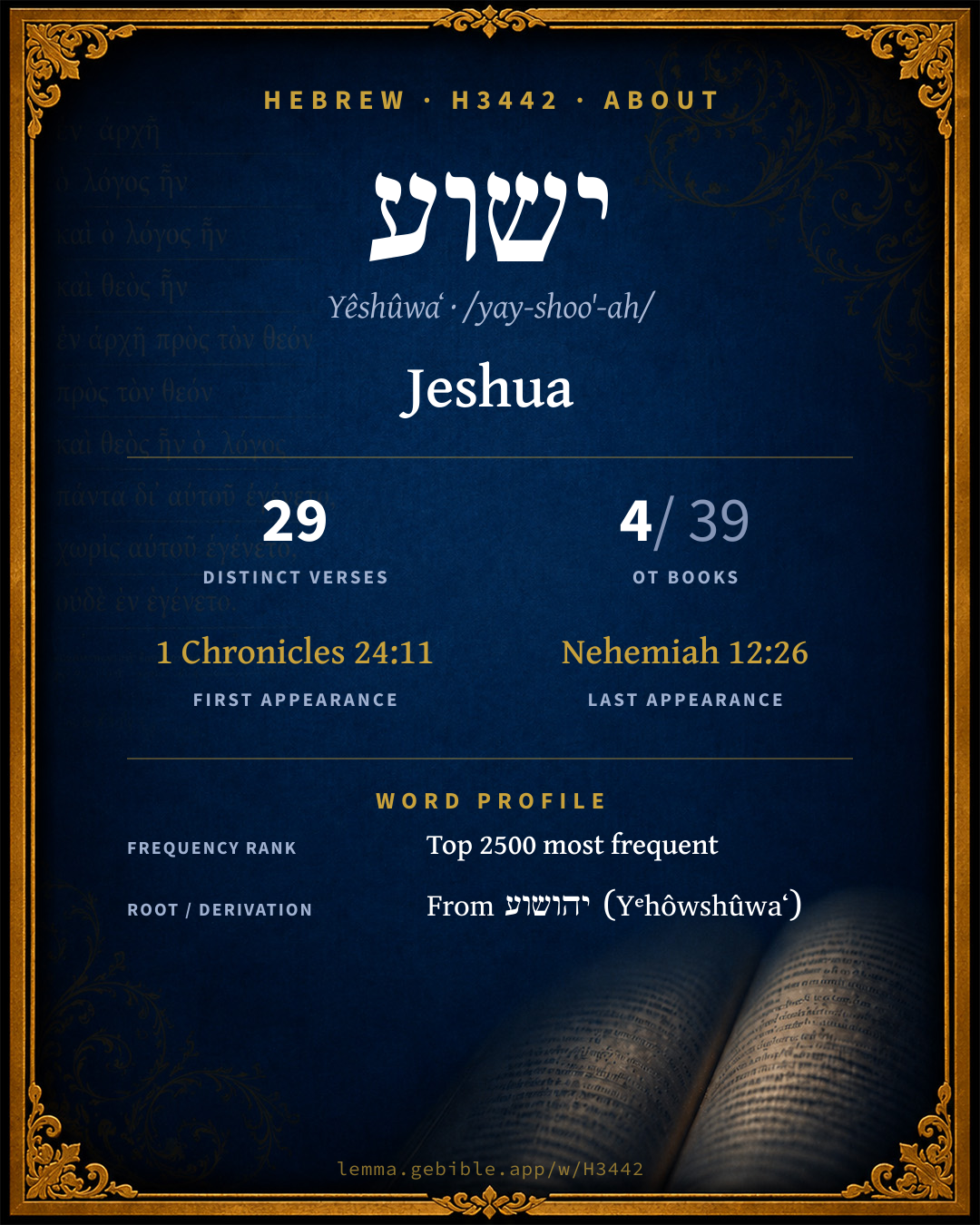
יֵשׁוּעַ
Jeshua
BDB lists 8 entries for ‘Jeshua’ fuller range ↓
Full lexicon entry — Brown-Driver-Briggs (BDB)
From Brown-Driver-Briggs (BDB)
Where this word appears
Grammar key — what these labels mean
Part of speech
- Noun
- A naming word — a person, place, thing, or idea.
Noun type
- Proper
- A name of a specific person, place, or people (e.g. Abraham, Zion, Israel).
Every verse where H3442 appears — 29 distinct verses across 4 books. Click any verse to open its interlinear word-by-word view. Verse text shown in the World English Bible for context — . Each verse’s Hebrew form is shown with its reference; the English is not keyword-highlighted, since the data carries no word-level English alignment. Use “Compare translations” on any verse to read it across multiple English versions. This concordance covers the Hebrew Bible; Septuagint (Greek Old Testament) occurrences are not indexed here.
1 Chronicles 1 verse
2 Chronicles 1 verse
Ezra 10 verses
- Ezra 2:2 יֵשׁ֡וּעַ n Proper who came with Zerubbabel, Jeshua, Nehemiah, Seraiah, Reelaiah, Mordecai, Bilshan, Mispar, Bigvai, Rehum, Baanah. The number of the men of the people of Israel:
- Ezra 2:6 יֵשׁ֖וּעַ n Proper The children of Pahath-moab, of the children of Jeshua [and] Joab, two thousand eight hundred twelve.
- Ezra 2:36 יֵשׁ֔וּעַ n Proper The priests: the children of Jedaiah, of the house of Jeshua, nine hundred seventy-three.
- Ezra 2:40 יֵשׁ֧וּעַ n Proper The Levites: the children of Jeshua and Kadmiel, of the children of Hodaviah, seventy-four.
- Ezra 3:2 יֵשׁ֨וּעַ n Proper Then stood up Jeshua the son of Jozadak, and his brothers the priests, and Zerubbabel the son of Shealtiel, and his brothers, and built the altar of the God of Israel, to offer burnt offerings thereon, as it is written in the law of Moses the man of God.
- Ezra 3:8 וְ/יֵשׁ֨וּעַ conj + n Proper Now in the second year of their coming to the house of God at Jerusalem, in the second month, began Zerubbabel the son of Shealtiel, and Jeshua the son of Jozadak, and the rest of their brothers the priests and the Levites, and all those who were come out of the captivity to Jerusalem, and appointed the Levites, from twenty years old and upward, to have the oversight of the work of the house of Yahweh.
- Ezra 3:9 יֵשׁ֡וּעַ n Proper Then stood Jeshua with his sons and his brothers, Kadmiel and his sons, the sons of Judah, together, to have the oversight of the workmen in the house of God: the sons of Henadad, with their sons and their brothers the Levites.
- Ezra 4:3 וְ/יֵשׁ֗וּעַ conj + n Proper But Zerubbabel, and Jeshua, and the rest of the heads of fathers' [houses] of Israel, said to them, You have nothing to do with us in building a house to our God; but we ourselves together will build to Yahweh, the God of Israel, as king Cyrus the king of Persia has commanded us.
- Ezra 8:33 יֵשׁ֛וּעַ n Proper On the fourth day the silver and the gold and the vessels were weighed in the house of our God into the hand of Meremoth the son of Uriah the priest; and with him was Eleazar the son of Phinehas; and with them was Jozabad the son of Jeshua, and Noadiah the son of Binnui, the Levite;
- Ezra 10:18 יֵשׁ֤וּעַ n Proper Among the sons of the priests there were found who had married foreign women: [namely], of the sons of Jeshua, the son of Jozadak, and his brothers, Maaseiah, and Eliezer, and Jarib, and Gedaliah.
Nehemiah 17 verses
- Nehemiah 3:19 יֵשׁ֛וּעַ n Proper Next to him repaired Ezer the son of Jeshua, the ruler of Mizpah, another portion, over against the ascent to the armory at the turning [of the wall].
- Nehemiah 7:7 יֵשׁ֡וּעַ n Proper who came with Zerubbabel, Jeshua, Nehemiah, Azariah, Raamiah, Nahamani, Mordecai, Bilshan, Mispereth, Bigvai, Nehum, Baanah. The number of the men of the people of Israel:
- Nehemiah 7:11 יֵשׁ֖וּעַ n Proper The children of Pahath-moab, of the children of Jeshua and Joab, two thousand eight hundred [and] eighteen.
- Nehemiah 7:39 יֵשׁ֔וּעַ n Proper The priests: The children of Jedaiah, of the house of Jeshua, nine hundred seventy-three.
- Nehemiah 7:43 יֵשׁ֧וּעַ n Proper The Levites: the children of Jeshua, of Kadmiel, of the children of Hodevah, seventy-four.
- Nehemiah 8:7 וְ/יֵשׁ֡וּעַ conj + n Proper Also Jeshua, and Bani, and Sherebiah, Jamin, Akkub, Shabbethai, Hodiah, Maaseiah, Kelita, Azariah, Jozabad, Hanan, Pelaiah, and the Levites, caused the people to understand the law: and the people [stood] in their place.
- Nehemiah 8:17 יֵשׁ֨וּעַ n Proper All the assembly of those who were come again out of the captivity made booths, and lived in the booths; for since the days of Jeshua the son of Nun to that day the children of Israel had not done so. There was very great gladness.
- Nehemiah 9:4 יֵשׁ֨וּעַ n Proper Then stood up on the stairs of the Levites, Jeshua, and Bani, Kadmiel, Shebaniah, Bunni, Sherebiah, Bani, [and] Chenani, and cried with a loud voice to Yahweh their God.
- Nehemiah 9:5 יֵשׁ֣וּעַ n Proper Then the Levites, Jeshua, and Kadmiel, Bani, Hashabneiah, Sherebiah, Hodiah, Shebaniah, [and] Pethahiah, said, Stand up and bless Yahweh your God from everlasting to everlasting; and blessed be your glorious name, which is exalted above all blessing and praise.
- Nehemiah 10:9 וְ/יֵשׁ֨וּעַ֙ conj + n Proper The Levites: namely, Jeshua the son of Azaniah, Binnui of the sons of Henadad, Kadmiel;
- Nehemiah 11:26 וּ/בְ/יֵשׁ֥וּעַ conj + prep + n Proper and in Jeshua, and in Moladah, and Beth Pelet,
- Nehemiah 12:1 וְ/יֵשׁ֑וּעַ conj + n Proper Now these are the priests and the Levites who went up with Zerubbabel the son of Shealtiel, and Jeshua: Seraiah, Jeremiah, Ezra,
- Nehemiah 12:7 יֵשֽׁוּעַ n Proper Sallu, Amok, Hilkiah, Jedaiah. These were the chiefs of the priests and of their brothers in the days of Jeshua.
- Nehemiah 12:8 יֵשׁ֧וּעַ n Proper Moreover the Levites: Jeshua, Binnui, Kadmiel, Sherebiah, Judah, [and] Mattaniah, who was over the thanksgiving, he and his brothers.
- Nehemiah 12:10 וְ/יֵשׁ֖וּעַ conj + n Proper Jeshua became the father of Joiakim, and Joiakim became the father of Eliashib, and Eliashib became the father of Joiada,
- Nehemiah 12:24 וְ/יֵשׁ֤וּעַ conj + n Proper The chiefs of the Levites: Hashabiah, Sherebiah, and Jeshua the son of Kadmiel, with their brothers over against them, to praise and give thanks, according to the commandment of David the man of God, watch next to watch.
- Nehemiah 12:26 יֵשׁ֖וּעַ n Proper These were in the days of Joiakim the son of Jeshua, the son of Jozadak, and in the days of Nehemiah the governor, and of Ezra the priest the scribe.
About this entry
At a glance — auto-summarized from this page’s data, not written by a person. Every figure links to its source below. This summary describes the numbers; it doesn’t interpret them.
“Jeshua” is the headline sense of the Hebrew name ישוע (Yêshûwaʻ). It clusters heavily in Nehemiah, which alone accounts for 59% of its uses. It turns up in 29 verses across 4 books, a moderately common footprint. Its earliest occurrence is 1 Chronicles 24:11. The sections below give every occurrence and version rendering.
Gloss history
Strong's 1890 vs modern scholarship
About this word
Strong's H3442 catalogs a Hebrew word from the Hebrew Old Testament.
These counts are not copied from any lexicon or concordance. They are computed here, from the morphology-tagged Hebrew Old Testament. What Lemma adds →
- 29
- distinct verses
- The word appears in 29 distinct verses.
- 4 / 39
- OT books
- The word appears in 4 of 39 Old Testament books.
- #1,160
- by frequency
- Top 2500 most frequent Hebrew words (rank 1,160 of 8,640 Hebrew words by occurrence).
View all 29 occurrences in the concordance →
Most concentrated in
- Nehemiah 17 verses 59%
- Ezra 10 verses 34%
- 1 Chronicles 1 verse 3%
By section of the Old Testament
By traditional corpus
Conventional, traditional groupings — biblical authorship is debated, so this is a traditional corpus grouping, not an authorship claim. Each share is this word’s portion of its verses in that division of the Hebrew canon. Each figure is a share of the word’s 29 distinct verses.
- Writings (Ketuvim) 29 verses · 100%
How translations render this word
Counts come from each version’s own published word-to-Strong’s tagging or interlinear alignment — an approximate guide to how each version renders this word, not a word-level alignment the data otherwise carries. Because each total is that version’s own tagged count, the per-version totals vary from one another and need not match the appearance or distinct-verse counts above. These counts may also differ from a printed concordance because Lemma counts each distinctly tagged rendering and does not collapse phrase taggings into a single head-word total. This is a fixed set of word-tagged versions (KJV, ASV, BSB, ULT) and does not change with the reading translation you choose elsewhere. Each version’s license is shown beside its name below (and on Sources).
BDB lists this Strong’s number as 2 distinct words (homographs). Each count above pools all of them and is not split by sense — see the Senses section below. A low-frequency rendering may belong to a different one of those words, not the primary meaning.
- King James Version†: Jeshua 28×
- American Standard Version†: Jeshua 27×
- Berean Standard Bible†: Jeshua 28×
- unfoldingWord Literal Text†: Jeshua 28×
King James Version Public Domain
Renders H3442 across 29† tagged occurrences — most commonly:
Plus 1 rendering that appears only once — usually multi-word phrases or single function words the recovered tagging swept in, not distinct renderings.
American Standard Version Public Domain
Renders H3442 across 29† tagged occurrences — most commonly:
Plus 2 renderings that appear only once — usually multi-word phrases or single function words the recovered tagging swept in, not distinct renderings.
Berean Standard Bible Public Domain
Renders H3442 across 29† tagged occurrences — most commonly:
Plus 1 rendering that appears only once — usually multi-word phrases or single function words the recovered tagging swept in, not distinct renderings.
unfoldingWord Literal Text CC BY-SA 4.0
Renders H3442 across 29† tagged occurrences — most commonly:
Plus 1 rendering that appears only once — usually multi-word phrases or single function words the recovered tagging swept in, not distinct renderings.
11 senses and sub-senses in the full BDB
What do BDB’s symbols mean?
BDB uses these scholarly abbreviations:
| Symbol | Meaning |
|---|---|
| 𝔊 | the Septuagint (the ancient Greek translation, LXX) |
| 𝔙 | the Vulgate (the Latin translation) |
| 𝔖 | the Syriac version (the Peshitta) |
| 𝔗 | the Targum (the Aramaic translation) |
| ψ | the Psalms |
| √ | root (the underlying root or stem) |
| ‖ | parallel passage (a synonymous or contrasted parallel) |
| † | the dagger: every passage where the word occurs is cited |
The 11 senses and sub-senses the full Brown-Driver-Briggs lexicon distinguishes for this word, in lexicon order (not ranked by frequency), with BDB’s own verbatim wording and sub-sense lettering. Shown in Hebrew script with BDB’s own scholarly abbreviations. The condensed entry is in the Lexicon Entry tab. See also the Forms in the corpus table below.
- 1. Moses’ successor, son of Nun, (𝔊 Ἰησοῦς) יְהוֹשׁוּעַ Dt 3:21 Ju 2:7; = יְהוֹשֻׁעַ Ex 17:9, 10, 13, 14; 24:13; 32:17; 33:11 Nu 11:28; 13:16; 14:6, 30, 38; 26:65; 27:18, 22; 32:12, 28; 34:17 Dt 1:38; 3:28; 31:3, 7, 14(×2), 23; 34:9 Jos 1:1 + 167 times Jos; Ju 1:1; 2:6, 7, 8, 21, 23; 1 K 16:34; 1 Ch 7:27; = יֵשׁוּעַ Ne 8:17 (𝔊 Ἰησοῦς); according to P, name changed by Moses from הוֹשֵׁעַ q.v. Nu 13:8, 16 (𝔊 Αὑση) Dt 32:44 (𝔊 Ἰησοῦς). e.g. Deuteronomy 3:21
- 2. יְהוֹשֻׁעַ a Bethshemite 1 S 6:14, 18 (𝔊 Ὡσηε, A Ἰησοῦς, 𝔊L Ἰωσηε). e.g. 1 Samuel 6:14
- 3. h.p. after the restoration, son of Jehozadak יְהוֹשֻׁעַ (𝔊 Ἰησοῦς) Hg 1:1, 12, 14; 2:2, 4; Zc 3:1, 3, 6, 8, 9; 6:11; = יֵשׁוּעַ (𝔊 Ἰησοῦς) Ezr 2:2; 3:2, 8; 4:3; 5:2; 10:18; Ne 7:7; 12:1, 7, 10, 26. e.g. Haggai 1:1
- 4. יְהוֹשֻׁעַ governor of Jerusalem under Josiah 2 K 23:8 (𝔊 Ἰησοῦς, 𝔊L Ἰωσηε). e.g. 2 Kings 23:8
- 5. יֵשׁוּעַ (𝔊 Ἰησοῦς) head of one of the classes of priests 1 Ch 24:11, possibly also Ezr 2:36 = Ne 7:39. e.g. 1 Chronicles 24:11
- 6. יֵשׁוּעַ (𝔊 Ἰησοῦς, etc.), a Levitical family-name of frequent occurrence:
- a. Ezr 2:40; 3:9 = Ne 7:43; 8:7; 9:4, 5; 10:10; 12:8. e.g. Ezra 2:40
- b. 2 Ch 31:15; Ezr 8:33; Ne 12:24. e.g. 2 Chronicles 31:15
- 7. יֵשׁוּעַ (𝔊 id.), father of a builder at the wall Ne 3:19, perhaps = e.g. Nehemiah 3:19
- 8. a Judaite family-name (𝔊 id.), Ezr 2:6 = Ne 7:11 (cf. SmListen 12). e.g. Ezra 2:6
- 9. n.pr.loc. in south of Judah Ne 11:26 בְּיֵשׁוּעַ (𝔊 ἐν Ἰησού, 𝔊L ἐν Σουα). e.g. Nehemiah 11:26
Senses from the full Brown-Driver-Briggs lexicon (Brown, Driver, Briggs; Oxford 1906 — public domain), digitized via Sefaria, supplemented by the OpenScriptures HebrewLexicon (CC BY 4.0). Full attribution on Sources.
Word origin
and (later יֵשׁוּעַ, n.pr.m. (& loc., v. 9 infr.) (י׳ is salvation, or י׳ is opulence, cf. אֱלִישָׁע, אֱלִישׁוּעַ, אֲבִישׁוּעַ, & NesSK 1892, 573 f.; in any case it came to be associated with ישׁע, cf. Mat 1:21; on יֵשׁוּעַ v. especially FräVOJ iv, 1890, 332 f. MüllSK 1892, 177 f. who cite analog. for change of וֹ to later—ֵ, & Nesl.c.)—
— Brown-Driver-Briggs (Oxford 1906, public domain), digitized via Sefaria, supplemented by the OpenScriptures HebrewLexicon (CC BY 4.0). See Sources.
Derived from יהושוע (Yᵉhôwshûwaʻ) (H3091) — Joshua.
Jastrow Dictionary
A second Hebrew/Aramaic lexicon for comparison, covering Aramaic and post-biblical (Talmudic, Targumic, Midrashic) usage that the biblical-Hebrew BDB does not. Matched by lemma rather than by Strong’s number, so a lemma may carry more than one Jastrow headword (shown separately below), and the entries cover usage well beyond the Bible.
יֵשׁוּעַ
- (b. h.) pr. n. m. Jeshua,
- 1. name of several persons. Yad. III, 5 Bab. ed. (Mish. יהושע). Y. M. Kat. III, 82ᶜ יֵישׁ׳.—Tosef. Ḥull. II, 22; 25; v. יֵשׁוּ.
- 2. (sub מִשְׁמָר) the priestly division of Jeshua which was the ninth in the order of divisions on duty each week (I Chr. XXIV, 7—18). Pesik. Haomer, p. 69ᵇ; Pesik. R. s. 18; Koh. R. to I, 3; Yalk. Lev. 643 [read:] אימתי הן תמימות בזמן שיש י׳ ושכניה ביניהם when are the seven weeks between Passover and Pentecost ‘complete’ (Lev. XXIII, 15), i.e. beginning and ending with the week? When the divisions of J. and Shekhania are between them, i.e. when there are ten Sabbaths between the first of the month of Nisan on the first Sabbath of which the turn commences, and the sixth of Sivan. e.g. 1 Chronicles 24:7
- 3. Jeshua (redemption), a disguise for פִּדְיוֹן; v. בֵּן. B. Kam. 80ᵃ
A Dictionary of the Targumim, the Talmud Babli and Yerushalmi, and the Midrashic Literature (Marcus Jastrow; London, Luzac, 1903) — Public Domain. Digitized via Sefaria. Digitized via Sefaria. Full attribution on Sources.
Forms in the corpus
The 18 distinct written forms H3442 takes in the Hebrew Bible, most frequent first — each parse links to that state’s occurrences in the concordance. Hebrew forms include their vowel points and cantillation, so a single lemma takes many written forms.
| Form | Parsing | Example | Uses |
|---|---|---|---|
| יֵשׁ֖וּעַ | Noun, Proper | Ezra 2:6 | 3 |
| יֵשׁ֡וּעַ | Noun, Proper | Ezra 2:2 | 3 |
| יֵשׁ֧וּעַ | Noun, Proper | Ezra 2:40 | 3 |
| יֵשׁ֨וּעַ | Noun, Proper | Ezra 3:2 | 3 |
| וְ/יֵשׁ֨וּעַ | Noun, Proper | Ezra 3:8 | 2 |
| יֵשׁ֔וּעַ | Noun, Proper | Ezra 2:36 | 2 |
| יֵשׁ֛וּעַ | Noun, Proper | Ezra 8:33 | 2 |
| וְ/יֵשׁ֑וּעַ | Noun, Proper | Nehemiah 12:1 | 1 |
| וְ/יֵשׁ֖וּעַ | Noun, Proper | Nehemiah 12:10 | 1 |
| וְ/יֵשׁ֗וּעַ | Noun, Proper | Ezra 4:3 | 1 |
| וְ/יֵשׁ֡וּעַ | Noun, Proper | Nehemiah 8:7 | 1 |
| וְ/יֵשׁ֤וּעַ | Noun, Proper | Nehemiah 12:24 | 1 |
| וְ/יֵשׁ֨וּעַ֙ | Noun, Proper | Nehemiah 10:9 | 1 |
| וּ/בְ/יֵשׁ֥וּעַ | Noun, Proper | Nehemiah 11:26 | 1 |
| יֵשׁ֣וּעַ | Noun, Proper | Nehemiah 9:5 | 1 |
| יֵשׁ֤וּעַ | Noun, Proper | Ezra 10:18 | 1 |
| יֵשֽׁוּעַ | Noun, Proper | Nehemiah 12:7 | 1 |
| לְ/יֵשׁ֨וּעַ֙ | Noun, Proper | 1 Chronicles 24:11 | 1 |
Same root — word family
Other BDB entries built from the same root as H3442, grouped by Strong’s listed origin. These share a root / origin per the lexicon — not necessarily a shared meaning. Each links to that word’s own entry.
Derives from
Proper names from this root
People and places named from this root — a name, not an additional meaning of the word.
Compare all same-root words → 3 of the same-root words are proper names (people or places). They share a root, not necessarily a meaning.
Bible dictionary
Public-domain dictionary articles matched to this entry by name (Jeshua). A biblical name can be shared by more than one person or place, so an article may treat several.
Easton's Bible Dictionary · M. G. Easton, 1897
(1.) Head of the ninth priestly order (Ezra 2:36); called also Jeshuah (1 Chr. 24:11).
(2.) A Levite appointed by Hezekiah to distribute offerings in the priestly cities (2 Chr. 31:15).
(3.) Ezra 2:6; Neh. 7:11.
(4.) Ezra 2:40; Neh. 7:43.
(5.) The son of Jozadak, and high priest of the Jews under Zerubbabel (Neh. 7:7; 12:1, 7, 10, 26); called Joshua (Hag. 1:1, 12; 2:2, 4; Zech. 3:1, 3, 6, 8, 9).
(6.) A Levite (Ezra 8:33).
(7.) Neh. 3:19.
(8.) A Levite who assisted in the reformation under Nehemiah (8:7; 9:4, 5).
(9.) Son of Kadmiel (Neh. 12:24).
(10.) A city of Judah (Neh. 11:26).
(11.) Neh. 8:17; Joshua, the son of Nun.
Smith's Bible Dictionary · William Smith, 1863
(whom Jehovah helps), one of the towns reinhabited by the people of Judah after the return from captivity. (Nehemiah 11:26) It is not mentioned elsewhere.
(a saviour), another form of the name of Joshua of Jesus.
+ Joshua the son of Nun. (Nehemiah 8:17) [Joshua] + A priest in the reign of David, to whom the nine course fell by David, to whom the ninth course fell by lot. (1 Chronicles 24:11) (B.C. 1014.) + One of the Levites in the reign of Hezekiah. (2 Chronicles 31:15) (B.C. 726.) + Son of Jehozadak, first high priest after the Babylonish captivity, B.C. 536. Jeshua was probably born in Babylon, whither his father Jehozadak had been taken captive while young. (1 Chronicles 6:15) Authorized Version. He came up from Babylon in the first year of Cyrus, with Zerubbabel, and took a leading part with him in the rebuilding of the temple and the restoration of the Jewish commonwealth. The two prophecies concerning him in (Zechariah 3:1) ... and Zech 6:9-15 Point him out as an eminent type of Christ. + Head of a Levitical house, one of those which returned from the Babylonish captivity. (Ezra 2:40; 3:9; Nehemiah 3:19; 8:7; 9:4,5; 12:8) etc. + A branch of the family of Pahath-moab, one of the chief families, probably, of the tribe of Judah. (Nehemiah 10:14; 7:11) etc.; Ezra 10:30
Hitchcock's Bible Names Dictionary · Roswell D. Hitchcock, 1869
same as Joshua
Classic public-domain reference works; full attribution on Sources.
Septuagint verse parallels
This word appears in 12 verses that also exist in the Greek Old Testament (Septuagint), out of the 29 Hebrew verses it occurs in. You can read those verses in Greek by switching the Old Testament edition to the Septuagint.
Read these verses in the Septuagint
This is a verse-level parallel only — the same verses exist in both the Hebrew and Greek Old Testaments. No word-level Hebrew↔Greek correspondence is claimed: the data carries no such alignment, so no Greek word is shown as this Hebrew word’s translation. Coverage is not total — the Septuagint omits the deuterocanon and renumbers the Psalms, so some Hebrew verses have no direct Greek parallel.