Numbers 13:16

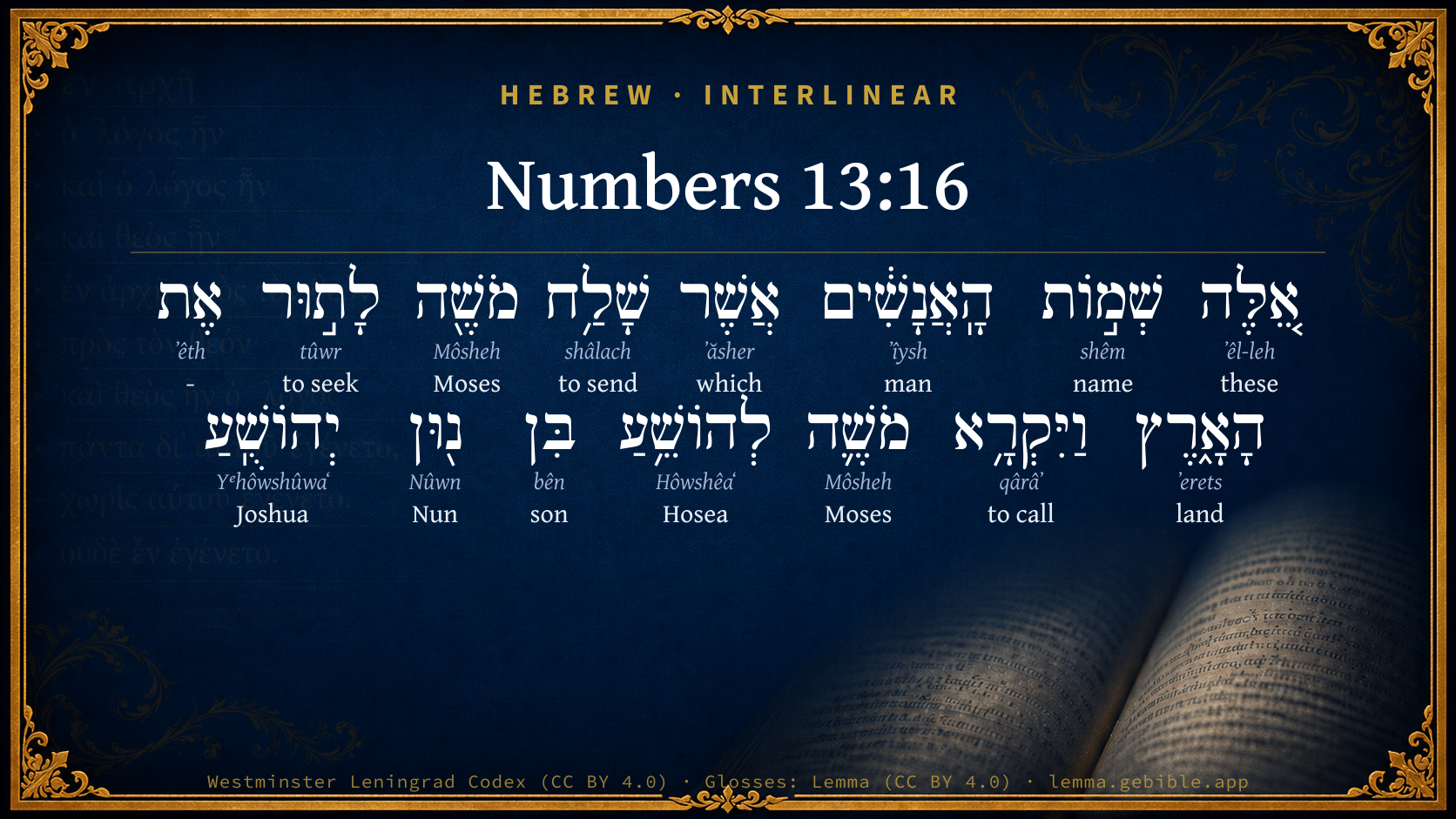
Hebrew (Westminster Leningrad Codex) Numbers 13:16 appears in the Hebrew Old Testament. The text above is from the Westminster Leningrad Codex. Each word links to its Strong’s number, a concise gloss, and parsing drawn from the Open Scriptures Hebrew Bible morphology. Click any word for its full Brown-Driver-Briggs (BDB) entry.
Download image
Cite this verse

Numbers 13:16 (World English Bible). Public Domain. Lemma interlinear Bible study tool, https://lemma.gebible.app/v/numbers/13/16.

Show BibTeX & RIS
BibTeX
RIS
English Translation
These are the names of the men who Moses sent to spy out the land. Moses called Hoshea the son of Nun Joshua.
World English Bible · Public Domain
Download a study sheet

One document with this verse’s original text, its word-by-word gloss line, the meaning frame, cross-references with their text, attributed commentary, and full source and license credits — printable, and it pastes into notes with its structure intact.

This verse Autodidact and up

Study sheet (.html) Plain text (.txt)

A passage Seminary Student

Up to 50 verses in one chapter. A passage sheet keeps up to 6 commentary sources and 12 cross-references per verse, in the order this page ranks them, and says so on the sheet whenever that leaves anything out. Ask for a single verse and you get the Autodidact verse sheet above.

Everything on this page stays free to read, with no account — the sheet is a download of what is already on screen, not access to it.

Want to remove ads? Support Godless Engineer
Compare translations 3

The same verse in 3 English versions, stacked beneath the original-language interlinear above. Click any original word for its lexicon entry.

Each is an independent rendering of the whole verse — the interlinear is not word-aligned to these translations.

Highlighted words mark where these versions differ — a whole-verse word diff, not a word-by-word alignment.

  • World English Bible Public Domain
    These are the names of the men who Moses sent to spy out the land. Moses called Hoshea the son of Nun Joshua.
  • King James Version Public Domain
    These are the names of the men which Moses sent to spy out the land. And Moses called Oshea the son of Nun Jehoshua.
  • unfoldingWord Literal Text CC BY-SA 4.0
    These the names of the men whom Moses sent to explore the land; and Moses called Hoshea, the son of Nun, Joshua.

unfoldingWord Literal Text — © unfoldingWord, licensed CC BY-SA 4.0. Word-aligned USFM3 via Door43 (git.door43.org/unfoldingWord/en_ult).

Versions to compare (up to 4)

3 of 4 selected

Show all 18 translations

Every available English version of this verse, each an independent rendering of the whole verse.

  • World English Bible Public Domain
    These are the names of the men who Moses sent to spy out the land. Moses called Hoshea the son of Nun Joshua.
  • Berean Standard Bible Public Domain
    These were the names of the men Moses sent to spy out the land; and Moses gave to Hoshea son of Nun the name Joshua.
  • Majority Standard Bible Public Domain
    These were the names of the men Moses sent to spy out the land; and Moses gave to Hoshea son of Nun the name Joshua.
  • King James Version Public Domain
    These are the names of the men which Moses sent to spy out the land. And Moses called Oshea the son of Nun Jehoshua.
  • American Standard Version (1901) Public Domain
    These are the names of the men that Moses sent to spy out the land. And Moses called Hoshea the son of Nun Joshua.
  • Revised Version (1885) Public Domain
    These are the names of the men which Moses sent to spy out the land. And Moses called Hoshea the son of Nun Joshua.
  • Geneva Bible (1599) Public Domain
    Of the tribe of Gad, Geuel the sonne of Machi.
  • Douay-Rheims (1899) Public Domain
    Of the tribe of Gad, Guel the son of Machi.
  • Young's Literal Translation Public Domain
    These `are' the names of the men whom Moses hath sent to spy the land; and Moses calleth Hoshea son of Nun, Jehoshua.
  • Literal Standard Version CC BY-SA 4.0
    These [are] the names of the men whom Moses has sent to spy out the land; and Moses calls Hoshea son of Nun, Joshua.
  • Unlocked Literal Bible CC BY-SA 4.0
    These were the names of the men whom Moses sent to examine the land. Moses called Hoshea son of Nun by the name of Joshua.
  • unfoldingWord Literal Text CC BY-SA 4.0
    These the names of the men whom Moses sent to explore the land; and Moses called Hoshea, the son of Nun, Joshua.
  • Darby Bible Public Domain
    These are the names of the men whom Moses sent to search out the land. And Moses called Hoshea the son of Nun, Jehoshua.
  • World Messianic Bible Public Domain
    These are the names of the men who Moses sent to spy out the land. Moses called Hoshea the son of Nun Joshua.
  • Webster's Bible Public Domain
    These are the names of the men whom Moses sent to explore the land. And Moses called Oshea the son of Nun Jehoshua.
  • Free Bible Version CC BY-SA 4.0
    These were the names of the men that Moses sent to explore the country. Moses called Hoshea Joshua.
  • Bible in Basic English Public Domain
    These are the names of the men whom Moses sent to get knowledge about the land. And Moses gave to Hoshea, the son of Nun, the name of Joshua.
  • JPS Tanakh (1917) Public Domain
    These are the names of the men that Moses sent to spy out the land. And Moses called Hoshea the son of Nun Joshua.

Literal Standard Version (2020), Covenant Press — licensed CC BY-SA 4.0. Text via the HelloAO Bible API (eBible.org). Unlocked Literal Bible (unfoldingWord) — licensed CC BY-SA 4.0. Text via the HelloAO Bible API (eBible.org). unfoldingWord Literal Text — © unfoldingWord, licensed CC BY-SA 4.0. Word-aligned USFM3 via Door43 (git.door43.org/unfoldingWord/en_ult). Free Bible Version, Dr. Jonathan Gallagher — licensed CC BY-SA 4.0. Text via the HelloAO Bible API (eBible.org).

Word by word

More ways to search: Search by grammar → Find every occurrence → Compare this word →

Practice this passage: Drill this verse → Learn its vocabulary →

לְהוֹשֵׁ֥עַ
Hôwshêaʻ
H1954
“to/for · Hosea”
Preposition + Noun, Proper
Part of Speech
Preposition + Noun
Type
Proper
Full BDB Definition

Origin: from H3467

TWOT: None

Hosea or Hoshea or Oshea = "salvation" - family name of Joshua, the son of Nun - the 19th and last king of the northern kingdom of Israel - son of Beeri, and the first of the minor prophets; prophet to the northern kingdom of Israel in the reign of Jeroboam II - a son of Azaziah, a chief of Ephraim in the time of David - an Israelite chief who sealed the covenant with Nehemiah
  1. אֵ֚לֶּה ʼêl-leh H428 “these” Pronoun, Demonstrative, Common, Plural
  2. שְׁמ֣וֹת shêm H8034 “names of” Noun, Common, Masculine, Plural, Construct
  3. הָֽאֲנָשִׁ֔ים ʼîysh H376 “the · men” Particle, Definite Article + Noun, Common, Masculine, Plural, Absolute
  4. אֲשֶׁר ʼăsher H834 “which” Particle, Relative
  5. שָׁלַ֥ח shâlach H7971 “to send” Verb, Qal, Perfect, 3rd Person, Masculine, Singular
  6. מֹשֶׁ֖ה Môsheh H4872 “Moses” Noun, Proper
  7. לָת֣וּר tûwr H8446 “to seek” Preposition + Verb, Qal, Infinitive Construct
  8. אֶת ʼêth H853 “-” Particle, Direct Object
  9. הָאָ֑רֶץ ʼerets H776 “the · land” Particle, Definite Article + Noun, Common, Both, Singular, Absolute
  10. וַיִּקְרָ֥א qârâʼ H7121 “and · to call” Conjunction + Verb, Qal, Sequential Imperfect, 3rd Person, Masculine, Singular
  11. מֹשֶׁ֛ה Môsheh H4872 “Moses” Noun, Proper
  12. בִּן bên H1121 “son of” Noun, Common, Masculine, Singular, Construct
  13. נ֖וּן Nûwn H5126 “Nun” Noun, Proper
  14. יְהוֹשֻֽׁעַ Yᵉhôwshûwaʻ H3091 “Joshua” Noun, Proper

About this verse

These counts appear in no published source. They are computed here, from the morphology-tagged text and Lemma’s own curated glosses. What Lemma adds →

15
words
14
distinct lemmas
Pentateuch
section

Notable vocabulary

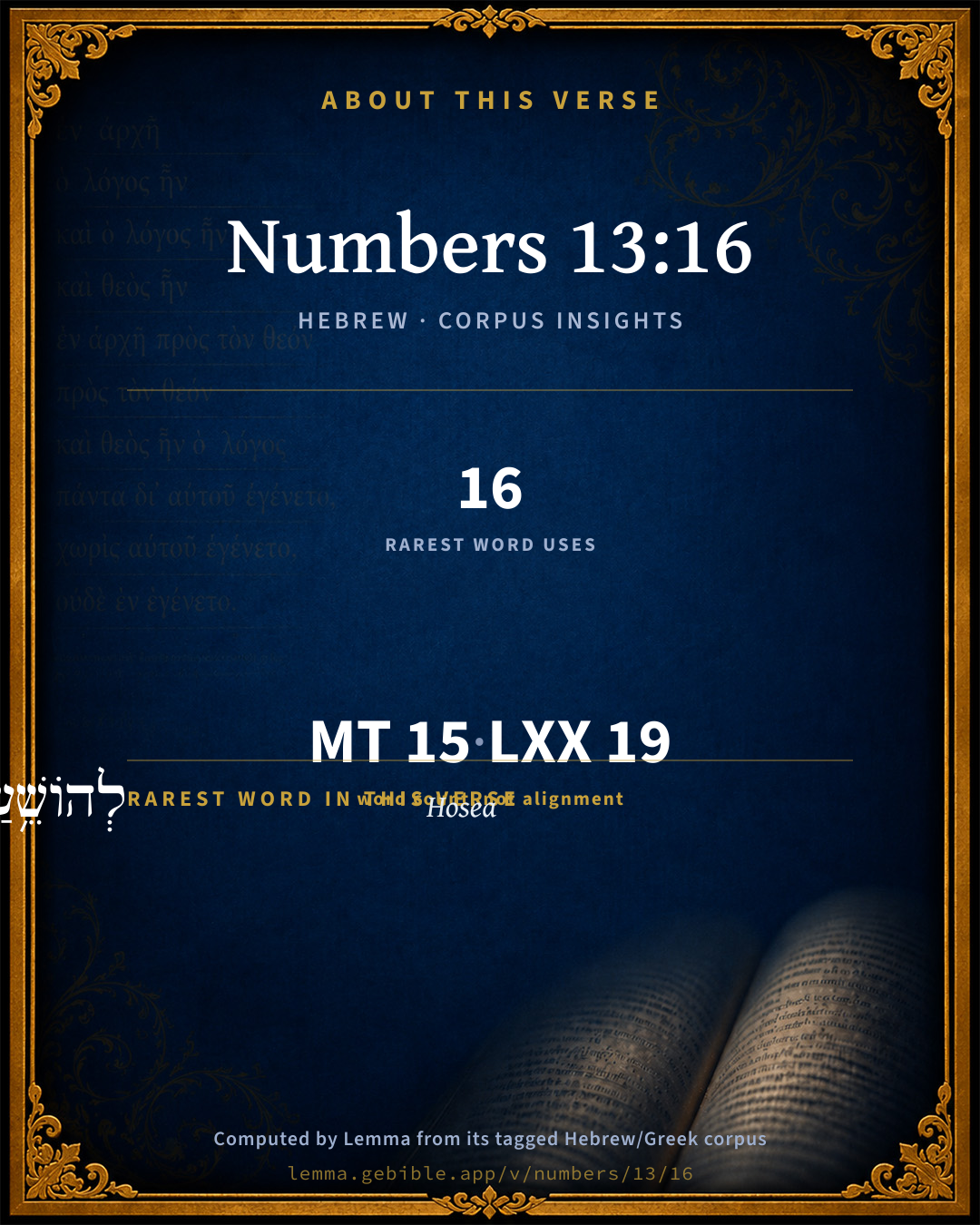
The rarest word here is לְהוֹשֵׁ֥עַ Hosea H1954 — appearing just 16 times in the whole Hebrew Bible.

Shared distinctive vocabulary

לְהוֹשֵׁ֥עַ Hosea H1954 occurs in 15 verses of the Hebrew Bible. Also found in:

Grammatical profile

  • 3 verbs
  • 9 nouns
  • 1 pronoun
  • 2 particles

Verb forms

  • שָׁלַ֥ח Qal · Perfect
  • לָת֣וּר Qal · Infinitive Construct
  • וַיִּקְרָ֥א Qal · Sequential Imperfect

Repetition

A word recurs within this verse — often emphatic in Hebrew:

  • מֹשֶׁ֖ה Moses H4872 ×2

Hebrew & Septuagint length

In English translation the verse runs 23 words from the Hebrew and 10 from the Septuagint (LXX English) — the Septuagint runs noticeably shorter here. See the side-by-side →

A rough comparison of the two English renderings, which tokenize alike — not a word-level alignment.

Word counts can differ between the Hebrew and the Greek without any difference in meaning — e.g. the Hebrew direct-object marker אֵת has no separate Greek word, and Greek often adds the article ὁ.

In the original languages it is 15 Hebrew tokens and 19 Greek tokens — but the two are counted differently (Hebrew bundles its prefixes and suffixes into one token; the Greek is in lemma form), so that isn’t a like-for-like length.

Cross-references

10

Topical passages linked to Numbers 13:16 in the Treasury of Scripture Knowledge — connected by theme and wording, ordered by reader-vote popularity; previews shown in the World English Bible.

  • Numbers 13:8 Of the tribe of Ephraim, Hoshea the son of Nun.
  • Exodus 17:9 Moses said to Joshua, "Choose men for us, and go out, fight with Amalek. Tomorrow I will stand on the top of the hill with God's rod in my hand."
  • Numbers 14:6 Joshua the son of Nun and Caleb the son of Jephunneh, who were of those who spied out the land, tore their clothes:
  • Numbers 14:30 surely you shall not come into the land, concerning which I swore that I would make you dwell therein, save Caleb the son of Jephunneh, and Joshua the son of Nun.
  • Deuteronomy 32:44 Moses came and spoke all the words of this song in the ears of the people, he and Joshua the son of Nun.
  • Hosea 1:1 The word of Yahweh that came to Hosea the son of Beeri, in the days of Uzziah, Jotham, Ahaz, and Hezekiah, kings of Judah, and in the days of Jeroboam the son of Joash, king of Israel.
  • Matthew 1:21–23 She shall bring forth a son. You shall call his name Jesus, for it is he who shall save his people from their sins."
  • Acts 7:45 which also our fathers, in their turn, brought in with Joshua when they entered into the possession of the nations, whom God drove out before the face of our fathers, to the days of David,
  • Romans 9:25 As he says also in Hosea, "I will call them 'my people,' which were not my people; And her 'beloved,' who was not beloved."
  • Hebrews 4:8 For if Joshua had given them rest, he would not have spoken afterward of another day.

Cross-references courtesy of OpenBible.info (CC BY 4.0).

Hebrew and Greek witnesses Masoretic Hebrew ↔ Greek Septuagint

The same verse in the two great witnesses to the Old Testament, shown verse-for-verse.

Here the Septuagint runs noticeably shorter than the Hebrew — LXX2012 (modern English Septuagint) 10 words vs World English Bible 23. A rough length comparison of the two English translations, not a word-level alignment — read both below.

These are two independent witnesses, not word-aligned to each other, and the Septuagint is shown in lemma (dictionary) form.

Hebrew Numbers 13:16 Masoretic · Westminster Leningrad Codex

אֵ֚לֶּה שְׁמ֣וֹת הָֽאֲנָשִׁ֔ים אֲשֶׁר שָׁלַ֥ח מֹשֶׁ֖ה לָת֣וּר אֶת הָאָ֑רֶץ וַיִּקְרָ֥א מֹשֶׁ֛ה לְהוֹשֵׁ֥עַ בִּן נ֖וּן יְהוֹשֻֽׁעַ

These are the names of the men who Moses sent to spy out the land. Moses called Hoshea the son of Nun Joshua.

World English Bible · Public Domain

Greek LXX Numbers 13:16 Septuagint · lemma form

οὗτος ὁ ὄνομα ὁ ἀνήρ ὅς ἀποστέλλω μωυσῆς κατασκέπτομαι ὁ γῆ καί ἐπιὀνομάζω μωυσῆς ὁ αυση υἱός ναυη ἰησοῦς

Of the tribe of Gad, Gudiel the son of Macchi.

LXX2012 (modern English Septuagint) · Public Domain

On this verse, The Pulpit Commentary discusses the Septuagint’s reading. Read the note in Commentary ↓

Hebrew: Westminster Leningrad Codex (CC BY 4.0). Greek: Septuagint (public domain); English from LXX2012 (modern English Septuagint) (Public Domain). How the Septuagint differs from the Hebrew →

Targum (Aramaic paraphrase)

2

The Targum is the ancient Jewish Aramaic paraphrase of the Hebrew Scriptures — an interpretive translation, not the Hebrew text itself. Onkelos (literal) and Pseudo-Jonathan (expansive) render the Torah, and Jonathan the Prophets. Coverage is partial: where no permissively-licensed English translation exists for a verse, only the Aramaic is shown. This is verse-level text, not a word-by-word alignment to the Hebrew.

  1. Targum Onkelos Torah (Genesis–Deuteronomy)
    אִלֵין שְׁמָהַת גֻבְרַיָא דִי שְׁלַח משֶׁה לְאַלָלָא יָת אַרְעָא וּקְרָא משֶׁה לְהוֹשֵׁעַ בַּר נוּן יְהוֹשֻׁעַ

    (no public-domain English translation for this verse)

    Targum Onkelos — Aramaic: “Onkelos Genesis” (public domain); “Onkelos Exodus” (public domain); “Onkelos Leviticus” (public domain); “Onkelos Numbers” (public domain); “Onkelos Deuteronomy” (public domain). English: “Sefaria Community Translation” (CC0 1.0 (public-domain dedication)); “J.W. Etheridge. The Targums of Onkelos and Jonathan Ben Uzziel on the Pentateuch. London: Longmans, Green, 1862” (public domain). Text via Sefaria.

  2. Targum Pseudo-Jonathan Torah (Genesis–Deuteronomy)
    אִלֵין שְׁמָהָן גוּבְרַיָא דְשָׁדַר משֶׁה לְאַלְלָא יַת אַרְעָא וּכְדִי חֲמָא משֶׁה עִנְוָותָנוּתֵיהּ קָרָא משֶׁה לְהוֹשֵׁעַ בַּר נוּן יְהוֹשֻׁעַ

    These are the names of the men whom Mosheh sent to explore the land; and when Mosheh saw his humility, he called Hoshea bar Nun Jehoshua.

    Targum Pseudo-Jonathan — Aramaic: “Targum Jonathan on Genesis” (public domain); “Targum Jonathan on Exodus” (public domain); “Targum Jonathan on Leviticus” (public domain); “Targum Jonathan on Numbers” (public domain); “Targum Jonathan on Deuteronomy” (public domain). English: “The Targum of Jonathan ben Uzziel, trans. J. W. Etheridge, London, 1862” (public domain). Text via Sefaria.

Commentary

Notes on Numbers 13:16 from classic Christian and Jewish commentators (each source and its license shown beneath its notes). The classic Christian expositions comment on the surrounding passage and are grouped to its opening verse, so a note may address several verses; the Jewish commentaries on the Tanakh (Rashi and others) are per-verse, so they appear only where the commentator wrote on this verse.

Lemma curates 59 commentaries, every one of them public domain or Creative Commons licensed, each selected and text-cleaned for this edition rather than reprinted as found. About our sources →

Trapp's Complete Commentary

John Trapp

Num 13:16 These [are] the names of the men which Moses sent to spy out the land. And Moses called Oshea the son of Nun Jehoshua.

Ver. 16. And Moses called Oshea the son of Nun Jehoshua.] His name was now changed from Save us O God, to God shall save us. Under the law which brings us, as it were, into a wilderness, we may desire, wish, and pray that there were a Saviour: but under the gospel, we are sure of salvation, and that our Jehoshua hath bound himself "to fulfil all righteousness" for us.

John Trapp, A Commentary or Exposition upon All the Books of the Old and New Testament (1647–1656) — public domain. Text from a community e-Sword module.

Joseph Benson's Commentary

Num 13:16. Jehoshua — Oshea denotes a desire of salvation, signifying, Save, we pray thee; but Jehoshua, or Joshua, includes a promise of salvation, He will save. So this was a prophecy of his succession to Moses in the government, and of the success of his arms. Joshua is the same name with Jesus, of whom Joshua was a type. He was the Saviour of God’s people from the powers of Canaan, Christ from the powers of hell.

Joseph Benson's Commentary on the Old and New Testaments (1811–1818) — public domain. Text from a community e-Sword module.

Jamieson, Fausset & Brown

Robert Jamieson, A. R. Fausset & David Brown

Oshea--that is, "a desire of salvation." Jehoshua, by prefixing the name of God, means "divinely appointed," "head of salvation," "Saviour," the same as Jesus [Mat 1:21, Margin].

Jamieson, Fausset & Brown — Commentary Critical and Explanatory on the Whole Bible (1871) — public domain (CC PDM 1.0). Text via the HelloAO Bible API.

Adam Clarke's Commentary

Verse 16. And Moses called Oshea Jehoshua.] Oshea, Heb. הושע should be written Hoshea: the word signifies saved, or a saviour, or salvation; but יהושע, he shall save, or the salvation of God; a letter, says Calmet, of the incommunicable name of God, being added to his former name. This was not the first time in which he had the name Joshua; see Ex 17:9, and the note there. Some suppose he had this change of name in consequence of his victory over Amalek; see Ex 17:13-14.

Adam Clarke's Commentary on the Bible (1810–1826) — public domain. Text from a community e-Sword/MySword module.

Ellicott's Commentary for English Readers

(16) And Moses called Oshea . . . —It is not distinctly stated that the change of name took place at this time. It may have taken place at an earlier period, and have been confirmed on the present occasion, as in the case of Israel (Gen_32:28; Gen_35:10), and of Bethel (Gen_28:19; Gen_35:15). On the other hand, it is quite possible that the name may have been proleptically adopted in Exo_17:9; Exo_17:13; Exo_24:13; Exo_32:17; Exo_33:11, and Num_11:28. The original name Hoshea means help, or salvation. The name Joshua, or Jehoshua, means Jehovah is help, or salvation.

A Bible Commentary for English Readers, edited by Charles John Ellicott (1878–1897) — public domain. Text from a community e-Sword module.

The Cambridge Bible for Schools and Colleges

gen. ed. J. J. S. Perowne

16. Joshua has not been hitherto mentioned in P . Exo_17:9; Exo_17:13; Exo_24:13; Exo_32:17; Exo_33:11, Num_11:28 are all J E . Hoshea, as the name of the son of Nun, is found only in Num_13:8 and Deu_32:44 (in the latter probably a textual error for ‘Joshua’). ‘Since, according to P , the name of Yahweh [Jehovah] was not revealed until after Joshua’s birth (Exo_6:3), a name containing Yeho = Yahweh could not have been given him at birth. P therefore attributes the name to Moses’ (Gray).

The Cambridge Bible for Schools and Colleges (gen. ed. J. J. S. Perowne; Cambridge University Press, 1878–1918) — public domain. Text from a community e-Sword module.

John Gill's Exposition

And they ascended by the south,.... When they returned, after they had searched the land, then they came into the south country again, which was in their way to Kadesh, where the camp of Israel remained; they are said to ascend, because of the hill country they again came to; for their coming to Hebron, and carrying a cluster of grapes from that place, not far from thence, was upon their return:

and came unto Hebron; which was in the hill country of Judea, in the tribe of Judah afterwards, which before was called Kirjatharba; in the original text it is, "he came" (s), Caleb, and he only, according to Jarchi and the Rabbins in Abendana; and certain it is that he was there, and he had this place on which his feet trod given him for an inheritance, Jos 14:9; and it is very probable that the spies did not go together, but perhaps singly, and at most but two together, which seems to be the case here by what follows:

where Ahiman, Sheshai, and Talmai, the children of Anak, were; where Anak, and these his three sons, dwelt, who were giants; and perhaps from thence Hebron before this was called Kirjatharbah, "the city of the four"; or from Arba, the father of Anak:

now Hebron was built seven years before Zoan in Egypt; or Tanais, as the Targum of Jonathan, whence one of the nomes of Egypt was called the Tanitic nome: it was the metropolis of that country, and may be observed, to abate the pride and vanity of that kingdom, which boasted of its antiquity. Josephus says (t), that the inhabitants of Hebron not only reckoned it more ancient than any of the cities of the land, but than Memphis in Egypt, accounting it (then in his time) 2300 years old; but who it was built by is not certain; Jarchi thinks it is possible that Ham built Hebron for Canaan his younger son, before he built Zoan for Mizraim his eldest son; which does not seem likely.

(s) "et venit", Montanus, Tigurine version, Drusius, so Onkelos; "et venit Caleb", Junius & Tremellius. (t) De Bello Jud. l. 5. c. 9. sect. 7.

John Gill's Exposition of the Whole Bible (1746–1763) — public domain (CC PDM 1.0). Text via the HelloAO Bible API.

Albert Barnes' Notes on the Bible

Oshea, Hoshea, or Hosea, the name also of the last king of Israel and the first minor prophet, means “deliverance” or and by the hand of him who bore the title of “God’s salvation.” Jehoshua was contracted (compare Neh 8:17) into Jeshua.

Albert Barnes' Notes on the Bible (1834–1885) — public domain. Text from a community e-Sword/MySword module.

Matthew Poole's English Annotations

Oshea notes a desire of salvation, signifying, Save, we pray thee, but Jehoshua, or Joshua, includes a promise of salvation, that he should save, or that God by his hands should save the people. So this was a prophecy of his succession to Moses in the government, and of the success of his arms.

Matthew Poole's English Annotations on the Holy Bible (1683–1685) — public domain. Text from a community e-Sword/MySword module.

Whedon's Commentary on the Bible

Daniel D. Whedon

16. Oshea — Hebrew, help, is changed into Jehoshua or Joshua, Hebrew, Jehovah-help. See Introduction to Joshua, page 7. It was an occasional custom for Hebrews to change their names if, at any point in their lives, there was a radical change of character or a marked transition from obscurity to distinction. Gen_17:5; Gen_32:28. It is to be noted that the exact time when Moses made this change is not indicated here. The change may have been previously made, while attention is called to it here. He is called Joshua in Exo_17:9; Exo_17:13; Exo_24:13; Exo_32:17; Exo_33:11; Num_11:28.

Daniel D. Whedon (gen. ed.), Commentary on the Old and New Testaments (1874–1909) — public domain. Text from a community e-Sword module.

The Pulpit Commentary

Moses called Oshea the son of Nun Jehoshua. The change was from vewOh (Hoshea, help or salvation) to vuwOhy (Jehoshua the same name with the first syllable of the sacred name prefixed, and one of the vowel points modified). It was afterwards contracted into Wvye, (Jeshua; cf. with Neh_8:17) and has come to us in its current form through the Vulgate. The Septuagint has here epwnomase to Ihsoun , and so the name appears in the New Testament. It is an obvious difficulty that Joshua has already been called by his new name at Exo_17:9, and in every other place where he has been mentioned. In fact he is only once elsewhere called Hoshea, and that in a place (Deu_32:44) where we should certainly not have expected it. There are two ways of explaining the difficulty, such as it is. We may suppose that the change of name was really made at this time, as the narrative seems (on the face of it) to assert; and then the previous mentions of Joshua by his subsequent and more familiar name will be cases of that anticipation which is so common in Scripture. (cf., e.g., Mat_9:9 Mar_2:14) Or we may suppose, what is perhaps more in harmony with the course of Joshua"s life, that the change bad been already made at the time of the victory over Amalek. In that case the Vav consec. in arqiYiw (and... called) must be referred to the order of thought, not of time, and a sufficient reason must be shown for the interpolation of the statement in this particular place. Such a reason may fairly be found in the probable fact that the names of the spies were copied out of the tribal registers, and that Joshua still appeared under his original name in those registers. As to the significance of the change, it is not easy to estimate it aright. On the one hand, the sacred syllable entered into so many of the Jewish names that it could not have seemed a very marked change; on the other hand, the fact that our Saviour received the same name because he was our Saviour throws a halo of glory about it which we cannot ignore. In the Divine providence Hoshea became Joshua because he was destined to be the temporal saviour of his people, and to lead them into their promised rest.

The Pulpit Commentary (1880–1919), ed. H.D.M. Spence-Jones & Joseph S. Exell — public domain. Text from a community e-Sword module.

John Wesley's Explanatory Notes

Jehoshua - Oshea notes a desire of salvation, signifying, Save we pray thee; but Jehoshua, or Joshua, includes a promise of salvation, He will save. So this was a prophecy of his succession to Moses in the government, and of the success of his arms. Josh. is the same name with Jesus, of whom Joshua was a type. He was the saviour of God's people from the powers of Canaan, Christ from the powers of hell.

John Wesley, Explanatory Notes Upon the Whole Bible (1754–1765) — public domain. Text via the GEBible commentary corpus.

Scofield Reference Notes

C. I. Scofield

Jehoshua

i.e. Saviour, or Deliverer.

The Scofield Reference Bible (1917 edition), notes by C. I. Scofield — public domain. Text from a community e-Sword module.

Rashi

Rabbi Shlomo Yitzchaki (Rashi)

ויקרא משה להושע וגו׳ AND MOSES CALLED HOSHEA [THE SON OF NUN JEHOSHUA] — By giving him this name יהושע which is a compound of יה and הושע “God may save”, he in effect prayed for him: “May God save you from the evil counsel of the spies” (Sotah 34b).

Rashi on the Tanakh — English translations: “The Judaica Press complete Tanach with Rashi, translated by A. J. Rosenberg” (CC BY 4.0); “Pentateuch with Rashi's commentary by M. Rosenbaum and A.M. Silbermann, 1929-1934” (public domain); “The Metsudah Tanach series, Lakewood, N.J” (CC BY 4.0); and “The Book of Joshua, Metsudah Publications, 1997” (CC BY 4.0). Text via Sefaria.

Lesson kit

Teaching starters — assembled from the data on this page, not authored interpretation. Every prompt links to the verse data it draws on. Edit before teaching.

Numbers, in the Pentateuch, opens this verse with 15 words (14 distinct Hebrew lemmas). Its most distinctive word is Hôwshêaʻ (“Hosea”). The Greek Septuagint runs shorter here. A historical commentator’s framing appears above. Read the whole chapter for the surrounding context.

Discussion questions

  1. How does “Hosea” (Hôwshêaʻ) shape what this verse is saying?
  2. How does Numbers 13:8, which shares the word «Hosea», read alongside this verse?
  3. What does the repetition of “Moses” (2× in this one verse) do in this verse?
  4. The Septuagint runs shorter here than the Hebrew. What might account for the difference?
  5. The translations on this page render this verse differently — a whole-verse word diff, not a word-by-word alignment. What might account for the different wordings?
  6. «שָׁלַ֥ח» is a Qal Perfect verb. How does that grammatical form shape the action described?
  7. Compare how Trapp's Complete Commentary and Joseph Benson's Commentary read this verse. Where do they agree or differ?

Things to notice

Reading settings

Reading text

Shown beneath each verse's original-language words.

Old Testament
Old Testament edition

Read the OT as the Masoretic Hebrew (MT) or the Greek Septuagint (LXX).

English shown for the Greek Septuagint (in the Hebrew ↔ Greek comparison).

Comparing translations? Open the Compare panel on any verse page to stack up to four side by side.