Joshua 3:9

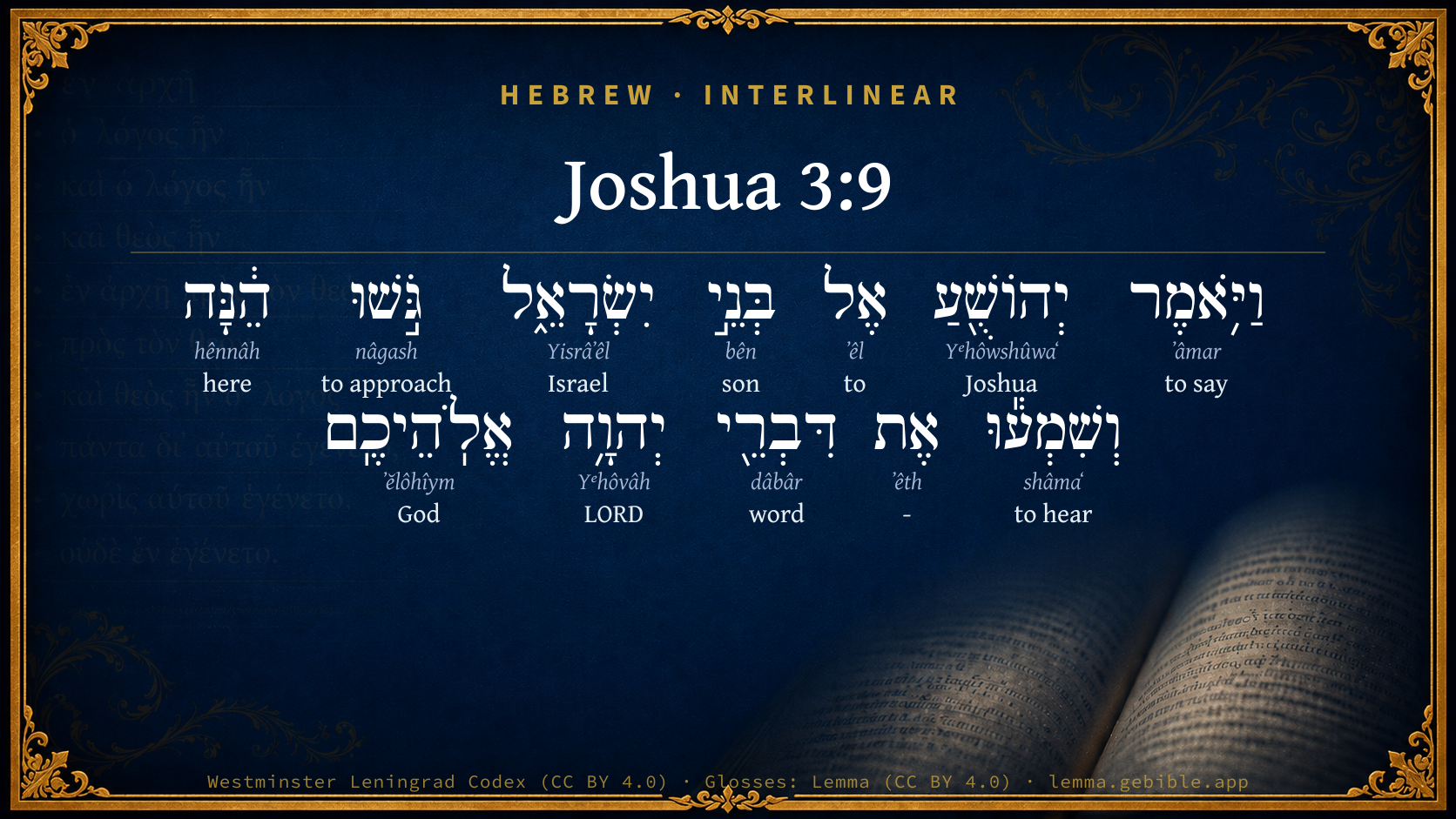
Hebrew (Westminster Leningrad Codex) Joshua 3:9 appears in the Hebrew Old Testament. The text above is from the Westminster Leningrad Codex. Each word links to its Strong’s number, a concise gloss, and parsing drawn from the Open Scriptures Hebrew Bible morphology. Click any word for its full Brown-Driver-Briggs (BDB) entry.
Download image
Cite this verse

Joshua 3:9 (World English Bible). Public Domain. Lemma interlinear Bible study tool, https://lemma.gebible.app/v/joshua/3/9.

Show BibTeX & RIS
BibTeX
RIS
English Translation
Joshua said to the children of Israel, Come here, and hear the words of Yahweh your God.
World English Bible · Public Domain
Download a study sheet

One document with this verse’s original text, its word-by-word gloss line, the meaning frame, cross-references with their text, attributed commentary, and full source and license credits — printable, and it pastes into notes with its structure intact.

This verse Autodidact and up

Study sheet (.html) Plain text (.txt)

A passage Seminary Student

Up to 50 verses in one chapter. A passage sheet keeps up to 6 commentary sources and 12 cross-references per verse, in the order this page ranks them, and says so on the sheet whenever that leaves anything out. Ask for a single verse and you get the Autodidact verse sheet above.

Everything on this page stays free to read, with no account — the sheet is a download of what is already on screen, not access to it.

Want to remove ads? Support Godless Engineer
Compare translations 3

The same verse in 3 English versions, stacked beneath the original-language interlinear above. Click any original word for its lexicon entry.

Each is an independent rendering of the whole verse — the interlinear is not word-aligned to these translations.

Highlighted words mark where these versions differ — a whole-verse word diff, not a word-by-word alignment.

  • World English Bible Public Domain
    Joshua said to the children of Israel, Come here, and hear the words of Yahweh your God.
  • King James Version Public Domain
    And Joshua said unto the children of Israel, Come hither, and hear the words of the LORD your God.
  • unfoldingWord Literal Text CC BY-SA 4.0
    And Joshua said to the sons of Israel, “Approach here and hear the words of Yahweh your God.”

unfoldingWord Literal Text — © unfoldingWord, licensed CC BY-SA 4.0. Word-aligned USFM3 via Door43 (git.door43.org/unfoldingWord/en_ult).

Versions to compare (up to 4)

3 of 4 selected

Show all 18 translations

Every available English version of this verse, each an independent rendering of the whole verse.

  • World English Bible Public Domain
    Joshua said to the children of Israel, Come here, and hear the words of Yahweh your God.
  • Berean Standard Bible Public Domain
    So Joshua told the Israelites, “Come here and listen to the words of the LORD your God.”
  • Majority Standard Bible Public Domain
    So Joshua told the Israelites, “Come here and listen to the words of the LORD your God.”
  • King James Version Public Domain
    And Joshua said unto the children of Israel, Come hither, and hear the words of the LORD your God.
  • American Standard Version (1901) Public Domain
    And Joshua said unto the children of Israel, Come hither, and hear the words of Jehovah your God.
  • Revised Version (1885) Public Domain
    And Joshua said unto the children of Israel, Come hither, and hear the words of the LORD your God.
  • Geneva Bible (1599) Public Domain
    Then Ioshua said vnto the children of Israel, Come hither, and heare the wordes of the Lord your God.
  • Douay-Rheims (1899) Public Domain
    And Josue said to the children of Israel: Come hither and hear the word of the Lord your God.
  • Young's Literal Translation Public Domain
    And Joshua saith unto the sons of Israel, `Come nigh hither, and hear the words of Jehovah your God;
  • Literal Standard Version CC BY-SA 4.0
    And Joshua says to the sons of Israel, “Come near here, and hear the words of your God YHWH”;
  • Unlocked Literal Bible CC BY-SA 4.0
    Then Joshua said to the people of Israel, “Come here, and listen to the words of Yahweh your God.
  • unfoldingWord Literal Text CC BY-SA 4.0
    And Joshua said to the sons of Israel, “Approach here and hear the words of Yahweh your God.”
  • Darby Bible Public Domain
    And Joshua said to the children of Israel, Come hither, and hear the words of Jehovah your God.
  • World Messianic Bible Public Domain
    Joshua said to the children of Israel, “Come here, and hear the words of the LORD your God.”
  • Webster's Bible Public Domain
    And Joshua said to the children of Israel, Come hither, and hear the words of the LORD your God.
  • Free Bible Version CC BY-SA 4.0
    So Joshua said to the Israelites, “Come here and listen to what the Lord your God has to say to you.
  • Bible in Basic English Public Domain
    And Joshua said to the children of Israel, Come to me here: and give ear to the words of the Lord your God.
  • JPS Tanakh (1917) Public Domain
    And Joshua said unto the children of Israel: 'Come hither, and hear the words of the LORD your God.'

Literal Standard Version (2020), Covenant Press — licensed CC BY-SA 4.0. Text via the HelloAO Bible API (eBible.org). Unlocked Literal Bible (unfoldingWord) — licensed CC BY-SA 4.0. Text via the HelloAO Bible API (eBible.org). unfoldingWord Literal Text — © unfoldingWord, licensed CC BY-SA 4.0. Word-aligned USFM3 via Door43 (git.door43.org/unfoldingWord/en_ult). Free Bible Version, Dr. Jonathan Gallagher — licensed CC BY-SA 4.0. Text via the HelloAO Bible API (eBible.org).

Word by word

More ways to search: Search by grammar → Find every occurrence → Compare this word →

Practice this passage: Drill this verse → Learn its vocabulary →

About this verse

These counts appear in no published source. They are computed here, from the morphology-tagged text and Lemma’s own curated glosses. What Lemma adds →

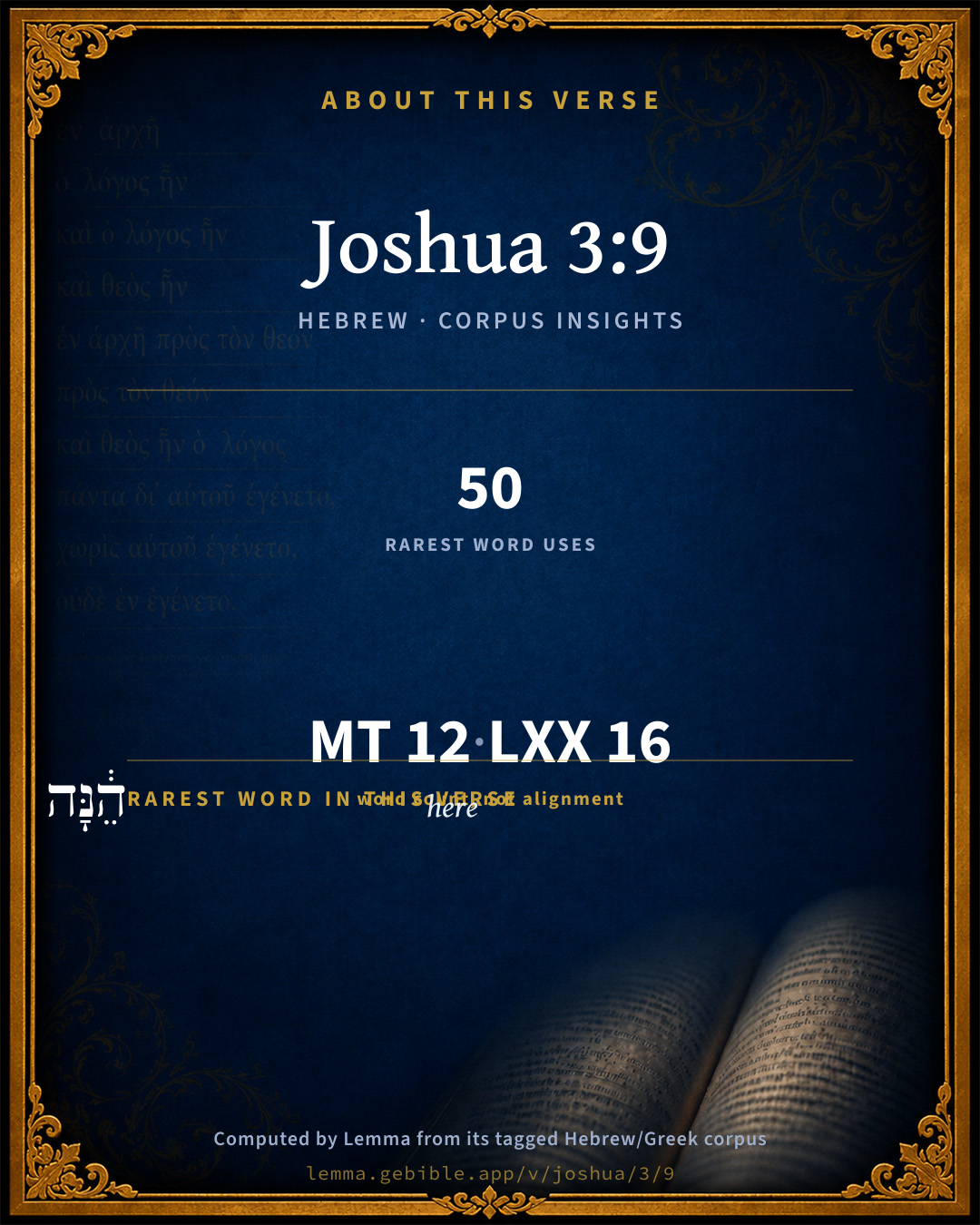
12
words
12
distinct lemmas
Historical
section

Shared distinctive vocabulary

הֵ֔נָּה here H2008 occurs in 42 verses of the Hebrew Bible. Also found in:

Grammatical profile

  • 3 verbs
  • 6 nouns
  • 1 preposition
  • 1 adverb
  • 1 particle

Verb forms

  • וַיֹּ֥אמֶר Qal · Sequential Imperfect
  • גֹּ֣שׁוּ Qal · Imperative
  • וְשִׁמְע֕וּ Qal · Imperative

Hebrew & Septuagint length

In English translation the verse runs 17 words from the Hebrew and 20 from the Septuagint (LXX English) — closely comparable.

A rough comparison of the two English renderings, which tokenize alike — not a word-level alignment.

Word counts can differ between the Hebrew and the Greek without any difference in meaning — e.g. the Hebrew direct-object marker אֵת has no separate Greek word, and Greek often adds the article ὁ.

In the original languages it is 12 Hebrew tokens and 16 Greek tokens — but the two are counted differently (Hebrew bundles its prefixes and suffixes into one token; the Greek is in lemma form), so that isn’t a like-for-like length.

Cross-references

2

Topical passages linked to Joshua 3:9 in the Treasury of Scripture Knowledge — connected by theme and wording, ordered by reader-vote popularity; previews shown in the World English Bible.

  • Deuteronomy 4:1 Now, Israel, listen to the statutes and to the ordinances, which I teach you, to do them; that you may live, and go in and possess the land which Yahweh, the God of your fathers, gives you.
  • Deuteronomy 12:8 You shall not do after all the things that we do here this day, every man whatever is right in his own eyes;

Cross-references courtesy of OpenBible.info (CC BY 4.0).

Hebrew and Greek witnesses Masoretic Hebrew ↔ Greek Septuagint

The same verse in the two great witnesses to the Old Testament, shown verse-for-verse.

These are two independent witnesses, not word-aligned to each other, and the Septuagint is shown in lemma (dictionary) form.

Hebrew Joshua 3:9 Masoretic · Westminster Leningrad Codex

וַיֹּ֥אמֶר יְהוֹשֻׁ֖עַ אֶל בְּנֵ֣י יִשְׂרָאֵ֑ל גֹּ֣שׁוּ הֵ֔נָּה וְשִׁמְע֕וּ אֶת דִּבְרֵ֖י יְהוָ֥ה אֱלֹֽהֵיכֶֽם

Joshua said to the children of Israel, Come here, and hear the words of Yahweh your God.

World English Bible · Public Domain

Greek LXX Joshua 3:9 Septuagint · lemma form

καί εἶπον ἰησοῦς ὁ υἱός ἰσραήλ προςἄγω ὧδε καί ἀκούω ὁ ῥῆμα κύριος ὁ θεός ἐγώ

And Joshua said to the children of Israel, Come hither, and listen to the word of the Lord our God.

LXX2012 (modern English Septuagint) · Public Domain

Hebrew: Westminster Leningrad Codex (CC BY 4.0). Greek: Septuagint (public domain); English from LXX2012 (modern English Septuagint) (Public Domain). How the Septuagint differs from the Hebrew →

Targum (Aramaic paraphrase)

1

The Targum is the ancient Jewish Aramaic paraphrase of the Hebrew Scriptures — an interpretive translation, not the Hebrew text itself. Onkelos (literal) and Pseudo-Jonathan (expansive) render the Torah, and Jonathan the Prophets. Coverage is partial: where no permissively-licensed English translation exists for a verse, only the Aramaic is shown. This is verse-level text, not a word-by-word alignment to the Hebrew.

  1. Targum Jonathan Prophets (Joshua–Malachi)
    וַאֲמַר יְהוֹשֻׁעַ לִבְנֵי יִשְׂרָאֵל אִתְקְרִיבוּ הַלְכָא וּשְׁמָעוּ יַת פִּתְגָמַיָא דַייָ אֱלָהָכוֹן:

    (no public-domain English translation for this verse)

    Targum Jonathan — Aramaic: “Mikraot Gedolot” (public domain). English: “Sefaria Community Translation” (CC0 1.0 (public-domain dedication)); “London "Chaldee Paraphrase," 1871” (public domain). Text via Sefaria.

Commentary

Notes on Joshua 3:9 from classic Christian and Jewish commentators (each source and its license shown beneath its notes). The classic Christian expositions comment on the surrounding passage and are grouped to its opening verse, so a note may address several verses; the Jewish commentaries on the Tanakh (Rashi and others) are per-verse, so they appear only where the commentator wrote on this verse.

Lemma curates 59 commentaries, every one of them public domain or Creative Commons licensed, each selected and text-cleaned for this edition rather than reprinted as found. About our sources →

Jamieson, Fausset & Brown

Robert Jamieson, A. R. Fausset & David Brown

JOSHUA ENCOURAGES THE PEOPLE. (Jos 3:9-13)

Come hither, and hear the words of the Lord--It seems that the Israelites had no intimation how they were to cross the river till shortly before the event. The premonitory address of Joshua, taken in connection with the miraculous result exactly as he had described it, would tend to increase and confirm their faith in the God of their fathers as not a dull, senseless, inanimate thing like the idols of the nations, but a Being of life, power, and activity to defend them and work for them.

Jamieson, Fausset & Brown — Commentary Critical and Explanatory on the Whole Bible (1871) — public domain (CC PDM 1.0). Text via the HelloAO Bible API.

The Cambridge Bible for Schools and Colleges

gen. ed. J. J. S. Perowne

9. And Joshua said] Jos_3:9-13 contain the substance of an address to a solemn assembly of the people, in which a fuller explanation is given of what has been stated generally in Jos_3:7-8.

The Cambridge Bible for Schools and Colleges (gen. ed. J. J. S. Perowne; Cambridge University Press, 1878–1918) — public domain. Text from a community e-Sword module.

Trapp's Complete Commentary

John Trapp

Jos 3:9 And Joshua said unto the children of Israel, Come hither, and hear the words of the LORD your God.

Ver. 9. Come hither, and hear the words of the Lord your God.] For miracles do but excite men; they do but as the bells that call us to the sermon, they cannot work faith in us: but faith cometh by hearing.

John Trapp, A Commentary or Exposition upon All the Books of the Old and New Testament (1647–1656) — public domain. Text from a community e-Sword module.

The Biblical Illustrator

Joseph S. Exell

Jos_3:9-13

Come hither, and hear the words of the Lord.

The environment of worship

That is a bold challenge. That is a voice we need. Every age wants some Joshua, some mighty soldier of the Cross, to say, Come, hear the upper music, the Divine melody, the holy revelation. Have we the hearing ear? If we could hear better we could hear more. Come hither. Does that indicate a point in space, a place, a boundary, a sanctuary? If so, it would be quite in keeping with Oriental thought in general, and with Jewish habit in particular. Always religious exercise was associated with locality--with the mountain, with the city, with the temple, with the tabernacle, with the terebinth, with some place made sacred by historic communes and wrestlings with God. Christ said, The time cometh and now is when neither in this mountain nor at Jerusalem (particularly and exclusively) shall men worship the Father, but wherever there is a human spirit desiring the upward way, the higher light, the noonday of thought, and hope, and peace, wherever there is such a soul God is there, and God is the Author of it. Yet Jesus Christ Himself went into the synagogue on the Sabbath day--one of the evangelists says, as was His custom. Beware lest in supposing ourselves able to grasp the all we grasp nothing. The universe is too big really for any one of us to grasp; we had better, therefore, have a little place cornered off and call it the Church, the sanctuary, the little temporary hostelry and lodging-place. All the earth is the Lords. Men are now in danger of worshipping totals, the Unspeakable All, the incognisable infinite, as the metaphysicians call it. We may believe in all that grandeur of immeasurableness, and yet at the same time we go home every evening. Home--but the earth is the Lords: why do you not live out in the open air? What do you want with home? you are a worshipper of Humanity, all space: why do you go home? You cannot keep away from the old place: the loved ones are there, all the lives that make your life a possible joy are there; all the holy, shadowy, tender memories are there--the old seat, the old books, the old fire that talks as it crackles and blazes are there. Come. Why, the mere coming does us good, the very walk to church reddens the blood. The hunter says the delight is in the chase; not in the death of the hunted animal, but in the flight, the leap, the bound, the dash. The coming, the act of locomotion and the act signified by locomotion, will do us good. For what purpose shall we come? Come hither, and hear the words of the Lord your God. That is the purpose. Not to hear the words of men. We are now here before God to hear what He will say unto us--Speak, Lord, for Thy servant heareth. What shall we hear? Shall we hear the words of some strange deity? Nay, hear the words of the Lord your God. It is a family meeting. These pronouns seem to bring us into sacred and general possession of things in common with God. Your God, our Father, my God, your fathers God: these are the terms in which the greatness and the nearness of God are typified to our dull imagination. When you hear the words of the Lord your God they will not be strange, inarticulate, untranslatable thunder; they will be gospels, voices of music, voices of welcome, tender assurances, great offers of love, sublime propositions of pardon; you will know every word of the speech, being neither affrighted by its majesty nor rendered indifferent by its condescension. To be able to receive such words--is that an insignificant sign? To know Gods voice--is not that an evidence of mans greatness? (J. Parker, D. D.)

Hereby ye shall know that the living God is among you.

The best helper

Observe the form which the purpose of the miracle assumes there. It is the confirmation of the Divine presence, not with the leader, but with the people and their consequent victory. Joshua grasped the inmost meaning of Gods word to himself, and showed noble self-suppression, when he thus turned the direction of the miracle. The true servant of God knows that God is with him, not for his personal glorification, but for the welfare of Gods people, and cares little for the estimation in which men hold him, if they will only believe that the conquering God is with them. We too often make great leaders and teachers in the Church opaque barriers to hide God from us, instead of transparent windows through which He shines upon His people. We are a great deal more ready to say God is with him, than to add, and therefore God is with us, in our Joshuas, and without them, Observe the grand emphasis of that name, the living God, tacitly contrasted with the dead idols of the enemies, and sealing the assurance of His swift and all-conquering might. Observe, too, the triumphant contempt in the enumeration of the many tribes of the foe with their barbarous names. Five of them had been enough, when named by the spies trembling lips, to terrify the congregation, but here the list of the whole seven but strengthens confidence. Faith delights to look steadily at its enemies, knowing that the one Helper is more than they all. This catalogue breathes the same spirit as Pauls rapturous list of the foes impotent to separate from the love of God. Mark, too, the long-drawn-out designation of the ark, with its accumulation of nouns, which grammatical purists have found difficulty--the ark of the covenant of the Lord of all the earth; where it leads they need not fear to follow. It was the pledge of His presence, it contained the ten words on which His covenant was concluded. That covenant enlisted on their side Him who was Lord of the swollen river as of all the fierce clans beyond; and with His ark in front their victory was sure. Then follows the command to elect twelve representatives of the tribes, for a purpose not yet explained; and then, at the last moment, the manner of crossing is disclosed, to the silencing of wise doubters and the confirmation of ignorant faith. The brief anticipatory announcement of the miracle puts stress on the arrest of the waters at the instant when the priests feet touched them, and tells what is to befall the arrested torrent above the point where the ark stood, saying nothing about the lower stretch of the river, and just hinting by one word, heap, the parallel between this miracle and that of the passing of the Red Sea (Exo_15:8). (A. Maclaren, D. D.)

The ark of the covenant of the Lord of all the earth.--The emphasis with which here and verse 13 Jehovah is called the Lord of all the earth is very significant. This miracle demonstrated His power over all nature. He who can by His word suspend the operation of material laws, and whose bidding the forces of the world obey, is the supreme ruler of the world. As such all that it contains is at His sovereign disposal. As the living God has the power, so the Lord of all the earth has the right to bestow the land of Canaan upon whomsoever He pleases. Joshua and Israel were under no delusion in claiming that the Most High had given them this land. They were acting under no fanatical impulse. And their conduct gives no sanction to crusades elsewhere waged by those who have imagined themselves the special favourites of heaven, and pleaded a Divine right for their acts of rapine and bloodshed. Israels credentials were of the most palpable character. The miracle which attended their march was Gods own attestation to the fact that they were working His will. And as Jehovah is the Lord of all the earth, He shall one day be universally worshipped and obeyed. The covenant of God with Israel has sometimes been decried as the offspring of a narrow mind, which would limit the Divine favour to particular nation. But it is here joined with the widest universality; and one purpose of this particular miracle wrought on Israels behalf is declared (Jos_4:24) to be that nil the people of the earth might learn a lesson of Jehovahs greatness. (W. H. Green, D. D.)

The ark of God; visible aids in religion

In the ark Israel saw God Himself, and yet lost none of their faith in the spiritual character of God. When the ark rested, Israel knew that God was among them; when the ark moved, then Israel believed that God was calling them to journey on again, and sang, Let God arise, and let His enemies be scattered, &c.; when, again, the ark rested, they ceased to move forward, and sang, Return, O Lord, to the many thousands of Israel. There was ever before the people of Israel the words of that commandment which forbade their ever thinking of God under any human, any material form, so that they had to content themselves with the ark of the covenant. But God, all this time, was preparing for a new manifestation of Himself in the Person of the Son, who was to take upon Him the form of His own highest creation, so that no longer should it be a sin to think of God under the likeness of a man. The man who depreciates the idea of a visible Church, and rejects externals in religion, has one side of the truth very clearly revealed to him; but I venture to think that not only is this one side insisted on to the exclusion of another equally true, but his position is maintained against certain unalterable facts, of which the first and foremost is, that our souls, through which alone, he argues, communion may be held with God, are imprisoned within material bodies, and cannot in this life, in the ordinary course, receive impressions of spiritual things except through the medium of those bodies. Israel in the wilderness was, no doubt, often very unworthy of the high calling which belonged to the chosen people; but they did succeed in living a life from which everything was removed except the prospect of the heavenly rewards. They knew they should not inherit temporal promises, and yet they patiently lived their lives in expectation of spiritual things. And during these lives they were guided by the ark of the covenant of the Lord of all the earth, and by the system of worship provided for them by God. We are looking, or ought to be looking, for like heavenly promises, and while we are in the flesh we shall find help, comfort, encouragement, and strength from these outward ordinances, which God has given us in His holy Church. (E. Smith, B. A.)

As soon as the soles of the feet . . . shall rest in the waters of Jordan.--

Committal

The first step was to be taken in the waters. They were called upon not only to face the difficulties, but to enter them. They were not to ask God to prove His power first. They were to trust Him first, and then should they see as they followed on to know the Lord, His giving forth to be prepared as the morning. How fatal had been a halt, although but one step short of the brim of the waters! Even the foot uplifted, ready to fall as soon as the path was ready, would have waited in vain. The promise was addressed only to the faith that, without seeing signs and wonders, could yet believe. That one step taken which proved their faith, and placed it in a position of entire receptivity--then God could prove His faithfulness and manifest His power. His wonders follow at once. The lesson which is here taught us is of the utmost importance, showing us the very essence of all true faith. Mature faith must be able to dare and to endure, with no other stay than seeing Him who is invisible. Our Father does, indeed, stretch out the hand of yearning tenderness to steady the tottering steps of a babe. In His pity and compassion He will not forbid the poor cripple his staff; but the faith of full years and of steady strength can never be developed by continued indulgence. It must be exercised by reason of use. Again, that God, instead of giving His people some visible aid for their crossing, set before them a most visible hindrance, doubling the danger and difficulty to the natural eye, is in perfect accord with our advanced experience. Only how often does the simplicity of our faith fail to equal theirs. It is the first instinctive impulse of unbelief to seek a sign--to have something to interpose between itself and the bare word of God. And so, how often is the question asked: If God be really disposed to bring me into this glorious liberty, will there not be at least some token of it? Shall I find no evidence of it in my own altered feelings; and especially will not the Lord prepare the way by lowering the opposing tide of temptation? The word of our God needs neither sign nor surety. Be it a promise, or be it a command, it matters not; for every command has a promise for its kernel. We are to go forward to obey His commands--forward to receive His promises--forward in faith--forward though difficulties double. Again, the foot dipped in the brimming waters declares emphatically that faith is to precede feeling. Nothing that we discover in heart or life need hinder us in coming to Christ to seek deliverance from it. We may even use our worst discoveries as our plea in coming; For the whole have no need of a physician, but they that are sick. Nor will my sickness make the Physician displeased with me in my first application to Him. But if after He has healed me, and taught me the conditions of sustaining health, I find myself again unloving, cold, perturbed, fretted, moody, I have not the least right to say that all is well, and that, disregarding all this, I am to believe myself fully accepted through Christ. Unless I bring this disturbance to Him for confession, forgiveness, and healing, I am utterly at fault. Our feelings are of importance. The same Creator who set the faithful nerves as sentinels along all the lines of the senses, to give due warning of danger and disease, gave a corresponding sensitiveness to our souls. Faith is not to discharge this as unnecessary, but to retain it in her service. If it be well with our faith, it will also be well with our feelings. (S. F. Smiley.)

When does Divine help come?

When we, actually going forth in duty as He has told us, according to the directions He has given, laying hold by faith upon His promise, come to the limit of our strength--when thus our feet are dipped in the brim of the waters of our Jordan, His great help does come.

1. Such Divine help comes in difficult duty. Though duty be difficult, when we go forth toward it, as God has ordered, and in faith in His promise, we may be certain somehow His help will meet us.

2. Such Divine help comes scattering foreboded inability, e.g., the women going to the sepulchre, asking, anxiously, Who shall roll away the stone? but going on and finding it rolled away (Mar_16:1-4).

3. Such Divine help will come in death. See what Mr. Greatheart says of Mr. Fearing in the second part of Pilgrims Progress. The whole passage is most exquisite.

4. Such Divine help will also come in conversion. There is that Jordan of belief in Jesus--of the absolute commitment of the self to Him which we must pass before we can enter the Canaan of forgiveness, and Gods favour, and the noble life. Now go on toward it. Cross it. But you have no feeling, you say; that is not to the matter. But you do not know such feeling as other people say they have; that is not to the matter. But you do not understand how it can be; you need not; that is not to the matter. But you are not fit to make the crossing; you never will be fitter; that is not to the matter. This is enough. God tells you to go forth, along His way in faith of His promise; and when your feet but touch the brim of a perfect self-surrender, you are His, you are Christian. His forgiveness falls, you have passed into the Canaan of the new life. (W. Hoyt, D. D.)

The ark in Jordan

It is worth noticing the use which in the passage of the river they made of the ark of the covenant. The pillar of fire had ceased to go before them. They had grown into the ability to appreciate a better and more spiritual symbolism. Fire meant more to the eye than a little box of acacia-wood, but the acacia box, considered as the casket of the Divine autograph of the two tables, denoted more to the mind and heart; and so it marks a growth that not the pillar, but the ark, guided them across the river. They treated the ark on this occasion reverently, but not superstitiously. They used it not as a charm, but as a symbol. The Israelites on a later occasion used it as a charm in one of their battles with the Philistines, when after one defeat they said (1Sa_4:3). To the men standing on the brink of the swollen Jordan, however, the ark was not a charm, a power, but only the representative of a power. Their own faith earned them miraculous passage, and not the little acacia chest; and they felt it so. There is danger of our coming to use the holy things of our religion more as the Israelites used the ark at Ebenezer than as they used it at the river. We easily fall into a way of attributing Divine potency to rites and ceremonies, prayers, sanctuaries, and ordinances, forgetting that these things are only types, significant as types, but not as forces--that the power of Christianity is not in the rites, but in the faith only that uses them. A symbol is a dangerous thing: the Hebrews learned that lesson at Ebenezer. A symbol is a precious thing: the Hebrews learned that lesson at the Jordan-crossing. (C. H. Parkhurst, D. D.

Obeying Gods commands

The Jordan of Canaan stands for any difficulty which the Lord commands us to encounter. Between us and the goal at which we are aiming, there is often some wide Jordan which, at the time, seems to us to be very peculiarly broad. At another time, when the stream is not so wide, we think that we might dare to make the attempt, but just now the thing seems too hazardous. We think we had better wait for a little, until the waters abate. So we stand on the brink shivering, and dare not plunge into the waves. How many a sinner has felt thus, as he has heard the call of God to forsake his sins! If only this or that were a little different, he thinks he might venture, but just now the opportunity seems hardly propitious. To the believer the same temptation comes, as he faces some duty, and recognises that it is a duty, while yet he shrinks from it to-day. To-morrow, he argues, will be a more favourable season; and so he too refuses to step boldly into the flood. We all are inclined to ask that the billows may cease flowing before we are called to descend into their very midst. Is it not so? Let the example of this people, whom we have so often condemned with a kind of superior feeling of virtue, spur us to better ways of heeding the command of God. All that we need to be sure of is that we have the command of God. Sure of that, there is only one thing to be done by the believer, and that is to go ahead. If God says, Go into the water, and when you get there the way will be made clear, we may be sure that in due time the waters will cease. Ours is to go ahead, and Gods business is to see that the waters abate. If we do our part, we need not fear but what He will do His. It is the first step that costs, is a proverb as true in religious matters as things secular. Many an undertaking that seemed impossible when we started has become very easy before we were done with it. Like the ten lepers who were told to go and show themselves to the priests before a spot of their leprosy had departed from them, but who as they went were cleansed, so it happens to the people of God: as they go, they receive the fulness of blessing, whereas had they waited for that until they were willing to start, they would have received nothing at all. How many blessings do you suppose you have failed to receive simply because you have refused to move until the whole way was made clear to you? You can at least go as far as the brink of the water, and even put your feet into the water, without being drowned. Why not try that much, and see what will happen? Is it not worth while? (A. F. Schauffler, D. D.)

The Biblical Illustrator, edited by Joseph S. Exell (c. 1880s–1900s) — public domain. Text from a community e-Sword module.

Joseph Benson's Commentary

Jos 3:9-10. Come hither — To the ark or tabernacle, the place of public assemblies. Hear the words of the Lord your God — Who is now about to give a proof that he is both the Lord, the omnipotent Governor of heaven and earth, and all creatures, and your God, in covenant with you, having a tender care and affection for you. Ye shall know — By experience and sensible evidence. The living God — Not a dull, dead, senseless idol, such as the gods of the nations are; but a God of life, and power, and activity, to watch over you and work for you. Among you — Is present with you to strengthen and help you.

Joseph Benson's Commentary on the Old and New Testaments (1811–1818) — public domain. Text from a community e-Sword module.

John Gill's Exposition

And Joshua said unto the children of Israel, come hither,.... Very probably to the door of the tabernacle:

and hear the words of the Lord your God; which he was about to deliver to them as from him, and in his name.

John Gill's Exposition of the Whole Bible (1746–1763) — public domain (CC PDM 1.0). Text via the HelloAO Bible API.

Haydock's Catholic Bible Commentary

Hither, probably to the door of the tabernacle, where the assemblies were held.

George Leo Haydock (1774–1849), Haydock's Catholic Family Bible and Commentary, 1859 edition — public domain. Excludes Psalms (Douay-Rheims chapter numbering differs from Protestant) and Deuterocanonical books (Catholic canon only).

Matthew Poole's English Annotations

Come hither, to the ark or tabernacle, the place of public assemblies, and hear the words of the Lord your God; who is now about to give a proof that he is both the Lord, the omnipotent Governor of heaven and earth, and all creatures; and your God, in covenant with you, having a tender care and true affection for you.

Matthew Poole's English Annotations on the Holy Bible (1683–1685) — public domain. Text from a community e-Sword/MySword module.

Whedon's Commentary on the Bible

Daniel D. Whedon

9. Unto the children of Israel — The objection that Colenso urges against these addresses to the children of Israel by Moses and by Joshua, that it was a physical impossibility for so vast an encampment to hear the words of one speaker, falls to the ground when we reflect that all the people were addressed, not personally en masse, but representatively, as specified Jos_3:2 and Jos_1:10; Jos_1:16, through the heads and officers of their tribes.

Daniel D. Whedon (gen. ed.), Commentary on the Old and New Testaments (1874–1909) — public domain. Text from a community e-Sword module.

Keil & Delitzsch

C. F. Keil & F. Delitzsch

The summons to the children of Israel, i.e., to the whole nation in the persons of its representatives, to draw near (גּשׁוּ for גּשׁוּ, as in Sa1 14:38; Rut 2:14) to hear the words of the Lord its God, points to the importance of the following announcement by which Israel was to learn that there was a living God in the midst of it, who had the power to fulfil His word. Jehovah is called a "living God," in contrast with the dead gods of the heathen, as a God who proved himself to be living, with special reference to those "divine operations by which God had shown that He was living and watchful on behalf of His people; just as His being in the midst of the people did not denote a naked presence, but a striking degree of presence on the part of God in relation to the performance of extraordinary operations, or the manifestation of peculiar care" (Seb. Schmidt). The God of Israel would now manifest himself as a living God by the extermination of the Canaanites, seven tribes of whom are enumerated, as in Deu 7:1 (see the remarks on this passage). Joshua mentions the destruction of these nations as the purpose which God had in view in the miraculous guidance of Israel through the Jordan, to fill the Israelites with confidence for their entrance into the promised land.

(Note: "He extends the force of the miracle beyond their entrance into the land, and properly so, since the mere opening of a way into a hostile country from which there would be no retreat, would be nothing but exposure to death. For they would either easily fall, through being entangled in difficulties and in an unknown region, or they would perish through want. Joshua therefore foretold, that when God drove back the river it would be as if He had stretched out His hand to strike all the inhabitants of the land, and that the proof which He gave of His power in their crossing the Jordan would be a certain presage of victory, to be gained over all the tribes.")

Keil & Delitzsch — Biblical Commentary on the Old Testament (1861–1891) — public domain (CC PDM 1.0). Text via the HelloAO Bible API. (Old Testament only.)

Kretzmann's Popular Commentary

Paul E. Kretzmann

The Miraculous Wall of Water

v. 9. And Joshua said unto the children of Israel, Come hither and hear the words of the Lord, your God, he addressed them in solemn assembly, as the congregation of Jehovah.

v. 10. And Joshua said, Hereby ye shall know that the living God is among you, and that He will without fail, most certainly, according to His promise, Deu 7:1, drive out from before you the Canaanites, occupying chiefly the valley of Jordan and the Plain of Sharon, and the Hittites, some tribes of which were living in the northern part of Canaan, northwest of the Sea of Chinnereth, and the Hivites, located almost in the center of the country, and the Perizzites, just east of them, and the Girgashites, west of the Sea of Chinnereth, and the Amorites, just west and southwest of the Dead Sea, and the Jebusites, in the neighborhood of what was later Jerusalem.

v. 11. Behold, the Ark of the Covenant of the Lord of all the earth passeth over before you into Jordan. Note that God, where the conquest of the land is in question, is called the Lord of the whole earth, the one to whom the whole earth belongs and who may dispense it at His pleasure, the one in whose almighty power the Israelites should have implicit faith.

v. 12. Now, therefore, take you twelve men out of the tribes of Israel, out of every tribe a man. The work which these men were to perform is described Jos 4:3.

v. 13. And it shall come to pass, as soon as the soles of the feet of the priests that bear the ark of the Lord, the Lord of all the earth, shall rest in the waters of Jordan, the mere touch of their feet being sufficient to bring about the miracle, that the waters of Jordan, of the flowing stream before them, shall be cut off from the waters that come down from above; and they, the rushing waters above the place of crossing, shall stand upon an heap, being held hack by the invisible dam of God’s almighty power.

v. 14. And it came to pass, when the people removed from their tents, struck camp at their departure, to pass over Jordan, and the priests bearing the Ark of the Covenant before the people, in the order prescribed by God,

v. 15. and as they that bare the ark were come unto Jordan, and the feet of the priests that bare the ark were dipped in the brim of the water (for Jordan, barely a hundred feet wide in the dry season, overfloweth all his banks all the time of harvest, the melting snows of the northern mountains in the late spring, the season at which the passage took place, at the beginning of the barley harvest, causing the river to overflow its lower banks and to fill even the space which was ordinarily overgrown with reeds and bushes,)

v. 16. that the waters which came down from above stood and rose up upon an heap very far from the city Adam, that is beside Zaretan, where the lower valley was considerably narrowed by a low range of hills, at some distance from the place of crossing; and those (waters) that came down toward the Sea of the Plain, even the Salt Sea, failed, and were cut off, diminished and finally disappeared entirely; and the people passed over right against Jericho.

v. 17. And the priests that bare the Ark of the Covenant of the Lord stood firm on dry ground in the midst of Jordan, for so completely had the waters disappeared that they had solid ground beneath their feet. And all the Israelites passed over on dry ground, until all the people were passed clean over Jordan, and beyond the reach of even the high water which afterward again overflowed the bed of the stream. Thus wonderfully the Lord led His people into the Land of Promise. And He is the same living, almighty God today, opening paths before His children where they are unable to find any, and assisting them in the midst of all dangers, until they reach the promised home above.

Paul E. Kretzmann, Popular Commentary of the Bible (1921–1924) — public domain. Text from a community e-Sword module.

unfoldingWord translationNotes

Door43 World Missions Community

General Information:

Joshua tells Israel what Yahweh is about to do

drive out from before you

Yahweh will force the other people living on the land to leave or be killed. (See: Metaphor)

crosses over

"cross over" means to go to the opposite bank of the river. AT: "will travel from this side to the opposite side" (See: Idiom)

translationWords

Joshua

Israel

Yahweh

God

life

Canaan

Hittite

Hivite

Perizzite

Girgashites

Amorite

Jebus

ark of the covenant

lord

Jordan River

unfoldingWord translationNotes — © Distant Shores Media and the Door43 World Missions Community, licensed CC BY-SA 4.0. Source: git.door43.org/Door43/en_tn.

Rashi

Rabbi Shlomo Yitzchaki (Rashi)

Move closer. He compressed all of them between the two poles of the Ark. This is one of the places where a small space was able to hold a large amount [of people.]

Rashi on the Tanakh — English translations: “The Judaica Press complete Tanach with Rashi, translated by A. J. Rosenberg” (CC BY 4.0); “Pentateuch with Rashi's commentary by M. Rosenbaum and A.M. Silbermann, 1929-1934” (public domain); “The Metsudah Tanach series, Lakewood, N.J” (CC BY 4.0); and “The Book of Joshua, Metsudah Publications, 1997” (CC BY 4.0). Text via Sefaria.

Lesson kit

Teaching starters — assembled from the data on this page, not authored interpretation. Every prompt links to the verse data it draws on. Edit before teaching.

Joshua, in the Historical, opens this verse with 12 words (12 distinct Hebrew lemmas). Its most distinctive word is hênnâh (“here”). A historical commentator’s framing appears above. Read the whole chapter for the surrounding context.

Discussion questions

  1. The word hênnâh carries the sense “here.” How does it shape the verse?
  2. Genesis 15:16 shares the word «here» with this verse. How do the two illuminate each other?
  3. The translations on this page render this verse differently — a whole-verse word diff, not a word-by-word alignment. What might account for the different wordings?
  4. The verb «וַיֹּ֥אמֶר» is Qal Sequential Imperfect. How does its form color the action?
  5. Reading how Jamieson, Fausset & Brown and The Cambridge Bible for Schools and Colleges read this verse, where do the two commentators agree and where do they part?

Things to notice

Reading settings

Reading text

Shown beneath each verse's original-language words.

Old Testament
Old Testament edition

Read the OT as the Masoretic Hebrew (MT) or the Greek Septuagint (LXX).

English shown for the Greek Septuagint (in the Hebrew ↔ Greek comparison).

Comparing translations? Open the Compare panel on any verse page to stack up to four side by side.