Matthew 27:26

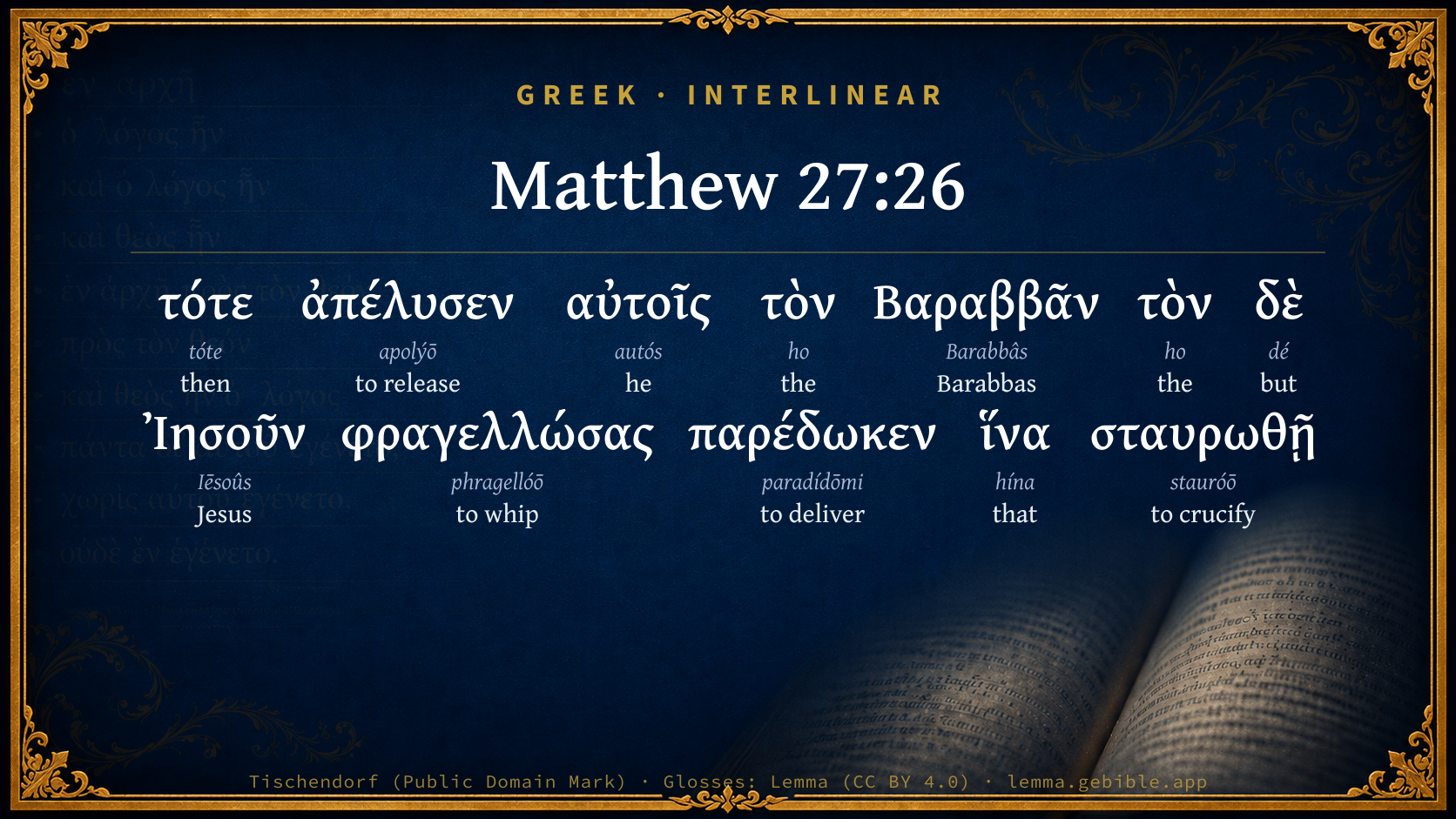
Greek (Tischendorf 8th ed.) Matthew 27:26 appears in the Greek New Testament. The text above is from the Tischendorf 8th edition. Each word links to its Strong’s number and a concise gloss. Click any word for its full Thayer’s Greek Lexicon entry.
Download image
Cite this verse

Matthew 27:26 (World English Bible). Public Domain. Lemma interlinear Bible study tool, https://lemma.gebible.app/v/matthew/27/26.

Show BibTeX & RIS
BibTeX
RIS
English Translation
Then he released to them Barabbas, but Jesus he flogged and delivered to be crucified.
World English Bible · Public Domain
Highlights
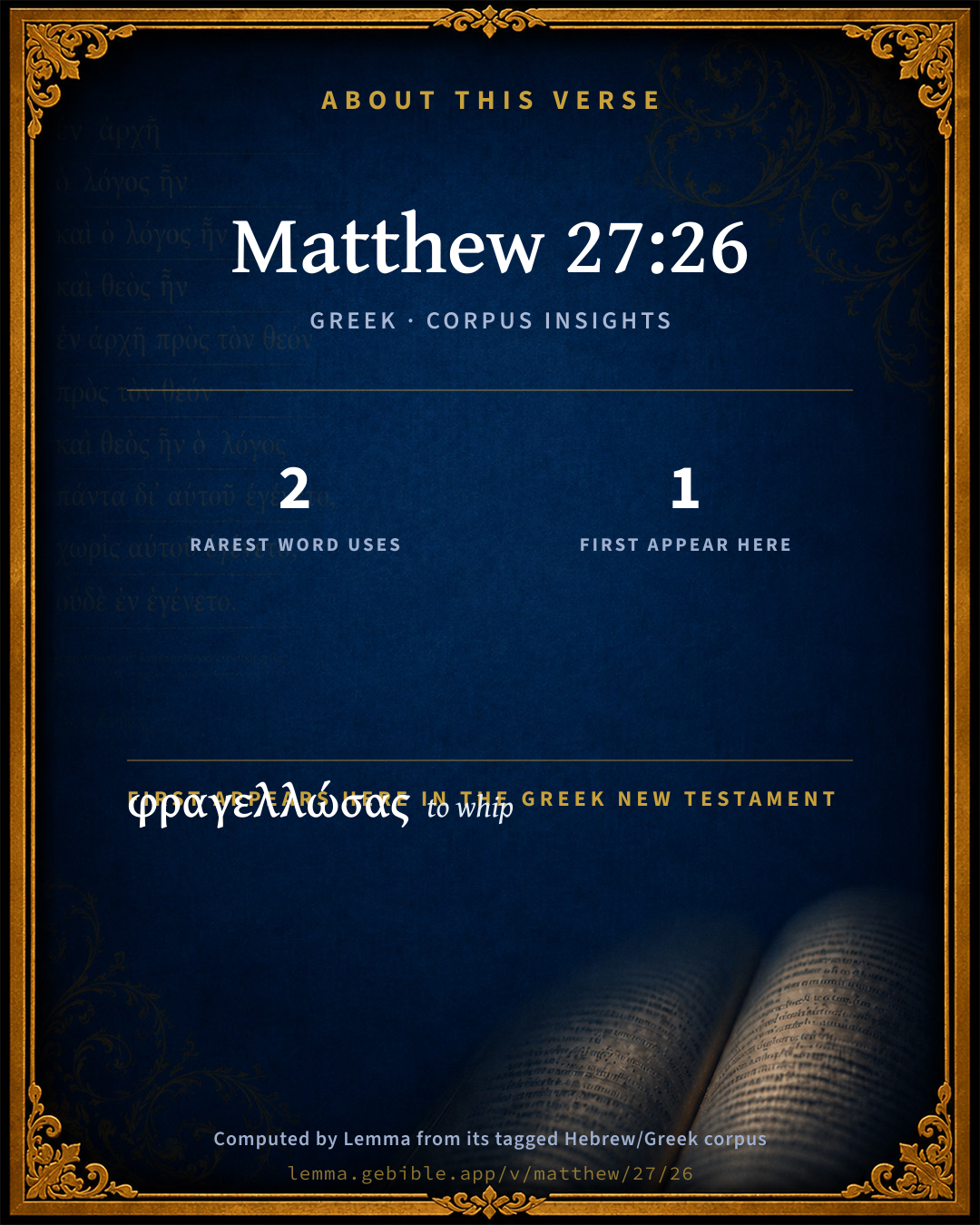
  • 1 first appearance in the Greek New Testament
Full analysis ↓
Download a study sheet

One document with this verse’s original text, its word-by-word gloss line, the meaning frame, cross-references with their text, attributed commentary, and full source and license credits — printable, and it pastes into notes with its structure intact.

This verse Autodidact and up

Study sheet (.html) Plain text (.txt)

A passage Seminary Student

Up to 50 verses in one chapter. A passage sheet keeps up to 6 commentary sources and 12 cross-references per verse, in the order this page ranks them, and says so on the sheet whenever that leaves anything out. Ask for a single verse and you get the Autodidact verse sheet above.

Everything on this page stays free to read, with no account — the sheet is a download of what is already on screen, not access to it.

Want to remove ads? Support Godless Engineer
Compare translations 3

The same verse in 3 English versions, stacked beneath the original-language interlinear above. Click any original word for its lexicon entry.

Each is an independent rendering of the whole verse — the interlinear is not word-aligned to these translations.

Highlighted words mark where these versions differ — a whole-verse word diff, not a word-by-word alignment.

  • World English Bible Public Domain
    Then he released to them Barabbas, but Jesus he flogged and delivered to be crucified.
  • King James Version Public Domain
    Then released he Barabbas unto them: and when he had scourged Jesus, he delivered him to be crucified.
  • unfoldingWord Literal Text CC BY-SA 4.0
    Then he released Barabbas to them, but having flogged Jesus, he handed over so that he might be crucified.

unfoldingWord Literal Text — © unfoldingWord, licensed CC BY-SA 4.0. Word-aligned USFM3 via Door43 (git.door43.org/unfoldingWord/en_ult).

Versions to compare (up to 4)

3 of 4 selected

Show all 19 translations

Every available English version of this verse, each an independent rendering of the whole verse.

  • World English Bible Public Domain
    Then he released to them Barabbas, but Jesus he flogged and delivered to be crucified.
  • Berean Standard Bible Public Domain
    So Pilate released Barabbas to them. But he had Jesus flogged, and handed Him over to be crucified.
  • Majority Standard Bible Public Domain
    So Pilate released Barabbas to them. But he had Jesus flogged, and handed Him over to be crucified.
  • King James Version Public Domain
    Then released he Barabbas unto them: and when he had scourged Jesus, he delivered him to be crucified.
  • American Standard Version (1901) Public Domain
    Then released he unto them Barabbas; but Jesus he scourged and delivered to be crucified.
  • Revised Version (1885) Public Domain
    Then released he unto them Barabbas: but Jesus he scourged and delivered to be crucified.
  • Geneva Bible (1599) Public Domain
    Thus let he Barabbas loose vnto them, and scourged Iesus, and deliuered him to be crucified.
  • Douay-Rheims (1899) Public Domain
    Then he released to them Barabbas, and having scourged Jesus, delivered him unto them to be crucified.
  • Young's Literal Translation Public Domain
    Then did he release to them Barabbas, and having scourged Jesus, he delivered `him' up that he may be crucified;
  • Literal Standard Version CC BY-SA 4.0
    Then he released Barabbas to them, and having scourged Jesus, he delivered [Him] up that He may be crucified;
  • Unlocked Literal Bible CC BY-SA 4.0
    Then he released Barabbas to them, but he scourged Jesus and handed him over to be crucified.
  • unfoldingWord Literal Text CC BY-SA 4.0
    Then he released Barabbas to them, but having flogged Jesus, he handed over so that he might be crucified.
  • Darby Bible Public Domain
    Then he released to them Barabbas; but Jesus, having scourged [him], he delivered up that he might be crucified.
  • World Messianic Bible Public Domain
    Then he released Barabbas to them, but Yeshua he flogged and delivered to be crucified.
  • Webster's Bible Public Domain
    Then he released Barabbas to them: and when he had scourged Jesus, he delivered him to be crucified.
  • Free Bible Version CC BY-SA 4.0
    Then he released Barabbas to them, but he had Jesus flogged and sent to be crucified.
  • Bible in Basic English Public Domain
    Then he let Barabbas go free: but after having Jesus whipped, he gave him up to be put to death on the cross.
  • Text-Critical English NT CC BY 4.0
    Then he released for them Barabbas, but he scourged Jesus and handed him over to be crucified.
  • Tyndale New Testament (1534) Public Domain
    Then let he Barrabas loose vnto them and scourged Iesus and delivered him to be crucified.

Literal Standard Version (2020), Covenant Press — licensed CC BY-SA 4.0. Text via the HelloAO Bible API (eBible.org). Unlocked Literal Bible (unfoldingWord) — licensed CC BY-SA 4.0. Text via the HelloAO Bible API (eBible.org). unfoldingWord Literal Text — © unfoldingWord, licensed CC BY-SA 4.0. Word-aligned USFM3 via Door43 (git.door43.org/unfoldingWord/en_ult). Free Bible Version, Dr. Jonathan Gallagher — licensed CC BY-SA 4.0. Text via the HelloAO Bible API (eBible.org).

Word by word

More ways to search: Search by grammar → Find every occurrence → Compare this word →

Practice this passage: Drill this verse → Learn its vocabulary →

φραγελλώσας
phragellóō
G5417
“to whip”
Verb, Aorist, Active, Participle, Nominative, Singular, Masculine
Part of Speech
Verb
Tense
Aorist
Voice
Active
Mood
Participle
Case
Nominative
Number
Singular
Gender
Masculine
Full Thayer's Definition

Origin: from a presumed equivalent of the Latin flagellum

TDNT: None

1. to scourge
  1. τότε tóte G5119 “then” Adverb
  2. ἀπέλυσεν apolýō G630 “to release” Verb, Aorist, Active, Indicative, 3rd person, Singular
  3. αὐτοῖς autós G846 “he” Personal pronoun, Dative, Plural, Masculine
  4. τὸν ho G3588 “the” Article, Accusative, Singular, Masculine
  5. Βαραββᾶν Barabbâs G912 “Barabbas” Noun, Accusative, Singular, Masculine
  6. τὸν ho G3588 “the” Article, Accusative, Singular, Masculine
  7. δὲ dé G1161 “but” Conjunction
  8. Ἰησοῦν Iēsoûs G2424 “Jesus” Noun, Accusative, Singular, Masculine
  9. παρέδωκεν paradídōmi G3860 “to deliver” Verb, Aorist, Active, Indicative, 3rd person, Singular
  10. ἵνα hína G2443 “that” Conjunction
  11. σταυρωθῇ stauróō G4717 “to crucify” Verb, Aorist, Passive, Subjunctive, 3rd person, Singular

About this verse

These counts appear in no published source. They are computed here, from the morphology-tagged text and Lemma’s own curated glosses. What Lemma adds →

12
words
11
distinct lemmas
Gospels
section

Notable vocabulary

The rarest word here is φραγελλώσας to whip G5417 — appearing just 2 times in the whole Greek New Testament.

First appearance in Scripture

This word makes its first canonical appearance in the Greek New Testament here:

  • φραγελλώσας to whip G5417

Shared distinctive vocabulary

φραγελλώσας to whip G5417 occurs in 2 verses of the Greek New Testament. Also found in:

Repetition

A word recurs within this verse:

Cross-references

11

Topical passages linked to Matthew 27:26 in the Treasury of Scripture Knowledge — connected by theme and wording, ordered by reader-vote popularity; previews shown in the World English Bible.

  • Isaiah 53:5 But he was pierced for our transgressions, he was crushed for our iniquities; the punishment that brought our peace was on him; and by his wounds we are healed.
  • John 19:1 So Pilate then took Jesus, and flogged him.
  • Mark 15:15 Pilate, wishing to please the multitude, released Barabbas to them, and handed over Jesus, when he had flogged him, to be crucified.
  • Isaiah 50:6 I gave my back to the strikers, and my cheeks to those who plucked off the hair; I didn't hide my face from shame and spitting.
  • Luke 23:16 I will therefore chastise him and release him."
  • Matthew 20:19 and will hand him over to the Gentiles to mock, to scourge, and to crucify; and the third day he will be raised up."
  • Mark 10:34 They will mock him, spit on him, scourge him, and kill him. On the third day he will rise again."
  • Luke 23:24–25 Pilate decreed that what they asked for should be done.
  • 1 Peter 2:24 who his own self bore our sins in his body on the tree, that we, having died to sins, might live to righteousness; by whose stripes you were healed.
  • Luke 18:32–33 For he will be delivered up to the Gentiles, will be mocked, treated shamefully, and spit on.
  • John 19:16 So then he delivered him to them to be crucified. So they took Jesus and led him away.

Cross-references courtesy of OpenBible.info (CC BY 4.0).

Commentary

Notes on Matthew 27:26 from classic Christian and Jewish commentators (each source and its license shown beneath its notes). The classic Christian expositions comment on the surrounding passage and are grouped to its opening verse, so a note may address several verses; the Jewish commentaries on the Tanakh (Rashi and others) are per-verse, so they appear only where the commentator wrote on this verse.

Lemma curates 59 commentaries, every one of them public domain or Creative Commons licensed, each selected and text-cleaned for this edition rather than reprinted as found. About our sources →

Joseph Benson's Commentary

Mat 27:26. And when he had scourged Jesus, &c. — This was an ignominious and cruel punishment, usually, but most unreasonably inflicted by the Romans on such as were condemned to be crucified; as if the exquisite tortures of crucifixion were not a punishment sufficient of any crime, real or pretended, without adding to them those of the scourge. Matthew and Mark seem to signify, that the scourging of Jesus was performed on the pavement; for they tell us, that after it was over, the soldiers took him into the prætorium, and mocked him. We may, therefore, suppose, that the priests and multitude required the governor to scourge him openly in their sight; and that he, to pacify them, consented, contrary to his inclination, hoping, as some suppose, that this previous punishment would excite the pity of the Jews and prevent Christ’s crucifixion. That, however, was not the case. Nothing short of that ignominious and torturing death would satisfy them. Jesus being thus scourged, the Scriptures were fulfilled, I gave my back to the smiters, Isa 50:6. The ploughers ploughed on my back: they made long their furrows, Psa 129:3. By his stripes we are healed.

Joseph Benson's Commentary on the Old and New Testaments (1811–1818) — public domain. Text from a community e-Sword module.

Whedon's Commentary on the Bible

Daniel D. Whedon

SCOURGING BY PILATE AND DELIVERY FOR CRUCIFIXION, Mat_27:26-31.

The purpose of this whole scene of course is to burlesque Jesus’s claim to royalty. A notable king forsooth is this, for whom the proper crown is a garland of thorns, the sceptre a reed, the robe an old cast off cloak. Mock homage, interspersed with insults and injuries, completes the wretched drama.

26. Scourged Jesus — The Greek word here used is borrowed from the Roman flagellum, which was the scourge with which slaves were chastised before execution. It was composed of ox nerves, extremely sharp, interwoven with sheep bones, so as to lacerate the flesh.

Daniel D. Whedon (gen. ed.), Commentary on the Old and New Testaments (1874–1909) — public domain. Text from a community e-Sword module.

Godbey's Commentary on the New Testament

William B. Godbey

JESUS SCOURGED AND MOCKED

Mar 15:19; Joh 19:1-3; Mat 27:26-30. “And having scourged Jesus, he delivered Him up, that He may be crucified.” As it was customary with the Romans to precede the crucifixion of condemned criminals by this awful and cruel scourging, Pilate now proceeds to have Jesus scourged, thus publicly demonstrating His condemnation, and afterward delivering Him up to be crucified pursuant to criminal law, at the same time congratulating himself on the presumed clemency of the Jews to permit His release. This was Pilate’s weakness. He here let go his grip, thinking to regain it, but failed.

“Then the soldiers of the governor, taking Jesus into the judgment-hall, gathered round Him the whole band; and divesting Him, put on Him a scarlet robe; and plaiting a crown of thorns, placed it on His head, and a reed in His right hand, and bowing the knee before Him, continued to mock Him, saying, Hall, King of the Jews. Spitting upon Him, they repeatedly took the reed, and struck Him on the head.” All this pomp, pageantry, and abuse, dressing Him up like a king, paying Him royal adoration, at the same time indulging in the vilest insult and abuse, was their way of humoring what they regarded as a ridiculous joke; i. e., His claim to be King. While Pilate, especially since the reception of his wife’s warning letter, was awfully troubled with suspicion and apprehension that He might be superhuman, and even one of the Roman gods, as their poets had described their deities as coming down in human form and walking over the earth ever and anon, the soldiers looked upon Him as a regular oddity, fanatically dreaming that He was King of the Jews. Consequently they intensely enjoyed amusement at His expense, dressing Him up like a king, with a crown on His head and a scepter in His hand, and His loyal subjects round Him, bowing the knee and doing homage to His Majesty.

William B. Godbey, Commentary on the New Testament (1896–1900) — public domain. Text from a community e-Sword module.

Tyndale Open Study Notes

Tyndale Open Resources

27:26 When a man was flogged, he was beaten with whips that had leather thongs at the end, some with sharp bone, lead, or rock fragments stuck to the ends of the thongs (see also Deut 25:1-3; 1 Kgs 12:11, 14; Acts 16:22; 22:25; 2 Cor 11:24-25).

Tyndale Open Study Notes — © Tyndale Open Resources, licensed CC BY-SA 4.0. Text via the HelloAO Bible API.

Bengel's Gnomon

Johann Albrecht Bengel

Mat 27:26. Φραγελλώσας, having scourged) after passing sentence.[1190]

[1190] The delivering up of Jesus to the will of the Jews was immediately connected with the setting of Barabbas free, and both were followed by the scourging, accompanied with the mocking of our Lord. In the presence of Caiaphas, it was not till after the capital sentence, that the mocking followed; and, on the same principle, the soldiers could not at pleasure vent their wanton ribaldry on Jesus, before that Pilate delivered Him up to the will and pleasure of the Jews.—Harm., p. 553.

Bengel's Gnomon of the New Testament — English translation (T&T Clark, Edinburgh, 1860) — public domain. Text from a community e-Sword module.

Meyer's Critical & Exegetical Commentary

Heinrich August Wilhelm Meyer

Mat_27:26 Φραγελλώσας] a late word adopted from the Latin, and used for μαστιγοῦν. Comp. Joh_2:15; see Wetstein. It was the practice among the Romans to scourge the culprit (with cords or thongs of leather) before crucifying him (Liv. xxxiii. 36; Curt. vii. 11. 28; Valer. Max. i. 7, Joseph. Bell. v. 11. 1, al.; Heyne, Opusc. III. p. 184 f.; Keim, III. p. 390 f.). According to the more detailed narrative of Joh_19:1 ff., Pilate, after this scourging was over, and while the soldiers were mocking Him, made a final attempt to have Jesus set at liberty. According to Luk_23:16, the governor contemplated ultimate scourging immediately after the examination before Herod,a circumstance which neither prevents us from supposing that he subsequently carried out his intention (in opposition to Strauss), nor justifies the interpretation of our passage given by Paulus: whom He had previously scourged (with a view to His being liberated).

παρέδωκεν] namely, to the Roman soldiers, Mat_27:27. These latter were entrusted with the task of seeing the execution carried out.

Meyer — Critical and Exegetical Commentary on the New Testament — English translation by Peter Christie, edited by Frederick Crombie (T&T Clark, 1880) — public domain. Text from a community e-Sword module.

Expositor's Greek Testament

ed. W. Robertson Nicoll

Mat 27:26 . τότε ἀπέλυσεν : Pilate, lacking the passion for justice, judges not according to the merits but according to policy. When he discovered that Jesus was not a popular favourite, in fact had no friends, he had no more interest in Him, but acted as the people wished, loosing Barabbas and delivering Jesus to be crucified, after having first subjected Him to scourging ( φραγελλώσας = flagello , a Latinism probably borrowed from Mk.). Such was the barbarous practice of the Romans. It is alluded to by Josephus (B. J., Mat 27:11 ; Mat 27:1 ) in these terms: μαστιγούμενοι δὴ καὶ προβασανιζόμενοι τοῦ θανάτου πᾶσαν αἰκίαν ἀνεσταυροῦντο τοῦ τείχους ἀντικρύ . Brandt thinks that the alleged custom of releasing a prisoner had no existence, and that the story in the Gospels arose out of an occurrence at a later time, the release of a prisoner the son of a Rabbi concerned in a tumult. The Christians said: they release the son of the Scribe and they crucified our Jesus, and at last the incident was read back into the story of the Passion ( E. G. , pp. 94 105).

The Expositor's Greek Testament, edited by W. Robertson Nicoll (1897–1910) — public domain. Text from a community e-Sword module.

Adam Clarke's Commentary

Verse 26. Scourged Jesus] This is allowed to have been a very severe punishment of itself among the Romans, the flesh being generally cut by the whips used for this purpose: so the poet: -

----Horribili SECTERE flagello. "To be cut by the horrible whip."-HOR. Sat. I. 3. 119.

And sometimes it seems, they were whipped to death. See the same poet, Sat. I. 2. 41.

----Ille FLAGELLIS

AD MORTEM caesus.----

See also HORAT. Epod. od. iv. v. 11.

It has been thought that Pilate might have spared this additional cruelty of whipping; but it appears that it was a common custom to scourge those criminals which were to be crucified, (see Josephus De Bello, lib. ii. c. 25,) and lenity in Christ's case is not to be allowed; he must take all the misery in full tale.

Delivered him to be crucified.] Tacitos, the Roman historian, mentions the death of Christ in very remarkable terms:-

Nero - quaesitissimis poenis is affecit, quos - vulgus CHRISTIANOS appellabat. Auctor nominis ejus CHRISTUS, qui Tiberio imperitante, per Procuratorem Pontium Pilatum supplicio affectus erat." -

Nero put those who commonly went by the name of Christians to the most exquisite tortures. The author of this name was CHRIST, who was capitally punished in the reign of TIBERIUS, by PONTIUS PILATE the PROCURATOR."

Adam Clarke's Commentary on the Bible (1810–1826) — public domain. Text from a community e-Sword/MySword module.

Ellicott's Commentary for English Readers

(26) When he had scourged Jesus.—The word used by St. Matthew, derived from the Latin flagellum, shows that it was the Roman punishment with knotted thongs of leather (like the Russian “knout” or the English “cat”), not the Jewish beating with rods (2Co_11:24-25). The pictures of the Stations, so widely used throughout Latin Christendom, have made other nations more familiar with the nature of the punishment than most Englishmen are. The prisoner was stripped sometimes entirely, sometimes to the waist, and tied by the hands to a pillar, with his back bent, so as to receive the full force of the blows. The scourge was of stout leather weighted with lead or bones. Jewish law limited its penalty to forty stripes, reduced in practice to “forty stripes save one” (2Co_11:24; Deu_25:3), but Roman practice knew no limit but that of the cruelty of the executioner or the physical endurance of the sufferer.

A Bible Commentary for English Readers, edited by Charles John Ellicott (1878–1897) — public domain. Text from a community e-Sword module.

The Cambridge Bible for Schools and Colleges

gen. ed. J. J. S. Perowne

26. when he had scourged Jesus] Scourging usually preceded crucifixion. It was in itself a cruel and barbarous torture, under which the victim often perished.

The Cambridge Bible for Schools and Colleges (gen. ed. J. J. S. Perowne; Cambridge University Press, 1878–1918) — public domain. Text from a community e-Sword module.

John Gill's Exposition

Then the soldiers of the governor,.... Those that were about him, his attendants and guards,

took Jesus into the common hall; the "praetorium", or judgment hall, as it is sometimes called; the governor's palace, into which the Jews would not enter, lest they should defile themselves: Pilate therefore came out to them, and went into the pavement called Gabbatha, and sat upon a judgment seat there; see Joh 18:28, where he passed sentence on Christ; which being done, the soldiers took him into the hall of judgment; which being both magnificent and large, was fit for the scene they intended to act there. Munster's Hebrew Gospel reads it, they took him "in the house of judgment"; and the Ethiopic version renders it, "out of the court of judicature"; both wrong.

And gathered unto him whole band of soldiers; the same that Judas had with him to take him, consisting of five hundred, and some say more: these their fellow soldiers, to whom Jesus was committed, got together to him, or "against him", as the Syriac and Persic versions render it, make themselves sport and diversion with him. Think in what hands and company our dear Lord now was: now was he encompassed with dogs, and enclosed with the assembly of the wicked indeed; see Psa 22:16. The Persic version renders it, "multitudes of knaves being gathered together to him".

John Gill's Exposition of the Whole Bible (1746–1763) — public domain (CC PDM 1.0). Text via the HelloAO Bible API.

Trapp's Complete Commentary

John Trapp

26 Then released he Barabbas unto them: and when he had scourged Jesus, he delivered him to be crucified.

Ver. 26. And when he had scourged Jesus] So to satisfy their cruelty, and move them, if it might be, to pity. But though they relented not at the sight, it’s fit we should. Would it not grieve us at the heart, if we should see the king’s son basely whipped by our adversaries, only for our affairs? Christ was scourged when we had offended, that he might free us from the sting of conscience, and those scourges and scorpions of eternal torments, that he might make us a plaster of his own blessed blood, {a} for by his stripes we are healed, by the bloody weals made upon his back we are delivered. We hold it a thing almost beyond belief, that the applying of medicines to the sword that wounded a man shall make the wounds heal in a man. But here is a mystery that only Christian religion can tell of, and of which there never was precedent in nature, that the scourging and wounding of one man should cure another. {See Trapp on "Joh 19:1"}

{a} Sanguis medici factus est medicina phrenetici.

John Trapp, A Commentary or Exposition upon All the Books of the Old and New Testament (1647–1656) — public domain. Text from a community e-Sword module.

Albert Barnes' Notes on the Bible

And when he had scourged Jesus - See the notes at Mat 10:17. Among the Romans it was customary to scourge or whip a “slave” before he was crucified. This was done to inflict greater suffering. than crucifixion would be alone, and to add to the horrors of the punishment. Our Lord, being about to be put to death after the manner of a slave, was also treated as a slave as one of the lowest and most despised of mankind.

He delivered him to be crucified - Not merely gave him up to them to crucify him, as if they only were answerable, but he gave him up as a judge, when he ought to have saved his life and might have done it. Crucifixion was a Roman punishment; it was performed by Roman soldiers; Pilate pronounced the sentence from a Roman tribunal, and Pilate affixed the title to the cross. Pilate, therefore, as well as the Jews, was answerable to God for the death of the Savior of the world.

Albert Barnes' Notes on the Bible (1834–1885) — public domain. Text from a community e-Sword/MySword module.

Haydock's Catholic Bible Commentary

And having scourged Jesus. We must know that Pilate was a subject of the Roman empire; and by the Roman law it was ordained, that whoever was condemned to the cross, should previously suffer the punishment of scourging. (St. Jerome) --- He wished also by this apparent severity to soften the minds of the Jews, content their inveterate animosity, and this with hopes that they would in the end consent to the liberation of Jesus. (Bible de Vence)

George Leo Haydock (1774–1849), Haydock's Catholic Family Bible and Commentary, 1859 edition — public domain. Excludes Psalms (Douay-Rheims chapter numbering differs from Protestant) and Deuterocanonical books (Catholic canon only).

The Pulpit Commentary

Released he Barabbas that for sedition and murder was cast into prison, whom they had desired" (Luke). When he had scourged Jesus. This was the usual preliminary to crucifixion, especially in the case of shires, and was a punishment of a most severe and cruel nature. The verb here used, fragellow , is formed from the Latin flagellum, and denotes the employment of that terrible implement the Roman scourge. This was no ordinary whip, but commonly a number of leather thongs loaded with lead or armed with sharp bones and spikes, so that every blow cut deeply into the flesh, causing intense pain. The culprit was stripped of his clothes, pinioned, and bound to a stake or pillar, and thus on his bare back suffered this inhuman chastisement. To think that the blessed Son of God was subject to such torture and indignity is indeed a lesson for us written in blood. When "he gave his back to the smiters", (Isa_50:6) he was taking the punishment of our sin upon his sacred shoulders. "He was wounded for our transgressions, he was bruised for our iniquities: the chastisement of our peace was upon him; and with his stripes we are healed". (Isa_53:5) Possibly Pilate thought that the sight of Christ"ssuffering might arouse at this last moment the pity of the Jews. (Joh_19:1-16) But he was mistaken. The appetite of the bloodthirsty crowd was only whetted by this anticipatory taste; they insisted on the whole programme being canted out, and Pilate yielded to the demand, giving up the useless struggle. He delivered him to be crucified. Pilate delivered Jesus to the will of the people, directing the soldiers to carry out the ordered execution. On the view taken by the Romans themselves of crucifixion, commentators quote Cicero, "In Verr.," 2:5. 66, "It is a crime to bind a Roman citizen; to scourge him is an act of wickedness; to put him to death is almost parricide: what shall I say of crucifying him? An act so abominable it is impossible to find any word adequately to express.

Vers. 26-34. Preparations.for the Crucifixion.

I THE SCOURGING.

1. It had been predicted. "I gave my back to the smiters," Isaiah said in the spirit of prophecy; and again, in words very solemn and very precious to sin-laden consciences, "By his stripes we are healed." The Lord himself had told his disciples beforehand that he should suffer this cruel indignity. (Mat_20:19) The circumstances of the Lord"s sufferings were revealed to the prophets ages before the time. This fact shows their solemn importance and deep spiritual significance. We should meditate in awe and adoring love on all those touching details which the Holy Ghost so long before made known to the prophets, that men should see the day of Christ by faith, and should anticipate the saving power of his atonement.

2. The intention of Pilate. Pilate had hoped to substitute the scourge for the cross. He had at first pronounced the Lord innocent. Then when the chief priests had stirred up the people and there were signs of gathering tumult, he thought of the act of grace usual at the Passover as a means for releasing him. Now when the frenzy of the excited crowd had become uncontrollable, he resorted to the scourge as a means for saving his life. "I will chastise him, and let him go". (Luk_23:22) He thought that the hatred of the chief priests might be satisfied, that the pity of the crowd might be moved by the anguish of the scourge. It was a pitiful exhibition of weakness. He would commit what seemed the lesser crime to avoid the greater. But sin ever leads on to sin. We may not do evil that good may come; we may not follow the multitude to do evil. The Christian must sometimes stand alone against an angry multitude if he knows that what is required of him is wrong in the sight of God.

3. The severity of the punishment. It was a sickening sight. The shame was cruel; the torture terrible. Holy Scripture records it in a few simple words. Ancient writers give us harrowing descriptions of the sufferings of Christian martyrs under the horrible lash. We must remember the Divine dignity of the awful Sufferer. We are treading on holy ground; we must approach these last scenes of the Lord"s Passion with reverence and godly fear. He is God, and he is suffering for us. We must draw near with deep sympathy for him, and with humble contrition, remembering our many and grievous offences which brought this agony upon him. And we must come with the deepest gratitude, with fervent love; for these his bitter pains manifest the unutterable strength and tenderness of his great love for us.

II THE MOCKERY.

1. The scarlet robe. The Lord had already been derided by the attendants of the chief priests, and afterwards by Herod; now the Roman soldiers were guilty of the like brutal insults. It was a scene of studied and gratuitous cruelty, which shows the depth of wickedness of which human nature is capable. The Lord had done them no wrong; some of them, at least, had heard the trial, and knew that he was innocent. But he was in their hands; he was to be put to death; and they would have their wicked pleasure; they would make sport of his agonies. They gathered round him the whole cohort to share their cruel game. They had heard of his claims to royal dignity; they put on him a scarlet robe, some cast-off military mantle, in imitation of the imperial purple.

2. The crown of thorns. They platted a crown of thorns to represent the wreath of laurel worn by the Caesars at Rome; they pressed it down, with its sharp spines, upon that holy head. They put a reed for a mock sceptre into his bound hands; and then the whole cohort, soldier after soldier, passed before him, each bowing the knee in pretended homage, each addressing him with the derisive title, "Hail, King of the Jews!" When they were wearied of this wicked sport, these bitter taunts, they spat upon that gracious face; they took the reed, and smote him on that thorn-crowned head, till, tired in turn of these insulting outrages, they took off the scarlet robe and put his own raiment on him, and led him away to crucify him. And he who suffered all this bitter mockery was indeed a King King of kings, and Lord of lords. At any moment throughout his long protracted agony he might, by one word, one look, have swept his torturers into utter death. He suffered in silence, patiently, calmly, setting us an example of meekness, of holy endurance. If the Lord most holy bore these outrageous insults, we sinful men may well take it patiently when we are called to suffer wrong when men speak ill of us.

III THE WAY OF SORROWS.

1. Simon of Cyrene. The heavy cross was laid upon the Lord. "He, bearing his cross, went forth." He was worn and wearied. The awful agony of Gethsemane, the cruel scourging, the many sufferings, bodily and mental, which in his blessed love he endured for us, had utterly exhausted his strength. He could not bear the cross; he sank beneath the burden. The soldiers, perhaps simply impatient of delay, perhaps in contempt of Simon, who may have been a disciple, and may have shown his sympathy with the suffering Lord, laid the Lord"s cross upon this stranger of Cyrene," that he might bear it after Jesus." It was done in insult, but it was in truth the highest honour. Simon was privileged to bear the Saviour"s cross, to help him in his seeming helplessness, to alleviate in some small degree his overwhelming sorrow. Simon has become the type, the figure of faithful Christians. They must bear the cross; the cross of suffering, in one form or another, is surely laid upon them all; they bear it after Jesus. That sad procession is a fitting representation of the Church of the elect. The Lord goeth at the head of them. After him follow in long order all his chosen, each bearing his cross, each learning of the Lord Jesus who first bore the cross, themselves to bear it patiently and with meek submission, glorying in the cross, for the royal way of the holy cross is the only way to life eternal, and without the cross there cannot come the crown.

2. Golgotha. We cannot certainly identify the spot where the dear Lord suffered. It would be consecrated by the holiest, the tenderest memories; we might well regard it as the most sacred spot in all the earth. The knowledge is hidden from us; and there is meaning in this. We may find Christ everywhere; every place, the whole world over, is hallowed by his blood. We may realize his death, and draw very near to the cross, and live under its shadow in England as well as at Jerusalem. Not all who saw him die were saved. It is the sight of Christ by faith that saves the soul. Blessed be God, we may bear about with us, wherever we go, the dying of the Lord Jesus, and in those who thus bear about that precious death, the life also of Jesus shall be manifested. The word "Golgotha" means "a skull." It reminds us of death; it tells us what we must one day be. But in that place which is called "a skull," he who is the Life of the world suffered and died; and by his death he hath abolished death; and we know that through him this corruptible must put on incorruption, and this mortal must put on immortality in that day when he shall change the body of our humiliation, fashioning it like unto the body of his glory.

3. The stupefying drink. They gave him wine to drink mingled with gall. Perhaps the women who bewailed and lamented him had provided it. It was offered in kindness, to stupefy the senses and dull the feeling of pain. The Lord acknowledged the kind intention by tasting the offered potion; but he would not drink it. He did not refuse the vinegar which was given afterwards in answer to the cry, "I thirst." But he would not take the opiate; he would meet death with clear untroubled intellect. We cannot comprehend the nature of that spiritual work of atonement which he had to complete ere the great cry of victory, "It is finished!" could issue from his dying lips. He would keep his consciousness calm and serene, that he might fulfil that sacred work. Let Christians imitate their Lord; let them never, in times of pain or distress, allow themselves to seek relief in strong drink; let them learn submission from the blessed Master.

LESSONS.

1. The Lord was scourged. Repine not in pain and agony, in unmerited disgrace.

2. He was mocked. Endure derision if it comes in his providence.

3. He bore the cross. Learn to bear it after Christ.

The Pulpit Commentary (1880–1919), ed. H.D.M. Spence-Jones & Joseph S. Exell — public domain. Text from a community e-Sword module.

John Wesley's Explanatory Notes

He delivered him to be crucified - The person crucified was nailed to the cross as it lay on the ground, through each hand extended to the utmost stretch, and through both the feet together. Then the cross was raised up, and the foot of it thrust with a violent shock into a hole in the ground prepared for it. This shock disjointed the body, whose whole weight hung upon the nails, till the persons expired through mere dint of pain. This kind of death was used only by the Romans, and by them inflicted only on slaves and the vilest criminals.

John Wesley, Explanatory Notes Upon the Whole Bible (1754–1765) — public domain. Text via the GEBible commentary corpus.

Kretzmann's Popular Commentary

Paul E. Kretzmann

Jesus condemned, and mocked by the soldiers:

v. 26. Then released he Barabbas unto them; and when he had scourged Jesus, he delivered Him to be crucified.

v. 27. Then the soldiers of the governor took Jesus into the common hall, and gathered unto Him the whole band of soldiers.

v. 28. And they stripped Him, and put on Him a scarlet robe.

v. 29. And when they had platted a crown of thorns, they put it upon His head, and a reed in His right hand; and they bowed the knee before Him, and mocked Him, saying, Hail, King of the Jews!

v. 30. And they spit upon Him, and took the reed, and smote Him on the head.

It was not a trial which here came to an end, but a travesty upon justice; Barabbas is released, but Jesus condemned. A type of the redemption, even at that: The innocent found guilty, the guilty released. But Pilate adds insult to injury and gives further evidence of the cruelty of small natures by having Jesus scourged, His naked back bent over a post, to which He was tied, and cut to pieces with leather thongs, as it was thus stretched out on the rack of pain. And having thus, as he hoped, fully regained the confidence of the Jews, he spoke the formal sentence of condemnation upon Jesus, sentencing Him to the death of the cross. This was a signal for the soldiers of the procurator, the prisoner was now delivered to their mercy. They first led Him into the judgment-hall of the palace, which was called praetorium from the fact that the praetor, or Roman magistrate, administered justice in this room in the absence of the higher officer of the empire. Here all the members of the Pretorian guard assembled to have their sport with the helpless victim. For a second time they stripped Him, throwing about Him, instead of His clothes, the scarlet mantle of a soldier, which had some resemblance to the robe of a king or emperor. They braided a crown of sharp thorns and pressed it down upon His head, thus lacerating the skin. They placed an old rod into His hand instead of a scepter. In mock solemnity and with feigned seriousness, they bowed their knees before Him, giving Him homage as King of the Jews. It was an insult to Christ, but also incidentally to the Jews. Their real nature came out in the climax of their torture, when they grew tired of acting, and spit in His face, while some of them took the mock scepter and drove the thorns still more deeply into the sensitive skin of the forehead by sharp blows. And in all these things the prophecies of the Old Testament, reinforced with those of Christ Himself, were fulfilled for the sake of mankind’s redemption.

Paul E. Kretzmann, Popular Commentary of the Bible (1921–1924) — public domain. Text from a community e-Sword module.

Burkitt's Expository Notes on the New Testament

William Burkitt

As the death of the cross was a Roman punishment, so it was the manner of the Romans first to scourge and whip their malefactores, and then deliver them to be crucified. Now the manner of the Romans scourging is said to be thus; they stripped the condemned person, and bound him to a post; two strong men first scourged him with rods of thorns; then two others scourged him with whips full of knots; and lastly two more with whips of wire, and therewith tore off the very flesh and skin from the person’s back and sides.

That our Saviour was thus cruelly scourged, seems to some not improbable, from that of the psalmist, The ploughers ploughed upon my luck, and made long furrows. Psa 129:3 Which, if spoken prophetically of Christ, was literally fulfilled in the day of his scourging. But why was the precious body of our blessed Lord thus galled and torn with scourgings! Doubtless to fulfil that prophecy; I gave my back to the smiters, and my cheeks to them that plucked off the hair,-That by his stripes we might be healed.

And to learn us patience from his example: Why should we think it strange to be scourged either with the tongue or the hand, or with both, when we see our dear Redeemer bleeding by stripes and scourges before our eyes?

William Burkitt's Expository Notes on the New Testament (1700–1703) — public domain. Text from a community e-Sword module.

The People's New Testament

B. W. Johnson

26. Jesus he scourged. Scourging usually preceded crucifixion. It was an awful punishment, inflicted by brutal soldiers, and continued until the victim was fainting under the torture.

B. W. Johnson's The People's New Testament with Notes (1889–1891) — public domain. Electronic text from the Christian Classics Ethereal Library (CCEL) ThML edition.

Cambridge Greek Testament for Schools and Colleges

26. φραγελλώσας. Here and Mar 15:15, from Latin ‘flagello.’ Scourging usually preceded crucifixion. It was in itself a cruel and barbarous torture, under which the victim often perished.

Cambridge Greek Testament for Schools and Colleges (Cambridge University Press, 1896; 21 vols, various authors incl. Carr, Maclear, Plummer, Farrar, Lumby, Moule, M. R. James, Simcox) — public domain. Text from a community e-Sword module.

Alford’s Greek Testament

Henry Alford

26.] φραγελ. is a late word, adopted from the Latin. The custom of scourging before execution was general among the Romans. After the scourging, Joh 19:1-16, Pilate made a last attempt to liberate Jesus—which answers to παιδεύσας ἀπολύσω, Luke, ver. 16.

παρέδωκεν] to the Roman soldiers, whose office the execution would be.

Henry Alford, The Greek Testament (1849–1861) — public domain. Text from a community e-Sword module.

International Critical Commentary

(M) 26. Then he released Barabbas to them; but he scourged Jesus, and delivered Him to be crucified.] Mk. has: “And Pilate, being willing to content the multitude, released Barabbas to them; and he delivered Jesus, when he had scourged Him, to be crucified.—τὸν δέ] So Lk. Mk. has καί. Mt. substitutes δέ, as often.

International Critical Commentary — older volumes (1896–1929), various authors — public domain. Text from a community e-Sword module.

Lesson kit

Teaching starters — assembled from the data on this page, not authored interpretation. Every prompt links to the verse data it draws on. Edit before teaching.

Matthew, in the Gospels, opens this verse with 12 words (11 distinct Greek lemmas). Its most distinctive word is phragellóō (“to whip”). A historical commentator’s framing appears above. Read the whole chapter for the surrounding context.

Discussion questions

  1. The word phragellóō carries the sense “to whip.” How does it shape the verse?
  2. This is the first place “to whip” appears in Scripture (first appears here). What does its debut here establish?
  3. How does Mark 15:15, which shares the word «to whip», read alongside this verse?
  4. What does the repetition of “the” (2× in this one verse) do in this verse?
  5. These translations render this verse differently. What is at stake in choosing one wording over another?
  6. Compare how Joseph Benson's Commentary and Whedon's Commentary on the Bible read this verse. Where do they agree or differ?

Things to notice

  • 1 word makes its first canonical appearance in Scripture here.
  • These translations choose different wording for 10 words in this verse.
  • “the” occurs 2× in this single verse.
  • 11 distinct Greek lemmas span 12 words in this verse.

Reading settings

Reading text

Shown beneath each verse's original-language words.

Old Testament
Old Testament edition

Read the OT as the Masoretic Hebrew (MT) or the Greek Septuagint (LXX).

English shown for the Greek Septuagint (in the Hebrew ↔ Greek comparison).

Comparing translations? Open the Compare panel on any verse page to stack up to four side by side.