
Numbers 32:28

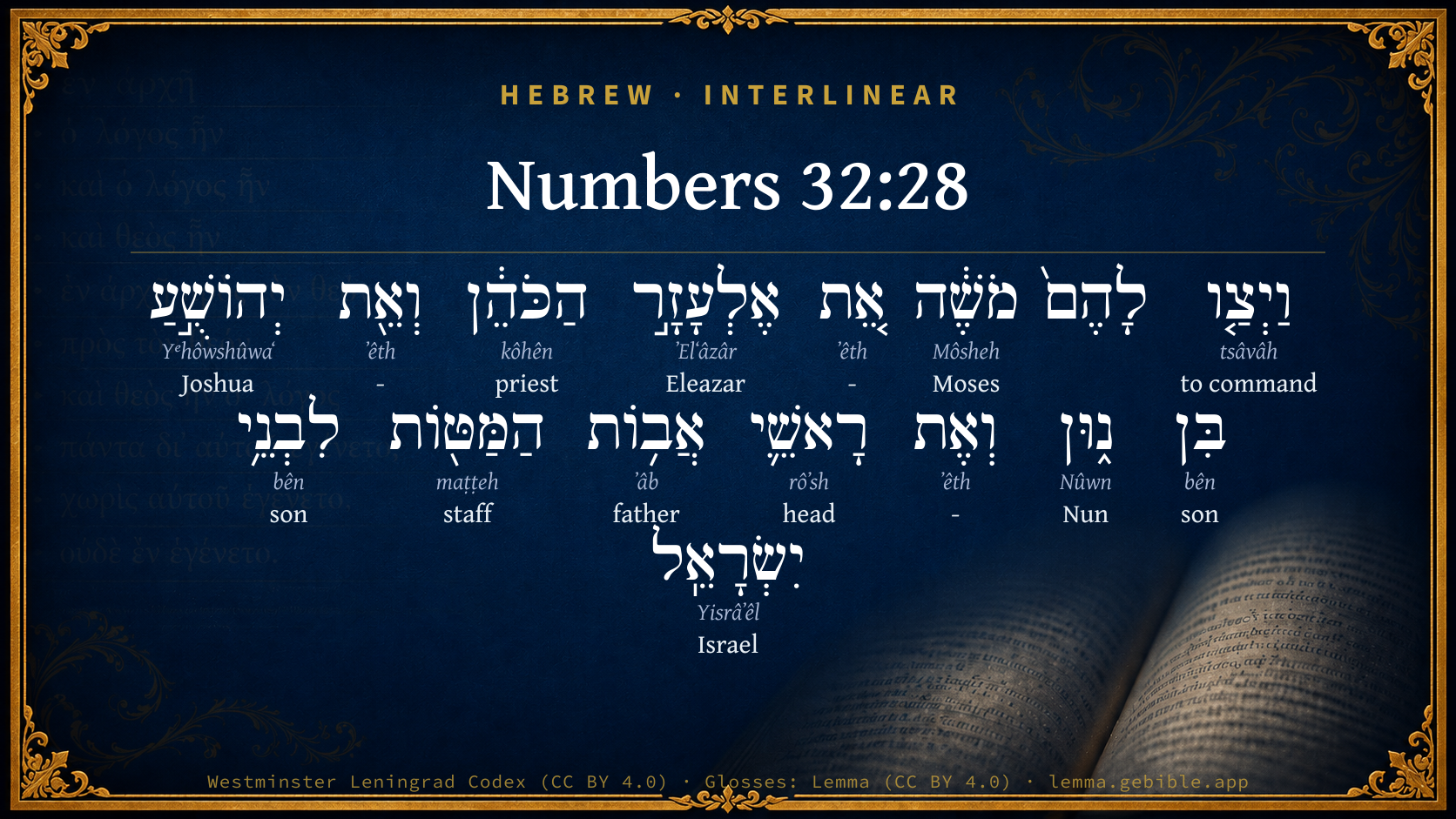
Hebrew (Westminster Leningrad Codex) Numbers 32:28 appears in the Hebrew Old Testament. The text above is from the Westminster Leningrad Codex. Each word links to its Strong’s number, a concise gloss, and parsing drawn from the Open Scriptures Hebrew Bible morphology. Click any word for its full Brown-Driver-Briggs (BDB) entry.
Download image
Cite this verse

Numbers 32:28 (World English Bible). Public Domain. Lemma interlinear Bible study tool, https://lemma.gebible.app/v/numbers/32/28.

Show BibTeX & RIS
BibTeX
RIS
English Translation
So Moses gave charge concerning them to Eleazar the priest, and to Joshua the son of Nun, and to the heads of the fathers' [houses] of the tribes of the children of Israel.
World English Bible · Public Domain
Download a study sheet

One document with this verse’s original text, its word-by-word gloss line, the meaning frame, cross-references with their text, attributed commentary, and full source and license credits — printable, and it pastes into notes with its structure intact.

This verse Autodidact and up

Study sheet (.html) Plain text (.txt)

A passage Seminary Student

Up to 50 verses in one chapter. A passage sheet keeps up to 6 commentary sources and 12 cross-references per verse, in the order this page ranks them, and says so on the sheet whenever that leaves anything out. Ask for a single verse and you get the Autodidact verse sheet above.

Everything on this page stays free to read, with no account — the sheet is a download of what is already on screen, not access to it.

Want to remove ads? Support Godless Engineer
Compare translations 3

The same verse in 3 English versions, stacked beneath the original-language interlinear above. Click any original word for its lexicon entry.

Each is an independent rendering of the whole verse — the interlinear is not word-aligned to these translations.

Highlighted words mark where these versions differ — a whole-verse word diff, not a word-by-word alignment.

  • World English Bible Public Domain
    So Moses gave charge concerning them to Eleazar the priest, and to Joshua the son of Nun, and to the heads of the fathers' [houses] of the tribes of the children of Israel.
  • King James Version Public Domain
    So concerning them Moses commanded Eleazar the priest, and Joshua the son of Nun, and the chief fathers of the tribes of the children of Israel:
  • unfoldingWord Literal Text CC BY-SA 4.0
    And Moses commanded Eleazar the priest and Joshua the son of Nun and the heads of the fathers of the tribes of the sons of Israel concerning them.

unfoldingWord Literal Text — © unfoldingWord, licensed CC BY-SA 4.0. Word-aligned USFM3 via Door43 (git.door43.org/unfoldingWord/en_ult).

Versions to compare (up to 4)

3 of 4 selected

Show all 18 translations

Every available English version of this verse, each an independent rendering of the whole verse.

  • World English Bible Public Domain
    So Moses gave charge concerning them to Eleazar the priest, and to Joshua the son of Nun, and to the heads of the fathers' [houses] of the tribes of the children of Israel.
  • Berean Standard Bible Public Domain
    So Moses gave orders about them to Eleazar the priest, to Joshua son of Nun, and to the family leaders of the tribes of Israel.
  • Majority Standard Bible Public Domain
    So Moses gave orders about them to Eleazar the priest, to Joshua son of Nun, and to the family leaders of the tribes of Israel.
  • King James Version Public Domain
    So concerning them Moses commanded Eleazar the priest, and Joshua the son of Nun, and the chief fathers of the tribes of the children of Israel:
  • American Standard Version (1901) Public Domain
    So Moses gave charge concerning them to Eleazar the priest, and to Joshua the son of Nun, and to the heads of the fathers' `houses' of the tribes of the children of Israel.
  • Revised Version (1885) Public Domain
    So Moses gave charge concerning them to Eleazar the priest, and to Joshua the son of Nun, and to the heads of the fathers’ houses of the tribes of the children of Israel.
  • Geneva Bible (1599) Public Domain
    So concerning them, Moses commanded Eleazar the Priest, and Ioshua the sonne of Nun, and the chiefe fathers of the tribes of the children of Israel:
  • Douay-Rheims (1899) Public Domain
    Moses therefore commanded Eleazar the priest, and Josue the son of Nun, and the princes of the families of all the tribes of Israel, and said to them:
  • Young's Literal Translation Public Domain
    And Moses commandeth concerning them Eleazar the priest, and Joshua son of Nun, and the heads of the fathers of the tribes of the sons of Israel;
  • Literal Standard Version CC BY-SA 4.0
    And Moses commands Eleazar the priest, and Joshua son of Nun, and the heads of the fathers of the tribes of the sons of Israel concerning them;
  • Unlocked Literal Bible CC BY-SA 4.0
    So Moses gave instructions concerning them to Eleazar the priest, to Joshua son of Nun, and to the leaders of the ancestor's clans in the tribes of the people of Israel.
  • unfoldingWord Literal Text CC BY-SA 4.0
    And Moses commanded Eleazar the priest and Joshua the son of Nun and the heads of the fathers of the tribes of the sons of Israel concerning them.
  • Darby Bible Public Domain
    So concerning them Moses commanded Eleazar the priest, and Joshua the son of Nun, and the chief fathers of the tribes of the children of Israel.
  • World Messianic Bible Public Domain
    So Moses commanded concerning them to Eleazar the priest, and to Joshua the son of Nun, and to the heads of the fathers’ households of the tribes of the children of Israel.
  • Webster's Bible Public Domain
    So concerning them Moses commanded Eleazar the priest, and Joshua the son of Nun, and the chief fathers of the tribes of the children of Israel:
  • Free Bible Version CC BY-SA 4.0
    Moses gave the following instructions about them to Eleazar the priest, to Joshua, son of Nun, and to the family leaders of the tribes of Israel.
  • Bible in Basic English Public Domain
    So Moses gave orders about them to Eleazar the priest and to Joshua, the son of Nun, and to the heads of families of the tribes of the children of Israel.
  • JPS Tanakh (1917) Public Domain
    So Moses gave charge concerning them to Eleazar the priest, and to Joshua the son of Nun, and to the heads of the fathers' houses of the tribes of the children of Israel.

Literal Standard Version (2020), Covenant Press — licensed CC BY-SA 4.0. Text via the HelloAO Bible API (eBible.org). Unlocked Literal Bible (unfoldingWord) — licensed CC BY-SA 4.0. Text via the HelloAO Bible API (eBible.org). unfoldingWord Literal Text — © unfoldingWord, licensed CC BY-SA 4.0. Word-aligned USFM3 via Door43 (git.door43.org/unfoldingWord/en_ult). Free Bible Version, Dr. Jonathan Gallagher — licensed CC BY-SA 4.0. Text via the HelloAO Bible API (eBible.org).

Word by word

More ways to search: Search by grammar → Find every occurrence → Compare this word →

Practice this passage: Drill this verse → Learn its vocabulary →

נ֑וּן
Nûwn
H5126
“Nun”
Noun, Proper
Part of Speech
Noun
Type
Proper
Full BDB Definition

Origin: from H5125

TWOT: None

Nun = "fish" or " posterity" - father of Joshua the successor of Moses
  1. וַיְצַ֤ו tsâvâh H6680 “and · to command” Conjunction + Verb, Piel, Sequential Imperfect, 3rd Person, Masculine, Singular
  2. מֹשֶׁ֔ה Môsheh H4872 “Moses” Noun, Proper
  3. אֵ֚ת ʼêth H853 “-” Particle, Direct Object
  4. אֶלְעָזָ֣ר ʼElʻâzâr H499 “Eleazar” Noun, Proper
  5. הַכֹּהֵ֔ן kôhên H3548 “the · priest” Particle, Definite Article + Noun, Common, Masculine, Singular, Absolute
  6. וְאֵ֖ת ʼêth H853 “and · -” Conjunction + Particle, Direct Object
  7. יְהוֹשֻׁ֣עַ Yᵉhôwshûwaʻ H3091 “Joshua” Noun, Proper
  8. בִּן bên H1121 “son of” Noun, Common, Masculine, Singular, Construct
  9. וְאֶת ʼêth H853 “and · -” Conjunction + Particle, Direct Object
  10. רָאשֵׁ֛י rôʼsh H7218 “heads of” Noun, Common, Masculine, Plural, Construct
  11. אֲב֥וֹת ʼâb H1 “fathers of” Noun, Common, Masculine, Plural, Construct
  12. הַמַּטּ֖וֹת maṭṭeh H4294 “the · staffs” Particle, Definite Article + Noun, Common, Masculine, Plural, Absolute
  13. לִבְנֵ֥י bên H1121 “to/for · sons of” Preposition + Noun, Common, Masculine, Plural, Construct
  14. יִשְׂרָאֵֽל Yisrâʼêl H3478 “Israel” Noun, Proper

About this verse

These counts appear in no published source. They are computed here, from the morphology-tagged text and Lemma’s own curated glosses. What Lemma adds →

16
words
12
distinct lemmas
Pentateuch
section

Shared distinctive vocabulary

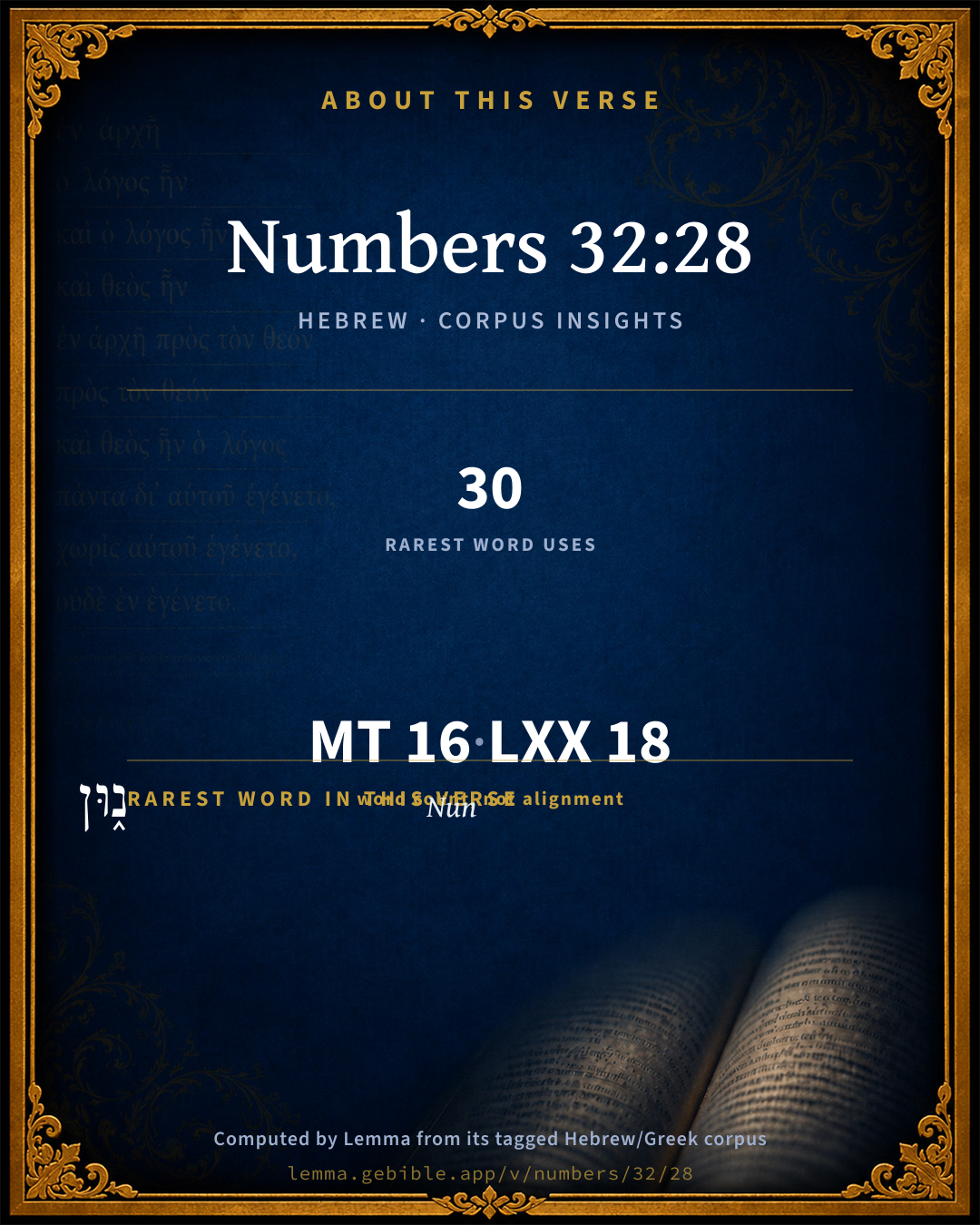
נ֑וּן Nun H5126 occurs in 30 verses of the Hebrew Bible. Also found in:

Grammatical profile

  • 1 verb
  • 11 nouns
  • 1 preposition
  • 3 particles

Verb forms

  • וַיְצַ֤ו Piel · Sequential Imperfect

Repetition

A word recurs within this verse — often emphatic in Hebrew:

Hebrew & Septuagint length

In English translation the verse runs 33 words from the Hebrew and 27 from the Septuagint (LXX English) — closely comparable.

A rough comparison of the two English renderings, which tokenize alike — not a word-level alignment.

Word counts can differ between the Hebrew and the Greek without any difference in meaning — e.g. the Hebrew direct-object marker אֵת has no separate Greek word, and Greek often adds the article ὁ.

In the original languages it is 16 Hebrew tokens and 18 Greek tokens — but the two are counted differently (Hebrew bundles its prefixes and suffixes into one token; the Greek is in lemma form), so that isn’t a like-for-like length.

Cross-references

1

Topical passages linked to Numbers 32:28 in the Treasury of Scripture Knowledge — connected by theme and wording, ordered by reader-vote popularity; previews shown in the World English Bible.

  • Joshua 1:13 Remember the word which Moses the servant of Yahweh commanded you, saying, Yahweh your God gives you rest, and will give you this land.

Cross-references courtesy of OpenBible.info (CC BY 4.0).

Hebrew and Greek witnesses Masoretic Hebrew ↔ Greek Septuagint

The same verse in the two great witnesses to the Old Testament, shown verse-for-verse.

These are two independent witnesses, not word-aligned to each other, and the Septuagint is shown in lemma (dictionary) form.

Hebrew Numbers 32:28 Masoretic · Westminster Leningrad Codex

וַיְצַ֤ו לָהֶם֙ מֹשֶׁ֔ה אֵ֚ת אֶלְעָזָ֣ר הַכֹּהֵ֔ן וְאֵ֖ת יְהוֹשֻׁ֣עַ בִּן נ֑וּן וְאֶת רָאשֵׁ֛י אֲב֥וֹת הַמַּטּ֖וֹת לִבְנֵ֥י יִשְׂרָאֵֽל

So Moses gave charge concerning them to Eleazar the priest, and to Joshua the son of Nun, and to the heads of the fathers' [houses] of the tribes of the children of Israel.

World English Bible · Public Domain

Greek LXX Numbers 32:28 Septuagint · lemma form

καί συνἵστημι αὐτός μωυσῆς ελεαζαρ ὁ ἱερεύς καί ἰησοῦς υἱός ναυη καί ὁ ἄρχων πατριά ὁ φυλή ἰσραήλ

And Moses appointed to them for judges Eleazar the priest, and Joshua the son of Naue, and the chiefs of the families of the tribes of Israel.

LXX2012 (modern English Septuagint) · Public Domain

Hebrew: Westminster Leningrad Codex (CC BY 4.0). Greek: Septuagint (public domain); English from LXX2012 (modern English Septuagint) (Public Domain). How the Septuagint differs from the Hebrew →

Targum (Aramaic paraphrase)

2

The Targum is the ancient Jewish Aramaic paraphrase of the Hebrew Scriptures — an interpretive translation, not the Hebrew text itself. Onkelos (literal) and Pseudo-Jonathan (expansive) render the Torah, and Jonathan the Prophets. Coverage is partial: where no permissively-licensed English translation exists for a verse, only the Aramaic is shown. This is verse-level text, not a word-by-word alignment to the Hebrew.

  1. Targum Onkelos Torah (Genesis–Deuteronomy)
    וּפַקֵד לְהוֹן משֶׁה יָת אֶלְעָזָר כַּהֲנָא וְיָת יְהוֹשֻׁעַ בַּר נוּן וְיָת רֵישֵׁי אֲבָהַת שִׁבְטַיָא לִבְנֵי יִשְׂרָאֵל

    (no public-domain English translation for this verse)

    Targum Onkelos — Aramaic: “Onkelos Genesis” (public domain); “Onkelos Exodus” (public domain); “Onkelos Leviticus” (public domain); “Onkelos Numbers” (public domain); “Onkelos Deuteronomy” (public domain). English: “Sefaria Community Translation” (CC0 1.0 (public-domain dedication)); “J.W. Etheridge. The Targums of Onkelos and Jonathan Ben Uzziel on the Pentateuch. London: Longmans, Green, 1862” (public domain). Text via Sefaria.

  2. Targum Pseudo-Jonathan Torah (Genesis–Deuteronomy)
    וּפַקֵיד עֲלֵיהוֹן משֶׁה יַת אֶלְעָזָר כַּהֲנָא וְיַת יְהוֹשֻׁעַ בַּר נוּן וְיַת רֵישֵׁי אַבְהַת שִׁבְטַיָא לִבְנֵי יִשְרָאֵל

    And Mosheh commanded concerning them Elazar the priest, and Jehoshua bar Nun, and the heads of the tribes of the Beni Israel,

    Targum Pseudo-Jonathan — Aramaic: “Targum Jonathan on Genesis” (public domain); “Targum Jonathan on Exodus” (public domain); “Targum Jonathan on Leviticus” (public domain); “Targum Jonathan on Numbers” (public domain); “Targum Jonathan on Deuteronomy” (public domain). English: “The Targum of Jonathan ben Uzziel, trans. J. W. Etheridge, London, 1862” (public domain). Text via Sefaria.

Commentary

Notes on Numbers 32:28 from classic Christian and Jewish commentators (each source and its license shown beneath its notes). The classic Christian expositions comment on the surrounding passage and are grouped to its opening verse, so a note may address several verses; the Jewish commentaries on the Tanakh (Rashi and others) are per-verse, so they appear only where the commentator wrote on this verse.

Lemma curates 59 commentaries, every one of them public domain or Creative Commons licensed, each selected and text-cleaned for this edition rather than reprinted as found. About our sources →

Tyndale Open Study Notes

Tyndale Open Resources

32:28-30 Israel’s leaders—Eleazar, Joshua, and the heads of clans—would help enforce Moses’ terms (cp. Josh 22:1-2) since his death was imminent.

Tyndale Open Study Notes — © Tyndale Open Resources, licensed CC BY-SA 4.0. Text via the HelloAO Bible API.

Geneva Bible (1599)

Geneva Bible translators

Moses gave charge that his promise made to the Reubenites, and others, should be performed after his death, so that they brake not theirs.

Geneva Bible (1599) marginal notes — public domain. Text via Bolls.life.

Jamieson, Fausset & Brown

Robert Jamieson, A. R. Fausset & David Brown

concerning them Moses commanded--The arrangement itself, as well as the express terms on which he assented to it, was announced by the leader to the public authorities. The pastoral country the two tribes had desired was to be granted them on condition that they would lend their aid to their brethren in the approaching invasion of Canaan. If they refused or failed to perform their promise, those possessions should be forfeited, and they themselves compelled to go across the Jordan and fight for a settlement like the rest of their brethren.

Jamieson, Fausset & Brown — Commentary Critical and Explanatory on the Whole Bible (1871) — public domain (CC PDM 1.0). Text via the HelloAO Bible API.

John Gill's Exposition

So concerning them Moses commanded,.... That they should have a grant of the land they requested: this looks as if Moses determined the case himself, though perhaps it was by the vote, and with the consent of the whole court; only Moses strictly enjoined them to observe it, namely:

Eleazar the priest, and Joshua the son of Nun, and the chief fathers of the tribes of the children of Israel; and the rather he did this, because he knew that he should die, and not see either the thing itself or the conditions of it performed.

John Gill's Exposition of the Whole Bible (1746–1763) — public domain (CC PDM 1.0). Text via the HelloAO Bible API.

Whedon's Commentary on the Bible

Daniel D. Whedon

28. Eleazar… Joshua… chief fathers — The commissioners for the allotment of Canaan. Num_34:17-29; Jos_14:1, note.

Daniel D. Whedon (gen. ed.), Commentary on the Old and New Testaments (1874–1909) — public domain. Text from a community e-Sword module.

The Pulpit Commentary

Moses commanded. See on Num_34:17, 18 Jos_1:13 Jos_22:1.

The Pulpit Commentary (1880–1919), ed. H.D.M. Spence-Jones & Joseph S. Exell — public domain. Text from a community e-Sword module.

Keil & Delitzsch

C. F. Keil & F. Delitzsch

Moses thereupon commanded Eleazar, Joshua, and the heads of the tribes of Israel, i.e., the persons entrusted in Num 34:17. with the division of the land of Canaan, to give the Gadites and Reubenites the land of Gilead for a possession, after the conquest of Canaan, if they should go along with them across the Jordan equipped for battle. But if they should not do this, they were to be made possessors (i.e., to be settled; נאחז in a passive sense, whereas in Gen 34:10; Gen 47:27, it is reflective, to fix oneself firmly, to settle) in the land of Canaan along with the other tribes. In the latter case, therefore, they were not only to receive no possession in the land to the east of the Jordan, but were to be compelled to go over the Jordan with their wives and children, and to receive an inheritance there for the purpose of preventing a schism of the nation.

Keil & Delitzsch — Biblical Commentary on the Old Testament (1861–1891) — public domain (CC PDM 1.0). Text via the HelloAO Bible API. (Old Testament only.)

unfoldingWord translationNotes

Door43 World Missions Community

every man who is armed

"every man who is ready with his weapon"

if the land is subdued before you

Here the word "land" refers to the people who live there. This can be stated in active form. AT: "if Yahweh subdues before you the people living in the land" or "if they help you subdue the people living in the land" (See: Active or Passive)

then they will acquire their possessions among you in the land of Canaan

"then the descendants of Gad and Reuben will receive land with you in Canaan"

translationWords

Eleazar

priest

Joshua

clan

tribe

Israel

Jordan River

Canaan

unfoldingWord translationNotes — © Distant Shores Media and the Door43 World Missions Community, licensed CC BY-SA 4.0. Source: git.door43.org/Door43/en_tn.

Rashi

Rabbi Shlomo Yitzchaki (Rashi)

. ויצו להם AND HE GAVE CHARGE — This is the same as, and he gave charge concerning them. The words imply: and to watch over the fulfilment of the agreement they had made he appointed Eleazar and Joshua. The use of the ל in להם here is the same as in (Exodus 14:14): “The Lord will fight לכם for you."

Rashi on the Tanakh — English translations: “The Judaica Press complete Tanach with Rashi, translated by A. J. Rosenberg” (CC BY 4.0); “Pentateuch with Rashi's commentary by M. Rosenbaum and A.M. Silbermann, 1929-1934” (public domain); “The Metsudah Tanach series, Lakewood, N.J” (CC BY 4.0); and “The Book of Joshua, Metsudah Publications, 1997” (CC BY 4.0). Text via Sefaria.

Lesson kit

Teaching starters — assembled from the data on this page, not authored interpretation. Every prompt links to the verse data it draws on. Edit before teaching.

Numbers, in the Pentateuch, opens this verse with 16 words (12 distinct Hebrew lemmas). Its most distinctive word is Nûwn (“Nun”). A historical commentator’s framing appears above. Read the whole chapter for the surrounding context.

Discussion questions

  1. What does “Nun” (Nûwn) contribute to the verse as a whole?
  2. How does Exodus 33:11, which shares the word «Nun», read alongside this verse?
  3. What does the repetition of “son” (2× in this one verse) do in this verse?
  4. These translations render this verse differently. What is at stake in choosing one wording over another?
  5. «וַיְצַ֤ו» is a Piel Sequential Imperfect verb. How does that grammatical form shape the action described?
  6. Compare how Tyndale Open Study Notes and Geneva Bible (1599) read this verse. Where do they agree or differ?

Things to notice

Reading settings

Reading text

Shown beneath each verse's original-language words.

Old Testament
Old Testament edition

Read the OT as the Masoretic Hebrew (MT) or the Greek Septuagint (LXX).

English shown for the Greek Septuagint (in the Hebrew ↔ Greek comparison).

Comparing translations? Open the Compare panel on any verse page to stack up to four side by side.