Mark 11:7

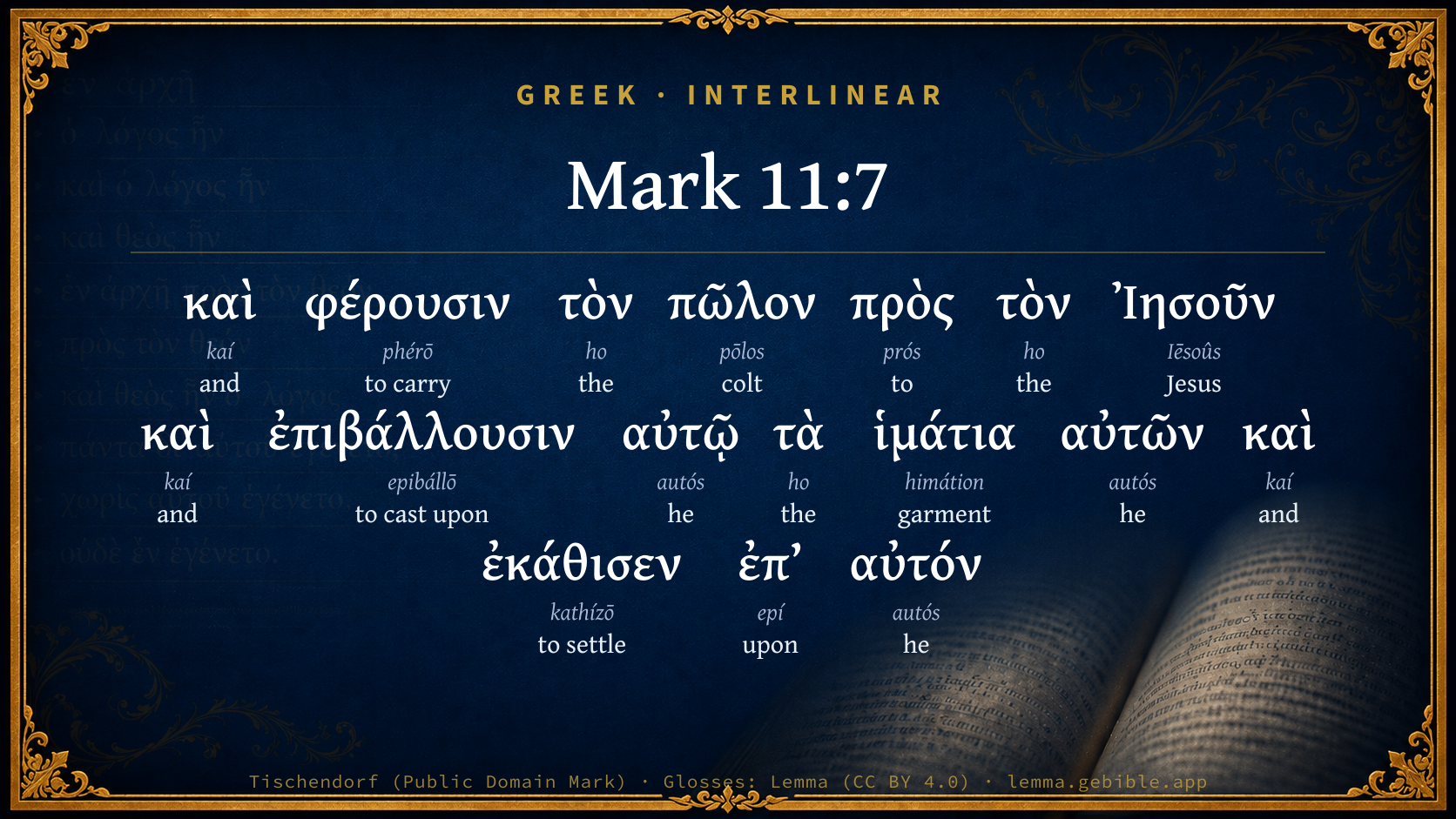
Greek (Tischendorf 8th ed.) Mark 11:7 appears in the Greek New Testament. The text above is from the Tischendorf 8th edition. Each word links to its Strong’s number and a concise gloss. Click any word for its full Thayer’s Greek Lexicon entry.
Download image
Cite this verse

Mark 11:7 (World English Bible). Public Domain. Lemma interlinear Bible study tool, https://lemma.gebible.app/v/mark/11/7.

Show BibTeX & RIS
BibTeX
RIS
English Translation
They brought the young donkey to Jesus, and threw their garments on it, and Jesus sat on it.
World English Bible · Public Domain
Download a study sheet

One document with this verse’s original text, its word-by-word gloss line, the meaning frame, cross-references with their text, attributed commentary, and full source and license credits — printable, and it pastes into notes with its structure intact.

This verse Autodidact and up

Study sheet (.html) Plain text (.txt)

A passage Seminary Student

Up to 50 verses in one chapter. A passage sheet keeps up to 6 commentary sources and 12 cross-references per verse, in the order this page ranks them, and says so on the sheet whenever that leaves anything out. Ask for a single verse and you get the Autodidact verse sheet above.

Everything on this page stays free to read, with no account — the sheet is a download of what is already on screen, not access to it.

Want to remove ads? Support Godless Engineer
Compare translations 3

The same verse in 3 English versions, stacked beneath the original-language interlinear above. Click any original word for its lexicon entry.

Each is an independent rendering of the whole verse — the interlinear is not word-aligned to these translations.

Highlighted words mark where these versions differ — a whole-verse word diff, not a word-by-word alignment.

  • World English Bible Public Domain
    They brought the young donkey to Jesus, and threw their garments on it, and Jesus sat on it.
  • King James Version Public Domain
    And they brought the colt to Jesus, and cast their garments on him; and he sat upon him.
  • unfoldingWord Literal Text CC BY-SA 4.0
    And they brought the colt to Jesus and throw their cloaks upon it, and he sat on it.

unfoldingWord Literal Text — © unfoldingWord, licensed CC BY-SA 4.0. Word-aligned USFM3 via Door43 (git.door43.org/unfoldingWord/en_ult).

Versions to compare (up to 4)

3 of 4 selected

Show all 19 translations

Every available English version of this verse, each an independent rendering of the whole verse.

  • World English Bible Public Domain
    They brought the young donkey to Jesus, and threw their garments on it, and Jesus sat on it.
  • Berean Standard Bible Public Domain
    Then they led the colt to Jesus and threw their cloaks over it, and He sat on it.
  • Majority Standard Bible Public Domain
    Then they led the colt to Jesus and threw their cloaks over it, and He sat on it.
  • King James Version Public Domain
    And they brought the colt to Jesus, and cast their garments on him; and he sat upon him.
  • American Standard Version (1901) Public Domain
    And they bring the colt unto Jesus, and cast on him their garments; and he sat upon him.
  • Revised Version (1885) Public Domain
    And they bring the colt unto Jesus, and cast on him their garments; and he sat upon him.
  • Geneva Bible (1599) Public Domain
    And they brought the colte to Iesus, and cast their garments on him, and he sate vpon him.
  • Douay-Rheims (1899) Public Domain
    And they brought the colt to Jesus; and they lay their garments on him, and he sat upon him.
  • Young's Literal Translation Public Domain
    And they brought the colt unto Jesus, and did cast upon it their garments, and he sat upon it,
  • Literal Standard Version CC BY-SA 4.0
    And they brought the colt to Jesus, and cast their garments on it, and He sat on it,
  • Unlocked Literal Bible CC BY-SA 4.0
    The two disciples brought the colt to Jesus and threw their cloaks on it so Jesus could ride it.
  • unfoldingWord Literal Text CC BY-SA 4.0
    And they brought the colt to Jesus and throw their cloaks upon it, and he sat on it.
  • Darby Bible Public Domain
    And they led the colt to Jesus, and cast their clothes upon it, and he sat on it;
  • World Messianic Bible Public Domain
    They brought the young donkey to Yeshua and threw their garments on it, and Yeshua sat on it.
  • Webster's Bible Public Domain
    And they brought the colt to Jesus, and cast their garments on him; and he sat upon him.
  • Free Bible Version CC BY-SA 4.0
    They brought the colt to Jesus, put their cloaks on it, and Jesus sat on it.
  • Bible in Basic English Public Domain
    And they took the young ass to Jesus, and put their clothing on him, and he got on his back.
  • Text-Critical English NT CC BY 4.0
    Then they brought the colt to Jesus and put their garments on it, and he sat on it.
  • Tyndale New Testament (1534) Public Domain
    And they brought the coolte to Iesus and caste their garmetes on him: and he sate vpo him.

Literal Standard Version (2020), Covenant Press — licensed CC BY-SA 4.0. Text via the HelloAO Bible API (eBible.org). Unlocked Literal Bible (unfoldingWord) — licensed CC BY-SA 4.0. Text via the HelloAO Bible API (eBible.org). unfoldingWord Literal Text — © unfoldingWord, licensed CC BY-SA 4.0. Word-aligned USFM3 via Door43 (git.door43.org/unfoldingWord/en_ult). Free Bible Version, Dr. Jonathan Gallagher — licensed CC BY-SA 4.0. Text via the HelloAO Bible API (eBible.org).

Word by word

More ways to search: Search by grammar → Find every occurrence → Compare this word →

Practice this passage: Drill this verse → Learn its vocabulary →

πῶλον
pōlos
G4454
“colt”
Noun, Accusative, Singular, Masculine
Part of Speech
Noun
Case
Accusative
Number
Singular
Gender
Masculine
Full Thayer's Definition

Origin: apparently a primary word

TDNT: 22:00,0

1. a colt, the young of a horse 2. a young creature a. of a young ass b. an ass's colt
  1. καὶ kaí G2532 “and” Conjunction
  2. φέρουσιν phérō G5342 “to carry” Verb, Present, Active, Indicative, 3rd person, Plural
  3. τὸν ho G3588 “the” Article, Accusative, Singular, Masculine
  4. πρὸς prós G4314 “to” Preposition
  5. τὸν ho G3588 “the” Article, Accusative, Singular, Masculine
  6. Ἰησοῦν Iēsoûs G2424 “Jesus” Noun, Accusative, Singular, Masculine
  7. καὶ kaí G2532 “and” Conjunction
  8. ἐπιβάλλουσιν epibállō G1911 “to cast upon” Verb, Present, Active, Indicative, 3rd person, Plural
  9. αὐτῷ autós G846 “he” Personal pronoun, Dative, Singular, Masculine
  10. τὰ ho G3588 “the” Article, Accusative, Plural, Neuter
  11. ἱμάτια himátion G2440 “garment” Noun, Accusative, Plural, Neuter
  12. αὐτῶν autós G846 “he” Personal pronoun, Genitive, Plural, Masculine
  13. καὶ kaí G2532 “and” Conjunction
  14. ἐκάθισεν kathízō G2523 “to settle” Verb, Aorist, Active, Indicative, 3rd person, Singular
  15. ἐπ’ epí G1909 “upon” Preposition
  16. αὐτόν autós G846 “he” Personal pronoun, Accusative, Singular, Masculine

About this verse

These counts appear in no published source. They are computed here, from the morphology-tagged text and Lemma’s own curated glosses. What Lemma adds →

17
words
11
distinct lemmas
Gospels
section

Notable vocabulary

The rarest word here is πῶλον colt G4454 — appearing just 12 times in the whole Greek New Testament.

Shared distinctive vocabulary

πῶλον colt G4454 occurs in 11 verses of the Greek New Testament. Also found in:

Repetition

Words recur within this verse:

Cross-references

6

Topical passages linked to Mark 11:7 in the Treasury of Scripture Knowledge — connected by theme and wording, ordered by reader-vote popularity; previews shown in the World English Bible.

  • Zechariah 9:9 Rejoice greatly, daughter of Zion! Shout, daughter of Jerusalem! Behold, your king comes to you! He is righteous, and having salvation; Lowly, and riding on a donkey, Even on a colt, the foal of a donkey.
  • Luke 19:35–36 They brought it to Jesus. They threw their cloaks on the colt, and set Jesus on them.
  • Matthew 21:4–5 All this was done, that it might be fulfilled which was spoken through the prophet, saying,
  • Matthew 21:7–8 and brought the donkey and the colt, and laid their clothes on them; and he sat on them.
  • John 12:12–16 On the next day a great multitude had come to the feast. When they heard that Jesus was coming to Jerusalem,
  • 2 Kings 9:13 Then they hurried, and took every man his garment, and put it under him on the top of the stairs, and blew the trumpet, saying, Jehu is king.

Cross-references courtesy of OpenBible.info (CC BY 4.0).

Commentary

Notes on Mark 11:7 from classic Christian and Jewish commentators (each source and its license shown beneath its notes). The classic Christian expositions comment on the surrounding passage and are grouped to its opening verse, so a note may address several verses; the Jewish commentaries on the Tanakh (Rashi and others) are per-verse, so they appear only where the commentator wrote on this verse.

Lemma curates 59 commentaries, every one of them public domain or Creative Commons licensed, each selected and text-cleaned for this edition rather than reprinted as found. About our sources →

Tyndale Open Study Notes

Tyndale Open Resources

11:7-8 the colt . . . he sat on it: Cp. Zech 9:9; some of the people undoubtedly understood that they were witnessing the arrival of the Messiah. • The disciples made a seat for Jesus with their outer garments and others spread garments and branches from nearby trees into an honorary pathway for Jesus to ride upon to Jerusalem (see 1 Kgs 1:38-48; 2 Kgs 9:13).

Tyndale Open Study Notes — © Tyndale Open Resources, licensed CC BY-SA 4.0. Text via the HelloAO Bible API.

The Cambridge Bible for Schools and Colleges

gen. ed. J. J. S. Perowne

7. and cast their garments on him] over both indeed (Mat_21:7), to do Him regal honour, just as the captains “took every man his garment, and put it under Jehu on the top of the stairs, and blew with trumpets, saying, Jehu is king” (2Ki_9:13).

he sat upon] the unused colt, while probably some of the Apostles led it by the bridle.

The Cambridge Bible for Schools and Colleges (gen. ed. J. J. S. Perowne; Cambridge University Press, 1878–1918) — public domain. Text from a community e-Sword module.

John Gill's Exposition

And they brought the colt to Jesus,.... Where he was,

and cast their garments on him; their clothes to be instead of a saddle, for Christ to sit upon:

and he sat upon him; or "Jesus rode on him", as the Syriac version renders it. The Ethiopic version reads, "they made him to mount him"; that is, the disciples assisted him in getting upon it, and having mounted it, he sat on it without any trouble, though it had never been backed before, and rode on his way to Jerusalem; See Gill on Mat 21:7.

John Gill's Exposition of the Whole Bible (1746–1763) — public domain (CC PDM 1.0). Text via the HelloAO Bible API.

Trapp's Complete Commentary

John Trapp

7 And they brought the colt to Jesus, and cast their garments on him; and he sat upon him.

Ver. 7. {See Trapp on "Mat 21:7"} {See Trapp on "Luk 19:35"}

John Trapp, A Commentary or Exposition upon All the Books of the Old and New Testament (1647–1656) — public domain. Text from a community e-Sword module.

Matthew Poole's English Annotations

See Poole on "Mat 21:8-9". It appeareth by our Saviour sending for the colt, that this little rural triumph, and the acclamations attending it, were designed by him both to show the people:

1. That he was the King whom God had promised to set upon his holy hill of Zion; and;

2. That his kingdom was not of this world. For, as he elsewhere saith, if his kingdom had been of this world, his servants would have fought for him.

So it may be said: You may know his kingdom that he spake of was not of this world; for if it had there would have been found a more stately beast than the colt of an ass, or at least a saddle for that; the ways would have been covered with tapestry, rather than poor men’s coats and cloaks; and other heralds would have been found than a company of children and poor men, crying Hosanna. This was such a thing as would but have ridiculed a government to be afraid of, nor indeed (to give Pontius Pilate, the Roman governor at this time in Jerusalem, his due) do we find him the least disturbed, though the scribes and Pharisees, (which were the Jewish churchmen), seeing their kingdom going down, were something nettled; and though they had more modesty than to bring this little triumph in judgment against him, yet their great charge was, his declaring and making himself a King, in order to which this was the greatest show he ever made.

Matthew Poole's English Annotations on the Holy Bible (1683–1685) — public domain. Text from a community e-Sword/MySword module.

Burkitt's Expository Notes on the New Testament

William Burkitt

Observe here, The obedience of his disciples. First, They did as Jesus had commanded, they do not dispute their Lord’s commands, nor raise objections, nor are afraid of dangers: when our call is clear, our obedience must be speedy; what Christ commands we are not to dispute, but to obey.

Observe, 2. The actions of the multitude in acknowledging Christ to be their King; they cast their garments on the ground for him to ride upon, according to the custom of princes when they ride in state; and do not only disrobe their backs, but expend their breath in joyful acclamations, and loud hosannas, wishing all manner of prosperity to their meek but mighty King. In this princely, yet poor and despicable pomp, doth our Saviour enter the famous city of Jerusalem.

O how far was our holy Lord from affecting worldly greatness and grandeur! He despised that glory which worldly hearts fondly admire; yet because he was a King, he would be proclaimed such, and have his kingdom confessed, applauded, and blessed. But that it might appear that his kingdom was not of this world, he abandons all worldly magnificence. O glorious, yet homely pomp! O meek, but mighty Prince!

William Burkitt's Expository Notes on the New Testament (1700–1703) — public domain. Text from a community e-Sword module.

unfoldingWord translationNotes

Door43 World Missions Community

threw their cloaks on it so Jesus could ride it

"laid their cloaks on its back so Jesus could ride it." It is easier to ride a colt or a horse when there is a blanket or something similar on its back. In this case, the disciples threw their cloaks on it.

cloaks

"coats" or "robes"

Many people spread their garments on the road

It was a tradition to lay garments on the road in front of important people to honor them. This can be made explicit. AT: "Many people spread their garments on the road to honor him" (See: Assumed Knowledge and Implicit Information)

others spread branches they had cut from the fields

It was a tradition to lay palm branches on the road in front of an important people to honor them. AT: "others spread branches on the road that they had cut from the fields, also to honor him" (See: Assumed Knowledge and Implicit Information)

who followed

"who followed him"

Hosanna

This word means "save us," but people also shouted it joyfully when they wanted to praise God. You can translate it according to how it was used, or you can write "Hosanna" using your language's way of spelling that word. AT: "Praise God" (See: Copy or Borrow Words)

Blessed is the one

This is referring to Jesus. This can be stated clearly. AT: "Blessed are you, the one" (See: Assumed Knowledge and Implicit Information)

in the name of the Lord

This is a metonym for the Lord's authority. AT: "the authority of the Lord" (See: Metonymy)

Blessed is the coming kingdom of our father David

"Blessed is our father David's coming kingdom." This refers to Jesus coming and ruling as king. The word "blessed" can be translated as an active verb. AT: "Blessed be the coming of your kingdom" or "May God bless you as you rule your coming kingdom" (See: Assumed Knowledge and Implicit Information and Active or Passive)

Blessed is

"May God bless"

of our father David

Here David's descendant who will rule is referred to as David himself. AT: "of the greatest descendant of our father David" or "that David's greatest descendant will rule" (See: Metonymy)

Hosanna in the highest

Possible meanings are 1) "Praise God who is in heaven" or 2) "Let those who are in heaven shout 'Hosanna'."

the highest

Here heaven is spoken of as "the highest." AT: "the highest heaven" or "heaven" (See: Metaphor)

translationWords

disciple

Jesus

bless

lord

kingdom

David

unfoldingWord translationNotes — © Distant Shores Media and the Door43 World Missions Community, licensed CC BY-SA 4.0. Source: git.door43.org/Door43/en_tn.

Cambridge Greek Testament for Schools and Colleges

7. φέρουσιν ([2487]c[2488][2489][2490][2491]) rather than ἄγουσιν ([2492][2493][2494] or ἤγαγον ([2495][2496][2497][2498][2499]). ἐπιβάλλουσιν ([2500][2501][2502][2503][2504][2505]) rather than ἐπέβαλον ([2506][2507][2508][2509][2510]).

[2487] Codex Sinaiticus. 4th cent. Discovered by Tischendorf in 1859 at the Monastery of St Katharine on Mount Sinai. Now at St Petersburg. The whole Gospel, ending at Mar 16:8. Photographic facsimile, 1911.

[2488] Codex Vaticanus. 4th cent., but perhaps a little later than א. In the Vatican Library almost since its foundation by Pope Nicolas V., and one of its greatest treasures. The whole Gospel, ending at Mar 16:8. Photographic facsimile, 1889.

[2489] Codex Regius. 8th cent. An important witness. At Paris. Contains Mar 1:1 to Mar 10:15; Mar 10:30 to Mar 15:1; Mar 15:20 to Mar 16:20, but the shorter ending is inserted between Mar 16:8 and Mar 16:9, showing that the scribe preferred it to the longer one.

[2490] Codex Sangallensis. 9th or 10th cent. Contains the Gospels nearly complete, with an interlinear Latin translation. The text of Mark is specially good, agreeing often with CL. At St Gall.

[2491] Codex Athous Laurae. 8th cent. Like N and Σ, it is written in silver letters on purple vellum. Contains Mar 9:5 to Mar 16:20, and, as in L, the shorter ending is inserted between Mar 16:8 and Mar 16:9. As in Δ, the text of Mark is specially good.

[2492] Codex Sinaiticus. 4th cent. Discovered by Tischendorf in 1859 at the Monastery of St Katharine on Mount Sinai. Now at St Petersburg. The whole Gospel, ending at Mar 16:8. Photographic facsimile, 1911.

[2493] An asterisk denotes that the word is not found elsewhere in N.T., and such words are included in the index, even if there is no note on them in the commentary.

[2494] Codex Ephraemi. 5th cent. A palimpsest: the original writing has been partially rubbed out, and the works of Ephraem the Syrian have been written over it; but a great deal of the original writing has been recovered; of Mark we have Mar 1:17 to Mar 6:31, Mar 8:5 to Mar 12:29, Mar 13:19 to Mar 16:20. In the National Library at Paris.

[2495] Codex Alexandrinus. 5th cent. Brought by Cyril Lucar, Patriarch of Constantinople, from Alexandria, and afterwards presented by him to King Charles I. in 1628. In the British Museum. The whole Gospel. Photographic facsimile, 1879.

[2496] Codex Bezae. 6th cent. Has a Latin translation (d) side by side with the Greek text, and the two do not quite always agree. Presented by Beza to the University Library of Cambridge in 1581. Remarkable for its frequent divergences from other texts. Contains Mark, except Mar 16:15-20, which has been added by a later hand. Photographic facsimile, 1899.

[2497] Codex Monacensis. 10th cent. Contains Mar 6:47 to Mar 16:20. Many verses in 14, 15, 16 are defective.

[2498] Codex Oxoniensis. 9th cent. Contains Mark, except Mar 3:35 to Mar 6:20.

[2499] Codex Petropolitanus. 9th cent. Gospels almost complete. Mar 16:18-20 is in a later hand.

[2500] Codex Sinaiticus. 4th cent. Discovered by Tischendorf in 1859 at the Monastery of St Katharine on Mount Sinai. Now at St Petersburg. The whole Gospel, ending at Mar 16:8. Photographic facsimile, 1911.

[2501] Codex Vaticanus. 4th cent., but perhaps a little later than א. In the Vatican Library almost since its foundation by Pope Nicolas V., and one of its greatest treasures. The whole Gospel, ending at Mar 16:8. Photographic facsimile, 1889.

[2502] Codex Ephraemi. 5th cent. A palimpsest: the original writing has been partially rubbed out, and the works of Ephraem the Syrian have been written over it; but a great deal of the original writing has been recovered; of Mark we have Mar 1:17 to Mar 6:31, Mar 8:5 to Mar 12:29, Mar 13:19 to Mar 16:20. In the National Library at Paris.

[2503] Codex Bezae. 6th cent. Has a Latin translation (d) side by side with the Greek text, and the two do not quite always agree. Presented by Beza to the University Library of Cambridge in 1581. Remarkable for its frequent divergences from other texts. Contains Mark, except Mar 16:15-20, which has been added by a later hand. Photographic facsimile, 1899.

[2504] Codex Regius. 8th cent. An important witness. At Paris. Contains Mar 1:1 to Mar 10:15; Mar 10:30 to Mar 15:1; Mar 15:20 to Mar 16:20, but the shorter ending is inserted between Mar 16:8 and Mar 16:9, showing that the scribe preferred it to the longer one.

[2505] Codex Sangallensis. 9th or 10th cent. Contains the Gospels nearly complete, with an interlinear Latin translation. The text of Mark is specially good, agreeing often with CL. At St Gall.

[2506] Codex Alexandrinus. 5th cent. Brought by Cyril Lucar, Patriarch of Constantinople, from Alexandria, and afterwards presented by him to King Charles I. in 1628. In the British Museum. The whole Gospel. Photographic facsimile, 1879.

[2507] Codex Bezae. 6th cent. Has a Latin translation (d) side by side with the Greek text, and the two do not quite always agree. Presented by Beza to the University Library of Cambridge in 1581. Remarkable for its frequent divergences from other texts. Contains Mark, except Mar 16:15-20, which has been added by a later hand. Photographic facsimile, 1899.

[2508] Codex Monacensis. 10th cent. Contains Mar 6:47 to Mar 16:20. Many verses in 14, 15, 16 are defective.

[2509] Codex Oxoniensis. 9th cent. Contains Mark, except Mar 3:35 to Mar 6:20.

[2510] Codex Petropolitanus. 9th cent. Gospels almost complete. Mar 16:18-20 is in a later hand.

7. φέρουσιν. Cf. Mar 1:32, Mar 7:32, Mar 8:22, and see on Mar 15:22.

ἐπιβάλλουσιν. See crit. note. As the colt had never been ridden, it would have no ἐπίσαγμα.

τὰ ἱμάτια αὐτῶν. [2619] has ἑαυτῶν, “their own upper garments.” The officers of Joram took off their garments to make a throne for Jehu, when they proclaimed him king (2Ki 9:13).

[2619] Codex Vaticanus. 4th cent., but perhaps a little later than א. In the Vatican Library almost since its foundation by Pope Nicolas V., and one of its greatest treasures. The whole Gospel, ending at Mar 16:8. Photographic facsimile, 1889.

ἐκάθισεν ἐπʼ αὐτόν. The acc. is freq. (Mar 11:2, Mar 2:14, Mar 4:38; Mat 19:28; Joh 12:14; etc.). In such cases the previous motion may be understood; see on Joh 1:32.

Cambridge Greek Testament for Schools and Colleges (Cambridge University Press, 1896; 21 vols, various authors incl. Carr, Maclear, Plummer, Farrar, Lumby, Moule, M. R. James, Simcox) — public domain. Text from a community e-Sword module.

International Critical Commentary

7. Καὶ φέρουσιν τὸν πῶλον …, καὶ ἐπιβάλλουσιν αὐτῷ τὰ ἱμάτια αὐτῶν, καὶ ἐκάθισεν ἐπʼ αὐτόν—And they bring the colt …, and put their garments on him, and he seated himself on him.

φέρουσιν, instead of ἤγαγον, Tisch. Treg. WH. RV. אc BL Δ. ἐπιβάλλουσιν, instead of ἐπέβαλον, Tisch. Treg. WH. RV. אBCDL Δ 1, 28, 91, 201, 299, mss. Lat. Vet. Vulg. Memph. αὐτὸν, instead of αὐτῷ after ἐπʼ, Tisch. Treg. WH. RV. אBCDL Δ.

τὰ ἱμάτια—the outer garments. On this form of royal homage, see 2 K. 9:13.

International Critical Commentary — older volumes (1896–1929), various authors — public domain. Text from a community e-Sword module.

Lesson kit

Teaching starters — assembled from the data on this page, not authored interpretation. Every prompt links to the verse data it draws on. Edit before teaching.

Mark, in the Gospels, opens this verse with 17 words (11 distinct Greek lemmas). Its most distinctive word is pōlos (“colt”). A historical commentator’s framing appears above. Read the whole chapter for the surrounding context.

Discussion questions

  1. What does “colt” (pōlos) contribute to the verse as a whole?
  2. Matthew 21:2 shares the word «colt» with this verse. How do the two illuminate each other?
  3. “and” occurs 3× in this one verse. What is the effect of the repetition?
  4. These translations render this verse differently; the difference is in the English rendering, not the original. What questions does that raise?
  5. Reading how Tyndale Open Study Notes and The Cambridge Bible for Schools and Colleges read this verse, where do the two commentators agree and where do they part?

Things to notice

Reading settings

Reading text

Shown beneath each verse's original-language words.

Old Testament
Old Testament edition

Read the OT as the Masoretic Hebrew (MT) or the Greek Septuagint (LXX).

English shown for the Greek Septuagint (in the Hebrew ↔ Greek comparison).

Comparing translations? Open the Compare panel on any verse page to stack up to four side by side.