Numbers 34:17

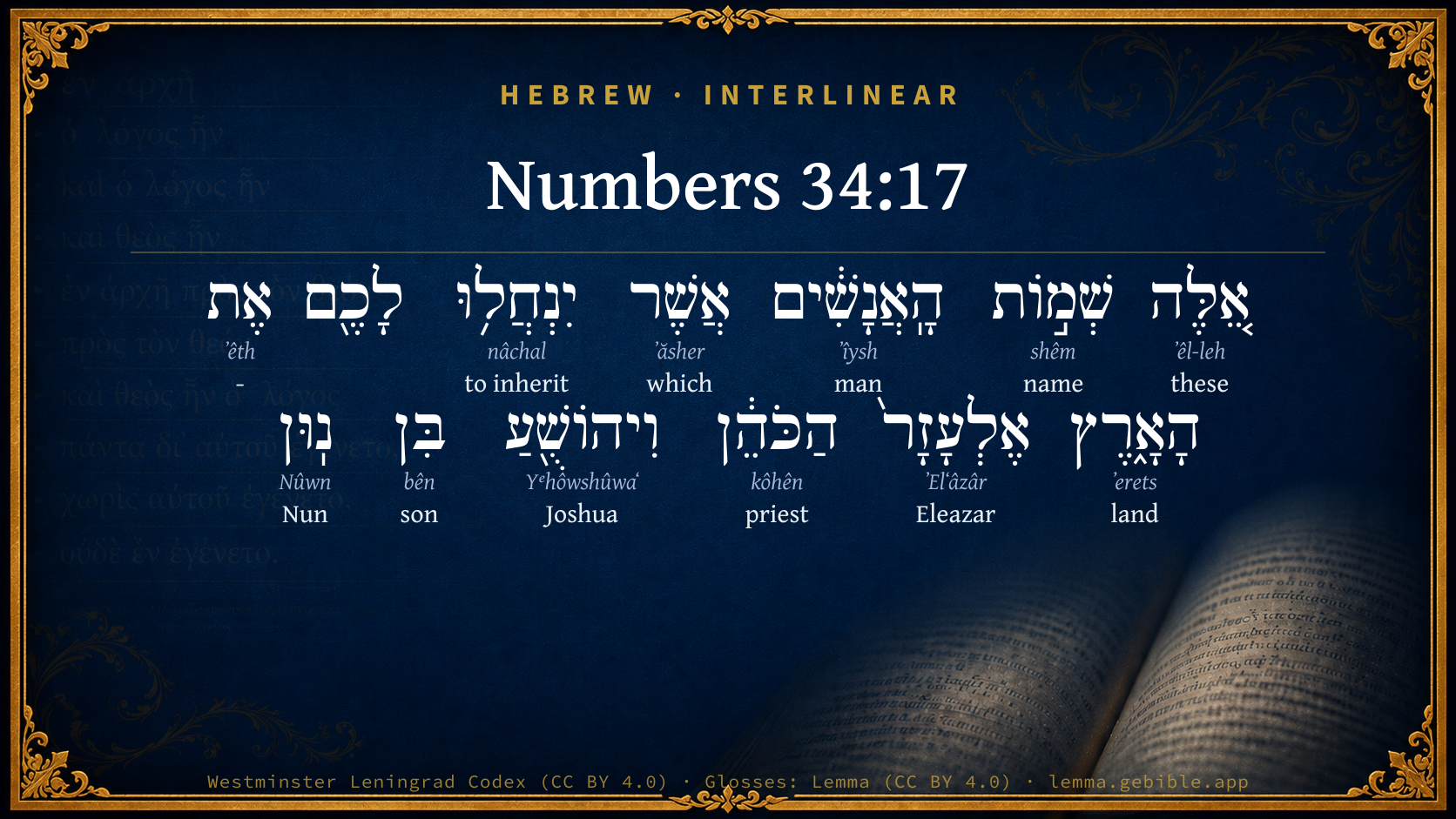
Hebrew (Westminster Leningrad Codex) Numbers 34:17 appears in the Hebrew Old Testament. The text above is from the Westminster Leningrad Codex. Each word links to its Strong’s number, a concise gloss, and parsing drawn from the Open Scriptures Hebrew Bible morphology. Click any word for its full Brown-Driver-Briggs (BDB) entry.
Download image
Cite this verse

Numbers 34:17 (World English Bible). Public Domain. Lemma interlinear Bible study tool, https://lemma.gebible.app/v/numbers/34/17.

Show BibTeX & RIS
BibTeX
RIS
English Translation
These are the names of the men who shall divide the land to you for inheritance: Eleazar the priest, and Joshua the son of Nun.
World English Bible · Public Domain
Download a study sheet

One document with this verse’s original text, its word-by-word gloss line, the meaning frame, cross-references with their text, attributed commentary, and full source and license credits — printable, and it pastes into notes with its structure intact.

This verse Autodidact and up

Study sheet (.html) Plain text (.txt)

A passage Seminary Student

Up to 50 verses in one chapter. A passage sheet keeps up to 6 commentary sources and 12 cross-references per verse, in the order this page ranks them, and says so on the sheet whenever that leaves anything out. Ask for a single verse and you get the Autodidact verse sheet above.

Everything on this page stays free to read, with no account — the sheet is a download of what is already on screen, not access to it.

Want to remove ads? Support Godless Engineer
Compare translations 3

The same verse in 3 English versions, stacked beneath the original-language interlinear above. Click any original word for its lexicon entry.

Each is an independent rendering of the whole verse — the interlinear is not word-aligned to these translations.

Highlighted words mark where these versions differ — a whole-verse word diff, not a word-by-word alignment.

  • World English Bible Public Domain
    These are the names of the men who shall divide the land to you for inheritance: Eleazar the priest, and Joshua the son of Nun.
  • King James Version Public Domain
    These are the names of the men which shall divide the land unto you: Eleazar the priest, and Joshua the son of Nun.
  • unfoldingWord Literal Text CC BY-SA 4.0
    “These are the names of the men who will divide the land for you as an inheritance: Eleazar the priest and Joshua the son of Nun.

unfoldingWord Literal Text — © unfoldingWord, licensed CC BY-SA 4.0. Word-aligned USFM3 via Door43 (git.door43.org/unfoldingWord/en_ult).

Versions to compare (up to 4)

3 of 4 selected

Show all 18 translations

Every available English version of this verse, each an independent rendering of the whole verse.

  • World English Bible Public Domain
    These are the names of the men who shall divide the land to you for inheritance: Eleazar the priest, and Joshua the son of Nun.
  • Berean Standard Bible Public Domain
    “These are the names of the men who are to assign the land as an inheritance for you: Eleazar the priest and Joshua son of Nun.
  • Majority Standard Bible Public Domain
    “These are the names of the men who are to assign the land as an inheritance for you: Eleazar the priest and Joshua son of Nun.
  • King James Version Public Domain
    These are the names of the men which shall divide the land unto you: Eleazar the priest, and Joshua the son of Nun.
  • American Standard Version (1901) Public Domain
    These are the names of the men that shall divide the land unto you for inheritance: Eleazar the priest, and Joshua the son of Nun.
  • Revised Version (1885) Public Domain
    These are the names of the men which shall divide the land unto you for inheritance: Eleazar the priest, and Joshua the son of Nun.
  • Geneva Bible (1599) Public Domain
    These are the names of the men which shall deuide ye land vnto you: Eleazar the Priest, and Ioshua the sonne of Nun.
  • Douay-Rheims (1899) Public Domain
    These are the names of the men, that shall divide the land unto you: Eleazar the priest, and Josue the son of Nun,
  • Young's Literal Translation Public Domain
    `These `are' the names of the men who give to you the inheritance of the land: Eleazar the priest, and Joshua son of Nun,
  • Literal Standard Version CC BY-SA 4.0
    “These [are] the names of the men who give the inheritance of the land to you: Eleazar the priest and Joshua son of Nun.
  • Unlocked Literal Bible CC BY-SA 4.0
    “These are the names of the men who will divide the land for your inheritance: Eleazar the priest and Joshua son of Nun.
  • unfoldingWord Literal Text CC BY-SA 4.0
    “These are the names of the men who will divide the land for you as an inheritance: Eleazar the priest and Joshua the son of Nun.
  • Darby Bible Public Domain
    These are the names of the men who shall divide the land unto you: Eleazar the priest, and Joshua the son of Nun.
  • World Messianic Bible Public Domain
    “These are the names of the men who shall divide the land to you for inheritance: Eleazar the priest, and Joshua the son of Nun.
  • Webster's Bible Public Domain
    These are the names of the men who shall divide the land to you: Eleazar the priest, and Joshua the son of Nun.
  • Free Bible Version CC BY-SA 4.0
    “These are the names of the men who will be in charge of allocating ownership of the land for you: Eleazar the priest and Joshua, son of Nun.
  • Bible in Basic English Public Domain
    These are the names of the men who are to make the distribution of the land among you: Eleazar the priest and Joshua, the son of Nun.
  • JPS Tanakh (1917) Public Domain
    'These are the names of the men that shall take possession of the land for you: Eleazar the priest, and Joshua the son of Nun.

Literal Standard Version (2020), Covenant Press — licensed CC BY-SA 4.0. Text via the HelloAO Bible API (eBible.org). Unlocked Literal Bible (unfoldingWord) — licensed CC BY-SA 4.0. Text via the HelloAO Bible API (eBible.org). unfoldingWord Literal Text — © unfoldingWord, licensed CC BY-SA 4.0. Word-aligned USFM3 via Door43 (git.door43.org/unfoldingWord/en_ult). Free Bible Version, Dr. Jonathan Gallagher — licensed CC BY-SA 4.0. Text via the HelloAO Bible API (eBible.org).

Word by word

More ways to search: Search by grammar → Find every occurrence → Compare this word →

Practice this passage: Drill this verse → Learn its vocabulary →

נֽוּן
Nûwn
H5126
“Nun”
Noun, Proper
Part of Speech
Noun
Type
Proper
Full BDB Definition

Origin: from H5125

TWOT: None

Nun = "fish" or " posterity" - father of Joshua the successor of Moses
  1. אֵ֚לֶּה ʼêl-leh H428 “these” Pronoun, Demonstrative, Common, Plural
  2. שְׁמ֣וֹת shêm H8034 “names of” Noun, Common, Masculine, Plural, Construct
  3. הָֽאֲנָשִׁ֔ים ʼîysh H376 “the · men” Particle, Definite Article + Noun, Common, Masculine, Plural, Absolute
  4. אֲשֶׁר ʼăsher H834 “which” Particle, Relative
  5. יִנְחֲל֥וּ nâchal H5157 “to inherit” Verb, Qal, Imperfect, 3rd Person, Masculine, Plural
  6. אֶת ʼêth H853 “-” Particle, Direct Object
  7. הָאָ֑רֶץ ʼerets H776 “the · land” Particle, Definite Article + Noun, Common, Both, Singular, Absolute
  8. אֶלְעָזָר֙ ʼElʻâzâr H499 “Eleazar” Noun, Proper
  9. הַכֹּהֵ֔ן kôhên H3548 “the · priest” Particle, Definite Article + Noun, Common, Masculine, Singular, Absolute
  10. וִיהוֹשֻׁ֖עַ Yᵉhôwshûwaʻ H3091 “and · Joshua” Conjunction + Noun, Proper
  11. בִּן bên H1121 “son of” Noun, Common, Masculine, Singular, Construct

About this verse

These counts appear in no published source. They are computed here, from the morphology-tagged text and Lemma’s own curated glosses. What Lemma adds →

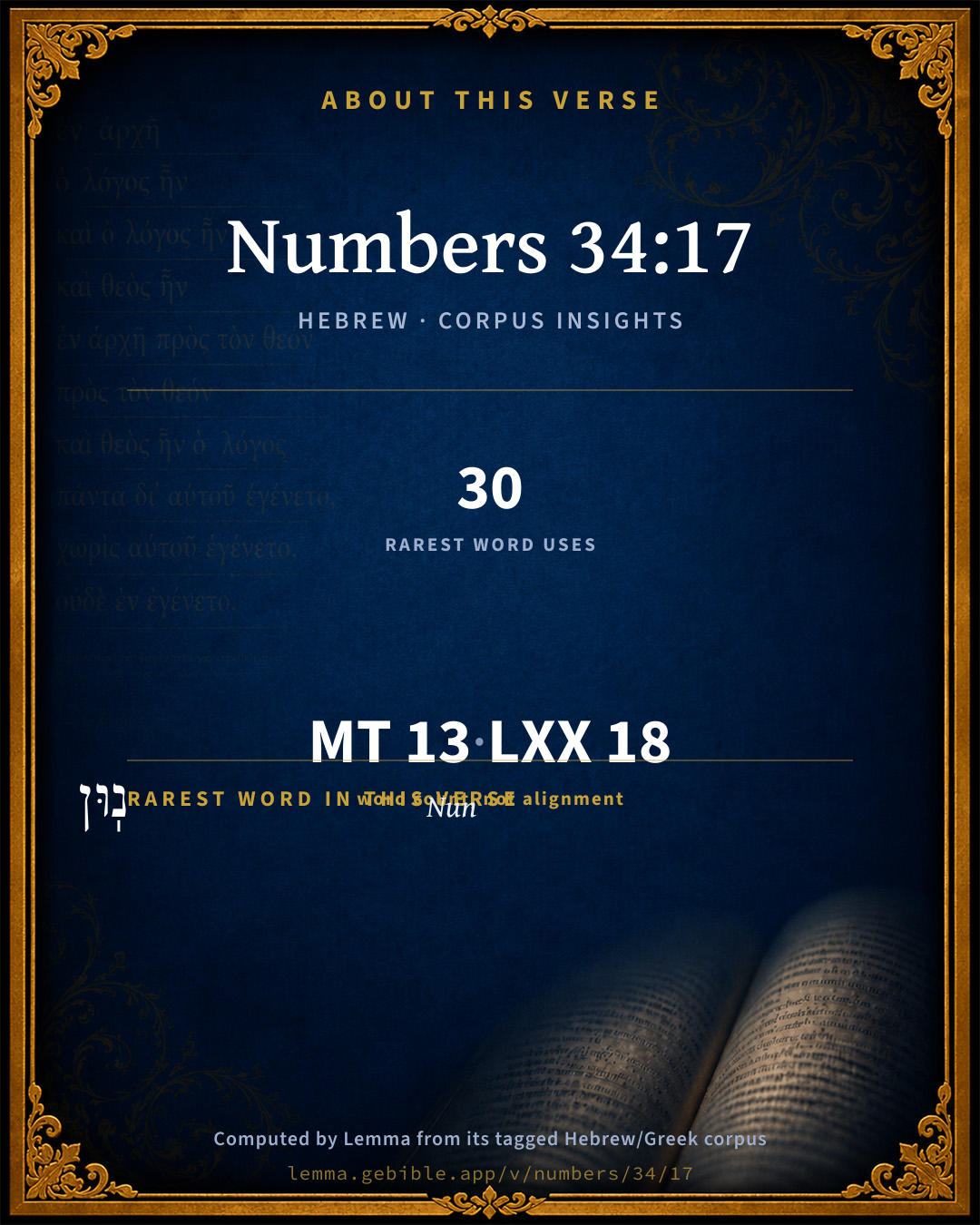
13
words
12
distinct lemmas
Pentateuch
section

Shared distinctive vocabulary

נֽוּן Nun H5126 occurs in 30 verses of the Hebrew Bible. Also found in:

Grammatical profile

  • 1 verb
  • 8 nouns
  • 1 pronoun
  • 1 preposition
  • 2 particles

Verb forms

  • יִנְחֲל֥וּ Qal · Imperfect

Hebrew & Septuagint length

In English translation the verse runs 25 words from the Hebrew and 26 from the Septuagint (LXX English) — closely comparable.

A rough comparison of the two English renderings, which tokenize alike — not a word-level alignment.

Word counts can differ between the Hebrew and the Greek without any difference in meaning — e.g. the Hebrew direct-object marker אֵת has no separate Greek word, and Greek often adds the article ὁ.

In the original languages it is 13 Hebrew tokens and 18 Greek tokens — but the two are counted differently (Hebrew bundles its prefixes and suffixes into one token; the Greek is in lemma form), so that isn’t a like-for-like length.

Cross-references

4

Topical passages linked to Numbers 34:17 in the Treasury of Scripture Knowledge — connected by theme and wording, ordered by reader-vote popularity; previews shown in the World English Bible.

  • Joshua 14:1 These are the inheritances which the children of Israel took in the land of Canaan, which Eleazar the priest, and Joshua the son of Nun, and the heads of the fathers' [houses] of the tribes of the children of Israel, distributed to them,
  • Joshua 19:51 These are the inheritances, which Eleazar the priest, and Joshua the son of Nun, and the heads of the fathers' [houses] of the tribes of the children of Israel, distributed for inheritance by lot in Shiloh before Yahweh, at the door of the tent of meeting. So they made an end of dividing the land.
  • Numbers 13:8 Of the tribe of Ephraim, Hoshea the son of Nun.
  • Numbers 13:16 These are the names of the men who Moses sent to spy out the land. Moses called Hoshea the son of Nun Joshua.

Cross-references courtesy of OpenBible.info (CC BY 4.0).

Hebrew and Greek witnesses Masoretic Hebrew ↔ Greek Septuagint

The same verse in the two great witnesses to the Old Testament, shown verse-for-verse.

These are two independent witnesses, not word-aligned to each other, and the Septuagint is shown in lemma (dictionary) form.

Hebrew Numbers 34:17 Masoretic · Westminster Leningrad Codex

אֵ֚לֶּה שְׁמ֣וֹת הָֽאֲנָשִׁ֔ים אֲשֶׁר יִנְחֲל֥וּ לָכֶ֖ם אֶת הָאָ֑רֶץ אֶלְעָזָר֙ הַכֹּהֵ֔ן וִיהוֹשֻׁ֖עַ בִּן נֽוּן

These are the names of the men who shall divide the land to you for inheritance: Eleazar the priest, and Joshua the son of Nun.

World English Bible · Public Domain

Greek LXX Numbers 34:17 Septuagint · lemma form

οὗτος ὁ ὄνομα ὁ ἀνήρ ὅς κληρονομέω σύ ὁ γῆ ελεαζαρ ὁ ἱερεύς καί ἰησοῦς ὁ ὁ ναυη

These are the names of the men who shall divide the land to you for an inheritance; Eleazar the priest and Joshua the son of Naue.

LXX2012 (modern English Septuagint) · Public Domain

Hebrew: Westminster Leningrad Codex (CC BY 4.0). Greek: Septuagint (public domain); English from LXX2012 (modern English Septuagint) (Public Domain). How the Septuagint differs from the Hebrew →

Targum (Aramaic paraphrase)

2

The Targum is the ancient Jewish Aramaic paraphrase of the Hebrew Scriptures — an interpretive translation, not the Hebrew text itself. Onkelos (literal) and Pseudo-Jonathan (expansive) render the Torah, and Jonathan the Prophets. Coverage is partial: where no permissively-licensed English translation exists for a verse, only the Aramaic is shown. This is verse-level text, not a word-by-word alignment to the Hebrew.

  1. Targum Onkelos Torah (Genesis–Deuteronomy)
    אִלֵין שְׁמָהַת גֻבְרַיָא דִי יַחְסְנוּן לְכוֹן יָת אַרְעָא אֶלְעָזָר כַּהֲנָא וִיהוֹשֻׁע בַּר נוּן

    (no public-domain English translation for this verse)

    Targum Onkelos — Aramaic: “Onkelos Genesis” (public domain); “Onkelos Exodus” (public domain); “Onkelos Leviticus” (public domain); “Onkelos Numbers” (public domain); “Onkelos Deuteronomy” (public domain). English: “Sefaria Community Translation” (CC0 1.0 (public-domain dedication)); “J.W. Etheridge. The Targums of Onkelos and Jonathan Ben Uzziel on the Pentateuch. London: Longmans, Green, 1862” (public domain). Text via Sefaria.

  2. Targum Pseudo-Jonathan Torah (Genesis–Deuteronomy)
    אִלֵין שְׁמָהַת גוּבְרַיָא דְיַחְסְנוּן לְכוֹן יַת אַרְעָא אֶלְעָזָר כַּהֲנָא וִיהוֹשֻׁעַ בַּר נוּן

    These are the names of the men who shall make to you the inheritance of the land: Elazar the priest, and Jehoshua bar Nun,

    Targum Pseudo-Jonathan — Aramaic: “Targum Jonathan on Genesis” (public domain); “Targum Jonathan on Exodus” (public domain); “Targum Jonathan on Leviticus” (public domain); “Targum Jonathan on Numbers” (public domain); “Targum Jonathan on Deuteronomy” (public domain). English: “The Targum of Jonathan ben Uzziel, trans. J. W. Etheridge, London, 1862” (public domain). Text via Sefaria.

Commentary

Notes on Numbers 34:17 from classic Christian and Jewish commentators (each source and its license shown beneath its notes). The classic Christian expositions comment on the surrounding passage and are grouped to its opening verse, so a note may address several verses; the Jewish commentaries on the Tanakh (Rashi and others) are per-verse, so they appear only where the commentator wrote on this verse.

Lemma curates 59 commentaries, every one of them public domain or Creative Commons licensed, each selected and text-cleaned for this edition rather than reprinted as found. About our sources →

Trapp's Complete Commentary

John Trapp

Num 34:17 These [are] the names of the men which shall divide the land unto you: Eleazar the priest, and Joshua the son of Nun.

Ver. 17. E1eazar the priest.] Pointing to the High Priest of the new covenant, by whom we have entrance into the promised inheritance, whither he is gone before to prepare a place for us, and hath told us, that in his "Father’s house are many mansions," room enough.

John Trapp, A Commentary or Exposition upon All the Books of the Old and New Testament (1647–1656) — public domain. Text from a community e-Sword module.

Joseph Benson's Commentary

Num 34:17. These are the men that shall divide the land — Although the division of the land was to be made by lot, (Num 34:13,) yet it was proper there should be some persons appointed to oversee this business, and to take care that there should be no fraud nor quarrels in the drawing of the lots. The management of it, therefore, is ordered to be in the hands of the high-priest, of the governor, or chief general, and a principal officer chosen out of each tribe, as its representative. Eleazar the priest — Was to preside in God’s name, to cast lots, to prevent contentions, to consult with God in cases of difficulty, and to see that the whole business was transacted in a solemn and religious manner.

Joseph Benson's Commentary on the Old and New Testaments (1811–1818) — public domain. Text from a community e-Sword module.

Ellicott's Commentary for English Readers

(17) Which shall divide the land unto you.—Better, Which shall give (or, allot) the land as an inheritance unto you.

A Bible Commentary for English Readers, edited by Charles John Ellicott (1878–1897) — public domain. Text from a community e-Sword module.

John Gill's Exposition

These are the names of the men which shall divide the land unto you,.... Or "inherit the land for you" (z); that is, as Jarchi interprets it, they were to take possession of it in their name and stead, as their representatives, and then distribute it unto them, or divide it to be inherited by them; but whatever may be said for the princes of the tribes, as acting for their respective tribes, and representing them, the same cannot be said of the two first named, as follow:

Eleazar the priest, and Joshua the son of Nun; the one the principal person in ecclesiastical affairs, and the other in civil ones; to divide the land being partly a sacred work, as it was a type of the heavenly Canaan, and a civil one, as it concerned the present welfare of the people of Israel; and both were types of Christ, the priest upon his throne, who is both priest and King; who, as the one, gives a right unto it, and, as the other, introduces into it.

(z) "haereditabunt vobis", Montanus; "qui haereditario jure accipient pro vobis", Tigurine not.

John Gill's Exposition of the Whole Bible (1746–1763) — public domain (CC PDM 1.0). Text via the HelloAO Bible API.

Matthew Poole's English Annotations

Eleazar was to act in God’s name, to cast lots, to prevent differences and contentions, to consult with God in cases of difficulty, to transact the whole business in a solemn and religious manner.

Matthew Poole's English Annotations on the Holy Bible (1683–1685) — public domain. Text from a community e-Sword/MySword module.

The Pulpit Commentary

Eleazar the priest, and Joshua the son of Nun. As the ecclesiastical anti military heads respectively of the theocracy. (see on Num_32:28)

The Pulpit Commentary (1880–1919), ed. H.D.M. Spence-Jones & Joseph S. Exell — public domain. Text from a community e-Sword module.

John Wesley's Explanatory Notes

Eleazar - Who was to act in God's name, to cast lots, to prevent contentions, to consult with God in cases of difficulty, to transact the whole business in a solemn and religious manner.

John Wesley, Explanatory Notes Upon the Whole Bible (1754–1765) — public domain. Text via the GEBible commentary corpus.

Rashi

Rabbi Shlomo Yitzchaki (Rashi)

אשר ינחלו לכם [THESE ARE THE … MEN] WHO SHALL TAKE POSSESSION OF THE LAND לכם — i.e., for you. Each prince was the agent of his tribe and divided the inheritance of the tribe amongst the families and again amongst the men, selecting for each a portion fitting for him. What they did was done (was legal) just as if they (the tribes) had appointed them their representatives (Kiddushin 42b). — It would not be right to explain this לכם as all other לכם (“to you”) which occur in the Bible, for if so it should have written יַנְחִילוּ לכם (Hiphil), “they will give the possession to you”. But יִנְחֲלוּ (Kal), implies that they themselves take possession לכם, “for you” and in your place. It is the same as, (Exodus 14:14): “The Lord will fight לכם” — “for you”.

Rashi on the Tanakh — English translations: “The Judaica Press complete Tanach with Rashi, translated by A. J. Rosenberg” (CC BY 4.0); “Pentateuch with Rashi's commentary by M. Rosenbaum and A.M. Silbermann, 1929-1934” (public domain); “The Metsudah Tanach series, Lakewood, N.J” (CC BY 4.0); and “The Book of Joshua, Metsudah Publications, 1997” (CC BY 4.0). Text via Sefaria.

Ibn Ezra

Rabbi Abraham ibn Ezra

Elozor. First, because according to his word Yehoshua set out, and also he is the son of Aharon. Scripture did not mention the leaders of the tribes of Reuvein and Gad, because they had already taken their portion. The commentators said: The order started with Yehudah because the lot came out on him first.

Ibn Ezra on the Tanakh — English translations: “Sefaria Community Translation” (CC0 1.0 (public-domain dedication)); “Yalkut, Sifsei Chachomim Chumash, Metsudah Publications, 2009” (CC BY 4.0); and “Commentary of Ibn Ezra on Isaiah - trans. by M. Friedlander, 1873” (public domain). Text via Sefaria.

Lesson kit

Teaching starters — assembled from the data on this page, not authored interpretation. Every prompt links to the verse data it draws on. Edit before teaching.

Numbers, in the Pentateuch, opens this verse with 13 words (12 distinct Hebrew lemmas). Its most distinctive word is Nûwn (“Nun”). A historical commentator’s framing appears above. Read the whole chapter for the surrounding context.

Discussion questions

  1. What does “Nun” (Nûwn) contribute to the verse as a whole?
  2. How does Exodus 33:11, which shares the word «Nun», read alongside this verse?
  3. The translations on this page render this verse differently — a whole-verse word diff, not a word-by-word alignment. What might account for the different wordings?
  4. «יִנְחֲל֥וּ» is a Qal Imperfect verb. How does that grammatical form shape the action described?
  5. Compare how Trapp's Complete Commentary and Joseph Benson's Commentary read this verse. Where do they agree or differ?

Things to notice

Reading settings

Reading text

Shown beneath each verse's original-language words.

Old Testament
Old Testament edition

Read the OT as the Masoretic Hebrew (MT) or the Greek Septuagint (LXX).

English shown for the Greek Septuagint (in the Hebrew ↔ Greek comparison).

Comparing translations? Open the Compare panel on any verse page to stack up to four side by side.