Numbers 27:22

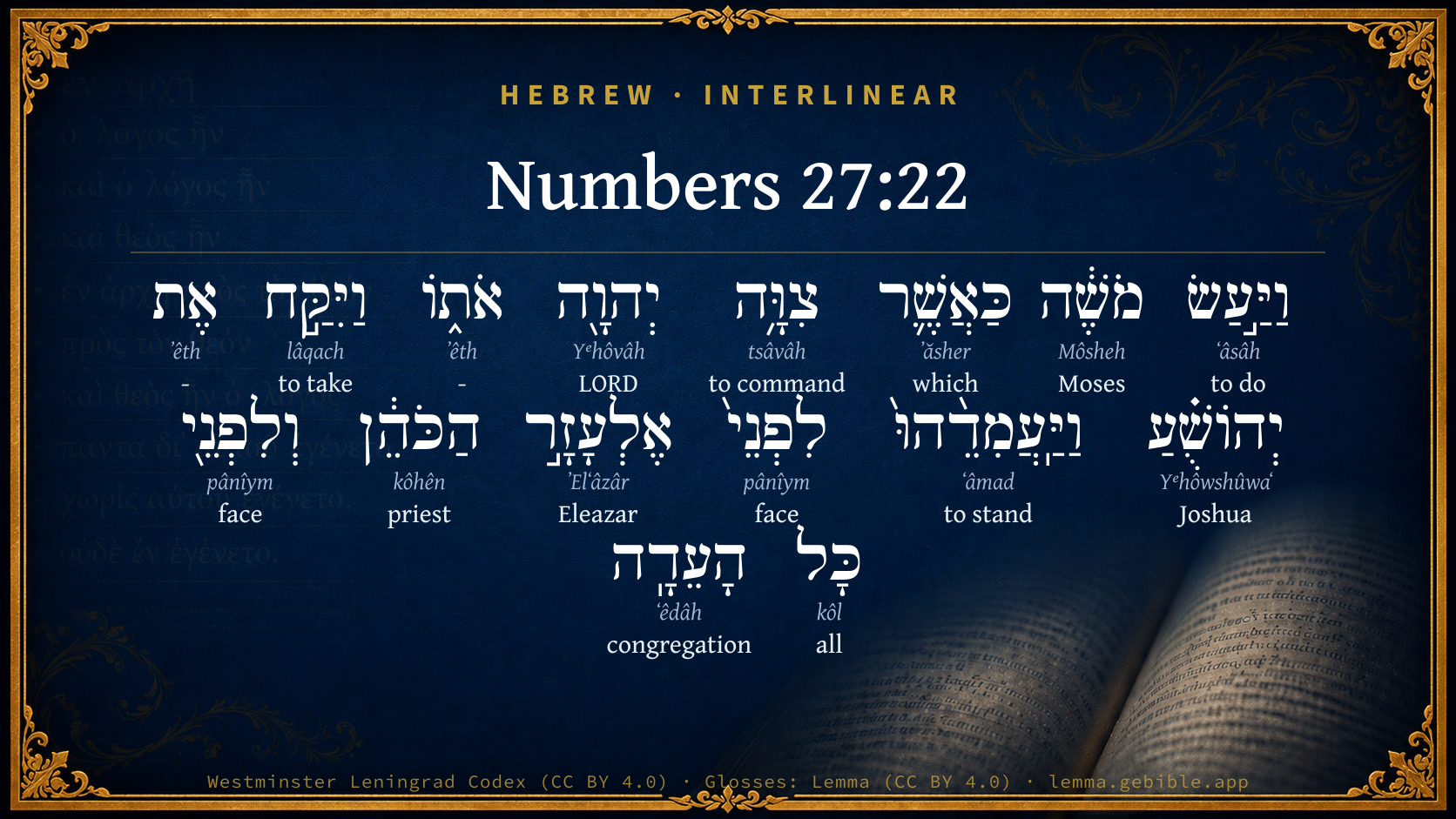
Hebrew (Westminster Leningrad Codex) Numbers 27:22 appears in the Hebrew Old Testament. The text above is from the Westminster Leningrad Codex. Each word links to its Strong’s number, a concise gloss, and parsing drawn from the Open Scriptures Hebrew Bible morphology. Click any word for its full Brown-Driver-Briggs (BDB) entry.
Download image
Cite this verse

Numbers 27:22 (World English Bible). Public Domain. Lemma interlinear Bible study tool, https://lemma.gebible.app/v/numbers/27/22.

Show BibTeX & RIS
BibTeX
RIS
English Translation
Moses did as Yahweh commanded him; and he took Joshua, and set him before Eleazar the priest, and before all the congregation:
World English Bible · Public Domain
Download a study sheet

One document with this verse’s original text, its word-by-word gloss line, the meaning frame, cross-references with their text, attributed commentary, and full source and license credits — printable, and it pastes into notes with its structure intact.

This verse Autodidact and up

Study sheet (.html) Plain text (.txt)

A passage Seminary Student

Up to 50 verses in one chapter. A passage sheet keeps up to 6 commentary sources and 12 cross-references per verse, in the order this page ranks them, and says so on the sheet whenever that leaves anything out. Ask for a single verse and you get the Autodidact verse sheet above.

Everything on this page stays free to read, with no account — the sheet is a download of what is already on screen, not access to it.

Want to remove ads? Support Godless Engineer
Compare translations 3

The same verse in 3 English versions, stacked beneath the original-language interlinear above. Click any original word for its lexicon entry.

Each is an independent rendering of the whole verse — the interlinear is not word-aligned to these translations.

Highlighted words mark where these versions differ — a whole-verse word diff, not a word-by-word alignment.

  • World English Bible Public Domain
    Moses did as Yahweh commanded him; and he took Joshua, and set him before Eleazar the priest, and before all the congregation:
  • King James Version Public Domain
    And Moses did as the LORD commanded him: and he took Joshua, and set him before Eleazar the priest, and before all the congregation:
  • unfoldingWord Literal Text CC BY-SA 4.0
    And Moses did just as Yahweh had commanded him, and he took Joshua and stood him before the face of Eleazar the priest and before the face of all the congregation,

unfoldingWord Literal Text — © unfoldingWord, licensed CC BY-SA 4.0. Word-aligned USFM3 via Door43 (git.door43.org/unfoldingWord/en_ult).

Versions to compare (up to 4)

3 of 4 selected

Show all 18 translations

Every available English version of this verse, each an independent rendering of the whole verse.

  • World English Bible Public Domain
    Moses did as Yahweh commanded him; and he took Joshua, and set him before Eleazar the priest, and before all the congregation:
  • Berean Standard Bible Public Domain
    Moses did as the LORD had commanded him. He took Joshua, had him stand before Eleazar the priest and the whole congregation,
  • Majority Standard Bible Public Domain
    Moses did as the LORD had commanded him. He took Joshua, had him stand before Eleazar the priest and the whole congregation,
  • King James Version Public Domain
    And Moses did as the LORD commanded him: and he took Joshua, and set him before Eleazar the priest, and before all the congregation:
  • American Standard Version (1901) Public Domain
    And Moses did as Jehovah commanded him; and he took Joshua, and set him before Eleazar the priest, and before all the congregation:
  • Revised Version (1885) Public Domain
    And Moses did as the LORD commanded him: and he took Joshua, and set him before Eleazar the priest, and before all the congregation:
  • Geneva Bible (1599) Public Domain
    So Moses did as the Lord had commanded him, and he tooke Ioshua, and set him before Eleazar the Priest, and before all the Congregation.
  • Douay-Rheims (1899) Public Domain
    Moses did as the Lord had commanded. And when he had taken Josue, he set him before Eleazar the priest, and all the assembly of the people,
  • Young's Literal Translation Public Domain
    And Moses doth as Jehovah hath commanded him, and taketh Joshua, and causeth him to stand before Eleazar the priest, and before all the company,
  • Literal Standard Version CC BY-SA 4.0
    And Moses does as YHWH has commanded him, and takes Joshua and causes him to stand before Eleazar the priest and before all the congregation,
  • Unlocked Literal Bible CC BY-SA 4.0
    So Moses did as Yahweh had commanded him. He took Joshua and placed him before Eleazar the priest and all the community.
  • unfoldingWord Literal Text CC BY-SA 4.0
    And Moses did just as Yahweh had commanded him, and he took Joshua and stood him before the face of Eleazar the priest and before the face of all the congregation,
  • Darby Bible Public Domain
    And Moses did as Jehovah had commanded him; and he took Joshua and set him before Eleazar the priest, and before the whole assembly.
  • World Messianic Bible Public Domain
    Moses did as the LORD commanded him. He took Joshua, and set him before Eleazar the priest and before all the congregation.
  • Webster's Bible Public Domain
    And Moses did as the LORD commanded him: and he took Joshua, and set him before Eleazar the priest, and before all the congregation:
  • Free Bible Version CC BY-SA 4.0
    Moses followed the Lord's instructions. He had Joshua come and stand in front of Eleazar the priest and all the Israelites.
  • Bible in Basic English Public Domain
    So Moses did as the Lord said: he took Joshua and put him before Eleazar the priest and the meeting of the people:
  • JPS Tanakh (1917) Public Domain
    And Moses did as the LORD commanded him; and he took Joshua, and set him before Eleazar the priest, and before all the congregation.

Literal Standard Version (2020), Covenant Press — licensed CC BY-SA 4.0. Text via the HelloAO Bible API (eBible.org). Unlocked Literal Bible (unfoldingWord) — licensed CC BY-SA 4.0. Text via the HelloAO Bible API (eBible.org). unfoldingWord Literal Text — © unfoldingWord, licensed CC BY-SA 4.0. Word-aligned USFM3 via Door43 (git.door43.org/unfoldingWord/en_ult). Free Bible Version, Dr. Jonathan Gallagher — licensed CC BY-SA 4.0. Text via the HelloAO Bible API (eBible.org).

Word by word

More ways to search: Search by grammar → Find every occurrence → Compare this word →

Practice this passage: Drill this verse → Learn its vocabulary →

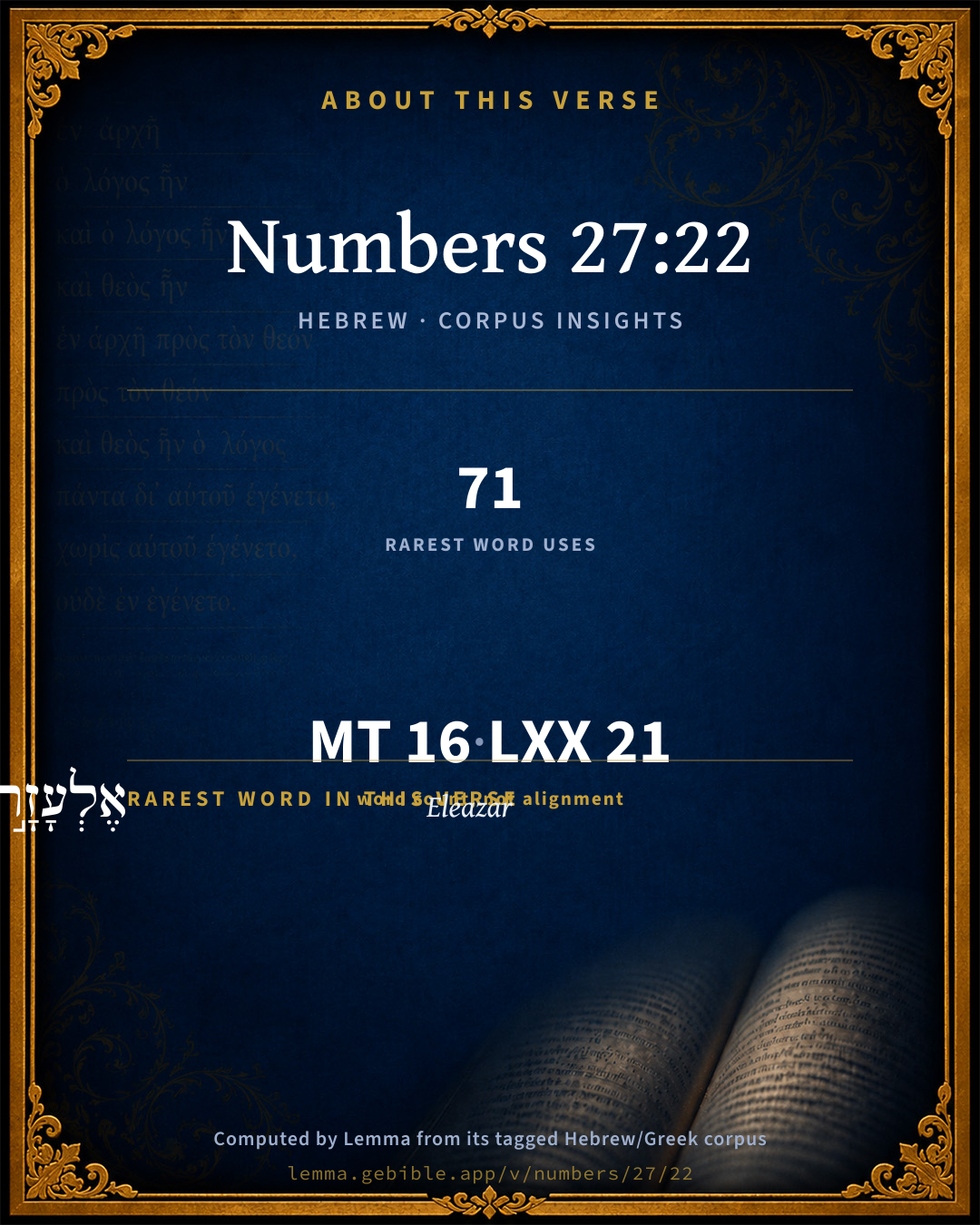
אֶלְעָזָ֣ר
ʼElʻâzâr
H499
“Eleazar”
Noun, Proper
Part of Speech
Noun
Type
Proper
Full BDB Definition

Origin: from H410 and H5826

TWOT: None

Eleazar = "God has helped" - the high priest son of Aaron - Abinadab's son who cared for the ark - the priest who rebuilt and dedicated the restored walls of Jerusalem in time of Ezra - one of David's mighty warriors - a Levite - one of the line of Parosh
  1. וַיַּ֣עַשׂ ʻâsâh H6213 “and · to do” Conjunction + Verb, Qal, Sequential Imperfect, 3rd Person, Masculine, Singular
  2. מֹשֶׁ֔ה Môsheh H4872 “Moses” Noun, Proper
  3. כַּאֲשֶׁ֛ר ʼăsher H834 “like/as · which” Preposition + Particle, Relative
  4. צִוָּ֥ה tsâvâh H6680 “to command” Verb, Piel, Perfect, 3rd Person, Masculine, Singular
  5. יְהוָ֖ה Yᵉhôvâh H3068 “LORD” Noun, Proper
  6. אֹת֑וֹ ʼêth H853 “- · him” Particle, Direct Object + Suffix, Personal, 3rd Person, Masculine, Singular
  7. וַיִּקַּ֣ח lâqach H3947 “and · to take” Conjunction + Verb, Qal, Sequential Imperfect, 3rd Person, Masculine, Singular
  8. אֶת ʼêth H853 “-” Particle, Direct Object
  9. יְהוֹשֻׁ֗עַ Yᵉhôwshûwaʻ H3091 “Joshua” Noun, Proper
  10. וַיַּֽעֲמִדֵ֨הוּ֙ ʻâmad H5975 “and · to stand · him” Conjunction + Verb, Hiphil, Sequential Imperfect, 3rd Person, Masculine, Singular + Suffix, Personal, 3rd Person, Masculine, Singular
  11. לִפְנֵי֙ pânîym H6440 “to/for · face(s) of” Preposition + Noun, Common, Both, Plural, Construct
  12. הַכֹּהֵ֔ן kôhên H3548 “the · priest” Particle, Definite Article + Noun, Common, Masculine, Singular, Absolute
  13. וְלִפְנֵ֖י pânîym H6440 “and · to/for · face(s) of” Conjunction + Preposition + Noun, Common, Both, Plural, Construct
  14. כָּל kôl H3605 “all of” Noun, Common, Masculine, Singular, Construct
  15. הָעֵדָֽה ʻêdâh H5712 “the · congregation” Particle, Definite Article + Noun, Common, Feminine, Singular, Absolute

About this verse

These counts appear in no published source. They are computed here, from the morphology-tagged text and Lemma’s own curated glosses. What Lemma adds →

16
words
14
distinct lemmas
Pentateuch
section

Grammatical profile

  • 4 verbs
  • 9 nouns
  • 3 particles

Verb forms

  • וַיַּ֣עַשׂ Qal · Sequential Imperfect
  • צִוָּ֥ה Piel · Perfect
  • וַיִּקַּ֣ח Qal · Sequential Imperfect
  • וַיַּֽעֲמִדֵ֨הוּ֙ Hiphil · Sequential Imperfect

Repetition

A word recurs within this verse — often emphatic in Hebrew:

  • לִפְנֵי֙ face H6440 ×2

Hebrew & Septuagint length

In English translation the verse runs 22 words from the Hebrew and 24 from the Septuagint (LXX English) — closely comparable.

A rough comparison of the two English renderings, which tokenize alike — not a word-level alignment.

Word counts can differ between the Hebrew and the Greek without any difference in meaning — e.g. the Hebrew direct-object marker אֵת has no separate Greek word, and Greek often adds the article ὁ.

In the original languages it is 16 Hebrew tokens and 21 Greek tokens — but the two are counted differently (Hebrew bundles its prefixes and suffixes into one token; the Greek is in lemma form), so that isn’t a like-for-like length.

Hebrew and Greek witnesses Masoretic Hebrew ↔ Greek Septuagint

The same verse in the two great witnesses to the Old Testament, shown verse-for-verse.

These are two independent witnesses, not word-aligned to each other, and the Septuagint is shown in lemma (dictionary) form.

Hebrew Numbers 27:22 Masoretic · Westminster Leningrad Codex

וַיַּ֣עַשׂ מֹשֶׁ֔ה כַּאֲשֶׁ֛ר צִוָּ֥ה יְהוָ֖ה אֹת֑וֹ וַיִּקַּ֣ח אֶת יְהוֹשֻׁ֗עַ וַיַּֽעֲמִדֵ֨הוּ֙ לִפְנֵי֙ אֶלְעָזָ֣ר הַכֹּהֵ֔ן וְלִפְנֵ֖י כָּל הָעֵדָֽה

Moses did as Yahweh commanded him; and he took Joshua, and set him before Eleazar the priest, and before all the congregation:

World English Bible · Public Domain

Greek LXX Numbers 27:22 Septuagint · lemma form

καί ποιέω μωυσῆς καθά ἐντέλλομαι αὐτός κύριος καί λαμβάνω ὁ ἰησοῦς ἵστημι αὐτός ἐναντίον ελεαζαρ ὁ ἱερεύς καί ἔναντι πᾶς συναγωγή

And Moses did as the Lord commanded him; and he took Joshua, and set him before Eleazar the priest, and before all the congregation.

LXX2012 (modern English Septuagint) · Public Domain

Hebrew: Westminster Leningrad Codex (CC BY 4.0). Greek: Septuagint (public domain); English from LXX2012 (modern English Septuagint) (Public Domain). How the Septuagint differs from the Hebrew →

Targum (Aramaic paraphrase)

2

The Targum is the ancient Jewish Aramaic paraphrase of the Hebrew Scriptures — an interpretive translation, not the Hebrew text itself. Onkelos (literal) and Pseudo-Jonathan (expansive) render the Torah, and Jonathan the Prophets. Coverage is partial: where no permissively-licensed English translation exists for a verse, only the Aramaic is shown. This is verse-level text, not a word-by-word alignment to the Hebrew.

  1. Targum Onkelos Torah (Genesis–Deuteronomy)
    וַעֲבַד משֶׁה כְּמָא דִי פַקֵיד יְיָ יָתֵיהּ וּדְבַר יָת יְהוֹשֻׁע וַאֲקִימֵיהּ קֳדָם אֶלְעָזָר כַּהֲנָא וּקְדָם כָּל כְּנִשְׁתָּא

    (no public-domain English translation for this verse)

    Targum Onkelos — Aramaic: “Onkelos Genesis” (public domain); “Onkelos Exodus” (public domain); “Onkelos Leviticus” (public domain); “Onkelos Numbers” (public domain); “Onkelos Deuteronomy” (public domain). English: “Sefaria Community Translation” (CC0 1.0 (public-domain dedication)); “J.W. Etheridge. The Targums of Onkelos and Jonathan Ben Uzziel on the Pentateuch. London: Longmans, Green, 1862” (public domain). Text via Sefaria.

  2. Targum Pseudo-Jonathan Torah (Genesis–Deuteronomy)
    וַעֲבַד משֶׁה הֵיכְמָא דְפַקֵיד יְיָ יָתֵיהּ וּדְבַר יַת יְהוֹשֻׁעַ וְאַקִימֵיהּ קֳדָם אֶלְעָזָר כַּהֲנָא וְקָדָם כָּל כְּנִישְׁתָּא

    And Mosheh did as the Lord commanded him, and took Jehoshua and caused him to stand before Elazar the priest and all the congregation;

    Targum Pseudo-Jonathan — Aramaic: “Targum Jonathan on Genesis” (public domain); “Targum Jonathan on Exodus” (public domain); “Targum Jonathan on Leviticus” (public domain); “Targum Jonathan on Numbers” (public domain); “Targum Jonathan on Deuteronomy” (public domain). English: “The Targum of Jonathan ben Uzziel, trans. J. W. Etheridge, London, 1862” (public domain). Text via Sefaria.

Commentary

Notes on Numbers 27:22 from classic Christian and Jewish commentators (each source and its license shown beneath its notes). The classic Christian expositions comment on the surrounding passage and are grouped to its opening verse, so a note may address several verses; the Jewish commentaries on the Tanakh (Rashi and others) are per-verse, so they appear only where the commentator wrote on this verse.

Lemma curates 59 commentaries, every one of them public domain or Creative Commons licensed, each selected and text-cleaned for this edition rather than reprinted as found. About our sources →

John Gill's Exposition

And he laid his hands upon him,.... Jarchi observes, that he did this cheerfully, and did more than he was commanded; for the Lord said to him, "lay thine hand", but he laid both his hands:

and gave him a charge, as the Lord commanded Moses; Num 27:19, this is a clear proof that Moses was no imposter, since he sought not to aggrandize his family, or serve the interest of that; nor did he in the least repine or murmur that the priesthood was given to his brother Aaron and sons, and now the civil government to his servant of the tribe of Ephraim; and as for his own posterity, they were only common Levites that waited upon the priests.

Next: Numbers Chapter 28

John Gill's Exposition of the Whole Bible (1746–1763) — public domain (CC PDM 1.0). Text via the HelloAO Bible API.

Whedon's Commentary on the Bible

Daniel D. Whedon

22. All the congregation — The assembled heads of the people or college of elders, in distinction from “all the children of Israel.”

Daniel D. Whedon (gen. ed.), Commentary on the Old and New Testaments (1874–1909) — public domain. Text from a community e-Sword module.

John Wesley's Explanatory Notes

And Moses did as the Lord commanded him - It had been little to resign his honour to a son of his own. But with his own hands, first to ordain Eleazar high-priest, and now Joshua chief ruler, while his own children had no preferment at all, but were left in the rank of common Levites: this was more to his glory than the highest advancement of his family could have been. This shews him to have had a principle which raised him above all other lawgivers, who always took care to establish their families in some share of the greatness themselves possessed.

John Wesley, Explanatory Notes Upon the Whole Bible (1754–1765) — public domain. Text via the GEBible commentary corpus.

Keil & Delitzsch

C. F. Keil & F. Delitzsch

Execution of the divine command.

Keil & Delitzsch — Biblical Commentary on the Old Testament (1861–1891) — public domain (CC PDM 1.0). Text via the HelloAO Bible API. (Old Testament only.)

unfoldingWord translationNotes

Door43 World Missions Community

placed him before

"told him to stand in front of"

He laid his hands on him and commanded him to lead

"He" refers to Moses, and "him" refers to Joshua.

He laid his hands on him

The laying on of hands was a way of setting a person apart to do a special task for God. (See: Symbolic Action)

to lead

You can make clear the understood information to lead the people. AT: "to lead the people" or "to be the leader of the Israelites" (See: Ellipsis)

as Yahweh had commanded him to do

Here "him" refers to Moses.

translationWords

Moses

Yahweh

command

Joshua

Eleazar

unfoldingWord translationNotes — © Distant Shores Media and the Door43 World Missions Community, licensed CC BY-SA 4.0. Source: git.door43.org/Door43/en_tn.

Rashi

Rabbi Shlomo Yitzchaki (Rashi)

ויקח את יהושע AND HE TOOK JOSHUA — he took him by fine words and told him the reward that will be given to Israel’s leaders in the world to come (Sifrei Bamidbar 141:2).

Rashi on the Tanakh — English translations: “The Judaica Press complete Tanach with Rashi, translated by A. J. Rosenberg” (CC BY 4.0); “Pentateuch with Rashi's commentary by M. Rosenbaum and A.M. Silbermann, 1929-1934” (public domain); “The Metsudah Tanach series, Lakewood, N.J” (CC BY 4.0); and “The Book of Joshua, Metsudah Publications, 1997” (CC BY 4.0). Text via Sefaria.

Lesson kit

Teaching starters — assembled from the data on this page, not authored interpretation. Every prompt links to the verse data it draws on. Edit before teaching.

Numbers, in the Pentateuch, opens this verse with 16 words (14 distinct Hebrew lemmas). Its most distinctive word is ʼElʻâzâr (“Eleazar”). A historical commentator’s framing appears above. Read the whole chapter for the surrounding context.

Discussion questions

  1. How does “Eleazar” (ʼElʻâzâr) shape what this verse is saying?
  2. What does the repetition of “face” (2× in this one verse) do in this verse?
  3. These translations render this verse differently. What is at stake in choosing one wording over another?
  4. «וַיַּ֣עַשׂ» is a Qal Sequential Imperfect verb. How does that grammatical form shape the action described?
  5. Compare how John Gill's Exposition and Whedon's Commentary on the Bible read this verse. Where do they agree or differ?

Things to notice

Reading settings

Reading text

Shown beneath each verse's original-language words.

Old Testament
Old Testament edition

Read the OT as the Masoretic Hebrew (MT) or the Greek Septuagint (LXX).

English shown for the Greek Septuagint (in the Hebrew ↔ Greek comparison).

Comparing translations? Open the Compare panel on any verse page to stack up to four side by side.