

Mark 10:32
Greek (Tischendorf 8th ed.) Mark 10:32 appears in the Greek New Testament. The text above is from the Tischendorf 8th edition. Each word links to its Strong’s number and a concise gloss. Click any word for its full Thayer’s Greek Lexicon entry.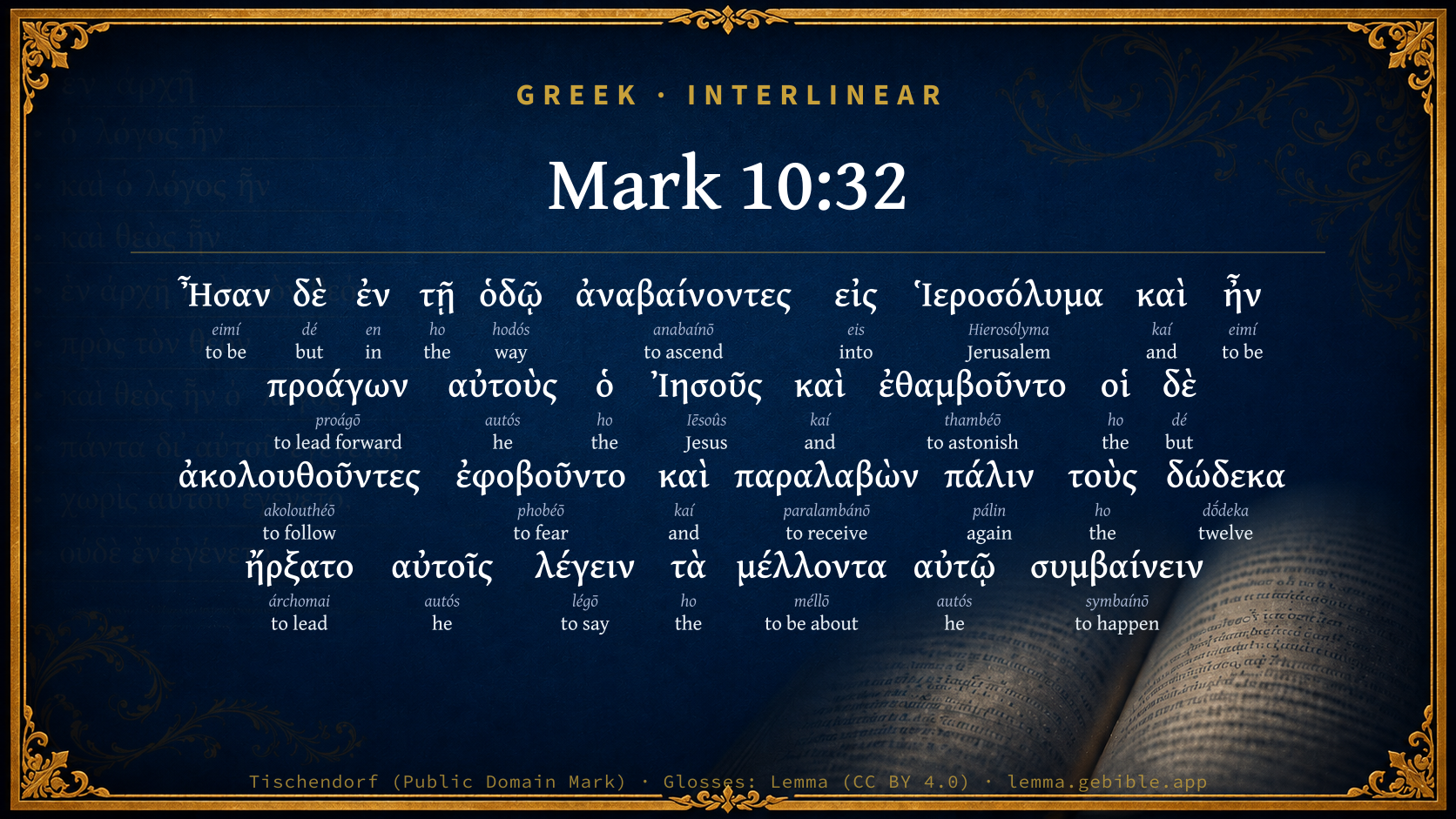
They were on the way, going up to Jerusalem; and Jesus was going in front of them, and they were amazed; and those who followed were afraid. He again took the twelve, and began to tell them the things that were going to happen to him.
Download a study sheet
One document with this verse’s original text, its word-by-word gloss line, the meaning frame, cross-references with their text, attributed commentary, and full source and license credits — printable, and it pastes into notes with its structure intact.
This verse Autodidact and up
A passage Seminary Student
Up to 50 verses in one chapter. A passage sheet keeps up to 6 commentary sources and 12 cross-references per verse, in the order this page ranks them, and says so on the sheet whenever that leaves anything out. Ask for a single verse and you get the Autodidact verse sheet above.
Everything on this page stays free to read, with no account — the sheet is a download of what is already on screen, not access to it.
Compare translations 3
The same verse in 3 English versions, stacked beneath the original-language interlinear above. Click any original word for its lexicon entry.
Each is an independent rendering of the whole verse — the interlinear is not word-aligned to these translations.
Highlighted words mark where these versions differ — a whole-verse word diff, not a word-by-word alignment.
-
World English Bible Public Domain
They were on the way, going up to Jerusalem; and Jesus was going in front of them, and they were amazed; and those who followed were afraid. He again took the twelve, and began to tell them the things that were going to happen to him.
-
King James Version Public Domain
And they were in the way going up to Jerusalem; and Jesus went before them: and they were amazed; and as they followed, they were afraid. And he took again the twelve, and began to tell them what things should happen unto him,
-
unfoldingWord Literal Text CC BY-SA 4.0
Now they were on the way, going up to Jerusalem, and Jesus was going ahead of them. And they were amazed, but the ones following behind were afraid. And having taken the Twelve aside again, he began to tell them the things being about to happen to him:
unfoldingWord Literal Text — © unfoldingWord, licensed CC BY-SA 4.0. Word-aligned USFM3 via Door43 (git.door43.org/unfoldingWord/en_ult).
Show all 19 translations
Every available English version of this verse, each an independent rendering of the whole verse.
-
World English Bible Public Domain
They were on the way, going up to Jerusalem; and Jesus was going in front of them, and they were amazed; and those who followed were afraid. He again took the twelve, and began to tell them the things that were going to happen to him.
-
Berean Standard Bible Public Domain
As they were going up the road to Jerusalem, Jesus was walking ahead of them. The disciples were amazed, but those who followed were afraid. Again Jesus took the Twelve aside and began to tell them what was going to happen to Him:
-
Majority Standard Bible Public Domain
As they were going up the road to Jerusalem, Jesus was walking ahead of them. The disciples were amazed, but as they followed, they were afraid. Again Jesus took the Twelve aside and began to tell them what was going to happen to Him:
-
King James Version Public Domain
And they were in the way going up to Jerusalem; and Jesus went before them: and they were amazed; and as they followed, they were afraid. And he took again the twelve, and began to tell them what things should happen unto him,
-
American Standard Version (1901) Public Domain
And they were on the way, going up to Jerusalem; and Jesus was going before them: and they were amazed; and they that followed were afraid. And he took again the twelve, and began to tell them the things that were to happen unto him,
-
Revised Version (1885) Public Domain
And they were in the way, going up to Jerusalem; and Jesus was going before them: and they were amazed; and they that followed were afraid. And he took again the twelve, and began to tell them the things that were to happen unto him,
-
Geneva Bible (1599) Public Domain
And they were in the way going vp to Hierusalem, and Iesus went before them and they were troubled, and as they followed, they were afraide, and Iesus tooke the twelue againe, and began to tell them what things should come vnto him,
-
Douay-Rheims (1899) Public Domain
And they were in the way going up to Jerusalem: and Jesus went before them, and they were astonished; and following were afraid. And taking again the twelve, he began to tell them the things that should befall him.
-
Young's Literal Translation Public Domain
And they were in the way going up to Jerusalem, and Jesus was going before them, and they were amazed, and following they were afraid. And having again taken the twelve, he began to tell them the things about to happen to him,
-
Literal Standard Version CC BY-SA 4.0
And they were in the way going up to Jerusalem, and Jesus was going before them, and they were amazed, and following they were afraid. And having again taken the Twelve, He began to tell them the things about to happen to Him:
-
Unlocked Literal Bible CC BY-SA 4.0
They were on the road, going up to Jerusalem, and Jesus was going ahead of them. The disciples were amazed, and those who were following behind were afraid. Then Jesus took the twelve aside again and began to tell them what would soon happen to him.
-
unfoldingWord Literal Text CC BY-SA 4.0
Now they were on the way, going up to Jerusalem, and Jesus was going ahead of them. And they were amazed, but the ones following behind were afraid. And having taken the Twelve aside again, he began to tell them the things being about to happen to him:
-
Darby Bible Public Domain
And they were in the way going up to Jerusalem, and Jesus was going on before them; and they were amazed, and were afraid as they followed. And taking the twelve again to [him], he began to tell them what was going to happen to him:
-
World Messianic Bible Public Domain
They were on the way, going up to Jerusalem; and Yeshua was going in front of them, and they were amazed; and those who followed were afraid. He again took the twelve, and began to tell them the things that were going to happen to him.
-
Webster's Bible Public Domain
And they were in the way, going up to Jerusalem; and Jesus went before them: and they were amazed; and as they followed, they were afraid. And he took again the twelve, and began to tell them what things should happen to him,
-
Free Bible Version CC BY-SA 4.0
They continued on their way to Jerusalem, with Jesus walking on ahead. The disciples were apprehensive and the other followers were afraid. So Jesus took the disciples aside and began to explain to them what was about to happen to him.
-
Bible in Basic English Public Domain
And they were on the way, going up to Jerusalem; and Jesus was going before them: and they were full of wonder; but those who came after him were in fear. And again he took the twelve, and gave them word of the things which were to come on him,
-
Text-Critical English NT CC BY 4.0
Now they were on the road going up to Jerusalem. Jesus was walking ahead of them, and they were amazed. But as they followed they became afraid. Again he took the twelve aside and began to tell them what was going to happen to him:
-
Tyndale New Testament (1534) Public Domain
And they were in the waye goinge vp to Ierusalem. And Iesus wet before them: and they were amased and as they folowed were affrayde. And Iesus toke the.xii. agayne and begane to tell the what thinges shuld happen vnto him.
Literal Standard Version (2020), Covenant Press — licensed CC BY-SA 4.0. Text via the HelloAO Bible API (eBible.org). Unlocked Literal Bible (unfoldingWord) — licensed CC BY-SA 4.0. Text via the HelloAO Bible API (eBible.org). unfoldingWord Literal Text — © unfoldingWord, licensed CC BY-SA 4.0. Word-aligned USFM3 via Door43 (git.door43.org/unfoldingWord/en_ult). Free Bible Version, Dr. Jonathan Gallagher — licensed CC BY-SA 4.0. Text via the HelloAO Bible API (eBible.org).
Word by word
More ways to search: Search by grammar → Find every occurrence → Compare this word →
Practice this passage: Drill this verse → Learn its vocabulary →
- Appears 3× in the Greek New Testament
- First appears at Mark 1:27
- Part of Speech
- Verb
- Tense
- Imperfect
- Voice
- Passive
- Mood
- Indicative
- Person
- 3rd person
- Number
- Plural
Full Thayer's Definition
- Ἦσαν eimí G1510 “to be” Verb, Imperfect, Active, Indicative, 3rd person, Plural
- δὲ dé G1161 “but” Conjunction
- ἐν en G1722 “in” Preposition
- τῇ ho G3588 “the” Article, Dative, Singular, Feminine
- ὁδῷ hodós G3598 “way” Noun, Dative, Singular, Feminine
- ἀναβαίνοντες anabaínō G305 “to ascend” Verb, Present, Active, Participle, Nominative, Plural, Masculine
- εἰς eis G1519 “into” Preposition
- Ἱεροσόλυμα Hierosólyma G2414 “Jerusalem” Noun, Accusative, Singular, Feminine
- καὶ kaí G2532 “and” Conjunction
- ἦν eimí G1510 “to be” Verb, Imperfect, Active, Indicative, 3rd person, Singular
- προάγων proágō G4254 “to lead forward” Verb, Present, Active, Participle, Nominative, Singular, Masculine
- αὐτοὺς autós G846 “he” Personal pronoun, Accusative, Plural, Masculine
- ὁ ho G3588 “the” Article, Nominative, Singular, Masculine
- Ἰησοῦς Iēsoûs G2424 “Jesus” Noun, Nominative, Singular, Masculine
- καὶ kaí G2532 “and” Conjunction
- ἐθαμβοῦντο thambéō G2284 “to astonish” Verb, Imperfect, Passive, Indicative, 3rd person, Plural
- οἱ ho G3588 “the” Article, Nominative, Plural, Masculine
- δὲ dé G1161 “but” Conjunction
- ἀκολουθοῦντες akolouthéō G190 “to follow” Verb, Present, Active, Participle, Nominative, Plural, Masculine
- ἐφοβοῦντο phobéō G5399 “to fear” Verb, Imperfect, Middle or Passive deponent, Indicative, 3rd person, Plural
- καὶ kaí G2532 “and” Conjunction
- παραλαβὼν paralambánō G3880 “to receive” Verb, Aorist, Active, Participle, Nominative, Singular, Masculine
- πάλιν pálin G3825 “again” Adverb
- τοὺς ho G3588 “the” Article, Accusative, Plural, Masculine
- δώδεκα dṓdeka G1427 “twelve” Adjective, Numeral (indeclinable)
- ἤρξατο árchomai G756 “to lead” Verb, Aorist, Middle deponent, Indicative, 3rd person, Singular
- αὐτοῖς autós G846 “he” Personal pronoun, Dative, Plural, Masculine
- λέγειν légō G3004 “to say” Verb, Present, Active, Infinitive
- τὰ ho G3588 “the” Article, Accusative, Plural, Neuter
- μέλλοντα méllō G3195 “to be about” Verb, Present, Active, Participle, Accusative, Plural, Neuter
- αὐτῷ autós G846 “he” Personal pronoun, Dative, Singular, Masculine
- συμβαίνειν symbaínō G4819 “to happen” Verb, Present, Active, Infinitive
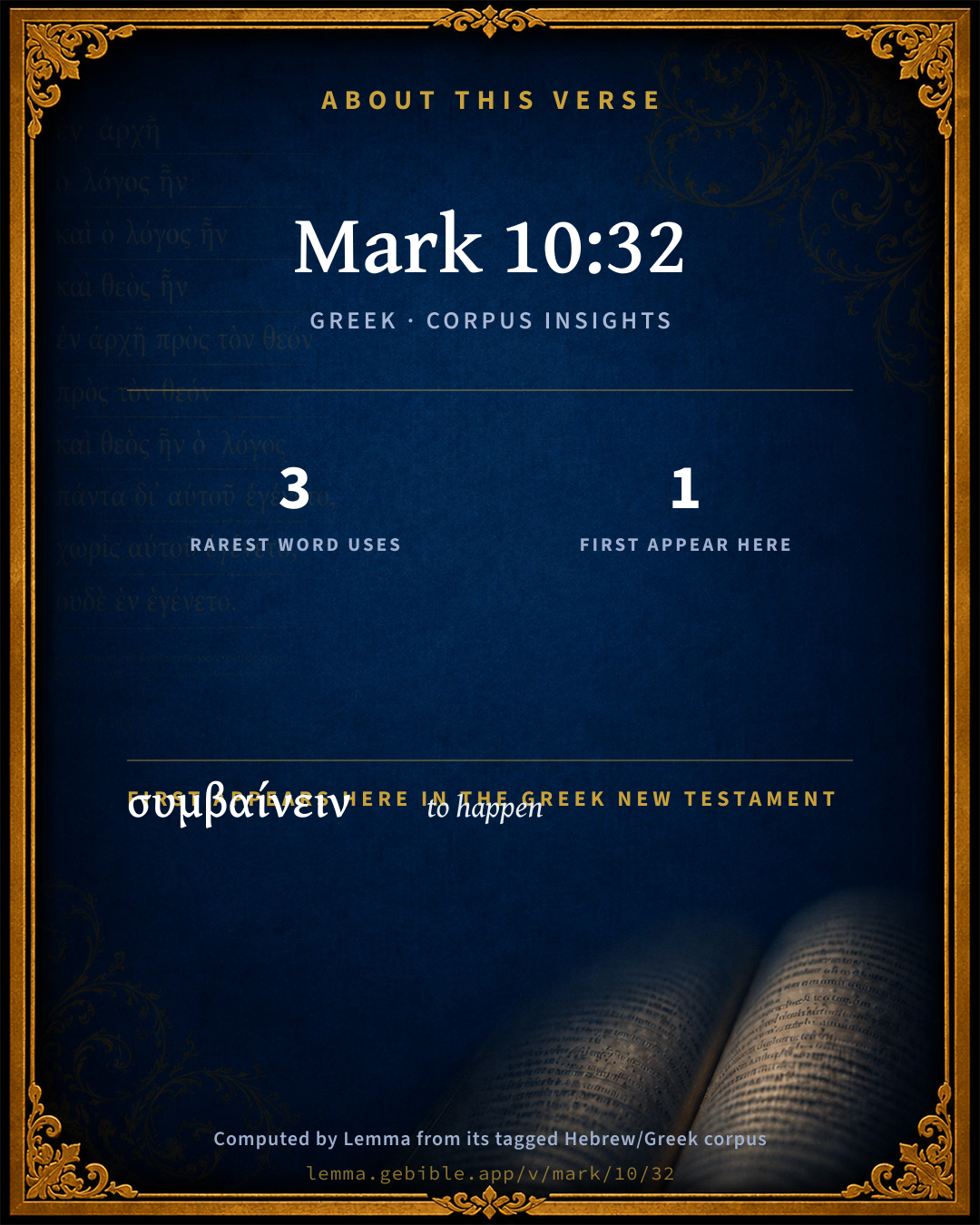
About this verse
These counts appear in no published source. They are computed here, from the morphology-tagged text and Lemma’s own curated glosses. What Lemma adds →
- 32
- words
- 22
- distinct lemmas
- Gospels
- section
Notable vocabulary
The rarest word here is ἐθαμβοῦντο to astonish G2284 — appearing just 3 times in the whole Greek New Testament.
First appearance in Scripture
This word makes its first canonical appearance in the Greek New Testament here:
- συμβαίνειν to happen G4819
Shared distinctive vocabulary
ἐθαμβοῦντο to astonish G2284 occurs in 3 verses of the Greek New Testament. Also found in:
Cross-references
10Topical passages linked to Mark 10:32 in the Treasury of Scripture Knowledge — connected by theme and wording, ordered by reader-vote popularity; previews shown in the World English Bible.
- Matthew 20:17–19 As Jesus was going up to Jerusalem, he took the twelve disciples aside, and on the way he said to them,
- Luke 18:31–34 He took the twelve aside, and said to them, "Behold, we are going up to Jerusalem, and all the things that are written through the prophets concerning the Son of Man will be completed.
- Luke 9:51 It came to pass, when the days were near that he should be taken up, he intently set his face to go to Jerusalem,
- Zechariah 3:8 Hear now, Joshua the high priest, you and your fellows who sit before you; for they are men who are a sign: for, behold, I will bring forth my servant, the Branch.
- Matthew 13:11 He answered them, "To you it is given to know the mysteries of the Kingdom of Heaven, but it is not given to them.
- Mark 4:34 Without a parable he didn't speak to them; but privately to his own disciples he explained all things.
- Luke 10:23 Turning to the disciples, he said privately, "Blessed are the eyes which see the things that you see,
- John 11:8 The disciples told him, "Rabbi, the Jews were just trying to stone you, and are you going there again?"
- John 11:16 Thomas therefore, who is called Didymus, said to his fellow disciples, "Let's go also, that we may die with him."
- Matthew 11:25 At that time, Jesus answered, "I thank you, Father, Lord of heaven and earth, that you hid these things from the wise and understanding, and revealed them to infants.
Cross-references courtesy of OpenBible.info (CC BY 4.0).
Lesson kit
Teaching starters — assembled from the data on this page, not authored interpretation. Every prompt links to the verse data it draws on. Edit before teaching.
Mark, in the Gospels, opens this verse with 32 words (22 distinct Greek lemmas). Its most distinctive word is thambéō (“to astonish”). A historical commentator’s framing appears above. Read the whole chapter for the surrounding context.
Discussion questions
- How does “to astonish” (thambéō) shape what this verse is saying?
- This is the first place “to happen” appears in Scripture (first appears here). What does its debut here establish?
- How does Mark 1:27, which shares the word «to astonish», read alongside this verse?
- What does the repetition of “to be” (2× in this one verse) do in this verse?
- These translations render this verse differently; the difference is in the English rendering, not the original. What questions does that raise?
- Compare how Matthew Henry's Commentary and Albert Barnes' Notes on the Bible read this verse. Where do they agree or differ?
Things to notice
- 1 word makes its first canonical appearance in Scripture here.
- These translations choose different wording for 18 words in this verse.
- “to be” occurs 2× in this single verse.
- 22 distinct Greek lemmas span 32 words in this verse.
Commentary
Notes on Mark 10:32 from classic Christian and Jewish commentators (each source and its license shown beneath its notes). The classic Christian expositions comment on the surrounding passage and are grouped to its opening verse, so a note may address several verses; the Jewish commentaries on the Tanakh (Rashi and others) are per-verse, so they appear only where the commentator wrote on this verse.
Lemma curates 59 commentaries, every one of them public domain or Creative Commons licensed, each selected and text-cleaned for this edition rather than reprinted as found. About our sources →
Matthew Henry's Commentary
Matthew Henry's Commentary on the Whole Bible (1708–1710) — public domain (CC PDM 1.0). Text via the HelloAO Bible API.
Albert Barnes' Notes on the Bible
Albert Barnes' Notes on the Bible (1834–1885) — public domain. Text from a community e-Sword/MySword module.
The Biblical Illustrator
Joseph S. Exell
The Biblical Illustrator, edited by Joseph S. Exell (c. 1880s–1900s) — public domain. Text from a community e-Sword module.
Joseph Benson's Commentary
Joseph Benson's Commentary on the Old and New Testaments (1811–1818) — public domain. Text from a community e-Sword module.
Whedon's Commentary on the Bible
Daniel D. Whedon
Daniel D. Whedon (gen. ed.), Commentary on the Old and New Testaments (1874–1909) — public domain. Text from a community e-Sword module.
The Preacher's Complete Homiletical Commentary
Joseph S. Exell (gen. ed.)
The Preacher's Complete Homiletical Commentary (gen. ed. Joseph S. Exell; Funk & Wagnalls, c. 1892) — public domain (pre-1929). A full-Bible homiletical/sermon-outline anthology covering 65 of 66 books (2 John is absent from the source module). Text from a community e-Sword module.
Lange's Commentary on the Holy Scriptures
Lange's Commentary on the Holy Scriptures (Critical, Doctrinal, and Homiletical), ed. John Peter Lange, English translation edited by Philip Schaff (1864–1880) — public domain. Text from a community e-Sword module.
MacLaren's Expositions of Holy Scripture
Alexander MacLaren
Alexander MacLaren, Expositions of Holy Scripture (1904–1910) — public domain. Text from a community e-Sword module.
Tyndale Open Study Notes
Tyndale Open Resources
Tyndale Open Study Notes — © Tyndale Open Resources, licensed CC BY-SA 4.0. Text via the HelloAO Bible API.
Bengel's Gnomon
Johann Albrecht Bengel
Bengel's Gnomon of the New Testament — English translation (T&T Clark, Edinburgh, 1860) — public domain. Text from a community e-Sword module.
Meyer's Critical & Exegetical Commentary
Heinrich August Wilhelm Meyer
Meyer — Critical and Exegetical Commentary on the New Testament — English translation by Peter Christie, edited by Frederick Crombie (T&T Clark, 1880) — public domain. Text from a community e-Sword module.
Expositor's Greek Testament
ed. W. Robertson Nicoll
The Expositor's Greek Testament, edited by W. Robertson Nicoll (1897–1910) — public domain. Text from a community e-Sword module.
Geneva Bible (1599)
Geneva Bible translators
Geneva Bible (1599) marginal notes — public domain. Text via Bolls.life.
Adam Clarke's Commentary
Adam Clarke's Commentary on the Bible (1810–1826) — public domain. Text from a community e-Sword/MySword module.
Ellicott's Commentary for English Readers
A Bible Commentary for English Readers, edited by Charles John Ellicott (1878–1897) — public domain. Text from a community e-Sword module.
The Cambridge Bible for Schools and Colleges
gen. ed. J. J. S. Perowne
The Cambridge Bible for Schools and Colleges (gen. ed. J. J. S. Perowne; Cambridge University Press, 1878–1918) — public domain. Text from a community e-Sword module.
John Gill's Exposition
John Gill's Exposition of the Whole Bible (1746–1763) — public domain (CC PDM 1.0). Text via the HelloAO Bible API.
Trapp's Complete Commentary
John Trapp
John Trapp, A Commentary or Exposition upon All the Books of the Old and New Testament (1647–1656) — public domain. Text from a community e-Sword module.
Haydock's Catholic Bible Commentary
George Leo Haydock (1774–1849), Haydock's Catholic Family Bible and Commentary, 1859 edition — public domain. Excludes Psalms (Douay-Rheims chapter numbering differs from Protestant) and Deuterocanonical books (Catholic canon only).
Matthew Poole's English Annotations
Matthew Poole's English Annotations on the Holy Bible (1683–1685) — public domain. Text from a community e-Sword/MySword module.
The Pulpit Commentary
The Pulpit Commentary (1880–1919), ed. H.D.M. Spence-Jones & Joseph S. Exell — public domain. Text from a community e-Sword module.
John Wesley's Explanatory Notes
John Wesley, Explanatory Notes Upon the Whole Bible (1754–1765) — public domain. Text via the GEBible commentary corpus.
Kretzmann's Popular Commentary
Paul E. Kretzmann
Paul E. Kretzmann, Popular Commentary of the Bible (1921–1924) — public domain. Text from a community e-Sword module.
Burkitt's Expository Notes on the New Testament
William Burkitt
William Burkitt's Expository Notes on the New Testament (1700–1703) — public domain. Text from a community e-Sword module.
McGarvey & Pendleton's Commentaries
J. W. McGarvey
J. W. McGarvey (with Philip Y. Pendleton), Commentaries on the New Testament (The Fourfold Gospel, 1914; Acts; and the epistles) — public domain. Text from a community e-Sword/MySword module.
The People's New Testament
B. W. Johnson
B. W. Johnson's The People's New Testament with Notes (1889–1891) — public domain. Electronic text from the Christian Classics Ethereal Library (CCEL) ThML edition.
unfoldingWord translationNotes
Door43 World Missions Community
unfoldingWord translationNotes — © Distant Shores Media and the Door43 World Missions Community, licensed CC BY-SA 4.0. Source: git.door43.org/Door43/en_tn.
Cambridge Greek Testament for Schools and Colleges
Cambridge Greek Testament for Schools and Colleges (Cambridge University Press, 1896; 21 vols, various authors incl. Carr, Maclear, Plummer, Farrar, Lumby, Moule, M. R. James, Simcox) — public domain. Text from a community e-Sword module.
Alford’s Greek Testament
Henry Alford
Henry Alford, The Greek Testament (1849–1861) — public domain. Text from a community e-Sword module.
International Critical Commentary
International Critical Commentary — older volumes (1896–1929), various authors — public domain. Text from a community e-Sword module.
Vincent's Word Studies in the New Testament
Marvin R. Vincent
Marvin R. Vincent, Word Studies in the New Testament (1887–1900) — public domain. Text from a community e-Sword/MySword module.