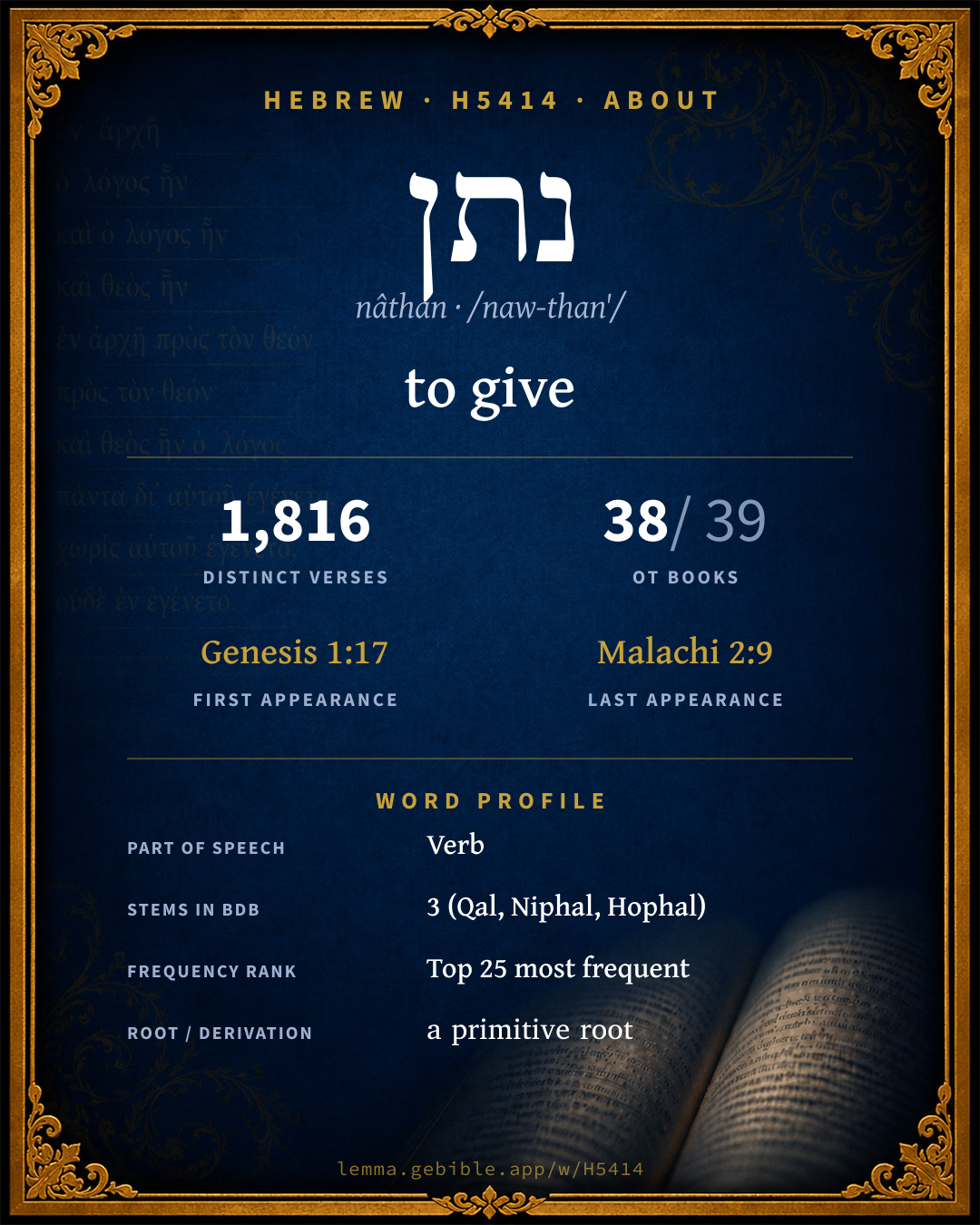
נָתַן
to give
also: put, set fuller range ↓
Full lexicon entry — Brown-Driver-Briggs (BDB)
From Brown-Driver-Briggs (BDB)
Where this word appears
See every Qal verb in the Hebrew Bible →
Grammar key — what these labels mean
Part of speech
- Verb
- An action or state-of-being word.
Stem
- Qal
- The basic, simple active stem — the plain form of the verb (“he wrote”). Here: ‘give’
- Niphal
- Usually the simple passive or reflexive of the Qal (“he was written”). Here: ‘be given to’
- Hophal
- The passive counterpart of the Hiphil (“he was caused to…”). Here: ‘be given’
- Qal Passive
- An archaic passive of the Qal, preserved in a few forms.
Form
- Perfect
- A completed action or state — Hebrew marks aspect (completeness) more than strict tense (“he wrote”).
- Sequential Imperfect
- An imperfect with prefixed waw — the standard past-narrative form (waw-consecutive imperfect).
- Imperfect
- An incomplete, ongoing, or future action (“he will / would write”).
- Sequential Perfect
- A perfect with prefixed waw continuing a preceding imperfect or command (waw-consecutive perfect).
- Infinitive Construct
- A bound verbal noun, frequently with prepositions (“to write / in writing”).
- Participle Active
- A verbal adjective expressing ongoing or characteristic action (“writing / one who writes”).
- Imperative
- A direct command (“write!”).
- Cohortative
- A first-person volitional form expressing wish or resolve (“let me / let us write”).
- Jussive
- A third- or second-person volitional form expressing wish or command (“let him write”).
- Participle Passive
- A verbal adjective expressing action received (“written”).
- Infinitive Absolute
- An unbound verbal noun, often intensifying or standing in for a finite verb.
State
- Absolute
- The independent form of a noun, not bound to a following word.
- Construct
- A noun bound to a following noun in a possessive / “of” relationship (the construct chain).
Person
- 3rd Person
- The one spoken about (“he / she / it / they”).
- 1st Person
- The speaker (“I / we”).
- 2nd Person
- The one addressed (“you”).
Gender
- Masculine
- Grammatically masculine.
- Common
- Either gender — not distinguished for this form.
- Feminine
- Grammatically feminine.
Number
- Singular
- One.
- Plural
- More than one (in Hebrew, generally three or more).
35 verses where H5414 appears in the Qal stem in the Book of 1 Chronicles. Filtered view — show all forms. Click any verse to open its interlinear word-by-word view. Verse text shown in the World English Bible for context — . Each verse’s Hebrew form is shown with its reference; the English is not keyword-highlighted, since the data carries no word-level English alignment. Use “Compare translations” on any verse to read it across multiple English versions. This concordance covers the Hebrew Bible; Septuagint (Greek Old Testament) occurrences are not indexed here.
1 Chronicles
- 1 Chronicles 2:35 וַ/יִּתֵּ֨ן conj + Qal wimpf 3ms Sheshan gave his daughter to Jarha his servant as wife; and she bore him Attai.
- 1 Chronicles 6:48 נְתוּנִ֕ים Qal ptcp.pass mp Their brothers the Levites were appointed for all the service of the tent of the house of God.
- 1 Chronicles 6:55 וַֽ/יִּתְּנ֥וּ conj + Qal wimpf 3mp to them they gave Hebron in the land of Judah, and the suburbs of it round about it;
- 1 Chronicles 6:56 נָתְנ֖וּ Qal pf 3cp but the fields of the city, and the villages of it, they gave to Caleb the son of Jephunneh.
- 1 Chronicles 6:57 נָתְנוּ֙ Qal pf 3cp To the sons of Aaron they gave the cities of refuge, Hebron; Libnah also with its suburbs, and Jattir, and Eshtemoa with its suburbs,
- 1 Chronicles 6:64 וַ/יִּתְּנ֥וּ conj + Qal wimpf 3mp The children of Israel gave to the Levites the cities with their suburbs.
- 1 Chronicles 6:65 וַ/יִּתְּנ֣וּ conj + Qal wimpf 3mp They gave by lot out of the tribe of the children of Judah, and out of the tribe of the children of Simeon, and out of the tribe of the children of Benjamin, these cities which are mentioned by name.
- 1 Chronicles 6:67 וַ/יִּתְּנ֨וּ conj + Qal wimpf 3mp They gave to them the cities of refuge, Shechem in the hill-country of Ephraim with its suburbs; Gezer also with its suburbs,
- 1 Chronicles 12:18 וַֽ/יִּתְּנֵ֖/ם conj + Qal wimpf 3ms + sfx pers 3mp Then the Spirit came on Amasai, who was chief of the thirty, [and he said], "We are yours, David, and on your side, you son of Jesse: peace, peace be to you, and peace be to your helpers; for your God helps you." Then David received them, and made them captains of the band.
- 1 Chronicles 14:10 וּ/נְתַתָּ֖/ם וּ/נְתַתִּ֖י/ם conj + Qal wpf 2ms + sfx pers 3mp conj + Qal wpf 1cs + sfx pers 3mp David inquired of God, saying, Shall I go up against the Philistines? and will you deliver them into my hand? Yahweh said to him, Go up; for I will deliver them into your hand.
- 1 Chronicles 14:17 נָתַ֥ן Qal pf 3ms The fame of David went out into all lands; and Yahweh brought the fear of him on all nations.
- 1 Chronicles 16:4 וַ/יִּתֵּ֞ן conj + Qal wimpf 3ms He appointed certain of the Levites to minister before the ark of Yahweh, and to celebrate and to thank and praise Yahweh, the God of Israel:
- 1 Chronicles 16:7 נָתַ֤ן Qal pf 3ms Then on that day David first ordained to give thanks to Yahweh, by the hand of Asaph and his brothers.
- 1 Chronicles 16:18 אֶתֵּ֣ן Qal impf 1cs Saying, To you will I give the land of Canaan, The lot of your inheritance;
- 1 Chronicles 17:22 וַ֠/תִּתֵּן conj + Qal wimpf 2ms For your people Israel did you make your own people forever; and you, Yahweh, became their God.
- 1 Chronicles 19:11 נָתַ֕ן Qal pf 3ms The rest of the people he committed into the hand of Abishai his brother; and they put themselves in array against the children of Ammon.
- 1 Chronicles 21:5 וַ/יִּתֵּ֥ן conj + Qal wimpf 3ms Joab gave up the sum of the numbering of the people to David. All those of Israel were one million one hundred thousand men who drew sword: and in Judah were four hundred seventy thousand men who drew sword.
- 1 Chronicles 21:14 וַ/יִּתֵּ֧ן conj + Qal wimpf 3ms So Yahweh sent a pestilence on Israel; and there fell of Israel seventy thousand men.
- 1 Chronicles 21:22 תְּנָ/ה תְּנֵ֣/הוּ Qal impv 2ms + sfx h Qal impv 2ms + sfx pers 3ms Then David said to Ornan, Give me the place of this threshing floor, that I may build thereon an altar to Yahweh: for the full price shall you give it me, that the plague may be stayed from the people.
- 1 Chronicles 21:23 נָתַ֨תִּי נָתָֽתִּי Qal pf 1cs Qal pf 1cs Ornan said to David, Take it to you, and let my lord the king do that which is good in his eyes: behold, I give [you] the oxen for burnt offerings, and the threshing instruments for wood, and the wheat for the meal-offering; I give it all.
- 1 Chronicles 21:25 וַ/יִּתֵּ֥ן conj + Qal wimpf 3ms So David gave to Ornan for the place six hundred shekels of gold by weight.
- 1 Chronicles 22:9 אֶתֵּ֥ן Qal impf 1cs Behold, a son shall be born to you, who shall be a man of rest; and I will give him rest from all his enemies round about; for his name shall be Solomon, and I will give peace and quietness to Israel in his days:
- 1 Chronicles 22:12 יִֽתֶּן Qal impf 3ms May Yahweh give you discretion and understanding, and put you in charge of Israel; that so you may keep the law of Yahweh your God.
- 1 Chronicles 22:18 נָתַ֣ן Qal pf 3ms Isn't Yahweh your God with you? Hasn't he given you rest on every side? for he has delivered the inhabitants of the land into my hand; and the land is subdued before Yahweh, and before his people.
- 1 Chronicles 22:19 תְּנ֤וּ Qal impv 2mp Now set your heart and your soul to seek after Yahweh your God; arise therefore, and build the sanctuary of Yahweh God, to bring the ark of the covenant of Yahweh, and the holy vessels of God, into the house that is to be built to the name of Yahweh.
- 1 Chronicles 25:5 וַ/יִּתֵּ֨ן conj + Qal wimpf 3ms All these were the sons of Heman the king's seer in the words of God, to lift up the horn. God gave to Heman fourteen sons and three daughters.
- 1 Chronicles 28:5 נָ֥תַן Qal pf 3ms Of all my sons (for Yahweh has given me many sons), he has chosen Solomon my son to sit on the throne of the kingdom of Yahweh over Israel.
- 1 Chronicles 28:11 וַ/יִּתֵּ֣ן conj + Qal wimpf 3ms Then David gave to Solomon his son the pattern of the porch [of the temple], and of the houses of it, and of the treasuries of it, and of the upper rooms of it, and of the inner chambers of it, and of the place of the mercy seat;
- 1 Chronicles 29:3 נָתַ֤תִּי Qal pf 1cs In addition, because I have set my affection on the house of my God, seeing that I have a treasure of my own of gold and silver, I give it to the house of my God, over and above all that I have prepared for the holy house,
- 1 Chronicles 29:7 וַֽ/יִּתְּנ֞וּ conj + Qal wimpf 3mp and they gave for the service of the house of God of gold five thousand talents and ten thousand darics, and of silver ten thousand talents, and of brass eighteen thousand talents, and of iron a hundred thousand talents.
- 1 Chronicles 29:8 נָתְנ֖וּ Qal pf 3cp They with whom [precious] stones were found gave them to the treasure of the house of Yahweh, under the hand of Jehiel the Gershonite.
- 1 Chronicles 29:14 נָתַ֥נּוּ Qal pf 1cp But who am I, and what is my people, that we should be able to offer so willingly as this? For all things come of you, and of your own have we given you.
- 1 Chronicles 29:19 תֵּ֚ן Qal impv 2ms and give to Solomon my son a perfect heart, to keep your commandments, your testimonies, and your statutes, and to do all these things, and to build the palace, for which I have made provision.
- 1 Chronicles 29:24 נָ֣תְנוּ Qal pf 3cp All the princes, the mighty men, and also all of the sons of king David submitted themselves to Solomon the king.
- 1 Chronicles 29:25 וַ/יִּתֵּ֤ן conj + Qal wimpf 3ms Yahweh magnified Solomon exceedingly in the sight of all Israel, and bestowed on him such royal majesty as had not been on any king before him in Israel.
About this entry
At a glance — auto-summarized from this page’s data, not written by a person. Every figure links to its source below. This summary describes the numbers; it doesn’t interpret them.
נתן (nâthan) is a Hebrew verb most often rendered “to give.” One archaism survives in the King James Version — “giveth” — where modern Bibles read “give”; see the renderings breakdown. With 1,816 verses in 38 books, it is one of the most common word in the Hebrew Bible. It first appears in Genesis 1:17. The verb spans 3 stems, from Qal to Niphal. For the data behind this summary, explore the sense tree and the renderings breakdown below.
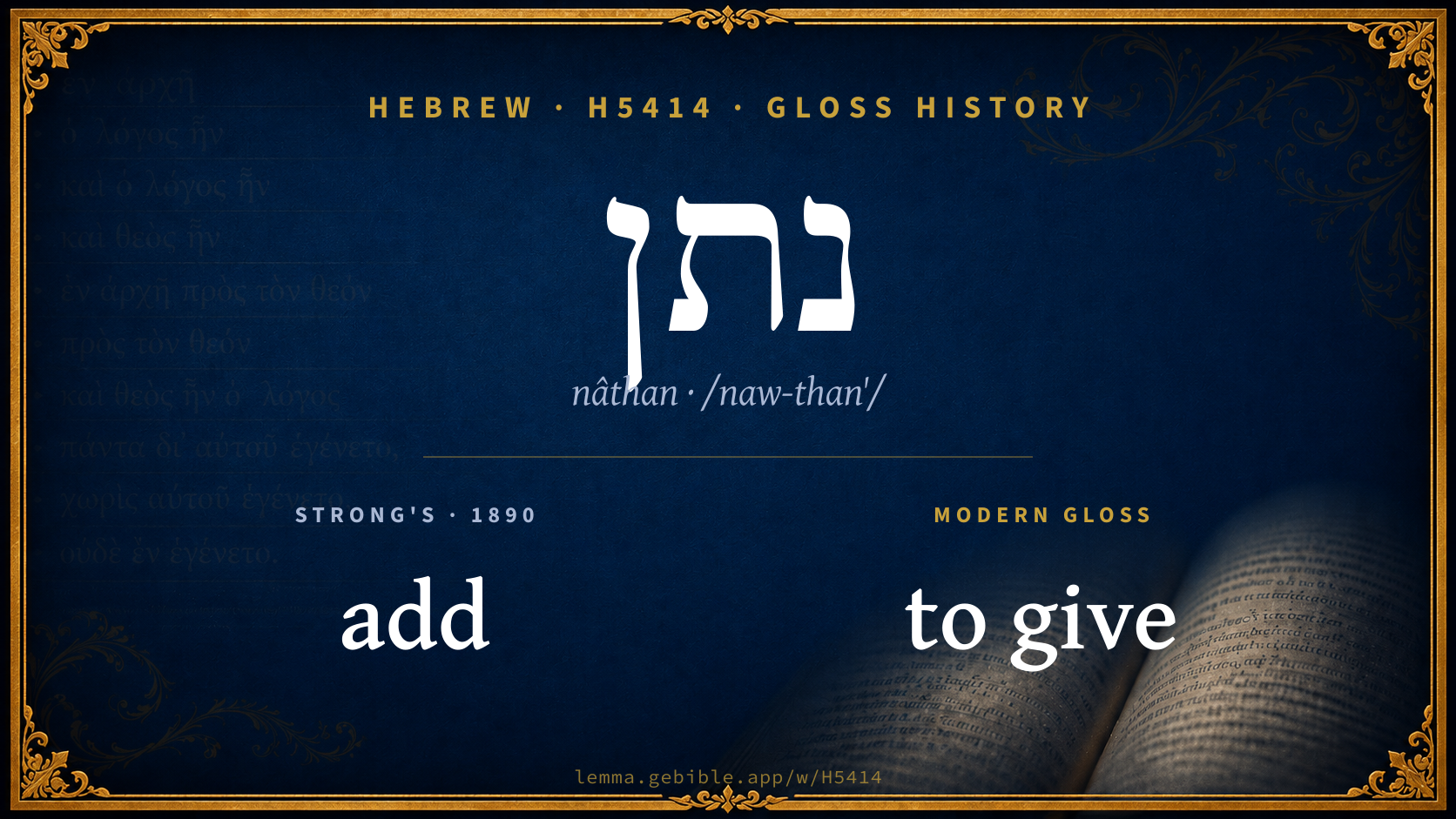
Gloss history
Strong's 1890 vs modern scholarship
About this word
Strong's H5414 catalogs a Hebrew word from the Hebrew Old Testament.
These counts are not copied from any lexicon or concordance. They are computed here, from the morphology-tagged Hebrew Old Testament. What Lemma adds →
- 1,816
- distinct verses
- The word appears in 1,816 distinct verses.
- 38 / 39
- OT books
- The word appears in 38 of 39 Old Testament books.
- #22
- by frequency
- Top 25 most frequent Hebrew words (rank 22 of 8,640 Hebrew words by occurrence).
View all 1,816 occurrences in the concordance →
Most concentrated in
- Ezekiel 189 verses 10%
- Deuteronomy 165 verses 9%
- Jeremiah 137 verses 8%
By section of the Old Testament
By traditional corpus
Conventional, traditional groupings — biblical authorship is debated, so this is a traditional corpus grouping, not an authorship claim. Each share is this word’s portion of its verses in that division of the Hebrew canon. Each figure is a share of the word’s 1,816 distinct verses.
- Prophets (Nevi'im) 803 verses · 44%
- Torah (Pentateuch) 576 verses · 32%
- Writings (Ketuvim) 437 verses · 24%
How translations render this word
Counts come from each version’s own published word-to-Strong’s tagging or interlinear alignment — an approximate guide to how each version renders this word, not a word-level alignment the data otherwise carries. Because each total is that version’s own tagged count, the per-version totals vary from one another and need not match the appearance or distinct-verse counts above. These counts may also differ from a printed concordance because Lemma counts each distinctly tagged rendering and does not collapse phrase taggings into a single head-word total. This is a fixed set of word-tagged versions (KJV, ASV, BSB, ULT) and does not change with the reading translation you choose elsewhere. Each version’s license is shown beside its name below (and on Sources).
- King James Version: Give 166×, Gave 144×, Put 83×
- American Standard Version: Give 144×, Gave 125×, Put 79×
- Berean Standard Bible: Give 115×, Gave 92×, I will give 61×
- unfoldingWord Literal Text: Give 226×, Gave 132×, And 115×
King James Version Public Domain
Renders H5414 across 2,007 tagged occurrences — most commonly:
Plus other, less common renderings. Plus 457 renderings that appear only once — usually multi-word phrases or single function words the recovered tagging swept in, not distinct renderings. Not rendered by a distinct English word in 2 further occurrences.
American Standard Version Public Domain
Renders H5414 across 2,006 tagged occurrences — most commonly:
Plus other, less common renderings. Plus 446 renderings that appear only once — usually multi-word phrases or single function words the recovered tagging swept in, not distinct renderings.
Berean Standard Bible Public Domain
Renders H5414 across 1,958 tagged occurrences — most commonly:
Plus other, less common renderings. Plus 566 renderings that appear only once — usually multi-word phrases or single function words the recovered tagging swept in, not distinct renderings. Not rendered by a distinct English word in 54 further occurrences.
unfoldingWord Literal Text CC BY-SA 4.0
Renders H5414 across 2,279 tagged occurrences — most commonly:
Plus other, less common renderings. Plus 299 renderings that appear only once — usually multi-word phrases or single function words the recovered tagging swept in, not distinct renderings.
60 senses and sub-senses in the full BDB
Hebrew verbs can shift meaning by stem (binyan): Qal is the basic action, Niphal is often passive or reflexive, Piel often intensifies or makes it factitive, and Hiphil is typically causative. The senses below are grouped under the stem BDB assigns to each. This entry also uses Hophal (the passive of Hiphil).
What do BDB’s symbols mean?
BDB uses these scholarly abbreviations:
| Symbol | Meaning |
|---|---|
| 𝔊 | the Septuagint (the ancient Greek translation, LXX) |
| 𝔙 | the Vulgate (the Latin translation) |
| 𝔖 | the Syriac version (the Peshitta) |
| 𝔗 | the Targum (the Aramaic translation) |
| ψ | the Psalms |
| √ | root (the underlying root or stem) |
| ‖ | parallel passage (a synonymous or contrasted parallel) |
| † | the dagger: every passage where the word occurs is cited |
The 60 senses and sub-senses the full Brown-Driver-Briggs lexicon distinguishes for this word, in lexicon order (not ranked by frequency), with BDB’s own verbatim wording and sub-sense lettering. Shown in Hebrew script with BDB’s own scholarly abbreviations. The condensed entry is in the Lexicon Entry tab. See also the Forms in the corpus table below.
Qal
- Pf. נ׳ Gn 24:53 +; 2 ms. נָתַ֫תָּ Ju 15:18 +, נָתַ֫תָּה Gn 3:12 +, תַּתָּה 2 S 22:41 (defended as vulg. form with aphaer. of נ׳ by Th Ges Lgb. 139 Ew§ 195 b Köi. 300 De ψ 18:41 al.; נָתַתָּה (so ‖ ψ 18:41) Ol§ 89 Sta§ 127 b Ges§ 19 i (hesitantly), Klo Bu Löhr HPS, cf. Hup-Now ψ 18:41); 2 fs. נָתַתְּ Ez 16:33, 36, נָתַתְּי v 18, sf. נְתַתִּיהוּ v 19; 1 s. נָתַ֫תִּי Ju 1:2 +, etc.; Impf. יִתֵּן Gn 43:14 +, וַיִּתֵּן 15:10 +; sf. 3 ms. יִתְּנֶ֫נּוּ Lv 5:24 Ec 2:21; 1 s. אֶתֵּן Gn 12:7 +; 1 pl. נִתֵּן 34:21 +, נִתַּן־ Ju 16:5, etc.; Imv. ms. תֵּן 2 K 4:42 +, תֶּן־ Gn 14:21, תְּנָה 1 S 2:15 +, sf. תְּנֵ֫הוּ Ne 1:11 1 Ch 21:22, תְּנֶנָּה 1 S 21:10; fs. תְּנִי Gn 30:14 +, תֵּ֑נִי Is 43:6; mpl. תְּנוּ Gn 34:8 +; Inf. abs. נָתוֹן Dt 15:10 +, נָתֹן Nu 21:2 +; cstr. נְתֹן 20:21, נְתָן־ Gn 38:9, לְתִתֵּן 1 K 6:19 (but read לָתֵת so Ol§ 224 d Ges§ 66 i Benz), תתן also 17:14 Kt (Qr תֵּת)—> these forms retained by Ew§ 238 c Köi. 305;—תֵּת Gn 4:12 +, especially לָתֵת 15:7 +, לָתֵת־ Ju 21:18, לָתֶת־ Ex 5:21 (so Ginsb, van d. H. לָתֵת־, cf. also Ki in Köi. 304 f.) +; sf. תִּתִּי Gn 29:19 +, תִּתְּךָ Dt 15:10 +, etc.; Pt. נֹתֵן Ju 21:18 +, etc.;— e.g. Genesis 24:53
- 1. give:
- a. = give personally, deliver or hand to, c. acc. rei + ל pers. 1 S 10:4; 22:10 2 K 22:10 Lv 5:16 (P) 22:14 (H) Ru 4:7 + often; in trade Pr 31:24; אֶל־ pers. Gn 21:14 (E), Je 3:8 Lv 15:14 + often; explicitly נ׳ בְּיַד Dt 24:1, 3 (bill of divorce); c. acc. rei alone Ju 5:25. e.g. 1 Samuel 10:4
- b. = bestow upon, c. acc. rei + ל pers. Gn 24:53 (J) 20:16 (E) 1:29 (P) + often; an understanding heart 1 K 3:9, 12, blessing Dt 12:15, mercy 13:18, cf. Je 16:13; 42:12; strength Dt 8:18 ψ 68:36; the sabbath Ex 16:29 (J) Ez 20:12; = procure for (לְ) one 1 S 17:10 1 K 21:7; יִתֵּן לָכֶם רַחֲמִים לִפְנֵי Gn 43:14 (J) he will give you compassion in the eyes of the man (cf. also 2 b, 3 b); give persons 46:18, 25 (P); of Levites given to (לְ) Aaron and his sons Nu 3:9 cf. 8:19, to י׳ 8:16 cf. 18:6 (all P); especially of י׳’s giving land to Abr. and his descendants Gn 15:18; 26:4 (J) 17:8 (P) Ex 6:8 (P; + מוֹרָשָׁה) + often (pt. in this sense 37 times Dt.), + לִרִשְׁתָּהּ Dt 3:18 +; אַל־תִּתֵּן לַנָּשִׁים תֵילֶ֑ךָ Pr 31:3; + מִן of source נָתַתִּי מִמֶּנָּה לְךָ בֵּן Gn 17:16 (P); c. acc. alone ψ 61:6 Ec 12:7 (רוּחַ); give something to (ל) one for (ל) sthg., in some capacity, אֶת־כָּל־אֶחָיו נ׳ לוֹ לַעֲבָדִים Gn 27:37 +; prob. also נ׳ בְּבָרוּתִי רֹאשׁ ψ 69:22 they gave, as my food, gall (בְּ essentiae), cf. supr. בְּ 7 c, Hup-Nowad loc.; acc. + inf. נ׳־לִי לֶחֶם לֶאֱכֹל וּבֶגֶד לִלְבּשׁ Gn 28:20 (J), cf. Ex 16:15 (P), Ne 9:15, 20; לֹא נ׳ לָכֶם לֵב לָדַעַת וְעֵינַיִם לִרְאוֹת וְאָזְנַיִם לִשְׁמֹעַ Dt 29:3. e.g. Genesis 24:53
- c. give woman to (ל) man as (ל) wife, Gn 29:28 (E), 34:8, 12 (J), Jos 15:16, 17 (JE), = Ju 1:12, 13 +; without 2nd ל Gn 29:19(×2) (E), Gn 38:26 Ex 2:21 (J), Gn 34:9, 14, 16 (P), Ju 15:2, 6 +; c. acc. alone, Gn 29:26 (E), 1 S 25:44. e.g. Genesis 29:28
- d. of (gracious) bestowals of various kinds: give = grant, send rain, גִּשְׁמֵיכֶם Lv 26:4 (H), מְטַר־אַרְצְכֶם Dt 11:14, מָטָר עַל־אַרְצְךָ 1 K 8:36, etc.; also of sending plague of hail Ex 9:23 (E); send herbage (עֵשֶׂב) in (בְּ) your field for (לְ) your cattle Dt 11:15; grant a remnant to (לְ) Judah Je 40:11; וְנָתַתִּי לְךָ אֶת־נַפְשְׁךָ לְשָׁלָל 45:5 and I will grant thee thy life as spoil; grant revenge (acc.) to (לְ) the king on (מִן) Saul, etc. 2 S 4:8, cf. הָאֵל הַגֹּתֵן נְקָמוֹת לִי 2 S 22:48 = ψ 18:48; other gifts Ju 15:18 (בְּיַד), 1 S 1:11 (לְ), Ru 4:13. e.g. Leviticus 26:4
- e. grant a request, שְׁאֵלָה 1 S 1:17, 27 Est 5:3 ψ 106:15 (+ ל pers.), בַּקָּשָׁה Ezr 7:6, תַּאֲוָה Pr 10:24, (רָשָׁע) מַאֲוַיֵּי ψ 140:9, תִּקְוָה Jb 6:8, מִשְׁאֲלֹת לִבֶּ֑ךָ ψ 37:4, cf. יִתֵּן י׳ לָכֶם וּמְצֶאןָ מְנוּחָה Ru 1:9. e.g. 1 Samuel 1:17
- f. מִי יִתֵּן who will give or grant, in expressions of wish = O that (I had! etc.; = Assyrian mannu inamdin JägerBAS ii. 279), especially (9 times) Jb.: c. acc. מִי־יִתֵּן עֶרֶב Dt 28:67 cf. v 67, Jb 14:4 ψ 14:7 = 53:7, 55:7 Je 9:1; c. 2 acc. כָּל־עַם י׳ נְבִיאִים Nu 11:29 (JE), lit. who will make all י׳’s people prophets? cf. Je 8:23; c. acc. + כְּ, מִי יִתֶּנְךָ כְאָח לִי Ct 8:1, cf. Jb 29:2; c. acc. + בְּ, אֶת־הָעָם הַזֶּה בְּיָדִי Ju 9:29 O that this people were in my charge! c. acc. + לְ Jb 31:35, lit. who will give to me (לִי) one hearing me? also מִי יִתְּנֵנִי Is 27:4 where sf. appar. = לִי; c. inf. מִי יִתֵּן מוּתֵנוּ Ex 16:3 (P), so 2 S 19:1, מִי יִתֵּן אֱלוֹהַּ דַּבֵּר Jb 11:5; c. impf. תָּבוֹא שֶׁאֱלָתִי Jb 6:8 O that my request might come to pass! 14:13; 31:31; impf. + וְ 19:23(×2); c. pf. יָדַעְתִּי 23:3 O that I knew! (+ וְאֶמְצָאֵהוּ); c. pf. consec. Dt 5:26†. e.g. Deuteronomy 28:67
- g. permit, c. acc. + inf., לֹא־נְתַתִּיךָ לִנְגֹּעַ אֵלֶיהָ Gn 20:6 (E), cf. 31:7 (E) Ex 3:19 (J) Nu 20:21; 21:23 (JE) + often; om. לְ Jb 9:18; c. ל pers. + inf. 2 Ch 20:10, also לֹא כֵן נ׳ לְךָ י׳ Dt 18:14 not thus hath י׳ permitted to thee; אִם־אֶתֵּן שְׁנָת לְעֵינָ֑י וגו׳ ψ 132:4 Pr 6:4; give thyself (לְ) no rest La 2:18, give him (לְ) no rest Is 62:6. e.g. Genesis 20:6
- h. = ascribe glory, etc. (acc.) to (לְ) God 1 S 6:5 Jb 36:3, especially imv. Je 13:16 Ezr 10:11 ψ 68:35 cf. 115:1 (so הָבוּ, v. יהב 4); to man 1 S 18:8(×2); unseemliness (תִּפְלָה) to God Jb 1:22. e.g. 1 Samuel 6:5
- i. = apply, devote heart to seek out, acc. + inf. Ec 1:13, 17; 8:9, 16 Dn 10:12, נ׳ לֵב לְ Ec 7:21 = attend to; conversely אֶת־כָּל־זֶה נָתַתִּי אֶל־לִבִּי Ec 9:1 = all this I set before my mind, 7:2; also (with subj. diff. from ind. obj.) מָה אֱלֹהַי נֹתֵן אֶל־לִבִּי לַעֲשׂוֹת Ne 2:12 cf. 7:5. e.g. Ecclesiastes 1:13
- j. = employ, devote money (acc.) עַל־עֲבֹדַת אֹהֶל מוֹעֵד Ex 30:16 (P). e.g. Exodus 30:16
- k. give offerings, לְי׳ Nu 18:12 (P), תְּרוּמַת י׳ Ex 30:15 (P), cf. give spoil to (לְ) י׳ Dt 20:14 (י׳ subj.); מִיָּֽדְךָ נָתַנּוּ לָ֑ךְ 1 Ch 29:14; offering to (לְ) idols Ez 6:13; especially to Moloch Lv 20:2, 4, to pass through fire to (ל) M 18:21, etc. e.g. Numbers 18:12
- l. = consecrate, dedicate to (לְ) י׳ 1 S 1:11 Ex 22:29 (E). e.g. 1 Samuel 1:11
- m. give a sign or wonder, acc. 1 K 13:3, 5, + לְ pers. Jos 2:12 (JE), with reflex. לְ Ex 7:9 (P), alm. = display, exhibit; cf. נָֽתְנוּ הֲדָרֵךְ Ez 27:10 they set forth, exhibit thy splendour; כִּי יִתֵּן בַּכּוֹס עֵינוֹ Pr 23:31 when it sheweth its sparkle in the cup. e.g. 1 Kings 13:3
- n. = pay, wages (acc., + sf.), נ׳ שְׂכָרִי Gn 30:18 (E) he hath paid my hire, Ex 2:9 (E) Dt 24:15, cf. Is 61:8; + ל pers. Je 22:13; a price, נ׳ מִכְרָם Nu 20:19 (JE), וַיִּתֵּן שְׂכָרָהּ Jon 1:3, i.e. paid his fare, passage-money; money (as) price (מחיר) 1 K 21:2, cf. נ׳ כֶּסֶף הַשָּׂדֶה Gn 23:13 (P); pay money for (ב) something Dt 14:26; wealth for (ב) love Ct 8:7; tax or rent, c. acc. rei + ל pers. Gn 47:24 (J); fine (c. id.) Ex 21:32 (E) Dt 22:29, acc. om. v 19, cf. וְנָתַן בִּפְלִלִים Ex 21:22 (v פָּלִיל), נ׳ שִׁבְתּוֹ v 19 (i.e. pay for his lost time), נ׳פִּדְיוֹן נַפְשׁוֹ v 30 (pay redemption-money; all E), cf. וְנ׳ אִישׁ כֹּפֶר נַפְשׁוֹ לְי׳ 30:12 (P); pay votive offering (c. acc. + ל) Lv 27:23 (P); a wager (c. acc. + ל) Ju 14:12, 13. e.g. Genesis 30:18
- o. c. בְּ, give for (ב) money = sell, תְּנָה־לִּי אֶת־כַּרְמְךָ בְּכֶסֶף 1 K 21:6, cf. Dt 2:28; 14:25 1 Ch 21:22;—נ׳ Ez 27 is trading term, but sometimes connexion obscure and text dub.: give wares for (בְ) 27:12 (but read prob. ך for ב 𝔊 𝔖 Co Berthol), v 13, 16 (del. 2nd ב), v 17, 19, 22 (cf., further, Co Berthol and especially Sm); נ׳ הַיֶּלֶד בַּוּוֹנָה Jo 4:3 (‖ מָכַר); ב instr., give בַּגּוֹרָל by lot Jos 21:8. e.g. 1 Kings 21:6
- p. give instead of, exchange for, c. תַּחַת Ex 21:23 (E) 1 K 21:2, 6 Is 43:4; 61:3, בְּעַד Jb 2:4. e.g. Exodus 21:23
- q. give, i.e. lend, at interest, כַּסְפּוֹ לֹא נ׳ בְּנֶשֶׁךְ Lv 25:37 ψ 15:5, so (acc. om.) Ez 18:8, 13. e.g. Leviticus 25:37
- r. = commit, entrust to, c. acc. + אֶל־ pers. Ex 22:6, 9 (E), c. ל pers. Ct 8:11, c. בְּיַד Gn 30:35; 39:4, 8, 22 (all J), 2 S 10:10. e.g. Exodus 22:6
- s. give over, deliver up, c. acc. Nu 21:3 (JE) Ju 20:13 1 S 11:12 2 S 14:7; 20:21 1 K 14:16 Ho 11:8 (‖ מִגֵּן), Mi 5:2; נ׳ בָּנָיו פְּלֵיטִים וּבְנֹתָיו בַּשְּׁבִית לְמֶלֶךְ אֱמֹרִי Nu 21:29 (JE); + ל, נ׳ פ׳ לַמָּוֶת ψ 118:18; + לִפְנֵי Dt 7:2, 23; 31:5 + (see Dr Dt. lxxxiii, No. 52, and v. further 2 b ad fin.); especially נ׳ בְּיַד, c. acc., Nu 21:34 (JE) Jos 2:24 (JE) Dt 2:24 + often e.g. Numbers 21:3
- t. yield produce, fruit, etc., especially of land, ground, Gn 4:12 (J), Lv 25:19; 26:4, 20 (all H), Dt 11:17 Is 55:10 (+ ל pers.) Zc 8:12 ψ 67:7; 85:13 cf. Ez 36:8; of tree Ez 34:27 Lv 26:4, 20 (H) ψ 1:3, + vine Jo 2:22, vine Zc 8:12; abs. root of righteous yields, יִתֵּן Pr 12:12 according to De Str (dub.; proposes to insert פְּרִי); Dy Kau Wild proposes אֵיתָן (as ψ 74:15, etc.), cf. as to sense Ew; other conj. v. Now; cf. Nu 20:8 (P) Zc 8:12 Ct 1:12; 2:13; 7:14. e.g. Genesis 4:12
- u. = occasion, produce, שֵׂכֶל טוֹב יִתֶּן־חֵ֑ן Pr 13:15 cf. 29:15, חֶרְדַּת אָדָם יִתֵּן מוֹקֵשׁ v 25 trembling before man occasioneth a snare. e.g. Proverbs 13:15
- v. requite to (לְ) a man, according to (כְּ) character 1 K 8:39 = 2 Ch 6:30 Je 17:10; 32:19 ψ 28:4(×2) c. עַל־ + כְּ Ez 7:9; c. עַל־ pers. + acc. of sin 7:3, 4, 8; 23:49 (cf. 2 b). e.g. 1 Kings 8:39
- w. = report, mention, וַיִּתֵּן אֶת־מִסְפַּר … אֶל־הַמֶּלֶךְ 2 S 24:9 he reported the number unto the king; וָאֶתְּנָה לוֹ זְמָ֑ן Ne 2:6 and I mentioned to him a time. e.g. 2 Samuel 24:9
- x. = utter, usually c. acc. קוֹל, utter a sound, lift up the voice: Je 4:16 (+ עַל against), 22:20; 48:34 La 2:7; in weeping, וַיִּתֵּן אֶת־קֹלוֹ בִּבְבִי Gn 45:2 (E), וַיִּבְכּוּ Nu 14:1 (P); + ל pers. Pr 2:3 (‖ לַבִּינָה תִּקְרָא); of wisdom Pr 1:20; 8:1 (‖ קרא); of י׳, especially in thunder of theoph. Am 1:2 2 S 22:14 (‖ יַרְעֵם), = ψ 18:14, Je 25:30 Jo 2:11; of clouds ψ 77:18, the deep Hb 3:10; of young lion’s roaring Am 3:4 Je 2:15; of birds ψ 104:12; קוֹל om., נ׳ דָּוִד … לְהֹדֹת לְי׳ 1 Ch 16:7; so of י׳’s voice in thunder, לְקוֹל תִּתּוֹ Je 10:13 (sc. קוֹלוֹ) at the sound of his uttering (his voice) = 51:16; נ׳ בְּקוֹל Je 12:8 (+ עַל־ against), of י׳ ψ 46:7, הֵן־יִתֵּן בְּקוֹלוֹ קוֹל עֹז 68:34; נ׳ with other words, אֹמֶר v 12 (of י׳); of confession, (acc. + ל pers.) Jos 7:19 (JE) Ezr 10:11. e.g. Jeremiah 4:16
- y. give = stretch out, extend, וַיִּתֶּן־יָד Gn 38:28 (J) it put out a hand; וַיִּתֵּן צַמַּרְתּוֹ אֶל־בֵּין עֲבוֹתִים (read עָבוֹת) Ez 31:10, 14 and it stretched its top amid the clouds. e.g. Genesis 38:28
- z. combinations are: יִתֵּן לְמַכֵּהוּ לֶחִ֑י La 3:30 (humiliation), cf. Is 50:6; וַיִּתְּנוּ כָתֵף סֹרָ֑רֶת Zc 7:11 (of stubbornness), so Ne 9:29 (‖ עָרְפָּם הִקְשׁוּ); also וַיִּתְּנוּ עֹרֶף 2 Ch 29:6 gave, i.e. turned (their) back (on י׳; ‖ וַיַּסֵּבּוּ פְנֵיהֶם מִמִּשְׁכַּן י׳); of compact, תְּנָה אֶת־יָדֶ֑ךָ 2 K 10:15 cf. v 15, so מִצְרַיִם נָתַנּוּ יָד La 5:6; of submission, נָֽתְנָה יָדָהּ Je 50:15 = she (Babyl.) hath surrendered; תְּנוּ יָד לְי׳ 2 Ch 30:8 = submit to י׳; more explicitly, נ׳ יָד תַּחַת שְׁלֹמֹה 1 Ch 29:24; נ׳ מָקוֹם לְ Ju 20:36 give place to (retire before); of sexual relation, אֶל־אֵשֶׁת … לֹא־תִתֵּן שְׁכָבְתְּךָ לְזָ֑רַע Lv 18:20 (H), וַיִּתֵּן אִישׁ בָּךְ אֶת־שְׁכָבְתּוֹ Nu 5:20 (P), so (בְּכָל־בְּהֵמָה) Lv 18:23 (H), cf. 20:15 (H).—יִתֵּן is taken impers. = ‘es giebt,’ there is, there are, in Jb 37:10 Pr 10:24; 13:10 by De, citing Ew§ 295 d, Now Pr 13:10 Str Frankenb (in transl., dub. in note), BaeJb in Kau; but improbable Kau Pr Di Jb, so Hi Bu Du (on Jb 37:10), reading יֻתַּן; cf. KöSynt. § 324 d β. e.g. Lamentations 3:30
- 2. Put, set, nearly = שִׂים, and sometimes ‖ with it:
- a. lit., (especially often in Ez P); c. acc. + עַל־ on, ring on hand Gn 41:42 (E), cf. Ez 16:11, helmet on head 1 S 17:38, also Je 27:2; 28:14 (in fig.), 1 K 12:4, 9 (in fig.), 18:23 (‖ שִׂים), Ex 12:7 (acc. om.), cf. 25:12, 26, 30 + often P; c. עַל־ = above Ex 25:21; 26:34 (P), = for, נ׳ גֹּרָלֹת עַל־ Lv 16:8 (P), cast lots for; = against Ez 26:8; c. אֶל־ into: ark into cart 1 S 6:8, put one in the stocks Je 29:26 (also c. עַל־ 20:2), in prison 37:18; 38:11, cf. Ex 25:16; 28:30 (P); put water upon (עַל־) sthg. into (אֶל־) vessel Nu 19:17; = toward וַיִּתֵּן פְּנֵי הַצֹּאן אֶל־עָקֹד Gn 30:40 (J; del. Ol Di al.); c. בְּ, cup into hand Gn 40:13 (E), cf. Ju 7:16, also Gn 41:48 (E), cf. 1 K 7:51, Gn 1:17 (P), 9:13 (P), 2 K 19:18, Je 27:8, נ׳ בֶּעָפָר פֶּה La 3:29 (in fig.), נָתַתִּי שִׁפְחָתִי בְּחֵיקֶ֑ךָ Gn 16:5 (J), וְנָתַתָּה בְאָזְנוֹ וּבַדֶּלֶת Dt 15:17 and thou shalt put (the awl) into his ear and into the door (pin his ear to the door); put disease into one Dt 7:15 (‖ שִׂים); inflict blemish (מוּם) on (בְּ), Lv 24:19, 20; וּכְתֹבֶת קַעֲקַע לֹא תִתְּנוּ בָּכֶם 19:28; c. בְּ + לְ, שֶׂרֶט לָנֶפֶשׁ לֹא תִתְּנוּ בִּבְשַׂרְכֶם v 28 (all H); c. לִפְנֵי before, in front of, set food before one, 2 K 4:43, 44; cf. Zc 3:9 Ez 3:20 Ex 30:6; 40:5, 6 (all P); c. בֵּין between, Ex 30:18; 40:17 (P); c. לְ, מִגְרָעוֹת נ׳ לַבַּיִת סָבִיב 1 K 6:6 he put ledges to the house; c. other preps. הָאִשָּׁה אֲשֶׁר נָתַתָּ עִמָּדִי Gn 3:16 (J), the woman whom thou hast set at my side, cf. Ex 31:6 (נ׳ אִתּוֹ; fig. of association, assistance); c. לִקְרַאת Gn 15:10 (J), lay each piece to meet its fellow; he set the sea מִכֶּתֶף הַבַּיִת 1 K 7:39; c. ה loc. put money שָׁמָּה into it 2 K 12:10, so of water Ex 30:18 (P), cf. 40:7 (שָׁם); c. 2 acc. נ׳ אוֹתוֹ בֵּית הַכְּלוּא Je 37:4 cf. v 15; put, place, abs. Ex 40:8 (P; ‖ שִׂים, cf. 26:32); set up, אֶבֶן מַשְׂכִּית בְּ Lv 26:1 (H; ‖ הֵקִים); + לְ pers., lay snare for me ψ 119:110 (in fig.). e.g. Genesis 41:42
- b. fig., in many phr.: c. עַל, put my spirit upon him Is 42:1, reproach upon one Je 23:40, blessing on Mt. Gerizim, etc., Dt 11:29, curses on enemies 30:7; impose tax upon Ne 10:33 cf. 2 K 23:33; נָתַן הוֹד עַל put majesty upon one 1 Ch 29:25 Dn 11:21 Nu 27:20 (P; מֵהוֹד; cf. ψ 21:6); so also perhaps ψ 8:2 hast set thy majesty upon (over) the heavens, cf. 𝔖 𝔙 𝔗 (read נָתַתָּה for תְּנָה, Hup De Pe Bae al.; other views v. in Thes Ew Ol Now Che We Du); = above, וּנְתָֽנְךָ עֶלְיוֹן עַל־כָּל־גּוֹיֵי הָאָרֶץ Dt 28:1 cf. 26:19; put (sthg.) over mouth Mi 3:5 (i.e. stop one’s mouth, by a gift); = against נ׳ מָצוֹר עַל־ Ez 4:2 (siege), cf. v 2b; c. אֶל־, וָאֶתְּנָה אֶת־פָּנַי אֶל־אֲדֹנָי … לְבַקֵּשׁ Dn 9:3; c. בְּ, words into mouth Dt 18:18 Je 1:9, cf. 1 K 22:23; wisdom into heart, or person, 1 K 10:24 Ex 31:6; 36:1, 2 (all P), cf. ψ 4:8; set peace in earth Lv 26:6 (H); (the idea of) perpetuity (עוֹלָם) in heart Ec 3:11; a purpose, וּלהוֹרֹת נ׳ בְּלִבּוֹ Ex 35:34 (P); וְנָתַתִּי אֶת־יָדִי בְּמִצְרַיִם Ex 7:4 (P); אַל־תִּתֵּן דָּם נָקִי בְּקֶרֶב עַמְּךָ Dt 21:8; וַיִּתֵּן חִנּוֹ בְּעֵינֵי Gn 39:21 (J), and he put his favour in the eyes of the prison-keeper (made the keeper favourable to him), cf. Ex 3:21; 11:3; 12:36 (all E; cf. also 1 b, 3 b); c. בְּ pers. = against, in phr. set my face against, oppose Ez 14:8; 15:7 Lv 17:10; 20:6 (both H); c. בֵּין, = put, i.e. make a covenant between Gn 17:2 (P), cf. Lv 26:46 (H); נ׳ אֶרֶץ לִפְנֵיכֶם i.e. place at your disposal Dt 1:8, 21 cf. 2:36; set ordinances, etc., before, לִפְנֵי (for observance), 1 K 9:6 Je 26:4; 44:10 Dn 9:10; blessings and cursings (for choice) Dt 30:1, 15, 19; נ׳ דֶּרֶךְ בְּרֹאשׁ פ׳ set or place one’s way upon his head, i.e. requite him, Ez 9:10; 11:21; 16:43; 22:31 cf. 17:19, also 1 K 8:32 = 2 Ch 6:23 + (cf. 1 v); לָתֵת נִקְמַת י׳ בְּמִדְיָן Nu 31:3 to set the vengeance of י׳ upon Midian; נ׳ ב׳ ψ 50:20 = set in, i.e. impute to (usually שִׂים ב׳). e.g. Isaiah 42:1
- c. set, appoint, c. acc. + עַל־ over, י׳ hath set a king over you 1 S 12:13 cf. Gn 41:41 (E); c. עַל־ on, נ׳ ישֵׁב עַל־כִּסְאִי 1 K 1:48; c. בְּ in = over, 1 Ch 12:9 Ne 13:4; c. לְ, Nethînîm לַעֲבֹדָה Ezr 8:20; c. acc. alone, idol-priests 2 K 23:5, prophet Je 1:5 (2 acc.), leader Nu 14:4; one instead of (תַּחַת) another 1 K 2:35. e.g. 1 Samuel 12:13
- d. = assign, designate, c. לְ: God hath assigned victim-flesh to (ל) you, in order to bear sins of people Lv 10:17, cf. Nu 18:8 (both P); cities for (ל) flight of man-slayer Nu 35:6 (P); נָתַתִּי לָכֶם עַל־הַמִּזְבֵּחַ לְכַפֵּר Lv 17:11 (H). e.g. Leviticus 10:17
- 3. Make, constitute,
- a. c. 2 acc., וְנָתַתִּי נְעָרִים שָׂרֵיהֶם Is 3:4 and I will make boys their princes, cf. Gn 17:5; Ex 7:1 (both P), ψ 18:33 (> וַיַּתֵּר in ‖ 2 S 22:33), 39:6; 69:12; 135:12, etc.; + בֵּין Jos 22:25 (P); + אֶל־ pers. וְנָתַתִּי אֶת־כָּל־אֹיְבֶיךָ אֵלֶיךָ עֹרֶף Ex 23:27 (E), and I will make all thine enemies unto thee a back, i.e. make them shew thee their back, flee from thee, so c. לְ ψ 18:41 = 2 S 22:41. e.g. Isaiah 3:4
- b. c. acc. + לְ, וְנָתַתִּי אֶת־יְרוּשָׁלַיִם לְגַלִּים Je 9:10 and I will make Jerusalem into ruin-heaps, cf. Dt 28:13; Is 42:24; Gn 17:6, 20; 48:4; Nu 5:21; Jos 17:3 (all P) +; נ׳ פ׳ לְרַחֲמִים לִפְנֵי 1 K 8:50 make persons an object of compassion before (in the eyes of), so Ne 1:11 ψ 106:46 Dn 1:9 (cf. also 1 b, 2 b); + לְ pers. for (especially Je.), וּנְתַתִּים לִזְוָעָה לְכֹל מַמְלְכוֹת הָאָרֶץ Je 15:4 and I will make them a terror for all kingdoms of the earth, cf. 24:9; 29:18; 34:17. e.g. Jeremiah 9:10
- c. c. acc. + כְּ, וְאֵת הָאֲדָזִים נ׳ כַּשִּׁקְמִים 1 K 10:27 and the cedars he made like the sycomores, i.e. as common, = 2 Ch 1:15, cf. 1 K 16:3 Ez 28:6 Lv 26:19 (H), Ru 4:11; וַיִּתֵּן אֹתָנוּ כִּמְרַגְּלִים Gn 42:30 (E), i.e. regarded, treated us as spies, but ins. בַּמִּשְׁמָר 𝔊 Ol Di Ball Holz,—אַל־תִּתֵּן אֶת־אֲמָֽתְךָ לִפְנֵי בַת בְּלִיַּעַל 1 S 1:16 difficult, (notwithstanding Jb 3:24; 4:19), read prob. כְּ (HPS), or לְ, for לִפְנֵי. e.g. 1 Kings 10:27
- d. rarely c. acc. alone: וּמִבְּנֵי יִשׂ׳ לֹא נ׳ שְׁלֹמֹה עֶבֶד 1 K 9:22 and of the sons of Israel Sol. made no slave, but read prob. לְמַם עֹבֵד (as v 21; 𝔊 A εἰς πράγμα om. B 𝔊L; cf. Klo Benz), וָאֶתֵּן עֲלֵיהֶם קְהִלָּה Ne 5:7 and I made (held) over their case a great assembly; make a decree, חֹק, ψ 148:6; perhaps also וַתִּתֵּן אֹתֹת בְּפַרְעֹה Ne 9:10 and thou didst perform signs and wonders against Pharaoh, etc. (cf. שִׂים אוֹתֹת בְּ Ex 10:2 ψ 78:43). e.g. 1 Kings 9:22
Niphal
- Pf. נִתַּן Is 9:5 +; 3 fs. נִתְּנָה Gn 38:14 +; 2 mpl. וְנִתַּתֶּם consec. Lv 26:25; 1 pl. נִתַּ֫נּוּ Ezr 9:7; Impf. יִנָּתֵן Ex 5:18 +, יִנָּ֫תֶן לוֹ 2 Ch 2:13 (Gi v. d. H. יִנָּ֫תֶן־לוֹ); Ptcp. נִתָּן 2 K 22:7; Inf. abs. הִנָּתֹן Je 32:4; 38:3; cstr. לְהִנָּתֵן Est 3:14; 8:13;— e.g. Isaiah 9:5
- 1. be given to (usually c. ל pers.):
- a. = bestowed upon Jos 24:33 (E), Ez 11:15 (+ לְמוֹרָשָׁה), 33:24 (+ id.), Jb 15:19; Ez 16:34; Nu 26:62 (P), Is 9:5, portion from sacrifice Lv 10:14 (P), glory Is 35:2, birthright 1 Ch 5:1, freedom Lv 19:20 (H). e.g. Joshua 24:33
- b. given to one (ל) for wife (ל) Gn 38:14 (J), 1 S 18:19. e.g. Genesis 38:14
- c. provided, usually c. ל Ex 5:16, 18 (J); 1 S 25:27; 2 K 25:30 = Je 52:34, Is 33:16; Ne 13:10; נ׳ מֵרֹעֶה אֶחָד Ec 12:11 they are given from one shepherd (i.e. words of wise) according to Ew De Hi-Now RüetschiKau; Wild underst. subj. of compilers. e.g. Exodus 5:16
- d. = entrusted to Je 13:20 cf. 2 Ch 2:13; c. עַל־יָדָם 2 K 22:7, בְּיַד 2 Ch 34:16. e.g. Jeremiah 13:20
- e. = be given into the power of (usually c. בְּיַד), especially of city (kg., people) given into the hand of foe 2 K 18:30 (+ אֶת־ acc.), 19:10 = Is 36:15; 37:10; Je 21:10 + 18 times Je Lv Chr Dn; earth into hand of wicked Jb 9:24; in good sense Gn 9:2 (P); delivered to death (ל), unto lower world (אֶל־), Ez 31:14; given to us (ל) for devouring (ל) 35:12; חֶרֶב נ׳ Ez 32:20 delivered to the sword (del. 𝔊 𝔖 Co SgfrKau Toy); abs., of צָבָא, Dn 8:12 (al. was appointed, v. especially Dr), 11:6. e.g. 2 Kings 18:30
- f. of request, be granted to (ל), Est 2:13; 5:3 (בַּקָּשָׁה), v 6; 7:2; 9:12 (all שְׁאֵלָה), cf. 7:3 (בִּשְׁאֵלָה, בְּבַקָּשָׁה). e.g. Esther 2:13
- g. = be permitted Est 9:13 (+ inf.). e.g. Esther 9:13
- h. = be issued, published (of royal decree), abs. Est 3:5, 14; 4:8; 8:13, 14; 9:14; of law given בְּיַד מֹשֶׁה Ne 10:30. e.g. Esther 3:5
- i. = be uttered, נ׳ שְׁאוֹן קוֹלָם Je 51:55 (of stormers of Babylon). e.g. Jeremiah 51:55
- j. be assigned for (ל), Ez 47:11. e.g. Ezekiel 47:11
- 2. Be put, set:
- a. lit., crown בְּרֹאשׁ Est 6:8; of personif. folly נ׳ הַסֶּכֶל בַּמְּרוֹמִים Ec 10:6. e.g. Esther 6:8
- b. in imagery of Ezek. נ׳ … בְּיַרְכְּתֵי־בוֹר Ez 32:23, c. אֵת (with) v 29, c. בְּתוֹךְ v 25, vine put (cast) לָאֵשׁ לְאָכְלָה Ez 15:4 into the fire for consuming; fig. of terror נ׳ בארץ 32:25. e.g. Ezekiel 32:23
- c. = be made, בֶּן־אָדָם חָצִיר יִנָּתֵן Is 51:12. e.g. Isaiah 51:12
- d. = be inflicted, of blemish (מוּם) Lv 24:20 (c. בְּ pers.). e.g. Leviticus 24:20
Hophal
- (or Qal pass. Ges§ 53 u) Impf. יֻתַּן 1 K 2:21 + 5 times + 2 S 21:6 Qr (Kt ינתן); וַיֻּתַּן 2 S 18:9;— e.g. 1 Kings 2:21
- 1.
- a. be given, bestowed, abs. Nu 26:54; c. לְ pers. 2 K 5:17; Nu 32:5 (אֶת־ c. acc.; both P); in exchange for (תַּחַת) Jb 28:15. e.g. Numbers 26:54
- b. = be given to one (ל) for wife (ל) 1 K 2:21 (Abishag, אֶת־ c. acc.). e.g. 1 Kings 2:21
- c. = be given, delivered, up to (ל) 2 S 21:6. e.g. 2 Samuel 21:6
- 2. be put upon (עַלִ־) Lv 11:38 (P); of Absalom וַיֻּתַּן בֵּין הַשָּׁמַיִם וגו׳ 2 S 18:9, וַיִּתָּל (√ תלה) 𝔊 𝔖 We Dr (?), Klo Kit Bu HPS. e.g. Leviticus 11:38
Senses from the full Brown-Driver-Briggs lexicon (Brown, Driver, Briggs; Oxford 1906 — public domain), digitized via Sefaria, supplemented by the OpenScriptures HebrewLexicon (CC BY 4.0). Full attribution on Sources.
Word origin
vb. give, put, set (Ecclus נתן 44:19 + often; OHeb נתן־יהו n.pr.m. Lzb 327; NH = BH; Ph. יתן, נתן in n.pr. מתנת, etc., Lzb 292, 327; Assyrian nadânu DlHWB 450 (rarely ittan Id ib. 488); Zinj. נתן, also in n.pr., Lzb 327 Cook 84; Nab. Impf. ינתן, and n.pr.; Palm., also n.pr. Lzb l.c. Cook l.c.; 𝔗 Impf. יִתֵּן, Inf. מִתַּן; Sab. נתן Hal 154, Liḥ n.pr. נתנבעל [North-&Sem. form] DHMEpigr. Denkm. 80, No. 35; Chr Pal. Aramaic ܢܬܢ (rare) SchwallyIdiot. 58; Syriac Impf. ܢܶܬܶܠ, Inf. ܡܶܬܰܠ LindbergVergl. Sem. Gram. 93 f., but Mand. נתן NöM 52);—
— Brown-Driver-Briggs (Oxford 1906, public domain), digitized via Sefaria, supplemented by the OpenScriptures HebrewLexicon (CC BY 4.0). See Sources.
Origin: a primitive root
Jastrow Dictionary
A second Hebrew/Aramaic lexicon for comparison, covering Aramaic and post-biblical (Talmudic, Targumic, Midrashic) usage that the biblical-Hebrew BDB does not. Matched by lemma rather than by Strong’s number, so a lemma may carry more than one Jastrow headword (shown separately below), and the entries cover usage well beyond the Bible.
נָתָן
- (b. h.) pr. n. m. Nathan,
- 1. the prophet. Koh. R. to IV, 12. Midr. Till. to Ps. LI; a. fr.—2) N. the Babylonian, a Tannai. Ber. IX, 5. Tosef. Yeb. VIII, 4. B. Bath. 73ᵃ; a. fr.—3) name of several Amoraim. Y. Erub. VI, 23ᶜ bot., v. דְּרוֹמָאָה; a. e.—Y. M. Kat. III, 82ᵃ נ׳ בר אבא.—Y. Ter. VII, 44ᶜ נ׳ בר הושעיה.—Y. Ber. IV, 7ᵇ נ׳ בר טובי; a. fr.—4) N. d’Tsutsitha, a penitent. Sabb. 56ᵇ.—אבות דר׳ נ׳, v. אָב II.
נָתַן
- (b. h.) to give; to place, put. Gitt. I, 6 תֵּן גט וכ׳ give this letter of divorce to my wife. Ib. תְּנוּ גט וכ׳ give ye &c. Ib. לא יִתְּנוּ לאחר מיתה they must not deliver it after the man’s death; a. v. fr.—נשא ונ׳, v. נָשָׂא.—נ׳ עיניו ל (to put an eye upon) to intend. B. Mets. 19ᵃ, a. e. כיון שנ׳ ע׳ לגרשה as soon as he has resolved to divorce her; a. fr.—נ׳ עיניו ב (to have an eye on) to desire, think of. Ned. XI, 12 שלא תהא אשה נוֹתֶנֶת עיניה באחר lest the woman have a liking for another man. Ib. 20ᵇ שלא אֶתֵּן עיני וכ׳ lest I think of another woman. Ib. אל ישתה … ויִתֵּן וכ׳ one must not drink of one cup (have connection with one woman) and think of another; a. fr.—Esp. נ׳ עיניו בו to cast an angry eye at, to hurt by an angry look. Ber. 58ᵃ נ׳ ע׳ בו ונעשה וכ׳ he cast an eye at him and he was changed into &c., v. גַּל; Sabb. 34ᵃ; a. e.—Y. Ber. III, beg. 5ᵈ, a. fr. נוֹתן תפלין puts on T’fillin.—נ׳ טעם, v. טַעַם.—הדין נותן the conclusion ad majus gives it, it is a legitimate conclusion. Bekh. 59ᵇ, a. fr. Ib. היא הנוֹתֶנֶת (on the contrary,) it is thus we should argue.—Gen. R. s. 33 והדין נותן and it stands to reason.—Esp. נ׳ (sub. דם) to put blood on the altar, sprinkle, smear. Zeb. VIII, 4; a. fr.—[Tosef. Neg. VI, 10 נותן, v. נָתַץ.]
- to be given, put &c.; to be intended. Ned. 38ᵃ לא נִיתְּנָה תורה אלא וכ׳ the Law was given only to Moses and his descendants. Ib. וכולן נִתְּנוּ וכ׳ and all those (gates of understanding) were granted to Moses; a. fr.—Keth. 81ᵃ לא ניתנה כתובה וכ׳ the K’thubah is not intended to be collected during life-time. R. Hash. 28ᵃ מצות … נִיתְּנוּ, v. הָנָה; a. fr.—[Tosef. Ab. Zar. V (VI), 8 עד שינתן, v. נָתַץ.]—Esp. to be put on the altar, sprinkled, smeared. Zeb. VIII, 9 הנִתָּנִין למטה … בנתנין למעלה blood which must be put below (the red line) which has been mixed with blood that must be put above. Ib. 10 יִנָּתְנוּ במתן וכ׳ shall be applied four times, v. מַתָּן a. מַתָּנָה; a. fr.
- to be put. Makhsh. I, 1 בכי יוּתַּן (הרי זה) it comes under the law (Lev. XI, 38), i.e. it is a liquid which, if put on eatables, makes them susceptible of uncleanness. Ib. 2 אינן בכי יותן do not qualify for uncleanness; a. fr. e.g. Leviticus 11:38
נְתַן
- Targ. Deut. XV, 10; a. fr.—[Targ. Is. LIII, 5 ובדנתינה some ed., read: ובדניתנהי, v. נְהֵי I.].
A Dictionary of the Targumim, the Talmud Babli and Yerushalmi, and the Midrashic Literature (Marcus Jastrow; London, Luzac, 1903) — Public Domain. Digitized via Sefaria. Digitized via Sefaria. Full attribution on Sources.
Forms in the corpus
The 705 distinct written forms H5414 takes in the Hebrew Bible, most frequent first — each parse links to that stem’s occurrences in the concordance. Hebrew forms include their vowel points and cantillation, so a single lemma takes many written forms.
The 60 most common forms are shown; 645 rarer forms follow in the full concordance.
Same root — word family
Other BDB entries built from the same root as H5414, grouped by Strong’s listed origin. These share a root / origin per the lexicon — not necessarily a shared meaning. Each links to that word’s own entry.
Derived from this word
Proper names from this root
People and places named from this root — a name, not an additional meaning of the word.
- נתן Nâthân H5416 Nathan
- נתנאל Nᵉthanʼêl H5417 Nethaneel
- נתניה Nᵉthanyâh H5418 Nethaniah
- נתןמלך Nᵉthan-Melek H5419 Nathan-melech
Compare all same-root words → Showing 4 of 8 — not the complete family. 4 of the same-root words are proper names (people or places). They share a root, not necessarily a meaning.
Septuagint verse parallels
This word appears in 1,694 verses that also exist in the Greek Old Testament (Septuagint), out of the 1,816 Hebrew verses it occurs in. You can read those verses in Greek by switching the Old Testament edition to the Septuagint.
Read these verses in the Septuagint
- Genesis 1:17
- Exodus 2:9
- Leviticus 1:7
- Numbers 3:9
- Deuteronomy 1:8
- Joshua 1:2
- Judges 1:2
- Ruth 1:6
- 1 Samuel 1:4
- 2 Samuel 3:14
- 1 Kings 1:48
- 2 Kings 3:10
This is a verse-level parallel only — the same verses exist in both the Hebrew and Greek Old Testaments. No word-level Hebrew↔Greek correspondence is claimed: the data carries no such alignment, so no Greek word is shown as this Hebrew word’s translation. Coverage is not total — the Septuagint omits the deuterocanon and renumbers the Psalms, so some Hebrew verses have no direct Greek parallel.