
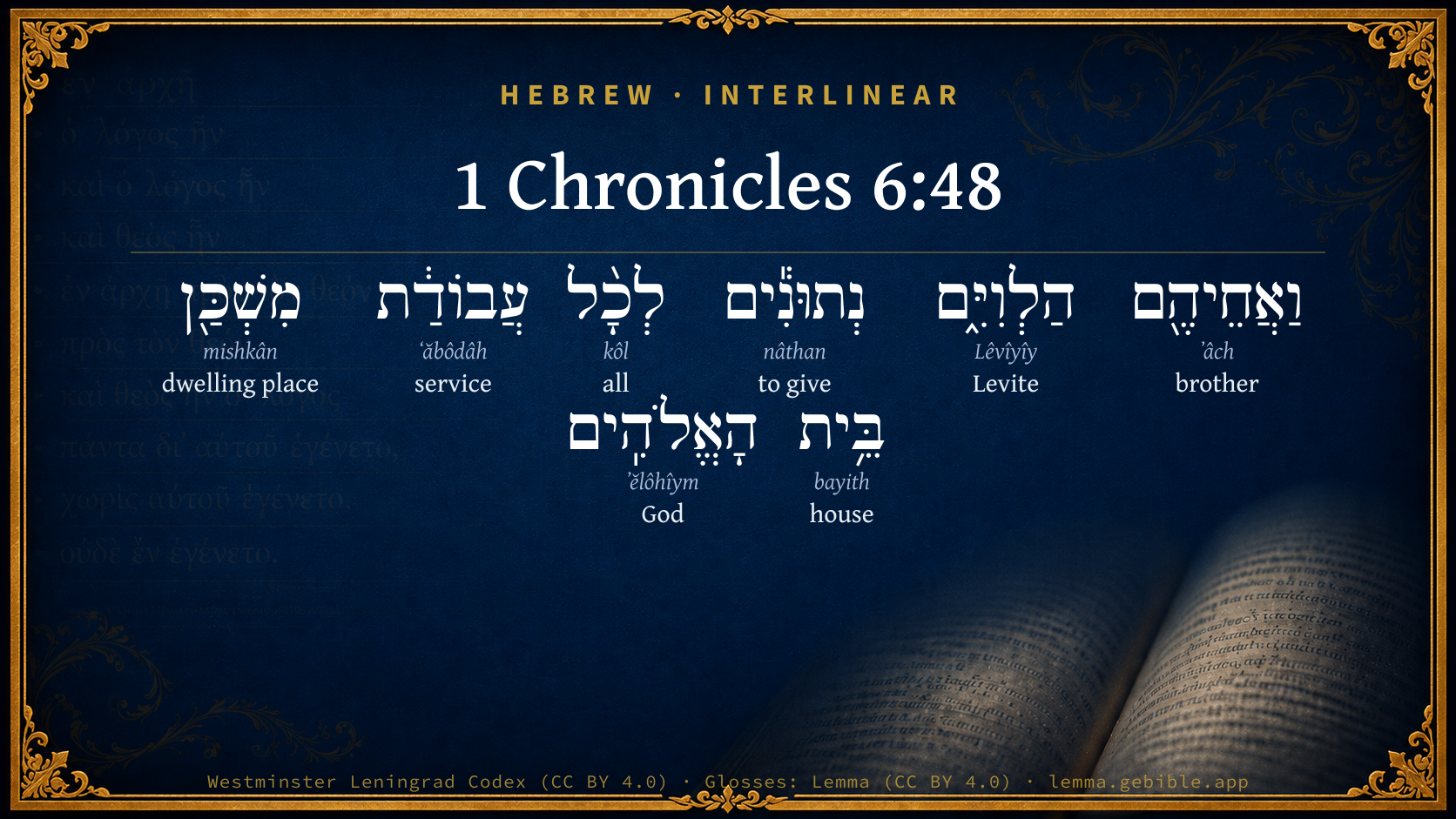
1 Chronicles 6:48

Hebrew (Westminster Leningrad Codex) 1 Chronicles 6:48 appears in the Hebrew Old Testament. The text above is from the Westminster Leningrad Codex. Each word links to its Strong’s number, a concise gloss, and parsing drawn from the Open Scriptures Hebrew Bible morphology. Click any word for its full Brown-Driver-Briggs (BDB) entry.
Download image
Cite this verse

1 Chronicles 6:48 (World English Bible). Public Domain. Lemma interlinear Bible study tool, https://lemma.gebible.app/v/1-chronicles/6/48.

Show BibTeX & RIS
BibTeX
RIS
English Translation
Their brothers the Levites were appointed for all the service of the tent of the house of God.
World English Bible · Public Domain
Download a study sheet

One document with this verse’s original text, its word-by-word gloss line, the meaning frame, cross-references with their text, attributed commentary, and full source and license credits — printable, and it pastes into notes with its structure intact.

This verse Autodidact and up

Study sheet (.html) Plain text (.txt)

A passage Seminary Student

Up to 50 verses in one chapter. A passage sheet keeps up to 6 commentary sources and 12 cross-references per verse, in the order this page ranks them, and says so on the sheet whenever that leaves anything out. Ask for a single verse and you get the Autodidact verse sheet above.

Everything on this page stays free to read, with no account — the sheet is a download of what is already on screen, not access to it.

Want to remove ads? Support Godless Engineer
Compare translations 3

The same verse in 3 English versions, stacked beneath the original-language interlinear above. Click any original word for its lexicon entry.

Each is an independent rendering of the whole verse — the interlinear is not word-aligned to these translations.

Highlighted words mark where these versions differ — a whole-verse word diff, not a word-by-word alignment.

  • World English Bible Public Domain
    Their brothers the Levites were appointed for all the service of the tent of the house of God.
  • King James Version Public Domain
    Their brethren also the Levites were appointed unto all manner of service of the tabernacle of the house of God.
  • unfoldingWord Literal Text CC BY-SA 4.0
    And their brothers, the Levites, were appointed to all of the service of the tabernacle of the house of God.

unfoldingWord Literal Text — © unfoldingWord, licensed CC BY-SA 4.0. Word-aligned USFM3 via Door43 (git.door43.org/unfoldingWord/en_ult).

Versions to compare (up to 4)

3 of 4 selected

Show all 18 translations

Every available English version of this verse, each an independent rendering of the whole verse.

  • World English Bible Public Domain
    Their brothers the Levites were appointed for all the service of the tent of the house of God.
  • Berean Standard Bible Public Domain
    Their fellow Levites were assigned to every kind of service of the tabernacle, the house of God.
  • Majority Standard Bible Public Domain
    Their fellow Levites were assigned to every kind of service of the tabernacle, the house of God.
  • King James Version Public Domain
    Their brethren also the Levites were appointed unto all manner of service of the tabernacle of the house of God.
  • American Standard Version (1901) Public Domain
    And their brethren the Levites were appointed for all the service of the tabernacle of the house of God.
  • Revised Version (1885) Public Domain
    And their brethren the Levites were appointed for all the service of the tabernacle of the house of God.
  • Geneva Bible (1599) Public Domain
    And their brethren the Leuites were appointed vnto all the seruice of the Tabernacle of the house of God,
  • Douay-Rheims (1899) Public Domain
    Their brethren also the Levites, who were appointed for all the ministry of the tabernacle of the house of the Lord.
  • Young's Literal Translation Public Domain
    And their brethren the Levites are put to all the service of the tabernacle of the house of God.
  • Literal Standard Version CC BY-SA 4.0
    And their brothers the Levites are put to all the service of the Dwelling Place of the house of God.
  • Unlocked Literal Bible CC BY-SA 4.0
    Their associates, the Levites, were assigned to do all the work for the tabernacle, the house of God.
  • unfoldingWord Literal Text CC BY-SA 4.0
    And their brothers, the Levites, were appointed to all of the service of the tabernacle of the house of God.
  • Darby Bible Public Domain
    And their brethren the Levites were given for all the service of the tabernacle of the house of God.
  • World Messianic Bible Public Domain
    Their brothers the Levites were appointed for all the service of the tabernacle of God’s house.
  • Webster's Bible Public Domain
    Their brethren also the Levites were appointed to all manner of service of the tabernacle of the house of God.
  • Free Bible Version CC BY-SA 4.0
    The other Levites carried out all the other functions in the Tabernacle, the house of God.
  • Bible in Basic English Public Domain
    And their brothers the Levites were responsible for all the work of the Tent of the house of God.
  • JPS Tanakh (1917) Public Domain
    (6-33) And their brethren the Levites were appointed for all the service of the tabernacle of the house of God.

Literal Standard Version (2020), Covenant Press — licensed CC BY-SA 4.0. Text via the HelloAO Bible API (eBible.org). Unlocked Literal Bible (unfoldingWord) — licensed CC BY-SA 4.0. Text via the HelloAO Bible API (eBible.org). unfoldingWord Literal Text — © unfoldingWord, licensed CC BY-SA 4.0. Word-aligned USFM3 via Door43 (git.door43.org/unfoldingWord/en_ult). Free Bible Version, Dr. Jonathan Gallagher — licensed CC BY-SA 4.0. Text via the HelloAO Bible API (eBible.org).

Word by word

More ways to search: Search by grammar → Find every occurrence → Compare this word →

Practice this passage: Drill this verse → Learn its vocabulary →

About this verse

These counts appear in no published source. They are computed here, from the morphology-tagged text and Lemma’s own curated glosses. What Lemma adds →

8
words
8
distinct lemmas
Historical
section

Grammatical profile

  • 1 verb
  • 7 nouns

Verb forms

  • נְתוּנִ֕ים Qal · Participle Passive

Hebrew & Septuagint length

In English translation the verse runs 18 words from the Hebrew and 30 from the Septuagint (LXX English) — the Septuagint runs noticeably longer here. See the side-by-side →

A rough comparison of the two English renderings, which tokenize alike — not a word-level alignment.

Word counts can differ between the Hebrew and the Greek without any difference in meaning — e.g. the Hebrew direct-object marker אֵת has no separate Greek word, and Greek often adds the article ὁ.

Cross-references

6

Topical passages linked to 1 Chronicles 6:48 in the Treasury of Scripture Knowledge — connected by theme and wording, ordered by reader-vote popularity; previews shown in the World English Bible.

  • Numbers 18:1–32 Yahweh said to Aaron, You and your sons and your fathers' house with you shall bear the iniquity of the sanctuary; and you and your sons with you shall bear the iniquity of your priesthood.
  • Numbers 3:1–4 Now this is the history of the generations of Aaron and Moses in the day that Yahweh spoke with Moses in Mount Sinai.
  • Numbers 16:9–10 [seems it but] a small thing to you, that the God of Israel has separated you from the congregation of Israel, to bring you near to himself, to do the service of the tent of Yahweh, and to stand before the congregation to minister to them;
  • 1 Chronicles 23:2 He gathered together all the princes of Israel, with the priests and the Levites.
  • 1 Chronicles 25:1–26 Moreover, David and the captains of the host set apart for the service certain of the sons of Asaph, and of Heman, and of Jeduthun, who should prophesy with harps, with psalteries, and with cymbals: and the number of those who did the work according to their service was:
  • Numbers 8:5–26 Yahweh spoke to Moses, saying,

Cross-references courtesy of OpenBible.info (CC BY 4.0).

Hebrew and Greek witnesses Masoretic Hebrew ↔ Greek Septuagint

The same verse in the two great witnesses to the Old Testament, shown verse-for-verse.

Here the Septuagint runs noticeably longer than the Hebrew — LXX2012 (modern English Septuagint) 30 words vs World English Bible 18. A rough length comparison of the two English translations, not a word-level alignment — read both below.

These are two independent witnesses, not word-aligned to each other, and the Septuagint is shown in lemma (dictionary) form.

Hebrew 1 Chronicles 6:48 Masoretic · Westminster Leningrad Codex

וַאֲחֵיהֶ֖ם הַלְוִיִּ֑ם נְתוּנִ֕ים לְכָ֨ל עֲבוֹדַ֔ת מִשְׁכַּ֖ן בֵּ֥ית הָאֱלֹהִֽים

Their brothers the Levites were appointed for all the service of the tent of the house of God.

World English Bible · Public Domain

Greek LXX 1 Chronicles 6:48 Septuagint · lemma form

καί ὁ υἱός μεραρι κατά πατριά αὐτός ἐκ φυλή ρουβην ἐκ φυλή γαδ ἐκ φυλή ζαβουλων κλῆρος πόλις δέκα δύο

And their brethren according to the houses of their fathers, were the Levites who were appointed to all the work of ministration of the tabernacle of the house of God.

LXX2012 (modern English Septuagint) · Public Domain

Hebrew: Westminster Leningrad Codex (CC BY 4.0). Greek: Septuagint (public domain); English from LXX2012 (modern English Septuagint) (Public Domain). How the Septuagint differs from the Hebrew →

Commentary

Notes on 1 Chronicles 6:48 from classic Christian and Jewish commentators (each source and its license shown beneath its notes). The classic Christian expositions comment on the surrounding passage and are grouped to its opening verse, so a note may address several verses; the Jewish commentaries on the Tanakh (Rashi and others) are per-verse, so they appear only where the commentator wrote on this verse.

Lemma curates 59 commentaries, every one of them public domain or Creative Commons licensed, each selected and text-cleaned for this edition rather than reprinted as found. About our sources →

The Biblical Illustrator

Joseph S. Exell

1Ch_6:31; 1Ch_6:48

And these are they whom David let over the service of song lit the house of the Lord.

The ministry of song

I. Song an element of Christian worship.

II. Song an expression of human feeling.

III. Song a power for which its possessors are responsible. (J. Wolfendale.)

Religious worship

I. Worship varied in its forms.

II. Lively in its spirit.

III. Orderly in its method.

IV. Universal in its participation. (J. Wolfendale.)

.

The Biblical Illustrator, edited by Joseph S. Exell (c. 1880s–1900s) — public domain. Text from a community e-Sword module.

Joseph Benson's Commentary

1Ch 6:48. Their brethren were appointed, &c. — Such of them as had no skill in singing were otherwise employed; being porters, keepers of the vessels of the sanctuary, occupied in preparing the sacrifices, and such like things. It is observable, that in all the genealogies of the Levites, there is not a word said of the sons of Moses and their posterity, he having no ambition to prefer them unto any great office.

Joseph Benson's Commentary on the Old and New Testaments (1811–1818) — public domain. Text from a community e-Sword module.

Geneva Bible (1599)

Geneva Bible translators

The Levites are called the singers brethen because they came of the same stock.

Read Num. 4:4.

Geneva Bible (1599) marginal notes — public domain. Text via Bolls.life.

Jamieson, Fausset & Brown

Robert Jamieson, A. R. Fausset & David Brown

Their brethren also the Levites were appointed unto all manner of service--Those of them who were endowed with musical tastes and talents were employed in various other departments of the temple service.

Jamieson, Fausset & Brown — Commentary Critical and Explanatory on the Whole Bible (1871) — public domain (CC PDM 1.0). Text via the HelloAO Bible API.

Ellicott's Commentary for English Readers

(48) Their brethren also the Levites.—That is, the Levites who were not musicians—the remaining Levites.

Appointed.—Literally, given—that is, to Aaron and his sons as their assistants; Num_3:9 (Heb.), “And thou shalt give the Levites to Aaron and to his sons, given are they to him from amongst the sons of Israel.” The word is nethûnîm. (Comp. nethînim, an identical form, as the name of a well-known class of Temple-servants.)

Tabernacle.—Rather, dwelling-place (mishkan).

A Bible Commentary for English Readers, edited by Charles John Ellicott (1878–1897) — public domain. Text from a community e-Sword module.

The Cambridge Bible for Schools and Colleges

gen. ed. J. J. S. Perowne

48, 49 (= 33, 34 according to the Heb. division). The distinction between Levites and Aaronites

48. Their brethren also the Levites] R.V. And their brethren the Levites, i.e. and the other Levites.

appointed] Heb. given, in allusion to Num_3:9; Num_18:6.

unto all manner of service] R.V. for all the service.

The Cambridge Bible for Schools and Colleges (gen. ed. J. J. S. Perowne; Cambridge University Press, 1878–1918) — public domain. Text from a community e-Sword module.

Haydock's Catholic Bible Commentary

Brethren. All the other Levites, who were not Cantors. (Menochius)

George Leo Haydock (1774–1849), Haydock's Catholic Family Bible and Commentary, 1859 edition — public domain. Excludes Psalms (Douay-Rheims chapter numbering differs from Protestant) and Deuterocanonical books (Catholic canon only).

Matthew Poole's English Annotations

The Levites; such of them as had no skill in singing were otherwise employed.

Matthew Poole's English Annotations on the Holy Bible (1683–1685) — public domain. Text from a community e-Sword/MySword module.

The Pulpit Commentary

The all manner of service, from that of the three "leaders of song" on their "cymbals of brass" (1Ch_15:19) down through the other Levitical grades, is fully illustrated in many places. (1Ch_15:18-24 1Ch_16:37-42 1Ch_23:2-32 1Ch_25:1-8 1Ch_26:1-26)

Vers. 48, 49.

Levites and priests.

These two verses contain a brief account of the offices of the two orders of ministry in the Jewish Church.

I LESSONS PECULIAR TO THE OLD COVENANT. Nothing was more prominent or important in Israel than the provision alluded to in this passage. We are reminded:

1. That amongst the chosen people there was a consecrated tribe, andwithin this a consecrated family.

2. That thus a provision was made for perpetual temple worship andappointed sacrifices.

3. That, in obedience to these prescribed ordinances, Israel abode beneaththe favour of Jehovah.

II LESSONS GENERALLY APPLICABLE TO THE RELIGIOUS LIFE.

1. Order and decency are becoming in the service of a righteous and holyGod. It is possible to regard the form and neglect the substances but it is also possible to despise the form and so to lose the substance.

2. In the service of God, the most menial office is honourable, whilst theloftiest office can never be executed by man otherwise than imperfectly and unworthily.

3. Under the Christian dispensation, all believers are ministers and priests,daily serving in God"s spiritual temple, and offering, through the Divine Mediator and Intercessor, spiritual and acceptable sacrifices. Every. family and every individual has an appointed office and ministration. T.

The honourableness of lesser service.

It is a familiar thought to the Christian that what is done to others is really done unto Christ. Upon it rests our Divine Master"s observation, and to it he gives his Divine approval. And we are permitted even to consider that such approval may rest upon so small and so simple a thing as the offering of "a cup of water." We have the corresponding teaching from the older dispensation suggested in this verse. What was done in the old tabernacle service was done unto God, and was accepted of him. Common work, porters" work, scavengers" work, all the wide circle of commonplace Levites" work, servants" work, was as truly service to God as the offerings of priests and the chantings of the singers. Two things may be fully opened and contrasted.

I MAN"S ESTIMATE OF THE GREAT AND SMALL. To him the great is that which makes a large figure to the eye, and man has in every age a set of arbitrary standards by which he judges the great and small.

II GOD"S ESTIMATE. To him its mere world figure and relation are of little significance. Things are judged according to their capacity for expressing character, quality, principle, virtue. To God a thing is miserably small that can offer no sphere for the utterance of a soul"s love, and loyalty, and obedience, and unselfishness, and trust. So often to God man"s high things are low, man"s first things are last. Nothing has character in itself. It gains character only by the spirit in which it is done. Then we ask what spirit is it which can give greatness or littleness to our human actions. There are certainly these two:

(1) loyalty to God and the right; and

(2) service to others.

St. Paul argues that the "lesser services" have the honourable stamp of superior necessity and usefulness. Porters" work in the temple bore directly on decency and cleanliness, and cultivated the idea of the pure and the orderly in God"s worship. As well do without priests as without Levites. "Careful less to please thee much than to serve thee perfectly. R.T.

The Pulpit Commentary (1880–1919), ed. H.D.M. Spence-Jones & Joseph S. Exell — public domain. Text from a community e-Sword module.

unfoldingWord translationNotes

Door43 World Missions Community

Their associates, the Levites, were assigned to do

This can be translated in active form. AT: "God had assigned their associates, the Levites, to do" or "It was the duty of their fellow workers, the Levites, to do" (See: Active or Passive)

translationWords

assign

works

tabernacle

house of God

unfoldingWord translationNotes — © Distant Shores Media and the Door43 World Missions Community, licensed CC BY-SA 4.0. Source: git.door43.org/Door43/en_tn.

Lesson kit

Teaching starters — assembled from the data on this page, not authored interpretation. Every prompt links to the verse data it draws on. Edit before teaching.

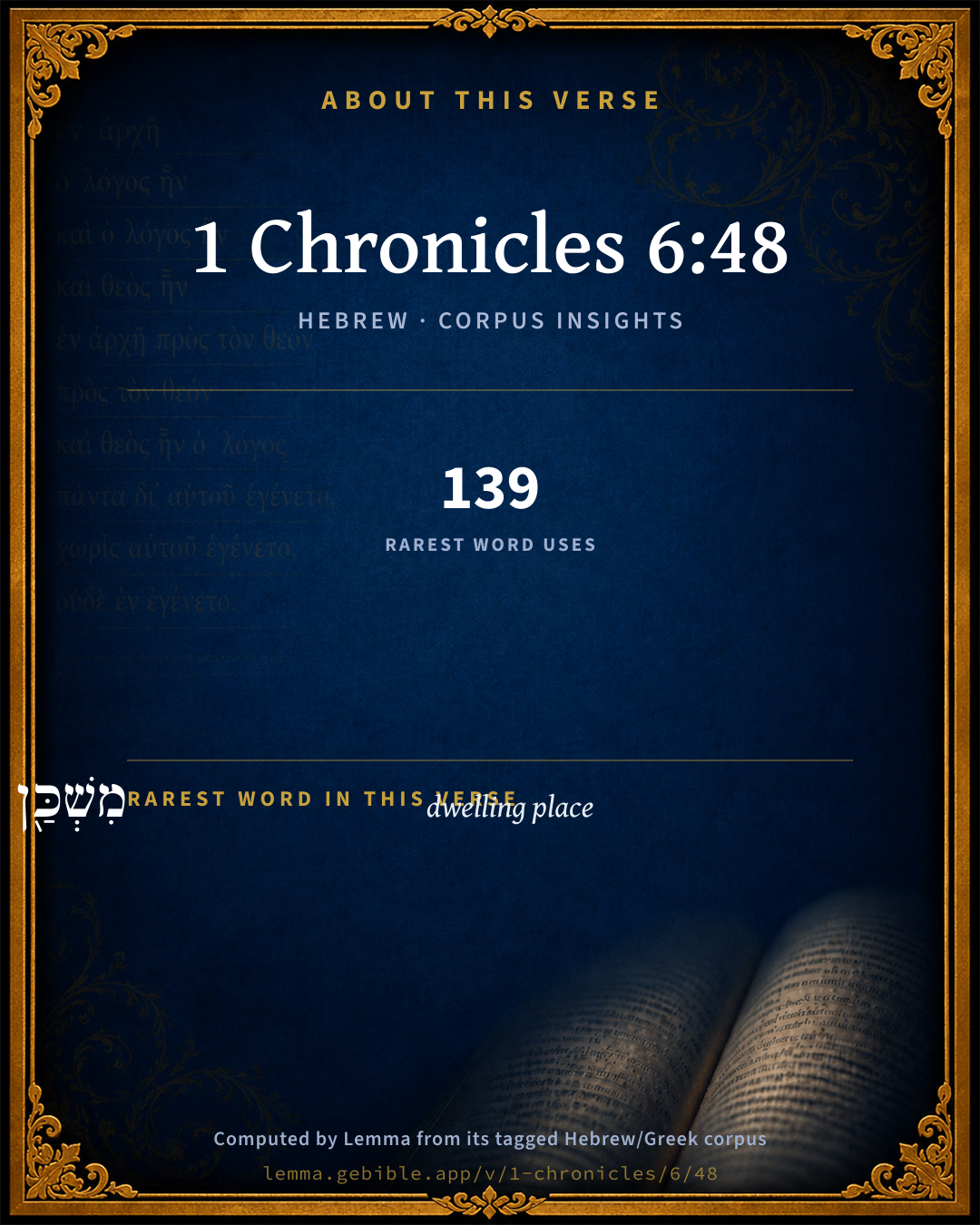
1 Chronicles, in the Historical, opens this verse with 8 words (8 distinct Hebrew lemmas). Its most distinctive word is mishkân (“dwelling place”). The Greek Septuagint runs longer here. A historical commentator’s framing appears above. Read the whole chapter for the surrounding context.

Discussion questions

  1. What does “dwelling place” (mishkân) contribute to the verse as a whole?
  2. How does Numbers 18:1–32, which shares this passage’s theme, read alongside this verse?
  3. The Septuagint runs longer here than the Hebrew. What might account for the difference?
  4. These translations render this verse differently. What is at stake in choosing one wording over another?
  5. «נְתוּנִ֕ים» is a Qal Participle Passive verb. How does that grammatical form shape the action described?
  6. Compare how The Biblical Illustrator and Joseph Benson's Commentary read this verse. Where do they agree or differ?

Things to notice

Reading settings

Reading text

Shown beneath each verse's original-language words.

Old Testament
Old Testament edition

Read the OT as the Masoretic Hebrew (MT) or the Greek Septuagint (LXX).

English shown for the Greek Septuagint (in the Hebrew ↔ Greek comparison).

Comparing translations? Open the Compare panel on any verse page to stack up to four side by side.