1 Chronicles 6:57

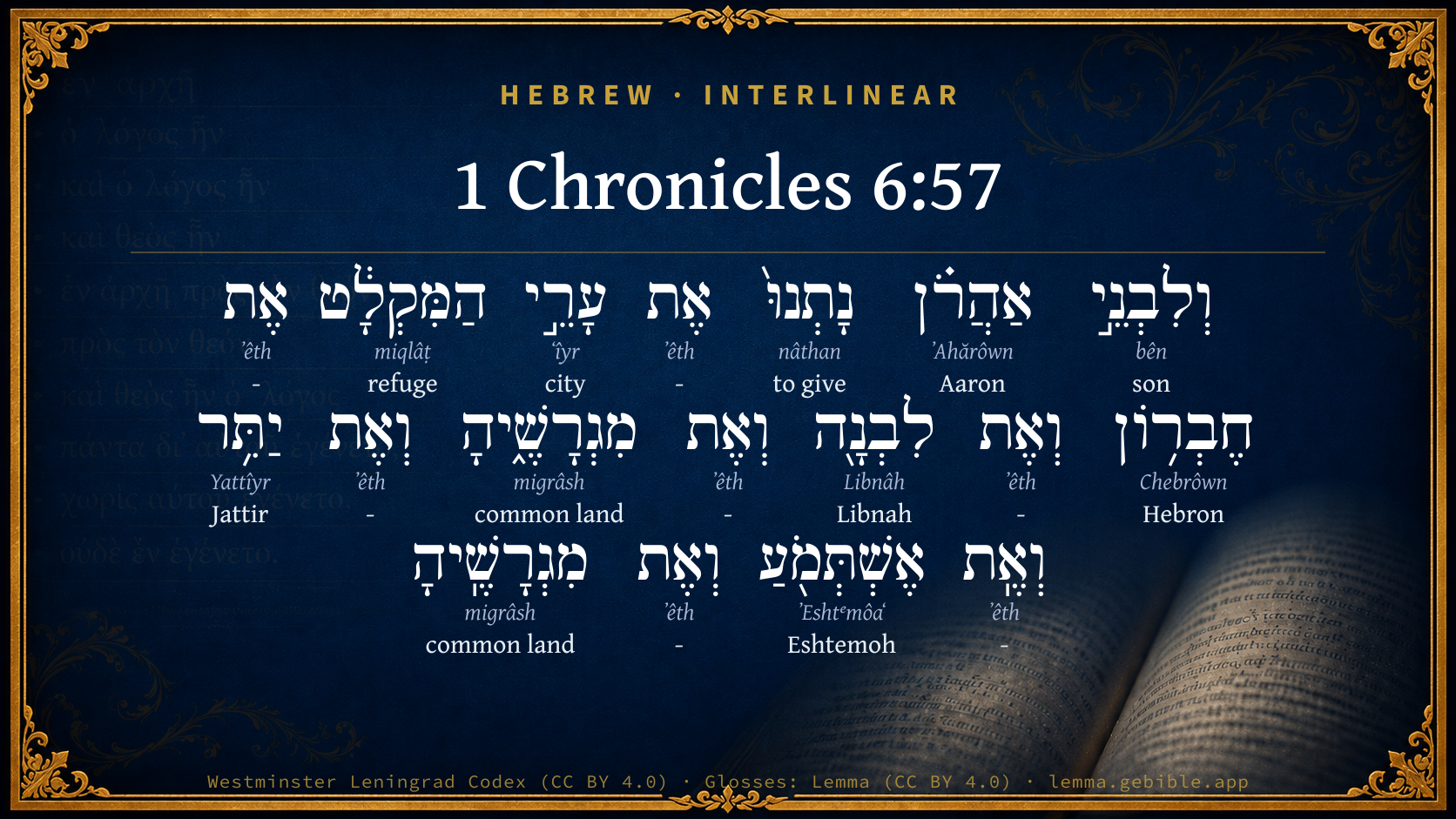
Hebrew (Westminster Leningrad Codex) 1 Chronicles 6:57 appears in the Hebrew Old Testament. The text above is from the Westminster Leningrad Codex. Each word links to its Strong’s number, a concise gloss, and parsing drawn from the Open Scriptures Hebrew Bible morphology. Click any word for its full Brown-Driver-Briggs (BDB) entry.
Download image
Cite this verse

1 Chronicles 6:57 (World English Bible). Public Domain. Lemma interlinear Bible study tool, https://lemma.gebible.app/v/1-chronicles/6/57.

Show BibTeX & RIS
BibTeX
RIS
English Translation
To the sons of Aaron they gave the cities of refuge, Hebron; Libnah also with its suburbs, and Jattir, and Eshtemoa with its suburbs,
World English Bible · Public Domain
Download a study sheet

One document with this verse’s original text, its word-by-word gloss line, the meaning frame, cross-references with their text, attributed commentary, and full source and license credits — printable, and it pastes into notes with its structure intact.

This verse Autodidact and up

Study sheet (.html) Plain text (.txt)

A passage Seminary Student

Up to 50 verses in one chapter. A passage sheet keeps up to 6 commentary sources and 12 cross-references per verse, in the order this page ranks them, and says so on the sheet whenever that leaves anything out. Ask for a single verse and you get the Autodidact verse sheet above.

Everything on this page stays free to read, with no account — the sheet is a download of what is already on screen, not access to it.

Want to remove ads? Support Godless Engineer
Compare translations 3

The same verse in 3 English versions, stacked beneath the original-language interlinear above. Click any original word for its lexicon entry.

Each is an independent rendering of the whole verse — the interlinear is not word-aligned to these translations.

Highlighted words mark where these versions differ — a whole-verse word diff, not a word-by-word alignment.

  • World English Bible Public Domain
    To the sons of Aaron they gave the cities of refuge, Hebron; Libnah also with its suburbs, and Jattir, and Eshtemoa with its suburbs,
  • King James Version Public Domain
    And to the sons of Aaron they gave the cities of Judah, namely, Hebron, the city of refuge, and Libnah with her suburbs, and Jattir, and Eshtemoa, with their suburbs,
  • unfoldingWord Literal Text CC BY-SA 4.0
    And to the sons of Aaron they gave cities of refuge: Hebron and Libnah and its pasturelands and Jattir and Eshtemoa and its pasturelands

unfoldingWord Literal Text — © unfoldingWord, licensed CC BY-SA 4.0. Word-aligned USFM3 via Door43 (git.door43.org/unfoldingWord/en_ult).

Versions to compare (up to 4)

3 of 4 selected

Show all 18 translations

Every available English version of this verse, each an independent rendering of the whole verse.

  • World English Bible Public Domain
    To the sons of Aaron they gave the cities of refuge, Hebron; Libnah also with its suburbs, and Jattir, and Eshtemoa with its suburbs,
  • Berean Standard Bible Public Domain
    So the descendants of Aaron were given Hebron (a city of refuge), Libnah, Jattir, Eshtemoa,
  • Majority Standard Bible Public Domain
    So the descendants of Aaron were given Hebron (a city of refuge), Libnah, Jattir, Eshtemoa,
  • King James Version Public Domain
    And to the sons of Aaron they gave the cities of Judah, namely, Hebron, the city of refuge, and Libnah with her suburbs, and Jattir, and Eshtemoa, with their suburbs,
  • American Standard Version (1901) Public Domain
    And to the sons of Aaron they gave the cities of refuge, Hebron; Libnah also with its suburbs, and Jattir, and Eshtemoa with its suburbs,
  • Revised Version (1885) Public Domain
    And to the sons of Aaron they gave the cities of refuge, Hebron; Libnah also with her suburbs, and Jattir, and Eshtemoa with her suburbs;
  • Geneva Bible (1599) Public Domain
    And to the sonnes of Aaron they gaue the cities of Iudah for refuge, euen Hebron and Libna with their suburbes, and Iattir, and Eshtemoa with their suburbes,
  • Douay-Rheims (1899) Public Domain
    And to the sons of Aaron they gave the cities for refuge Hebron, and Lobna, and the suburbs thereof,
  • Young's Literal Translation Public Domain
    And to the sons of Aaron they gave the cities of refuge: Hebron, and Libnah and its suburbs, and Jattir, and Eshtemoa and its suburbs,
  • Literal Standard Version CC BY-SA 4.0
    And they gave the cities of refuge to the sons of Aaron: Hebron, and Libnah and its outskirts, and Jattir, and Eshtemoa and its outskirts,
  • Unlocked Literal Bible CC BY-SA 4.0
    To the descendants of Aaron they gave: Hebron (a city of refuge), and Libnah with its pasturelands, Jattir, Eshtemoa with its pasturelands,
  • unfoldingWord Literal Text CC BY-SA 4.0
    And to the sons of Aaron they gave cities of refuge: Hebron and Libnah and its pasturelands and Jattir and Eshtemoa and its pasturelands
  • Darby Bible Public Domain
    And to the children of Aaron they gave the city of refuge, Hebron; and Libnah and its suburbs, and Jattir, and Eshtemoa and its suburbs,
  • World Messianic Bible Public Domain
    To the sons of Aaron they gave the cities of refuge, Hebron, Libnah also with its pasture lands, Jattir, Eshtemoa with its pasture lands,
  • Webster's Bible Public Domain
    And to the sons of Aaron they gave the cities of Judah, namely, Hebron, the city of refuge, and Libnah with its suburbs, and Jattir, and Eshtemoa, with their suburbs,
  • Free Bible Version CC BY-SA 4.0
    So the descendants of Aaron received Hebron, a town of refuge, Libnah, Jattir, Eshtemoa,
  • Bible in Basic English Public Domain
    And to the sons of Aaron they gave Hebron, the town to which men might go in flight and be safe, and Libnah with its outskirts, and Jattir, and Eshtemoa with its outskirts,
  • JPS Tanakh (1917) Public Domain
    (6-42) And to the sons of Aaron they gave the city of refuge, Hebron; Libnah also with the open land about it, and Jattir, and Eshtemoa with the open land about it;

Literal Standard Version (2020), Covenant Press — licensed CC BY-SA 4.0. Text via the HelloAO Bible API (eBible.org). Unlocked Literal Bible (unfoldingWord) — licensed CC BY-SA 4.0. Text via the HelloAO Bible API (eBible.org). unfoldingWord Literal Text — © unfoldingWord, licensed CC BY-SA 4.0. Word-aligned USFM3 via Door43 (git.door43.org/unfoldingWord/en_ult). Free Bible Version, Dr. Jonathan Gallagher — licensed CC BY-SA 4.0. Text via the HelloAO Bible API (eBible.org).

Word by word

More ways to search: Search by grammar → Find every occurrence → Compare this word →

Practice this passage: Drill this verse → Learn its vocabulary →

יַתִּ֥ר
Yattîyr
H3492
“Jattir”
Noun, Proper
Part of Speech
Noun
Type
Proper
Full BDB Definition

Origin: from H3498

TWOT: None

Jattir = "plenty" - a town in the mountains of Judah
  1. וְלִבְנֵ֣י bên H1121 “and · to/for · sons of” Conjunction + Preposition + Noun, Common, Masculine, Plural, Construct
  2. אַהֲרֹ֗ן ʼAhărôwn H175 “Aaron” Noun, Proper
  3. נָתְנוּ֙ nâthan H5414 “to give” Verb, Qal, Perfect, 3rd Person, Common, Plural
  4. אֶת ʼêth H853 “-” Particle, Direct Object
  5. עָרֵ֣י ʻîyr H5892 “cities of” Noun, Common, Feminine, Plural, Construct
  6. הַמִּקְלָ֔ט miqlâṭ H4733 “the · refuge” Particle, Definite Article + Noun, Common, Masculine, Singular, Absolute
  7. אֶת ʼêth H853 “-” Particle, Direct Object
  8. חֶבְר֥וֹן Chebrôwn H2275 “Hebron” Noun, Proper
  9. וְאֶת ʼêth H853 “and · -” Conjunction + Particle, Direct Object
  10. לִבְנָ֖ה Libnâh H3841 “Libnah” Noun, Proper
  11. וְאֶת ʼêth H853 “and · -” Conjunction + Particle, Direct Object
  12. מִגְרָשֶׁ֑יהָ migrâsh H4054 “common lands · her” Noun, Common, Masculine, Plural, Construct + Suffix, Personal, 3rd Person, Feminine, Singular
  13. וְאֶת ʼêth H853 “and · -” Conjunction + Particle, Direct Object
  14. וְאֶֽת ʼêth H853 “and · -” Conjunction + Particle, Direct Object
  15. אֶשְׁתְּמֹ֖עַ ʼEshtᵉmôaʻ H851 “Eshtemoh” Noun, Proper
  16. וְאֶת ʼêth H853 “and · -” Conjunction + Particle, Direct Object
  17. מִגְרָשֶֽׁיהָ migrâsh H4054 “common lands · her” Noun, Common, Masculine, Plural, Construct + Suffix, Personal, 3rd Person, Feminine, Singular

About this verse

These counts appear in no published source. They are computed here, from the morphology-tagged text and Lemma’s own curated glosses. What Lemma adds →

18
words
11
distinct lemmas
Historical
section

Notable vocabulary

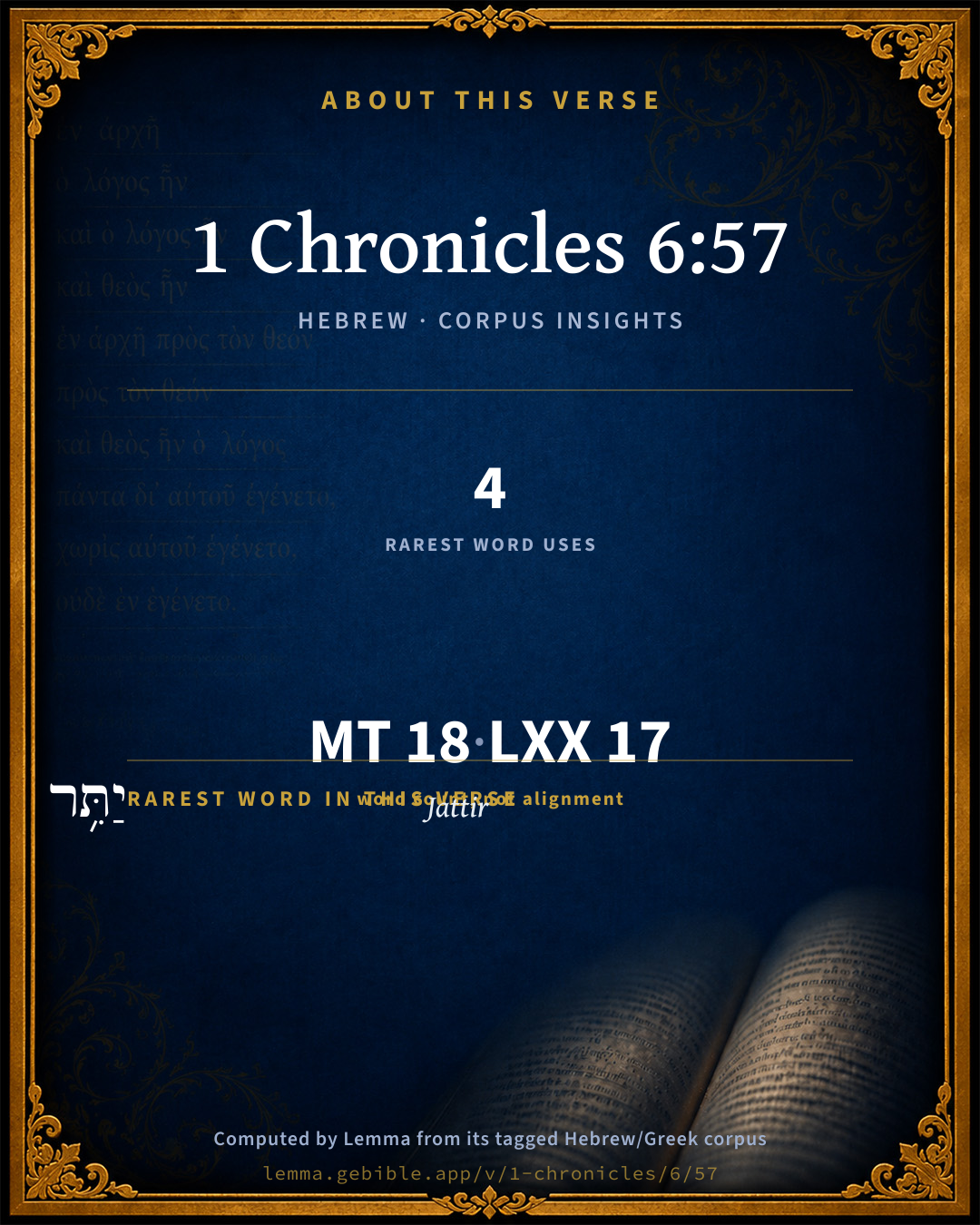
The rarest word here is יַתִּ֥ר Jattir H3492 — appearing just 4 times in the whole Hebrew Bible.

Shared distinctive vocabulary

יַתִּ֥ר Jattir H3492 occurs in 4 verses of the Hebrew Bible. Also found in:

Grammatical profile

  • 1 verb
  • 10 nouns
  • 7 particles

Verb forms

  • נָתְנוּ֙ Qal · Perfect

Repetition

A word recurs within this verse — often emphatic in Hebrew:

  • מִגְרָשֶׁ֑יהָ common land H4054 ×2

Hebrew & Septuagint length

In English translation the verse runs 24 words from the Hebrew and 31 from the Septuagint (LXX English) — closely comparable.

A rough comparison of the two English renderings, which tokenize alike — not a word-level alignment.

Word counts can differ between the Hebrew and the Greek without any difference in meaning — e.g. the Hebrew direct-object marker אֵת has no separate Greek word, and Greek often adds the article ὁ.

In the original languages it is 18 Hebrew tokens and 17 Greek tokens — but the two are counted differently (Hebrew bundles its prefixes and suffixes into one token; the Greek is in lemma form), so that isn’t a like-for-like length.

Cross-references

8

Topical passages linked to 1 Chronicles 6:57 in the Treasury of Scripture Knowledge — connected by theme and wording, ordered by reader-vote popularity; previews shown in the World English Bible.

  • Joshua 15:48 In the hill-country, Shamir, and Jattir, and Socoh,
  • Joshua 21:13–14 To the children of Aaron the priest they gave Hebron with its suburbs, the city of refuge for the manslayer, and Libnah with its suburbs,
  • Numbers 35:13–15 The cities which you shall give shall be for you six cities of refuge.
  • Joshua 10:29 Joshua passed from Makkedah, and all Israel with him, to Libnah, and fought against Libnah:
  • Joshua 15:42 Libnah, and Ether, and Ashan,
  • Joshua 20:7–9 They set apart Kedesh in Galilee in the hill-country of Naphtali, and Shechem in the hill-country of Ephraim, and Kiriath Arba (the same is Hebron) in the hill-country of Judah.
  • Joshua 21:19 All the cities of the children of Aaron, the priests, were thirteen cities with their suburbs.
  • 1 Chronicles 4:17 The sons of Ezrah: Jether, and Mered, and Epher, and Jalon; and she bore Miriam, and Shammai, and Ishbah the father of Eshtemoa.

Cross-references courtesy of OpenBible.info (CC BY 4.0).

Hebrew and Greek witnesses Masoretic Hebrew ↔ Greek Septuagint

The same verse in the two great witnesses to the Old Testament, shown verse-for-verse.

These are two independent witnesses, not word-aligned to each other, and the Septuagint is shown in lemma (dictionary) form.

Hebrew 1 Chronicles 6:57 Masoretic · Westminster Leningrad Codex

וְלִבְנֵ֣י אַהֲרֹ֗ן נָתְנוּ֙ אֶת עָרֵ֣י הַמִּקְלָ֔ט אֶת חֶבְר֥וֹן וְאֶת לִבְנָ֖ה וְאֶת מִגְרָשֶׁ֑יהָ וְאֶת יַתִּ֥ר וְאֶֽת אֶשְׁתְּמֹ֖עַ וְאֶת מִגְרָשֶֽׁיהָ

To the sons of Aaron they gave the cities of refuge, Hebron; Libnah also with its suburbs, and Jattir, and Eshtemoa with its suburbs,

World English Bible · Public Domain

Greek LXX 1 Chronicles 6:57 Septuagint · lemma form

καί ἐκ φυλή ισσαχαρ ὁ κεδες καί ὁ περισπόριον αὐτός καί ὁ δεβερι καί ὁ περισπόριον αὐτός

And to the sons of Aaron they gave the cities of refuge, even Chebron, and Lobna and her suburbs round about, and Selna and her suburbs, and Esthamo and her suburbs,

LXX2012 (modern English Septuagint) · Public Domain

On this verse, Haydock's Catholic Bible Commentary discusses the Septuagint’s reading. Read the note in Commentary ↓

Hebrew: Westminster Leningrad Codex (CC BY 4.0). Greek: Septuagint (public domain); English from LXX2012 (modern English Septuagint) (Public Domain). How the Septuagint differs from the Hebrew →

Commentary

Notes on 1 Chronicles 6:57 from classic Christian and Jewish commentators (each source and its license shown beneath its notes). The classic Christian expositions comment on the surrounding passage and are grouped to its opening verse, so a note may address several verses; the Jewish commentaries on the Tanakh (Rashi and others) are per-verse, so they appear only where the commentator wrote on this verse.

Lemma curates 59 commentaries, every one of them public domain or Creative Commons licensed, each selected and text-cleaned for this edition rather than reprinted as found. About our sources →

Geneva Bible (1599)

Geneva Bible translators

That he that had killed a man might flee thereunto for succor till his cause were tried, Deut. 19:2.

Geneva Bible (1599) marginal notes — public domain. Text via Bolls.life.

Ellicott's Commentary for English Readers

(57) They gave the cities of Judah.—Heb. text, the cities of refuge, Hebron and Libnah, and her pastures. Of the cities mentioned only Hebron was an asylum for the manslayer. The other cities of refuge were Kedesh-Naphtali, Shechem, Bezer, Ramoth-Gilead, and Golan. (See Jos_20:7-8.). Here our translators have adopted the Hebrew marginal correction of the text. (Comp. Jos_21:13, which reads. “The manslayer’s city of refuge, Hebron.”) The same inaccuracy recurs in 1Ch_6:67, below.

With her suburbs.—With her pastures. The phrase has been omitted after Jattir (Jos_21:13).

A Bible Commentary for English Readers, edited by Charles John Ellicott (1878–1897) — public domain. Text from a community e-Sword module.

The Cambridge Bible for Schools and Colleges

gen. ed. J. J. S. Perowne

57. the cities of Judah, namely, Hebron, the city of refuge] Render (with a slight correction of the Hebrew) the city of refuge, Hebron (cp. Jos_21:13), Hebron being the only city of refuge here mentioned (Jos_20:7).

Libnah] Jos_10:29; 2Ki_8:22; 2Ki_19:8. It was in the S.W. of Judah.

Eshtemoa] the modern es-Semu‘a, three and a half hours S. of Hebron.

The Cambridge Bible for Schools and Colleges (gen. ed. J. J. S. Perowne; Cambridge University Press, 1878–1918) — public domain. Text from a community e-Sword module.

Haydock's Catholic Bible Commentary

Of, is not authorized by the Vulgate civitates, but is added, to signify that all these 13 cities were not thus privileged. (Haydock) --- There were only six cites of refuge, of which Hebron was one. See Josue xx. 7. (Calmet) (Menochius) --- Protestants, "And to the sons of Aaron they gave the cities of Juda, namely, Hebron, the city of refuge." But "such a licence to insert words at pleasure, cannot be allowed." Hebrew literally, "they gave cities of Hebrew refuge, Hebron," &c. The "sense absolutely disallows the word Judah," which is omitted , (Josue xxi. 13.) as well as in some Hebrew manuscripts in the Bamberg, and Complutensian editions, and in those of Jablonski and Michaelis. --- Hari, "cities," ought to be hir, "a city," as only one is meant. We should also add with the Arabic and Syriac, and the parallel passage in Josue, "and her suburbs," after Hebron. (Kennicott) --- "Juda" is not found in the Septuagint, &c.: and Buxtorf acted with little wisdom, when he thought he had sufficiently answered Capellus, by observing that the Masora declared the word to be authentic. (Anticrit.) It is a great misfortune that most of the printed Hebrew editions have been given under such influence; and that the Masorets have defaced so many manuscripts by their corrections. (Haydock) --- Hence they probably burnt all the first edition of Naples, 1487, except part of a single copy, comprising the Cethubim given to Eton college by Dr. Pellet, which omits the word Juda. (Kennicott, Dis. i. p. 520-2)

George Leo Haydock (1774–1849), Haydock's Catholic Family Bible and Commentary, 1859 edition — public domain. Excludes Psalms (Douay-Rheims chapter numbering differs from Protestant) and Deuterocanonical books (Catholic canon only).

Matthew Poole's English Annotations

They gave the cities, or, out of the cities; the Hebrew eth being put for meeth, as hath been oft noted.

Matthew Poole's English Annotations on the Holy Bible (1683–1685) — public domain. Text from a community e-Sword/MySword module.

The Pulpit Commentary

The city of refuge.

Hebron was one of the six cities of refuge, which were provided to shelter the manslayer from the wrath of the avenger of blood, and thus to cheek the savage lawlessness of a warlike people in a primitive state of society. They are, in one passage of the New Testament, regarded as emblematical of the provision made in Christ for the security of the penitent and returning sinner. There is suggested

I A CASE OF NEED AND DANGER. The cause of the peril and alarm is sin. And the righteous Law and retributive government of God render the case of the sinner one serious in itself and its issues. This appears from the gospel admonitions to repentance.

II A PROVISION OF MERCY AND WINDOW. As the city of refuge was appointed for the innocent manslayer"s escape from vengeance and death, so the guilty sinner is the object of the Divine compassion which has provided in Christ a safe and eternal shelter. In the Divine Redeemer is refuge from sin and condemnation, is the favour and life of God.

III AN ACTION OF FAITH AND ENERGY. The city was of no use except the imperilled Israelite fled unto it for safety. So with Christ, whose almighty sufficiency avails for those, and those only, who accept him and shelter themselves in his riven side. They are saved who have "fled for refuge to the hope set before them in the gospel.

IV A DIVINELY PLEDGED SECURITY FOR THOSE WHO ARE IN CHRIST. The Jewish Law assured of safety those who made use of the provision for refuge. And the Divine word and faithfulness are pledged to those who confide in Christ, that they shall never perish, but shall have eternal life.

V A TRUE GOSPEL. It is the office of the Church of the Redeemer both to warn sinners of the danger to which they are exposed and to point them to the one only Refuge provided by Divine wisdom for their security and peace. It is a refuge accessible to all and sufficient for all, and there is no reason in the heart of God why any poor sinner should remain outside this refuge and spiritually perish. T.

Vers. 57, 67.

The doctrinal witness of the refuge cities. (Exo_21:13; Num_35:6, Num_35:11, Num_35:14; Deu_19:1-10 Jos 20)

The severity of the Mosaic laws and institutions has often been dwelt on, but a careful estimate of the prevailing sentiments of surrounding nations, in those early times, would rather impress us with the mercifulness of Judaism, and the ways in which customs which pressed with undue severity on individual rights and liberties were toned and modified, in the East two things are familiar which appear strange and unworthy to us:

(1) irresponsible governments, usually involving tyrannous dealings; and

(2) a very light estimate of the value of human life. The mercifulness of Judaism is plainly seen in the Mosaic appointment of the refuge cities. The laws relating to murder are clearly defined, and the different forms of the crime are duly recognized. Premeditated murder is distinguished from unintentional homicide, and the man who accidentally kills another is secured until he can prove the circumstances of the accident. But in the arrangement made for him Moses wisely retains the older sentiment of justice, which called upon the nearest relative of a slain man to act as his blood-avenger, or goel. Amongst the other nations, as the Arab tribes of the present day, "any bloodshed whatever, whether wilful or accidental, laid the homicide open to the duteous revenge of the relatives and family of the slain person, who again in their turn were then similarly watched and hunted by the opposite party, until a family war of extermination had legally settled itself from generation to generation, without the least prospect of a peaceful termination." Moses allowed the goel still to pursue; but the homicide had his chance of escape. Cities conveniently situated on both the west and east of Jordan were made refuge cities, and the roads to them were kept clear. Once within the gates a calm consideration of the circumstances was assured; and only if proved guilty of wilful murder could the man be delivered up to the goel-avenger.

I THE SOCIAL WORKING OF THE REFUGE SYSTEM. Its influence may be shown in:

1. Its cultivation of a worthier sense of justice.

2. Its teaching as to the relation of motive to crime, such motive giving the act of crime its serious quality.

3. Its tendency to relieve the individual from the thought of executing hisown vengeance.

4. Its claim to have a fixed authority for the settling of all social laws, andtheir vindication by due punishments. A worthy and strongly enforced legislative system lies at the very foundation of the peaceful order and stable progress of every nation. The element of personal passion must be removed if punishment is to be wisely administered; men must be willing to put aside their own avengings if social order is to be secured. Nations need to be very careful to secure purity in the administration of justice.

II THE RELIGIOUS SUGGESTIONS OF THE REFUGE SYSTEM. These will differ according to the school of thought to which the preacher may belong. From the evangelical standpoint, the city of refuge symbolizes Christ. The avenger represents the law-penalty under which the sinner comes, which seeks his death. There is made by Christ Jesus a free and open road to himself, the Refuge. But the sinner must himself arise and flee, running into the shelter of the ever-opened gates. When "in Christ," if a due examination be made of his sins, the all-sufficing answer which secures eternal safety is this: "Jesus has already borne the penalty of them all, and the Law cannot revive its satisfied claim." There is "no condemnation" for those who have "fled for refuge to lay hold of the hope set before them in the gospel.

More generally treated, we may learn:

1. The Divine righteousness in affixing a natural and necessary penalty to every act of sin.

2. The fallen state of man, in that he so readily makes holy avenging into passionate revenging.

3. The mercifulness of the Divine administration, in that God puts man"s passions under wise restraints; and secures the fair, considerate, and honourable treatment even of the sinner. R.T.

The Pulpit Commentary (1880–1919), ed. H.D.M. Spence-Jones & Joseph S. Exell — public domain. Text from a community e-Sword module.

unfoldingWord translationNotes

Door43 World Missions Community

General Information:

See: How to Translate Names

Hebron ... Libnah ... Jattir ... Eshtemoa ... Hilen ... Debir

These are names of places. (See: How to Translate Names)

its pasturelands

the land with grass for animals to eat. See how you translated this in 1 Chronicles 5:16.

translationWords

refuge

unfoldingWord translationNotes — © Distant Shores Media and the Door43 World Missions Community, licensed CC BY-SA 4.0. Source: git.door43.org/Door43/en_tn.

Lesson kit

Teaching starters — assembled from the data on this page, not authored interpretation. Every prompt links to the verse data it draws on. Edit before teaching.

1 Chronicles, in the Historical, opens this verse with 18 words (11 distinct Hebrew lemmas). Its most distinctive word is Yattîyr (“Jattir”). A historical commentator’s framing appears above. Read the whole chapter for the surrounding context.

Discussion questions

  1. The word Yattîyr carries the sense “Jattir.” How does it shape the verse?
  2. How does Joshua 15:48, which shares the word «Jattir», read alongside this verse?
  3. What does the repetition of “common land” (2× in this one verse) do in this verse?
  4. The translations on this page render this verse differently — a whole-verse word diff, not a word-by-word alignment. What might account for the different wordings?
  5. «נָתְנוּ֙» is a Qal Perfect verb. How does that grammatical form shape the action described?
  6. Compare how Geneva Bible (1599) and Ellicott's Commentary for English Readers read this verse. Where do they agree or differ?

Things to notice

Reading settings

Reading text

Shown beneath each verse's original-language words.

Old Testament
Old Testament edition

Read the OT as the Masoretic Hebrew (MT) or the Greek Septuagint (LXX).

English shown for the Greek Septuagint (in the Hebrew ↔ Greek comparison).

Comparing translations? Open the Compare panel on any verse page to stack up to four side by side.