1 Chronicles 17:22

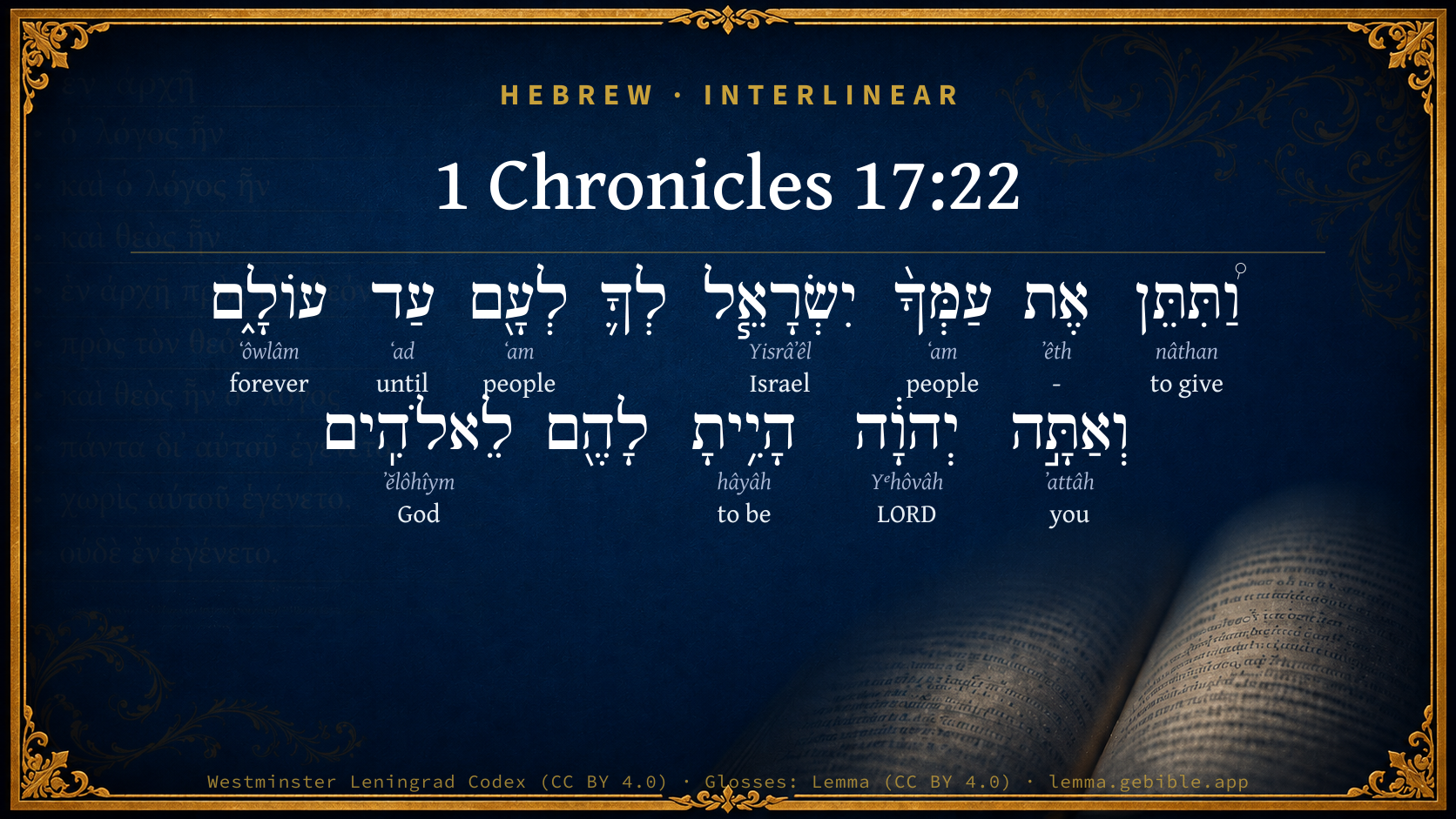
Hebrew (Westminster Leningrad Codex) 1 Chronicles 17:22 appears in the Hebrew Old Testament. The text above is from the Westminster Leningrad Codex. Each word links to its Strong’s number, a concise gloss, and parsing drawn from the Open Scriptures Hebrew Bible morphology. Click any word for its full Brown-Driver-Briggs (BDB) entry.
Download image
Cite this verse

1 Chronicles 17:22 (World English Bible). Public Domain. Lemma interlinear Bible study tool, https://lemma.gebible.app/v/1-chronicles/17/22.

Show BibTeX & RIS
BibTeX
RIS
English Translation
For your people Israel did you make your own people forever; and you, Yahweh, became their God.
World English Bible · Public Domain
Download a study sheet

One document with this verse’s original text, its word-by-word gloss line, the meaning frame, cross-references with their text, attributed commentary, and full source and license credits — printable, and it pastes into notes with its structure intact.

This verse Autodidact and up

Study sheet (.html) Plain text (.txt)

A passage Seminary Student

Up to 50 verses in one chapter. A passage sheet keeps up to 6 commentary sources and 12 cross-references per verse, in the order this page ranks them, and says so on the sheet whenever that leaves anything out. Ask for a single verse and you get the Autodidact verse sheet above.

Everything on this page stays free to read, with no account — the sheet is a download of what is already on screen, not access to it.

Want to remove ads? Support Godless Engineer
Compare translations 3

The same verse in 3 English versions, stacked beneath the original-language interlinear above. Click any original word for its lexicon entry.

Each is an independent rendering of the whole verse — the interlinear is not word-aligned to these translations.

Highlighted words mark where these versions differ — a whole-verse word diff, not a word-by-word alignment.

  • World English Bible Public Domain
    For your people Israel did you make your own people forever; and you, Yahweh, became their God.
  • King James Version Public Domain
    For thy people Israel didst thou make thine own people for ever; and thou, LORD, becamest their God.
  • unfoldingWord Literal Text CC BY-SA 4.0
    And you established your people Israel for yourself as a people to forever, and you, Yahweh, you became God to them.

unfoldingWord Literal Text — © unfoldingWord, licensed CC BY-SA 4.0. Word-aligned USFM3 via Door43 (git.door43.org/unfoldingWord/en_ult).

Versions to compare (up to 4)

3 of 4 selected

Show all 18 translations

Every available English version of this verse, each an independent rendering of the whole verse.

  • World English Bible Public Domain
    For your people Israel did you make your own people forever; and you, Yahweh, became their God.
  • Berean Standard Bible Public Domain
    For You have made Your people Israel Your very own forever, and You, O LORD, have become their God.
  • Majority Standard Bible Public Domain
    For You have made Your people Israel Your very own forever, and You, O LORD, have become their God.
  • King James Version Public Domain
    For thy people Israel didst thou make thine own people for ever; and thou, LORD, becamest their God.
  • American Standard Version (1901) Public Domain
    For thy people Israel didst thou make thine own people for ever; and thou, Jehovah, becamest their God.
  • Revised Version (1885) Public Domain
    For thy people Israel didst thou make thine own people for ever; and thou, LORD, becamest their God.
  • Geneva Bible (1599) Public Domain
    For thou hast ordeined thy people Israel to be thine owne people for euer, and thou Lord art become their God.
  • Douay-Rheims (1899) Public Domain
    And thou hast made thy people Israel to be thy own people for ever, and thou, O Lord, art become their God.
  • Young's Literal Translation Public Domain
    Yea, Thou dost appoint Thy people Israel to Thee for a people unto the age, and Thou, O Jehovah, hast been to them for God.
  • Literal Standard Version CC BY-SA 4.0
    Indeed, You appoint Your people Israel to Yourself for a people for all time, and You, O YHWH, have been to them for God.
  • Unlocked Literal Bible CC BY-SA 4.0
    You made Israel your own people forever, and you, Yahweh, became their God.
  • unfoldingWord Literal Text CC BY-SA 4.0
    And you established your people Israel for yourself as a people to forever, and you, Yahweh, you became God to them.
  • Darby Bible Public Domain
    And thy people Israel hast thou made thine own people for ever; and thou, Jehovah, art become their God.
  • World Messianic Bible Public Domain
    For you made your people Israel your own people forever; and you, LORD, became their God.
  • Webster's Bible Public Domain
    For thy people Israel didst thou make thy own people for ever; and thou, LORD, becamest their God.
  • Free Bible Version CC BY-SA 4.0
    You made your people Israel your own forever, and you, Lord, have become their God.
  • Bible in Basic English Public Domain
    For your people Israel you made yours for ever; and you, Lord, became their God.
  • JPS Tanakh (1917) Public Domain
    For Thy people Israel didst Thou make Thine own people for ever; and Thou, LORD, becamest their God.

Literal Standard Version (2020), Covenant Press — licensed CC BY-SA 4.0. Text via the HelloAO Bible API (eBible.org). Unlocked Literal Bible (unfoldingWord) — licensed CC BY-SA 4.0. Text via the HelloAO Bible API (eBible.org). unfoldingWord Literal Text — © unfoldingWord, licensed CC BY-SA 4.0. Word-aligned USFM3 via Door43 (git.door43.org/unfoldingWord/en_ult). Free Bible Version, Dr. Jonathan Gallagher — licensed CC BY-SA 4.0. Text via the HelloAO Bible API (eBible.org).

Word by word

More ways to search: Search by grammar → Find every occurrence → Compare this word →

Practice this passage: Drill this verse → Learn its vocabulary →

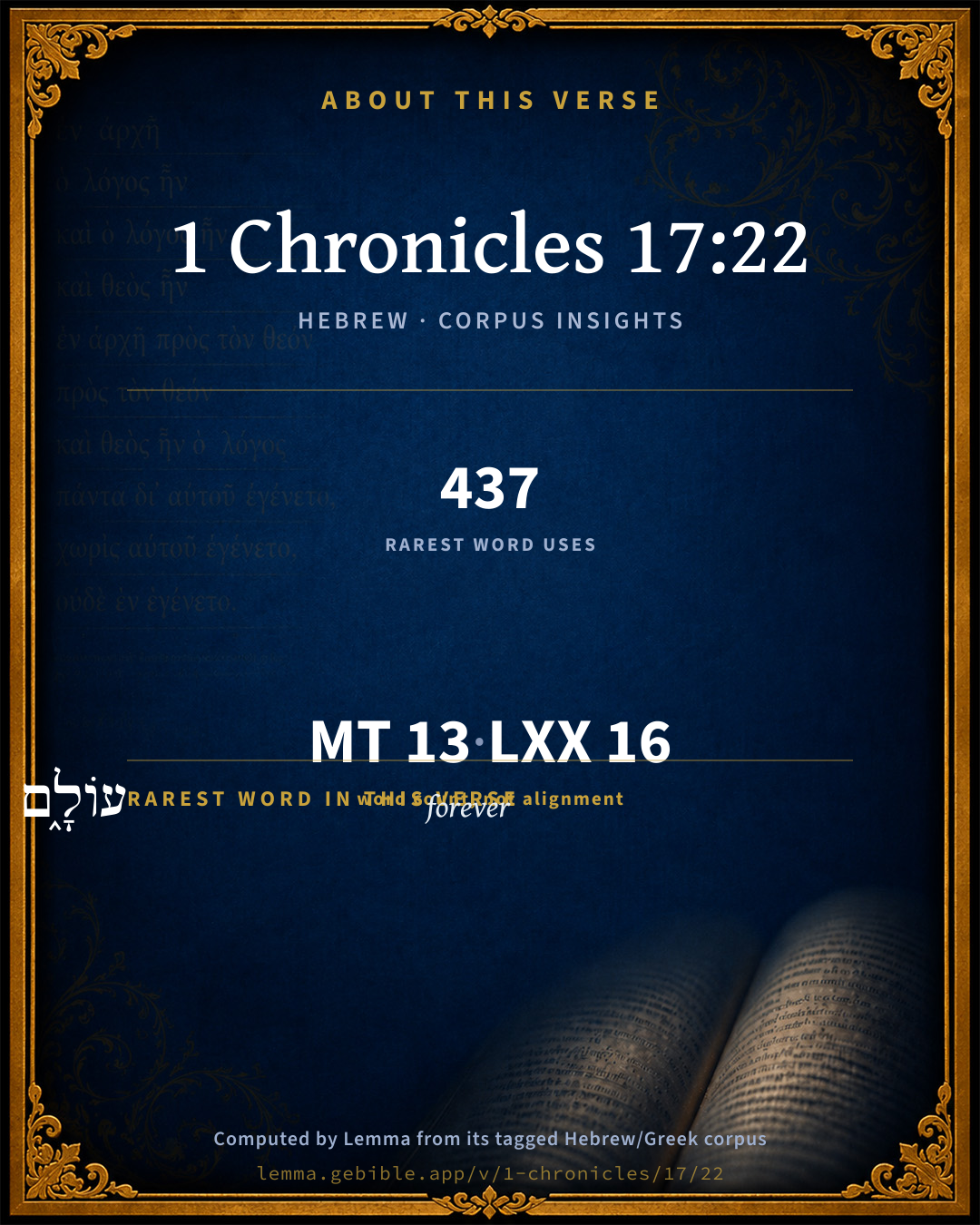
עוֹלָ֑ם
ʻôwlâm
H5769
“forever”
Noun, Common, Masculine, Singular, Absolute
Part of Speech
Noun
Type
Common
Gender
Masculine
Number
Singular
State
Absolute
Full BDB Definition

Origin: from H5956

TWOT: 1631a

long duration, antiquity, futurity, for ever, ever, everlasting, evermore, perpetual, old, ancient, world - ancient time, long time (of past) - (of future) - for ever, always - continuous existence, perpetual - everlasting, indefinite or unending future, eternity
  1. וַ֠תִּתֵּן nâthan H5414 “and · to give” Conjunction + Verb, Qal, Sequential Imperfect, 2nd Person, Masculine, Singular
  2. אֶת ʼêth H853 “-” Particle, Direct Object
  3. עַמְּךָ֨ ʻam H5971 “people · your” Noun, Common, Masculine, Singular, Construct + Suffix, Personal, 2nd Person, Masculine, Singular
  4. יִשְׂרָאֵ֧ל Yisrâʼêl H3478 “Israel” Noun, Proper
  5. לְעָ֖ם ʻam H5971 “to/for · people” Preposition + Noun, Common, Masculine, Singular, Absolute
  6. עַד ʻad H5704 “until” Preposition
  7. וְאַתָּ֣ה ʼattâh H859 “and · you” Conjunction + Pronoun, Personal, 2nd Person, Masculine, Singular
  8. יְהוָ֔ה Yᵉhôvâh H3068 “LORD” Noun, Proper
  9. הָיִ֥יתָ hâyâh H1961 “to be” Verb, Qal, Perfect, 2nd Person, Masculine, Singular
  10. לֵאלֹהִֽים ʼĕlôhîym H430 “to/for · God(s)” Preposition + Noun, Common, Masculine, Plural, Absolute

About this verse

These counts appear in no published source. They are computed here, from the morphology-tagged text and Lemma’s own curated glosses. What Lemma adds →

13
words
10
distinct lemmas
Historical
section

Grammatical profile

  • 2 verbs
  • 6 nouns
  • 1 pronoun
  • 3 prepositions
  • 1 particle

Verb forms

  • וַ֠תִּתֵּן Qal · Sequential Imperfect
  • הָיִ֥יתָ Qal · Perfect

Repetition

A word recurs within this verse — often emphatic in Hebrew:

  • עַמְּךָ֨ people H5971 ×2

Hebrew & Septuagint length

In English translation the verse runs 17 words from the Hebrew and 23 from the Septuagint (LXX English) — closely comparable.

A rough comparison of the two English renderings, which tokenize alike — not a word-level alignment.

Word counts can differ between the Hebrew and the Greek without any difference in meaning — e.g. the Hebrew direct-object marker אֵת has no separate Greek word, and Greek often adds the article ὁ.

In the original languages it is 13 Hebrew tokens and 16 Greek tokens — but the two are counted differently (Hebrew bundles its prefixes and suffixes into one token; the Greek is in lemma form), so that isn’t a like-for-like length.

Cross-references

11

Topical passages linked to 1 Chronicles 17:22 in the Treasury of Scripture Knowledge — connected by theme and wording, ordered by reader-vote popularity; previews shown in the World English Bible.

  • Exodus 19:5–6 Now therefore, if you will indeed obey my voice, and keep my covenant, then you shall be my own possession from among all peoples; for all the earth is mine;
  • 1 Peter 2:9 But you are a chosen race, a royal priesthood, a holy nation, a people for God's own possession, that you may show forth the excellencies of him who called you out of darkness into his marvelous light:
  • Genesis 17:7 I will establish my covenant between me and you and your seed after you throughout their generations for an everlasting covenant, to be a God to you and to your seed after you.
  • Deuteronomy 7:6–8 For you are a holy people to Yahweh your God: Yahweh your God has chosen you to be a people for his own possession, above all peoples who are on the face of the earth.
  • Deuteronomy 26:18–19 and Yahweh has declared you this day to be a people for his own possession, as he has promised you, and that you should keep all his commandments;
  • 1 Samuel 12:22 For Yahweh will not forsake his people for his great name's sake, because it has pleased Yahweh to make you a people to himself.
  • Jeremiah 31:31–34 Behold, the days come, says Yahweh, that I will make a new covenant with the house of Israel, and with the house of Judah:
  • Zechariah 13:9 I will bring the third part into the fire, And will refine them as silver is refined, And will test them like gold is tested. They will call on my name, and I will hear them. I will say, 'It is my people;' And they will say, 'Yahweh is my God.'"
  • Romans 9:4–6 who are Israelites; whose is the adoption, the glory, the covenants, the giving of the law, the service, and the promises;
  • Romans 9:25–26 As he says also in Hosea, "I will call them 'my people,' which were not my people; And her 'beloved,' who was not beloved."
  • Romans 11:1–12 I ask then, Did God reject his people? May it never be! For I also am an Israelite, a descendant of Abraham, of the tribe of Benjamin.

Cross-references courtesy of OpenBible.info (CC BY 4.0).

Hebrew and Greek witnesses Masoretic Hebrew ↔ Greek Septuagint

The same verse in the two great witnesses to the Old Testament, shown verse-for-verse.

These are two independent witnesses, not word-aligned to each other, and the Septuagint is shown in lemma (dictionary) form.

Hebrew 1 Chronicles 17:22 Masoretic · Westminster Leningrad Codex

וַ֠תִּתֵּן אֶת עַמְּךָ֨ יִשְׂרָאֵ֧ל לְךָ֛ לְעָ֖ם עַד עוֹלָ֑ם וְאַתָּ֣ה יְהוָ֔ה הָיִ֥יתָ לָהֶ֖ם לֵאלֹהִֽים

For your people Israel did you make your own people forever; and you, Yahweh, became their God.

World English Bible · Public Domain

Greek LXX 1 Chronicles 17:22 Septuagint · lemma form

καί δίδωμι ὁ λαός σύ ἰσραήλ σεαυτοῦ λαός ἕως αἰών καί σύ κύριος αὐτός εἰς θεός

And you have appointed your people Israel as a people to yourself for ever; and you, Lord, did become a God to them.

LXX2012 (modern English Septuagint) · Public Domain

Hebrew: Westminster Leningrad Codex (CC BY 4.0). Greek: Septuagint (public domain); English from LXX2012 (modern English Septuagint) (Public Domain). How the Septuagint differs from the Hebrew →

Commentary

Notes on 1 Chronicles 17:22 from classic Christian and Jewish commentators (each source and its license shown beneath its notes). The classic Christian expositions comment on the surrounding passage and are grouped to its opening verse, so a note may address several verses; the Jewish commentaries on the Tanakh (Rashi and others) are per-verse, so they appear only where the commentator wrote on this verse.

Lemma curates 59 commentaries, every one of them public domain or Creative Commons licensed, each selected and text-cleaned for this edition rather than reprinted as found. About our sources →

Ellicott's Commentary for English Readers

(22) For thy people Israel . . .—Literally, And Thou gavest (Samuel, confirmedst it) Thy people Israel unto Thyself for a people. Our reading is probably a result of partial obliteration.

And thou, Lord . . .—Literally, and Thou, Jehovah, becamest unto them for a God. (See Gen_17:7-8; Gen_28:21; Exo_6:3; Exo_6:7.)

A Bible Commentary for English Readers, edited by Charles John Ellicott (1878–1897) — public domain. Text from a community e-Sword module.

The Pulpit Commentary

Didst thou make. This appears in Samuel, "Thou didst confirm.

Vers. 22-24.

The eternity of David"s kingdom.

It seems quite evident that the term "for ever" is used in the Scripture as a figure of speech, and one which carries wish it several distinct suggestions. It is a condition of human thought that we must set things in the order of time; and it is usual for us to estimate the value of things according to the time they will last. The words "eternal" and "for ever" and ever lasting" often stand for long continuance. Mountains that outlast the generations are called "everlasting hills." Canaan was given to Israel as an "everlasting possession." So here, in these verses, God promises a throne to David, an eternal kingdom, a posterity that will never be extinguished; and the first idea we should attach to the promise is that David and his descendants" empire should be of long duration, and of a stable character. It is a further truth, embodied in the expression, that the material kingdom of David should by-and-by pass into the spiritual kingdom of David"s greater Son, and that in him should be established that spiritual theocracy which could be, and should be, absolutely eternal, enduring as long as there should be a God to rule, and creatures of God to be ruled. Taking the Old Testament term "for ever," we may see what thoughts are properly suggested by it, and consider them in their advancing order.

I "For ever" means LASTING THROUGH MANY GENERATIONS. Matching the idea concerning "length of life" is the idea of "continuance and permanence of dynasty." To live long was, to the Jewish mind, the direct reward of virtue, a sign of the Divine recognition of personal goodness. And so the pious king who founded a kingdom passed the thought on to the life of his race. Its prolongation through many generations would be the proof of Divine favour and acceptance resting upon it. Show how the writer of a book seeks fame in the continuity of its influence. The rich man, nowadays, hopes to found a family which shall outlast the generations. And this desire for permanence of influence is found, in various measures, influencing all men. So still God can promise to us that noble living and faithful working shall be made to bear the "eternal" stamp. In this first sense the good man never dies; on earth he may be said to live "for ever." David lives on to-day. He influences men now, rules hearts and lives, more truly than ever.

II "For ever" means UNDER CHANGED FORMS LASTING THROUGH ALL HUMAN GENERATIONS. We must find what is the very essence of David"s kingdom, for the notion of its eternity can properly only be applied to that. The essence is this God"s immediate rule of men through the administration of man. David"s kingdom was this the theocracy practically realized. Then all that belonged to the mere human form and order may change to meet the exigencies of changing ages; the essence would remain, and by-and-by appear in the theocracy of the Church, in the administration of the exalted Man Christ Jesus. We now are members of David"s everlasting kingdom; since Christ"s kingdom is essentially David"s. In its central principle its spiritual principle of direct governmental relations with Jehovah, David"s kingdom must last absolutely for ever and ever.

III" For ever" has this limitation IN ITS EARTHLY FORM IT IS DEPENDENT ON THE ALLEGIANCE OF DAVID"S DESCENDANTS TO THE SPIRITUAL PRINCIPLE. So far as their earthly features are concerned, God"s promises are always conditional. And the condition is always the same. It is loyalty, full loyalty, the obedient service of the truehearted. This point David anxiously impressed on his son Solomon (ch. 28:9, 10).

Work out the conditions of perpetuity still. "He that doeth the will of God abideth for ever." And show what is the assurance of our earthly and our heavenly "for ever." We shall live on here, we shall live on yonder, in what we have been for God, and done for him, in his grace and strength. R.T.

The Pulpit Commentary (1880–1919), ed. H.D.M. Spence-Jones & Joseph S. Exell — public domain. Text from a community e-Sword module.

unfoldingWord translationNotes

Door43 World Missions Community

Connecting Statement:

David continues to speak to Yahweh.

So now

Here "now" does not mean "at this moment," but is used to draw attention to the important point that follows.

may the promise that you made concerning your servant and his family be established forever

This can be stated in active form. AT: "may you do what you promised to me and my family, and may your promise never change" (See: Active or Passive)

your servant and his family

David is speaking about himself in the third person. This can be stated in the first person. AT: "me and my family" (See: First, Second, or Third Person)

May your name

Here "name" represents Yahweh's reputation. (See: Metonymy)

the house of me, David, your servant

Here "house" represents family. AT: "my family" (See: Metonymy)

is established before you

This can be stated in active form. AT: "is secure because of you" or "continues because of you" (See: Active or Passive)

translationWords

eternity

promise

Yahweh of hosts

house

David

unfoldingWord translationNotes — © Distant Shores Media and the Door43 World Missions Community, licensed CC BY-SA 4.0. Source: git.door43.org/Door43/en_tn.

Lesson kit

Teaching starters — assembled from the data on this page, not authored interpretation. Every prompt links to the verse data it draws on. Edit before teaching.

1 Chronicles, in the Historical, opens this verse with 13 words (10 distinct Hebrew lemmas). Its most distinctive word is ʻôwlâm (“forever”). A historical commentator’s framing appears above. Read the whole chapter for the surrounding context.

Discussion questions

  1. How does “forever” (ʻôwlâm) shape what this verse is saying?
  2. How does Exodus 19:5–6, which shares this passage’s theme, read alongside this verse?
  3. What does the repetition of “people” (2× in this one verse) do in this verse?
  4. The translations on this page render this verse differently — a whole-verse word diff, not a word-by-word alignment. What might account for the different wordings?
  5. «וַ֠תִּתֵּן» is a Qal Sequential Imperfect verb. How does that grammatical form shape the action described?
  6. Compare how Ellicott's Commentary for English Readers and The Pulpit Commentary read this verse. Where do they agree or differ?

Things to notice

Reading settings

Reading text

Shown beneath each verse's original-language words.

Old Testament
Old Testament edition

Read the OT as the Masoretic Hebrew (MT) or the Greek Septuagint (LXX).

English shown for the Greek Septuagint (in the Hebrew ↔ Greek comparison).

Comparing translations? Open the Compare panel on any verse page to stack up to four side by side.