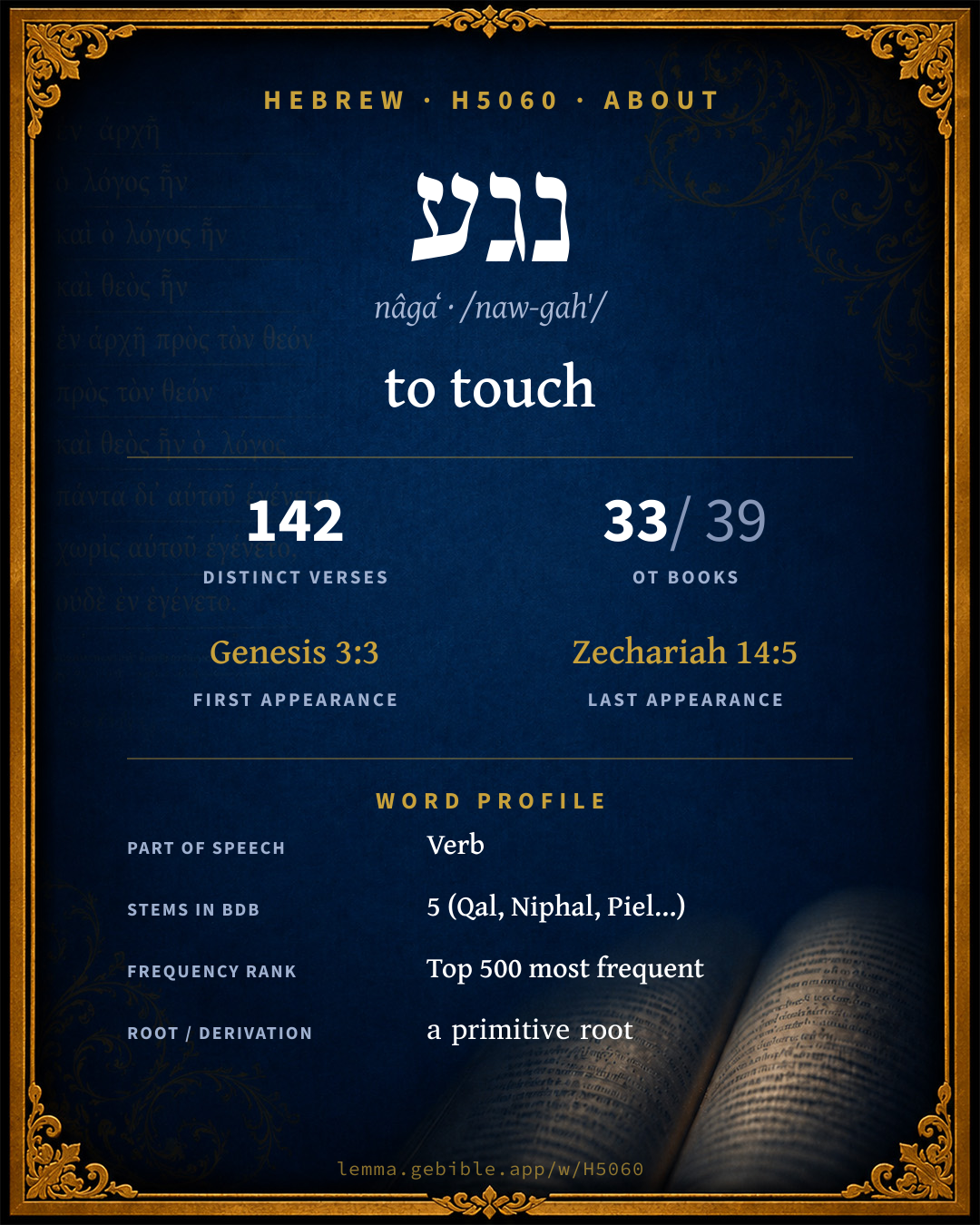
נָגַע
to touch
also: reach, strike fuller range ↓
Full lexicon entry — Brown-Driver-Briggs (BDB)
From Brown-Driver-Briggs (BDB)
Where this word appears
See every Qal verb in the Hebrew Bible →
Grammar key — what these labels mean
Part of speech
- Verb
- An action or state-of-being word.
Stem
- Qal
- The basic, simple active stem — the plain form of the verb (“he wrote”). Here: ‘touch’
- Hiphil
- The causative active stem (“he caused / brought about”). Here: ‘cause to touch’
- Piel
- An intensive or resultative active stem.
- Niphal
- Usually the simple passive or reflexive of the Qal (“he was written”).
- Pual
- The passive counterpart of the Piel.
Form
- Participle Active
- A verbal adjective expressing ongoing or characteristic action (“writing / one who writes”).
- Imperfect
- An incomplete, ongoing, or future action (“he will / would write”).
- Sequential Imperfect
- An imperfect with prefixed waw — the standard past-narrative form (waw-consecutive imperfect).
- Perfect
- A completed action or state — Hebrew marks aspect (completeness) more than strict tense (“he wrote”).
- Infinitive Construct
- A bound verbal noun, frequently with prepositions (“to write / in writing”).
- Jussive
- A third- or second-person volitional form expressing wish or command (“let him write”).
- Imperative
- A direct command (“write!”).
- Participle Passive
- A verbal adjective expressing action received (“written”).
- Sequential Perfect
- A perfect with prefixed waw continuing a preceding imperfect or command (waw-consecutive perfect).
State
- Absolute
- The independent form of a noun, not bound to a following word.
- Construct
- A noun bound to a following noun in a possessive / “of” relationship (the construct chain).
Person
- 3rd Person
- The one spoken about (“he / she / it / they”).
- 2nd Person
- The one addressed (“you”).
- 1st Person
- The speaker (“I / we”).
Gender
- Masculine
- Grammatically masculine.
- Feminine
- Grammatically feminine.
- Common
- Either gender — not distinguished for this form.
Number
- Singular
- One.
- Plural
- More than one (in Hebrew, generally three or more).
Grammatical forms 39 distinct
- Verb, Qal, Participle Active, Masculine, Singular, Absolute 30 times (20%)
- Verb, Qal, Imperfect, 3rd Person, Masculine, Singular 15 times (10%)
- Verb, Qal, Sequential Imperfect, 3rd Person, Masculine, Singular 10 times (7%)
- Verb, Hiphil, Participle Active, Masculine, Singular, Absolute 8 times (5%)
- Verb, Qal, Infinitive Construct 8 times (5%)
- Verb, Hiphil, Perfect, 3rd Person, Masculine, Singular 7 times (5%)
- Verb, Qal, Perfect, 3rd Person, Masculine, Singular 7 times (5%)
- Verb, Qal, Imperfect, 3rd Person, Feminine, Singular 6 times (4%)
+31 more forms (59 occurrences)
Parsed forms decoded from the imported morphology (morphhb / Westminster Leningrad Codex — WLC text public domain, morphhb tagging CC BY 4.0), counted across 150 parsed occurrences — not distinct verses.
Every verse where H5060 appears — 142 distinct verses across 33 books. Click any verse to open its interlinear word-by-word view. Verse text shown in the World English Bible for context — . Each verse’s Hebrew form is shown with its reference; the English is not keyword-highlighted, since the data carries no word-level English alignment. Use “Compare translations” on any verse to read it across multiple English versions. This concordance covers the Hebrew Bible; Septuagint (Greek Old Testament) occurrences are not indexed here.
Genesis 8 verses
- Genesis 3:3 תִגְּע֖וּ Qal impf 2mp but of the fruit of the tree which is in the midst of the garden, God has said, 'You shall not eat of it, neither shall you touch it, lest you die.'"
- Genesis 12:17 וַ/יְנַגַּ֨ע conj + Piel wimpf 3ms Yahweh plagued Pharaoh and his house with great plagues because of Sarai, Abram's wife.
- Genesis 20:6 לִ/נְגֹּ֥עַ prep + Qal inf.cs God said to him in the dream, "Yes, I know that in the integrity of your heart you have done this, and I also withheld you from sinning against me. Therefore I didn't allow you to touch her.
- Genesis 26:11 הַ/נֹּגֵ֜עַ ptcl def.art + Qal ptcp.act ms Abimelech charged all the people, saying, "He who touches this man or his wife will surely be put to death."
- Genesis 26:29 נְגַֽעֲנ֔וּ/ךָ Qal pf 1cp + sfx pers 2ms that you will do us no harm, as we have not touched you, and as we have done to you nothing but good, and have sent you away in peace.' You are now the blessed of Yahweh."
- Genesis 28:12 מַגִּ֣יעַ Hiphil ptcp.act ms He dreamed. Behold, a stairway set up on the earth, and the top of it reached to heaven. Behold, the angels of God ascending and descending on it.
- Genesis 32:25 וַ/יִּגַּ֖ע conj + Qal wimpf 3ms When he saw that he didn't prevail against him, he touched the hollow of his thigh, and the hollow of Jacob's thigh was strained, as he wrestled.
- Genesis 32:32 נָגַע֙ Qal pf 3ms Therefore the children of Israel don't eat the sinew of the hip, which is on the hollow of the thigh, to this day, because he touched the hollow of Jacob's thigh in the sinew of the hip.
Exodus 6 verses
- Exodus 4:25 וַ/תַּגַּ֖ע conj + Hiphil wimpf 3fs Then Zipporah took a flint, and cut off the foreskin of her son, and cast it at his feet; and she said, "Surely you are a bridegroom of blood to me."
- Exodus 12:22 וְ/הִגַּעְתֶּ֤ם conj + Hiphil wpf 2mp You shall take a bunch of hyssop, and dip it in the blood that is in the basin, and strike the lintel and the two side-posts with the blood that is in the basin; and none of you shall go out of the door of his house until the morning.
- Exodus 19:12 וּ/נְגֹ֣עַ הַ/נֹּגֵ֥עַ conj + Qal inf.cs ptcl def.art + Qal ptcp.act ms You shall set bounds to the people round about, saying, 'Be careful that you don't go up onto the mountain, or touch its border. Whoever touches the mountain shall be surely put to death.
- Exodus 19:13 תִגַּ֨ע Qal impf 3fs No hand shall touch him, but he shall surely be stoned or shot through; whether it is animal or man, he shall not live.' When the trumpet sounds long, they shall come up to the mountain."
- Exodus 29:37 הַ/נֹּגֵ֥עַ ptcl def.art + Qal ptcp.act ms Seven days you shall make atonement for the altar, and sanctify it: and the altar shall be most holy; whatever touches the altar shall be holy.
- Exodus 30:29 הַ/נֹּגֵ֥עַ ptcl def.art + Qal ptcp.act ms You shall sanctify them, that they may be most holy. Whatever touches them shall be holy.
Leviticus 28 verses
- Leviticus 5:2 תִּגַּע֮ Qal impf 3fs "'Or if anyone touches any unclean thing, whether it is the carcass of an unclean animal, or the carcass of unclean cattle, or the carcass of unclean creeping things, and it is hidden from him, and he is unclean, then he shall be guilty.
- Leviticus 5:3 יִגַּע֙ Qal impf 3ms "'Or if he touches the uncleanness of man, whatever his uncleanness is with which he is unclean, and it is hidden from him; when he knows of it, then he shall be guilty.
- Leviticus 5:7 תַגִּ֣יע Hiphil impf 3fs "'If he can't afford a lamb, then he shall bring his trespass offering for that in which he has sinned, two turtledoves, or two young pigeons, to Yahweh; one for a sin offering, and the other for a burnt offering.
- Leviticus 6:18 יִגַּ֥ע Qal impf 3ms Every male among the children of Aaron shall eat of it, as their portion forever throughout your generations, from the offerings of Yahweh made by fire. Whoever touches them shall be holy.'"
- Leviticus 6:27 יִגַּ֥ע Qal impf 3ms Whatever shall touch its flesh shall be holy. When there is any of its blood sprinkled on a garment, you shall wash that on which it was sprinkled in a holy place.
- Leviticus 7:19 יִגַּ֤ע Qal impf 3ms "'The flesh that touches any unclean thing shall not be eaten. It shall be burned with fire. As for the flesh, everyone who is clean may eat it;
- Leviticus 7:21 תִגַּ֣ע Qal impf 3fs When anyone touches any unclean thing, the uncleanness of man, or an unclean animal, or any unclean abomination, and eats some of the flesh of the sacrifice of peace offerings, which belong to Yahweh, that soul shall be cut off from his people.'"
- Leviticus 11:8 תִגָּ֑עוּ Qal impf 2mp Of their flesh you shall not eat, and their carcasses you shall not touch; they are unclean to you.
- Leviticus 11:24 הַ/נֹּגֵ֥עַ ptcl def.art + Qal ptcp.act ms "'By these you will become unclean: whoever touches the carcass of them shall be unclean until the evening.
- Leviticus 11:26 הַ/נֹּגֵ֥עַ ptcl def.art + Qal ptcp.act ms "'Every animal which parts the hoof, and is not cloven-footed, nor chews the cud, is unclean to you. Everyone who touches them shall be unclean.
- Leviticus 11:27 הַ/נֹּגֵ֥עַ ptcl def.art + Qal ptcp.act ms Whatever goes on its paws, among all animals that go on all fours, they are unclean to you. Whoever touches their carcass shall be unclean until the evening.
- Leviticus 11:31 הַ/נֹּגֵ֧עַ ptcl def.art + Qal ptcp.act ms These are they which are unclean to you among all that creep. Whoever touches them when they are dead, shall be unclean until the evening.
- Leviticus 11:36 וְ/נֹגֵ֥עַ conj + Qal ptcp.act ms Nevertheless a spring or a cistern in which water is a gathered shall be clean: but that which touches their carcass shall be unclean.
- Leviticus 11:39 הַ/נֹּגֵ֥עַ ptcl def.art + Qal ptcp.act ms "'If any animal, of which you may eat, dies; he who touches its carcass shall be unclean until the evening.
- Leviticus 12:4 תִגָּ֗ע Qal impf 3fs She shall continue in the blood of purification thirty-three days. She shall not touch any holy thing, nor come into the sanctuary, until the days of her purifying are completed.
- Leviticus 15:5 יִגַּ֖ע Qal impf 3ms Whoever touches his bed shall wash his clothes, and bathe himself in water, and be unclean until the evening.
- Leviticus 15:7 וְ/הַ/נֹּגֵ֖עַ conj + ptcl def.art + Qal ptcp.act ms "'He who touches the body of him who has the discharge shall wash his clothes, and bathe himself in water, and be unclean until the evening.
- Leviticus 15:10 הַ/נֹּגֵ֗עַ ptcl def.art + Qal ptcp.act ms Whoever touches anything that was under him shall be unclean until the evening. He who carries those things shall wash his clothes, and bathe himself in water, and be unclean until the evening.
- Leviticus 15:11 יִגַּע Qal impf 3ms "'Whoever he who has the discharge touches, without having rinsed his hands in water, he shall wash his clothes, and bathe himself in water, and be unclean until the evening.
- Leviticus 15:12 יִגַּע Qal impf 3ms "'The earthen vessel, which he who has the discharge touches, shall be broken; and every vessel of wood shall be rinsed in water.
- Leviticus 15:19 הַ/נֹּגֵ֥עַ ptcl def.art + Qal ptcp.act ms "'If a woman has a discharge, and her discharge in her flesh is blood, she shall be in her impurity seven days: and whoever touches her shall be unclean until the evening.
- Leviticus 15:21 הַ/נֹּגֵ֖עַ ptcl def.art + Qal ptcp.act ms Whoever touches her bed shall wash his clothes, and bathe himself in water, and be unclean until the evening.
- Leviticus 15:22 הַ/נֹּגֵ֔עַ ptcl def.art + Qal ptcp.act ms Whoever touches anything that she sits on shall wash his clothes, and bathe himself in water, and be unclean until the evening.
- Leviticus 15:23 בְּ/נָגְע/וֹ prep + Qal inf.cs + sfx pers 3ms If it is on the bed, or on anything whereon she sits, when he touches it, he shall be unclean until the evening.
- Leviticus 15:27 הַ/נּוֹגֵ֥עַ ptcl def.art + Qal ptcp.act ms Whoever touches these things shall be unclean, and shall wash his clothes, and bathe himself in water, and be unclean until the evening.
- Leviticus 22:4 וְ/הַ/נֹּגֵ֨עַ֙ conj + ptcl def.art + Qal ptcp.act ms "'Whoever of the seed of Aaron is a leper or has an issue; he shall not eat of the holy things, until he is clean. Whoever touches anything that is unclean by the dead, or a man whose seed goes from him;
- Leviticus 22:5 יִגַּ֔ע Qal impf 3ms or whoever touches any creeping thing, whereby he may be made unclean, or a man of whom he may take uncleanness, whatever uncleanness he has;
- Leviticus 22:6 תִּגַּע Qal impf 3fs the person that touches any such shall be unclean until the evening, and shall not eat of the holy things, unless he bathe his body in water.
Numbers 9 verses
- Numbers 4:15 יִגְּע֥וּ Qal impf 3mp "When Aaron and his sons have finished covering the sanctuary, and all the furniture of the sanctuary, as the camp moves forward; after that, the sons of Kohath shall come to carry it: but they shall not touch the sanctuary, lest they die. These things are the burden of the sons of Kohath in the Tent of Meeting.
- Numbers 16:26 תִּגְּע֖וּ Qal juss 2mp He spoke to the congregation, saying, Depart, I pray you, from the tents of these wicked men, and touch nothing of theirs, lest you be consumed in all their sins.
- Numbers 19:11 הַ/נֹּגֵ֥עַ ptcl def.art + Qal ptcp.act ms He who touches the dead body of any man shall be unclean seven days:
- Numbers 19:13 הַ/נֹּגֵ֡עַ ptcl def.art + Qal ptcp.act ms Whoever touches a dead person, the body of a man who has died, and doesn't purifies himself, defiles the tent of Yahweh; and that soul shall be cut off from Israel: because the water for impurity was not sprinkled on him, he shall be unclean; his uncleanness is yet on him.
- Numbers 19:16 יִגַּ֜ע Qal impf 3ms Whoever in the open field touches one who is slain with a sword, or a dead body, or a bone of a man, or a grave, shall be unclean seven days.
- Numbers 19:18 הַ/נֹּגֵ֗עַ ptcl def.art + Qal ptcp.act ms and a clean person shall take hyssop, and dip it in the water, and sprinkle it on the tent, and on all the vessels, and on the persons who were there, and on him who touched the bone, or the slain, or the dead, or the grave:
- Numbers 19:21 וְ/הַ/נֹּגֵ֨עַ֙ conj + ptcl def.art + Qal ptcp.act ms It shall be a perpetual statute to them: and he who sprinkles the water for impurity shall wash his clothes, and he who touches the water for impurity shall be unclean until even.
- Numbers 19:22 יִגַּע הַ/נֹּגַ֖עַת Qal impf 3ms ptcl def.art + Qal ptcp.act fs Whatever the unclean person touches shall be unclean; and the soul that touches it shall be unclean until even.
- Numbers 31:19 נֹגֵ֣עַ Qal ptcp.act ms Encamp you outside of the camp seven days: whoever has killed any person, and whoever has touched any slain, purify yourselves on the third day and on the seventh day, you and your captives.
Deuteronomy 1 verse
Joshua 2 verses
- Joshua 8:15 וַ/יִּנָּֽגְע֛וּ conj + Niphal wimpf 3mp Joshua and all Israel made as if they were beaten before them, and fled by the way of the wilderness.
- Joshua 9:19 לִ/נְגֹּ֥עַ prep + Qal inf.cs But all the princes said to all the congregation, We have sworn to them by Yahweh, the God of Israel: now therefore we may not touch them.
Judges 3 verses
- Judges 6:21 וַ/יִּגַּ֥ע conj + Qal wimpf 3ms Then the angel of Yahweh put forth the end of the staff that was in his hand, and touched the flesh and the unleavened cakes; and there went up fire out of the rock, and consumed the flesh and the unleavened cakes; and the angel of Yahweh departed out of his sight.
- Judges 20:34 נֹגַ֥עַת Qal ptcp.act fs There came over against Gibeah ten thousand chosen men out of all Israel, and the battle was sore; but they didn't know that evil was close on them.
- Judges 20:41 נָגְעָ֥ה Qal pf 3fs The men of Israel turned, and the men of Benjamin were dismayed; for they saw that evil had come on them.
Ruth 1 verse
1 Samuel 3 verses
- 1 Samuel 6:9 נָ֣גְעָה Qal pf 3fs Behold; if it goes up by the way of its own border to Beth-shemesh, then he has done us this great evil: but if not, then we shall know that it is not his hand that struck us; it was a chance that happened to us."
- 1 Samuel 10:26 נָגַ֥ע Qal pf 3ms Saul also went to his house to Gibeah; and there went with him the host, whose hearts God had touched.
- 1 Samuel 14:9 הַגִּיעֵ֖/נוּ Hiphil inf.cs + sfx pers 1cp If they say thus to us, Wait until we come to you; then we will stand still in our place, and will not go up to them.
2 Samuel 3 verses
- 2 Samuel 5:8 וְ/יִגַּ֣ע conj + Qal impf 3ms David said on that day, Whoever strikes the Jebusites, let him get up to the watercourse, and [strike] the lame and the blind, who are hated of David's soul. Therefore they say, There are the blind and the lame; he can't come into the house.
- 2 Samuel 14:10 לָ/גַ֥עַת prep + Qal inf.cs The king said, Whoever says anything to you, bring him to me, and he shall not touch you any more.
- 2 Samuel 23:7 יִגַּ֣ע Qal impf 3ms But the man who touches them Must be armed with iron and the staff of a spear: They shall be utterly burned with fire in [their] place
1 Kings 3 verses
- 1 Kings 6:27 וַ/תִּגַּ֤ע נֹגַ֖עַת נֹגְעֹ֖ת conj + Qal wimpf 3fs Qal ptcp.act fs Qal ptcp.act fp He set the cherubim within the inner house; and the wings of the cherubim were stretched forth, so that the wing of the one touched the one wall, and the wing of the other cherub touched the other wall; and their wings touched one another in the midst of the house.
- 1 Kings 19:5 נֹגֵ֣עַ Qal ptcp.act ms He lay down and slept under a juniper tree; and, behold, an angel touched him, and said to him, Arise and eat.
- 1 Kings 19:7 וַ/יִּגַּע conj + Qal wimpf 3ms The angel of Yahweh came again the second time, and touched him, and said, Arise and eat, because the journey is too great for you.
2 Kings 2 verses
- 2 Kings 13:21 וַ/יִּגַּ֤ע conj + Qal wimpf 3ms It happened, as they were burying a man, that behold, they spied a band; and they cast the man into the tomb of Elisha: and as soon as the man touched the bones of Elisha, he revived, and stood up on his feet.
- 2 Kings 15:5 וַ/יְנַגַּ֨ע conj + Piel wimpf 3ms Yahweh struck the king, so that he was a leper to the day of his death, and lived in a separate house. Jotham the king's son was over the household, judging the people of the land.
1 Chronicles 1 verse
2 Chronicles 4 verses
- 2 Chronicles 3:11 מַגַּ֨עַת֙ מַגִּ֕יעַ Hiphil ptcp.act fs Hiphil ptcp.act ms The wings of the cherubim were twenty cubits long: the wing of the one [cherub] was five cubits, reaching to the wall of the house; and the other wing was [likewise] five cubits, reaching to the wing of the other cherub.
- 2 Chronicles 3:12 מַגִּ֖יעַ Hiphil ptcp.act ms The wing of the other cherub was five cubits, reaching to the wall of the house; and the other wing was five cubits [also], joining to the wing of the other cherub.
- 2 Chronicles 26:20 נִגְּע֖/וֹ Piel pf 3ms + sfx pers 3ms Azariah the chief priest, and all the priests, looked on him, and, behold, he was leprous in his forehead, and they thrust him out quickly from there; yes, himself hurried also to go out, because Yahweh had struck him.
- 2 Chronicles 28:9 הִגִּֽיעַ Hiphil pf 3ms But a prophet of Yahweh was there, whose name was Oded: and he went out to meet the host that came to Samaria, and said to them, Behold, because Yahweh, the God of your fathers, was angry with Judah, he has delivered them into your hand, and you have slain them in a rage which has reached up to heaven.
Ezra 1 verse
Nehemiah 1 verse
Esther 9 verses
- Esther 2:12 וּ/בְ/הַגִּ֡יעַ conj + prep + Hiphil inf.cs Now when the turn of every maiden was come to go in to king Ahasuerus, after it had been done to her as prescribed for the women twelve months (for so were the days of their purification accomplished, [to wit], six months with oil of myrrh, and six months with sweet odors and with the things for the purifying of the women),
- Esther 2:15 וּ/בְ/הַגִּ֣יעַ conj + prep + Hiphil inf.cs Now when the turn of Esther, the daughter of Abihail the uncle of Mordecai, who had taken her for his daughter, was come to go in to the king, she required nothing but what Hegai the king's chamberlain, the keeper of the women, appointed. Esther obtained favor in the sight of all those who looked at her.
- Esther 4:3 מַגִּ֔יעַ Hiphil ptcp.act ms In every province, wherever the king's commandment and his decree came, there was great mourning among the Jews, and fasting, and weeping, and wailing; and many lay in sackcloth and ashes.
- Esther 4:14 הִגַּ֖עַתְּ Hiphil pf 2fs For if you altogether hold your peace at this time, then will relief and deliverance arise to the Jews from another place, but you and your father's house will perish: and who knows whether you haven't come to the kingdom for such a time as this?
- Esther 5:2 וַ/תִּגַּ֖ע conj + Qal wimpf 3fs It was so, when the king saw Esther the queen standing in the court, that she obtained favor in his sight; and the king held out to Esther the golden scepter that was in his hand. So Esther drew near, and touched the top of the scepter.
- Esther 6:14 הִגִּ֑יעוּ Hiphil pf 3cp While they were yet talking with him, came the king's chamberlains, and hurried to bring Haman to the banquet that Esther had prepared.
- Esther 8:17 מַגִּ֔יעַ Hiphil ptcp.act ms In every province, and in every city, wherever the king's commandment and his decree came, the Jews had gladness and joy, a feast and a good day. Many from among the peoples of the land became Jews; for the fear of the Jews was fallen on them.
- Esther 9:1 הִגִּ֧יעַ Hiphil pf 3ms Now in the twelfth month, which is the month Adar, on the thirteenth day of the same, when the king's commandment and his decree drew near to be put in execution, on the day that the enemies of the Jews hoped to have rule over them, (whereas it was turned to the contrary, that the Jews had rule over those who hated them),
- Esther 9:26 הִגִּ֖יעַ Hiphil pf 3ms Therefore they called these days Purim, after the name of Pur. Therefore because of all the words of this letter, and of that which they had seen concerning this matter, and that which had come to them,
Job 8 verses
- Job 1:11 וְ/גַ֖ע conj + Qal impv 2ms But put forth your hand now, and touch all that he has, and he will renounce you to your face."
- Job 1:19 וַ/יִּגַּע֙ conj + Qal wimpf 3ms and, behold, there came a great wind from the wilderness, and struck the four corners of the house, and it fell on the young men, and they are dead. I alone have escaped to tell you."
- Job 2:5 וְ/גַ֥ע conj + Qal impv 2ms But put forth your hand now, and touch his bone and his flesh, and he will renounce you to your face."
- Job 4:5 תִּגַּ֥ע Qal impf 3fs But now it is come to you, and you faint; It touches you, and you are troubled.
- Job 5:19 יִגַּ֖ע Qal impf 3ms He will deliver you in six troubles; Yes, in seven there shall no evil touch you.
- Job 6:7 לִ/נְגּ֣וֹעַ prep + Qal inf.cs My soul refuses to touch them; They are as loathsome food to me.
- Job 19:21 נָ֣גְעָה Qal pf 3fs "Have pity on me, have pity on me, you my friends; For the hand of God has touched me.
- Job 20:6 יַגִּֽיעַ Hiphil impf 3ms Though his height mount up to the heavens, And his head reach to the clouds,
Psalms 8 verses
- Psalms 32:6 יַגִּֽיעוּ Hiphil impf 3mp For this, let everyone who is godly pray to you in a time when you may be found. Surely when the great waters overflow, they shall not reach to him.
- Psalms 73:5 יְנֻגָּֽעוּ Pual impf 3mp They are free from burdens of men, Neither are they plagued like other men.
- Psalms 73:14 נָ֭גוּעַ Qal ptcp.pass ms For all day long have I been plagued, And punished every morning.
- Psalms 88:3 הִגִּֽיעוּ Hiphil pf 3cp For my soul is full of troubles. My life draws near to Sheol.
- Psalms 104:32 יִגַּ֖ע Qal impf 3ms He looks at the earth, and it trembles. He touches the mountains, and they smoke.
- Psalms 105:15 תִּגְּע֥וּ Qal juss 2mp "Don't touch my anointed ones! Do my prophets no harm!"
- Psalms 107:18 וַ֝/יַּגִּ֗יעוּ conj + Hiphil wimpf 3mp Their soul abhors all kinds of food. They draw near to the gates of death.
- Psalms 144:5 גַּ֖ע Qal impv 2ms Part your heavens, Yahweh, and come down. Touch the mountains, and they will smoke.
Proverbs 1 verse
Ecclesiastes 2 verses
- Ecclesiastes 8:14 מַגִּ֤יעַ שֶׁ/מַּגִּ֥יעַ Hiphil ptcp.act ms ptcl rel + Hiphil ptcp.act ms There is a vanity which is done on the earth, that there are righteous men to whom it happens according to the work of the wicked. Again, there are wicked men to whom it happens according to the work of the righteous. I said that this also is vanity.
- Ecclesiastes 12:1 וְ/הִגִּ֣יעוּ conj + Hiphil wpf 3cp Remember also your Creator in the days of your youth, Before the evil days come, and the years draw near, When you will say, "I have no pleasure in them;"
Song of Solomon 1 verse
Isaiah 9 verses
- Isaiah 5:8 מַגִּיעֵ֥י Hiphil ptcp.act mp cs Woe to those who join house to house, Who lay field to field, until there is no room, And you are made to dwell alone in the midst of the land!
- Isaiah 6:7 וַ/יַּגַּ֣ע נָגַ֥ע conj + Hiphil wimpf 3ms Qal pf 3ms He touched my mouth with it, and said, "Behold, this has touched your lips; and your iniquity is taken away, and your sin forgiven."
- Isaiah 8:8 יַגִּ֑יעַ Hiphil impf 3ms and it shall sweep onward into Judah; it shall overflow and pass through; it shall reach even to the neck; and the stretching out of its wings shall fill the breadth of your land, Immanuel.
- Isaiah 16:8 נָגָ֖עוּ Qal pf 3cp For the fields of Heshbon languish, [and] the vine of Sibmah; the lords of the nations have broken down the choice branches of it, which reached even to Jazer, which wandered into the wilderness; its shoots were spread abroad, they passed over the sea.
- Isaiah 25:12 הִגִּ֥יעַ Hiphil pf 3ms The high fortress of your walls has he brought down, laid low, and brought to the ground, even to the dust.
- Isaiah 26:5 יַגִּיעֶ֖/נָּה Hiphil impf 3ms + sfx pers 3fs For he has brought down those who dwell on high, the lofty city: he lays it low, he lays it low even to the ground; he brings it even to the dust.
- Isaiah 30:4 יַגִּֽיעוּ Hiphil impf 3mp For their princes are at Zoan, and their ambassadors are come to Hanes.
- Isaiah 52:11 תִּגָּ֑עוּ Qal juss 2mp Depart you, depart you, go you out from there, touch no unclean thing; go you out of the midst of her; cleanse yourselves, you who bear the vessels of Yahweh.
- Isaiah 53:4 נָג֛וּעַ Qal ptcp.pass ms Surely he has borne our sickness, and carried our suffering; yet we considered him plagued, struck by God, and afflicted.
Jeremiah 6 verses
- Jeremiah 1:9 וַ/יַּגַּ֖ע conj + Hiphil wimpf 3ms Then Yahweh put forth his hand, and touched my mouth; and Yahweh said to me, Behold, I have put my words in your mouth:
- Jeremiah 4:10 וְ/נָגְעָ֥ה conj + Qal wpf 3fs Then said I, Ah, Lord Yahweh! surely you have greatly deceived this people and Jerusalem, saying, You shall have peace; whereas the sword reaches to the life.
- Jeremiah 4:18 נָגַ֖ע Qal pf 3ms Your way and your doings have procured these things to you; this is your wickedness; for it is bitter, for it reaches to your heart.
- Jeremiah 12:14 הַ/נֹּֽגְעִים֙ ptcl def.art + Qal ptcp.act mp Thus says Yahweh against all my evil neighbors, who touch the inheritance which I have caused my people Israel to inherit: behold, I will pluck them up from off their land, and will pluck up the house of Judah from among them.
- Jeremiah 48:32 נָגָ֑עוּ Qal pf 3cp With more than the weeping of Jazer will I weep for you, vine of Sibmah: your branches passed over the sea, they reached even to the sea of Jazer: on your summer fruits and on your vintage the destroyer is fallen.
- Jeremiah 51:9 נָגַ֤ע Qal pf 3ms We would have healed Babylon, but she is not healed: forsake her, and let us go everyone into his own country; for her judgment reaches to heaven, and is lifted up even to the skies.
Lamentations 3 verses
- Lamentations 2:2 הִגִּ֣יעַ Hiphil pf 3ms The Lord has swallowed up all the habitations of Jacob, and has not pitied: He has thrown down in his wrath the strongholds of the daughter of Judah; He has brought them down to the ground; he has profaned the kingdom and the princes of it.
- Lamentations 4:14 יִגְּע֖וּ Qal impf 3mp They wander as blind men in the streets, they are polluted with blood, So that men can't touch their garments.
- Lamentations 4:15 תִּגָּ֔עוּ Qal juss 2mp Depart you, they cried to them, Unclean! depart, depart, don't touch! When they fled away and wandered, men said among the nations, They shall no more sojourn [here].
Ezekiel 3 verses
- Ezekiel 7:12 הִגִּ֣יעַ Hiphil pf 3ms The time is come, the day draws near: don't let the buyer rejoice, nor the seller mourn; for wrath is on all the multitude of it.
- Ezekiel 13:14 וְ/הִגַּעְתִּ֥י/הוּ conj + Hiphil wpf 1cs + sfx pers 3ms So will I break down the wall that you have daubed with whitewash, and bring it down to the ground, so that the foundation of it shall be uncovered; and it shall fall, and you shall be consumed in the midst of it: and you shall know that I am Yahweh.
- Ezekiel 17:10 כְ/גַ֨עַת prep + Qal inf.cs Yes, behold, being planted, shall it prosper? shall it not utterly wither, when the east wind touches it? it shall wither in the beds where it grew.
Daniel 8 verses
- Daniel 8:5 נוֹגֵ֖עַ Qal ptcp.act ms As I was considering, behold, a male goat came from the west over the surface of the whole earth, and didn't touch the ground: and the goat had a notable horn between his eyes.
- Daniel 8:7 מַגִּ֣יעַ Hiphil ptcp.act ms I saw him come close to the ram, and he was moved with anger against him, and struck the ram, and broke his two horns; and there was no power in the ram to stand before him; but he cast him down to the ground, and trampled on him; and there was none who could deliver the ram out of his hand.
- Daniel 8:18 וַ/יִּ֨גַּע conj + Qal wimpf 3ms Now as he was speaking with me, I fell into a deep sleep with my face toward the ground; but he touched me, and set me upright.
- Daniel 9:21 נֹגֵ֣עַ Qal ptcp.act ms yes, while I was speaking in prayer, the man Gabriel, whom I had seen in the vision at the beginning, being caused to fly swiftly, touched me about the time of the evening offering.
- Daniel 10:10 נָ֣גְעָה Qal pf 3fs Behold, a hand touched me, which set me on my knees and on the palms of my hands.
- Daniel 10:16 נֹגֵ֖עַ Qal ptcp.act ms Behold, one in the likeness of the sons of men touched my lips: then I opened my mouth, and spoke and said to him who stood before me, my lord, by reason of the vision my sorrows are turned on me, and I retain no strength.
- Daniel 10:18 וַ/יִּגַּע conj + Qal wimpf 3ms Then there touched me again one like the appearance of a man, and he strengthened me.
- Daniel 12:12 וְ/יַגִּ֑יעַ conj + Hiphil impf 3ms Blessed is he who waits, and comes to the one thousand three hundred thirty-five days.
Hosea 1 verse
Amos 1 verse
Jonah 1 verse
Micah 1 verse
Haggai 2 verses
- Haggai 2:12 וְ/נָגַ֣ע conj + Qal pf 3ms 'If someone carries holy meat in the fold of his garment, and with his fold touches bread, stew, wine, oil, or any food, will it become holy?'" The priests answered, "No."
- Haggai 2:13 יִגַּ֧ע Qal impf 3ms Then Haggai said, "If one who is unclean by reason of a dead body touch any of these, will it be unclean?" The priests answered, "It will be unclean."
Zechariah 2 verses
- Zechariah 2:8 הַ/נֹּגֵ֣עַ נֹגֵ֖עַ ptcl def.art + Qal ptcp.act ms Qal ptcp.act ms For thus says Yahweh of hosts: 'For honor he has sent me to the nations which plundered you; for he who touches you touches the apple of his eye.
- Zechariah 14:5 יַגִּ֣יעַ Hiphil impf 3ms You shall flee by the valley of my mountains; for the valley of the mountains shall reach to Azel; yes, you shall flee, just like you fled from before the earthquake in the days of Uzziah king of Judah. Yahweh my God will come, and all the holy ones with you.
About this entry
At a glance — auto-summarized from this page’s data, not written by a person. Every figure links to its source below. This summary describes the numbers; it doesn’t interpret them.
The Hebrew verb נגע centers on the idea of “to touch.” The King James Version usually renders it “touched,” while modern versions prefer “touches” (Berean Standard Bible) — see the renderings breakdown. Spanning 142 verses in 33 books, it ranks among the common words of the Hebrew Bible. Debuting at Genesis 3:3, it then recurs through the corpus. Different stems carry different senses — BDB groups them under 5 stems, among them Qal and Niphal. Dig into 142-verse concordance and the renderings breakdown below.
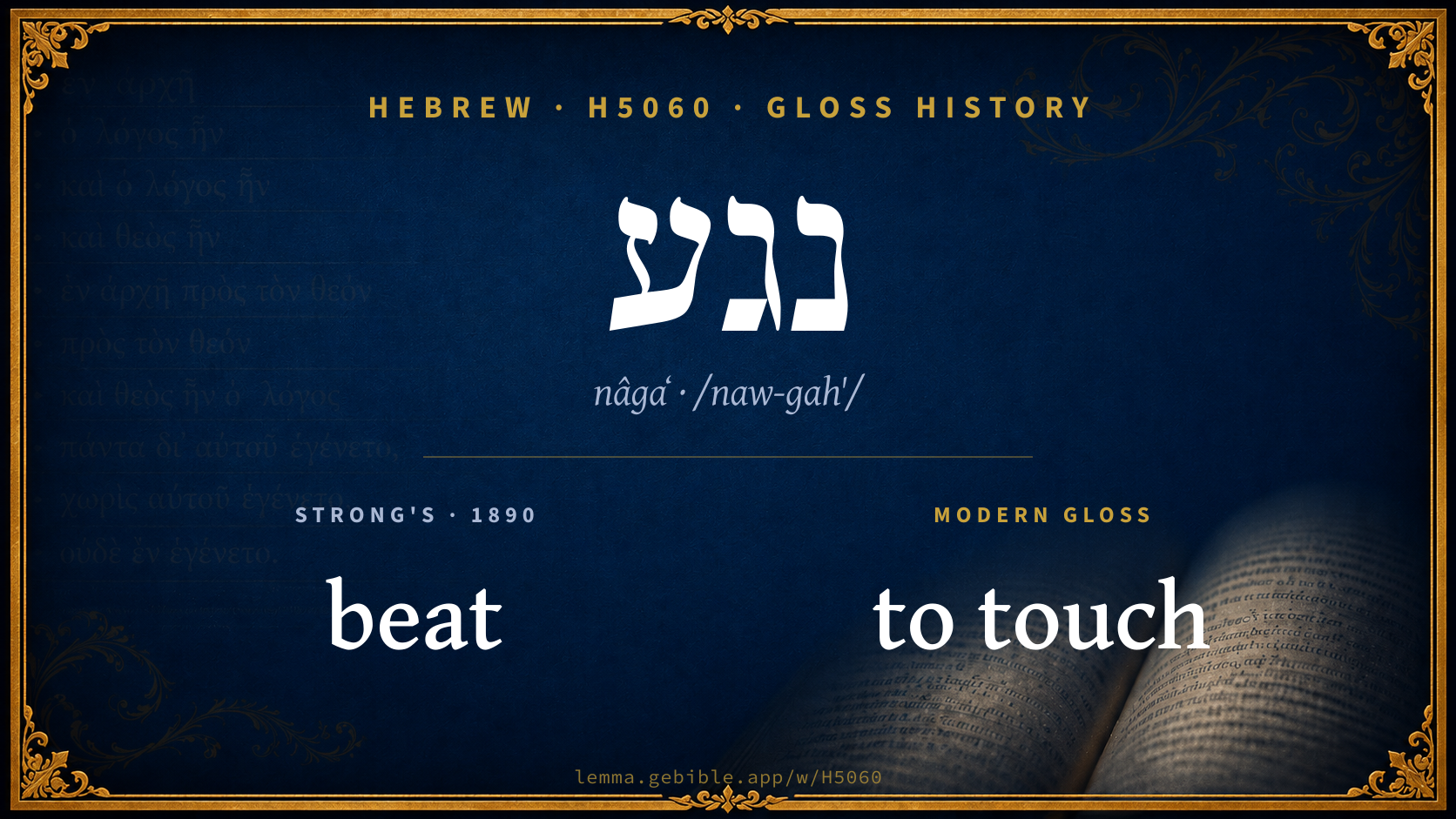
Gloss history
Strong's 1890 vs modern scholarship
About this word
Strong's H5060 catalogs a Hebrew word from the Hebrew Old Testament.
These counts are not copied from any lexicon or concordance. They are computed here, from the morphology-tagged Hebrew Old Testament. What Lemma adds →
- 142
- distinct verses
- The word appears in 142 distinct verses.
- 33 / 39
- OT books
- The word appears in 33 of 39 Old Testament books.
- #298
- by frequency
- Top 500 most frequent Hebrew words (rank 298 of 8,640 Hebrew words by occurrence).
View all 142 occurrences in the concordance →
By section of the Old Testament
By traditional corpus
Conventional, traditional groupings — biblical authorship is debated, so this is a traditional corpus grouping, not an authorship claim. Each share is this word’s portion of its verses in that division of the Hebrew canon. Each figure is a share of the word’s 142 distinct verses.
- Torah (Pentateuch) 52 verses · 37%
- Writings (Ketuvim) 48 verses · 34%
- Prophets (Nevi'im) 42 verses · 30%
How translations render this word
Counts come from each version’s own published word-to-Strong’s tagging or interlinear alignment — an approximate guide to how each version renders this word, not a word-level alignment the data otherwise carries. Because each total is that version’s own tagged count, the per-version totals vary from one another and need not match the appearance or distinct-verse counts above. These counts may also differ from a printed concordance because Lemma counts each distinctly tagged rendering and does not collapse phrase taggings into a single head-word total. This is a fixed set of word-tagged versions (KJV, ASV, BSB, ULT) and does not change with the reading translation you choose elsewhere. Each version’s license is shown beside its name below (and on Sources).
- King James Version: Touched 14×, Touch 12×, Whosoever toucheth 10×
- American Standard Version: Touched 12×, Toucheth 11×, Whosoever toucheth 9×
- Berean Standard Bible: Touches 30×, Touched 14×, Touch 10×
- unfoldingWord Literal Text: Touch 21×, Touches 20×, Touched 9×
King James Version Public Domain
Renders H5060 across 150 tagged occurrences — most commonly:
Plus other, less common renderings. Plus 63 renderings that appear only once — usually multi-word phrases or single function words the recovered tagging swept in, not distinct renderings.
American Standard Version Public Domain
Renders H5060 across 151 tagged occurrences — most commonly:
Plus other, less common renderings. Plus 66 renderings that appear only once — usually multi-word phrases or single function words the recovered tagging swept in, not distinct renderings.
Berean Standard Bible Public Domain
Renders H5060 across 144 tagged occurrences — most commonly:
Plus other, less common renderings. Plus 61 renderings that appear only once — usually multi-word phrases or single function words the recovered tagging swept in, not distinct renderings. Not rendered by a distinct English word in 6 further occurrences.
unfoldingWord Literal Text CC BY-SA 4.0
Renders H5060 across 180 tagged occurrences — most commonly:
Plus other, less common renderings. Plus 54 renderings that appear only once — usually multi-word phrases or single function words the recovered tagging swept in, not distinct renderings.
14 senses and sub-senses in the full BDB
Hebrew verbs can shift meaning by stem (binyan): Qal is the basic action, Niphal is often passive or reflexive, Piel often intensifies or makes it factitive, and Hiphil is typically causative. The senses below are grouped under the stem BDB assigns to each. This entry also uses Pual (the passive of Piel).
What do BDB’s symbols mean?
BDB uses these scholarly abbreviations:
| Symbol | Meaning |
|---|---|
| 𝔊 | the Septuagint (the ancient Greek translation, LXX) |
| 𝔙 | the Vulgate (the Latin translation) |
| 𝔖 | the Syriac version (the Peshitta) |
| 𝔗 | the Targum (the Aramaic translation) |
| ψ | the Psalms |
| √ | root (the underlying root or stem) |
| ‖ | parallel passage (a synonymous or contrasted parallel) |
| † | the dagger: every passage where the word occurs is cited |
The 14 senses and sub-senses the full Brown-Driver-Briggs lexicon distinguishes for this word, in lexicon order (not ranked by frequency), with BDB’s own verbatim wording and sub-sense lettering. Shown in Hebrew script with BDB’s own scholarly abbreviations. The condensed entry is in the Lexicon Entry tab. See also the Forms in the corpus table below.
Qal
- Pf. נ׳ Gn 32:33 +; נָֽגְעָה Ju 20:41 +; 1 pl. sf. נְגַעֲנוּךָ Gn 26:29; Impf. יִגַּע Lv 5:3 +; וַיִּגַּע Gn 32:26 +, etc.; Imv. גַּע ψ 144:5 + 2 times; Inf. cstr. נְגֹעַ, לִנְגּוֹעַ Gn 20:6 + 3 times; גַּ֫עַת 2 S 14:10 Ez 17:10; sf. נָגְעֵךְ Ru 2:9, etc.; Pt. act. נֹגֵעַ 1 K 19:5 +; נֹגְעִים Je 12:14; f. נֹגַ֫עַת Nu 19:22 + 2 times; pl. נֹגְעֹת 1 K 6:27; pass. נָגוּעַ ψ 73:14; Is 53:4;— e.g. Genesis 32:33
- 1.
- a. touch, usually sq. בְּ Gn 3:3 (J), 32:26, 33; Ex 19:12(×2), 13 (all E), 29:37; 30:29 (P), Lv 5:2, 3 + 25 times Lv; Nu 16:26 + 7 times Nu (P) + 19:22 (no בְּ or obj.), Dt 14:8; Ju 6:21; 2 S 23:7; 1 K 6:27(×2), 19:5, 7; 2 K 13:21 Est 5:2; Dn 8:5, 18; 10:10, 18; La 4:14; sq. אֶל־ Hg 2:12; Nu 4:15; 1 K 6:27; Dn 9:21, cf. Ho 4:2; sq. עַל־פֶּה Is 6:7; עַל־שָׂפָה Dn 10:16; sq. acc. Is 52:11; abs. (no obj. expr.) Jb 6:7 La 4:15. e.g. Genesis 3:3
- b. of י׳ touching earth, mountains, etc., sq. בְּ Am 9:5 ψ 104:32; 144:5; fig. of י׳ touching the heart, sq. בְּ 1 S 10:26. e.g. Amos 9:5
- 2. nearly = strike, pass. stricken, ψ 73:14; Is 53:4 (‖ מֻכֶּה), of wind Jb 1:19; Ez 17:10; of divine chastisement 1 S 6:9 Jb 1:11; 19:21; sq. אֶל 2:5. e.g. Psalms 73:14
- 3. touch = harm, sq. בְּ, Gn 26:11 (J), Jos 9:19; 2 S 14:10; 1 Ch 16:22 (‖ הָרֵעַ) = ψ 105:15, Je 12:14; Zc 2:12(×2); sq. אֶל־ Gn 20:6 (touch a woman), so Pr 6:29 (sq. בְּ); sq. acc. Gn 26:29 (J, sf.), so Ru 2:9; v. also Jb 5:19 (subj. רַע, sq. בְּ), Ju 20:34, 41 (both subj. רָעָה, sq. עַל־). e.g. Genesis 26:11
- 4. reach, extend to, 2 S 5:8, sq. בְּ (but crpt. v. Dr HPS); in metaph., sq. עַד of vine Is 16:8; Je 48:32; of sword Je 4:10, cf. v 18; of chastisement Mi 1:9, cf. Jb 4:5 (‖ בּוֹא אֶל־); also (sq. אֶל) Je 51:9; = come, sq. אֶל־ Jon 3:6; arrive (of time), abs. Ezr 3:1; Ne 7:73. e.g. 2 Samuel 5:8
Niphal
- Impf. וַיִּנָּֽגְעוּ Jos 8:15 be stricken, defeated (in battle), i.e. feign to be so, but read prob. וַיִּנָּֽגְפוּ, v. נגף Niph. e.g. Joshua 8:15
Piel
- Pf. sf. נִגְּעוֹ 2 Ch 26:20 strike (with leprosy, 2 acc.), subj. י׳; so Impf. וַיְנַגַּע 2 K 15:5; Gn 12:17 (subj. י׳; acc. pers. + acc. cogn.). e.g. 2 Chronicles 26:20
Pual
- Impf. יְנֻגָּע֑וּ be stricken by diseases (?; cf. Pi. and נֶגַע 2. 3. especially 2 S 7:14) ψ 73:5. e.g. 2 Samuel 7:14
Hiphil
- Pf. הִגִּיעַ Is 25:12 + 6 times; 2 fs. הִגַּ֫עַתְּ Est 4:14; 1 s. sf. וְהִגַּעְתִּ֫יהוּ Ez 13:14, etc.; Impf. יַגִּיעַ Is 8:8 + 3 times; וַיַּגַּע Is 6:7; Je 1:9, etc.; Inf. cstr. הַגִּיעַ Est 2:12, 15; Pt. מַגִּיעַ Gn 28:12 +; f. מַגַּ֫עַת 2 Ch 3:11;—cause to touch; reach, approach, arrive: e.g. Isaiah 25:12
- 1. cause to touch, apply, Ex 12:22 (JE; מִדָּם, אֶל־); cause to touch (sq. עַד עָפָר, לָאָרֶץ), i.e. bring to ground, Is 25:12; 26:5, cf. La 2:2, Ez 13:14 (sq. אֶל־), Ex 4:25 (J; sq. לְרַגְלָיו); sq. עַל־פֶּה Is 6:7; Je 1:9; sq. בְּ Is 5:8. e.g. Exodus 12:22
- 2. intr. reach, extend, Gn 28:12 (sq. ָה loc.); sq. אֶל־ Zc 14:5, sq. עַד Is 8:8; cf. תַּגּ׳ יָדוֹ דֵּי שֶׂה Lv 5:7 if his hand do not reach enough for a lamb (i.e. he be not able to furnish a lamb); sq. לְ Jb 20:6 (hyperb.) 2 Ch 3:11(×2), 12; sq. עַד לְ 28:9; attain, sq. לְ Est 4:14, arrive, come, sq. acc. loc. Is 30:4 Est 4:3; 8:17, sq. לְ (of time) Dn 12:12, sq. אֶל־ 1 S 14:9, sq. עַד־ ψ 107:18, abs. Est 6:14; sq. אֵצֶל Dn 8:7. e.g. Genesis 28:12
- 3. approach, of time, abs. Ec 12:1; Ct 2:12; Ez 7:12 (‖ בּוֹא); v. also Est 9:1 (sq. Inf.), cf. 2:12, 15 ψ 88:4 (sq. לְ). e.g. Ecclesiastes 12:1
- 4. of fate or lot, = befall, sq. אֶל־ Est 9:26 Ec 8:14(×2); reach ψ 32:6. e.g. Esther 9:26
Senses from the full Brown-Driver-Briggs lexicon (Brown, Driver, Briggs; Oxford 1906 — public domain), digitized via Sefaria, supplemented by the OpenScriptures HebrewLexicon (CC BY 4.0). Full attribution on Sources.
Word origin
vb. touch, reach, strike (NH id.; Arabic نَجَعَ is agree with one (of food), produce effect; Aramaic נְגַע Ithpa. be struck (sc. w. leprosy), cf. Pi. infr.);—
— Brown-Driver-Briggs (Oxford 1906, public domain), digitized via Sefaria, supplemented by the OpenScriptures HebrewLexicon (CC BY 4.0). See Sources.
Origin: a primitive root
Jastrow Dictionary
A second Hebrew/Aramaic lexicon for comparison, covering Aramaic and post-biblical (Talmudic, Targumic, Midrashic) usage that the biblical-Hebrew BDB does not. Matched by lemma rather than by Strong’s number, so a lemma may carry more than one Jastrow headword (shown separately below), and the entries cover usage well beyond the Bible.
נָגַע
- (b. h.)
- 1. to touch; to strike; to injure (with ב of object). Sabb. 13ᵇ. Num. R. s. 14 אילו נ׳ באשת וכ׳ if he touched Potifar’s wife. Ib. (ref. to Koh. VIII, 5) שלא נ׳ בו הדבר the thing (the speech of the chief butler) did not harm him, v. נִגְעָה. Y. Peah VIII, 21ᵃ bot., a. e. נָגְעוּ בה, v. מַכָּה. Y. Yeb. I, end, 13ᵇ לא היו ב"ש נוֹגְעִין בו the Shammaites would not take up the case; a. v. fr.—נוֹגֵעַ בעדות an interested witness. Snh. 34ᵃ דמיחזי כנ׳ בעדותו he has the appearance of an interested witness. B. Bath. 43ᵃ top אמאי נוֹגְעִין בעדותן הן why are they admitted to testify? Are they not interested witnesses? Kidd. 43ᵇ; a. fr. e.g. Ecclesiastes 8:5
- 2. (v. Hif.) to arrive, to come to pass. Gen. R. s. 84 שעתידין הדברים לִיגַּע for these things (which Joseph dreamt) shall come to pass; Yalk. ib. 141.
- 1. to reach; to become the property of; to obtain; to cause to reach. B. Mets. X, 5 הִגִּיעוּךָ they shall be thine. Arakh. VIII, 1; 3 (27ᵃ, sq.) הִגִּיעָתְךָ it is thine (Bab. ed. הִגַּעְתִּיךָ I let thee have it), i.e. thy offer is accepted; Tosef. ib. IV, 20 הִגַּעְתָּהוּ thou hast acquired it. Tosef. B. Bath. VI, 7, a. e. הִגִּיעוֹ it is his, i.e. he must pay for it. Y. Erub. III, 21ᵃ bot., a. e. הִגִּיעוּךָ סוף thou hast been made to reach the final conclusion, i.e. thou must admit, v. חָוַר. Ber. IX, 3 (54ᵃ) שהחינו וקיימנו והִגִּיעָנוּ לזמן הזה (Mish. ed. only שהחינו) who hast granted us life and sustenance and suffered us to reach this period. Pes. X, 6 כן … יַגִּיעֵנוּ וכ׳ so may He allow us to reach &c.; a. v. fr.—הַגַּע עצמך put thyself in the position, i.e. suppose. Y. Gitt. III, 44ᵈ, v. זָוַג; a. fr.
- 2. to arrive, to come to pass; to concern. Gen. R. l. c. שתחיית המתים מַגַּעַת בימיו that the resurrection of the dead will come to pass in his days. Ib. שהדברים מַגִּיעִים לבלהה וכ׳ that these things concern Bilhah. &c. Gitt. VIII, 3 כיון שה׳ לאויר וכ׳ as soon as the letter of divorce reaches the space over the roof. Ib. VII, 7 ה׳ לאנטיפטריס if he came as far as Antipatris. Num. R. s. 5 שלא יַגִּיעַ לכם כשם שה׳ וכ׳ that the same may not happen to you as happened to the sons of Aaron. Ned. VIII, 2 עד שיגיע until the time (Passover) comes, opp. עד שיצא until it is passed; a. fr.—[Tosef. Toh. VI, 14 ומשהגיע, v. יָגַע.]
- to be brought to a condition. Zeb. 88ᵃ, sq. הוּגְּעוּ למים Rashi (ed. במים, v. Rabb. D. S. a. l. note 2) if they have come to such a condition as to need washing in water; הוגעו לנתר ואהל if they need cleansing with natron and aloes; (Yalk. Ex. 381 הוּגְעֲלוּ במים if they can be cleansed with &c., v. גָּעַל).
- (denom. of נֶגַע) to afflict with leprosy.—Part. pass. מְנוּגָּע; f. מְנוּגַּעַת; pl. מְנוּגָּעִים; מְנוּגָּעוֹת. Neg. XIII, 9 מי שנכנס לבית המ׳ he who enters a house which is unclean on account of leprosy in the walls. Erub. VIII, 2 חצייה לבית המנ׳ half the time (required for consuming it) is the measure for the stay in a leprous house. Tosef. Neg. VI, 1 בית המנ׳ לא היה וכ׳ a case of a leprous house has never occurred &c. Ib. אבנים מנ׳ stones from a leprous house; Snh. 71ᵃ; a. e.
- to be afflicted with leprosy. Ker. II, 3 מצורע שנ׳ נגעים הרבה a leper that had several attacks in succession (before being purified from the first); Tosef. Neg. IX, 7. Tosef. B. Mets. VIII, 30 המשכיר … וניתנ׳ if one rented a house to his neighbor, and it became leprous; Arakh. 20ᵇ; a. fr.
נְגַע
- , to touch. Snh. 19ᵃ לא אתי למִינְגַּע he will not chance to touch (the corpse). Y. Keth. VII, end, 31ᵈ טלמסן למִגּע dared to touch, v. טוֹלְמִיסִין; a. fr.
- to bring in contact. Bekh. 28ᵇ דא׳ בהו שרץ he (the judge) made the disputed objects touch a reptile; Snh. 33ᵇ דאגעי וכ׳ (corr. acc.). Zeb. 88ᵃ דמַגַּע להו he brings the blood in immediate contact with the altar; a. e.
- to afflict with leprosy.—Part. pass. מְנַגַּע. Ḥull. 60ᵃ they have a custom in Rome דכל דמנ׳ וכ׳ to give every one stricken with leprosy a reel &c., v. דַּוְלָלָא; Yalk. Ps. 862 דמִתְנַגַּע.
- to be stricken with leprosy. Targ. Is. VI, 1.—Ḥull. l. c. אִינַּגְּעָה she became a leper; Yalk. l. c. אִתְנַגְּעָה.
נֶגַע
- preced.) plague, esp. suspected leprosy. Neg. II, 4 כיצד ראיית הנ׳ what must be the patient’s position when the priest is examining the plague (Lev. XIII, 3)? Tosef. ib. VI, 7 כיצד ראיית הנ׳ what are the proceedings at examining a plague in the wall?; a. fr.—Pl. נְגָעִים, constr. נגְעֵי. Ib. 1, a. fr. מטמאה בנ׳ is subject to uncleanness from house plagues. Ib. 7 אין הנ׳ … לה"ר plagues are the punishment for an evil tongue. Neg. II, 5 כל הנ׳ … חוץ מנגעי עצמו. a priest may examine all suspicious plagues except his own; a. v. fr.—נְגָעִים the laws concerning plagues. Y. M. Kat. II, end, 81ᵇ; Ḥag. 14ᵃ, v. אָהִיל.—N’ga‘im, name of a treatise of the Mishnah and Tosefta of the Order of Tohăroth, and of a section of Sifra (Thazri‘a and Mʾtsor‘a). e.g. Leviticus 13:3
A Dictionary of the Targumim, the Talmud Babli and Yerushalmi, and the Midrashic Literature (Marcus Jastrow; London, Luzac, 1903) — Public Domain. Digitized via Sefaria. Digitized via Sefaria. Full attribution on Sources.
Forms in the corpus
The 118 distinct written forms H5060 takes in the Hebrew Bible, most frequent first — each parse links to that stem’s occurrences in the concordance. Hebrew forms include their vowel points and cantillation, so a single lemma takes many written forms.
The 60 most common forms are shown; 58 rarer forms follow in the full concordance.
Same root — word family
Other BDB entries built from the same root as H5060, grouped by Strong’s listed origin. These share a root / origin per the lexicon — not necessarily a shared meaning. Each links to that word’s own entry.
Derived from this word
Compare all same-root words → They share a root, not necessarily a meaning.
Septuagint verse parallels
This word appears in 138 verses that also exist in the Greek Old Testament (Septuagint), out of the 142 Hebrew verses it occurs in. You can read those verses in Greek by switching the Old Testament edition to the Septuagint.
Read these verses in the Septuagint
- Genesis 3:3
- Exodus 4:25
- Leviticus 5:2
- Numbers 4:15
- Deuteronomy 14:8
- Joshua 8:15
- Judges 6:21
- Ruth 2:9
- 1 Samuel 6:9
- 2 Samuel 5:8
- 1 Kings 6:27
- 2 Kings 13:21
This is a verse-level parallel only — the same verses exist in both the Hebrew and Greek Old Testaments. No word-level Hebrew↔Greek correspondence is claimed: the data carries no such alignment, so no Greek word is shown as this Hebrew word’s translation. Coverage is not total — the Septuagint omits the deuterocanon and renumbers the Psalms, so some Hebrew verses have no direct Greek parallel.