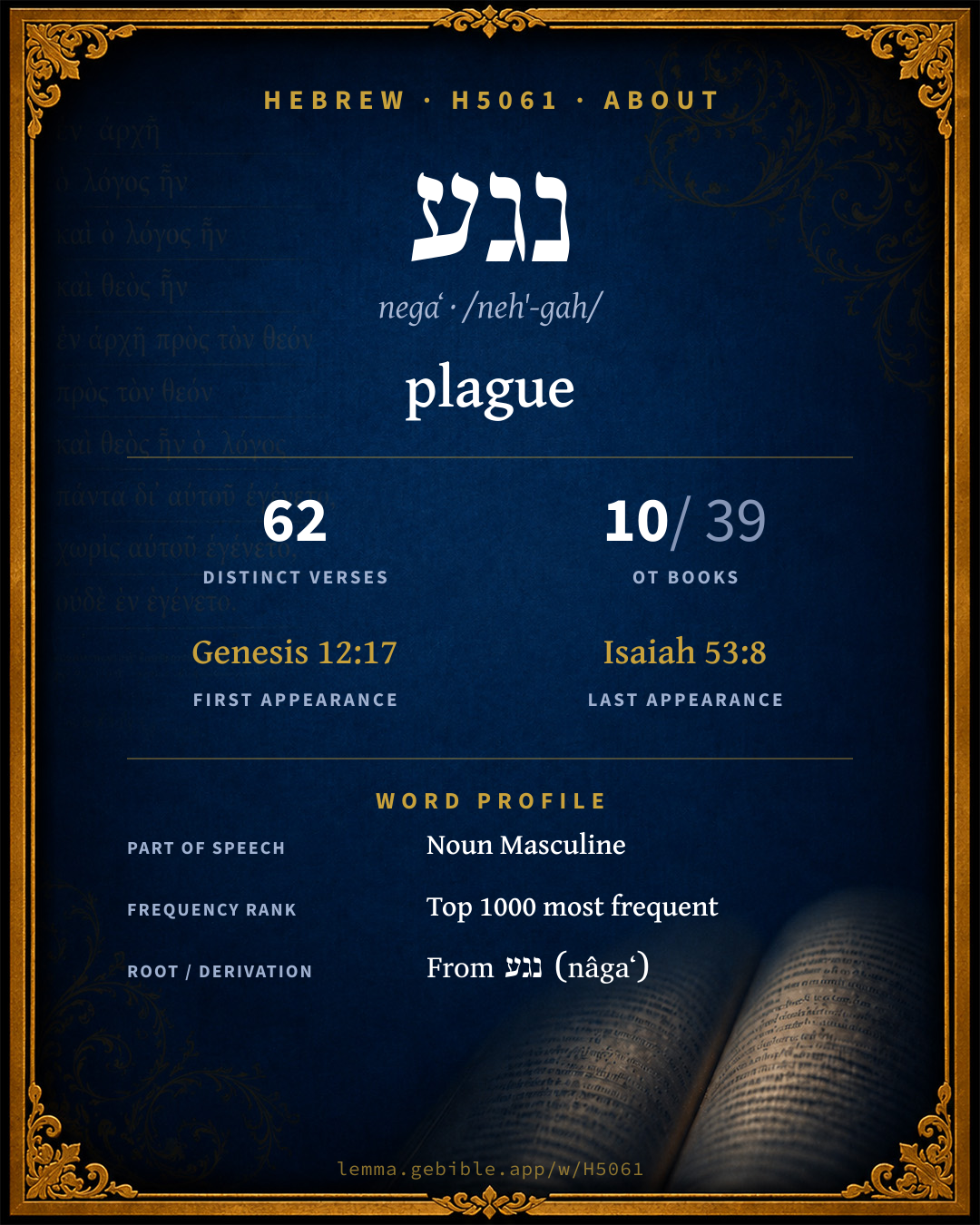
נֶ֫גַע
plague
also: stroke, disease, mark, plague spot fuller range ↓
Full lexicon entry — Brown-Driver-Briggs (BDB)
From Brown-Driver-Briggs (BDB)
Where this word appears
See every Absolute-state word in the Hebrew Bible →
Grammar key — what these labels mean
Part of speech
- Noun
- A naming word — a person, place, thing, or idea.
Noun type
- Common
- A common noun — a general class of person, place, or thing (“king,” “city,” “water”), not a specific name.
State
- Absolute
- The independent form of a noun, not bound to a following word.
- Construct
- A noun bound to a following noun in a possessive / “of” relationship (the construct chain).
Gender
- Masculine
- Grammatically masculine.
Number
- Singular
- One.
- Plural
- More than one (in Hebrew, generally three or more).
Grammatical forms
- Noun, Common, Masculine, Singular, Absolute 54 times (69%)
- Noun, Common, Masculine, Singular, Construct 21 times (27%)
- Noun, Common, Masculine, Plural, Absolute 2 times (3%)
- Noun, Common, Masculine, Plural, Construct 1 time (1%)
Parsed forms decoded from the imported morphology (morphhb / Westminster Leningrad Codex — WLC text public domain, morphhb tagging CC BY 4.0), counted across 78 parsed occurrences — not distinct verses.
Every verse where H5061 appears — 62 distinct verses across 10 books. Click any verse to open its interlinear word-by-word view. Verse text shown in the World English Bible for context — . Each verse’s Hebrew form is shown with its reference; the English is not keyword-highlighted, since the data carries no word-level English alignment. Use “Compare translations” on any verse to read it across multiple English versions. This concordance covers the Hebrew Bible; Septuagint (Greek Old Testament) occurrences are not indexed here.
Genesis 1 verse
Exodus 1 verse
Leviticus 46 verses
- Leviticus 13:2 לְ/נֶ֣גַע prep + n c ms cs "When a man shall have a rising in his body's skin, or a scab, or a bright spot, and it becomes in the skin of his body the plague of leprosy, then he shall be brought to Aaron the priest, or to one of his sons the priests:
- Leviticus 13:3 הַ/נֶּ֣גַע בַּ/נֶּ֜גַע הַ/נֶּ֨גַע֙ נֶ֥גַע ptcl def.art + n c ms prep det + n c ms ptcl def.art + n c ms n c ms cs and the priest shall examine the plague in the skin of the body: and if the hair in the plague has turned white, and the appearance of the plague is deeper than the body's skin, it is the plague of leprosy; and the priest shall examine him, and pronounce him unclean.
- Leviticus 13:4 הַ/נֶּ֖גַע ptcl def.art + n c ms If the bright spot is white in the skin of his body, and the appearance of it isn't deeper than the skin, and the hair of it hasn't turned white, then the priest shall isolate the infected person for seven days.
- Leviticus 13:5 הַ/נֶּ֨גַע֙ הַ/נֶּ֖גַע ptcl def.art + n c ms ptcl def.art + n c ms The priest shall examine him on the seventh day, and, behold, if in his eyes the plague is arrested, and the plague hasn't spread in the skin, then the priest shall isolate him for seven more days.
- Leviticus 13:6 הַ/נֶּ֔גַע הַ/נֶּ֖גַע ptcl def.art + n c ms ptcl def.art + n c ms The priest shall examine him again on the seventh day; and, behold, if the plague has faded, and the plague hasn't spread in the skin, then the priest shall pronounce him clean. It is a scab. He shall wash his clothes, and be clean.
- Leviticus 13:9 נֶ֣גַע n c ms cs "When the plague of leprosy is in a man, then he shall be brought to the priest;
- Leviticus 13:12 הַ/נֶּ֔גַע ptcl def.art + n c ms "If the leprosy breaks out all over the skin, and the leprosy covers all the skin of the infected person from his head even to his feet, as far as it appears to the priest;
- Leviticus 13:13 הַ/נָּ֑גַע ptcl def.art + n c ms then the priest shall examine him; and, behold, if the leprosy has covered all his flesh, he shall pronounce him clean of the plague. It has all turned white: he is clean.
- Leviticus 13:17 הַ/נֶּ֖גַע הַ/נֶּ֖גַע ptcl def.art + n c ms ptcl def.art + n c ms and the priest shall examine him; and, behold, if the plague has turned white, then the priest shall pronounce him clean of the plague. He is clean.
- Leviticus 13:20 נֶֽגַע n c ms cs and the priest shall examine it; and, behold, if the appearance of it is lower than the skin, and the hair of it has turned white, then the priest shall pronounce him unclean. It is the plague of leprosy. It has broken out in the boil.
- Leviticus 13:22 נֶ֥גַע n c ms If it spreads in the skin, then the priest shall pronounce him unclean. It is a plague.
- Leviticus 13:25 נֶ֥גַע n c ms cs then the priest shall examine it; and, behold, if the hair in the bright spot has turned white, and the appearance of it is deeper than the skin; it is leprosy. It has broken out in the burning, and the priest shall pronounce him unclean. It is the plague of leprosy.
- Leviticus 13:27 נֶ֥גַע n c ms cs The priest shall examine him on the seventh day. If it has spread in the skin, then the priest shall pronounce him unclean. It is the plague of leprosy.
- Leviticus 13:29 נָ֑גַע n c ms "When a man or woman has a plague on the head or on the beard,
- Leviticus 13:30 הַ/נֶּ֗גַע ptcl def.art + n c ms then the priest shall examine the plague; and, behold, if the appearance of it is deeper than the skin, and the hair in it is yellow and thin, then the priest shall pronounce him unclean: it is an itch, it is leprosy of the head or of the beard.
- Leviticus 13:31 נֶ֣גַע נֶ֥גַע n c ms cs n c ms cs If the priest examines the plague of itching, and, behold, its appearance isn't deeper than the skin, and there is no black hair in it, then the priest shall isolate him the person infected with itching seven days.
- Leviticus 13:32 הַ/נֶּגַע֮ ptcl def.art + n c ms On the seventh day the priest shall examine the plague; and, behold, if the itch hasn't spread, and there is no yellow hair in it, and the appearance of the itch isn't deeper than the skin,
- Leviticus 13:42 נֶ֖גַע n c ms But if there is in the bald head, or the bald forehead, a reddish-white plague; it is leprosy breaking out in his bald head, or his bald forehead.
- Leviticus 13:43 הַ/נֶּ֨גַע֙ ptcl def.art + n c ms Then the priest shall examine him; and, behold, if the rising of the plague is reddish-white in his bald head, or in his bald forehead, like the appearance of leprosy in the skin of the flesh,
- Leviticus 13:44 נִגְעֽ/וֹ n c ms cs + sfx pers 3ms he is a leprous man. He is unclean. The priest shall surely pronounce him unclean. His plague is on his head.
- Leviticus 13:45 הַ/נֶּ֗גַע ptcl def.art + n c ms "The leper in whom the plague is shall wear torn clothes, and the hair of his head shall hang loose. He shall cover his upper lip, and shall cry, 'Unclean! Unclean!'
- Leviticus 13:46 הַ/נֶּ֥גַע ptcl def.art + n c ms All the days in which the plague is in him he shall be unclean. He is unclean. He shall dwell alone. Outside of the camp shall be his dwelling.
- Leviticus 13:47 נֶ֣גַע n c ms cs "The garment also that the plague of leprosy is in, whether it is a woolen garment, or a linen garment;
- Leviticus 13:49 הַ/נֶּ֜גַע נֶ֥גַע ptcl def.art + n c ms n c ms cs if the plague is greenish or reddish in the garment, or in the skin, or in the warp, or in the woof, or in anything made of skin; it is the plague of leprosy, and shall be shown to the priest.
- Leviticus 13:50 הַ/נָּ֑גַע הַ/נֶּ֖גַע ptcl def.art + n c ms ptcl def.art + n c ms The priest shall examine the plague, and isolate the plague seven days.
- Leviticus 13:51 הַ/נֶּ֜גַע הַ/נֶּ֨גַע֙ הַ/נֶּ֖גַע ptcl def.art + n c ms ptcl def.art + n c ms ptcl def.art + n c ms He shall examine the plague on the seventh day. If the plague has spread in the garment, either in the warp, or in the woof, or in the skin, whatever use the skin is used for, the plague is a destructive mildew. It is unclean.
- Leviticus 13:52 הַ/נָּ֑גַע ptcl def.art + n c ms He shall burn the garment, whether the warp or the woof, in wool or in linen, or anything of skin, in which the plague is: for it is a destructive mildew. It shall be burned in the fire.
- Leviticus 13:53 הַ/נֶּ֔גַע ptcl def.art + n c ms "If the priest examines it, and, behold, the plague hasn't spread in the garment, either in the warp, or in the woof, or in anything of skin;
- Leviticus 13:54 הַ/נָּ֑גַע ptcl def.art + n c ms then the priest shall command that they wash the thing in which the plague is, and he shall isolate it seven more days.
- Leviticus 13:55 הַ/נֶּ֗גַע הַ/נֶּ֤גַע וְ/הַ/נֶּ֣גַע ptcl def.art + n c ms ptcl def.art + n c ms conj + ptcl def.art + n c ms Then the priest shall examine it, after the plague is washed; and, behold, if the plague hasn't changed its color, and the plague hasn't spread, it is unclean; you shall burn it in the fire. It is a mildewed spot, whether the bareness is inside or outside.
- Leviticus 13:56 הַ/נֶּ֔גַע ptcl def.art + n c ms If the priest looks, and, behold, the plague has faded after it is washed, then he shall tear it out of the garment, or out of the skin, or out of the warp, or out of the woof:
- Leviticus 13:57 הַ/נָּֽגַע ptcl def.art + n c ms and if it appears again in the garment, either in the warp, or in the woof, or in anything of skin, it is spreading. You shall burn with fire that in which the plague is.
- Leviticus 13:58 הַ/נָּ֑גַע ptcl def.art + n c ms The garment, either the warp, or the woof, or whatever thing of skin it is, which you shall wash, if the plague has departed from them, then it shall be washed the second time, and it will be clean."
- Leviticus 13:59 נֶֽגַע n c ms cs This is the law of the plague of mildew in a garment of wool or linen, either in the warp, or the woof, or in anything of skin, to pronounce it clean, or to pronounce it unclean.
- Leviticus 14:3 נֶֽגַע n c ms cs and the priest shall go forth out of the camp. The priest shall examine him, and, behold, if the plague of leprosy is healed in the leper,
- Leviticus 14:32 נֶ֣גַע n c ms cs This is the law for him in whom is the plague of leprosy, who is not able to afford the sacrifice for his cleansing.
- Leviticus 14:34 נֶ֣גַע n c ms cs "When you have come into the land of Canaan, which I give to you for a possession, and I put a spreading mildew in a house in the land of your possession,
- Leviticus 14:35 כְּ/נֶ֕גַע prep + n c ms then he who owns the house shall come and tell the priest, saying, 'There seems to me to be some sort of plague in the house.'
- Leviticus 14:36 הַ/נֶּ֔גַע ptcl def.art + n c ms The priest shall command that they empty the house, before the priest goes in to examine the plague, that all that is in the house not be made unclean: and afterward the priest shall go in to inspect the house.
- Leviticus 14:37 הַ/נֶּ֗גַע הַ/נֶּ֨גַע֙ ptcl def.art + n c ms ptcl def.art + n c ms He shall examine the plague; and, behold, if the plague is in the walls of the house with hollow streaks, greenish or reddish, and it appears to be deeper than the wall;
- Leviticus 14:39 הַ/נֶּ֖גַע ptcl def.art + n c ms The priest shall come again on the seventh day, and look. If the plague has spread in the walls of the house,
- Leviticus 14:40 הַ/נָּ֑גַע ptcl def.art + n c ms then the priest shall command that they take out the stones in which is the plague, and cast them into an unclean place outside of the city:
- Leviticus 14:43 הַ/נֶּ֨גַע֙ ptcl def.art + n c ms "If the plague comes again, and breaks out in the house, after he has taken out the stones, and after he has scraped the house, and after it was plastered;
- Leviticus 14:44 הַ/נֶּ֖גַע ptcl def.art + n c ms then the priest shall come in and look; and, behold, if the plague has spread in the house, it is a destructive mildew in the house. It is unclean.
- Leviticus 14:48 הַ/נֶּ֨גַע֙ הַ/נָּֽגַע ptcl def.art + n c ms ptcl def.art + n c ms "If the priest shall come in, and examine it, and, behold, the plague hasn't spread in the house, after the house was plastered, then the priest shall pronounce the house clean, because the plague is healed.
- Leviticus 14:54 נֶ֥גַע n c ms cs This is the law for any plague of leprosy, and for an itch,
Deuteronomy 3 verses
- Deuteronomy 17:8 נֶ֨גַע֙ לָ/נֶ֔גַע n c ms prep + n c ms If there arise a matter too hard for you in judgment, between blood and blood, between plea and plea, and between stroke and stroke, being matters of controversy within your gates; then shall you arise, and go up to the place which Yahweh your God shall choose;
- Deuteronomy 21:5 נָֽגַע n c ms The priests the sons of Levi shall come near; for them Yahweh your God has chosen to minister to him, and to bless in the name of Yahweh; and according to their word shall every controversy and every stroke be.
- Deuteronomy 24:8 בְּ/נֶֽגַע prep + n c ms cs Take heed in the plague of leprosy, that you observe diligently, and do according to all that the priests the Levites shall teach you: as I commanded them, so you shall observe to do.
2 Samuel 1 verse
1 Kings 2 verses
- 1 Kings 8:37 נֶ֖גַע n c ms If there be in the land famine, if there be pestilence, if there be blasting [or] mildew, locust [or] caterpillar; if their enemy besiege them in the land of their cities; whatever plague, whatever sickness there be;
- 1 Kings 8:38 נֶ֣גַע n c ms cs whatever prayer and supplication be made by any man, [or] by all your people Israel, who shall know every man the plague of his own heart, and spread forth his hands toward this house:
2 Chronicles 2 verses
- 2 Chronicles 6:28 נֶ֖גַע n c ms If there be in the land famine, if there be pestilence, if there be blasting or mildew, locust or caterpillar; if their enemies besiege them in the land of their cities; whatever plague or whatever sickness there be;
- 2 Chronicles 6:29 נִגְע/וֹ֙ n c ms cs + sfx pers 3ms whatever prayer and supplication be made by any man, or by all your people Israel, who shall know every man his own plague and his own sorrow, and shall spread forth his hands toward this house:
Psalms 4 verses
- Psalms 38:11 נִגְעִ֣/י n c ms cs + sfx pers 1cs My lovers and my friends stand aloof from my plague. My kinsmen stand far away.
- Psalms 39:10 נִגְעֶ֑/ךָ n c ms cs + sfx pers 2ms Remove your scourge away from me. I am overcome by the blow of your hand.
- Psalms 89:32 וּ/בִ/נְגָעִ֥ים conj + prep + n c mp Then I will punish their sin with the rod, And their iniquity with stripes.
- Psalms 91:10 וְ֝/נֶ֗גַע conj + n c ms No evil shall happen to you, Neither shall any plague come near your dwelling.
Proverbs 1 verse
Isaiah 1 verse
About this entry
At a glance — auto-summarized from this page’s data, not written by a person. Every figure links to its source below. This summary describes the numbers; it doesn’t interpret them.
נגע — transliterated negaʻ — is a Hebrew noun carrying the sense “plague.” Its uses cluster heavily in Leviticus (74% of all occurrences). Spanning 62 verses in 10 books, it ranks among the moderately common words of the Hebrew Bible. Alongside “plague” the lexicon also lists “stroke”, “disease”, and “mark” — part of its full sense range. Its English rendering has broadened — “plague” classically, “mildew” (Berean Standard Bible) and “infection” (unfoldingWord Literal Text) in modern versions; see the renderings breakdown. Each statement above links to its evidence; the full detail follows below.
Gloss history
Strong's 1890 vs modern scholarship

About this word
Strong's H5061 catalogs a Hebrew word from the Hebrew Old Testament.
These counts are not copied from any lexicon or concordance. They are computed here, from the morphology-tagged Hebrew Old Testament. What Lemma adds →
- 62
- distinct verses
- The word appears in 62 distinct verses.
- 10 / 39
- OT books
- The word appears in 10 of 39 Old Testament books.
- #514
- by frequency
- Top 1000 most frequent Hebrew words (rank 514 of 8,640 Hebrew words by occurrence).
View all 62 occurrences in the concordance →
Most concentrated in
- Leviticus 46 verses 74%
- Psalms 4 verses 6%
- Deuteronomy 3 verses 5%
By section of the Old Testament
By traditional corpus
Conventional, traditional groupings — biblical authorship is debated, so this is a traditional corpus grouping, not an authorship claim. Each share is this word’s portion of its verses in that division of the Hebrew canon. Each figure is a share of the word’s 62 distinct verses.
- Torah (Pentateuch) 51 verses · 82%
- Writings (Ketuvim) 7 verses · 11%
- Prophets (Nevi'im) 4 verses · 6%
How translations render this word
Counts come from each version’s own published word-to-Strong’s tagging or interlinear alignment — an approximate guide to how each version renders this word, not a word-level alignment the data otherwise carries. Because each total is that version’s own tagged count, the per-version totals vary from one another and need not match the appearance or distinct-verse counts above. These counts may also differ from a printed concordance because Lemma counts each distinctly tagged rendering and does not collapse phrase taggings into a single head-word total. This is a fixed set of word-tagged versions (KJV, ASV, BSB, ULT) and does not change with the reading translation you choose elsewhere. Each version’s license is shown beside its name below (and on Sources).
- King James Version: Plague 30×, Behold if the plague 8×, Is a plague 4×
- American Standard Version: Plague 30×, And 9×, Is the plague 6×
- Berean Standard Bible: Mildew 13×, Infection 10×, Contaminated 6×
- unfoldingWord Literal Text: Infection 45×, Infection of 10×, Plague 6×
King James Version Public Domain
Renders H5061 across 78 tagged occurrences — most commonly:
Plus 15 renderings that appear only once — usually multi-word phrases or single function words the recovered tagging swept in, not distinct renderings.
American Standard Version Public Domain
Renders H5061 across 77 tagged occurrences — most commonly:
Plus 19 renderings that appear only once — usually multi-word phrases or single function words the recovered tagging swept in, not distinct renderings.
Berean Standard Bible Public Domain
Renders H5061 across 64 tagged occurrences — most commonly:
Plus 22 renderings that appear only once — usually multi-word phrases or single function words the recovered tagging swept in, not distinct renderings. Not rendered by a distinct English word in 14 further occurrences.
unfoldingWord Literal Text CC BY-SA 4.0
Renders H5061 across 81 tagged occurrences — most commonly:
Plus 12 renderings that appear only once — usually multi-word phrases or single function words the recovered tagging swept in, not distinct renderings.
Senses in the full BDB
What do BDB’s symbols mean?
BDB uses these scholarly abbreviations:
| Symbol | Meaning |
|---|---|
| 𝔊 | the Septuagint (the ancient Greek translation, LXX) |
| 𝔙 | the Vulgate (the Latin translation) |
| 𝔖 | the Syriac version (the Peshitta) |
| 𝔗 | the Targum (the Aramaic translation) |
| ψ | the Psalms |
| √ | root (the underlying root or stem) |
| ‖ | parallel passage (a synonymous or contrasted parallel) |
| † | the dagger: every passage where the word occurs is cited |
The 3 senses and sub-senses the full Brown-Driver-Briggs lexicon distinguishes for this word, in lexicon order (not ranked by frequency), with BDB’s own verbatim wording and sub-sense lettering. Shown in Hebrew script with BDB’s own scholarly abbreviations. The condensed entry is in the Lexicon Entry tab. See also the Forms in the corpus table below.
- 1. stroke, wound, inflicted by man on man Dt 17:8; 21:5 (‖ רִיב), Pr 6:33. e.g. Deuteronomy 17:8
- 2. stroke, metaph., especially of a disease, regarded as sent by a divine chastisement, Gn 12:17 (J), Ex 11:1 (E), 2 S 7:14 (נ׳ בְנֵי אָדָם, ‖ שֵׁבֶט אֲנָשִׁים, i.e. customary, ordinary), 1 K 8:37 = 2 Ch 6:28 (both ‖ מַחֲלָה); 1 K 8:38 (נ׳ לְבָבוֹ) = 2 Ch 6:29 (נִגְעוֹ); ψ 91:10 (‖ רָעָה); of Israel 38:12; 39:11 (‖ תִּגְרַת יָֽדְךָ), 89:33 (‖ שֵׁבֶט); v. also Is 53:8 (of suffering servant of י׳, נֶגַע לָ֑מוֹ). e.g. Genesis 12:17
- 3. mark (60 times Lv 13, 14), indeterm. Lv 13:5, 6 (מִסְפַּחַת), v 17, 29, 30, 32, 43, 44; of leprosy, regarded as the heavy touch or stroke of a disease, נ׳ צָרַ֫עַת Lv 13:2 +; v 51 (צָרַעַת מַמְאֶרֶת הַנּ׳), v 59 14:3, 32, 54, Dt 24:8; also נ׳ הַנֶּתֶק Lv 13:31; נ׳ לָבָן אֲדַמְדָּם v 42; identif. with person having it 13:4, 12, 13, 17, 31; in garment, etc. v 47 + 15 times Lv 13; in house 14:34, 35, 36, 43, 44, 48(×2); i.e. house-wall v 37(×2), 39; in stones of wall v 40; = garment, etc., with plague-spot 13:50. e.g. Leviticus 13:5
Senses from the full Brown-Driver-Briggs lexicon (Brown, Driver, Briggs; Oxford 1906 — public domain), digitized via Sefaria, supplemented by the OpenScriptures HebrewLexicon (CC BY 4.0). Full attribution on Sources.
Word origin
n.m. Gn 12:17 stroke, plague, mark, plague-spot;—נ׳ abs. Ex 11:1 +, נָ֑נַע Lv 13:13 +; cstr. Dt 24:8 +; sf. נִגְעִי ψ 38:12; נִגְעֶ֑ךָ 39:11; נִגְעוֹ Lv 13:44; 2 Ch 6:29; pl. נְגָעִים Gn 12:17 ψ 89:33; cstr. נִגְעֵי 2 S 7:14;—
— Brown-Driver-Briggs (Oxford 1906, public domain), digitized via Sefaria, supplemented by the OpenScriptures HebrewLexicon (CC BY 4.0). See Sources.
Derived from נגע (nâgaʻ) (H5060) — to touch.
Jastrow Dictionary
A second Hebrew/Aramaic lexicon for comparison, covering Aramaic and post-biblical (Talmudic, Targumic, Midrashic) usage that the biblical-Hebrew BDB does not. Matched by lemma rather than by Strong’s number, so a lemma may carry more than one Jastrow headword (shown separately below), and the entries cover usage well beyond the Bible.
נָגַע
- (b. h.)
- 1. to touch; to strike; to injure (with ב of object). Sabb. 13ᵇ. Num. R. s. 14 אילו נ׳ באשת וכ׳ if he touched Potifar’s wife. Ib. (ref. to Koh. VIII, 5) שלא נ׳ בו הדבר the thing (the speech of the chief butler) did not harm him, v. נִגְעָה. Y. Peah VIII, 21ᵃ bot., a. e. נָגְעוּ בה, v. מַכָּה. Y. Yeb. I, end, 13ᵇ לא היו ב"ש נוֹגְעִין בו the Shammaites would not take up the case; a. v. fr.—נוֹגֵעַ בעדות an interested witness. Snh. 34ᵃ דמיחזי כנ׳ בעדותו he has the appearance of an interested witness. B. Bath. 43ᵃ top אמאי נוֹגְעִין בעדותן הן why are they admitted to testify? Are they not interested witnesses? Kidd. 43ᵇ; a. fr. e.g. Ecclesiastes 8:5
- 2. (v. Hif.) to arrive, to come to pass. Gen. R. s. 84 שעתידין הדברים לִיגַּע for these things (which Joseph dreamt) shall come to pass; Yalk. ib. 141.
- 1. to reach; to become the property of; to obtain; to cause to reach. B. Mets. X, 5 הִגִּיעוּךָ they shall be thine. Arakh. VIII, 1; 3 (27ᵃ, sq.) הִגִּיעָתְךָ it is thine (Bab. ed. הִגַּעְתִּיךָ I let thee have it), i.e. thy offer is accepted; Tosef. ib. IV, 20 הִגַּעְתָּהוּ thou hast acquired it. Tosef. B. Bath. VI, 7, a. e. הִגִּיעוֹ it is his, i.e. he must pay for it. Y. Erub. III, 21ᵃ bot., a. e. הִגִּיעוּךָ סוף thou hast been made to reach the final conclusion, i.e. thou must admit, v. חָוַר. Ber. IX, 3 (54ᵃ) שהחינו וקיימנו והִגִּיעָנוּ לזמן הזה (Mish. ed. only שהחינו) who hast granted us life and sustenance and suffered us to reach this period. Pes. X, 6 כן … יַגִּיעֵנוּ וכ׳ so may He allow us to reach &c.; a. v. fr.—הַגַּע עצמך put thyself in the position, i.e. suppose. Y. Gitt. III, 44ᵈ, v. זָוַג; a. fr.
- 2. to arrive, to come to pass; to concern. Gen. R. l. c. שתחיית המתים מַגַּעַת בימיו that the resurrection of the dead will come to pass in his days. Ib. שהדברים מַגִּיעִים לבלהה וכ׳ that these things concern Bilhah. &c. Gitt. VIII, 3 כיון שה׳ לאויר וכ׳ as soon as the letter of divorce reaches the space over the roof. Ib. VII, 7 ה׳ לאנטיפטריס if he came as far as Antipatris. Num. R. s. 5 שלא יַגִּיעַ לכם כשם שה׳ וכ׳ that the same may not happen to you as happened to the sons of Aaron. Ned. VIII, 2 עד שיגיע until the time (Passover) comes, opp. עד שיצא until it is passed; a. fr.—[Tosef. Toh. VI, 14 ומשהגיע, v. יָגַע.]
- to be brought to a condition. Zeb. 88ᵃ, sq. הוּגְּעוּ למים Rashi (ed. במים, v. Rabb. D. S. a. l. note 2) if they have come to such a condition as to need washing in water; הוגעו לנתר ואהל if they need cleansing with natron and aloes; (Yalk. Ex. 381 הוּגְעֲלוּ במים if they can be cleansed with &c., v. גָּעַל).
- (denom. of נֶגַע) to afflict with leprosy.—Part. pass. מְנוּגָּע; f. מְנוּגַּעַת; pl. מְנוּגָּעִים; מְנוּגָּעוֹת. Neg. XIII, 9 מי שנכנס לבית המ׳ he who enters a house which is unclean on account of leprosy in the walls. Erub. VIII, 2 חצייה לבית המנ׳ half the time (required for consuming it) is the measure for the stay in a leprous house. Tosef. Neg. VI, 1 בית המנ׳ לא היה וכ׳ a case of a leprous house has never occurred &c. Ib. אבנים מנ׳ stones from a leprous house; Snh. 71ᵃ; a. e.
- to be afflicted with leprosy. Ker. II, 3 מצורע שנ׳ נגעים הרבה a leper that had several attacks in succession (before being purified from the first); Tosef. Neg. IX, 7. Tosef. B. Mets. VIII, 30 המשכיר … וניתנ׳ if one rented a house to his neighbor, and it became leprous; Arakh. 20ᵇ; a. fr.
נְגַע
- , to touch. Snh. 19ᵃ לא אתי למִינְגַּע he will not chance to touch (the corpse). Y. Keth. VII, end, 31ᵈ טלמסן למִגּע dared to touch, v. טוֹלְמִיסִין; a. fr.
- to bring in contact. Bekh. 28ᵇ דא׳ בהו שרץ he (the judge) made the disputed objects touch a reptile; Snh. 33ᵇ דאגעי וכ׳ (corr. acc.). Zeb. 88ᵃ דמַגַּע להו he brings the blood in immediate contact with the altar; a. e.
- to afflict with leprosy.—Part. pass. מְנַגַּע. Ḥull. 60ᵃ they have a custom in Rome דכל דמנ׳ וכ׳ to give every one stricken with leprosy a reel &c., v. דַּוְלָלָא; Yalk. Ps. 862 דמִתְנַגַּע.
- to be stricken with leprosy. Targ. Is. VI, 1.—Ḥull. l. c. אִינַּגְּעָה she became a leper; Yalk. l. c. אִתְנַגְּעָה.
נֶגַע
- preced.) plague, esp. suspected leprosy. Neg. II, 4 כיצד ראיית הנ׳ what must be the patient’s position when the priest is examining the plague (Lev. XIII, 3)? Tosef. ib. VI, 7 כיצד ראיית הנ׳ what are the proceedings at examining a plague in the wall?; a. fr.—Pl. נְגָעִים, constr. נגְעֵי. Ib. 1, a. fr. מטמאה בנ׳ is subject to uncleanness from house plagues. Ib. 7 אין הנ׳ … לה"ר plagues are the punishment for an evil tongue. Neg. II, 5 כל הנ׳ … חוץ מנגעי עצמו. a priest may examine all suspicious plagues except his own; a. v. fr.—נְגָעִים the laws concerning plagues. Y. M. Kat. II, end, 81ᵇ; Ḥag. 14ᵃ, v. אָהִיל.—N’ga‘im, name of a treatise of the Mishnah and Tosefta of the Order of Tohăroth, and of a section of Sifra (Thazri‘a and Mʾtsor‘a). e.g. Leviticus 13:3
A Dictionary of the Targumim, the Talmud Babli and Yerushalmi, and the Midrashic Literature (Marcus Jastrow; London, Luzac, 1903) — Public Domain. Digitized via Sefaria. Digitized via Sefaria. Full attribution on Sources.
Forms in the corpus
The 33 distinct written forms H5061 takes in the Hebrew Bible, most frequent first — each parse links to that state’s occurrences in the concordance. Hebrew forms include their vowel points and cantillation, so a single lemma takes many written forms.
Septuagint verse parallels
This word appears in 61 verses that also exist in the Greek Old Testament (Septuagint), out of the 62 Hebrew verses it occurs in. You can read those verses in Greek by switching the Old Testament edition to the Septuagint.
Read these verses in the Septuagint
- Genesis 12:17
- Exodus 11:1
- Leviticus 13:2
- Deuteronomy 17:8
- 2 Samuel 7:14
- 1 Kings 8:37
- 2 Chronicles 6:28
- Psalms 38:11
- Proverbs 6:33
- Isaiah 53:8
This is a verse-level parallel only — the same verses exist in both the Hebrew and Greek Old Testaments. No word-level Hebrew↔Greek correspondence is claimed: the data carries no such alignment, so no Greek word is shown as this Hebrew word’s translation. Coverage is not total — the Septuagint omits the deuterocanon and renumbers the Psalms, so some Hebrew verses have no direct Greek parallel.