Jeremiah 4:18

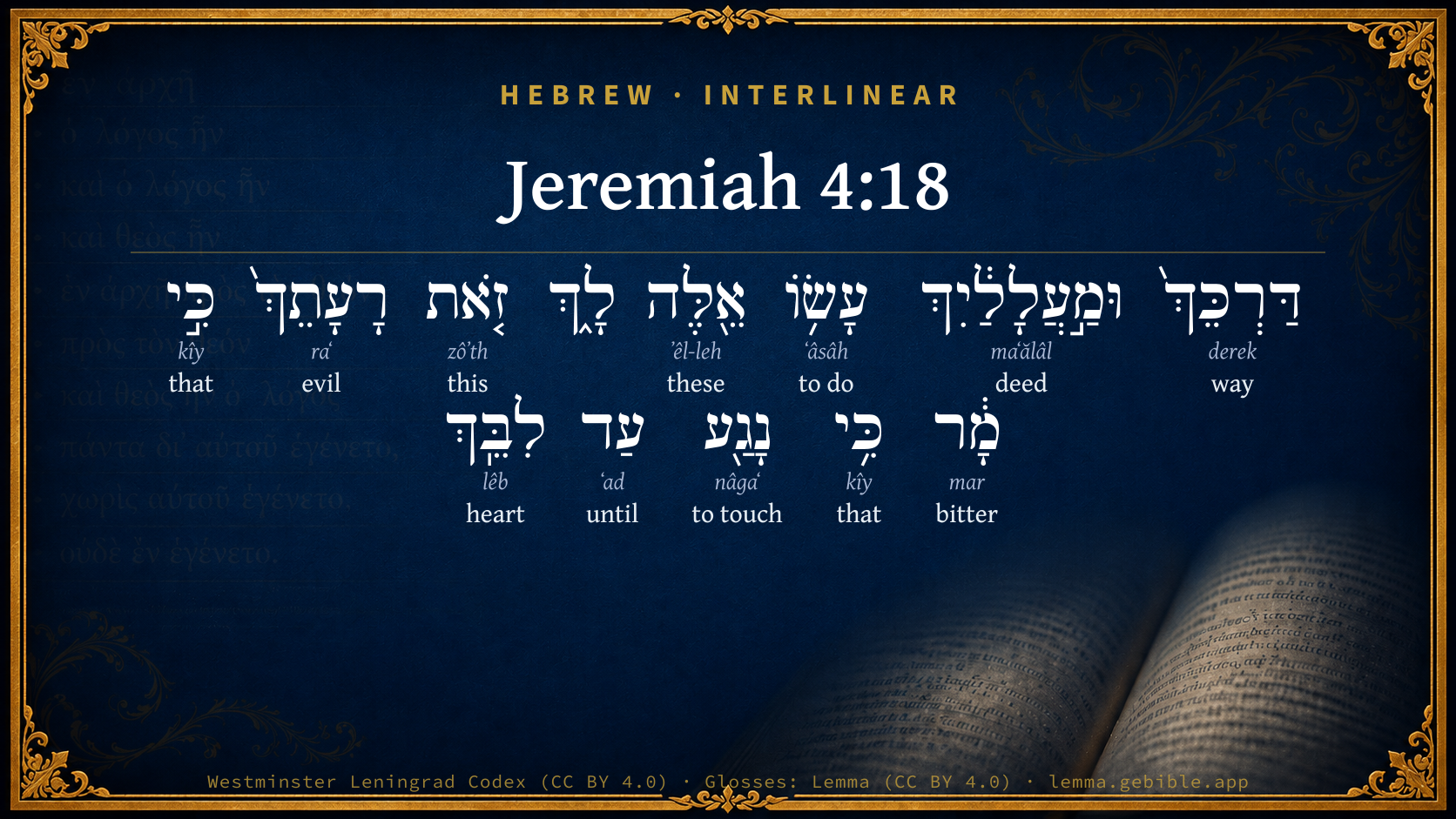
Hebrew (Westminster Leningrad Codex) Jeremiah 4:18 appears in the Hebrew Old Testament. The text above is from the Westminster Leningrad Codex. Each word links to its Strong’s number, a concise gloss, and parsing drawn from the Open Scriptures Hebrew Bible morphology. Click any word for its full Brown-Driver-Briggs (BDB) entry.
Download image
Cite this verse

Jeremiah 4:18 (World English Bible). Public Domain. Lemma interlinear Bible study tool, https://lemma.gebible.app/v/jeremiah/4/18.

Show BibTeX & RIS
BibTeX
RIS
English Translation
Your way and your doings have procured these things to you; this is your wickedness; for it is bitter, for it reaches to your heart.
World English Bible · Public Domain
Download a study sheet

One document with this verse’s original text, its word-by-word gloss line, the meaning frame, cross-references with their text, attributed commentary, and full source and license credits — printable, and it pastes into notes with its structure intact.

This verse Autodidact and up

Study sheet (.html) Plain text (.txt)

A passage Seminary Student

Up to 50 verses in one chapter. A passage sheet keeps up to 6 commentary sources and 12 cross-references per verse, in the order this page ranks them, and says so on the sheet whenever that leaves anything out. Ask for a single verse and you get the Autodidact verse sheet above.

Everything on this page stays free to read, with no account — the sheet is a download of what is already on screen, not access to it.

Want to remove ads? Support Godless Engineer
Compare translations 3

The same verse in 3 English versions, stacked beneath the original-language interlinear above. Click any original word for its lexicon entry.

Each is an independent rendering of the whole verse — the interlinear is not word-aligned to these translations.

Highlighted words mark where these versions differ — a whole-verse word diff, not a word-by-word alignment.

  • World English Bible Public Domain
    Your way and your doings have procured these things to you; this is your wickedness; for it is bitter, for it reaches to your heart.
  • King James Version Public Domain
    Thy way and thy doings have procured these things unto thee; this is thy wickedness, because it is bitter, because it reacheth unto thine heart.
  • unfoldingWord Literal Text CC BY-SA 4.0
    your way and your deeds have done these to you. This your evil. Indeed bitter! Indeed it reaches as far as your heart! ts\*

unfoldingWord Literal Text — © unfoldingWord, licensed CC BY-SA 4.0. Word-aligned USFM3 via Door43 (git.door43.org/unfoldingWord/en_ult).

Versions to compare (up to 4)

3 of 4 selected

Show all 18 translations

Every available English version of this verse, each an independent rendering of the whole verse.

  • World English Bible Public Domain
    Your way and your doings have procured these things to you; this is your wickedness; for it is bitter, for it reaches to your heart.
  • Berean Standard Bible Public Domain
    “Your ways and deeds have brought this upon you. This is your punishment; how bitter it is, because it pierces to the heart!”
  • Majority Standard Bible Public Domain
    “Your ways and deeds have brought this upon you. This is your punishment; how bitter it is, because it pierces to the heart!”
  • King James Version Public Domain
    Thy way and thy doings have procured these things unto thee; this is thy wickedness, because it is bitter, because it reacheth unto thine heart.
  • American Standard Version (1901) Public Domain
    Thy way and thy doings have procured these things unto thee; this is thy wickedness; for it is bitter, for it reacheth unto thy heart.
  • Revised Version (1885) Public Domain
    Thy way and thy doings have procured these things unto thee; this is thy wickedness; for it is bitter, for it reacheth unto thine heart.
  • Geneva Bible (1599) Public Domain
    Thy wayes and thine inuentions haue procured thee these things, such is thy wickednesse: therefore it shall be bitter, therefore it shall perce vnto thine heart.
  • Douay-Rheims (1899) Public Domain
    They ways, and thy devices have brought these things upon thee: this is thy wickedness, because it is bitter, because it hath touched thy heart.
  • Young's Literal Translation Public Domain
    Thy way and thy doings have done these to thee, This `is' thy vexation, for `it is' bitter, For it hath struck unto thy heart.
  • Literal Standard Version CC BY-SA 4.0
    “Your way and your doings have done these to you, || This [is] your distress, for [it is] bitter, || For it has struck to your heart.”
  • Unlocked Literal Bible CC BY-SA 4.0
    and your conduct and your deeds have done these things to you. This will be your punishment. How terrible it will be! It will strike your very heart.
  • unfoldingWord Literal Text CC BY-SA 4.0
    your way and your deeds have done these to you. This your evil. Indeed bitter! Indeed it reaches as far as your heart! ts\*
  • Darby Bible Public Domain
    Thy way and thy doings have procured these [things] unto thee; this is thy wickedness, yea, it is bitter, yea, it reacheth unto thy heart.
  • World Messianic Bible Public Domain
    “Your way and your doings have brought these things to you. This is your wickedness, for it is bitter, for it reaches to your heart.”
  • Webster's Bible Public Domain
    Thy way and thy doings have procured these things to thee; this is thy wickedness, because it is bitter, because it reacheth to thy heart.
  • Free Bible Version CC BY-SA 4.0
    You've brought this on yourself by your own attitudes and actions. This is your punishment, and it's so painful, it's like being stabbed in the heart!”
  • Bible in Basic English Public Domain
    Your ways and your doings have made these things come on you; this is your sin; truly it is bitter, going deep into your heart.
  • JPS Tanakh (1917) Public Domain
    Thy way and thy doings have procured these things unto thee; this is thy wickedness; yea, it is bitter, yea, it reacheth unto thy heart.

Literal Standard Version (2020), Covenant Press — licensed CC BY-SA 4.0. Text via the HelloAO Bible API (eBible.org). Unlocked Literal Bible (unfoldingWord) — licensed CC BY-SA 4.0. Text via the HelloAO Bible API (eBible.org). unfoldingWord Literal Text — © unfoldingWord, licensed CC BY-SA 4.0. Word-aligned USFM3 via Door43 (git.door43.org/unfoldingWord/en_ult). Free Bible Version, Dr. Jonathan Gallagher — licensed CC BY-SA 4.0. Text via the HelloAO Bible API (eBible.org).

Word by word

More ways to search: Search by grammar → Find every occurrence → Compare this word →

Practice this passage: Drill this verse → Learn its vocabulary →

מָ֔ר
mar
H4751
“bitter”
Adjective, Adjective, Masculine, Singular, Absolute
Part of Speech
Adjective
Type
Adjective
Gender
Masculine
Number
Singular
State
Absolute
Full BDB Definition

Origin: from H4843

TWOT: 1248a , 1248c

bitter, bitterness (adjective) - of water or food - of harlot's end, end of wickedness, cry (figuratively) - of pain (substantive) - bitterly (adverb)
  1. דַּרְכֵּךְ֙ derek H1870 “way · your” Noun, Common, Both, Singular, Construct + Suffix, Personal, 2nd Person, Feminine, Singular
  2. וּמַ֣עֲלָלַ֔יִךְ maʻălâl H4611 “and · deeds · your” Conjunction + Noun, Common, Masculine, Plural, Construct + Suffix, Personal, 2nd Person, Feminine, Singular
  3. עָשׂ֥וֹ ʻâsâh H6213 “to do” Verb, Qal, Infinitive Absolute
  4. אֵ֖לֶּה ʼêl-leh H428 “these” Pronoun, Demonstrative, Common, Plural
  5. זֹ֤את zôʼth H2063 “this” Pronoun, Demonstrative, Feminine, Singular
  6. רָעָתֵךְ֙ raʻ H7451 “evil · your” Noun, Common, Feminine, Singular, Construct + Suffix, Personal, 2nd Person, Feminine, Singular
  7. כִּ֣י kîy H3588 “that” Conjunction
  8. כִּ֥י kîy H3588 “that” Conjunction
  9. נָגַ֖ע nâgaʻ H5060 “to touch” Verb, Qal, Perfect, 3rd Person, Masculine, Singular
  10. עַד ʻad H5704 “until” Preposition
  11. לִבֵּֽךְ lêb H3820 “heart · your” Noun, Common, Masculine, Singular, Construct + Suffix, Personal, 2nd Person, Feminine, Singular

About this verse

These counts appear in no published source. They are computed here, from the morphology-tagged text and Lemma’s own curated glosses. What Lemma adds →

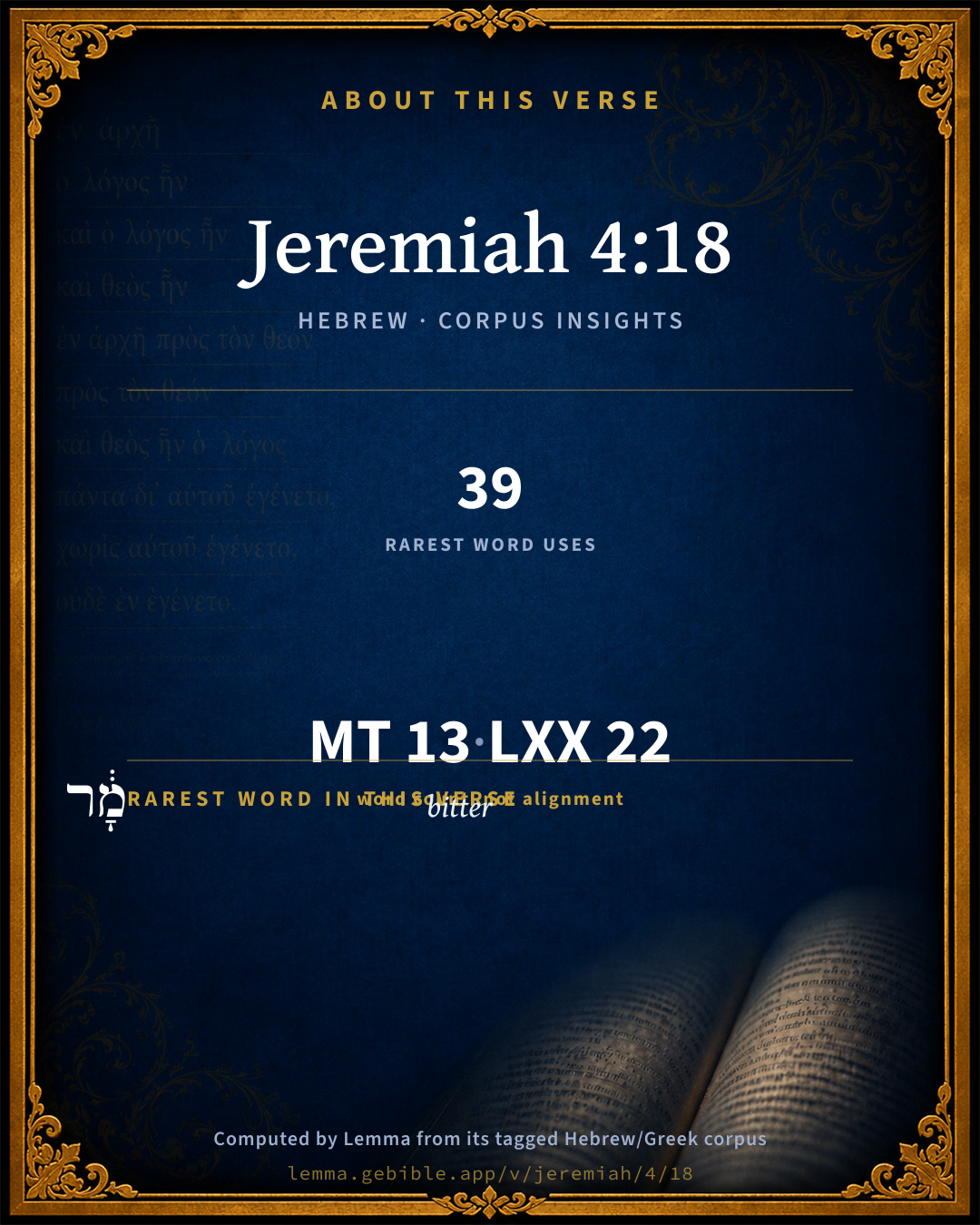
13
words
11
distinct lemmas
Prophets
section

Shared distinctive vocabulary

מָ֔ר bitter H4751 occurs in 36 verses of the Hebrew Bible. Also found in:

Grammatical profile

  • 2 verbs
  • 4 nouns
  • 1 adjective
  • 2 pronouns
  • 2 prepositions
  • 2 conjunctions

Verb forms

  • עָשׂ֥וֹ Qal · Infinitive Absolute
  • נָגַ֖ע Qal · Perfect

Repetition

A word recurs within this verse — often emphatic in Hebrew:

  • כִּ֣י that H3588 ×2

Hebrew & Septuagint length

In the original languages it is 13 Hebrew tokens and 22 Greek tokens — but the two are counted differently (Hebrew bundles its prefixes and suffixes into one token; the Greek is in lemma form), so that isn’t a like-for-like length.

Cross-references

10

Topical passages linked to Jeremiah 4:18 in the Treasury of Scripture Knowledge — connected by theme and wording, ordered by reader-vote popularity; previews shown in the World English Bible.

  • Jeremiah 2:19 Your own wickedness shall correct you, and your backsliding shall reprove you: know therefore and see that it is an evil thing and a bitter, that you have forsaken Yahweh your God, and that my fear is not in you, says the Lord, Yahweh of Hosts.
  • Psalms 107:17 Fools are afflicted because of their disobedience, And because of their iniquities.
  • Proverbs 1:31 Therefore they will eat of the fruit of their own way, And be filled with their own schemes.
  • Isaiah 50:1 Thus says Yahweh, Where is the bill of your mother's divorce, with which I have put her away? or which of my creditors is it to whom I have sold you? Behold, for your iniquities were you sold, and for your transgressions was your mother put away.
  • Jeremiah 2:17 Haven't you procured this to yourself, in that you have forsaken Yahweh your God, when he led you by the way?
  • Jeremiah 6:19 Hear, earth: behold, I will bring evil on this people, even the fruit of their thoughts, because they have not listened to my words; and as for my law, they have rejected it.
  • Job 20:5–16 That the triumphing of the wicked is short, The joy of the godless but for a moment?
  • Proverbs 5:22 The evil deeds of the wicked ensnare him. The cords of his sin hold him firmly.
  • Jeremiah 5:19 It shall happen, when you shall say, Why has Yahweh our God done all these things to us? then shall you say to them, Like as you have forsaken me, and served foreign gods in your land, so shall you serve strangers in a land that is not yours.
  • Jeremiah 26:19 Did Hezekiah king of Judah and all Judah put him to death? Didn't he fear Yahweh, and entreat the favor of Yahweh, and Yahweh repented him of the evil which he had pronounced against them? Thus should we commit great evil against our own souls.

Cross-references courtesy of OpenBible.info (CC BY 4.0).

Hebrew and Greek witnesses Masoretic Hebrew ↔ Greek Septuagint

The same verse in the two great witnesses to the Old Testament, shown verse-for-verse.

These are two independent witnesses, not word-aligned to each other, and the Septuagint is shown in lemma (dictionary) form.

Hebrew Jeremiah 4:18 Masoretic · Westminster Leningrad Codex

דַּרְכֵּךְ֙ וּמַ֣עֲלָלַ֔יִךְ עָשׂ֥וֹ אֵ֖לֶּה לָ֑ךְ זֹ֤את רָעָתֵךְ֙ כִּ֣י מָ֔ר כִּ֥י נָגַ֖ע עַד לִבֵּֽךְ

Your way and your doings have procured these things to you; this is your wickedness; for it is bitter, for it reaches to your heart.

World English Bible · Public Domain

Greek LXX Structure differs

In the Septuagint, Jeremiah is about an eighth shorter than the Hebrew and arranges its material differently — the Oracles Against the Nations (Hebrew chapters 46–51) appear in the middle of the Greek book, after 25:13. Because the chapter and verse boundaries do not line up, a verse-for-verse comparison with the Hebrew is not shown.

A verse-for-verse comparison isn’t shown here because the chapters and verses don’t line up. Switch to the LXX edition with the MT / LXX toggle above to read the Greek directly.

Hebrew: Westminster Leningrad Codex (CC BY 4.0). Greek: Septuagint (public domain); English from a public-domain English Septuagint. How the Septuagint differs from the Hebrew →

Targum (Aramaic paraphrase)

1

The Targum is the ancient Jewish Aramaic paraphrase of the Hebrew Scriptures — an interpretive translation, not the Hebrew text itself. Onkelos (literal) and Pseudo-Jonathan (expansive) render the Torah, and Jonathan the Prophets. Coverage is partial: where no permissively-licensed English translation exists for a verse, only the Aramaic is shown. This is verse-level text, not a word-by-word alignment to the Hebrew.

  1. Targum Jonathan Prophets (Joshua–Malachi)
    אוֹרְחָתָךְ בִּישְׁתָא וְעוֹבָדָךְ מְקַלְקְלַיָא גְרָמוּ אִלֵין לִיךְ דָא בִישְׁתָא וּמְרָדָא אַיְתֵי עֲלָךְ יְרוּשְׁלֵם עַד דְאִתְּבַּר רְשַׁע לִבִּיךְ:

    (no public-domain English translation for this verse)

    Targum Jonathan — Aramaic: “Mikraot Gedolot” (public domain). English: “Sefaria Community Translation” (CC0 1.0 (public-domain dedication)); “London "Chaldee Paraphrase," 1871” (public domain). Text via Sefaria.

Commentary

Notes on Jeremiah 4:18 from classic Christian and Jewish commentators (each source and its license shown beneath its notes). The classic Christian expositions comment on the surrounding passage and are grouped to its opening verse, so a note may address several verses; the Jewish commentaries on the Tanakh (Rashi and others) are per-verse, so they appear only where the commentator wrote on this verse.

Lemma curates 59 commentaries, every one of them public domain or Creative Commons licensed, each selected and text-cleaned for this edition rather than reprinted as found. About our sources →

Trapp's Complete Commentary

John Trapp

Jer 4:18 Thy way and thy doings have procured these [things] unto thee; this [is] thy wickedness, because it is bitter, because it reacheth unto thine heart.

Ver. 18. Thy way and thy doings have procured these things unto thee.] This is like as we use to say to our children when they have taken cold or got any harm, This is your gadding and dabbling in the dirt, your going in the snow, your eating of fruit, &c.

This is thy wickedness,] i.e., Merces malitlae; the wages of thy wickedness, the fruit of thy folly.

Because it is bitter.] Thou hast given God a bitter pill, as it were, that went to his heart; and now he hath given thee as bitter a potion, that reacheth unto thine heart.

John Trapp, A Commentary or Exposition upon All the Books of the Old and New Testament (1647–1656) — public domain. Text from a community e-Sword module.

Joseph Benson's Commentary

Jer 4:18. Thy way and thy doings — Thy manner of life, and particularly thy idolatries; have procured these things unto thee — Have been the causes of this thy grievous affliction, of bringing such a bitter enemy against thee, which hath reached unto thy very heart. “Whatsoever happens to you,” says Jerome on the place, “happens by your own fault, who have turned the sweet goodness of God into bitterness, and have compelled him, however unwilling, to rage against you.”

Joseph Benson's Commentary on the Old and New Testaments (1811–1818) — public domain. Text from a community e-Sword module.

Jamieson, Fausset & Brown

Robert Jamieson, A. R. Fausset & David Brown

(Jer 2:17, Jer 2:19; Psa 107:17).

this is thy wickedness--that is, the fruit of thy wickedness.

Jamieson, Fausset & Brown — Commentary Critical and Explanatory on the Whole Bible (1871) — public domain (CC PDM 1.0). Text via the HelloAO Bible API.

John Calvin's Commentaries

As I have just said, the Prophet confirms what he had declared, — that the Jews would not have to suffer, according to what is commonly said, an adverse fortune, but would be summoned by God to judgment, in order that being touched with the fear of God, they might repent, or at least, though destroyed as to the flesh, they might yet, being humbled, obtain pardon and be saved as to the Spirit.

He therefore says, that their deeds had done this for them; as though he had said, “There is no reason for you to blame God, or your adverse fortune, as ye are wont to do, and as all the heathens also do; for your own deeds have procured for you these calamities. Thus God will perform his office of a judge; and whatever may happen to you is to be ascribed to your own wickedness.” And to the same purpose is what he adds, This is thy wickedness. In short, the Prophet shews, that the Jews in vain transferred their calamities to this or that cause, for the whole blame was in themselves; they procured for themselves their own ruin by their impiety and evil deeds.

In the second clause of the verse, כי מר כי נגע, ki mer, ki nego, etc., the Prophet intimates, that however bitter might be to them what they were to endure, and however it might penetrate into the inmost heart, it was yet to be ascribed to themselves. For hypocrites are wont in their lamentations to cast the blame on God, or at least to complain of fortune. The Prophet anticipates these evasions, by shewing that however bitter might be what the Jews had to endure, and that though God should pierce them through and penetrate to their very bowels and hearts, yet they themselves were the authors of all their calamities. He then adds —

John Calvin's Commentaries (1540-1563) — public domain. Text from the Calvin Translation Society English edition (1840s-50s) via the Christian Classics Ethereal Library (ccel.org). Calvin's coverage is partial (roughly two-thirds of the Bible); uncommented books and verses are honest gaps, never fabricated. The 19th-century editor's footnotes and remarks are omitted so the notes are faithfully Calvin's own voice.

Ellicott's Commentary for English Readers

(18) This is thy wickedness.—Better, this is thy evil. She was reaping the fruit of her own doing, and this gave her sorrows a fresh bitterness. The Hebrew word, like the English “evil,” includes both guilt and its punishment.

A Bible Commentary for English Readers, edited by Charles John Ellicott (1878–1897) — public domain. Text from a community e-Sword module.

The Cambridge Bible for Schools and Colleges

gen. ed. J. J. S. Perowne

18. Thy way and thy doings] See on Jer_7:3.

wickedness] i.e. its result, viz. calamity.

The Cambridge Bible for Schools and Colleges (gen. ed. J. J. S. Perowne; Cambridge University Press, 1878–1918) — public domain. Text from a community e-Sword module.

John Gill's Exposition

Thy way and thy doings have procured these things unto thee,.... The way in which they walked, which was an evil one; and the actions which they committed; their idolatries, backslidings, and rebellions, before spoken of in this and the preceding chapter, were the cause of this siege, and those calamities coming upon them; they had none to blame but themselves; it was their own sinful ways and works which brought this ruin and destruction on them:

this is thy wickedness; the fruit of thy wickedness; or, "this thy calamity"; that is, is owing to these things; so the word is rendered in Psa 141:5,

because it is bitter; not sin, as in Jer 2:19, but the punishment of it; the calamity before mentioned; which was hard and heavy, and grievous to be borne, and yet very just; it was by way of retaliation; "they had bitterly provoked the Lord", as the word may be rendered in the preceding verse; and now he sends them a bitter calamity, and a heavy judgment:

because it reacheth unto thine heart; into the midst of them, and utterly destroyed them. The two last clauses may be rendered, "though it is bitter, though it reacheth unto thine heart" (d); though it is such a sore distress, and such an utter destruction, yet it was to be ascribed to nothing else but their own sins and transgressions.

(d) "quamvis amarum sit, quamvis pertigerit", Calvin.

John Gill's Exposition of the Whole Bible (1746–1763) — public domain (CC PDM 1.0). Text via the HelloAO Bible API.

Albert Barnes' Notes on the Bible

Thy wickedness - This siege is thy wickedness, i. e., in its results; or better, this is thy wretchedness, this army and thy approaching ruin is thy misery.

Because - “For.” To feel that one’s misery is the result of one’s own doings adds bitterness to the anguish, and makes it reach, penetrate to the heart.

Albert Barnes' Notes on the Bible (1834–1885) — public domain. Text from a community e-Sword/MySword module.

Matthew Poole's English Annotations

Thy way; thy manner of life, and particularly thy idolatries.

Have procured these things unto thee: q.d. Thou canst not lay any blame upon me.

This is thy wickedness, because it is bitter; thy wickedness hath been the cause of this thy grievous affliction, Isa 1:1; Jer 2:17,19, of this thy bitterness of bringing such a bitter enemy against thee, a metonymy of the efficient, which hath reached unto thy very heart, as the sword is said to reach unto the soul, Jer 4:10.

Matthew Poole's English Annotations on the Holy Bible (1683–1685) — public domain. Text from a community e-Sword/MySword module.

The Pulpit Commentary

This is thy wickedness; i.e. the effect of thy wickedness. (For the following words, comp. Jer_2:19 Jer_4:10) Because; rather, truly.

The Pulpit Commentary (1880–1919), ed. H.D.M. Spence-Jones & Joseph S. Exell — public domain. Text from a community e-Sword module.

John Wesley's Explanatory Notes

Bitter - Thy wickedness hath been the cause of bringing such a bitter enemy against thee, which hath reached unto thy very heart.

John Wesley, Explanatory Notes Upon the Whole Bible (1754–1765) — public domain. Text via the GEBible commentary corpus.

Rashi

Rabbi Shlomo Yitzchaki (Rashi)

have done these to you To do these to you.

Rashi on the Tanakh — English translations: “The Judaica Press complete Tanach with Rashi, translated by A. J. Rosenberg” (CC BY 4.0); “Pentateuch with Rashi's commentary by M. Rosenbaum and A.M. Silbermann, 1929-1934” (public domain); “The Metsudah Tanach series, Lakewood, N.J” (CC BY 4.0); and “The Book of Joshua, Metsudah Publications, 1997” (CC BY 4.0). Text via Sefaria.

Lesson kit

Teaching starters — assembled from the data on this page, not authored interpretation. Every prompt links to the verse data it draws on. Edit before teaching.

Jeremiah, in the Prophets, opens this verse with 13 words (11 distinct Hebrew lemmas). Its most distinctive word is mar (“bitter”). A historical commentator’s framing appears above. Read the whole chapter for the surrounding context.

Discussion questions

  1. How does “bitter” (mar) shape what this verse is saying?
  2. Genesis 27:34 shares the word «bitter» with this verse. How do the two illuminate each other?
  3. “that” occurs 2× in this one verse. What is the effect of the repetition?
  4. These translations render this verse differently; the difference is in the English rendering, not the original. What questions does that raise?
  5. The verb «עָשׂ֥וֹ» is Qal Infinitive Absolute. How does its form color the action?
  6. Reading how Trapp's Complete Commentary and Joseph Benson's Commentary read this verse, where do the two commentators agree and where do they part?

Things to notice

Reading settings

Reading text

Shown beneath each verse's original-language words.

Old Testament
Old Testament edition

Read the OT as the Masoretic Hebrew (MT) or the Greek Septuagint (LXX).

English shown for the Greek Septuagint (in the Hebrew ↔ Greek comparison).

Comparing translations? Open the Compare panel on any verse page to stack up to four side by side.