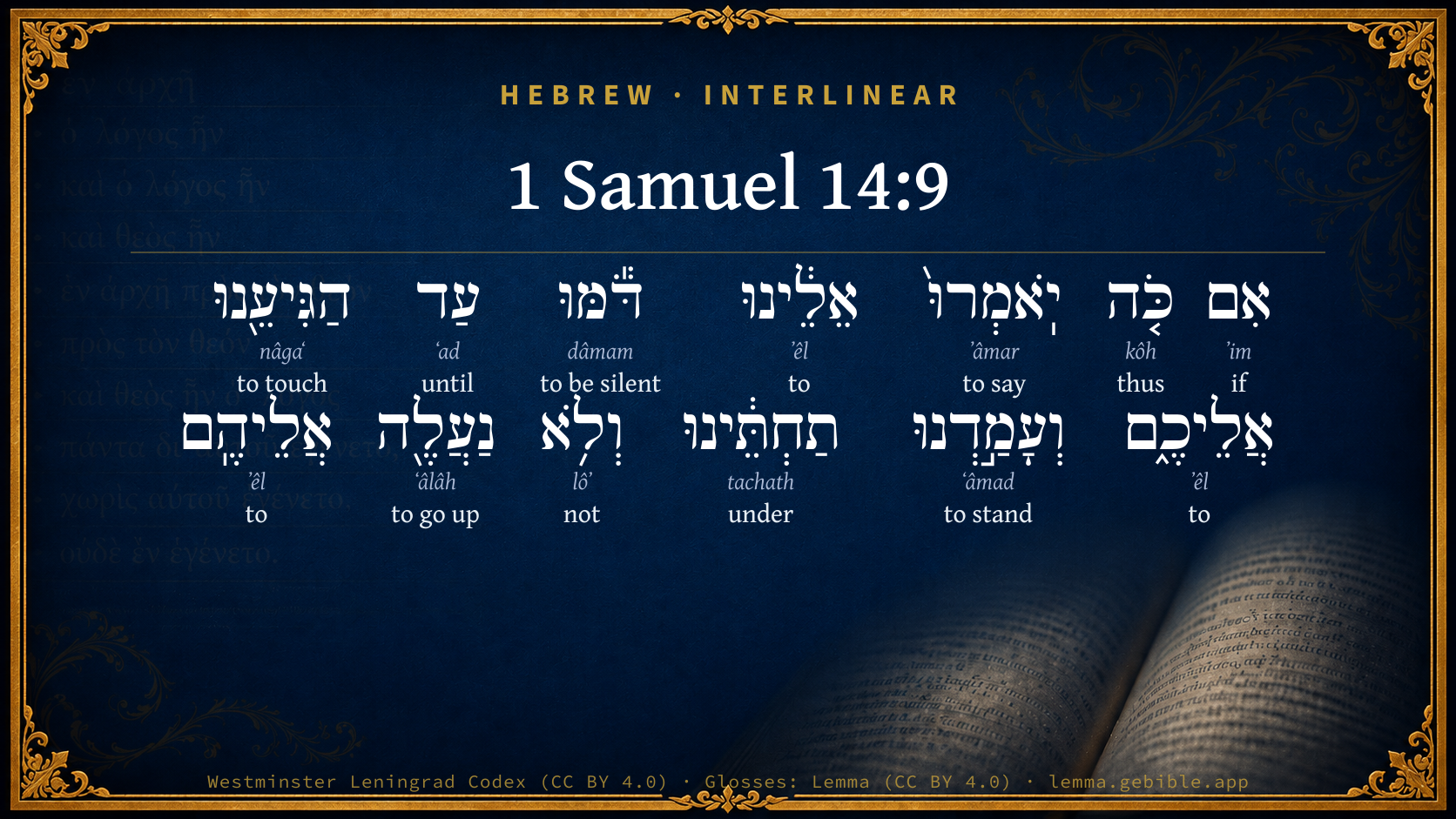
1 Samuel 14:9

Hebrew (Westminster Leningrad Codex) 1 Samuel 14:9 appears in the Hebrew Old Testament. The text above is from the Westminster Leningrad Codex. Each word links to its Strong’s number, a concise gloss, and parsing drawn from the Open Scriptures Hebrew Bible morphology. Click any word for its full Brown-Driver-Briggs (BDB) entry.
Download image
Cite this verse

1 Samuel 14:9 (World English Bible). Public Domain. Lemma interlinear Bible study tool, https://lemma.gebible.app/v/1-samuel/14/9.

Show BibTeX & RIS
BibTeX
RIS
English Translation
If they say thus to us, Wait until we come to you; then we will stand still in our place, and will not go up to them.
World English Bible · Public Domain
Download a study sheet

One document with this verse’s original text, its word-by-word gloss line, the meaning frame, cross-references with their text, attributed commentary, and full source and license credits — printable, and it pastes into notes with its structure intact.

This verse Autodidact and up

Study sheet (.html) Plain text (.txt)

A passage Seminary Student

Up to 50 verses in one chapter. A passage sheet keeps up to 6 commentary sources and 12 cross-references per verse, in the order this page ranks them, and says so on the sheet whenever that leaves anything out. Ask for a single verse and you get the Autodidact verse sheet above.

Everything on this page stays free to read, with no account — the sheet is a download of what is already on screen, not access to it.

Want to remove ads? Support Godless Engineer
Compare translations 3

The same verse in 3 English versions, stacked beneath the original-language interlinear above. Click any original word for its lexicon entry.

Each is an independent rendering of the whole verse — the interlinear is not word-aligned to these translations.

Highlighted words mark where these versions differ — a whole-verse word diff, not a word-by-word alignment.

  • World English Bible Public Domain
    If they say thus to us, Wait until we come to you; then we will stand still in our place, and will not go up to them.
  • King James Version Public Domain
    If they say thus unto us, Tarry until we come to you; then we will stand still in our place, and will not go up unto them.
  • unfoldingWord Literal Text CC BY-SA 4.0
    If thus they say to us, ‘Wait until we reach you,’ then we will stand under us, and we will not go up to them.

unfoldingWord Literal Text — © unfoldingWord, licensed CC BY-SA 4.0. Word-aligned USFM3 via Door43 (git.door43.org/unfoldingWord/en_ult).

Versions to compare (up to 4)

3 of 4 selected

Show all 18 translations

Every available English version of this verse, each an independent rendering of the whole verse.

  • World English Bible Public Domain
    If they say thus to us, Wait until we come to you; then we will stand still in our place, and will not go up to them.
  • Berean Standard Bible Public Domain
    If they say, ‘Wait until we come to you,’ then we will stay where we are and will not go up to them.
  • Majority Standard Bible Public Domain
    If they say, ‘Wait until we come to you,’ then we will stay where we are and will not go up to them.
  • King James Version Public Domain
    If they say thus unto us, Tarry until we come to you; then we will stand still in our place, and will not go up unto them.
  • American Standard Version (1901) Public Domain
    If they say thus unto us, Tarry until we come to you; then we will stand still in our place, and will not go up unto them.
  • Revised Version (1885) Public Domain
    If they say thus unto us, Tarry until we come to you; then we will stand still in our place, and will not go up unto them.
  • Geneva Bible (1599) Public Domain
    If they say on this wise to vs, Tarie vntill we come to you, then we will stand still in our place, and not goe vp to them.
  • Douay-Rheims (1899) Public Domain
    If they shall speak thus to us: Stay till we come to you: let us stand still in our place, and not go up to them.
  • Young's Literal Translation Public Domain
    if thus they say unto us, `Stand still till we have come unto you,' then we have stood in our place, and do not go up unto them;
  • Literal Standard Version CC BY-SA 4.0
    if they thus say to us, Stand still until we have come to you, then we have stood in our place, and do not go up to them;
  • Unlocked Literal Bible CC BY-SA 4.0
    If they say to us, 'Wait there until we come over to you'—then we will stay in our place and will not cross over to them.
  • unfoldingWord Literal Text CC BY-SA 4.0
    If thus they say to us, ‘Wait until we reach you,’ then we will stand under us, and we will not go up to them.
  • Darby Bible Public Domain
    If they say thus to us, Stand still until we come to you, then we will stay in our place, and will not go up to them.
  • World Messianic Bible Public Domain
    If they say this to us, ‘Wait until we come to you!’ then we will stand still in our place and will not go up to them.
  • Webster's Bible Public Domain
    If they say thus to us, Tarry until we come to you; then we will stand still in our place, and will not go up to them.
  • Free Bible Version CC BY-SA 4.0
    If they tell us, ‘Wait there until we come down to you,’ we will wait where we are and we won't go up to them.
  • Bible in Basic English Public Domain
    If they say to us, Keep quiet where you are till we come to you; then we will keep our places and not go up to them.
  • JPS Tanakh (1917) Public Domain
    If they say thus unto us: Tarry until we come to you; then we will stand still in our place, and will not go up unto them.

Literal Standard Version (2020), Covenant Press — licensed CC BY-SA 4.0. Text via the HelloAO Bible API (eBible.org). Unlocked Literal Bible (unfoldingWord) — licensed CC BY-SA 4.0. Text via the HelloAO Bible API (eBible.org). unfoldingWord Literal Text — © unfoldingWord, licensed CC BY-SA 4.0. Word-aligned USFM3 via Door43 (git.door43.org/unfoldingWord/en_ult). Free Bible Version, Dr. Jonathan Gallagher — licensed CC BY-SA 4.0. Text via the HelloAO Bible API (eBible.org).

Word by word

More ways to search: Search by grammar → Find every occurrence → Compare this word →

Practice this passage: Drill this verse → Learn its vocabulary →

דֹּ֕מּוּ
dâmam
H1826
“be silent”
Verb, Qal, Imperative, 2nd Person, Masculine, Plural
Part of Speech
Verb
Stem
Qal
Form
Imperative
Person
2nd Person
Gender
Masculine
Number
Plural
Full BDB Definition

Origin: a prim root [compare H1724 , H1820 ]

TWOT: 439

to be silent, be still, wait, be dumb, grow dumb - (Qal) - to be silent - to be still, die - to be struck dumb - (Niphal) to be silenced, be made silent, destroyed - (Poal) to make quiet - (Hiphil) to make silent (cause to die)
  1. אִם ʼim H518 “if” Conjunction
  2. כֹּ֤ה kôh H3541 “thus” Adverb
  3. יֹֽאמְרוּ֙ ʼâmar H559 “to say” Verb, Qal, Imperfect, 3rd Person, Masculine, Plural
  4. אֵלֵ֔ינוּ ʼêl H413 “to · us” Preposition + Suffix, Personal, 1st Person, Common, Plural
  5. עַד ʻad H5704 “until” Preposition
  6. הַגִּיעֵ֖נוּ nâgaʻ H5060 “to touch · us” Verb, Hiphil, Infinitive Construct + Suffix, Personal, 1st Person, Common, Plural
  7. אֲלֵיכֶ֑ם ʼêl H413 “to · you” Preposition + Suffix, Personal, 2nd Person, Masculine, Plural
  8. וְעָמַ֣דְנוּ ʻâmad H5975 “and · to stand” Conjunction + Verb, Qal, Sequential Perfect, 1st Person, Common, Plural
  9. תַחְתֵּ֔ינוּ tachath H8478 “under · us” Preposition + Suffix, Personal, 1st Person, Common, Plural
  10. וְלֹ֥א lôʼ H3808 “and · not” Conjunction + Particle, Negative
  11. נַעֲלֶ֖ה ʻâlâh H5927 “to go up” Verb, Qal, Imperfect, 1st Person, Common, Plural
  12. אֲלֵיהֶֽם ʼêl H413 “to · them” Preposition + Suffix, Personal, 3rd Person, Masculine, Plural

About this verse

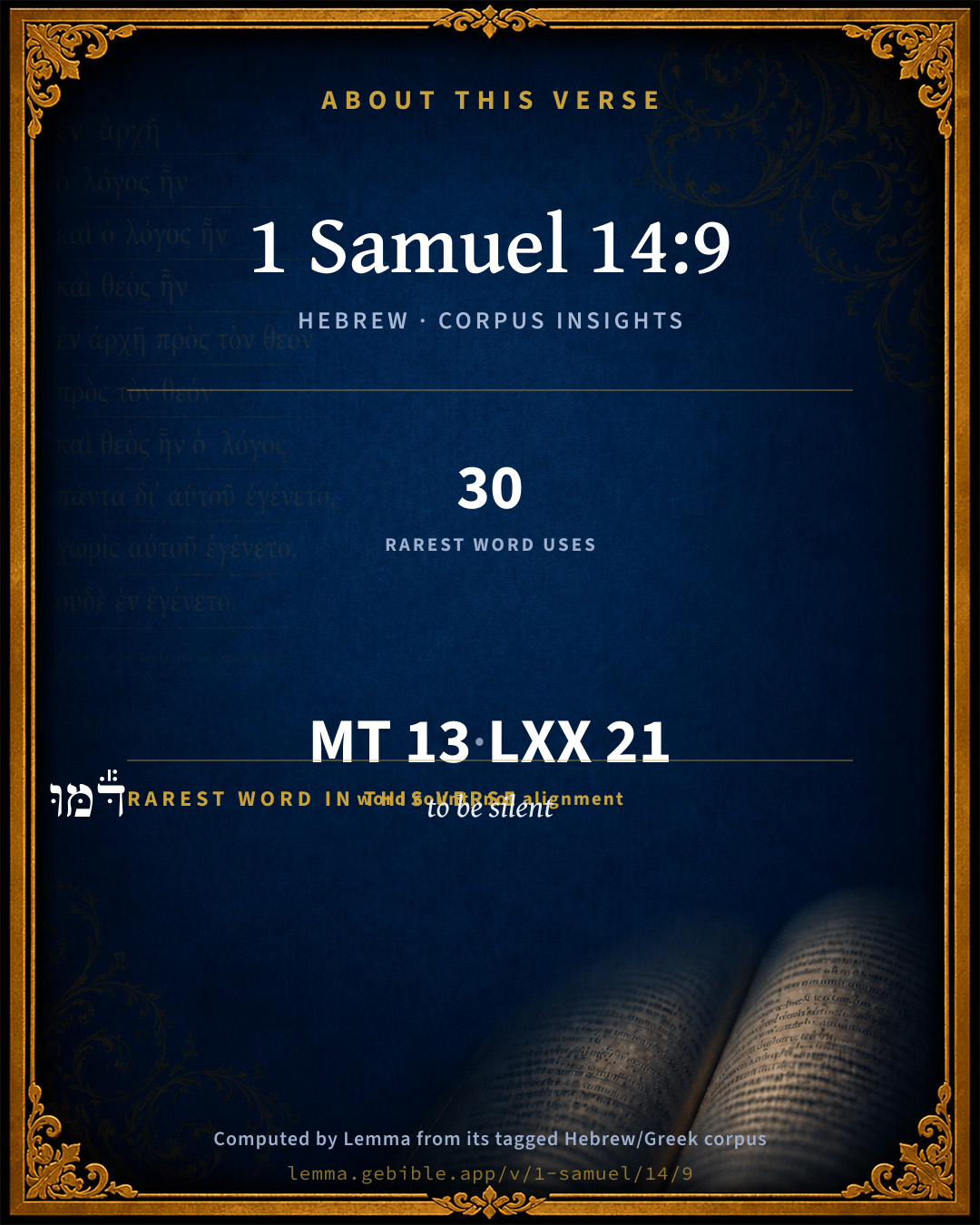
These counts appear in no published source. They are computed here, from the morphology-tagged text and Lemma’s own curated glosses. What Lemma adds →

13
words
11
distinct lemmas
Historical
section

Shared distinctive vocabulary

דֹּ֕מּוּ to be silent H1826 occurs in 29 verses of the Hebrew Bible. Also found in:

Grammatical profile

  • 5 verbs
  • 5 prepositions
  • 1 conjunction
  • 1 adverb
  • 1 particle

Verb forms

  • יֹֽאמְרוּ֙ Qal · Imperfect
  • דֹּ֕מּוּ Qal · Imperative
  • הַגִּיעֵ֖נוּ Hiphil · Infinitive Construct
  • וְעָמַ֣דְנוּ Qal · Sequential Perfect
  • נַעֲלֶ֖ה Qal · Imperfect

Repetition

A word recurs within this verse — often emphatic in Hebrew:

  • אֵלֵ֔ינוּ to H413 ×3

Hebrew & Septuagint length

In English translation the verse runs 27 words from the Hebrew and 30 from the Septuagint (LXX English) — closely comparable.

A rough comparison of the two English renderings, which tokenize alike — not a word-level alignment.

Word counts can differ between the Hebrew and the Greek without any difference in meaning — e.g. the Hebrew direct-object marker אֵת has no separate Greek word, and Greek often adds the article ὁ.

In the original languages it is 13 Hebrew tokens and 21 Greek tokens — but the two are counted differently (Hebrew bundles its prefixes and suffixes into one token; the Greek is in lemma form), so that isn’t a like-for-like length.

Cross-references

2

Topical passages linked to 1 Samuel 14:9 in the Treasury of Scripture Knowledge — connected by theme and wording, ordered by reader-vote popularity; previews shown in the World English Bible.

  • Genesis 24:13–14 Behold, I am standing by the spring of water. The daughters of the men of the city are coming out to draw water.
  • Judges 6:36–40 Gideon said to God, If you will save Israel by my hand, as you have spoken,

Cross-references courtesy of OpenBible.info (CC BY 4.0).

Hebrew and Greek witnesses Masoretic Hebrew ↔ Greek Septuagint

The same verse in the two great witnesses to the Old Testament, shown verse-for-verse.

These are two independent witnesses, not word-aligned to each other, and the Septuagint is shown in lemma (dictionary) form.

Hebrew 1 Samuel 14:9 Masoretic · Westminster Leningrad Codex

אִם כֹּ֤ה יֹֽאמְרוּ֙ אֵלֵ֔ינוּ דֹּ֕מּוּ עַד הַגִּיעֵ֖נוּ אֲלֵיכֶ֑ם וְעָמַ֣דְנוּ תַחְתֵּ֔ינוּ וְלֹ֥א נַעֲלֶ֖ה אֲלֵיהֶֽם

If they say thus to us, Wait until we come to you; then we will stand still in our place, and will not go up to them.

World English Bible · Public Domain

Greek LXX 1 Samuel 14:9 Septuagint · lemma form

ἐάν ὅδε εἶπον πρός ἐγώ ἀποἵστημι ἐκεῖ ἕως ἄν ἀποἀγγέλλω σύ καί ἵστημι ἐπί ἑαυτοῦ καί οὐ μή ἀναβαίνω ἐπί αὐτός

If they should say thus to us, Stand aloof there until we shall send you word; then we will stand still by ourselves, and will not go up against them.

LXX2012 (modern English Septuagint) · Public Domain

Hebrew: Westminster Leningrad Codex (CC BY 4.0). Greek: Septuagint (public domain); English from LXX2012 (modern English Septuagint) (Public Domain). How the Septuagint differs from the Hebrew →

Targum (Aramaic paraphrase)

1

The Targum is the ancient Jewish Aramaic paraphrase of the Hebrew Scriptures — an interpretive translation, not the Hebrew text itself. Onkelos (literal) and Pseudo-Jonathan (expansive) render the Torah, and Jonathan the Prophets. Coverage is partial: where no permissively-licensed English translation exists for a verse, only the Aramaic is shown. This is verse-level text, not a word-by-word alignment to the Hebrew.

  1. Targum Jonathan Prophets (Joshua–Malachi)
    אִם כְּדֵין יֵימְרוּן לָנָא אוֹרִיכוּ עַד דְנִתְמְטֵי לְוַתְכוֹן וּנְקוּם בְּאַתְרָנָא וְלָא נִיסַק לְוַתְהוֹן:

    (no public-domain English translation for this verse)

    Targum Jonathan — Aramaic: “Mikraot Gedolot” (public domain). English: “Sefaria Community Translation” (CC0 1.0 (public-domain dedication)); “London "Chaldee Paraphrase," 1871” (public domain). Text via Sefaria.

Commentary

Notes on 1 Samuel 14:9 from classic Christian and Jewish commentators (each source and its license shown beneath its notes). The classic Christian expositions comment on the surrounding passage and are grouped to its opening verse, so a note may address several verses; the Jewish commentaries on the Tanakh (Rashi and others) are per-verse, so they appear only where the commentator wrote on this verse.

Lemma curates 59 commentaries, every one of them public domain or Creative Commons licensed, each selected and text-cleaned for this edition rather than reprinted as found. About our sources →

Trapp's Complete Commentary

John Trapp

1Sa 14:9 If they say thus unto us, Tarry until we come to you; then we will stand still in our place, and will not go up unto them.

Ver. 9. If they say thus unto us.] This sign was Nec superstitiosum nec Dei tentativum, sed religiosum aeque ac animosum: it was given him in answer to his earnest prayer, saith Josephus, as was also that of Abraham’s servant. {Gen 24:13-14} So was not that of the Pazones in Herodotus, who warring upon the Perinthians, had this answer from the oracle, If the Perinthians call you by your name, and challenge you, then set upon them: as if otherwise, not: They did accordingly, and had the better. {a} Satan is God’s ape, as they say.

{a} Herod., lib. v. initio.

John Trapp, A Commentary or Exposition upon All the Books of the Old and New Testament (1647–1656) — public domain. Text from a community e-Sword module.

Geneva Bible (1599)

Geneva Bible translators

This he spake by the spirit of prophecy, forasmuch hereby God gave him assurance of the victory.

Geneva Bible (1599) marginal notes — public domain. Text via Bolls.life.

Jamieson, Fausset & Brown

Robert Jamieson, A. R. Fausset & David Brown

if they say, Come up unto us; then we will go up: for the Lord hath delivered them into our hand--When Jonathan appears here to prescribe a sign or token of God's will, we may infer that the same spirit which inspired this enterprise suggested the means of its execution, and put into his heart what to ask of God. (See on Gen 24:12).

Jamieson, Fausset & Brown — Commentary Critical and Explanatory on the Whole Bible (1871) — public domain (CC PDM 1.0). Text via the HelloAO Bible API.

Adam Clarke's Commentary

Verse 9. If they say thus unto us] Jonathan had no doubt asked this as a sign from God; exactly as Eliezer the servant of Abraham did, Ge 24:12.

Adam Clarke's Commentary on the Bible (1810–1826) — public domain. Text from a community e-Sword/MySword module.

John Gill's Exposition

If they say thus unto us,.... By this and what follows he gives his man a sign by which both might know how they should conduct themselves in this expedition, and what would be the issue, whether they should succeed or not: should they say,

tarry until we come to you; this, as it would express boldness in the men of the garrison, and show that they were ready to come out and fight, would portend evil, and then what they had to do was to be upon the defensive:

then we will stand still in our place; wait till they came to them, and make the best defence of themselves as they could, showing as little fear as possible, and not attempting to retreat and flee:

and will not go up unto them; neither go backwards nor forwards; not backward, which would show fear; nor forward, to expose themselves to too much danger from the garrison, they appearing to be bold and intrepid.

John Gill's Exposition of the Whole Bible (1746–1763) — public domain (CC PDM 1.0). Text via the HelloAO Bible API.

Whedon's Commentary on the Bible

Daniel D. Whedon

9. Then we will stand still — For if they come to us they will discover our hostile intentions.

Daniel D. Whedon (gen. ed.), Commentary on the Old and New Testaments (1874–1909) — public domain. Text from a community e-Sword module.

The Pulpit Commentary

Tarry. Hebrew, "be still," "stand still," the word used by Joshua of the sun; (Jos_10:12, Jos_10:13) but not the word rendered stand still just below, where the Hebrew has, "We will stand under us," i.e. we will stop just where we were.

The Pulpit Commentary (1880–1919), ed. H.D.M. Spence-Jones & Joseph S. Exell — public domain. Text from a community e-Sword module.

Rashi

Rabbi Shlomo Yitzchaki (Rashi)

Stop. Wait, as in, "Sun, wait [דּוֹם] in Givon," and as in, "Wait for." השם [The meaning here being] if they say, "Wait, and we will go up to you," they are presently successful and they are proud.

Rashi on the Tanakh — English translations: “The Judaica Press complete Tanach with Rashi, translated by A. J. Rosenberg” (CC BY 4.0); “Pentateuch with Rashi's commentary by M. Rosenbaum and A.M. Silbermann, 1929-1934” (public domain); “The Metsudah Tanach series, Lakewood, N.J” (CC BY 4.0); and “The Book of Joshua, Metsudah Publications, 1997” (CC BY 4.0). Text via Sefaria.

Lesson kit

Teaching starters — assembled from the data on this page, not authored interpretation. Every prompt links to the verse data it draws on. Edit before teaching.

1 Samuel, in the Historical, opens this verse with 13 words (11 distinct Hebrew lemmas). Its most distinctive word is dâmam (“to be silent”). A historical commentator’s framing appears above. Read the whole chapter for the surrounding context.

Discussion questions

  1. How does “to be silent” (dâmam) shape what this verse is saying?
  2. Exodus 15:16 shares the word «to be silent» with this verse. How do the two illuminate each other?
  3. “to” occurs 3× in this one verse. What is the effect of the repetition?
  4. These translations render this verse differently. What is at stake in choosing one wording over another?
  5. The verb «יֹֽאמְרוּ֙» is Qal Imperfect. How does its form color the action?
  6. Reading how Trapp's Complete Commentary and Geneva Bible (1599) read this verse, where do the two commentators agree and where do they part?

Things to notice

Reading settings

Reading text

Shown beneath each verse's original-language words.

Old Testament
Old Testament edition

Read the OT as the Masoretic Hebrew (MT) or the Greek Septuagint (LXX).

English shown for the Greek Septuagint (in the Hebrew ↔ Greek comparison).

Comparing translations? Open the Compare panel on any verse page to stack up to four side by side.