

2 Chronicles 26:20

Hebrew (Westminster Leningrad Codex) 2 Chronicles 26:20 appears in the Hebrew Old Testament. The text above is from the Westminster Leningrad Codex. Each word links to its Strong’s number, a concise gloss, and parsing drawn from the Open Scriptures Hebrew Bible morphology. Click any word for its full Brown-Driver-Briggs (BDB) entry.
Download image
Cite this verse

2 Chronicles 26:20 (World English Bible). Public Domain. Lemma interlinear Bible study tool, https://lemma.gebible.app/v/2-chronicles/26/20.

Show BibTeX & RIS
BibTeX
RIS
English Translation
Azariah the chief priest, and all the priests, looked on him, and, behold, he was leprous in his forehead, and they thrust him out quickly from there; yes, himself hurried also to go out, because Yahweh had struck him.
World English Bible · Public Domain
Highlights
  • 1 first appearance in the Hebrew Bible
Full analysis ↓
Download a study sheet

One document with this verse’s original text, its word-by-word gloss line, the meaning frame, cross-references with their text, attributed commentary, and full source and license credits — printable, and it pastes into notes with its structure intact.

This verse Autodidact and up

Study sheet (.html) Plain text (.txt)

A passage Seminary Student

Up to 50 verses in one chapter. A passage sheet keeps up to 6 commentary sources and 12 cross-references per verse, in the order this page ranks them, and says so on the sheet whenever that leaves anything out. Ask for a single verse and you get the Autodidact verse sheet above.

Everything on this page stays free to read, with no account — the sheet is a download of what is already on screen, not access to it.

Want to remove ads? Support Godless Engineer
Compare translations 3

The same verse in 3 English versions, stacked beneath the original-language interlinear above. Click any original word for its lexicon entry.

Each is an independent rendering of the whole verse — the interlinear is not word-aligned to these translations.

Highlighted words mark where these versions differ — a whole-verse word diff, not a word-by-word alignment.

  • World English Bible Public Domain
    Azariah the chief priest, and all the priests, looked on him, and, behold, he was leprous in his forehead, and they thrust him out quickly from there; yes, himself hurried also to go out, because Yahweh had struck him.
  • King James Version Public Domain
    And Azariah the chief priest, and all the priests, looked upon him, and, behold, he was leprous in his forehead, and they thrust him out from thence; yea, himself hasted also to go out, because the LORD had smitten him.
  • unfoldingWord Literal Text CC BY-SA 4.0
    And Azariah the head priest turned to him, and all the priests, and, behold, he was leprous on his forehead. And they hastened him from there. And also, he himself hastened to go out, for Yahweh afflicted him.

unfoldingWord Literal Text — © unfoldingWord, licensed CC BY-SA 4.0. Word-aligned USFM3 via Door43 (git.door43.org/unfoldingWord/en_ult).

Versions to compare (up to 4)

3 of 4 selected

Show all 18 translations

Every available English version of this verse, each an independent rendering of the whole verse.

  • World English Bible Public Domain
    Azariah the chief priest, and all the priests, looked on him, and, behold, he was leprous in his forehead, and they thrust him out quickly from there; yes, himself hurried also to go out, because Yahweh had struck him.
  • Berean Standard Bible Public Domain
    When Azariah the chief priest and all the priests turned to him and saw his leprous forehead, they rushed him out. Indeed, he himself hurried to get out, because the LORD had afflicted him.
  • Majority Standard Bible Public Domain
    When Azariah the chief priest and all the priests turned to him and saw his leprous forehead, they rushed him out. Indeed, he himself hurried to get out, because the LORD had afflicted him.
  • King James Version Public Domain
    And Azariah the chief priest, and all the priests, looked upon him, and, behold, he was leprous in his forehead, and they thrust him out from thence; yea, himself hasted also to go out, because the LORD had smitten him.
  • American Standard Version (1901) Public Domain
    And Azariah the chief priest, and all the priests, looked upon him, and, behold, he was leprous in his forehead, and they thrust him out quickly from thence; yea, himself hasted also to go out, because Jehovah had smitten him.
  • Revised Version (1885) Public Domain
    And Azariah the chief priest, and all the priests, looked upon him, and, behold, he was leprous in his forehead, and they thrust him out quickly from thence; yea, himself hasted also to go out, because the LORD had smitten him.
  • Geneva Bible (1599) Public Domain
    And when Azariah the chiefe Priest with al the Priestes looked vpon him, behold, he was leprous in his forehead, and they caused him hastily to depart thence: and he was euen compelled to go out, because the Lord had smitten him.
  • Douay-Rheims (1899) Public Domain
    And Azarias the high priest, and all the rest of the priests looked upon him, and saw the leprosy in his forehead, and they made haste to thrust him out. Yea himself also being frightened, hasted to go out, because he had quickly felt the stroke of the Lord.
  • Young's Literal Translation Public Domain
    And Azariah the head priest looketh unto him, and all the priests, and lo, he `is' leprous in his forehead, and they hasten him thence, and also he himself hath hastened to go out, for Jehovah hath plagued him.
  • Literal Standard Version CC BY-SA 4.0
    And Azariah the head priest looks toward him, and all the priests, and behold, he [is] leprous in his forehead, and they hurry him there, and also he himself has hurried to go out, for YHWH has plagued him.
  • Unlocked Literal Bible CC BY-SA 4.0
    Azariah the chief priest and all the priests looked at him, and, behold, he had become leprous on his forehead. They quickly drove him out of there. Indeed, he hurried to go out, because Yahweh had struck him.
  • unfoldingWord Literal Text CC BY-SA 4.0
    And Azariah the head priest turned to him, and all the priests, and, behold, he was leprous on his forehead. And they hastened him from there. And also, he himself hastened to go out, for Yahweh afflicted him.
  • Darby Bible Public Domain
    And Azariah the chief priest and all the priests looked upon him, and behold, he was leprous in his forehead, and they thrust him out from thence; even he himself hasted to go out, because Jehovah had smitten him.
  • World Messianic Bible Public Domain
    Azariah the chief priest and all the priests looked at him, and behold, he was leprous in his forehead; and they thrust him out quickly from there. Indeed, he himself also hurried to go out, because the LORD had struck him.
  • Webster's Bible Public Domain
    And Azariah the chief priest, and all the priests looked upon him, and behold, he was leprous in his forehead, and they thrust him out from thence; yea, himself hasted also to go out, because the LORD had smitten him.
  • Free Bible Version CC BY-SA 4.0
    When Azariah the chief priest and all the priests looked at him and saw the leprosy on his forehead, they rushed him out. In fact he too was in a hurry to leave, because the Lord had struck him.
  • Bible in Basic English Public Domain
    And Azariah, the chief priest, and all the priests, looking at him, saw the mark of the leper on his brow, and they sent him out quickly and he himself went out straight away, for the Lord's punishment had come on him.
  • JPS Tanakh (1917) Public Domain
    And Azariah the chief priest, and all the priests, looked upon him, and, behold, he was leprous in his forehead, and they thrust him out quickly from thence; yea, himself made haste also to go out, because the LORD had smitten him.

Literal Standard Version (2020), Covenant Press — licensed CC BY-SA 4.0. Text via the HelloAO Bible API (eBible.org). Unlocked Literal Bible (unfoldingWord) — licensed CC BY-SA 4.0. Text via the HelloAO Bible API (eBible.org). unfoldingWord Literal Text — © unfoldingWord, licensed CC BY-SA 4.0. Word-aligned USFM3 via Door43 (git.door43.org/unfoldingWord/en_ult). Free Bible Version, Dr. Jonathan Gallagher — licensed CC BY-SA 4.0. Text via the HelloAO Bible API (eBible.org).

Word by word

More ways to search: Search by grammar → Find every occurrence → Compare this word →

Practice this passage: Drill this verse → Learn its vocabulary →

נִדְחַ֣ף
dâchaph
H1765
“to hasten”
Verb, Niphal, Perfect, 3rd Person, Masculine, Singular
Part of Speech
Verb
Stem
Niphal
Form
Perfect
Person
3rd Person
Gender
Masculine
Number
Singular
Full BDB Definition

Origin: a primitive root

TWOT: 423

to drive on, hurry, hasten - (Qal) to hasten - (Niphal) to hasten oneself, hurry
  1. וַיִּ֣פֶן pânâh H6437 “and · to turn” Conjunction + Verb, Qal, Sequential Imperfect, 3rd Person, Masculine, Singular
  2. אֵלָ֡יו ʼêl H413 “to · him” Preposition + Suffix, Personal, 3rd Person, Masculine, Singular
  3. עֲזַרְיָהוּ֩ ʻĂzaryâh H5838 “Azariah” Noun, Proper
  4. כֹהֵ֨ן kôhên H3548 “priest of” Noun, Common, Masculine, Singular, Construct
  5. הָרֹ֜אשׁ rôʼsh H7218 “the · head” Particle, Definite Article + Noun, Common, Masculine, Singular, Absolute
  6. וְכָל kôl H3605 “and · all of” Conjunction + Noun, Common, Masculine, Singular, Construct
  7. הַכֹּהֲנִ֗ים kôhên H3548 “the · priests” Particle, Definite Article + Noun, Common, Masculine, Plural, Absolute
  8. וְהִנֵּה hinnêh H2009 “and · behold” Conjunction + Particle, Demonstrative
  9. ה֤וּא hûwʼ H1931 “he” Pronoun, Personal, 3rd Person, Masculine, Singular
  10. מְצֹרָע֙ tsâraʻ H6879 “leprous” Verb, Pual, Participle Passive, Masculine, Singular, Absolute
  11. בְּמִצְח֔וֹ mêtsach H4696 “in/at · forehead · his” Preposition + Noun, Common, Masculine, Singular, Construct + Suffix, Personal, 3rd Person, Masculine, Singular
  12. וַיַּבְהִל֖וּהוּ bâhal H926 “and · to terrify · him” Conjunction + Verb, Hiphil, Sequential Imperfect, 3rd Person, Masculine, Plural + Suffix, Personal, 3rd Person, Masculine, Singular
  13. מִשָּׁ֑ם shâm H8033 “from · there” Preposition + Adverb
  14. וְגַם gam H1571 “and · also” Conjunction + Particle, Accusative
  15. הוּא֙ hûwʼ H1931 “he” Pronoun, Personal, 3rd Person, Masculine, Singular
  16. לָצֵ֔את yâtsâʼ H3318 “to go out” Preposition + Verb, Qal, Infinitive Construct
  17. כִּ֥י kîy H3588 “that” Conjunction
  18. נִגְּע֖וֹ nâgaʻ H5060 “to touch · him” Verb, Piel, Perfect, 3rd Person, Masculine, Singular + Suffix, Personal, 3rd Person, Masculine, Singular
  19. יְהוָֽה Yᵉhôvâh H3068 “LORD” Noun, Proper

About this verse

These counts appear in no published source. They are computed here, from the morphology-tagged text and Lemma’s own curated glosses. What Lemma adds →

20
words
18
distinct lemmas
Historical
section

Notable vocabulary

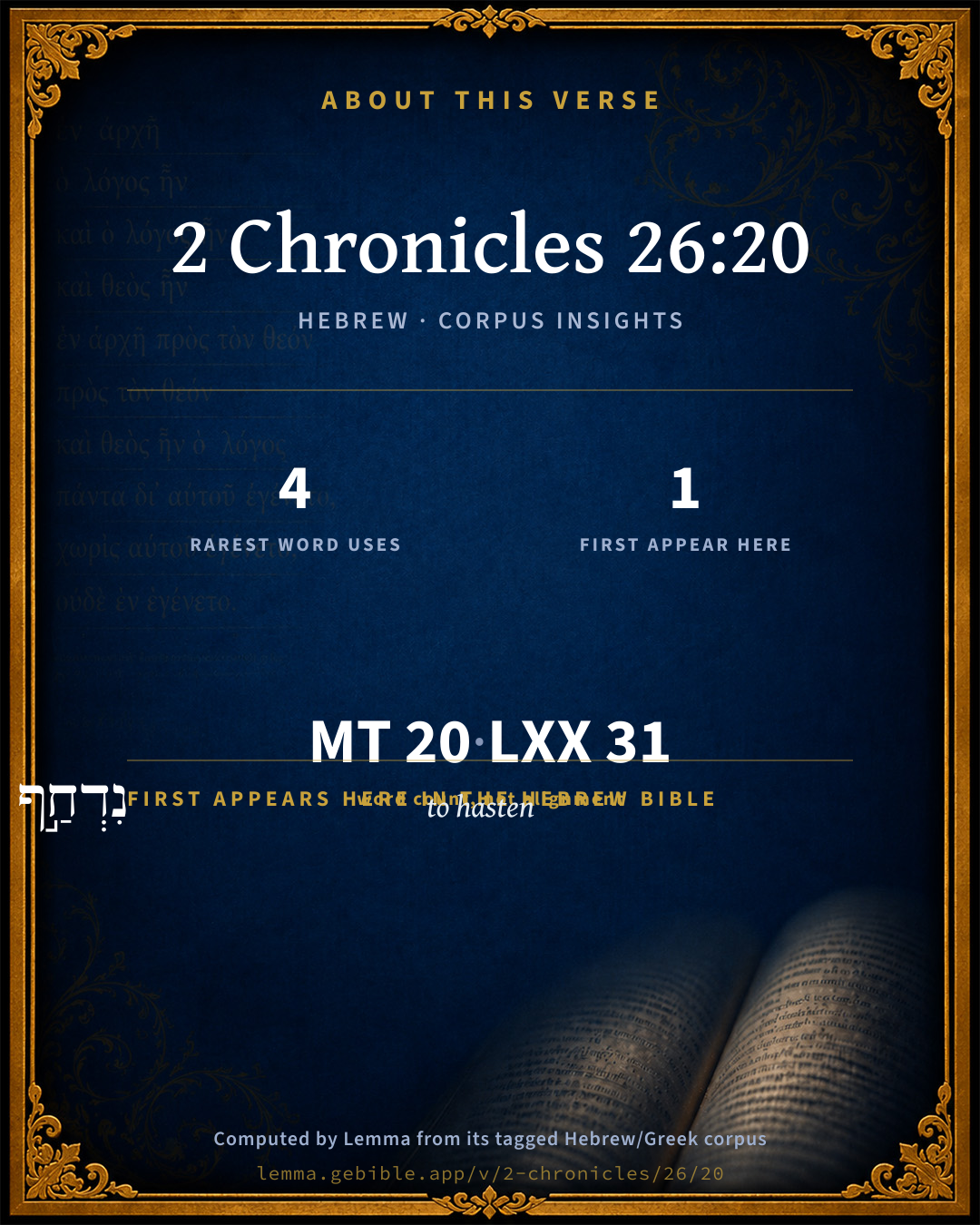
The rarest word here is נִדְחַ֣ף to hasten H1765 — appearing just 4 times in the whole Hebrew Bible.

First appearance in Scripture

This word makes its first canonical appearance in the Hebrew Bible here:

  • נִדְחַ֣ף to hasten H1765

Shared distinctive vocabulary

נִדְחַ֣ף to hasten H1765 occurs in 4 verses of the Hebrew Bible. Also found in:

Grammatical profile

  • 6 verbs
  • 7 nouns
  • 2 pronouns
  • 1 preposition
  • 1 conjunction
  • 1 adverb
  • 2 particles

Verb forms

  • וַיִּ֣פֶן Qal · Sequential Imperfect
  • מְצֹרָע֙ Pual · Participle Passive
  • וַיַּבְהִל֖וּהוּ Hiphil · Sequential Imperfect
  • נִדְחַ֣ף Niphal · Perfect
  • לָצֵ֔את Qal · Infinitive Construct
  • נִגְּע֖וֹ Piel · Perfect

Repetition

Words recur within this verse — often emphatic in Hebrew:

  • כֹהֵ֨ן priest H3548 ×2
  • ה֤וּא he H1931 ×2

Hebrew & Septuagint length

In English translation the verse runs 39 words from the Hebrew and 42 from the Septuagint (LXX English) — closely comparable.

A rough comparison of the two English renderings, which tokenize alike — not a word-level alignment.

Word counts can differ between the Hebrew and the Greek without any difference in meaning — e.g. the Hebrew direct-object marker אֵת has no separate Greek word, and Greek often adds the article ὁ.

In the original languages it is 20 Hebrew tokens and 31 Greek tokens — but the two are counted differently (Hebrew bundles its prefixes and suffixes into one token; the Greek is in lemma form), so that isn’t a like-for-like length.

Cross-references

4

Topical passages linked to 2 Chronicles 26:20 in the Treasury of Scripture Knowledge — connected by theme and wording, ordered by reader-vote popularity; previews shown in the World English Bible.

  • Leviticus 14:34 "When you have come into the land of Canaan, which I give to you for a possession, and I put a spreading mildew in a house in the land of your possession,
  • Deuteronomy 28:22 Yahweh will strike you with consumption, and with fever, and with inflammation, and with fiery heat, and with the sword, and with blasting, and with mildew; and they shall pursue you until you perish.
  • Deuteronomy 28:35 Yahweh will strike you in the knees, and in the legs, with a sore boil, of which you can not be healed, from the sole of your foot to the crown of your head.
  • Esther 6:12 Mordecai came again to the king's gate. But Haman hurried to his house, mourning and having his head covered.

Cross-references courtesy of OpenBible.info (CC BY 4.0).

Hebrew and Greek witnesses Masoretic Hebrew ↔ Greek Septuagint

The same verse in the two great witnesses to the Old Testament, shown verse-for-verse.

These are two independent witnesses, not word-aligned to each other, and the Septuagint is shown in lemma (dictionary) form.

Hebrew 2 Chronicles 26:20 Masoretic · Westminster Leningrad Codex

וַיִּ֣פֶן אֵלָ֡יו עֲזַרְיָהוּ֩ כֹהֵ֨ן הָרֹ֜אשׁ וְכָל הַכֹּהֲנִ֗ים וְהִנֵּה ה֤וּא מְצֹרָע֙ בְּמִצְח֔וֹ וַיַּבְהִל֖וּהוּ מִשָּׁ֑ם וְגַם הוּא֙ נִדְחַ֣ף לָצֵ֔את כִּ֥י נִגְּע֖וֹ יְהוָֽה

Azariah the chief priest, and all the priests, looked on him, and, behold, he was leprous in his forehead, and they thrust him out quickly from there; yes, himself hurried also to go out, because Yahweh had struck him.

World English Bible · Public Domain

Greek LXX 2 Chronicles 26:20 Septuagint · lemma form

καί ἐπιστρέφω ἐπί αὐτός ὁ ἱερεύς ὁ πρῶτος καί ὁ ἱερεύς καί ἰδού αὐτός λεπρός ἐν ὁ μέτωπον καί κατασπεύδω αὐτός ἐκεῖθεν καί γάρ αὐτός σπεύδω ἐκἔρχομαι ὅτι ἐλέγχω αὐτός κύριος

And Azarias the chief priest, and the other priests, turned to look at him, and, behold, he was leprous in his forehead; and they got him hastily out thence, for he also hasted to go out, because the Lord had rebuked him.

LXX2012 (modern English Septuagint) · Public Domain

On this verse, Ellicott's Commentary for English Readers discusses the Septuagint’s reading. Read the note in Commentary ↓

Hebrew: Westminster Leningrad Codex (CC BY 4.0). Greek: Septuagint (public domain); English from LXX2012 (modern English Septuagint) (Public Domain). How the Septuagint differs from the Hebrew →

Commentary

Notes on 2 Chronicles 26:20 from classic Christian and Jewish commentators (each source and its license shown beneath its notes). The classic Christian expositions comment on the surrounding passage and are grouped to its opening verse, so a note may address several verses; the Jewish commentaries on the Tanakh (Rashi and others) are per-verse, so they appear only where the commentator wrote on this verse.

Lemma curates 59 commentaries, every one of them public domain or Creative Commons licensed, each selected and text-cleaned for this edition rather than reprinted as found. About our sources →

Trapp's Complete Commentary

John Trapp

2Ch 26:20 And Azariah the chief priest, and all the priests, looked upon him, and, behold, he [was] leprous in his forehead, and they thrust him out from thence; yea, himself hasted also to go out, because the LORD had smitten him.

Ver. 20. Yea, he himself also hasted.] As Est 6:12.

John Trapp, A Commentary or Exposition upon All the Books of the Old and New Testament (1647–1656) — public domain. Text from a community e-Sword module.

Joseph Benson's Commentary

2Ch 26:20. They thrust him out from thence — Not by force, which needed not, for he voluntarily hasted away, as it follows; but by vehement persuasions and denunciations of God’s further judgments upon him, if he did not depart.

Joseph Benson's Commentary on the Old and New Testaments (1811–1818) — public domain. Text from a community e-Sword module.

Adam Clarke's Commentary

Verse 20. Because the Lord had smitten him.] "Because the WORD of the Lord had brought the plague upon him." - T.

Adam Clarke's Commentary on the Bible (1810–1826) — public domain. Text from a community e-Sword/MySword module.

Ellicott's Commentary for English Readers

(20) Looked upon him.—Turned towards him.

They thrust him out.—Hibhîl—scared, hurried him out. (Comp. Est_6:14, “they made haste.”) LXX., κατέσπευσαν αὐτὸν ἐκεῖθεν.

Hasted.—Literally, thrust himself. The Hebrew is a late word occurring thrice in Esther, and not elsewhere.

The Lord had smitten him.—2Ki_14:5.

A Bible Commentary for English Readers, edited by Charles John Ellicott (1878–1897) — public domain. Text from a community e-Sword module.

The Cambridge Bible for Schools and Colleges

gen. ed. J. J. S. Perowne

20. thrust him out] R.V. thrust him out quickly.

the Lord had smitten him] So 2Ki_15:5.

The Cambridge Bible for Schools and Colleges (gen. ed. J. J. S. Perowne; Cambridge University Press, 1878–1918) — public domain. Text from a community e-Sword module.

John Gill's Exposition

Now the rest of the acts of Uzziah, first and last,.... What were done by him, both in the beginning and latter end of his reign:

did Isaiah the prophet, the son of Amoz, write: not in his own prophecy, but in the history of his own times, which was usual for every prophet to write, though now lost, see Kg2 15:6.

John Gill's Exposition of the Whole Bible (1746–1763) — public domain (CC PDM 1.0). Text via the HelloAO Bible API.

Albert Barnes' Notes on the Bible

Death was denounced by the Law against those who invaded the office of the priest; and death had been the actual punishment of Korah and his company. Uzziah feared lest from him also the extreme penalty should be exacted, and therefore hasted to quit the sacred building where his bare presence was a capital crime.

Albert Barnes' Notes on the Bible (1834–1885) — public domain. Text from a community e-Sword/MySword module.

Matthew Poole's English Annotations

They thrust him out; not by force, as was noted on 2Ch 26:18, which needed not, for he voluntarily hasted away, as it follows; but by vehement persuasions and denunciations of God’s further judgments upon him, if he did not depart. Some suppose that the earthquake, mentioned Amo 1:1; Zec 14:5, happened upon this occasion, as another token of God’s displeasure against this unparalled arrogancy.

Matthew Poole's English Annotations on the Holy Bible (1683–1685) — public domain. Text from a community e-Sword/MySword module.

The Pulpit Commentary

They thrust him out. This hiph. conjugation of kal lhB; does not point to the force adopted, but to the trembling anxiety with which, for horror"s sake of such a monstrous catastrophe, as a leper by the altar and with a censer in his hand, etc., the priests urged him out. Evidently, from the next clause, no great force in the ordinary sense was needed. Yea, himself hasted. The Hebrew verb is niph. conjugation of pjd; It is interesting to note that this root occurs only here and three times in Esther, viz. 3:15; 6:12; 8:14. Uzziah can scarcely have been ignorant that he had been daring the utmost penalty of the Law. (Num_16:31, 35 18:7)

The Pulpit Commentary (1880–1919), ed. H.D.M. Spence-Jones & Joseph S. Exell — public domain. Text from a community e-Sword module.

John Wesley's Explanatory Notes

Thrust - Not by force, which needed not, for he voluntarily hasted away, as it follows; but by vehement persuasions and denunciations of God's farther judgments upon him, if he did not depart.

John Wesley, Explanatory Notes Upon the Whole Bible (1754–1765) — public domain. Text via the GEBible commentary corpus.

Lesson kit

Teaching starters — assembled from the data on this page, not authored interpretation. Every prompt links to the verse data it draws on. Edit before teaching.

2 Chronicles, in the Historical, opens this verse with 20 words (18 distinct Hebrew lemmas). Its most distinctive word is dâchaph (“to hasten”). A historical commentator’s framing appears above. Read the whole chapter for the surrounding context.

Discussion questions

  1. How does “to hasten” (dâchaph) shape what this verse is saying?
  2. The word “to hasten” first appears here in Scripture. What is being introduced at this debut?
  3. Esther 3:15 shares the word «to hasten» with this verse. How do the two illuminate each other?
  4. “priest” occurs 2× in this one verse. What is the effect of the repetition?
  5. These translations render this verse differently; the difference is in the English rendering, not the original. What questions does that raise?
  6. The verb «וַיִּ֣פֶן» is Qal Sequential Imperfect. How does its form color the action?
  7. Reading how Trapp's Complete Commentary and Joseph Benson's Commentary read this verse, where do the two commentators agree and where do they part?

Things to notice

Reading settings

Reading text

Shown beneath each verse's original-language words.

Old Testament
Old Testament edition

Read the OT as the Masoretic Hebrew (MT) or the Greek Septuagint (LXX).

English shown for the Greek Septuagint (in the Hebrew ↔ Greek comparison).

Comparing translations? Open the Compare panel on any verse page to stack up to four side by side.