
Judges 20:41

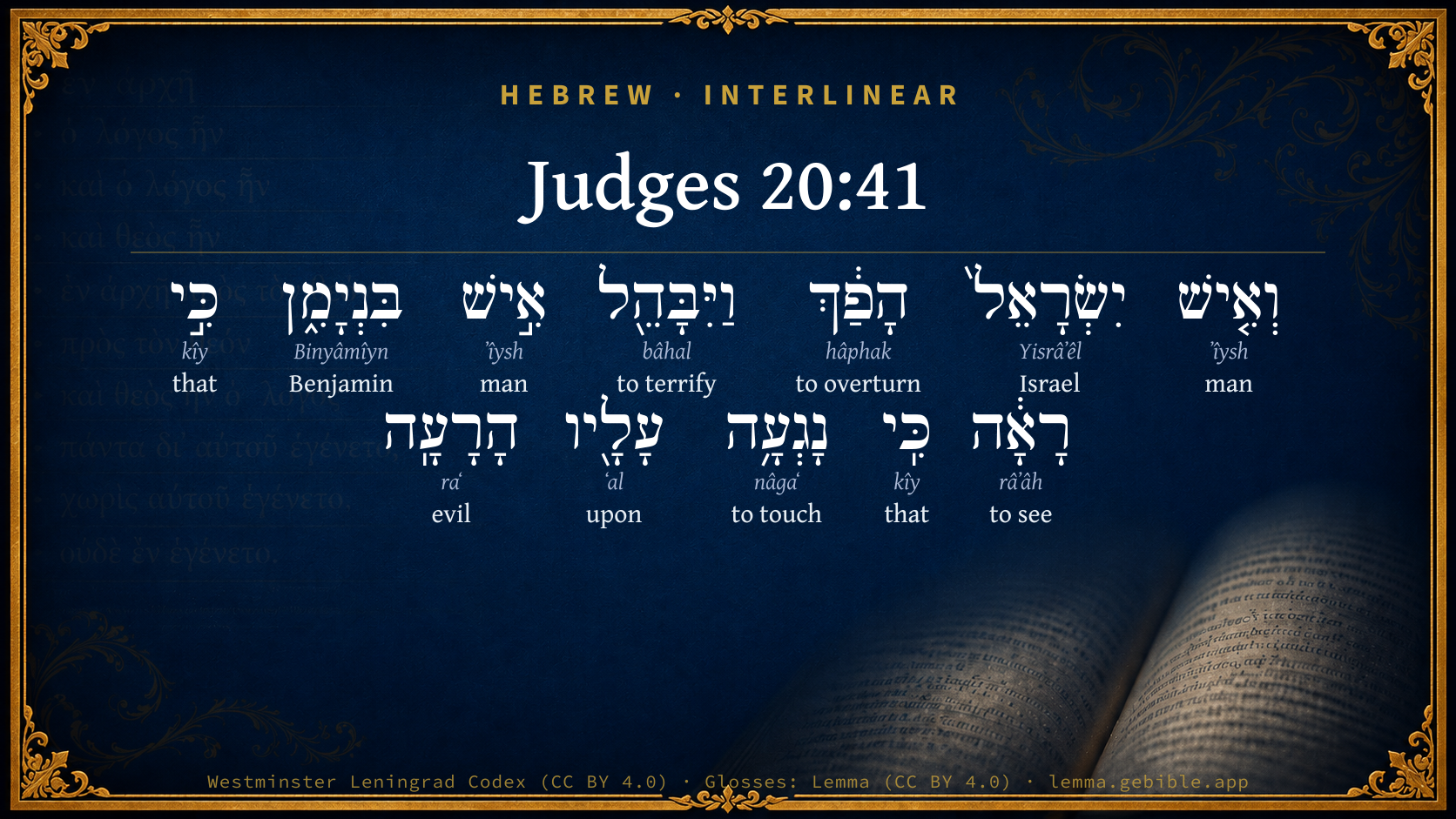
Hebrew (Westminster Leningrad Codex) Judges 20:41 appears in the Hebrew Old Testament. The text above is from the Westminster Leningrad Codex. Each word links to its Strong’s number, a concise gloss, and parsing drawn from the Open Scriptures Hebrew Bible morphology. Click any word for its full Brown-Driver-Briggs (BDB) entry.
Download image
Cite this verse

Judges 20:41 (World English Bible). Public Domain. Lemma interlinear Bible study tool, https://lemma.gebible.app/v/judges/20/41.

Show BibTeX & RIS
BibTeX
RIS
English Translation
The men of Israel turned, and the men of Benjamin were dismayed; for they saw that evil had come on them.
World English Bible · Public Domain
Download a study sheet

One document with this verse’s original text, its word-by-word gloss line, the meaning frame, cross-references with their text, attributed commentary, and full source and license credits — printable, and it pastes into notes with its structure intact.

This verse Autodidact and up

Study sheet (.html) Plain text (.txt)

A passage Seminary Student

Up to 50 verses in one chapter. A passage sheet keeps up to 6 commentary sources and 12 cross-references per verse, in the order this page ranks them, and says so on the sheet whenever that leaves anything out. Ask for a single verse and you get the Autodidact verse sheet above.

Everything on this page stays free to read, with no account — the sheet is a download of what is already on screen, not access to it.

Want to remove ads? Support Godless Engineer
Compare translations 3

The same verse in 3 English versions, stacked beneath the original-language interlinear above. Click any original word for its lexicon entry.

Each is an independent rendering of the whole verse — the interlinear is not word-aligned to these translations.

Highlighted words mark where these versions differ — a whole-verse word diff, not a word-by-word alignment.

  • World English Bible Public Domain
    The men of Israel turned, and the men of Benjamin were dismayed; for they saw that evil had come on them.
  • King James Version Public Domain
    And when the men of Israel turned again, the men of Benjamin were amazed: for they saw that evil was come upon them.
  • unfoldingWord Literal Text CC BY-SA 4.0
    And a man of Israel turned, and a man of Benjamin was alarmed, for he saw that harm had touched upon him.

unfoldingWord Literal Text — © unfoldingWord, licensed CC BY-SA 4.0. Word-aligned USFM3 via Door43 (git.door43.org/unfoldingWord/en_ult).

Versions to compare (up to 4)

3 of 4 selected

Show all 18 translations

Every available English version of this verse, each an independent rendering of the whole verse.

  • World English Bible Public Domain
    The men of Israel turned, and the men of Benjamin were dismayed; for they saw that evil had come on them.
  • Berean Standard Bible Public Domain
    Then the men of Israel turned back on them, and the men of Benjamin were terrified when they realized that disaster had come upon them.
  • Majority Standard Bible Public Domain
    Then the men of Israel turned back on them, and the men of Benjamin were terrified when they realized that disaster had come upon them.
  • King James Version Public Domain
    And when the men of Israel turned again, the men of Benjamin were amazed: for they saw that evil was come upon them.
  • American Standard Version (1901) Public Domain
    And the men of Israel turned, and the men of Benjamin were dismayed; for they saw that evil was come upon them.
  • Revised Version (1885) Public Domain
    And the men of Israel turned, and the men of Benjamin were amazed: for they saw that evil was come upon them.
  • Geneva Bible (1599) Public Domain
    Then the men of Israel turned againe, and the men of Beniamin were astonied: for they saw that euill was neere vnto them.
  • Douay-Rheims (1899) Public Domain
    They that before had made as if they fled, turning their faces stood bravely against them; which the children of Benjamin seeing, turned their backs,
  • Young's Literal Translation Public Domain
    And the men of Israel have turned, and the men of Benjamin are troubled, for they have seen that the evil hath stricken against them --
  • Literal Standard Version CC BY-SA 4.0
    And the men of Israel have turned, and the men of Benjamin are troubled, for they have seen that the calamity has struck against them—
  • Unlocked Literal Bible CC BY-SA 4.0
    Then the people of Israel turned against them. The men of Benjamin were terrified, for they saw that disaster had come on them.
  • unfoldingWord Literal Text CC BY-SA 4.0
    And a man of Israel turned, and a man of Benjamin was alarmed, for he saw that harm had touched upon him.
  • Darby Bible Public Domain
    Then the men of Israel turned, and the men of Benjamin were dismayed, for they saw that disaster was close upon them.
  • World Messianic Bible Public Domain
    The men of Israel turned, and the men of Benjamin were dismayed; for they saw that disaster had come on them.
  • Webster's Bible Public Domain
    And when the men of Israel turned again, the men of Benjamin were amazed: for they saw that evil had come upon them.
  • Free Bible Version CC BY-SA 4.0
    they turned on their enemies. The Benjamites were horrified when they saw it and realized they were doomed.
  • Bible in Basic English Public Domain
    And the men of Israel had made a turn about, and the men of Benjamin were overcome with fear, for they saw that evil had overtaken them.
  • JPS Tanakh (1917) Public Domain
    And the men of Israel turned, and the men of Benjamin were amazed; for they saw that evil was come upon them.

Literal Standard Version (2020), Covenant Press — licensed CC BY-SA 4.0. Text via the HelloAO Bible API (eBible.org). Unlocked Literal Bible (unfoldingWord) — licensed CC BY-SA 4.0. Text via the HelloAO Bible API (eBible.org). unfoldingWord Literal Text — © unfoldingWord, licensed CC BY-SA 4.0. Word-aligned USFM3 via Door43 (git.door43.org/unfoldingWord/en_ult). Free Bible Version, Dr. Jonathan Gallagher — licensed CC BY-SA 4.0. Text via the HelloAO Bible API (eBible.org).

Word by word

More ways to search: Search by grammar → Find every occurrence → Compare this word →

Practice this passage: Drill this verse → Learn its vocabulary →

וַיִּבָּהֵ֖ל
bâhal
H926
“and · to terrify”
Conjunction + Verb, Niphal, Sequential Imperfect, 3rd Person, Masculine, Singular
Part of Speech
Conjunction + Verb
Stem
Niphal
Form
Sequential Imperfect
Person
3rd Person
Gender
Masculine
Number
Singular
Full BDB Definition

Origin: a primitive root

TWOT: 207

to disturb, alarm, terrify, hurry, be disturbed, be anxious, be afraid, be hurried, be nervous - (Niphal) - to be disturbed, dismayed, terrified, anxious - to be in haste, be hasty - (Piel) - to make haste, act hastily, be hurried, be hastened - to dismay, terrify - (Pual) - to hasten - hastened, hastily gained (participle) - (Hiphil) - to hasten, hurry, make haste - to dismay, terrify
  1. וְאִ֤ישׁ ʼîysh H376 “and · man of” Conjunction + Noun, Common, Masculine, Singular, Construct
  2. יִשְׂרָאֵל֙ Yisrâʼêl H3478 “Israel” Noun, Proper
  3. הָפַ֔ךְ hâphak H2015 “to overturn” Verb, Qal, Perfect, 3rd Person, Masculine, Singular
  4. אִ֣ישׁ ʼîysh H376 “man of” Noun, Common, Masculine, Singular, Construct
  5. בִּנְיָמִ֑ן Binyâmîyn H1144 “Benjamin” Noun, Proper
  6. כִּ֣י kîy H3588 “that” Conjunction
  7. רָאָ֔ה râʼâh H7200 “to see” Verb, Qal, Perfect, 3rd Person, Masculine, Singular
  8. כִּֽי kîy H3588 “that” Conjunction
  9. נָגְעָ֥ה nâgaʻ H5060 “to touch” Verb, Qal, Perfect, 3rd Person, Feminine, Singular
  10. עָלָ֖יו ʻal H5921 “upon · him” Preposition + Suffix, Personal, 3rd Person, Masculine, Singular
  11. הָרָעָֽה raʻ H7451 “the · evil” Particle, Definite Article + Noun, Common, Feminine, Singular, Absolute

About this verse

These counts appear in no published source. They are computed here, from the morphology-tagged text and Lemma’s own curated glosses. What Lemma adds →

12
words
10
distinct lemmas
Historical
section

Shared distinctive vocabulary

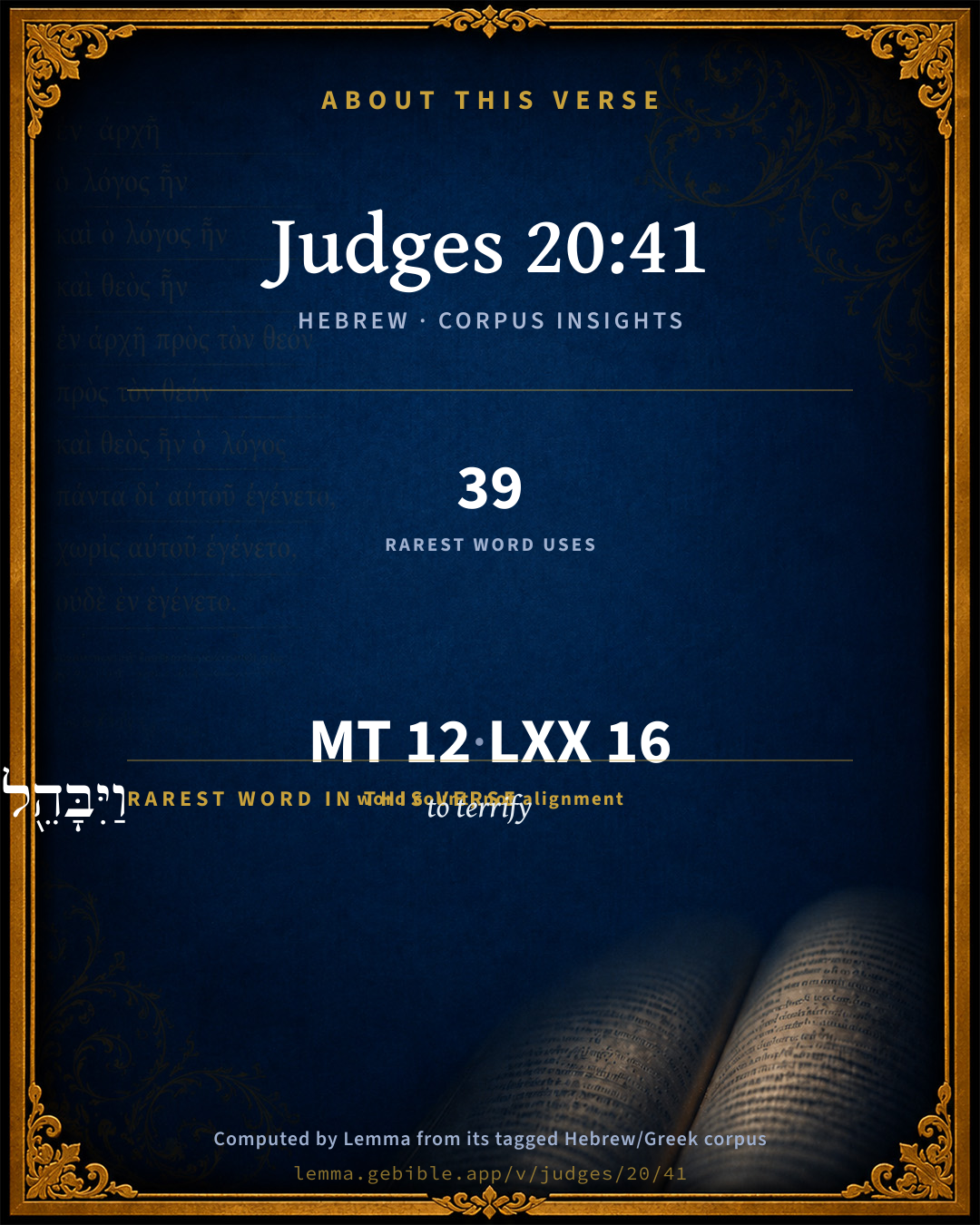
וַיִּבָּהֵ֖ל to terrify H926 occurs in 39 verses of the Hebrew Bible. Also found in:

Grammatical profile

  • 4 verbs
  • 5 nouns
  • 1 preposition
  • 2 conjunctions

Verb forms

  • הָפַ֔ךְ Qal · Perfect
  • וַיִּבָּהֵ֖ל Niphal · Sequential Imperfect
  • רָאָ֔ה Qal · Perfect
  • נָגְעָ֥ה Qal · Perfect

Repetition

Words recur within this verse — often emphatic in Hebrew:

  • וְאִ֤ישׁ man H376 ×2
  • כִּ֣י that H3588 ×2

Hebrew & Septuagint length

In English translation the verse runs 21 words from the Hebrew and 22 from the Septuagint (LXX English) — closely comparable.

A rough comparison of the two English renderings, which tokenize alike — not a word-level alignment.

Word counts can differ between the Hebrew and the Greek without any difference in meaning — e.g. the Hebrew direct-object marker אֵת has no separate Greek word, and Greek often adds the article ὁ.

In the original languages it is 12 Hebrew tokens and 16 Greek tokens — but the two are counted differently (Hebrew bundles its prefixes and suffixes into one token; the Greek is in lemma form), so that isn’t a like-for-like length.

Cross-references

9

Topical passages linked to Judges 20:41 in the Treasury of Scripture Knowledge — connected by theme and wording, ordered by reader-vote popularity; previews shown in the World English Bible.

  • Luke 17:27–28 They ate, they drank, they married, they were given in marriage, until the day that Noah entered into the ark, and the flood came, and destroyed them all.
  • Luke 21:26 men fainting for fear, and for expectation of the things which are coming on the world: for the powers of the heavens will be shaken.
  • 1 Thessalonians 5:3 For when they are saying, "Peace and safety," then sudden destruction will come on them, like birth pains on a pregnant woman; and they will in no way escape.
  • 2 Peter 2:12 But these, as unreasoning creatures, born natural animals to be taken and destroyed, speaking evil in matters about which they are ignorant, will in their destroying surely be destroyed,
  • Exodus 15:9–10 The enemy said, 'I will pursue, I will overtake, I will divide the spoil. My desire shall be satisfied on them. I will draw my sword, my hand shall destroy them.'
  • Isaiah 13:8–9 and they shall be dismayed; pangs and sorrows shall take hold [of them]; they shall be in pain as a woman in travail: they shall look in amazement one at another; their faces [shall be] faces of flame.
  • Isaiah 33:14 The sinners in Zion are afraid; trembling has seized the godless ones: Who among us can dwell with the devouring fire? who among us can dwell with everlasting burning?
  • Revelation 6:15–17 The kings of the earth, the princes, the commanding officers, the rich, the strong, and every slave and free person, hid themselves in the caves and in the rocks of the mountains.
  • Revelation 18:8–10 Therefore in one day her plagues will come: death, mourning, and famine; and she will be utterly burned with fire; for the Lord God who has judged her is strong.

Cross-references courtesy of OpenBible.info (CC BY 4.0).

Hebrew and Greek witnesses Masoretic Hebrew ↔ Greek Septuagint

The same verse in the two great witnesses to the Old Testament, shown verse-for-verse.

These are two independent witnesses, not word-aligned to each other, and the Septuagint is shown in lemma (dictionary) form.

Hebrew Judges 20:41 Masoretic · Westminster Leningrad Codex

וְאִ֤ישׁ יִשְׂרָאֵל֙ הָפַ֔ךְ וַיִּבָּהֵ֖ל אִ֣ישׁ בִּנְיָמִ֑ן כִּ֣י רָאָ֔ה כִּֽי נָגְעָ֥ה עָלָ֖יו הָרָעָֽה

The men of Israel turned, and the men of Benjamin were dismayed; for they saw that evil had come on them.

World English Bible · Public Domain

Greek LXX Judges 20:41 Septuagint · lemma form

καί ἀνήρ ἰσραήλ ἐπιστρέφω καί σπεύδω ἀνήρ βενιαμίν ὅτι ὁράω ὅτι συνἀντάω ἐπί αὐτός ὁ πονηρία

And the men of Israel turned back, and the men of Benjamin hasted, because they saw that evil had come upon them.

LXX2012 (modern English Septuagint) · Public Domain

Hebrew: Westminster Leningrad Codex (CC BY 4.0). Greek: Septuagint (public domain); English from LXX2012 (modern English Septuagint) (Public Domain). How the Septuagint differs from the Hebrew →

Targum (Aramaic paraphrase)

1

The Targum is the ancient Jewish Aramaic paraphrase of the Hebrew Scriptures — an interpretive translation, not the Hebrew text itself. Onkelos (literal) and Pseudo-Jonathan (expansive) render the Torah, and Jonathan the Prophets. Coverage is partial: where no permissively-licensed English translation exists for a verse, only the Aramaic is shown. This is verse-level text, not a word-by-word alignment to the Hebrew.

  1. Targum Jonathan Prophets (Joshua–Malachi)
    וֶאֱנַשׁ יִשְׂרָאֵל אִתְחַזֵר וְאִתְבְּהֵיל אֱנַשׁ בִּנְיָמִין אֲרֵי חֲזָא אֲרֵי קְרִיבַת דִתֵיתֵי לְהוֹן בִּישְׁתָּא:

    (no public-domain English translation for this verse)

    Targum Jonathan — Aramaic: “Mikraot Gedolot” (public domain). English: “Sefaria Community Translation” (CC0 1.0 (public-domain dedication)); “London "Chaldee Paraphrase," 1871” (public domain). Text via Sefaria.

Commentary

Notes on Judges 20:41 from classic Christian and Jewish commentators (each source and its license shown beneath its notes). The classic Christian expositions comment on the surrounding passage and are grouped to its opening verse, so a note may address several verses; the Jewish commentaries on the Tanakh (Rashi and others) are per-verse, so they appear only where the commentator wrote on this verse.

Lemma curates 59 commentaries, every one of them public domain or Creative Commons licensed, each selected and text-cleaned for this edition rather than reprinted as found. About our sources →

Trapp's Complete Commentary

John Trapp

Jdg 20:41 Evll was come upon them.] Heb., Touched them; that they were lost.

Ver. 41. Evll was come upon them.] Heb., Touched them; that they were lost.

John Trapp, A Commentary or Exposition upon All the Books of the Old and New Testament (1647–1656) — public domain. Text from a community e-Sword module.

Geneva Bible (1599)

Geneva Bible translators

And withstood their enemies.

Geneva Bible (1599) marginal notes — public domain. Text via Bolls.life.

Ellicott's Commentary for English Readers

(41) And when the men of Israel turned again.—Another detail of the rally described in Jdg_20:33, and its effect (Jdg_20:34).

A Bible Commentary for English Readers, edited by Charles John Ellicott (1878–1897) — public domain. Text from a community e-Sword module.

The Cambridge Bible for Schools and Colleges

gen. ed. J. J. S. Perowne

41. amazed] An archaism in English, for bewildered; cf. St Mar_10:32, 1Pe_3:6 (AV., contrast RV.).

The Cambridge Bible for Schools and Colleges (gen. ed. J. J. S. Perowne; Cambridge University Press, 1878–1918) — public domain. Text from a community e-Sword module.

John Gill's Exposition

Therefore they turned their backs before the men of Israel,.... And fled from them:

unto the way of the wilderness; what wilderness is not certain, perhaps the wilderness of Judah; they did not turn directly back towards Gibeah, perceiving that was taken, and in the hands of a body of men that would meet them, and therefore they turned on one side towards the wilderness, if happily they could make their escape thither, and shelter themselves:

but the battle overtook them; that is, they that made war, as the Targum, the Israelites that were engaged in battle with them pursued them, and overtook them:

and them which came out of the cities they destroyed in the midst of them; either the Israelites that came out of their cities to assist their brethren destroyed the Benjaminites as they fled, or the Benjaminites who came out of other cities to Gibeah, these were destroyed in the midst of it with the inhabitants, by the liers in wait, when they entered it.

John Gill's Exposition of the Whole Bible (1746–1763) — public domain (CC PDM 1.0). Text via the HelloAO Bible API.

Matthew Poole's English Annotations

The men of Benjamin were amazed, because of their great disappointment, and the present danger wherewith they were surrounded on every side.

Matthew Poole's English Annotations on the Holy Bible (1683–1685) — public domain. Text from a community e-Sword/MySword module.

Lesson kit

Teaching starters — assembled from the data on this page, not authored interpretation. Every prompt links to the verse data it draws on. Edit before teaching.

Judges, in the Historical, opens this verse with 12 words (10 distinct Hebrew lemmas). Its most distinctive word is bâhal (“to terrify”). A historical commentator’s framing appears above. Read the whole chapter for the surrounding context.

Discussion questions

  1. What does “to terrify” (bâhal) contribute to the verse as a whole?
  2. How does Genesis 45:3, which shares the word «to terrify», read alongside this verse?
  3. What does the repetition of “man” (2× in this one verse) do in this verse?
  4. These translations render this verse differently. What is at stake in choosing one wording over another?
  5. «הָפַ֔ךְ» is a Qal Perfect verb. How does that grammatical form shape the action described?
  6. Compare how Trapp's Complete Commentary and Geneva Bible (1599) read this verse. Where do they agree or differ?

Things to notice

Reading settings

Reading text

Shown beneath each verse's original-language words.

Old Testament
Old Testament edition

Read the OT as the Masoretic Hebrew (MT) or the Greek Septuagint (LXX).

English shown for the Greek Septuagint (in the Hebrew ↔ Greek comparison).

Comparing translations? Open the Compare panel on any verse page to stack up to four side by side.