
Leviticus 11:24

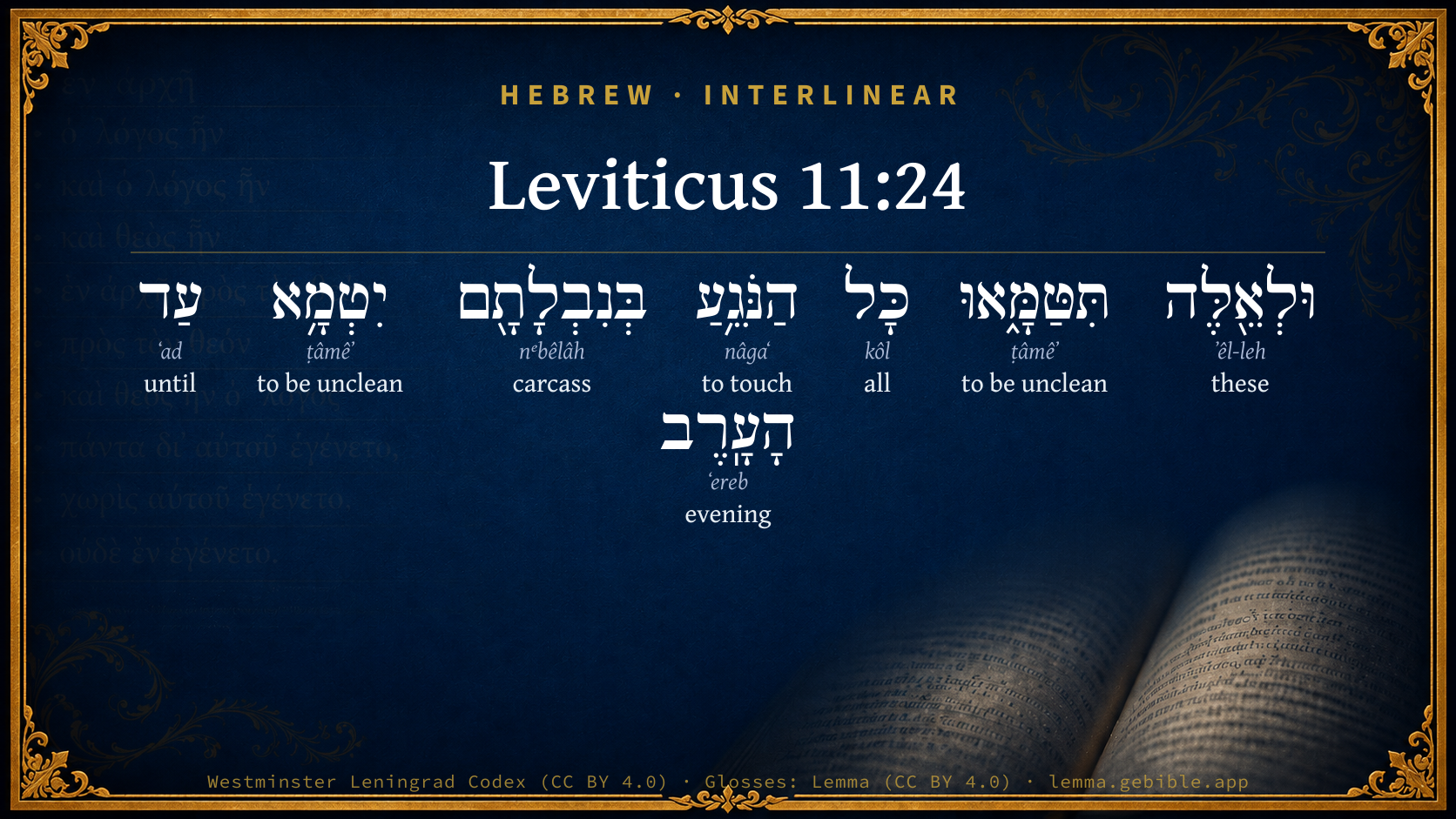
Hebrew (Westminster Leningrad Codex) Leviticus 11:24 appears in the Hebrew Old Testament. The text above is from the Westminster Leningrad Codex. Each word links to its Strong’s number, a concise gloss, and parsing drawn from the Open Scriptures Hebrew Bible morphology. Click any word for its full Brown-Driver-Briggs (BDB) entry.
Download image
Cite this verse

Leviticus 11:24 (World English Bible). Public Domain. Lemma interlinear Bible study tool, https://lemma.gebible.app/v/leviticus/11/24.

Show BibTeX & RIS
BibTeX
RIS
English Translation
"'By these you will become unclean: whoever touches the carcass of them shall be unclean until the evening.
World English Bible · Public Domain
Download a study sheet

One document with this verse’s original text, its word-by-word gloss line, the meaning frame, cross-references with their text, attributed commentary, and full source and license credits — printable, and it pastes into notes with its structure intact.

This verse Autodidact and up

Study sheet (.html) Plain text (.txt)

A passage Seminary Student

Up to 50 verses in one chapter. A passage sheet keeps up to 6 commentary sources and 12 cross-references per verse, in the order this page ranks them, and says so on the sheet whenever that leaves anything out. Ask for a single verse and you get the Autodidact verse sheet above.

Everything on this page stays free to read, with no account — the sheet is a download of what is already on screen, not access to it.

Want to remove ads? Support Godless Engineer
Compare translations 3

The same verse in 3 English versions, stacked beneath the original-language interlinear above. Click any original word for its lexicon entry.

Each is an independent rendering of the whole verse — the interlinear is not word-aligned to these translations.

Highlighted words mark where these versions differ — a whole-verse word diff, not a word-by-word alignment.

  • World English Bible Public Domain
    "'By these you will become unclean: whoever touches the carcass of them shall be unclean until the evening.
  • King James Version Public Domain
    And for these ye shall be unclean: whosoever toucheth the carcass of them shall be unclean until the even.
  • unfoldingWord Literal Text CC BY-SA 4.0
    And by these, you will make yourselves unclean. Anyone who touches their carcasses will become unclean until the evening,

unfoldingWord Literal Text — © unfoldingWord, licensed CC BY-SA 4.0. Word-aligned USFM3 via Door43 (git.door43.org/unfoldingWord/en_ult).

Versions to compare (up to 4)

3 of 4 selected

Show all 18 translations

Every available English version of this verse, each an independent rendering of the whole verse.

  • World English Bible Public Domain
    "'By these you will become unclean: whoever touches the carcass of them shall be unclean until the evening.
  • Berean Standard Bible Public Domain
    These creatures will make you unclean. Whoever touches their carcasses will be unclean until evening,
  • Majority Standard Bible Public Domain
    These creatures will make you unclean. Whoever touches their carcasses will be unclean until evening,
  • King James Version Public Domain
    And for these ye shall be unclean: whosoever toucheth the carcass of them shall be unclean until the even.
  • American Standard Version (1901) Public Domain
    And by these ye shall become unclean: whosoever toucheth the carcass of them shall be unclean until the even;
  • Revised Version (1885) Public Domain
    And by these ye shall become unclean: whosoever toucheth the carcase of them shall be unclean until the even:
  • Geneva Bible (1599) Public Domain
    For by such ye shalbe polluted: whosoeuer toucheth their carkeis, shalbe vncleane vnto the euening.
  • Douay-Rheims (1899) Public Domain
    And whosoever shall touch the carcasses of them, shall be defiled, and shall be unclean until the evening:
  • Young's Literal Translation Public Domain
    `And by these ye are made unclean, any one who is coming against their carcase is unclean till the evening;
  • Literal Standard Version CC BY-SA 4.0
    And you are made unclean by these; anyone who is coming against their carcass is unclean until the evening;
  • Unlocked Literal Bible CC BY-SA 4.0
    You will become unclean until evening by these animals if you touch a carcass of one of them.
  • unfoldingWord Literal Text CC BY-SA 4.0
    And by these, you will make yourselves unclean. Anyone who touches their carcasses will become unclean until the evening,
  • Darby Bible Public Domain
    And by these ye shall make yourselves unclean; whoever toucheth their carcase shall be unclean until the even.
  • World Messianic Bible Public Domain
    “‘By these you will become unclean: whoever touches their carcass shall be unclean until the evening.
  • Webster's Bible Public Domain
    And for these ye shall be unclean: whoever toucheth the carcass of them shall be unclean until the evening.
  • Free Bible Version CC BY-SA 4.0
    and will make you unclean. If you touch their dead bodies you will be unclean until the evening,
  • Bible in Basic English Public Domain
    By these you will be made unclean; anyone touching their dead bodies will be unclean till evening:
  • JPS Tanakh (1917) Public Domain
    And by these ye shall become unclean; whosoever toucheth the carcass of them shall be unclean until even.

Literal Standard Version (2020), Covenant Press — licensed CC BY-SA 4.0. Text via the HelloAO Bible API (eBible.org). Unlocked Literal Bible (unfoldingWord) — licensed CC BY-SA 4.0. Text via the HelloAO Bible API (eBible.org). unfoldingWord Literal Text — © unfoldingWord, licensed CC BY-SA 4.0. Word-aligned USFM3 via Door43 (git.door43.org/unfoldingWord/en_ult). Free Bible Version, Dr. Jonathan Gallagher — licensed CC BY-SA 4.0. Text via the HelloAO Bible API (eBible.org).

Word by word

More ways to search: Search by grammar → Find every occurrence → Compare this word →

Practice this passage: Drill this verse → Learn its vocabulary →

בְּנִבְלָתָ֖ם
nᵉbêlâh
H5038
“in/at · carcass · their”
Preposition + Noun, Common, Feminine, Singular, Construct + Suffix, Personal, 3rd Person, Masculine, Plural
Part of Speech
Preposition + Noun
Type
Common
Gender
Feminine
Number
Singular
State
Construct
Full BDB Definition

Origin: from H5034

TWOT: 1286a

carcass, corpse - of humans, idols, animals
  1. וּלְאֵ֖לֶּה ʼêl-leh H428 “and · to/for · these” Conjunction + Preposition + Pronoun, Demonstrative, Common, Plural
  2. תִּטַּמָּ֑אוּ ṭâmêʼ H2930 “to be unclean” Verb, Hithpael, Imperfect, 2nd Person, Masculine, Plural
  3. כָּל kôl H3605 “all of” Noun, Common, Masculine, Singular, Construct
  4. הַנֹּגֵ֥עַ nâgaʻ H5060 “the · touching” Particle, Definite Article + Verb, Qal, Participle Active, Masculine, Singular, Absolute
  5. יִטְמָ֥א ṭâmêʼ H2930 “to be unclean” Verb, Qal, Imperfect, 3rd Person, Masculine, Singular
  6. עַד ʻad H5704 “until” Preposition
  7. הָעָֽרֶב ʻereb H6153 “the · evening” Particle, Definite Article + Noun, Common, Masculine, Singular, Absolute

About this verse

These counts appear in no published source. They are computed here, from the morphology-tagged text and Lemma’s own curated glosses. What Lemma adds →

8
words
7
distinct lemmas
Pentateuch
section

Shared distinctive vocabulary

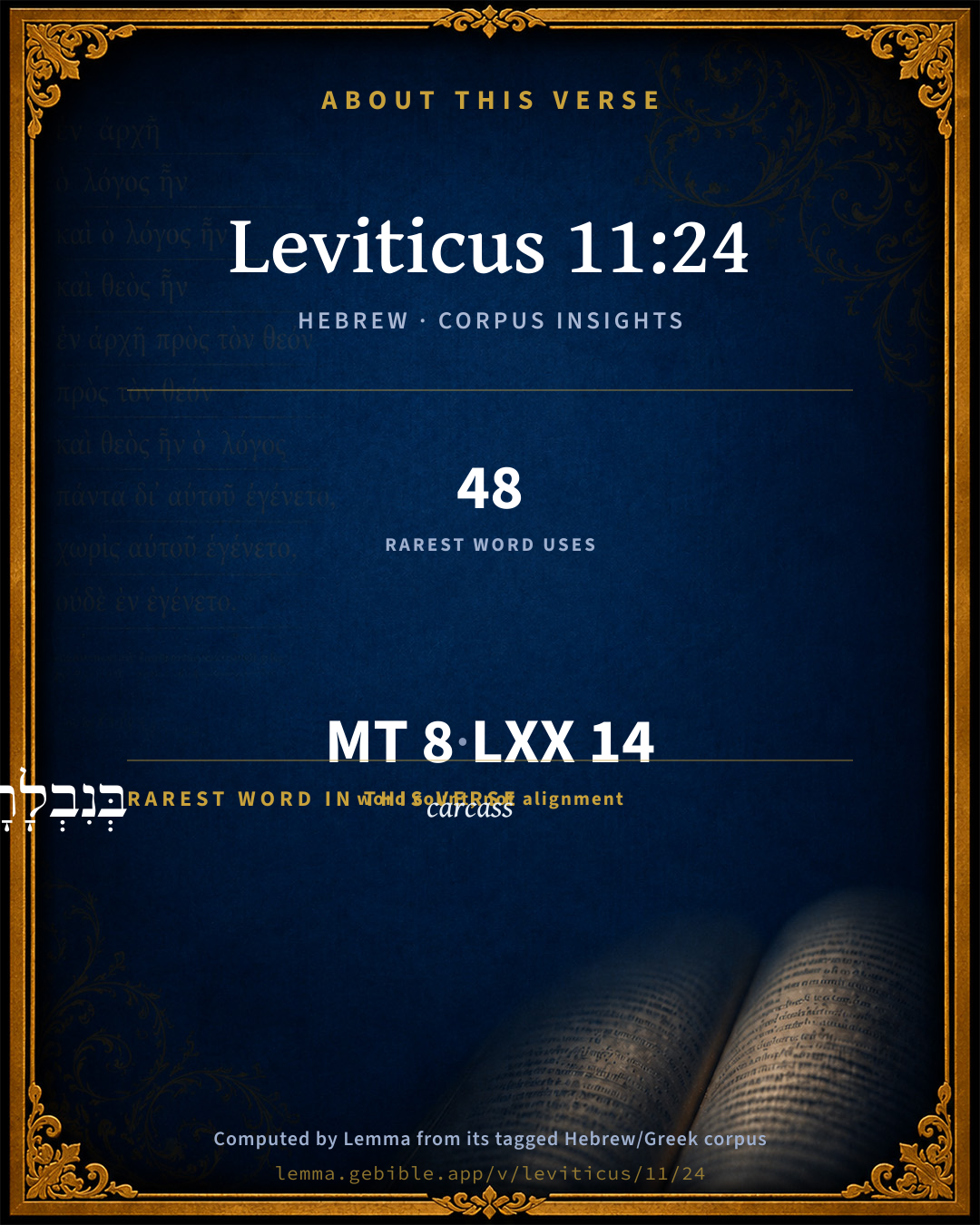
בְּנִבְלָתָ֖ם carcass H5038 occurs in 41 verses of the Hebrew Bible. Also found in:

Grammatical profile

  • 3 verbs
  • 3 nouns
  • 1 pronoun
  • 1 preposition

Verb forms

  • תִּטַּמָּ֑אוּ Hithpael · Imperfect
  • הַנֹּגֵ֥עַ Qal · Participle Active
  • יִטְמָ֥א Qal · Imperfect

Repetition

A word recurs within this verse — often emphatic in Hebrew:

  • תִּטַּמָּ֑אוּ to be unclean H2930 ×2

Hebrew & Septuagint length

In English translation the verse runs 18 words from the Hebrew and 19 from the Septuagint (LXX English) — closely comparable.

A rough comparison of the two English renderings, which tokenize alike — not a word-level alignment.

Word counts can differ between the Hebrew and the Greek without any difference in meaning — e.g. the Hebrew direct-object marker אֵת has no separate Greek word, and Greek often adds the article ὁ.

In the original languages it is 8 Hebrew tokens and 14 Greek tokens — but the two are counted differently (Hebrew bundles its prefixes and suffixes into one token; the Greek is in lemma form), so that isn’t a like-for-like length.

Cross-references

14

Topical passages linked to Leviticus 11:24 in the Treasury of Scripture Knowledge — connected by theme and wording, ordered by reader-vote popularity; previews shown in the World English Bible.

  • Leviticus 11:8 Of their flesh you shall not eat, and their carcasses you shall not touch; they are unclean to you.
  • Leviticus 11:27–28 Whatever goes on its paws, among all animals that go on all fours, they are unclean to you. Whoever touches their carcass shall be unclean until the evening.
  • Leviticus 11:31 These are they which are unclean to you among all that creep. Whoever touches them when they are dead, shall be unclean until the evening.
  • Leviticus 11:38–40 But if water is put on the seed, and part of their carcass falls on it, it is unclean to you.
  • Leviticus 17:15–16 "'Every person that eats what dies of itself, or that which is torn by animals, whether he is native-born or a foreigner, he shall wash his clothes, and bathe himself in water, and be unclean until the evening: then he shall be clean.
  • Isaiah 22:14 Yahweh of Hosts revealed himself in my ears, Surely this iniquity shall not be forgiven you until you die, says the Lord, Yahweh of Hosts.
  • 1 Corinthians 15:33 Don't be deceived! "Evil companionships corrupt good morals."
  • 2 Corinthians 6:17 Therefore, "'Come out from among them, And be separate,' says the Lord, 'Touch no unclean thing. I will receive you.
  • Ephesians 2:1–3 You were made alive when you were dead in transgressions and sins,
  • Ephesians 5:11 Have no fellowship with the unfruitful works of darkness, but rather even reprove them.
  • Colossians 2:16–17 Let no man therefore judge you in eating, or in drinking, or with respect to a feast day or a new moon or a Sabbath day,
  • Colossians 2:20 If you died with Christ from the elements of the world, why, as though living in the world, do you subject yourselves to ordinances,
  • Hebrews 9:26 or else he must have suffered often since the foundation of the world. But now once at the end of the ages, he has been revealed to put away sin by the sacrifice of himself.
  • 1 John 1:7 But if we walk in the light, as he is in the light, we have fellowship with one another, and the blood of Jesus Christ, his Son, cleanses us from all sin.

Cross-references courtesy of OpenBible.info (CC BY 4.0).

Hebrew and Greek witnesses Masoretic Hebrew ↔ Greek Septuagint

The same verse in the two great witnesses to the Old Testament, shown verse-for-verse.

These are two independent witnesses, not word-aligned to each other, and the Septuagint is shown in lemma (dictionary) form.

Hebrew Leviticus 11:24 Masoretic · Westminster Leningrad Codex

וּלְאֵ֖לֶּה תִּטַּמָּ֑אוּ כָּל הַנֹּגֵ֥עַ בְּנִבְלָתָ֖ם יִטְמָ֥א עַד הָעָֽרֶב

"'By these you will become unclean: whoever touches the carcass of them shall be unclean until the evening.

World English Bible · Public Domain

Greek LXX Leviticus 11:24 Septuagint · lemma form

καί ἐν οὗτος μιαίνω πᾶς ὁ ἅπτομαι ὁ θνησιμαῖος αὐτός ἀκάθαρτος εἰμί ἕως ἑσπέρα

And by these you⌃ shall be defiled; every one that touches their carcasses shall be unclean till the evening.

LXX2012 (modern English Septuagint) · Public Domain

Hebrew: Westminster Leningrad Codex (CC BY 4.0). Greek: Septuagint (public domain); English from LXX2012 (modern English Septuagint) (Public Domain). How the Septuagint differs from the Hebrew →

Targum (Aramaic paraphrase)

2

The Targum is the ancient Jewish Aramaic paraphrase of the Hebrew Scriptures — an interpretive translation, not the Hebrew text itself. Onkelos (literal) and Pseudo-Jonathan (expansive) render the Torah, and Jonathan the Prophets. Coverage is partial: where no permissively-licensed English translation exists for a verse, only the Aramaic is shown. This is verse-level text, not a word-by-word alignment to the Hebrew.

  1. Targum Onkelos Torah (Genesis–Deuteronomy)
    וּלְאִלֵין תִּסְתָּאָבוּן כָּל דְיִקְרַב בִּנְבִלְתְּהוֹן יְהֵי מְסָאָב עַד רַמשָׁא

    (no public-domain English translation for this verse)

    Targum Onkelos — Aramaic: “Onkelos Genesis” (public domain); “Onkelos Exodus” (public domain); “Onkelos Leviticus” (public domain); “Onkelos Numbers” (public domain); “Onkelos Deuteronomy” (public domain). English: “Sefaria Community Translation” (CC0 1.0 (public-domain dedication)); “J.W. Etheridge. The Targums of Onkelos and Jonathan Ben Uzziel on the Pentateuch. London: Longmans, Green, 1862” (public domain). Text via Sefaria.

  2. Targum Pseudo-Jonathan Torah (Genesis–Deuteronomy)
    וּלְאִלֵין תִּסְתַּאֲבוּן כָּל דְיִקְרַב בִּנְבֵילְתְּהוֹן יְהֵי מְסָאָב עַד רַמְשָׁא

    and by them you would be defiled: whosoever toucheth their carcase shall be unclean until evening.

    Targum Pseudo-Jonathan — Aramaic: “Targum Jonathan on Genesis” (public domain); “Targum Jonathan on Exodus” (public domain); “Targum Jonathan on Leviticus” (public domain); “Targum Jonathan on Numbers” (public domain); “Targum Jonathan on Deuteronomy” (public domain). English: “The Targum of Jonathan ben Uzziel, trans. J. W. Etheridge, London, 1862” (public domain). Text via Sefaria.

Commentary

Notes on Leviticus 11:24 from classic Christian and Jewish commentators (each source and its license shown beneath its notes). The classic Christian expositions comment on the surrounding passage and are grouped to its opening verse, so a note may address several verses; the Jewish commentaries on the Tanakh (Rashi and others) are per-verse, so they appear only where the commentator wrote on this verse.

Lemma curates 59 commentaries, every one of them public domain or Creative Commons licensed, each selected and text-cleaned for this edition rather than reprinted as found. About our sources →

The Cambridge Bible for Schools and Colleges

gen. ed. J. J. S. Perowne

24–28. Uncleanness caused by Dead Bodies

(See introductory note on Lev_11:20-23.)

Lev_11:24-25 are a general introduction. ‘And by these’ (Lev_11:24) refers to what follows, not to the ‘winged creeping things’ of Lev_11:23.

(a) touching or bearing the carcase of (α) beasts specified in Lev_11:26-27 or (β) swarming things specified in Lev_11:29-30 caused uncleanness till the even; if they were carried, the clothes must also be washed.

(b) further cases of defilement were caused by a carcase, (α) a vessel (Lev_11:32-33), (β) food (Lev_11:34), (γ) ovens, etc. (Lev_11:35), (δ) water in a pit (Lev_11:36), (ε) seed (Lev_11:37-38).

Carrying part of the carcase involves uncleanness of a higher degree than that caused by mere contact. Note the difference in the regulations of Lev_11:24-25; Lev_11:27-28.

In Lev_11:26-27 the beasts are specified by their characteristics; in Lev_11:29-30 by their names.

The Cambridge Bible for Schools and Colleges (gen. ed. J. J. S. Perowne; Cambridge University Press, 1878–1918) — public domain. Text from a community e-Sword module.

Trapp's Complete Commentary

John Trapp

Lev 11:24 And for these ye shall be unclean: whosoever toucheth the carcase of them shall be unclean until the even.

Ver. 24. Whosoever toucheth the carcass.] This and the like signified that all, even the least sins, are to be purged through Christ, and carefully cast away.

John Trapp, A Commentary or Exposition upon All the Books of the Old and New Testament (1647–1656) — public domain. Text from a community e-Sword module.

Keil & Delitzsch

C. F. Keil & F. Delitzsch

In Lev 11:24-28 there follow still further and more precise instructions, concerning defilement through contact with the carcases (i.e., the carrion) of the animals already mentioned. These instructions relate first of all (Lev 11:24 and Lev 11:25) to aquatic and winged animals, which were not to be eaten because they were unclean (the expression "for these" in Lev 11:24 relates to them); and then (Lev 11:26-28) to quadrupeds, both cattle that have not the hoof thoroughly divided and do not ruminate (Lev 11:26), and animals that go upon their hands, i.e., upon paws, and have no hoofs, such as cats, dogs, bears, etc.

Keil & Delitzsch — Biblical Commentary on the Old Testament (1861–1891) — public domain (CC PDM 1.0). Text via the HelloAO Bible API. (Old Testament only.)

Tyndale Open Study Notes

Tyndale Open Resources

11:24-25 defiled until evening: Anyone who touched a carcass of an unclean animal would be unclean until evening, which marked the beginning of the next day in Israel.

Tyndale Open Study Notes — © Tyndale Open Resources, licensed CC BY-SA 4.0. Text via the HelloAO Bible API.

Ellicott's Commentary for English Readers

(24) And for these ye shall be unclean.—Rather, and by these ye shall be defiled, that is, the beasts and animals specified in Lev_11:26-27.

Shall be unclean until the even.—For coming in contact with the dead body of the animals contracts defilement for the rest of the day, and till the beginning of a new day, which took place after sunset (comp. Lev_23:32). During these hours of legal uncleanness he was not allowed to enter the sanctuary, touch any sacred thing, or have intercourse with those who were legally clean, since contact with one who has contracted legal defilement imparted defilement to both persons and things.

A Bible Commentary for English Readers, edited by Charles John Ellicott (1878–1897) — public domain. Text from a community e-Sword module.

John Gill's Exposition

And for these ye shalt be unclean,.... That is, for eating them; or should they eat them they would be unclean:

whosoever toucheth the carcass of them shall be unclean until the even; not only he was unclean that ate them, but he that even touched their dead bodies was reckoned unclean; might not go into the tabernacle, nor have conversation with men, nor eat of the holy things, which were forbid men in any uncleanness; and though there is no mention of his washing himself, it may be understood, this being a short or concise way of speaking, as Aben Ezra observes; who adds, that it was necessary that he should wash himself in water; which was typical of washing and cleansing by the grace and blood of Christ, without which a man cannot be cleansed from the least sin, and pollution by it; and may signify that during the legal dispensation there was no proper cleansing from sin, until the evening of the world, when Christ came and shed his blood for the cleansing of it.

John Gill's Exposition of the Whole Bible (1746–1763) — public domain (CC PDM 1.0). Text via the HelloAO Bible API.

Albert Barnes' Notes on the Bible

Unclean - If the due purification was omitted at the time, through negligence or forgetfulness, a sin-offering was required. See Lev 5:2.

Albert Barnes' Notes on the Bible (1834–1885) — public domain. Text from a community e-Sword/MySword module.

Haydock's Catholic Bible Commentary

Evening. If he were guilty of sin in so doing, contrition would be necessary to regain God’s favour. (Worthington) --- But the legal uncleanness would not be removed till the evening; as the one might subsist while the other was remitted. (Haydock)

George Leo Haydock (1774–1849), Haydock's Catholic Family Bible and Commentary, 1859 edition — public domain. Excludes Psalms (Douay-Rheims chapter numbering differs from Protestant) and Deuterocanonical books (Catholic canon only).

Matthew Poole's English Annotations

And such were excluded both from the courts of God’s house, and from free conversation with other men.

Until the even; which possibly might signify that even the smallest defilements could not be cleansed but by the death of Christ, who was to come and offer up himself in the evening, or end, or declining age of the world, as the prophets signify, and the apostle expresseth, Heb 9:26.

Matthew Poole's English Annotations on the Holy Bible (1683–1685) — public domain. Text from a community e-Sword/MySword module.

Whedon's Commentary on the Bible

Daniel D. Whedon

24. Unclean until the even — The slighter degrees of uncleanness were merely “until even,” and were removed by bathing and washing the clothes at the end of it; meanwhile the person was excluded from certain religious privileges. See Lev_5:2, note.

Daniel D. Whedon (gen. ed.), Commentary on the Old and New Testaments (1874–1909) — public domain. Text from a community e-Sword module.

The Pulpit Commentary

Vers. 24-28. These verses contain an expansion of the warning contained in verse 8, to the effect that the touch of the dead bodies of the forbidden animals was defiling, as well as the consumption of their flesh. A further mark of an unclean animal is added in verse 27. Whatsoever goeth upon his paws; that is, whatever has not hoofs, but goes stealthily, like beasts of prey of the eat kind. It includes also dogs.

Vers. 24-28, 39, 40. The significance of death.

"Whosoever toucheth the carcass shall be unclean." What is the meaning of these minute and stringent regulations touching the dead bodies of animals, both clean (verses 39, 40) and unclean (verses 24-28)? The answer to this question is in the fourfold consideration

I HOW MUCH GOD MAKES OF DEATH. Death is the key-note of very much of sacred Scripture. "Thou shalt die" is a constantly recurring refrain. "And he died" is a continually repeated statement. It was the death of the slain victim at the altar that made expiation for the sinner. It is the death upon the cross which constitutes the sacrifice for the world"s sin. The death of the soul is the awful punishment of guilt hereafter as it is on earth. It was the death of these animals that made their caresses unclean. In the Old Testament and New, God makes much of death.

II THE SIGNIFICANCE OF DEATH. Death is odious and intolerable in God"s sight: it must be made to seem so in man"s; for:

1. It is the consequence of sin in man.

2. It is the picture of sin in man.

3. It is a reminder of the painful and hateful presence of sin in man.

III THE AVOIDABLENESS OF SIN. The fact that the dead carcass could be and must be avoided, and that contraction of ceremonial defilement could be prevented, indicated to the Jew and now intimates to us that sin may be and must be shunned. Two things were and are necessary:

1. Carefulness: scrupulous regard to the known laws (verses 32, 34, 38).

2. Self-sacrifice: things made unclean must be broken up, disused, cast away, at whatever cost (verses 33, 35).

IV THE REMOVAL OF THE STAIN OF SIN. "It must be put into water; ... so it shall be cleansed" (verse 32). "There is a fountain filled with blood," etc. C.

The Pulpit Commentary (1880–1919), ed. H.D.M. Spence-Jones & Joseph S. Exell — public domain. Text from a community e-Sword module.

John Wesley's Explanatory Notes

Unclean - And such were excluded both from the court of God's house, and from free conversation with other men.

John Wesley, Explanatory Notes Upon the Whole Bible (1754–1765) — public domain. Text via the GEBible commentary corpus.

unfoldingWord translationNotes

Door43 World Missions Community

General Information:

Yahweh begins to tell Moses and Aaron which animals the people are to consider unclean.

You will become unclean until evening by these animals if you touch a carcass of one of them

This can be translated in active form. AT: "The dead bodies of these animals will make you unclean if you touch any of them" (See: Active or Passive)

You will become unclean

A person who is unacceptable for God's purposes because he has touched one of these dead animals is spoken of as if the person were physically unclean. (See: Metaphor)

these animals

This refers to the animals he is about to list in the following verses.

translationWords

clean

unfoldingWord translationNotes — © Distant Shores Media and the Door43 World Missions Community, licensed CC BY-SA 4.0. Source: git.door43.org/Door43/en_tn.

Rashi

Rabbi Shlomo Yitzchaki (Rashi)

ולאלה AND TO THESE which are to be mentioned further on in the section,

תטמאו YE CAN BECOME UNCLEAN — that is, by touching them there is uncleanness.

Rashi on the Tanakh — English translations: “The Judaica Press complete Tanach with Rashi, translated by A. J. Rosenberg” (CC BY 4.0); “Pentateuch with Rashi's commentary by M. Rosenbaum and A.M. Silbermann, 1929-1934” (public domain); “The Metsudah Tanach series, Lakewood, N.J” (CC BY 4.0); and “The Book of Joshua, Metsudah Publications, 1997” (CC BY 4.0). Text via Sefaria.

Ramban (Nachmanides)

Rabbi Moshe ben Nachman (Ramban / Nachmanides)

AND BY THESE YE SHALL BECOME UNCLEAN. “By these which are to be mentioned further on in the section, ye shall become unclean. Here Scripture teaches you that the carcass of an animal unfit for food conveys impurity, and in the subject at the end of the section it explains [the law] concerning the carcass of an animal fit for food.” This is Rashi’s language. But if so, [the question arises], why did Scripture divide them and why did it treat them singly, animals, were discussed in Verses 24-28 in detail, with separate verses for each category of these unclean animals, when one general statement could have covered all subjects? when it should rather have said [in one general statement], “whosoever touches the carcass of any animal shall be unclean until the evening, and whosoever carries any of its carcass shall wash his clothes and be unclean until the evening?”The correct interpretation is that here Scripture mentioned the carcass of them without qualification and did not mention “death” in connection with them, thus teaching that [the law of] ritual slaughtering [required to render animals fit for food] does not apply to them [the unclean animals mentioned here], and whoever touches them when they are no longer alive [whether they died by themselves or even if they were ritually slaughtered], becomes impure. But further on it states, And if any beast, of which ye may eat, die, thus teaching that if it [an animal fit for food] was ritually slaughtered, it does not convey impurity [to a person who touches it]. Now the meaning of the section in mentioning [here]: And by these ye shall become unclean, is to state that all things referred to above — namely, fishes, fowls, and grasshoppers — do not have this [law of] impurity, but only those which He is about to mention further on, these being Every beast … which is not cloven-footed, nor cheweth the cud. It is with reference to these that He states, they are unclean to you; every one that toucheth them shall be unclean with the uncleanness mentioned [in the preceding Verses 24-25: whosoever toucheth the carcass of them shall be unclean until the even. And whosoever beareth aught of the carcass of them shall wash his clothes, and be unclean until the even]. Then He continues by stating that any beast which walks upon its paws shall also convey impurity until the evening to a person who touches its carcass, and that a person who carries it shall, in addition, wash his clothes. Similarly, And these are they which are unclean unto you among the swarming things means among those which are to be mentioned further on. etc. Rabbi Abraham ibn Ezra erred here. (in Verse 24 before us) as referring to sheretz ha’oph (winged creeping things) and also to the fowls unfit for food as mentioned above in Scripture. But this is a mistake, since no impurity is conveyed by a fowl unfit for food, nor by a winged creeping thing unfit for food.Now above, in stating the prohibition of eating [an animal prohibited as food], Scripture mentioned those animals which are not cloven-footed and do not chew the cud, but it did not mention [the law] of beasts that walk upon their paws. Perhaps it is because it is not customary to eat them [on account of the danger involved in catching them] that He did not single them out, but left them [to be] included in the general principle which He had stated, that we should eat only the animal that parts the hoof and is cloven-footed and chews the cud, and not others, and chayah (beast) is included in the term beheimah (animal) as it is said, These are ‘ha’beheimah’ (the animals) which ye may eat … the hart, and the gazelle, and the roebuck. and goes on to enumerate chayah (beasts). Our Rabbis in the Torath Kohanim have interpretations on this whole section. [Thus they explain the expression], Every beast [which parteth the hoof, but is not cloven-footed …] is unclean to you, to include a limb cut off from a living animal [in the law of conveying impurity]. 6:6. And whatsoever goeth upon its paws, to include a limb cut off from a dead animal [in the law of conveying impurity]. For Scripture speaks at length and mentions many expressions of impurity in order to allude [to the law] that they convey impurity in whole or in part, either through the death of the whole body or through the death of one of its limbs, as when it was cut off from a living body.

HE SHALL BE UNCLEAN UNTIL THE EVEN. The meaning of this expression in the whole section is that at night he becomes pure, if he had bathed his flesh in water [before sundown]. Scripture, however, speaks briefly [and therefore omitted] the bathing of the body, because it mentioned the washing of clothes of the one who carries anything unclean, which means their immersion [in a ritual pool], and it follows all the more so that he must bathe his body. Then when Scripture finished mentioning all the impurities [conveyed by] carcasses and [dead] creeping things, it mentioned immersion [for those vessels which became impure through touching them]: it must be put into water, and it shall be unclean until the even; then shall it be clean, the same law applying to man, for it is from here that the principle is derived. In another section He explained, And every soul that eateth that which died of itself, or that which is torn of beasts, whether he be home-born or a stranger, he shall wash his clothes, and bathe himself in water, and be unclean until the even, and He mentioned also the punishment for the violation thereof, But if he wash them not, nor bathe his flesh, then he shall bear his iniquity., Verse 16. I.e., if he ate holy food or entered the Sanctuary in an impure state. This is a general principle of all impurities [conveyed by] carrion, and from it the law is derived for [impurities conveyed by] creeping things. The matter of bathing [in the case of impurity conveyed by] creeping things has already been mentioned here, as I have written. Now Scripture was more severe in the case of a person who carries an impure object than in the case of a person who touches it, in requiring the bearer to wash his clothes, [but not one who only touches it], because it is natural that a person who touches does so with his hand lightly, while he who carries as a burden [does so in such a way] that it presses upon him, and in the majority of cases his clothes help him [in carrying].

Ramban (Nachmanides) on the Tanakh — English translation: “Commentary on the Torah by Ramban (Nachmanides). Translated and annotated by Charles B. Chavel. New York, Shilo Pub. House, 1971-1976” (CC BY 4.0). Text via Sefaria.

Lesson kit

Teaching starters — assembled from the data on this page, not authored interpretation. Every prompt links to the verse data it draws on. Edit before teaching.

Leviticus, in the Pentateuch, opens this verse with 8 words (7 distinct Hebrew lemmas). Its most distinctive word is nᵉbêlâh (“carcass”). A historical commentator’s framing appears above. Read the whole chapter for the surrounding context.

Discussion questions

  1. The word nᵉbêlâh carries the sense “carcass.” How does it shape the verse?
  2. Leviticus 5:2 shares the word «carcass» with this verse. How do the two illuminate each other?
  3. “to be unclean” occurs 2× in this one verse. What is the effect of the repetition?
  4. These translations render this verse differently. What is at stake in choosing one wording over another?
  5. The verb «תִּטַּמָּ֑אוּ» is Hithpael Imperfect. How does its form color the action?
  6. Reading how The Cambridge Bible for Schools and Colleges and Trapp's Complete Commentary read this verse, where do the two commentators agree and where do they part?

Things to notice

Reading settings

Reading text

Shown beneath each verse's original-language words.

Old Testament
Old Testament edition

Read the OT as the Masoretic Hebrew (MT) or the Greek Septuagint (LXX).

English shown for the Greek Septuagint (in the Hebrew ↔ Greek comparison).

Comparing translations? Open the Compare panel on any verse page to stack up to four side by side.