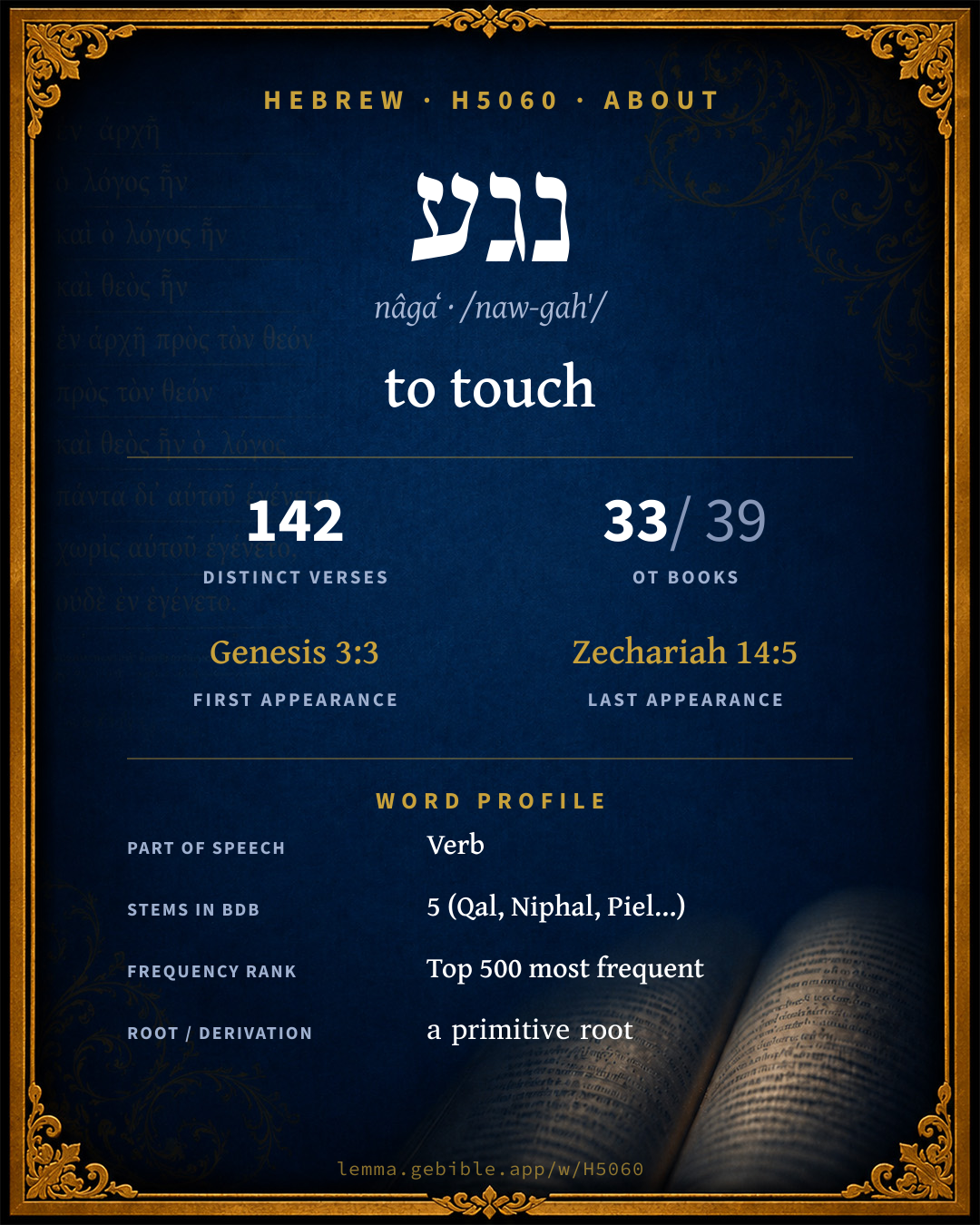
נָגַע
to touch
also: reach, strike fuller range ↓
Full lexicon entry — Brown-Driver-Briggs (BDB)
From Brown-Driver-Briggs (BDB)
Where this word appears
See every Niphal verb in the Hebrew Bible →
Grammar key — what these labels mean
Part of speech
- Verb
- An action or state-of-being word.
Stem
- Qal
- The basic, simple active stem — the plain form of the verb (“he wrote”). Here: ‘touch’
- Hiphil
- The causative active stem (“he caused / brought about”). Here: ‘cause to touch’
- Piel
- An intensive or resultative active stem.
- Niphal
- Usually the simple passive or reflexive of the Qal (“he was written”).
- Pual
- The passive counterpart of the Piel.
Form
- Participle Active
- A verbal adjective expressing ongoing or characteristic action (“writing / one who writes”).
- Imperfect
- An incomplete, ongoing, or future action (“he will / would write”).
- Sequential Imperfect
- An imperfect with prefixed waw — the standard past-narrative form (waw-consecutive imperfect).
- Perfect
- A completed action or state — Hebrew marks aspect (completeness) more than strict tense (“he wrote”).
- Infinitive Construct
- A bound verbal noun, frequently with prepositions (“to write / in writing”).
- Jussive
- A third- or second-person volitional form expressing wish or command (“let him write”).
- Imperative
- A direct command (“write!”).
- Participle Passive
- A verbal adjective expressing action received (“written”).
- Sequential Perfect
- A perfect with prefixed waw continuing a preceding imperfect or command (waw-consecutive perfect).
State
- Absolute
- The independent form of a noun, not bound to a following word.
- Construct
- A noun bound to a following noun in a possessive / “of” relationship (the construct chain).
Person
- 3rd Person
- The one spoken about (“he / she / it / they”).
- 2nd Person
- The one addressed (“you”).
- 1st Person
- The speaker (“I / we”).
Gender
- Masculine
- Grammatically masculine.
- Feminine
- Grammatically feminine.
- Common
- Either gender — not distinguished for this form.
Number
- Singular
- One.
- Plural
- More than one (in Hebrew, generally three or more).
Every verse where H5060 appears in the Book of Joshua — 2 distinct verses. Click any verse to open its interlinear word-by-word view. Verse text shown in the World English Bible for context — . Each verse’s Hebrew form is shown with its reference; the English is not keyword-highlighted, since the data carries no word-level English alignment. Use “Compare translations” on any verse to read it across multiple English versions. This concordance covers the Hebrew Bible; Septuagint (Greek Old Testament) occurrences are not indexed here.
Joshua
- Joshua 8:15 וַ/יִּנָּֽגְע֛וּ conj + Niphal wimpf 3mp Joshua and all Israel made as if they were beaten before them, and fled by the way of the wilderness.
- Joshua 9:19 לִ/נְגֹּ֥עַ prep + Qal inf.cs But all the princes said to all the congregation, We have sworn to them by Yahweh, the God of Israel: now therefore we may not touch them.
About this entry
At a glance — auto-summarized from this page’s data, not written by a person. Every figure links to its source below. This summary describes the numbers; it doesn’t interpret them.
The Hebrew verb נגע centers on the idea of “to touch.” The King James Version usually renders it “touched,” while modern versions prefer “touches” (Berean Standard Bible) — see the renderings breakdown. Spanning 142 verses in 33 books, it ranks among the common words of the Hebrew Bible. Debuting at Genesis 3:3, it then recurs through the corpus. Different stems carry different senses — BDB groups them under 5 stems, among them Qal and Niphal. Dig into 142-verse concordance and the renderings breakdown below.
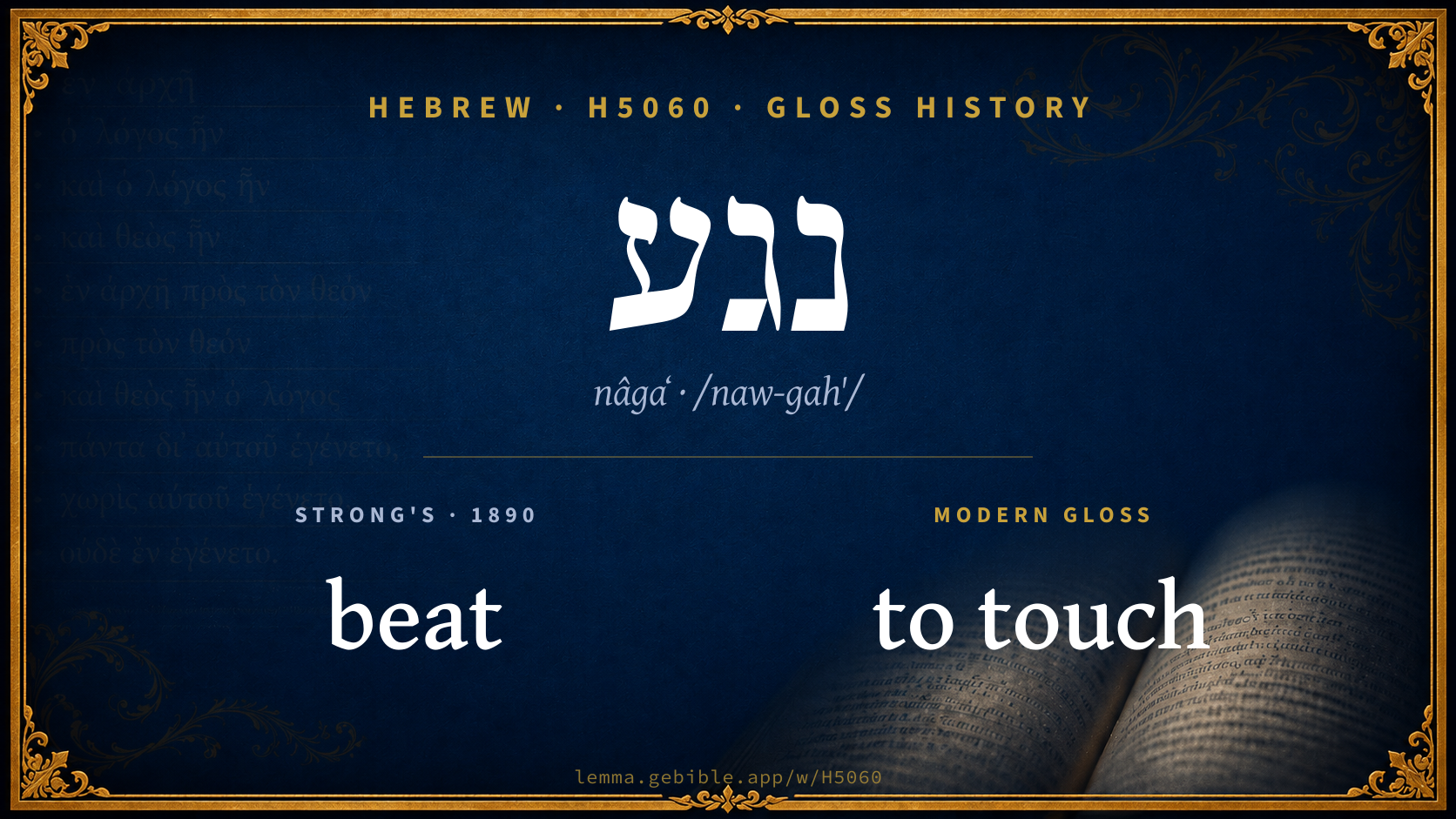
Gloss history
Strong's 1890 vs modern scholarship
About this word
Strong's H5060 catalogs a Hebrew word from the Hebrew Old Testament.
These counts are not copied from any lexicon or concordance. They are computed here, from the morphology-tagged Hebrew Old Testament. What Lemma adds →
- 142
- distinct verses
- The word appears in 142 distinct verses.
- 33 / 39
- OT books
- The word appears in 33 of 39 Old Testament books.
- #298
- by frequency
- Top 500 most frequent Hebrew words (rank 298 of 8,640 Hebrew words by occurrence).
View all 142 occurrences in the concordance →
By section of the Old Testament
By traditional corpus
Conventional, traditional groupings — biblical authorship is debated, so this is a traditional corpus grouping, not an authorship claim. Each share is this word’s portion of its verses in that division of the Hebrew canon. Each figure is a share of the word’s 142 distinct verses.
- Torah (Pentateuch) 52 verses · 37%
- Writings (Ketuvim) 48 verses · 34%
- Prophets (Nevi'im) 42 verses · 30%
How translations render this word
Counts come from each version’s own published word-to-Strong’s tagging or interlinear alignment — an approximate guide to how each version renders this word, not a word-level alignment the data otherwise carries. Because each total is that version’s own tagged count, the per-version totals vary from one another and need not match the appearance or distinct-verse counts above. These counts may also differ from a printed concordance because Lemma counts each distinctly tagged rendering and does not collapse phrase taggings into a single head-word total. This is a fixed set of word-tagged versions (KJV, ASV, BSB, ULT) and does not change with the reading translation you choose elsewhere. Each version’s license is shown beside its name below (and on Sources).
- King James Version: Touched 14×, Touch 12×, Whosoever toucheth 10×
- American Standard Version: Touched 12×, Toucheth 11×, Whosoever toucheth 9×
- Berean Standard Bible: Touches 30×, Touched 14×, Touch 10×
- unfoldingWord Literal Text: Touch 21×, Touches 20×, Touched 9×
King James Version Public Domain
Renders H5060 across 150 tagged occurrences — most commonly:
Plus other, less common renderings. Plus 63 renderings that appear only once — usually multi-word phrases or single function words the recovered tagging swept in, not distinct renderings.
American Standard Version Public Domain
Renders H5060 across 151 tagged occurrences — most commonly:
Plus other, less common renderings. Plus 66 renderings that appear only once — usually multi-word phrases or single function words the recovered tagging swept in, not distinct renderings.
Berean Standard Bible Public Domain
Renders H5060 across 144 tagged occurrences — most commonly:
Plus other, less common renderings. Plus 61 renderings that appear only once — usually multi-word phrases or single function words the recovered tagging swept in, not distinct renderings. Not rendered by a distinct English word in 6 further occurrences.
unfoldingWord Literal Text CC BY-SA 4.0
Renders H5060 across 180 tagged occurrences — most commonly:
Plus other, less common renderings. Plus 54 renderings that appear only once — usually multi-word phrases or single function words the recovered tagging swept in, not distinct renderings.
14 senses and sub-senses in the full BDB
Hebrew verbs can shift meaning by stem (binyan): Qal is the basic action, Niphal is often passive or reflexive, Piel often intensifies or makes it factitive, and Hiphil is typically causative. The senses below are grouped under the stem BDB assigns to each. This entry also uses Pual (the passive of Piel).
What do BDB’s symbols mean?
BDB uses these scholarly abbreviations:
| Symbol | Meaning |
|---|---|
| 𝔊 | the Septuagint (the ancient Greek translation, LXX) |
| 𝔙 | the Vulgate (the Latin translation) |
| 𝔖 | the Syriac version (the Peshitta) |
| 𝔗 | the Targum (the Aramaic translation) |
| ψ | the Psalms |
| √ | root (the underlying root or stem) |
| ‖ | parallel passage (a synonymous or contrasted parallel) |
| † | the dagger: every passage where the word occurs is cited |
The 14 senses and sub-senses the full Brown-Driver-Briggs lexicon distinguishes for this word, in lexicon order (not ranked by frequency), with BDB’s own verbatim wording and sub-sense lettering. Shown in Hebrew script with BDB’s own scholarly abbreviations. The condensed entry is in the Lexicon Entry tab. See also the Forms in the corpus table below.
Qal
- Pf. נ׳ Gn 32:33 +; נָֽגְעָה Ju 20:41 +; 1 pl. sf. נְגַעֲנוּךָ Gn 26:29; Impf. יִגַּע Lv 5:3 +; וַיִּגַּע Gn 32:26 +, etc.; Imv. גַּע ψ 144:5 + 2 times; Inf. cstr. נְגֹעַ, לִנְגּוֹעַ Gn 20:6 + 3 times; גַּ֫עַת 2 S 14:10 Ez 17:10; sf. נָגְעֵךְ Ru 2:9, etc.; Pt. act. נֹגֵעַ 1 K 19:5 +; נֹגְעִים Je 12:14; f. נֹגַ֫עַת Nu 19:22 + 2 times; pl. נֹגְעֹת 1 K 6:27; pass. נָגוּעַ ψ 73:14; Is 53:4;— e.g. Genesis 32:33
- 1.
- a. touch, usually sq. בְּ Gn 3:3 (J), 32:26, 33; Ex 19:12(×2), 13 (all E), 29:37; 30:29 (P), Lv 5:2, 3 + 25 times Lv; Nu 16:26 + 7 times Nu (P) + 19:22 (no בְּ or obj.), Dt 14:8; Ju 6:21; 2 S 23:7; 1 K 6:27(×2), 19:5, 7; 2 K 13:21 Est 5:2; Dn 8:5, 18; 10:10, 18; La 4:14; sq. אֶל־ Hg 2:12; Nu 4:15; 1 K 6:27; Dn 9:21, cf. Ho 4:2; sq. עַל־פֶּה Is 6:7; עַל־שָׂפָה Dn 10:16; sq. acc. Is 52:11; abs. (no obj. expr.) Jb 6:7 La 4:15. e.g. Genesis 3:3
- b. of י׳ touching earth, mountains, etc., sq. בְּ Am 9:5 ψ 104:32; 144:5; fig. of י׳ touching the heart, sq. בְּ 1 S 10:26. e.g. Amos 9:5
- 2. nearly = strike, pass. stricken, ψ 73:14; Is 53:4 (‖ מֻכֶּה), of wind Jb 1:19; Ez 17:10; of divine chastisement 1 S 6:9 Jb 1:11; 19:21; sq. אֶל 2:5. e.g. Psalms 73:14
- 3. touch = harm, sq. בְּ, Gn 26:11 (J), Jos 9:19; 2 S 14:10; 1 Ch 16:22 (‖ הָרֵעַ) = ψ 105:15, Je 12:14; Zc 2:12(×2); sq. אֶל־ Gn 20:6 (touch a woman), so Pr 6:29 (sq. בְּ); sq. acc. Gn 26:29 (J, sf.), so Ru 2:9; v. also Jb 5:19 (subj. רַע, sq. בְּ), Ju 20:34, 41 (both subj. רָעָה, sq. עַל־). e.g. Genesis 26:11
- 4. reach, extend to, 2 S 5:8, sq. בְּ (but crpt. v. Dr HPS); in metaph., sq. עַד of vine Is 16:8; Je 48:32; of sword Je 4:10, cf. v 18; of chastisement Mi 1:9, cf. Jb 4:5 (‖ בּוֹא אֶל־); also (sq. אֶל) Je 51:9; = come, sq. אֶל־ Jon 3:6; arrive (of time), abs. Ezr 3:1; Ne 7:73. e.g. 2 Samuel 5:8
Niphal
- Impf. וַיִּנָּֽגְעוּ Jos 8:15 be stricken, defeated (in battle), i.e. feign to be so, but read prob. וַיִּנָּֽגְפוּ, v. נגף Niph. e.g. Joshua 8:15
Piel
- Pf. sf. נִגְּעוֹ 2 Ch 26:20 strike (with leprosy, 2 acc.), subj. י׳; so Impf. וַיְנַגַּע 2 K 15:5; Gn 12:17 (subj. י׳; acc. pers. + acc. cogn.). e.g. 2 Chronicles 26:20
Pual
- Impf. יְנֻגָּע֑וּ be stricken by diseases (?; cf. Pi. and נֶגַע 2. 3. especially 2 S 7:14) ψ 73:5. e.g. 2 Samuel 7:14
Hiphil
- Pf. הִגִּיעַ Is 25:12 + 6 times; 2 fs. הִגַּ֫עַתְּ Est 4:14; 1 s. sf. וְהִגַּעְתִּ֫יהוּ Ez 13:14, etc.; Impf. יַגִּיעַ Is 8:8 + 3 times; וַיַּגַּע Is 6:7; Je 1:9, etc.; Inf. cstr. הַגִּיעַ Est 2:12, 15; Pt. מַגִּיעַ Gn 28:12 +; f. מַגַּ֫עַת 2 Ch 3:11;—cause to touch; reach, approach, arrive: e.g. Isaiah 25:12
- 1. cause to touch, apply, Ex 12:22 (JE; מִדָּם, אֶל־); cause to touch (sq. עַד עָפָר, לָאָרֶץ), i.e. bring to ground, Is 25:12; 26:5, cf. La 2:2, Ez 13:14 (sq. אֶל־), Ex 4:25 (J; sq. לְרַגְלָיו); sq. עַל־פֶּה Is 6:7; Je 1:9; sq. בְּ Is 5:8. e.g. Exodus 12:22
- 2. intr. reach, extend, Gn 28:12 (sq. ָה loc.); sq. אֶל־ Zc 14:5, sq. עַד Is 8:8; cf. תַּגּ׳ יָדוֹ דֵּי שֶׂה Lv 5:7 if his hand do not reach enough for a lamb (i.e. he be not able to furnish a lamb); sq. לְ Jb 20:6 (hyperb.) 2 Ch 3:11(×2), 12; sq. עַד לְ 28:9; attain, sq. לְ Est 4:14, arrive, come, sq. acc. loc. Is 30:4 Est 4:3; 8:17, sq. לְ (of time) Dn 12:12, sq. אֶל־ 1 S 14:9, sq. עַד־ ψ 107:18, abs. Est 6:14; sq. אֵצֶל Dn 8:7. e.g. Genesis 28:12
- 3. approach, of time, abs. Ec 12:1; Ct 2:12; Ez 7:12 (‖ בּוֹא); v. also Est 9:1 (sq. Inf.), cf. 2:12, 15 ψ 88:4 (sq. לְ). e.g. Ecclesiastes 12:1
- 4. of fate or lot, = befall, sq. אֶל־ Est 9:26 Ec 8:14(×2); reach ψ 32:6. e.g. Esther 9:26
Senses from the full Brown-Driver-Briggs lexicon (Brown, Driver, Briggs; Oxford 1906 — public domain), digitized via Sefaria, supplemented by the OpenScriptures HebrewLexicon (CC BY 4.0). Full attribution on Sources.
Word origin
vb. touch, reach, strike (NH id.; Arabic نَجَعَ is agree with one (of food), produce effect; Aramaic נְגַע Ithpa. be struck (sc. w. leprosy), cf. Pi. infr.);—
— Brown-Driver-Briggs (Oxford 1906, public domain), digitized via Sefaria, supplemented by the OpenScriptures HebrewLexicon (CC BY 4.0). See Sources.
Origin: a primitive root
Jastrow Dictionary
A second Hebrew/Aramaic lexicon for comparison, covering Aramaic and post-biblical (Talmudic, Targumic, Midrashic) usage that the biblical-Hebrew BDB does not. Matched by lemma rather than by Strong’s number, so a lemma may carry more than one Jastrow headword (shown separately below), and the entries cover usage well beyond the Bible.
נָגַע
- (b. h.)
- 1. to touch; to strike; to injure (with ב of object). Sabb. 13ᵇ. Num. R. s. 14 אילו נ׳ באשת וכ׳ if he touched Potifar’s wife. Ib. (ref. to Koh. VIII, 5) שלא נ׳ בו הדבר the thing (the speech of the chief butler) did not harm him, v. נִגְעָה. Y. Peah VIII, 21ᵃ bot., a. e. נָגְעוּ בה, v. מַכָּה. Y. Yeb. I, end, 13ᵇ לא היו ב"ש נוֹגְעִין בו the Shammaites would not take up the case; a. v. fr.—נוֹגֵעַ בעדות an interested witness. Snh. 34ᵃ דמיחזי כנ׳ בעדותו he has the appearance of an interested witness. B. Bath. 43ᵃ top אמאי נוֹגְעִין בעדותן הן why are they admitted to testify? Are they not interested witnesses? Kidd. 43ᵇ; a. fr. e.g. Ecclesiastes 8:5
- 2. (v. Hif.) to arrive, to come to pass. Gen. R. s. 84 שעתידין הדברים לִיגַּע for these things (which Joseph dreamt) shall come to pass; Yalk. ib. 141.
- 1. to reach; to become the property of; to obtain; to cause to reach. B. Mets. X, 5 הִגִּיעוּךָ they shall be thine. Arakh. VIII, 1; 3 (27ᵃ, sq.) הִגִּיעָתְךָ it is thine (Bab. ed. הִגַּעְתִּיךָ I let thee have it), i.e. thy offer is accepted; Tosef. ib. IV, 20 הִגַּעְתָּהוּ thou hast acquired it. Tosef. B. Bath. VI, 7, a. e. הִגִּיעוֹ it is his, i.e. he must pay for it. Y. Erub. III, 21ᵃ bot., a. e. הִגִּיעוּךָ סוף thou hast been made to reach the final conclusion, i.e. thou must admit, v. חָוַר. Ber. IX, 3 (54ᵃ) שהחינו וקיימנו והִגִּיעָנוּ לזמן הזה (Mish. ed. only שהחינו) who hast granted us life and sustenance and suffered us to reach this period. Pes. X, 6 כן … יַגִּיעֵנוּ וכ׳ so may He allow us to reach &c.; a. v. fr.—הַגַּע עצמך put thyself in the position, i.e. suppose. Y. Gitt. III, 44ᵈ, v. זָוַג; a. fr.
- 2. to arrive, to come to pass; to concern. Gen. R. l. c. שתחיית המתים מַגַּעַת בימיו that the resurrection of the dead will come to pass in his days. Ib. שהדברים מַגִּיעִים לבלהה וכ׳ that these things concern Bilhah. &c. Gitt. VIII, 3 כיון שה׳ לאויר וכ׳ as soon as the letter of divorce reaches the space over the roof. Ib. VII, 7 ה׳ לאנטיפטריס if he came as far as Antipatris. Num. R. s. 5 שלא יַגִּיעַ לכם כשם שה׳ וכ׳ that the same may not happen to you as happened to the sons of Aaron. Ned. VIII, 2 עד שיגיע until the time (Passover) comes, opp. עד שיצא until it is passed; a. fr.—[Tosef. Toh. VI, 14 ומשהגיע, v. יָגַע.]
- to be brought to a condition. Zeb. 88ᵃ, sq. הוּגְּעוּ למים Rashi (ed. במים, v. Rabb. D. S. a. l. note 2) if they have come to such a condition as to need washing in water; הוגעו לנתר ואהל if they need cleansing with natron and aloes; (Yalk. Ex. 381 הוּגְעֲלוּ במים if they can be cleansed with &c., v. גָּעַל).
- (denom. of נֶגַע) to afflict with leprosy.—Part. pass. מְנוּגָּע; f. מְנוּגַּעַת; pl. מְנוּגָּעִים; מְנוּגָּעוֹת. Neg. XIII, 9 מי שנכנס לבית המ׳ he who enters a house which is unclean on account of leprosy in the walls. Erub. VIII, 2 חצייה לבית המנ׳ half the time (required for consuming it) is the measure for the stay in a leprous house. Tosef. Neg. VI, 1 בית המנ׳ לא היה וכ׳ a case of a leprous house has never occurred &c. Ib. אבנים מנ׳ stones from a leprous house; Snh. 71ᵃ; a. e.
- to be afflicted with leprosy. Ker. II, 3 מצורע שנ׳ נגעים הרבה a leper that had several attacks in succession (before being purified from the first); Tosef. Neg. IX, 7. Tosef. B. Mets. VIII, 30 המשכיר … וניתנ׳ if one rented a house to his neighbor, and it became leprous; Arakh. 20ᵇ; a. fr.
נְגַע
- , to touch. Snh. 19ᵃ לא אתי למִינְגַּע he will not chance to touch (the corpse). Y. Keth. VII, end, 31ᵈ טלמסן למִגּע dared to touch, v. טוֹלְמִיסִין; a. fr.
- to bring in contact. Bekh. 28ᵇ דא׳ בהו שרץ he (the judge) made the disputed objects touch a reptile; Snh. 33ᵇ דאגעי וכ׳ (corr. acc.). Zeb. 88ᵃ דמַגַּע להו he brings the blood in immediate contact with the altar; a. e.
- to afflict with leprosy.—Part. pass. מְנַגַּע. Ḥull. 60ᵃ they have a custom in Rome דכל דמנ׳ וכ׳ to give every one stricken with leprosy a reel &c., v. דַּוְלָלָא; Yalk. Ps. 862 דמִתְנַגַּע.
- to be stricken with leprosy. Targ. Is. VI, 1.—Ḥull. l. c. אִינַּגְּעָה she became a leper; Yalk. l. c. אִתְנַגְּעָה.
נֶגַע
- preced.) plague, esp. suspected leprosy. Neg. II, 4 כיצד ראיית הנ׳ what must be the patient’s position when the priest is examining the plague (Lev. XIII, 3)? Tosef. ib. VI, 7 כיצד ראיית הנ׳ what are the proceedings at examining a plague in the wall?; a. fr.—Pl. נְגָעִים, constr. נגְעֵי. Ib. 1, a. fr. מטמאה בנ׳ is subject to uncleanness from house plagues. Ib. 7 אין הנ׳ … לה"ר plagues are the punishment for an evil tongue. Neg. II, 5 כל הנ׳ … חוץ מנגעי עצמו. a priest may examine all suspicious plagues except his own; a. v. fr.—נְגָעִים the laws concerning plagues. Y. M. Kat. II, end, 81ᵇ; Ḥag. 14ᵃ, v. אָהִיל.—N’ga‘im, name of a treatise of the Mishnah and Tosefta of the Order of Tohăroth, and of a section of Sifra (Thazri‘a and Mʾtsor‘a). e.g. Leviticus 13:3
A Dictionary of the Targumim, the Talmud Babli and Yerushalmi, and the Midrashic Literature (Marcus Jastrow; London, Luzac, 1903) — Public Domain. Digitized via Sefaria. Digitized via Sefaria. Full attribution on Sources.
Forms in the corpus
The 118 distinct written forms H5060 takes in the Hebrew Bible, most frequent first — each parse links to that stem’s occurrences in the concordance. Hebrew forms include their vowel points and cantillation, so a single lemma takes many written forms.
The 60 most common forms are shown; 58 rarer forms follow in the full concordance.
Same root — word family
Other BDB entries built from the same root as H5060, grouped by Strong’s listed origin. These share a root / origin per the lexicon — not necessarily a shared meaning. Each links to that word’s own entry.
Derived from this word
Compare all same-root words → They share a root, not necessarily a meaning.
Septuagint verse parallels
This word appears in 138 verses that also exist in the Greek Old Testament (Septuagint), out of the 142 Hebrew verses it occurs in. You can read those verses in Greek by switching the Old Testament edition to the Septuagint.
Read these verses in the Septuagint
- Genesis 3:3
- Exodus 4:25
- Leviticus 5:2
- Numbers 4:15
- Deuteronomy 14:8
- Joshua 8:15
- Judges 6:21
- Ruth 2:9
- 1 Samuel 6:9
- 2 Samuel 5:8
- 1 Kings 6:27
- 2 Kings 13:21
This is a verse-level parallel only — the same verses exist in both the Hebrew and Greek Old Testaments. No word-level Hebrew↔Greek correspondence is claimed: the data carries no such alignment, so no Greek word is shown as this Hebrew word’s translation. Coverage is not total — the Septuagint omits the deuterocanon and renumbers the Psalms, so some Hebrew verses have no direct Greek parallel.