Numbers 19:22

Hebrew (Westminster Leningrad Codex) Numbers 19:22 appears in the Hebrew Old Testament. The text above is from the Westminster Leningrad Codex. Each word links to its Strong’s number, a concise gloss, and parsing drawn from the Open Scriptures Hebrew Bible morphology. Click any word for its full Brown-Driver-Briggs (BDB) entry.
Download image
Cite this verse

Numbers 19:22 (World English Bible). Public Domain. Lemma interlinear Bible study tool, https://lemma.gebible.app/v/numbers/19/22.

Show BibTeX & RIS
BibTeX
RIS
English Translation
Whatever the unclean person touches shall be unclean; and the soul that touches it shall be unclean until even.
World English Bible · Public Domain
Download a study sheet

One document with this verse’s original text, its word-by-word gloss line, the meaning frame, cross-references with their text, attributed commentary, and full source and license credits — printable, and it pastes into notes with its structure intact.

This verse Autodidact and up

Study sheet (.html) Plain text (.txt)

A passage Seminary Student

Up to 50 verses in one chapter. A passage sheet keeps up to 6 commentary sources and 12 cross-references per verse, in the order this page ranks them, and says so on the sheet whenever that leaves anything out. Ask for a single verse and you get the Autodidact verse sheet above.

Everything on this page stays free to read, with no account — the sheet is a download of what is already on screen, not access to it.

Want to remove ads? Support Godless Engineer
Compare translations 3

The same verse in 3 English versions, stacked beneath the original-language interlinear above. Click any original word for its lexicon entry.

Each is an independent rendering of the whole verse — the interlinear is not word-aligned to these translations.

Highlighted words mark where these versions differ — a whole-verse word diff, not a word-by-word alignment.

  • World English Bible Public Domain
    Whatever the unclean person touches shall be unclean; and the soul that touches it shall be unclean until even.
  • King James Version Public Domain
    And whatsoever the unclean person toucheth shall be unclean; and the soul that toucheth it shall be unclean until even.
  • unfoldingWord Literal Text CC BY-SA 4.0
    And everything that the unclean one touches shall be unclean, and the soul touching shall be unclean until the evening.’”

unfoldingWord Literal Text — © unfoldingWord, licensed CC BY-SA 4.0. Word-aligned USFM3 via Door43 (git.door43.org/unfoldingWord/en_ult).

Versions to compare (up to 4)

3 of 4 selected

Show all 18 translations

Every available English version of this verse, each an independent rendering of the whole verse.

  • World English Bible Public Domain
    Whatever the unclean person touches shall be unclean; and the soul that touches it shall be unclean until even.
  • Berean Standard Bible Public Domain
    Anything the unclean person touches will become unclean, and anyone who touches it will be unclean until evening.”
  • Majority Standard Bible Public Domain
    Anything the unclean person touches will become unclean, and anyone who touches it will be unclean until evening.”
  • King James Version Public Domain
    And whatsoever the unclean person toucheth shall be unclean; and the soul that toucheth it shall be unclean until even.
  • American Standard Version (1901) Public Domain
    And whatsoever the unclean person toucheth shall be unclean; and the soul that toucheth it shall be unclean until even.
  • Revised Version (1885) Public Domain
    And whatsoever the unclean person toucheth shall be unclean; and the soul that toucheth it shall be unclean until even.
  • Geneva Bible (1599) Public Domain
    And whatsoeuer the vncleane person toucheth, shall be vncleane: and the person that toucheth him, shalbe vncleane vntill the euen.
  • Douay-Rheims (1899) Public Domain
    Whatsoever a person toucheth who is unclean, he shall make it unclean: and the person that toucheth any of these things, shall be unclean until the evening.
  • Young's Literal Translation Public Domain
    and all against which the unclean person cometh is unclean, and the person who is coming against `it' is unclean till the evening.'
  • Literal Standard Version CC BY-SA 4.0
    and all against which the unclean person comes is unclean, and the person who is coming against [it] is unclean until the evening.”
  • Unlocked Literal Bible CC BY-SA 4.0
    Whatever the unclean person touches will become unclean. The person who touches it will become unclean until evening.”
  • unfoldingWord Literal Text CC BY-SA 4.0
    And everything that the unclean one touches shall be unclean, and the soul touching shall be unclean until the evening.’”
  • Darby Bible Public Domain
    And whatever the unclean person toucheth shall be unclean; and the soul that toucheth it shall be unclean until even.
  • World Messianic Bible Public Domain
    “Whatever the unclean person touches shall be unclean; and the soul that touches it shall be unclean until evening.”
  • Webster's Bible Public Domain
    And whatever the unclean person toucheth shall be unclean; and the soul that toucheth it shall be unclean until the evening.
  • Free Bible Version CC BY-SA 4.0
    Anything the unclean person touches will be unclean, and anyone who touches it will be unclean until the evening.”
  • Bible in Basic English Public Domain
    Anything touched by the unclean person will be unclean; and any person touching it will be unclean till evening.
  • JPS Tanakh (1917) Public Domain
    And whatsoever the unclean person toucheth shall be unclean; and the soul that toucheth him shall be unclean until even.

Literal Standard Version (2020), Covenant Press — licensed CC BY-SA 4.0. Text via the HelloAO Bible API (eBible.org). Unlocked Literal Bible (unfoldingWord) — licensed CC BY-SA 4.0. Text via the HelloAO Bible API (eBible.org). unfoldingWord Literal Text — © unfoldingWord, licensed CC BY-SA 4.0. Word-aligned USFM3 via Door43 (git.door43.org/unfoldingWord/en_ult). Free Bible Version, Dr. Jonathan Gallagher — licensed CC BY-SA 4.0. Text via the HelloAO Bible API (eBible.org).

Word by word

More ways to search: Search by grammar → Find every occurrence → Compare this word →

Practice this passage: Drill this verse → Learn its vocabulary →

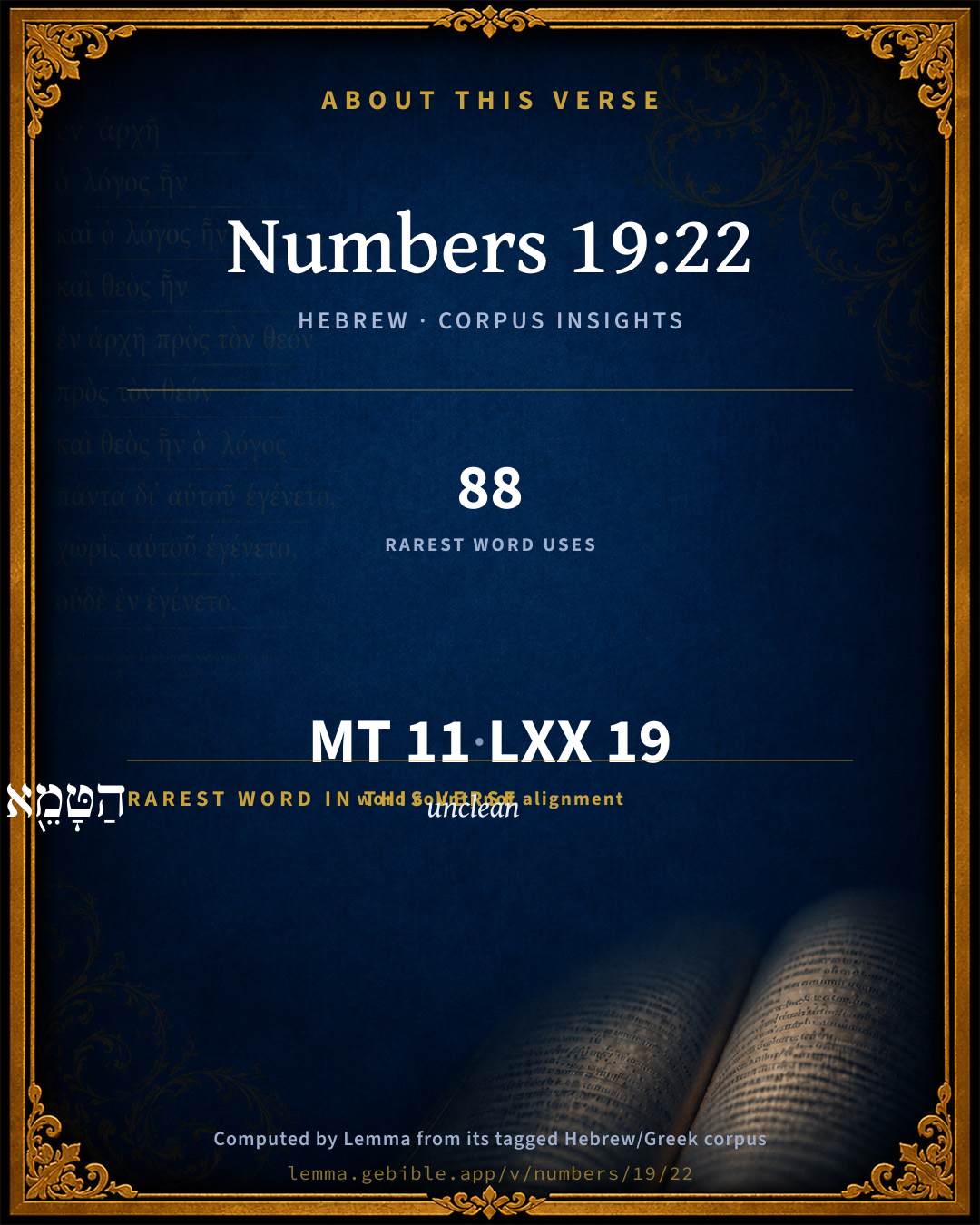
הַטָּמֵ֖א
ṭâmêʼ
H2931
“the · unclean”
Particle, Definite Article + Adjective, Adjective, Masculine, Singular, Absolute
Part of Speech
Particle + Adjective
Type
Adjective
Gender
Masculine
Number
Singular
State
Absolute
Full BDB Definition

Origin: from H2930

TWOT: 809a

unclean, impure - ethically and religiously - ritually - of places
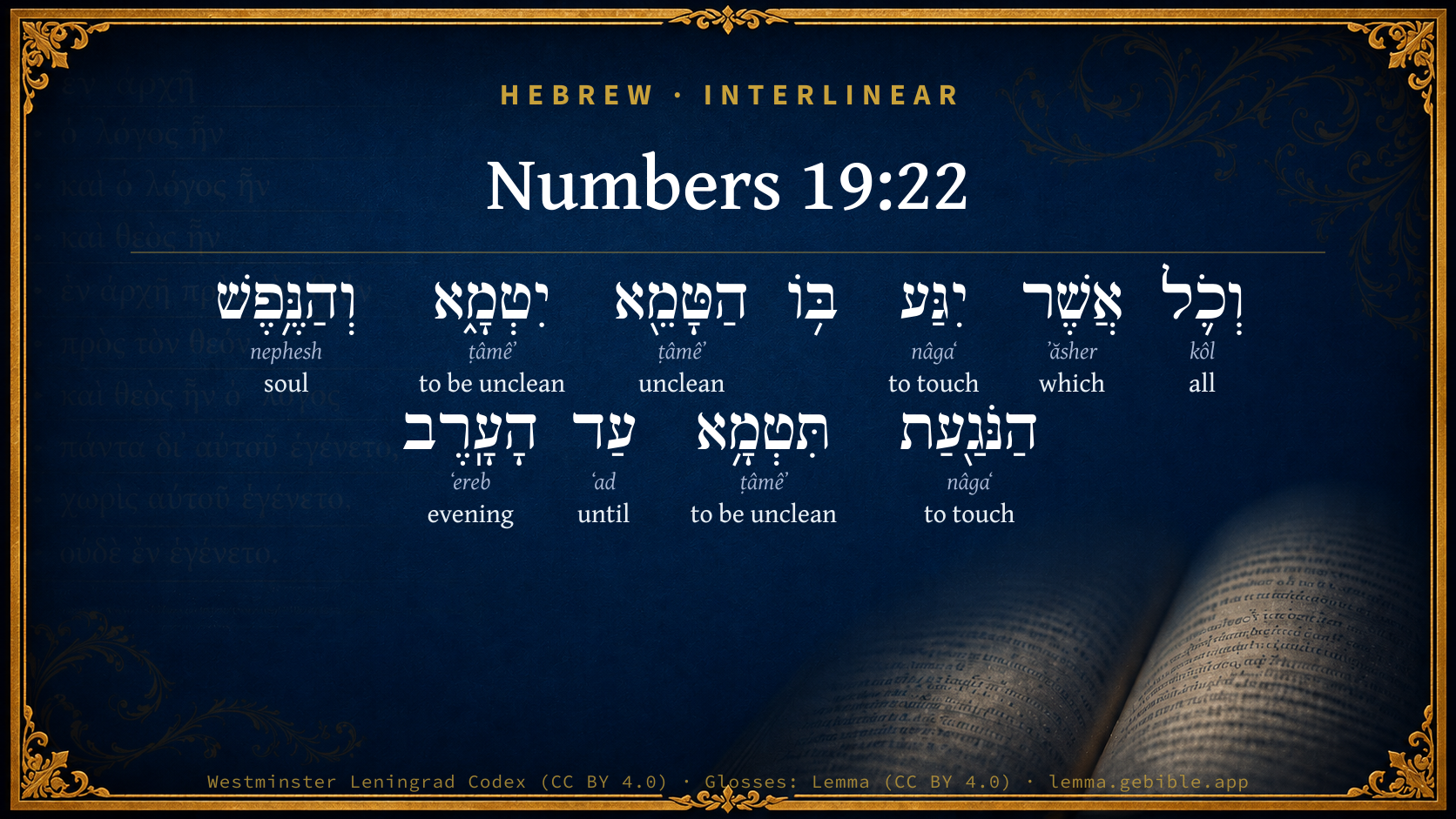
  1. וְכֹ֛ל kôl H3605 “and · all” Conjunction + Noun, Common, Masculine, Singular, Absolute
  2. אֲשֶׁר ʼăsher H834 “which” Particle, Relative
  3. יִגַּע nâgaʻ H5060 “to touch” Verb, Qal, Imperfect, 3rd Person, Masculine, Singular
  4. יִטְמָ֑א ṭâmêʼ H2930 “to be unclean” Verb, Qal, Imperfect, 3rd Person, Masculine, Singular
  5. וְהַנֶּ֥פֶשׁ nephesh H5315 “and · the · soul” Conjunction + Particle, Definite Article + Noun, Common, Both, Singular, Absolute
  6. הַנֹּגַ֖עַת nâgaʻ H5060 “the · touching” Particle, Definite Article + Verb, Qal, Participle Active, Feminine, Singular, Absolute
  7. תִּטְמָ֥א ṭâmêʼ H2930 “to be unclean” Verb, Qal, Imperfect, 3rd Person, Feminine, Singular
  8. עַד ʻad H5704 “until” Preposition
  9. הָעָֽרֶב ʻereb H6153 “the · evening” Particle, Definite Article + Noun, Common, Masculine, Singular, Absolute

About this verse

These counts appear in no published source. They are computed here, from the morphology-tagged text and Lemma’s own curated glosses. What Lemma adds →

11
words
8
distinct lemmas
Pentateuch
section

Grammatical profile

  • 4 verbs
  • 3 nouns
  • 1 adjective
  • 2 prepositions
  • 1 particle

Verb forms

  • יִגַּע Qal · Imperfect
  • יִטְמָ֑א Qal · Imperfect
  • הַנֹּגַ֖עַת Qal · Participle Active
  • תִּטְמָ֥א Qal · Imperfect

Repetition

Words recur within this verse — often emphatic in Hebrew:

  • יִגַּע to touch H5060 ×2
  • יִטְמָ֑א to be unclean H2930 ×2

Hebrew & Septuagint length

In English translation the verse runs 19 words from the Hebrew and 21 from the Septuagint (LXX English) — closely comparable.

A rough comparison of the two English renderings, which tokenize alike — not a word-level alignment.

Word counts can differ between the Hebrew and the Greek without any difference in meaning — e.g. the Hebrew direct-object marker אֵת has no separate Greek word, and Greek often adds the article ὁ.

In the original languages it is 11 Hebrew tokens and 19 Greek tokens — but the two are counted differently (Hebrew bundles its prefixes and suffixes into one token; the Greek is in lemma form), so that isn’t a like-for-like length.

Cross-references

6

Topical passages linked to Numbers 19:22 in the Treasury of Scripture Knowledge — connected by theme and wording, ordered by reader-vote popularity; previews shown in the World English Bible.

  • Haggai 2:13 Then Haggai said, "If one who is unclean by reason of a dead body touch any of these, will it be unclean?" The priests answered, "It will be unclean."
  • Leviticus 7:19 "'The flesh that touches any unclean thing shall not be eaten. It shall be burned with fire. As for the flesh, everyone who is clean may eat it;
  • Leviticus 5:2 "'Or if anyone touches any unclean thing, whether it is the carcass of an unclean animal, or the carcass of unclean cattle, or the carcass of unclean creeping things, and it is hidden from him, and he is unclean, then he shall be guilty.
  • Leviticus 15:5 Whoever touches his bed shall wash his clothes, and bathe himself in water, and be unclean until the evening.
  • Matthew 15:19–20 For out of the heart come forth evil thoughts, murders, adulteries, sexual sins, thefts, false testimony, and blasphemies.
  • Mark 7:21–23 For from within, out of the hearts of men, proceed evil thoughts, adulteries, sexual sins, murders, thefts,

Cross-references courtesy of OpenBible.info (CC BY 4.0).

Hebrew and Greek witnesses Masoretic Hebrew ↔ Greek Septuagint

The same verse in the two great witnesses to the Old Testament, shown verse-for-verse.

These are two independent witnesses, not word-aligned to each other, and the Septuagint is shown in lemma (dictionary) form.

Hebrew Numbers 19:22 Masoretic · Westminster Leningrad Codex

וְכֹ֛ל אֲשֶׁר יִגַּע בּ֥וֹ הַטָּמֵ֖א יִטְמָ֑א וְהַנֶּ֥פֶשׁ הַנֹּגַ֖עַת תִּטְמָ֥א עַד הָעָֽרֶב

Whatever the unclean person touches shall be unclean; and the soul that touches it shall be unclean until even.

World English Bible · Public Domain

Greek LXX Numbers 19:22 Septuagint · lemma form

καί πᾶς ὅς ἐάν ἅπτομαι αὐτός ὁ ἀκάθαρτος ἀκάθαρτος εἰμί καί ὁ ψυχή ὁ ἅπτομαι ἀκάθαρτος εἰμί ἕως ἑσπέρα

And whatever the unclean man shall touch shall be unclean, and the soul that touches it shall be unclean till evening.

LXX2012 (modern English Septuagint) · Public Domain

Hebrew: Westminster Leningrad Codex (CC BY 4.0). Greek: Septuagint (public domain); English from LXX2012 (modern English Septuagint) (Public Domain). How the Septuagint differs from the Hebrew →

Targum (Aramaic paraphrase)

2

The Targum is the ancient Jewish Aramaic paraphrase of the Hebrew Scriptures — an interpretive translation, not the Hebrew text itself. Onkelos (literal) and Pseudo-Jonathan (expansive) render the Torah, and Jonathan the Prophets. Coverage is partial: where no permissively-licensed English translation exists for a verse, only the Aramaic is shown. This is verse-level text, not a word-by-word alignment to the Hebrew.

  1. Targum Onkelos Torah (Genesis–Deuteronomy)
    וְכָל דִי יִקְרַב בֵּיהּ מְסָאָבָא יְהֵי מְסָאָב וֶאֱנַשׁ דְיִקְרַב בֵּיהּ יְהֵי מְסָאָב עַד רַמְשָׁא

    (no public-domain English translation for this verse)

    Targum Onkelos — Aramaic: “Onkelos Genesis” (public domain); “Onkelos Exodus” (public domain); “Onkelos Leviticus” (public domain); “Onkelos Numbers” (public domain); “Onkelos Deuteronomy” (public domain). English: “Sefaria Community Translation” (CC0 1.0 (public-domain dedication)); “J.W. Etheridge. The Targums of Onkelos and Jonathan Ben Uzziel on the Pentateuch. London: Longmans, Green, 1862” (public domain). Text via Sefaria.

  2. Targum Pseudo-Jonathan Torah (Genesis–Deuteronomy)
    וְכָל מִדַעַם דְיִקְרַב בֵּיהּ מְסָאֲבָא וְלָא בְהֵיסֵיטָא יְהֵי מְסָאָב וּבַר נַשׁ דְכֵי דְיִקְרַב בֵּיהּ יְהֵי מְסָאָב עַד רַמְשָׁא

    And whatever the unclean person hath touched, though he carry it not, shall be unclean; and the clean man who toucheth him shall be unclean till evening.

    Targum Pseudo-Jonathan — Aramaic: “Targum Jonathan on Genesis” (public domain); “Targum Jonathan on Exodus” (public domain); “Targum Jonathan on Leviticus” (public domain); “Targum Jonathan on Numbers” (public domain); “Targum Jonathan on Deuteronomy” (public domain). English: “The Targum of Jonathan ben Uzziel, trans. J. W. Etheridge, London, 1862” (public domain). Text via Sefaria.

Commentary

Notes on Numbers 19:22 from classic Christian and Jewish commentators (each source and its license shown beneath its notes). The classic Christian expositions comment on the surrounding passage and are grouped to its opening verse, so a note may address several verses; the Jewish commentaries on the Tanakh (Rashi and others) are per-verse, so they appear only where the commentator wrote on this verse.

Lemma curates 59 commentaries, every one of them public domain or Creative Commons licensed, each selected and text-cleaned for this edition rather than reprinted as found. About our sources →

Geneva Bible (1599)

Geneva Bible translators

That is, unclean.

Geneva Bible (1599) marginal notes — public domain. Text via Bolls.life.

John Gill's Exposition

And whatsoever the unclean person toucheth shall be unclean,.... Not the person unclean by sprinkling, or touching the water of purification, but the unclean person spoken of throughout the chapter, that was unclean by touching a dead body, bone, or grave; whatever that man touched, any vessel or thing, that was unclean also; or "whomsoever", any person, man or woman, for it respects both persons and things:

and the soul that toucheth it; that which the unclean person hath touched; or "him", the unclean person, whether the unclean person touched him, or he the unclean person, or touched anything he had touched, he was unclean; denoting the spreading and infectious nature of sin, and how much sin and sinners are to be avoided; see Lev 15:4.

Next: Numbers Chapter 20

John Gill's Exposition of the Whole Bible (1746–1763) — public domain (CC PDM 1.0). Text via the HelloAO Bible API.

Haydock's Catholic Bible Commentary

Is unclean, by touching the dead, must remain defiled seven days. But those whom he touches, as well as all who may have communication with them in infinitum, may be purified in the evening. (Calmet)

George Leo Haydock (1774–1849), Haydock's Catholic Family Bible and Commentary, 1859 edition — public domain. Excludes Psalms (Douay-Rheims chapter numbering differs from Protestant) and Deuterocanonical books (Catholic canon only).

Matthew Poole's English Annotations

The unclean person; not he who is so only by touching the water of separation, Num 19:21, but he who is so by the greater sort of uncleanness, which lasted seven days, of which Num 19:11,16, and which was not removed without the use of this water of purification, as is manifest from the context and other places of Scripture, and from the nature of the thing; for the lesser sort of uncleanness, mentioned in the foregoing verse, lasted only till even, and was cleansed by the sole washing of his clothes and flesh in water, Num 19:7, without any use of this water of purification, which, if it had been necessary, must have been used on the third and on the seventh day, according to the rule, Num 19:12,19, and so the uncleanness of one day had been made an uncleanness of seven days, which is a contradiction. Besides it is unreasonable, that he who immediately touched the defiling thing, should be no more and longer unclean than he who touched that person only; and it was contrary to other rules in like cases, as Le 15, where the man or woman having an issue, are thereby made unclean for seven days, Lev 15:13,28, but he who toucheth them is made unclean only till even, Le 15:7,27. And therefore this cannot be meant of him who was unclean by touching this water, who himself was unclean only till even, Num 19:21, as also he who toucheth him is in this place.

Shall be unclean, to signify to us the very infectious nature of sin and of sinful company.

Until even, because as his defilement was less, so it was fit the duration of it should be shorter.

Matthew Poole's English Annotations on the Holy Bible (1683–1685) — public domain. Text from a community e-Sword/MySword module.

John Wesley's Explanatory Notes

The unclean person - Not he who is so only by touching the water of separation, ver. 21, but he who is so by the greater sort of uncleanness, which lasted seven days, and which was not removed without the use of this water of purification.

John Wesley, Explanatory Notes Upon the Whole Bible (1754–1765) — public domain. Text via the GEBible commentary corpus.

Rashi

Rabbi Shlomo Yitzchaki (Rashi)

וכל אשר יגע בו הטמא AND WHATSOEVER THE UNCLEAN PERSON TOUCHETH — i.e., this unclean person who has become unclean by reason of a corpse, SHALL TOUCH, יטמא SHALL BECOME UNCLEAN.

והנפש הנגעת AND THE SOUL THAT TOUCHETH him that hath become unclean by reason of a corpse,

תטמא עד הערב SHALL BE UNCLEAN UNTIL THE EVEN — Here we learn that a corpse is a progenitor of a primary source of uncleanness, and he that touches it becomes a primary source of uncleanness and can render a human being unclean. — This is its explanation (that of the whole chapter) according to what it literally implies and according to the Halachoth connected with it. — A Midrashic explanation I have copied from the work of R. Moses the Preacher, and this is:

ויקחו אליך AND THEY SHALL TAKE UNTO THEE — They shall take from that which is their own: just as they divested themselves of their golden earrings for making of the calf — i.e., of that which was their own, so shall they bring this calf-like animal as an atonement from that which is their own.

פרה אדמה A RED COW — Why this rite was performed with a cow may be exemplified by a parable it may be compared to the case of a handmaid’s child that defiled the king’s palace. They said: Let the mother come and wipe up the excrement. Similarly here: since they became defiled by a calf, let its mother (a cow) come and atone for the calf (cf. Midrash Tanchuma, Chukat 8).

אדמה RED — It had to be red in allusion to the idea contained in the text (Isaiah 1:18): “Though they (your sins) be red as scarlet [they shall become as white as snow]” — so you see that sin is termed red.

תמימה PERFECT — in allusion to the Israelites who were perfect but through it (the calf) became morally maimed: let this perfect animal come and atone for them so that they may regain their state of perfection.

לא עלה עליה על [A COW] UPON WHICH NEVER CAME A YOKE — just as they cast off themselves the yoke of Heaven.

אל אלעזר הכהן TO ELEAZAR THE PRIEST — just as they gathered together against Aaron who was a priest to force him to make the golden calf. But because Aaron had made the calf this rite was not entrusted to him that it should be carried out by him, because the prosecuting counsel cannot become the defending counsel (Rosh Hashanah 26a; cf. Rashi on Leviticus 16:4; Aaron who had caused the sin was not a fitting person to atone for it: therefore the rite had to be performed by another priest, viz., by Eleazar).

ושרף את הפרה AND ONE SHALL BURN THE COW, just as the calf was burnt (Exodus 32:20).

עץ ארז ואזוב ושני תולעת CEDAR WOOD AND HYSSOP AND CRIMSON — These three species correspond to the three thousand men who fell by the edge of the sword on account of the golden calf. The cedar is the loftiest of all trees and the hyssop the lowliest of all — a symbol that the man of high position who displays pride and on that account falls into sin should make himself as lowly as the hyssop and the worm (תולעת), and he will then gain atonement.

למשמרת [IT SHALL BE] KEPT [FOR THE CONGREGATION OF THE CHILDREN OF ISRAEL], just as the transgression of the calf is kept in remembrance for all future generations for punishment, for there is no visitation of Israel in which there is not something of the visitation of the sin caused by the calf, as it is said, (Exodus 32:34) “On the day when I visit I will visit [their sin upon them]” (cf. Rashi on that verse, and Sanhedrin 102a; Yerushalmi Taanit 14). And just as the calf rendered unclean everyone who busied himself with it (cf. Avodah Zarah 32b), so, too, does the cow make unclean all who busy themselves with it. And just as they (Israel) were purified by its dust (Exodus 22:20), similarly it states, (v. 17) “And for an unclean person shall they take of the dust of the burnt cow of purification, etc.”

Rashi on the Tanakh — English translations: “The Judaica Press complete Tanach with Rashi, translated by A. J. Rosenberg” (CC BY 4.0); “Pentateuch with Rashi's commentary by M. Rosenbaum and A.M. Silbermann, 1929-1934” (public domain); “The Metsudah Tanach series, Lakewood, N.J” (CC BY 4.0); and “The Book of Joshua, Metsudah Publications, 1997” (CC BY 4.0). Text via Sefaria.

Lesson kit

Teaching starters — assembled from the data on this page, not authored interpretation. Every prompt links to the verse data it draws on. Edit before teaching.

Numbers, in the Pentateuch, opens this verse with 11 words (8 distinct Hebrew lemmas). Its most distinctive word is ṭâmêʼ (“unclean”). A historical commentator’s framing appears above. Read the whole chapter for the surrounding context.

Discussion questions

  1. The word ṭâmêʼ carries the sense “unclean.” How does it shape the verse?
  2. Haggai 2:13 shares this passage’s theme. How do the two illuminate each other?
  3. “to touch” occurs 2× in this one verse. What is the effect of the repetition?
  4. These translations render this verse differently; the difference is in the English rendering, not the original. What questions does that raise?
  5. The verb «יִגַּע» is Qal Imperfect. How does its form color the action?
  6. Reading how Geneva Bible (1599) and John Gill's Exposition read this verse, where do the two commentators agree and where do they part?

Things to notice

Reading settings

Reading text

Shown beneath each verse's original-language words.

Old Testament
Old Testament edition

Read the OT as the Masoretic Hebrew (MT) or the Greek Septuagint (LXX).

English shown for the Greek Septuagint (in the Hebrew ↔ Greek comparison).

Comparing translations? Open the Compare panel on any verse page to stack up to four side by side.