
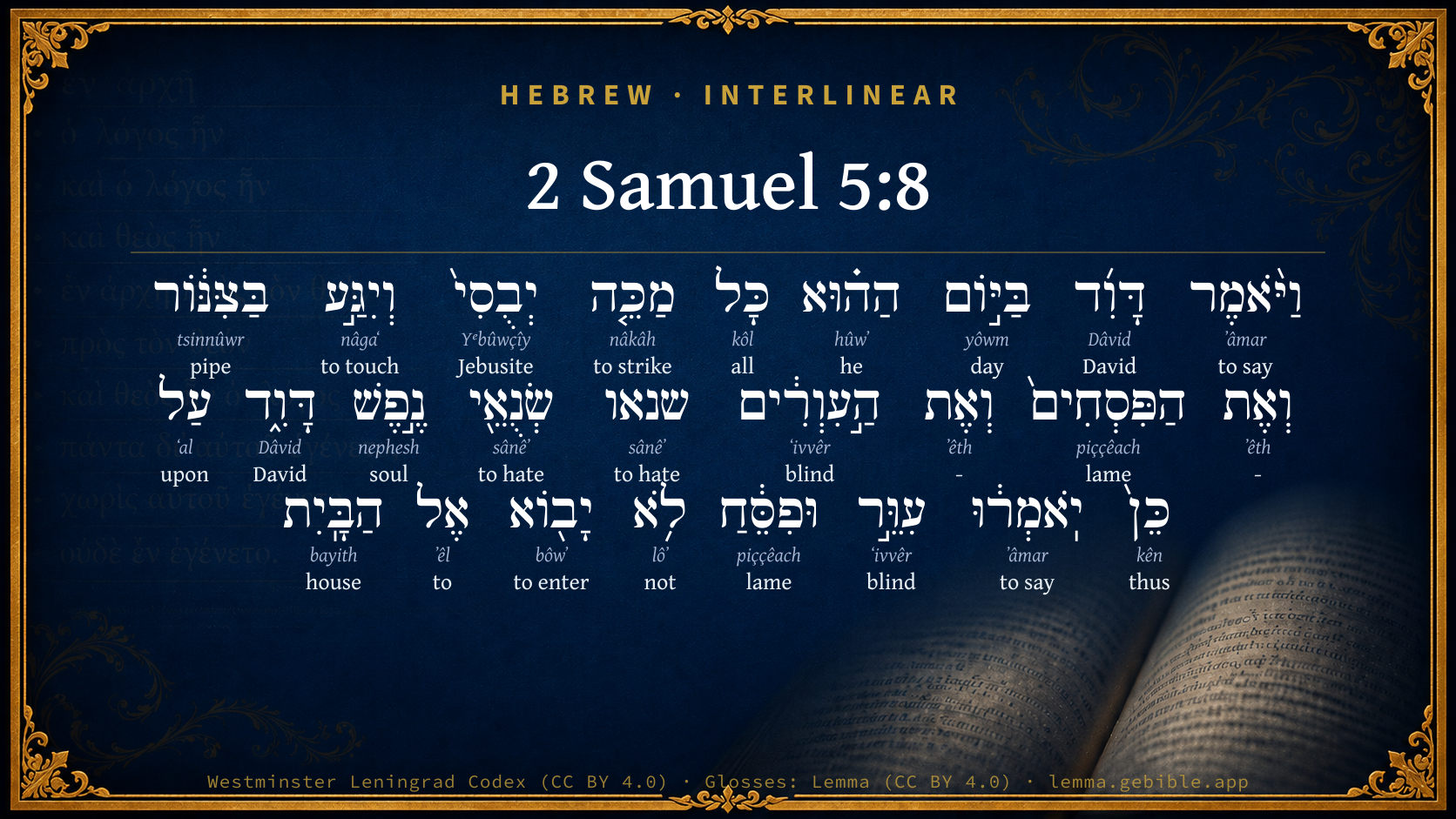
2 Samuel 5:8

Hebrew (Westminster Leningrad Codex) 2 Samuel 5:8 appears in the Hebrew Old Testament. The text above is from the Westminster Leningrad Codex. Each word links to its Strong’s number, a concise gloss, and parsing drawn from the Open Scriptures Hebrew Bible morphology. Click any word for its full Brown-Driver-Briggs (BDB) entry.
Download image
Cite this verse

2 Samuel 5:8 (World English Bible). Public Domain. Lemma interlinear Bible study tool, https://lemma.gebible.app/v/2-samuel/5/8.

Show BibTeX & RIS
BibTeX
RIS
English Translation
David said on that day, Whoever strikes the Jebusites, let him get up to the watercourse, and [strike] the lame and the blind, who are hated of David's soul. Therefore they say, There are the blind and the lame; he can't come into the house.
World English Bible · Public Domain
Highlights
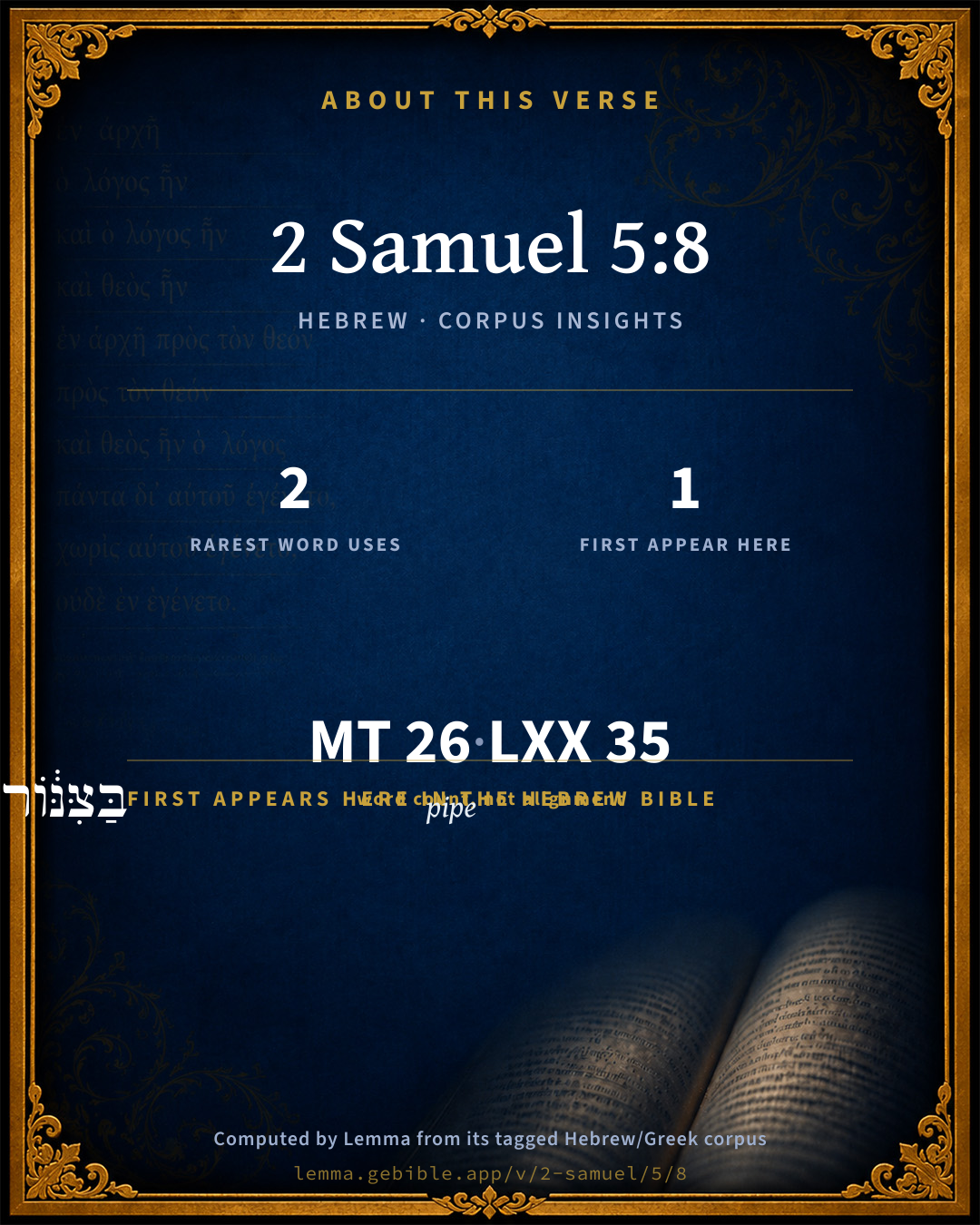
  • 1 first appearance in the Hebrew Bible
Full analysis ↓
Download a study sheet

One document with this verse’s original text, its word-by-word gloss line, the meaning frame, cross-references with their text, attributed commentary, and full source and license credits — printable, and it pastes into notes with its structure intact.

This verse Autodidact and up

Study sheet (.html) Plain text (.txt)

A passage Seminary Student

Up to 50 verses in one chapter. A passage sheet keeps up to 6 commentary sources and 12 cross-references per verse, in the order this page ranks them, and says so on the sheet whenever that leaves anything out. Ask for a single verse and you get the Autodidact verse sheet above.

Everything on this page stays free to read, with no account — the sheet is a download of what is already on screen, not access to it.

Want to remove ads? Support Godless Engineer
Compare translations 3

The same verse in 3 English versions, stacked beneath the original-language interlinear above. Click any original word for its lexicon entry.

Each is an independent rendering of the whole verse — the interlinear is not word-aligned to these translations.

Highlighted words mark where these versions differ — a whole-verse word diff, not a word-by-word alignment.

  • World English Bible Public Domain
    David said on that day, Whoever strikes the Jebusites, let him get up to the watercourse, and [strike] the lame and the blind, who are hated of David's soul. Therefore they say, There are the blind and the lame; he can't come into the house.
  • King James Version Public Domain
    And David said on that day, Whosoever getteth up to the gutter, and smiteth the Jebusites, and the lame and the blind that are hated of David's soul, he shall be chief and captain. Wherefore they said, The blind and the lame shall not come into the house.
  • unfoldingWord Literal Text CC BY-SA 4.0
    And David said on that day, “Anyone striking the Jebusite, then let him approach through the water shaft the lame and the blind, hated by the soul of David.” (Therefore they say, “The blind and the lame shall not come into the house.”)

unfoldingWord Literal Text — © unfoldingWord, licensed CC BY-SA 4.0. Word-aligned USFM3 via Door43 (git.door43.org/unfoldingWord/en_ult).

Versions to compare (up to 4)

3 of 4 selected

Show all 18 translations

Every available English version of this verse, each an independent rendering of the whole verse.

  • World English Bible Public Domain
    David said on that day, Whoever strikes the Jebusites, let him get up to the watercourse, and [strike] the lame and the blind, who are hated of David's soul. Therefore they say, There are the blind and the lame; he can't come into the house.
  • Berean Standard Bible Public Domain
    On that day he said, “Whoever attacks the Jebusites must use the water shaft to reach the lame and blind who are despised by David.” That is why it is said, “The blind and the lame will never enter the palace.”
  • Majority Standard Bible Public Domain
    On that day he said, “Whoever attacks the Jebusites must use the water shaft to reach the lame and blind who are despised by David.” That is why it is said, “The blind and the lame will never enter the palace.”
  • King James Version Public Domain
    And David said on that day, Whosoever getteth up to the gutter, and smiteth the Jebusites, and the lame and the blind that are hated of David's soul, he shall be chief and captain. Wherefore they said, The blind and the lame shall not come into the house.
  • American Standard Version (1901) Public Domain
    And David said on that day, Whosoever smiteth the Jebusites, let him get up to the watercourse, and `smite' the lame and the blind, that are hated of David's soul. Wherefore they say, There are the blind and the lame; he cannot come into the house.
  • Revised Version (1885) Public Domain
    And David said on that day, Whosoever smiteth the Jebusites, let him get up to the watercourse, and smite the lame and the blind, that are hated of David’s soul. Wherefore they say, There are the blind and the lame; he cannot come into the house.
  • Geneva Bible (1599) Public Domain
    Nowe Dauid had sayd the same day, Whosoeuer smiteth the Iebusites, and getteth vp to the gutters and smiteth the lame and blinde, which Dauids soule hateth, I will preferre him: therefore they saide, The blinde and the lame shall not come into that house.
  • Douay-Rheims (1899) Public Domain
    But David took the castle of Sion, the same is the city of David.
  • Young's Literal Translation Public Domain
    And David saith on that day, `Any one smiting the Jebusite, (let him go up by the watercourse), and the lame and the blind -- the hated of David's soul,' -- because the blind and lame say, `He doth not come into the house.'
  • Literal Standard Version CC BY-SA 4.0
    And on that day David says, “Anyone striking the Jebusite, let him go up by the watercourse (and the lame and the blind—the hated of David’s soul).” Therefore they say, “The blind and lame—he does not come into the house.”
  • Unlocked Literal Bible CC BY-SA 4.0
    At that time David said, “Those who attack the Jebusites will have to go through the water shaft to reach the 'lame and the blind' who are David's enemies.” That is why people say, “The 'blind and the lame' must not enter the palace.”
  • unfoldingWord Literal Text CC BY-SA 4.0
    And David said on that day, “Anyone striking the Jebusite, then let him approach through the water shaft the lame and the blind, hated by the soul of David.” (Therefore they say, “The blind and the lame shall not come into the house.”)
  • Darby Bible Public Domain
    And David said on that day, Whoever smites the Jebusites and gets up to the watercourse, and the lame and the blind hated of David's soul...! Therefore they say, The blind and the lame shall not come into the house.
  • World Messianic Bible Public Domain
    David said on that day, “Whoever strikes the Jebusites, let him go up to the watercourse and strike those lame and blind, who are hated by David’s soul.” Therefore they say, “The blind and the lame can’t come into the house.”
  • Webster's Bible Public Domain
    And David said on that day, Whoever getteth up to the gutter, and smiteth the Jebusites, and the lame and the blind, that are hated by David's soul, he shall be chief and captain: Wherefore they said, The blind and the lame shall not come into the house.
  • Free Bible Version CC BY-SA 4.0
    At that time he said, “If we are to successfully conquer the Jebusites we'll have to go up the water shaft to attack these ‘lame and blind’ —these people who hate David.” This is why it's said, “The blind and the lame will never enter the house.”
  • Bible in Basic English Public Domain
    And that day David said, Whoever makes an attack on the Jebusites, let him go up by the water-pipe, and put to death all the blind and feeble-footed who are hated by David. And this is why they say, The blind and feeble-footed may not come into the house.
  • JPS Tanakh (1917) Public Domain
    And David said on that day: 'Whosoever smiteth the Jebusites, and getteth up to the gutter, and taketh away the lame and the blind, that are hated of David's soul —.' Wherefore they say: 'There are the blind and the lame; he cannot come into the house.'

Literal Standard Version (2020), Covenant Press — licensed CC BY-SA 4.0. Text via the HelloAO Bible API (eBible.org). Unlocked Literal Bible (unfoldingWord) — licensed CC BY-SA 4.0. Text via the HelloAO Bible API (eBible.org). unfoldingWord Literal Text — © unfoldingWord, licensed CC BY-SA 4.0. Word-aligned USFM3 via Door43 (git.door43.org/unfoldingWord/en_ult). Free Bible Version, Dr. Jonathan Gallagher — licensed CC BY-SA 4.0. Text via the HelloAO Bible API (eBible.org).

Word by word

More ways to search: Search by grammar → Find every occurrence → Compare this word →

Practice this passage: Drill this verse → Learn its vocabulary →

בַּצִּנּ֔וֹר
tsinnûwr
H6794
“in/at the · pipe”
Preposition, Determined + Noun, Common, Masculine, Singular, Absolute
Part of Speech
Preposition + Noun
Type
Common
Gender
Masculine
Number
Singular
State
Absolute
Full BDB Definition

Origin: from an unused root perhaps meaning to be hollow

TWOT: 1942a

pipe, spout, conduit, water conduit
  1. וַיֹּ֨אמֶר ʼâmar H559 “and · to say” Conjunction + Verb, Qal, Sequential Imperfect, 3rd Person, Masculine, Singular
  2. דָּוִ֜ד Dâvid H1732 “David” Noun, Proper
  3. בַּיּ֣וֹם yôwm H3117 “in/at the · day” Preposition, Determined + Noun, Common, Masculine, Singular, Absolute
  4. הַה֗וּא hûwʼ H1931 “the · he” Particle, Definite Article + Pronoun, Personal, 3rd Person, Masculine, Singular
  5. כָּל kôl H3605 “all of” Noun, Common, Masculine, Singular, Construct
  6. מַכֵּ֤ה nâkâh H5221 “striking” Verb, Hiphil, Participle Active, Masculine, Singular, Construct
  7. יְבֻסִי֙ Yᵉbûwçîy H2983 “Jebusite” Noun, Gentilic, Masculine, Singular, Absolute
  8. וְיִגַּ֣ע nâgaʻ H5060 “and · to touch” Conjunction + Verb, Qal, Imperfect, 3rd Person, Masculine, Singular
  9. וְאֶת ʼêth H853 “and · -” Conjunction + Particle, Direct Object
  10. הַפִּסְחִים֙ piççêach H6455 “the · lame” Particle, Definite Article + Adjective, Adjective, Masculine, Plural, Absolute
  11. וְאֶת ʼêth H853 “and · -” Conjunction + Particle, Direct Object
  12. הַ֣עִוְרִ֔ים ʻivvêr H5787 “the · blind” Particle, Definite Article + Adjective, Adjective, Masculine, Plural, Absolute
  13. שנאו sânêʼ H8130 “to hate” Verb, Qal, Perfect, 3rd Person, Common, Plural
  14. שְׂנֻאֵ֖י sânêʼ H8130 “hated” Verb, Qal, Participle Passive, Masculine, Plural, Construct
  15. נֶ֣פֶשׁ nephesh H5315 “soul of” Noun, Common, Both, Singular, Construct
  16. דָּוִ֑ד Dâvid H1732 “David” Noun, Proper
  17. עַל ʻal H5921 “upon” Preposition
  18. כֵּן֙ kên H3651 “thus” Particle, Demonstrative
  19. יֹֽאמְר֔וּ ʼâmar H559 “to say” Verb, Qal, Imperfect, 3rd Person, Masculine, Plural
  20. עִוֵּ֣ר ʻivvêr H5787 “blind” Adjective, Adjective, Masculine, Singular, Absolute
  21. וּפִסֵּ֔חַ piççêach H6455 “and · lame” Conjunction + Adjective, Adjective, Masculine, Singular, Absolute
  22. לֹ֥א lôʼ H3808 “not” Particle, Negative
  23. יָב֖וֹא bôwʼ H935 “to enter” Verb, Qal, Imperfect, 3rd Person, Masculine, Singular
  24. אֶל ʼêl H413 “to” Preposition
  25. הַבָּֽיִת bayith H1004 “the · house” Particle, Definite Article + Noun, Common, Masculine, Singular, Absolute

About this verse

These counts appear in no published source. They are computed here, from the morphology-tagged text and Lemma’s own curated glosses. What Lemma adds →

26
words
20
distinct lemmas
Historical
section

Notable vocabulary

The rarest word here is בַּצִּנּ֔וֹר pipe H6794 — appearing just 2 times in the whole Hebrew Bible.

First appearance in Scripture

This word makes its first canonical appearance in the Hebrew Bible here:

  • בַּצִּנּ֔וֹר pipe H6794

Shared distinctive vocabulary

בַּצִּנּ֔וֹר pipe H6794 occurs in 2 verses of the Hebrew Bible. Also found in:

Grammatical profile

  • 7 verbs
  • 8 nouns
  • 4 adjectives
  • 1 pronoun
  • 2 prepositions
  • 4 particles

Verb forms

  • וַיֹּ֨אמֶר Qal · Sequential Imperfect
  • מַכֵּ֤ה Hiphil · Participle Active
  • וְיִגַּ֣ע Qal · Imperfect
  • שנאו Qal · Perfect
  • שְׂנֻאֵ֖י Qal · Participle Passive
  • יֹֽאמְר֔וּ Qal · Imperfect
  • יָב֖וֹא Qal · Imperfect

Repetition

Words recur within this verse — often emphatic in Hebrew:

  • וַיֹּ֨אמֶר to say H559 ×2
  • דָּוִ֜ד David H1732 ×2
  • הַפִּסְחִים֙ lame H6455 ×2
  • הַ֣עִוְרִ֔ים blind H5787 ×2
  • שנאו to hate H8130 ×2

Hebrew & Septuagint length

In English translation the verse runs 45 words from the Hebrew and 49 from the Septuagint (LXX English) — closely comparable.

A rough comparison of the two English renderings, which tokenize alike — not a word-level alignment.

Word counts can differ between the Hebrew and the Greek without any difference in meaning — e.g. the Hebrew direct-object marker אֵת has no separate Greek word, and Greek often adds the article ὁ.

In the original languages it is 26 Hebrew tokens and 35 Greek tokens — but the two are counted differently (Hebrew bundles its prefixes and suffixes into one token; the Greek is in lemma form), so that isn’t a like-for-like length.

Cross-references

3

Topical passages linked to 2 Samuel 5:8 in the Treasury of Scripture Knowledge — connected by theme and wording, ordered by reader-vote popularity; previews shown in the World English Bible.

  • Joshua 15:16–17 Caleb said, He who strikes Kiriath Sepher, and takes it, to him will I give Achsah my daughter as wife.
  • 1 Chronicles 11:6–9 David said, Whoever strikes the Jebusites first shall be chief and captain. Joab the son of Zeruiah went up first, and was made chief.
  • 1 Samuel 17:25 The men of Israel said, Have you seen this man who is come up? surely to defy Israel is he come up: and it shall be, that the man who kills him, the king will enrich him with great riches, and will give him his daughter, and make his father's house free in Israel.

Cross-references courtesy of OpenBible.info (CC BY 4.0).

Hebrew and Greek witnesses Masoretic Hebrew ↔ Greek Septuagint

The same verse in the two great witnesses to the Old Testament, shown verse-for-verse.

These are two independent witnesses, not word-aligned to each other, and the Septuagint is shown in lemma (dictionary) form.

Hebrew 2 Samuel 5:8 Masoretic · Westminster Leningrad Codex

וַיֹּ֨אמֶר דָּוִ֜ד בַּיּ֣וֹם הַה֗וּא כָּל מַכֵּ֤ה יְבֻסִי֙ וְיִגַּ֣ע בַּצִּנּ֔וֹר וְאֶת הַפִּסְחִים֙ וְאֶת הַ֣עִוְרִ֔ים שנאו שְׂנֻאֵ֖י נֶ֣פֶשׁ דָּוִ֑ד עַל כֵּן֙ יֹֽאמְר֔וּ עִוֵּ֣ר וּפִסֵּ֔חַ לֹ֥א יָב֖וֹא אֶל הַבָּֽיִת

David said on that day, Whoever strikes the Jebusites, let him get up to the watercourse, and [strike] the lame and the blind, who are hated of David's soul. Therefore they say, There are the blind and the lame; he can't come into the house.

World English Bible · Public Domain

Greek LXX 2 Samuel 5:8 Septuagint · lemma form

καί εἶπον δαυίδ ὁ ἡμέρα ἐκεῖνος πᾶς τύπτω ιεβουσαῖος ἅπτομαι ἐν παραξιφίς καί ὁ χωλός καί ὁ τυφλός καί ὁ μισέω ὁ ψυχή δαυίδ διά οὗτος εἶπον τυφλός καί χωλός οὐ εἰςἔρχομαι εἰς οἶκος κύριος

And David said on that day, Every one that smites the Jebusite, let him attack with the dagger both the lame and the blind, and those that hate the soul of David. Therefore they say, The lame and the blind shall not enter into the house of the Lord.

LXX2012 (modern English Septuagint) · Public Domain

On this verse, Whedon's Commentary on the Bible discusses the Septuagint’s reading. Read the note in Commentary ↓

Hebrew: Westminster Leningrad Codex (CC BY 4.0). Greek: Septuagint (public domain); English from LXX2012 (modern English Septuagint) (Public Domain). How the Septuagint differs from the Hebrew →

Targum (Aramaic paraphrase)

1

The Targum is the ancient Jewish Aramaic paraphrase of the Hebrew Scriptures — an interpretive translation, not the Hebrew text itself. Onkelos (literal) and Pseudo-Jonathan (expansive) render the Torah, and Jonathan the Prophets. Coverage is partial: where no permissively-licensed English translation exists for a verse, only the Aramaic is shown. This is verse-level text, not a word-by-word alignment to the Hebrew.

  1. Targum Jonathan Prophets (Joshua–Malachi)
    וַאֲמַר דָוִד בְּיוֹמָא הַהוּא כָּל דְיִקְטַל יְבוּסָאָה וְיִשְׁרֵי לְמִכְבַּשׁ כְּרַכָּא וְיַת חַטָאַיָא וְיַת חַיָבַיָא רְחִיקָא נַפְשָׁא דְדָוִד עַל כֵּן יֵימְרוּן חַטָאַיָא וְחַיָבַיָא לָא יַעֲלוּן לְבֵיתָא:

    (no public-domain English translation for this verse)

    Targum Jonathan — Aramaic: “Mikraot Gedolot” (public domain). English: “Sefaria Community Translation” (CC0 1.0 (public-domain dedication)); “London "Chaldee Paraphrase," 1871” (public domain). Text via Sefaria.

Commentary

Notes on 2 Samuel 5:8 from classic Christian and Jewish commentators (each source and its license shown beneath its notes). The classic Christian expositions comment on the surrounding passage and are grouped to its opening verse, so a note may address several verses; the Jewish commentaries on the Tanakh (Rashi and others) are per-verse, so they appear only where the commentator wrote on this verse.

Lemma curates 59 commentaries, every one of them public domain or Creative Commons licensed, each selected and text-cleaned for this edition rather than reprinted as found. About our sources →

Trapp's Complete Commentary

John Trapp

2Sa 5:8 And David said on that day, Whosoever getteth up to the gutter, and smiteth the Jebusites, and the lame and the blind, [that are] hated of David’s soul, [he shall be chief and captain]. Wherefore they said, The blind and the lame shall not come into the house.

Ver. 8. Whosoever getteth up to the gutter.] This bitter scoff had not so much encouraged as enraged David and his men to assault the fort, which they took by scaling, Joab venturing almost as hard for it, as that brave Englishman did, who, at the storming of an earthwork in the low countries, caught hold of a pike in the hand of his enemy, and was thereby drawn up to the taking of the place.

Wherefore they said.] Or, Because they had said, even the blind and the lame, He shall not come into the house, that is, into the hold. Now because they had put this scorn upon him, David was set upon it to have them out. So the king of France, jesting at William the Conqueror’s great belly, whereof he said he lay in at Rouen, so irritated him, as he being recovered of a sickness, entered France in the chiefest time of their fruits, making spoil of all in his way till he came even to Paris, where the king of France then was, to show him of his activity after his illness: and from thence marched to the city of Mentz, which he utterly sacked, &c. {a}

{a} Dan Hist., 42.

John Trapp, A Commentary or Exposition upon All the Books of the Old and New Testament (1647–1656) — public domain. Text from a community e-Sword module.

The Biblical Illustrator

Joseph S. Exell

2Sa_5:8

Whosoever getteth up to the gutter.

The assault upon Zion

Some far-seeing Hittite or Amorite had designed from the inside of the city that a subterraneous passage should be cut through the rock to the spring below, so that in troublous times when the daughters of Zion could no longer venture outside the gates to draw water from the fountain, the needful supply should be obtainable without the knowledge of the besiegers, and without risk to the besieged. (Harper.) There is strong presumption that David obtained information of this secret way through a citizen--Araunah the Jebusite. At all events whoever disclosed to him the singular viaduct--gutter of our Bibles--he issued forthwith the proclamation that an attack through it was feasible. This has received the amplest confirmation from two other well-known Palestine explorers by having themselves accomplished the feat. They worked their way up through this same covered passage. (J. R. Macduff, D. D.)

Storming the citadel

Joab stormed the stronghold of Zion, which the Jebusites thought-impregnable. Jonathan and his armour-bearer were scornfully despised by the Philistine garrison (2Sa_5:1-25.) So General Wolfe won the great victory which has made his name famous, by leading his men up the Heights of Abraham above Quebec, his French opponents not dreaming that such a feat was practicable.

Storming the fortress

The whole incident recalled a kindred adventure in Scottish history; when during the wars of the Douglas, Dumbarton Rock--550 feet in height, crowned with its fortress and castle, had its precipices of ballast sealed by a few daring men, with the aid of ladders and grappling irons and misty midnight. An ash tree growing in a crevice near the top served as an equivalent for what, in the water-course of Jebus, helped materially to crown the feat with success. (J. R. Macduff, D. D.)

The Biblical Illustrator, edited by Joseph S. Exell (c. 1880s–1900s) — public domain. Text from a community e-Sword module.

Joseph Benson's Commentary

2Sa 5:8. David said on that day — When the assault was made; Whosoever getteth up into the gutter — That is, whosoever scaleth the fort, or getteth up to the top of it, where the gutter was. Or, as some understand it, cuts off their pipes of water, or their cisterns into which the water fell. Dr. Kennicott observes that “the Hebrew, צנור, zenur, gutter, occurs but once more in the Bible, and does not seem commonly understood in this place. The English version calls it, the gutter; the Vulgate, fistulas, pipes; Vatablus, canales; Junius and Tremellius, emissarium, a common sewer; Poole, tubus aquæ, a pipe for water; and Bochart, alveus, a bed or channel of a river. Most interpreters agree in making the word signify something hollow, and in applying it to water.” It may mean, he thinks, “a subterraneous passage, or great hollow, through which men could pass and repass for water. That this zenur, in the text, was such an under-ground passage, might be strongly presumed from the text itself; but it is proved to have been so by Josephus. For, speaking of this very transaction, he says, ‘The citadel being as yet in the possession of the enemy, the king promised that he would make any one general of all his forces who should ascend into the citadel, δια υποκειμενων φαραγγων, through the subterraneous cavities.’ Here then we have subterraneous cavities most remarkably answering to zenur, and putting this interpretation upon a very solid footing.” Kenn. Dissert., vol. 1. p. 42. And the lame and the blind, that are hated of David’s soul — This, some think, plainly shows, that by the lame and the blind must be meant the idols of the Jebusites; because David certainly abhorred idolatry, but could never detest men for mere unblameable infirmities. But two things may be said in answer to this: 1st, That the lame and the blind Jebusites had probably themselves insulted David, and blasphemed God, and David might hate them in the same sense in which he often speaks of hating the wicked in his Psalms; that is, he might hate their ways, their dispositions, and actions. But, 2d, The original words may, and certainly should be rendered, as they are by the Seventy, who hate David’s soul. He shall be chief and captain — These words are not in the Hebrew here, but are fifty supplied from 1Ch 11:6, where they are expressed. Wherefore they said — That is, it became a proverb, or common saying, used by David and others: The blind and the lame shall not come into the house — Or, into this house; that is, into the fort of Zion. The blind and lame Jebusites were set to keep that fort, and to keep others from coming into it; but now they themselves are shut out of it, and none of them was to be admitted to come into it again; which David might resolve to ordain, to keep up the memory of this great exploit, and of the insolent carriage of the Jebusites, and their unhappy success. Or, the blind and the lame shall not come into my house; namely, into the king’s palace; which, though a general rule and decree of David, yet might be dispensed with in some special cases, as in that of Mephibosheth. But it is not necessary to understand this as a proverb; for the words may be rendered, as they are in the margin of our Bibles, Because they had said, Even the blind and the lame, he (that is, David) shall not come into the house; or, because they (the Jebusites) had said, The blind and the lame shall hinder him. They who understand, by the blind and the lame, the idols of the Jebusites, consider this clause as meaning, that from this time it became a proverb, Let not the blind and lame come into the house; that is, do not trust in idols, who have eyes and see not, &c.; and who are not able to do more for you than the lame and the blind.

Joseph Benson's Commentary on the Old and New Testaments (1811–1818) — public domain. Text from a community e-Sword module.

Tyndale Open Study Notes

Tyndale Open Resources

5:8 How David conquered Jerusalem is debated. Possibly he used a water tunnel as a conduit for his troops to enter the city, but not all interpreters agree. Another possibility is that David and his men conquered Jerusalem with the more traditional siege works and by scaling the walls. The term translated water tunnel occurs only here and in Ps 42:7 (“raging seas”); the statement might be metaphorical, referring to the ferocity of the attack. • The blind and the lame may not enter the house: House could refer either to the Temple, which had not yet been built, or to David’s palace. The proverb may explain why Mephibosheth, Saul’s descendant, was barred from the throne (see study note on 2 Sam 4:4). • David also promised that those who undertook the siege of Jerusalem would become the commanders of his army (see 1 Chr 11:6).

Tyndale Open Study Notes — © Tyndale Open Resources, licensed CC BY-SA 4.0. Text via the HelloAO Bible API.

Geneva Bible (1599)

Geneva Bible translators

The idols should enter no more into that place.

Geneva Bible (1599) marginal notes — public domain. Text via Bolls.life.

Jamieson, Fausset & Brown

Robert Jamieson, A. R. Fausset & David Brown

Whosoever getteth up to the gutter--This is thought by some to mean a subterranean passage; by others a spout through which water was poured upon the fire which the besiegers often applied to the woodwork at the gateways, and by the projections of which a skilful climber might make his ascent good; a third class render the words, "whosoever dasheth them against the precipice" (Ch1 11:6).

Jamieson, Fausset & Brown — Commentary Critical and Explanatory on the Whole Bible (1871) — public domain (CC PDM 1.0). Text via the HelloAO Bible API.

Ellicott's Commentary for English Readers

(8) Getteth up to the gutter.—The sense of this passage is obscure, partly from the difficulty of the Hebrew construction, partly from the uncertainty of the meaning of the word translated gutter. This word occurs elsewhere only in Psa_42:7, where it is translated waterspouts. The ancient versions differ in their interpretations, but the most probable sense is watercourses, such as were connected with the precipices around Mount Zion. The two clauses also are unnecessarily transposed in our version, and the word getteth, by a very slight change in the Masoretic vowels, becomes cast or hurl. The whole clause will then read, “Whosoever smites the Jebusites, let him hurl into the watercourses (i.e., down the precipice) the lame and the blind.” David thus applies to all the Jebusites the expression they had just used of those who would suffice to resist his attack. The clause “that are hated of David’s soul,” shows that in this siege no quarter was to be given; the Jebusites were under the old ban resting upon all the Canaanites, and were to be destroyed. The English version inserts the clause, “he shall be chief and captain,” which is not in the original, and is here obscure. In 1Ch_11:6, however, the same statement is made more fully and is important: “David said, Whosoever smiteth the Jebusites first shall be chief and captain. So Joab the son of Zeruiah went first up and was chief.” It thus appears that David promised the command of his army to the man who should successfully lead the forlorn hope; Joab did this, and won the place in the armies of all Israel which he had hitherto filled in that of Judah. This fact helps to explain the sense of obligation and restraint which David afterwards felt towards Joab.

Wherefore they said.—Rather, they say. This became a proverbial expression: no intercourse is to be had with such people as the Jebusites, here again called “the blind and the lame.”

A Bible Commentary for English Readers, edited by Charles John Ellicott (1878–1897) — public domain. Text from a community e-Sword module.

The Cambridge Bible for Schools and Colleges

gen. ed. J. J. S. Perowne

8. Whosoever, &c.] An obscure and probably corrupt passage. The E. V., which transposes the first two clauses and introduces an apodosis from Chronicles, cannot be defended. The most probable explanations, neither of them however free from serious objections, are:

(1) Whosoever smiteth the Jebusite,

let him hurl down the precipice

both the lame and the blind,

hated of David’s soul.

David bids his men give no quarter, taking up the words of the Jebusites, and in derision calling their garrison “blind and lame.”

(2) Whosoever smiteth the Jebusite,

let him reach the watercourse,

[and smite] both the lame and the blind,

hated of David’s soul.

According to this rendering there is a reference to the way in which the citadel, supposed by its defenders to be inaccessible, was to be scaled, either by some waterworn gully in the rock, or through a subterranean channel which had been constructed to supply the fortress with water.

The author of the book of Chronicles either had a different text in his original authority, or, more probably, omitted an expression which was already obscure. He gives the passage thus: “Whosoever smiteth the Jebusites first shall be chief and captain. So Joab the son of Zeruiah went first up, and was chief.”

The Sept. reads; “Whosoever smiteth the Jebusite, let him slay with the sword both the lame and the blind who hate David’s soul.” The Vulg. gives a mere paraphrase: “For David had offered a reward on that day to the man who should smite the Jebusite, and reach the water-pipes of the houses, and remove the blind and lame who hated David’s soul.”

Wherefore they said] Wherefore they are wont to say: the regular phrase for introducing a proverb. Cp. 1Sa_19:24.

The blind, &c.] This is understood by the Sept., which reads “into the house of the Lord,” and by the Vulgate, which renders “into the Temple,” to mean that the blind and lame were excluded from the Temple. But this does not seem to have been the case, although they were forbidden to minister (Lev_21:18). The explanation that it was a proverb applied to obnoxious persons, meaning “We will not have disagreeable persons in the house,” does not take account of the origin of the saying. Probably it should be rendered as a kind of exclamation: “Blind and lame! he cannot come into the house!” i.e. the blind and the lame are sufficient to defend the fortress: he (the assailant) cannot enter into it.

The Cambridge Bible for Schools and Colleges (gen. ed. J. J. S. Perowne; Cambridge University Press, 1878–1918) — public domain. Text from a community e-Sword module.

John Gill's Exposition

And David said on that day,.... On which he took the strong hold of Zion:

whosoever getteth up to the gutter; where it is generally supposed the blind and lame were, whether images or real men: but what is meant by "Tzinnur", we render "gutter", is not easy to say; we follow some of the Jewish writers, who take it to be a canal, or water spout, used to carry off the water from roofs of houses into cisterns, as the word is rendered in Psa 42:7; which is the only place besides this in which it is used in Scripture; but R. Isaiah takes it to be the bar or bolt of the gate, and the sense to be, whoever got up to the gate, and got in at that, unbolting it, or breaking through it; the Targum interprets it of the tower of the city, or strong fortress, and so Abarbinel; but Jarchi says it was a ditch, agreeably to which Bochart (h) translates the words, and indeed more agreeably to the order of them;"whosoever smites the Jebusites, let him cast into the ditch (next the wall) both the blind and the lame, extremely hated by David.''But a learned modern writer (i) gives a more ingenious and probable interpretation of these words thus;"whosoever (first) smiteth the Jebusites, and through the subterraneous passages reaches the lame and the blind, &c.''and which seems to be favoured by Josephus, as he observes; who says (k), the king promised the command of the whole army to him who should , "through the subterraneous cavities", go up to the citadel, and take it: to which I would add that the word is used in the Chaldee paraphrase of Ecc 1:7, of the several subterraneous passages, through which the rivers flow out of and reflow into the ocean: remarkable is the note of Theodoret,

"a certain Hebrew says, Aquila renders it "through a pipe"; on which, he observes, David being willing to spare the walls of the city, ordered the citizens should enter into the city by an aqueduct;''according to the Jews, there, was a cave underground, which reached from the king's house in Jerusalem to Jericho, when it was taken by Nebuchadnezzar; See Gill on Jer 39:4; in which story there may be a mixture of fable; yet it is not improbable that there was such a subterraneous passage; since Dio Cassius (l) speaks of several such, through which the Jews made their escape in the last siege of the city:

and smiteth the Jebusites, and the lame and the blind; or even the lame and the blind men the Jebusites had placed to mock David; and therefore it follows:

that are hated of David's soul: because he was despised and jeered at by them, and through them: if these could be understood of their idols and images, the phrase would be easily accounted for, nothing being more abominable to David than idolatry:

he shall be chief and captain; these words are not in the original text here, but are supplied from Ch1 11:6; that is, he shall be chief commander of the army, as Joab became, who was the first that went up and smote them:

wherefore they said, the blind and the lame shall not come into the house; that is, either the Jebusites said this, that their images, called in derision by David the blind and the lame, if these did not keep David out, they should never be intrusted with the safety of their fort any more (m); or rather because the blind and the lame men said this of David, he shall not come into the house, the fort, or citadel, therefore David hated them; which is the sense of the above learned writer (n).

(h) Phaleg. l. 4. c. 36. col. 304. (i) Dr. Kennicott's Dissert. 1. p. 35. (k) Ut supra. (Antiqu. l. 7. c. 3. sect. 1.) (l) Hist. l. 66. (m) Gregory, ut supra. (Notes and Observations, &c. ch. 7.) (n) Dr. Kennicott, ut supra. (Dissert. 1. p. 35.)

John Gill's Exposition of the Whole Bible (1746–1763) — public domain (CC PDM 1.0). Text via the HelloAO Bible API.

Albert Barnes' Notes on the Bible

i. e. “Whosoever will smite the Jebusites, let him reach both the lame and the blind, who are the hated of David’s soul, by the gutter or water-course, and he shall be chief.” The only access to the citadel was where the water had worn a channel (some understand a subterranean channel), and where there was, in consequence, some vegetation in the rock. Joab (see the marginal reference) took the hint, and with all the activity that had distinguished his brother Anabel 2Sa 2:18, climbed up first. The blind and the lame are either literally such, placed there in derision by the Jebusites who thought the stronghold impregnable, or they are the Jebusite garrison, so called in derision by David.

Wherefore they said ... - i. e. it became a proverb (as in 1Sa 19:24). The proverb seems merely to have arisen from the blind and the lame being the hated of David’s soul, and hence, to have been used proverbially of any that were hated, or unwelcome, or disagreeable.

Albert Barnes' Notes on the Bible (1834–1885) — public domain. Text from a community e-Sword/MySword module.

Haydock's Catholic Bible Commentary

Gutters. Hebrew Tsinnor, "through (Nodius) the subterraneous passage," (leading to the tops of the houses.) (Hugo of Vienna) --- Thus Babylon was taken by Cyrus, who passed through the channel of the Euphrates, the waters of which he had let out; though the inhabitants had derided his attempt to take the city by siege, as the men of Jebus do here. Polybius says, "Rabatamana, a city of Arabia, could not be taken, till one of the prisoners shewed the besiegers a subterraneous passage, (Greek: uponomon) through which the besieged came down for water." Of the same nature were the gutters here spoken of. (Kennicott) --- "The king promised to give the command of the army to the man who would pass through the cavities (Greek: pharaggon) below, and take the citadel." (Josephus) --- This reward is expressly mentioned in 1 Paralipomenon xi. 6, with the person who obtained it; (St. Jerome, Trad.) and it seems, after David, this ought to be inserted, "shall be the head and captain. And Joab, the son of Sarvia, went up first, and was made the general." (Haydock) ---Hatred. Hebrew, "that are hated by David’s soul." Cajetan supposes that the Jebusites in the citadel, are thus distinguished from those who dwelt peaceably in the lower town, with the Israelites. (Calmet) --- Proverb. Protestants insert, "He shall be head and captain. Wherefore they said, the blind....into the house." What is translated temple, may denote also, "the house" of David, or "the place" where this provocation had been given. (Haydock) --- Idols shall never be adored in the true Church. (Worthington) --- Some think that the blind and the lame were excluded from the temple, or from David’s palace. But we find that they had free access to the temple; (Matthew xxi. 14., and Acts iii. 2.) and Miphiboseth ate at David’s table, though he was lame. If the Jebusites be designated, they were already excluded from the temple, like other infidels of Chanaan. (Calmet) --- Josephus ([Antiquities?] vii. 3.) insinuates, that "David drove them from Jerusalem," though we read of Areuna residing there, chap. xxiv.16. But he might be a proselyte before, and not dwell in the fort. The expression seems however to be proverbial, to signify any very difficult enterprize, which proves successful, and contrary to expectation. (Haydock) --- The Jebusites were thus derided (Sanctius) in their turn. (Tirinus) --- Whether Joab took this strong place by a subterraneous passage, (Haydock) or scaled the walls, and so got to the top, whence the water falls, as from a gutter; (Calmet) it is certain that he displayed the utmost valour, and thus obtained the confirmation of his authority, which David would perhaps have willingly taken from him, (Salien) if another had offered himself, and performed this hazardous enterprize. (Haydock) --- He made a fair offer to all Israel, as they probably expected. (Kennicott)

George Leo Haydock (1774–1849), Haydock's Catholic Family Bible and Commentary, 1859 edition — public domain. Excludes Psalms (Douay-Rheims chapter numbering differs from Protestant) and Deuterocanonical books (Catholic canon only).

Matthew Poole's English Annotations

Whosoever getteth up to the gutter, i.e. whosoever scaleth the fort, or getteth up to the top of it, where the gutter was.

And the lame and the blind, or even, or especially (for the Hebrew particle vau signifies both ways) the lame and the blind; i.e. those of them who are set to defend that place; who, as they pretend, should be only the lame and the blind. Others understand it of their idols or images. But they could not properly be said to be smitten, i. e. killed; as that word is used here, and elsewhere.

That are hated of David’s soul: this belongs to the Jebusite, and the lame and the blind; and it is explained in 2Sa 5:6.

He shall be chief and captain: these words are fitly supplied out of 1Ch 11:6, where they are expressed; and they must needs be understood to make the sense complete. And such ellipses or defects of a part of the sentence are usual in promises, and oaths, and conditional offers, such as this was.

Wherefore they said, The blind and the lame shall not come into the house, i.e. whence it became a proverb, or a common saying, used by David and others upon this occasion. Or otherwise, The blind and the lame Jebusites were set to keep the house, i.e. the fort of Zion; and to keep others from coming into it; but now they are shut out of it, and none of them, to wit, either,

1. Of the Jebusites; or,

2. Of blind and lame persons, shall be admitted to come into it again; which David might resolve, and ordain, to keep up the memory of this great exploit, and of the insolent carriage of the Jebusites, and their unhappy success. Or, The blind and the lame shall not come into my house, to wit, into the king’s palace. And although this might be a general rule and decree of David’s, yet he might dispense with it in some special cases, as in that of Mephibosheth. But it is not necessary that this should be a proverb; for the words may be thus rendered, as it is in the margin of our Bible, Because they had said, even the blind and the lame, He (i. e. David) shall not come into the house; or, Because they (i. e. the Jebusites) had said, The blind and the lame shall hinder him; (which words are easily supplied out of 2Sa 5:6, where having spoken of this more largely, it was sufficient here to mention the most emphatical words, as is usual in such cases;) he shall not come into the house, or hither, as they say, 2Sa 5:6. i. e. into the fort; for the word house is used very largely and generally in the Hebrew language, for any place, as Jdg 16:21.

Matthew Poole's English Annotations on the Holy Bible (1683–1685) — public domain. Text from a community e-Sword/MySword module.

Whedon's Commentary on the Bible

Daniel D. Whedon

8. Getteth up to the gutter — This the Septuagint renders, Let him put to the sword. Similarly the Syriac and Arabic. The whole verse is obscure, and appears to be an abridged and broken transcription from a fuller document. Our translators have attempted to emend the passage by comparison with its parallel in 1Ch_11:6. The word צנור, here rendered gutter, is rendered water-spout in Psa_42:7. Gesenius and Keil render it cataract. According to Furst, it means a hollow passage, a water-conduit. Adopting the last signification, we refer it to the deep hollow beneath the citadel and translate thus: Every one smiting a Jebusite, let him thrust (him) into the gulf, (beneath,) both the lame and the blind, (who) hated the soul of David. The Masoretic pointing is of insufficient authority to lead us to adopt the keri שׂנואי; the kethib should be pointed and read שׂנאו— the kal preterit. Ewald translates the passage metrically, thus:

Whoso shall conquer the Jebusite,

Let him hurl down from the cliff

The lame and the blind together,

Hated of David’s soul.

To this order David also added the offer recorded in 1Ch_11:6 : Whosoever smiteth the Jebusites first shall be chief and captain; and other things he doubtless said on that day which have not been recorded.

Wherefore they said — Therefore, that is, from this circumstance the following proverb arose.

The blind and the lame shall not come into the house — The spirit and meaning of the proverb is, Those who are repulsive and hateful to us we shall not allow to enter our dwellings; a proverb characteristic of Jewish antipathy and intolerance towards persons of another nation and another religion.

Daniel D. Whedon (gen. ed.), Commentary on the Old and New Testaments (1874–1909) — public domain. Text from a community e-Sword module.

The Pulpit Commentary

Whosoever getteth up to the gutter. The word rendered "gutter" occurs elsewhere only in. Psa_42:7, where it is translated "waterspout." Josephus thinks that it was an underground passage or drain. Ewald argues that it was a precipice, and others that it was a dent or hollow in the rocky face of the ravine, which David had noticed and thought practicable. The view of Josephus, suggested to him probably by his knowledge of the way in which the site of Jerusalem is honeycombed by tunnels, has been wonderfully confirmed by the discoveries made by Sir C. Warren ("Recovery of Jerusalem," pp. 240, sqq. ) At the northern end of the Pool of Siloam he found an arched passage gradually narrowing down from a considerable height, till finally there was a passage of only fourteen inches, and as there was a depth of ten inches of water, there were left but four inches of space for breathing. But through this his men struggled, and, at the end of four hours" labour, they reached the light of day at the spring called the Virgin"s Fount. Beginning here on a subsequent day, they went along a passage sixty-seven feet in length, and came to a perpendicular shaft leading up through the solid stone of the hill; and, having scaled this, they next came upon a sloping passage, which finally conducted them to a spot on the hill of Ophel within the fortifications. Now, there are reasons for believing that this passage is older than the wall built by Solomon, and through it, or some such tunnel, Joab and a few men may have worked their way, and so have effected an entrance into the city, which otherwise was impregnable. It was probably the entrance near the Virgin"s Fountain which they had observed, and David"s words mean, "Whoever will undertake this dangerous enterprise, let him try this underground passage, and when he has entered the fortifications by its means, let him smite the lame and the blind, that are hated of David"s soul," because of the beast of the Jebusites, that their cripples were a match for his heroes. It must be noticed, however, that the K"tib, or written text, has "who hate David"s soul;" and as this is what the Jewish Massorites found in the manuscripts, it has more authority than their correction. These Jebusites had probably, in their boastful insult, spoken of David with contempt, and even said, like Goliath, that they would give his flesh to the vultures. (1Sa_17:44) We learn from 1Ch_11:6 that David promised the office of commander of the host to the man who undertook this exploit; and when Joab had volunteered and succeeded, he regained thereby the post which he had forfeited by the murder of Abner. The blind and the lame shall not some into the house. The proverb is one of contempt for these poor cripples, and forbids the exercise of hospitality to them. Such people, if they took to mendicancy, were to meet with refusal, though at their own homes they were fit objects of charity. This way of describing tramps as "the blind and lame" arose, we are here told, from this Jebusite taunt.

The Pulpit Commentary (1880–1919), ed. H.D.M. Spence-Jones & Joseph S. Exell — public domain. Text from a community e-Sword module.

John Wesley's Explanatory Notes

To the gutter - That is, whosoever scaleth the fort, or getteth up to the top of it, where the gutter was. That are hated - The Jebusites, and the lame, and the blind, Who had probably themselves insulted him, and blasphemed God. He shall be - These words are fitly supplied out of 1 Chron. xi, 6, where they are expressed. They said &c. - That is, whence it became a proverb, or a common saying, used by David, and others, the blind and the lame Jebusites, were set to keep the house, that is, the fort of Zion; and to keep others from coming into it; but now they are shut out of it, and none of them, either of the Jebusites, or of blind and lame persons, shall be admitted to come into it again. Which David might ordain, to keep up the memory of this great exploit, and of the insolent carriage of the Jebusites.

John Wesley, Explanatory Notes Upon the Whole Bible (1754–1765) — public domain. Text via the GEBible commentary corpus.

unfoldingWord translationNotes

Door43 World Missions Community

David said, "Those who attack the Jebusites

David was speaking to his soldiers. AT: "David said to his soldiers, 'Those who want to get rid of the Jebus people"

The 'blind and the lame'

Possible meanings are 1) this refers to people who are truly lame and blind or 2) this is a metonym that speaks about the Jebusites inside the city of Jerusalem as if they were all weak and handicapped. (See: Metonymy)

translationWords

Jebus

water

palace

life

stronghold

call

city of David

Yahweh of hosts

unfoldingWord translationNotes — © Distant Shores Media and the Door43 World Missions Community, licensed CC BY-SA 4.0. Source: git.door43.org/Door43/en_tn.

Rashi

Rabbi Shlomo Yitzchaki (Rashi)

Whoever kills the Yevusi and touches [and destroys] the towers spire Whoever kills the Yevusi and has the strength to conquor the fortress.

And [the idols of] the lame. And destroys [the idols of] the lame and the blind which were abhorrent to Dovid.

Upon which they are saying. Upon which they are saying, "The blind one and the lame one," i.e., while the blind one and the lame one are here.

[Dovid] will not come Dovid will not come here. This is a shortened verse [because] it stated, "Whoever kills the Yevusi and touches [and destroys] the tower's spire" but [the verse] does not explain what happens to the person [who reaches the spire]. However, in Divrei Hayomim I, 11, 6) it explains, "Whoever kills the Yevusi first will be made a chief and a prince." Similar to this [we find]. "Therefore, whoever kills Kayin" (Bereishis 4, 14) and [that verse] does not explain what happens to the person [who kills Kayin] but from its context, it's understood that the language conveys rebuke and anger.

And touches [and destroys] the tower's spire. [This word] denotes the spire of a tower because that's where their idols were placed. [During] the days of Dovid, the generations of the oath had already passed.

Rashi on the Tanakh — English translations: “The Judaica Press complete Tanach with Rashi, translated by A. J. Rosenberg” (CC BY 4.0); “Pentateuch with Rashi's commentary by M. Rosenbaum and A.M. Silbermann, 1929-1934” (public domain); “The Metsudah Tanach series, Lakewood, N.J” (CC BY 4.0); and “The Book of Joshua, Metsudah Publications, 1997” (CC BY 4.0). Text via Sefaria.

Lesson kit

Teaching starters — assembled from the data on this page, not authored interpretation. Every prompt links to the verse data it draws on. Edit before teaching.

2 Samuel, in the Historical, opens this verse with 26 words (20 distinct Hebrew lemmas). Its most distinctive word is tsinnûwr (“pipe”). A historical commentator’s framing appears above. Read the whole chapter for the surrounding context.

Discussion questions

  1. What does “pipe” (tsinnûwr) contribute to the verse as a whole?
  2. The word “pipe” first appears here in Scripture. What is being introduced at this debut?
  3. Psalms 42:7 shares the word «pipe» with this verse. How do the two illuminate each other?
  4. “to say” occurs 2× in this one verse. What is the effect of the repetition?
  5. These translations render this verse differently; the difference is in the English rendering, not the original. What questions does that raise?
  6. The verb «וַיֹּ֨אמֶר» is Qal Sequential Imperfect. How does its form color the action?
  7. Reading how Trapp's Complete Commentary and The Biblical Illustrator read this verse, where do the two commentators agree and where do they part?

Things to notice

Reading settings

Reading text

Shown beneath each verse's original-language words.

Old Testament
Old Testament edition

Read the OT as the Masoretic Hebrew (MT) or the Greek Septuagint (LXX).

English shown for the Greek Septuagint (in the Hebrew ↔ Greek comparison).

Comparing translations? Open the Compare panel on any verse page to stack up to four side by side.