Ezekiel 17:10

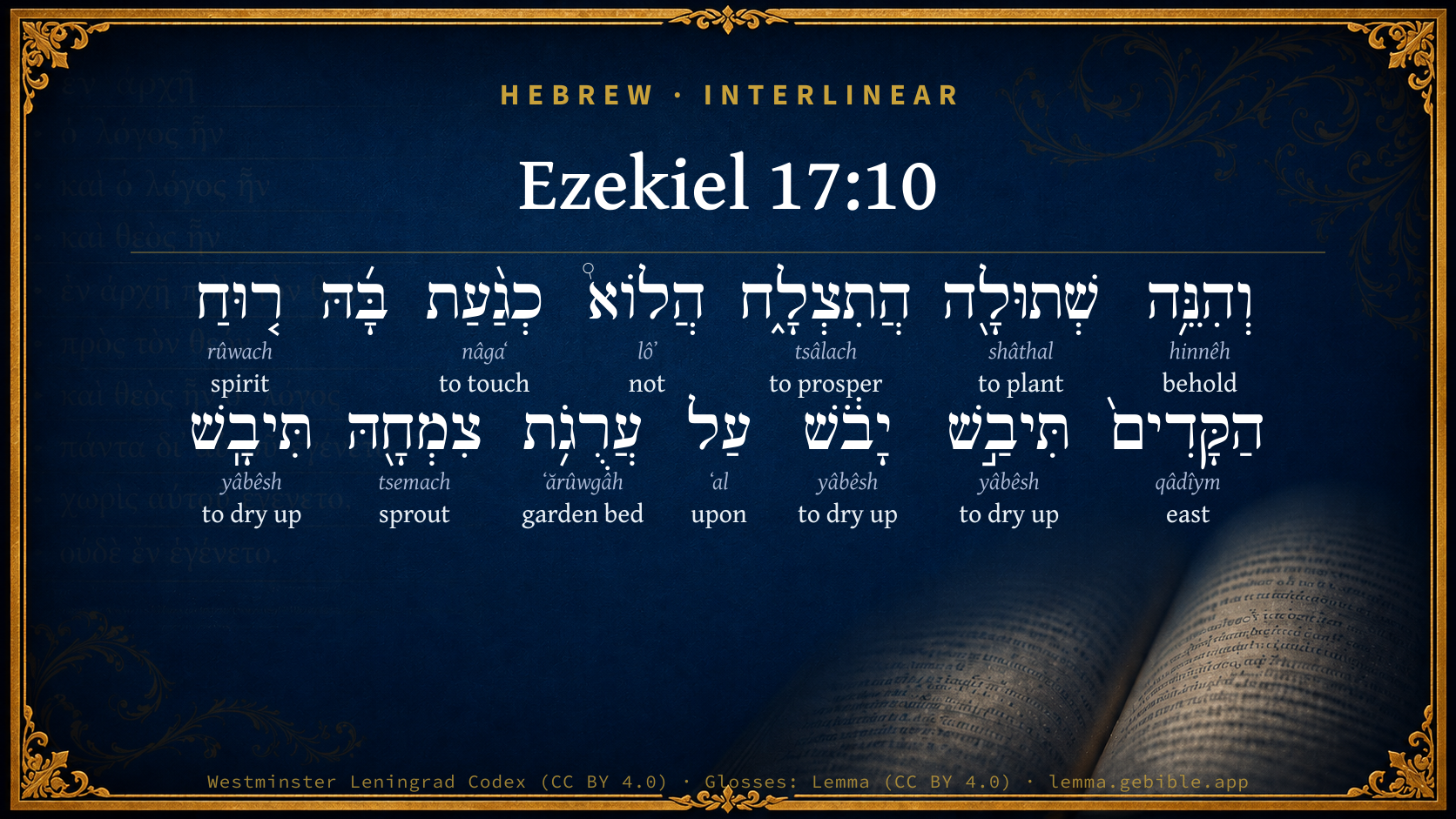
Hebrew (Westminster Leningrad Codex) Ezekiel 17:10 appears in the Hebrew Old Testament. The text above is from the Westminster Leningrad Codex. Each word links to its Strong’s number, a concise gloss, and parsing drawn from the Open Scriptures Hebrew Bible morphology. Click any word for its full Brown-Driver-Briggs (BDB) entry.
Download image
Cite this verse

Ezekiel 17:10 (World English Bible). Public Domain. Lemma interlinear Bible study tool, https://lemma.gebible.app/v/ezekiel/17/10.

Show BibTeX & RIS
BibTeX
RIS
English Translation
Yes, behold, being planted, shall it prosper? shall it not utterly wither, when the east wind touches it? it shall wither in the beds where it grew.
World English Bible · Public Domain
Download a study sheet

One document with this verse’s original text, its word-by-word gloss line, the meaning frame, cross-references with their text, attributed commentary, and full source and license credits — printable, and it pastes into notes with its structure intact.

This verse Autodidact and up

Study sheet (.html) Plain text (.txt)

A passage Seminary Student

Up to 50 verses in one chapter. A passage sheet keeps up to 6 commentary sources and 12 cross-references per verse, in the order this page ranks them, and says so on the sheet whenever that leaves anything out. Ask for a single verse and you get the Autodidact verse sheet above.

Everything on this page stays free to read, with no account — the sheet is a download of what is already on screen, not access to it.

Want to remove ads? Support Godless Engineer
Compare translations 3

The same verse in 3 English versions, stacked beneath the original-language interlinear above. Click any original word for its lexicon entry.

Each is an independent rendering of the whole verse — the interlinear is not word-aligned to these translations.

Highlighted words mark where these versions differ — a whole-verse word diff, not a word-by-word alignment.

  • World English Bible Public Domain
    Yes, behold, being planted, shall it prosper? shall it not utterly wither, when the east wind touches it? it shall wither in the beds where it grew.
  • King James Version Public Domain
    Yea, behold, being planted, shall it prosper? shall it not utterly wither, when the east wind toucheth it? it shall wither in the furrows where it grew.
  • unfoldingWord Literal Text CC BY-SA 4.0
    So behold! After it has been planted, will it grow? Will it not wither when the eastern wind touches it? It will completely wither away in the garden plot where it sprouted.’”

unfoldingWord Literal Text — © unfoldingWord, licensed CC BY-SA 4.0. Word-aligned USFM3 via Door43 (git.door43.org/unfoldingWord/en_ult).

Versions to compare (up to 4)

3 of 4 selected

Show all 18 translations

Every available English version of this verse, each an independent rendering of the whole verse.

  • World English Bible Public Domain
    Yes, behold, being planted, shall it prosper? shall it not utterly wither, when the east wind touches it? it shall wither in the beds where it grew.
  • Berean Standard Bible Public Domain
    Even if it is transplanted, will it flourish? Will it not completely wither when the east wind strikes? It will wither on the bed where it sprouted.’”
  • Majority Standard Bible Public Domain
    Even if it is transplanted, will it flourish? Will it not completely wither when the east wind strikes? It will wither on the bed where it sprouted.’”
  • King James Version Public Domain
    Yea, behold, being planted, shall it prosper? shall it not utterly wither, when the east wind toucheth it? it shall wither in the furrows where it grew.
  • American Standard Version (1901) Public Domain
    Yea, behold, being planted, shall it prosper? shall it not utterly wither, when the east wind toucheth it? it shall wither in the beds where it grew.
  • Revised Version (1885) Public Domain
    Yea, behold, being planted, shall it prosper? shall it not utterly wither; when the east wind toucheth it? it shall wither in the beds where it grew.
  • Geneva Bible (1599) Public Domain
    Beholde, it was planted: but shall it prosper? shall it not be dried vp, and wither? when the East winde shall touch it, it shall wither in the trenches, where it grewe.
  • Douay-Rheims (1899) Public Domain
    Behold, it is planted: shall it prosper then? shall it not be dried up when the burning wind shall touch it, and shall it not wither in the furrows where it grew?
  • Young's Literal Translation Public Domain
    And lo, the planted thing -- doth it prosper? When come against it doth the east wind, Doth it not utterly wither? On the furrows of its springing it withereth.'
  • Literal Standard Version CC BY-SA 4.0
    And behold, the planted thing—does it prosper? When the east wind comes against it, does it not utterly wither? On the furrows of its springing it withers.”
  • Unlocked Literal Bible CC BY-SA 4.0
    So behold! After it has been planted, will it grow? Will it not wither when the eastern wind touches it? It will completely wither away in the garden plot where it sprouted.'”
  • unfoldingWord Literal Text CC BY-SA 4.0
    So behold! After it has been planted, will it grow? Will it not wither when the eastern wind touches it? It will completely wither away in the garden plot where it sprouted.’”
  • Darby Bible Public Domain
    And behold, being planted, shall it prosper? shall it not utterly wither when the east wind toucheth it? It shall wither in the beds where it grew.
  • World Messianic Bible Public Domain
    Yes, behold, being planted, will it prosper? Won’t it utterly wither when the east wind touches it? It will wither in the ground where it grew.”’”
  • Webster's Bible Public Domain
    Yes, behold, being planted, shall it prosper? shall it not utterly wither, when the east wind toucheth it? it shall wither in the furrows where it grew.
  • Free Bible Version CC BY-SA 4.0
    Even if it's transplanted, is it going to survive? Won't it wither up completely when the east wind blows? In fact, it will wither right where it was planted.’”
  • Bible in Basic English Public Domain
    And if it is planted will it do well? will it not become quite dry at the touch of the east wind, drying up in the bed where it was planted?
  • JPS Tanakh (1917) Public Domain
    Yea, behold, being planted, shall it prosper? Shall it not utterly wither, when the east wind toucheth it? In the beds where it grew it shall wither.'

Literal Standard Version (2020), Covenant Press — licensed CC BY-SA 4.0. Text via the HelloAO Bible API (eBible.org). Unlocked Literal Bible (unfoldingWord) — licensed CC BY-SA 4.0. Text via the HelloAO Bible API (eBible.org). unfoldingWord Literal Text — © unfoldingWord, licensed CC BY-SA 4.0. Word-aligned USFM3 via Door43 (git.door43.org/unfoldingWord/en_ult). Free Bible Version, Dr. Jonathan Gallagher — licensed CC BY-SA 4.0. Text via the HelloAO Bible API (eBible.org).

Word by word

More ways to search: Search by grammar → Find every occurrence → Compare this word →

Practice this passage: Drill this verse → Learn its vocabulary →

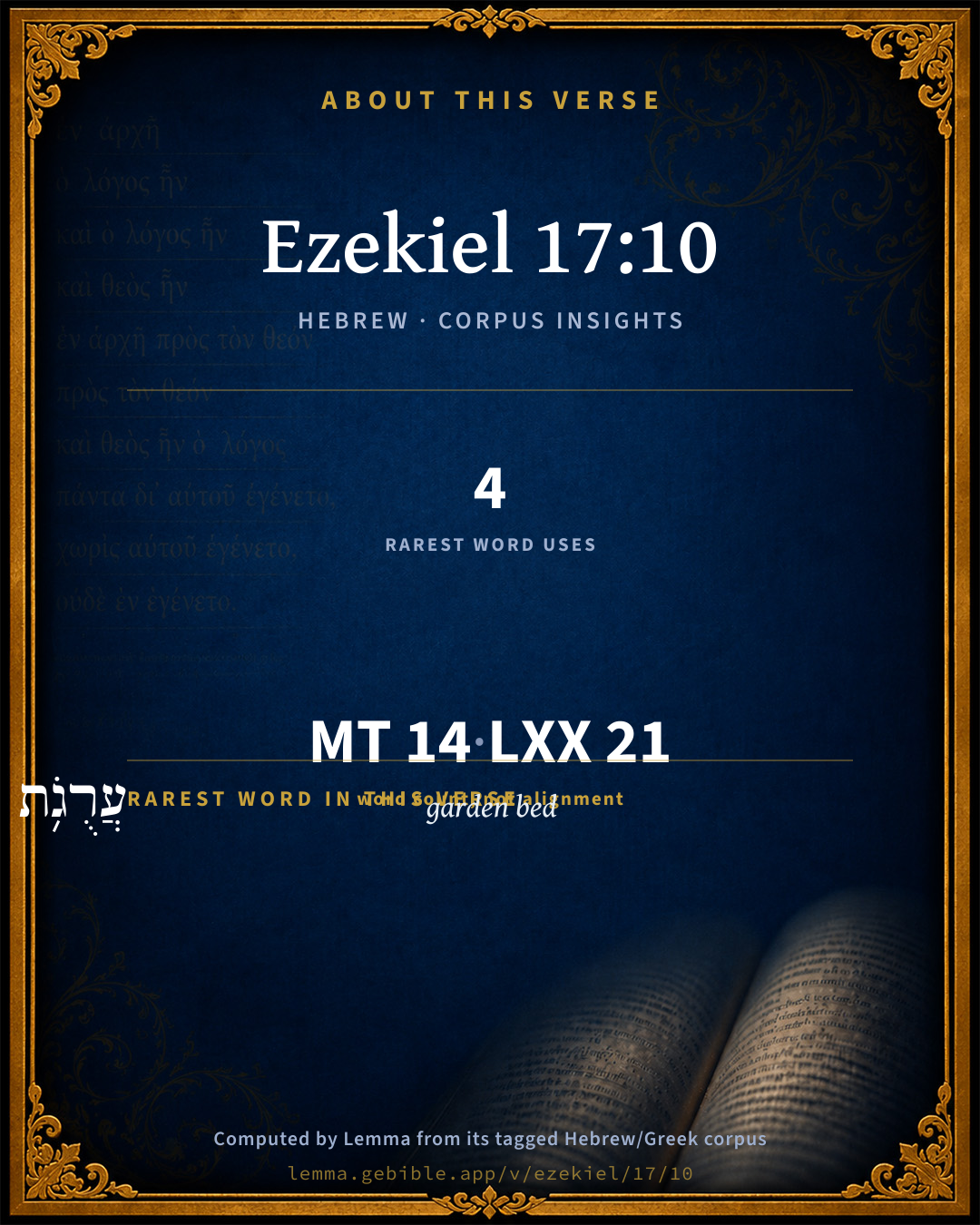
עֲרֻגֹ֥ת
ʻărûwgâh
H6170
“garden beds of”
Noun, Common, Feminine, Plural, Construct
Part of Speech
Noun
Type
Common
Gender
Feminine
Number
Plural
State
Construct
Full BDB Definition

Origin: pass. part. of H6165

TWOT: 1691a

garden terrace or bed
  1. וְהִנֵּ֥ה hinnêh H2009 “and · behold” Conjunction + Particle, Demonstrative
  2. שְׁתוּלָ֖ה shâthal H8362 “planted” Verb, Qal, Participle Passive, Feminine, Singular, Absolute
  3. הֲתִצְלָ֑ח tsâlach H6743 “to prosper” Particle, Interrogative + Verb, Qal, Imperfect, 3rd Person, Feminine, Singular
  4. הֲלוֹא֩ lôʼ H3808 “not” Particle, Interrogative + Particle, Negative
  5. כְגַ֨עַת nâgaʻ H5060 “like/as · to touch” Preposition + Verb, Qal, Infinitive Construct
  6. ר֤וּחַ rûwach H7307 “spirit of” Noun, Common, Both, Singular, Construct
  7. הַקָּדִים֙ qâdîym H6921 “the · east” Particle, Definite Article + Noun, Common, Masculine, Singular, Absolute
  8. תִּיבַ֣שׁ yâbêsh H3001 “to dry up” Verb, Qal, Imperfect, 3rd Person, Feminine, Singular
  9. יָבֹ֔שׁ yâbêsh H3001 “to dry up” Verb, Qal, Infinitive Absolute
  10. עַל ʻal H5921 “upon” Preposition
  11. צִמְחָ֖הּ tsemach H6780 “sprout · her” Noun, Common, Masculine, Singular, Construct + Suffix, Personal, 3rd Person, Feminine, Singular
  12. תִּיבָֽשׁ yâbêsh H3001 “to dry up” Verb, Qal, Imperfect, 3rd Person, Feminine, Singular

About this verse

These counts appear in no published source. They are computed here, from the morphology-tagged text and Lemma’s own curated glosses. What Lemma adds →

14
words
11
distinct lemmas
Prophets
section

Notable vocabulary

The rarest word here is עֲרֻגֹ֥ת garden bed H6170 — appearing just 4 times in the whole Hebrew Bible.

Shared distinctive vocabulary

עֲרֻגֹ֥ת garden bed H6170 occurs in 4 verses of the Hebrew Bible. Also found in:

Grammatical profile

  • 6 verbs
  • 4 nouns
  • 2 prepositions
  • 2 particles

Verb forms

  • שְׁתוּלָ֖ה Qal · Participle Passive
  • הֲתִצְלָ֑ח Qal · Imperfect
  • כְגַ֨עַת Qal · Infinitive Construct
  • תִּיבַ֣שׁ Qal · Imperfect
  • יָבֹ֔שׁ Qal · Infinitive Absolute
  • תִּיבָֽשׁ Qal · Imperfect

Repetition

A word recurs within this verse — often emphatic in Hebrew:

  • תִּיבַ֣שׁ to dry up H3001 ×3

Hebrew & Septuagint length

In English translation the verse runs 27 words from the Hebrew and 30 from the Septuagint (LXX English) — closely comparable.

A rough comparison of the two English renderings, which tokenize alike — not a word-level alignment.

Word counts can differ between the Hebrew and the Greek without any difference in meaning — e.g. the Hebrew direct-object marker אֵת has no separate Greek word, and Greek often adds the article ὁ.

In the original languages it is 14 Hebrew tokens and 21 Greek tokens — but the two are counted differently (Hebrew bundles its prefixes and suffixes into one token; the Greek is in lemma form), so that isn’t a like-for-like length.

Cross-references

7

Topical passages linked to Ezekiel 17:10 in the Treasury of Scripture Knowledge — connected by theme and wording, ordered by reader-vote popularity; previews shown in the World English Bible.

  • Hosea 13:15 Though he is fruitful among his brothers, an east wind will come, The breath of Yahweh coming up from the wilderness; And his spring will become dry, And his fountain will be dried up. He will plunder the storehouse of treasure.
  • Ezekiel 19:12–14 But it was plucked up in fury, it was cast down to the ground, and the east wind dried up its fruit: its strong rods were broken off and withered; the fire consumed them.
  • Hosea 12:1 Ephraim feeds on wind, And chases the east wind. He continually multiplies lies and desolation. They make a covenant with Assyria, And oil is carried into Egypt.
  • Matthew 21:19 Seeing a fig tree by the road, he came to it, and found nothing on it but leaves. He said to it, "Let there be no fruit from you forever!" Immediately the fig tree withered away.
  • Mark 11:20 As they passed by in the morning, they saw the fig tree withered away from the roots.
  • John 15:6 If a man doesn't remain in me, he is thrown out as a branch, and is withered; and they gather them, throw them into the fire, and they are burned.
  • Jude 1:12 These are hidden rocky reefs in your love feasts when they feast with you, shepherds who without fear feed themselves; clouds without water, carried along by winds; autumn leaves without fruit, twice dead, plucked up by the roots;

Cross-references courtesy of OpenBible.info (CC BY 4.0).

Hebrew and Greek witnesses Masoretic Hebrew ↔ Greek Septuagint

The same verse in the two great witnesses to the Old Testament, shown verse-for-verse.

These are two independent witnesses, not word-aligned to each other, and the Septuagint is shown in lemma (dictionary) form.

Hebrew Ezekiel 17:10 Masoretic · Westminster Leningrad Codex

וְהִנֵּ֥ה שְׁתוּלָ֖ה הֲתִצְלָ֑ח הֲלוֹא֩ כְגַ֨עַת בָּ֜הּ ר֤וּחַ הַקָּדִים֙ תִּיבַ֣שׁ יָבֹ֔שׁ עַל עֲרֻגֹ֥ת צִמְחָ֖הּ תִּיבָֽשׁ

Yes, behold, being planted, shall it prosper? shall it not utterly wither, when the east wind touches it? it shall wither in the beds where it grew.

World English Bible · Public Domain

Greek LXX Ezekiel 17:10 Septuagint · lemma form

καί ἰδού πιαίνω μή καταεὐθύνω οὐ ἅμα ὁ ἅπτομαι αὐτός ἄνεμος ὁ καύσων ξηραίνω ξηρασία σύν ὁ βῶλος ἀνατολή αὐτός ξηραίνω

And, behold, it thrives: shall it prosper? shall it not wither as soon as the east wind touches it? it shall be withered together with the growth of its shoots.

LXX2012 (modern English Septuagint) · Public Domain

On this verse, John Gill's Exposition discusses the Septuagint’s reading. Read the note in Commentary ↓

Hebrew: Westminster Leningrad Codex (CC BY 4.0). Greek: Septuagint (public domain); English from LXX2012 (modern English Septuagint) (Public Domain). How the Septuagint differs from the Hebrew →

Targum (Aramaic paraphrase)

1

The Targum is the ancient Jewish Aramaic paraphrase of the Hebrew Scriptures — an interpretive translation, not the Hebrew text itself. Onkelos (literal) and Pseudo-Jonathan (expansive) render the Torah, and Jonathan the Prophets. Coverage is partial: where no permissively-licensed English translation exists for a verse, only the Aramaic is shown. This is verse-level text, not a word-by-word alignment to the Hebrew.

  1. Targum Jonathan Prophets (Joshua–Malachi)
    וְהָא שְׁתִילָא הֲתִצְלַח הֲלָא כְּמִיקְרַב בָּה רוּחַ קִידוּמָא תִיבַשׁ מֵיבַשׁ עַל עוּגְיַת נִצְבְתָהּ תִּיבָשׁ:

    (no public-domain English translation for this verse)

    Targum Jonathan — Aramaic: “Mikraot Gedolot” (public domain). English: “Sefaria Community Translation” (CC0 1.0 (public-domain dedication)); “London "Chaldee Paraphrase," 1871” (public domain). Text via Sefaria.

Commentary

Notes on Ezekiel 17:10 from classic Christian and Jewish commentators (each source and its license shown beneath its notes). The classic Christian expositions comment on the surrounding passage and are grouped to its opening verse, so a note may address several verses; the Jewish commentaries on the Tanakh (Rashi and others) are per-verse, so they appear only where the commentator wrote on this verse.

Lemma curates 59 commentaries, every one of them public domain or Creative Commons licensed, each selected and text-cleaned for this edition rather than reprinted as found. About our sources →

Trapp's Complete Commentary

John Trapp

Eze 17:10 Yea, behold, [being] planted, shall it prosper? shall it not utterly wither, when the east wind toucheth it? it shall wither in the furrows where it grew.

Ver. 10. Shall it not utterly wither?] As Jonah’s gourd did when smitten with a worm; as Phocas’s wall came down with a witness, because built upon mines of gunpowder - sin lay at the bottom, as one told him - which, being once fired, would blow up all.

When the east wind toucheth it.] Which is very hurtful to vines, saith, Columella. As all creatures, so the winds are God’s agents; as to purge the air - Rupertus calleth them the besoms of the air - and to refresh men’s spirits, so to execute many of God’s judgments upon his rebels, as here. Aliorum perditio nostra sit cautio; Let other men’s destruction be our instruction.

It shall wither in the furrows where it grew,] i.e., In Egypt, where it rained not, but was all watered by furrows drawn from Nile, to run into all their fields. Here this vine should thrive, one would think, if anywhere - viz., in moist and fat furrows but it could not, because blasted by God’s curse.

John Trapp, A Commentary or Exposition upon All the Books of the Old and New Testament (1647–1656) — public domain. Text from a community e-Sword module.

Tyndale Open Study Notes

Tyndale Open Resources

17:10 In Judah, the east wind blows from the desert and is therefore hot and dry.

Tyndale Open Study Notes — © Tyndale Open Resources, licensed CC BY-SA 4.0. Text via the HelloAO Bible API.

Geneva Bible (1599)

Geneva Bible translators

By this dry wind he meaneth the Babylonians.

Geneva Bible (1599) marginal notes — public domain. Text via Bolls.life.

Jamieson, Fausset & Brown

Robert Jamieson, A. R. Fausset & David Brown

being planted--that is, "though planted."

east wind--The east wind was noxious to vegetation in Palestine; a fit emblem of Babylon, which came from the northeast.

wither in . . . furrows where it grew--Zedekiah was taken at Jericho, on Jewish soil (Jer 52:8). "It shall wither, although it has furrows from which it expects continual waterings" [CALVIN], (Eze 19:12; Hos 13:15).

Jamieson, Fausset & Brown — Commentary Critical and Explanatory on the Whole Bible (1871) — public domain (CC PDM 1.0). Text via the HelloAO Bible API.

Adam Clarke's Commentary

Verse 10. Shall - utterly whither] The regal government shall be no more restored. Zedekiah shall be the last king, and the monarchy shall finally terminate with him.

Adam Clarke's Commentary on the Bible (1810–1826) — public domain. Text from a community e-Sword/MySword module.

The Cambridge Bible for Schools and Colleges

gen. ed. J. J. S. Perowne

10. Destruction under another figure, that of the east wind, before which vegetation crumbles into dust. Cf. ch. Eze_19:12; Hos_13:15; Isa_27:8; Isa_40:7; Job_27:21.

The Cambridge Bible for Schools and Colleges (gen. ed. J. J. S. Perowne; Cambridge University Press, 1878–1918) — public domain. Text from a community e-Sword module.

John Gill's Exposition

Moreover the word of the Lord came unto me, saying. Here follows the explanation of the above riddle and parable, which the prophet from the Lord had orders to deliver.

Moreover the word of the Lord came unto me, saying. Here follows the explanation of the above riddle and parable, which the prophet from the Lord had orders to deliver.

Ezekiel 17:12

eze 17:12

eze 17:12

eze 17:12Say now to the rebellious house,.... It had been a rebellious house to God, and to his prophets, before; see Eze 2:5 and See Gill on Eze 2:5; and now, besides this was rebellious to the king of Babylon, to whom they were in some measure subject, Eze 17:15;

know ye not what these things mean? the riddle and parable concerning the two eagles and the vine; suggesting that they must be very inattentive, and very stupid, if they did not know the meaning of them; for though the things intended were delivered in an enigmatical and parabolical way, yet they were easily to be understood by all that know the affairs of the Jewish nation; being things that were lately transacted there, and were obvious to everyone's view; but if they were so stupid and blockish as not to understand them, the prophet had the following order, to explain them to them:

tell them, behold, the king of Babylon is come to Jerusalem; so that Nebuchadnezzar king of Babylon is meant by the first "eagle", and the land of Judea, and particularly Jerusalem, by Lebanon, it came unto, Eze 17:3. The Septuagint, Syriac, and Arabic versions, read this and the following verses in the future; as if these were things that were yet to come to pass, whereas they are related as things already done; and so the Targum renders all in the past sense, as the history of them requires it should:

and hath taken the king thereof, and the princes thereof, and led them with him to Babylon; the king of Judea, and the princes of it; Jeconiah and his nobles, who had been carried captive into Babylon by Nebuchadnezzar; for Ezekiel was among these captives, Eze 1:2; see Kg2 24:12; so that it appears that by the "twigs" of the cedar the princes of the land are designed; and by the "top" of them King Jeconiah; and by "the land of traffic" the land of Chaldea; and by the "city of merchants" the city of Babylon, Eze 17:4; whither they were carried.

John Gill's Exposition of the Whole Bible (1746–1763) — public domain (CC PDM 1.0). Text via the HelloAO Bible API.

Matthew Poole's English Annotations

Nay, suppose this contrivance were successful, suppose this vine were planted by the help of Egypt, could it possibly prosper? No, no.

When the east wind; when the king of Babylon, which like the blasting wind conms from the north-east, shall but touch it, it will utterly wither.

In the furrows; even amidst its greatest and best helps to make it flourish. This discontent, ingratitude, and treachery will occasion the utter ruin of this people.

Matthew Poole's English Annotations on the Holy Bible (1683–1685) — public domain. Text from a community e-Sword/MySword module.

Whedon's Commentary on the Bible

Daniel D. Whedon

10. When the east wind toucheth it — After having been pulled up it shall not take root again, but shall wither where it falls (xix, 12). “Its destruction shall come from the quarter where it derived its origin.” — Skinner.

Daniel D. Whedon (gen. ed.), Commentary on the Old and New Testaments (1874–1909) — public domain. Text from a community e-Sword module.

The Pulpit Commentary

The question, Shall it prosper? comes with all the emphasis of iteration. The east wind is, as elsewhere, the symbol of scorching and devastating power. (Eze_19:12; Hos_13:15; Jon_4:8; Job_27:21) For furrows, read beds, with Revised Version. In the ease of the Chaldeans, who came from the east, there was a special appropriateness in the symbolism.

Shall it prosper?

I PROSPERITY IS NATURALLY SOUGHT AFTER. False ideas of prosperity may blind us as to its true nature. There is a prosperity which none need covet, a swollen worldly success that leaves the soul starved, barren, and sapless. It may be more blessed to suffer from the stimulating shocks of adversity than to be surfeited with such a false prosperity. But real prosperity is naturally and rightly desired. No one ought to be content to make shipwreck of life. We may not attain to the objects which we set before ourselves, and we may never realize any very great success in the eyes of men. But that our lives should break up in ruin is of all things most to he deplored. The question, "Shall it prosper?" is thus to be asked with natural anxiety. We may ask it in regard to

(1) the soul;

(2) the Church;

(3) a specific enterprise.

II PROSPERITY MAY BE EASILY MISSED. The vine in the parable did not prosper. Zedekiah"s diplomacy was a failure. Many men make shipwreck of life. Churches sink into deadness. The inquiry should go back to the possible causes of failure.

1. A false aim. Zedekiah thought only of his own throne. He did not give evidence of the genuine patriotism which would have preferred the welfare of the nation to his own safety. Selfishness may win worldly success. But it is certain to starve the roots of soul prosperity.

2. A false trust. Zedekiah trusted to Pharaoh instead of God. If we are looking for prosperity in any region to the neglect of our trust in God, we are courting failure, for with him are the issues of life.

3. A false character. Zedekiah not only leaned upon a broken reed in trusting to Egypt; he acted treacherously in so doing. Deceit is fatal to the soul. Fraud never secures true prosperity, though it may win earthly pelf.

III PROSPERITY NEED NOT BE MISSED. Here, again, we must bear in mind the nature of true prosperity. We cannot all be rich or successful in earthly enterprises. But no soul need be wrecked, for it is within the power of all to attain to a life which shall be reckoned successful in the sight of God. We should see to it that we have the secret of this prosperity.

1. Living for God. This will give us a right aim. The soul that lives for self, for the world, for any lower aim, is running for the rocks. But no one who truly lives for God can utterly fail.

2. Trusting in God. It is not easy to pursue this high aim; indeed, it is impossible to do so without the aid of Divine grace. The life of faith is the only perfectly prosperous life. The heroes of faith whose fame is celebrated in Hebrews 11. were all of them truly successful, though many of them suffered and some died as martyrs.

IV PROSPERITY IS WORTH INQUIRING ABOUT. Ezekiel"s question is pertinent. Everything else may look fair, but if this vital question receives a negative reply, all the other points of excellence count for nothing, or even tell against us in mockery of the one fatal flaw. The life may be comfortable; the Church may be sound and orthodox, or popular and attractive; the plan of work may be clever and original. But what is the use of all these pleasant features if they are to end in failure?

The Pulpit Commentary (1880–1919), ed. H.D.M. Spence-Jones & Joseph S. Exell — public domain. Text from a community e-Sword module.

John Wesley's Explanatory Notes

Yea - Suppose this vine were planted by the help of Egypt. The east wind - When the king of Babylon, who like the blasting wind comes from the northeast, shall but touch it, it shall wither. In the furrows - Even amidst its greatest helps, to make it flourish.

John Wesley, Explanatory Notes Upon the Whole Bible (1754–1765) — public domain. Text via the GEBible commentary corpus.

Rashi

Rabbi Shlomo Yitzchaki (Rashi)

And behold now it is planted as they wished.

will it prosper Is it possible that it will prosper, this one that betrayed the one who planted it originally?

Rashi on the Tanakh — English translations: “The Judaica Press complete Tanach with Rashi, translated by A. J. Rosenberg” (CC BY 4.0); “Pentateuch with Rashi's commentary by M. Rosenbaum and A.M. Silbermann, 1929-1934” (public domain); “The Metsudah Tanach series, Lakewood, N.J” (CC BY 4.0); and “The Book of Joshua, Metsudah Publications, 1997” (CC BY 4.0). Text via Sefaria.

Lesson kit

Teaching starters — assembled from the data on this page, not authored interpretation. Every prompt links to the verse data it draws on. Edit before teaching.

Ezekiel, in the Prophets, opens this verse with 14 words (11 distinct Hebrew lemmas). Its most distinctive word is ʻărûwgâh (“garden bed”). A historical commentator’s framing appears above. Read the whole chapter for the surrounding context.

Discussion questions

  1. What does “garden bed” (ʻărûwgâh) contribute to the verse as a whole?
  2. Song of Solomon 5:13 shares the word «garden bed» with this verse. How do the two illuminate each other?
  3. “to dry up” occurs 3× in this one verse. What is the effect of the repetition?
  4. The translations on this page render this verse differently — a whole-verse word diff, not a word-by-word alignment. What might account for the different wordings?
  5. The verb «שְׁתוּלָ֖ה» is Qal Participle Passive. How does its form color the action?
  6. Reading how Trapp's Complete Commentary and Tyndale Open Study Notes read this verse, where do the two commentators agree and where do they part?

Things to notice

Reading settings

Reading text

Shown beneath each verse's original-language words.

Old Testament
Old Testament edition

Read the OT as the Masoretic Hebrew (MT) or the Greek Septuagint (LXX).

English shown for the Greek Septuagint (in the Hebrew ↔ Greek comparison).

Comparing translations? Open the Compare panel on any verse page to stack up to four side by side.