
Leviticus 13:3

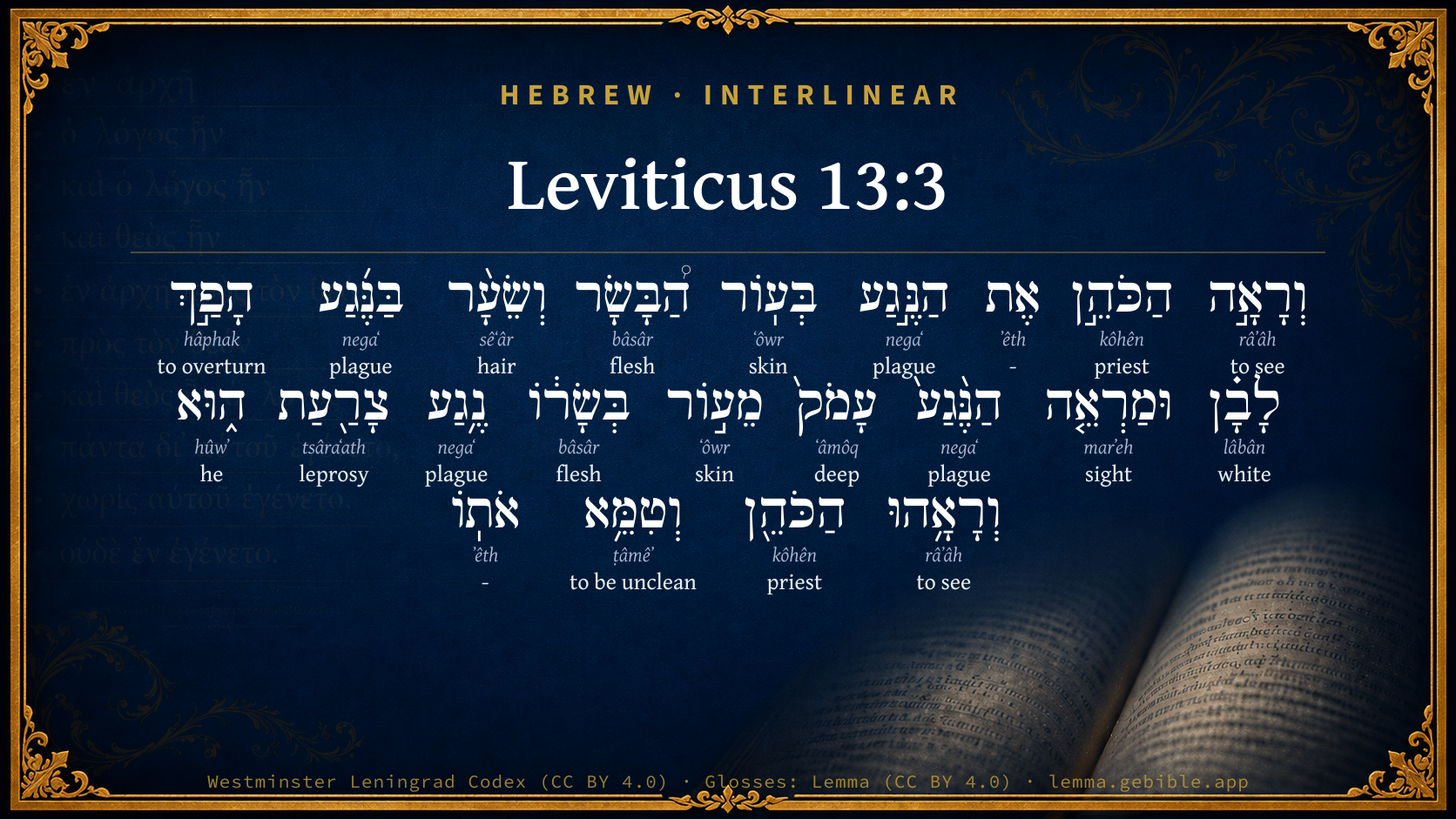
Hebrew (Westminster Leningrad Codex) Leviticus 13:3 appears in the Hebrew Old Testament. The text above is from the Westminster Leningrad Codex. Each word links to its Strong’s number, a concise gloss, and parsing drawn from the Open Scriptures Hebrew Bible morphology. Click any word for its full Brown-Driver-Briggs (BDB) entry.
Download image
Cite this verse

Leviticus 13:3 (World English Bible). Public Domain. Lemma interlinear Bible study tool, https://lemma.gebible.app/v/leviticus/13/3.

Show BibTeX & RIS
BibTeX
RIS
English Translation
and the priest shall examine the plague in the skin of the body: and if the hair in the plague has turned white, and the appearance of the plague is deeper than the body's skin, it is the plague of leprosy; and the priest shall examine him, and pronounce him unclean.
World English Bible · Public Domain
Highlights
  • 1 first appearance in the Hebrew Bible
Full analysis ↓
Download a study sheet

One document with this verse’s original text, its word-by-word gloss line, the meaning frame, cross-references with their text, attributed commentary, and full source and license credits — printable, and it pastes into notes with its structure intact.

This verse Autodidact and up

Study sheet (.html) Plain text (.txt)

A passage Seminary Student

Up to 50 verses in one chapter. A passage sheet keeps up to 6 commentary sources and 12 cross-references per verse, in the order this page ranks them, and says so on the sheet whenever that leaves anything out. Ask for a single verse and you get the Autodidact verse sheet above.

Everything on this page stays free to read, with no account — the sheet is a download of what is already on screen, not access to it.

Want to remove ads? Support Godless Engineer
Compare translations 3

The same verse in 3 English versions, stacked beneath the original-language interlinear above. Click any original word for its lexicon entry.

Each is an independent rendering of the whole verse — the interlinear is not word-aligned to these translations.

Highlighted words mark where these versions differ — a whole-verse word diff, not a word-by-word alignment.

  • World English Bible Public Domain
    and the priest shall examine the plague in the skin of the body: and if the hair in the plague has turned white, and the appearance of the plague is deeper than the body's skin, it is the plague of leprosy; and the priest shall examine him, and pronounce him unclean.
  • King James Version Public Domain
    And the priest shall look on the plague in the skin of the flesh: and when the hair in the plague is turned white, and the plague in sight be deeper than the skin of his flesh, it is a plague of leprosy: and the priest shall look on him, and pronounce him unclean.
  • unfoldingWord Literal Text CC BY-SA 4.0
    And the priest shall see the infection on the skin of the flesh, and the hair on the infection has turned white, and the appearance of the infection deeper than the skin of his flesh, it an infection of skin disease. And the priest shall see it, and he shall pronounce him unclean.

unfoldingWord Literal Text — © unfoldingWord, licensed CC BY-SA 4.0. Word-aligned USFM3 via Door43 (git.door43.org/unfoldingWord/en_ult).

Versions to compare (up to 4)

3 of 4 selected

Show all 18 translations

Every available English version of this verse, each an independent rendering of the whole verse.

  • World English Bible Public Domain
    and the priest shall examine the plague in the skin of the body: and if the hair in the plague has turned white, and the appearance of the plague is deeper than the body's skin, it is the plague of leprosy; and the priest shall examine him, and pronounce him unclean.
  • Berean Standard Bible Public Domain
    The priest is to examine the infection on his skin, and if the hair in the infection has turned white and the sore appears to be deeper than the skin, it is a skin disease. After the priest examines him, he must pronounce him unclean.
  • Majority Standard Bible Public Domain
    The priest is to examine the infection on his skin, and if the hair in the infection has turned white and the sore appears to be deeper than the skin, it is a skin disease. After the priest examines him, he must pronounce him unclean.
  • King James Version Public Domain
    And the priest shall look on the plague in the skin of the flesh: and when the hair in the plague is turned white, and the plague in sight be deeper than the skin of his flesh, it is a plague of leprosy: and the priest shall look on him, and pronounce him unclean.
  • American Standard Version (1901) Public Domain
    and the priest shall look on the plague in the skin of the flesh: and if the hair in the plague be turned white, and the appearance of the plague be deeper than the skin of his flesh, it is the plague of leprosy; and the priest shall look on him, and pronounce him unclean.
  • Revised Version (1885) Public Domain
    and the priest shall look on the plague in the skin of the flesh: and if the hair in the plague be turned white, and the appearance of the plague be deeper than the skin of his flesh, it is the plague of leprosy: and the priest shall look on him, and pronounce him unclean.
  • Geneva Bible (1599) Public Domain
    And the Priest shall looke on the sore in the skinne of his flesh: if the heare in the sore be turned into white, and the sore seeme to be lower then the skinne of his flesh, it is a plague of leprosie. therefore the Priest shall looke on him, and pronounce him vncleane:
  • Douay-Rheims (1899) Public Domain
    And if he see the leprosy in his skin, and the hair turned white, and the place where the leprosy appears lower than the skin and the rest of the flesh: it is the stroke of the leprosy, and upon his judgment he shall be separated.
  • Young's Literal Translation Public Domain
    and the priest hath seen the plague in the skin of the flesh, and the hair in the plague hath turned white, and the appearance of the plague `is' deeper than the skin of his flesh -- it `is' a plague of leprosy, and the priest hath seen him, and hath pronounced him unclean.
  • Literal Standard Version CC BY-SA 4.0
    and the priest has seen the plague in the skin of the flesh, and the hair in the plague has turned white, and the appearance of the plague [is] deeper than the skin of his flesh—it [is] a plague of leprosy, and the priest has seen him, and has pronounced him unclean.
  • Unlocked Literal Bible CC BY-SA 4.0
    Then the priest will examine the disease in the skin of his body. If the hair in the diseased area has turned white, and if the disease appears to be deeper than just on the skin, then it is an infectious disease. After the priest examines him, he must pronounce him unclean.
  • unfoldingWord Literal Text CC BY-SA 4.0
    And the priest shall see the infection on the skin of the flesh, and the hair on the infection has turned white, and the appearance of the infection deeper than the skin of his flesh, it an infection of skin disease. And the priest shall see it, and he shall pronounce him unclean.
  • Darby Bible Public Domain
    And when the priest looketh on the sore in the skin of the flesh, and the hair in the sore is turned white, and the sore looketh deeper than the skin of his flesh, it is the sore of leprosy; and the priest shall look on him and pronounce him unclean.
  • World Messianic Bible Public Domain
    The priest shall examine the plague in the skin of the body. If the hair in the plague has turned white, and the appearance of the plague is deeper than the body’s skin, it is the plague of leprosy; so the priest shall examine him and pronounce him unclean.
  • Webster's Bible Public Domain
    And the priest shall look on the plague in the skin of the flesh: and when the hair in the plague is turned white, and the plague in sight is deeper than the skin of his flesh, it is a plague of leprosy: and the priest shall look on him, and pronounce him unclean.
  • Free Bible Version CC BY-SA 4.0
    The priest will inspect whatever is on the skin. If the hair there has turned white and if the issue seems to be more than something on the surface, it is a serious skin disease, and the priest who inspects it will declare the person unclean.
  • Bible in Basic English Public Domain
    And if, when the priest sees the mark on his skin, the hair on the place is turned white and the mark seems to go deeper than the skin, it is the mark of a leper: and the priest, after looking at him, will say that he is unclean.
  • JPS Tanakh (1917) Public Domain
    And the priest shall look upon the plague in the skin of the flesh; and if the hair in the plague be turned white, and the appearance of the plague be deeper than the skin of his flesh, it is the plague of leprosy; and the priest shall look on him, and pronounce him unclean.

Literal Standard Version (2020), Covenant Press — licensed CC BY-SA 4.0. Text via the HelloAO Bible API (eBible.org). Unlocked Literal Bible (unfoldingWord) — licensed CC BY-SA 4.0. Text via the HelloAO Bible API (eBible.org). unfoldingWord Literal Text — © unfoldingWord, licensed CC BY-SA 4.0. Word-aligned USFM3 via Door43 (git.door43.org/unfoldingWord/en_ult). Free Bible Version, Dr. Jonathan Gallagher — licensed CC BY-SA 4.0. Text via the HelloAO Bible API (eBible.org).

Word by word

More ways to search: Search by grammar → Find every occurrence → Compare this word →

Practice this passage: Drill this verse → Learn its vocabulary →

עָמֹק֙
ʻâmôq
H6013
“deep”
Adjective, Adjective, Masculine, Singular, Absolute
Part of Speech
Adjective
Type
Adjective
Gender
Masculine
Number
Singular
State
Absolute
Full BDB Definition

Origin: from H6009

TWOT: 1644d

deep, mysterious, depths - deep - unsearchable
  1. וְרָאָ֣ה râʼâh H7200 “and · to see” Conjunction + Verb, Qal, Sequential Perfect, 3rd Person, Masculine, Singular
  2. הַכֹּהֵ֣ן kôhên H3548 “the · priest” Particle, Definite Article + Noun, Common, Masculine, Singular, Absolute
  3. אֶת ʼêth H853 “-” Particle, Direct Object
  4. הַנֶּ֣גַע negaʻ H5061 “the · plague” Particle, Definite Article + Noun, Common, Masculine, Singular, Absolute
  5. בְּעֽוֹר ʻôwr H5785 “in/at · skin of” Preposition + Noun, Common, Masculine, Singular, Construct
  6. הַ֠בָּשָׂר bâsâr H1320 “the · flesh” Particle, Definite Article + Noun, Common, Masculine, Singular, Absolute
  7. וְשֵׂעָ֨ר sêʻâr H8181 “and · hair” Conjunction + Noun, Common, Masculine, Singular, Absolute
  8. בַּנֶּ֜גַע negaʻ H5061 “in/at the · plague” Preposition, Determined + Noun, Common, Masculine, Singular, Absolute
  9. הָפַ֣ךְ hâphak H2015 “to overturn” Verb, Qal, Perfect, 3rd Person, Masculine, Singular
  10. לָבָ֗ן lâbân H3836 “white” Adjective, Adjective, Masculine, Singular, Absolute
  11. וּמַרְאֵ֤ה marʼeh H4758 “and · sight of” Conjunction + Noun, Common, Masculine, Singular, Construct
  12. הַנֶּ֨גַע֙ negaʻ H5061 “the · plague” Particle, Definite Article + Noun, Common, Masculine, Singular, Absolute
  13. מֵע֣וֹר ʻôwr H5785 “from · skin of” Preposition + Noun, Common, Masculine, Singular, Construct
  14. בְּשָׂר֔וֹ bâsâr H1320 “flesh · his” Noun, Common, Masculine, Singular, Construct + Suffix, Personal, 3rd Person, Masculine, Singular
  15. נֶ֥גַע negaʻ H5061 “plague of” Noun, Common, Masculine, Singular, Construct
  16. צָרַ֖עַת tsâraʻath H6883 “leprosy” Noun, Common, Feminine, Singular, Absolute
  17. ה֑וּא hûwʼ H1931 “he” Pronoun, Personal, 3rd Person, Masculine, Singular
  18. וְרָאָ֥הוּ râʼâh H7200 “and · to see · him” Conjunction + Verb, Qal, Sequential Perfect, 3rd Person, Masculine, Singular + Suffix, Personal, 3rd Person, Masculine, Singular
  19. הַכֹּהֵ֖ן kôhên H3548 “the · priest” Particle, Definite Article + Noun, Common, Masculine, Singular, Absolute
  20. וְטִמֵּ֥א ṭâmêʼ H2930 “and · to be unclean” Conjunction + Verb, Piel, Sequential Perfect, 3rd Person, Masculine, Singular
  21. אֹתֽוֹ ʼêth H853 “- · him” Particle, Direct Object + Suffix, Personal, 3rd Person, Masculine, Singular

About this verse

These counts appear in no published source. They are computed here, from the morphology-tagged text and Lemma’s own curated glosses. What Lemma adds →

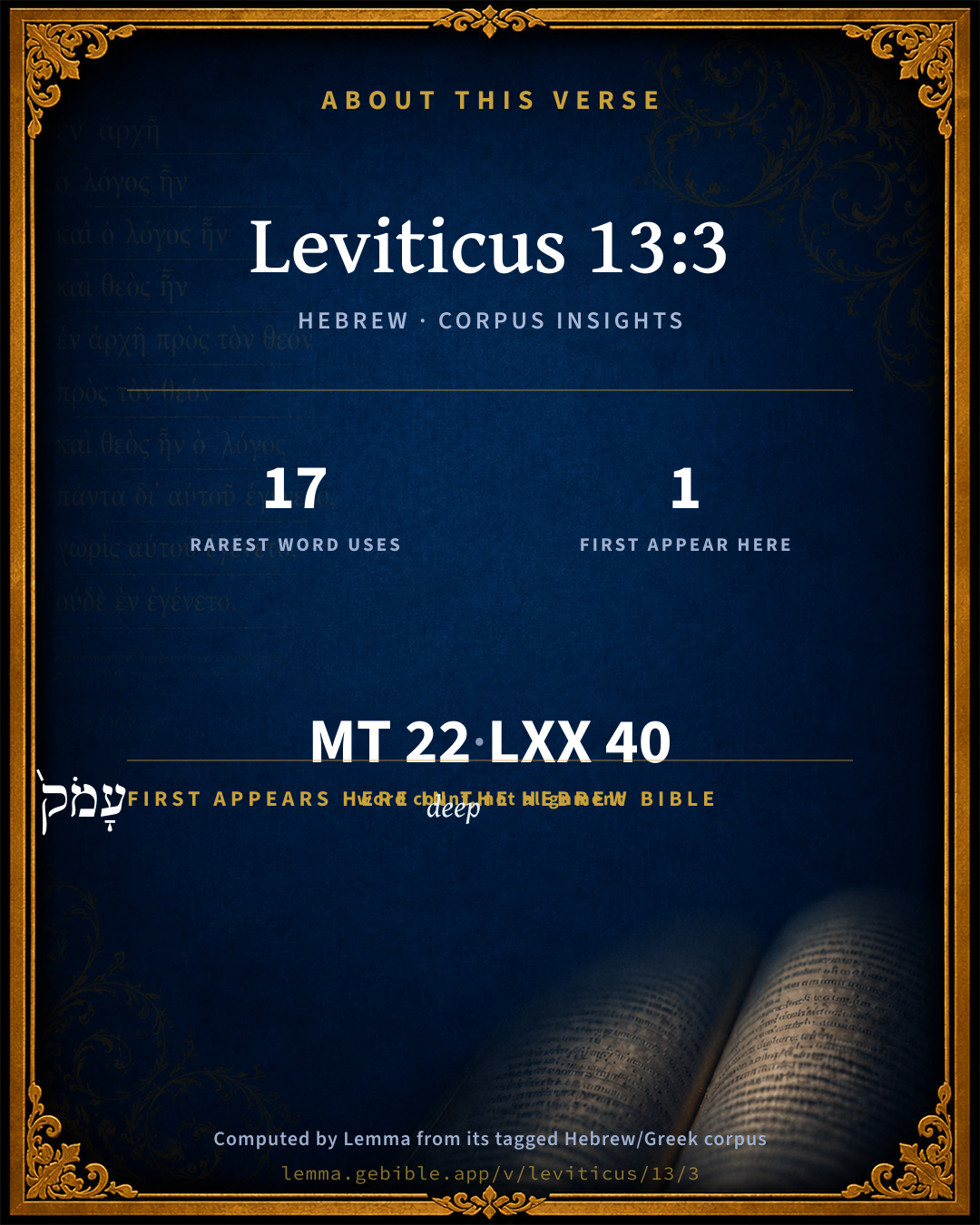
22
words
14
distinct lemmas
Pentateuch
section

Notable vocabulary

The rarest word here is עָמֹק֙ deep H6013 — appearing just 17 times in the whole Hebrew Bible.

First appearance in Scripture

This word makes its first canonical appearance in the Hebrew Bible here:

  • עָמֹק֙ deep H6013

Shared distinctive vocabulary

עָמֹק֙ deep H6013 occurs in 16 verses of the Hebrew Bible. Also found in:

Grammatical profile

  • 4 verbs
  • 13 nouns
  • 2 adjectives
  • 1 pronoun
  • 2 particles

Verb forms

  • וְרָאָ֣ה Qal · Sequential Perfect
  • הָפַ֣ךְ Qal · Perfect
  • וְרָאָ֥הוּ Qal · Sequential Perfect
  • וְטִמֵּ֥א Piel · Sequential Perfect

Repetition

Words recur within this verse — often emphatic in Hebrew:

  • הַנֶּ֣גַע plague H5061 ×4
  • וְרָאָ֣ה to see H7200 ×2
  • הַכֹּהֵ֣ן priest H3548 ×2
  • בְּעֽוֹר skin H5785 ×2
  • הַ֠בָּשָׂר flesh H1320 ×2

Hebrew & Septuagint length

In English translation the verse runs 51 words from the Hebrew and 54 from the Septuagint (LXX English) — closely comparable.

A rough comparison of the two English renderings, which tokenize alike — not a word-level alignment.

Word counts can differ between the Hebrew and the Greek without any difference in meaning — e.g. the Hebrew direct-object marker אֵת has no separate Greek word, and Greek often adds the article ὁ.

In the original languages it is 22 Hebrew tokens and 40 Greek tokens — but the two are counted differently (Hebrew bundles its prefixes and suffixes into one token; the Greek is in lemma form), so that isn’t a like-for-like length.

Cross-references

21

Topical passages linked to Leviticus 13:3 in the Treasury of Scripture Knowledge — connected by theme and wording, ordered by reader-vote popularity; previews shown in the World English Bible.

  • Romans 3:19–20 Now we know that whatever things the law says, it speaks to those who are under the law, that every mouth may be closed, and all the world may be brought under the judgment of God.
  • Genesis 13:3 He went on his journeys from the South even to Bethel, to the place where his tent had been at the beginning, between Bethel and Ai,
  • Leviticus 10:10 and that you are to make a distinction between the holy and the common, and between the unclean and the clean;
  • Leviticus 13:2 "When a man shall have a rising in his body's skin, or a scab, or a bright spot, and it becomes in the skin of his body the plague of leprosy, then he shall be brought to Aaron the priest, or to one of his sons the priests:
  • Ezekiel 16:30 How weak is your heart, says the Lord Yahweh, seeing you do all these things, the work of an impudent prostitute;
  • Ezekiel 44:23 They shall teach my people the difference between the holy and the common, and cause them to discern between the unclean and the clean.
  • Hosea 7:9 Strangers have devoured his strength, And he doesn't realize it. Indeed, gray hairs are here and there on him, And he doesn't realize it.
  • Haggai 2:11 "Thus says Yahweh of Hosts: Ask now the priests concerning the law, saying,
  • Malachi 2:7 For the priest's lips should keep knowledge, and they should seek the law at his mouth; for he is the messenger of Yahweh of Hosts.
  • Matthew 16:19 I will give to you the keys of the Kingdom of Heaven, and whatever you bind on earth will be bound in heaven; and whatever you release on earth will be released in heaven."
  • Matthew 18:17–18 If he refuses to listen to them, tell it to the assembly. If he refuses to hear the assembly also, let him be to you as a Gentile or a tax collector.
  • John 20:23 Whoever's sins you forgive, they are forgiven them. Whoever's sins you retain, they have been retained."
  • Acts 20:28 Take heed, therefore, to yourselves, and to all the flock, in which the Holy Spirit has made you overseers, to shepherd the assembly of the Lord and God which he purchased with his own blood.
  • Romans 7:7 What shall we say then? Is the law sin? May it never be! However, I wouldn't have known sin, except through the law. For I wouldn't have known coveting, unless the law had said, "You shall not covet."
  • 1 Corinthians 5:4–6 In the name of our Lord Jesus Christ, you being gathered together, and my spirit, with the power of our Lord Jesus Christ,
  • 2 Thessalonians 3:14–15 If any man doesn't obey our word in this letter, note that man, that you have no company with him, to the end that he may be ashamed.
  • 1 Timothy 1:20 of whom is Hymenaeus and Alexander; whom I delivered to Satan, that they might be taught not to blaspheme.
  • 2 Timothy 2:16–17 But shun empty chatter, for they will proceed further in ungodliness,
  • 2 Timothy 3:13 But evil men and impostors will grow worse and worse, deceiving and being deceived.
  • Hebrews 13:7 Remember your leaders, men who spoke to you the word of God, and considering the results of their conduct, imitate their faith.
  • Revelation 2:23 I will kill her children with Death, and all the assemblies will know that I am he who searches the minds and hearts. I will give to each one of you according to your deeds.

Cross-references courtesy of OpenBible.info (CC BY 4.0).

Hebrew and Greek witnesses Masoretic Hebrew ↔ Greek Septuagint

The same verse in the two great witnesses to the Old Testament, shown verse-for-verse.

These are two independent witnesses, not word-aligned to each other, and the Septuagint is shown in lemma (dictionary) form.

Hebrew Leviticus 13:3 Masoretic · Westminster Leningrad Codex

וְרָאָ֣ה הַכֹּהֵ֣ן אֶת הַנֶּ֣גַע בְּעֽוֹר הַ֠בָּשָׂר וְשֵׂעָ֨ר בַּנֶּ֜גַע הָפַ֣ךְ לָבָ֗ן וּמַרְאֵ֤ה הַנֶּ֨גַע֙ עָמֹק֙ מֵע֣וֹר בְּשָׂר֔וֹ נֶ֥גַע צָרַ֖עַת ה֑וּא וְרָאָ֥הוּ הַכֹּהֵ֖ן וְטִמֵּ֥א אֹתֽוֹ

and the priest shall examine the plague in the skin of the body: and if the hair in the plague has turned white, and the appearance of the plague is deeper than the body's skin, it is the plague of leprosy; and the priest shall examine him, and pronounce him unclean.

World English Bible · Public Domain

Greek LXX Leviticus 13:3 Septuagint · lemma form

καί ὁράω ὁ ἱερεύς ὁ ἁφή ἐν δέρμα ὁ χρώς αὐτός καί ὁ θρίξ ἐν ὁ ἁφή μεταβάλλω λευκός καί ὁ ὄψις ὁ ἁφή ταπεινός ἀπό ὁ δέρμα ὁ χρώς ἁφή λέπρα εἰμί καί ὁράω ὁ ἱερεύς καί μιαίνω αὐτός

And the priest shall view the spot in the skin of his flesh; and if the hair in the spot be changed to white, and the appearance of the spot be below the skin of the flesh, it is a plague of leprosy; and the priest shall look upon it, and pronounce him unclean.

LXX2012 (modern English Septuagint) · Public Domain

Hebrew: Westminster Leningrad Codex (CC BY 4.0). Greek: Septuagint (public domain); English from LXX2012 (modern English Septuagint) (Public Domain). How the Septuagint differs from the Hebrew →

Targum (Aramaic paraphrase)

2

The Targum is the ancient Jewish Aramaic paraphrase of the Hebrew Scriptures — an interpretive translation, not the Hebrew text itself. Onkelos (literal) and Pseudo-Jonathan (expansive) render the Torah, and Jonathan the Prophets. Coverage is partial: where no permissively-licensed English translation exists for a verse, only the Aramaic is shown. This is verse-level text, not a word-by-word alignment to the Hebrew.

  1. Targum Onkelos Torah (Genesis–Deuteronomy)
    וְיֶחֱזֵי כַהֲנָא יָת מַכְתָּשָׁא בִמְשַׁךְ בִּסְרָא וְשֵׂעָר בְּמַכְתָּשָׁא אִתְהַפִיךְ לְמֶחֱוָר וּמֶחֱזֵי מַכְתָּשָׁא עַמִיק בִּמְשַׁךְ בִּסְרֵהּ מַכְתַּשׁ סְגִירוּתָא הוּא וְיֶחֱזִנֵהּ כַּהֲנָא וִיסָאֵב יָתֵהּ

    (no public-domain English translation for this verse)

    Targum Onkelos — Aramaic: “Onkelos Genesis” (public domain); “Onkelos Exodus” (public domain); “Onkelos Leviticus” (public domain); “Onkelos Numbers” (public domain); “Onkelos Deuteronomy” (public domain). English: “Sefaria Community Translation” (CC0 1.0 (public-domain dedication)); “J.W. Etheridge. The Targums of Onkelos and Jonathan Ben Uzziel on the Pentateuch. London: Longmans, Green, 1862” (public domain). Text via Sefaria.

  2. Targum Pseudo-Jonathan Torah (Genesis–Deuteronomy)
    וְיֶחֱמֵי כַּהֲנָא יַת מַכְתְּשָׁא בִּמְשַׁךְ בִּישְרָא וְשַעֲרָא בְּמַכְתְּשָׁא אִיתְהַפִּיךְ לְחִיוָור וְחֵיזְיוּ דְמַכְתְּשָׁא עַמִיק לִמְחַוָור כְּתַלְגָא יַתִּיר מִמְשַׁךְ בִּישְרֵיהּ מַכְתַּשׁ סְגִירוּתָא הוּא וְיַחֲמִינֵיהּ כַּהֲנָא וִיסָאֵיב יָתֵיהּ

    And the priest shall look at the plague in the skin of the flesh,--and if the hair of the stricken place be turned to whiteness, and the appearance of the plague be deeper (than the surface), and be whiter than the skin of his flesh, like snow, it is the plague of leprosy; and the priest having inspected him shall make him to be unclean.

    Targum Pseudo-Jonathan — Aramaic: “Targum Jonathan on Genesis” (public domain); “Targum Jonathan on Exodus” (public domain); “Targum Jonathan on Leviticus” (public domain); “Targum Jonathan on Numbers” (public domain); “Targum Jonathan on Deuteronomy” (public domain). English: “The Targum of Jonathan ben Uzziel, trans. J. W. Etheridge, London, 1862” (public domain). Text via Sefaria.

Commentary

Notes on Leviticus 13:3 from classic Christian and Jewish commentators (each source and its license shown beneath its notes). The classic Christian expositions comment on the surrounding passage and are grouped to its opening verse, so a note may address several verses; the Jewish commentaries on the Tanakh (Rashi and others) are per-verse, so they appear only where the commentator wrote on this verse.

Lemma curates 59 commentaries, every one of them public domain or Creative Commons licensed, each selected and text-cleaned for this edition rather than reprinted as found. About our sources →

Trapp's Complete Commentary

John Trapp

Lev 13:3 And the priest shall look on the plague in the skin of the flesh: and [when] the hair in the plague is turned white, and the plague in sight [be] deeper than the skin of his flesh, it [is] a plague of leprosy: and the priest shall look on him, and pronounce him unclean.

Ver. 3. The plague in the skin of the flesh.] That is, the white bright spot. {Lev 13:2} Compare Exo 4:6 Num 12:10.

Is turned white.] This might note such as have continued long and are aged in any wickedness.

Be deeper than the skin of his flesh.] Compare Num 12:12 2Ki 5:14. Such are they whose wickedness is not only acted by their hands, but seated in their hearts and sunk into their spirits: like the spots of the leopard, which no art can cure, no water wash off, because they are not in the skin, but in the flesh and bones, in the sinews and most inner parts. Ingrained diseases are not easily stirred, much less destroyed.

John Trapp, A Commentary or Exposition upon All the Books of the Old and New Testament (1647–1656) — public domain. Text from a community e-Sword module.

Joseph Benson's Commentary

Lev 13:3. The priest shall look on the plague — In some dubious cases, the priest might find it convenient to take the judgment of physicians, or of persons who understood the theory of diseases better than himself; but, as he was to admit to or exclude from the sanctuary, he alone was to give judgment, and pronounce who were clean or unclean, and, as such, to be admitted or excluded. When the hair is turned white — He begins with the last of the three marks of a leprosy, namely, the bright spot. The reason of the hair’s turning white is thus assigned by Calmet, in his Dissertation on the Leprosy: “The flesh,” says he, “ceasing to receive its proper nourishment from the blood, which gave it its former vivid colour, the hair, which has its root in the corrupted, empoverished glands, becomes likewise ill-nourished, and so grows whitish and slender, like a plant in stony, parched ground.” His flesh — For the leprosy consumed both the skin and the flesh.

Joseph Benson's Commentary on the Old and New Testaments (1811–1818) — public domain. Text from a community e-Sword module.

Tyndale Open Study Notes

Tyndale Open Resources

13:3 more than skin-deep: This indicates that either the infection had eaten away the skin or the infection was visible beneath the skin. The white hair, together with the depression in the skin, indicated a skin disease that could spread (13:21-23). This made the person unclean (13:8).

Tyndale Open Study Notes — © Tyndale Open Resources, licensed CC BY-SA 4.0. Text via the HelloAO Bible API.

Geneva Bible (1599)

Geneva Bible translators

Hebrew, shall pollute him.

That is, shrunken in, and be lower than the rest of the skin.

Geneva Bible (1599) marginal notes — public domain. Text via Bolls.life.

Jamieson, Fausset & Brown

Robert Jamieson, A. R. Fausset & David Brown

the priest shall look on the plague in the skin of the flesh, &c.--The leprosy, as covering the person with a white, scaly scurf, has always been accounted an offensive blemish rather than a serious malady in the East, unless when it assumed its less common and malignant forms. When a Hebrew priest, after a careful inspection, discovered under the cutaneous blemish the distinctive signs of contagious leprosy, the person was immediately pronounced unclean, and is supposed to have been sent out of the camp to a lazaretto provided for that purpose. If the symptoms appeared to be doubtful, he ordered the person to be kept in domestic confinement for seven days, when he was subjected to a second examination; and if during the previous week the eruption had subsided or appeared to be harmless, he was instantly discharged. But if the eruption continued unabated and still doubtful, he was put under surveillance another week; at the end of which the character of the disorder never failed to manifest itself, and he was either doomed to perpetual exclusion from society or allowed to go at large. A person who had thus been detained on suspicion, when at length set at liberty, was obliged to "wash his clothes," as having been tainted by ceremonial pollution; and the purification through which he was required to go was, in the spirit of the Mosaic dispensation, symbolical of that inward purity it was instituted to promote.

Jamieson, Fausset & Brown — Commentary Critical and Explanatory on the Whole Bible (1871) — public domain (CC PDM 1.0). Text via the HelloAO Bible API.

Adam Clarke's Commentary

Verse 3. The priest shall - pronounce him unclean.] וטמא אתו vetimme otho; literally, shall pollute him, i. e., in the Hebrew idiom, shall declare or pronounce him polluted; and in Le 13:23, it is said, the priest shall pronounce him clean, וטהרו הכהן vetiharo haccohen, the priest shall cleanse him, i. e., declare him clean. In this phrase we have the proper meaning of Mt 16:19: Whatsoever ye bind on earth, shall be bound in heaven; and whatsoever ye loose on earth shall be loosed in heaven. By which our Lord intimates that the disciples, from having the keys, i. e., the true knowledge of the doctrine, of the kingdom of heaven, should, from particular evidences, be at all times able to distinguish between the clean and the unclean, the sincere and the hypocrite; and pronounce a judgment as infallible as the priest did in the case of the leprosy, from the tokens already specified. And as this binding and loosing, or pronouncing fit or unfit for fellowship with the members of Christ, must in the case of the disciples be always according to the doctrine of the kingdom of heaven, the sentence should be considered as proceeding immediately from thence, and consequently as Divinely ratified. The priest polluted or cleansed, i. e., declared the man clean or unclean, according to signs well known and infallible. The disciples or ministers of Christ bind or loose, declare to be fit or unfit for Church fellowship, according to unequivocal evidences of innocence or guilt. In the former case, the priest declared the person fit or unfit for civil society; in the latter, the ministers of Christ declare the person against whom the suspicion of guilt is laid, fit or unfit for continued association with the Church of God. The office was the same in both, a declaration of the truth, not from any power that they possessed of cleansing or polluting, of binding or of loosing, but by the knowledge they gained from the infallible signs and evidences produced on the respective cases.

Adam Clarke's Commentary on the Bible (1810–1826) — public domain. Text from a community e-Sword/MySword module.

Ellicott's Commentary for English Readers

(3) When the hair in the plague is turned white.—Better, and the hair in the plagued spot, &c. The first symptom indicating the existence of the disorder is that the hair, which is generally jet-black among the Hebrews, turns white on the affected spot. The authorities during the second Temple defined it that there must at least be two hairs white, at the root and in the body of the bright spot, before the patient can be declared unclean. The word plague, in accordance with a usage common in Hebrew—to put the abstract for the concrete—denotes here the plagued spot, or the spot affected by the plague, whilst in Lev_13:4 it means the person affected by this disorder. Thus in Lev_19:32, “the hoary head” stands for hoary-headed person.

And the plague in sight be deeper than the skin.—Better, and the appearance of the plagued spot be deeper, &c. The second symptom which shows the development of the disorder is that the spot affected by this plague appears to be deeper than the rest of the skin.

Pronounce him unclean.—Literally, make him unclean. According to the frequently occurring phraseology a man is said to do that which in his official capacity he pronounces as done, or orders to be done. Thus Ezekiel is said “to destroy the city” when he simply foretold its destruction (Eze_43:3). The existence of these two symptoms made it incumbent upon the priest to declare the person unclean, and hence imparting defilement.

A Bible Commentary for English Readers, edited by Charles John Ellicott (1878–1897) — public domain. Text from a community e-Sword module.

The Cambridge Bible for Schools and Colleges

gen. ed. J. J. S. Perowne

3. The distinctive marks of leprosy are—the hair, which is generally very dark among Jews, turns while, and the swelling appears deep-seated; in that case the priest is at once to declare the man unclean.

The Cambridge Bible for Schools and Colleges (gen. ed. J. J. S. Perowne; Cambridge University Press, 1878–1918) — public domain. Text from a community e-Sword module.

John Gill's Exposition

And the priest shall look on the plague in the skin of the flesh,.... Whether it be a swelling, scab, or a bright spot that appears, and judge of it by the following rules, and none but a priest might do this:

and when the hair in the plague is turned white; it arising in a place where hair grows, and which hair is not naturally white, but of another colour, but changed through the force of the plague; and there were to be two hairs at least, which were at first black, but turned white; so Jarchi and Ben Gersom: and these hairs, according to the Misnah (e), must be white at bottom; if the root (or bottom) is black, and the head (or top) white, he is clean; if the root white, and the head black, he is defiled; for hairs turning white is a sign of a disorder, of weakness, of a decay of nature, as may be observed in ancient persons:

and the plague in sight be deeper than the skin of his flesh; appears plainly to view to be more than skin deep, to have corroded and eat into the flesh below the skin:

it is a plague of leprosy; when these two signs were observed, hair turned white, and the plague was more than skin deep, then it was a plain case that it was the leprosy of which See Gill on Mat 8:2, Mat 8:3, Luk 5:12. This was an emblem of sin, and the corruption of nature, which is an uncleanness, and with which every man is defiled, and which renders him infectious, nauseous, and abominable; and of which he is only to be cured and cleansed by Christ, the great High Priest, through his blood, which cleanses from all sin. The above signs and marks of leprosy may be observed in this; the white hair denoting a decay of strength, see Hos 7:9 may be seen in sinners, as in the leper, who are without moral and spiritual strength to keep the law of God, to do anything that is spiritually good, to regenerate, renew, convert, and sanctify themselves, or to bring themselves out of the state of pollution, bondage, and misery, in which they are; and, like the leprosy, sin lies deep in man; it is in his flesh, in which dwells no good thing, and in which there is no soundness; it does not lie merely in outward actions, but it is in the heart, which is desperately wicked; for the inward part of man is very wicked:

and the priest shall look on him, and pronounce him unclean; and so should be obliged to rend his clothes, make bare his head, put a covering on his upper lip, and cry, unclean, unclean; dwell alone without the camp, and at a proper time bring the offering for his cleansing, and submit to the several rites and ceremonies prescribed, Lev 13:45.

(e) Negaim, c. 4. sect. 4.

John Gill's Exposition of the Whole Bible (1746–1763) — public domain (CC PDM 1.0). Text via the HelloAO Bible API.

Albert Barnes' Notes on the Bible

The hair in the plague is turned white - The sparing growth of very fine whitish hair on leprous spots in the place of the natural hair, appears to have been always regarded as a characteristic symptom.

the plague in sight be deeper than the skin of his flesh - Rather The stroke appears to be deeper than the scarf skin. The bright spot changed to a brownish color with a metallic or oily luster, and with a clearly-defined edge. This symptom, along with the whitish hair, at once decided the case to be one of leprosy.

Albert Barnes' Notes on the Bible (1834–1885) — public domain. Text from a community e-Sword/MySword module.

Haydock's Catholic Bible Commentary

Flesh. These two signs indicated the species of leprosy called volatile, or impetigo, (Menochius) resembling a scab, which did not penetrate the flesh or bones, as our leprosy or elephantiasis does. (Vales.; Chap. xix.) --- Separated from society. Hebrew, "he shall contaminate him." See ver. 11. (Haydock) --- Some assert, that the physician was first to be consulted. But none but the priests could declare them unclean, or set them at liberty. After they had pronounced sentence, the lepers might apply for medicines to others.

George Leo Haydock (1774–1849), Haydock's Catholic Family Bible and Commentary, 1859 edition — public domain. Excludes Psalms (Douay-Rheims chapter numbering differs from Protestant) and Deuterocanonical books (Catholic canon only).

Matthew Poole's English Annotations

On the plague, i.e. the sign or appearance of the plague of leprosy. And it is observable, that the same signs of it are given by Moses here, and by the learned physicians in their works. And when the leprosy came to its height, not the hair only, but also the skin was turned white, as Exo 4:6; Num 12:10. And this change of colour was an evidence both of the abundance of excrementitious humours, and of the weakness of nature, as we see in old and sick persons. Deeper than the skin; for the leprosy did consume both the skin and the flesh, as appears from 2Ki 5:14.

Pronounce him unclean, Heb. make him unclean, i. e ministerially and declaratively, in which sense ministers are said to remit sins, Mat 16:19, and to destroy nations, Jer 1:10.

Matthew Poole's English Annotations on the Holy Bible (1683–1685) — public domain. Text from a community e-Sword/MySword module.

Whedon's Commentary on the Bible

Daniel D. Whedon

3. The priest shall look — The eye is still the chief instrument in the diagnosis of diseases. The microscope has greatly enhanced the accuracy of its reports, especially in cutaneous diseases, each of which has its peculiar manifestations. In practice the inspection took place on clear days from nine o’clock to twelve, and from one to four, because colours were best discerned then.

Hair… turned white — The leprosy is so radical in its nature that it whitens the hairs in the leprous spots. “There must be at least two in the body of the white spot.” — Maimonides.

Deeper than the skin — Deeper than the general level of the skin. White spots frequently appear from some defect in the pigments which lie immediately beneath the transparent cuticle. The leprosy must be carefully distinguished from this cutaneous whiteness.

Daniel D. Whedon (gen. ed.), Commentary on the Old and New Testaments (1874–1909) — public domain. Text from a community e-Sword module.

The Pulpit Commentary

When the hair in the plague is turned white. This is the first symptom, and the most noticeable as the commencement of the disease. The hair around the spot loses its colour and becomes thin and weak, the separate hairs being hardly stronger or individually thicker than down. The second symptom is when the plague in sight be deeper than the skin of his flesh; that is, below the upper skin, or cuticle, and in the real cutis. These two symptoms distinguish real leprosy from other affections which at first bear a similar appearance.

HOMILIES BY W. CLARKSON Ver. 3. "It is a plague of leprosy.

The chosen type of sin its individual aspect. The conjecture that leprosy was contracted by the children of Israel in the hot and dusty brick-fields of Egypt is probable enough. The definition that it was "any severe disease spreading on the surface of the body in the way described in the chapter, and so shocking of aspect... that public feeling called for separation," is near enough for our purpose, There can be no question that it was the divinely chosen type of sin.

All disease is pictorial of sin. It is to our bodily frame the very thing that sin is to our soul. Sin is the derangement or disorder of the soul, as sickness is of the body. It is an inward disorder, showing itself in some outward manifestation of a displeasing or painful character. It is something wrong within some faculty (organ) not doing what it was made to do, or doing what it was not meant to do, causing disturbance and distress, But leprosy was selected by the Divine Ruler of Israel as a disease which should be regarded by his people as specially typical and suggestive of sin. It was admirably fitted so to be, whether looked at in its individual or in its social aspect, We will take the former first,

I THE OBSCURITY OF ITS ORIGIN. By what sad and strange process came it to pass that man"s bodily frame fashioned by the Divine Creator, made clean and pure, wholesome and fair has become the seat of such a foul disorder? How can it be that the little child whose flesh is beautiful and spotless, the very picture of all that is clean and sweet, grows up into a man who is "full of leprosy," covered from head to foot with revolting sores? And whence came sin into the soul and life of man? How came it here to blot and mar God"s fair creation? How comes it to pass that into the heart of the innocent and lovely child there enters the very vilest spirit, showing itself in the most shocking words and the most revolting deeds, in later life?

II ITS STUBBORNNESS. When, after seven days, the Hebrew priest could see no signs of true leprosy, he did not pronounce the patient clean: he shut him up other seven days (verse 5), and examined him again. Leprosy was a tenacious and stubborn disease, disappearing and reappearing, After a long interval it might, under exciting cause, come once again to the surface. How like the affliction of the soul sin! How tenacious is its hold on the human heart! It disappears and we are grateful, congratulatory, triumphant. But the inducing circumstances, the favourable conditions arise and conspire, and behold there is its hateful face again. We "would do good," we resolve to do good, but, alas! "evil is present with us" once more. (Rom_7:21)

III ITS DEATHFULNESS. The outward appearance was due to inward derangement; the springs of health were poisoned; the internal processes necessary to health were stayed; and the consequence was that feature after feature, limb after limb, decayed and fell away. The man was in a constant process of dissolution. It was death above the ground death in a living form! Sin is death. The soul that lives in sin is "dead while it lives." It is not that which it was created to be, does not that which it was created to do. Its spiritual faculties (the organs and members of the soul) are in a state of continual dissolution, becoming feebler and feebler, till they are wholly lost. It is a living death.

IV ITS UNCURABLENESS BY MAN. The Jews did not bring the physician to the leper; they regarded leprosy as a visitation from God, and considered it incurable by human art. Sin is incurable by mere human methods. Rules for the regulation of human conduct; pledges or vows of abstinence from particular temptations; parental, magisterial, social vigilance; penalties inflicted by ourself or by others for disobedience; these are well enough in their way. They are sometimes desirable, sometimes necessary; but they do not cure. Nothing human will cure the soul"s disorder; only the Almighty Hand can minister to the "mind diseased.

When Jesus Christ would prove to John that he was indeed the "One that should come," and that there was no need to "look for another," he added to the recital of his benefactions, "the lepers are cleansed". (Mat_11:5) It was a true mark of the Messiah. The coming Saviour was he who had power to cure the incurable, to touch the foulest of the foul with the finger of the Divine mercy and sovereign power, and to make even him whole and pure. To that Divine Physician the man fullest of the leprosy of sin may go and say, "Lord, if thou wilt thou canst make me clean". C. (Luk_5:12)

Conviction of sin.

"And the priest shall look on him, and pronounce him unclean." In the Hebrew commonwealth:

1. There were those who were reasonably suspected of leprosy, i.e., of "uncleanness.

2. It was a matter of the gravest consequence to know whether these suspicions were well founded or not. For ascertained leprosy meant unfitness to approach God in worship, exclusion from the fellowship of his people, etc.

3. It was the function of the priest to decide positively in the matter. The priest was to "look on him, and pronounce him unclean," or, on the other hand, to rule that he was clean (verse 6).

In every commonwealth today, in the whole human world

I THERE ARE THOSE REASONABLY SUSPECTED OF SIN. These are not the few exceptions; they are the multitude without exception. (Psa_14:2-3)

II IT IS A MATTER OF THE GRAVEST CONSEQUENCE TO KNOW WHETHER WE ARE SINFUL OR NOT. For sin means

(1) unlikeness to God;

(2) separation from God;

(3) condemnation by God, both here and hereafter;

(4) exclusion from the home of the holy. Hence we must ask

III WHO ARE THEY ON WHOM THIS GREAT DECISION IS DEVOLVED. It rests with no human priest to decide on our state before God. Our own heart must condemn us if we are to have that conviction of sift which leads to contrition for sin and to "repentance and remission of sin.

1. God will be our Divine Helper. He helps us to a right conclusion by his informing Word and by his illuminating Spirit.

2. Our fellow-men will be human helpers; they will guide us to an understanding of the Word of the Lord, and, directed by their own experience, will lead us to judge truly concerning our spiritual condition. Their aid will be ministerial, not authoritative.

3. We ourselves must decide in the last resort. This is one of those grave matters in which "every man must bear his own burden." We must recognize, with the eyes of our own soul, the signs and tokens of guilt in our heart and life. It must be the deliberate utterance of our own judgment, as well as the sigh of our own spirit, and the cry of our own lips, "I have sinned against the Lord;" "Unclean, unclean!" When we look at our inner selves as well as outer life; when we consider what we have left undone of all our obligations, as well as what we have done that has been forbidden; when we contrast our hearts and lives with the precepts of God"s holy Law and the ideal of human perfection in the example of our sinless Saviour; we shall have no hesitation in concluding that we are "utterly unclean," that we deserve exclusion from the friendship of God and the fellowship of the holy, and that it is our heavenly wisdom to seek at once his blessed presence who will say to us, "Wilt thou be made whole?" and to gain at once the touch of his mighty hand who, in answer to our earnest prayer, will respond by saying, I will; be thou clean. C.

The Pulpit Commentary (1880–1919), ed. H.D.M. Spence-Jones & Joseph S. Exell — public domain. Text from a community e-Sword module.

John Wesley's Explanatory Notes

When the hair is turned white - This change of colour was an evidence both of the abundance of excrementious humours, and of the weakness of nature, as we see in old and sick persons. His flesh - For the leprosy consumed both the skin and the flesh.

John Wesley, Explanatory Notes Upon the Whole Bible (1754–1765) — public domain. Text via the GEBible commentary corpus.

Scofield Reference Notes

C. I. Scofield

priest

Some have found in the regulations of this chapter concerning an inquest by the priest of a case of leprosy, elaborate provisions for the exercise of discipline in the local church. No little self-righteousness and cruelty have come in thereby. The explicit instructions of the N.T. are the alone and sufficient rule of discipline.

The Scofield Reference Bible (1917 edition), notes by C. I. Scofield — public domain. Text from a community e-Sword module.

unfoldingWord translationNotes

Door43 World Missions Community

General Information:

Yahweh continues telling Moses and Aaron what the people must do.

skin of his body

Here "his" refers to the person with the skin disease.

infectious disease

a sickness that can spread easily from one person to another

he must pronounce him unclean

"the priest must pronounce the man unclean." The man whom other people must not touch is spoken of as if he were physically unclean. (See: Metaphor)

for seven days

"for 7 days" (See: Numbers)

translationWords

priest

clean

unfoldingWord translationNotes — © Distant Shores Media and the Door43 World Missions Community, licensed CC BY-SA 4.0. Source: git.door43.org/Door43/en_tn.

Rashi

Rabbi Shlomo Yitzchaki (Rashi)

הפך לבן [THE HAIR …] IS TURNED WHITE — This means that at first it was dark, and it turned white within the plague. The smallest number of hairs implied by the term שער is two (Sifra, Tazria Parashat Nega'im, Chapter 2 2).

עמק מעור בשרו [THE PLAGUE] IS DEEPER THAN THE SKIN OF HIS FLESH — Every white colour is deep (in contrast to a dark colour surrounding it) just as the colour of anything illuminated by the sun is deeper than the shadow (Shevuot 6b).

וטמא אתו HE SHALL PRONOUNCE HIM UNCLEAN — He (the priest) shall say to him. “Thou art unclean” — for it is an enactment of Scripture that hair that has become white is a symptom of uncleanness.

Rashi on the Tanakh — English translations: “The Judaica Press complete Tanach with Rashi, translated by A. J. Rosenberg” (CC BY 4.0); “Pentateuch with Rashi's commentary by M. Rosenbaum and A.M. Silbermann, 1929-1934” (public domain); “The Metsudah Tanach series, Lakewood, N.J” (CC BY 4.0); and “The Book of Joshua, Metsudah Publications, 1997” (CC BY 4.0). Text via Sefaria.

Ramban (Nachmanides)

Rabbi Moshe ben Nachman (Ramban / Nachmanides)

AND THE APPEARANCE OF THE PLAGUE BE DEEPER THAN THE SKIN OF THE FLESH. “Every white color appears deep [in contrast to the darker color surrounding it], just as a color illuminated by the sun appears deeper than the shadow.” This is Rashi’s language. For this reason when the Rabbi [Rashi] reached the following verse, stating, And if the bright spot be white in the skin of his flesh, and the appearance thereof be not deeper than the skin, are based: (a) Any of the four colors of white (see Note 105) which appears in the skin of the flesh, does not of itself render the person impure, unless in addition it has one of the three symptoms of impurity, which are: if the plague has turned a minimum of two black hairs in the white patch in the flesh to white, or some “quick flesh” has appeared in the middle of the plague, or, if not having had one of these symptoms to begin with, the person was shut up for seven days, and then it was seen that the white patch of the plague had spread in the skin. (b) If any of these four colors appear in a place where there was an inflammation or a burning inflammation, the person is rendered impure only by means of one of these two symptoms: hair changing color from black to white, or the spreading of the white patch of the plague in the skin. The appearance of “quick flesh” in this case is not a sign of impurity. (c) If a plague appears in the hair, the symptoms of impurity are one of two: if the plague has caused a minimum of two hairs to turn gold-colored, or if it has spread in the skin. (d) A special lengthy discussion appears in Ramban (further in Verse 29) as to the precise nature of the plague which the Torah calls nethek (Verse 30), and which laws regulate it. Other laws pertinent to these discussions are clearly set forth in the text. Finally, it should be noted that a person shut up or quarantined for a week by the priest is rendered unclean in every respect as a leper that is certified unclean, except that he need not go with unkempt hair and rent garments; also, if declared “clean” by the priest at the end of the week he need not do the cutting off of the hair and the bringing of the bird-offerings etc., as they are required of the leper that had been certified unclean when healed of his leprosy (see further Chapter 14) (Megillah 8 b). he wrote, “I do not know the meaning of this.” The sense of Rashi’s statement is as follows: It appeared to him difficult, for since the bright spot is white, it is impossible that the appearance thereof should not be deeper than the skin, even as the color of anything illuminated by the sun appears deeper than the shadow!Now we are in a position to remove this difficulty. For the verses do not speak of the appearance of a plague seeming deeper than the skin, unless two hairs in the plague become white [such being the case in Verse 3 before us]. But when it states [as it does in the following verse], and the hair thereof be not turned white, it says, and the appearance thereof be not deeper than the skin. are based: (a) Any of the four colors of white (see Note 105) which appears in the skin of the flesh, does not of itself render the person impure, unless in addition it has one of the three symptoms of impurity, which are: if the plague has turned a minimum of two black hairs in the white patch in the flesh to white, or some “quick flesh” has appeared in the middle of the plague, or, if not having had one of these symptoms to begin with, the person was shut up for seven days, and then it was seen that the white patch of the plague had spread in the skin. (b) If any of these four colors appear in a place where there was an inflammation or a burning inflammation, the person is rendered impure only by means of one of these two symptoms: hair changing color from black to white, or the spreading of the white patch of the plague in the skin. The appearance of “quick flesh” in this case is not a sign of impurity. (c) If a plague appears in the hair, the symptoms of impurity are one of two: if the plague has caused a minimum of two hairs to turn gold-colored, or if it has spread in the skin. (d) A special lengthy discussion appears in Ramban (further in Verse 29) as to the precise nature of the plague which the Torah calls nethek (Verse 30), and which laws regulate it. Other laws pertinent to these discussions are clearly set forth in the text. Finally, it should be noted that a person shut up or quarantined for a week by the priest is rendered unclean in every respect as a leper that is certified unclean, except that he need not go with unkempt hair and rent garments; also, if declared “clean” by the priest at the end of the week he need not do the cutting off of the hair and the bringing of the bird-offerings etc., as they are required of the leper that had been certified unclean when healed of his leprosy (see further Chapter 14) (Megillah 8 b). For such is the distinctive characteristic of anything illuminated by the sun: if there is something black scattered about in it, there will not be an appearance of depth to a person who looks at it. Now hair in its natural state is dark, and therefore destroys the appearance of depth of the plague. When the hairs in the plague have turned white or yellow, then only does the whiteness of the plague shine brightly, and appears to anyone who looks at it from a distance as if it were deeper [than the skin of the flesh].Yet despite all this, that which the Rabbi [Rashi] has said — “Every white color is deeper [in contrast to dark colors surrounding it]” — does not appear to me to be correct. For the Rabbis have said: “The word se’eith is always an expression of ‘rising,’” and the se’eith is white, as it is written, ‘se’eith l’vanah’ (a white rising), Verse 10. and the Rabbis have further said: “Se’eith is [as white] as white wool, and its second [subsidiary] shade is as white as the membrane of an egg.” Thus se’eith is very white, and [according to Rashi] it should appear very deep, so why then do the Rabbis call it “rising?” Scripture also does not state anywhere concerning the color of se’eith that it is deeper than the skin! (a white rising) or ‘bahereth’ (a bright spot) … and the priest shall look; and behold, if the appearance thereof be ‘shaphal’ (lower) than the skin. Now the word shaphal (lower) refers obviously to both se’eith and bahereth mentioned before. But according to Rashi, Ramban asks, why does it not state concerning the color of se’eith that it is ‘amok min ha’or’ (“deeper” than the skin) instead of “lower” than the skin, when, as Rashi put it, “Every white color is ‘deeper’ [in contrast to the black surrounding it]?” And here too (in Verse 3 before us) it merely says that the appearance of ‘the plague’ be deeper, but it does not say so about the se’eith! And in the Torah Kohanim the Rabbis have said:, Negaim 1:4. “What is the meaning of the term se’eith? It is ‘rising,’ just as the color of the shadow is higher than that of anything illuminated by the sun.” And if every white color is deep [in contrast to a dark color surrounding it, as Rashi put it], then the fact is the opposite [of what the Rabbis have said in the Torath Kohanim]! Perhaps we may say that the terms se’eith signifies “rising” in contrast to bahereth, so that if you place both of them together, the bahereth will appear as if illuminated by the sun, and the se’eith at its side will have the appearance of the shadow, while both of them in relation to the skin [which is darker] will appear as deeper. signifies “rising,” for it is only in contrast to bahereth which is bright-white like snow, that the duller color of se’eith appears “higher.” Thus there is no contradiction between this statement of the Rabbis and that which Rashi said, that “Every white color is deep etc.,” since the above interpretation of the Rabbis concerning se’eith was with reference to a contrast of a still brighter color. It still remains to explain why Scripture does not speak of se’eith as appearing “deeper” than the skin, but instead speaks of it as being “lower” than the skin (see Note 65 above). This point Ramban will now proceed to explain. Yet Scripture [nonetheless] does not speak of the color of se’eith as being deeper than the skin!The explanation of this matter appears to me to be as follows. There is a kind of white which shines into and dazzles the eyes just as the appearance of the sun does, with the result that the eyes are incapable of receiving the intense color of that whiteness, and therefore it seems to him [a person looking] as if it were deep, just as the color illuminated by the sun appears deeper than the shadow, because the eye can receive the darker color and it is fixed thereon, whereas the white color scatters the visionary power and appears further removed from it, and therefore seems to be deep. Thus the whiteness of bahereth which is a bright white like snow, causes the visionary power to be weakened, just as it becomes weak in a place illuminated by the sun, provided that there is no black hair in the bahereth, in which case the visionary power concentrates on the black and from there it spreads out to the whole appearance of the plague and does not “flee” from it [on account of its intense whiteness, and therefore it does not appear to be deeper than the skin]. — on which Rashi had commented, “I do not know the meaning of this,” for the reason explained above. Ramban explains it on the basis of physical laws of nature, that since the verse continues to state, and the hair thereof be not turned white, therefore the visionary power of the eye concentrates on the black hair, and from there it spreads forth to the white plague, and consequently the whiteness does not appear deeper than the skin. Now the plague known as se’eith is also white, but its whiteness is not intense [as that of bahereth], as mentioned above, is as white as white wool. and it does not weaken the visionary power; therefore the eye spreads out [over the whole plague] and sees it closely with the result that the se’eith appears near to it and elevated, just as when one looks at the stars which appear to be high in the heavens.Now in the case of an inflammation [in the skin, in which symptoms of leprosy occurred], Scripture mentions two colors, a white ‘se’eith’ (rising) or a white ‘bahereth’ (bright spot) intermingled with red, and states concerning it, behold, it be in sight ‘lower’ than the skin, Verse 20. At this point Ramban interprets the phrase quoted as referring back to both se’eith and bahereth. Further on he will explain it as referring only to bahereth. See further, Note 73. but does not say “deeper” [than the skin], because although that bahereth is an intense white, the redness in it lessens the “depth” thereof and makes it appear only slightly “lower” [than the skin].But by way of the plain meaning of Scripture the phrase behold, it be in sight ‘lower’ than the skin only refers back to the bahereth, but of the white ‘se’eith’ (rising) it does not say so. in the nature of every form of white to appear deeper than the skin [unlike Rashi who stated categorically, “Every white color is deep etc.,” as a result of which Rashi found it difficult to explain the phrase in Verse 4: and the appearance thereof be ‘not’ deeper than the skin, as mentioned above] and since se’eith is only as white as white wool, unlike the bahereth which is bright-white like snow, therefore Scripture does not speak of it as appearing “lower” than the skin. Instead, the phrase, behold, it be in sight ‘lower’ than the skin (Verse 20) refers back only to the white bahereth. It is only according to Rashi who wrote that “Every white color appears deeper etc.” that the phrase in Verse 20, behold, it be in sight ‘lower’ etc. refers back to both se’eith and bahereth mentioned in Verse 19. And concerning both of them [se’eith and bahereth] Scripture says [in the case of an inflammation in the skin], But behold, if there be no white hairs therein, and it be not lower than the skin, but be dim, for on account of the redness [which is intermingled in the white], and the blackness of the hair, the plague has lost even its appearance of being “lower” [than the skin] and is only “dim.”In the case of a burning by fire Scripture mentions, and the quick flesh of the burnt part have a white ‘bahereth’ (bright spot), reddish-white or white, and then it continues [in the following verse] to state, and it be in sight ‘deeper’ than the skin; [that refers back only] to “the white” [in the preceding verse, but not to the reddish-white, which, as explained above, does not appear to be “deeper” than the skin]. Then it states further on, But if the priest look on it, and behold, there be no white hair in the ‘bahereth’ (bright spot), and it be no lower than the skin. In this case He mentioned the matter of being “lower” or not with reference [also] to “the reddish-white” [in Verse 24], thus teaching that the appearance of the plague either as “deep” or “low” is an indication of impurity, and that they are only pure if there is no appearance at all [of the bright spot] being “lower” than the skin, but instead it is only “dim.” (bright spot) stay in its place … but it be dim … the priest shall pronounce him clean (Verse 28).Now the Torah desired the purity of Israel and the cleanliness of their bodies, and it therefore took measures to keep this sickness [of leprosy] far from them at its very inception, for these colors [of the plagues] are not yet the real leprosy, but they lead to it. Doctors state in their books: “We should fear beharoth [bright spots in the skin of the flesh] more than the leprosy itself.” That is the reason why Scripture calls them when they are just beginning, the affliction of leprosy, meaning an affliction of a leprous nature, but not yet the actual leprosy. It is when the symptoms of impurity are clearly identified, after the leper has been put in quarantine [for a trial period], that Scripture says, it is leprosy meaning that it is possible that it is a genuine form of leprosy. At times Scripture will say of impurity, and the priest shall pronounce him unclean; it is an affliction of leprosy, the meaning thereof being to state that the priest shall declare him impure at once, for it is an affliction of a leprous nature that will surely result in actual leprosy, and therefore it is advisable that he be separated from the people from that moment on. Similarly, and the priest shall pronounce him unclean; it is an affliction, means that it is a great affliction which will not be healed [easily], but instead will grow the whole day and spread [into the skin] as it has done till now.As to that which Rashi stated [in Verse 3 before us] that: “It is a Scriptural ordinance [the reason of which is not known] that hair that has become white is a symptom of impurity” — this is the interpretation of the thing; it is the decree of the Most High, which is come upon, 4:21. that person, for a plague which does not turn the hair white, is only an ugly spot in the skin, but not a secretion which will cause any sickness.

Ramban (Nachmanides) on the Tanakh — English translation: “Commentary on the Torah by Ramban (Nachmanides). Translated and annotated by Charles B. Chavel. New York, Shilo Pub. House, 1971-1976” (CC BY 4.0). Text via Sefaria.

Lesson kit

Teaching starters — assembled from the data on this page, not authored interpretation. Every prompt links to the verse data it draws on. Edit before teaching.

Leviticus, in the Pentateuch, opens this verse with 22 words (14 distinct Hebrew lemmas). Its most distinctive word is ʻâmôq (“deep”). A historical commentator’s framing appears above. Read the whole chapter for the surrounding context.

Discussion questions

  1. The word ʻâmôq carries the sense “deep.” How does it shape the verse?
  2. This is the first place “deep” appears in Scripture (first appears here). What does its debut here establish?
  3. How does Leviticus 13:4, which shares the word «deep», read alongside this verse?
  4. What does the repetition of “plague” (4× in this one verse) do in this verse?
  5. The translations on this page render this verse differently — a whole-verse word diff, not a word-by-word alignment. What might account for the different wordings?
  6. «וְרָאָ֣ה» is a Qal Sequential Perfect verb. How does that grammatical form shape the action described?
  7. Compare how Trapp's Complete Commentary and Joseph Benson's Commentary read this verse. Where do they agree or differ?

Things to notice

Reading settings

Reading text

Shown beneath each verse's original-language words.

Old Testament
Old Testament edition

Read the OT as the Masoretic Hebrew (MT) or the Greek Septuagint (LXX).

English shown for the Greek Septuagint (in the Hebrew ↔ Greek comparison).

Comparing translations? Open the Compare panel on any verse page to stack up to four side by side.