
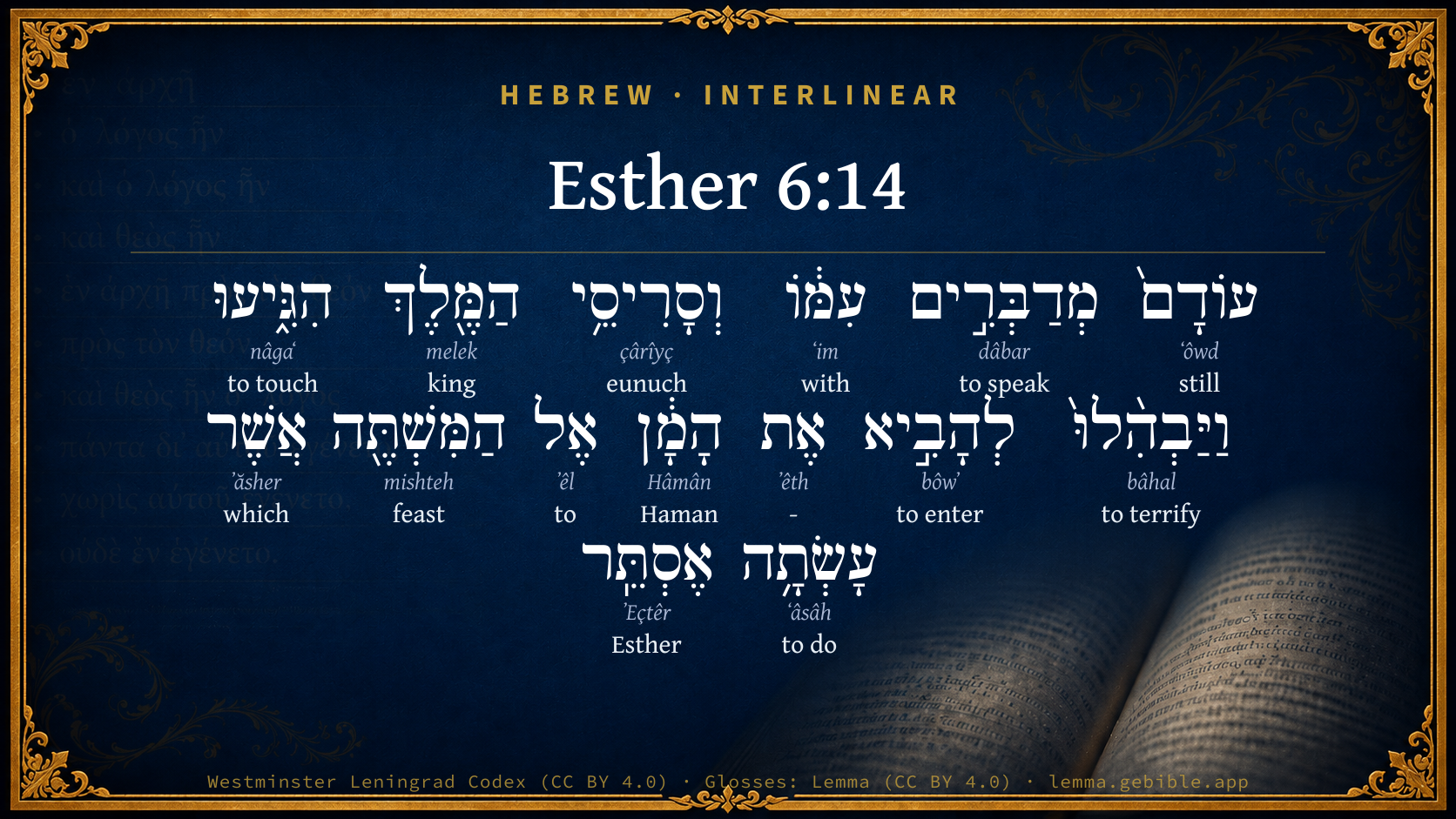
Esther 6:14

Hebrew (Westminster Leningrad Codex) Esther 6:14 appears in the Hebrew Old Testament. The text above is from the Westminster Leningrad Codex. Each word links to its Strong’s number, a concise gloss, and parsing drawn from the Open Scriptures Hebrew Bible morphology. Click any word for its full Brown-Driver-Briggs (BDB) entry.
Download image
Cite this verse

Esther 6:14 (World English Bible). Public Domain. Lemma interlinear Bible study tool, https://lemma.gebible.app/v/esther/6/14.

Show BibTeX & RIS
BibTeX
RIS
English Translation
While they were yet talking with him, came the king's chamberlains, and hurried to bring Haman to the banquet that Esther had prepared.
World English Bible · Public Domain
Download a study sheet

One document with this verse’s original text, its word-by-word gloss line, the meaning frame, cross-references with their text, attributed commentary, and full source and license credits — printable, and it pastes into notes with its structure intact.

This verse Autodidact and up

Study sheet (.html) Plain text (.txt)

A passage Seminary Student

Up to 50 verses in one chapter. A passage sheet keeps up to 6 commentary sources and 12 cross-references per verse, in the order this page ranks them, and says so on the sheet whenever that leaves anything out. Ask for a single verse and you get the Autodidact verse sheet above.

Everything on this page stays free to read, with no account — the sheet is a download of what is already on screen, not access to it.

Want to remove ads? Support Godless Engineer
Compare translations 3

The same verse in 3 English versions, stacked beneath the original-language interlinear above. Click any original word for its lexicon entry.

Each is an independent rendering of the whole verse — the interlinear is not word-aligned to these translations.

Highlighted words mark where these versions differ — a whole-verse word diff, not a word-by-word alignment.

  • World English Bible Public Domain
    While they were yet talking with him, came the king's chamberlains, and hurried to bring Haman to the banquet that Esther had prepared.
  • King James Version Public Domain
    And while they were yet talking with him, came the king's chamberlains, and hasted to bring Haman unto the banquet that Esther had prepared.
  • unfoldingWord Literal Text CC BY-SA 4.0
    They were still speaking with him when the eunuchs of the king arrived. And they hurried to bring Haman to the banquet that Esther had made.

unfoldingWord Literal Text — © unfoldingWord, licensed CC BY-SA 4.0. Word-aligned USFM3 via Door43 (git.door43.org/unfoldingWord/en_ult).

Versions to compare (up to 4)

3 of 4 selected

Show all 18 translations

Every available English version of this verse, each an independent rendering of the whole verse.

  • World English Bible Public Domain
    While they were yet talking with him, came the king's chamberlains, and hurried to bring Haman to the banquet that Esther had prepared.
  • Berean Standard Bible Public Domain
    While they were still speaking with Haman, the king’s eunuchs arrived and rushed him to the banquet that Esther had prepared.
  • Majority Standard Bible Public Domain
    While they were still speaking with Haman, the king’s eunuchs arrived and rushed him to the banquet that Esther had prepared.
  • King James Version Public Domain
    And while they were yet talking with him, came the king's chamberlains, and hasted to bring Haman unto the banquet that Esther had prepared.
  • American Standard Version (1901) Public Domain
    While they were yet talking with him, came the king's chamberlains, and hasted to bring Haman unto the banquet that Esther had prepared.
  • Revised Version (1885) Public Domain
    While they were yet talking with him, came the king’s chamberlains, and hasted to bring Haman unto the banquet that Esther had prepared.
  • Geneva Bible (1599) Public Domain
    And while they were yet talking with him, came the Kings eunuches and hasted to bring Haman vnto the banket that Ester had prepared.
  • Douay-Rheims (1899) Public Domain
    As they were yet speaking, the king's eunuchs came, and compelled him to go quickly to the banquet which the queen had prepared.
  • Young's Literal Translation Public Domain
    They are yet speaking with him, and eunuchs of the king have come, and haste to bring in Haman unto the banquet that Esther hath made.
  • Literal Standard Version CC BY-SA 4.0
    They are yet speaking with him, and eunuchs of the king have come, and hurry to bring in Haman to the banquet that Esther has made.
  • Unlocked Literal Bible CC BY-SA 4.0
    While they were talking with him, the king's officials arrived. They hurried to bring Haman to the feast that Esther had prepared.
  • unfoldingWord Literal Text CC BY-SA 4.0
    They were still speaking with him when the eunuchs of the king arrived. And they hurried to bring Haman to the banquet that Esther had made.
  • Darby Bible Public Domain
    While they were yet talking with him, the king's chamberlains came, and hasted to bring Haman to the banquet that Esther had prepared.
  • World Messianic Bible Public Domain
    While they were yet talking with him, the king’s eunuchs came, and hurried to bring Haman to the banquet that Esther had prepared.
  • Webster's Bible Public Domain
    And while they were yet talking with him, came the king's chamberlains, and hasted to bring Haman to the banquet that Esther had prepared.
  • Free Bible Version CC BY-SA 4.0
    While they were still talking to him, the king's eunuchs arrived and quickly took Haman to the dinner which Esther had prepared.
  • Bible in Basic English Public Domain
    While they were still talking, the king's servants came to take Haman to the feast which Esther had made ready.
  • JPS Tanakh (1917) Public Domain
    While they were yet talking with him, came the king's chamberlains, and hastened to bring Haman unto the banquet that Esther had prepared.

Literal Standard Version (2020), Covenant Press — licensed CC BY-SA 4.0. Text via the HelloAO Bible API (eBible.org). Unlocked Literal Bible (unfoldingWord) — licensed CC BY-SA 4.0. Text via the HelloAO Bible API (eBible.org). unfoldingWord Literal Text — © unfoldingWord, licensed CC BY-SA 4.0. Word-aligned USFM3 via Door43 (git.door43.org/unfoldingWord/en_ult). Free Bible Version, Dr. Jonathan Gallagher — licensed CC BY-SA 4.0. Text via the HelloAO Bible API (eBible.org).

Word by word

More ways to search: Search by grammar → Find every occurrence → Compare this word →

Practice this passage: Drill this verse → Learn its vocabulary →

וַיַּבְהִ֨לוּ֙
bâhal
H926
“and · to terrify”
Conjunction + Verb, Hiphil, Sequential Imperfect, 3rd Person, Masculine, Plural
Part of Speech
Conjunction + Verb
Stem
Hiphil
Form
Sequential Imperfect
Person
3rd Person
Gender
Masculine
Number
Plural
Full BDB Definition

Origin: a primitive root

TWOT: 207

to disturb, alarm, terrify, hurry, be disturbed, be anxious, be afraid, be hurried, be nervous - (Niphal) - to be disturbed, dismayed, terrified, anxious - to be in haste, be hasty - (Piel) - to make haste, act hastily, be hurried, be hastened - to dismay, terrify - (Pual) - to hasten - hastened, hastily gained (participle) - (Hiphil) - to hasten, hurry, make haste - to dismay, terrify
  1. עוֹדָם֙ ʻôwd H5750 “still · their” Adverb + Suffix, Personal, 3rd Person, Masculine, Plural
  2. מְדַבְּרִ֣ים dâbar H1696 “speaking” Verb, Piel, Participle Active, Masculine, Plural, Absolute
  3. עִמּ֔וֹ ʻim H5973 “with · him” Preposition + Suffix, Personal, 3rd Person, Masculine, Singular
  4. וְסָרִיסֵ֥י çârîyç H5631 “and · eunuchs of” Conjunction + Noun, Common, Masculine, Plural, Construct
  5. הַמֶּ֖לֶךְ melek H4428 “the · king” Particle, Definite Article + Noun, Common, Masculine, Singular, Absolute
  6. הִגִּ֑יעוּ nâgaʻ H5060 “to touch” Verb, Hiphil, Perfect, 3rd Person, Common, Plural
  7. לְהָבִ֣יא bôwʼ H935 “to enter” Preposition + Verb, Hiphil, Infinitive Construct
  8. אֶת ʼêth H853 “-” Particle, Direct Object
  9. הָמָ֔ן Hâmân H2001 “Haman” Noun, Proper
  10. אֶל ʼêl H413 “to” Preposition
  11. הַמִּשְׁתֶּ֖ה mishteh H4960 “the · feast” Particle, Definite Article + Noun, Common, Masculine, Singular, Absolute
  12. אֲשֶׁר ʼăsher H834 “which” Particle, Relative
  13. עָשְׂתָ֥ה ʻâsâh H6213 “to do” Verb, Qal, Perfect, 3rd Person, Feminine, Singular
  14. אֶסְתֵּֽר ʼEçtêr H635 “Esther” Noun, Proper

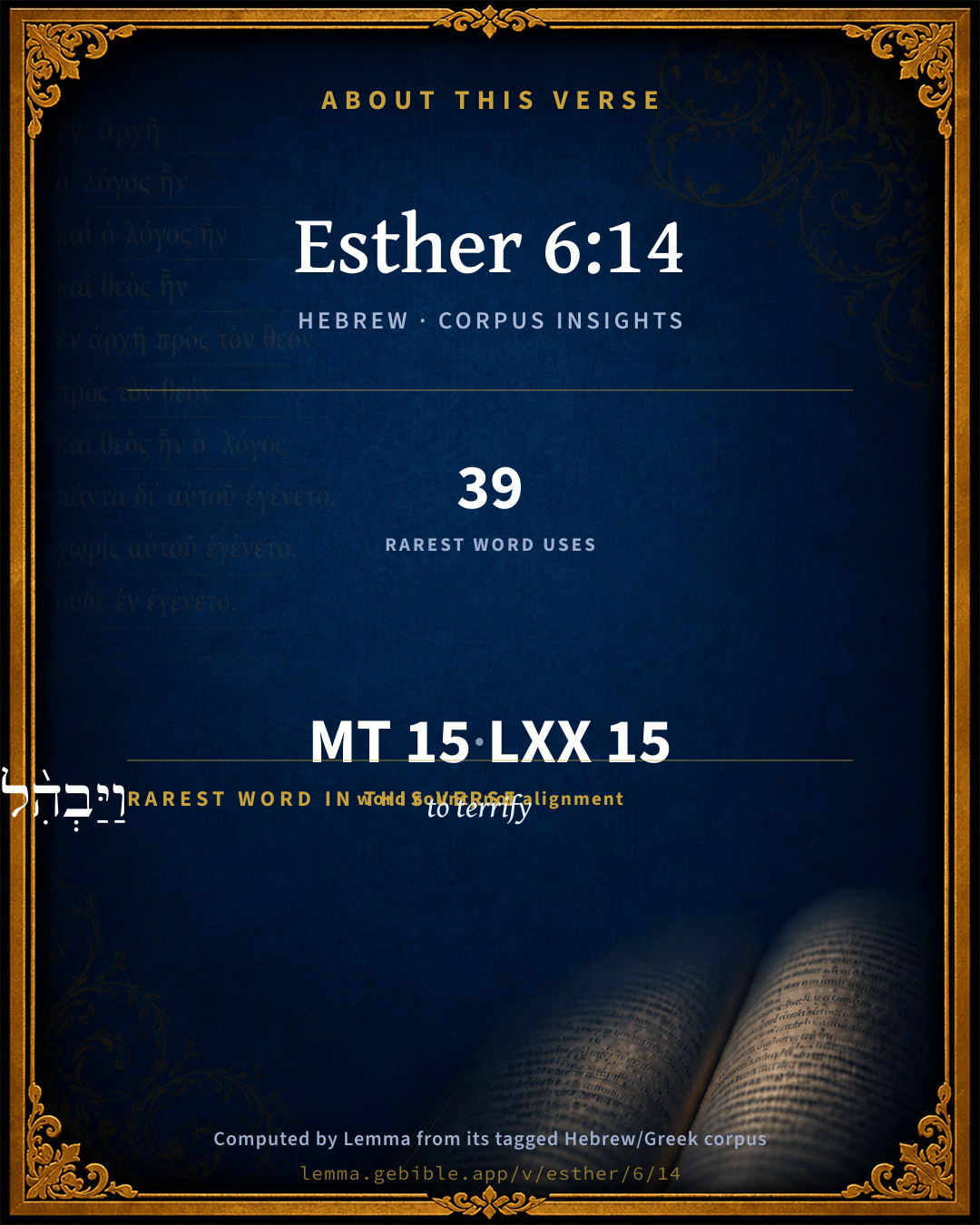
About this verse

These counts appear in no published source. They are computed here, from the morphology-tagged text and Lemma’s own curated glosses. What Lemma adds →

15
words
15
distinct lemmas
Historical
section

Shared distinctive vocabulary

וַיַּבְהִ֨לוּ֙ to terrify H926 occurs in 39 verses of the Hebrew Bible. Also found in:

Grammatical profile

  • 5 verbs
  • 5 nouns
  • 2 prepositions
  • 1 adverb
  • 2 particles

Verb forms

  • מְדַבְּרִ֣ים Piel · Participle Active
  • הִגִּ֑יעוּ Hiphil · Perfect
  • וַיַּבְהִ֨לוּ֙ Hiphil · Sequential Imperfect
  • לְהָבִ֣יא Hiphil · Infinitive Construct
  • עָשְׂתָ֥ה Qal · Perfect

Hebrew & Septuagint length

In English translation the verse runs 23 words from the Hebrew and 18 from the Septuagint (LXX English) — closely comparable.

A rough comparison of the two English renderings, which tokenize alike — not a word-level alignment.

Word counts can differ between the Hebrew and the Greek without any difference in meaning — e.g. the Hebrew direct-object marker אֵת has no separate Greek word, and Greek often adds the article ὁ.

In the original languages it is 15 Hebrew tokens and 15 Greek tokens — but the two are counted differently (Hebrew bundles its prefixes and suffixes into one token; the Greek is in lemma form), so that isn’t a like-for-like length.

Cross-references

3

Topical passages linked to Esther 6:14 in the Treasury of Scripture Knowledge — connected by theme and wording, ordered by reader-vote popularity; previews shown in the World English Bible.

  • Esther 5:8 if I have found favor in the sight of the king, and if it please the king to grant my petition, and to perform my request, let the king and Haman come to the banquet that I shall prepare for them, and I will do tomorrow as the king has said.
  • Deuteronomy 32:35–36 Vengeance is mine, and recompense, At the time when their foot shall slide: For the day of their calamity is at hand, The things that are to come on them shall make haste.
  • Esther 5:14 Then said Zeresh his wife and all his friends to him, Let a gallows be made fifty cubits high, and in the morning speak you to the king that Mordecai may be hanged thereon: then go you in merrily with the king to the banquet. The thing pleased Haman; and he caused the gallows to be made.

Cross-references courtesy of OpenBible.info (CC BY 4.0).

Hebrew and Greek witnesses Masoretic Hebrew ↔ Greek Septuagint

The same verse in the two great witnesses to the Old Testament, shown verse-for-verse.

These are two independent witnesses, not word-aligned to each other, and the Septuagint is shown in lemma (dictionary) form.

Hebrew Esther 6:14 Masoretic · Westminster Leningrad Codex

עוֹדָם֙ מְדַבְּרִ֣ים עִמּ֔וֹ וְסָרִיסֵ֥י הַמֶּ֖לֶךְ הִגִּ֑יעוּ וַיַּבְהִ֨לוּ֙ לְהָבִ֣יא אֶת הָמָ֔ן אֶל הַמִּשְׁתֶּ֖ה אֲשֶׁר עָשְׂתָ֥ה אֶסְתֵּֽר

While they were yet talking with him, came the king's chamberlains, and hurried to bring Haman to the banquet that Esther had prepared.

World English Bible · Public Domain

Greek LXX Esther 6:14 Septuagint · lemma form

ἔτι αὐτός λαλέω παραγίγνομαι ὁ εὐνοῦχος ἐπισπεύδω ὁ αμαν ἐπί ὁ πότος ὅς ἑτοιμάζω εσθηρ

While they were yet speaking, the chamberlains arrived, to hasten Aman to the banquet which Esther had prepared.

LXX2012 (modern English Septuagint) · Public Domain

Hebrew: Westminster Leningrad Codex (CC BY 4.0). Greek: Septuagint (public domain); English from LXX2012 (modern English Septuagint) (Public Domain). How the Septuagint differs from the Hebrew →

Commentary

Notes on Esther 6:14 from classic Christian and Jewish commentators (each source and its license shown beneath its notes). The classic Christian expositions comment on the surrounding passage and are grouped to its opening verse, so a note may address several verses; the Jewish commentaries on the Tanakh (Rashi and others) are per-verse, so they appear only where the commentator wrote on this verse.

Lemma curates 59 commentaries, every one of them public domain or Creative Commons licensed, each selected and text-cleaned for this edition rather than reprinted as found. About our sources →

Trapp's Complete Commentary

John Trapp

Est 6:14 And while they [were] yet talking with him, came the king’s chamberlains, and hasted to bring Haman unto the banquet that Esther had prepared.

Ver. 14. And while they were yet talking with him] But could not yield him one word of comfort. He hoped haply that they would have found out for him some good occasion, some means of supplanting Mordecai, now his co-rival and counterfactionist, and of incensing the king against him, that he might build upon his ruins. But the hope of unjust men shall perish, Pro 11:7, Etiam spes valentissimo perit, so some render it, and themselves with it. As Haman had not one to speak for him when the king frowned upon him; so here he hath not one to speak to his heart, or to shore him up, now that he is upon the fall. Those that before took crafty counsel against God’s people, and consulted against his hidden ones, Psa 83:3, are now at their wits’ end, as seeing themselves taken as wild beasts in a snare, δρασσομενος, 1Co 3:19, "in their own craftiness," yea, they are mad for the sight of their eyes, which that day they should see, Deu 28:34.

Came the king’s chamberlains, and hasted to brinq Haman] Heb. and hurried and headlonged in a turbulent manner; for it may be the king and queen tarried for him. Could he have been any way excused, he had no such mind to have gone. For his stomach was full, and what if he should meet Mordecai, the new favourite, there, and see him set above him? But now it is no time to consult further with friends, or cast perils by himself. Harbonah hasteneth him, having first taken notice of the lofty gallows, and (as Josephus saith) asked of one of the servants of the house what it meant, and for whom it was prepared? See Est 7:9.

Unto the banquet that Esther had prepared] That fatal feast, Ubi manducaret quod apud inferos digereret (August.), where his food in his bowels was turned, it became the gall of asps within him, Job 20:14. Why then should any saint envy the wicked man his fed bits, his murdering morsels? is not his food sauced, his drink spiced, with the bitter wrath of God? Adonijah’s feast ended in horror; the ears of his guests were filled (because their bellies had prepared deceit, Job 15:35) with the sound of those trumpets, which at once proclaim Solomon’s triumph and their confusion. Ever after the meal is ended comes the reckoning, but at this banquet of Esther it came before, Est 7:2. And Haman sped not so well as Caesar Borgia’s nobles, whom he invited to a feast, and after they had well dined, he cut off their heads.

John Trapp, A Commentary or Exposition upon All the Books of the Old and New Testament (1647–1656) — public domain. Text from a community e-Sword module.

Joseph Benson's Commentary

Est 6:14. The king’s chamberlains hasted to bring Haman unto the banquet — Who was now slack to go thither, by reason of the great dejection of his own mind, and the fear of a worse entertainment from the king and queen than he had formerly received.

Joseph Benson's Commentary on the Old and New Testaments (1811–1818) — public domain. Text from a community e-Sword module.

Jamieson, Fausset & Brown

Robert Jamieson, A. R. Fausset & David Brown

came the king's chamberlains, and hasted to bring Haman unto the banquet that Esther had prepared--Besides the invitation given to an entertainment, a message is always sent to the guests, immediately at the day and hour appointed, to announce that all things are ready.

Next: Esther Chapter 7

Jamieson, Fausset & Brown — Commentary Critical and Explanatory on the Whole Bible (1871) — public domain (CC PDM 1.0). Text via the HelloAO Bible API.

Adam Clarke's Commentary

Verse 14. Hasted to bring Haman] There was a dreadful banquet before him, of which he knew nothing: and he could have little appetite to enjoy that which he knew was prepared at the palace of Esther.

ONE grand design of this history is, to show that he who lays a snare for the life of his neighbour, is most likely to fall into it himself: for, in the course of the Divine providence, men generally meet with those evils in life which they have been the means of inflicting on others: and this is exactly agreeable to the saying of our Lord: "With what measure ye mete it shall be measured to you withal."

Adam Clarke's Commentary on the Bible (1810–1826) — public domain. Text from a community e-Sword/MySword module.

The Cambridge Bible for Schools and Colleges

gen. ed. J. J. S. Perowne

14. The dramatic instinct of the writer presents us with a sudden change of scene, and contrasts Haman’s exultant anticipations (Est_5:12) of splendour attaching to the royal banquet with the dark forebodings which now oppressed the apparently so highly honoured guest.

hasted to bring Haman] We need not suppose that the coming of the attendants implies fear on the part of Esther that through a presentiment of his approaching fall he might fail to arrive. The Eastern custom of fetching guests is well known. Cp. Luk_14:17.

Est_7:3. Haman’s humiliation of the morning doubtless encourages Esther to prefer her petition without further delay. The abruptness perceptible in her speech is itself indicative of the emotion with which its utterance was accompanied.

The Cambridge Bible for Schools and Colleges (gen. ed. J. J. S. Perowne; Cambridge University Press, 1878–1918) — public domain. Text from a community e-Sword module.

Haydock's Catholic Bible Commentary

CHAPTER VI.

As. Thus from morning till noon, (Tirinus) or night, had this petty god (Haydock) been forced to stoop to the meanest offices, and durst not say a word in opposition. (Tirinus) --- He would gladly have now absented himself from the feast, (Menochius) with the idea of which he had been enraptured. (Haydock)

George Leo Haydock (1774–1849), Haydock's Catholic Family Bible and Commentary, 1859 edition — public domain. Excludes Psalms (Douay-Rheims chapter numbering differs from Protestant) and Deuterocanonical books (Catholic canon only).

Matthew Poole's English Annotations

He was now slack to go thither, by reason of the great dejection of his own mind, and the fear of a worse entertainment from the king and queen than he had formerly received.

Matthew Poole's English Annotations on the Holy Bible (1683–1685) — public domain. Text from a community e-Sword/MySword module.

Whedon's Commentary on the Bible

Daniel D. Whedon

14. Hasted to bring Haman — The avenging fates seem to hurry him to his doom.

Daniel D. Whedon (gen. ed.), Commentary on the Old and New Testaments (1874–1909) — public domain. Text from a community e-Sword module.

The Pulpit Commentary

Came the king"s chamberlains, and hasted to bring Haman. This is a custom not elsewhere mentioned as Persian, but quite in accordance with Oriental ideas. The polite host sends his servants to escort guests of importance from their own homes to the place of entertainment.

The Pulpit Commentary (1880–1919), ed. H.D.M. Spence-Jones & Joseph S. Exell — public domain. Text from a community e-Sword module.

John Wesley's Explanatory Notes

To bring - Who was now slack to go thither, by reason of the great dejection of his own mind.

John Wesley, Explanatory Notes Upon the Whole Bible (1754–1765) — public domain. Text via the GEBible commentary corpus.

Keil & Delitzsch

C. F. Keil & F. Delitzsch

During this conversation certain courtiers had already arrived, who hastily brought Haman to the banquet of the queen, to which he would certainly go in a less happy state of mind than on the preceding day.

Keil & Delitzsch — Biblical Commentary on the Old Testament (1861–1891) — public domain (CC PDM 1.0). Text via the HelloAO Bible API. (Old Testament only.)

Lesson kit

Teaching starters — assembled from the data on this page, not authored interpretation. Every prompt links to the verse data it draws on. Edit before teaching.

Esther, in the Historical, opens this verse with 15 words (15 distinct Hebrew lemmas). Its most distinctive word is bâhal (“to terrify”). A historical commentator’s framing appears above. Read the whole chapter for the surrounding context.

Discussion questions

  1. The word bâhal carries the sense “to terrify.” How does it shape the verse?
  2. Genesis 45:3 shares the word «to terrify» with this verse. How do the two illuminate each other?
  3. These translations render this verse differently. What is at stake in choosing one wording over another?
  4. The verb «מְדַבְּרִ֣ים» is Piel Participle Active. How does its form color the action?
  5. Reading how Trapp's Complete Commentary and Joseph Benson's Commentary read this verse, where do the two commentators agree and where do they part?

Things to notice

Reading settings

Reading text

Shown beneath each verse's original-language words.

Old Testament
Old Testament edition

Read the OT as the Masoretic Hebrew (MT) or the Greek Septuagint (LXX).

English shown for the Greek Septuagint (in the Hebrew ↔ Greek comparison).

Comparing translations? Open the Compare panel on any verse page to stack up to four side by side.