
Zechariah 14:5

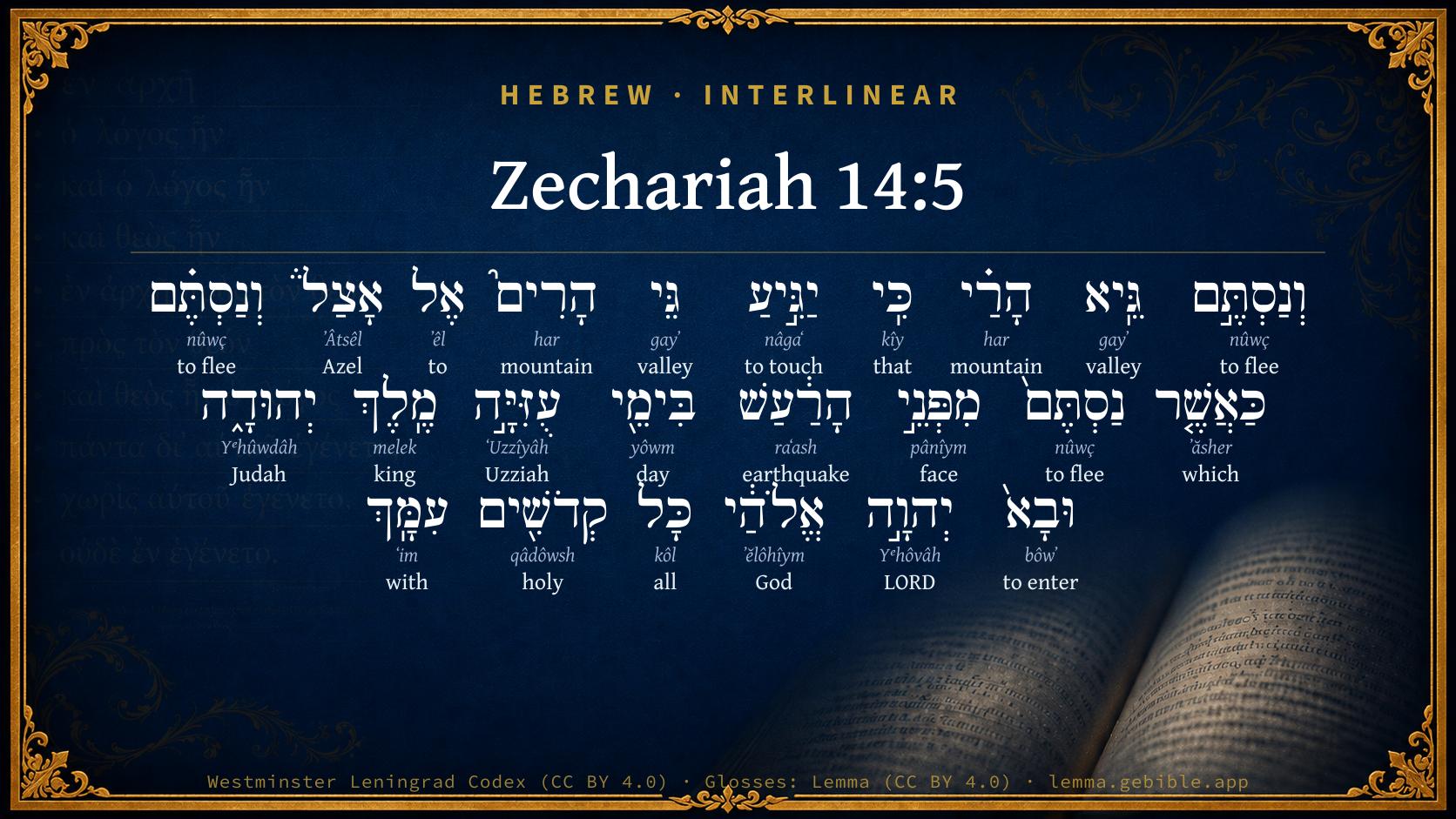
Hebrew (Westminster Leningrad Codex) Zechariah 14:5 appears in the Hebrew Old Testament. The text above is from the Westminster Leningrad Codex. Each word links to its Strong’s number, a concise gloss, and parsing drawn from the Open Scriptures Hebrew Bible morphology. Click any word for its full Brown-Driver-Briggs (BDB) entry.
Download image
Cite this verse

Zechariah 14:5 (World English Bible). Public Domain. Lemma interlinear Bible study tool, https://lemma.gebible.app/v/zechariah/14/5.

Show BibTeX & RIS
BibTeX
RIS
English Translation
You shall flee by the valley of my mountains; for the valley of the mountains shall reach to Azel; yes, you shall flee, just like you fled from before the earthquake in the days of Uzziah king of Judah. Yahweh my God will come, and all the holy ones with you.
World English Bible · Public Domain
Download a study sheet

One document with this verse’s original text, its word-by-word gloss line, the meaning frame, cross-references with their text, attributed commentary, and full source and license credits — printable, and it pastes into notes with its structure intact.

This verse Autodidact and up

Study sheet (.html) Plain text (.txt)

A passage Seminary Student

Up to 50 verses in one chapter. A passage sheet keeps up to 6 commentary sources and 12 cross-references per verse, in the order this page ranks them, and says so on the sheet whenever that leaves anything out. Ask for a single verse and you get the Autodidact verse sheet above.

Everything on this page stays free to read, with no account — the sheet is a download of what is already on screen, not access to it.

Want to remove ads? Support Godless Engineer
Compare translations 3

The same verse in 3 English versions, stacked beneath the original-language interlinear above. Click any original word for its lexicon entry.

Each is an independent rendering of the whole verse — the interlinear is not word-aligned to these translations.

Highlighted words mark where these versions differ — a whole-verse word diff, not a word-by-word alignment.

  • World English Bible Public Domain
    You shall flee by the valley of my mountains; for the valley of the mountains shall reach to Azel; yes, you shall flee, just like you fled from before the earthquake in the days of Uzziah king of Judah. Yahweh my God will come, and all the holy ones with you.
  • King James Version Public Domain
    And ye shall flee to the valley of the mountains; for the valley of the mountains shall reach unto Azal: yea, ye shall flee, like as ye fled from before the earthquake in the days of Uzziah king of Judah: and the LORD my God shall come, and all the saints with thee.
  • unfoldingWord Literal Text CC BY-SA 4.0
    Then you will flee down the valley between Yahweh’s mountains, for the valley between those mountains will reach to Azel. You will flee just as you fled from the earthquake in the days of Uzziah, king of Judah. Then Yahweh my God will come and all the holy ones will be with him.

unfoldingWord Literal Text — © unfoldingWord, licensed CC BY-SA 4.0. Word-aligned USFM3 via Door43 (git.door43.org/unfoldingWord/en_ult).

Versions to compare (up to 4)

3 of 4 selected

Show all 18 translations

Every available English version of this verse, each an independent rendering of the whole verse.

  • World English Bible Public Domain
    You shall flee by the valley of my mountains; for the valley of the mountains shall reach to Azel; yes, you shall flee, just like you fled from before the earthquake in the days of Uzziah king of Judah. Yahweh my God will come, and all the holy ones with you.
  • Berean Standard Bible Public Domain
    You will flee by My mountain valley, for it will extend to Azal. You will flee as you fled from the earthquake in the days of Uzziah king of Judah. Then the LORD my God will come, and all the holy ones with Him.
  • Majority Standard Bible Public Domain
    You will flee by My mountain valley, for it will extend to Azal. You will flee as you fled from the earthquake in the days of Uzziah king of Judah. Then the LORD my God will come, and all the holy ones with Him.
  • King James Version Public Domain
    And ye shall flee to the valley of the mountains; for the valley of the mountains shall reach unto Azal: yea, ye shall flee, like as ye fled from before the earthquake in the days of Uzziah king of Judah: and the LORD my God shall come, and all the saints with thee.
  • American Standard Version (1901) Public Domain
    And ye shall flee by the valley of my mountains; for the valley of the mountains shall reach unto Azel; yea, ye shall flee, like as ye fled from before the earthquake in the days of Uzziah king of Judah; and Jehovah my God shall come, and all the holy ones with thee.
  • Revised Version (1885) Public Domain
    And ye shall flee by the valley of my mountains; for the valley of the mountains shall reach unto Azel: yea, ye shall flee, like as ye fled from before the earthquake in the days of Uzziah king of Judah: and the LORD my God shall come, and all the holy ones with thee.
  • Geneva Bible (1599) Public Domain
    And yee shall flee vnto the valley of the mountaines: for the valley of the mountaines shall reache vnto Azal: yea, yee shall flee like as ye fled from the earthquake in the daies of Vzziah King of Iudah: and the Lord my God shall come, and all the Saints with thee.
  • Douay-Rheims (1899) Public Domain
    And you shall flee to the valley of those mountains, for the valley of the mountains shall be joined even to the next, and you shall flee r as you fled from the face of the earthquake in the days of Ozias king of Juda: and the Lord my God shall come, and all the saints with him.
  • Young's Literal Translation Public Domain
    And ye have fled `to' the valley of My mountains, For join doth the valley of the mountains to Azal, And ye have fled as ye fled before the shaking, In the days of Uzziah king of Judah, And come in hath Jehovah my God, All holy ones `are' with Thee.
  • Literal Standard Version CC BY-SA 4.0
    And you have fled [to] the valley of My mountains, || For the valley of the mountains joins to Azal, || And you have fled as you fled before the shaking, || In the days of Uzziah king of Judah, || And my God YHWH has come in, || All holy ones [are] with You.
  • Unlocked Literal Bible CC BY-SA 4.0
    Then you will flee down the valley between Yahweh's mountains, for the valley between those mountains will reach to Azel. You will flee just as you fled from the earthquake in the days of Uzziah, king of Judah. Then Yahweh my God will come and all the holy ones will be with him.
  • unfoldingWord Literal Text CC BY-SA 4.0
    Then you will flee down the valley between Yahweh’s mountains, for the valley between those mountains will reach to Azel. You will flee just as you fled from the earthquake in the days of Uzziah, king of Judah. Then Yahweh my God will come and all the holy ones will be with him.
  • Darby Bible Public Domain
    And ye shall flee [by] the valley of my mountains; for the valley of the mountains shall reach unto Azal: ye shall even flee, like as ye fled from before the earthquake in the days of Uzziah king of Judah. And Jehovah my God shall come, [and] all the holy ones with thee.
  • World Messianic Bible Public Domain
    You shall flee by the valley of my mountains, for the valley of the mountains shall reach to Azel. Yes, you shall flee, just like you fled from before the earthquake in the days of Uzziah king of Judah. The LORD my God will come, and all the holy ones with you.
  • Webster's Bible Public Domain
    And ye shall flee to the valley of the mountains; for the valley of the mountains shall reach to Azal: yes, ye shall flee as ye fled from before the earthquake in the days of Uzziah king of Judah: and the LORD my God shall come, and all the saints with thee.
  • Free Bible Version CC BY-SA 4.0
    You will run away through this mountain valley for it will reach as far as Azal. You will run away like people did at the time of the earthquake during the reign of Uzzah, king of Judah. Then the Lord will come, accompanied by all his holy ones.
  • Bible in Basic English Public Domain
    And the valley will be stopped... and you will go in flight as you went in flight from the earth-shock in the days of Uzziah, king of Judah: and the Lord my God will come, and all his holy ones with him.
  • JPS Tanakh (1917) Public Domain
    And ye shall flee to the valley of the mountains; for the valley of the mountains shall reach unto Azel; yea, ye shall flee, like as ye fled from before the earthquake in the days of Uzziah king of Judah; and the LORD my God shall come, and all the holy ones with Thee.

Literal Standard Version (2020), Covenant Press — licensed CC BY-SA 4.0. Text via the HelloAO Bible API (eBible.org). Unlocked Literal Bible (unfoldingWord) — licensed CC BY-SA 4.0. Text via the HelloAO Bible API (eBible.org). unfoldingWord Literal Text — © unfoldingWord, licensed CC BY-SA 4.0. Word-aligned USFM3 via Door43 (git.door43.org/unfoldingWord/en_ult). Free Bible Version, Dr. Jonathan Gallagher — licensed CC BY-SA 4.0. Text via the HelloAO Bible API (eBible.org).

Word by word

More ways to search: Search by grammar → Find every occurrence → Compare this word →

Practice this passage: Drill this verse → Learn its vocabulary →

אָצַל֒
ʼÂtsêl
H682
“Azel”
Noun, Proper
Part of Speech
Noun
Type
Proper
Full BDB Definition

Origin: from H680

TWOT: None

Azel = "reserved" - a place near Jerusalem, site presently unknown (noun proper locative) - a Benjamite descendant of Saul and Jonathan (noun proper masculine)
  1. וְנַסְתֶּ֣ם nûwç H5127 “and · to flee” Conjunction + Verb, Qal, Sequential Perfect, 2nd Person, Masculine, Plural
  2. גֵּֽיא gayʼ H1516 “valley of” Noun, Common, Both, Singular, Construct
  3. הָרַ֗י har H2022 “mountains · my” Noun, Common, Masculine, Plural, Construct + Suffix, Personal, 1st Person, Common, Singular
  4. כִּֽי kîy H3588 “that” Conjunction
  5. יַגִּ֣יעַ nâgaʻ H5060 “to touch” Verb, Hiphil, Imperfect, 3rd Person, Masculine, Singular
  6. גֵּי gayʼ H1516 “valley of” Noun, Common, Both, Singular, Construct
  7. הָרִים֮ har H2022 “mountains” Noun, Common, Masculine, Plural, Absolute
  8. אֶל ʼêl H413 “to” Preposition
  9. וְנַסְתֶּ֗ם nûwç H5127 “and · to flee” Conjunction + Verb, Qal, Sequential Perfect, 2nd Person, Masculine, Plural
  10. כַּאֲשֶׁ֤ר ʼăsher H834 “like/as · which” Preposition + Particle, Relative
  11. נַסְתֶּם֙ nûwç H5127 “to flee” Verb, Qal, Perfect, 2nd Person, Masculine, Plural
  12. מִפְּנֵ֣י pânîym H6440 “from · face(s) of” Preposition + Noun, Common, Both, Plural, Construct
  13. הָרַ֔עַשׁ raʻash H7494 “the · earthquake” Particle, Definite Article + Noun, Common, Masculine, Singular, Absolute
  14. בִּימֵ֖י yôwm H3117 “in/at · days of” Preposition + Noun, Common, Masculine, Plural, Construct
  15. עֻזִּיָּ֣ה ʻUzzîyâh H5818 “Uzziah” Noun, Proper
  16. מֶֽלֶךְ melek H4428 “king of” Noun, Common, Masculine, Singular, Construct
  17. יְהוּדָ֑ה Yᵉhûwdâh H3063 “Judah” Noun, Proper
  18. וּבָא֙ bôwʼ H935 “and · to enter” Conjunction + Verb, Qal, Sequential Perfect, 3rd Person, Masculine, Singular
  19. יְהוָ֣ה Yᵉhôvâh H3068 “LORD” Noun, Proper
  20. אֱלֹהַ֔י ʼĕlôhîym H430 “God(s) · my” Noun, Common, Masculine, Plural, Construct + Suffix, Personal, 1st Person, Common, Singular
  21. כָּל kôl H3605 “all of” Noun, Common, Masculine, Singular, Construct
  22. קְדֹשִׁ֖ים qâdôwsh H6918 “holy” Adjective, Adjective, Masculine, Plural, Absolute
  23. עִמָּֽךְ ʻim H5973 “with · her” Preposition + Suffix, Personal, 3rd Person, Feminine, Singular

About this verse

These counts appear in no published source. They are computed here, from the morphology-tagged text and Lemma’s own curated glosses. What Lemma adds →

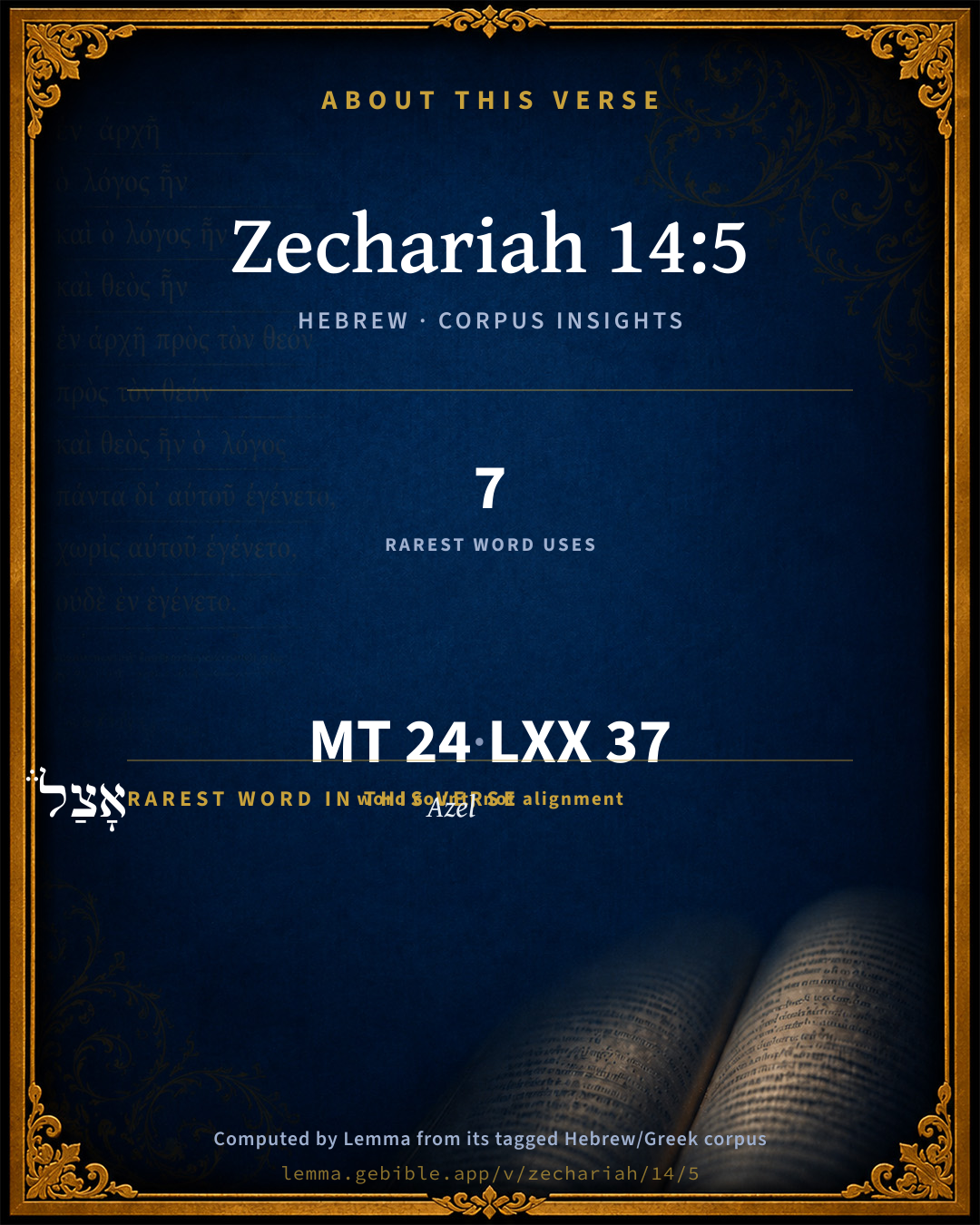
24
words
20
distinct lemmas
Prophets
section

Notable vocabulary

The rarest word here is אָצַל֒ Azel H682 — appearing just 7 times in the whole Hebrew Bible.

Shared distinctive vocabulary

אָצַל֒ Azel H682 occurs in 5 verses of the Hebrew Bible. Also found in:

Grammatical profile

  • 5 verbs
  • 14 nouns
  • 1 adjective
  • 2 prepositions
  • 1 conjunction
  • 1 particle

Verb forms

  • וְנַסְתֶּ֣ם Qal · Sequential Perfect
  • יַגִּ֣יעַ Hiphil · Imperfect
  • וְנַסְתֶּ֗ם Qal · Sequential Perfect
  • נַסְתֶּם֙ Qal · Perfect
  • וּבָא֙ Qal · Sequential Perfect

Repetition

Words recur within this verse — often emphatic in Hebrew:

  • וְנַסְתֶּ֣ם to flee H5127 ×3
  • גֵּֽיא valley H1516 ×2
  • הָרַ֗י mountain H2022 ×2

Hebrew & Septuagint length

In English translation the verse runs 51 words from the Hebrew and 59 from the Septuagint (LXX English) — closely comparable.

A rough comparison of the two English renderings, which tokenize alike — not a word-level alignment.

Word counts can differ between the Hebrew and the Greek without any difference in meaning — e.g. the Hebrew direct-object marker אֵת has no separate Greek word, and Greek often adds the article ὁ.

In the original languages it is 24 Hebrew tokens and 37 Greek tokens — but the two are counted differently (Hebrew bundles its prefixes and suffixes into one token; the Greek is in lemma form), so that isn’t a like-for-like length.

Cross-references

28

Topical passages linked to Zechariah 14:5 in the Treasury of Scripture Knowledge — connected by theme and wording, ordered by reader-vote popularity; previews shown in the World English Bible.

  • Jude 1:14–15 About these also Enoch, the seventh from Adam, prophesied, saying, "Behold, the Lord came with ten thousands of his holy ones,
  • Amos 1:1 The words of Amos, who was among the herdsmen of Tekoa, which he saw concerning Israel in the days of Uzziah king of Judah, and in the days of Jeroboam the son of Joash king of Israel, two years before the earthquake.
  • Matthew 25:31 "But when the Son of Man comes in his glory, and all the holy angels with him, then he will sit on the throne of his glory.
  • Matthew 16:27 For the Son of Man will come in the glory of his Father with his angels, and then he will render to everyone according to his deeds.
  • Deuteronomy 33:2 He said, Yahweh came from Sinai, Rose from Seir to them; He shined forth from Mount Paran, He came from the ten thousands of holy ones: At his right hand was a fiery law for them.
  • Psalms 96:13 Before Yahweh; for he comes, For he comes to judge the earth. He will judge the world with righteousness, The peoples with his truth.
  • Isaiah 29:6 She shall be visited of Yahweh of Hosts with thunder, and with earthquake, and great noise, with whirlwind and tempest, and the flame of a devouring fire.
  • Isaiah 66:15–16 For, behold, Yahweh will come with fire, and his chariots shall be like the whirlwind; to render his anger with fierceness, and his rebuke with flames of fire.
  • 1 Thessalonians 3:13 to the end he may establish your hearts blameless in holiness before our God and Father, at the coming of our Lord Jesus with all his saints.
  • 2 Thessalonians 1:7–10 and to give relief to you that are afflicted with us, when the Lord Jesus is revealed from heaven with his mighty angels in flaming fire,
  • Daniel 7:9–14 I saw until thrones were placed, and one who was ancient of days sat: his clothing was white as snow, and the hair of his head like pure wool; his throne was fiery flames, [and] the wheels of it burning fire.
  • Matthew 24:27–31 For as the lightning comes forth from the east, and is seen even to the west, so will be the coming of the Son of Man.
  • Mark 13:26–27 Then they will see the Son of Man coming in clouds with great power and glory.
  • 2 Thessalonians 2:8 Then the lawless one will be revealed, whom the Lord will kill with the breath of his mouth, and bring to nothing by the brightness of his coming;
  • James 5:8 You also be patient. Establish your hearts, for the coming of the Lord is at hand.
  • Revelation 11:13 In that day there was a great earthquake, and a tenth of the city fell. Seven thousand people were killed in the earthquake, and the rest were terrified, and gave glory to the God of heaven.
  • Revelation 20:4 I saw thrones, and they sat on them, and judgment was given to them. I saw the souls of those who had been beheaded for the testimony of Jesus, and for the word of God, and such as didn't worship the beast nor his image, and didn't receive the mark on their forehead and on their hand. They lived, and reigned with Christ for the thousand years.
  • Numbers 16:34 All Israel that were round about them fled at the cry of them; for they said, Lest the earth swallow us up.
  • Psalms 97:4–6 His lightning lights up the world. The earth sees, and trembles.
  • Psalms 98:9 Let them sing before Yahweh, For he comes to judge the earth. He will judge the world with righteousness, And the peoples with equity.
  • Isaiah 64:1–3 Oh that you would tear the heavens, that you would come down, that the mountains might quake at your presence,
  • Daniel 7:21–27 I saw, and the same horn made war with the saints, and prevailed against them;
  • Matthew 24:3 As he sat on the Mount of Olives, the disciples came to him privately, saying, "Tell us, when will these things be? What is the sign of your coming, and of the end of the age?"
  • Luke 21:27 Then they will see the Son of Man coming in a cloud with power and great glory.
  • Revelation 6:16–17 They told the mountains and the rocks, "Fall on us, and hide us from the face of him who sits on the throne, and from the wrath of the Lamb,
  • Revelation 16:18–21 There were lightnings, sounds, and thunders; and there was a great earthquake, such as was not since there were men on the earth, so great an earthquake, so mighty.
  • Revelation 20:11 I saw a great white throne, and him who sat on it, from whose face the earth and the heaven fled away. There was found no place for them.
  • Joel 3:11 Hurry and come, all you surrounding nations, And gather yourselves together." Cause your mighty ones to come down there, Yahweh.

Cross-references courtesy of OpenBible.info (CC BY 4.0).

Hebrew and Greek witnesses Masoretic Hebrew ↔ Greek Septuagint

The same verse in the two great witnesses to the Old Testament, shown verse-for-verse.

These are two independent witnesses, not word-aligned to each other, and the Septuagint is shown in lemma (dictionary) form.

Hebrew Zechariah 14:5 Masoretic · Westminster Leningrad Codex

וְנַסְתֶּ֣ם גֵּֽיא הָרַ֗י כִּֽי יַגִּ֣יעַ גֵּי הָרִים֮ אֶל אָצַל֒ וְנַסְתֶּ֗ם כַּאֲשֶׁ֤ר נַסְתֶּם֙ מִפְּנֵ֣י הָרַ֔עַשׁ בִּימֵ֖י עֻזִּיָּ֣ה מֶֽלֶךְ יְהוּדָ֑ה וּבָא֙ יְהוָ֣ה אֱלֹהַ֔י כָּל קְדֹשִׁ֖ים עִמָּֽךְ

You shall flee by the valley of my mountains; for the valley of the mountains shall reach to Azel; yes, you shall flee, just like you fled from before the earthquake in the days of Uzziah king of Judah. Yahweh my God will come, and all the holy ones with you.

World English Bible · Public Domain

Greek LXX Zechariah 14:5 Septuagint · lemma form

καί ἐνφράσσω φάραγξ ὄρος ἐγώ καί ἐνκολλάω φάραγξ ὄρος ἕως ιασολ καί ἐνφράσσω καθώς ἐνφράσσω ἐν ὁ ἡμέρα ὁ σεισμός ἐν ἡμέρα οζίας βασιλεύς ιουδα καί ἥκω κύριος ὁ θεός ἐγώ καί πᾶς ὁ ἅγιος μετά αὐτός

And the valley of my mountains shall be closed up, and the valley of the mountains shall be joined on to Jasod, and shall be blocked up as it was blocked up in the days of the earthquake, in the days of Ozias king of Juda; and the Lord my God shall come, and all the saints with him.

LXX2012 (modern English Septuagint) · Public Domain

On this verse, Ellicott's Commentary for English Readers discusses the Septuagint’s reading. Read the note in Commentary ↓

Hebrew: Westminster Leningrad Codex (CC BY 4.0). Greek: Septuagint (public domain); English from LXX2012 (modern English Septuagint) (Public Domain). How the Septuagint differs from the Hebrew →

Targum (Aramaic paraphrase)

1

The Targum is the ancient Jewish Aramaic paraphrase of the Hebrew Scriptures — an interpretive translation, not the Hebrew text itself. Onkelos (literal) and Pseudo-Jonathan (expansive) render the Torah, and Jonathan the Prophets. Coverage is partial: where no permissively-licensed English translation exists for a verse, only the Aramaic is shown. This is verse-level text, not a word-by-word alignment to the Hebrew.

  1. Targum Jonathan Prophets (Joshua–Malachi)
    וְיִסְתְּתִים חֵילָא דְטוּרַיָא אֲרֵי יִמְטֵי חֵילָא דְטוּרַיָא לְאָצֵל וְתֶעֶרְקִין כְּמָא דַעֲרַקְתּוּן מִן קֳדָם זִיעָא דַהֲוָה בִּימֵי עֻזִיָה מְלַךְ שִׁבְטָא דְבֵית יְהוּדָה וְיִתְגְלֵי יְיָ אֱלָהֵי וְכָל קַדִישׁוֹהִי עִמֵיהּ:

    (no public-domain English translation for this verse)

    Targum Jonathan — Aramaic: “Mikraot Gedolot” (public domain). English: “Sefaria Community Translation” (CC0 1.0 (public-domain dedication)); “London "Chaldee Paraphrase," 1871” (public domain). Text via Sefaria.

Commentary

Notes on Zechariah 14:5 from classic Christian and Jewish commentators (each source and its license shown beneath its notes). The classic Christian expositions comment on the surrounding passage and are grouped to its opening verse, so a note may address several verses; the Jewish commentaries on the Tanakh (Rashi and others) are per-verse, so they appear only where the commentator wrote on this verse.

Lemma curates 59 commentaries, every one of them public domain or Creative Commons licensed, each selected and text-cleaned for this edition rather than reprinted as found. About our sources →

Trapp's Complete Commentary

John Trapp

Zec 14:5 And ye shall flee [to] the valley of the mountains; for the valley of the mountains shall reach unto Azal: yea, ye shall flee, like as ye fled from before the earthquake in the days of Uzziah king of Judah: and the LORD my God shall come, [and] all the saints with thee.

Ver. 5. And ye shall flee to the valley of the mountains] Or, ye shall flee the valley of the mountains, sc. of mount Olivet, made by God, {Zec 14:4} by whom the Romans were set to work to garrison mount Olivet against the Jews; and, by digging down a great part of it, to fill up the brook Kidron, or the town ditch, and to bring a wall (wherewith they compassed about the whole city) through the midst of this mount; whereby the city was greatly pressed, and much annoyed. This mountain ye shall flee (as many of you as are Azal; that is, separated: confer Exo 24:11 Isa 43:4), and repair to Pella, a place of rest provided for you. Not without some perturbation of spirit (though causeless), as in common calamities it happens; and the like shall befall the very elect also at the last day, till they have recollected themselves, till they remember that now their redemption draweth nigh.

And ye shall flee] sc. With utmost haste and fright; death being that terrible of terribles, as the philosopher calleth it, Nature’s slaughterman, hell’s purveyor.

Like as ye fled from before the earthquake] Which might be as sad and as sudden at that at Pleures, in Rhetia, A.D. 1618, Aug. 25, the whole town was overcovered with a mountain, which, with its most swift motion, buried 1500 people (Alst. Chronol.).

In the days of Uzziah king of Judah] Whether this earthquake occured just at that instant time when Uzziah offered incense, and was therefore smitten with leprosy (as the Jewish doctors affirm), I have not to say. But of the horror of it, besides Amo 1:1, Josephus relateth, that a mountain towards the west cleft in sunder and removed from its proper place the space of four furlongs, or half a mile; and farther it had proceeded, had not a great mountain towards the east stayed its course. Camden reporteth the like hereunto to have happened in Herefordshire, A. D. 1571, Cal. Martij 12; about six o’clock in the evening, a great hill lifted up itself with a huge noise, and ascending into a higher place, carried along with it trees, flocks of cattle, sheep cotes, walked about from Saturday night till Monday noon, overturned a certain chapel that stood in its way. This kind of earthquake philosophers call Brasmatia, shaking of the earth.

And the Lord my God shall come] q.d. Let scoffers doubt and deride, saying, "Where is the promise of his coming?" My God will effect with his hand what he hath spoken with his mouth, he will, he will, Hab 2:8. There is an emphasis in the word "my" (q.d. The God whose I am, yea, ολως εκεινος, wholly his, as Aristotle saith of a servant), and another in the following apostrophe.

And all the saints with thee] The prophet, in a holy indignation at his hearers’ obstinace and untractableness, turns him thus to God; like as doth old Jacob, Gen 49:18; and our blessed Saviour cried out with the people’s perverseness, Mat 11:25-26. {See Trapp on "Gen 49:18"} {See Trapp on "Mat 11:25"} {See Trapp on "Mat 11:26"}

John Trapp, A Commentary or Exposition upon All the Books of the Old and New Testament (1647–1656) — public domain. Text from a community e-Sword module.

Tyndale Open Study Notes

Tyndale Open Resources

14:5 Some identify Azal (Hebrew ’atsal) as a district on the northeast side of Jerusalem inhabited by descendants of Azel (1 Chr 8:37-39; 9:43-44). Others emend the Hebrew to ’etsel, “alongside” or “the side [of it].” • The date of the earthquake in the days of King Uzziah is unknown, but Amos began his ministry two years before it (Amos 1:1). • The holy ones are probably the multitude of angels that worship God and serve as his army (see Ps 89:5, 7).

Tyndale Open Study Notes — © Tyndale Open Resources, licensed CC BY-SA 4.0. Text via the HelloAO Bible API.

Geneva Bible (1599)

Geneva Bible translators

Because they did not credit the Prophet’s words, he turneth to God and comforteth himself in that that he knew that these things should come, and saith, Thou, O God, with thine Angels wilt come to perform this great thing.

He speaketh of the hypocrites, which could not abide God’s presence, but should flee into all places, where they might hide them among the mountains.

Read Amos 1:1.

Geneva Bible (1599) marginal notes — public domain. Text via Bolls.life.

Jamieson, Fausset & Brown

Robert Jamieson, A. R. Fausset & David Brown

ye shall flee to the valley--rather "through the valley," as in Sa2 2:29. The valley made by the cleaving asunder of the Mount of Olives (Zac 14:4) is designed to be their way of escape, not their place of refuge [MAURER]. JEROME is on the side of English Version. If it be translated so, it will mean, Ye shall flee "to" the valley, not to hide there, but as the passage through which an escape may be effected. The same divinely sent earthquake which swallows up the foe, opens out a way of escape to God's people. The earthquake in Uzziah's days is mentioned (Amo 1:1) as a recognized epoch in Jewish history. Compare also Isa 6:1 : perhaps the same year that Jehovah held His heavenly court and gave commission to Isaiah for the Jews, an earthquake in the physical world, as often happens (Mat 24:7), marked momentous movements in the unseen spiritual world.

of the mountains--rather, "of My mountains," namely, Zion and Moriah, peculiarly sacred to Jehovah [MOORE]. Or, the mountains formed by My cleaving Olivet into two [MAURER].

Azal--the name of a place near a gate east of the city. The Hebrew means "adjoining" [HENDERSON]. Others give the meaning, "departed," "ceased." The valley reaches up to the city gates, so as to enable the fleeing citizens to betake themselves immediately to it on leaving the city.

Lord my God . . . with thee--The mention of the "Lord my God" leads the prophet to pass suddenly to a direct address to Jehovah. It is as if "lifting up his head" (Luk 21:28), he suddenly sees in vision the Lord coming, and joyfully exclaims, "All the saints with Thee!" So Isa 25:9.

saints--holy angels escorting the returning King (Mat 24:30-31; Jde 1:14); and redeemed men (Co1 15:23; Th1 3:13; Th1 4:14). Compare the similar mention of the "saints" and "angels" at His coming on Sinai (Deu 32:2-3; Act 7:53; Gal 3:19; Heb 2:2). PHILLIPS thinks Azal is Ascalon on the Mediterranean. An earthquake beneath Messiah's tread will divide Syria, making from Jerusalem to Azal a valley which will admit the ocean waters from the west to the Dead Sea. The waters will rush down the valley of Arabah, the old bed of the Jordan, clear away the sand-drift of four thousand years, and cause the commerce of Petra and Tyre to center in the holy city. The Dead Sea rising above its shores will overflow by the valley of Edom, completing the straits of Azal into the Red Sea. Thus will be formed the great pool of Jerusalem (compare Zac 14:8; Eze 47:1, &c.; Joe 3:18). Euphrates will be the north boundary, and the Red Sea the south. Twenty-five miles north and twenty-five miles south of Jerusalem will form one side of the fifty miles square of the Lord's Holy Oblation (Eze. 48:1-35). There are seven spaces of fifty miles each from Jerusalem northward to the Euphrates, and five spaces of fifty miles each southward to the Red Sea. Thus there are thirteen equal distances on the breadth of the future promised land, one for the oblation and twelve for the tribes, according to Eze. 48:1-35. That the Euphrates north, Mediterranean west, the Nile and Red Sea south, are to be the future boundaries of the holy land, which will include Syria and Arabia, is favored by Gen 15:8; Exo 23:31; Deu 11:24; Jos 1:4; Kg1 4:21; Ch2 9:26; Isa 27:12; all which was partially realized in Solomon's reign, shall be antitypically so hereafter. The theory, if true, will clear away many difficulties in the way of the literal interpretation of this chapter and Eze. 48:1-35.

Jamieson, Fausset & Brown — Commentary Critical and Explanatory on the Whole Bible (1871) — public domain (CC PDM 1.0). Text via the HelloAO Bible API.

Adam Clarke's Commentary

Verse 5. Ye shall flee to the valley] Some think this refers to the valley through which Zedekiah and others endeavoured to escape when Nebuchadnezzar pressed the siege of Jerusalem: but it appears to speak only of the Jewish wars of the Romans.

Azal] This, as a place, is not known. If a place, it was most probably near to Jerusalem; and had its name from that circumstance.

Adam Clarke's Commentary on the Bible (1810–1826) — public domain. Text from a community e-Sword/MySword module.

John Calvin's Commentaries

The Prophet says again, that God’s presence would be terrible, so that it would put to flight all the Jews; for though God promises to be the deliverer of his chosen people, yet as there were still mixed with them hypocrites, his language varies. But we must further observe, that though the Lord may appear for our deliverance, it yet cannot be but that his majesty will strike us with fear; for the flesh must be humbled before God. What the Prophet then says is the same as though he had said, that the coming of God, which he had just mentioned, would be fearful to all, not only to open enemies whom he would come to destroy, but also to the faithful, though they knew that he would put forth his power to save them. And thus the Prophet seems to reason from the less to the greater; for if the faithful, who look anxiously for God, yet tremble and quake at his presence, what must happen to his enemies, who know that he is against them? As then the Prophet bids here the faithful to be prepared reverently to look for God, so also he shows that he will be dreadful to all the ungodly, in order that the elect might not hesitate to flee to his aid and to rely on him.

Flee, he says, shall ye through the valley of the mountains. Some imagine this to have been a valley so called, because it was of long extent, stretching through chains of mountains; but we read nothing of this in scripture. It seems to me probable, that valleys of the mountains were all those places called, which were rough, impassable, and intricate. Since then there was much wood, and no easy passage through these countries, the Prophet says that there would be a long valley, which never was before, but which the rending, of which he had spoken, would produce. And for the same purpose he adds, Reach shall the valley of the mountains to Azal. This I think is a proper name of a place; yet some render it, next; but I see not for what reason. The meaning then is, — that where there were previously many hills which were not passable, or even mountains through which it was difficult to penetrate, there would be one continuous and even valley to a place very remote.

And he says, that flight would be hasty, as in the days of Uzziah, king of Judah; for it appears from sacred history that Judah was then shaken with a terrible earthquake. The Jews, as they are bold in their conjectures, suppose that this happened when Uzziah approached the altar to burn incense to God; and Jerome has followed them. But at what time that earthquake happened is not certain. Amos says that he began to prophecy two years after an earthquake, (Amos 1:1;) but for what cause the earth was then shaken we nowhere read: and yet we learn from this as well as from other passages, that it was an awful sign and presage of God’s vengeance. God then intended to announce to the Jews a dreadful calamity, when he thus shook the earth. And for the same purpose also does Zechariah now say, that the flight would be precipitous, as when the Jews retook themselves to flight, as it were in extreme despair, in the time of Uzziah. As then ye fled from the earthquake, so shall ye flee now. A long time had indeed intervened from the death of Uzziah to the return of the people; hence the Prophet intimates that it would be an unusual calamity, for the like had not happened which had caused so much terror to the Jews for many ages.

But we must remember what I have said — that this coming of God is not described as fearful for the purpose of threatening the Jews; but rather in order to show that the ungodly would not be able to stand in the presence of God, as he would terrify even those for whose aid he would come forth. And we must also observe what has been stated that God varies his address by his Prophets; for now he speaks to the whole Church, in which hypocrites are mingled with the sincere, and so threatening must be blended with promises, and then, he directs his words especially to the elect alone, to whom he manifests his favor.

He says at length, And come shall Jehovah, my God. The Prophet repeats what he had said shortly before — that God’s power would be made evident to the Jews, as though they saw it with their eyes. There is indeed no necessity to suppose that God would actually descend from heaven; but he teaches us, as I have said, that though God’s power would be for a time hidden, it would at length appear in the deliverance of his elect, as though God descended for the purpose from heaven. He calls him his God, in order to gain more credit to his prophecy. He no doubt thus courageously assailed all the ungodly, to whom promises as well as threatening were a mockery; and he also intended to support the minds of the godly, that they might not doubt but that this was promised them from above, though they heard but the voice of a mortal man. The Prophet then with great confidence claims God here as his God, as though he had said — that there was no reason for them to judge of what he said by any worldly circumstance or by his person; in short, he declares here that he was sent from above, that he did not rashly intrude himself, so as to promise anything which he himself had invented, but that he was favored with a divine mission, so that he represented God himself.

And this also is the object of the conclusion, which has been overlooked by some. All the saints with thee. There seems to be here a kind of indignation, as though the Prophet turned himself away from his hearers, whom he observed to be in a measure prepared obstinately to reject his heavenly doctrine; for he turns his discourse to God. The sentence seems indeed to lose a portion of its gracefulness, when the Prophet speaks so abruptly, Come shall Jehovah my God, all the saints with thee He might have said “all the saints with him:” but as I have said, he addresses God, as though he could not, on account of disgust, speak to malignant and perverse men, and this serves much to confirm the authority of his prophecy; for he not only declares boldly to men what was to be, but also appeals to God as his witness; nay, he seems as though he had derived by a secret and familiar colloquy what he certainly knew was committed to him by God. But by saints, as I think, he understands the angels; for to include the holy patriarchs and kings, would seem unnatural and far-fetched: and angels, we know, are called saints or holy in other places, as we have seen in the third chapter of Habakkuk (Habakkuk 3:1); and they are called sometimes elect angels. In short, the Prophet shows, that the coming of God would be magnificent; he would descend, as it were, in a visible manner together with his angels, that men’s minds might be roused into admiration and wonder. This is the meaning.

John Calvin's Commentaries (1540-1563) — public domain. Text from the Calvin Translation Society English edition (1840s-50s) via the Christian Classics Ethereal Library (ccel.org). Calvin's coverage is partial (roughly two-thirds of the Bible); uncommented books and verses are honest gaps, never fabricated. The 19th-century editor's footnotes and remarks are omitted so the notes are faithfully Calvin's own voice.

Ellicott's Commentary for English Readers

(5) And ye shall flee to.—The Hebrew will not bear the rendering of Luther, “and ye shall flee before.” The Oriental Jews, Targ., LXX., &c., by a different vocalisation, read, “And the valley of my mountains shall be stopped;” but this reading is inappropriate. “My mountains,” the Mount of Olives, which is divided in twain by the advent of the Lord, he calls “my mountains” (Marg.). It seems that they would flee thither for fear of being overwhelmed in the destruction of Jerusalem, “for the valley of the mountains” will afford a ready place of refuge, for it “shall reach unto Azal.” Some suppose Azal to be a place near Jerusalem (some placing it to the west of the Temple-Mount, others to the east of the Mount of Olives), but others take the word as a preposition, and render it “very nigh.” In any case, they flee to the valley because of its convenient proximity.

The earthquake in the days of Uzziah is not mentioned in the sacred history, but it was an event that left such an impression on the popular mind that it became an era from which to date (Amo_1:1). “Similarly in Crete recent events are dated by such eras as in the year before the great earthquake.” (Blakesley’s Herodotus i. 263.) Thus the mention of this earthquake does not “fix the date of the prophecy to the days of Uzziah” as some commentators have affirmed. The second person, “ye fled,” need not be taken as referring directly to the persons addressed; but, considering the fact of the continuity of the national existence, may be understood as denoting the same nation at an earlier period, as in Jos_24:5. Moreover, if we cared to dwell on the fact of the addition of the words “king of Judah” to the name of Uzziah, it might be taken to imply that the prophecy was delivered so long after the time of Uzziah that it was necessary for the prophet to remind his hearers who this Uzziah was.

Saints.—Better, angels. (Comp. Deu_33:2; Psa_89:5 [6].)

With thee.—The change into the second person denotes the prophet’s own joyful waiting for his God’s advent. Some versions and MSS. read “with him.”

A Bible Commentary for English Readers, edited by Charles John Ellicott (1878–1897) — public domain. Text from a community e-Sword module.

The Cambridge Bible for Schools and Colleges

gen. ed. J. J. S. Perowne

5. to the valley of the mountains] Rather, by the valley of My mountains, i.e. a way of escape from the city shall be opened to you along the valley formed by My mountains, those mountains, that is, which I have just made for that very purpose, by cleaving the mount of Olives.

unto Azal] Jerome and others render, very near, “usque ad proximum.” If, however, Azal is a proper name, it denotes some then familiar locality, either at the eastern extremity of the newly-formed valley, or more probably at its western extremity, close to the walls of Jerusalem. In any case the meaning is that the way of escape shall be made easy.

the earthquake in the days of Uzziah] There is no mention of this in the historical books. The references to it here and in Amo_1:1 show that it made a deep impression on the people and was long remembered. The story of Josephus (see Stanley, Jewish Church, ii. 439) connecting it with Uzziah’s attempt to burn incense (2Ch_26:19) is probably only an embellishment of this passage of Zechariah. Ewald puts the earthquake in “one of the first years of Uzziah.”

all the saints] Rather, holy ones, i.e. angels. Comp. Deu_33:2; Mat_25:31; Judges 14.

with thee] i.e. with the Lord, to whom the prophet turns in direct address. These abrupt changes of person are not uncommon in Hebrew. See chap. Zec_2:8, note.

The Cambridge Bible for Schools and Colleges (gen. ed. J. J. S. Perowne; Cambridge University Press, 1878–1918) — public domain. Text from a community e-Sword module.

John Gill's Exposition

And ye shall flee to the valley of the mountains,.... To seek for shelter and safety in them, for fear of the Lord, and the glory of his majesty, whom every eye shall see, Isa 2:19,

for the valley of the mountains shall reach unto Azal; a name of a place not known; it may be thought to be at some considerable distance:

yea, ye shall flee, like as ye fled from before the earthquake in the days of Uzziah king of Judah; two years before which Amos prophesied, Amo 1:1 and which, according to Josephus (i), was at the time when King Uzziah was stricken with a leprosy for invading the priest's office; when, as he says, at a place before the city called Eroge, half part of the mountain towards the west was broken, and rolled half a mile towards the eastern part, and there stood; so that the ways were stopped up to the king's gardens:

and the Lord my God shall come; the Lord Jesus Christ, who is truly God, and the God of his people; and who will appear to be so at his second coming, which is here meant, by raising the dead, gathering all nations before him, and separating them; by bringing to light all secret and hidden things; judging the whole world, and executing the sentence on them; and particularly by taking his own people to himself:

and all the saints with thee: the Targum, and the Septuagint, Syriac, and Arabic versions, read, "with him"; meaning either the holy angels; so Aben Ezra, Kimchi, and Ben Melech; who will attend him partly for the glory of his majesty, and partly for terror to the wicked, and also for service; or rather glorified saints, the spirits of just men made perfect, whom Christ will bring with him to be united to their bodies, which will now be raised, and to be with him in the new heavens and new earth, which will now be formed, and to be presented to him, and dwell with him, during the thousand years.

(i) Antiqu. l. 9. c. 10. sect. 4.

John Gill's Exposition of the Whole Bible (1746–1763) — public domain (CC PDM 1.0). Text via the HelloAO Bible API.

Albert Barnes' Notes on the Bible

And ye shall flee to the valley of the mountains - Rather, along the valley of My mountains namely, of those mountains, which God had just formed by dividing the mount of Olives. “For the valley of the mountains shall reach unto Azal, that is, Azel,” the same word which enters into Beth-Azel of Micah, where the allusion probably is to its firm-rootedness. It is more probable that the name of a place should have been chosen with an allusive meaning, as in Micah, than that an unusual appellative should have been chosen to express a very common meaning. Cyril had heard of it as the name of a village at the extremity of the mountain. Elsewhere it might very probably have been destroyed in the destructive Roman wars: The Roman camp in the last siege must have been very near it . The destruction of villages, after the frantic revolt under Bar-Kochba, was enormous.

Yea, ye shall flee like as ye fled from before the earthquake - An earthquake in the time of Uzziah, whose memory survived the captivity to the time of Zechariah, nearly two centuries, must have been very terrible, but no historical account remains of it, Josephus having apparently described the past earthquake in the language which Zechariah uses of the future (see the introduction to Amos). Such an earthquake is the more remarkable a visitation in Jerusalem, because it was out of the line of earthquakes. These were to the north and east of Palestine: within it, they were almost unknown (see Amo 4:11, vol. i. p. 286). Interpositions of God even in man’s favor, are full of awe and terror. They are tokens of the presence of the all-holy among the unholy. Fear was an accompaniment of special miracles in the Gospel, not only among the poor Gadarenes Mar 5:15; Luk 8:25, or the people , but even the Apostles ; apart from the effect of the sight of angels on us who are in the flesh . It is then quite compatible, that the valley so formed should be the means of deliverance, and yet an occasion of terror to those delivered through it. The escape of the Christians in Jerusalem to Pella, during the break of the siege, after the withdrawal of Cestius Gallus was a slight image of this deliverance.

And the Lord thy God shall come, and all the saints with Thee, O God - The prophet, having spoken of God as “my God,” turns suddenly to speak to Him, as present. Jerome on Zec 14:6-7 : “This is manifestly said of the second Coming of the Saviour, of which John too in his Apocalypse says, ‘Behold He shall come with the clouds, and every eye shall see Him, and they also which pierced Him’ Rev 1:7. And the Lord Himself in the Gospel declareth, that ‘the Son of Man shall come in the clouds of heaven with power and great glory’ Mat 24:30. He shall ‘come with the clouds,’ that is, with the angels, who are ‘ministering spirits’ and are sent for different offices, and with the prophets and apostles.” Ribera: “Whenever Scripture says that the saints and angels come with Christ, it is always speaking of His second Coming, as in that, ‘When the Son of Man shall come in His glory and all His holy angels with Him’ Mat 25:31, and in the Epistle of Jude, ‘Behold the Lord cometh with ten thousand of His saints, to execute judgment’ Jud 1:14-15.”

Albert Barnes' Notes on the Bible (1834–1885) — public domain. Text from a community e-Sword/MySword module.

Haydock's Catholic Bible Commentary

Flee. Whle the siege was forming many escaped, according to Josephus. Hebrew, Septuagint, &c., "The vale of my mountain shall be filled up, for," &c. (Calmet) --- Yet Protestants agree with us. (Haydock) --- Those should be "my." (Ribera) (Menochius) --- The next. Protestants and Septuagint, "reach unto Azal." (Haydock) --- You shall. Septuagint, &c., "and it shall be filled, as it was filled at the earthquake," &c. (Calmet) --- The Romans had to raise many works in the vale of Cedron, so that the trees all round were cut down, and the garden walls removed thither. (Josephus, Jewish Wars vi. 4, 14.) --- Ozias, when he attempted to offer incense. (Josephus, Antiquities ix. 11.) (Amos i. 1., and 4 Kings xv. 15.) --- Yet the earthquake is not specified in the sacred historical books. (Worthington) --- On that occasion, the people retired into the vale formed by the separation of Olivet; or, if we follow the Septuagint, part of that mountain fell into the valley of Cedron, which we find nowhere else specified. (Calmet) --- With him. Protestants, "thee." (Haydock) --- God is attended by his angels; though the Romans may be called his saints, or people destined to execute his decrees in this war, Isaias xiii. 3., and Sophonias i. 7., and Deuteronomy xxxiii. 3., and Joel iii. 1. (Calmet)

George Leo Haydock (1774–1849), Haydock's Catholic Family Bible and Commentary, 1859 edition — public domain. Excludes Psalms (Douay-Rheims chapter numbering differs from Protestant) and Deuterocanonical books (Catholic canon only).

Matthew Poole's English Annotations

And ye, you that are members of the church, and whom God doth in wonderful power and majesty come to save,

shall flee; filled with apprehensions of such strange things, and troubled at the convulsions and strugglings of nations against God and you, shall, as in a great fear, flee to some place of safety and repose; you will flee the valley itself which God maketh: by terrible things in righteousness doth God answer, and his people tremble before him when he cometh to save them. So here are represented to us a people wonderfully saved, and astonished at the methods of it; God makes valleys in the midst of mountains, and they (for whose good they are made) flee those valleys. So the words were better read; our marginal readings and the Gallic version do so read it.

For, or although, or

notwithstanding, this

valley reach unto Azal, which speaks, say some, a separate place, i.e. provided of God for their safety a Zoar for Lot, or Pella for the citizens of Jerusalem. They shall, as is usual in great frights and consternation of mind, not see how safe they are, or whither to go, but some will run for a while from or beyond their refuge.

As ye fled from before the earthquake: this was some dreadful earthquake, and put the people into a mighty fear, and made them flee in all haste; it is mentioned Amo 1:1; and the prophet tells us, that when God shakes the kingdoms of his enemies, to make a plain and level way for his ransomed ones, it shall make them flee for fear too.

The Lord my God shall come: as thus rendered it gives reason of this commotion of mind and this hasty flight. But it would be plainer if it were, as it may be, I think, read, and, or yet, O Lord my God, come, and bring all the saints with thee. As if it were said, Though it will, O Lord, put us into such fears; yet without such wonderful works we shall not have our hopes, nor see thy salvation; therefore, O Lord my God, come, and bring thy saints, holy ones, angels, with thee: and so will this be like that of St. John, Rev 22:20, shutting up the visions of the new heaven and the new earth, and the appendages of them, with,

Come, Lord Jesus.

Matthew Poole's English Annotations on the Holy Bible (1683–1685) — public domain. Text from a community e-Sword/MySword module.

The Pulpit Commentary

Ye shall flee to the valley of the mountains; ye shall flee by the valley of my mountains; i.e. by the ravine made by the cleaving of Olivet into two, which God calls "my mountain," because effected by his special interposition. Septuagint, Fracyhsetai h faragx twn orewn mou , "The valley of my mountains shall be blocked;" Vulgate, Fugietis ad vallem montium eorum. The last word is probably an error for meorum. Into the chasm thus miraculously formed the remnant shall flee for refuge. Unto Azal; ewv Iasod (Septuagint); usque ad proximum (Vulgate); so Symmachus. If Azal, or Azel, be a proper name, it is with some probability identified with Beth-ezel, mentioned in Mic_1:11, a village on the east of Olivet. The meaning in this case is that the valley should extend from the west unto the east side of the Mount of Olives, and that in it the people shall find an asylum, that they might not be involved in the judgments which fall on the enemy. Some take Azal to mean "union," and see in it a symbol of the union of the Law and the gospel, or the Jew and Gentile, in one Church the valley of God"s mountain extending to "union;" that is, to enfolding all the faithful (see Wordsworth, in loc. ). The earthquake in the days of Uzziah. This is mentioned in Amo_1:1, but not in the historical books (see note on Amos, loc. cit. ). The intervention of the Lord is here accompanied by an earthquake, which produces the same panic as on the former occasion, and drives the inhabitants to flight. Shall come. To smite his enemies and to defend his people. All the saints (holy ones ) with thee. The versions have, "with him;" and thus many Hebrew manuscripts. But such abrupt changes of persons are not uncommon. (see note on Zec_2:8) The "holy ones" are the angels. (comp. Deu 3:2Jo Deu_5:1 Dan_7:10; and the parallel predictions in Mat_24:30, 31 25:31)

HOMILIES BY W. FORSYTH Ver. 5. Lessons of the earthquake.

"Speak to the earth, and it shall teach thee." So said Job (12:8). The earthquake serves

I TO IMPRESS US WITH THE GREATNESS OF GOD. There are forces great and terrible. But back of all, and controlling all, is God. So the prophets taught, and so we believe. (Psa_68:8 Psa_104:32 Job 25 Exo_19:18)

II TO HUMBLE US UNDER A SENSE OF OUR UTTER HELPLESSNESS. Many things possible to man. Can tame the wild beasts and subdue the earth. Can make fire and air and water his servants. But there are times when he feels his impotence. When the earthquake comes, can only say, "It is the will of the Lord". (Isa_2:19-22)

III TO CONVINCE US OF THE INSTABILITY OF ALL EARTHLY THINGS. The earth seems of all things the most stable. But there comes a crisis, and our old faith is gone forever. "A bad earthquake at once destroys our oldest associations. The earth, the very emblem of solidity, has moved beneath our feet; one second of time has created in the mind a strange idea of insecurity which hours of reflection could not have produced" (Darwin).

IV TO ADMONISH US OF THE JUDGMENTS THAT ARE COMING UPON THE EARTH. Geologists tell us of internal fires, and the probability of some great catastrophe, sooner or later. "Coming events cast their shadows before." Earthquakes are prophecies. Confirmed by Scripture. (2Pe_3:10-12)

V TO TEACH US THE PERFECT SECURITY OF GOD"S SAINTS. Come what will, who shall separate us from the love of God? There are things which cannot be moved, and they are the heritage of God"s people. (Isa_54:10 Ps 46 Heb_12:25-29) We look for a new heaven and a new earth, wherein dwelleth righteousness. F.

The Pulpit Commentary (1880–1919), ed. H.D.M. Spence-Jones & Joseph S. Exell — public domain. Text from a community e-Sword module.

John Wesley's Explanatory Notes

The valley of the mountains - A place provided of God for their safety. O Lord my God - As if it were said, though it will, O Lord, put us into fear; yet without such wonderful works we shall not see thy salvation; therefore, O Lord my God come, and bring thy holy ones with thee.

John Wesley, Explanatory Notes Upon the Whole Bible (1754–1765) — public domain. Text via the GEBible commentary corpus.

unfoldingWord translationNotes

Door43 World Missions Community

General Information:

These verses continue the description of the final war for the city of Jerusalem and of how God will save her.

you will flee

Here "you" is plural and refers to the people of Jerusalem. (See: Forms of You)

between Yahweh's mountains

This refers to the mountains created after the Mount of Olives split in half.

Azel

This is the name of a town or village east of Jerusalem. (See: How to Translate Names)

You will flee just as you fled

Here "You will" refers to the people of Jerusalem. But, "you fled" refers to their ancestors since this describes an event that happened many years earlier. AT: "You will flee just as your ancestors fled" (See: Assumed Knowledge and Implicit Information)

in the days of Uzziah, king of Judah

Here "in the days" is an idiom that refers to the time when Uzziah was king. AT: "when Uzziah was king of Judah" (See: Idiom)

the holy ones

This probably refers to God's angels.

translationWords

Uzziah

king

Judah

Yahweh

holy

unfoldingWord translationNotes — © Distant Shores Media and the Door43 World Missions Community, licensed CC BY-SA 4.0. Source: git.door43.org/Door43/en_tn.

Rashi

Rabbi Shlomo Yitzchaki (Rashi)

And you shall flee to the valley of the mountains Jonathan renders. And the valley of the mountains shall be stopped up. Since Jerusalem is surrounded by mountains, and there is a valley between the mountains in the north and the Mount of Olives, and [this is also] so in the south, when half of the Mount of Olives draws toward the mountain in the north, the valley between them will be stopped up. [This will also be] so in the south.

shall reach The height of the valley that will be between the mountains.

to Azal To the height of the mountaintops that are from either side. So did Menahem classify this (Machbereth p. 32), with (Isa. 41:9) “and from its nobles I called you.” Its meaning is an expression of height.

and you shall flee when you see this great wonder.

as you fled because of the earthquake [Isa. 6:4] “And the doorposts quaked” on the day that Uzziah was stricken with zaraath.

all holy ones Angels.

Rashi on the Tanakh — English translations: “The Judaica Press complete Tanach with Rashi, translated by A. J. Rosenberg” (CC BY 4.0); “Pentateuch with Rashi's commentary by M. Rosenbaum and A.M. Silbermann, 1929-1934” (public domain); “The Metsudah Tanach series, Lakewood, N.J” (CC BY 4.0); and “The Book of Joshua, Metsudah Publications, 1997” (CC BY 4.0). Text via Sefaria.

Lesson kit

Teaching starters — assembled from the data on this page, not authored interpretation. Every prompt links to the verse data it draws on. Edit before teaching.

Zechariah, in the Prophets, opens this verse with 24 words (20 distinct Hebrew lemmas). Its most distinctive word is ʼÂtsêl (“Azel”). A historical commentator’s framing appears above. Read the whole chapter for the surrounding context.

Discussion questions

  1. What does “Azel” (ʼÂtsêl) contribute to the verse as a whole?
  2. How does 1 Chronicles 8:37, which shares the word «Azel», read alongside this verse?
  3. What does the repetition of “to flee” (3× in this one verse) do in this verse?
  4. These translations render this verse differently. What is at stake in choosing one wording over another?
  5. «וְנַסְתֶּ֣ם» is a Qal Sequential Perfect verb. How does that grammatical form shape the action described?
  6. Compare how Trapp's Complete Commentary and Tyndale Open Study Notes read this verse. Where do they agree or differ?

Things to notice

Reading settings

Reading text

Shown beneath each verse's original-language words.

Old Testament
Old Testament edition

Read the OT as the Masoretic Hebrew (MT) or the Greek Septuagint (LXX).

English shown for the Greek Septuagint (in the Hebrew ↔ Greek comparison).

Comparing translations? Open the Compare panel on any verse page to stack up to four side by side.