
Psalms 104:32

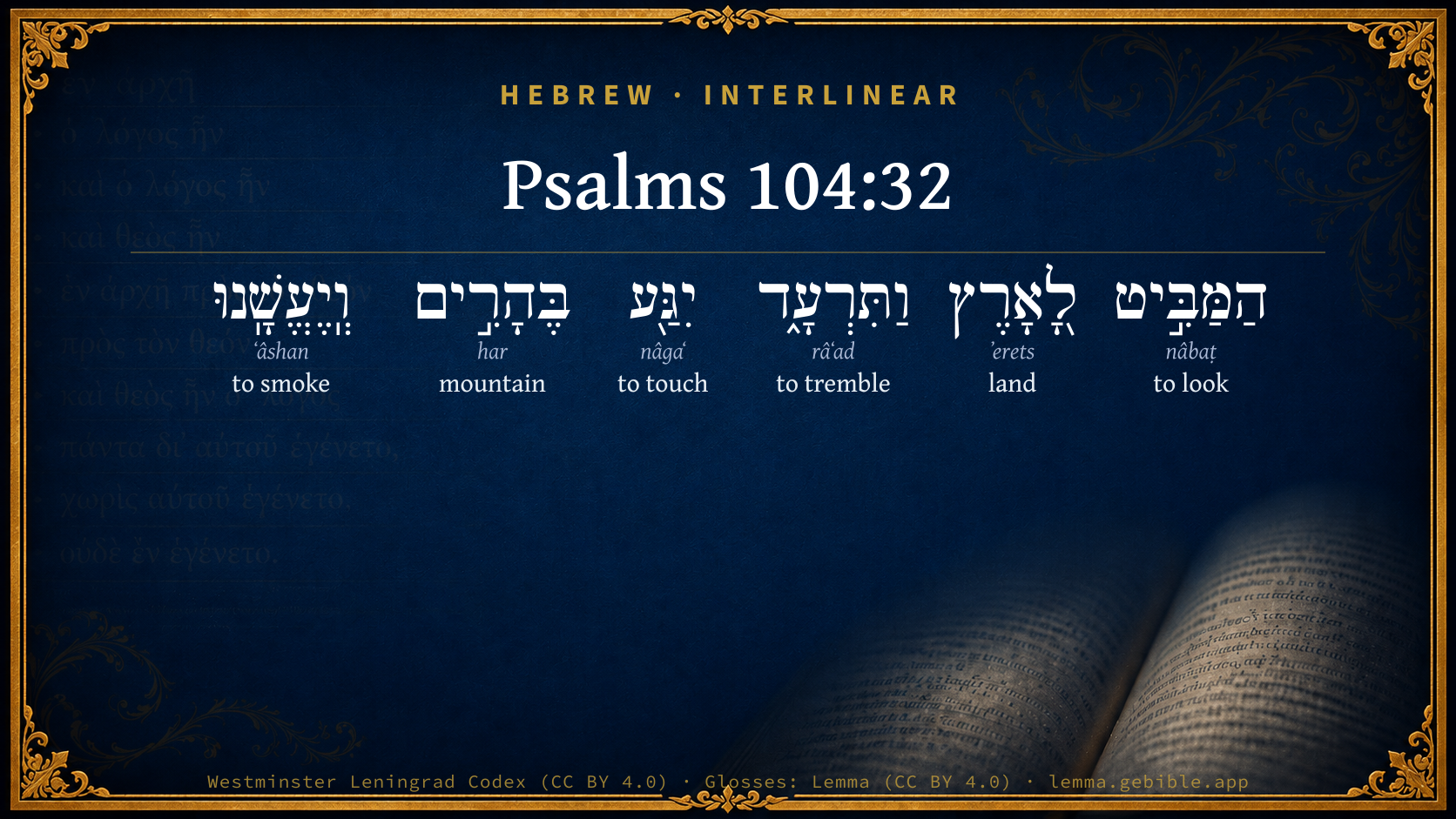
Hebrew (Westminster Leningrad Codex) Psalms 104:32 appears in the Hebrew Old Testament. The text above is from the Westminster Leningrad Codex. Each word links to its Strong’s number, a concise gloss, and parsing drawn from the Open Scriptures Hebrew Bible morphology. Click any word for its full Brown-Driver-Briggs (BDB) entry.
Download image
Cite this verse

Psalms 104:32 (World English Bible). Public Domain. Lemma interlinear Bible study tool, https://lemma.gebible.app/v/psalms/104/32.

Show BibTeX & RIS
BibTeX
RIS
English Translation
He looks at the earth, and it trembles. He touches the mountains, and they smoke.
World English Bible · Public Domain
Download a study sheet

One document with this verse’s original text, its word-by-word gloss line, the meaning frame, cross-references with their text, attributed commentary, and full source and license credits — printable, and it pastes into notes with its structure intact.

This verse Autodidact and up

Study sheet (.html) Plain text (.txt)

A passage Seminary Student

Up to 50 verses in one chapter. A passage sheet keeps up to 6 commentary sources and 12 cross-references per verse, in the order this page ranks them, and says so on the sheet whenever that leaves anything out. Ask for a single verse and you get the Autodidact verse sheet above.

Everything on this page stays free to read, with no account — the sheet is a download of what is already on screen, not access to it.

Want to remove ads? Support Godless Engineer
Compare translations 3

The same verse in 3 English versions, stacked beneath the original-language interlinear above. Click any original word for its lexicon entry.

Each is an independent rendering of the whole verse — the interlinear is not word-aligned to these translations.

Highlighted words mark where these versions differ — a whole-verse word diff, not a word-by-word alignment.

  • World English Bible Public Domain
    He looks at the earth, and it trembles. He touches the mountains, and they smoke.
  • King James Version Public Domain
    He looketh on the earth, and it trembleth: he toucheth the hills, and they smoke.
  • unfoldingWord Literal Text CC BY-SA 4.0
    The one looking at the earth, and it shakes— he touches the mountains, and they smoke.

unfoldingWord Literal Text — © unfoldingWord, licensed CC BY-SA 4.0. Word-aligned USFM3 via Door43 (git.door43.org/unfoldingWord/en_ult).

Versions to compare (up to 4)

3 of 4 selected

Show all 18 translations

Every available English version of this verse, each an independent rendering of the whole verse.

  • World English Bible Public Domain
    He looks at the earth, and it trembles. He touches the mountains, and they smoke.
  • Berean Standard Bible Public Domain
    He looks on the earth, and it trembles; He touches the mountains, and they smolder.
  • Majority Standard Bible Public Domain
    He looks on the earth, and it trembles; He touches the mountains, and they smolder.
  • King James Version Public Domain
    He looketh on the earth, and it trembleth: he toucheth the hills, and they smoke.
  • American Standard Version (1901) Public Domain
    Who looketh on the earth, and it trembleth; He toucheth the mountains, and they smoke.
  • Revised Version (1885) Public Domain
    Who looketh on the earth, and it trembleth; he toucheth the mountains, and they smoke.
  • Geneva Bible (1599) Public Domain
    He looketh on the earth and it trembleth: he toucheth the mountaines, and they smoke.
  • Douay-Rheims (1899) Public Domain
    He looketh upon the earth, and maketh it tremble: he toucheth the mountains, and they smoke.
  • Young's Literal Translation Public Domain
    Who is looking to earth, and it trembleth, He cometh against hills, and they smoke.
  • Literal Standard Version CC BY-SA 4.0
    Who is looking to earth, and it trembles, || He comes against hills, and they smoke.
  • Unlocked Literal Bible CC BY-SA 4.0
    He looks down on the earth, and it shakes; he touches the mountains, and they smoke.
  • unfoldingWord Literal Text CC BY-SA 4.0
    The one looking at the earth, and it shakes— he touches the mountains, and they smoke.
  • Darby Bible Public Domain
    He looketh on the earth, and it trembleth; he toucheth the mountains, and they smoke.
  • World Messianic Bible Public Domain
    He looks at the earth, and it trembles. He touches the mountains, and they smoke.
  • Webster's Bible Public Domain
    He looketh on the earth, and it trembleth: he toucheth the hills, and they smoke.
  • Free Bible Version CC BY-SA 4.0
    He only has to look at the earth and it trembles; mountains pour out smoke at his touch.
  • Bible in Basic English Public Domain
    At whose look the earth is shaking; at whose touch the mountains send out smoke.
  • JPS Tanakh (1917) Public Domain
    Who looketh on the earth, and it trembleth; He toucheth the mountains, and they smoke.

Literal Standard Version (2020), Covenant Press — licensed CC BY-SA 4.0. Text via the HelloAO Bible API (eBible.org). Unlocked Literal Bible (unfoldingWord) — licensed CC BY-SA 4.0. Text via the HelloAO Bible API (eBible.org). unfoldingWord Literal Text — © unfoldingWord, licensed CC BY-SA 4.0. Word-aligned USFM3 via Door43 (git.door43.org/unfoldingWord/en_ult). Free Bible Version, Dr. Jonathan Gallagher — licensed CC BY-SA 4.0. Text via the HelloAO Bible API (eBible.org).

Word by word

More ways to search: Search by grammar → Find every occurrence → Compare this word →

Practice this passage: Drill this verse → Learn its vocabulary →

About this verse

These counts appear in no published source. They are computed here, from the morphology-tagged text and Lemma’s own curated glosses. What Lemma adds →

6
words
6
distinct lemmas
Wisdom
section

Notable vocabulary

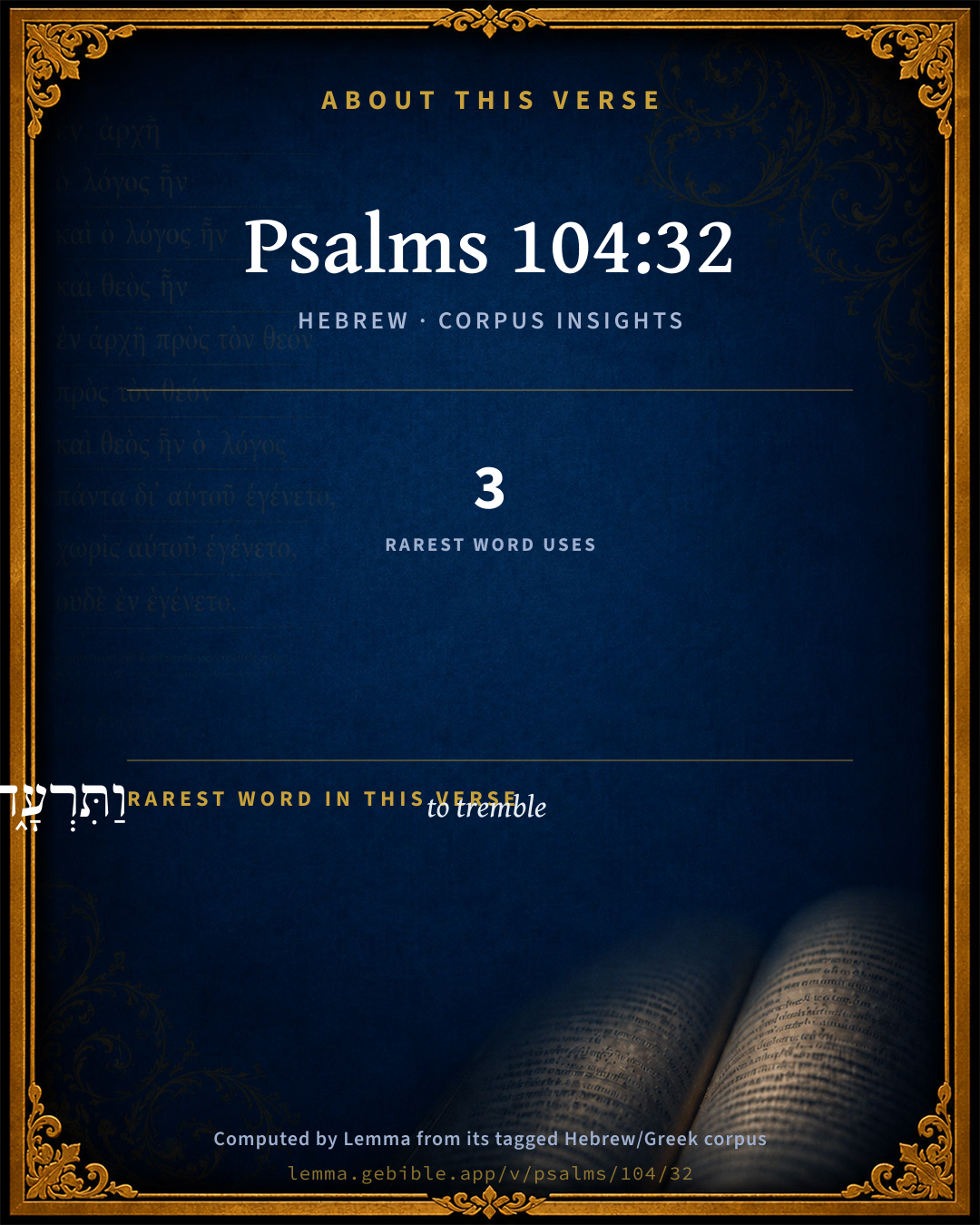
The rarest word here is וַתִּרְעָ֑ד to tremble H7460 — appearing just 3 times in the whole Hebrew Bible.

Shared distinctive vocabulary

וַתִּרְעָ֑ד to tremble H7460 occurs in 3 verses of the Hebrew Bible. Also found in:

Grammatical profile

  • 4 verbs
  • 2 nouns

Verb forms

  • הַמַּבִּ֣יט Hiphil · Participle Active
  • וַתִּרְעָ֑ד Qal · Sequential Imperfect
  • יִגַּ֖ע Qal · Imperfect
  • וְֽיֶעֱשָֽׁנוּ Qal · Imperfect

Hebrew & Septuagint length

In English translation the verse runs 15 words from the Hebrew and 16 from the Septuagint (LXX English) — closely comparable.

A rough comparison of the two English renderings, which tokenize alike — not a word-level alignment.

Word counts can differ between the Hebrew and the Greek without any difference in meaning — e.g. the Hebrew direct-object marker אֵת has no separate Greek word, and Greek often adds the article ὁ.

Cross-references

15

Topical passages linked to Psalms 104:32 in the Treasury of Scripture Knowledge — connected by theme and wording, ordered by reader-vote popularity; previews shown in the World English Bible.

  • Psalms 144:5 Part your heavens, Yahweh, and come down. Touch the mountains, and they will smoke.
  • Exodus 19:18 Mount Sinai, the whole of it, smoked, because Yahweh descended on it in fire; and its smoke ascended like the smoke of a furnace, and the whole mountain quaked greatly.
  • Psalms 97:4–5 His lightning lights up the world. The earth sees, and trembles.
  • Habakkuk 3:10 The mountains saw you, and were afraid. The tempest of waters passed by. The deep roared and lifted up its hands on high.
  • Psalms 114:7 Tremble, you earth, at the presence of the Lord, At the presence of the God of Jacob,
  • Psalms 50:3 Our God comes, and does not keep silent. A fire devours before him. It is very tempestuous around him.
  • Psalms 77:16 The waters saw you, God. The waters saw you, and they writhed. The depths also convulsed.
  • Isaiah 64:1–2 Oh that you would tear the heavens, that you would come down, that the mountains might quake at your presence,
  • Jeremiah 4:23–26 I saw the earth, and, behold, it was waste and void; and the heavens, and they had no light.
  • Jeremiah 5:22 Don't you fear me? says Yahweh: won't you tremble at my presence, who have placed the sand for the bound of the sea, by a perpetual decree, that it can't pass it? and though the waves of it toss themselves, yet they can't prevail; though they roar, yet they can't pass over it.
  • Amos 8:8 Won't the land tremble for this, And everyone mourn who dwells in it? Yes, it will rise up wholly like the River; And it will be stirred up and sink again, like the River of Egypt.
  • Nahum 1:5–6 The mountains quake before him, and the hills melt away. The earth trembles at his presence, yes, the world, and all who dwell in it.
  • Habakkuk 3:5–6 Plague went before him, And pestilence followed his feet.
  • Revelation 20:11 I saw a great white throne, and him who sat on it, from whose face the earth and the heaven fled away. There was found no place for them.
  • Revelation 19:3 A second said, "Hallelujah! Her smoke goes up forever and ever."

Cross-references courtesy of OpenBible.info (CC BY 4.0).

Hebrew and Greek witnesses Masoretic Hebrew ↔ Greek Septuagint

The same verse in the two great witnesses to the Old Testament, shown verse-for-verse.

You’re reading Greek Psalm 103 (Hebrew Psalm 104). The Septuagint counts the superscription, so verse numbers can differ from the Hebrew — chapter-level alignment, not verse-by-verse. Numbering follows Rahlfs.

These are two independent witnesses, not word-aligned to each other, and the Septuagint is shown in lemma (dictionary) form.

Hebrew Psalms 104:32 Masoretic · Westminster Leningrad Codex

הַמַּבִּ֣יט לָ֭אָרֶץ וַתִּרְעָ֑ד יִגַּ֖ע בֶּהָרִ֣ים וְֽיֶעֱשָֽׁנוּ

He looks at the earth, and it trembles. He touches the mountains, and they smoke.

World English Bible · Public Domain

Greek LXX Greek Psalm 103:32 Septuagint · lemma form

ὁ ἐπιβλέπω ἐπί ὁ γῆ καί ποιέω αὐτός τρέμω ὁ ἅπτομαι ὁ ὄρος καί καπνίζω

who looks upon the earth, and makes it tremble; who touches the mountains, and they smoke.

LXX2012 (modern English Septuagint) · Public Domain

Hebrew: Westminster Leningrad Codex (CC BY 4.0). Greek: Septuagint (public domain); English from LXX2012 (modern English Septuagint) (Public Domain). How the Septuagint differs from the Hebrew →

Commentary

Notes on Psalms 104:32 from classic Christian and Jewish commentators (each source and its license shown beneath its notes). The classic Christian expositions comment on the surrounding passage and are grouped to its opening verse, so a note may address several verses; the Jewish commentaries on the Tanakh (Rashi and others) are per-verse, so they appear only where the commentator wrote on this verse.

Lemma curates 59 commentaries, every one of them public domain or Creative Commons licensed, each selected and text-cleaned for this edition rather than reprinted as found. About our sources →

The Cambridge Bible for Schools and Colleges

gen. ed. J. J. S. Perowne

32. Who looketh on the earth, and it trembleth,

Toucheth the mountains, and they smoke.

May this manifestation of God in Nature ever continue! May Jehovah never cease to rejoice in His works as He rejoiced when He pronounced all things to be very good (Gen_1:31; Pro_8:31). A look, a touch are enough to remind the earth of the awful power of its Creator, Who if He willed could annihilate as easily as He created. The Psalmist has in mind Amo_9:5 (cp. above Psa_104:3), Exo_19:18; Psa_104:32 b is imitated in Psa_144:5, Psa_104:33 in Psa_146:2.

The Cambridge Bible for Schools and Colleges (gen. ed. J. J. S. Perowne; Cambridge University Press, 1878–1918) — public domain. Text from a community e-Sword module.

Trapp's Complete Commentary

John Trapp

Psa 104:32 He looketh on the earth, and it trembleth: he toucheth the hills, and they smoke.

Ver. 32. He looketh on the earth, and it trembleth] This must be considered, that God may be as well feared as loved and praised.

He toucheth the hills, and they smoke] It is, therefore, ill falling into his hands, who can do such terrible things with his looks and touches.

John Trapp, A Commentary or Exposition upon All the Books of the Old and New Testament (1647–1656) — public domain. Text from a community e-Sword module.

The Biblical Illustrator

Joseph S. Exell

Psa_104:32

He looketh on the earth, and it trembleth.

God can shake the world

Earthquakes certainly teach us that human existence in this world is entirely dependent upon God. Probably no natural experience impresses the mind as completely with the sense of utter insecurity. A traveller in South America gives a graphic account of his own helplessness during one of these terrible convulsions. He was in the street when the ground began to rock under his feet. His first impulse was to seek refuge inside a house, and it tumbled into ruins before him. He turned toward the shore, and there was the sea tossing and foaming as if in a storm. He glanced at the hills, but even they were shaken like trees with the wind. All he could do was to stand still, and look towards heaven, which alone was unmoved amidst the upheavings of the globe. He did well, for in God only is perfect safety. All other refuges save His mercy and power are refuges of lies. But none need fear whom He protects. One gladly recalls the remark of the good old lady mentioned by Mr. Spurgeon in a sermon. When her neighbours were in mortal terror, owing to certain vibrations of the ground,, she remained quite calm. Are you not afraid? they asked her. Afraid? No! was her answer; I rejoice to know I have a God who can shake the world. (Sunday Companion.)

The Biblical Illustrator, edited by Joseph S. Exell (c. 1880s–1900s) — public domain. Text from a community e-Sword module.

Joseph Benson's Commentary

Psa 104:32. He looketh on the earth, and it trembleth, &c. — Unable to bear his frown. This is a further illustration of God’s powerful providence. As when he affords his favour to creatures, they live and thrive; so, on the contrary, one angry look or touch of his, upon the hills or earth, makes them tremble or smoke, as once Sinai did when God appeared on it.

Joseph Benson's Commentary on the Old and New Testaments (1811–1818) — public domain. Text from a community e-Sword module.

J. A. Alexander on Psalms

Joseph Addison Alexander

32. (Psa 104:32) He that looks at the earth and it quakes, touches the hills and they smoke. There is something in the form of this verse similar to that of Psa 104:28. God has only to look at the earth to make it quake. He has only to touch the mountains and they smoke. His controlling and terrifying acts are as prompt and easy as his acts of grace. There seems to be a reference to the words of Moses in describing the effects of the theophany at Sinai, when its summit smoked, and its very roots or bases were on fire. See Exo 19:18, Deu 32:22. To those familiar with the constant use of mountains as a symbol of great monarchies, this verse would necessarily suggest the thought, that God's power over states is no less absolute than that which he exercises over individuals, or over the inanimate creation.

Joseph Addison Alexander, The Psalms Translated and Explained (1850) — public domain. Text from a community e-Sword module.

Tyndale Open Study Notes

Tyndale Open Resources

104:32 The trembling earth and the smoking mountains represent the Lord’s coming in judgment against sinners and salvation for his faithful people (see 18:7-15).

Tyndale Open Study Notes — © Tyndale Open Resources, licensed CC BY-SA 4.0. Text via the HelloAO Bible API.

Geneva Bible (1599)

Geneva Bible translators

God’s merciful face giveth strength unto the earth, but his severe countenance burneth the mountains.

Geneva Bible (1599) marginal notes — public domain. Text via Bolls.life.

Adam Clarke's Commentary

Verse 32. He looketh on the earth] Even the look of God terrifies all created nature!

He toucheth the hills] So easy is it for God to burn up the earth and the worlds thereof, that even his touch kindles the mountains into flames! See Etna, Vesuvius, Stromboli, c. these are ignited by the touch of God. How majestic are these figures!

The renewal of the earth, and re-creation of deceased animals, shall take place when he shall shake terribly the heavens and the earth; when they shall be wrapped together as a scroll, and the earth and its works be dissolved, that is, after the general convulsion and conflagration of the world.

Adam Clarke's Commentary on the Bible (1810–1826) — public domain. Text from a community e-Sword/MySword module.

Ellicott's Commentary for English Readers

(32) Trembleth.—With the praise is united something of awe and fear, since the majesty and power of Him who made the world is so great. Its very existence is dependent on His will, and a glance, a touch from Him would be enough to shake it to its foundations and consume it. For “the smoky mountain tops,” comp. Psa_144:5, and see Note, Psa_148:8.

A Bible Commentary for English Readers, edited by Charles John Ellicott (1878–1897) — public domain. Text from a community e-Sword module.

John Gill's Exposition

He looketh on the earth, and it trembleth,.... As Sinai did when he descended on it, Psa 68:8, to which the allusion seems to be; and a look from him, a severe one, a frowning one, will make the inhabitants of the earth to tremble; a providential look, sending famine, pestilence or the sword among them. A displeased look will make the hearts of his own children tremble, as no doubt Peter's did, when the Lord looked upon him, and he remembered his word; and if a look, much more a word, an awful word, as his voice in the law, pronouncing such cursed as keep it not; and especially the tremendous sentence he will pronounce on the wicked at the last day,

go, ye cursed, &c. and if a look and a word are so terrible, what will be the lighting down of his arm, with the indignation of his anger upon those who have refused to give him glory? For the words seem to carry in them a reason why he should be glorified, taken from the consequence of not glorifying him, who has such a majesty in his looks, such a terror in his countenance, and such power in his hands.

He toucheth the hills, and they smoke; as Sinai likewise did, when he was upon it, Exo 19:18, and as other hills do, when touched with lightning; the tops of mountains, the higher they are, the sooner and the more they smoke (u). God, with a touch of his hand, can set mountains on fire, open "volcanos", and cause them to burn for years together; as Etna, Vesuvius, Hecla, and others: and how easily can he set on fire the course of nature, burn the world, and all that is in it! It is but touching it, and it takes fire immediately: this he can as easily do as a man can light a torch or a candle; and as easily can he destroy sinners with the fire of his wrath, or cast them into everlasting fire, with the devil and his angels, which will burn to the lowest hell; and what are hills and mountains, or the greatest personages on earth, if he does but touch them, or lay his hand upon them in wrath? They are crushed as the moth; they are nothing before our great Zerubbabel.

(u) "Montis vicina cacumina coelo----Tanto "magis edita fumant", Lucret. de Rerum Natura, l. 6. v. 458, 459.

John Gill's Exposition of the Whole Bible (1746–1763) — public domain (CC PDM 1.0). Text via the HelloAO Bible API.

Albert Barnes' Notes on the Bible

He looketh on the earth, and it trembleth - There is great sublimity in this expression, as indicating the power and the majesty of God. He has only to “look” upon his works, and they stand in awe and tremble. The most mighty and fearful convulsions of nature occur as if they were the mere effect of God’s “looking” on the earth. Compare Hab 3:10 - “The mountains saw thee, and they trembled.”

He toucheth the hills, and they smoke - That is, as Mount Sinai did when God came down upon it. Exo 19:18. It is as if the hills were conscious of his presence, and were awed.

Albert Barnes' Notes on the Bible (1834–1885) — public domain. Text from a community e-Sword/MySword module.

Matthew Poole's English Annotations

This is a further illustration of God’s powerful providence over all the creatures, and their dependence upon him; as when he affords his favour to creatures, they live and thrive, so one the contrary one angry look or touch of his upon the hills or earth makes them tremble and smoke, as once Sinai did when God appeared in it. And this consideration he may possibly suggest to enforce the foregoing exhortation of glorifying God, because if we do not give him the glory due to his name, he call quickly right himself, and destroy us and all his works.

Matthew Poole's English Annotations on the Holy Bible (1683–1685) — public domain. Text from a community e-Sword/MySword module.

The Treasury of David

Charles H. Spurgeon

Ver. 32. He looketh on the earth, and it trembleth. The Lord who has graciously displayed his power in acts and works of goodness might, if he had seen fit, have overwhelmed us with the terrors of destruction, for even at a glance of his eye the solid earth rocks with fear.

He toucheth the hills, and they smoke. Sinai was altogether on a smoke when the Lord descended upon it. It was but a touch, but it sufficed to make the mountain dissolve in flame. Even our God is a consuming fire. Woe unto those who shall provoke him to frown upon them, they shall perish at the touch of his hand. If sinners were not altogether insensible a glance of the Lord's eye would make them tremble, and the touches of his hand in affliction would set their hearts on fire with repentance. "Of reason all things show some sign, " except man's unfeeling heart.

Ver. 32. He looketh on the earth and it trembleth. As man can soon give a cast with his eye, so soon can God shake the earth, that is, either the whole mass of the earth, or the inferior sort of men on the earth when he "looketh, "or casteth an angry eye "upon the earth it trembleth." "He toucheth the hills, "(that is, the powers and principalities of the world), "and they smoke; "if he do but touch them they smoke, that is, the dreadful effects of the power and judgment of God are visible upon them. Joseph Caryl.

Ver. 32. No one save a photographer can sketch the desert around Sinai. Roberts' views are noble, and to a certain extent true; but they do not represent these desert cliffs and ravines. No artist can rightly do it. Only the photographer can pourtray the million of minute details that go to make up the bleakness, the wildness, the awfulness, and the dismal loneliness of these unearthly wastes.

About noon I went out and walked upon the convent roof. The star light over the mountain peaks was splendid, while the gloom that hung round these enormous precipices and Impenetrable ravines was quite oppressive to the spirit. This is the scene of which David spoke. "He looketh on the earth, and it trembleth: he toucheth the hills, and they smoke." This is the mountain "that was touched, and that burned with fire" (Heb 7:18). Not the mount that "might be touched, "as our translators have rendered it, but the mount "that was touched, " qhla fwmena, the mount on which the finger of God rested.

We could imagine the black girdle of the thick darkness with which the mountain was surrounded, and the lightnings giving forth their quick fire through tiffs covering, making its blackness blacker. We could imagine, too, the supernatural blaze, kindled by no earthly hand, that shot up out of the midst of this, like a living column of fire, ascending, amid the sound of angelic trumpets and superangelic thunders, to the very heart of heaven. Horatius Bonar, in "The Desert of Sinai", 1858.

Ver. 32. The philosopher labours to investigate the natural cause of earthquakes and volcanoes. Well, let him account as he will, still the immediate power of Jehovah is the true and ultimate cause. God works in these tremendous operations. "He looketh on the earth, and it trembleth; he toucheth the hills, and they smoke." This is the philosophy of Scripture: this, then, shall be my philosophy. Never was a sentence uttered by uninspired man so sublime as this sentence. The thought is grand beyond conception; and the expression clothes the thought with suitable external majesty. God needs no means by which to give effect to his purpose by his power, yet, in general, he has established means through which he acts. In conformity with this Divine plan, he created by means, and he governs by means. But the means which he has employed in creation, and the means which he employs in providence, are effectual only by his almighty power. The sublimity of the expression in this passage arises from the infinite disproportion between the means and the end. An earthly sovereign looks with anger, and his courtiers tremble. God looks on the earth, and it trembles to its foundation. He touches the mountains, and the volcano smokes, vomiting forth torrents of lava. Hills are said to melt at the presence of the Lord. "Tremble, thou earth, at the presence of the Lord, at the presence of the God of Jacob." How chill and withering is the breath of that noxious philosophy, that would detach our minds from viewing God in his works of Providence! The Christian who lives in this atmosphere, or on the borders of it, will be unhealthy and unfruitful in true works of righteousness. This malaria destroys all spiritual life. Alexander Carson.

Ver. 32. He toucheth the hills, and they smoke. It's therefore ill falling into his hands, who can do such terrible things with his looks and touches. John Trapp.

Ver. 32.

1. What there is in a Look of God. "He looketh, "etc.

(a) What in a look of anger.

(b) What in a look of love. He looked out of the fiery

pillar upon the Egyptians. "The Lord hath looked out

from his pillar of glory, "etc. He gave another look

from the same pillar to Israel.

2. What there is in a Touch of God: "He toucheth, "etc. A touch of his may raise a soul to heaven, or sink a soul to hell. G.R.

Psalms 104:33*

Charles H. Spurgeon's The Treasury of David (1869–1885) — public domain. Psalms only. Text from a community e-Sword/MySword module.

The Pulpit Commentary

He looketh on the earth, and it trembleth. (comp. Psa_18:7 Psa_114:7) The earth "trembles," as knowing that it can be destroyed at any moment. He toucheth the hills, and they smoke; or, the mountains the strongest portions of the earth (Psa_36:6 Psa_65:6) when he touches them. (see Exo_19:18 Deu_4:11 Psa_144:5)

The Pulpit Commentary (1880–1919), ed. H.D.M. Spence-Jones & Joseph S. Exell — public domain. Text from a community e-Sword module.

John Wesley's Explanatory Notes

He looketh - This is a farther illustration of God's powerful providence: as when he affords his favour to creatures, they live and thrive, so on the contrary, one angry look or touch of his upon the hills or earth, makes them tremble and smoke, as Sinai did when God appeared in it.

John Wesley, Explanatory Notes Upon the Whole Bible (1754–1765) — public domain. Text via the GEBible commentary corpus.

Rashi

Rabbi Shlomo Yitzchaki (Rashi)

He touches the mountains and they emit smoke as is depicted of Sinai (Exod. 19:18): “And Mount Sinai was all in smoke.”

Rashi on the Tanakh — English translations: “The Judaica Press complete Tanach with Rashi, translated by A. J. Rosenberg” (CC BY 4.0); “Pentateuch with Rashi's commentary by M. Rosenbaum and A.M. Silbermann, 1929-1934” (public domain); “The Metsudah Tanach series, Lakewood, N.J” (CC BY 4.0); and “The Book of Joshua, Metsudah Publications, 1997” (CC BY 4.0). Text via Sefaria.

Lesson kit

Teaching starters — assembled from the data on this page, not authored interpretation. Every prompt links to the verse data it draws on. Edit before teaching.

Psalms, in the Wisdom, opens this verse with 6 words (6 distinct Hebrew lemmas). Its most distinctive word is râʻad (“to tremble”). A historical commentator’s framing appears above. Read the whole chapter for the surrounding context.

Discussion questions

  1. What does “to tremble” (râʻad) contribute to the verse as a whole?
  2. Ezra 10:9 shares the word «to tremble» with this verse. How do the two illuminate each other?
  3. These translations render this verse differently. What is at stake in choosing one wording over another?
  4. The verb «הַמַּבִּ֣יט» is Hiphil Participle Active. How does its form color the action?
  5. Reading how The Cambridge Bible for Schools and Colleges and Trapp's Complete Commentary read this verse, where do the two commentators agree and where do they part?

Things to notice

Reading settings

Reading text

Shown beneath each verse's original-language words.

Old Testament
Old Testament edition

Read the OT as the Masoretic Hebrew (MT) or the Greek Septuagint (LXX).

English shown for the Greek Septuagint (in the Hebrew ↔ Greek comparison).

Comparing translations? Open the Compare panel on any verse page to stack up to four side by side.