
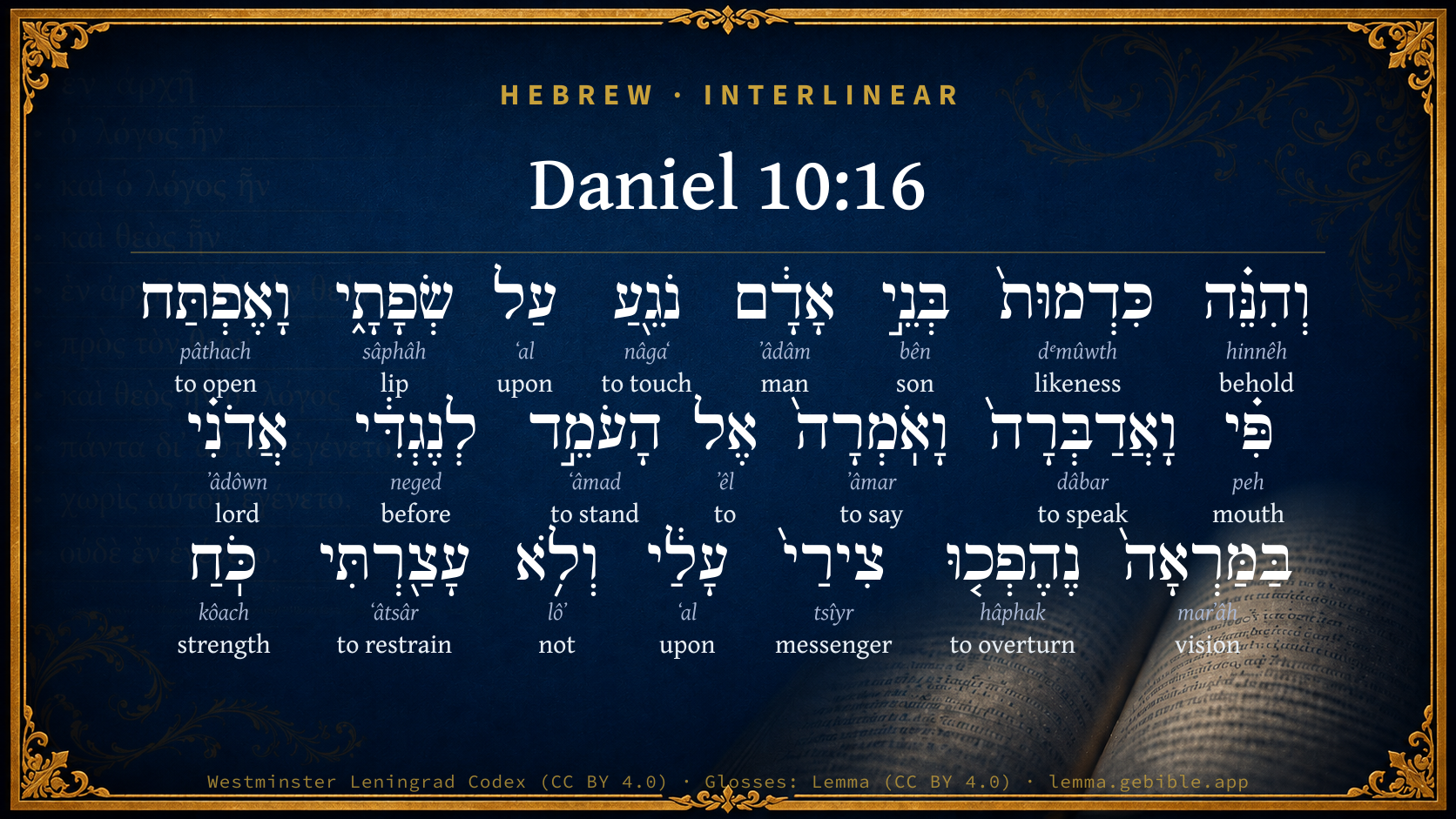
Daniel 10:16

Hebrew (Westminster Leningrad Codex) Daniel 10:16 appears in the Hebrew Old Testament. The text above is from the Westminster Leningrad Codex. Each word links to its Strong’s number, a concise gloss, and parsing drawn from the Open Scriptures Hebrew Bible morphology. Click any word for its full Brown-Driver-Briggs (BDB) entry.
Download image
Cite this verse

Daniel 10:16 (World English Bible). Public Domain. Lemma interlinear Bible study tool, https://lemma.gebible.app/v/daniel/10/16.

Show BibTeX & RIS
BibTeX
RIS
English Translation
Behold, one in the likeness of the sons of men touched my lips: then I opened my mouth, and spoke and said to him who stood before me, my lord, by reason of the vision my sorrows are turned on me, and I retain no strength.
World English Bible · Public Domain
Download a study sheet

One document with this verse’s original text, its word-by-word gloss line, the meaning frame, cross-references with their text, attributed commentary, and full source and license credits — printable, and it pastes into notes with its structure intact.

This verse Autodidact and up

Study sheet (.html) Plain text (.txt)

A passage Seminary Student

Up to 50 verses in one chapter. A passage sheet keeps up to 6 commentary sources and 12 cross-references per verse, in the order this page ranks them, and says so on the sheet whenever that leaves anything out. Ask for a single verse and you get the Autodidact verse sheet above.

Everything on this page stays free to read, with no account — the sheet is a download of what is already on screen, not access to it.

Want to remove ads? Support Godless Engineer
Compare translations 3

The same verse in 3 English versions, stacked beneath the original-language interlinear above. Click any original word for its lexicon entry.

Each is an independent rendering of the whole verse — the interlinear is not word-aligned to these translations.

Highlighted words mark where these versions differ — a whole-verse word diff, not a word-by-word alignment.

  • World English Bible Public Domain
    Behold, one in the likeness of the sons of men touched my lips: then I opened my mouth, and spoke and said to him who stood before me, my lord, by reason of the vision my sorrows are turned on me, and I retain no strength.
  • King James Version Public Domain
    And, behold, one like the similitude of the sons of men touched my lips: then I opened my mouth, and spake, and said unto him that stood before me, O my lord, by the vision my sorrows are turned upon me, and I have retained no strength.
  • unfoldingWord Literal Text CC BY-SA 4.0
    And behold, one in the likeness of the sons of man touched my lips. Then I opened my mouth and spoke and said to him who stood before me: “O my lord, pains have come upon me because of the vision; I retain no strength.

unfoldingWord Literal Text — © unfoldingWord, licensed CC BY-SA 4.0. Word-aligned USFM3 via Door43 (git.door43.org/unfoldingWord/en_ult).

Versions to compare (up to 4)

3 of 4 selected

Show all 18 translations

Every available English version of this verse, each an independent rendering of the whole verse.

  • World English Bible Public Domain
    Behold, one in the likeness of the sons of men touched my lips: then I opened my mouth, and spoke and said to him who stood before me, my lord, by reason of the vision my sorrows are turned on me, and I retain no strength.
  • Berean Standard Bible Public Domain
    And suddenly one with the likeness of a man touched my lips, and I opened my mouth and said to the one standing before me, “My lord, because of the vision, I am overcome with anguish, and I have no strength.
  • Majority Standard Bible Public Domain
    And suddenly one with the likeness of a man touched my lips, and I opened my mouth and said to the one standing before me, “My lord, because of the vision, I am overcome with anguish, and I have no strength.
  • King James Version Public Domain
    And, behold, one like the similitude of the sons of men touched my lips: then I opened my mouth, and spake, and said unto him that stood before me, O my lord, by the vision my sorrows are turned upon me, and I have retained no strength.
  • American Standard Version (1901) Public Domain
    And, behold, one in the likeness of the sons of men touched my lips: then I opened my mouth, and spake and said unto him that stood before me, O my lord, by reason of the vision my sorrows are turned upon me, and I retain no strength.
  • Revised Version (1885) Public Domain
    And, behold, one like the similitude of the sons of men touched my lips: then I opened my mouth, and spake and said unto him that stood before me, O my lord, by reason of the vision my sorrows are turned upon me, and I retain no strength.
  • Geneva Bible (1599) Public Domain
    And beholde, one like the similitude of the sonnes of man touched my lippes: then I opened my mouth, and spake, and said vnto him that stoode before me, O my Lord, by the vision my sorowes are returned vpon me, and I haue reteined no strength.
  • Douay-Rheims (1899) Public Domain
    And behold, as it were the likeness of a son of man touched my lips: then I opened my mouth, and spoke, and said to him that stood before me: O my Lord, at the sight of thee my joints are loosed, and no strength hath remained in me.
  • Young's Literal Translation Public Domain
    and lo, as the manner of the sons of men, he is striking against my lips, and I open my mouth, and I speak, and say unto him who is standing over-against me: My lord, by the appearance turned have been my pangs against me, and I have retained no power.
  • Literal Standard Version CC BY-SA 4.0
    and behold, as the manner of the sons of men, he is striking against my lips, and I open my mouth, and I speak, and say to him who is standing in opposition in front of me: My lord, by the vision my pangs have been turned against me, and I have retained no power.
  • Unlocked Literal Bible CC BY-SA 4.0
    One who was like the sons of man touched my lips, and I opened my mouth and spoke to him who stood before me: “My master, I am in agony because of the vision; I have no strength left.
  • unfoldingWord Literal Text CC BY-SA 4.0
    And behold, one in the likeness of the sons of man touched my lips. Then I opened my mouth and spoke and said to him who stood before me: “O my lord, pains have come upon me because of the vision; I retain no strength.
  • Darby Bible Public Domain
    And behold, one after the likeness of the sons of men touched my lips; and I opened my mouth and spoke, and said unto him that stood before me, My lord, by reason of the vision my pains are turned upon me, and I retain no strength.
  • World Messianic Bible Public Domain
    Behold, one in the likeness of the sons of men touched my lips. Then I opened my mouth, and spoke and said to him who stood before me, “My lord, by reason of the vision my sorrows have overtaken me, and I retain no strength.
  • Webster's Bible Public Domain
    And behold, one like the similitude of the sons of men touched my lips: then I opened my mouth, and spoke, and said to him that stood before me, O my lord, by the vision my sorrows are turned upon me, and I have retained no strength.
  • Free Bible Version CC BY-SA 4.0
    Then the one who looked like a human being touched my lips and I was able to speak. I told the one standing in front of me, “My lord, since I saw the vision I've been in agony and I feel really weak.
  • Bible in Basic English Public Domain
    Then one whose form was like the sons of men put his finger on my lips; and opening my mouth, I said to him who was before me, O my lord, because of the vision my pains have come on me, and I have no more strength.
  • JPS Tanakh (1917) Public Domain
    And, behold, one like the similitude of the sons of men touched my lips; then I opened my mouth, and spoke and said unto him that stood before me: 'O my lord, by reason of the vision my pains are come upon me, and I retain no strength.

Literal Standard Version (2020), Covenant Press — licensed CC BY-SA 4.0. Text via the HelloAO Bible API (eBible.org). Unlocked Literal Bible (unfoldingWord) — licensed CC BY-SA 4.0. Text via the HelloAO Bible API (eBible.org). unfoldingWord Literal Text — © unfoldingWord, licensed CC BY-SA 4.0. Word-aligned USFM3 via Door43 (git.door43.org/unfoldingWord/en_ult). Free Bible Version, Dr. Jonathan Gallagher — licensed CC BY-SA 4.0. Text via the HelloAO Bible API (eBible.org).

Word by word

More ways to search: Search by grammar → Find every occurrence → Compare this word →

Practice this passage: Drill this verse → Learn its vocabulary →

בַּמַּרְאָה֙
marʼâh
H4759
“in/at the · vision”
Preposition, Determined + Noun, Common, Feminine, Singular, Absolute
Part of Speech
Preposition + Noun
Type
Common
Gender
Feminine
Number
Singular
State
Absolute
Full BDB Definition

Origin: from H4758

TWOT: 2095g , 2095h

vision - mode of revelation - mirror
  1. וְהִנֵּ֗ה hinnêh H2009 “and · behold” Conjunction + Particle, Demonstrative
  2. כִּדְמוּת֙ dᵉmûwth H1823 “like/as · likeness of” Preposition + Noun, Common, Feminine, Singular, Construct
  3. בְּנֵ֣י bên H1121 “sons of” Noun, Common, Masculine, Plural, Construct
  4. אָדָ֔ם ʼâdâm H120 “man” Noun, Common, Masculine, Singular, Absolute
  5. נֹגֵ֖עַ nâgaʻ H5060 “touching” Verb, Qal, Participle Active, Masculine, Singular, Absolute
  6. עַל ʻal H5921 “upon” Preposition
  7. שְׂפָתָ֑י sâphâh H8193 “lips · my” Noun, Common, Feminine, Dual, Construct + Suffix, Personal, 1st Person, Common, Singular
  8. וָאֶפְתַּח pâthach H6605 “and · to open” Conjunction + Verb, Qal, Sequential Imperfect, 1st Person, Common, Singular
  9. פִּ֗י peh H6310 “mouth · my” Noun, Common, Masculine, Singular, Construct + Suffix, Personal, 1st Person, Common, Singular
  10. וָאֲדַבְּרָה֙ dâbar H1696 “and · to speak” Conjunction + Verb, Piel, Sequential Imperfect, 1st Person, Common, Singular + Suffix, h
  11. וָאֹֽמְרָה֙ ʼâmar H559 “and · to say” Conjunction + Verb, Qal, Sequential Imperfect, 1st Person, Common, Singular + Suffix, h
  12. אֶל ʼêl H413 “to” Preposition
  13. הָעֹמֵ֣ד ʻâmad H5975 “the · standing” Particle, Definite Article + Verb, Qal, Participle Active, Masculine, Singular, Absolute
  14. לְנֶגְדִּ֔י neged H5048 “to/for · before · me” Preposition + Preposition + Suffix, Personal, 1st Person, Common, Singular
  15. אֲדֹנִ֗י ʼâdôwn H113 “lord · my” Noun, Common, Masculine, Singular, Construct + Suffix, Personal, 1st Person, Common, Singular
  16. נֶהֶפְכ֤וּ hâphak H2015 “to overturn” Verb, Niphal, Perfect, 3rd Person, Common, Plural
  17. צִירַי֙ tsîyr H6735 “messengers · my” Noun, Common, Masculine, Plural, Construct + Suffix, Personal, 1st Person, Common, Singular
  18. עָלַ֔י ʻal H5921 “upon · me” Preposition + Suffix, Personal, 1st Person, Common, Singular
  19. וְלֹ֥א lôʼ H3808 “and · not” Conjunction + Particle, Negative
  20. עָצַ֖רְתִּי ʻâtsâr H6113 “to restrain” Verb, Qal, Perfect, 1st Person, Common, Singular
  21. כֹּֽחַ kôach H3581 “strength” Noun, Common, Masculine, Singular, Absolute

About this verse

These counts appear in no published source. They are computed here, from the morphology-tagged text and Lemma’s own curated glosses. What Lemma adds →

22
words
21
distinct lemmas
Prophets
section

Notable vocabulary

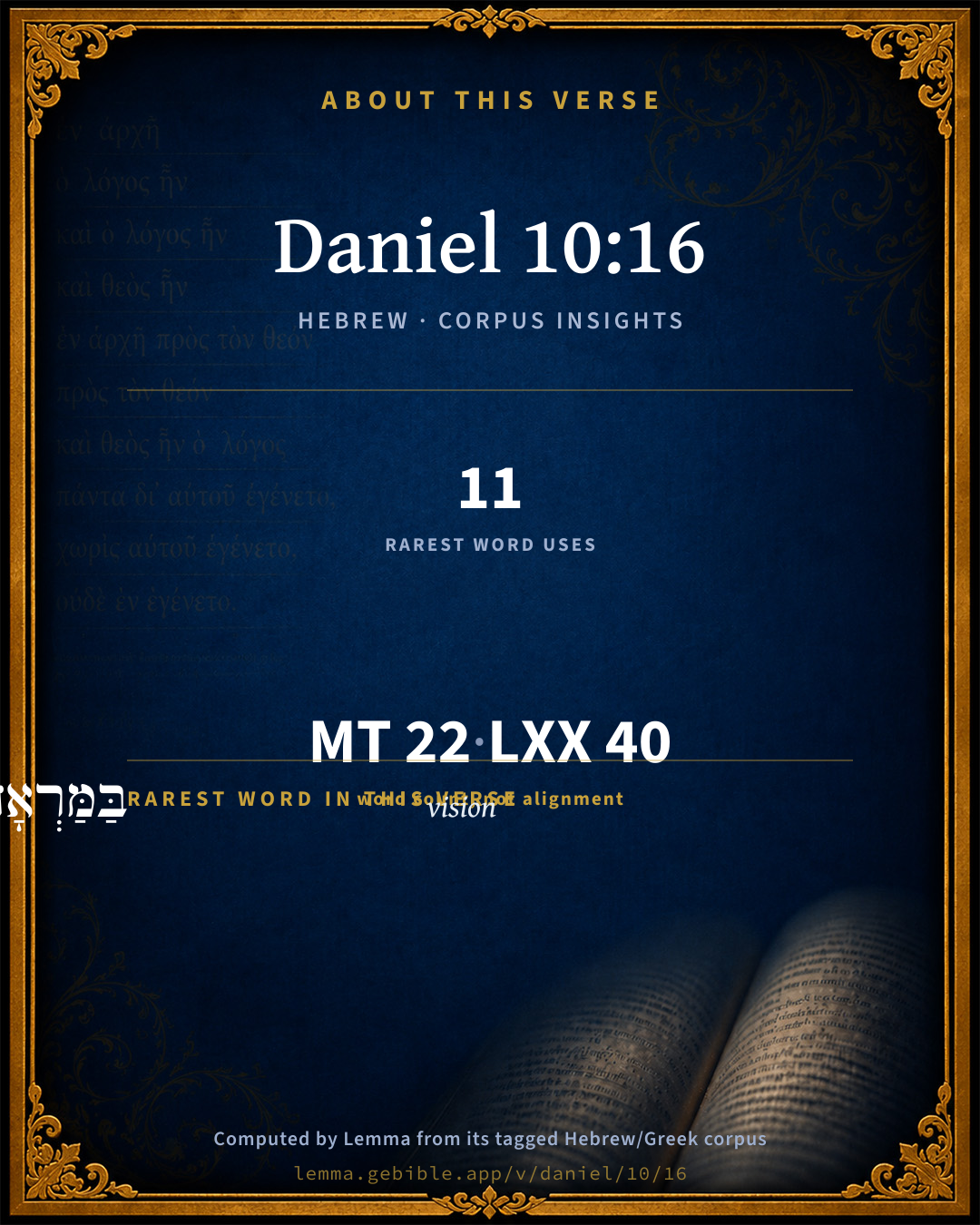
The rarest word here is בַּמַּרְאָה֙ vision H4759 — appearing just 11 times in the whole Hebrew Bible.

Shared distinctive vocabulary

בַּמַּרְאָה֙ vision H4759 occurs in 10 verses of the Hebrew Bible. Also found in:

Grammatical profile

  • 7 verbs
  • 9 nouns
  • 4 prepositions
  • 2 particles

Verb forms

  • נֹגֵ֖עַ Qal · Participle Active
  • וָאֶפְתַּח Qal · Sequential Imperfect
  • וָאֲדַבְּרָה֙ Piel · Sequential Imperfect
  • וָאֹֽמְרָה֙ Qal · Sequential Imperfect
  • הָעֹמֵ֣ד Qal · Participle Active
  • נֶהֶפְכ֤וּ Niphal · Perfect
  • עָצַ֖רְתִּי Qal · Perfect

Repetition

A word recurs within this verse — often emphatic in Hebrew:

Hebrew & Septuagint length

In English translation the verse runs 46 words from the Hebrew and 49 from the Septuagint (LXX English) — closely comparable.

A rough comparison of the two English renderings, which tokenize alike — not a word-level alignment.

Word counts can differ between the Hebrew and the Greek without any difference in meaning — e.g. the Hebrew direct-object marker אֵת has no separate Greek word, and Greek often adds the article ὁ.

In the original languages it is 22 Hebrew tokens and 40 Greek tokens — but the two are counted differently (Hebrew bundles its prefixes and suffixes into one token; the Greek is in lemma form), so that isn’t a like-for-like length.

Cross-references

27

Topical passages linked to Daniel 10:16 in the Treasury of Scripture Knowledge — connected by theme and wording, ordered by reader-vote popularity; previews shown in the World English Bible.

  • Isaiah 6:7 He touched my mouth with it, and said, "Behold, this has touched your lips; and your iniquity is taken away, and your sin forgiven."
  • Daniel 8:15 It happened, when I, even I Daniel, had seen the vision, that I sought to understand it; and, behold, there stood before me as the appearance of a man.
  • Jeremiah 1:9 Then Yahweh put forth his hand, and touched my mouth; and Yahweh said to me, Behold, I have put my words in your mouth:
  • Daniel 7:15 As for me, Daniel, my spirit was grieved in the midst of my body, and the visions of my head troubled me.
  • Daniel 7:28 Here is the end of the matter. As for me, Daniel, my thoughts much troubled me, and my face was changed in me: but I kept the matter in my heart.
  • Daniel 8:17 So he came near where I stood; and when he came, I was frightened, and fell on my face: but he said to me, Understand, son of man; for the vision belongs to the time of the end.
  • Daniel 8:27 I, Daniel, fainted, and was sick certain days; then I rose up, and did the king's business: and I wondered at the vision, but none understood it.
  • Revelation 1:13 And among the lampstands was one like a son of man, clothed with a robe reaching down to his feet, and with a golden sash around his chest.
  • Exodus 4:10 Moses said to Yahweh, "Oh, Lord, I am not eloquent, neither before now, nor since you have spoken to your servant; for I am slow of speech, and of a slow tongue."
  • Exodus 4:13 He said, "Oh, Lord, please send someone else."
  • Joshua 5:14 He said, No; but [as] prince of the host of Yahweh am I now come. Joshua fell on his face to the earth, and did worship, and said to him, What says my lord to his servant?
  • Judges 6:13 Gideon said to him, Oh, my lord, if Yahweh is with us, why then has all this happened to us? and where are all his wondrous works which our fathers told us of, saying, Did not Yahweh bring us up from Egypt? but now Yahweh has cast us off, and delivered us into the hand of Midian.
  • Judges 6:15 He said to him, Oh, Lord, with which shall I save Israel? behold, my family is the poorest in Manasseh, and I am the least in my father's house.
  • Judges 13:8 Then Manoah entreated Yahweh, and said, Oh, Lord, please let the man of God whom you did send come again to us, and teach us what we shall do to the child who shall be born.
  • Ecclesiastes 1:18 For in much wisdom is much grief; and he who increases knowledge increases sorrow.
  • Ezekiel 1:26 Above the expanse that was over their heads was the likeness of a throne, as the appearance of a sapphire stone; and on the likeness of the throne was a likeness as the appearance of a man on it above.
  • Ezekiel 3:27 But when I speak with you, I will open your mouth, and you shall tell them, Thus says the Lord Yahweh: He who hears, let him hear; and he who forbears, let him forbear: for they are a rebellious house.
  • Ezekiel 33:22 Now the hand of Yahweh had been on me in the evening, before he who was escaped came; and he had opened my mouth, until he came to me in the morning; and my mouth was opened, and I was no more mute.
  • Daniel 9:21 yes, while I was speaking in prayer, the man Gabriel, whom I had seen in the vision at the beginning, being caused to fly swiftly, touched me about the time of the evening offering.
  • Daniel 10:5–6 I lifted up my eyes, and looked, and, behold, a man clothed in linen, whose loins were girded with pure gold of Uphaz:
  • Daniel 10:8–10 So I was left alone, and saw this great vision, and there remained no strength in me; for my comeliness was turned in me into corruption, and I retained no strength.
  • Daniel 10:17–18 For how can the servant of this my lord talk with this my lord? for as for me, immediately there remained no strength in me, neither was there breath left in me.
  • Daniel 12:8 I heard, but I didn't understand: then said I, my lord, what shall be the issue of these things?
  • Luke 1:64 His mouth was opened immediately, and his tongue freed, and he spoke, blessing God.
  • Luke 21:15 for I will give you a mouth and wisdom which all your adversaries will not be able to withstand or to contradict.
  • John 20:28 Thomas answered him, "My Lord and my God!"
  • Philippians 2:7–8 but emptied himself, taking the form of a servant, being made in the likeness of men.

Cross-references courtesy of OpenBible.info (CC BY 4.0).

Hebrew and Greek witnesses Masoretic Hebrew ↔ Greek Septuagint

The same verse in the two great witnesses to the Old Testament, shown verse-for-verse.

These are two independent witnesses, not word-aligned to each other, and the Septuagint is shown in lemma (dictionary) form.

Hebrew Daniel 10:16 Masoretic · Westminster Leningrad Codex

וְהִנֵּ֗ה כִּדְמוּת֙ בְּנֵ֣י אָדָ֔ם נֹגֵ֖עַ עַל שְׂפָתָ֑י וָאֶפְתַּח פִּ֗י וָאֲדַבְּרָה֙ וָאֹֽמְרָה֙ אֶל הָעֹמֵ֣ד לְנֶגְדִּ֔י אֲדֹנִ֗י בַּמַּרְאָה֙ נֶהֶפְכ֤וּ צִירַי֙ עָלַ֔י וְלֹ֥א עָצַ֖רְתִּי כֹּֽחַ

Behold, one in the likeness of the sons of men touched my lips: then I opened my mouth, and spoke and said to him who stood before me, my lord, by reason of the vision my sorrows are turned on me, and I retain no strength.

World English Bible · Public Domain

Greek LXX Daniel 10:16 Septuagint · lemma form

καί ἰδού ὡς ὁμοίωσις χείρ ἄνθρωπος ἅπτομαι ἐγώ ὁ χεῖλος καί ἀναοἴγω ὁ στόμα ἐγώ καί λαλέω καί εἶπον ὁ ἵστημι ἀπέναντι ἐγώ κύριος καί ὡς ὅρασις ἀποστρέφω ἐπί ὁ πλευρόν ἐγώ ἐπί ἐγώ καί οὐ εἰμί ἐν ἐγώ ἰσχύς

And, behold, as it were the likeness of a son of man touched my lips; and I opened my mouth, and spoke, and said to him that stood before me, O my lord, at the sight of you my bowels were turned within me, and I had no strength.

LXX2012 (modern English Septuagint) · Public Domain

On this verse, John Gill's Exposition discusses the Septuagint’s reading. Read the note in Commentary ↓

Hebrew: Westminster Leningrad Codex (CC BY 4.0). Greek: Septuagint (public domain); English from LXX2012 (modern English Septuagint) (Public Domain). How the Septuagint differs from the Hebrew →

Commentary

Notes on Daniel 10:16 from classic Christian and Jewish commentators (each source and its license shown beneath its notes). The classic Christian expositions comment on the surrounding passage and are grouped to its opening verse, so a note may address several verses; the Jewish commentaries on the Tanakh (Rashi and others) are per-verse, so they appear only where the commentator wrote on this verse.

Lemma curates 59 commentaries, every one of them public domain or Creative Commons licensed, each selected and text-cleaned for this edition rather than reprinted as found. About our sources →

Trapp's Complete Commentary

John Trapp

Dan 10:16 And, behold, [one] like the similitude of the sons of men touched my lips: then I opened my mouth, and spake, and said unto him that stood before me, O my lord, by the vision my sorrows are turned upon me, and I have retained no strength.

Ver. 16. And, behold, one like the similitude,] i.e., The angel in human shape. {as Dan 10:10}

Touched my lips.] Restored unto me my speech. Good affections wanting expression shall have God’s furtherance.

And said unto him that stood before me,] i.e., To Christ, whom he had seen. {Dan 10:5-6}

My sorrows are turned upon me.] Heb., My bowels, which are even strained and straitened.

And I have retained no strength.] It is ordinary with God’s people in their prayers to complain much of their own weakness. {Jer 31:18}

John Trapp, A Commentary or Exposition upon All the Books of the Old and New Testament (1647–1656) — public domain. Text from a community e-Sword module.

Tyndale Open Study Notes

Tyndale Open Resources

10:16 touched my lips: Cp. Exod 4:11-12; Isa 6:5-7.

Tyndale Open Study Notes — © Tyndale Open Resources, licensed CC BY-SA 4.0. Text via the HelloAO Bible API.

Geneva Bible (1599)

Geneva Bible translators

I was overcome with fear and sorrow, when I saw the vision.

This was the same Angel that spake with him before in the similitude of a man.

Geneva Bible (1599) marginal notes — public domain. Text via Bolls.life.

Jamieson, Fausset & Brown

Robert Jamieson, A. R. Fausset & David Brown

touched my lips--the same significant action wherewith the Son of man accompanied His healing of the dumb (Mar 7:33). He alone can give spiritual utterance (Isa 6:6-7; Eph 6:19), enabling one to "open the mouth boldly." The same one who makes dumb (Dan 10:15) opens the mouth.

sorrows--literally, "writhings" as of a woman in travail.

Jamieson, Fausset & Brown — Commentary Critical and Explanatory on the Whole Bible (1871) — public domain (CC PDM 1.0). Text via the HelloAO Bible API.

Adam Clarke's Commentary

Verse 16. Like the similitude of the sons of men.] I think Gabriel is here meant, who appeared to Daniel in a human form; and so in Da 10:18, and see also Da 9:21.

Touched my lips] Before this he was unable to speak.

By the vision] The vision that I have already had, and of which I have not a proper knowledge has greatly afflicted me, because I see it intimates grievous calamities to my people. See Da 9:26.

Adam Clarke's Commentary on the Bible (1810–1826) — public domain. Text from a community e-Sword/MySword module.

John Calvin's Commentaries

Daniel here narrates how the angel who inflicted the wound at the same time brought the remedy. Though he had been cast down by fear, yet the touch of the angel raised him up, not because there was any virtue in the mere touch, but the use of symbols we know to be keenly encouraged by God, as we have previously observed. Thus the angel raised the Prophet not only by his voice but by his touch. Whence we gather the oppressive nature of the terror from the difficulty with which he was roused from it. This ought to be referred to its own end, which was to stamp the prophecy with the impress of authority, and openly to proclaim Daniel’s mission from God. We are aware, too, how Satan transforms himself into an angel of light, (2 Corinthians 11:14;) and hence God distinguishes this prediction, by fixed marks, from all the fallacies of Satan. Lastly, by all these circumstances the Prophet shews God to be the author of the prophecy to be afterwards uttered, as the angel brought with him trustworthy credentials, by which he procured for himself favor, and openly proved his mission to Daniel. He says he appeared after the likeness of a man, or of the sons of man. He seems here to be speaking of another angel; but as we proceed we shall perceive the angel to be the same as at first. He had formerly imposed upon him the name of a man; now, to distinguish him from men, and to prove him to be only human in form and not in nature, he says he bore the similitude of the sons of a man. Some restrict this to Christ, but I fear this is too forced; and when all points shall have been more accurately discussed, I have already anticipated the result, as most probably the same angel is here designated of whom Daniel has hitherto spoken. We have already stated him not to be the Christ, because this interpretation is better suited to that Michael who has been already mentioned, and will be again at the end of this chapter. Whence it is more simple to receive it thus: the angel strengthened Daniel by touching his lips; and the angel, formerly called a man, was only one in appearance, wearing the human figure and image, yet not partaking of our nature. For allowing God to have sent his angels clad frequently in human bodies, he never created them men in the sense in which Christ was made man; for this is the special difference between angels and Christ. We have formerly stated how Christ was depicted for us under this figure. And there is nothing surprising in this, because Christ assumed some form of human nature before he was manifested in flesh, and angels themselves have put on the human appearance.

He says afterwards, he opened his mouth and spake By these words he explains more fully what we previously stated, for he was quite stupefied by terror, and to all appearance was dead. Then he began to open his mouth, and was animated to confidence. No wonder, then, if men fall down and faint away, when God shews such signs of his glory; for when God puts forth his strength against us, what are we? At his appearance alone the mountains melt, at his voice alone the whole earth is shaken. (Psalm 104:32.) How, then, can men stand upright who are only dust and ashes, when God appears in his glory? Daniel, then, was prostrate, but afterwards recovered his strength when God restored his courage. We ought to understand the certainty of our being compelled to vanish into nothing whenever God sets before us any sign of his power and majesty; and yet he restores us again, and shews himself to be our father, and bears witness of his favor towards us by both words and other signs. The language of this clause might seem superfluous — he opened his mouth, and spake, and said; but by this repetition he wished, as I have stated, to express plainly his own recovery of the use of speech after being refreshed by the angel’s touch.

He says he spoke to him who stood opposite This phrase enables us to conclude the angel here sent to be the same as the previous one; and this will appear more clearly from the end of the chapter, and as we proceed with our subject. Then he says, O my Lord, in the vision my distresses are turned upon me, and I have not retained my strength He here calls the angel “Lord,” after the Hebrew custom. Paul’s assertion was true under the law — there is but one Lord, (1 Corinthians 8:6,) but the Hebrews use the word promiscuously when they address any one by a title of respect. It was no less customary with them than with us to use this phrase in special cases. I confess it to be a weakness; but as it was a common form of expression, the Prophet uses no ceremony in calling angels lords. The angel, then, is called lord, simply for the sake of respect, just as the title is applied to men who excel in dignity. In the vision itself, that is, before thou didst begin to speak, I was buried in grief and deprived of strength. How then, says he, am I able to speak now? Thou by thy very appearance hast depressed me; no wonder I was utterly dumb; and now if I open my mouth, I know not what to say, as the fright which thy presence occasioned me held all my senses completely spellbound. We perceive the Prophet to be but partially erect, being still subject to some degree of fear, and therefore unable to utter freely the thoughts of his mind. Therefore he adds, And how shall the servant of this my Lord be able to speak with that my Lord? The demonstrative זה, zeh, seems to be used by way of amplifying, according to the phrase common enough in our day, with such a one. Daniel does not simply point out the angel’s presence, but wishes to express his rare and singular excellence. Dispute would be both superfluous and out of place should any one assert the unlawfulness of ascribing such authority to the angel. For, according to my previous remark, the Prophet uses the common language of the times. He never intended to detract in any way from the monarchy of God. He knew the existence of only one God, and Christ to be the only prince of the Church; meanwhile, he freely permitted himself to follow the common and popular form of speech. And truly we are too apt either to avoid or neglect religious ceremony in the use of words. Although we maintain that the Prophet followed the customary forms of expression, he detracted nothing from God by transferring it to the angel, as the Papists do when they manufacture innumerable patron saints, and despoil Christ of his just honor. Daniel would not sanction this, but treated the angel with honor, as he would any remarkable and illustrious mortal, according to my previous assertion. He knew him to be an angel, but in his discourse with him he did not give way to any empty scruples. As he saw him under the form of a man, he conversed with him as such; and with reference to the certainty of the prophecy, he was clearly persuaded of the angel’s mission as a heavenly instructor.

He next adds, Henceforth my strength did not remain within me, and my breath was no longer left in me. Some translate this in the future tense, — it will not stand; and certainly the verb יגמד ignemed, “shall stand,” is in the future tense; but then the past tense follows when he says, no breath was left in me. Without doubt, this is but a repetition of what we observed before; for Daniel was seized not only by fear, but also by stupor at the sight of the angel. Whence it appears how utterly destitute he was of both intellect and tongue, both to understand and express himself in reply to the angel. This is the full sense of the words. He adds, secondly, he was strengthened by the touch of him who wore the likeness of a man; for he touched me, says he. By these words Daniel more clearly explains how he failed to recover his entire strength at the first touch, but was roused by degrees, and could only utter three or four words at first. We perceive, then, how impossible it is for those who are prostrated by God to collect all their strength at the first moment, and how they partially and gradually recover the powers which they had lost. Hence the necessity for a second touch, to enable Daniel to hear the angel speaking to him with a mind perfectly composed. And here again he inspires us with faith in the prophecy, as he was by no means in an ecstasy while the angel was discoursing concerning future events. If he had always lain prostrate, his attention could never have been given to the angel’s message, and he could never have discharged towards us the duty of prophet and teacher. Thus God joined these two conditions — terror and a renewal of strength — to render it possible for Daniel to receive with calmness the angel’s teaching, and to deliver faithfully to us what he had received from God through the hand of the angel. It follows: —

John Calvin's Commentaries (1540-1563) — public domain. Text from the Calvin Translation Society English edition (1840s-50s) via the Christian Classics Ethereal Library (ccel.org). Calvin's coverage is partial (roughly two-thirds of the Bible); uncommented books and verses are honest gaps, never fabricated. The 19th-century editor's footnotes and remarks are omitted so the notes are faithfully Calvin's own voice.

Ellicott's Commentary for English Readers

(16) One like . . .—Comp. Dan_8:15. However, there is no reason for supposing that the person is different from the one mentioned in Dan_10:10; Dan_10:18. By “sorrows” is meant the pain produced by terror.

A Bible Commentary for English Readers, edited by Charles John Ellicott (1878–1897) — public domain. Text from a community e-Sword module.

The Cambridge Bible for Schools and Colleges

gen. ed. J. J. S. Perowne

16. A second touch restores Daniel’s power of speech.

one like the similitude, &c.] not an actual man, but a figure or appearance resembling a man. The word rendered similitude is the one which in the visions of Ezekiel (Eze_1:5; Eze_1:10; Eze_1:13; Eze_1:16; Eze_1:22; Eze_1:26; Eze_1:28; Eze_8:2; Eze_10:1; Eze_10:10; Eze_10:21-22) is rendered regularly by likeness: the variation here is presumably for the purpose of avoiding the juxtaposition of ‘like’ and ‘likeness.’

touched my lips] cf.—though the expression is not quite the same, and the purpose is in each case different—Isa_6:7 (‘made it—the hot coal—touch my lips’), Jer_1:9 (‘made it—his hand—touch my mouth’). The touch having restored Daniel’s power of speech, he hastens to excuse his confusion: the vision, he says, had overpowered him.

to him that stood in front of me] The dazzling being, whom Daniel had seen in Dan_10:5-6.

my lord] 1Sa_1:15; 1Sa_1:26; 1Sa_22:12, &c.; Zec_1:9; Zec_4:4-5; Zec_4:13; Zec_6:4.

by reason of the vision my throes were turned upon me] i.e. came suddenly upon me. The word rendered throes is said properly of the pains of a woman in travail (Isa_13:8); and the whole phrase occurs in 1Sa_4:19 of the pains of labour suddenly seizing Ichabod’s mother. The figure is thus a strong one: it describes Daniel as being as prostrate and helpless as a woman in the pains of labour. Cf. Isa_21:3, where it is used similarly to describe the prostration produced by an alarming vision.

and I retained no strength] Dan_10:8, end.

The Cambridge Bible for Schools and Colleges (gen. ed. J. J. S. Perowne; Cambridge University Press, 1878–1918) — public domain. Text from a community e-Sword module.

John Gill's Exposition

And, behold, one like the similitude of the sons of men,.... Not the man clothed with linen, or Christ; but either the same angel, Gabriel, who appeared more manifestly to him in a human form; or another of the attendants of Christ, who also had the similitude of a man:

touched my lips; with his hand, as the Prophet Isaiah's were, by a seraph, with a live coal from the altar, Isa 6:7, thereby restoring him to his speech, and giving him freedom and boldness to make use of it; and removing from him his impurity, and a sense of it, which occasioned his silence:

then I opened my mouth, and spake freely, and yet with all becoming modesty:

and said unto him that stood before me, O lord; the angel that appeared in the likeness of a man, and stood before the prophet, and touched his lips, whom he calls "lord"; not because of sovereignty and dominion over him, which belong to Christ, as the Creator of all things, and Head of the church; but for honour's sake, being a noble and exalted creature:

by the vision my sorrows are turned upon me; on sight of the glorious object represented to him in the vision, pains seized his body in all parts of it, sharp and pungent, like those of a woman in travail. Gussetius (y) interprets it of the knuckle bones, which turned in the pan of them, like the hinges of a door, of which the word is used, Pro 26:14, and this through the tendons being loosed by the dissipation of the spirits; and this sense the Vulgate Latin version gives countenance to,

my joints are dissolved; the Septuagint, Syriac, and Arabic versions, are, "my inward parts or bowels are turned in me: and I have retained no strength"; See Gill on Dan 10:8.

(y) Comment. Ebr. p. 713.

John Gill's Exposition of the Whole Bible (1746–1763) — public domain (CC PDM 1.0). Text via the HelloAO Bible API.

Albert Barnes' Notes on the Bible

And, behold, one like the similitude of the sons of men touched my lips - In the form of a man. The reference here is undoubtedly to Gabriel appearing to Daniel in human form. Why he does not name him is unknown; nor is there any intimation whether he changed his form as he now approached the prophet. It would seem not improbable that, seeing the effect of his presence and his words on Daniel, he laid aside some of the manifestations of awe and majesty in which he had at first appeared to him, and approached him as a man, and placed his hands on his lips - as a sign that he should speak, or as imparting power to him to speak. See the notes at Isa 6:6-7.

I opened my mouth, and spake - His fear was removed, and he was now able to address the heavenly messenger.

O my lord - A title of respectful address, but without indicating the rank of him to whom it is applied.

By the vision my sorrows are turned upon me - The word rendered “sorrows” (צירים tsı̂yrı̂ym) means, properly, “writhings, throes, pains,” as of a woman in travail, Isa 13:8; Isa 21:3; 1Sa 4:19; and then any deep pain or anguish. Here it refers to “terror or fright,” as so great as to prostrate the strength of Daniel. The word rendered “are turned” (נהפכוּ nehepekû - from הפך hâphak) means, in Niphal. to turn one’s self about, to turn back. The same phrase which is used here occurs also in 1Sa 4:19, “her pains turned upon her;” that is, came upon her. Perhaps we should express the idea by saying that they rolled upon us, or over us - like the surges of the ocean.

Albert Barnes' Notes on the Bible (1834–1885) — public domain. Text from a community e-Sword/MySword module.

Matthew Poole's English Annotations

One like the similitude of the sons of men; an angel in the shape of a man, and no other but Jesus Christ, as before he that had humbled him now helped and encouraged him.

I opened my mouth, and spake; which cannot be till the Lord touch our lips, Psa 51:15; Isa 6:5-7; Jer 1:9. Though the angel appeared to him, and spake to him as a man, yet could not Daniel bear his presence without some dread.

Matthew Poole's English Annotations on the Holy Bible (1683–1685) — public domain. Text from a community e-Sword/MySword module.

Whedon's Commentary on the Bible

Daniel D. Whedon

16. One like the similitude of the sons of men — Theodotion renders “son of man” instead of “sons of men.” The clear meaning is that one having human appearance — but whom he did not dare to speak of as man merely — touched him. As Gabriel was alone when he left the field of battle (note Dan_10:13), and as no other angelic beings have been mentioned, it is almost certain that it was he who touched the prophet’s lips as he had once before given him a shock of new life (Dan_10:10). As Daniel’s eyes are on the ground he only sees the human outline of this glorious figure as it approaches him. (Compare Dan_10:5-6.)

My sorrows are turned upon me — Rather, my pangs. It is a word used for the agonies of childbirth (1Sa_4:19). For the occasion of these sorrows see note Dan_10:15.

Daniel D. Whedon (gen. ed.), Commentary on the Old and New Testaments (1874–1909) — public domain. Text from a community e-Sword module.

The Pulpit Commentary

And, behold, one like the similitude of the sons of men touched my lips: then I opened my mouth, and spake, and said unto him that stood before me, O my lord, by the vision my sorrows are turned upon me, and I have retained no strength. The LXX rendering differs from this, "And behold, as the likeness of the hand of a man due, more likely to explanatory paraphrase than to various reading of ry for ynb still the phrase, "a likeness of sons of man," is somewhat violent, and not to be paralleled by Psa_45:3 my lips, and I opened my mouth, and spake, and I said to him who stood before me, Lord, even when the vision was turned upon my side to me." Clearly ydyx (tzeedee) has been read by mistake for yryx (tzeeree). The sense of the Massoretic is difficult; but this is nonsense. "And there was no strength in me," reading ylwya instead of ytrx. Theodotion renders, "And behold, as the likeness of a son of man touched my lips, and I opened my mouth, and spake, and said to him that stood before me, In thy appearance my bowels (tov mou) were turned in me, and I had no strength." Theodotion has evidently had the singular B, instead of yneb, or perhaps regarded it as a survival of the old form of the construct. It is probably not due to a different reading, but to a different meaning given to that we have ejntov. The Peshitta resembles Theodotion very closely, having, however, enosh, "man," instead of "son of man." We have also go", "body," or "viscera," as the translation of tzeereem. The Vulgate renders to the same purport; the last portion of the verse runs thus: In visions tua dissolutas sunt compages meae et nihil in me remansit virium. It also has, in the first clause, similitudo filii hominis. It seems difficult to avoid the conclusion that we should read "son of man" instead of "sons of man" Were there any diplomatic or other evidence in favour of the reading of the LXX, it would be much preferable to any other, as we have the description of the visitant whose hand touched Daniel, in vers. 5 and 6. Hence the assertion here, that the likeness of a son of man touched him, does not harmonize with this, as it seems to introduce a new person. There is no reference to hands in the description in vers. 5 and 6, "the hand as of a man" there would not be the introduction of something already mentioned. Touched my lips. In the previous chapter, ver. 21, the angel Gabriel "touches" Daniel. The emphasis of the act, in the present instance, does not be in the fact of touching, but in this that it was the lips that were touched. in Isa_6:6 and 7 one of the seraphim touches the lips of the prophet with a live coal from off the altar." In Isaiah the object is purification; in the case before us it is the restoration of the power of speech. Then I opened my mouth, and spake, and said unto him that stood before me. This is the result of the touch of the angelic hand. O my lord, by the vision my sorrows are turned upon me, and I have retained no strength. "Lord" here is not "Jehovah," but "Adonai a title of respect, certainly, but not necessarily of adoration. Theodotion and the Vulgate render "thy vision," understanding by that "thy appearance." The meaning is the same as that of the ordinary reading. Hence it is probably due to a desire to emphasize this rather than to any difference of reading. "My sorrows are turned upon me." This is a term that involves great difficulty. The term is used of the pangs of child-birth, (1Sa_4:19) and transferred to sorrows. (Isa_13:8) And this is the sense in which it has generally been taken here; the more readily that in 1Sa_4:19 the same phrase is used as here But the sense does not seem very good; the appearance of the angel was not an occasion of sorrow, however much of awe there might be in it. The word has a number of meanings, which it is certainly difficult to bring into relationship with each other. Thus in Pro_26:14 it means a "hinge;" in Pro_25:13 it means "messenger," and this is the meaning it most frequently bears (Isa_18:2; Jer_49:14; Oba_1:1) Neither of these meanings is at all suitable. in Psa_49:16 we have the word appearing in the K"thib, and translated "beauty;" hence it would be equivalent to ydwh (hodee) of ver. 8. The LXX is out of court.

Theodotion, the Peshitta, and the Vulgate differ from each other, so that nothing is to be drawn from them. We would, then, take this phrase as equivalent to that in the eighth verse, "I have retained no strength." This fitly follows up what has been already stated.

The Pulpit Commentary (1880–1919), ed. H.D.M. Spence-Jones & Joseph S. Exell — public domain. Text from a community e-Sword module.

John Wesley's Explanatory Notes

One like the sons of men - This likewise seems to have been Gabriel. I have retained no strength - Tho' he appeared to him, and spake to him as a man, yet Daniel could not bear his presence, without some dread.

John Wesley, Explanatory Notes Upon the Whole Bible (1754–1765) — public domain. Text via the GEBible commentary corpus.

unfoldingWord translationNotes

Door43 World Missions Community

One who was like the sons of man

This may refer to the one who had just spoken to Daniel. However, some versions interpret it as referring to a different person. AT: "This one, who looked like a human"

like the sons of man

Here this expression refers to human beings in general. AT: "like a human being" (See: Idiom)

agony

severe emotional suffering

I am your servant. How can I talk with my master?

Daniel asks this question meaning that he cannot speak to the angel because he is not the angel's equal. These sentences can be combined. AT: "I am not able to answer you because I am only your servant" (See: Rhetorical Question)

there is no breath left in me

This idiom refers to breathing. AT: "I cannot breathe" or "it's very hard to breathe" (See: Idiom)

translationWords

Son of Man

lord

vision

servant

breath

unfoldingWord translationNotes — © Distant Shores Media and the Door43 World Missions Community, licensed CC BY-SA 4.0. Source: git.door43.org/Door43/en_tn.

Rashi

Rabbi Shlomo Yitzchaki (Rashi)

my joints turned upon me Heb. צִירַי. These are the ends of the bones, all the limbs that are thrust into their sockets and turn within them like a door on its hinge in the socket of the threshold. My joints turned to become dislocated from their place out of much trembling and quaking.

Rashi on the Tanakh — English translations: “The Judaica Press complete Tanach with Rashi, translated by A. J. Rosenberg” (CC BY 4.0); “Pentateuch with Rashi's commentary by M. Rosenbaum and A.M. Silbermann, 1929-1934” (public domain); “The Metsudah Tanach series, Lakewood, N.J” (CC BY 4.0); and “The Book of Joshua, Metsudah Publications, 1997” (CC BY 4.0). Text via Sefaria.

Lesson kit

Teaching starters — assembled from the data on this page, not authored interpretation. Every prompt links to the verse data it draws on. Edit before teaching.

Daniel, in the Prophets, opens this verse with 22 words (21 distinct Hebrew lemmas). Its most distinctive word is marʼâh (“vision”). A historical commentator’s framing appears above. Read the whole chapter for the surrounding context.

Discussion questions

  1. How does “vision” (marʼâh) shape what this verse is saying?
  2. How does Genesis 46:2, which shares the word «vision», read alongside this verse?
  3. What does the repetition of “upon” (2× in this one verse) do in this verse?
  4. These translations render this verse differently. What is at stake in choosing one wording over another?
  5. «נֹגֵ֖עַ» is a Qal Participle Active verb. How does that grammatical form shape the action described?
  6. Compare how Trapp's Complete Commentary and Tyndale Open Study Notes read this verse. Where do they agree or differ?

Things to notice

Reading settings

Reading text

Shown beneath each verse's original-language words.

Old Testament
Old Testament edition

Read the OT as the Masoretic Hebrew (MT) or the Greek Septuagint (LXX).

English shown for the Greek Septuagint (in the Hebrew ↔ Greek comparison).

Comparing translations? Open the Compare panel on any verse page to stack up to four side by side.