
Psalms 105:15

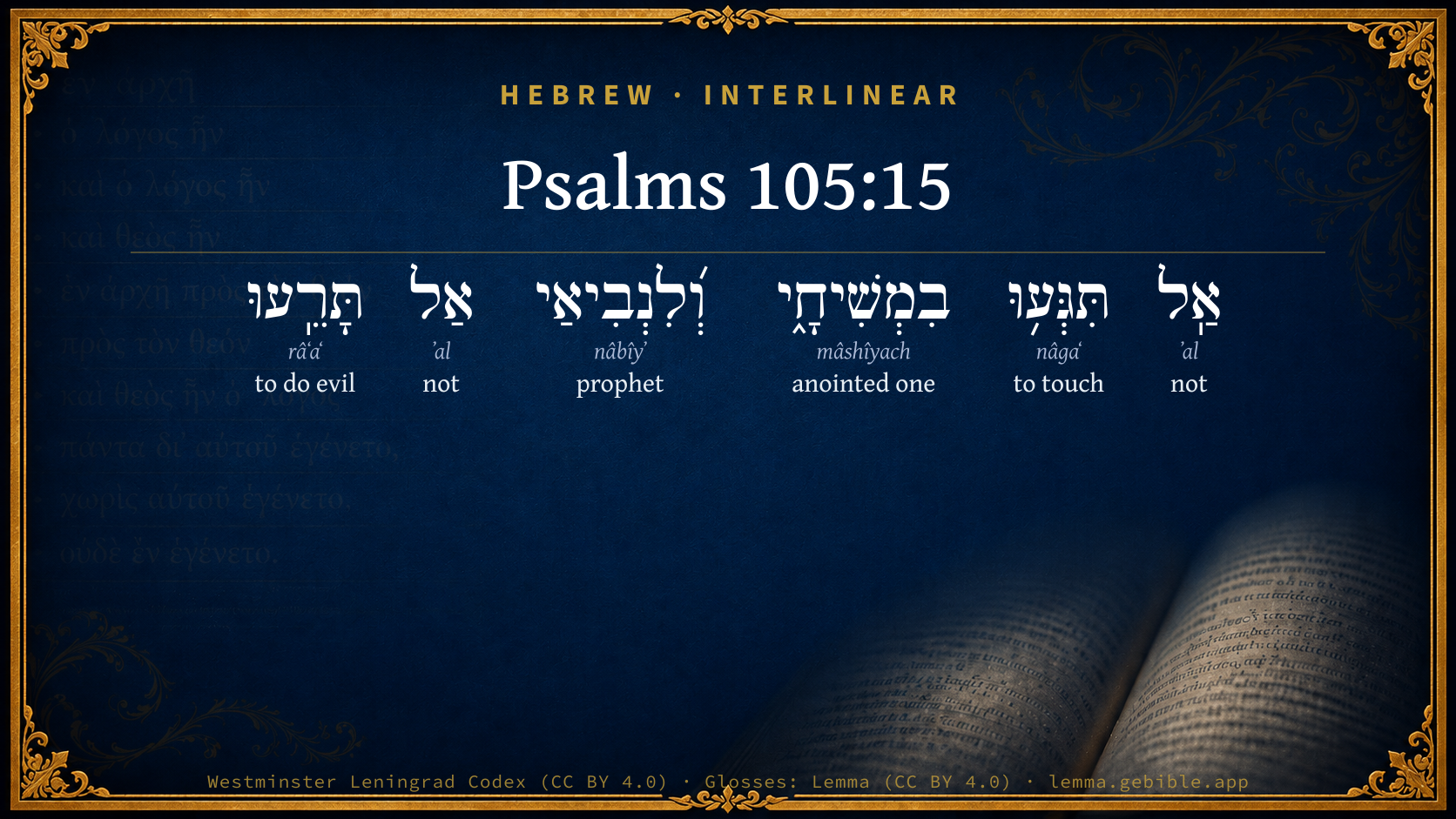
Hebrew (Westminster Leningrad Codex) Psalms 105:15 appears in the Hebrew Old Testament. The text above is from the Westminster Leningrad Codex. Each word links to its Strong’s number, a concise gloss, and parsing drawn from the Open Scriptures Hebrew Bible morphology. Click any word for its full Brown-Driver-Briggs (BDB) entry.
Download image
Cite this verse

Psalms 105:15 (World English Bible). Public Domain. Lemma interlinear Bible study tool, https://lemma.gebible.app/v/psalms/105/15.

Show BibTeX & RIS
BibTeX
RIS
English Translation
"Don't touch my anointed ones! Do my prophets no harm!"
World English Bible · Public Domain
Download a study sheet

One document with this verse’s original text, its word-by-word gloss line, the meaning frame, cross-references with their text, attributed commentary, and full source and license credits — printable, and it pastes into notes with its structure intact.

This verse Autodidact and up

Study sheet (.html) Plain text (.txt)

A passage Seminary Student

Up to 50 verses in one chapter. A passage sheet keeps up to 6 commentary sources and 12 cross-references per verse, in the order this page ranks them, and says so on the sheet whenever that leaves anything out. Ask for a single verse and you get the Autodidact verse sheet above.

Everything on this page stays free to read, with no account — the sheet is a download of what is already on screen, not access to it.

Want to remove ads? Support Godless Engineer
Compare translations 3

The same verse in 3 English versions, stacked beneath the original-language interlinear above. Click any original word for its lexicon entry.

Each is an independent rendering of the whole verse — the interlinear is not word-aligned to these translations.

Highlighted words mark where these versions differ — a whole-verse word diff, not a word-by-word alignment.

  • World English Bible Public Domain
    "Don't touch my anointed ones! Do my prophets no harm!"
  • King James Version Public Domain
    Saying, Touch not mine anointed, and do my prophets no harm.
  • unfoldingWord Literal Text CC BY-SA 4.0
    “Do not touch my anointed ones, and do not harm my prophets.”

unfoldingWord Literal Text — © unfoldingWord, licensed CC BY-SA 4.0. Word-aligned USFM3 via Door43 (git.door43.org/unfoldingWord/en_ult).

Versions to compare (up to 4)

3 of 4 selected

Show all 18 translations

Every available English version of this verse, each an independent rendering of the whole verse.

  • World English Bible Public Domain
    "Don't touch my anointed ones! Do my prophets no harm!"
  • Berean Standard Bible Public Domain
    “Do not touch My anointed ones! Do no harm to My prophets!”
  • Majority Standard Bible Public Domain
    “Do not touch My anointed ones! Do no harm to My prophets!”
  • King James Version Public Domain
    Saying, Touch not mine anointed, and do my prophets no harm.
  • American Standard Version (1901) Public Domain
    `Saying', Touch not mine anointed ones, And do my prophets no harm.
  • Revised Version (1885) Public Domain
    Saying, Touch not mine anointed ones, and do my prophets no harm.
  • Geneva Bible (1599) Public Domain
    Touche not mine anointed, and doe my Prophets no harme.
  • Douay-Rheims (1899) Public Domain
    Touch ye not my anointed: and do no evil to my prophets.
  • Young's Literal Translation Public Domain
    `Strike not against Mine anointed, And to My prophets do not evil.'
  • Literal Standard Version CC BY-SA 4.0
    “Do not strike against My anointed, || And do no evil to My prophets.”
  • Unlocked Literal Bible CC BY-SA 4.0
    He said, “Do not touch my anointed ones, and do not harm my prophets.”
  • unfoldingWord Literal Text CC BY-SA 4.0
    “Do not touch my anointed ones, and do not harm my prophets.”
  • Darby Bible Public Domain
    [Saying,] Touch not mine anointed ones, and do my prophets no harm.
  • World Messianic Bible Public Domain
    “Don’t touch my anointed ones! Do my prophets no harm!”
  • Webster's Bible Public Domain
    Saying, Touch not my anointed, and do my prophets no harm.
  • Free Bible Version CC BY-SA 4.0
    “Don't touch my chosen people; don't harm my prophets!”
  • Bible in Basic English Public Domain
    Saying, Put not your hand on those who have been marked with my holy oil, and do my prophets no wrong.
  • JPS Tanakh (1917) Public Domain
    'Touch not Mine anointed ones, and do My prophets no harm.'

Literal Standard Version (2020), Covenant Press — licensed CC BY-SA 4.0. Text via the HelloAO Bible API (eBible.org). Unlocked Literal Bible (unfoldingWord) — licensed CC BY-SA 4.0. Text via the HelloAO Bible API (eBible.org). unfoldingWord Literal Text — © unfoldingWord, licensed CC BY-SA 4.0. Word-aligned USFM3 via Door43 (git.door43.org/unfoldingWord/en_ult). Free Bible Version, Dr. Jonathan Gallagher — licensed CC BY-SA 4.0. Text via the HelloAO Bible API (eBible.org).

Word by word

More ways to search: Search by grammar → Find every occurrence → Compare this word →

Practice this passage: Drill this verse → Learn its vocabulary →

About this verse

These counts appear in no published source. They are computed here, from the morphology-tagged text and Lemma’s own curated glosses. What Lemma adds →

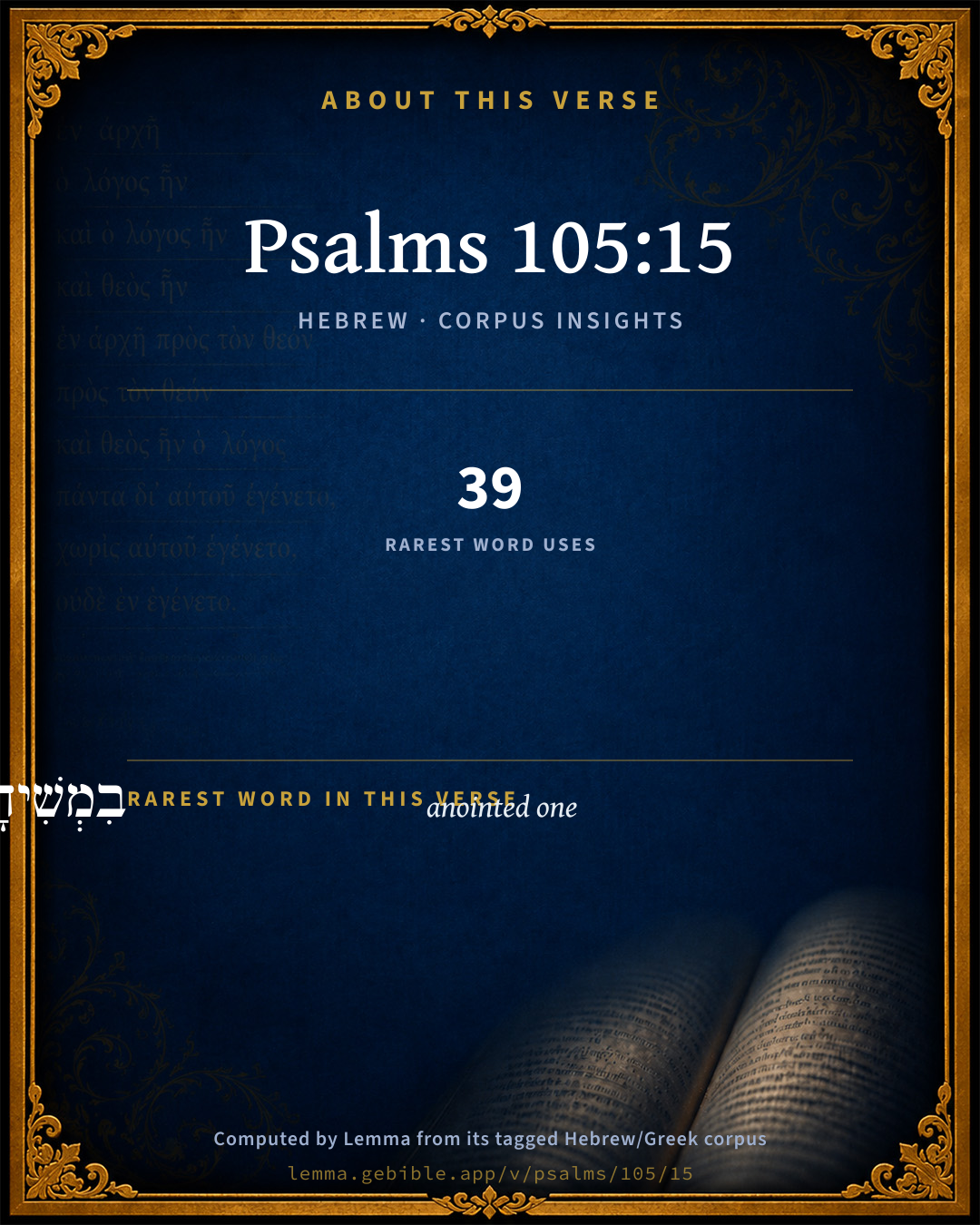
6
words
5
distinct lemmas
Wisdom
section

Shared distinctive vocabulary

בִמְשִׁיחָ֑י anointed one H4899 occurs in 38 verses of the Hebrew Bible. Also found in:

Grammatical profile

  • 2 verbs
  • 2 nouns
  • 2 particles

Verb forms

  • תִּגְּע֥וּ Qal · Jussive
  • תָּרֵֽעוּ Hiphil · Jussive

Repetition

A word recurs within this verse — often emphatic in Hebrew:

  • אַֽל not H408 ×2

Hebrew & Septuagint length

In English translation the verse runs 10 words from the Hebrew and 12 from the Septuagint (LXX English) — closely comparable.

A rough comparison of the two English renderings, which tokenize alike — not a word-level alignment.

Word counts can differ between the Hebrew and the Greek without any difference in meaning — e.g. the Hebrew direct-object marker אֵת has no separate Greek word, and Greek often adds the article ὁ.

Cross-references

6

Topical passages linked to Psalms 105:15 in the Treasury of Scripture Knowledge — connected by theme and wording, ordered by reader-vote popularity; previews shown in the World English Bible.

  • Zechariah 2:8 For thus says Yahweh of hosts: 'For honor he has sent me to the nations which plundered you; for he who touches you touches the apple of his eye.
  • Genesis 26:11 Abimelech charged all the people, saying, "He who touches this man or his wife will surely be put to death."
  • Genesis 20:7 Now therefore, restore the man's wife. For he is a prophet, and he will pray for you, and you will live. If you don't restore her, know for sure that you will die, you, and all who are yours."
  • 1 John 2:27 As for you, the anointing which you received from him remains in you, and you don't need for anyone to teach you. But as his anointing teaches you concerning all things, and is true, and is no lie, and even as it taught you, you will remain in him.
  • Genesis 49:8–33 "Judah, your brothers will praise you: Your hand will be on the neck of your enemies; Your father's sons will bow down before you.
  • Genesis 48:19–20 His father refused, and said, "I know, my son, I know. He also will become a people, and he also will be great. However, his younger brother will be greater than he, and his seed will become a multitude of nations."

Cross-references courtesy of OpenBible.info (CC BY 4.0).

Hebrew and Greek witnesses Masoretic Hebrew ↔ Greek Septuagint

The same verse in the two great witnesses to the Old Testament, shown verse-for-verse.

You’re reading Greek Psalm 104 (Hebrew Psalm 105). The Septuagint counts the superscription, so verse numbers can differ from the Hebrew — chapter-level alignment, not verse-by-verse. Numbering follows Rahlfs.

These are two independent witnesses, not word-aligned to each other, and the Septuagint is shown in lemma (dictionary) form.

Hebrew Psalms 105:15 Masoretic · Westminster Leningrad Codex

אַֽל תִּגְּע֥וּ בִמְשִׁיחָ֑י וְ֝לִנְבִיאַי אַל תָּרֵֽעוּ

"Don't touch my anointed ones! Do my prophets no harm!"

World English Bible · Public Domain

Greek LXX Greek Psalm 104:15 Septuagint · lemma form

μή ἅπτομαι ὁ χριστός ἐγώ καί ἐν ὁ προφήτης ἐγώ μή πονηρεύομαι

saying, Touch not my anointed ones; and do my prophets no harm.

LXX2012 (modern English Septuagint) · Public Domain

Hebrew: Westminster Leningrad Codex (CC BY 4.0). Greek: Septuagint (public domain); English from LXX2012 (modern English Septuagint) (Public Domain). How the Septuagint differs from the Hebrew →

Commentary

Notes on Psalms 105:15 from classic Christian and Jewish commentators (each source and its license shown beneath its notes). The classic Christian expositions comment on the surrounding passage and are grouped to its opening verse, so a note may address several verses; the Jewish commentaries on the Tanakh (Rashi and others) are per-verse, so they appear only where the commentator wrote on this verse.

Lemma curates 59 commentaries, every one of them public domain or Creative Commons licensed, each selected and text-cleaned for this edition rather than reprinted as found. About our sources →

Trapp's Complete Commentary

John Trapp

Psa 105:15 [Saying], Touch not mine anointed, and do my prophets no harm.

Ver. 15. Touch not mine anointed, &c.] This God speaketh not of kings, but to kings, concerning his people who have an unction from the Father, being sanctified and set apart for his peculiar. To touch these is to touch the apple of God’s eye, Zec 2:8; they are sacred persons.

And do my prophets no harm] The patriarchs were such, Gen 20:7, so are still all godly ministers, whom they who harm by word or deed have not so much knowledge as Pilate’s wife had in a dream. See Psa 14:4.

John Trapp, A Commentary or Exposition upon All the Books of the Old and New Testament (1647–1656) — public domain. Text from a community e-Sword module.

The Biblical Illustrator

Joseph S. Exell

Psa_105:15

Touch not Mine anointed, and do My prophets no harm.

The inviolable Messiahs and prophets

I. Every Christian is a Messiah. Jesus was the Christ, the Messias, because that Divine Spirit dwelt in Him without measure. And if we are Christians in the real sense of the word, then, however imperfectly, yet really, and by Gods grace increasingly, there is such a union between us and our Saviour as that into us there does flow the anointing of His Spirit. And, there being a community of life derived from the Source of Life, it is no presumption to say that every Christian man is a Christ.

II. Every Christian is a prophet. The word is connected with a root which means to boil, or bubble, like a fountain. It expresses, not so much the theme of the utterance as its nature. The welling up, from a full heart, of Gods thoughts and Gods truth, that is prophecy. The patriarchs were prophets, in the sense of being bearers of a Divine Word, breathed into them by that anointing Spirit, that it may be uttered forth by them. That sort of prophetic inspiration belongs to all Christians. Every one who has been anointed will be thus gifted. A silent Christian is an anomaly, a contradiction in terms, as much as black light, or dark stars. If Christ is in you He will come out of you. If your hearts are full the crystal treasure will flow over the brim.

III. Every Christian, in his double capacity of anointed and prophet, is watched over by God. There is no real harm in so-called evil. That is the interpretation that Christianity gives to such words as this of my text, not because it is forced to weaken them by the obstinate facts of life, but because it has learnt to strengthen them by the understanding of what is harm and what is good; what is gain and what is loss. (A. Maclaren, D.D.)

The Biblical Illustrator, edited by Joseph S. Exell (c. 1880s–1900s) — public domain. Text from a community e-Sword module.

J. A. Alexander on Psalms

Joseph Addison Alexander

15. (Psa 105:15) Touch not mine anointed ones, and to my prophets do no harm. These are the words of God himself, and are designated as such in the English Bible, by supplying the word saying, which is expressed in the analogous case, ver. 11. Touch not, as in Gen 26:11; Gen 26:29. In the Old Testament, unction is the symbol of spiritual gifts, and especially of those imparted to the great theocratical offices. See above, on Psa 2:2. From the case of Elisha (1Ki 19:16) it would seem that prophets were anointed when inducted into office. The patriarchs are here called prophets in the proper sense of the term, as denoting men inspired of God, and admitted to confidential intercourse with him. The allusion here is to Gen 20:7, where God says to Abimelech of Abraham, "Restore the man his wife, for he is a prophet, and he will pray for thee, and thou shalt live."

Joseph Addison Alexander, The Psalms Translated and Explained (1850) — public domain. Text from a community e-Sword module.

Tyndale Open Study Notes

Tyndale Open Resources

105:15 Abraham was one of the nation’s prophets (Gen 20:7).

Tyndale Open Study Notes — © Tyndale Open Resources, licensed CC BY-SA 4.0. Text via the HelloAO Bible API.

Geneva Bible (1599)

Geneva Bible translators

Those whom I have sanctified to be my people.

Meaning, the old fathers, to whom God showed himself plainly, and who were setters forth of his word.

Geneva Bible (1599) marginal notes — public domain. Text via Bolls.life.

Adam Clarke's Commentary

Verse 15. Touch not mine anointed] It is supposed that the patriarchs are here intended; but the whole people of Israel may be meant. They were a kingdom of priests and kings unto God; and prophets, priests, and kings were always anointed.

Adam Clarke's Commentary on the Bible (1810–1826) — public domain. Text from a community e-Sword/MySword module.

John Calvin's Commentaries

15. Saying, Touch not my anointed ones The Psalmist proceeds farther, affirming, that when God made war against kings for the sake of his servants, they were defended by him, not only as he is accustomed to succor the miserable and the unjustly oppressed, but because he had taken them under his special guardianship. God protects his people, not only upon a general ground, but because he has declared on account of his free adoption, that he will maintain them. This is the reason why these holy patriarchs are here honored with two designations, his prophets and his anointed ones In speaking of other men, God would have said, Touch not these men who have done wrong to nobody, hurt not these poor wretched creatures who have deserved no such treatment at your hands. But in the person of Abraham and his children, he shows that there was another reason for his defending them. He calls them anointed ones, because he had set them apart to be his peculiar people. In the same sense, he designates them prophets, (a title with which Abraham is also honored, Genesis 20:7) not only because God had manifested himself more intimately to them, but also because they faithfully spread around them divine truth, that the memory of it might survive them, and flourish after their death. Anointing, it is true, was not as yet in use, as it was afterwards under the law; but the prophet teaches, that what God at a subsequent period exhibited in the ceremonies of the law was really and in very deed in Abraham, even as God engraves the mark of sanctification on all his chosen ones. If God’s inward anointing was of such powerful efficacy, even at the time when he had not yet appointed, or delivered the figures of the law, with how much greater care will he defend his servants now, after having exhibited to us the plenitude of anointing in his only begotten Son!

John Calvin's Commentaries (1540-1563) — public domain. Text from the Calvin Translation Society English edition (1840s-50s) via the Christian Classics Ethereal Library (ccel.org). Calvin's coverage is partial (roughly two-thirds of the Bible); uncommented books and verses are honest gaps, never fabricated. The 19th-century editor's footnotes and remarks are omitted so the notes are faithfully Calvin's own voice.

Ellicott's Commentary for English Readers

(15) Anointed.—In the plural, “my anointed ones.” As referring to the patriarchs, the expression is not technical, since they were never, like priests, prophets, and kings in later times, actually anointed. But the terms being sometimes applied to the covenant people as a whole (see Psa_89:38; Psa_89:51), its application to the founders of the race, especially those to whom the “promises came,” is very just.

As to the term “prophet,” the poet found it expressly conferred on Abraham in Gen_20:7.

A Bible Commentary for English Readers, edited by Charles John Ellicott (1878–1897) — public domain. Text from a community e-Sword module.

The Cambridge Bible for Schools and Colleges

gen. ed. J. J. S. Perowne

15. Jehovah’s words. Saying is rightly supplied.

Touch not] The phrase is suggested by Gen_20:6; cp. Psa_26:11.

mine anointed ones … my prophets] The patriarchs were not actually anointed, but the term is applied to them as bearing the seal of a Divine consecration in virtue of which their persons were sacred and inviolable. Abraham is called a prophet in Gen_20:7 as an intercessor, and the term is applied to the patriarchs generally as the recipients of Divine revelation.

16 ff. The events which led to the migration of Jacob into Egypt.

The Cambridge Bible for Schools and Colleges (gen. ed. J. J. S. Perowne; Cambridge University Press, 1878–1918) — public domain. Text from a community e-Sword module.

John Gill's Exposition

Saying, Touch not mine anointed,.... Or, "mine anointed ones"; my Christs, as Abraham, Isaac, and Jacob, were, who, though not anointed with material oil, yet were all that, that such were, who in later times were anointed with it. They were prophets, priests, and kings; and which all met in one person, particularly in Abraham, Gen 20:7, besides, they were anointed with the oil of grace, with an unction from the Holy One, with the Holy Ghost, and his gifts and graces, as all true believers are: they are the Lord's Christs, or his anointed ones; which stand before him, and have the name of Christians from hence. These the Lord will not have touched, so as to be hurt; they are sacred persons: they are near unto God, in union with him;

and he that toucheth him toucheth the apple of his eye; so dear are they to him.

And do my prophets no harm; so Abraham is expressly called a prophet, Gen 20:7, and so were Isaac and Jacob; men to whom the Lord spoke familiarly in dreams and visions, as he used to do with prophets; and who taught and made known the mind and will of God to others, as well as foretold things to come; they being the Lord's servants, his prophets, they were revealed unto them, Num 12:7. These the Lord will have no harm done to them; he guards them by his power; he holds them in his right hand; and covers them under the shadow of his wing.

John Gill's Exposition of the Whole Bible (1746–1763) — public domain (CC PDM 1.0). Text via the HelloAO Bible API.

Albert Barnes' Notes on the Bible

Saying, Touch not mine anointed - That is, This was the language of his “providence.” It was as though God had said this. It is not meant that this was said in so many words, but this is the “poetic” form of representing the dealings of Providence. Compare Gen 26:11. The word “anointed” here means that God had, as it were, set them apart to his service, or that they were to him as kings, and priests, and prophets, sacred people, belonging to God. The “language” is not found in the Old Testament as applied to the patriarchs, but the “idea” is fairly implied there, that they belonged to God as sacred and holy men.

And do my prophets no harm - As if God had thus spoken to them, and called them prophets. That is, they belonged to God as a sacred order: they were separate from other men, and God regarded them as his own.

Albert Barnes' Notes on the Bible (1834–1885) — public domain. Text from a community e-Sword/MySword module.

Matthew Poole's English Annotations

Touch not; hurt not, as this word is used of these very persons, Gen 26:11,29, and elsewhere.

Mine anointed; my prophets, as the next words explain it, to wit, Abraham, and Isaac, and Jacob, as is evident; who are called God’s anointed, because they were eminently blessed of God, and consecrated to be his peculiar people, and to be kings and priests in their families, and replenished with the gifts and graces of the Holy Ghost, in respect whereof many persons are said to be anointed in Scripture who never had any material oil applied to them, as Psa 45:7; Isa 61:1; 2Co 1:21. And they are called

prophets, because God did familiarly converse with them, and revealed his mind and will to them, and by them to others; and because they were instructors or teachers of others in the true religion. See Gen 18:19; 20:7.

Matthew Poole's English Annotations on the Holy Bible (1683–1685) — public domain. Text from a community e-Sword/MySword module.

The Treasury of David

Charles H. Spurgeon

Ver. 15. Saying, touch not mine anointed, and do my prophets no harm. Abraham and his seed were in the midst of the world a generation of priests anointed to present sacrifice unto the most High God; since to them the oracles were committed, they were also the prophets of mankind; and they were kings tooa royal priesthood; hence they had received a threefold anointing. Their holy office surrounded them with a sacredness which rendered it sacrilege to molest them. The Lord was pleased to impress the wild tribes of Canaan with a respectful awe of the pious strangers who had come to abide with them, so that they came not near them to do them ill. The words here mentioned may not have been actually spoken, but the impression of awe which fell upon the nations is thus poetically described. God will not have those touched who have been set apart unto himself He calls them his own, saying, "Mine anointed" he declares that he has "anointed" them to be prophets, priests, and kings unto himself, and yet again he claims them as his prophets"Do my prophets no harm." All through the many years in which the three great fathers dwelt in Canaan no man was able to injure them; they were not able to defend themselves by force of arms; but the eternal God was their refuge. Even so at this present time the remnant according to the election of grace cannot be destroyed, nay, nor so much as touched, without the divine consent. Against the church of Christ the gates of hell cannot prevail. In all this we see reasons for giving thanks unto the Lord, and proclaiming his name according to the exhortation of the first verse of the Psalm. Here ends the portion which was sung at the moving of the ark: its fitness to be used for such a purpose is very manifest, for the ark was the symbol both of the covenant and of that mystic dwelling of God with Israel which was at once her glory and her defence. None could touch the Lord's peculiar ones, for the Lord was among them, flaming forth in majesty between the cherubims.

The presence of God having remained with his chosen ones while they sojourned in Canaan, it did not desert them when they were called to go down into Egypt. They did not go there of their own choice, but under divine direction, and hence the Lord prepared their way and prospered them until he saw fit to conduct them again to the land of promise.

Ver. 15. Mine anointed. Abraham, Isaac, and Jacob had no external anointing. They were, however, called "anointed, "because they were separated by God from the multitude of wicked men, and endowed with the Spirit and his gifts, of which the oil was an emblem. Mollerus.

Ver. 15. Touch not mine anointed, and do my prophets no harm. We see here a vivid description of the people of God. They are "his anointed ones, ""having the residue of his Spirit"; they are his prophets, to whom is intrusted the word of life, that they may be witnesses in the world. To these he gives as it were a safe passport through the world. Though they have ever been but men of number, accounted as a vile thing, they are precious in his sight. They are not distinguished by external dignity, numbers and power, as Rome sets forth the marks of her communion. They are in the midst of kingdoms, but not of them. They form usually the humblest portions of most communities, and yet they receive honour from God. Despised by the world, but unto God kings and priests, ordained and anointed to reign with Christ for ever. W. Wilson.

Ver. 15. Prophets. The aybk is the prophet, or forth speaker; the term laying stress on the utterance, and not upon the vision. The Hebrew word comes from a root which means to bubble up and overflow as from a full fountain. But the fulness of the true prophets of Jehovah was not that of their own thoughts and emotions. It was of the Divine Spirit within them. "The prophecy came not in old time by the will of man: but holy men of God spake as they were moved by the Holy Ghost, "2Pe 1:21. The first application of the word is to Abraham (Ge 2:7); although, long before Abraham, "Enoch the seventh from Adam, prophesied, "Jude 14. Donald Fraser, in "Synoptical Lectures on the Books of Holy Scripture." 1873.

Ver. 15. In what respect Abraham was a prophet, and how far believers are the same.

Psalms 105:16*

Charles H. Spurgeon's The Treasury of David (1869–1885) — public domain. Psalms only. Text from a community e-Sword/MySword module.

Whedon's Commentary on the Bible

Daniel D. Whedon

15. Anointed—The “anointed” was the one set apart to a special purpose or office, whether as king, priest, or prophet, by pouring oil upon the head. In the Old Testament this anointing was a standing symbol of what we denominate, in New Testament times, the grace, gifts, and callings of the Holy Spirit. In the text it applies to the three Hebrew patriarchs.

Prophets—Same as anointed. So called Gen_20:7. The word here takes its radical sense—one who speaks under a divine influence.

Daniel D. Whedon (gen. ed.), Commentary on the Old and New Testaments (1874–1909) — public domain. Text from a community e-Sword module.

The Pulpit Commentary

Saying, Touch not mine anointed; literally, mine anointed ones; i.e. those consecrated to my service, as were Abraham, Isaac, and Jacob. And do my prophets no harm. (comp. Gen_20:7 Gen_27:27-29 and 39, 40; Gen_49:3-27) The actual words of this verse do not occur in Genesis, but they express the lesson which God"s dealings with Pharaoh and Abimelech taught the kings and peoples.

Divine defence.

"Touch not mine anointed ones" (Revised Version). The reference is evidently to the patriarchs; and they are spoken of in the light of later associations, classified with those who received special Divine communications. "They were as kings and priests before God; therefore they are called "his anointed;" they had the word, they knew the spirit of the Lord, therefore they are his "prophets. (Illustrate the term "prophet" from Gen_20:7) The psalmist had some special instances in his mind, which he regarded as representative of the Divine defence that is always overshadowing God"s faithful people. They are cases in which the three great patriarchs moved into the territory of alien or alienated people, and were preserved from all harm.

I DIVINE DEFENCE OF ABRAHAM IN CANAAN, EGYPT, AND GERAR. Journeying into Canaan, which was then occupied by several nations, we might have expected his coming to have excited jealousy, it not fear. His tribe was large, his flocks and herds were abundant; he must have eaten up the land as he passed through it. But the Divine defence was over him, and his course was practically unhindered. He never had to fight for any position. God made his way. In Egypt, and again in Gerar, he was placed in much anxiety, and in some peril, by the licentious customs of the age. But the Divine defence was over him and his no evil befell him; and even the seeming evil proved to be for his own moral good, and for other people"s.

II DIVINE DEFENCE OF ISAAC IN PHILISTIA. From a similar anxiety to that which Abraham had experienced, and from the strife which arose about the wells that Isaac digged. It is well to notice that, in the matter of the wells, the Divine defence worked along with Isaac"s wise self-restraint, and refusal to make quarrels.

III DIVINE DEFENCE OF JACOB IN SYRIA, AND IN ESAU"S COUNTRY. Laban of Syria was far more of an enemy than a friend to Jacob. How much the patriarch had to endure! But God ever watched over him. The supreme peril of Jacob"s life was that return to Canaan which involved his meeting the justly offended Esau. Even then we find him within the Divine defence. R.T.

The Pulpit Commentary (1880–1919), ed. H.D.M. Spence-Jones & Joseph S. Exell — public domain. Text from a community e-Sword module.

John Wesley's Explanatory Notes

Anointed - My prophets, Abraham, Isaac, and Jacob; who are called God's anointed, because they were consecrated to be his peculiar people, and to be kings and princes in their families. And they are called prophets, because God familiarly conversed with them and revealed his will to them, and by them to others.

John Wesley, Explanatory Notes Upon the Whole Bible (1754–1765) — public domain. Text via the GEBible commentary corpus.

Rashi

Rabbi Shlomo Yitzchaki (Rashi)

My anointed ones My great ones. Every [expression of] anointing is an expression of rulership and greatness.

Rashi on the Tanakh — English translations: “The Judaica Press complete Tanach with Rashi, translated by A. J. Rosenberg” (CC BY 4.0); “Pentateuch with Rashi's commentary by M. Rosenbaum and A.M. Silbermann, 1929-1934” (public domain); “The Metsudah Tanach series, Lakewood, N.J” (CC BY 4.0); and “The Book of Joshua, Metsudah Publications, 1997” (CC BY 4.0). Text via Sefaria.

Lesson kit

Teaching starters — assembled from the data on this page, not authored interpretation. Every prompt links to the verse data it draws on. Edit before teaching.

Psalms, in the Wisdom, opens this verse with 6 words (5 distinct Hebrew lemmas). Its most distinctive word is mâshîyach (“anointed one”). A historical commentator’s framing appears above. Read the whole chapter for the surrounding context.

Discussion questions

  1. How does “anointed one” (mâshîyach) shape what this verse is saying?
  2. Leviticus 4:3 shares the word «anointed one» with this verse. How do the two illuminate each other?
  3. “not” occurs 2× in this one verse. What is the effect of the repetition?
  4. The translations on this page render this verse differently — a whole-verse word diff, not a word-by-word alignment. What might account for the different wordings?
  5. The verb «תִּגְּע֥וּ» is Qal Jussive. How does its form color the action?
  6. Reading how Trapp's Complete Commentary and The Biblical Illustrator read this verse, where do the two commentators agree and where do they part?

Things to notice

Reading settings

Reading text

Shown beneath each verse's original-language words.

Old Testament
Old Testament edition

Read the OT as the Masoretic Hebrew (MT) or the Greek Septuagint (LXX).

English shown for the Greek Septuagint (in the Hebrew ↔ Greek comparison).

Comparing translations? Open the Compare panel on any verse page to stack up to four side by side.