Micah 1:9

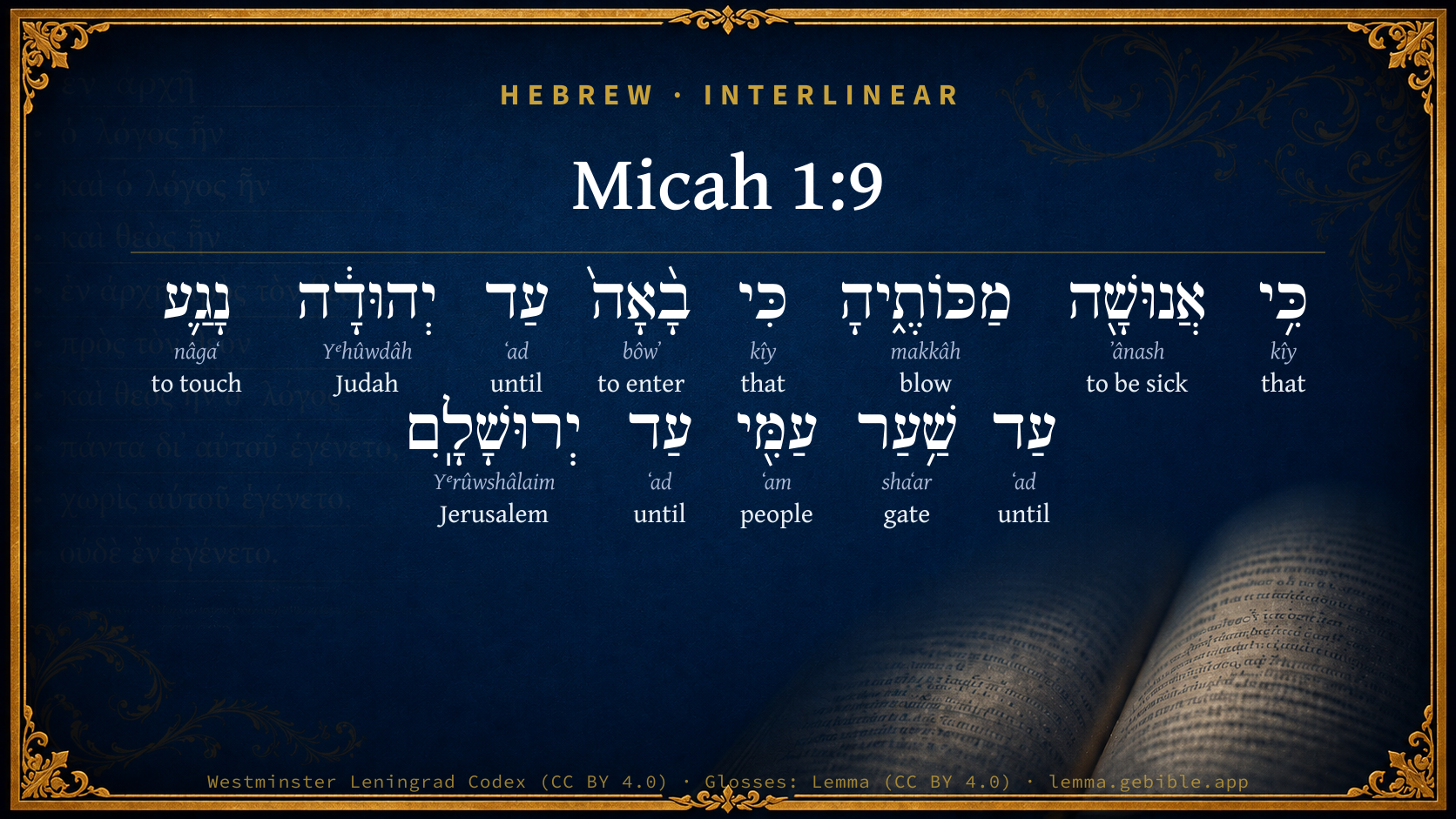
Hebrew (Westminster Leningrad Codex) Micah 1:9 appears in the Hebrew Old Testament. The text above is from the Westminster Leningrad Codex. Each word links to its Strong’s number, a concise gloss, and parsing drawn from the Open Scriptures Hebrew Bible morphology. Click any word for its full Brown-Driver-Briggs (BDB) entry.
Download image
Cite this verse

Micah 1:9 (World English Bible). Public Domain. Lemma interlinear Bible study tool, https://lemma.gebible.app/v/micah/1/9.

Show BibTeX & RIS
BibTeX
RIS
English Translation
For her wounds are incurable; For it has come even to Judah. It reaches to the gate of my people, Even to Jerusalem.
World English Bible · Public Domain
Download a study sheet

One document with this verse’s original text, its word-by-word gloss line, the meaning frame, cross-references with their text, attributed commentary, and full source and license credits — printable, and it pastes into notes with its structure intact.

This verse Autodidact and up

Study sheet (.html) Plain text (.txt)

A passage Seminary Student

Up to 50 verses in one chapter. A passage sheet keeps up to 6 commentary sources and 12 cross-references per verse, in the order this page ranks them, and says so on the sheet whenever that leaves anything out. Ask for a single verse and you get the Autodidact verse sheet above.

Everything on this page stays free to read, with no account — the sheet is a download of what is already on screen, not access to it.

Want to remove ads? Support Godless Engineer
Compare translations 3

The same verse in 3 English versions, stacked beneath the original-language interlinear above. Click any original word for its lexicon entry.

Each is an independent rendering of the whole verse — the interlinear is not word-aligned to these translations.

Highlighted words mark where these versions differ — a whole-verse word diff, not a word-by-word alignment.

  • World English Bible Public Domain
    For her wounds are incurable; For it has come even to Judah. It reaches to the gate of my people, Even to Jerusalem.
  • King James Version Public Domain
    For her wound is incurable; for it is come unto Judah; he is come unto the gate of my people, even to Jerusalem.
  • unfoldingWord Literal Text CC BY-SA 4.0
    For her wounds incurable, for it has come to Judah. It has reached to the gate of my people, to Jerusalem.

unfoldingWord Literal Text — © unfoldingWord, licensed CC BY-SA 4.0. Word-aligned USFM3 via Door43 (git.door43.org/unfoldingWord/en_ult).

Versions to compare (up to 4)

3 of 4 selected

Show all 18 translations

Every available English version of this verse, each an independent rendering of the whole verse.

  • World English Bible Public Domain
    For her wounds are incurable; For it has come even to Judah. It reaches to the gate of my people, Even to Jerusalem.
  • Berean Standard Bible Public Domain
    For her wound is incurable; it has reached even Judah; it has approached the gate of my people, as far as Jerusalem itself.
  • Majority Standard Bible Public Domain
    For her wound is incurable; it has reached even Judah; it has approached the gate of my people, as far as Jerusalem itself.
  • King James Version Public Domain
    For her wound is incurable; for it is come unto Judah; he is come unto the gate of my people, even to Jerusalem.
  • American Standard Version (1901) Public Domain
    For her wounds are incurable; for it is come even unto Judah; it reacheth unto the gate of my people, even to Jerusalem.
  • Revised Version (1885) Public Domain
    For her wounds are incurable: for it is come even unto Judah; it reacheth unto the gate of my people, even to Jerusalem.
  • Geneva Bible (1599) Public Domain
    For her plagues are grieuous: for it is come into Iudah: the enemie is come vnto the gate of my people, vnto Ierusalem.
  • Douay-Rheims (1899) Public Domain
    Because her wound is desperate, because it is come even to Juda, it hath touched the gate of my people even to Jerusalem.
  • Young's Literal Translation Public Domain
    For mortal `are' her wounds, For it hath come unto Judah, It hath come to a gate of My people -- to Jerusalem.
  • Literal Standard Version CC BY-SA 4.0
    For mortal [are] her wounds, || For it has come to Judah, || It has come to a gate of My people—to Jerusalem.
  • Unlocked Literal Bible CC BY-SA 4.0
    For her wound is incurable, for it has come to Judah. It has reached the gate of my people, to Jerusalem.
  • unfoldingWord Literal Text CC BY-SA 4.0
    For her wounds incurable, for it has come to Judah. It has reached to the gate of my people, to Jerusalem.
  • Darby Bible Public Domain
    For her wounds are incurable; for it is come even unto Judah, it reacheth unto the gate of my people, even to Jerusalem.
  • World Messianic Bible Public Domain
    For her wounds are incurable; for it has come even to Judah. It reaches to the gate of my people, even to Jerusalem.
  • Webster's Bible Public Domain
    For her wound is incurable; for it is come to Judah; he is come to the gate of my people, even to Jerusalem.
  • Free Bible Version CC BY-SA 4.0
    Their wound cannot be healed, it has extended to Judah, and reached right to the gates of Jerusalem.
  • Bible in Basic English Public Domain
    For her wounds may not be made well: for it has come even to Judah, stretching up to the doorway of my people, even to Jerusalem.
  • JPS Tanakh (1917) Public Domain
    For her wound is incurable; for it is come even unto Judah; it reacheth unto the gate of my people, even to Jerusalem.

Literal Standard Version (2020), Covenant Press — licensed CC BY-SA 4.0. Text via the HelloAO Bible API (eBible.org). Unlocked Literal Bible (unfoldingWord) — licensed CC BY-SA 4.0. Text via the HelloAO Bible API (eBible.org). unfoldingWord Literal Text — © unfoldingWord, licensed CC BY-SA 4.0. Word-aligned USFM3 via Door43 (git.door43.org/unfoldingWord/en_ult). Free Bible Version, Dr. Jonathan Gallagher — licensed CC BY-SA 4.0. Text via the HelloAO Bible API (eBible.org).

Word by word

More ways to search: Search by grammar → Find every occurrence → Compare this word →

Practice this passage: Drill this verse → Learn its vocabulary →

אֲנוּשָׁ֖ה
ʼânash
H605
“incurable”
Adjective, Adjective, Feminine, Singular, Absolute
Part of Speech
Adjective
Type
Adjective
Gender
Feminine
Number
Singular
State
Absolute
Full BDB Definition

Origin: a primitive root

TWOT: 135

to be weak, sick, frail - (Qal) - to be incurable - to be sick - desperate, incurable, desperately wicked, woeful, very sick (passive participle) (metaphorically) - (Niphal) to be sick
  1. כִּ֥י kîy H3588 “that” Conjunction
  2. מַכּוֹתֶ֑יהָ makkâh H4347 “blows · her” Noun, Common, Feminine, Plural, Construct + Suffix, Personal, 3rd Person, Feminine, Singular
  3. כִּי kîy H3588 “that” Conjunction
  4. בָ֨אָה֙ bôwʼ H935 “to enter” Verb, Qal, Perfect, 3rd Person, Feminine, Singular
  5. עַד ʻad H5704 “until” Preposition
  6. יְהוּדָ֔ה Yᵉhûwdâh H3063 “Judah” Noun, Proper
  7. נָגַ֛ע nâgaʻ H5060 “to touch” Verb, Qal, Perfect, 3rd Person, Masculine, Singular
  8. עַד ʻad H5704 “until” Preposition
  9. שַׁ֥עַר shaʻar H8179 “gate of” Noun, Common, Masculine, Singular, Construct
  10. עַמִּ֖י ʻam H5971 “people · my” Noun, Common, Masculine, Singular, Construct + Suffix, Personal, 1st Person, Common, Singular
  11. עַד ʻad H5704 “until” Preposition
  12. יְרוּשָׁלִָֽם Yᵉrûwshâlaim H3389 “Jerusalem” Noun, Proper

About this verse

These counts appear in no published source. They are computed here, from the morphology-tagged text and Lemma’s own curated glosses. What Lemma adds →

13
words
10
distinct lemmas
Prophets
section

Notable vocabulary

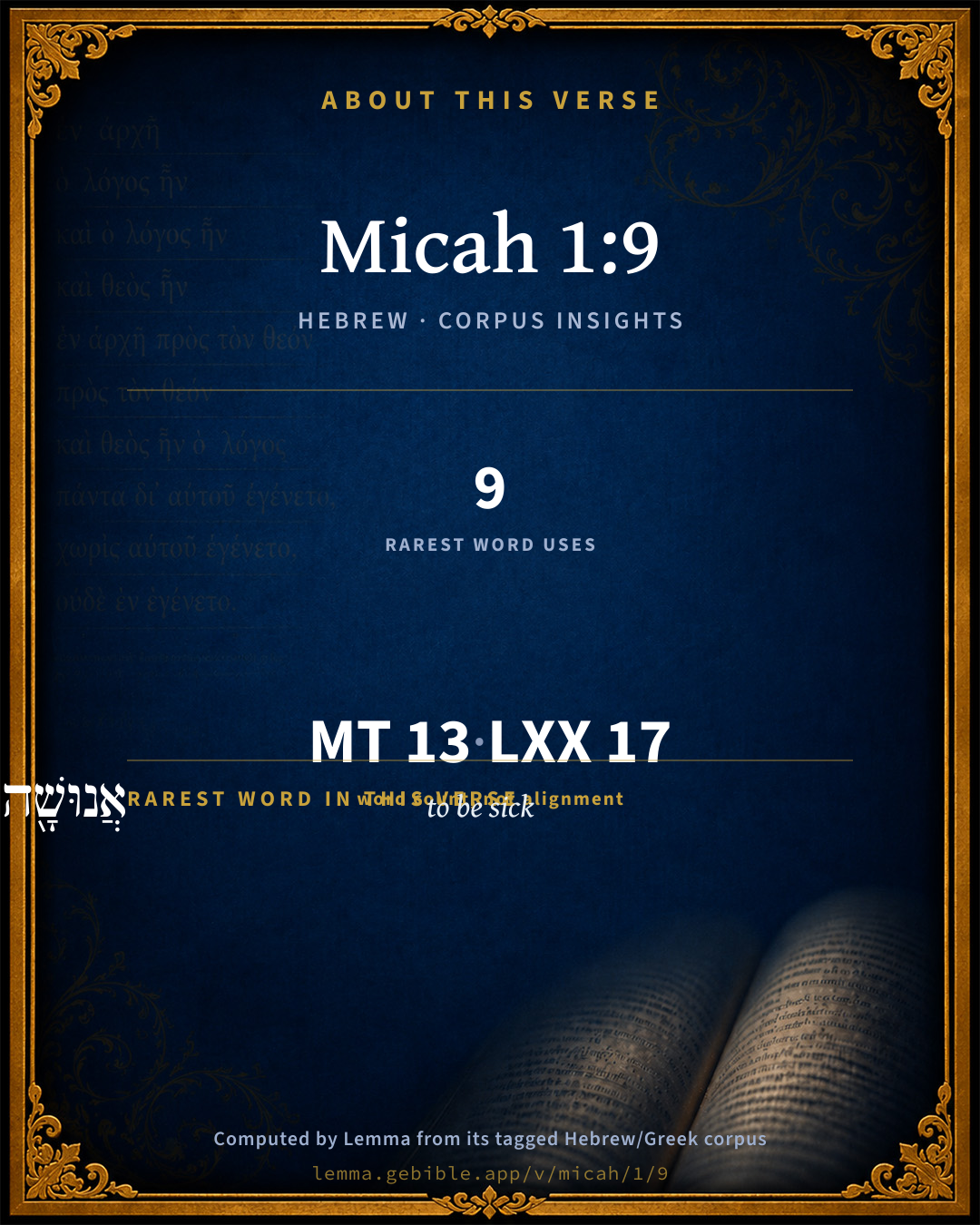
The rarest word here is אֲנוּשָׁ֖ה to be sick H605 — appearing just 9 times in the whole Hebrew Bible.

Shared distinctive vocabulary

אֲנוּשָׁ֖ה to be sick H605 occurs in 9 verses of the Hebrew Bible. Also found in:

Grammatical profile

  • 2 verbs
  • 5 nouns
  • 1 adjective
  • 3 prepositions
  • 2 conjunctions

Verb forms

  • בָ֨אָה֙ Qal · Perfect
  • נָגַ֛ע Qal · Perfect

Repetition

Words recur within this verse — often emphatic in Hebrew:

  • עַד until H5704 ×3
  • כִּ֥י that H3588 ×2

Hebrew & Septuagint length

In English translation the verse runs 23 words from the Hebrew and 25 from the Septuagint (LXX English) — closely comparable.

A rough comparison of the two English renderings, which tokenize alike — not a word-level alignment.

Word counts can differ between the Hebrew and the Greek without any difference in meaning — e.g. the Hebrew direct-object marker אֵת has no separate Greek word, and Greek often adds the article ὁ.

In the original languages it is 13 Hebrew tokens and 17 Greek tokens — but the two are counted differently (Hebrew bundles its prefixes and suffixes into one token; the Greek is in lemma form), so that isn’t a like-for-like length.

Cross-references

10

Topical passages linked to Micah 1:9 in the Treasury of Scripture Knowledge — connected by theme and wording, ordered by reader-vote popularity; previews shown in the World English Bible.

  • Jeremiah 30:11–15 For I am with you, says Yahweh, to save you: for I will make a full end of all the nations where I have scattered you, but I will not make a full end of you; but I will correct you in measure, and will in no way leave you unpunished.
  • 2 Chronicles 32:1–23 After these things, and this faithfulness, Sennacherib king of Assyria came, and entered into Judah, and encamped against the fortified cities, and thought to win them for himself.
  • Isaiah 8:7–8 now therefore, behold, the Lord brings up on them the waters of the River, strong and many, [even] the king of Assyria and all his glory: and it shall come up over all its channels, and go over all its banks;
  • Jeremiah 15:18 Why is my pain perpetual, and my wound incurable, which refuses to be healed? will you indeed be to me as a deceitful [brook], as waters that fail?
  • Micah 1:12 For the inhabitant of Maroth waits anxiously for good, Because evil has come down from Yahweh to the gate of Jerusalem.
  • 2 Kings 18:9–13 It happened in the fourth year of king Hezekiah, which was the seventh year of Hoshea son of Elah king of Israel, that Shalmaneser king of Assyria came up against Samaria, and besieged it.
  • Isaiah 1:5–6 Why should you be beaten more, That you revolt more and more? The whole head is sick, And the whole heart faint.
  • Isaiah 3:26 Her gates shall lament and mourn; And she shall be desolate and sit on the ground.
  • Isaiah 10:28–32 He is come to Aiath, he is passed through Migron; at Michmash he lays up his baggage;
  • Isaiah 37:22–36 this is the word which Yahweh has spoken concerning him: The virgin daughter of Zion has despised you and ridiculed you; the daughter of Jerusalem has shaken her head at you.

Cross-references courtesy of OpenBible.info (CC BY 4.0).

Hebrew and Greek witnesses Masoretic Hebrew ↔ Greek Septuagint

The same verse in the two great witnesses to the Old Testament, shown verse-for-verse.

These are two independent witnesses, not word-aligned to each other, and the Septuagint is shown in lemma (dictionary) form.

Hebrew Micah 1:9 Masoretic · Westminster Leningrad Codex

כִּ֥י אֲנוּשָׁ֖ה מַכּוֹתֶ֑יהָ כִּי בָ֨אָה֙ עַד יְהוּדָ֔ה נָגַ֛ע עַד שַׁ֥עַר עַמִּ֖י עַד יְרוּשָׁלִָֽם

For her wounds are incurable; For it has come even to Judah. It reaches to the gate of my people, Even to Jerusalem.

World English Bible · Public Domain

Greek LXX Micah 1:9 Septuagint · lemma form

ὅτι κατακρατέω ὁ πληγή αὐτός διότι ἔρχομαι ἕως ιουδα καί ἅπτομαι ἕως πύλη λαός ἐγώ ἕως ἰερουσαλήμ

For her plague has become grievous; for it has come even to Juda; and has reached to the gate of my people, even to Jerusalem.

LXX2012 (modern English Septuagint) · Public Domain

Hebrew: Westminster Leningrad Codex (CC BY 4.0). Greek: Septuagint (public domain); English from LXX2012 (modern English Septuagint) (Public Domain). How the Septuagint differs from the Hebrew →

Targum (Aramaic paraphrase)

1

The Targum is the ancient Jewish Aramaic paraphrase of the Hebrew Scriptures — an interpretive translation, not the Hebrew text itself. Onkelos (literal) and Pseudo-Jonathan (expansive) render the Torah, and Jonathan the Prophets. Coverage is partial: where no permissively-licensed English translation exists for a verse, only the Aramaic is shown. This is verse-level text, not a word-by-word alignment to the Hebrew.

  1. Targum Jonathan Prophets (Joshua–Malachi)
    אֲרֵי מְמָרְעָא מֵחֲתָהָא אֲרֵי מְטַת עַד דְבֵית יְהוּדָה קְרִיבַת לְמֵיעַל בְּתַרְעֵי עַמִי עַד יְרוּשְׁלֵם:

    (no public-domain English translation for this verse)

    Targum Jonathan — Aramaic: “Mikraot Gedolot” (public domain). English: “Sefaria Community Translation” (CC0 1.0 (public-domain dedication)); “London "Chaldee Paraphrase," 1871” (public domain). Text via Sefaria.

Commentary

Notes on Micah 1:9 from classic Christian and Jewish commentators (each source and its license shown beneath its notes). The classic Christian expositions comment on the surrounding passage and are grouped to its opening verse, so a note may address several verses; the Jewish commentaries on the Tanakh (Rashi and others) are per-verse, so they appear only where the commentator wrote on this verse.

Lemma curates 59 commentaries, every one of them public domain or Creative Commons licensed, each selected and text-cleaned for this edition rather than reprinted as found. About our sources →

Trapp's Complete Commentary

John Trapp

Mic 1:9 For her wound [is] incurable; for it is come unto Judah; he is come unto the gate of my people, [even] to Jerusalem.

Ver. 9. For her wound is incurable] Or, she is grievously sick of her wounds; or, her wounds are full of anguish, neither is there any to pour in balm of Gilead, to allay it; any to lick it whole, as the Lady Elinor did her husband Prince Edward’s wound, traitorously given him in the Holy Land, by an assassin, with a poisoned knife.

For it is come unto Judah] viz. Samaria’s wound and plague is come, i.e. shall shortly come, though now they live as if out of the reach of God’s rod, or as if they had a protection.

He is come unto the gate of my people] Sennacherib (flushed with former successes at Samaria, which had been carried captive by his father) came up to the very gate of Jerusalem as an overflowing scourge; and thought to have cut off all the Jews at once, as if they had had all but one neck. He came up over all his channels, and went over all his banks. He passed through Judah, and overflowed, reaching even to the neck; and the stretching out of his wings filled the breadth of thy land, O Immanuel, Isa 8:8. But Immanuel soon took a course with him, Isa 37:33, so that though he came to the gates, yet he entered not into the city, nor shot an arrow there, nor cast a bank against it. "Look upon Zion," saith that prophet, "the city of our solemnities," and see if Jerusalem be not still "a quiet habitation," Isa 33:20. "Walk about Zion," saith the psalmist, "and go round about her: tell the towers thereof." See if any be missing since Sennacherib came up against them. "Mark ye well her bulwarks": are they diminished? "consider her palaces": are they at all defaced? Psa 48:12-13. What if Jerusalem be wicked? yet Sennacherib is insolent. If therefore Jerusalem shall be smitten with the rod of Sennacherib’s fear, Sennacherib shall be smitten with the sword of God’s revenges, who of all things cannot endure a presumptuous and self-confident vaunter; but will deal with his people not according to his ordinary rule, but according to his prerogative. Surely "Israel hath not been forsaken, nor Judah of his God, of the Lord of hosts; though their land was filled with sin against the Holy One of Israel," Jer 51:5.

John Trapp, A Commentary or Exposition upon All the Books of the Old and New Testament (1647–1656) — public domain. Text from a community e-Sword module.

Whedon's Commentary on the Bible

Daniel D. Whedon

Mic_1:9 points to the impending ruin of Judah as one of the reasons for the grief and consternation of the prophet. He knows that, if Samaria falls, the enemy will sooner or later attack the south. This fear was seen to be justified when in 702-701 the army of Sennacherib advanced to the very gates of Jerusalem (Isaiah 36:37; compare Isa_1:7).

Wound — More accurately, stripes; the devastation wrought by the enemy.

Incurable — Nothing can cure the effects of the judgment, or prevent the spread of the disaster; it will steadily spread until the very heart, Jerusalem, becomes affected. Not even the presence of Jehovah in the temple can save the city.

It is not possible to reproduce in English the plays upon words so evident in the original of 10-15; sometimes it is difficult to apprehend the allusion of the prophet, and in more than one place the correctness of the present Hebrew text is not beyond question. The word plays are not due to the playful mood of the prophet. “He could not possibly jest about the fate of his friends. No, he is in sober earnest, and sees a preordained correspondence between names and fortunes.” Some consider the artistic character of the passage sufficient reason for denying the verses to Micah.

The apostrophes to the cities remind one of Isa_10:28 ff. It is possible that Micah, like Isaiah, intends to describe the route taken by the enemy toward the capital, though in view of the uncertainty with regard to some of the cities this cannot be proved. If this is the prophet’s purpose, Micah, unlike Isaiah, expects the advance to come from the west, the territory of the Philistines; and this is the direction followed by Sennacherib in 702-701.

Daniel D. Whedon (gen. ed.), Commentary on the Old and New Testaments (1874–1909) — public domain. Text from a community e-Sword module.

Tyndale Open Study Notes

Tyndale Open Resources

1:9 into Judah . . . Jerusalem: The corruption now permeated the entire nation, north to south.

Tyndale Open Study Notes — © Tyndale Open Resources, licensed CC BY-SA 4.0. Text via the HelloAO Bible API.

Jamieson, Fausset & Brown

Robert Jamieson, A. R. Fausset & David Brown

wound . . . incurable--Her case, politically and morally, is desperate (Jer 8:22).

it is come--the wound, or impending calamity (compare Isa 10:28).

he is come . . . even to Jerusalem--The evil is no longer limited to Israel. The prophet foresees Sennacherib coming even "to the gate" of the principal city. The use of "it" and "he" is appropriately distinct. "It," the calamity, "came unto" Judah, many of the inhabitants of which suffered, but did not reach the citizens of Jerusalem, "the gate" of which the foe ("he") "came unto," but did not enter (Isa 36:1; Isa 37:33-37).

Jamieson, Fausset & Brown — Commentary Critical and Explanatory on the Whole Bible (1871) — public domain (CC PDM 1.0). Text via the HelloAO Bible API.

Adam Clarke's Commentary

Verse 9. Her wound is incurable] Nothing shall prevent their utter ruin, for they have filled up the measure of their iniquity.

He is come - even to Jerusalem.] The desolation and captivity of Israel shall first take place; that of Judah shall come after.

Adam Clarke's Commentary on the Bible (1810–1826) — public domain. Text from a community e-Sword/MySword module.

John Calvin's Commentaries

He afterwards subjoins, that the wounds vault be grievous; but he speaks as of what was present, Grievous, he says, are the wounds Grievous means properly full of grief; others render it desperate or incurable, but it is a meaning which suits not this place; for אנושה, anushe, means what we express in French by douloureuse. The wounds, then, are full of grief: for it came, (something is understood; it may suitably be referred to the enemy, or, what is more approved, to the slaughter) — It came then, that is, the slaughter, to Judah; it has reached to the gate of my people, even to Jerusalem itself. He says first, to Judah, speaking of the land; and then he confines it to the cities; for when the gates are closed up against enemies, they are forced to stop. But the Prophet says, that the cities would be no hindrance to the enemies to approach the very gates and even the chief city of Judah, that is, Jerusalem; and this, we know, was fulfilled. It is the same then as though he said that the whole kingdom of Israel would be so laid waste, that their enemies would not he content with victory, but would proceed farther and besiege the holy city: and this Sennacherib did. For after having subverted the kingdom of Israel, as though it was not enough to draw the ten tribes into exile, he resolved to take possession of the kingdom of Judah; and Jerusalem, as Isaiah says, was left as a tent. We hence see that the threatening of the Prophet Micah were not in vain. It now follows —

John Calvin's Commentaries (1540-1563) — public domain. Text from the Calvin Translation Society English edition (1840s-50s) via the Christian Classics Ethereal Library (ccel.org). Calvin's coverage is partial (roughly two-thirds of the Bible); uncommented books and verses are honest gaps, never fabricated. The 19th-century editor's footnotes and remarks are omitted so the notes are faithfully Calvin's own voice.

Ellicott's Commentary for English Readers

(9) Her wound is incurable.—The state of Samaria is incurable: she is doomed: the destroyer is approaching—nay, he comes near, even to Jerusalem. The outlying towns are described as shuddering at the invader’s advance, but Jerusalem itself is spared.

A Bible Commentary for English Readers, edited by Charles John Ellicott (1878–1897) — public domain. Text from a community e-Sword module.

The Cambridge Bible for Schools and Colleges

gen. ed. J. J. S. Perowne

9. her wound] Lit. her stripes. Samaria’s trouble is a chastisement (comp. Isa_1:3-4), but it is not Samaria’s trouble only. It has reached Jerusalem; hence the ‘incurableness’ of the ‘wound,’ for Jerusalem is the heart of the nation. The past tenses vividly express the certainty of the prophet’s intuition of the future.

he is come] Or, it is come. The subject may be either the ‘stripe’ or the dealer of the stripe—Jehovah.

the gate of my people] Jerusalem is to the chosen people in general what the gate is to the city itself. The shady space in the city gate was the favourite place of meeting; so Jerusalem is the scene of ‘our solemn meetings’ (Isa_33:20), our religious and political centre.

The Cambridge Bible for Schools and Colleges (gen. ed. J. J. S. Perowne; Cambridge University Press, 1878–1918) — public domain. Text from a community e-Sword module.

John Gill's Exposition

For her wound is incurable,.... Or her "stroke is desperate" (e). The ruin of Samaria, and the ten tribes, was inevitable; the decree being gone forth, and they hardened in their sins, and continuing in their impenitence; and their destruction was irrevocable; they were not to be restored again, nor are they to this day; nor will be till the time comes that all Israel shall be saved: or "she is grievously sick of her wounds"; just ready to die, upon the brink of ruin, and no hope of saving her; this is the cause and reason of the above lamentation of the prophet: and what increased his grief and sorrow the more was,

for it is come unto Judah; the calamity has reached the land of Judah; it stopped not with Israel or the ten tribes, but spread itself into the two tribes of Judah and Benjamin; for the Assyrian army, having taken Samaria, and carried Israel captive, in a short time, about seven or eight years, invaded Judea, and took the fenced cities of Judah in Hezekiah's time, in which Micah prophesied;

he is come unto the gate of my people, even to Jerusalem; Sennacherib, king of Assyria, having taken the fenced cities, came up to the very gates of Jerusalem, and besieged it, where the courts of judicature were kept, and the people resorted to, to have justice done them; and Micah, being of the tribe of Judah, calls them his people, and was the more affected with their distress.

(e) "desperata est plaga ejus", V. L. "plagae ejus", Montanus, Drusius.

John Gill's Exposition of the Whole Bible (1746–1763) — public domain (CC PDM 1.0). Text via the HelloAO Bible API.

Albert Barnes' Notes on the Bible

For her - Samaria’s

Wound - o, (literally, her wounds, or strokes, (the word is used especially of those inflicted by God, (Lev 26:21; Num 11:33; Deu 28:59, Deu 28:61, etc.) each, one by one,) is incurable The idiom is used of inflictions on the body politic (Nahum 3 ult.; Jer 30:12, Jer 30:15) or the mind , for which there is no remedy. The wounds were very sick, or incurable, not in themselves or on God’s part, but on Israel’s. The day of grace passes away at last, when man has so steeled himself against grace, as to be morally dead, having deadened himself to all capacity of repentance.

For it is come unto - (quite up to) Judah; he, (the enemy,) is come (literally, hath reached, touched,) to (quite up to) the gate of my people, even to (quite up to) Jerusalem Jerome: “The same sin, yea, the same punishment for sin, which overthrew Samaria, shall even come unto, quite up to Judah. Then the prophet suddenly changes the gender, and, as Scripture so often does, speaks of the one agent, the center and impersonation of the coming evil, as sweeping on over Judah, quite up to the gate of his people, quite up to Jerusalem. He does not say here, whether Jerusalem would be taken; and so, it seems likely that he speaks of a calamity short of excision. Of Israel’s wounds only he here says, that they are incurable; he describes the wasting of even lesser places near or beyond Jerusalem, the flight of their inhabitants. Of the capital itself he is silent, except that the enemy reached, touched, struck against it, quite up to it. Probably, then, he is here describing the first visitation of God, when 2Ki 18:13 Sennacherib came up against all the fenced cities of Judah and took them, but Jerusalem was spared. God’s judgments come step by step, leaving time for repentance. The same enemy, although not the same king, came against Jerusalem who had wasted Samaria. Samaria was probably as strong as Jerusalem. Hezekiah prayed; God heard, the Assyrian army perished by miracle; Jerusalem was respited for 124 years.

Albert Barnes' Notes on the Bible (1834–1885) — public domain. Text from a community e-Sword/MySword module.

Haydock's Catholic Bible Commentary

CHAPTER I.

Gate. That is, the destruction of Samaria shall be followed by the invasion of my people of Juda, and the Assyrian shall come and lay all waste even to the confines of Jerusalem. (Challoner) --- Juda received the worship of Baal from Israel. It shared in the punishment of that kingdom. The prophet alludes to the ravages of Sennacherib, ver 13. Yet Juda was much afflicted by Razin and Phacee, before that invasion: which caused Achaz to call in the aid of Theglathphalassar, 2 Paralipomenon xxviii., and 4 Kings xvi. (Calmet)

George Leo Haydock (1774–1849), Haydock's Catholic Family Bible and Commentary, 1859 edition — public domain. Excludes Psalms (Douay-Rheims chapter numbering differs from Protestant) and Deuterocanonical books (Catholic canon only).

Matthew Poole's English Annotations

Her wound is incurable; the wounds of Samaria and the ten tribes; her own sins, God’s just displeasure, and the enemy’s rage have deeply wounded her, she is senseless, impenitent, and furious against her Physician, and she shall at last die by sword, famine, pestilence, and captivity.

It is come unto Judah; the contagion of her sins, and the indignation of God against it, and the enemy’s successes, viz. Sennacherib’s, or Nebuchadnezzar’s, like a flood have reached to Judah also; and this is the reason why the prophet foretells such mourning, and is willing to personate it to awaken both kingdoms to repent and turn to God.

He is come; the insulting, conquering, and cruel enemy, or, in the neuter gender, it, i.e. the evil, is come, i.e. in the prophetic style, will certainly and suddenly come.

Unto the gate of my people; either signifying the Assyrians besieging Jerusalem, as Sennacherib son of Shalmaneser did some few years after the sack of Samaria, or else by

gate of my people is meant the city where the sovereign court of judicature to the whole kingdom is, denoting the victories of the Assyrian over the rest of the kingdom of Judah, or else the victories of Nebuchadnezzar.

Even to Jerusalem: this seems added to explain the former phrase.

Matthew Poole's English Annotations on the Holy Bible (1683–1685) — public domain. Text from a community e-Sword/MySword module.

The Pulpit Commentary

Her wound; her stripes, the punishment inflicted on Samaria. Incurable (comp. Jer_15:18) The day of grace is past, and Israel has not repented. It is come. The stripe, the punishment, reaches Judah. To the prophetic eye the Assyrians" invasion of Judaea seems close at hand, and even the final attack of the Chaldeans comes within his view. The same sins in the northern and southern capitals lead to the same fate. He is come. He, the enemy, the agent of the "stripe." The gate of my people. The gate, the place of meeting, the well guarded post, is put for the city itself. (comp. Gen_22:17 Deu_28:52 Oba_1:11) Pusey thinks that Micah refers to something short of total excision, and therefore that the invasion of Sennacherib alone is meant. (2Ki_18:13) But the fore shortened view of the prophet may well include the final ruin.

The Pulpit Commentary (1880–1919), ed. H.D.M. Spence-Jones & Joseph S. Exell — public domain. Text from a community e-Sword module.

John Wesley's Explanatory Notes

Her wound - The wounds of Samaria, her own sins, and God's just displeasure. It is come - The contagion of her sins, and the indignation of God against it, have reached to Judah also, yea, to Jerusalem.

John Wesley, Explanatory Notes Upon the Whole Bible (1754–1765) — public domain. Text via the GEBible commentary corpus.

Rashi

Rabbi Shlomo Yitzchaki (Rashi)

For she is mortally ill [from] her wounds Heb. אֱנוּשָׁה. For she is ill from her wounds. Cf. (II Sam. 12:15) “And it became mortally ill (וַיֵּאָנַשׁ.).”

Rashi on the Tanakh — English translations: “The Judaica Press complete Tanach with Rashi, translated by A. J. Rosenberg” (CC BY 4.0); “Pentateuch with Rashi's commentary by M. Rosenbaum and A.M. Silbermann, 1929-1934” (public domain); “The Metsudah Tanach series, Lakewood, N.J” (CC BY 4.0); and “The Book of Joshua, Metsudah Publications, 1997” (CC BY 4.0). Text via Sefaria.

Lesson kit

Teaching starters — assembled from the data on this page, not authored interpretation. Every prompt links to the verse data it draws on. Edit before teaching.

Micah, in the Prophets, opens this verse with 13 words (10 distinct Hebrew lemmas). Its most distinctive word is ʼânash (“to be sick”). A historical commentator’s framing appears above. Read the whole chapter for the surrounding context.

Discussion questions

  1. What does “to be sick” (ʼânash) contribute to the verse as a whole?
  2. 2 Samuel 12:15 shares the word «to be sick» with this verse. How do the two illuminate each other?
  3. “until” occurs 3× in this one verse. What is the effect of the repetition?
  4. These translations render this verse differently; the difference is in the English rendering, not the original. What questions does that raise?
  5. The verb «בָ֨אָה֙» is Qal Perfect. How does its form color the action?
  6. Reading how Trapp's Complete Commentary and Whedon's Commentary on the Bible read this verse, where do the two commentators agree and where do they part?

Things to notice

Reading settings

Reading text

Shown beneath each verse's original-language words.

Old Testament
Old Testament edition

Read the OT as the Masoretic Hebrew (MT) or the Greek Septuagint (LXX).

English shown for the Greek Septuagint (in the Hebrew ↔ Greek comparison).

Comparing translations? Open the Compare panel on any verse page to stack up to four side by side.