Haggai 2:13

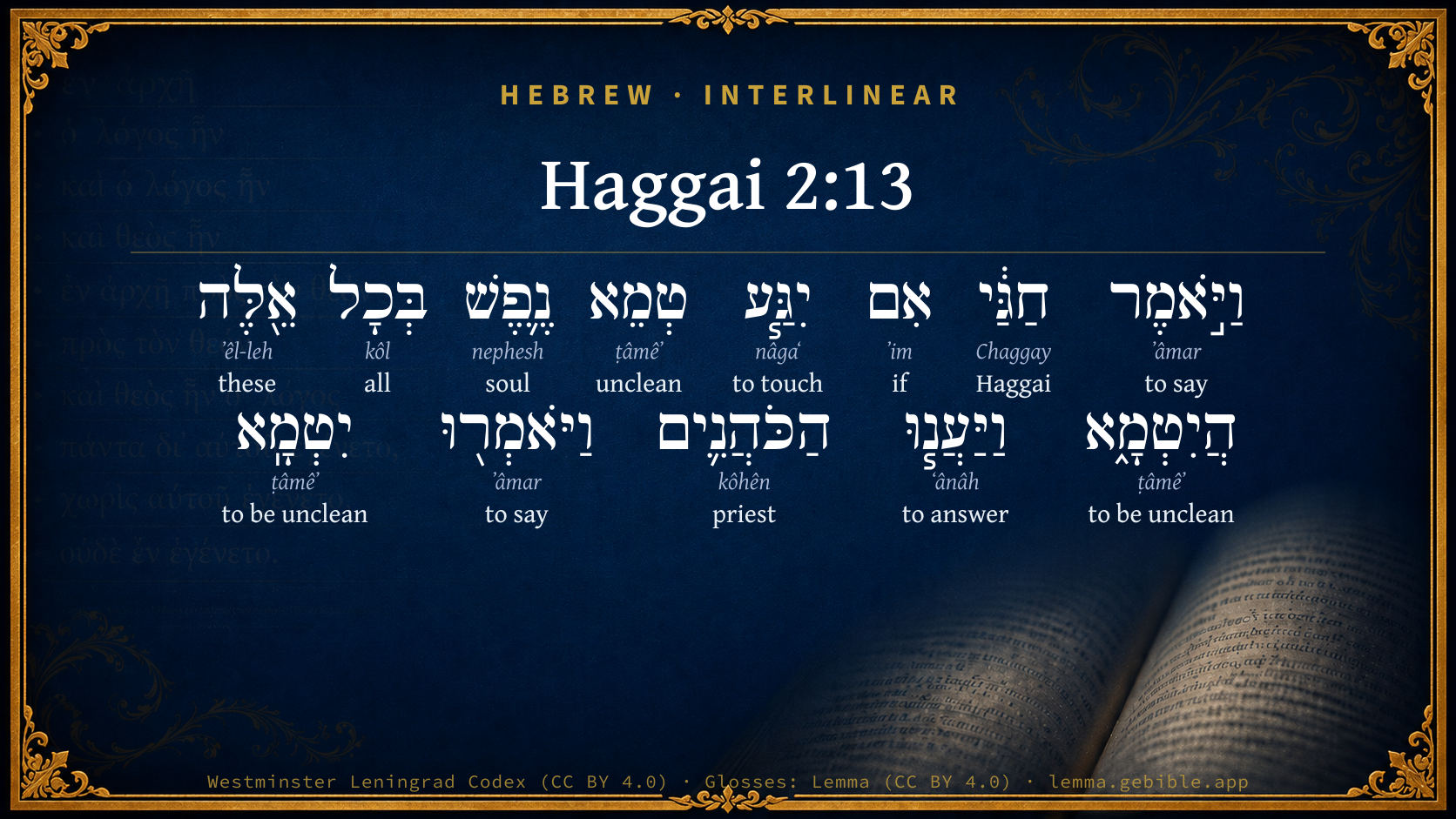
Hebrew (Westminster Leningrad Codex) Haggai 2:13 appears in the Hebrew Old Testament. The text above is from the Westminster Leningrad Codex. Each word links to its Strong’s number, a concise gloss, and parsing drawn from the Open Scriptures Hebrew Bible morphology. Click any word for its full Brown-Driver-Briggs (BDB) entry.
Download image
Cite this verse

Haggai 2:13 (World English Bible). Public Domain. Lemma interlinear Bible study tool, https://lemma.gebible.app/v/haggai/2/13.

Show BibTeX & RIS
BibTeX
RIS
English Translation
Then Haggai said, "If one who is unclean by reason of a dead body touch any of these, will it be unclean?" The priests answered, "It will be unclean."
World English Bible · Public Domain
Download a study sheet

One document with this verse’s original text, its word-by-word gloss line, the meaning frame, cross-references with their text, attributed commentary, and full source and license credits — printable, and it pastes into notes with its structure intact.

This verse Autodidact and up

Study sheet (.html) Plain text (.txt)

A passage Seminary Student

Up to 50 verses in one chapter. A passage sheet keeps up to 6 commentary sources and 12 cross-references per verse, in the order this page ranks them, and says so on the sheet whenever that leaves anything out. Ask for a single verse and you get the Autodidact verse sheet above.

Everything on this page stays free to read, with no account — the sheet is a download of what is already on screen, not access to it.

Want to remove ads? Support Godless Engineer
Compare translations 3

The same verse in 3 English versions, stacked beneath the original-language interlinear above. Click any original word for its lexicon entry.

Each is an independent rendering of the whole verse — the interlinear is not word-aligned to these translations.

Highlighted words mark where these versions differ — a whole-verse word diff, not a word-by-word alignment.

  • World English Bible Public Domain
    Then Haggai said, "If one who is unclean by reason of a dead body touch any of these, will it be unclean?" The priests answered, "It will be unclean."
  • King James Version Public Domain
    Then said Haggai, If one that is unclean by a dead body touch any of these, shall it be unclean? And the priests answered and said, It shall be unclean.
  • unfoldingWord Literal Text CC BY-SA 4.0
    Then Haggai said, “If the unclean by a person touches any of these, will it be unclean?” And the priests answered and said, “It will be unclean.”

unfoldingWord Literal Text — © unfoldingWord, licensed CC BY-SA 4.0. Word-aligned USFM3 via Door43 (git.door43.org/unfoldingWord/en_ult).

Versions to compare (up to 4)

3 of 4 selected

Show all 18 translations

Every available English version of this verse, each an independent rendering of the whole verse.

  • World English Bible Public Domain
    Then Haggai said, "If one who is unclean by reason of a dead body touch any of these, will it be unclean?" The priests answered, "It will be unclean."
  • Berean Standard Bible Public Domain
    So Haggai asked, “If one who is defiled by contact with a corpse touches any of these, does it become defiled?” “Yes, it becomes defiled,” the priests answered.
  • Majority Standard Bible Public Domain
    So Haggai asked, “If one who is defiled by contact with a corpse touches any of these, does it become defiled?” “Yes, it becomes defiled,” the priests answered.
  • King James Version Public Domain
    Then said Haggai, If one that is unclean by a dead body touch any of these, shall it be unclean? And the priests answered and said, It shall be unclean.
  • American Standard Version (1901) Public Domain
    Then said Haggai, If one that is unclean by reason of a dead body touch any of these, shall it be unclean? And the priests answered and said, It shall be unclean.
  • Revised Version (1885) Public Domain
    Then said Haggai, If one that is unclean by a dead body touch any of these, shall it be unclean? And the priests answered and said, It shall be unclean.
  • Geneva Bible (1599) Public Domain
    If one beare holy flesh in the skirt of his garment, and with his skirt doe touch the bread, or the potage, or the wine, or oyle, or any meate, shall it be holy? And the Priests answered and said, No.
  • Douay-Rheims (1899) Public Domain
    If a man carry sanctified flesh in the skirt of his garment, and touch with his skirt, bread, or pottage, or wine, or oil, or any meat: shall it be sanctified? And the priests answered, and said: No.
  • Young's Literal Translation Public Domain
    And Haggai saith, `If the unclean of body doth come against any of these, is it unclean?' And the priests answer and say, `It is unclean.'
  • Literal Standard Version CC BY-SA 4.0
    And Haggai says, “If the unclean of body comes against any of these, is it unclean?” And the priests answer and say, “It is unclean.”
  • Unlocked Literal Bible CC BY-SA 4.0
    Then Haggai said, “If someone who is unclean because of death touches any of these things, do they become unclean?” The priests answered and said, “Yes, they become unclean.”
  • unfoldingWord Literal Text CC BY-SA 4.0
    Then Haggai said, “If the unclean by a person touches any of these, will it be unclean?” And the priests answered and said, “It will be unclean.”
  • Darby Bible Public Domain
    And Haggai said, If one that is unclean by a dead body touch any of these, is it become unclean? And the priests answered and said, It shall be unclean.
  • World Messianic Bible Public Domain
    Then Haggai said, “If one who is unclean by reason of a dead body touches any of these, will it be unclean?” The priests answered, “It will be unclean.”
  • Webster's Bible Public Domain
    Then said Haggai, If one that is unclean by a dead body shall touch any of these, shall it be unclean? And the priests answered and said, It shall be unclean.
  • Free Bible Version CC BY-SA 4.0
    Then Haggai asked, “If someone becomes unclean by touching a dead body and then touches any of these foods, do they become unclean?” The priests answered, “Yes, it does become unclean.”
  • Bible in Basic English Public Domain
    Then Haggai said, Will any of these be made unclean by the touch of one who is unclean through touching a dead body? And the priests answering said, It will be made unclean.
  • JPS Tanakh (1917) Public Domain
    Then said Haggai: 'If one that is unclean by a dead body touch any of these, shall it be unclean?' And the priests answered and said: 'It shall be unclean.'

Literal Standard Version (2020), Covenant Press — licensed CC BY-SA 4.0. Text via the HelloAO Bible API (eBible.org). Unlocked Literal Bible (unfoldingWord) — licensed CC BY-SA 4.0. Text via the HelloAO Bible API (eBible.org). unfoldingWord Literal Text — © unfoldingWord, licensed CC BY-SA 4.0. Word-aligned USFM3 via Door43 (git.door43.org/unfoldingWord/en_ult). Free Bible Version, Dr. Jonathan Gallagher — licensed CC BY-SA 4.0. Text via the HelloAO Bible API (eBible.org).

Word by word

More ways to search: Search by grammar → Find every occurrence → Compare this word →

Practice this passage: Drill this verse → Learn its vocabulary →

חַגַּ֔י
Chaggay
H2292
“Haggai”
Noun, Proper
Part of Speech
Noun
Type
Proper
Full BDB Definition

Origin: from H2282

TWOT: None

Haggai = "festive" - 10th in order of the minor prophets; first prophet to prophecy after the captivity
  1. וַיֹּ֣אמֶר ʼâmar H559 “and · to say” Conjunction + Verb, Qal, Sequential Imperfect, 3rd Person, Masculine, Singular
  2. אִם ʼim H518 “if” Conjunction
  3. יִגַּ֧ע nâgaʻ H5060 “to touch” Verb, Qal, Imperfect, 3rd Person, Masculine, Singular
  4. טְמֵא ṭâmêʼ H2931 “unclean of” Adjective, Adjective, Masculine, Singular, Construct
  5. נֶ֛פֶשׁ nephesh H5315 “soul” Noun, Common, Both, Singular, Absolute
  6. בְּכָל kôl H3605 “in/at · all of” Preposition + Noun, Common, Masculine, Singular, Construct
  7. אֵ֖לֶּה ʼêl-leh H428 “these” Pronoun, Demonstrative, Common, Plural
  8. הֲיִטְמָ֑א ṭâmêʼ H2930 “to be unclean” Particle, Interrogative + Verb, Qal, Imperfect, 3rd Person, Masculine, Singular
  9. וַיַּעֲנ֧וּ ʻânâh H6030 “and · to answer” Conjunction + Verb, Qal, Sequential Imperfect, 3rd Person, Masculine, Plural
  10. הַכֹּהֲנִ֛ים kôhên H3548 “the · priests” Particle, Definite Article + Noun, Common, Masculine, Plural, Absolute
  11. וַיֹּאמְר֖וּ ʼâmar H559 “and · to say” Conjunction + Verb, Qal, Sequential Imperfect, 3rd Person, Masculine, Plural
  12. יִטְמָֽא ṭâmêʼ H2930 “to be unclean” Verb, Qal, Imperfect, 3rd Person, Masculine, Singular

About this verse

These counts appear in no published source. They are computed here, from the morphology-tagged text and Lemma’s own curated glosses. What Lemma adds →

13
words
11
distinct lemmas
Prophets
section

Notable vocabulary

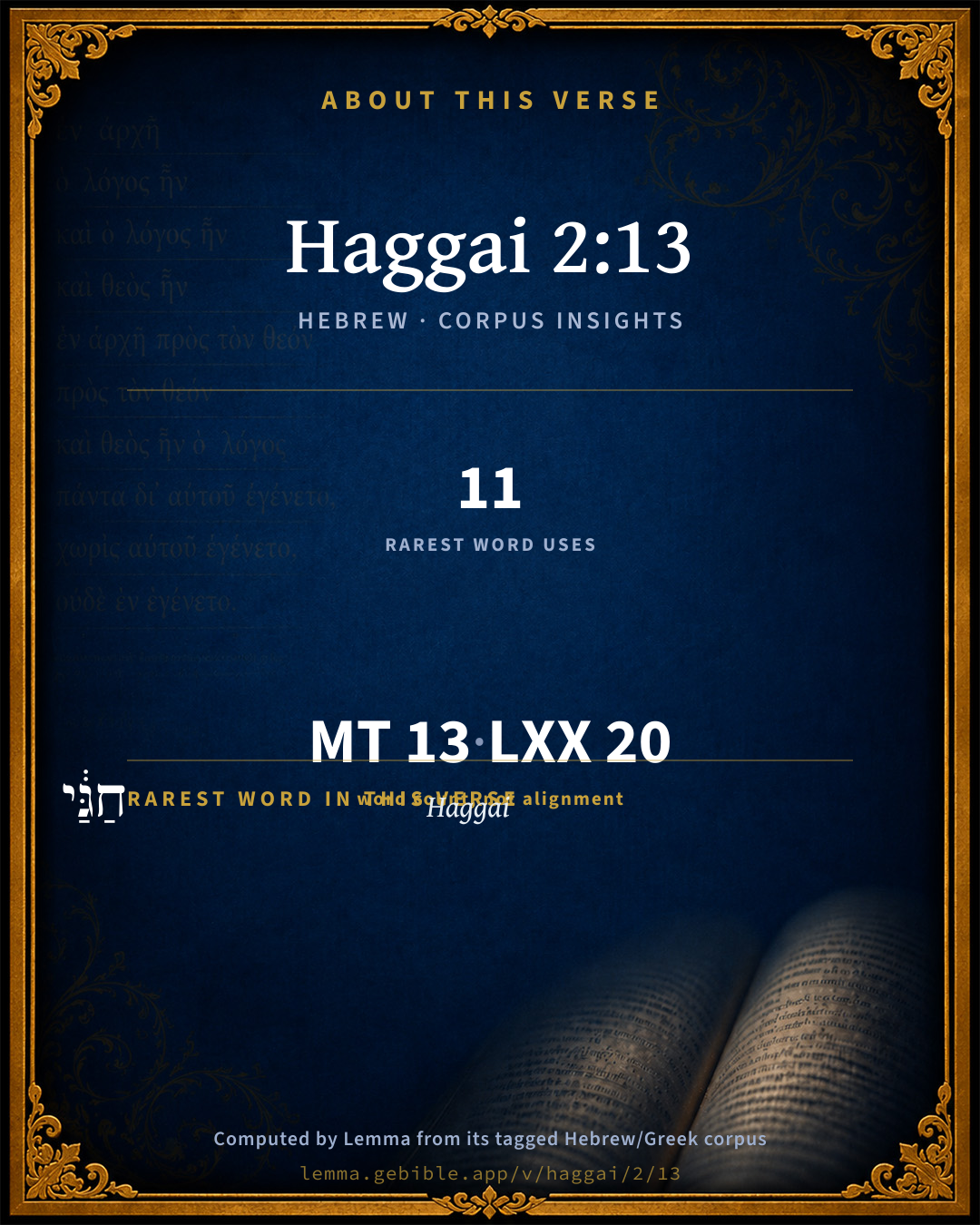
The rarest word here is חַגַּ֔י Haggai H2292 — appearing just 11 times in the whole Hebrew Bible.

Shared distinctive vocabulary

חַגַּ֔י Haggai H2292 occurs in 11 verses of the Hebrew Bible. Also found in:

Grammatical profile

  • 6 verbs
  • 4 nouns
  • 1 adjective
  • 1 pronoun
  • 1 conjunction

Verb forms

  • וַיֹּ֣אמֶר Qal · Sequential Imperfect
  • יִגַּ֧ע Qal · Imperfect
  • הֲיִטְמָ֑א Qal · Imperfect
  • וַיַּעֲנ֧וּ Qal · Sequential Imperfect
  • וַיֹּאמְר֖וּ Qal · Sequential Imperfect
  • יִטְמָֽא Qal · Imperfect

Repetition

Words recur within this verse — often emphatic in Hebrew:

  • וַיֹּ֣אמֶר to say H559 ×2
  • הֲיִטְמָ֑א to be unclean H2930 ×2

Hebrew & Septuagint length

In English translation the verse runs 29 words from the Hebrew and 42 from the Septuagint (LXX English) — the Septuagint runs noticeably longer here. See the side-by-side →

A rough comparison of the two English renderings, which tokenize alike — not a word-level alignment.

Word counts can differ between the Hebrew and the Greek without any difference in meaning — e.g. the Hebrew direct-object marker אֵת has no separate Greek word, and Greek often adds the article ὁ.

In the original languages it is 13 Hebrew tokens and 20 Greek tokens — but the two are counted differently (Hebrew bundles its prefixes and suffixes into one token; the Greek is in lemma form), so that isn’t a like-for-like length.

Cross-references

4

Topical passages linked to Haggai 2:13 in the Treasury of Scripture Knowledge — connected by theme and wording, ordered by reader-vote popularity; previews shown in the World English Bible.

  • Leviticus 22:4–6 "'Whoever of the seed of Aaron is a leper or has an issue; he shall not eat of the holy things, until he is clean. Whoever touches anything that is unclean by the dead, or a man whose seed goes from him;
  • Numbers 5:2–3 "Command the children of Israel that they put out of the camp every leper, and everyone who has an issue, and whoever is unclean by the dead.
  • Numbers 9:6–10 There were certain men, who were unclean because of the dead body of a man, so that they could not keep the Passover on that day, and they came before Moses and before Aaron on that day.
  • Numbers 19:11–22 He who touches the dead body of any man shall be unclean seven days:

Cross-references courtesy of OpenBible.info (CC BY 4.0).

Hebrew and Greek witnesses Masoretic Hebrew ↔ Greek Septuagint

The same verse in the two great witnesses to the Old Testament, shown verse-for-verse.

Here the Septuagint runs noticeably longer than the Hebrew — LXX2012 (modern English Septuagint) 42 words vs World English Bible 29. A rough length comparison of the two English translations, not a word-level alignment — read both below.

These are two independent witnesses, not word-aligned to each other, and the Septuagint is shown in lemma (dictionary) form.

Hebrew Haggai 2:13 Masoretic · Westminster Leningrad Codex

וַיֹּ֣אמֶר חַגַּ֔י אִם יִגַּ֧ע טְמֵא נֶ֛פֶשׁ בְּכָל אֵ֖לֶּה הֲיִטְמָ֑א וַיַּעֲנ֧וּ הַכֹּהֲנִ֛ים וַיֹּאמְר֖וּ יִטְמָֽא

Then Haggai said, "If one who is unclean by reason of a dead body touch any of these, will it be unclean?" The priests answered, "It will be unclean."

World English Bible · Public Domain

Greek LXX Haggai 2:13 Septuagint · lemma form

καί εἶπον αγγαιος ἐάν ἅπτομαι μιαίνω ἐπί ψυχή ἀπό πᾶς οὗτος εἰ μιαίνω καί ἀποκρίνω ὁ ἱερεύς καί εἶπον μιαίνω

If a man should take holy flesh in the skirt of his garment, and the skirt of his garment should touch bread, or pottage, or wine, or oil, or any meat, shall it be holy? And the priests answered and said, No.

LXX2012 (modern English Septuagint) · Public Domain

On this verse, The Pulpit Commentary discusses the Septuagint’s reading. Read the note in Commentary ↓

Hebrew: Westminster Leningrad Codex (CC BY 4.0). Greek: Septuagint (public domain); English from LXX2012 (modern English Septuagint) (Public Domain). How the Septuagint differs from the Hebrew →

Targum (Aramaic paraphrase)

1

The Targum is the ancient Jewish Aramaic paraphrase of the Hebrew Scriptures — an interpretive translation, not the Hebrew text itself. Onkelos (literal) and Pseudo-Jonathan (expansive) render the Torah, and Jonathan the Prophets. Coverage is partial: where no permissively-licensed English translation exists for a verse, only the Aramaic is shown. This is verse-level text, not a word-by-word alignment to the Hebrew.

  1. Targum Jonathan Prophets (Joshua–Malachi)
    וַאֲמַר חַגַי אִם יִקְרֵיב טְמֵא נַפְשָׁא בְּכָל אִלֵין הֲיִסְתָּאֵב וְאָתִיבוּ כַהֲנַיָא וַאֲמָרוּ יִסְתָּאָב:

    (no public-domain English translation for this verse)

    Targum Jonathan — Aramaic: “Mikraot Gedolot” (public domain). English: “Sefaria Community Translation” (CC0 1.0 (public-domain dedication)); “London "Chaldee Paraphrase," 1871” (public domain). Text via Sefaria.

Commentary

Notes on Haggai 2:13 from classic Christian and Jewish commentators (each source and its license shown beneath its notes). The classic Christian expositions comment on the surrounding passage and are grouped to its opening verse, so a note may address several verses; the Jewish commentaries on the Tanakh (Rashi and others) are per-verse, so they appear only where the commentator wrote on this verse.

Lemma curates 59 commentaries, every one of them public domain or Creative Commons licensed, each selected and text-cleaned for this edition rather than reprinted as found. About our sources →

Trapp's Complete Commentary

John Trapp

Hag 2:13 Then said Haggai, If [one that is] unclean by a dead body touch any of these, shall it be unclean? And the priests answered and said, It shall be unclean.

Ver. 13. If one that is unclean by a dead body] With a ceremonial uncleanness. The Hebrew hath it thus, If one that is unclean in soul, that is, in his whole person, as every wicked man is totus totus pollutus, wholly covered with corruption, a loathsome leper from head to foot, wholly set upon sin, as Exo 32:22, lying down in wickedness, or in that wicked one, 1Jn 5:19, sick of such a disease as the physicians call corruptionem totius substantiae, nay, dead in sins and trespasses, Eph 2:1; and can therefore do no better than dead work at best, Heb 9:14, such as the living God will not be served with. {See Trapp on "Mal 3:16"} doct. 4, use 1. He is unclean, unclean, and impureth all that he toucheth, according to that which followeth.

John Trapp, A Commentary or Exposition upon All the Books of the Old and New Testament (1647–1656) — public domain. Text from a community e-Sword module.

Tyndale Open Study Notes

Tyndale Open Resources

2:13 Ceremonial uncleanness is transmitted much more easily than ceremonial purity. Anyone touching a corpse became defiled and thus unclean. Anything touched by a ceremonially unclean person was also rendered impure (see Num 19:11-13, 22). Haggai applies this in Hag 2:14.

Tyndale Open Study Notes — © Tyndale Open Resources, licensed CC BY-SA 4.0. Text via the HelloAO Bible API.

Geneva Bible (1599)

Geneva Bible translators

That is, the flesh of the sacrifices, whereby he signifieth that thing which of itself is good, cannot make another thing so: and therefore they ought not to justify themselves by their sacrifices and ceremonies: but contrary he that is unclean and not pure of heart, doth corrupt those things and make them detestable unto God, which else are good and godly.

Geneva Bible (1599) marginal notes — public domain. Text via Bolls.life.

Jamieson, Fausset & Brown

Robert Jamieson, A. R. Fausset & David Brown

On the other hand, a legally "unclean" person imparts his uncleanness to any thing, whereas a legally holy thing cannot confer its sanctity on an "unclean" person (Num 19:11, Num 19:13, Num 19:22). Legal sanctity is not so readily communicated as legal impurity. So the paths to sin are manifold: the paths to holiness one, and that one of difficult access [GROTIUS]. One drop of filth will defile a vase of water: many drops of water will not purity a vase of filth [MOORE].

Jamieson, Fausset & Brown — Commentary Critical and Explanatory on the Whole Bible (1871) — public domain (CC PDM 1.0). Text via the HelloAO Bible API.

Ellicott's Commentary for English Readers

(13) Unclean.—The defilement incurred by contact with a dead body was one of the deepest. (See Num_19:11-16.) On the force of the term tmê nephesh, compare the passages Lev_21:11; Lev_22:4; Num_6:6.

A Bible Commentary for English Readers, edited by Charles John Ellicott (1878–1897) — public domain. Text from a community e-Sword module.

The Cambridge Bible for Schools and Colleges

gen. ed. J. J. S. Perowne

13. unclean by a dead body] Lit. unclean by a person. The full phrase, “a dead person, or body,” occurs Lev_21:11; Num_6:6; but the word “dead” is often left to be understood as here and Lev_21:1; Lev_22:4. The law of ceremonial uncleanness as attaching to death (under which there lay, no doubt, the moral idea that death polluted because it was the offspring and the wages of sin) is found in Num_19:11-22.

shall it be unclean?] as clearly laid down in Num_19:22. Compare, for the moral counterpart, Jas_2:10, where Dean Plumptre observes: “This seems at first of the nature of an ethical paradox, but practically it states a deep moral truth. If we wilfully transgress one commandment we shew that in principle we sit loose to all. It is but accident, or fear, or the absence of temptation, that prevents our transgressing them also. Actual transgression in one case involves potential transgression in all.” Camb. Bible for Schools, St James, p. 68.

The Cambridge Bible for Schools and Colleges (gen. ed. J. J. S. Perowne; Cambridge University Press, 1878–1918) — public domain. Text from a community e-Sword module.

John Gill's Exposition

Then answered Haggai, and said,.... To the priests, and before the people; and made an application of these things to them, which was the thing in view in putting the questions:

So is this people, and so is this nation before me, saith the Lord; not only those people that were present and at work at the temple, but those that were absent, even the whole body of the people; who, though they were pure in their own eyes, yet were not so before the Lord; who knew their hearts, and the spring of all their actions; what were their ends and views in all they did: as a garment carrying in it holy flesh could not sanctify other things touched by it that were common and profane, but left them as they were; so their ritual devotions, and externally holy actions, did not and could not sanctify their impure hearts, but left them as unclean as before; nor did they sanctify their common mercies, their bread, pottage, wine, and oil: and, on the other hand, as an impure person made everything impure he touched; so they, being impure in heart, all their actions, even their religious ones, were impure also, as follows:

and so is every work of their hands; and that which they offer there is unclean; pointing at the altar, which they had built, and offered sacrifice on ever since they came out of Babylon, though the temple was not yet built, Ezr 3:3 but all their outward religious services, and all the sacrifices they offered up, were in the Lord's account impure and abominable, as well as themselves; coming from an unsanctified heart, and offered up with unclean hands, and without repentance towards God, and faith in Christ; and living in other respects in disobedience to God, and especially while they neglected the building of the temple; satisfying themselves with offering sacrifices on the altar, when the house of God lay desolate; which is the principal thing respected, as appears by what follows.

John Gill's Exposition of the Whole Bible (1746–1763) — public domain (CC PDM 1.0). Text via the HelloAO Bible API.

Haydock's Catholic Bible Commentary

No, conformably to Leviticus vi. 27. (Menochius) --- What the linen covered could not render other things sacred. The victim must come in immediate contact with them, to have this effect. (Haydock) --- Those who had touched the dead, rendered both holy and common things unclean for others. There were two sorts of sanctified meat: the victims for sin, which the priests on duty alone could eat, (Leviticus vii. 1, 6.) and the peace-offerings, of which all who were clean might partake, Leviticus xix. The former alone sanctified what they touched. Both must be burnt if they touched any thing unclean, while ordinary food in the same predicament might be consumed by people in mourning, &c. (Calmet) --- That which touched a holy things was sanctified, (Leviticus vi. 18.) but that thing did not sanctify others; so the people, by touching the sacrifices, were only legally holy, and therefore their victims were not acceptable to the Lord as long as they did not comply with their duty of building his temple. (Worthington)

George Leo Haydock (1774–1849), Haydock's Catholic Family Bible and Commentary, 1859 edition — public domain. Excludes Psalms (Douay-Rheims chapter numbering differs from Protestant) and Deuterocanonical books (Catholic canon only).

Matthew Poole's English Annotations

Now the second case is proposed for resolution, &c.

If one that is unclean; ceremonially or legally polluted, and unclean.

By a dead body; for such touch, though at unawares, did pollute, Num 19:13.

Touch any of these; bread or pottage, wine, or oil, or meat.

Shall it be unclean? shall that which the unclean (by touch of the dead) doth touch become unclean, or no? Though a mediate touch of what is holy will not make holy, yet will not a mediate touch of what is polluted defile whatsoever it toucheth?

It shall be unclean; it is resolved affirmatively, It shall be polluted.

Matthew Poole's English Annotations on the Holy Bible (1683–1685) — public domain. Text from a community e-Sword/MySword module.

The Pulpit Commentary

Unclean by a dead body; Septuagint, ajkaqartov ejpi yuch|: Vulgate. pollutus in anima. These versions are closer to the Hebrew, "unclean by a soul," than the Authorized Version, but not so intelligible. "Soul" ( nephesh) is used to mean a person, and, with the attribute "dead" understood, a corpse, as Lev_21:1. The full phrase is found in Num_6:6, Num_6:11. Contact with a dead body produced the gravest ceremonial uncleanness, which lasted seven days, and could be purged only by a double lustration and other rites. (Num_19:11, etc.) This uncleanness was doubtless connected with the idea that death was the result of sin. Any of these. The things mentioned in the preceding verse. It shall be unclean. In accordance with Num_19:22 A polluted human being communicated his pollution to all that he touched. It was owing to the defilement that accompanied contact with the dead that the later Jews used to whiten the sepulchres every year, that they might be seen and avoided. (Mat_23:27, and Lightfoot, "Her. Hebr." in loc. )

The Pulpit Commentary (1880–1919), ed. H.D.M. Spence-Jones & Joseph S. Exell — public domain. Text from a community e-Sword module.

John Wesley's Explanatory Notes

Said - Now the second case is proposed. These - Bread or pottage, wine or oil, or meat. Unclean - Shall that which the unclean doth touch, become unclean? Though a mediate touch of what is holy will not make holy, yet will not a mediate touch of what is polluted defile?

John Wesley, Explanatory Notes Upon the Whole Bible (1754–1765) — public domain. Text via the GEBible commentary corpus.

unfoldingWord translationNotes

Door43 World Missions Community

because of death

"because he has touched a dead body"

So Haggai answered and said, "So it is ... is unclean

Haggai answers the priests with the words that Yahweh told Haggai to tell the priests. AT: "So Haggai answered and told them Yahweh's words: 'So it is ... is unclean"

So it is with this people and this nation before me

"I look at this people and this nation the same way." Yahweh reminds the priests that a clean thing that touches an unclean thing becomes unclean. He then reminds them that he thinks of them as unclean because they have been worshiping idols, and so everything they touch and make becomes unclean.

this is Yahweh's declaration

Yahweh speaks of himself by name to express the certainty of what he is declaring. See how you translated this in Haggai 1:9. AT: "this is what Yahweh has declared" or "this is what I, Yahweh, have declared" (See: First, Second, or Third Person)

translationWords

clean

die

people group

nation

unfoldingWord translationNotes — © Distant Shores Media and the Door43 World Missions Community, licensed CC BY-SA 4.0. Source: git.door43.org/Door43/en_tn.

Rashi

Rabbi Shlomo Yitzchaki (Rashi)

If the contamination of a dead body The dead body itself.

It will become contaminated For the dead body is the father of the father of contamination. The fifth degree of the contamination of the reptile or rodent is a fourth degree in the contamination of a dead body.

Rashi on the Tanakh — English translations: “The Judaica Press complete Tanach with Rashi, translated by A. J. Rosenberg” (CC BY 4.0); “Pentateuch with Rashi's commentary by M. Rosenbaum and A.M. Silbermann, 1929-1934” (public domain); “The Metsudah Tanach series, Lakewood, N.J” (CC BY 4.0); and “The Book of Joshua, Metsudah Publications, 1997” (CC BY 4.0). Text via Sefaria.

Lesson kit

Teaching starters — assembled from the data on this page, not authored interpretation. Every prompt links to the verse data it draws on. Edit before teaching.

Haggai, in the Prophets, opens this verse with 13 words (11 distinct Hebrew lemmas). Its most distinctive word is Chaggay (“Haggai”). The Greek Septuagint runs longer here. A historical commentator’s framing appears above. Read the whole chapter for the surrounding context.

Discussion questions

  1. How does “Haggai” (Chaggay) shape what this verse is saying?
  2. How does Ezra 5:1, which shares the word «Haggai», read alongside this verse?
  3. What does the repetition of “to say” (2× in this one verse) do in this verse?
  4. The Septuagint runs longer here than the Hebrew. What might account for the difference?
  5. These translations render this verse differently. What is at stake in choosing one wording over another?
  6. «וַיֹּ֣אמֶר» is a Qal Sequential Imperfect verb. How does that grammatical form shape the action described?
  7. Compare how Trapp's Complete Commentary and Tyndale Open Study Notes read this verse. Where do they agree or differ?

Things to notice

Reading settings

Reading text

Shown beneath each verse's original-language words.

Old Testament
Old Testament edition

Read the OT as the Masoretic Hebrew (MT) or the Greek Septuagint (LXX).

English shown for the Greek Septuagint (in the Hebrew ↔ Greek comparison).

Comparing translations? Open the Compare panel on any verse page to stack up to four side by side.