Isaiah 26:5

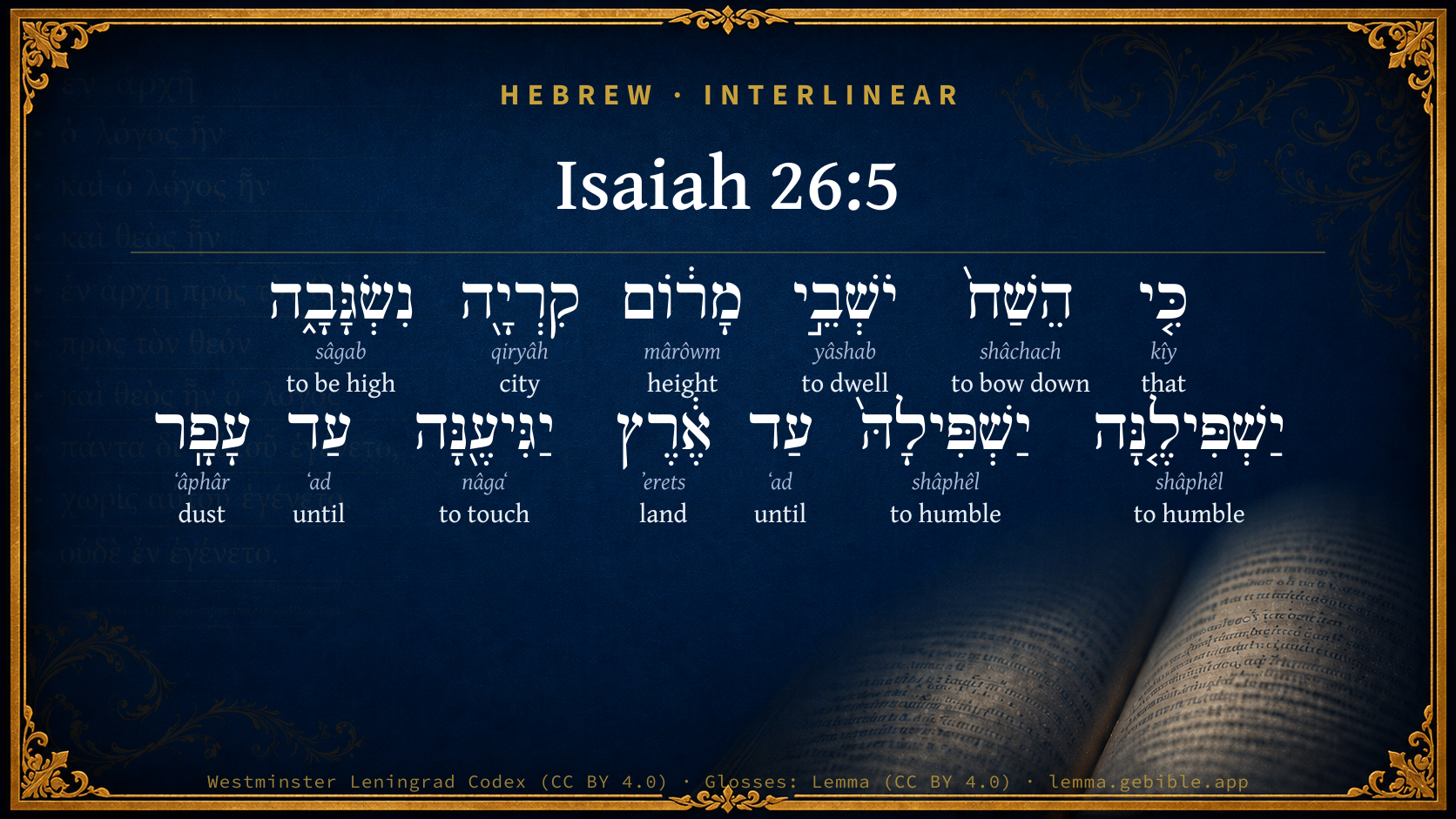
Hebrew (Westminster Leningrad Codex) Isaiah 26:5 appears in the Hebrew Old Testament. The text above is from the Westminster Leningrad Codex. Each word links to its Strong’s number, a concise gloss, and parsing drawn from the Open Scriptures Hebrew Bible morphology. Click any word for its full Brown-Driver-Briggs (BDB) entry.
Download image
Cite this verse

Isaiah 26:5 (World English Bible). Public Domain. Lemma interlinear Bible study tool, https://lemma.gebible.app/v/isaiah/26/5.

Show BibTeX & RIS
BibTeX
RIS
English Translation
For he has brought down those who dwell on high, the lofty city: he lays it low, he lays it low even to the ground; he brings it even to the dust.
World English Bible · Public Domain
Download a study sheet

One document with this verse’s original text, its word-by-word gloss line, the meaning frame, cross-references with their text, attributed commentary, and full source and license credits — printable, and it pastes into notes with its structure intact.

This verse Autodidact and up

Study sheet (.html) Plain text (.txt)

A passage Seminary Student

Up to 50 verses in one chapter. A passage sheet keeps up to 6 commentary sources and 12 cross-references per verse, in the order this page ranks them, and says so on the sheet whenever that leaves anything out. Ask for a single verse and you get the Autodidact verse sheet above.

Everything on this page stays free to read, with no account — the sheet is a download of what is already on screen, not access to it.

Want to remove ads? Support Godless Engineer
Compare translations 3

The same verse in 3 English versions, stacked beneath the original-language interlinear above. Click any original word for its lexicon entry.

Each is an independent rendering of the whole verse — the interlinear is not word-aligned to these translations.

Highlighted words mark where these versions differ — a whole-verse word diff, not a word-by-word alignment.

  • World English Bible Public Domain
    For he has brought down those who dwell on high, the lofty city: he lays it low, he lays it low even to the ground; he brings it even to the dust.
  • King James Version Public Domain
    For he bringeth down them that dwell on high; the lofty city, he layeth it low; he layeth it low, even to the ground; he bringeth it even to the dust.
  • unfoldingWord Literal Text CC BY-SA 4.0
    For he brings down the dwellers of the height, the exalted city. He brings it low, he brings it low to the earth; he makes it touch to the dust.

unfoldingWord Literal Text — © unfoldingWord, licensed CC BY-SA 4.0. Word-aligned USFM3 via Door43 (git.door43.org/unfoldingWord/en_ult).

Versions to compare (up to 4)

3 of 4 selected

Show all 18 translations

Every available English version of this verse, each an independent rendering of the whole verse.

  • World English Bible Public Domain
    For he has brought down those who dwell on high, the lofty city: he lays it low, he lays it low even to the ground; he brings it even to the dust.
  • Berean Standard Bible Public Domain
    For He has humbled those who dwell on high; He lays the lofty city low. He brings it down to the ground; He casts it into the dust.
  • Majority Standard Bible Public Domain
    For He has humbled those who dwell on high; He lays the lofty city low. He brings it down to the ground; He casts it into the dust.
  • King James Version Public Domain
    For he bringeth down them that dwell on high; the lofty city, he layeth it low; he layeth it low, even to the ground; he bringeth it even to the dust.
  • American Standard Version (1901) Public Domain
    For he hath brought down them that dwell on high, the lofty city: he layeth it low, he layeth it low even to the ground; he bringeth it even to the dust.
  • Revised Version (1885) Public Domain
    For he hath brought down them that dwell on high, the lofty city: he layeth it low, he layeth it low even to the ground; he bringeth it even to the dust.
  • Geneva Bible (1599) Public Domain
    For hee will bring downe them that dwell on hie: the hie citie he will abase: euen vnto the ground wil he cast it downe, and bring it vnto dust.
  • Douay-Rheims (1899) Public Domain
    For he shall bring down them that dwell on high, the high city he shall lay low. He shall bring it down even to the ground, he shall pull it down even to the dust.
  • Young's Literal Translation Public Domain
    For He bowed down the dwellers on high, A city set on high He maketh low, He maketh it low unto the earth, He causeth it to come unto the dust,
  • Literal Standard Version CC BY-SA 4.0
    For He bowed down the dwellers on high, || A city set on high He makes low, || He makes it low to the earth, || He causes it to come to the dust,
  • Unlocked Literal Bible CC BY-SA 4.0
    For he will bring down those who live proudly; the fortified city he will lay low, he will lay low to the ground; he will level it to the dust.
  • unfoldingWord Literal Text CC BY-SA 4.0
    For he brings down the dwellers of the height, the exalted city. He brings it low, he brings it low to the earth; he makes it touch to the dust.
  • Darby Bible Public Domain
    For he bringeth down them that dwell on high; the lofty city, he layeth it low, he layeth it low to the ground, he bringeth it even to the dust.
  • World Messianic Bible Public Domain
    For he has brought down those who dwell on high, the lofty city. He lays it low. He lays it low even to the ground. He brings it even to the dust.
  • Webster's Bible Public Domain
    For he bringeth down them that dwell on high; the lofty city, he layeth it low; he layeth it low, even to the ground; he bringeth it even to the dust.
  • Free Bible Version CC BY-SA 4.0
    He brings down those who live so high and mighty; he demolishes the proud city with its high walls, bringing it down to the ground, into the dust.
  • Bible in Basic English Public Domain
    For he has made low those who are lifted up, all the people of the town of pride: he makes it low, crushing it down to the earth; he makes it low in the dust.
  • JPS Tanakh (1917) Public Domain
    For He hath brought down them that dwell on high, the lofty city, laying it low, laying it low even to the ground, bringing it even to the dust.

Literal Standard Version (2020), Covenant Press — licensed CC BY-SA 4.0. Text via the HelloAO Bible API (eBible.org). Unlocked Literal Bible (unfoldingWord) — licensed CC BY-SA 4.0. Text via the HelloAO Bible API (eBible.org). unfoldingWord Literal Text — © unfoldingWord, licensed CC BY-SA 4.0. Word-aligned USFM3 via Door43 (git.door43.org/unfoldingWord/en_ult). Free Bible Version, Dr. Jonathan Gallagher — licensed CC BY-SA 4.0. Text via the HelloAO Bible API (eBible.org).

Word by word

More ways to search: Search by grammar → Find every occurrence → Compare this word →

Practice this passage: Drill this verse → Learn its vocabulary →

נִשְׂגָּבָ֑ה
sâgab
H7682
“being high”
Verb, Niphal, Participle Active, Feminine, Singular, Absolute
Part of Speech
Verb
Stem
Niphal
Form
Participle Active
Gender
Feminine
Number
Singular
State
Absolute
Full BDB Definition

Origin: a primitive root

TWOT: 2234

to be high, be inaccessibly high - (Qal) - to be (too) high (for capture) - to be high (of prosperity) - (Niphal) - to be high - to be set on high, be (safely) set on high - to be exalted (of God) - (Piel) - to set on high, set (securely) on high - to exalt, exalt (in effective hostility) - (Pual) to be set (securely) on high - (Hiphil) to act exaltedly
  1. כִּ֤י kîy H3588 “that” Conjunction
  2. הֵשַׁח֙ shâchach H7817 “to bow down” Verb, Hiphil, Perfect, 3rd Person, Masculine, Singular
  3. יֹשְׁבֵ֣י yâshab H3427 “dwelling” Verb, Qal, Participle Active, Masculine, Plural, Construct
  4. מָר֔וֹם mârôwm H4791 “height” Noun, Common, Masculine, Singular, Absolute
  5. קִרְיָ֖ה qiryâh H7151 “city” Noun, Common, Feminine, Singular, Absolute
  6. יַשְׁפִּילֶ֤נָּה shâphêl H8213 “to humble · her” Verb, Hiphil, Imperfect, 3rd Person, Masculine, Singular + Suffix, Personal, 3rd Person, Feminine, Singular
  7. יַשְׁפִּילָהּ֙ shâphêl H8213 “to humble · her” Verb, Hiphil, Imperfect, 3rd Person, Masculine, Singular + Suffix, Personal, 3rd Person, Feminine, Singular
  8. עַד ʻad H5704 “until” Preposition
  9. אֶ֔רֶץ ʼerets H776 “land” Noun, Common, Both, Singular, Absolute
  10. יַגִּיעֶ֖נָּה nâgaʻ H5060 “to touch · her” Verb, Hiphil, Imperfect, 3rd Person, Masculine, Singular + Suffix, Personal, 3rd Person, Feminine, Singular
  11. עַד ʻad H5704 “until” Preposition
  12. עָפָֽר ʻâphâr H6083 “dust” Noun, Common, Masculine, Singular, Absolute

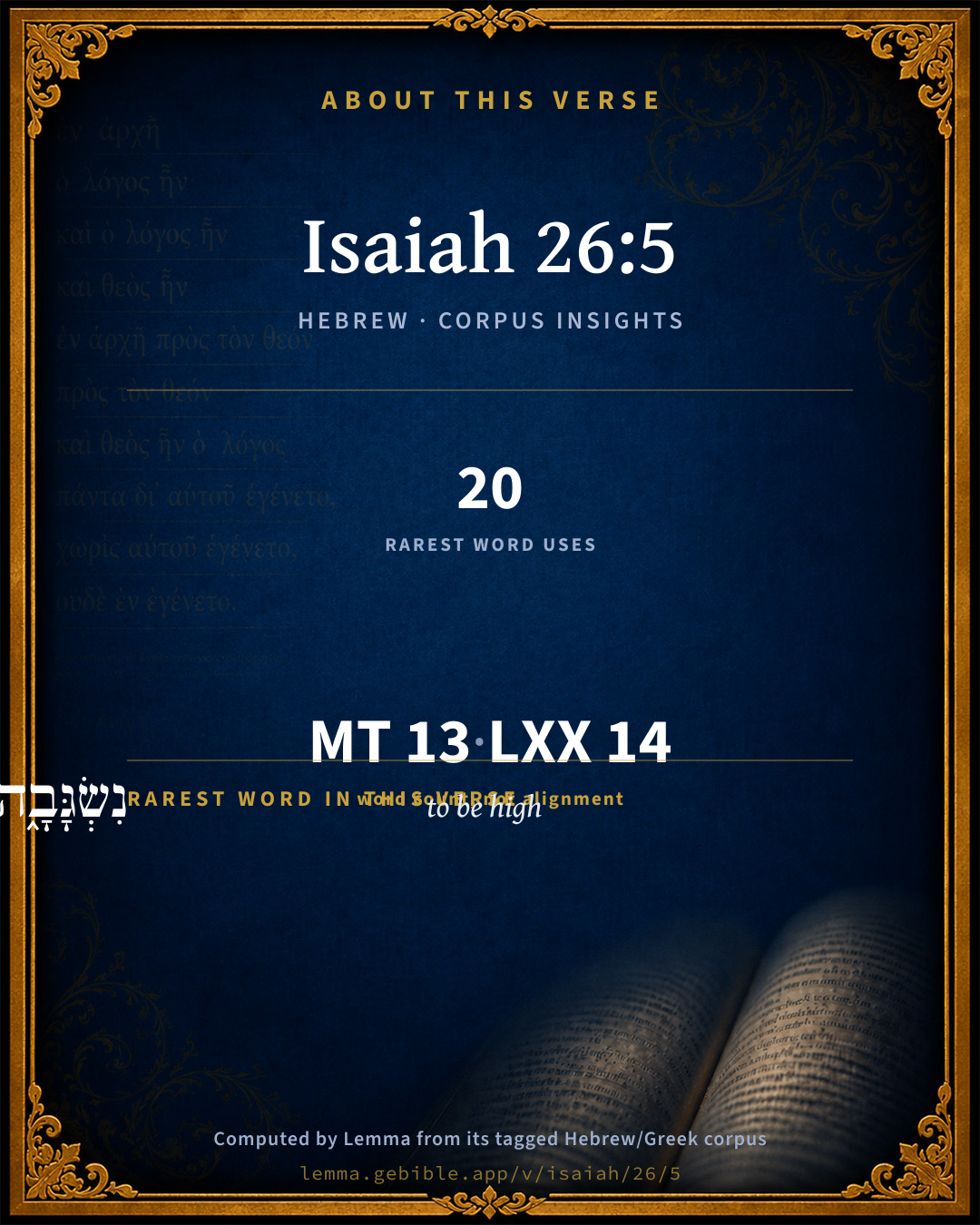
About this verse

These counts appear in no published source. They are computed here, from the morphology-tagged text and Lemma’s own curated glosses. What Lemma adds →

13
words
11
distinct lemmas
Prophets
section

Notable vocabulary

The rarest word here is נִשְׂגָּבָ֑ה to be high H7682 — appearing just 20 times in the whole Hebrew Bible.

Shared distinctive vocabulary

נִשְׂגָּבָ֑ה to be high H7682 occurs in 20 verses of the Hebrew Bible. Also found in:

Grammatical profile

  • 6 verbs
  • 4 nouns
  • 2 prepositions
  • 1 conjunction

Verb forms

  • הֵשַׁח֙ Hiphil · Perfect
  • יֹשְׁבֵ֣י Qal · Participle Active
  • נִשְׂגָּבָ֑ה Niphal · Participle Active
  • יַשְׁפִּילֶ֤נָּה Hiphil · Imperfect
  • יַשְׁפִּילָהּ֙ Hiphil · Imperfect
  • יַגִּיעֶ֖נָּה Hiphil · Imperfect

Repetition

Words recur within this verse — often emphatic in Hebrew:

  • יַשְׁפִּילֶ֤נָּה to humble H8213 ×2
  • עַד until H5704 ×2

Hebrew & Septuagint length

In English translation the verse runs 32 words from the Hebrew and 23 from the Septuagint (LXX English) — closely comparable.

A rough comparison of the two English renderings, which tokenize alike — not a word-level alignment.

Word counts can differ between the Hebrew and the Greek without any difference in meaning — e.g. the Hebrew direct-object marker אֵת has no separate Greek word, and Greek often adds the article ὁ.

In the original languages it is 13 Hebrew tokens and 14 Greek tokens — but the two are counted differently (Hebrew bundles its prefixes and suffixes into one token; the Greek is in lemma form), so that isn’t a like-for-like length.

Cross-references

12

Topical passages linked to Isaiah 26:5 in the Treasury of Scripture Knowledge — connected by theme and wording, ordered by reader-vote popularity; previews shown in the World English Bible.

  • Job 40:11–13 Pour forth the fury of your anger. Look on everyone who is proud, and bring him low.
  • Jeremiah 51:37 Babylon shall become heaps, a dwelling-place for jackals, an astonishment, and a hissing, without inhabitant.
  • Revelation 18:2 He cried with a mighty voice, saying, "Fallen, fallen is Babylon the great, and she has become a habitation of demons, a prison of every unclean spirit, and a prison of every unclean and hateful bird!
  • Isaiah 13:11 I will punish the world for [their] evil, and the wicked for their iniquity: and I will cause the arrogance of the proud to cease, and will lay low the haughtiness of the terrible.
  • Jeremiah 51:25–26 Behold, I am against you, destroying mountain, says Yahweh, which destroy all the earth; and I will stretch out my hand on you, and roll you down from the rocks, and will make you a burnt mountain.
  • Jeremiah 51:64 and you shall say, Thus shall Babylon sink, and shall not rise again because of the evil that I will bring on her; and they shall be weary. Thus far are the words of Jeremiah.
  • Isaiah 2:12 For there will be a day of Yahweh of Hosts for all that is proud and haughty, And for all that is lifted up; And it shall be brought low:
  • Isaiah 14:13 You said in your heart, I will ascend into heaven, I will exalt my throne above the stars of God; and I will sit on the mountain of congregation, in the uttermost parts of the north;
  • Isaiah 25:11–12 He shall spread forth his hands in the midst of it, as he who swims spreads forth [his hands] to swim; but [Yahweh] will lay low his pride together with the craft of his hands.
  • Isaiah 32:19 But it shall hail in the downfall of the forest; and the city shall be utterly laid low.
  • Isaiah 47:1 Come down, and sit in the dust, virgin daughter of Babylon; sit on the ground without a throne, daughter of the Chaldeans: for you shall no more be called tender and delicate.
  • Jeremiah 50:31–32 Behold, I am against you, you proud one, says the Lord, Yahweh of Hosts; for your day is come, the time that I will visit you.

Cross-references courtesy of OpenBible.info (CC BY 4.0).

Hebrew and Greek witnesses Masoretic Hebrew ↔ Greek Septuagint

The same verse in the two great witnesses to the Old Testament, shown verse-for-verse.

These are two independent witnesses, not word-aligned to each other, and the Septuagint is shown in lemma (dictionary) form.

Hebrew Isaiah 26:5 Masoretic · Westminster Leningrad Codex

כִּ֤י הֵשַׁח֙ יֹשְׁבֵ֣י מָר֔וֹם קִרְיָ֖ה נִשְׂגָּבָ֑ה יַשְׁפִּילֶ֤נָּה יַשְׁפִּילָהּ֙ עַד אֶ֔רֶץ יַגִּיעֶ֖נָּה עַד עָפָֽר

For he has brought down those who dwell on high, the lofty city: he lays it low, he lays it low even to the ground; he brings it even to the dust.

World English Bible · Public Domain

Greek LXX Isaiah 26:5 Septuagint · lemma form

ὅς ταπεινόω καταἄγω ὁ ἐνοἰκέω ἐν ὑψηλός πόλις ὀχυρός καταβάλλω καί καταἄγω ἕως ἔδαφος

who have humbled and brought down them that dwell on high, you shall cast down strong cities, and bring them to the ground.

LXX2012 (modern English Septuagint) · Public Domain

Hebrew: Westminster Leningrad Codex (CC BY 4.0). Greek: Septuagint (public domain); English from LXX2012 (modern English Septuagint) (Public Domain). How the Septuagint differs from the Hebrew →

Targum (Aramaic paraphrase)

1

The Targum is the ancient Jewish Aramaic paraphrase of the Hebrew Scriptures — an interpretive translation, not the Hebrew text itself. Onkelos (literal) and Pseudo-Jonathan (expansive) render the Torah, and Jonathan the Prophets. Coverage is partial: where no permissively-licensed English translation exists for a verse, only the Aramaic is shown. This is verse-level text, not a word-by-word alignment to the Hebrew.

  1. Targum Jonathan Prophets (Joshua–Malachi)
    אֲרֵי אַמְאִיךְ יַתְבֵי רוּמָא קִרְיָא תַקִיפָא יַמְאֲכִינָא וְיַרְמִינָהּ עַד אַרְעָא יִמְטִינָהּ עַד עַפְרָא:

    For he will humble the inhabitants of the high and strong city; he will humble her, he will cast her unto the ground, he will bring her even to the dust.

    Targum Jonathan — Aramaic: “Mikraot Gedolot” (public domain). English: “Sefaria Community Translation” (CC0 1.0 (public-domain dedication)); “London "Chaldee Paraphrase," 1871” (public domain). Text via Sefaria.

Commentary

Notes on Isaiah 26:5 from classic Christian and Jewish commentators (each source and its license shown beneath its notes). The classic Christian expositions comment on the surrounding passage and are grouped to its opening verse, so a note may address several verses; the Jewish commentaries on the Tanakh (Rashi and others) are per-verse, so they appear only where the commentator wrote on this verse.

Lemma curates 59 commentaries, every one of them public domain or Creative Commons licensed, each selected and text-cleaned for this edition rather than reprinted as found. About our sources →

Matthew Henry's Commentary

Here the prophet further encourages us to trust in the Lord for ever, and to continue waiting on him; for,

I. He will make humble souls that trust in him to triumph over their proud enemies, Isa 26:5, Isa 26:6. Those that exalt themselves shall be abased: For he brings down those that dwell on high; and wherein they deal proudly he is, and will be, above them. Even the lofty city Babylon itself, or Nineveh, he lays it low, Isa 25:12. He can do it, be it ever so well fortified. He has often done it. He will do it, for he resists the proud. It is his glory to do it, for he proves himself to be God by looking on the proud and abasing them, Job 40:12. But, on the contrary, those that humble themselves shall be exalted; for the feet of the poor shall tread upon the lofty cities, Isa 26:6. He does not say, Great armies shall tread them down; but, When God will have it done, even the feet of the poor shall do it, Mal 4:3. You shall tread down the wicked. Come, set your feet on the necks of these kings. See Psa 147:6; Rom 16:20.

II. He takes cognizance of the way of his people and has delight in it (Isa 26:7): The way of the just is evenness (so it may be read): it is their endeavour and constant care to walk with God in an even steady course of obedience and holy conversation. My foot stands in an even place, goes in an even path, Psa 26:12. And it is their happiness that God makes their way plain and easy before them: Thou, most upright, dost level (or make even) the path of the just, by preventing or removing those things that would be stumbling-blocks to them, so that nothing shall offend them, Psa 119:165. God weighs it (so we read it); he considers it, and will give them grace sufficient for them, to help them over all the difficulties they may meet with in their way. Thus with the upright God will show himself upright.

III. It is our duty, and will be our comfort, to wait for God, and to keep up holy desires towards him in the darkest and most discouraging times, Isa 26:8, Isa 26:9. This has always been the practice of God's people, even when God has frowned upon them, 1. To keep up a constant dependence upon him: "In the way of thy judgments we have still waited for thee; when thou hast corrected us we have looked to no other hand than thine to relieve us," as the servant looks only to the hand of his master, till he have mercy upon him, Psa 123:2. We cannot appeal from God's justice but to his mercy. If God's judgments continue long, if it be a road of judgments (so the word signifies), yet we must not be weary but continue waiting. 2. To send up holy desires towards him. Our troubles, how pressing soever, must never put us out of conceit with our religion, nor turn us away from God; but still the desire of our soul must be to his name and to the remembrance of him; and in the night, the darkest longest night of affliction, with our souls must we desire him. (1.) Our great concern must be for God's name, and our earnest desire must be that his name may be glorified, whatever becomes of us and our names. This is that which we must wait for, and pray for. "Father, glorify thy name, and we are satisfied." (2.) Our great comfort must be in the remembrance of that name, of all that whereby God has made himself known. The remembrance of God must be our great support and pleasure; and, though sometimes we be unmindful of him, yet still our desire must be towards the remembrance of him and we must take pains with our own hearts to have him always in mind. (3.) Our desires towards God must be inward, fervent, and sincere. With our soul we must desire him, with our soul we must pant after him (Psa 42:1), and with our spirits within us, with the innermost thought and the closest application of mind, we must seek him. We make nothing of our religion, whatever our profession be, if we do not make heart-work of it. (4.) Even in the darkest night of affliction our desires must be towards God, as our sun and shield; for, however God is pleased to deal with us, we must never think the worse of him, nor cool in our love to him. (5.) If our desires be indeed towards God,. we must give evidence that they are so by seeking him, and seeking him early, as those that desire to find him, and dread the thoughts of missing him. Those that would seek God and find him must seek betimes, and seek him earnestly. Though we come ever so early, we shall find him ready to receive us.

IV. It is God's gracious design, in sending abroad his judgments, thereby to bring men to seek him and serve him: When thy judgments are upon the earth, laying all waste, then we have reason to expect that not only God's professing people, but even the inhabitants of the world, will learn righteousness, will have their mistakes rectified and their lives reformed, will be brought to acknowledge God's righteousness in punishing them, will repent of their own unrighteousness in offending God, and so be brought to walk in right paths. They will do this; that is, judgments are designed to bring them to this, they have a natural tendency to produce this effect, and, though many continue obstinate, yet some even of the inhabitants of the world will profit by this discipline, and will learn righteousness; surely they will; they are strangely stupid if they do not. Note, The intention of afflictions is to teach us righteousness; and blessed is the man whom God chastens, and thus teaches, Psa 94:12. Discite justitiam, moniti, et non temnere divos - Let this rebuke teach you to cultivate righteousness, and cease from despising the gods. - Virgil.

V. Those are wicked indeed that will not be wrought upon by the favourable methods God takes to subdue and reform them; and it is necessary that God should deal with them in a severe way by his judgments, which shall prevail to humble those that would not otherwise be humbled. Observe,

1. How sinners walk contrary to God, and refuse to comply with the means used for their reformation and to answer the intentions of them, Isa 26:10. (1.) Favour is shown to them. They receive many mercies from God; he causes his sun to shine and his rain to fall upon them, nay, he prospers them, and into their hands he brings plentifully; they escape many of the strokes of God's judgments, which others less wicked than they have been cut off by; in some particular instances they seem to be remarkably favoured above their neighbours, and the design of all this is that they may be won upon to love and serve that God who thus favours them; and yet it is all in vain: They will not learn righteousness, will not be led to repentance by the goodness of God, and therefore it is requisite that God should send his judgments into the earth, to reckon with men for abused mercies. (2.) They live in a land of uprightness, where religion is professed and is in reputation, where the word of God is preached, and where they have many good examples set them, - in a land of evenness, where there are not so many stumbling-blocks as in other places, - in a land of correction, where vice and profaneness are discountenanced and punished; yet there they will deal unjustly, and go on frowardly in their evil ways. Those that do wickedly deal unjustly both with God and man, as well as with their own souls; and those that will not be reclaimed by the justice of the nation may expect the judgments of God upon them. Nor can those expect a place hereafter in the land of blessedness who now conform not to the laws and usages, nor improve the privileges and advantages, of the land of uprightness; and why do they not? It is because they will not behold the majesty of the Lord, will not believe, will not consider, what a God of terrible majesty he is whose laws and justice they persist in the contempt of. God's majesty appears in all the dispensations of his providence; but they regard it not, and therefore study not to answer the ends of those dispensations. Even when we receive of the mercy of the Lord we must still behold the majesty of the Lord and his goodness. (3.) God lifts up his hand to give them warning, that they may, by repentance and prayer, make their peace with him; but they take no notice of it, are not aware that God is angry with them, or coming forth against them: They will not see, and none so blind as those who will not see, who shut their eyes against the clearest conviction of guilt and wrath, who ascribe that to chance, or common fate, which is manifestly a divine rebuke, who regard not the threatening symptoms of their own ruin, but cry Peace to themselves, when the righteous God is waging war with them.

2. How God will at length be too hard for them; for, when he judges, he will overcome: They will not see, but they shall see, shall be made to see, whether they will or no, that God is angry with them. Atheists, scorners, and the secure, will shortly feel what now they will not believe, that it is a fearful thing to fall into the hands of the living God. They will not see the evil of sin, and particularly the sin of hating and persecuting the people of God; but they shall see, by the tokens of God's displeasure against them for it and the deliverances in which God will plead his people's cause, that what is done against them he takes as done against himself and will reckon for it accordingly. They shall see that they have done God's people a great deal of wrong, and therefore shall be ashamed of their enmity and envy towards them, and their ill usage of such as deserved better treatment. Note, Those that bear ill-will to God's people have reason to be ashamed of it, so absurd and unreasonable is it; and, sooner or later, they shall be ashamed of it, and the remembrance of it shall fill them with confusion. Some read it, They shall see and be confounded for the zeal of the people, by the zeal God will show for his people; when they shall be made to know how jealous God is for the honour and welfare of his people they shall be confounded to think that they might have been of that people and would not. Their doom therefore is that, since they slighted the happiness of God's friends, the fire of his enemies shall devour them, that is, the fire which is prepared for his enemies and with which they shall be devoured, the fire designed for the devil and his angels. Note, Those that are enemies to God's people, and envy them, God looks upon as his enemies, and will deal with them accordingly.

Matthew Henry's Commentary on the Whole Bible (1708–1710) — public domain (CC PDM 1.0). Text via the HelloAO Bible API.

The Cambridge Bible for Schools and Colleges

gen. ed. J. J. S. Perowne

5, 6. Jehovah has proved himself to be a Rock by the destruction of “the lofty city”; see on ch. Isa_25:2. The principal pause in Isa_26:5 should be after the word “city.”

The Cambridge Bible for Schools and Colleges (gen. ed. J. J. S. Perowne; Cambridge University Press, 1878–1918) — public domain. Text from a community e-Sword module.

Trapp's Complete Commentary

John Trapp

Isa 26:5 For he bringeth down them that dwell on high; the lofty city, he layeth it low; he layeth it low, [even] to the ground; he bringeth it [even] to the dust.

Ver. 5. For he bringeth down those that dwell on high.] Even all adverse power, and every high thing that exalteth itself against the knowledge of God. {2Co 10:5}

The lofty city he layeth it low.] This Museulus understands of Babylon, that towering city; as also of Rome, that spiritual Babylon, to which it was long since said -

“ Versa eris in cineres quasi nunquam Roma fuisses. ”

John Trapp, A Commentary or Exposition upon All the Books of the Old and New Testament (1647–1656) — public domain. Text from a community e-Sword module.

Joseph Benson's Commentary

Isa 26:5-6. For he bringeth down — Hebrew, he hath brought down, or, as it may be rendered, he will bring down, them that dwell on high — He speaks not so much of height of place, as of dignity and power, in which sense also he mentions the lofty city in the next clause; which may be understood, either of proud Babylon, or of all the strong and stately cities of God’s enemies. The foot shall tread it down — God will bring it under the feet of his poor, weak, and despised people. The meaning is, you have good reason for trusting in God, for he can and does raise up some and throw down others, according to his own good pleasure.

Joseph Benson's Commentary on the Old and New Testaments (1811–1818) — public domain. Text from a community e-Sword module.

MacLaren's Expositions of Holy Scripture

Alexander MacLaren

Isaiah

THE SONG OF TWO CITIES

Isa 26:1 - Isa 26:10.

‘This song’ is to be interpreted as a song, not with the cold-blooded accuracy proper to a scientific treatise. The logic of emotion is as sound as that of cool intellect, but it has its own laws and links of connection. First, the song sets in sharp contrast the two cities, describing, in Isa 26:1 - Isa 26:4, the city of God, its strength defences, conditions of citizenship, and the peace which reigns within its walls; and in Isa 26:5 - Isa 26:6 the fall and utter ruin of the robber city, its antagonist Jerusalem, on its rocky peninsula, supplies the form of Isaiah’s thought; but it is only a symbol of the true city of God, the stable, invisible, but most real, polity and order of things to which men, even while wandering lonely and pilgrims, do come, if they will. It is possible even here and now to have our citizenship in the heavens, and to feel that we belong to a great community beyond the sea of time, though our feet have never trodden its golden pavements, nor our eyes seen its happy glories.

In one aspect, it is ideal, but in truth it is more real than the intrusive and false things of this fleeting present, which call themselves realities. ‘The things which are’ are the things above. The things here are but shows and shadows.

The city’s walls are salvation. There is no need to name the architect of these fortifications. One hand only can pile their strength. God appoints salvation in lieu of all visible defences. Whom He purposes to save are saved. Whom He wills to keep safe are kept safe. They who can shelter behind that strong defence need no other. Weak, sense-governed hearts may crave something more palpable, but they do not really need it. A parapet on an Alpine road gives no real security, but only satisfies imagination. The sky needs no pillars to hold it up.

Then an unknown voice breaks in upon the song, calling on unnamed attendants to fling wide the gates. The city is conceived of as empty; its destined inhabitants must have certain qualifications. They must be righteous, and must ‘keep faithfulness’ being true to the God who is ‘faithful and true’ in all His relations. None but the righteous can dwell in conscious citizenship with the Unseen while here, and none but the righteous can enter through the gates into the city. That requirement is founded in the very nature of the case, and is as emphatically proclaimed by the gospel as by the prophet. But the gospel tells more articulately than he was enlightened to do, how righteousness is to be won. The last vision of the Apocalypse, which is so like this song in its central idea, tells us of the fall of Babylon, of the descent to earth of the New Jerusalem, and leaves as its last message the great saying, ‘Blessed are they that wash their robes that they may . . . enter in through the gate into the city.’

Our song gives some hint of similar thoughts by passing from the description of the qualifications for entrance to the celebration of the security which comes from trust. The safety which is realised within the walls of the strong city is akin to the ‘perfect peace’ in which he who trusts is kept; and the juxtaposition of the two representations is equivalent to the teaching that trust, which is precisely the same as the New Testament faith, is the condition of entrance. We know that faith makes righteous, because it opens the heart to receive God’s gift of righteousness; but that effect of faith is implied rather than stated here, where security and peace are the main ideas. As some fugitives from the storm of war sit in security behind the battlements of a fortress, and scarcely hear the din of conflict in the open field below, the heart, which has taken refuge by trust in God, is kept in peace so deep that it passes description, and the singer is fain to give a notion of its completeness by calling it ‘peace, peace.’ The mind which trusts is steadied thereby, as light things lashed to a firm stay are kept steadfast, however the ship toss. The only way to get and keep fixedness of temper and spirit amid change and earthquake is to hold on to God, and then we may be stable with stability derived from the foundations of His throne to which we cling.

Therefore the song breaks into triumphant fervour of summons to all who hear it, to ‘trust in Jab Jehovah for ever,’ Such settled, perpetual trust is the only attitude corresponding to His mighty name, and to the realities found in His character. He is the ‘Bock of Ages’ the grand figure which Moses learned beneath the cliffs of Sinai and wove into his last song, and which tells us of the unchanging strength that makes a sure hiding-place for all generations, and the ample space which will hold all the souls of men, and be for a shadow from the heat, a covert from the tempest, a shelter from the foe, and a home for the homeless, with many a springing fountain in its clefts.

The great act of judgment which the song celebrates is now {Isa 26:5 - Isa 26:6} brought into contrast with the blessed picture of the city, and by the introductory ‘for’ is stated as the reason for eternal trust. The language, as it were, leaps and dances in jubilation, heaping together brief emotional and synonymous clauses. So low is the once proud city brought, that the feet of the poor tread it down. These ‘poor’ and ‘needy’ are the true Israel, the suffering saints, who had known how cruel the sway of the fallen robber city was; and now they march across its site; and its broken columns and ruined palaces strew the ground below their feet. ‘The righteous nation’ of the one picture are ‘the poor and needy’ of the other. No doubt the prophecy has had partial accomplishments more than once or twice, when the oppressed church has triumphed, and some hoary iniquity been levelled at a blow, or toppled over by slow decay. But the complete accomplishment is yet future, and not to be realised till that last act, when all antagonism shall be ended, and the net result of the weary history of the world be found to be just these two pictures of Isaiah’s-the strong city of God with its happy inhabitants, and the everlasting desolations of the fallen city of confusion.

The triumphant hurry of the song pauses for a moment to gaze upon the crash, and in Isa 26:7 gathers its lessons into a kind of proverbial saying, which is perhaps best translated ‘The path of the just is smooth {or “plain"}; Thou levellest smooth the path of the just.’ To render ‘upright’ instead of ‘smooth’ seems to make the statement almost an identical proposition, and is tame. What is meant is, that, in the light of the end, the path which often seemed rough is vindicated. The judgment has showed that the righteous man’s course had no unnecessary difficulties. The goal explains the road. The good man’s path is smooth, not because of its own nature, but because God makes it so. We are to look for the clearing of our road, not to ourselves, nor to circumstances, but to Him; and even when it is engineered through rocks and roughnesses, to believe that He will make the rough places plain, or give us shoes of iron and brass to encounter them. Trust that when the journey is over the road will be explained, and that this reflection, which breaks the current of the swift song of the prophet, will be the abiding, happy conviction of heaven.

Lastly, the song looks back and tells how the poor and needy, in whose name the prophet speaks, had filled the dreary past, while the tyranny of the fallen city lasted, with yearning for the judgment which has now come at last. Isa 26:8 - Isa 26:9 breathe the very spirit of patient longing and meek hope. There is a certain tone of triumph in that ‘Yea,’ as if the singer would point to the great judgment now accomplished, as vindicating the long, weary hours of hope deferred. That for which ‘the poor and needy’ wait is the coming ‘in the path of Thy judgments.’ The attitude of expectance is as much the duty and support of Christians as of Israel. We have a greater future clearer before us than they had. The world needs God’s coming in judgment more than ever; and it says little for either the love to God or the benevolence towards man of average Christians, that they should know so little of that yearning of soul which breathes through so much of the Old Testament. For the glory of God and the good of men, we should have the desire of our souls turned to His manifestation of Himself in His righteous judgments. It was no personal end which bred the prophet’s yearning. True, the ‘night’ round him was dreary enough, and sorrow lay black on his people and himself; but it was God’s ‘name’ and ‘memorial’ that was uppermost in his desires. That is to say, the chief object of the devout soul’s longings should be the glory of God’s revealed character. And the deepest reason for wishing that He would flash forth from His hiding-place in judgments, is because such an apocalypse is the only way by which wilfully blind eyes can be made to see, and wilfully unrighteous hearts can be made to practise righteousness.

Isaiah believed in the wholesome effect of terror. His confidence in the power of judgments to teach the obstinate corresponds to the Old Testament point of view, and contains a truth for all points of view; but it is not the whole truth. We know only too well that sorrows and judgments do not work infallibly, and that men ‘being often reproved, harden their necks.’ We know, too, more clearly than any prophet of old could know, that the last arrow in God’s quiver is not some unheard-of awfulness of judgment, but an unspeakable gift of love, and that if that ‘favour shown to the wicked’ in the life and death of God’s Son does not lead him to ‘learn righteousness,’ nothing else will.

But while this is true, the prophet’s aspirations are founded on the facts of human nature too, and judgments do sometimes startle those whom kindness had failed to touch. It is an awful thought that human nature may so steel itself against the whole armoury of divine weapons as that favour and severity are equally blunted, and the heart remains unpierced by either. It is an awful thought that there may be induced such truculent obstinacy of love of evil that, even when in ‘a land of uprightness,’ a man shall choose evil, and forcibly shut his eyes, that he may not see the majesty of the Lord, which he does not wish to see because it condemns his choice, and threatens to burn up him and his work together. A blasted tree when all the woods are green, a fleece dry when all around is rejoicing in the dew, a window dark when the whole city is illuminated, one black sheep amid the white flock, or anything else anomalous and alone in its evil, is less tragic than the sight, so common, of a man so sold to sin that the presence of good only makes him angry and restless. It is possible to dwell amidst the full light of Christian truth, and in a society moulded by its precepts, and to be unblessed, unsoftened thereby. If not softened, then hardened; and the wicked who in the land of uprightness deals wrongfully is all the worse for the light which he hated because it showed him the sinfulness of the sin which he obstinately loved and would keep.

Alexander MacLaren, Expositions of Holy Scripture (1904–1910) — public domain. Text from a community e-Sword module.

Tyndale Open Study Notes

Tyndale Open Resources

26:5 The proud and arrogant are often characterized as exalting themselves (see 2:11-12), whereas God humbles them.

Tyndale Open Study Notes — © Tyndale Open Resources, licensed CC BY-SA 4.0. Text via the HelloAO Bible API.

Geneva Bible (1599)

Geneva Bible translators

There is no power so high that can let God, when he will deliver his.

Geneva Bible (1599) marginal notes — public domain. Text via Bolls.life.

Jamieson, Fausset & Brown

Robert Jamieson, A. R. Fausset & David Brown

lofty city--Babylon; representative of the stronghold of the foes of God's people in all ages (Isa 25:2, Isa 25:12; Isa 13:14).

Jamieson, Fausset & Brown — Commentary Critical and Explanatory on the Whole Bible (1871) — public domain (CC PDM 1.0). Text via the HelloAO Bible API.

Ellicott's Commentary for English Readers

(5) The lofty city, he layeth it low . . .—The “city” is probably the great imperial “city of confusion” that had exalted itself against God and his people. To that city, Moab, in all its pride, was but as a tributary.

A Bible Commentary for English Readers, edited by Charles John Ellicott (1878–1897) — public domain. Text from a community e-Sword module.

John Gill's Exposition

For he bringeth down them that dwell on high, the lofty city,.... That dwell on high in the high city, so the accents require the words to be rendered; and accordingly the Targum is,

"for he will bring low the inhabitants of the high and strong city;''

such that dwell in a city built on high, and in the high towers and palaces of it; or that sit on high thrones, are spiritual wickednesses in high places, and are of proud and haughty dispositions and conduct; as the pope of Rome and his cardinals, &c.; for not the city of Jerusalem is here meant, as Jerom thinks, whose destruction he supposes is foretold, as both by the Babylonians and Romans; and therefore, he observes, the word is doubled in the next clause; nor the city of Nineveh; nor Babylon, literally taken; but mystical Babylon is here meant. Jarchi interprets them that dwell on high of Tyre and Greece; but Jerom says, the Jews understand by the lofty city the city of Rome; and this seems to be the true sense; a city built upon seven hills or mountains; a city that has ruled over the kings of the earth, and whose present inhabitants are proud and haughty:

he layeth it low: he layeth it low, even to the ground; he bringeth it even to the dust; all which expressions denote the utter destruction of it; see Isa 25:12.

John Gill's Exposition of the Whole Bible (1746–1763) — public domain (CC PDM 1.0). Text via the HelloAO Bible API.

Albert Barnes' Notes on the Bible

The lofty city, he layeth it low - The city of Babylon (see the note at Isa 25:12; compare Isa. 13, note; Isa 14:1, note)

Albert Barnes' Notes on the Bible (1834–1885) — public domain. Text from a community e-Sword/MySword module.

Haydock's Catholic Bible Commentary

High: Nabuchodonosor and his empire.

George Leo Haydock (1774–1849), Haydock's Catholic Family Bible and Commentary, 1859 edition — public domain. Excludes Psalms (Douay-Rheims chapter numbering differs from Protestant) and Deuterocanonical books (Catholic canon only).

Matthew Poole's English Annotations

He bringeth down, Heb. he hath brought down, which yet may be put for the future, he will bring down, &c. You may trust him; for he can and doth raise some, and throw down others, according to his own good pleasure.

Them that dwell on high; he speaks not so much of height of place as of dignity and power, in which sense also he mentions the lofty city, in the next clause. The lofty city; which may be understood either of proud Babylon; or collectively, of all the strong and stately cities of God’s enemies.

Matthew Poole's English Annotations on the Holy Bible (1683–1685) — public domain. Text from a community e-Sword/MySword module.

Whedon's Commentary on the Bible

Daniel D. Whedon

5-7. He bringeth down them that dwell on high — The argument is, Why not trust such a One who has overwhelmed imperial oppressive cities, and abolished nearer gainsaying peoples. A more free rendering here, but giving the true sense is, “The dwellers in high pride he hurled downward, the towering fortress he tumbled to the ground and pulverized it to dust. Feet of common people, feet of the poor and lowly, are treading it in very scorn.” But to the righteous how otherwise the result! Their way is straight and even. The word weigh, in Isa_26:7, is used in the sense of to make even, to level. The course of the just is smooth and unimpeded.

Daniel D. Whedon (gen. ed.), Commentary on the Old and New Testaments (1874–1909) — public domain. Text from a community e-Sword module.

The Pulpit Commentary

He bringeth down; rather, he hath brought down. The redeemed praise God for his past mercies. He brought down in his own good time all the proud and lofty ones who exalted themselves against him and oppressed his saints, making cities desolate (Isa_24:10, Isa_24:12) and giving over their inhabitants to destruction. (Isa_24:6) Them that dwell on high; i.e. "that exalt themselves." It is net eminence, but pride, that provokes the Divine anger. The heathen judged differently (see Herod., 7:10, The lofty city. (comp. Isa_24:10, 12 25:2, 3) The "world-city" (as it has been called); i.e. the idealized stronghold of the adversaries of God in this world, is intended.

HOMILIES BY W. CLARKSON Vers. 5-7, 8 (latter half). The righteousness of God"s rule.

I ITS APPARENT ABSENCE. We still find on the earth "them that dwell on high the arrogant, the presumptuous, the oppressor; there is to be seen" the lofty city," exalted in its pride of power, dealing its blows upon the weak and suffering, fearing not God nor regarding the rights of men. In every age, beneath every sky, these men and these cities have been known. To those who have been humiliated and ill treated, God has seemed absent; his righteousness has appeared afar off; their cry has been, "How long, O Lord, how long dost thou not avenge," etc.? Among such suffering and perplexed ones are down-trodden peoples, persecuted Churches, wronged individual men and women.

II ITS ASSERTION IN DUE TIME. The justice of God "is not dead, but sleepeth." It may be truer to say that it waits in patience for the hour of manifestation; then it descends; and it appears:

1. In the utter overthrow of iniquity. The lofty are laid low, the proud city is brought down to the ground (ver. 5). Instead of power is utter enfeeblement; the weapon of cruelty is stricken out of its hand, the words of condemnation and cursing are taken out of its mouth. Instead of honor is humiliation; the throne is exchanged for the very dust of the ground; and instead of unholy joy is hopeless misery.

2. In the exaltation of rectitude (ver. 6). Those who have been reduced to poverty and need by the unscrupulousness of the sinful will accede to their heritage of power, of wealth, of pleasure, or what is better than these of influence, of sufficiency, of thankfulness. God, the Most Upright One, smooths the path of the just (ver. 7), makes it level, enables the righteous to pursue their way of fruitful activity, of Divine worship, of holy joy.

III THE EFFECT OF ITS ASSERTION. "When God"s judgments are in the earth," i.e. when the righteousness of God is seen and felt in the infliction of penalty on the guilty and the leveling of the path of the just, then "the inhabitants... learn righteousness" (ver. 8).

1. The devout are confirmed in their devotion, and they cleave to God and to his service.

2. The waverers are decided, and they resolve to unite themselves with his people.

3. The presumptuous are alarmed, and they may be awakened and redeemed. This is God"s intention in, and is the fitting end of, his Divine judgments; it is our folly and our sin if we allow that purpose to be defeated. C.

The Pulpit Commentary (1880–1919), ed. H.D.M. Spence-Jones & Joseph S. Exell — public domain. Text from a community e-Sword module.

John Wesley's Explanatory Notes

On high - He speaks not so much of height of place, as of dignity and power, in which sense also he mentions the lofty city in the next clause. Lofty city - Which may be understood either of proud Babylon, or of all the strong and stately cities of God's enemies.

John Wesley, Explanatory Notes Upon the Whole Bible (1754–1765) — public domain. Text via the GEBible commentary corpus.

Keil & Delitzsch

C. F. Keil & F. Delitzsch

He has already proved Himself to be such a rock, on which everything breaks that would attack the faithful whom He surrounds. "For He hath bent down them that dwell on high; the towering castle, He tore it down, tore it down to the earth, cast it into dust. The foot treads it to pieces, feet of the poor, steps of the lowly." Passing beyond the fall of Moab, the fall of the imperial city is celebrated, to which Moab was only an annex (Isa 25:1-2; Isa 24:10-12). The futures are determined by the preterite; and the anadiplosis, which in other instances (e.g., Isa 25:1, cf., Psa 118:11) links together derivatives or variations of form, is satisfied in this instance with changing the forms of the suffix. The second thought of Isa 26:6 is a more emphatic repetition of the first: it is trodden down; the oppression of those who have been hitherto oppressed is trodden down.

Keil & Delitzsch — Biblical Commentary on the Old Testament (1861–1891) — public domain (CC PDM 1.0). Text via the HelloAO Bible API. (Old Testament only.)

J. A. Alexander on Isaiah

Joseph Addison Alexander

“For He hath brought down the inhabitants of the high place, the exalted city; He will lay it low, He will lay it low, to the very ground; He will bring it to the very dust.” He has proved himself able to protect his people, and consequently worthy to be trusted by them, in His signal overthrow of that great power by which they were oppressed. The alternation of the tenses here is somewhat remarkable. The English Version treats them all as presents, which is often allowable where the forms are intermingled. But in this case, a reason can be given for the use of the two tenses, even if strictly understood. The Prophet looks at the events from two distinct points of observation, his own and that of the ideal speakers. With respect to the latter, the fall of Babylon was past; with respect to the former it was still future. He might therefore naturally say, even in the same sentence, he has brought it low and he shall bring it to the dust.

Joseph Addison Alexander, The Prophecies of Isaiah (1846–1847; New York: Scribner, 1870–1878) — public domain. Text from a community e-Sword module.

unfoldingWord translationNotes

Door43 World Missions Community

he will bring down those who live proudly

Yahweh humiliating those who are proud is spoken of as if proud people were up high and he would cause them to come down low. (See: Metaphor)

the fortified city

This means fortified cities in general not a specific city. (See: Generic Noun Phrases)

he will lay low ... he will level

Yahweh causing an army to destroy fortified cities is spoken of as if Yahweh would do it himself. (See: Metonymy)

It will be trampled down by the feet of the poor and the treading of the needy

Both statements mean the same thing. This can be stated in active form. AT: "The poor and oppressed people will trample on the ruins of the city" (See: Parallelism and Active or Passive)

translationWords

proud

stronghold

unfoldingWord translationNotes — © Distant Shores Media and the Door43 World Missions Community, licensed CC BY-SA 4.0. Source: git.door43.org/Door43/en_tn.

Rashi

Rabbi Shlomo Yitzchaki (Rashi)

the inhabitants of the high places Tyre and other lands. ([Manuscripts yield:] Tyre and Rome and Italy. [Parshandatha])

Rashi on the Tanakh — English translations: “The Judaica Press complete Tanach with Rashi, translated by A. J. Rosenberg” (CC BY 4.0); “Pentateuch with Rashi's commentary by M. Rosenbaum and A.M. Silbermann, 1929-1934” (public domain); “The Metsudah Tanach series, Lakewood, N.J” (CC BY 4.0); and “The Book of Joshua, Metsudah Publications, 1997” (CC BY 4.0). Text via Sefaria.

Ibn Ezra

Rabbi Abraham ibn Ezra

השח He bringeth down. A verb ע״ע like הֵקַל he afflicted slightly (8:23). Them that dwell on high, etc. This refers to the heathens.

ישפילנה ישפילה He layeth it low, he layeth it low. He will continually lay it low; comp. עזי ומעזי My strength and my fortress (Jer. 16:19).

Ibn Ezra on the Tanakh — English translations: “Sefaria Community Translation” (CC0 1.0 (public-domain dedication)); “Yalkut, Sifsei Chachomim Chumash, Metsudah Publications, 2009” (CC BY 4.0); and “Commentary of Ibn Ezra on Isaiah - trans. by M. Friedlander, 1873” (public domain). Text via Sefaria.

Lesson kit

Teaching starters — assembled from the data on this page, not authored interpretation. Every prompt links to the verse data it draws on. Edit before teaching.

Isaiah, in the Prophets, opens this verse with 13 words (11 distinct Hebrew lemmas). Its most distinctive word is sâgab (“to be high”). A historical commentator’s framing appears above. Read the whole chapter for the surrounding context.

Discussion questions

  1. The word sâgab carries the sense “to be high.” How does it shape the verse?
  2. Deuteronomy 2:36 shares the word «to be high» with this verse. How do the two illuminate each other?
  3. “to humble” occurs 2× in this one verse. What is the effect of the repetition?
  4. These translations render this verse differently. What is at stake in choosing one wording over another?
  5. The verb «הֵשַׁח֙» is Hiphil Perfect. How does its form color the action?
  6. Reading how Matthew Henry's Commentary and The Cambridge Bible for Schools and Colleges read this verse, where do the two commentators agree and where do they part?

Things to notice

Reading settings

Reading text

Shown beneath each verse's original-language words.

Old Testament
Old Testament edition

Read the OT as the Masoretic Hebrew (MT) or the Greek Septuagint (LXX).

English shown for the Greek Septuagint (in the Hebrew ↔ Greek comparison).

Comparing translations? Open the Compare panel on any verse page to stack up to four side by side.