Leviticus 11:36

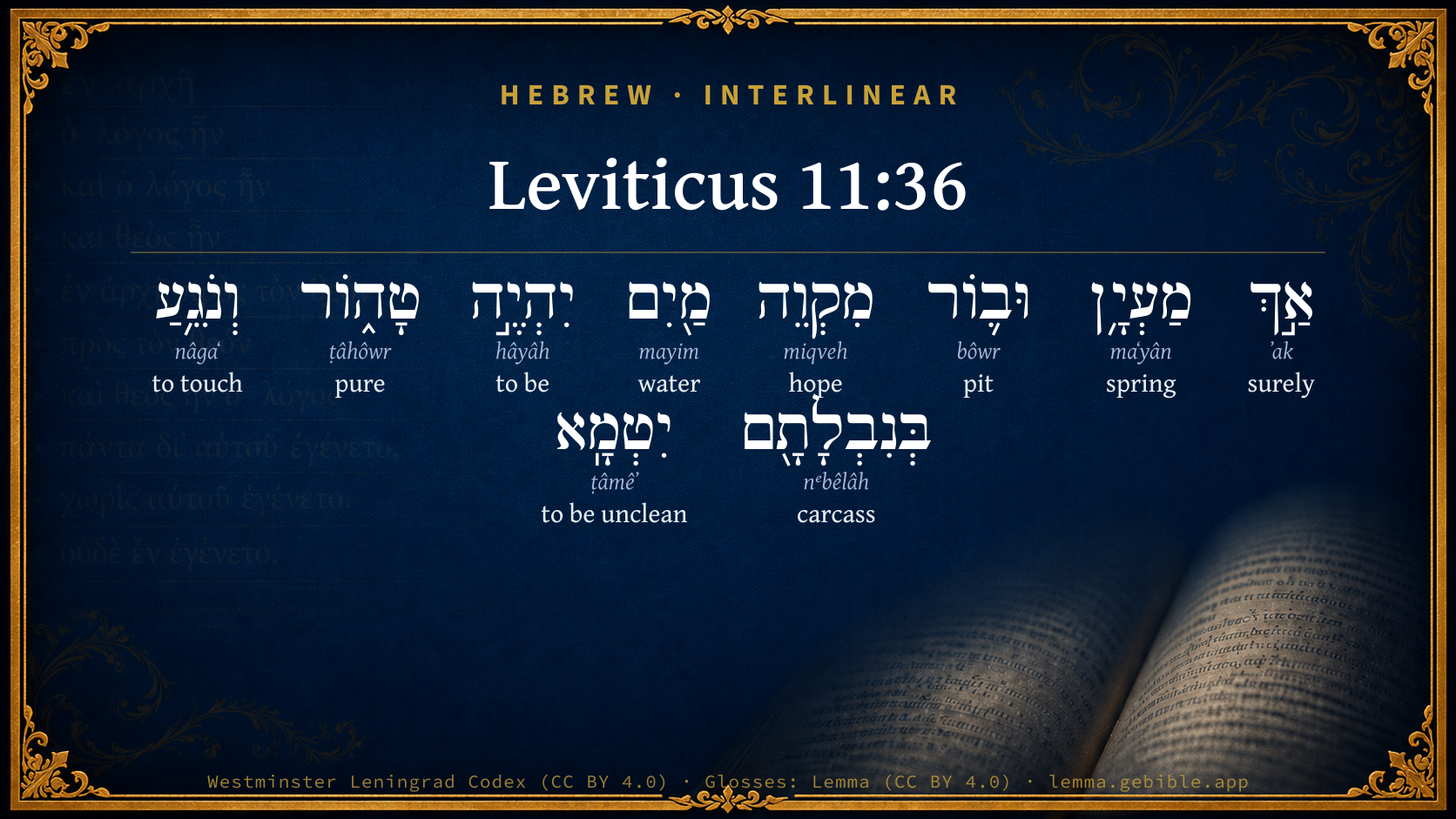
Hebrew (Westminster Leningrad Codex) Leviticus 11:36 appears in the Hebrew Old Testament. The text above is from the Westminster Leningrad Codex. Each word links to its Strong’s number, a concise gloss, and parsing drawn from the Open Scriptures Hebrew Bible morphology. Click any word for its full Brown-Driver-Briggs (BDB) entry.
Download image
Cite this verse

Leviticus 11:36 (World English Bible). Public Domain. Lemma interlinear Bible study tool, https://lemma.gebible.app/v/leviticus/11/36.

Show BibTeX & RIS
BibTeX
RIS
English Translation
Nevertheless a spring or a cistern in which water is a gathered shall be clean: but that which touches their carcass shall be unclean.
World English Bible · Public Domain
Download a study sheet

One document with this verse’s original text, its word-by-word gloss line, the meaning frame, cross-references with their text, attributed commentary, and full source and license credits — printable, and it pastes into notes with its structure intact.

This verse Autodidact and up

Study sheet (.html) Plain text (.txt)

A passage Seminary Student

Up to 50 verses in one chapter. A passage sheet keeps up to 6 commentary sources and 12 cross-references per verse, in the order this page ranks them, and says so on the sheet whenever that leaves anything out. Ask for a single verse and you get the Autodidact verse sheet above.

Everything on this page stays free to read, with no account — the sheet is a download of what is already on screen, not access to it.

Want to remove ads? Support Godless Engineer
Compare translations 3

The same verse in 3 English versions, stacked beneath the original-language interlinear above. Click any original word for its lexicon entry.

Each is an independent rendering of the whole verse — the interlinear is not word-aligned to these translations.

Highlighted words mark where these versions differ — a whole-verse word diff, not a word-by-word alignment.

  • World English Bible Public Domain
    Nevertheless a spring or a cistern in which water is a gathered shall be clean: but that which touches their carcass shall be unclean.
  • King James Version Public Domain
    Nevertheless a fountain or pit, wherein there is plenty of water, shall be clean: but that which toucheth their carcass shall be unclean.
  • unfoldingWord Literal Text CC BY-SA 4.0
    Nevertheless, a spring or a cistern, a collection of water, shall be clean, but the one touching their carcass will become unclean.

unfoldingWord Literal Text — © unfoldingWord, licensed CC BY-SA 4.0. Word-aligned USFM3 via Door43 (git.door43.org/unfoldingWord/en_ult).

Versions to compare (up to 4)

3 of 4 selected

Show all 18 translations

Every available English version of this verse, each an independent rendering of the whole verse.

  • World English Bible Public Domain
    Nevertheless a spring or a cistern in which water is a gathered shall be clean: but that which touches their carcass shall be unclean.
  • Berean Standard Bible Public Domain
    Nevertheless, a spring or cistern containing water will remain clean, but one who touches a carcass in it will be unclean.
  • Majority Standard Bible Public Domain
    Nevertheless, a spring or cistern containing water will remain clean, but one who touches a carcass in it will be unclean.
  • King James Version Public Domain
    Nevertheless a fountain or pit, wherein there is plenty of water, shall be clean: but that which toucheth their carcass shall be unclean.
  • American Standard Version (1901) Public Domain
    Nevertheless a fountain or a pit wherein is a gathering of water shall be clean: but that which toucheth their carcass shall be unclean.
  • Revised Version (1885) Public Domain
    Nevertheless a fountain or a pit wherein is a gathering of water shall be clean: but that which toucheth their carcase shall be unclean.
  • Geneva Bible (1599) Public Domain
    Yet the fountaines and welles where there is plentie of water shalbe cleane: but that which toucheth their carkeises shalbe vncleane.
  • Douay-Rheims (1899) Public Domain
    But fountains and cisterns, and all gatherings together of waters shall be clean. He that toucheth their carcasses shall be defiled.
  • Young's Literal Translation Public Domain
    `Only -- a fountain or pit, a collection of water, is clean, but that which is coming against their carcase is unclean;
  • Literal Standard Version CC BY-SA 4.0
    Only, a fountain or pit, a collection of water, is clean, but that which is coming against their carcass is unclean;
  • Unlocked Literal Bible CC BY-SA 4.0
    A spring or cistern for collecting water remains clean; but anyone who touches their carcass is unclean.
  • unfoldingWord Literal Text CC BY-SA 4.0
    Nevertheless, a spring or a cistern, a collection of water, shall be clean, but the one touching their carcass will become unclean.
  • Darby Bible Public Domain
    Nevertheless, a spring or a well, a quantity of water, shall be clean. But he that toucheth their carcase shall be unclean.
  • World Messianic Bible Public Domain
    Nevertheless a spring or a cistern in which water is gathered shall be clean, but that which touches their carcass shall be unclean.
  • Webster's Bible Public Domain
    Nevertheless, a fountain or pit, in which there is plenty of water, shall be clean: but that which toucheth their carcass shall be unclean.
  • Free Bible Version CC BY-SA 4.0
    On the other hand, if it's a spring or cistern containing water then it will remain clean, but if you touch one of these dead bodies in it you will be unclean.
  • Bible in Basic English Public Domain
    But at the same time a fountain or a place where water is stored for use will be clean; but anyone touching their dead bodies will be unclean.
  • JPS Tanakh (1917) Public Domain
    Nevertheless a fountain or a cistern wherein is a gathering of water shall be clean; but he who toucheth their carcass shall be unclean.

Literal Standard Version (2020), Covenant Press — licensed CC BY-SA 4.0. Text via the HelloAO Bible API (eBible.org). Unlocked Literal Bible (unfoldingWord) — licensed CC BY-SA 4.0. Text via the HelloAO Bible API (eBible.org). unfoldingWord Literal Text — © unfoldingWord, licensed CC BY-SA 4.0. Word-aligned USFM3 via Door43 (git.door43.org/unfoldingWord/en_ult). Free Bible Version, Dr. Jonathan Gallagher — licensed CC BY-SA 4.0. Text via the HelloAO Bible API (eBible.org).

Word by word

More ways to search: Search by grammar → Find every occurrence → Compare this word →

Practice this passage: Drill this verse → Learn its vocabulary →

מִקְוֵה
miqveh
H4723
“hope of”
Noun, Common, Masculine, Singular, Construct
Part of Speech
Noun
Type
Common
Gender
Masculine
Number
Singular
State
Construct
Full BDB Definition

Origin: from H6960

TWOT: 1994c , 1995a

hope - hope - ground of hope - things hoped for, outcome - collection, collected mass
  1. אַ֣ךְ ʼak H389 “surely” Particle, Accusative
  2. מַעְיָ֥ן maʻyân H4599 “spring” Noun, Common, Masculine, Singular, Absolute
  3. וּב֛וֹר bôwr H953 “and · pit” Conjunction + Noun, Common, Masculine, Singular, Absolute
  4. מַ֖יִם mayim H4325 “water(s)” Noun, Common, Masculine, Plural, Absolute
  5. יִהְיֶ֣ה hâyâh H1961 “to be” Verb, Qal, Imperfect, 3rd Person, Masculine, Singular
  6. טָה֑וֹר ṭâhôwr H2889 “pure” Adjective, Adjective, Masculine, Singular, Absolute
  7. וְנֹגֵ֥עַ nâgaʻ H5060 “and · touching” Conjunction + Verb, Qal, Participle Active, Masculine, Singular, Absolute
  8. בְּנִבְלָתָ֖ם nᵉbêlâh H5038 “in/at · carcass · their” Preposition + Noun, Common, Feminine, Singular, Construct + Suffix, Personal, 3rd Person, Masculine, Plural
  9. יִטְמָֽא ṭâmêʼ H2930 “to be unclean” Verb, Qal, Imperfect, 3rd Person, Masculine, Singular

About this verse

These counts appear in no published source. They are computed here, from the morphology-tagged text and Lemma’s own curated glosses. What Lemma adds →

10
words
10
distinct lemmas
Pentateuch
section

Notable vocabulary

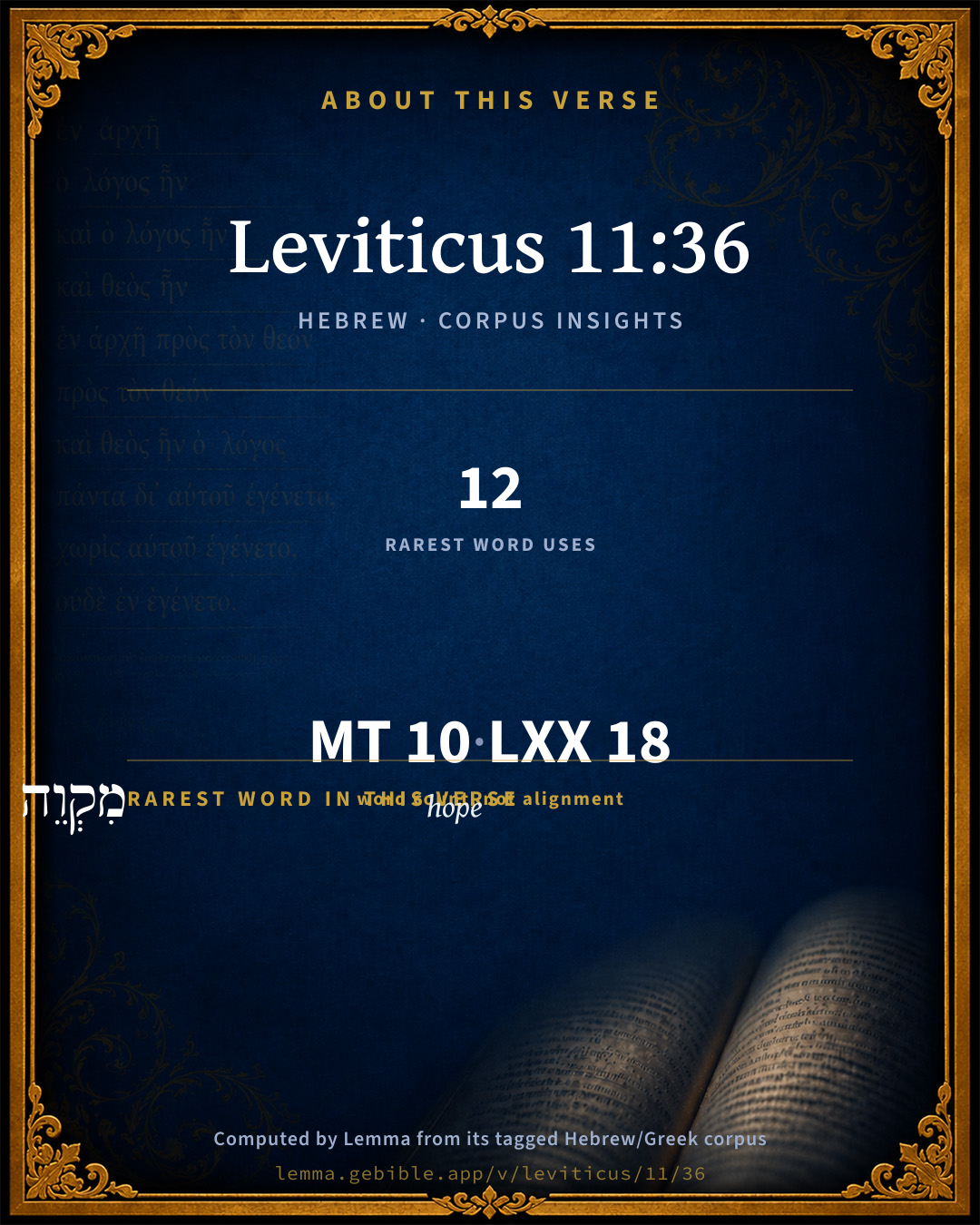
The rarest word here is מִקְוֵה hope H4723 — appearing just 12 times in the whole Hebrew Bible.

Shared distinctive vocabulary

מִקְוֵה hope H4723 occurs in 10 verses of the Hebrew Bible. Also found in:

Grammatical profile

  • 3 verbs
  • 5 nouns
  • 1 adjective
  • 1 particle

Verb forms

  • יִהְיֶ֣ה Qal · Imperfect
  • וְנֹגֵ֥עַ Qal · Participle Active
  • יִטְמָֽא Qal · Imperfect

Hebrew & Septuagint length

In English translation the verse runs 24 words from the Hebrew and 29 from the Septuagint (LXX English) — closely comparable.

A rough comparison of the two English renderings, which tokenize alike — not a word-level alignment.

Word counts can differ between the Hebrew and the Greek without any difference in meaning — e.g. the Hebrew direct-object marker אֵת has no separate Greek word, and Greek often adds the article ὁ.

In the original languages it is 10 Hebrew tokens and 18 Greek tokens — but the two are counted differently (Hebrew bundles its prefixes and suffixes into one token; the Greek is in lemma form), so that isn’t a like-for-like length.

Cross-references

2

Topical passages linked to Leviticus 11:36 in the Treasury of Scripture Knowledge — connected by theme and wording, ordered by reader-vote popularity; previews shown in the World English Bible.

  • Zechariah 13:1 "In that day there will be a spring opened to the house of David and to the inhabitants of Jerusalem, for sin and for uncleanness.
  • John 4:14 but whoever drinks of the water that I will give him will never thirst again; but the water that I will give him will become in him a well of water springing up to eternal life."

Cross-references courtesy of OpenBible.info (CC BY 4.0).

Hebrew and Greek witnesses Masoretic Hebrew ↔ Greek Septuagint

The same verse in the two great witnesses to the Old Testament, shown verse-for-verse.

These are two independent witnesses, not word-aligned to each other, and the Septuagint is shown in lemma (dictionary) form.

Hebrew Leviticus 11:36 Masoretic · Westminster Leningrad Codex

אַ֣ךְ מַעְיָ֥ן וּב֛וֹר מִקְוֵה מַ֖יִם יִהְיֶ֣ה טָה֑וֹר וְנֹגֵ֥עַ בְּנִבְלָתָ֖ם יִטְמָֽא

Nevertheless a spring or a cistern in which water is a gathered shall be clean: but that which touches their carcass shall be unclean.

World English Bible · Public Domain

Greek LXX Leviticus 11:36 Septuagint · lemma form

πλήν πηγή ὕδωρ καί λάκκος καί συναγωγή ὕδωρ εἰμί καθαρός ὁ δέ ἅπτομαι ὁ θνησιμαῖος αὐτός ἀκάθαρτος εἰμί

Only if the water be of fountains of water, or a pool, or confluence of water, it shall be clean; but he that touches their carcasses shall be unclean.

LXX2012 (modern English Septuagint) · Public Domain

Hebrew: Westminster Leningrad Codex (CC BY 4.0). Greek: Septuagint (public domain); English from LXX2012 (modern English Septuagint) (Public Domain). How the Septuagint differs from the Hebrew →

Targum (Aramaic paraphrase)

2

The Targum is the ancient Jewish Aramaic paraphrase of the Hebrew Scriptures — an interpretive translation, not the Hebrew text itself. Onkelos (literal) and Pseudo-Jonathan (expansive) render the Torah, and Jonathan the Prophets. Coverage is partial: where no permissively-licensed English translation exists for a verse, only the Aramaic is shown. This is verse-level text, not a word-by-word alignment to the Hebrew.

  1. Targum Onkelos Torah (Genesis–Deuteronomy)
    בְּרַם מַעְיָן וְגוֹב בֵּית כְּנִישׁוּת מַיָא יְהֵי דְכֵי וּדְיִקְרַב בִּנְבִלְתְּהוֹן יְהֵי מְסָאָב

    (no public-domain English translation for this verse)

    Targum Onkelos — Aramaic: “Onkelos Genesis” (public domain); “Onkelos Exodus” (public domain); “Onkelos Leviticus” (public domain); “Onkelos Numbers” (public domain); “Onkelos Deuteronomy” (public domain). English: “Sefaria Community Translation” (CC0 1.0 (public-domain dedication)); “J.W. Etheridge. The Targums of Onkelos and Jonathan Ben Uzziel on the Pentateuch. London: Longmans, Green, 1862” (public domain). Text via Sefaria.

  2. Targum Pseudo-Jonathan Torah (Genesis–Deuteronomy)
    לְחוֹד עֵינַוָון וְגוֹבִין בֵּית כְּנִישׁוּת מַיָין נַבְעִין יְהֵי דְכֵי בְּרַם דִי יִקְרַב בִּנְבֵילְתְּהוֹן בְּגוֹ מַיָא הָאִילְיֵין יְהֵי מְסָאָב

    But fountains and cisterns, the place of the collection of running waters, shall be clean: but he who toucheth the carcase of any of those things (that may have fallen) into the water shall be unclean.

    Targum Pseudo-Jonathan — Aramaic: “Targum Jonathan on Genesis” (public domain); “Targum Jonathan on Exodus” (public domain); “Targum Jonathan on Leviticus” (public domain); “Targum Jonathan on Numbers” (public domain); “Targum Jonathan on Deuteronomy” (public domain). English: “The Targum of Jonathan ben Uzziel, trans. J. W. Etheridge, London, 1862” (public domain). Text via Sefaria.

Commentary

Notes on Leviticus 11:36 from classic Christian and Jewish commentators (each source and its license shown beneath its notes). The classic Christian expositions comment on the surrounding passage and are grouped to its opening verse, so a note may address several verses; the Jewish commentaries on the Tanakh (Rashi and others) are per-verse, so they appear only where the commentator wrote on this verse.

Lemma curates 59 commentaries, every one of them public domain or Creative Commons licensed, each selected and text-cleaned for this edition rather than reprinted as found. About our sources →

Trapp's Complete Commentary

John Trapp

Lev 11:36 Nevertheless a fountain or pit, [wherein there is] plenty of water, shall be clean: but that which toucheth their carcase shall be unclean.

Ver. 36. Nevertheless a fountain.] Because it would cleanse itself, and work out the uncleanness. So will faith.

John Trapp, A Commentary or Exposition upon All the Books of the Old and New Testament (1647–1656) — public domain. Text from a community e-Sword module.

Joseph Benson's Commentary

Lev 11:36-37. Nevertheless, a fountain or pit shall be clean — Of this no reason can be given, but the will of the Lawgiver, and his merciful condescension to men’s necessities, water being scarce in those countries; and for the same reason God would have the ceremonial law of sacrifices give place to the law of mercy. Seed — Partly because this was necessary provision for man, and partly because such seed would not be used for man’s food till it had received many alterations in the earth, whereby such pollution was taken away.

Joseph Benson's Commentary on the Old and New Testaments (1811–1818) — public domain. Text from a community e-Sword module.

Tyndale Open Study Notes

Tyndale Open Resources

11:36 A cistern was a hole dug into the ground or rock, often lined with plaster, that retained rain and surface water.

Tyndale Open Study Notes — © Tyndale Open Resources, licensed CC BY-SA 4.0. Text via the HelloAO Bible API.

Geneva Bible (1599)

Geneva Bible translators

So much of the water as toucheth it.

Geneva Bible (1599) marginal notes — public domain. Text via Bolls.life.

Adam Clarke's Commentary

Verse 36. A fountain or pit, c.] This must either refer to running water, the stream of which soon carries off all impurities, or to large reservoirs where the water soon purifies itself the water in either which touched the unclean thing, being considered as impure, the rest of the water being clean.

Adam Clarke's Commentary on the Bible (1810–1826) — public domain. Text from a community e-Sword/MySword module.

Ellicott's Commentary for English Readers

(36) Nevertheless a fountain or pit, wherein there is plenty of water.—Better, But wells and cisterns being gatherings together of water. But if the unclean carcase, or any portion of it, happens to fall or to be thrown into wells or cisterns, they are to be treated as large collections of water, such as pools, ponds, and lakes, and hence are exempt from contracting pollution. The constant change of water which takes place in these reservoirs counteracts the effects of the polluting carcase. When it is borne in mind how few are the wells and cisterns in the East, and how scarce water is, the merciful provision of this law will be apparent. According to the canon which obtained during the second Temple, this immunity was only applicable to receptacles of water actually in the ground, but not to collections of water in vessels.

But that which toucheth.—Better, but he who toucheth. But though the water into which the carcase has fallen is mercifully exempted, he who comes in contact with the carcase in the water and removes it from the water is unclean, because the carcase itself remains a source of defilement.

A Bible Commentary for English Readers, edited by Charles John Ellicott (1878–1897) — public domain. Text from a community e-Sword module.

The Cambridge Bible for Schools and Colleges

gen. ed. J. J. S. Perowne

36. The continuous renewal of water in a well renders the uncleanness inappreciable, but he who takes out the carcase is rendered unclean by touching it. The case of the pit or cistern is not clear. It might be so large that the effect of a small swarming thing could be neglected, or the water might be replenished by rain.

The Cambridge Bible for Schools and Colleges (gen. ed. J. J. S. Perowne; Cambridge University Press, 1878–1918) — public domain. Text from a community e-Sword module.

John Gill's Exposition

Nevertheless, a fountain or pit, wherein there is plenty of water,.... Or, "a fountain or pit, a collection of waters", the copulative being wanting, as some observe, Aben Ezra takes notice of; or it may be by way of apposition, and so may explain what fountain or pit is meant, even such an one where there is a large continence of water, into which, if any carcass of a creeping thing fell, or any part of it, yet it

shall be clean: and fit for use, either because of the abundance of water in it, which could not be affected with the fall of such a creature into it as where there is but a small quantity; or rather this exception was made, because pools of water were of considerable value in these countries, and frequently in use for bathings, &c. and therefore for the good of men, and that they might not suffer so great a loss by such an accident, they are declared notwithstanding to be clean and free for use: hence you may learn, says Jarchi, that he that dips in them is pure from his uncleanness; that a man might lawfully make use of them for a bath on account of any uncleanness, notwithstanding the carcass of a creeping thing had fallen into it; as a mouse, or rat, or any such creature:

but that which toucheth their carcass shall be unclean; not the waters which touch the carcass, as Aben Ezra interprets it, for then the whole would be defiled, and unfit for use; but either the man that touched the carcass, laid hold upon it to pluck it out of the fountain or pit, or that which he made use of to get it out, or both these, were unclean in a ceremonial sense: the Targum of Jonathan is, "but he that toucheth their carcasses in the midst of these waters shall be unclean.''

John Gill's Exposition of the Whole Bible (1746–1763) — public domain (CC PDM 1.0). Text via the HelloAO Bible API.

Haydock's Catholic Bible Commentary

Clean. They would be so difficult to purify, and water is so necessary.

George Leo Haydock (1774–1849), Haydock's Catholic Family Bible and Commentary, 1859 edition — public domain. Excludes Psalms (Douay-Rheims chapter numbering differs from Protestant) and Deuterocanonical books (Catholic canon only).

Matthew Poole's English Annotations

Wherein there is plenty of water; of which no solid reason can be given, whilst such unclean things remain in them, but only the will of the Lawgiver, and his merciful condescension to men’s necessities, water being scarce in those countries; and for the same reason God would have the ceremonial law of sacrifices to be offered to God, give place to the moral law of mercy towards men.

Matthew Poole's English Annotations on the Holy Bible (1683–1685) — public domain. Text from a community e-Sword/MySword module.

Whedon's Commentary on the Bible

Daniel D. Whedon

36. A fountain… shall be clean — Living water, the means of purity, must be incapable of defilement, or pollution may become universal.

Daniel D. Whedon (gen. ed.), Commentary on the Old and New Testaments (1874–1909) — public domain. Text from a community e-Sword module.

John Wesley's Explanatory Notes

Of this no reason can be given, but the will of the law-giver and his merciful condescension to men's necessities, water being scarce in those countries; and for the same reason God would have the ceremonial law of sacrifices, give place to the law of mercy.

John Wesley, Explanatory Notes Upon the Whole Bible (1754–1765) — public domain. Text via the GEBible commentary corpus.

unfoldingWord translationNotes

Door43 World Missions Community

General Information:

Yahweh continues telling Moses and Aaron which animals the people are to consider unclean.

A spring or cistern ... remains clean

Water that the people are permitted to drink from a spring or cistern is spoken of as if it were physically clean. (See: Metaphor)

carcass

The dead body of an animal that God has declared to be unfit for the people to touch or eat is spoken of as if it were physically unclean. (See: Metaphor)

unclean

A person who is unacceptable for God's purposes because he has touched the carcass of one of these animals is spoken of as if he were physically unclean. (See: Metaphor)

seeds for planting

"seeds that you intend to plant"

those seeds will still be clean ... they will be unclean

Seeds that God has declared to be acceptable for the people to plant are spoken of as if they are physically clean, and those which are unacceptable are spoken of as if they were unclean. (See: Metaphor)

But if water is put on the seeds

This can be translated in active form. AT: "But if you put water on the seeds" (See: Active or Passive)

translationWords

fountain

cistern

water

creature

clean

seed

unfoldingWord translationNotes — © Distant Shores Media and the Door43 World Missions Community, licensed CC BY-SA 4.0. Source: git.door43.org/Door43/en_tn.

Rashi

Rabbi Shlomo Yitzchaki (Rashi)

עין ובור מקוה מים‎אך מ NEVERTHELESS A FOUNTAIN OR A PIT WHERE THERE IS A GATHERING OF WATERS which are attached to the ground are not receptive of uncleanness (not being included in וכל משקה וגו׳ בכל כלי mentioned in v. 34, since it states here יהיה טהור, it shall remain clean). But you may also give it the meaning: יהיה טהור, he shall be clean i.e. he who immerses himself in them to free himself from his uncleanness.

ונגע בנבלתם יטמא BUT THAT WHICH TOUCHES THEIR CARRION SHALL BE UNCLEAN — even if one is in the fountain or pit and comes in contact with their uncleanness (their carcasses) he shall be unclean. This is specifically stated in order that you should not argue à fortiori as follows: since it cleanses the unclean from their uncleanness, it follows à fortiori that it will save the clean from becoming unclean, — it stales therefore, “but whoever touches their carrion shall be unclean” (Sifra, Shemini, Section 9 5; Nedarim 75b).

Rashi on the Tanakh — English translations: “The Judaica Press complete Tanach with Rashi, translated by A. J. Rosenberg” (CC BY 4.0); “Pentateuch with Rashi's commentary by M. Rosenbaum and A.M. Silbermann, 1929-1934” (public domain); “The Metsudah Tanach series, Lakewood, N.J” (CC BY 4.0); and “The Book of Joshua, Metsudah Publications, 1997” (CC BY 4.0). Text via Sefaria.

Ramban (Nachmanides)

Rabbi Moshe ben Nachman (Ramban / Nachmanides)

NEVERTHELESS A FOUNTAIN OR A CISTERN WHEREIN IS A GATHERING OF WATER SHALL BE CLEAN. Scripture is stating that the waters in the immersion-pool whilst attached to the ground are not susceptible to impurity if any [source of] impurity should fall therein. BUT THAT WHICH TOUCHETH THEIR CARCASS SHALL BE UNCLEAN. The meaning thereof is as follows: “but waters which touch the carcass [of any of the creeping things] shall become impure, [meaning that waters which are separated [from a gathering of water] are rendered impure if they touch their carcass. [The phrase, and [waters] which touch their carcass shall be unclean, must be referring to detached waters], for when the waters are still attached to the pool, they cannot [be said to] ‘touch’ their carcass, but rather [Scripture should have said], their carcass ‘fell’ into it.” Scripture speaks of water in the singular [saying, v’nogeia — “and that which toucheth”], just as it says elsewhere, the water of sprinkling was not sprinkled upon him. (was not sprinkled) in referring to water, although the Hebrew word ‘mayim’ is in the plural form. Or it may be that Scripture is saying, “and whatsoever touches their carcass shall be impure,” and the intent is to include water and [the other] drinks mentioned. In general, this verse comes to teach that water is susceptible to impurity when it is detached [from a pool], but not when it is attached thereto, a principle that has not been mentioned heretofore.Now in the Torath Kohanim we find that [the Rabbis gave this interpretation]: 9:6. “Rabbi Yosei the Galilean said: But that which toucheth their carcass shall be unclean. By touching they [i.e., the eight dead creeping things] convey impurity, but not by carrying them.” This too is feasible, that [the verse] is referring back to all the laws mentioned [in Verses 24-5] previously, and saying that creeping things convey impurity only by touch. Our Rabbis have further interpretations of the redundant expressions in this [whole] verse, all of them laws given to Moses on Sinai.Now Scripture mentioned the purity of the immersion-pool and waters attached to the ground in speaking of [the impurity conveyed by] creeping things, but the same law applies to [that conveyed by] carrion [of animals forbidden as food, and of those permitted animals not slaughtered properly or which died by themselves]. It waited, however, to mention [the law concerning the purity of pools till now], until it had completed the enumeration of all objects that convey impurity. Or it may be that it is because creeping things frequently die in fountains or in cisterns. I have already mentioned my opinion [that this verse mentions the impurity of vessels conveyed by creeping things and their purification by immersion, and from it we learn the law of people and vessels in connection with the other forms of impurity mentioned above].

Ramban (Nachmanides) on the Tanakh — English translation: “Commentary on the Torah by Ramban (Nachmanides). Translated and annotated by Charles B. Chavel. New York, Shilo Pub. House, 1971-1976” (CC BY 4.0). Text via Sefaria.

Lesson kit

Teaching starters — assembled from the data on this page, not authored interpretation. Every prompt links to the verse data it draws on. Edit before teaching.

Leviticus, in the Pentateuch, opens this verse with 10 words (10 distinct Hebrew lemmas). Its most distinctive word is miqveh (“hope”). A historical commentator’s framing appears above. Read the whole chapter for the surrounding context.

Discussion questions

  1. The word miqveh carries the sense “hope.” How does it shape the verse?
  2. How does Genesis 1:10, which shares the word «hope», read alongside this verse?
  3. These translations render this verse differently; the difference is in the English rendering, not the original. What questions does that raise?
  4. «יִהְיֶ֣ה» is a Qal Imperfect verb. How does that grammatical form shape the action described?
  5. Compare how Trapp's Complete Commentary and Joseph Benson's Commentary read this verse. Where do they agree or differ?

Things to notice

Reading settings

Reading text

Shown beneath each verse's original-language words.

Old Testament
Old Testament edition

Read the OT as the Masoretic Hebrew (MT) or the Greek Septuagint (LXX).

English shown for the Greek Septuagint (in the Hebrew ↔ Greek comparison).

Comparing translations? Open the Compare panel on any verse page to stack up to four side by side.