Jonah 3:6

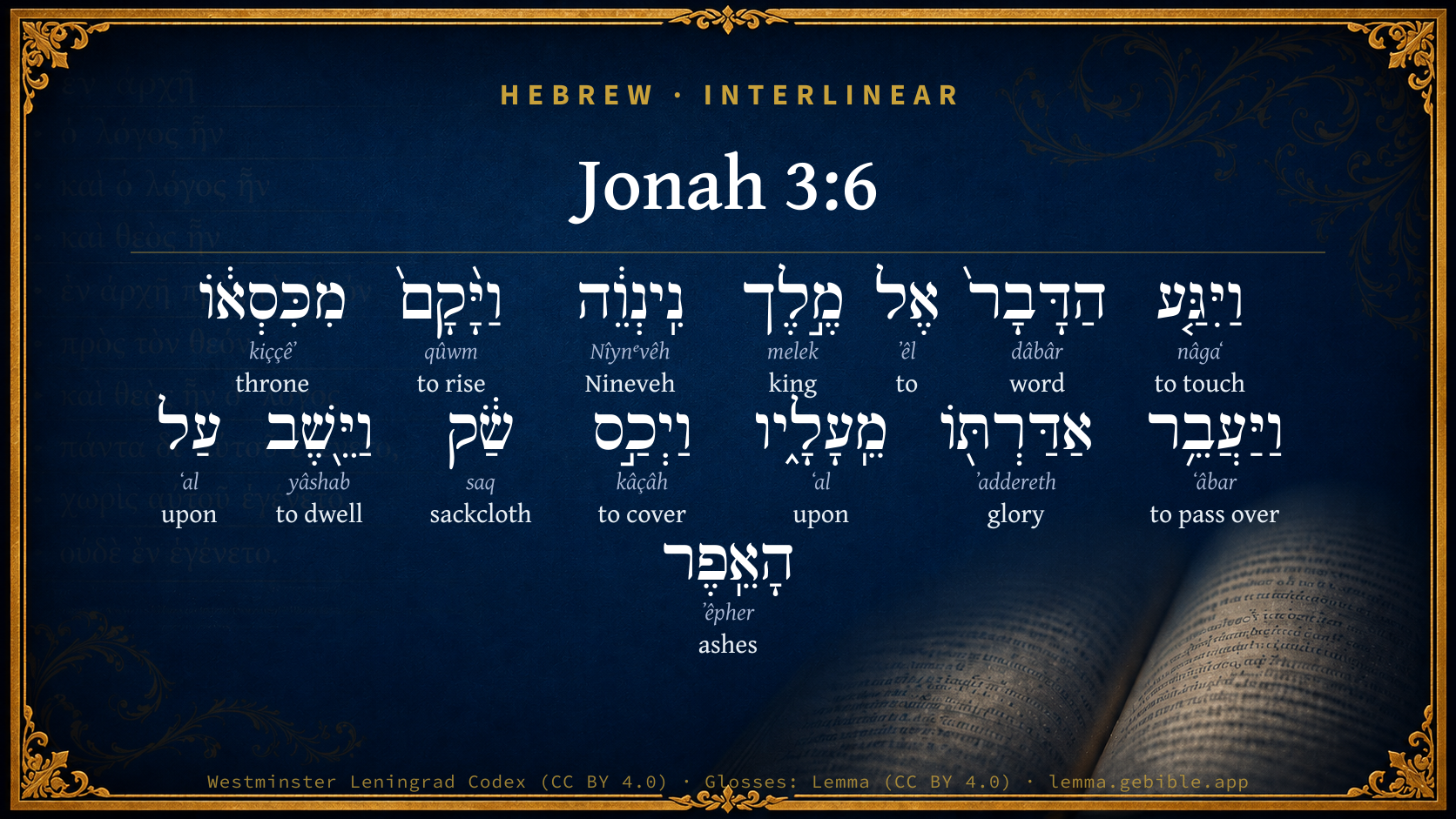
Hebrew (Westminster Leningrad Codex) Jonah 3:6 appears in the Hebrew Old Testament. The text above is from the Westminster Leningrad Codex. Each word links to its Strong’s number, a concise gloss, and parsing drawn from the Open Scriptures Hebrew Bible morphology. Click any word for its full Brown-Driver-Briggs (BDB) entry.
Download image
Cite this verse

Jonah 3:6 (World English Bible). Public Domain. Lemma interlinear Bible study tool, https://lemma.gebible.app/v/jonah/3/6.

Show BibTeX & RIS
BibTeX
RIS
English Translation
The news reached the king of Nineveh, and he arose from his throne, and took off his royal robe, covered himself with sackcloth, and sat in ashes.
World English Bible · Public Domain
Download a study sheet

One document with this verse’s original text, its word-by-word gloss line, the meaning frame, cross-references with their text, attributed commentary, and full source and license credits — printable, and it pastes into notes with its structure intact.

This verse Autodidact and up

Study sheet (.html) Plain text (.txt)

A passage Seminary Student

Up to 50 verses in one chapter. A passage sheet keeps up to 6 commentary sources and 12 cross-references per verse, in the order this page ranks them, and says so on the sheet whenever that leaves anything out. Ask for a single verse and you get the Autodidact verse sheet above.

Everything on this page stays free to read, with no account — the sheet is a download of what is already on screen, not access to it.

Want to remove ads? Support Godless Engineer
Compare translations 3

The same verse in 3 English versions, stacked beneath the original-language interlinear above. Click any original word for its lexicon entry.

Each is an independent rendering of the whole verse — the interlinear is not word-aligned to these translations.

Highlighted words mark where these versions differ — a whole-verse word diff, not a word-by-word alignment.

  • World English Bible Public Domain
    The news reached the king of Nineveh, and he arose from his throne, and took off his royal robe, covered himself with sackcloth, and sat in ashes.
  • King James Version Public Domain
    For word came unto the king of Nineveh, and he arose from his throne, and he laid his robe from him, and covered him with sackcloth, and sat in ashes.
  • unfoldingWord Literal Text CC BY-SA 4.0
    Then the word came to the king of Nineveh, and he rose up from his throne, and he took off his robe from being on him, and he covered himself sackcloth and sat down on the ash heap.

unfoldingWord Literal Text — © unfoldingWord, licensed CC BY-SA 4.0. Word-aligned USFM3 via Door43 (git.door43.org/unfoldingWord/en_ult).

Versions to compare (up to 4)

3 of 4 selected

Show all 18 translations

Every available English version of this verse, each an independent rendering of the whole verse.

  • World English Bible Public Domain
    The news reached the king of Nineveh, and he arose from his throne, and took off his royal robe, covered himself with sackcloth, and sat in ashes.
  • Berean Standard Bible Public Domain
    When word reached the king of Nineveh, he got up from his throne, took off his royal robe, covered himself with sackcloth, and sat in ashes.
  • Majority Standard Bible Public Domain
    When word reached the king of Nineveh, he got up from his throne, took off his royal robe, covered himself with sackcloth, and sat in ashes.
  • King James Version Public Domain
    For word came unto the king of Nineveh, and he arose from his throne, and he laid his robe from him, and covered him with sackcloth, and sat in ashes.
  • American Standard Version (1901) Public Domain
    And the tidings reached the king of Nineveh, and he arose from his throne, and laid his robe from him, and covered him with sackcloth, and sat in ashes.
  • Revised Version (1885) Public Domain
    And the tidings reached the king of Nineveh, and he arose from his throne, and laid his robe from him, and covered him with sackcloth, and sat in ashes.
  • Geneva Bible (1599) Public Domain
    For worde came vnto the King of Nineueh, and he rose from his throne, and he layed his robe from him, and couered him with sackecloth, and sate in ashes.
  • Douay-Rheims (1899) Public Domain
    And the word came to the king of Ninive; and he rose up out of his throne, and cast away his robe from him, and was clothed with sackcloth, and sat in ashes.
  • Young's Literal Translation Public Domain
    seeing the word doth come unto the king of Nineveh, and he riseth from his throne, and removeth his honourable robe from off him, and spreadeth out sackcloth, and sitteth on the ashes,
  • Literal Standard Version CC BY-SA 4.0
    seeing the word comes to the king of Nineveh, and he rises from his throne, and removes his honorable robe from off him, and spreads out sackcloth, and sits on the ashes,
  • Unlocked Literal Bible CC BY-SA 4.0
    Soon the news reached the king of Nineveh. He rose up from his throne, took off his robe, covered himself with sackcloth, and sat in ashes.
  • unfoldingWord Literal Text CC BY-SA 4.0
    Then the word came to the king of Nineveh, and he rose up from his throne, and he took off his robe from being on him, and he covered himself sackcloth and sat down on the ash heap.
  • Darby Bible Public Domain
    And the word reached the king of Nineveh, and he arose from his throne, and laid his robe from him, and covered himself with sackcloth, and sat in ashes.
  • World Messianic Bible Public Domain
    The news reached the king of Nineveh, and he arose from his throne, took off his royal robe, covered himself with sackcloth, and sat in ashes.
  • Webster's Bible Public Domain
    For word came to the king of Nineveh, and he arose from his throne, and he laid his robe from him, and covered himself with sackcloth, and sat in ashes.
  • Free Bible Version CC BY-SA 4.0
    When the news of what was happening reached the king of Nineveh he came down from his throne, took off his robe, put on sackcloth, and sat in ashes.
  • Bible in Basic English Public Domain
    And the word came to the king of Nineveh, and he got up from his seat of authority, and took off his robe, and covering himself with haircloth, took his seat in the dust.
  • JPS Tanakh (1917) Public Domain
    And the tidings reached the king of Nineveh, and he arose from his throne, and laid his robe from him, and covered him with sackcloth, and sat in ashes.

Literal Standard Version (2020), Covenant Press — licensed CC BY-SA 4.0. Text via the HelloAO Bible API (eBible.org). Unlocked Literal Bible (unfoldingWord) — licensed CC BY-SA 4.0. Text via the HelloAO Bible API (eBible.org). unfoldingWord Literal Text — © unfoldingWord, licensed CC BY-SA 4.0. Word-aligned USFM3 via Door43 (git.door43.org/unfoldingWord/en_ult). Free Bible Version, Dr. Jonathan Gallagher — licensed CC BY-SA 4.0. Text via the HelloAO Bible API (eBible.org).

Word by word

More ways to search: Search by grammar → Find every occurrence → Compare this word →

Practice this passage: Drill this verse → Learn its vocabulary →

אַדַּרְתּ֖וֹ
ʼaddereth
H155
“glory · his”
Noun, Common, Feminine, Singular, Construct + Suffix, Personal, 3rd Person, Masculine, Singular
Part of Speech
Noun
Type
Common
Gender
Feminine
Number
Singular
State
Construct
Full BDB Definition

Origin: f of H117

TWOT: 28c

glory, cloak - glory, splendour, magnificence (of a vine, shepherds) - mantle, cloak made of fur or fine material - prophet's garment
  1. וַיִּגַּ֤ע nâgaʻ H5060 “and · to touch” Conjunction + Verb, Qal, Sequential Imperfect, 3rd Person, Masculine, Singular
  2. הַדָּבָר֙ dâbâr H1697 “the · word” Particle, Definite Article + Noun, Common, Masculine, Singular, Absolute
  3. אֶל ʼêl H413 “to” Preposition
  4. מֶ֣לֶך melek H4428 “king of” Noun, Common, Masculine, Singular, Construct
  5. נִֽינְוֵ֔ה Nîynᵉvêh H5210 “Nineveh” Noun, Proper
  6. וַיָּ֨קָם֙ qûwm H6965 “and · to rise” Conjunction + Verb, Qal, Sequential Imperfect, 3rd Person, Masculine, Singular
  7. מִכִּסְא֔וֹ kiççêʼ H3678 “from · throne · his” Preposition + Noun, Common, Masculine, Singular, Construct + Suffix, Personal, 3rd Person, Masculine, Singular
  8. וַיַּעֲבֵ֥ר ʻâbar H5674 “and · to pass over” Conjunction + Verb, Hiphil, Sequential Imperfect, 3rd Person, Masculine, Singular
  9. מֵֽעָלָ֑יו ʻal H5921 “from · upon · him” Preposition + Preposition + Suffix, Personal, 3rd Person, Masculine, Singular
  10. וַיְכַ֣ס kâçâh H3680 “and · to cover” Conjunction + Verb, Piel, Sequential Imperfect, 3rd Person, Masculine, Singular
  11. שַׂ֔ק saq H8242 “sackcloth” Noun, Common, Masculine, Singular, Absolute
  12. וַיֵּ֖שֶׁב yâshab H3427 “and · to dwell” Conjunction + Verb, Qal, Sequential Imperfect, 3rd Person, Masculine, Singular
  13. עַל ʻal H5921 “upon” Preposition
  14. הָאֵֽפֶר ʼêpher H665 “the · ashes” Particle, Definite Article + Noun, Common, Masculine, Singular, Absolute

About this verse

These counts appear in no published source. They are computed here, from the morphology-tagged text and Lemma’s own curated glosses. What Lemma adds →

15
words
14
distinct lemmas
Prophets
section

Notable vocabulary

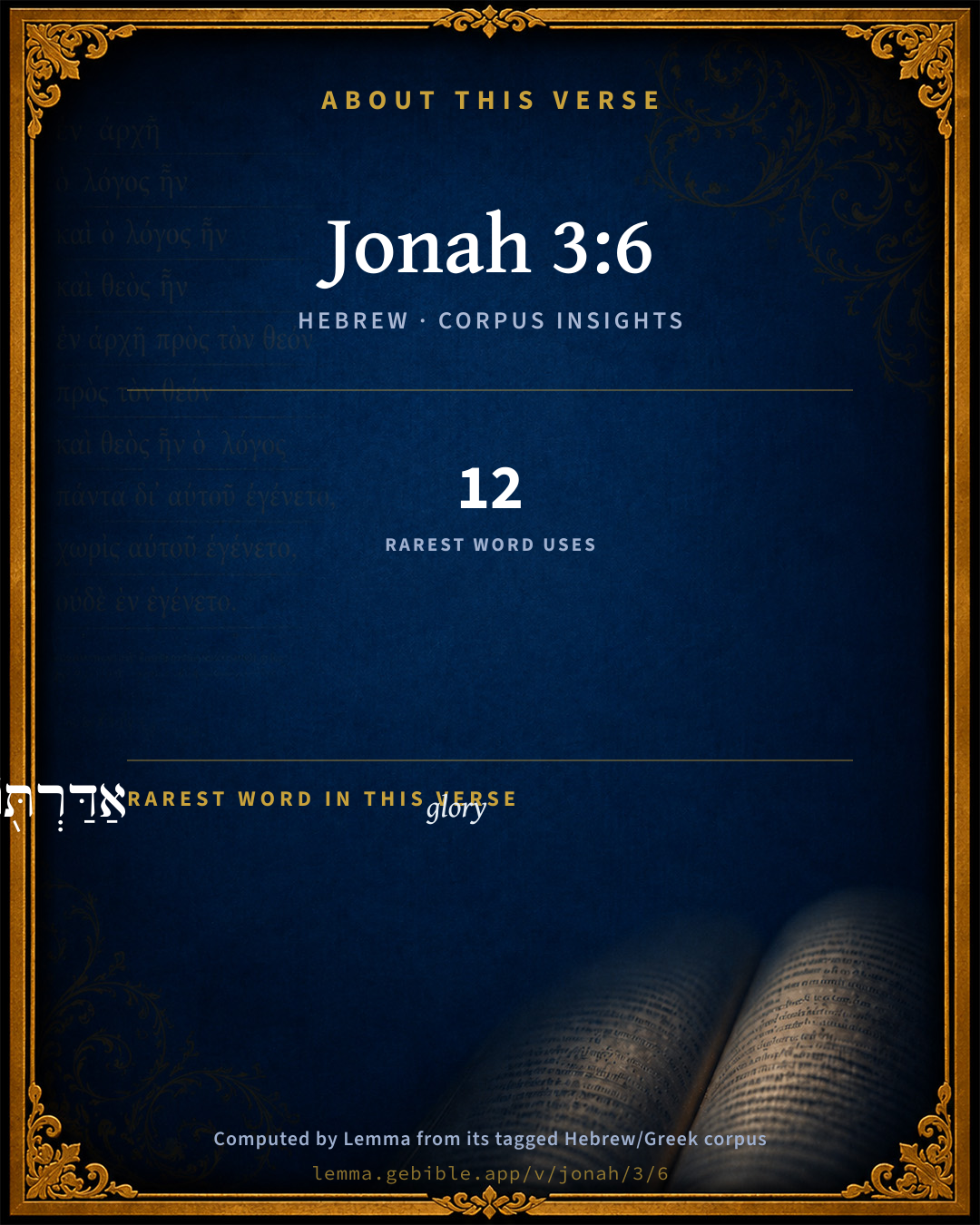
The rarest word here is אַדַּרְתּ֖וֹ glory H155 — appearing just 12 times in the whole Hebrew Bible.

Shared distinctive vocabulary

אַדַּרְתּ֖וֹ glory H155 occurs in 12 verses of the Hebrew Bible. Also found in:

Grammatical profile

  • 5 verbs
  • 7 nouns
  • 3 prepositions

Verb forms

  • וַיִּגַּ֤ע Qal · Sequential Imperfect
  • וַיָּ֨קָם֙ Qal · Sequential Imperfect
  • וַיַּעֲבֵ֥ר Hiphil · Sequential Imperfect
  • וַיְכַ֣ס Piel · Sequential Imperfect
  • וַיֵּ֖שֶׁב Qal · Sequential Imperfect

Repetition

A word recurs within this verse — often emphatic in Hebrew:

  • מֵֽעָלָ֑יו upon H5921 ×2

Hebrew & Septuagint length

In English translation the verse runs 27 words from the Hebrew and 30 from the Septuagint (LXX English) — closely comparable.

A rough comparison of the two English renderings, which tokenize alike — not a word-level alignment.

Word counts can differ between the Hebrew and the Greek without any difference in meaning — e.g. the Hebrew direct-object marker אֵת has no separate Greek word, and Greek often adds the article ὁ.

Cross-references

14

Topical passages linked to Jonah 3:6 in the Treasury of Scripture Knowledge — connected by theme and wording, ordered by reader-vote popularity; previews shown in the World English Bible.

  • Esther 4:1–4 Now when Mordecai knew all that was done, Mordecai tore his clothes, and put on sackcloth with ashes, and went out into the midst of the city, and cried with a loud and a bitter cry;
  • James 4:6–10 But he gives more grace. Therefore it says, "God resists the proud, but gives grace to the humble."
  • Job 2:8 He took for himself a potsherd to scrape himself with, and he sat among the ashes.
  • Daniel 9:3 I set my face to the Lord God, to seek by prayer and petitions, with fasting and sackcloth and ashes.
  • Jeremiah 6:26 Daughter of my people, gird you with sackcloth, and wallow yourself in ashes: make you mourning, as for an only son, most bitter lamentation; for the destroyer shall suddenly come on us.
  • Ezekiel 27:30–31 and shall cause their voice to be heard over you, and shall cry bitterly, and shall cast up dust on their heads, they shall wallow themselves in the ashes:
  • Matthew 11:21 "Woe to you, Chorazin! Woe to you, Bethsaida! For if the mighty works had been done in Tyre and Sidon which were done in you, they would have repented long ago in sackcloth and ashes.
  • Luke 10:13 "Woe to you, Chorazin! Woe to you, Bethsaida! For if the mighty works had been done in Tyre and Sidon which were done in you, they would have repented long ago, sitting in sackcloth and ashes.
  • James 1:9–10 But let the brother in humble circumstances glory in his high position;
  • Jeremiah 13:18 Say you to the king and to the queen-mother, Humble yourselves, sit down; for your headdresses are come down, even the crown of your glory.
  • Job 42:6 Therefore I abhor myself, And repent in dust and ashes."
  • Psalms 2:10–12 Now therefore be wise, you kings. Be instructed, you judges of the earth.
  • Lamentations 3:29 Let him put his mouth in the dust, if so be there may be hope.
  • Micah 1:10 Don't tell it in Gath, Don't weep at all. At Beth Ophrah I have rolled myself in the dust.

Cross-references courtesy of OpenBible.info (CC BY 4.0).

Hebrew and Greek witnesses Masoretic Hebrew ↔ Greek Septuagint

The same verse in the two great witnesses to the Old Testament, shown verse-for-verse.

These are two independent witnesses, not word-aligned to each other, and the Septuagint is shown in lemma (dictionary) form.

Hebrew Jonah 3:6 Masoretic · Westminster Leningrad Codex

וַיִּגַּ֤ע הַדָּבָר֙ אֶל מֶ֣לֶך נִֽינְוֵ֔ה וַיָּ֨קָם֙ מִכִּסְא֔וֹ וַיַּעֲבֵ֥ר אַדַּרְתּ֖וֹ מֵֽעָלָ֑יו וַיְכַ֣ס שַׂ֔ק וַיֵּ֖שֶׁב עַל הָאֵֽפֶר

The news reached the king of Nineveh, and he arose from his throne, and took off his royal robe, covered himself with sackcloth, and sat in ashes.

World English Bible · Public Domain

Greek LXX Jonah 3:6 Septuagint · lemma form

καί ἐγγίζω ὁ λόγος πρός ὁ βασιλεύς ὁ νινευη καί ἐκ ἀναἵστημι ἀπό ὁ θρόνος αὐτός καί περιαἱρέω ὁ στολή αὐτός ἀπό ἑαυτοῦ καί περιβάλλω σάκκος καί καταἵζω ἐπί σποδός

And the word reached the king of Nineve, and he arose from off his throne, and took off his raiment from him, and put on sackcloth, and sat on ashes.

LXX2012 (modern English Septuagint) · Public Domain

On this verse, The Pulpit Commentary discusses the Septuagint’s reading. Read the note in Commentary ↓

Hebrew: Westminster Leningrad Codex (CC BY 4.0). Greek: Septuagint (public domain); English from LXX2012 (modern English Septuagint) (Public Domain). How the Septuagint differs from the Hebrew →

Targum (Aramaic paraphrase)

1

The Targum is the ancient Jewish Aramaic paraphrase of the Hebrew Scriptures — an interpretive translation, not the Hebrew text itself. Onkelos (literal) and Pseudo-Jonathan (expansive) render the Torah, and Jonathan the Prophets. Coverage is partial: where no permissively-licensed English translation exists for a verse, only the Aramaic is shown. This is verse-level text, not a word-by-word alignment to the Hebrew.

  1. Targum Jonathan Prophets (Joshua–Malachi)
    וּמְטָא פִּתְגָמָא לְוַת מַלְכָּא דְנִינְוֵה וְקָם מִכּוּרְסֵי מַלְכוּתֵיהּ וְאַעְדִי לְבוּשֵׁי יְקָרֵיהּ מִנֵיהּ וְאִתְכַּסֵי שַׂקָא וִיתִיב עַל קִיטְמָא:

    And the word reached before the king of Nineveh, and he got up from his royal throne and removed his valuable clothes and from him and covered himself in sackcloth and sat on ashes.

    Targum Jonathan — Aramaic: “Mikraot Gedolot” (public domain). English: “Sefaria Community Translation” (CC0 1.0 (public-domain dedication)); “London "Chaldee Paraphrase," 1871” (public domain). Text via Sefaria.

Commentary

Notes on Jonah 3:6 from classic Christian and Jewish commentators (each source and its license shown beneath its notes). The classic Christian expositions comment on the surrounding passage and are grouped to its opening verse, so a note may address several verses; the Jewish commentaries on the Tanakh (Rashi and others) are per-verse, so they appear only where the commentator wrote on this verse.

Lemma curates 59 commentaries, every one of them public domain or Creative Commons licensed, each selected and text-cleaned for this edition rather than reprinted as found. About our sources →

The Cambridge Bible for Schools and Colleges

gen. ed. J. J. S. Perowne

6. For word came unto] Rather, And the tidings reached, R.V. The introduction of the word “for” for “and” in A.V. is of the nature of a gloss. Our translators appear to have taken the view that Jon_3:5 states generally the effect of Jonah’s preaching upon the Ninevites, and that Jon_3:6-9 relate more particularly how the fast mentioned in Jon_3:5 was brought about. “They proclaimed a fast,” I said, “and it was by a royal edict that they did so, for the report of what was going on was brought to the king, and he too was moved like his people, and both inaugurated in his own person and instituted by his authority a national fast.” The statement in Jon_3:5, however, is not necessarily proleptical. It may be intended by the writer to describe the effect produced in each district of the city as Jonah reached it, before the Court had any knowledge of what was going on. The people were first impressed, and then their rulers. The tide of penitence and humiliation rose higher and higher, till it reached and included the king and his nobles, and what had been done by spontaneous action, or local authority, received the final sanction and imprimatur of the central government. Whichever view be adopted, the literal translation should be retained.

he arose from his throne, &c.] It is in favour of the view that the people did not wait for the royal edict to commence their fast, that the king himself seems to have been the subject of immediate and strong emotion, as soon as the tidings reached him. He first, as by a resistless impulse, humbled himself to the dust, and then took measures, out of the depth of his humiliation, that his subjects should be humbled with him.

The outward form which the humiliation both of king and people took was that common in the East (comp. Eze_26:16; and see Dictionary of the Bible, Article Mourning), as we know both from sacred and secular writings. In the case of the king of Assyria it is the more remarkable both because of his characteristic pride as “the great king” (2Ki_18:19; 2Ki_18:28), and because of the pomp and luxury with which he was ordinarily surrounded. No greater contrast could well be conceived than between the royal “robe” and “sackcloth,” or between the heap of “ashes” and the king’s “throne.” “In the bas-relief I am describing,” writes Layard, “the dress of a king consisted of a long flowing garment, edged with fringes and tassels, descending to his ankles, and confined at the waist by a girdle. Over this robe a second, similarly ornamented and open in front, appears to have been thrown. From his shoulders fell a cape or hood, also adorned with tassels, and to it were attached two long ribbons or lappets. He wore the conical mitre, or tiara, which distinguishes the monarch in Assyrian bas-reliefs, and appears to have been reserved for him alone … Around the neck of the king was a necklace. He wore ear-rings, and his arms, which were bare from a little above the elbow, were encircled by armlets and bracelets remarkable for the beauty of their forms. The clasps were formed by the heads of animals, and the centre by stars and rosettes, probably inlaid with precious stones.” (Nineveh, abridged edition, 1851, p. 97.)

Of the throne the same writer says, “The thrones or arm-chairs, supported by animals and human figures, resemble those of the ancient Egyptians, and of the monuments of Kouyunjik, Khorsabad and Persepolis. They also remind us of the throne of Solomon, which had ‘stays (or arms) on either side on the place of the seat, and two lions stood by the stays. And twelve lions stood there, on the one side and on the other, upon the six steps.’ ” 1Ki_10:19-20. (lb. p. 164.)

his robe] The same word is used of Achan’s “goodly Babylonish garment,” Jos_7:21, which this may have resembled. But it is also used of a garment of rough hair-cloth, Gen_25:25; Zec_13:4, and of Elijah’s hairy “mantle,” or cloak, 1Ki_19:13; 1Ki_19:19. The root-meaning of the word is size, amplitude.

The Cambridge Bible for Schools and Colleges (gen. ed. J. J. S. Perowne; Cambridge University Press, 1878–1918) — public domain. Text from a community e-Sword module.

Trapp's Complete Commentary

John Trapp

Jon 3:6 For word came unto the king of Nineveh, and he arose from his throne, and he laid his robe from him, and covered [him] with sackcloth, and sat in ashes.

Ver. 6. For word came unto the king of Nineveh] I can hardly believe that this was Sardanapalus, as some will carry it, but some other better prince, that, Vespasian-like, was patientissimus veri, very tolerant of the truth, one that had those about him that would tell him the truth of things, and he was content to hear it, and submit to it (Quintilian). Like enough it is, that this was but harsh news to him at first hearing; but when he had well considered it, and taken advice upon it, he set upon a reformation. Our chroniclers tell us of a poor hermit that came to Richard I, A. D. 1195, and, preaching to him the words of eternal life, bade him be mindful of the overthrow of Sodom, and to abstain from things unlawful. Otherwise, said he, the deserved vengeance of God will come upon thee. The hermit being gone, the king at first seemed to slight his words. But, afterwards falling sick, he more seriously bethought himself; and, waxing sound in soul as well as body, he grew more devout and charitable to the poor, rising early and not departing from the church till divine service were finished. If the King of Nineveh had ever heard of Jonah’s being in the whale’s belly, it might well be some inducement to him to believe his preaching, it might do him no less good than John Frith’s book, called "A Preparation to the Cross," brought in a fish’s belly to the University of Cambridge a little before the commencement, did to some good people here, that had hearts to make use of it. One grave divine (Mr Jeremiah Dike) gave this note upon it in a sermon before the parliament, over 20 years since: That such a book should be brought in such a manner, and to such a place, and at such a time, when by reason of people’s confluence out of all parts notice might be given to all places of the land, in mine apprehension it can be construed for no less than a Divine warning, and to have this voice with it, England, prepare for the cross.

He arose from his throne] Laid aside his state, as the Great Turk also doth, at this day, when he entereth into his temple to pray. Jer 13:18, "Say unto the king and to the queen, Humble yourselves, sit down: for your principalities shall come down, even to the crown of your glory." This great king could not but know himself to be a great sinner; and that his sins had done much harm: 1. By imputation: for plectuntur Achivi, the people often pray for their rulers’ follies, as in David’s days, 2Sa 24:2. By imitation: for magnates are magnets, they draw many by their example; and as bad humours flow from the head to the body, so do bad rulers corrupt the rest. This conscious and (as some think) conscientious king therefore riseth up from his throne (as Eglon, that unwieldy king of Moab, had once done to hear God’s message by Ehud, Jdg 3:20), et qui paulo ante sedebat superbus in folio, nunc iacet humilis in solo, he lieth low, and putteth his mouth in the dust, Lam 3:29, laying aside all cogitation and pride of his kingly majesty; together with all soft and sumptuous raiment, that nest of pride, as one calleth it.

He laid his robe from him] Paludamentum suum, saith Tremelius; but that is a cloak which the Roman emperors used to put on when they went forth to battle, and therefore not so proper here (as Piscator thinks), since there was no visible enemy, which makes the Ninevites’ repentance the more remarkable. Mercer rendereth it Chlamydem suam, his imperial cloak; the Chaldee, his precious garments. The word signifieth his sumptuous and gorgeous attire, his cloak of state, no less costly, perhaps, than that of Alcisthenes, the Sybarite, sold to the Carthaginians by Dionysius for 120 talents; or that of Demetrius of Macedon, which none of his successors would wear, propter invidiosam impendii magnificentiam, for the exceeding great costliness thereof. This robe or purple and other ornaments the King of Nineveh laid aside, as was fit, in this day of restraint, as a fast day is fitly called. So "the children of Israel stripped themselves of their ornaments by the mount Horeb," where they had made a golden calf, Exo 33:6. "For the Lord had said to Moses, Say unto the children of Israel, Ye are a stiffnecked people: I will come up into the midst of thee, and consume thee: therefore now put off thy ornaments from thee, that I may know what to do unto thee," Exo 33:5, that I may determine how to dispose of thee: and this is spoken after the manner of men, who judge by the outward actions, as Gen 18:21; Gen 22:12, for otherwise, God knoweth all his works from the beginning of the world, Act 15:18. But he speaketh this here as if he would hereby judge by their repentance, whether it were true or false. The prophet Isaiah objects it to those of his time for a foul fault, "Behold, in the day of your fast ye find your pleasure," Isa 58:3.

And covered him with sackcloth] And so, as Chrysostom hath it, quod non poterat diadema, id saccus obtinuit; sicut ferrum potest quod aurum non potest. Sackcloth could prevail more than silk, as iron can do what gold cannot.

And sat in ashes] In cinere illo, so Vatablus rendereth it; in that ashes wherein he used to sit when he most mourned. Our sorrow for sin should be the deepest of all sorrows, Zec 12:11-13. {See Trapp on "Zec 12:11"} {See Trapp on "Zec 12:12"} {See Trapp on "Zec 12:13"}

John Trapp, A Commentary or Exposition upon All the Books of the Old and New Testament (1647–1656) — public domain. Text from a community e-Sword module.

Tyndale Open Study Notes

Tyndale Open Resources

3:6 The king of Nineveh was either an unknown governor of the city or perhaps the king of Assyria, who might have used Nineveh as a regular seat of government (cp. 2 Kgs 19:9-13).

Tyndale Open Study Notes — © Tyndale Open Resources, licensed CC BY-SA 4.0. Text via the HelloAO Bible API.

Jamieson, Fausset & Brown

Robert Jamieson, A. R. Fausset & David Brown

in ashes--emblem of the deepest humiliation (; ).

Jamieson, Fausset & Brown — Commentary Critical and Explanatory on the Whole Bible (1871) — public domain (CC PDM 1.0). Text via the HelloAO Bible API.

Adam Clarke's Commentary

Verse 6. Word came unto the king] This, some think, was Pul; others, Sardanapalus his son, king of Assyria, who flourished in the reign of Jeroboam the Second: but it seems more probable that the monarch here alluded to was a king of Assyria contemporary with Joash, king of Judah. It was by the decree of the king that the fast was instituted, and became general.

Adam Clarke's Commentary on the Bible (1810–1826) — public domain. Text from a community e-Sword/MySword module.

John Calvin's Commentaries

It is uncertain whether Jonah had preached for some days in the city before it was known to the king. This is indeed the common opinion; for interpreters so expound the verse, which says that word was brought to the king, as though the king himself knew, that the whole city was in commotion through the preaching of Jonah: but the words admit of a different sense, that is that the preaching of Jonah immediately reached the king; and I am disposed to take this view, as Jonah seems here to explain how the Ninevites were led to put on sackcloth. He had before spoken briefly on the subject, but he now explains what took place more fully; and we know that it was commonly the manner of the Hebrews — to relate the chief points in few words, and then to add an explanation. As then Jonah had said in the last verse that the Ninevites had put on sackcloth, and proclaimed a fast, so he now seems to express more distinctly how this happened, that is, through the royal edict. And it is by no means probable that a fast was proclaimed in the royal city by the mere consent of the people, as the king and his counselors were there present. Inasmuch then as it appears more reasonable that the edict respecting the fast had proceeded from the king, I am therefore inclined so to connect the two verses, as that the first briefly mentions the fruit which followed the preaching of Jonah, and that the second is added as an explanation, for it gives a fuller account of what took place.

Jonah then now says, that a fast was proclaimed by the Ninevites, for the king and his council had so appointed: and I regard the verb ויגע, uigo, as being in the pluperfect tense, When word had come to the king; for Jonah now states the reason why the Ninevites proclaimed a fast; it was because the king had been apprised of the preaching of Jonah, and had called together his counselors. It was then a public edict, and not any movement among the people, capriciously made, as it sometimes happens. He says, that it was an edict published by the authority of the king and his council, or his nobles. At the same time, some take טעם, thom, as meaning reason or approbation. טעם, thom, means to taste, and Jonah afterwards uses the verb in this sense; but it is to be taken here in a metaphorical sense for counsel; And I think this meaning is more suitable to this passage. I come now to the subject.

It is worthy of being noticed, that the king of so splendid a city , nay, at that time the greatest monarch, should have rendered himself so submissive to the exhortation of Jonah: for we see how proud kings are; as they think themselves exempt from the common lot of men, so they carry themselves above all laws. Hence it comes, that they will have all things to be lawful for them; and while they give loose reins to their lusts they cannot bear to be admonished, even by their equals. But Jonah was a stranger and of a humble condition: that he therefore so touched the heart of the king, must be ascribed to the hidden power of God, which he puts forth through his word whenever he pleases. God does not indeed work alike by the preaching of his word, he does not always keep to the same course; but, when he pleases, he so efficaciously touches the hearts of men, that the success of his word exceeds all expectation, as in the memorable example presented to us here. Who could have said that a heathen king, who had ever lived according to his own will, who had no feeling as to true and genuine religion, would have been thus in an instant subdued? For he put aside his royal dress, laid himself in the dust, and clothed himself in sackcloth. We hence see that God not only spoke by the mouth of Jonah, but added power to his word.

We must also bear in mind what Christ says, that the men of Nineveh would rise up in judgment against that generation, as they had repented at the preaching of Jonah; and “Behold,” he said, “a greater than Jonah is here,” (Matthew 12:41.) Christ, at this day, proclaims the voice of his Gospel; for though he is not here in a visible form among us, he yet speaks by his ministers. If we despise his doctrine, how can our obstinacy and hardness be excused, since the Ninevites, who had no knowledge of the true doctrine of religion, who were imbued with no religious principles, were so suddenly converted by the preaching of Jonah? And that their repentance was sincere we may conclude from this circumstance — that the preaching of Jonah was severe, for he denounced destruction on a most powerful city; this might have instantly inflamed the king’s mind with rage and fury; and that he was calmly humbled, was certainly a proof of no common change. We have then here a remarkable instance of penitence, — that the king should have so forgotten himself and his dignity, as to throw aside his splendid dress, to put on sackcloth, and to lie down on ashes.

But as to fasting and sackcloth, it is very true, as we have observed in our remarks on Joel, that repentance consists not in these external things: for God cares not for outward rites, and all those things which are resplendent in the sight of men are worthless before him; what indeed he requires, is sincerity of heart. Hence what Jonah here says of fasting, and other outward performances, ought to be referred to their legitimate end, — that the Ninevites intended thus to show that they were justly summoned as guilty before God’s tribunal, and also, that they humbly deprecated the wrath of their judge. Fasting then and sackcloth were only an external profession of repentance. Were any one to fast all his life, and to put on sackcloth, and to scatter dust on himself, and not to connect with all this a sincerity of heart, he would do nothing but mock God. Hence these outward performances are, in themselves, of small or of no value, except when preceded by an interior feeling of heart, and men be on this account led to manifest such outward evidences. Whenever then Scripture mentions fasting, and ashes, and sackcloth, we must bear in mind that these things are set before us as the outward signs of repentance which when not genuine do nothing else but provoke the wrath of God; but when true, they are approved of God on account of the end in view, and not that they avail, of themselves, to pacify his wrath, or to expiate sins.

If now any one asks whether penitence is always to be accompanied with fasting, ashes, and sackcloth, the answer is at hand, — that the faithful ought through their whole life to repent: for except everyone of us continually strives to renounce himself and his former life, he has not yet learned what it is to serve God; for we must ever contend with the flesh. But though there is a continual exercise of repentance, yet fasting is not required of us always. It then follows that fasting is a public and solemn testimony of repentance, when there appears to be some extraordinary evidence of God’s wrath. Thus have we seen that the Jews were by Joel called to lie in ashes, and to put on sackcloth because God had come forth, as it were, armed against them; and all the Prophets had declared that destruction was nigh the people. In the same manner the Ninevites, when terrified by this dreadful edict, put on sackcloth proclaimed a fasts because this was usually done in extremities. We now then perceive why the king, having himself put on sackcloth, enjoined on the whole people both fasting and other tokens of repentance.

John Calvin's Commentaries (1540-1563) — public domain. Text from the Calvin Translation Society English edition (1840s-50s) via the Christian Classics Ethereal Library (ccel.org). Calvin's coverage is partial (roughly two-thirds of the Bible); uncommented books and verses are honest gaps, never fabricated. The 19th-century editor's footnotes and remarks are omitted so the notes are faithfully Calvin's own voice.

Ellicott's Commentary for English Readers

(6) For word came.—Rather, And the matter reached. The Authorised Version treats the royal edict that follows as the same with the proclamation in Jon_3:5. This is possible, but it is more probable that the writer intended to describe the effect produced on each district of the vast city in succession, and on all grades of people. The piercing cry uttered from street to street, from square to square, reaches at last the king on his throne of state.

And he laid . . .—Stripping off the state mantle (the Hebrew word implies amplitude. See 1Ki_19:13.) It is interesting to find it used of the “Babylonish garment,” found in Achan’s tent. See Jos_7:21), the monarch assumes a mourning dress. To form a conception of the change involved, the descriptions of Assyrian royal magnificence should be studied in Layard, or their representations in the Assyrian courts of the Crystal Palace. For the usual signs of Oriental mourning, comp. Gen_37:34; 2Sa_3:31; Job_2:8; Psa_35:13; Eze_26:16, &c.

A Bible Commentary for English Readers, edited by Charles John Ellicott (1878–1897) — public domain. Text from a community e-Sword module.

John Gill's Exposition

For word came unto the king of Nineveh,.... Who was not Sardanapalus, a very dissolute prince, and abandoned to his lusts; but rather Pul, the same that came against Menahem king of Israel, Kg2 15:19, as Bishop Usher (s) thinks; to him news were brought that there was such a prophet come into the city, and published such and such things, which met with credit among the people; and that these, of all ranks and degrees, age and sex, were afflicted with it, and thrown into the utmost concern about it; so very swiftly did the ministry of Jonah spread in the city; and what he delivered was so quickly carried from one to another, that in one day's time it reached the palace, and the royal ear:

and he arose from his throne; where he sat in great majesty and splendour, encircled by his nobles, receiving their caresses and compliments; or, it may be, giving audience to foreign ambassadors, sent to court his friendship and alliance; or hearing causes, and redressing the grievances of his subjects; for he appears to be one that did not indulge himself in hunting, and such like exercises, or in his lusts and pleasures:

and he laid his robe from him; his royal apparel, his imperial robe, and garments of his glory, as the Targum; or his glorious garments, with which he was richly and most magnificently arrayed; he put off these, and left his throne, in token of his concern at hearing such dismal tidings as the overthrow of his capital city, and of his humiliation and abasement:

and covered him with sackcloth; which was very rough and coarse, and must be very disagreeable to a person so tender and delicate, and was what the meanest of his subjects wore on this occasion:

and sat in ashes; or "in the" or "that ashes" (t); used in such times of mourning, which were either strewed under him, or put upon his head; and this, with the other, were done to afflict the body, and affect the mind with a sense of sin, and the misery threatened for sin, and to shaw deep humiliation for it.

(s) Annales Vet. Test. A. M. 3233. Vid. Rollin's Ancient History, vol. 2. p. 30. (t) "in cinere illo", Vatablus, Tarnovius.

John Gill's Exposition of the Whole Bible (1746–1763) — public domain (CC PDM 1.0). Text via the HelloAO Bible API.

Albert Barnes' Notes on the Bible

For word came - , rather, “And the matter came,” i. e., the “whole account,” as we say. “The word, word,” throughout Holy Scripture, as in so many languages stands for that which is reported of. “The whole account,” namely, how this stranger, in strange austere attire, had come, what had happened to him before he came, how he preached, how the people had believed him, what they had done, as had just been related, “came to the king.” The form of words implies that what Jonah relates in this verse took place after what had been mentioned before. People are slow to carry to sovereigns matters of distress, in which they cannot help. This was no matter of peril from man, in which the counsel or energy of the king could be of use. Anyhow it came to him last. But when it came to him, he disdained not to follow the example of those below him. He was not jealous of his prerogative, or that his advice had not been had; but, in the common peril, acted as his subjects had, and humbled himself as they did. Yet this king was the king of Nineveh, the king, whose name was dreaded far and wide, whose will none who disputed, prospered . “He who was accounted and was the greatest of the kings of the earth, was not held back by any thought of his own splendor, greatness or dignity, from fleeing as a suppliant to the mercy of God, and inciting others by his example to the same earnesthess.” The kings of Assyria were religious, according to their light. They ascribed all their victories to their god, Asshur . When the king came to hear of One who had a might such as he had not seen, he believed in Him.

And he arose from his throne - He lost no time; he heard, “and he arose” . “It denotes great earnestness, haste, diligence.” “And he laid his robe from him.” This was the large costly upper garment, so called from its amplitude It is the name of the goodly Babylonian garment Jos 7:21 which Achan coveted. As worn by kings, it was the most magnificent part of their dress, and a special part of their state. Kings were buried as they lived, in splendid apparel; and rich adornments were buried with them. The king of Nineveh dreads no charge of precipitancy nor man’s judgment . “He exchanges purple, gold, gems for the simple rough and sordid sackcloth, and his throne for the most abject ashes, the humblest thing he could do, fulfilling a deeper degree of humility than is related of the people.”

Strange credulity, had Jonah’s message not been true; strange madness of unbelief which does not repent when a Greater than Jonah cries Mat 4:17, “Repent ye, for the kingdom of heaven is at hand.” Strange garb for the king, in the eyes of a luxurious age; acceptable in His who said Mat 11:21, “if the mighty works which have been done in you had been done in Tyre and Sidon, they would have repented long ago in sackcloth and ashes” . “Many wish to repent, yet so as not to part with their luxuries or the vanity of their dress, like the Greek who said he would ‘like to be a philosopher, yet in a few things, not altogether.’ To whom we may answer, ‘delicate food and costly dress agree not with penitence; and that is no great grief which never comes to light’” . “It was a marvelous thing, that purple was outvied by sackcloth. Sackcloth availed, what the purple robe availed not. What the diadem accomplished not, the ashes accomplished. Seest thou, I said not groundlessly that we should fear, not fasting but drunkenness and satiety? For drunkenness and satiety shook the city through and through, and were about to overthrow it; when it was reeling and about to fall, fasting stablished it” . “The king had conquered enemies by valor; he conquered God by humility. Wise king, who, for the saving of his people, owns himself a sinner rather than a king. He forgets that he is a king, fearing God, the King of all; he remembereth not his own power, coming to own the power of the Godhead. Marvelous! While he remembereth not that he is a king of men, he beginneth to be a king of righteousness. The prince, becoming religious, lost not his empire but changed it. Before, he held the princedom of military discipline; now, he obtained the princedom in heavenly disciplines.”

Albert Barnes' Notes on the Bible (1834–1885) — public domain. Text from a community e-Sword/MySword module.

Haydock's Catholic Bible Commentary

King Sardanapalus, (Salien, in the year of the world 3216) or rather his father, Phul, whom Strabo calls Anacyndaraxes, (Calmet.) and who died in the year 3237, (Usher) four years after he had invaded Palestine, 4 Kings xv. 19.

George Leo Haydock (1774–1849), Haydock's Catholic Family Bible and Commentary, 1859 edition — public domain. Excludes Psalms (Douay-Rheims chapter numbering differs from Protestant) and Deuterocanonical books (Catholic canon only).

Matthew Poole's English Annotations

This now accounteth for the people’s proclaiming a fast, Jon 3:5, they did it because it was commanded, and they had the king’s example herein.

Word came to the king: whether Jonah did particularly speak to his hearers to send word to the king, or whether the strangeness of the thing might move some or other to report it to the courtiers, and they to the king, is not specified; certain it is that the king had word brought him, and it was considered by him: nor is it said who this king was; Sardanapalus seems too early, Pul-belochus is with more probability thought to be this king.

Arose from his throne; came down from his royal seat.

Laid his robe from him; put off his rich, gorgeous, and luxurious apparel.

Covered him with sackcloth; put on the rough and uneasy garments of a mourner.

And sat in ashes, as Est 4:3; Job 2:8; 42:6.

Matthew Poole's English Annotations on the Holy Bible (1683–1685) — public domain. Text from a community e-Sword/MySword module.

The Pulpit Commentary

For word came; and the mater came; hggisen o logov , "the word came near" (Septuagint). The tokens of penitence mentioned in ver. 5 were not exhibited in obedience to any royal command. Rather, as the impression made by the prophet spread among the people, and as they adopted these modes of showing their sorrow, the news of the movement reached the king, and he put himself at the head of it. The reigning monarch was probably either Shalmaneser III or one of the two who succeeded him, Asshur-danil and Asshur-nirari, whose three reigns extended from B.C. 781 to 750. His robe (addereth); the word used for the "Babylonish garment" in Jos_7:21. The magnificence of the Assyrian kings attire is attested by the monuments. Sat in ashes. (comp. Job_2:8 Est_4:3)

A king"s contrition.

It is an illustration of the power of truth, of the commanding majesty of the faithful and fearless preacher, which we witness in this narrative. An unknown Hebrew, with nothing to recommend him, nothing to enforce attention, comes to a foreign city, passes through the public places, reproaches the citizens for their sins, denounces destruction upon the inhabitants as the punishment due to them because of their wickedness. And what is the result? Is it neglect, or derision, or incredulity? On the contrary, the people feel the justice of the rebukes, acknowledge their ill desert, humble themselves before God, and entreat mercy, forbearance, pardon. What a testimony to the reality of the moral law, to the authority of conscience! Jonah preaches, and the king of a mighty empire divests himself of the insignia of power and rule, abases himself before God in sackcloth and ashes!

I KINGS ARE SOMETIMES THE LEADERS OF THEIR PEOPLE IN SIN. Surrounded by everything that can minister to selfish gratification, beset by flatterers, possessed in some instances of absolute power, it is not to be wondered at that the occupants of thrones are often the foremost in cruelty, in vice, in self-indulgence. They may blame, but in a just estimate their perilous circumstances will be considered. Their temptations are many, and their faithful friends are few.

II KINGS ARE ACCORDINGLY SOMETIMES RESPONSIBLE FOR THE MISERIES OF THEIR SUBJECTS. When royal ambition has led to culpable warfare and slaughter; when headstrong purposes have issued in national disaster, impoverishment, and disgrace; when luxury in palaces has entailed hunger upon the occupants of hovels; in such cases sovereigns have a terrible account to render to him who is no respecter of persons, who is King of kings and Lord of lords.

III KINGS ARE SUITABLY EMPLOYED IN HEADING EVERY ELEVATING AND PROFITABLE MOVEMENT. Happily there are many examples of such conduct on the part of those occupying the very highest stations. Institutions and agencies for imparting knowledge, for refining life, for relieving suffering, are better deserving the "patronage" and the attention of royalty than schemes of pleasure or methods of destruction.

IV WHEN KINGS AS WELL AS SUBJECTS HAVE SINNED IT BECOMES ALL TO UNTIL IN SACRIFICES OF CONTRITION AND IN VOWS OF REFORMATION, The frank, dignified, fight-minded conduct of the King of Nineveh raises him in our esteem. No man is disgraced by admitting his faults. And every man, even though he be a king, is in his right place when low on his knees in penitence and in prayer.

The Pulpit Commentary (1880–1919), ed. H.D.M. Spence-Jones & Joseph S. Exell — public domain. Text from a community e-Sword module.

John Wesley's Explanatory Notes

The king - Probably Phul Belochus. His robe - Put off his rich apparel.

John Wesley, Explanatory Notes Upon the Whole Bible (1754–1765) — public domain. Text via the GEBible commentary corpus.

unfoldingWord translationNotes

Door43 World Missions Community

the news

"Jonah's message"

He rose up from his throne

"He got up from his throne" or "He stood up from his throne." The king left his throne to show that he was acting humbly.

throne

A throne is a chair that the king sits on. It shows that he is the king.

He sent out a proclamation that said

"He sent out an official announcement that said" or "He sent his messengers to announce to the people in Nineveh"

nobles

important men who helped the king rule the city

herd nor flock

This refers to two kinds of animals that people care for. AT: "cattle or sheep"

Let them not eat, nor drink water

"They must not eat nor drink anything." The reason they were not to eat or drink anything can be made explicit by adding "in order to show that they are sorry for their sins." (See: Assumed Knowledge and Implicit Information)

translationWords

king

Nineveh

throne

sackcloth

preach

authority

unfoldingWord translationNotes — © Distant Shores Media and the Door43 World Missions Community, licensed CC BY-SA 4.0. Source: git.door43.org/Door43/en_tn.

Rashi

Rabbi Shlomo Yitzchaki (Rashi)

his royal robe Heb. אַדַּרְתּוֹ, the cloak of his honor.

Rashi on the Tanakh — English translations: “The Judaica Press complete Tanach with Rashi, translated by A. J. Rosenberg” (CC BY 4.0); “Pentateuch with Rashi's commentary by M. Rosenbaum and A.M. Silbermann, 1929-1934” (public domain); “The Metsudah Tanach series, Lakewood, N.J” (CC BY 4.0); and “The Book of Joshua, Metsudah Publications, 1997” (CC BY 4.0). Text via Sefaria.

Radak

Rabbi David Kimhi (Radak)

"And the matter reached"- The matter which the prophet had spoken and called out about the city.

"His mantle"- The robe of kingship that was on him, and [Targum] Yonatan translates: "His esteemed garment."

Radak on the Tanakh — English translations: “Sefaria Community Translation” (CC0 1.0 (public-domain dedication)); “Eliyahu Munk, HaChut Hameshulash” (CC BY 4.0); “Rabbi Mike Feuer, Jerusalem Anthology” (CC BY 4.0); and “R. David Kimhi on the first book of Psalms, Translated by R.G. Finch, London, 1919” (public domain). Text via Sefaria.

Ibn Ezra

Rabbi Abraham ibn Ezra

"And it reached"- this [was] before the donning of the sackcloth.

"And he took off"- [this word ויעבר means] remove.

"And he covered"- his flesh[himself] in sackcloth, [and this is not meant to be read that he simply "covered"], for this a transitive verb [which requires an object on which to act in the sentence, thus he covered himself].

Ibn Ezra on the Tanakh — English translations: “Sefaria Community Translation” (CC0 1.0 (public-domain dedication)); “Yalkut, Sifsei Chachomim Chumash, Metsudah Publications, 2009” (CC BY 4.0); and “Commentary of Ibn Ezra on Isaiah - trans. by M. Friedlander, 1873” (public domain). Text via Sefaria.

Lesson kit

Teaching starters — assembled from the data on this page, not authored interpretation. Every prompt links to the verse data it draws on. Edit before teaching.

Jonah, in the Prophets, opens this verse with 15 words (14 distinct Hebrew lemmas). Its most distinctive word is ʼaddereth (“glory”). A historical commentator’s framing appears above. Read the whole chapter for the surrounding context.

Discussion questions

  1. How does “glory” (ʼaddereth) shape what this verse is saying?
  2. How does Genesis 25:25, which shares the word «glory», read alongside this verse?
  3. What does the repetition of “upon” (2× in this one verse) do in this verse?
  4. The translations on this page render this verse differently — a whole-verse word diff, not a word-by-word alignment. What might account for the different wordings?
  5. «וַיִּגַּ֤ע» is a Qal Sequential Imperfect verb. How does that grammatical form shape the action described?
  6. Compare how The Cambridge Bible for Schools and Colleges and Trapp's Complete Commentary read this verse. Where do they agree or differ?

Things to notice

Reading settings

Reading text

Shown beneath each verse's original-language words.

Old Testament
Old Testament edition

Read the OT as the Masoretic Hebrew (MT) or the Greek Septuagint (LXX).

English shown for the Greek Septuagint (in the Hebrew ↔ Greek comparison).

Comparing translations? Open the Compare panel on any verse page to stack up to four side by side.