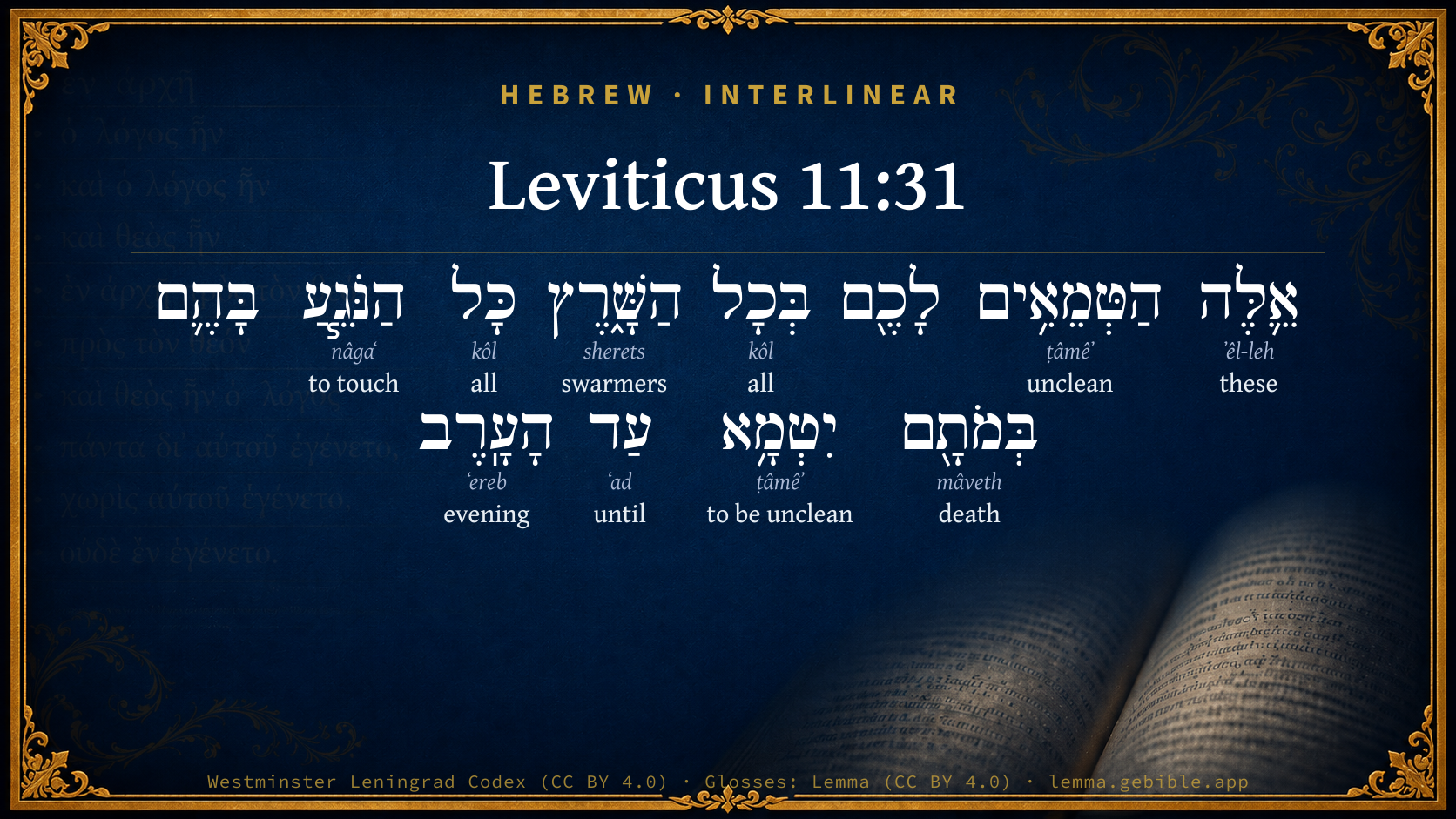
Leviticus 11:31

Hebrew (Westminster Leningrad Codex) Leviticus 11:31 appears in the Hebrew Old Testament. The text above is from the Westminster Leningrad Codex. Each word links to its Strong’s number, a concise gloss, and parsing drawn from the Open Scriptures Hebrew Bible morphology. Click any word for its full Brown-Driver-Briggs (BDB) entry.
Download image
Cite this verse

Leviticus 11:31 (World English Bible). Public Domain. Lemma interlinear Bible study tool, https://lemma.gebible.app/v/leviticus/11/31.

Show BibTeX & RIS
BibTeX
RIS
English Translation
These are they which are unclean to you among all that creep. Whoever touches them when they are dead, shall be unclean until the evening.
World English Bible · Public Domain
Download a study sheet

One document with this verse’s original text, its word-by-word gloss line, the meaning frame, cross-references with their text, attributed commentary, and full source and license credits — printable, and it pastes into notes with its structure intact.

This verse Autodidact and up

Study sheet (.html) Plain text (.txt)

A passage Seminary Student

Up to 50 verses in one chapter. A passage sheet keeps up to 6 commentary sources and 12 cross-references per verse, in the order this page ranks them, and says so on the sheet whenever that leaves anything out. Ask for a single verse and you get the Autodidact verse sheet above.

Everything on this page stays free to read, with no account — the sheet is a download of what is already on screen, not access to it.

Want to remove ads? Support Godless Engineer
Compare translations 3

The same verse in 3 English versions, stacked beneath the original-language interlinear above. Click any original word for its lexicon entry.

Each is an independent rendering of the whole verse — the interlinear is not word-aligned to these translations.

Highlighted words mark where these versions differ — a whole-verse word diff, not a word-by-word alignment.

  • World English Bible Public Domain
    These are they which are unclean to you among all that creep. Whoever touches them when they are dead, shall be unclean until the evening.
  • King James Version Public Domain
    These are unclean to you among all that creep: whosoever doth touch them, when they be dead, shall be unclean until the even.
  • unfoldingWord Literal Text CC BY-SA 4.0
    These unclean to you among all the swarming things. Anyone who touches them when they are dead will become unclean until the evening.

unfoldingWord Literal Text — © unfoldingWord, licensed CC BY-SA 4.0. Word-aligned USFM3 via Door43 (git.door43.org/unfoldingWord/en_ult).

Versions to compare (up to 4)

3 of 4 selected

Show all 18 translations

Every available English version of this verse, each an independent rendering of the whole verse.

  • World English Bible Public Domain
    These are they which are unclean to you among all that creep. Whoever touches them when they are dead, shall be unclean until the evening.
  • Berean Standard Bible Public Domain
    These animals are unclean for you among all the crawling creatures. Whoever touches them when they are dead shall be unclean until evening.
  • Majority Standard Bible Public Domain
    These animals are unclean for you among all the crawling creatures. Whoever touches them when they are dead shall be unclean until evening.
  • King James Version Public Domain
    These are unclean to you among all that creep: whosoever doth touch them, when they be dead, shall be unclean until the even.
  • American Standard Version (1901) Public Domain
    These are they which are unclean to you among all that creep: whosoever doth touch them, when they are dead, shall be unclean until the even.
  • Revised Version (1885) Public Domain
    These are they which are unclean to you among all that creep: whosoever doth touch them, when they are dead, shall be unclean until the even.
  • Geneva Bible (1599) Public Domain
    These shall be vncleane to you among all that creepe: whosoeuer doeth touch them when they be dead, shalbe vncleane vntil the euen.
  • Douay-Rheims (1899) Public Domain
    All these are unclean. He that toucheth their carcasses shall be unclean until the evening.
  • Young's Literal Translation Public Domain
    these `are' the unclean to you among all which are teeming; any one who is coming against them in their death is unclean till the evening.
  • Literal Standard Version CC BY-SA 4.0
    these [are] the unclean to you among all which are teeming; anyone who is coming against them in their death is unclean until the evening.
  • Unlocked Literal Bible CC BY-SA 4.0
    Of all the animals that creep, these are the animals which will be unclean to you. Whoever touches them when they are dead will be unclean until evening.
  • unfoldingWord Literal Text CC BY-SA 4.0
    These unclean to you among all the swarming things. Anyone who touches them when they are dead will become unclean until the evening.
  • Darby Bible Public Domain
    These shall be unclean unto you among all that crawl: whoever toucheth them when they are dead, shall be unclean until the even.
  • World Messianic Bible Public Domain
    These are they which are unclean to you among all that creep. Whoever touches them when they are dead shall be unclean until the evening.
  • Webster's Bible Public Domain
    These are unclean to you among all that creep: whoever doth touch them, when they are dead, shall be unclean until the evening.
  • Free Bible Version CC BY-SA 4.0
    These animals that run along the ground are unclean for you. If you touch a dead one of them you will be unclean until the evening.
  • Bible in Basic English Public Domain
    All these are unclean to you: anyone touching them when they are dead will be unclean till evening.
  • JPS Tanakh (1917) Public Domain
    These are they which are unclean to you among all that swarm; whosoever doth touch them, when they are dead, shall be unclean until the even.

Literal Standard Version (2020), Covenant Press — licensed CC BY-SA 4.0. Text via the HelloAO Bible API (eBible.org). Unlocked Literal Bible (unfoldingWord) — licensed CC BY-SA 4.0. Text via the HelloAO Bible API (eBible.org). unfoldingWord Literal Text — © unfoldingWord, licensed CC BY-SA 4.0. Word-aligned USFM3 via Door43 (git.door43.org/unfoldingWord/en_ult). Free Bible Version, Dr. Jonathan Gallagher — licensed CC BY-SA 4.0. Text via the HelloAO Bible API (eBible.org).

Word by word

More ways to search: Search by grammar → Find every occurrence → Compare this word →

Practice this passage: Drill this verse → Learn its vocabulary →

הַשָּׁ֑רֶץ
sherets
H8318
“the · swarmers”
Particle, Definite Article + Noun, Common, Masculine, Singular, Absolute
Part of Speech
Particle + Noun
Type
Common
Gender
Masculine
Number
Singular
State
Absolute
Full BDB Definition

Origin: from H8317

TWOT: 2467a

teeming or swarming things, creepers, swarmers - of insects, animals, small reptiles, quadrupeds
  1. אֵ֛לֶּה ʼêl-leh H428 “these” Pronoun, Demonstrative, Common, Plural
  2. הַטְּמֵאִ֥ים ṭâmêʼ H2931 “the · unclean” Particle, Definite Article + Adjective, Adjective, Masculine, Plural, Absolute
  3. בְּכָל kôl H3605 “in/at · all of” Preposition + Noun, Common, Masculine, Singular, Construct
  4. כָּל kôl H3605 “all of” Noun, Common, Masculine, Singular, Construct
  5. הַנֹּגֵ֧עַ nâgaʻ H5060 “the · touching” Particle, Definite Article + Verb, Qal, Participle Active, Masculine, Singular, Absolute
  6. בְּמֹתָ֖ם mâveth H4194 “in/at · death · their” Preposition + Noun, Common, Masculine, Singular, Construct + Suffix, Personal, 3rd Person, Masculine, Plural
  7. יִטְמָ֥א ṭâmêʼ H2930 “to be unclean” Verb, Qal, Imperfect, 3rd Person, Masculine, Singular
  8. עַד ʻad H5704 “until” Preposition
  9. הָעָֽרֶב ʻereb H6153 “the · evening” Particle, Definite Article + Noun, Common, Masculine, Singular, Absolute

About this verse

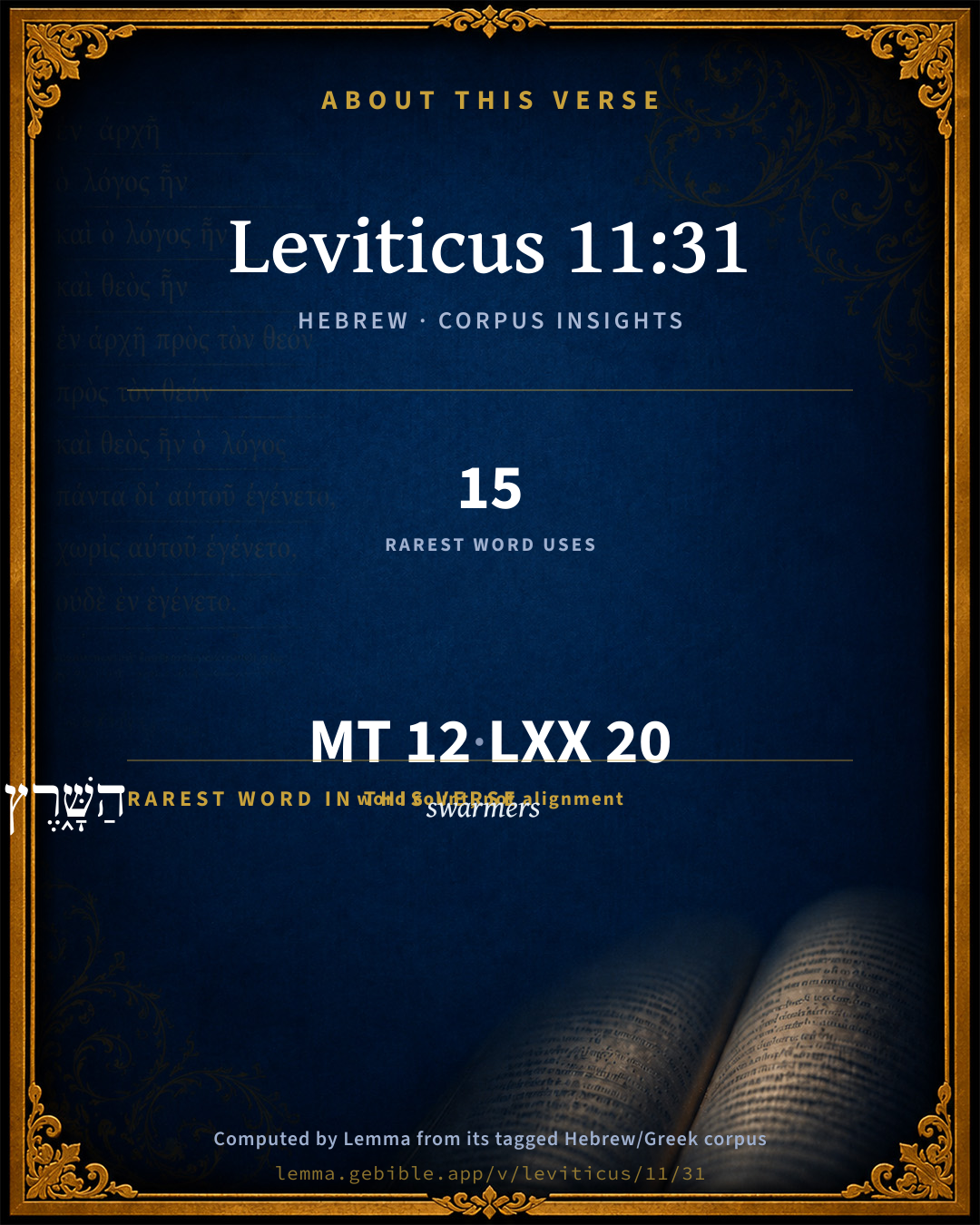
These counts appear in no published source. They are computed here, from the morphology-tagged text and Lemma’s own curated glosses. What Lemma adds →

12
words
9
distinct lemmas
Pentateuch
section

Notable vocabulary

The rarest word here is הַשָּׁ֑רֶץ swarmers H8318 — appearing just 15 times in the whole Hebrew Bible.

Shared distinctive vocabulary

הַשָּׁ֑רֶץ swarmers H8318 occurs in 15 verses of the Hebrew Bible. Also found in:

Grammatical profile

  • 2 verbs
  • 5 nouns
  • 1 adjective
  • 1 pronoun
  • 3 prepositions

Verb forms

  • הַנֹּגֵ֧עַ Qal · Participle Active
  • יִטְמָ֥א Qal · Imperfect

Repetition

A word recurs within this verse — often emphatic in Hebrew:

  • בְּכָל all H3605 ×2

Hebrew & Septuagint length

In English translation the verse runs 25 words from the Hebrew and 25 from the Septuagint (LXX English) — the same length.

A rough comparison of the two English renderings, which tokenize alike — not a word-level alignment.

Word counts can differ between the Hebrew and the Greek without any difference in meaning — e.g. the Hebrew direct-object marker אֵת has no separate Greek word, and Greek often adds the article ὁ.

In the original languages it is 12 Hebrew tokens and 20 Greek tokens — but the two are counted differently (Hebrew bundles its prefixes and suffixes into one token; the Greek is in lemma form), so that isn’t a like-for-like length.

Cross-references

2

Topical passages linked to Leviticus 11:31 in the Treasury of Scripture Knowledge — connected by theme and wording, ordered by reader-vote popularity; previews shown in the World English Bible.

  • Leviticus 11:8 Of their flesh you shall not eat, and their carcasses you shall not touch; they are unclean to you.
  • Leviticus 11:24–25 "'By these you will become unclean: whoever touches the carcass of them shall be unclean until the evening.

Cross-references courtesy of OpenBible.info (CC BY 4.0).

Hebrew and Greek witnesses Masoretic Hebrew ↔ Greek Septuagint

The same verse in the two great witnesses to the Old Testament, shown verse-for-verse.

These are two independent witnesses, not word-aligned to each other, and the Septuagint is shown in lemma (dictionary) form.

Hebrew Leviticus 11:31 Masoretic · Westminster Leningrad Codex

אֵ֛לֶּה הַטְּמֵאִ֥ים לָכֶ֖ם בְּכָל הַשָּׁ֑רֶץ כָּל הַנֹּגֵ֧עַ בָּהֶ֛ם בְּמֹתָ֖ם יִטְמָ֥א עַד הָעָֽרֶב

These are they which are unclean to you among all that creep. Whoever touches them when they are dead, shall be unclean until the evening.

World English Bible · Public Domain

Greek LXX Leviticus 11:31 Septuagint · lemma form

οὗτος ἀκάθαρτος σύ ἀπό πᾶς ὁ ἑρπετόν ὁ ἐπί ὁ γῆ πᾶς ὁ ἅπτομαι αὐτός θνήσκω ἀκάθαρτος εἰμί ἕως ἑσπέρα

These are unclean to you of all the reptiles which are on the earth; every one who touches their carcasses shall be unclean till evening.

LXX2012 (modern English Septuagint) · Public Domain

Hebrew: Westminster Leningrad Codex (CC BY 4.0). Greek: Septuagint (public domain); English from LXX2012 (modern English Septuagint) (Public Domain). How the Septuagint differs from the Hebrew →

Targum (Aramaic paraphrase)

2

The Targum is the ancient Jewish Aramaic paraphrase of the Hebrew Scriptures — an interpretive translation, not the Hebrew text itself. Onkelos (literal) and Pseudo-Jonathan (expansive) render the Torah, and Jonathan the Prophets. Coverage is partial: where no permissively-licensed English translation exists for a verse, only the Aramaic is shown. This is verse-level text, not a word-by-word alignment to the Hebrew.

  1. Targum Onkelos Torah (Genesis–Deuteronomy)
    אִלֵין דִמְסַאֲבִין לְכוֹן בְּכָל רִחֲשָׁא כֹּל דְיִקְרַב בְּהוֹן בְּמוֹתְהוֹן יְהֵי מְסָאָב עַד רַמְשָׁא

    (no public-domain English translation for this verse)

    Targum Onkelos — Aramaic: “Onkelos Genesis” (public domain); “Onkelos Exodus” (public domain); “Onkelos Leviticus” (public domain); “Onkelos Numbers” (public domain); “Onkelos Deuteronomy” (public domain). English: “Sefaria Community Translation” (CC0 1.0 (public-domain dedication)); “J.W. Etheridge. The Targums of Onkelos and Jonathan Ben Uzziel on the Pentateuch. London: Longmans, Green, 1862” (public domain). Text via Sefaria.

  2. Targum Pseudo-Jonathan Torah (Genesis–Deuteronomy)
    אִלֵין תְּמַנְיָא מִינַיָיא דִמְסָאָבִין לְכוֹן בְּכָל רִיחֲשָׁא כָּל דְיִקְרַב בְּהוֹן וּבְמוֹשְׁכֵיהוֹן וּבְאַדְמֵיהוֹן יְהֵי מְסָאָב עַד רַמְשָׁא

    These eight kinds are unclean to you among all reptiles: whoever toucheth them, their skin or their blood, shall be unclean until the evening.

    Targum Pseudo-Jonathan — Aramaic: “Targum Jonathan on Genesis” (public domain); “Targum Jonathan on Exodus” (public domain); “Targum Jonathan on Leviticus” (public domain); “Targum Jonathan on Numbers” (public domain); “Targum Jonathan on Deuteronomy” (public domain). English: “The Targum of Jonathan ben Uzziel, trans. J. W. Etheridge, London, 1862” (public domain). Text via Sefaria.

Commentary

Notes on Leviticus 11:31 from classic Christian and Jewish commentators (each source and its license shown beneath its notes). The classic Christian expositions comment on the surrounding passage and are grouped to its opening verse, so a note may address several verses; the Jewish commentaries on the Tanakh (Rashi and others) are per-verse, so they appear only where the commentator wrote on this verse.

Lemma curates 59 commentaries, every one of them public domain or Creative Commons licensed, each selected and text-cleaned for this edition rather than reprinted as found. About our sources →

Trapp's Complete Commentary

John Trapp

Lev 11:31 These [are] unclean to you among all that creep: whosoever doth touch them, when they be dead, shall be unclean until the even.

Ver. 31. Touch them, when they be dead.] There is no kind of living creature that is defiled while it is alive, or that defileth while it is alive, save man only, saith Maimony. Others note that there were more remarkable expressions of God’s anger upon man’s sin in the dead body of a man than of a beast. The one made unclean but till evening: the other seven days.

John Trapp, A Commentary or Exposition upon All the Books of the Old and New Testament (1647–1656) — public domain. Text from a community e-Sword module.

Jamieson, Fausset & Brown

Robert Jamieson, A. R. Fausset & David Brown

whosoever doth touch them, when . . . dead, shall be unclean until the even--These regulations must have often caused annoyance by suddenly requiring the exclusion of people from society, as well as the ordinances of religion. Nevertheless they were extremely useful and salutary, especially as enforcing attention to cleanliness. This is a matter of essential importance in the East, where venomous reptiles often creep into houses and are found lurking in boxes, vessels, or holes in the wall; and the carcass of one of them, or a dead mouse, mole, lizard, or other unclean animal, might be inadvertently touched by the hand, or fall on clothes, skin bottles, or any article of common domestic use. By connecting, therefore, the touch of such creatures with ceremonial defilement, which required immediately to be removed, an effectual means was taken to prevent the bad effects of venom and all unclean or noxious matter.

Jamieson, Fausset & Brown — Commentary Critical and Explanatory on the Whole Bible (1871) — public domain (CC PDM 1.0). Text via the HelloAO Bible API.

Ellicott's Commentary for English Readers

(31) These are unclean.—Better, these are the most unclean, as Lev_11:29. That is, the eight animals thus enumerated are pre-eminently unclean of all the creeping things.

When they be dead.—The phrase, “whosoever doth touch them when they be dead,” is simply another expression for “whosoever toucheth the carcase of them,” which is used in Lev_11:24. Defilement is only contracted when their dead bodies are touched, but not if touched when alive. According to the canon which obtained during the second Temple, “there is no kind of living creature that becomes defiled while it is alive, or defiles when it is alive, save man only.”

A Bible Commentary for English Readers, edited by Charles John Ellicott (1878–1897) — public domain. Text from a community e-Sword module.

The Cambridge Bible for Schools and Colleges

gen. ed. J. J. S. Perowne

31. creep] swarm.

The Cambridge Bible for Schools and Colleges (gen. ed. J. J. S. Perowne; Cambridge University Press, 1878–1918) — public domain. Text from a community e-Sword module.

John Gill's Exposition

These are unclean to you of all that creep,.... Unfit for food, and not to be touched, at least when dead, as in the next clause, that is, these eight sorts of creeping things before mentioned, as the Targum of Jonathan expresses it, and these only, as Maimonides says (r):

whosoever doth touch them when they are dead shall be unclean until the even; for touching them while alive did not defile, only when dead; and this the Jews interpret, while they are in the case in which they died, that is, while they are moist; for, as Ben Gersom says, if they are so dry, as that they cannot return to their moisture, they do not defile; for which reason, neither the bones, nor nails, nor nerves, nor skin of these creeping things, defile; but, they say (s), while the back bone is whole, and the bones cleave to it, then a creeping thing is reckoned moist, and while it is so it defiles. (r) Hilchot, Abot Hatumaot, c. 4. sect. 14. (s) Maimon. & Bartenora in Misn. Niddah, c. 7. sect. 1.

John Gill's Exposition of the Whole Bible (1746–1763) — public domain (CC PDM 1.0). Text via the HelloAO Bible API.

The Pulpit Commentary

Vers. 31-38. As the little animals just mentioned weasels, mice, and lizards are more likely than those of a larger size to be found dead in domestic utensils and clothes, a further warning as to their defiling character is added, with tales for daily use. The words translated ranges for pots (verse 35) should rather be rendered covered pots, that is, pots or kettles with lids to them. Seed which is to be sown, that is, seed corn, is not defiled by contact with these dead animals, unless it has been wetted by water being put on it, in which case the moisture would convey the corruption into the seeds.

The Pulpit Commentary (1880–1919), ed. H.D.M. Spence-Jones & Joseph S. Exell — public domain. Text from a community e-Sword module.

unfoldingWord translationNotes

Door43 World Missions Community

General Information:

Yahweh continues telling Moses and Aaron which animals the people are to consider unclean.

these are the animals which will be unclean to you

These animals that God declared to be unfit for people to touch or eat are spoken of as if they were physically unclean. (See: Metaphor)

Whoever touches them ... will be unclean

A person who is unacceptable for God's purposes because he has touched one of these dead animals is spoken of as if he were physically unclean. (See: Metaphor)

until evening

"until sunset"

that thing will be unclean

Something that God has declared to be unfit for people to touch because one of these dead animals has fallen on it is spoken of as if it were physically unclean. It is spoken of as physically clean after it has been washed. (See: Metaphor)

Then it will be clean

Something that God has declared to be fit for people to touch after it has been washed is spoken of as if it were physically clean. (See: Metaphor)

whatever it is used for, it must be put into water

This can be translated in active form. AT: "however you use it, you must put it into water" (See: Active or Passive)

translationWords

clean

die

sackcloth

clean

unfoldingWord translationNotes — © Distant Shores Media and the Door43 World Missions Community, licensed CC BY-SA 4.0. Source: git.door43.org/Door43/en_tn.

Lesson kit

Teaching starters — assembled from the data on this page, not authored interpretation. Every prompt links to the verse data it draws on. Edit before teaching.

Leviticus, in the Pentateuch, opens this verse with 12 words (9 distinct Hebrew lemmas). Its most distinctive word is sherets (“swarmers”). A historical commentator’s framing appears above. Read the whole chapter for the surrounding context.

Discussion questions

  1. What does “swarmers” (sherets) contribute to the verse as a whole?
  2. Genesis 1:20 shares the word «swarmers» with this verse. How do the two illuminate each other?
  3. “all” occurs 2× in this one verse. What is the effect of the repetition?
  4. The translations on this page render this verse differently — a whole-verse word diff, not a word-by-word alignment. What might account for the different wordings?
  5. The verb «הַנֹּגֵ֧עַ» is Qal Participle Active. How does its form color the action?
  6. Reading how Trapp's Complete Commentary and Jamieson, Fausset & Brown read this verse, where do the two commentators agree and where do they part?

Things to notice

Reading settings

Reading text

Shown beneath each verse's original-language words.

Old Testament
Old Testament edition

Read the OT as the Masoretic Hebrew (MT) or the Greek Septuagint (LXX).

English shown for the Greek Septuagint (in the Hebrew ↔ Greek comparison).

Comparing translations? Open the Compare panel on any verse page to stack up to four side by side.