Ezekiel 7:12

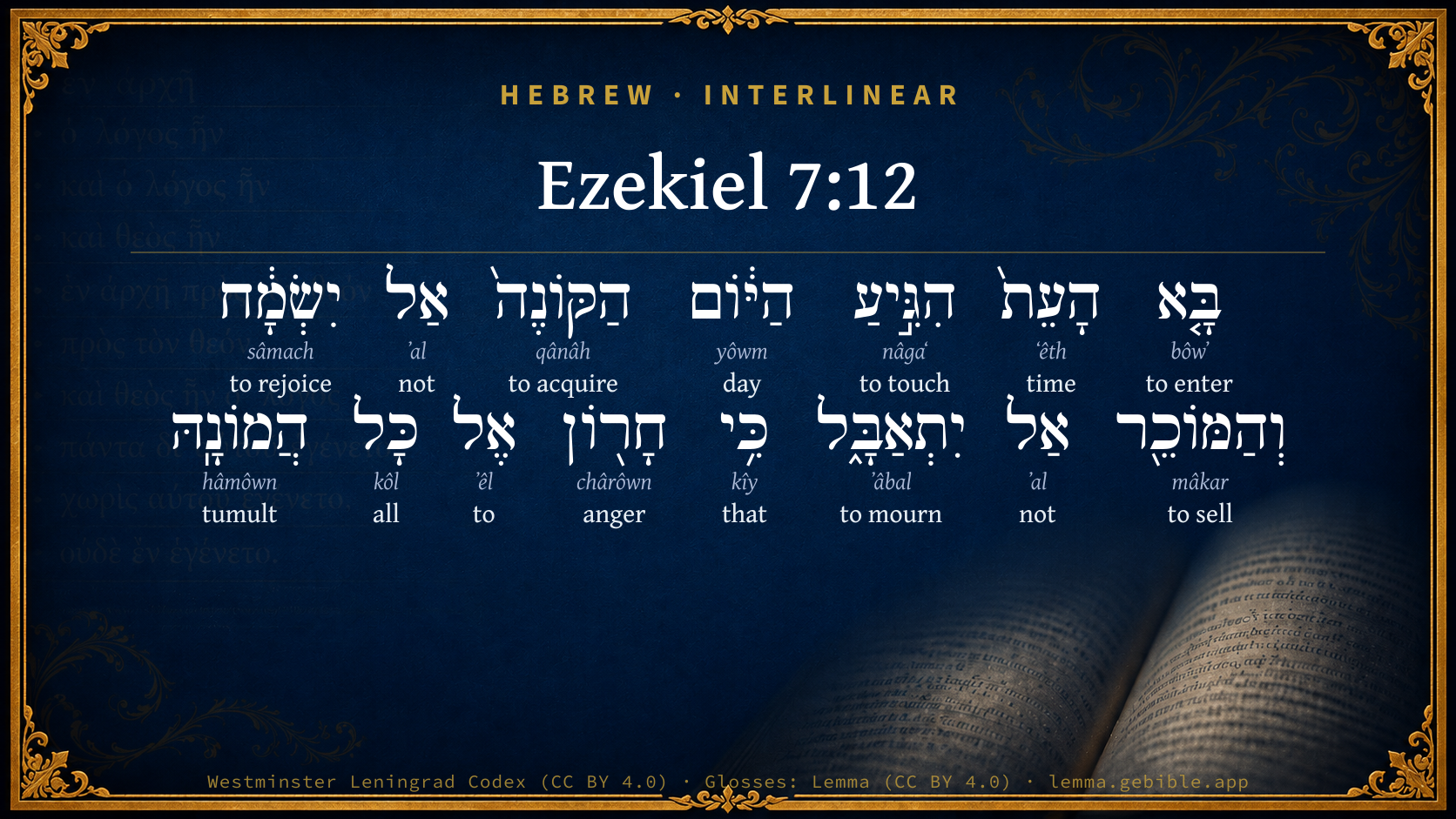
Hebrew (Westminster Leningrad Codex) Ezekiel 7:12 appears in the Hebrew Old Testament. The text above is from the Westminster Leningrad Codex. Each word links to its Strong’s number, a concise gloss, and parsing drawn from the Open Scriptures Hebrew Bible morphology. Click any word for its full Brown-Driver-Briggs (BDB) entry.
Download image
Cite this verse

Ezekiel 7:12 (World English Bible). Public Domain. Lemma interlinear Bible study tool, https://lemma.gebible.app/v/ezekiel/7/12.

Show BibTeX & RIS
BibTeX
RIS
English Translation
The time is come, the day draws near: don't let the buyer rejoice, nor the seller mourn; for wrath is on all the multitude of it.
World English Bible · Public Domain
Download a study sheet

One document with this verse’s original text, its word-by-word gloss line, the meaning frame, cross-references with their text, attributed commentary, and full source and license credits — printable, and it pastes into notes with its structure intact.

This verse Autodidact and up

Study sheet (.html) Plain text (.txt)

A passage Seminary Student

Up to 50 verses in one chapter. A passage sheet keeps up to 6 commentary sources and 12 cross-references per verse, in the order this page ranks them, and says so on the sheet whenever that leaves anything out. Ask for a single verse and you get the Autodidact verse sheet above.

Everything on this page stays free to read, with no account — the sheet is a download of what is already on screen, not access to it.

Want to remove ads? Support Godless Engineer
Compare translations 3

The same verse in 3 English versions, stacked beneath the original-language interlinear above. Click any original word for its lexicon entry.

Each is an independent rendering of the whole verse — the interlinear is not word-aligned to these translations.

Highlighted words mark where these versions differ — a whole-verse word diff, not a word-by-word alignment.

  • World English Bible Public Domain
    The time is come, the day draws near: don't let the buyer rejoice, nor the seller mourn; for wrath is on all the multitude of it.
  • King James Version Public Domain
    The time is come, the day draweth near: let not the buyer rejoice, nor the seller mourn: for wrath is upon all the multitude thereof.
  • unfoldingWord Literal Text CC BY-SA 4.0
    The time is coming; the day has come close. Do not let the buyer rejoice, nor the seller mourn, since my anger is on the entire multitude!

unfoldingWord Literal Text — © unfoldingWord, licensed CC BY-SA 4.0. Word-aligned USFM3 via Door43 (git.door43.org/unfoldingWord/en_ult).

Versions to compare (up to 4)

3 of 4 selected

Show all 18 translations

Every available English version of this verse, each an independent rendering of the whole verse.

  • World English Bible Public Domain
    The time is come, the day draws near: don't let the buyer rejoice, nor the seller mourn; for wrath is on all the multitude of it.
  • Berean Standard Bible Public Domain
    The time has come; the day has arrived. Let the buyer not rejoice and the seller not mourn, for wrath is upon the whole multitude.
  • Majority Standard Bible Public Domain
    The time has come; the day has arrived. Let the buyer not rejoice and the seller not mourn, for wrath is upon the whole multitude.
  • King James Version Public Domain
    The time is come, the day draweth near: let not the buyer rejoice, nor the seller mourn: for wrath is upon all the multitude thereof.
  • American Standard Version (1901) Public Domain
    The time is come, the day draweth near: let not the buyer rejoice, nor the seller mourn; for wrath is upon all the multitude thereof.
  • Revised Version (1885) Public Domain
    The time is come, the day draweth near: let not the buyer rejoice, nor the seller mourn: for wrath is upon all the multitude thereof.
  • Geneva Bible (1599) Public Domain
    The time is come, the day draweth neere: let not the byer reioyce, nor let him that selleth, mourne: for the wrath is vpon al the multitude thereof.
  • Douay-Rheims (1899) Public Domain
    The time is come, the day is at hand: let not the buyer rejoice: nor the seller mourn: for wrath is upon all the people thereof.
  • Young's Literal Translation Public Domain
    Come hath the time, arrived hath the day, The buyer doth not rejoice, And the seller doth not become a mourner, For wrath `is' unto all its multitude.
  • Literal Standard Version CC BY-SA 4.0
    The time has come, the day has arrived, || The buyer does not rejoice, || And the seller does not become a mourner, || For wrath [is] to all its multitude.
  • Unlocked Literal Bible CC BY-SA 4.0
    The time is coming; the day has come close. Do not let the buyer rejoice, nor the seller mourn, since my anger is on the entire multitude!
  • unfoldingWord Literal Text CC BY-SA 4.0
    The time is coming; the day has come close. Do not let the buyer rejoice, nor the seller mourn, since my anger is on the entire multitude!
  • Darby Bible Public Domain
    The time is come, the day draweth near: let not the buyer rejoice, nor the seller mourn; for fierce anger is upon all the multitude thereof.
  • World Messianic Bible Public Domain
    The time has come! The day draws near. Don’t let the buyer rejoice, nor the seller mourn; for wrath is on all its multitude.
  • Webster's Bible Public Domain
    The time is come, the day draweth near: let not the buyer rejoice, nor the seller mourn: for wrath is upon all the multitude thereof.
  • Free Bible Version CC BY-SA 4.0
    The time has come; the day is here! Buyers, don't celebrate thinking you'll get a good deal; sellers, don't cry thinking you're going to make a loss—because punishment is coming to everyone.
  • Bible in Basic English Public Domain
    The time has come, the day is near: let not him who gives a price for goods be glad, or him who gets the price have sorrow:
  • JPS Tanakh (1917) Public Domain
    The time is come, the day draweth near; let not the buyer rejoice, nor the seller mourn; for wrath is upon all the multitude thereof.

Literal Standard Version (2020), Covenant Press — licensed CC BY-SA 4.0. Text via the HelloAO Bible API (eBible.org). Unlocked Literal Bible (unfoldingWord) — licensed CC BY-SA 4.0. Text via the HelloAO Bible API (eBible.org). unfoldingWord Literal Text — © unfoldingWord, licensed CC BY-SA 4.0. Word-aligned USFM3 via Door43 (git.door43.org/unfoldingWord/en_ult). Free Bible Version, Dr. Jonathan Gallagher — licensed CC BY-SA 4.0. Text via the HelloAO Bible API (eBible.org).

Word by word

More ways to search: Search by grammar → Find every occurrence → Compare this word →

Practice this passage: Drill this verse → Learn its vocabulary →

יִתְאַבָּ֑ל
ʼâbal
H56
“to mourn”
Verb, Hithpael, Jussive, 3rd Person, Masculine, Singular
Part of Speech
Verb
Stem
Hithpael
Form
Jussive
Person
3rd Person
Gender
Masculine
Number
Singular
Full BDB Definition

Origin: a primitive root

TWOT: 6

to mourn, lament - (Qal) to mourn, lament - of humans - of inanimate objects (figuratively) - of gates - of land - (Hiphil) - to mourn, cause to mourn (figuratively) - (Hithpael) - to mourn - play the mourner
  1. בָּ֤א bôwʼ H935 “to enter” Verb, Qal, Perfect, 3rd Person, Masculine, Singular
  2. הָעֵת֙ ʻêth H6256 “the · time” Particle, Definite Article + Noun, Common, Both, Singular, Absolute
  3. הִגִּ֣יעַ nâgaʻ H5060 “to touch” Verb, Hiphil, Perfect, 3rd Person, Masculine, Singular
  4. הַיּ֔וֹם yôwm H3117 “the · day” Particle, Definite Article + Noun, Common, Masculine, Singular, Absolute
  5. הַקּוֹנֶה֙ qânâh H7069 “the · acquiring” Particle, Definite Article + Verb, Qal, Participle Active, Masculine, Singular, Absolute
  6. אַל ʼal H408 “not” Particle, Negative
  7. יִשְׂמָ֔ח sâmach H8055 “to rejoice” Verb, Qal, Jussive, 3rd Person, Masculine, Singular
  8. וְהַמּוֹכֵ֖ר mâkar H4376 “and · the · selling” Conjunction + Particle, Definite Article + Verb, Qal, Participle Active, Masculine, Singular, Absolute
  9. אַל ʼal H408 “not” Particle, Negative
  10. כִּ֥י kîy H3588 “that” Conjunction
  11. חָר֖וֹן chârôwn H2740 “anger” Noun, Common, Masculine, Singular, Absolute
  12. אֶל ʼêl H413 “to” Preposition
  13. כָּל kôl H3605 “all of” Noun, Common, Masculine, Singular, Construct
  14. הֲמוֹנָֽהּ hâmôwn H1995 “tumult · her” Noun, Common, Masculine, Singular, Construct + Suffix, Personal, 3rd Person, Feminine, Singular

About this verse

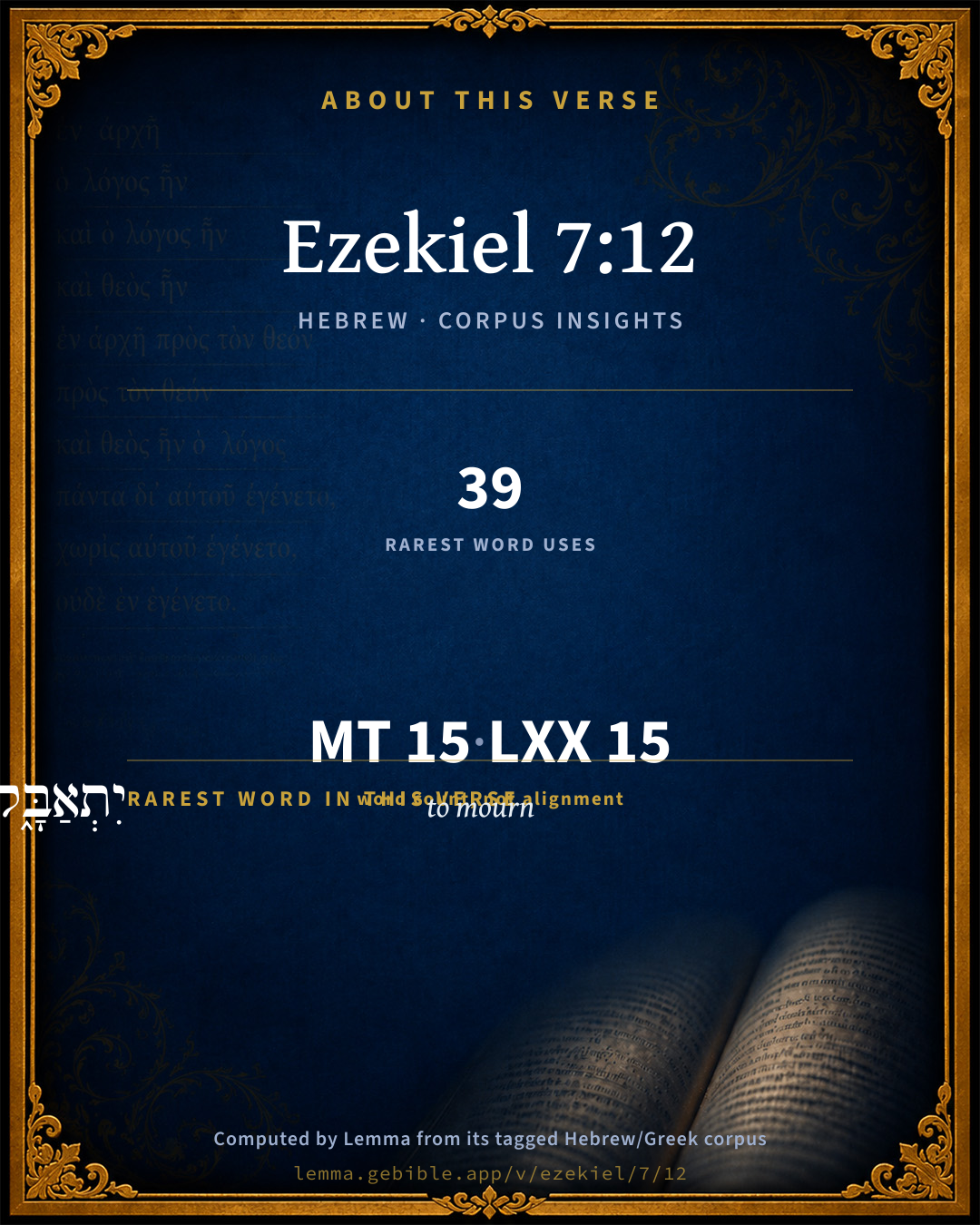
These counts appear in no published source. They are computed here, from the morphology-tagged text and Lemma’s own curated glosses. What Lemma adds →

15
words
14
distinct lemmas
Prophets
section

Shared distinctive vocabulary

יִתְאַבָּ֑ל to mourn H56 occurs in 38 verses of the Hebrew Bible. Also found in:

Grammatical profile

  • 6 verbs
  • 5 nouns
  • 1 preposition
  • 1 conjunction
  • 2 particles

Verb forms

  • בָּ֤א Qal · Perfect
  • הִגִּ֣יעַ Hiphil · Perfect
  • הַקּוֹנֶה֙ Qal · Participle Active
  • יִשְׂמָ֔ח Qal · Jussive
  • וְהַמּוֹכֵ֖ר Qal · Participle Active
  • יִתְאַבָּ֑ל Hithpael · Jussive

Repetition

A word recurs within this verse — often emphatic in Hebrew:

  • אַל not H408 ×2

Hebrew & Septuagint length

In English translation the verse runs 26 words from the Hebrew and 18 from the Septuagint (LXX English) — the Septuagint runs noticeably shorter here. See the side-by-side →

A rough comparison of the two English renderings, which tokenize alike — not a word-level alignment.

Word counts can differ between the Hebrew and the Greek without any difference in meaning — e.g. the Hebrew direct-object marker אֵת has no separate Greek word, and Greek often adds the article ὁ.

In the original languages it is 15 Hebrew tokens and 15 Greek tokens — but the two are counted differently (Hebrew bundles its prefixes and suffixes into one token; the Greek is in lemma form), so that isn’t a like-for-like length.

Cross-references

10

Topical passages linked to Ezekiel 7:12 in the Treasury of Scripture Knowledge — connected by theme and wording, ordered by reader-vote popularity; previews shown in the World English Bible.

  • Isaiah 5:13–14 Therefore my people go into captivity for lack of knowledge; Their honorable men are famished, And their multitudes are parched with thirst.
  • 1 Corinthians 7:29–31 But I say this, brothers: the time is short, that from now on, both those who have wives may be as though they had none;
  • Isaiah 24:1–2 Behold, Yahweh makes the earth empty, and makes it waste, and turns it upside down, and scatters abroad the inhabitants of it.
  • Jeremiah 32:7–8 Behold, Hanamel the son of Shallum your uncle shall come to you, saying, Buy you my field that is in Anathoth; for the right of redemption is yours to buy it.
  • Ezekiel 6:11–12 Thus says the Lord Yahweh: Smite with your hand, and stamp with your foot, and say, Alas! because of all the evil abominations of the house of Israel; for they shall fall by the sword, by the famine, and by the pestilence.
  • Ezekiel 7:5–7 Thus says the Lord Yahweh: An evil, an only evil; behold, it comes.
  • Ezekiel 7:10 Behold, the day, behold, it comes: your doom is gone forth; the rod has blossomed, pride has budded.
  • James 5:8–9 You also be patient. Establish your hearts, for the coming of the Lord is at hand.
  • Jeremiah 32:24–25 Behold, the mounds, they are come to the city to take it; and the city is given into the hand of the Chaldeans who fight against it, because of the sword, and of the famine, and of the pestilence; and what you have spoken has happened; and, behold, you see it.
  • Ezekiel 7:13–14 For the seller shall not return to that which is sold, although they be yet alive: for the vision is touching the whole multitude of it, none shall return; neither shall any strengthen himself in the iniquity of his life.

Cross-references courtesy of OpenBible.info (CC BY 4.0).

Hebrew and Greek witnesses Masoretic Hebrew ↔ Greek Septuagint

The same verse in the two great witnesses to the Old Testament, shown verse-for-verse.

Here the Septuagint runs noticeably shorter than the Hebrew — LXX2012 (modern English Septuagint) 18 words vs World English Bible 26. A rough length comparison of the two English translations, not a word-level alignment — read both below.

These are two independent witnesses, not word-aligned to each other, and the Septuagint is shown in lemma (dictionary) form.

Hebrew Ezekiel 7:12 Masoretic · Westminster Leningrad Codex

בָּ֤א הָעֵת֙ הִגִּ֣יעַ הַיּ֔וֹם הַקּוֹנֶה֙ אַל יִשְׂמָ֔ח וְהַמּוֹכֵ֖ר אַל יִתְאַבָּ֑ל כִּ֥י חָר֖וֹן אֶל כָּל הֲמוֹנָֽהּ

The time is come, the day draws near: don't let the buyer rejoice, nor the seller mourn; for wrath is on all the multitude of it.

World English Bible · Public Domain

Greek LXX Ezekiel 7:12 Septuagint · lemma form

ἥκω ὁ καιρός ἰδού ὁ ἡμέρα ὁ κτάομαι μή χαίρω καί ὁ πωλέω μή θρηνέω

The time is come, behold the day: let not the buyer rejoice, and let not the seller mourn.

LXX2012 (modern English Septuagint) · Public Domain

Hebrew: Westminster Leningrad Codex (CC BY 4.0). Greek: Septuagint (public domain); English from LXX2012 (modern English Septuagint) (Public Domain). How the Septuagint differs from the Hebrew →

Targum (Aramaic paraphrase)

1

The Targum is the ancient Jewish Aramaic paraphrase of the Hebrew Scriptures — an interpretive translation, not the Hebrew text itself. Onkelos (literal) and Pseudo-Jonathan (expansive) render the Torah, and Jonathan the Prophets. Coverage is partial: where no permissively-licensed English translation exists for a verse, only the Aramaic is shown. This is verse-level text, not a word-by-word alignment to the Hebrew.

  1. Targum Jonathan Prophets (Joshua–Malachi)
    מְטָא עִדָן תּוּשְׁלְמַת חוֹבִין קָרִיב יוֹם פּוּרְעֲנוּת חֶטְאִין זָבְנָא לָא יֶחֱדֵי וּמְזוֹבְנָא לָא יִדְוֵי אֲרֵי רְגַז מִן קֳדָמַי עַל כָּל אִתְרְגוּשַׁתְהוֹן:

    (no public-domain English translation for this verse)

    Targum Jonathan — Aramaic: “Mikraot Gedolot” (public domain). English: “Sefaria Community Translation” (CC0 1.0 (public-domain dedication)); “London "Chaldee Paraphrase," 1871” (public domain). Text via Sefaria.

Commentary

Notes on Ezekiel 7:12 from classic Christian and Jewish commentators (each source and its license shown beneath its notes). The classic Christian expositions comment on the surrounding passage and are grouped to its opening verse, so a note may address several verses; the Jewish commentaries on the Tanakh (Rashi and others) are per-verse, so they appear only where the commentator wrote on this verse.

Lemma curates 59 commentaries, every one of them public domain or Creative Commons licensed, each selected and text-cleaned for this edition rather than reprinted as found. About our sources →

Trapp's Complete Commentary

John Trapp

Eze 7:12 The time is come, the day draweth near: let not the buyer rejoice, nor the seller mourn: for wrath [is] upon all the multitude thereof.

Ver. 12. The time is come, the day draweth near.] Advenit illud tempus, pertigit ilia dies. Let this voice ever sound in the ears of those negligent spirits who cry Cras Domine, tomorrow Lord, wiling away their time as she in Rev 2:21, and so fooling away their own salvation, as those virgins. {Mat 25:1-12}

Let not the buyer rejoice.] He shall have no such great joy of his purchase, since the enemy shall shortly take all, et qui latifundia habuerunt, ne latum pedem retinebunt, and those who have large estates will not keep back enough for a foot, and no man shall be master of his own, nay, not of a molehill.

For wrath is upon all the multitude thereof.] Or, Upon all the wealth thereof. To like purpose the apostle in 1Co 7:29; "This, then, I say, brethren, The time is short," or trussed up, contracted. "Let them that have wives be as though they had none, they that weep as though they wept not, they that rejoice as though they rejoiced not, and they that buy as though they possessed not," &c. Rebus non me trado sed commodo, said the wise heathen. {a} Hang loose to all things here below, and labour after that undefiled and unfadable inheritance. {1Pe 1:4-7}

{a} Sen.

John Trapp, A Commentary or Exposition upon All the Books of the Old and New Testament (1647–1656) — public domain. Text from a community e-Sword module.

Joseph Benson's Commentary

Eze 7:12-15. Let not the buyer rejoice, &c. — The buyer will have no reason to rejoice, because he will not enjoy what he hath bought; nor the seller have cause to mourn for having been obliged to part with his possessions, of which the approaching desolation of the country and the captivity would otherwise have deprived him. For the seller shall not return to that which was sold, &c. — The year of jubilee shall be no advantage to the sellers; for though they should live till it come, yet they shall not enjoy the benefit of the law, (Lev 25:13,) nor be restored again to their possessions, as the Chaldeans will have seized upon their lands, who will pay no regard to the year of jubilee, with respect to restoring to every one his old inheritance. For the vision — Or the prophecy; is touching the whole multitude — Is concerning the whole people; which shall not return — Or, as Bishop Newcome reads it. It, that is, the vision or prophecy, shall not return, namely, unfulfilled; or, it shall not be void. Neither shall any strengthen himself in iniquity — Neither shall any one secure himself by acting wickedly. Or, “And though they harden themselves in sin, and shut their eyes against the judgments which hang over their heads, these will at last unavoidably overtake them.” They have blown the trumpet — The house of Israel have summoned in all fit for arms: see Jer 6:1. But none goeth to the battle — There is not a man going to the war. For the people’s hearts fail them — Looking upon themselves as given up to destruction. For my wrath is upon all the multitude thereof — That displeasure which takes away their courage. The sword is without — In the countries; and the pestilence and the famine within — The besieged city. He that is in the field — Whoever is in the field; shall die with the sword — Of the Chaldean soldiers. And he that is in the city — Whither he had fled for safety; famine and pestilence shall devour him — Shall eat him up. You, O Jews, shall be food for these insatiable destroyers.

Joseph Benson's Commentary on the Old and New Testaments (1811–1818) — public domain. Text from a community e-Sword module.

Tyndale Open Study Notes

Tyndale Open Resources

7:12-27 Comprehensive judgment is depicted in two parallel panels, 7:12-18 and 7:19-27. Each begins with the futility of material gain in view of this impending judgment and moves through the arrival of war and its associated horrors to a declaration of universal ineffectiveness, terror, and mourning.

7:12-13 Commercial transactions would lose their meaning. There would be no such thing as a good deal or a bad deal; buyers and sellers alike would face God’s terrible anger.

Tyndale Open Study Notes — © Tyndale Open Resources, licensed CC BY-SA 4.0. Text via the HelloAO Bible API.

unfoldingWord translationNotes

Door43 World Missions Community

General Information:

These are Yahweh's words about Israel.

The time is coming; the day has come close

Both "The time" and "the day" refer to the time when God will punish the people of Israel. AT: "Israel's punishment will happen very soon" (See: Parallelism)

my anger is on the entire multitude

"I am angry with the whole multitude"

multitude

a very large number of people. Here it refers to the people of Israel.

as long as they both live

as long as "the buyer" and "the seller" (Eze 7:12) both live

the vision concerning the entire multitude will not be reversed

"God will surely do to the multitude what he has shown me"

none of them will be strengthened

This can be translated in active form. AT: "God will not strengthen any of them" (See: Active or Passive)

translationWords

joy

anger

vision

sin

unfoldingWord translationNotes — © Distant Shores Media and the Door43 World Missions Community, licensed CC BY-SA 4.0. Source: git.door43.org/Door43/en_tn.

Geneva Bible (1599)

Geneva Bible translators

For the present profit.

For he shall lose nothing.

Geneva Bible (1599) marginal notes — public domain. Text via Bolls.life.

Jamieson, Fausset & Brown

Robert Jamieson, A. R. Fausset & David Brown

let not . . . buyer rejoice--because he has bought an estate at a bargain price.

nor . . . seller mourn--because he has had to sell his land at a sacrifice through poverty. The Chaldeans will be masters of the land, so that neither shall the buyer have any good of his purchase, nor the seller any loss; nor shall the latter (Eze 7:13) return to his inheritance at the jubilee year (see Lev 25:13). Spiritually this holds good now, seeing that "the time is short"; "they that rejoice should be as though they rejoiced not, and they that buy as though they possessed not": Paul (Co1 7:30) seems to allude to Ezekiel here. Jer 32:15, Jer 32:37, Jer 32:43, seems to contradict Ezekiel here. But Ezekiel is speaking of the parents, and of the present; Jeremiah, of the children, and of the future. Jeremiah is addressing believers, that they should hope for a restoration; Ezekiel, the reprobate, who were excluded from hope of deliverance.

Jamieson, Fausset & Brown — Commentary Critical and Explanatory on the Whole Bible (1871) — public domain (CC PDM 1.0). Text via the HelloAO Bible API.

Adam Clarke's Commentary

Verse 12. Let not the buyer rejoice, nor the seller mourn] Such is now the state of public affairs, that he who through want has been obliged to sell his inheritance, need not mourn on the account; as of this the enemy would soon have deprived him. And he who has bought it need not rejoice in his bargain, as he shall soon be stripped of his purchase, and either fall by the sword, or be glad to flee for his life.

Adam Clarke's Commentary on the Bible (1810–1826) — public domain. Text from a community e-Sword/MySword module.

John Calvin's Commentaries

The Prophet now uses another kind of speech. Meanwhile he teaches that there should be such a change that all things should be so mixed as if there were no difference between the rich and the poor. Yet such a change does not happen unless God were grievously offended, and so did not exact ordinary vengeance as he had formerly denounced. Paul indeed exhorts all the pious to pass through this world as if they were pilgrims in it, (1 Corinthians 7:29, 30, 31,) and thus he says is our faith proved, as with the buyer so with the seller, as with the married so with the single. This general doctrine is prescribed to all the children of God, since the fashion of this world passes away, that they may pass through it, without having their minds fixed on these perishing things. But the meaning of our Prophet is different, because God will so disturb all things among the Israelites, that there shall be no difference between buyer and seller. He who acquires rejoices, and he who is compelled to sell suffers some degree of sorrow; and sometimes the man who is deprived of his lands and possessions tears out as it were his own entrails. It is natural therefore for the buyer to rejoice, and for the seller to lament. Now God shows that the confusion in the kingdom of Israel was so great, that neither poverty nor riches afford the material for sorrow or grief. Now we understand the Prophet’s meaning. He says, the time has come, the day has approached, in which the buyer will not rejoice, and the seller will not lament: because, says he, indignation is upon all this multitude Here that reason of Paul is not brought forward, that the fashion of this world passes away, but a concussion, or rather ruin of that land is pointed out, so that nothing remains safe. For although, whilst we travel through the world, we ought always to erect our minds and senses towards heaven, yet the political faculty remains and flourishes even among the faithful. For the sons of God, though they are poor in spirit, yet possess what God has conferred upon them: they exist, as Paul exhorts them, as it were not possessing but yet enjoying their goods. But the Prophet here signifies, that when the kingdom of Israel shall have been overturned, there will be no use for either money or lands, because all being cast out of their country shall be reduced to want. And he follows up the same sentiment —

John Calvin's Commentaries (1540-1563) — public domain. Text from the Calvin Translation Society English edition (1840s-50s) via the Christian Classics Ethereal Library (ccel.org). Calvin's coverage is partial (roughly two-thirds of the Bible); uncommented books and verses are honest gaps, never fabricated. The 19th-century editor's footnotes and remarks are omitted so the notes are faithfully Calvin's own voice.

The Cambridge Bible for Schools and Colleges

gen. ed. J. J. S. Perowne

12. The inhabitants shall be overwhelmed in a common ruin, in which all social relations shall be forgotten—the buyer shall not rejoice nor the seller sorrow. A universal “wrath” shall be on all classes, involving them in a common destruction. Cf. Isa_24:2, “It shall be as with the buyer so with the seller, as with the lender so with the borrower,” &c.

The Cambridge Bible for Schools and Colleges (gen. ed. J. J. S. Perowne; Cambridge University Press, 1878–1918) — public domain. Text from a community e-Sword module.

John Gill's Exposition

For the seller shall not return to that which is sold,.... In the year of jubilee, because he shall be in captivity: according to the law in Lev 25:13, when a man had sold his possession, he returned to it again, if alive, in the year of jubilee; let it come sooner or later, within thirty, or twenty, or ten years after the sale, be it as it will: now the Babylonish captivity being seventy years, in that time there must be a jubilee; and yet those that had sold their estates, being captives in another land, could not return to them:

although they were yet alive: either though what they have sold is in being, and in good condition; or rather, though they that have sold them are in the land of the living, but, not being in their own land, cannot possess:

for the vision is touching the whole multitude thereof; the prophecy of the destruction of the Jews is general, and respects the whole body of the people; men of all ranks and degrees, the buyer and the seller, the rich and the poor:

which shall not return; void and of no effect, but shall be fully accomplished; see Isa 54:11; though some think this refers not to prophecy, but to the people, who did not upon it return by repentance; in this sense it is taken by Jarchi and Kimchi; and so the Targum,

"for the prophets prophesied to the whole multitude of them to return by repentance, and they returned not:''

neither shall any strengthen himself in the iniquity of his life: either secure himself from danger by his unrighteous mammon, his ill gotten goods; or think to escape by his daring impiety, and vicious course of life, continued in without repentance.

John Gill's Exposition of the Whole Bible (1746–1763) — public domain (CC PDM 1.0). Text via the HelloAO Bible API.

Albert Barnes' Notes on the Bible

The day - Either of temporal or final judgment.

It was grievous for an Israelite to part with his land. But now the seller need not mourn his loss, nor the buyer exult in him gain. All should live the pitiful lives of strangers in another country.

Albert Barnes' Notes on the Bible (1834–1885) — public domain. Text from a community e-Sword/MySword module.

Matthew Poole's English Annotations

The time is come: see Eze 7:2,3,6,7. Though the buyer honestly possess what his money purchased, yet let him not hug himself in the thought of his riches.

Nor the seller mourn: men usually part with their estates grieving that they must transmit their right to others, but let sellers now think how little a while they could have kept them, and how little time they shall keep them who have bought them. Wrath; such wrath from God, an offended Judge, and from insolent enemies, that buyer and seller shall find their state much alike.

Matthew Poole's English Annotations on the Holy Bible (1683–1685) — public domain. Text from a community e-Sword/MySword module.

Whedon's Commentary on the Bible

Daniel D. Whedon

12. All classes of the population are involved in one calamity. Real estate will only move at panic prices, but no buyer need rejoice and no seller need mourn at the bargain, for both buyer and seller shall be dragged away in the same captivity. (Compare Jer_32:6-16; Mic_2:2; Isa_5:8.)

Daniel D. Whedon (gen. ed.), Commentary on the Old and New Testaments (1874–1909) — public domain. Text from a community e-Sword module.

The Pulpit Commentary

Let not the buyer rejoice, etc. We have to read, between the lines, the story of Ezekiel"s companions in exile. They belonged, it will be remembered, to the nobler and wealthier class. (2Ki_25:19) They, it would seem, had been compelled to sell their estates at a price which made the "buyer rejoice and the seller mourn." In each ease the joy and the sorrow would be but transient. Wrath had gone out against the whole multitude in Mic_2:2 and Isa_5:8 we have parallel instances of the advantage taken by the rich of the distress of the old tree holders. In the story of Jer_32:6-16 we have, though from a very different point of view, the history of a like purchase, while the city was actually surrounded by the Chaldeans. The neglect of the sabbatic year (Jer_34:8-17) makes it probable that the jubilee year also (if, indeed, it had ever been more than an ideal) had fallen into desuetude, and that the buyers comforted themselves with the thought that the land they had got, on cheap terms, weald belong to them and their children forever.

Buyer and seller.

I RELIGION HAS A RIGHT TO BE CONCERNED WITH COMMERCE. Religion is spiritual, but it aims at filling the secular sphere, as the soul fills the body. The Church may be its centre, as the brain is the centre of the soul"s consciousness; but every region of life is a scene for its operation, as every limb of the body is for the action of the soul. Religion claims a place in the shop, in the factory, in the mine, on the highway of the sea, in the noisy streets and markets of the city. She does not claim this place as a mere spectator or guest, to be respected in name, but not followed with obedience, like the statue of a deceased citizen set up in a public place to honour his memory, although his principles are derided and travestied by the throng of present day men who crowd about it. Religion claims to be a living presence, guiding and controlling commerce. The relations of buyer and seller are too often treated on the ground of pure self-interest self-interest of the lowest kind, mere money profit. Religion should inspire higher motives.

1. A respect for truth and justice. A Christian merchant"s word should be as good as his bond in his counting house as well as in his home. It is scandalous that "trust" can only go with "security." Christian honour should pay the debt that cannot be exacted by law. The bankrupt who listens to the teachings of Christ will not be content to scrape through the courts by the aid of technicalities which only enable him to cheat his creditors. The Christian seller will not deceive the buyer, nor the Christian buyer take advantage of the difficulties of the seller to drive an unfair bargain. Justice means more than keeping the law it means fair dealing and equal treatment.

2. A recognition of human brotherhood. If I recognize my neighbour as a brother when at church, can I pounce upon him as my prey in the world? The "golden rule" belongs to commerce as much as to any other part of life. But it will not be effective till a spirit of cooperation takes the place of one of cruel, hard, selfish competition.

3. A reverence for the rights of God in the fruits of commerce. Over the Royal Exchange, in London, there runs, in great and bold letters, the legend, "The earth is the Lord"s, and the fulness thereof." How far is that the text of the words and deeds of the men who throng the streets round this public building? If all in the earth belongs to God, we shall have to give him an account of our trade transactions.

II COMMERCE WITHOUT RELIGION WILL NOT SECURE THE WELFARE OF A PEOPLE. People who prefer Mammon to God will find they have chosen a hard master.

1. When commerce is prosperous, it will not satisfy the greatest needs of men. Man does not live by bread alone, and certainly he cannot subsist on bankers" accounts. In Jerusalem the buyer and seller would cease to rejoice over their bargains, would even not care for loss or gain, glad if only they escaped with their lives. The best things cannot be bought with money; but, happily, they can be had "without money and without price.

2. When national calamity comes, commerce fails. The commercial barometer is a most sensitive test of approaching political storms. Wickedness in business is deservedly punished in the general calamity of a nation by the collapse of trade that is certain to be one of the first results of the adversity.

3. Commercial sin will be justly punished with commercial ruin. This does not necessarily happen to the individual trader who may die rich with ill-gotten gains; but history proves it to be true in the long run with nations.

Vers. 12, 13, 19. The limitation of the power of riches.

time is come, the day draweth near: let not the buyer rejoice, nor the seller mourn," etc. It is not wise to despise riches, or to affect to do so, or to depreciate them. They have many uses; they may be made the means of promoting the physical well being and the mental progress of their possessor, of enabling him to do much good to others, and of furthering the highest and best interests of the human race. When wisely employed, they produce most excellent results. On the other hand, it is foolish and wrong to over estimate them: to make their attainment the object of our supreme concern and effort, to trust in them, to make a god of them. The verses chosen as our text suggest the following observations.

I THAT CIRCUMSTANCES MAY ARISE REDUCING THE VALUE OF RICHES UNTIL THEY ARE ALMOST WORTHLESS. "Let not the buyer rejoice, nor the seller mourn: for wrath is upon all the multitude thereof. For the seller shall not return to that which is sold, although they were yet alive: for the vision is touching the whole multitude thereof; he shall not return." The reference seems to be to a compulsory sale of their estates by the Jews at the time of the troubles now impending. As the "Speaker"s Commentary" points out, "it was grievous for an Israelite to part with his land. But now the seller need not mourn his loss, nor the buyer exult in his gain. A common ruin should carry both away; the buyer should not take possession, nor should the seller return to profit by the buyer"s absence. Should he live, it will be in exile. All should live the pitiful lives of strangers in another country." The sad changes about to transpire would so depreciate the value of the commodity sold, that the seller need not mourn over a bad bargain, or the buyer rejoice over a good one. Circumstances and events producing similar effects frequently arise, and will readily occur to every one upon reflection. The commercial value of properties and possessions fluctuates; and that to which a man may be looking confidently for the means of subsistence may become almost or altogether worthless. There is no absolute and permanent value in the riches of this world.

II THAT THERE ARE EVILS IN LIFE FROM WHICH RICHES ARE UTTERLY POWERLESS TO DELIVER THEIR POSSESSORS. (Ver. 19.) Notice:

1. Their inability to satisfy their souls. "They shall not satisfy their souls." Schroder interprets this that their silver and gold were aesthetically worthless to the Israelites in the day of their calamity; they were not able to minister to their taste or promote their enjoyment in their season of hitter woe. It is true that in the day of sore distress all that can be bought with money will not afford relief. Aesthetic gratifications pictures and statues, poetry and music cannot adequately minister to the soul in its deepest sorrows. But may we not discover in the words a deeper meaning? Gold and silver cannot supply the soul"s greatest needs, or satisfy its most importunate cravings. The gifts of God cannot be purchased with money.

2. Their inability, in certain circumstances, to procure even the necessaries of bodily life. "They shall neither fill their bowels." When no food was left in the beleaguered city, the Israelites could not appease, or even mitigate, their hunger with their riches. I have read of an Arab who lost his way in the desert, and was in danger of dying from hunger. At last he found one of the cisterns out of which the camels drink, and a little leathern bag near it. "God be thanked!" he exclaimed. "Here are some dates or nuts; let me refresh myself." He opened the bag, but only to turn away in sad disappointment. The bag contained pearls. And of what value were they to one who, like Esau, was "at the point to die"?

3. Their inability to deliver from the retributions of the Divine government. "Their silver and their gold shall not be able to deliver them in the day of the wrath of the Lord". (cf. Zep_1:18) Riches can neither set a man so high that God"s judgments cannot reach him. nor surround him with such panoply that God"s arrows cannot pierce through it. We have striking illustrations of this in the cases of two rich men of whom our Lord spake. (Luk_12:16-20 Luk_16:19-31) And there are some of the ordinary afflictions and sorrows of this life from which we can secure neither immunity nor deliverance by means of riches. "A golden crown cannot cure the headache, nor a velvet slipper give ease of the gout, nor a purple robe flay away a burning fever." All the royal wealth of King David could not ward off death from one of his children, (2Sa_12:15-18) or exempt him from the heartbreaking treachery and rebellion of another. (2Sa 15)

III THAT CERTAIN EVILS OF LIFE ARE AGGRAVATED BY THE POSSESSION OF RICHES. In circumstances like those indicated by the prophet riches are calculated to increase the evils in two ways.

1. They may endanger life by enkindling the cupidity of enemies. Greedy of booty, the invaders of Jerusalem would be likely to direct their unwelcome attentions to the rich, and not to the poor. As Matthew Henry quaintly observes, "It would be a temptation to the enemy to cut their throats for their money." Hence Ezekiel says, "They shall cast their silver in the streets, and their gold shall be removed," or "shall be as filth." They would cast it away as an unclean thing, because their life was imperilled by it.

2. They may endanger life by hindering flight from enemies. Riches would be an encumbrance to those Israelites who sought to escape from the Chaldean soldiery by flight, and would retard their progress. Therefore, to be more free and swift in their movements, "they shall cast their silver in the streets, and their gold shall be as filth." How many human lives have been lost in the attempt to save riches! When the steamer Washington was burnt, one of the passengers, on the first alarm of fire, ran to his trunk, and took from it a large amount of gold and silver coin, and, loading his pockets, ran to the deck and jumped overboard. As a necessary consequence, he went down immediately. His riches were his ruin.

IV THAT RICHES MAY BE THE OCCASION OF SIN. "Because it is the stumbling block of their iniquity." Their silver and gold had been the occasion of sin to the Israelites, especially in the manufacture of idols. "Of their silver and their gold have they made them idols". (Hos_8:4) And there are many in our age and country to whom riches are an occasion of sin; they set their affections upon them, they repose their confidence in them. "How hardly shall they that have riches enter into the kingdom of God!" etc.. (Luk_18:24, Luk_18:25) "The deceitfulness of riches chokes the word" of the kingdom. "They that will be rich tall into temptation and a snare," etc.. (1Ti_6:9, 1Ti_6:10, 1Ti_6:17-19)

CONCLUSION.

1. Let us endeavour to form a true estimate of riches.

2. If we possess them, let us use our riches, not as the proprietors, but asthe stewards thereof, who will one day be called by the great Owner to render the account of oar stewardship. W.J.

The Pulpit Commentary (1880–1919), ed. H.D.M. Spence-Jones & Joseph S. Exell — public domain. Text from a community e-Sword module.

John Wesley's Explanatory Notes

Mourn - Men usually part with their estates grieving that they must transmit their right to others; but let them now think how little a while they could have kept them, and how little time they shall keep them who have bought them.

John Wesley, Explanatory Notes Upon the Whole Bible (1754–1765) — public domain. Text via the GEBible commentary corpus.

Rashi

Rabbi Shlomo Yitzchaki (Rashi)

neither will the seller mourn Although one who sells his field usually grieves, he will not grieve because you are destined to go into exile.

Rashi on the Tanakh — English translations: “The Judaica Press complete Tanach with Rashi, translated by A. J. Rosenberg” (CC BY 4.0); “Pentateuch with Rashi's commentary by M. Rosenbaum and A.M. Silbermann, 1929-1934” (public domain); “The Metsudah Tanach series, Lakewood, N.J” (CC BY 4.0); and “The Book of Joshua, Metsudah Publications, 1997” (CC BY 4.0). Text via Sefaria.

Lesson kit

Teaching starters — assembled from the data on this page, not authored interpretation. Every prompt links to the verse data it draws on. Edit before teaching.

Ezekiel, in the Prophets, opens this verse with 15 words (14 distinct Hebrew lemmas). Its most distinctive word is ʼâbal (“to mourn”). The Greek Septuagint runs shorter here. A historical commentator’s framing appears above. Read the whole chapter for the surrounding context.

Discussion questions

  1. How does “to mourn” (ʼâbal) shape what this verse is saying?
  2. How does Genesis 37:34, which shares the word «to mourn», read alongside this verse?
  3. What does the repetition of “not” (2× in this one verse) do in this verse?
  4. The Septuagint runs shorter here than the Hebrew. What might account for the difference?
  5. These translations render this verse differently; the difference is in the English rendering, not the original. What questions does that raise?
  6. «בָּ֤א» is a Qal Perfect verb. How does that grammatical form shape the action described?
  7. Compare how Trapp's Complete Commentary and Joseph Benson's Commentary read this verse. Where do they agree or differ?

Things to notice

Reading settings

Reading text

Shown beneath each verse's original-language words.

Old Testament
Old Testament edition

Read the OT as the Masoretic Hebrew (MT) or the Greek Septuagint (LXX).

English shown for the Greek Septuagint (in the Hebrew ↔ Greek comparison).

Comparing translations? Open the Compare panel on any verse page to stack up to four side by side.