
Leviticus 6:18

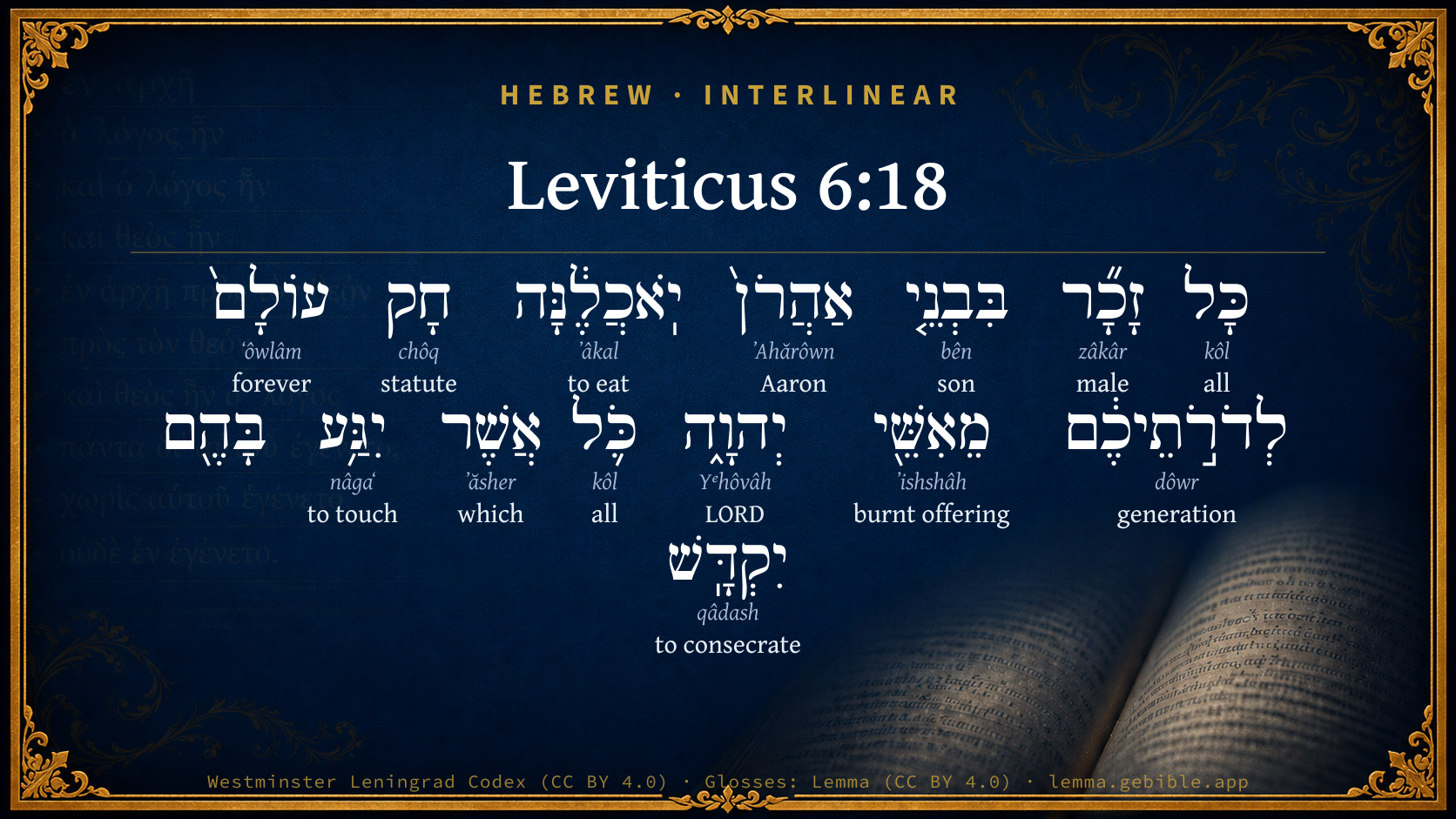
Hebrew (Westminster Leningrad Codex) Leviticus 6:18 appears in the Hebrew Old Testament. The text above is from the Westminster Leningrad Codex. Each word links to its Strong’s number, a concise gloss, and parsing drawn from the Open Scriptures Hebrew Bible morphology. Click any word for its full Brown-Driver-Briggs (BDB) entry.
Download image
Cite this verse

Leviticus 6:18 (World English Bible). Public Domain. Lemma interlinear Bible study tool, https://lemma.gebible.app/v/leviticus/6/18.

Show BibTeX & RIS
BibTeX
RIS
English Translation
Every male among the children of Aaron shall eat of it, as their portion forever throughout your generations, from the offerings of Yahweh made by fire. Whoever touches them shall be holy.'"
World English Bible · Public Domain
Download a study sheet

One document with this verse’s original text, its word-by-word gloss line, the meaning frame, cross-references with their text, attributed commentary, and full source and license credits — printable, and it pastes into notes with its structure intact.

This verse Autodidact and up

Study sheet (.html) Plain text (.txt)

A passage Seminary Student

Up to 50 verses in one chapter. A passage sheet keeps up to 6 commentary sources and 12 cross-references per verse, in the order this page ranks them, and says so on the sheet whenever that leaves anything out. Ask for a single verse and you get the Autodidact verse sheet above.

Everything on this page stays free to read, with no account — the sheet is a download of what is already on screen, not access to it.

Want to remove ads? Support Godless Engineer
Compare translations 3

The same verse in 3 English versions, stacked beneath the original-language interlinear above. Click any original word for its lexicon entry.

Each is an independent rendering of the whole verse — the interlinear is not word-aligned to these translations.

Highlighted words mark where these versions differ — a whole-verse word diff, not a word-by-word alignment.

  • World English Bible Public Domain
    Every male among the children of Aaron shall eat of it, as their portion forever throughout your generations, from the offerings of Yahweh made by fire. Whoever touches them shall be holy.'"
  • King James Version Public Domain
    All the males among the children of Aaron shall eat of it. It shall be a statute for ever in your generations concerning the offerings of the LORD made by fire: every one that toucheth them shall be holy.
  • unfoldingWord Literal Text CC BY-SA 4.0
    Every male among the sons of Aaron will eat it, an enduring portion for your generations, from the gifts of Yahweh. Anything that touches them will be holy.’”

unfoldingWord Literal Text — © unfoldingWord, licensed CC BY-SA 4.0. Word-aligned USFM3 via Door43 (git.door43.org/unfoldingWord/en_ult).

Versions to compare (up to 4)

3 of 4 selected

Show all 18 translations

Every available English version of this verse, each an independent rendering of the whole verse.

  • World English Bible Public Domain
    Every male among the children of Aaron shall eat of it, as their portion forever throughout your generations, from the offerings of Yahweh made by fire. Whoever touches them shall be holy.'"
  • Berean Standard Bible Public Domain
    Any male among the sons of Aaron may eat it. This is a permanent portion from the offerings made by fire to the LORD for the generations to come. Anything that touches them will become holy.”
  • Majority Standard Bible Public Domain
    Any male among the sons of Aaron may eat it. This is a permanent portion from the food offerings to the LORD for the generations to come. Anything that touches them will become holy.”
  • King James Version Public Domain
    All the males among the children of Aaron shall eat of it. It shall be a statute for ever in your generations concerning the offerings of the LORD made by fire: every one that toucheth them shall be holy.
  • American Standard Version (1901) Public Domain
    Every male among the children of Aaron shall eat of it, as `his' portion for ever throughout your generations, from the offerings of Jehovah made by fire: whosoever toucheth them shall be holy.
  • Revised Version (1885) Public Domain
    Every male among the children of Aaron shall eat of it, as a due for ever throughout your generations, from the offerings of the LORD made by fire: whosoever toucheth them shall be holy.
  • Geneva Bible (1599) Public Domain
    All the males among the children of Aaron shall eate of it: It shalbe a statute for euer in your generations concerning the offrings of the Lord, made by fire: whatsoeuer toucheth them shall be holy.
  • Douay-Rheims (1899) Public Domain
    The males only of the race of Aaron shall eat it. It shall be an ordinance everlasting in your generations concerning the sacrifices of the Lord: Every one that toucheth them shall be sanctified.
  • Young's Literal Translation Public Domain
    Every male among the sons of Aaron doth eat it -- a statute age-during to your generations, out of the fire-offerings of Jehovah: all that cometh against them is holy.'
  • Literal Standard Version CC BY-SA 4.0
    Every male among the sons of Aaron eats it—a continuous statute throughout your generations, out of the fire-offerings of YHWH. All that comes against them is holy.”
  • Unlocked Literal Bible CC BY-SA 4.0
    For all time to come throughout your people's generations, any male descended from Aaron may eat it as his share, taken from the offerings of Yahweh made by fire. Whoever touches them will become holy.'”
  • unfoldingWord Literal Text CC BY-SA 4.0
    Every male among the sons of Aaron will eat it, an enduring portion for your generations, from the gifts of Yahweh. Anything that touches them will be holy.’”
  • Darby Bible Public Domain
    All the males among the children of Aaron shall eat of it. [It is] an everlasting statute in your generations, [their portion] of Jehovah's offerings by fire: whatever toucheth these shall be holy.
  • World Messianic Bible Public Domain
    Every male among the children of Aaron shall eat of it, as their portion forever throughout your generations, from the offerings of the LORD made by fire. Whoever touches them shall be holy.’”
  • Webster's Bible Public Domain
    \\6:25\\Speak to Aaron and to his sons, saying, This is the law of the sin-offering: In the place where the burnt-offering is killed shall the sin-offering be killed before the LORD: it is most holy.
  • Free Bible Version CC BY-SA 4.0
    Any of Aaron's male descendants may eat it. This is a permanent allowance from the food offerings to the Lord for future generations. Whatever touches them shall become holy.”
  • Bible in Basic English Public Domain
    Say to Aaron and his sons, This is the law for the sin-offering: the sin-offering is to be put to death before the Lord in the same place as the burned offering; it is most holy.
  • JPS Tanakh (1917) Public Domain
    (6-11) Every male among the children of Aaron may eat of it, as a due for ever throughout your generations, from the offerings of the LORD made by fire; whatsoever toucheth them shall be holy.

Literal Standard Version (2020), Covenant Press — licensed CC BY-SA 4.0. Text via the HelloAO Bible API (eBible.org). Unlocked Literal Bible (unfoldingWord) — licensed CC BY-SA 4.0. Text via the HelloAO Bible API (eBible.org). unfoldingWord Literal Text — © unfoldingWord, licensed CC BY-SA 4.0. Word-aligned USFM3 via Door43 (git.door43.org/unfoldingWord/en_ult). Free Bible Version, Dr. Jonathan Gallagher — licensed CC BY-SA 4.0. Text via the HelloAO Bible API (eBible.org).

Word by word

More ways to search: Search by grammar → Find every occurrence → Compare this word →

Practice this passage: Drill this verse → Learn its vocabulary →

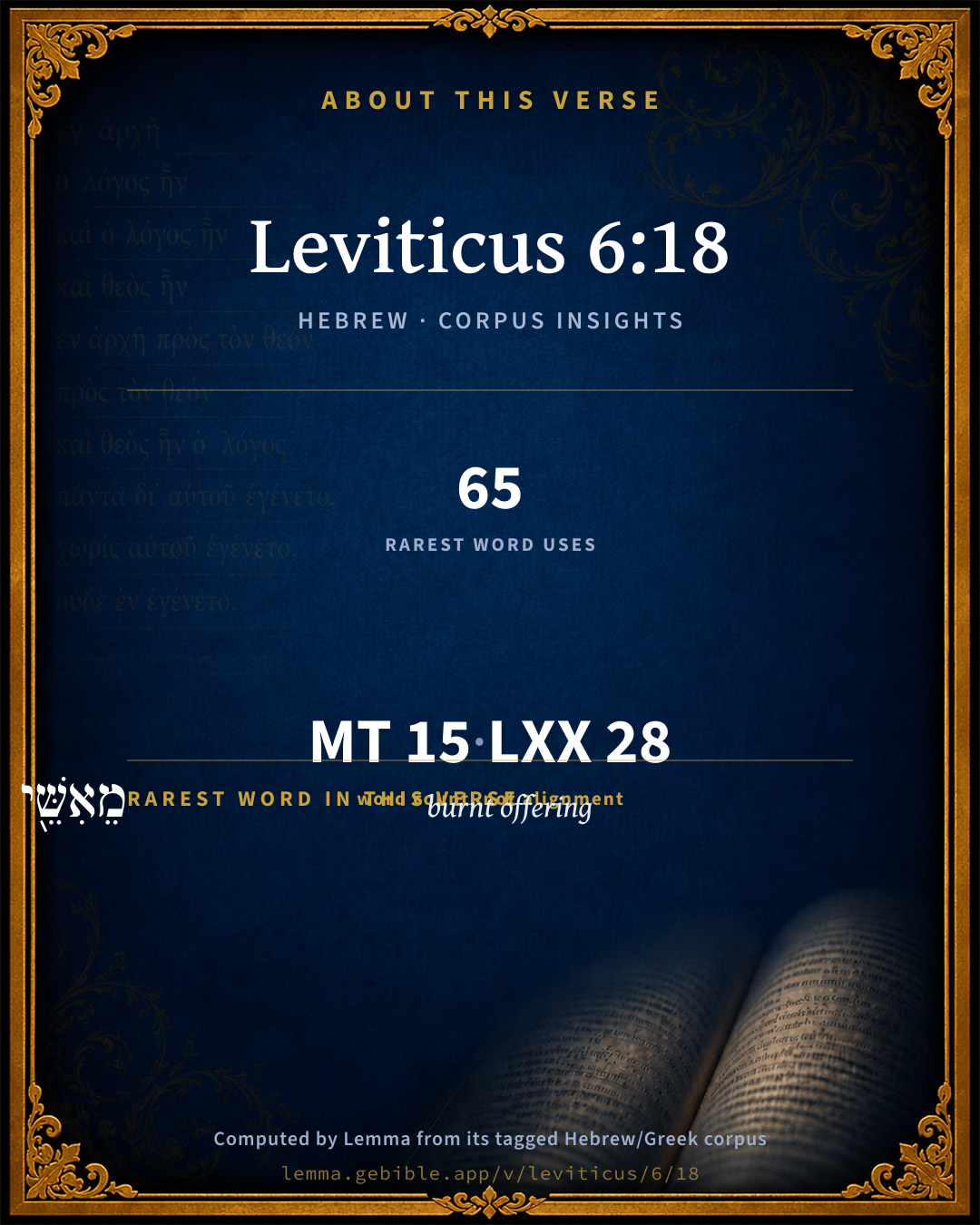
מֵאִשֵּׁ֖י
ʼishshâh
H801
“from · burnt offerings of”
Preposition + Noun, Common, Masculine, Plural, Construct
Part of Speech
Preposition + Noun
Type
Common
Gender
Masculine
Number
Plural
State
Construct
Full BDB Definition

Origin: the same as H800 , but used in a liturgical sense

TWOT: 172a

burnt-offering, offering made by fire, fire offering
  1. כָּל kôl H3605 “all of” Noun, Common, Masculine, Singular, Construct
  2. זָכָ֞ר zâkâr H2145 “male” Adjective, Adjective, Masculine, Singular, Absolute
  3. בִּבְנֵ֤י bên H1121 “in/at · sons of” Preposition + Noun, Common, Masculine, Plural, Construct
  4. אַהֲרֹן֙ ʼAhărôwn H175 “Aaron” Noun, Proper
  5. יֹֽאכֲלֶ֔נָּה ʼâkal H398 “to eat · her” Verb, Qal, Imperfect, 3rd Person, Masculine, Singular + Suffix, Personal, 3rd Person, Feminine, Singular
  6. חָק chôq H2706 “statute of” Noun, Common, Masculine, Singular, Construct
  7. עוֹלָם֙ ʻôwlâm H5769 “forever” Noun, Common, Masculine, Singular, Absolute
  8. לְדֹרֹ֣תֵיכֶ֔ם dôwr H1755 “to/for · generations · your” Preposition + Noun, Common, Masculine, Plural, Construct + Suffix, Personal, 2nd Person, Masculine, Plural
  9. יְהוָ֑ה Yᵉhôvâh H3068 “LORD” Noun, Proper
  10. כֹּ֛ל kôl H3605 “all” Noun, Common, Masculine, Singular, Absolute
  11. אֲשֶׁר ʼăsher H834 “which” Particle, Relative
  12. יִגַּ֥ע nâgaʻ H5060 “to touch” Verb, Qal, Imperfect, 3rd Person, Masculine, Singular
  13. יִקְדָּֽשׁ qâdash H6942 “to consecrate” Verb, Qal, Imperfect, 3rd Person, Masculine, Singular

About this verse

These counts appear in no published source. They are computed here, from the morphology-tagged text and Lemma’s own curated glosses. What Lemma adds →

15
words
13
distinct lemmas
Pentateuch
section

Grammatical profile

  • 3 verbs
  • 9 nouns
  • 1 adjective
  • 1 preposition
  • 1 particle

Verb forms

  • יֹֽאכֲלֶ֔נָּה Qal · Imperfect
  • יִגַּ֥ע Qal · Imperfect
  • יִקְדָּֽשׁ Qal · Imperfect

Repetition

A word recurs within this verse — often emphatic in Hebrew:

Hebrew & Septuagint length

In English translation the verse runs 32 words from the Hebrew and 30 from the Septuagint (LXX English) — closely comparable.

A rough comparison of the two English renderings, which tokenize alike — not a word-level alignment.

Word counts can differ between the Hebrew and the Greek without any difference in meaning — e.g. the Hebrew direct-object marker אֵת has no separate Greek word, and Greek often adds the article ὁ.

In the original languages it is 15 Hebrew tokens and 28 Greek tokens — but the two are counted differently (Hebrew bundles its prefixes and suffixes into one token; the Greek is in lemma form), so that isn’t a like-for-like length.

Cross-references

11

Topical passages linked to Leviticus 6:18 in the Treasury of Scripture Knowledge — connected by theme and wording, ordered by reader-vote popularity; previews shown in the World English Bible.

  • Leviticus 6:29 Every male among the priests shall eat of it: it is most holy.
  • Numbers 18:10 As the most holy things shall you eat of it; every male shall eat of it: it shall be holy to you.
  • Exodus 29:37 Seven days you shall make atonement for the altar, and sanctify it: and the altar shall be most holy; whatever touches the altar shall be holy.
  • Leviticus 3:17 "'It shall be a perpetual statute throughout your generations in all your dwellings, that you shall eat neither fat nor blood.'"
  • Leviticus 6:27 Whatever shall touch its flesh shall be holy. When there is any of its blood sprinkled on a garment, you shall wash that on which it was sprinkled in a holy place.
  • Leviticus 21:21–22 no man of the seed of Aaron the priest, who has a blemish, shall come near to offer the offerings of Yahweh made by fire. Since has a blemish, he shall not come near to offer the bread of his God.
  • Leviticus 22:3–7 Tell them, 'If anyone of all your seed throughout your generations approaches the holy things, which the children of Israel make holy to Yahweh, having his uncleanness on him, that soul shall be cut off from before me. I am Yahweh.
  • Haggai 2:12–14 'If someone carries holy meat in the fold of his garment, and with his fold touches bread, stew, wine, oil, or any food, will it become holy?'" The priests answered, "No."
  • Zechariah 14:20–21 In that day there will be on the bells of the horses, "HOLY TO YAHWEH;" and the pots in Yahweh's house will be like the bowls before the altar.
  • 1 Peter 1:16 because it is written, "You shall be holy; for I am holy."
  • 1 Peter 2:9 But you are a chosen race, a royal priesthood, a holy nation, a people for God's own possession, that you may show forth the excellencies of him who called you out of darkness into his marvelous light:

Cross-references courtesy of OpenBible.info (CC BY 4.0).

Hebrew and Greek witnesses Masoretic Hebrew ↔ Greek Septuagint

The same verse in the two great witnesses to the Old Testament, shown verse-for-verse.

These are two independent witnesses, not word-aligned to each other, and the Septuagint is shown in lemma (dictionary) form.

Hebrew Leviticus 6:18 Masoretic · Westminster Leningrad Codex

כָּל זָכָ֞ר בִּבְנֵ֤י אַהֲרֹן֙ יֹֽאכֲלֶ֔נָּה חָק עוֹלָם֙ לְדֹרֹ֣תֵיכֶ֔ם מֵאִשֵּׁ֖י יְהוָ֑ה כֹּ֛ל אֲשֶׁר יִגַּ֥ע בָּהֶ֖ם יִקְדָּֽשׁ

Every male among the children of Aaron shall eat of it, as their portion forever throughout your generations, from the offerings of Yahweh made by fire. Whoever touches them shall be holy.'"

World English Bible · Public Domain

Greek LXX Leviticus 6:18 Septuagint · lemma form

λαλέω ἀαρών καί ὁ υἱός αὐτός λέγω οὗτος ὁ νόμος ὁ ἁμαρτία ἐν τόπος οὗ σφάζω ὁ ὁλοκαύτωμα σφάζω ὁ περί ὁ ἁμαρτία ἔναντι κύριος ἅγιος ἅγιος εἰμί

Every male of the priests shall eat it: it is a perpetual ordinance throughout your generations of the burnt offerings of the Lord; whoever shall touch them shall be hallowed.

LXX2012 (modern English Septuagint) · Public Domain

Hebrew: Westminster Leningrad Codex (CC BY 4.0). Greek: Septuagint (public domain); English from LXX2012 (modern English Septuagint) (Public Domain). How the Septuagint differs from the Hebrew →

Targum (Aramaic paraphrase)

2

The Targum is the ancient Jewish Aramaic paraphrase of the Hebrew Scriptures — an interpretive translation, not the Hebrew text itself. Onkelos (literal) and Pseudo-Jonathan (expansive) render the Torah, and Jonathan the Prophets. Coverage is partial: where no permissively-licensed English translation exists for a verse, only the Aramaic is shown. This is verse-level text, not a word-by-word alignment to the Hebrew.

  1. Targum Onkelos Torah (Genesis–Deuteronomy)
    מַלֵל עִם אַהֲרֹן וְעִם בְּנוֹהִי לְמֵימָר דָא אוֹרַיְתָא דְחַטָאתָא בַּאֲתַר דִי תִתְנְכֵס עֲלָתָא תִּתְנְכֵס חַטָאתָא קֳדָם יְיָ קֹדֶשׁ קוּדְשִׁין הִיא

    (no public-domain English translation for this verse)

    Targum Onkelos — Aramaic: “Onkelos Genesis” (public domain); “Onkelos Exodus” (public domain); “Onkelos Leviticus” (public domain); “Onkelos Numbers” (public domain); “Onkelos Deuteronomy” (public domain). English: “Sefaria Community Translation” (CC0 1.0 (public-domain dedication)); “J.W. Etheridge. The Targums of Onkelos and Jonathan Ben Uzziel on the Pentateuch. London: Longmans, Green, 1862” (public domain). Text via Sefaria.

  2. Targum Pseudo-Jonathan Torah (Genesis–Deuteronomy)
    מַלֵיל עִם אַהֲרן וְעִם בְּנוֹי לְמֵימָר דָא אוֹרַיְיתָא דְחַטָאתָא בְּאַתְרָא דְתִתְנְכֵס עֲלָתָא תִּתְנְכֵס חַטָאתָא קֳדָם יְיָ קוֹדֶשׁ קוּדְשִׁין הוּא

    Speak with Aharon and with his sons, saying: This is the law of the sin offering which is to be killed in the place where the burnt offering is killed; it shall be slain as a sin offering before the Lord; it is most sacred.

    Targum Pseudo-Jonathan — Aramaic: “Targum Jonathan on Genesis” (public domain); “Targum Jonathan on Exodus” (public domain); “Targum Jonathan on Leviticus” (public domain); “Targum Jonathan on Numbers” (public domain); “Targum Jonathan on Deuteronomy” (public domain). English: “The Targum of Jonathan ben Uzziel, trans. J. W. Etheridge, London, 1862” (public domain). Text via Sefaria.

Commentary

Notes on Leviticus 6:18 from classic Christian and Jewish commentators (each source and its license shown beneath its notes). The classic Christian expositions comment on the surrounding passage and are grouped to its opening verse, so a note may address several verses; the Jewish commentaries on the Tanakh (Rashi and others) are per-verse, so they appear only where the commentator wrote on this verse.

Lemma curates 59 commentaries, every one of them public domain or Creative Commons licensed, each selected and text-cleaned for this edition rather than reprinted as found. About our sources →

The Cambridge Bible for Schools and Colleges

gen. ed. J. J. S. Perowne

18. whosoever toucheth them shall be holy] This does not mean that only priests who have properly purified themselves may touch the most holy things, but that anyone, priest or layman, who inadvertently comes in contact with anything that is ‘most holy,’ becomes holy (i.e. dedicated to God, and put at His disposal), cp. Jos_6:18; Jos_7:15. No rule is given here about the treatment of such persons; for inanimate things which are brought into contact with the ‘most holy,’ see Lev_6:27-28. According to Hag_2:12, the garment in which ‘holy flesh’ is carried, does not communicate holiness to the food which it may happen to touch.

Holiness is here regarded as a contagious quality; contact with holy things must be avoided, just as contact with things that are considered unclean is forbidden. This similarity in the treatment of things which from the levitical standpoint are so widely separated as the holy and the unclean is a survival of primitive modes of expression, due to imperfect conception of the gods, and of their relations to men. For further discussion of this subject see Driver (C. B.) on Exo_29:37, with quotation from Frazer, G. B., G. B. Gray on Num. (Intern. Crit. Comm.) pp. 209–211, Rob.-Sm. Rel. Sem.2 p. 152, and the note B, pp. 446 f., and HDB. Art. Uncleanness, iv. 826 f. Cp. notes on ch. 11.

The Cambridge Bible for Schools and Colleges (gen. ed. J. J. S. Perowne; Cambridge University Press, 1878–1918) — public domain. Text from a community e-Sword module.

Trapp's Complete Commentary

John Trapp

Lev 6:18 All the males among the children of Aaron shall eat of it. [It shall be] a statute for ever in your generations concerning the offerings of the LORD made by fire: every one that toucheth them shall be holy.

Ver. 18. Shall be holy.] God "will be sanctified in all that draw near unto him."

“ … Procul hinc, procul este profani. ”

John Trapp, A Commentary or Exposition upon All the Books of the Old and New Testament (1647–1656) — public domain. Text from a community e-Sword module.

Tyndale Open Study Notes

Tyndale Open Resources

6:18 The priestly share did not belong exclusively to the priest conducting the sacrifice; it was to be shared with all of Aaron’s male descendants. The text does not indicate why these offerings could be eaten only by the males while other offerings were available to all members of the priests’ families (see study note on 10:13-15; see also Num 18:20-24). • will become holy: Or must be holy; also in Lev 6:27. Though uncleanness could be spread by touch (ch 15), Haggai implied that holiness could not (Hag 2:12). If an unclean person encountered that which was holy, disaster could result (Lev 10:1-3; 1 Sam 6:19-20; 2 Sam 6:6-8).

Tyndale Open Study Notes — © Tyndale Open Resources, licensed CC BY-SA 4.0. Text via the HelloAO Bible API.

Ellicott's Commentary for English Readers

(18) All the males among the children of Aaron.—The sin offerings, the trespass offerings, and the remainder of the peace offerings being most holy, could only be eaten by the male members of the families of the priests within the court of the sanctuary; whilst the offerings of tithes, fruit, the shoulder and breast of the people’s peace offerings, &c, being less holy, were not only eaten by the officiating priests in Jerusalem, but by their incapacitated sons, their daughters, &c, provided they were ritually clean. Any priest who ate the most holy things outside the wall of the courts, or the less holy things outside of the walls of Jerusalem, received forty stripes save one.

Every one that toucheth them shall be holy.—According to this rendering, which exhibits one of the views that obtained during the second Temple, the meaning is that any one who touches the sacrifices of the first order of holiness must not only be a descendant of Aaron and a male, but must have sanctified himself by undergoing the necessary ablutions. (See Lev_22:6-7.) There is, however, another view of the passage which is of equal, if not of anterior, date. That is, whoso or whatsoever toucheth them shall become holy. Any layman or any ordinary utensil, &c., becomes sacred by touching one of the higher order of sanctity. (See Exo_29:37; Exo_30:29; Eze_44:19; Eze_46:20; Hag_2:12.)

A Bible Commentary for English Readers, edited by Charles John Ellicott (1878–1897) — public domain. Text from a community e-Sword module.

John Gill's Exposition

And the Lord spake unto Moses,.... At the same time the above laws were delivered:

saying; as follows.

John Gill's Exposition of the Whole Bible (1746–1763) — public domain (CC PDM 1.0). Text via the HelloAO Bible API.

Haydock's Catholic Bible Commentary

Lord. As long as this law shall be enforced. (Menochius) --- Sanctified. Theodoret (q. 5,) seems to assert, that all such were obliged to serve the altar in some function or other. If any unclean person touched the victims wilfully, he was slain; if, by mistake, the blood sprinkled a garment, it was to be washed, ver. 27.

George Leo Haydock (1774–1849), Haydock's Catholic Family Bible and Commentary, 1859 edition — public domain. Excludes Psalms (Douay-Rheims chapter numbering differs from Protestant) and Deuterocanonical books (Catholic canon only).

Matthew Poole's English Annotations

It may be understood either,

1. Of persons, that none should touch or eat them but consecrated persons, to wit, priests. Or this may be an additional caution, that they who eat them should be not only priests, or their male children, but also

holy, i.e. having no uncleanness upon them, for in that case even the priests themselves might not touch them. Or rather,

2. Of things, as may be gathered by comparing this with Lev 6:27,28. Whatsoever toucheth them, as suppose the dish that receives them, the knife, or spoon, &c. which is used about them, those shall be taken for holy, and not employed for common uses. See Exo 29:37.

Matthew Poole's English Annotations on the Holy Bible (1683–1685) — public domain. Text from a community e-Sword/MySword module.

Whedon's Commentary on the Bible

Daniel D. Whedon

18. Statute for ever — Chap. 17, note.

Every one that toucheth them shall be holy — This applies to persons and to things. The priest is forbidden to eat these oblations while ceremonially defiled, and the sacred utensils brought in contact with them must not be put to any secular use. Every layman who touched the most holy things became holy through contact, so that he must henceforth guard against defilement as scrupulously as the priests, but without their rights and prerogatives. This placed him in an awkward relation to secular things.

Daniel D. Whedon (gen. ed.), Commentary on the Old and New Testaments (1874–1909) — public domain. Text from a community e-Sword module.

John Wesley's Explanatory Notes

Everyone - That is, none should touch, or eat them, but consecrated persons, priests, or their sons.

John Wesley, Explanatory Notes Upon the Whole Bible (1754–1765) — public domain. Text via the GEBible commentary corpus.

Ramban (Nachmanides)

Rabbi Moshe ben Nachman (Ramban / Nachmanides)

THIS IS THE LAW OF THE SIN-OFFERING. In Seder Vayikra He commanded concerning [the offerings in the following order]: the burnt-offering, the meal-offering, the peace-offerings, the sin-offering and the guilt-offering, [the reason for this order being] that at first He spoke about the freewill offerings [namely the burnt-offering, the meal-offering and the peace-offerings], and afterwards He mentioned those offerings which are obligatory upon the sinner. Here, however, [in Seder Tzav] the explanation is given first in connection with the burnt-offering and meal-offering, and only then about the sin-offering and guilt-offering, because He wished to explain the laws of the most holy offerings [in one group], since there is one law for them all, as He said [above in Verse 10] with reference to the meal-offering, it is most holy, as the sin-offering and the guilt-offering, and only afterwards He explains the law of those offerings which are less holy [namely, the peace-offerings].Now in this section [dealing with the sin-offering] He added many new laws. [The verse] This is the law of the sin-offering teaches that there is one law for all sin-offerings, or torath (“law” or “law of”) at the beginning of a section, denotes inclusion, while hi denotes exclusion. So also the word zoth (this), as it says here in this case, zoth torath … (this is the law of …), means exclusion. meaning that even the blood of “the inner sin-offerings” sin-offerings,” that if any of their blood was sprinkled upon a garment, the garment must be washed in a holy place [i.e., in the Court of the Sanctuary], But it does not say this law with regard to “the inner sin-offerings.” Since the section, however, begins with the expression [zoth] ‘torath’ hachatath (this is ‘the law’ of the sin-offering), and the word torath denotes inclusion, we know that the same law applies to both kinds of sin-offering. [if sprinkled upon a garment] must be washed off [in a holy place]. I might think that this applies also to a sin-offering brought from a bird, Scripture therefore says zoth [‘zoth’ torath hachatath (‘this’ is the law of the sin-offering) — and the word zoth denotes exclusion]. He also states here [in the verse before us], in the place where the burnt-offering is slaughtered shall the sin-offering be slaughtered before the Eternal, thus indicating that all sin-offerings must be slaughtered only on the northern side of the altar, since in the section of Vayikra this was stated only with reference to the sin-offering of the prince and of the individual;, Verses 29, 33. therefore here [in this section] they are all included — the sin-offerings of the public and “the inner sin-offerings.” sin-offerings,” that if any of their blood was sprinkled upon a garment, the garment must be washed in a holy place [i.e., in the Court of the Sanctuary], But it does not say this law with regard to “the inner sin-offerings.” Since the section, however, begins with the expression [zoth] ‘torath’ hachatath (this is ‘the law’ of the sin-offering), and the word torath denotes inclusion, we know that the same law applies to both kinds of sin-offering.The Rabbis have further interpreted: Most holy, this comes to include the peace-offerings of the public, and they were considered of a lesser degree of holiness. Only once a year, namely, on the Festival of Shevuoth, were peace-offerings brought by the public (see further, 23:19). These were considered among “the most holy offerings.” Offerings which were most holy were slaughtered on the north side of the altar, and could be eaten only by male priests, within the Court of the Sanctuary, during the same day and night; those that were holy to a lesser degree were slaughtered in any part of the Court, and could be eaten by any person, within the enclosed city of Jerusalem, for two days and the intervening night. The thanks-offering and the Nazirite’s ram, though holy to a lesser degree, could be eaten only the same day and the ensuing night. teaching that they may only be slaughtered on the northern side of the altar, as all offerings of the most holy degree are required to be slaughtered on the northern side. Hi (it is) — ‘it is’ the most holy, comes to exclude the thanks-offering and the ram of the Nazirite ). [thus teaching that they may be slaughtered anywhere in the Temple Court, as their holiness is of a lesser degree]. He further commanded here to give the meat of the sin-offerings to the sons of Aaron — that is, to the males and not the daughters of Aaron — and commanded them to eat it within the Court of the Tent of Meeting. In addition He mentioned [in this section] many new laws concerning absorption [of the taste of] the sin-offerings [by the vessels in which they are boiled].

Ramban (Nachmanides) on the Tanakh — English translation: “Commentary on the Torah by Ramban (Nachmanides). Translated and annotated by Charles B. Chavel. New York, Shilo Pub. House, 1971-1976” (CC BY 4.0). Text via Sefaria.

Lesson kit

Teaching starters — assembled from the data on this page, not authored interpretation. Every prompt links to the verse data it draws on. Edit before teaching.

Leviticus, in the Pentateuch, opens this verse with 15 words (13 distinct Hebrew lemmas). Its most distinctive word is ʼishshâh (“burnt offering”). A historical commentator’s framing appears above. Read the whole chapter for the surrounding context.

Discussion questions

  1. The word ʼishshâh carries the sense “burnt offering.” How does it shape the verse?
  2. How does Leviticus 6:29, which shares this passage’s theme, read alongside this verse?
  3. What does the repetition of “all” (2× in this one verse) do in this verse?
  4. The translations on this page render this verse differently — a whole-verse word diff, not a word-by-word alignment. What might account for the different wordings?
  5. «יֹֽאכֲלֶ֔נָּה» is a Qal Imperfect verb. How does that grammatical form shape the action described?
  6. Compare how The Cambridge Bible for Schools and Colleges and Trapp's Complete Commentary read this verse. Where do they agree or differ?

Things to notice

Reading settings

Reading text

Shown beneath each verse's original-language words.

Old Testament
Old Testament edition

Read the OT as the Masoretic Hebrew (MT) or the Greek Septuagint (LXX).

English shown for the Greek Septuagint (in the Hebrew ↔ Greek comparison).

Comparing translations? Open the Compare panel on any verse page to stack up to four side by side.